




Abstract
Although Airbnb debuted in 2008, incumbent lodging firms did not fully recognize it as a legitimate competitor for several years. However, as Airbnb made inroads into the accommodation business, hotel firms and their investors started to take notice and to legitimize its disruptive role. In this paper, we investigate investors’ awareness of the disruptor Airbnb as a competitor of incumbent lodging firms. Specifically, we assess the effect of awareness on incumbent hotel management and hotel property owner firms. Employing an event study methodology, our analysis finds that Airbnb performance milestones negatively affect incumbents’ market value. This research contributes to our understanding of the role played by investors and financial analysts in shaping competitive markets by legitimizing an industry disruptor and by spurring competitive action among incumbent firms.
Highlights
The recognition of Airbnb as a legitimate competitor has been overlooked
Analysts at earnings calls lead to incumbents recognizing Airbnb as a competitor
Recognition alters the effect of Airbnb milestones on incumbent market value
Introduction
The rise of short-term rentals has changed the nature of the lodging business as it allows owners or tenants of residential properties to participate in the business of accommodating guests. Today, short-term rentals are a professionalized business as hosts and property management firms often rent multiple properties (Maté-Sánchez-Val, 2021; Xie & Mao, 2019). Furthermore, channel management software allows hosts to coordinate availability and pricing across multiple short-term rental booking platforms (Chattopadhyay & Mitra, 2020). Finally, large incumbent lodging firms like Marriott and Hyatt have developed their own short-term rental-like products to capitalize on the short-term rental market: Marriott developed “Homes and Villas by Marriott,” an online service that allows hosts to rent their rooms or apartments similar to Airbnb, while Hyatt invested in several alternatives to Airbnb such as Oasis and OneFineStay.
The increased popularity and professionalization of the short-term rental market inspired several tourism and hospitality studies. Consumer research on short-term rentals finds that they provide unique experiences (Tussyadiah & Pesonen, 2016), alter how consumers experience destinations (Belarmino & Koh, 2020; Dolnicar, 2019; Pera et al., 2019), and affect pricing of hotel rooms (Blal et al., 2018; Zervas et al., 2017) and hotel failure rates (Maté-Sánchez-Val, 2021). Hence, Airbnb has been recognized as a successful disruptor from a consumer point of view, and is indeed perceived as a substitute for hotels (Hajibaba & Dolnicar, 2017). With the maturity of the short-term rental market it is, however, also important to understand how Airbnb as the leader was recognized by market actors. Zach et al. (2020) assessed legitimacy directly from incumbents and their responses to short-term rental offerings. As hospitality in the United States is dominated by chain brands owned by publicly traded companies, it is important to understand the role of the stock market in legitimizing Airbnb as the market leader of the short-term rental market. From a theoretical perspective, Airbnb is thus an ideal case to learn about hospitality market dynamics following the entrance of a disruptor.
Publicly traded companies are motivated not only by their interpretation of the market, but also by the interpretation of financial analysts that ask questions at regularly held earnings calls (Benner & Ranganathan, 2012). Indeed, probing firm leadership for responses on the challenges presented by a disruptor, these financial analysts provide legitimacy for the disruptor, just as they can provide legitimacy for the top management team (Certo & Hodge, 2007). The recognition of a disruptor by investors is a seminal event for publicly traded incumbent firms as it implies their awareness of the disruption and, as such, is a fundamental step toward a strategic countermove (Chen, 1996). We can thus distinguish between a pre- and post-recognition phase. We argue that the stock market assesses the performance of the disruptor differently in these two phases to answer the following research questions: How did Airbnb’s performance trajectory and growth affect incumbents’ market value? What role did external entities like financial analysts and the stock market play in incumbents’ recognition of Airbnb as a legitimate competitor?
The success and persistency of Airbnb, despite negative effects such as reduced housing inventories or conflicts with neighbors, is a unique opportunity to study competitor dynamics in the hospitality context to examine if financial analysts’ recognition of a disruptor’s success has consequences for incumbent lodging firms. To assess these consequences, we investigate the effect of different types of Airbnb’s performance milestones. Milestones are defined as important developments toward the growth of Airbnb, for example: a funding round; the development of a new feature; or the opening of a new international headquarters. This study provides a nuanced understanding of the effects of different milestone types on incumbent hospitality firms at different states of disruptor recognition. Specifically, we study the effect on hotel management firms, such as the Hilton or Marriott, and real estate investment trusts (REITs) such as Host Hotels. This study provides insights into the types of disruptor successes that affect the stock market value of incumbent hospitality firms. Moreover, this study contributes to our understanding of the effect of the stock market actors in legitimizing disruptors.
Literature Review
Short-Term Rentals and Their Effects on Traditional Lodging
There is general agreement in the hospitality and tourism literature that short-term rentals were disruptive for the lodging industry. Airbnb created the peer-to-peer short-term rental market (Dolnicar, 2017; Maté-Sánchez-Val, 2021), and became a leader in the peer-to-peer economy (Mikhalkina & Cabantous, 2015). Most research relating to short-term rentals focuses on the consumer side. For example, So et al. (2018) investigated consumers’ motivation and constraints, predicting behavioral intentions toward Airbnb, while Tussyadiah and Pesonen (2016) found that staying at a short-term rental creates unique traveler experiences that traditional lodging options cannot offer. Some research has, however, also been conducted on host behavior. For example, Xie and Mao (2019) used the resource-based view to investigate property location strategies and conducted studies on revenue maximization by short-term rental hosts.
Another research stream attempts to understand the competitive effect of short-term rentals on incumbent lodging firms. While early studies provided valuable insights on the initial development of short-term rentals, later studies have accounted for performance effects on lodging firms over a period of time. Studies by Guttentag (2015), Blal et al. (2018), and Hajibaba and Dolnicar (2017) found that Airbnb negatively impacted the revenues of low-tier hotels as the latter were forced to compete with the disruptor, thus suggesting direct competition. On a similar note, Maté-Sánchez-Val (2021) found that the existence of Airbnb hosts, especially multi-property hosts, was harmful for the survival of traditional hotels in the city of Barcelona, confirming the role of Airbnb as substitute to established hotel firms. Moreover, research has also found how the development of Airbnb was detrimental for the community. In New York City, for example, residents have complained about increased rents and disturbances caused by Airbnb houses used for parties (Gunter et al., 2020).
When Airbnb launched, hotel firm decision makers reiterated that it was not a substitute for their firms given the differences in the services offered (Blal et al., 2018). Some research provides evidence that Airbnb can sometimes serve as a complement to hotels: Gunter and Önder (2018) found that Airbnb served as a complementary product in Vienna, Austria, as it was able to offer room types that would otherwise be in short supply, while Adamiak (2018) found that the presence of short-term lease options increased room supply in developing countries that would otherwise have a shortage. Thus, complementarity is restricted to areas where there is a shortage in lodging supply. However, in areas that do not face such a shortage, Airbnb functions as a substitute to incumbent hotel firms competing with them for demand (Gunter et al., 2020).
Competitor Recognition
The competitive environment in which firms are embedded tends to change over time (Lyu & Lee, 2018). A new firm entering an established market poses a threat to incumbent firms in terms of market share and revenue loss. The actions of the new entrant nearly always result in a response by incumbent firms entering the dynamic competitive action-response dyad which creates inter-firm rivalry changing the nature of the industry (Chen, 1996). Based on the perceived threat and the incumbent firms’ capabilities, the repertoire of firm responses include tactical actions such as price cuts or strategic actions such as technological or product innovation, expansion into new markets, or acquisitions (Chen et al., 2007). A threat analysis by incumbents’ key decision-makers is the first step toward competitive dynamics, cognition, and depth of awareness of the competitors. Indeed, the cognitive capacity of incumbent leaders allows these firms to look beyond what is taken for granted and to assess new threats (Steele, 2021).
A firm’s collective cognition of its competitive environment is the awareness component in Chen’s (1996) awareness-motivation-capability model. In short, awareness represents recognition of a change in the marketplace, motivation is the drive to address this change, and capability is the capacity of a firm to respond to that change. From a recognition point of view, an incumbent firm misses the opportunity to address the competitive moves of another firm if it was not identified as a competitor (Gur & Greckhamer, 2019). Hence, recognition of a competitor is critical for incumbent survival as it allows incumbents to make strategic decisions in response to the threat. Thus, a lack of awareness can result in a failure to recognize and, ultimately, to respond.
Motivation is the extent to which a focal firm sees value in responding to a competitive move. The extent to which a firm is motivated to answer a competitive move stems from market commonality: the degree to which two firms share a common market (Chen, 1996; Chen & Miller, 2012). The more the markets of the incumbent and the new entrant overlap, the higher the market communality, and the higher the motivation to respond to a competitive move (Chen, 1996). Finally, capability refers to firms’ resources to respond to a competitive attack (Chen & Miller, 2012). Thus, once a competitor is recognized, firms are expected to respond. In other words, recognition raises expectations.
The stock market accounts for such expectations and thus is a critical actor for publicly traded companies as it has the capacity to generate institutional pressures that affect corporate decisions (Benner & Ranganathan, 2012) and to reward or punish these decisions (Benner, 2007). Indeed, incumbent lodging firms that responded to Airbnb saw a significant effect on their stock price, suggesting investors and financial analysts expected responsive moves from incumbents (Zach et al., 2020). Hence, although it is known that the stock market has a definitive impact on incumbent firms, there remains an unanswered question of whether the stock market rewards or punishes incumbent firms differently before and after the disruptor is recognized as a competitor. We argue that stock market recognition varies with different types of milestones the disruptor accumulates.
Milestones are key performance events that inform the market about the progress made by a firm. Understanding different types of milestones is relevant as different types might require different responses and also solicit different effects on the market value of incumbent firms. This is because the stock market is assumed to work under a condition of efficiency (James & Valenzuela, 2020). Hence, the effect that a milestone will have in the future on firms’ revenue will be discounted to assess the price in the current time (Benner, 2007). Thus, the stock market’s recognition of a milestone as a threat or an opportunity is reflected in the market value of incumbent firms whereby a threat results in a decrease and an opportunity in an increase in incumbents’ market value. These rewards and punishments represent legitimation of the disruptor by the stock market as an external actor.
Legitimation From the Stock Market
Institutional theory describes the process through which firms become established in a given field and is defined as “the rules of the game in the society” (North, 1990). More specifically, institutional theory analyzes the processes that establish guidelines for social behavior and, as such, the legitimation of firms in a field (Scott, 2005). Legitimation is determined by pressures relating to institutionalization stemming from the external environment in which firms are embedded (DiMaggio & Powell, 1983; Gnyawali & Madhavan, 2001). Furthermore, in reacting to these institutional pressures, firms tend to become increasingly isomorphic or similar to each other, as they conform to the successful model in order to be acknowledged as legitimate actors in the market (Brookes & Altinay, 2017).
The success of Airbnb and other short-term rental platforms has led some incumbent firms to respond by offering similar lodging solutions either by developing a short-term rental solution (for example “Homes and Villas by Marriott”) or investing in or acquiring a short-term rental firm (for example Hyatt initially invested in, and later acquired, Oasis). In doing so, incumbent hotel firms have become increasingly isomorphic to short-term rental platforms in terms of services offered. Thus, over time, the short-term rental market gained legitimacy not only due to the success of firms like Airbnb, but also due to incumbent firms entering this new market space.
An additional source to grant legitimacy to the short-term rental market are investors and financial analysts as they represent two key stock market actors affecting publicly traded firms (Yu et al., 2020). Investors are entities that trade in the shares of a firm whereby the collective sum of investor actions changes stock prices. Financial analysts, on the other hand, do not trade, but provide expert guidance to which investors may or may not listen. As such, financial analysts are mediators investigating firm performances and producing reports and forecasts on whether investors should “buy,” “hold,” or “sell.” Financial analysts’ recommendations can, therefore, have an indirect influence on stock price (Rao et al., 2001).
Financial analysts can, furthermore, exercise a more direct influence on a firm’s top management at quarterly earnings calls (Benner & Ranganathan, 2012). During these calls, financial analysts have direct access to the Chief Executive Officers and Chief Financial Officers of publicly traded firms and have the opportunity to ask questions regarding firm performance, future outlooks, and similar critical success indicators (Zhang & Gimeno, 2010). Financial analysts’ questions are thus an example of institutional pressures as answers from corporate leadership can reveal company strategies and resource allocations that have not yet been announced, thus revealing information for the first time. On the other hand, financial analysts’ questions can also influence the decisions made by the firm (Benner & Ranganathan, 2012; Rao et al., 2001). As such, it is not surprising that firms experiencing pressures from financial analysts are more likely to exploit new markets (Zhang & Gimeno, 2010).
Investors are entities who retain ownership in a firm whereby institutional investors retain a substantial number of stocks and are able to have a significant influence on price fluctuations (Connelly et al., 2019). Institutional investors influence firms’ competitive behavior (Connelly et al., 2019) and even firms’ identities (Chen et al., 2007) by punishing or rewarding behavior depending on the perceived legitimacy (Benner, 2007). They do so mostly in private meetings (McCahery et al., 2016) that are subsequently reflected in a change in the valuation of stock prices (Bushee et al., 2018). Other investors comprise small funds and individuals, whereby all investor types rely on guidance set by financial analysts. Hence, the financial analysts’ assessments come first, and investors follow (Rao et al., 2001). When financial analysts recognize a new competitor, investors, therefore, adjust their trading activity, thus affecting market value. This chain of events suggests that financial analysts can legitimize a disruptor.
Methodology
Our research questions are to learn whether the disruptor’s growth trajectory, as evidenced by performance milestones, resulted in different effects on incumbent market value before and after the disruptor Airbnb was recognized by financial analysts. To address these questions, we first identified when financial analysts referred to Airbnb as a challenger or a disruptor in earnings calls’ interactions with incumbent hotel firms. We used Airbnb, as it was the first short-term rental firm and is still the most prominent one. Furthermore, due to its success and prominence, Airbnb performance milestones are well documented. This allowed us to divide the lodging field into a timeline of a pre- and post-phase of analysis depending on recognizing Airbnb as a disruptor. Next, for each phase we conducted an event study analysis on the stock market value of publicly traded hotel management firms that operate lodging properties and real estate investment trusts (REITs) that own lodging properties to identify the effect of Airbnb performance milestones. We investigated these two types of firms as they represent two dominant business models previously used in the lodging industry. On one hand, hotel firms that own brands operate an asset-light business model where revenue is generated by operating hotels or by franchising brands (Li & Singal, 2019). On the other hand, REITs have a capital-intensive business model that generates revenue by owning hotel assets while leaving the management of the asset to aforementioned hotel operators (Li & Singal, 2019). Finally, to control for confounding effects, we searched for other news related to incumbent hotel firms and other short-term rental firms on the same dates as the Airbnb milestones to include in our analysis. However, no such news was found.
Identifying Stock Market Recognition of Short-Term Rentals
To identify pressures from financial analysts, we analyzed quarterly earnings calls of incumbent U.S. hotel management firms and real estate investment trusts to find mentions of Airbnb. These earnings calls are required of publicly traded firms in the United States to provide the public and investors with the opportunity to question firm leadership. Knowing the timing of financial analysts’ questions regarding Airbnb allows us to gauge when it was recognized as a competitor.
As an additional check to learn whether financial analysts did mention Airbnb before firms identified it as a competitor, we also assessed annual 10–K filings for U.S. lodging firms and equivalent annual reports for non-U.S. lodging firms. These filings contain the names of current and perceived future competitors.
Following Danielewicz-Betz (2016) a keyword analysis was used to capture the frequency of keywords connected to Airbnb, such as the firm name “Airbnb,” “short-term rentals,” “short-term lease,” “peer-to-peer,” “private rentals,” and the like, including different variants and spellings of these keywords. The frequency of these mentions over time informs us of the magnitude of the pressure generated by financial analysts to recognize Airbnb as a competitor.
Event Study Analysis
An event study allows us to analyze fluctuations in the stock market so that we can ascertain the different estimations of firms’ values as the combined value of all firm stocks calculated by the stock market in response to a specific event. The evaluation, that is, the appreciation and depreciation of a firm’s market value, can be conducted on the basis of the previously explained efficient market hypothesis assumption, which is widely applied in finance literature (James & Valenzuela, 2020). Thus, a higher or lower valuation of a firm’s stock price as a result of an event indicates that the stock market has considered that event capable of increasing or decreasing a firm’s market value (Benner, 2007; James & Valenzuela, 2020; Jones et al., 2016). This increase or decrease constitutes pressure to act.
We calculated daily cumulative abnormal returns (CAR) using a three-factor Fama-French model (Fama & French, 1992), similar to Swidler et al. (2019), Hua et al. (2016), and Kim et al. (2019), for the press release dates of the Airbnb milestones. A window of 1 (
Accordingly, the market model has been established as follows:

where


where



where



Data
Our sample of lodging firms consists of all hotel management firms and hotel real estate investment trusts (REITs) that were publicly traded and operated in the United States in the period between January 1, 2008 (the year in which Airbnb was founded) and October 31, 2020 (see Table 2). We excluded the last 2 months of 2020 before Airbnb’s initial public offering (Pokryshevskaya & Antipov, 2017) as the news of the firm going public was an establishment of legitimation and hence would have affected the stock market, adding endogeneity to the model. Transcripts of all earning calls for the sample firms from the first quarter of 2008 to the third quarter of 2020 were collected resulting in 853 earnings call transcripts (317 from hotel management firms, 536 from real estate investment trusts).
Airbnb milestones were sourced by integrating self-reported milestones on Airbnb.com with search results from the news database Factiva. We retrieved articles using the keywords “Airbnb,” “milestone,” and “timeline.” Only the first mentions of a milestone are used as the event date. Milestones were analyzed and categorized according to their representation of Airbnb’s development. Five different milestone event categories were identified: product, financial, usage, acquisition or partnership, and opening of international offices. The following criteria were used to assign each event to only one category: First, events assigned to the product category relate to a new offering in terms of product or feature. Second, financial events refer to news that is strictly related to financial matters such as a round of funding or announcements surrounding the initial public offering. Third, usage events represent the achievement of important usage milestones, such as the millionth guest. Fourth, acquisition or partnership events represent an event connected to an acquisition or a strategic partnership. Finally, the opening of international offices refers to announcements related to the opening of new offices overseas, thus indicating Airbnb’s intention to increase its presence in a new international market. The event types were coded by the three co-authors individually and later combined to reach a 100% agreement on the category assigned.
Daily returns of the stock market were acquired using The Center for Research in Security Prices (CRSP) database. Precise daily holding period return data (RET) were gathered starting 2 years prior to Airbnb’s founding, and Fama and French (1992) three-factor data were also obtained from the same source for the study period from January 1, 2008 to October 31, 2020, as a benchmark for market return.
Results
Stock Market Recognition of Short-Term Rentals and Airbnb Performance Milestones
The keyword analysis of the earnings call found that the company name Airbnb was the only recurrent keyword that was used in these calls. This is in line with previous studies that found that Airbnb is considered as a synonym for the short-term rentals business model (Mikhalkina & Cabantous, 2015).
Table 1 (left side) provides an overview of the number of inquiries made by financial analysts for each year of analysis for the two types of lodging firms we investigated. The frequency count was normalized “per every one thousand words” (PTW) to account for different lengths of earnings calls (Crawford Camiciottoli, 2018). We found no trace of Airbnb as a keyword until 2013. The count drastically increased in 2015 for both hotel management firms and real estate investment trusts (REITs). After 2015, the keyword count decreased for both firm types, but with some distinctions. While in 2017, the count increased again for hotel management firms, real estate investment trusts saw a constant decrease while maintaining higher numbers compared to hotel management firms. This is particularly the case for the first three quarters of 2020 (the year Airbnb went public) when financial analysts’ inquiries for real estate investment trusts saw an increase while there was no mention of it at all for hotel management firms. These results suggest that financial analysts started to inquire about Airbnb in 2013 and 2014 and that it was fully acknowledged as a competitor by 2015. This coincides with the first countermove by an incumbent firm; that is Hyatt’s participation to the $40 million Series D funding round of “One Fine Stay,” a competitor of Airbnb, toward the end of 2015.
Timeline of Inquiries by Financial Analysts at Earnings Calls and Airbnb Milestones.
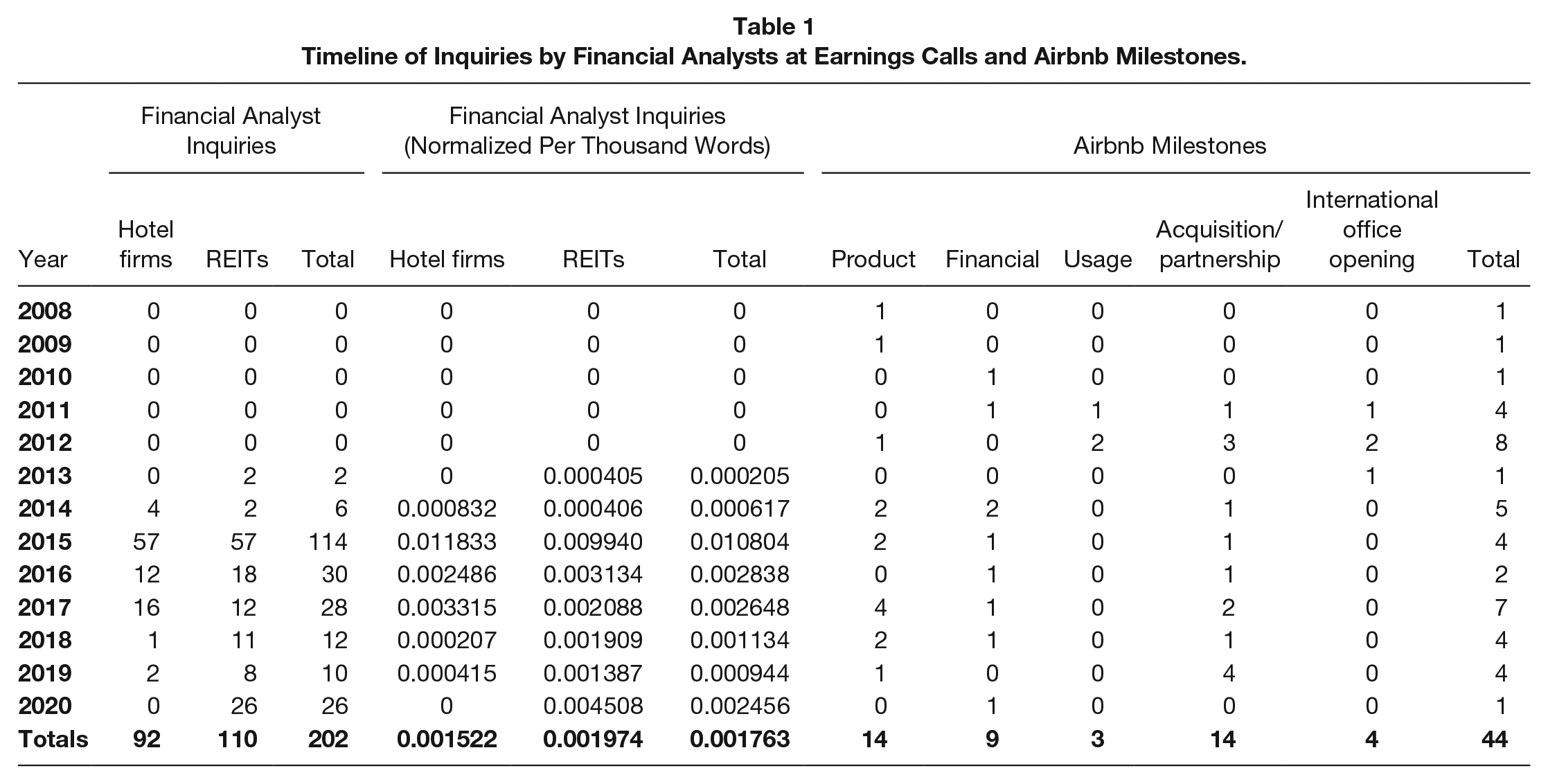
Table 1 (right side) shows the frequency count of Airbnb milestone types for each year. We found that, of the total 44 milestones, about half (21) took place before the surge of Airbnb mentions in earnings calls in 2015. Most milestones took place in 2012, when Airbnb completed three acquisitions or partnerships and opened two international offices. Moreover, the division among categories of events shows that most events were product-related followed by acquisitions and partnerships.
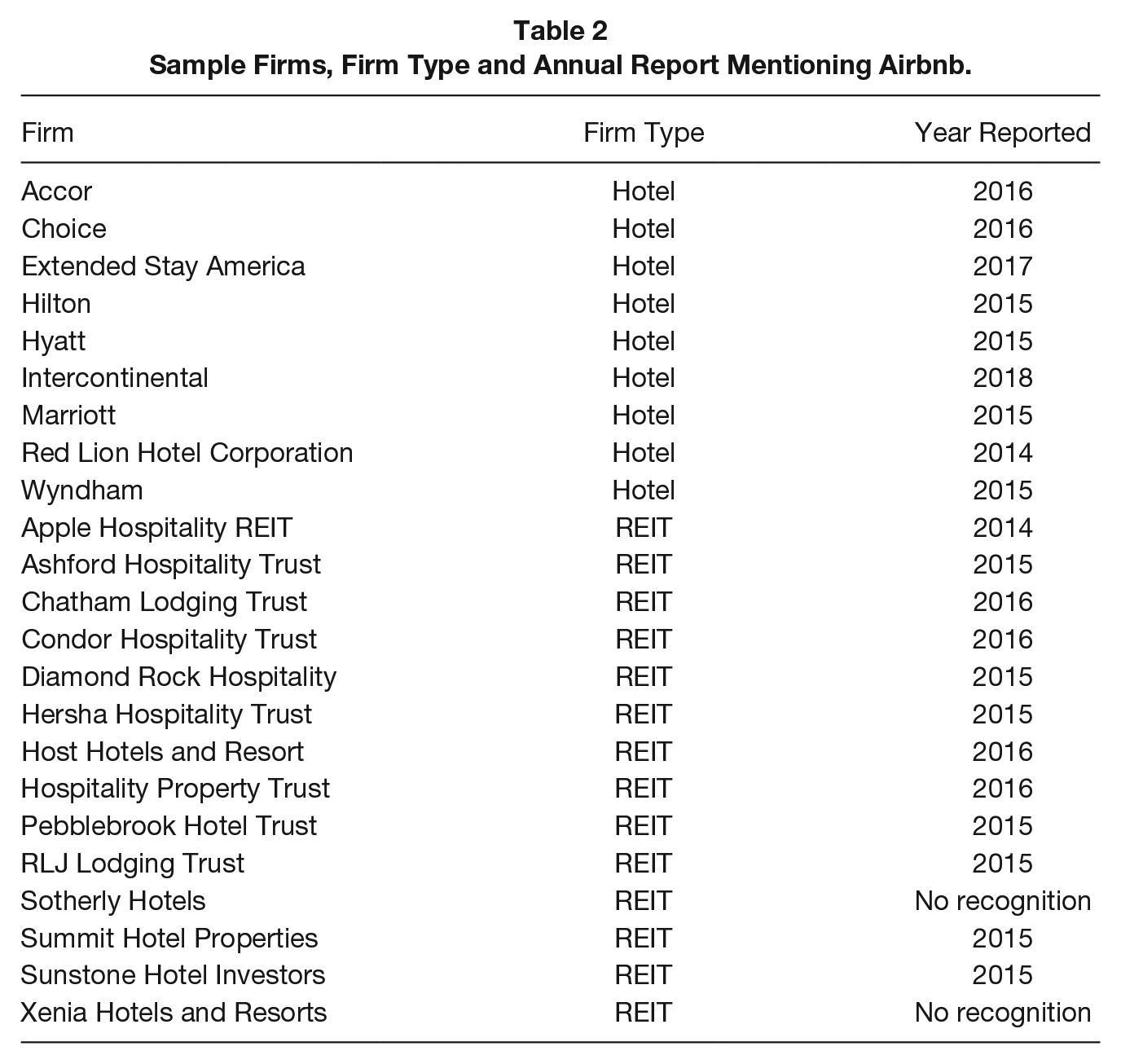
From the incumbents’ annual reports, we learned that all but two firms in our sample mentioned Airbnb as a competitor after financial analysts started to ask Airbnb-related questions in 2013. Most firms, however, started to mention Airbnb in their 2015 and 2016 annual reports (Table 2). Importantly, annual reports are filed with some delay; hence, the 2015 annual reports would have been published sometime around February or March 2016. This shows how firms in our sample publicly recognized Airbnb as a competitor in 2015 and 2016, years in which all major firms enacted their countermoves. Hence, we conclude that the recognition of Airbnb by sampled firms occurred between 2013, the first year of mention by financial analysts, and 2015.
Sample Firms, Firm Type and Annual Report Mentioning Airbnb.
Event Study Analysis
Since we learn from the previous analysis that the recognition of Airbnb as a legitimate competitor by incumbent hotel firms occurred between 2013 and 2015, we used 2013 and 2014 as gap years in order to clearly identify a pre- and a post-recognition period. Table 3 shows results from the event analysis reflecting the effect that each milestone type had on incumbent firms’ market value before (2008–2012) and after Airbnb was acknowledged as a legitimate competitor (2015–2020).
Cumulative Abnormal Returns (CAR) for Milestone Events Before and After Recognition.
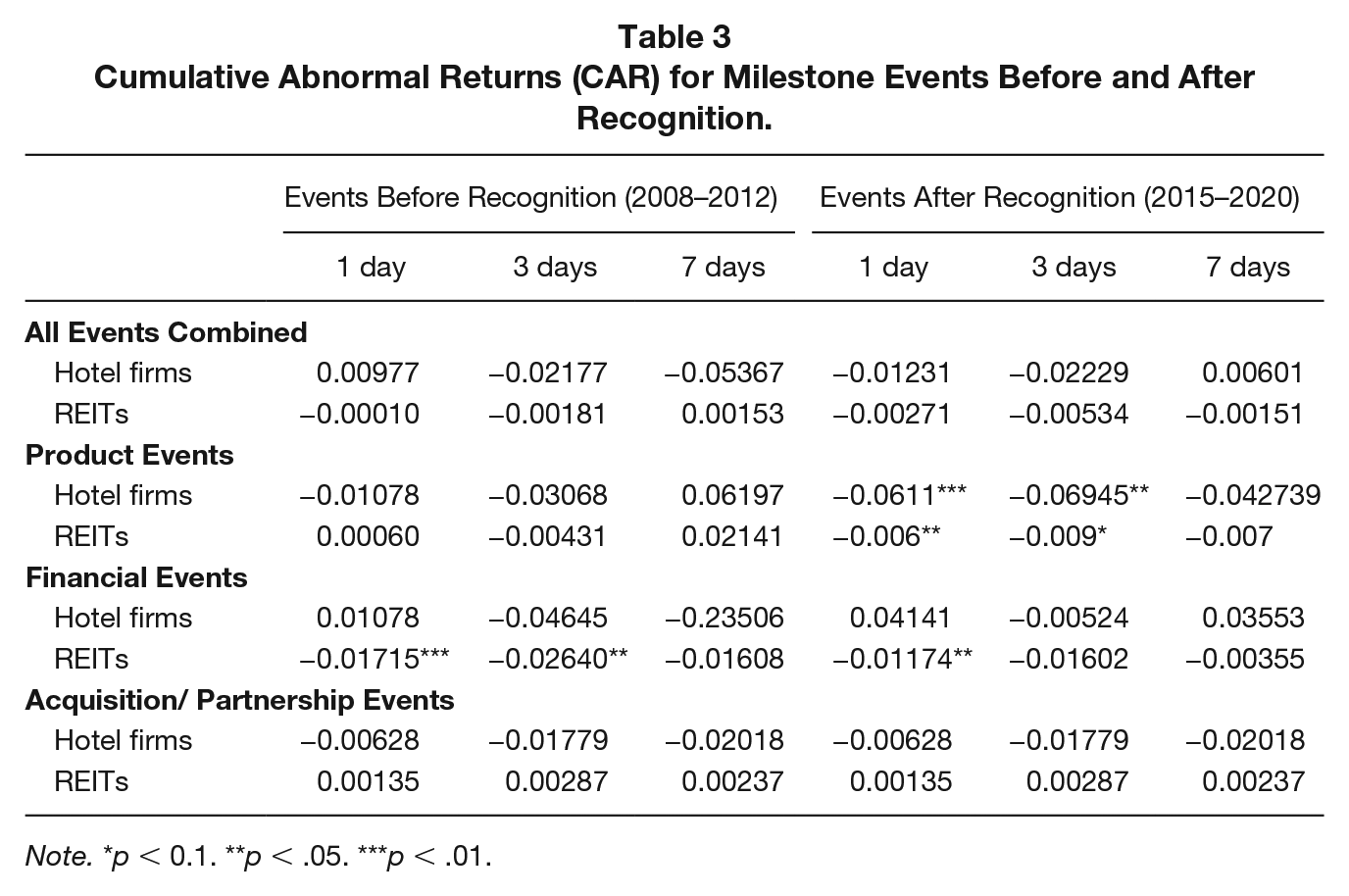
Note. *p < 0.1. **p < .05. ***p < .01.
Results show that the impact on incumbent firms’ market value varied according to the type of event and the type of firm. Product events had a significant and negative effect on lodging firms only after Airbnb was recognized by financial analysts (2015–2020). Hotel management firms and real estate investment trusts experienced an average drop in market value of 6% and 0.6%, respectively, on the same day Airbnb announced a new product. Financial events, on the other hand, had a negative and significant effect on real estate investment trusts both before and after Airbnb was acknowledged as a competitor with a magnitude of -1.7% and -1%, respectively, for the day on which the event was announced. Acquisition and partnership events did not result in a significant effect on the sample. Finally, usage milestones and the opening of a new international office were not included in the event analysis as all milestones in these categories happened before 2015.
Robustness Checks and Further Analyses
We conducted several additional analyses to confirm the robustness of our findings. First, the distribution of events among the years could have created endogeneity problems with regard to the different types of events resulting from over-representation in some years and particularly strong effects of events in other years. We tested for that eventuality by creating year-dummy variables and testing market reactions for all events combined. We found that the combined effect was statistically significant at 0.05% for only 1 year (2010) and at a magnitude of -0.34, thus ruling out potential endogeneity concerns.
Second, acquisition or partnership events could have been strategic moves on the part of Airbnb to expand into a new market or to create new products. While we cannot speculate on the reasons why Airbnb made these acquisitions or entered into partnerships, it is necessary to understand the consequences of different types of acquisitions, specifically vertical and horizontal acquisitions. Horizontal acquisitions are aimed at acquiring a direct competitor (e.g., CrashPadder) whereas vertical ones are aimed at integrating services of the acquired firm into Airbnb’s product portfolio (e.g., Vamo, a trip planning service). The effects of these sub-categories on incumbents’ market value are still not significant, confirming the results of the event analysis (see Supplemental Table 1).
Finally, while 2013 and 2014 were taken as gap years, having been identified as the years in which sampled firms became aware of Airbnb as a legitimate competitor, we cannot deny that firms started to receive serious pressure from financial analysts in 2015. We thus tested the reliability of our pre- and post-recognition split with a different contrast of the before and after time windows. First, we took 2015 as a gap year, thus calculating cumulative abnormal returns for the pre-recognition window from 2008 to 2014 and the post-recognition window from 2016 to 2020 (see Supplemental Table 2). Second, we ran the same analysis, but included 2015 in the calculation so as not to omit possible important events (see Supplemental Table 3). Both analyses were in line with the result of the main analysis, thus confirming the reliability of the initial pre- and post-recognition split in 2015.
Discussion
The analysis of analyst questions during earnings calls and the mentioning of Airbnb in the annual reports of publicly traded firms revealed that Airbnb was recognized as a competitor between 2013 and 2014. By acknowledging Airbnb as a competitor, incumbent hotel firms became aware of the potential threat it poses for their own business. Without awareness, incumbents could not have reacted because awareness represents the first perceptual step for firms to respond to a competitive move (Chen, 1996). Thus, about 6 years after its launch in 2008, Airbnb was recognized as a lodging business and a competitor by hotel management firms and REITs.
The late recognition of Airbnb is surprising as nearly half of all Airbnb milestones occurred before 2013. Indeed, despite Airbnb rapidly gaining market share (5 million bookings in January 2012 and twice as many bookings in June of the same year), hotel firms did not experience any negative effects on their market value. This implies that the stock market initially lacked awareness of Airbnb as a competitor. In other words, Airbnb was not perceived as a threat, thus confirming the study by Chen (1996) that a lack of awareness prevents incumbent firms from reacting in the marketplace.
Once Airbnb was acknowledged as a competitor, introduction of its new products and services resulted in a negative effect on incumbent market value. Indeed, financial analysts and investors recognized Airbnb as a threat to hotels and REITs. In its early years, Airbnb attracted a new type of customer emerging from the 2008 Global Financial Crisis who was budget conscious yet still interested in traveling and seeking experiences that traditional hotel accommodation could not deliver (Tussyadiah & Pesonen, 2016). From 2015, however, Airbnb began to attract business travelers and luxury travelers, both critical markets pursued hotels and REITs. Ultimately, these developments resulted in incumbent firms becoming aware of competitive moves and consequently implementing strategic countermoves.
The lack of significant effects of financial milestones on hotel management firms as compared to significant effects on real estate investment trusts can be explained by the difference in the type of firm. Hotel management firms are mostly asset-light firms that own a very limited number of assets and have a business model that does not require real estate ownership while real estate investment trusts are essentially near exclusive asset-holding firms. Real estate investment trusts are thus affected to a greater degree by real estate risk compared to asset-light firms (Kim et al., 2019). News about Airbnb progressively attracting more capital and its services becoming more professionalized, therefore, implies a projected increase in real estate prices (Benítez-Aurioles & Tussyadiah, 2020). These increases affect real estate investment trusts as asset holders, but not hotel management firms that manage properties (Li & Singal, 2019).
The non-significant findings for acquisition and partnership events suggest that investors could not evaluate whether Airbnb’s acquisition and partnership activities would have had consequences for incumbent lodging firms. This is also sustained by the further analysis of vertical and horizontal acquisitions, thus indicating that incumbent firms did not fully understand the Airbnb business model and its acquisitions that contributed to its growth.
Our study demonstrates that incumbents’ market value was affected as Airbnb grew in importance, especially after it was recognized as a legitimate competitor by financial analysts. This suggests that financial analysts are major influencers of the stock market and that both publicly traded firms and their investors should pay attention to the questions they raise at quarterly earnings calls. In other words, it appears that, with regard to Airbnb, financial analysts were faster at identifying the disruptive capacity of Airbnb than incumbent firms.
Contributions and Future Research
Theoretical and Methodological Implications
This study investigates whether, when, and how the recognition of a disruptor by financial analysts leads to a change in the effect of the disruptor’s performance milestones on incumbents’ market values. This effect was tested using the example of Airbnb as a disruptor and incumbent hotels as it provides a unique opportunity for hospitality research to study disruption in its own context and also contribute to disruption literature in the mainstream management field.
We found that by asking questions during earnings calls, financial analysts recognized Airbnb as a competitor in the lodging market often before competitors were fully aware of the competition, and that products/services launched by Airbnb after such recognition had a negative effect on incumbents’ market value. This awareness of Airbnb as a competitor was central to inducing incumbent firms to react to the competitive threat (Zach et al., 2020) as awareness represents one of the fundamental perceptive states to respond to a competitive action posed by a competitor (Chen, 1996). These results contribute to the literature on disruption and innovation in hospitality as it shows the involvement of the stock market in the legitimation of Airbnb as a hospitality firm and the short-term rentals’ business model as a new sector of the lodging market. It also provides an additional context and case for management literature regarding disruptor effects.
This study also demonstrates the applicability and importance of the awareness piece of the awareness-motivation-capability framework and validates the notion that, in order to compete effectively, incumbent firms must become aware of the new entrant and identify its threat. Indeed, we found that awareness and resulting motivation are provided externally by financial analysts and stock market investors before incumbent firms act.
The current study contributes to the literature on short term rentals by being the first to explicitly investigate the legitimation process of Airbnb as an established hotel firm. We did so by taking a quantitative approach to tracing the origins of Airbnb as a legitimate competitor in the lodging sector involving text mining algorithms on earning calls transcripts and event analysis on stock market data. While the use of event analysis is extensively used in the hospitality literature, using text mining algorithms on earning calls transcripts represent, to the extent of our knowledge, a novelty in the hospitality literature.
It is important to note that while the recognition of Airbnb as a competitor by incumbent firms was triggered by financial analysts, it was already popular with consumers and had achieved several performance milestones prior to its acknowledgment as a competitor. Future studies should examine whether and to what extent consumers created pressures for the recognition of Airbnb before financial analysts did. The discrepancy between consumer and corporate cognition and awareness can provide insights into why incumbents turned a blind eye to a disruptor and how this can be avoided in the future.
Managerial Implications
This study also has practical implications for lodging firms. It shows how, in an evolving competitive landscape, decision makers of established hotel management firms and REITs should also be attentive to firms that normally operate outside the constituted market boundaries. Most importantly, this study shows how actors external to firms may have an important influence on altering market boundaries. Hence, decision makers should react to financial analysts’ questions in anticipation of upcoming market changes, rather than simply regarding these analysts as an external entity only exercising a control function. In doing so, decision makers at incumbent hotel management firms can identify possible new competitors and quickly react to them. Our results and past research (Zach et al., 2020) shows that the stock market rewards hospitality firms that move first.
Limitations and Conclusion
A limitation of this study is its sample size as not all hotel management firms and real estate investment trusts are publicly traded. Hence, we cannot state with any certainty when privately held firms recognized Airbnb as a competitor. However, given that the only hotel firms developing responses to Airbnb are publicly traded and reacted after becoming aware and acknowledging Airbnb as a competitor, we can assume that private firms would behave similarly. Another limitation is the small sample size of lodging firms. Other studies assessing Airbnb and similar disruptors in other industrial fields would be a welcome test of the effect of recognizing disruptors as competitors. Finally, despite a firm being legitimized (and hence recognized as a competitor) in different ways, this study only investigates legitimation coming from pressures posed by the stock market. Future research can build on this study and investigate other forms of legitimation.
In conclusion, this study investigates the role of investors and financial analysts in legitimizing industry disruptors. We did so by analyzing financial analysts’ questions during earnings calls and incumbents’ market value coincidently with a disruptor’s milestone. Results show how both investors and analysis posed institutional pressures on incumbent firms in order to recognize the disruptor, which may have led to a consequent countermove.
Supplemental Material
sj-docx-1-jht-10.1177_10963480221085215 – Supplemental material for Disruptor Recognition and Market Value of Incumbent Firms: Airbnb and the Lodging Industry
Supplemental material, sj-docx-1-jht-10.1177_10963480221085215 for Disruptor Recognition and Market Value of Incumbent Firms: Airbnb and the Lodging Industry by Simone Bianco, Florian J. Zach and Manisha Singal in Journal of Hospitality & Tourism Research
Footnotes

Supplemental Material
Supplemental material for this article is available online.
References
Supplementary Material
Please find the following supplemental material available below.
For Open Access articles published under a Creative Commons License, all supplemental material carries the same license as the article it is associated with.
For non-Open Access articles published, all supplemental material carries a non-exclusive license, and permission requests for re-use of supplemental material or any part of supplemental material shall be sent directly to the copyright owner as specified in the copyright notice associated with the article.
