




Abstract
Through a systematic review of recent publications on residents’ quality of life (QOL) in relation to tourism development (TD), this study surveys associated dynamics and emerging trends. Several patterns are observed: i) geographic areas of interest have expanded from developed economies to developing economies; ii) an array of theories and concepts have been introduced or merged with classic frameworks; iii) subjective composite approaches have dominated residents’ QOL measurement; and iv) the direct and indirect influences of TD on residents’ QOL constitute a main focus of recent work. Future work can take several directions: i) establishing a conceptual framework to link tourists’ and residents’ perspectives on QOL; ii) combining subjective and objective scales to improve generalizability; iii) employing longitudinal designs with innovative methods to offer insight into the dynamics of the TD–QOL nexus; and iv) investigating QOL/well-being from the eudaimonic tradition to accommodate diversified elements and broader perspectives of QOL.
Highlights
A systematic review of 184 journal articles on residents’ QOL in last 7 years;
Theoretical foundations, QOL measurements, and TD-QOL nexuses are revealed;
Future research should consider both tourists’ and residents’ perspectives;
Combined subjective and objective measurements are to be explored.
Introduction
Quality of life (QOL), as a multi-dimensional, comprehensive concept geared towards individual happiness and maximum freedom, has been recognized as a social indicator since the 1960s (Land et al., 2012). The concept has appeared in the tourism literature for nearly half a century and has been scrutinized from three perspectives: i) tourists/visitors; ii) employees of tourism service providers; and iii) communities/residents (Uysal et al., 2016). Relatedly, the number of studies on residents’ QOL in the context of tourism development (TD) has continued to grow in recent decades.
Two review papers on QOL and well-being have been published in the tourism domain to date. Uysal et al. (2016) addressed the QOL of tourists and residents in a host community through a review of the literature available prior to 2015; the authors found that 36 of the 71 chosen papers focused on residents’ QOL and TD. Hartwell et al.’s (2018) work considered 142 articles and reviewed QOL-related topics from the perspectives of tourists, residents, and industries. Residents’ perspectives appeared in 40 studies between 1997 and 2015. In particular, the authors gathered sources using keywords such as “health,” “wellness,” “quality of life,” and “well-being;” the scope of the 40 studies was therefore broader than Uysal et al.’s (2016) exclusive attention on QOL. Earlier, Harrill (2004) reviewed research on residents’ attitudes towards TD, whereas Sharpley (2014) examined studies about residents’ perceptions of TD; neither focused specifically on the relationship between TD and residents’ QOL. Collectively, the aforementioned four review papers either framed residents’ QOL and TD research as part of wider studies or solely surveyed residents’ attitudes towards TD—and mostly prior to 2015. Despite rising interest in this area, no systematic review in tourism has specifically focused on residents’ QOL and TD. A review of the most recent relevant studies is therefore needed to better reflect the shifting dynamics in mainstream tendencies and emerging perspectives.
The present study aims to fill this knowledge gap via a timely systematic review of English-language articles related to residents’ QOL and TD published in peer-reviewed journals from 2015 to November 2021. A manual search and bibliometric analyses unveiled relevant theoretical foundations, research contexts, data and methods, QOL measurements, and residents’ QOL–TD nexus. Findings offer valuable insight into key historical trends and burgeoning research avenues on residents’ QOL and TD since 2015.
The remainder of this paper is organized as follows. The source selection process is outlined in Section 2. Section 3 presents major findings on mainstream tendencies and emerging shifts in associated research along with the overall results of bibliometric analysis. Section 4 summarizes our findings and describes directions for future work.
Literature Selection
A two-step strategy was adopted to identify suitable sources. In Step 1, several keywords (determined based on relevant literature reviews) were used to search for and extract literature from three primary online databases: Scopus, Web of Science, and EBSCOhost. Search results were manually filtered in Step 2.
The terms “well-being,” “happiness,” and “life satisfaction” are generally used interchangeably with “quality of life,” despite some criticism about potential inaccuracy in theoretical QOL studies (e.g., Cummins, 2005; Felce & Perry, 1995). This study used “quality of life,” “life satisfaction,” “well-being,” and “happiness” as proxies of QOL to encompass a wide scope of QOL-related literature. Given considerable growth in scholarship on the relationship between TD and QOL from a human development standpoint, “human development” was included as an additional keyword. Moreover, the terms “resident,” “local community,” and “host community” were used as proxies of residents and community; “tourism” was taken as a broad proxy of TD. Earlier studies on the topic covered work published until 2015. The period of interest in this study thus spanned from January 2015 to November 2021. Two additional search filters were applied: only articles written in English and published in peer-reviewed journals were considered. Ultimately, Step 1 returned the following results: 401 papers from Scopus across “Title,” “Keyword,” and “Abstract” searches; and 195 from Web of Science and 136 from EBSCOhost based on “All fields” searches. Results were next imported into Mendeley, a reference management software, for data management. After removing duplicates, 471 papers remained. Thirty-eight eligible results from other sources were identified from reference lists in the original 471 articles. The initial literature pool therefore contained 509 sources.
Step 2 consisted of manual screening to exclude irrelevant studies from the literature pool. Eligible sources needed to include at least one resident-related QOL concept or a scale investigated in a TD context. Specifically, for conceptual studies to be included in the pool, at least one resident-related QOL concept needed to have been defined or included as a primary element in the conceptual framework. For empirical studies to be included, at least one QOL scale needed to have been considered in data analysis. In the end, 325 papers were excluded and 184 were retained for the systematic review analysis. Figure 1 illustrates the literature selection process.
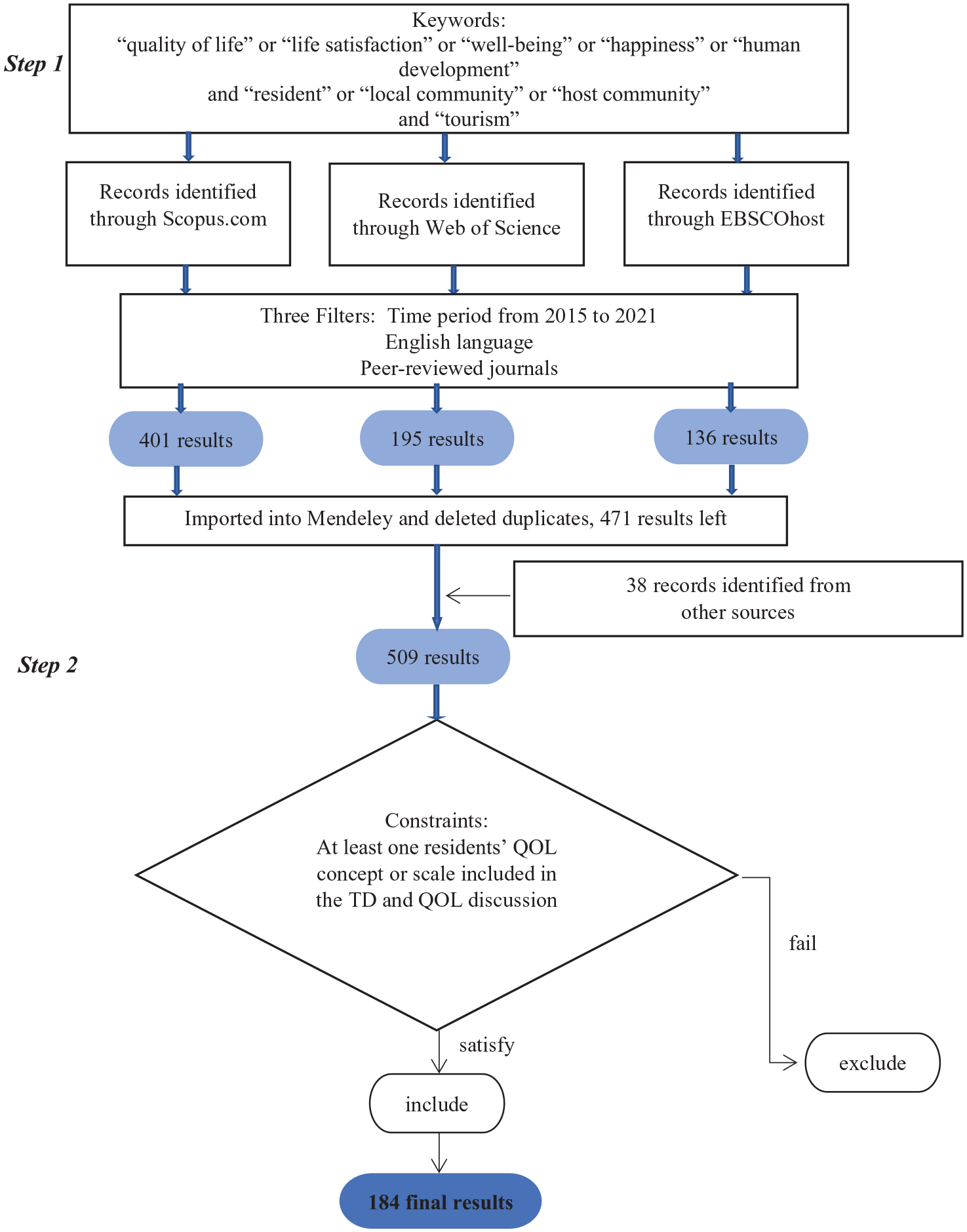
Process of Literature Selection
Main Findings and Discussion
Descriptive statistics for the identified papers and network analyses of co-authorship and keyword co-occurrence were generated via VOSviewer (Version 1.6.17, 2021), a bibliometric software, to provide an overview of the selected papers. Content analysis was performed to further investigate theoretical foundations, residents’ QOL measurements, data and methods, and residents’ QOL–TD nexus to discern research patterns and emerging shifts in residents’ QOL in a TD context.
Journal Distribution
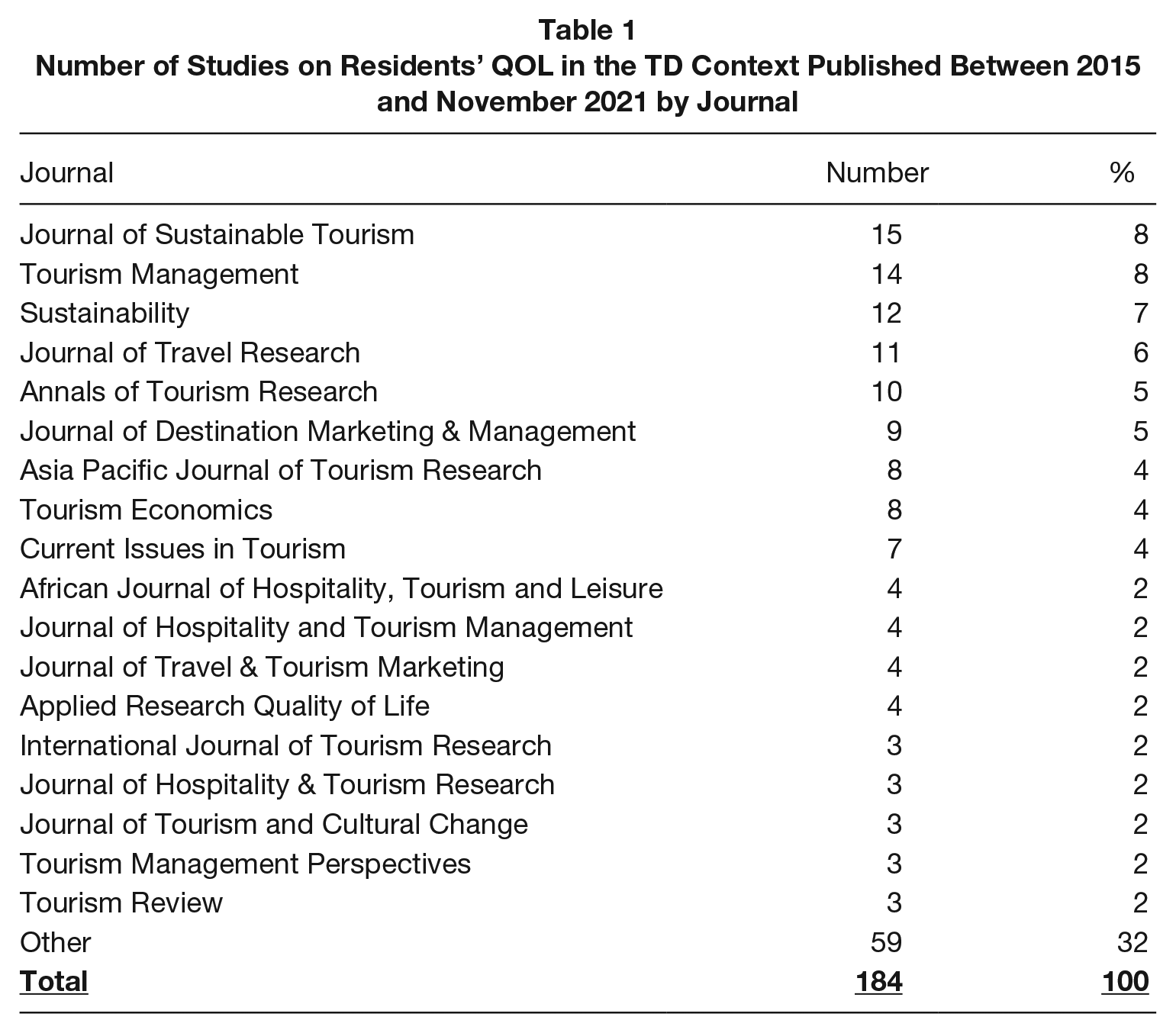
Sixty-nine journals contained papers on residents’ QOL in the TD context between 2015 and November 2021. Table 1 includes 18 journals, each of which featured at least three papers; these journals contained 68% of all papers (i.e., 125 of the 184 selected studies).
Number of Studies on Residents’ QOL in the TD Context Published Between 2015 and November 2021 by Journal
Co-Authorship Analysis
Co-authorship and keyword co-occurrence analyses were conducted in VOSviewer 1.6.17. The 25 most productive authors who contributed at least three papers from 2015 onward were listed in supplement Table 1. A link denotes a cooperative relationship between authors, and link strength indicates the number of links for an individual author as a proportion of the 1530 links among the 184 papers. Overall, 465 total scholars authored the 184 papers. Fourteen papers had one author while 170 were co-authored.
Co-Occurrence Analysis
A keyword co-occurrence analysis was carried out to discern common keywords and themes among the 184 studies. The software identified 56 keywords with at least three occurrences each among the 597 results. As displayed in supplement Figure 1, nodes of the same color represent a cluster linked with other clusters. The size of a node is scaled in proportion to the frequency of its occurrences.
Keywords with a high co-occurrence reflected main research trends related to this topic. Several noteworthy patterns emerged. First, studies’ focal destinations were diverse, including developing countries such as China (e.g., Liang & Hui, 2016), Iran (e.g., Olya & Gavilyan, 2017), Aruba (e.g., Ridderstaat et al., 2016a), and Viet Nam (Lee et al., 2020). Second, popular theories consisted of social exchange theory integrated with bottom-up spillover theory (e.g., Woo et al., 2015) and destination social responsibility (e.g., Su et al., 2018). Third, popular measures were primarily hedonic in nature, covering constructs such as subjective well-being (e.g., Ivlevs, 2017), happiness (e.g., Bimonte & Faralla, 2016), and life satisfaction (e.g., Woo et al., 2018).
Of note, the “human development” framework based on Sen’s capability approach (e.g., Croes et al., 2020) marked a substantial shift in understanding the relationship between TD and QOL. Meanwhile, various forms of tourism featuring similar concepts—“volunteer tourism” (e.g., Lupoli et al., 2015), “community-based tourism” (e.g., Stienmetz et al., 2020), “ecotourism” (e.g., Ali et al., 2020), “sustainable tourism” (e.g., Băndoi et al., 2020), and “responsible tourism” (e.g., Mathew & Sreejesh, 2017)—were studied as potential solutions to alleviate the negative impacts of mass tourism and “overtourism” (e.g., Mihalic & Kuščer, 2021). These approaches have also been shown to promote ongoing tourism development (e.g., Vogt et al., 2020), coinciding with the United Nations’ Sustainable Development Goals (SDGs).
Study Contexts and Geographic Areas
Over the last 7 years, when excluding the 13 identified conceptual papers, 171 empirical studies analyzed residents’ QOL and TD. Of these, 157 focused on a single country or region whereas the other 14 concerned multiple areas. A geographic distribution of these empirical studies based on the United Nations’ country classification (UN DESA, 2021) was presented in supplement Figure 2. China was featured most frequently (28 studies; e.g., Liang & Hui, 2016), followed by the United States (17 studies; e.g., Lindberg et al., 2021), the Republic of Korea (10 studies; e.g., Lee et al., 2018), and Malaysia (eight studies; e.g., Eslami et al., 2019), with each country or region representing more than 5% of all chosen studies. Out of the 171 articles, 114 pertained to developing economies and economies in transition. Fifty-four focused on developed economies, and three concerned both developed and non-developed economies. By contrast, as indicated by Uysal et al. (2016), most research in this field prior to 2015 (29 out of 36 studies) was conducted in developed economies including the United States (e.g., Cecil et al., 2010), Australia (e.g., Bachleitner & Zins, 1999), Spain (e.g., Urtasun & Gutiérrez, 2006), Portugal (Renda et al., 2011) and Norway (Gjerald, 2005). The regions of interest have clearly diversified over time and are shifting from developed to developing economies.
Shifts in research settings accorded with this evolving geographic distribution. Prior to 2015, the foci of residents’ QOL and TD research included the resurgence of rural communities (e.g., Bachleitner & Zins, 1999), impacts of casinos (e.g., Roehl, 1999), and cultural effects related to cities or urban tourism (e.g., Cecil et al., 2010). Most such work was carried out in the United States. Although recent studies have also investigated these seemingly conventional contexts, the geographic areas have expanded over time from developed countries to developing economies as mentioned. For instance, the benefits of farming were studied in Iran (e.g., Nematpour & Khodadadi, 2020). Casinos or gaming companies and their relationship with community QOL and residents’ attitudes/support were explored in the Republic of Korea (e.g., Lee et al., 2018) and Viet Nam (e.g., Lee et al., 2020). Influencing factors driving residents’ QOL in a heritage destination were examined in China (e.g., Chi et al., 2017) and Iran (e.g., Rastegar et al., 2021). Key topics thus appear somewhat similar across research conducted before and after 2015. However, the geographical move towards diversified areas (covering 133 countries) is a distinguishing feature of later work.
Theoretical Foundations and Conceptual Frameworks
Historically, the philosophy on QOL/well-being was dichotomized between hedonic and eudaimonic well-being. The hedonic well-being entails pleasure/enjoyment/satisfaction, a focus on oneself/the present moment, and ways of feeling. Eudaimonic well-being is associated with meaning/value/self-fulfillment, a balance between oneself and others/the present and future, and ways of behaving (Huta & Waterman, 2014; Ryan & Deci, 2001). The hedonic form is typically evaluated on the bases of subjective well-being, life satisfaction, happiness, and positive and negative effects; the latter can comprise numerous dimensions corresponding to fundamental theories such as self-actualization (Maslow, 1962) or purpose in life and personal growth (Ryff, 1989; Ryff et al., 2021). A ballooning number of tourism studies have begun to address hedonic and eudaimonic paradigms of well-being, namely in terms of the tourism experience (e.g., Kay Smith & Diekmann, 2017). Only a few studies have revolved around residents’ QOL (e.g., Rivera et al., 2016; Volo, 2017). In particular, Volo (2017) investigated residents’ eudaimonic well-being in Sicily using Waterman et al.’s (2010) Questionnaire for Eudaimonic Well-Being.
Table 2 lists theories and concepts applied in the TD and QOL area in at least three selected papers. Social exchange theory (SET) is a popular theory, on the basis of which other theories have been either incorporated into the TD and SET framework or have replaced the SET framework entirely. SET posits that a person appraises both positive and negative values when pondering their social behavior. This theory is analogous to cost and benefit analysis in economics (Ap, 1992; Homans, 1958). SET has been widely adopted to understand the dynamics of stakeholder intersections/interactions, often in tandem with other concepts or theories. The notion of bottom-up spillover in sociological QOL studies (Ferriss, 2006; Hagerty et al., 2001) postulates that one’s subjective well-being (i.e., overall life satisfaction or happiness, as determined by one’s satisfaction with multiple life domains) is usually tied to SET. Tourist area life cycle (TALC) theory (Butler, 1980) has also been adopted frequently. TALC suggests that the impact of TD differs by phase. This theory has been applied to discern tourism-related effects on residents’ happiness between countries with different TD levels. It has often been discussed together with other theories and concepts such as Doxey’s Irridex model (e.g., Fan et al., 2019), affiliation with the tourism industry (e.g., Woo et al., 2018), and tourism carrying capacity (TCC; O’Reilly, 1986).
Theories and Concepts Frequently Integrated With TD and QOL
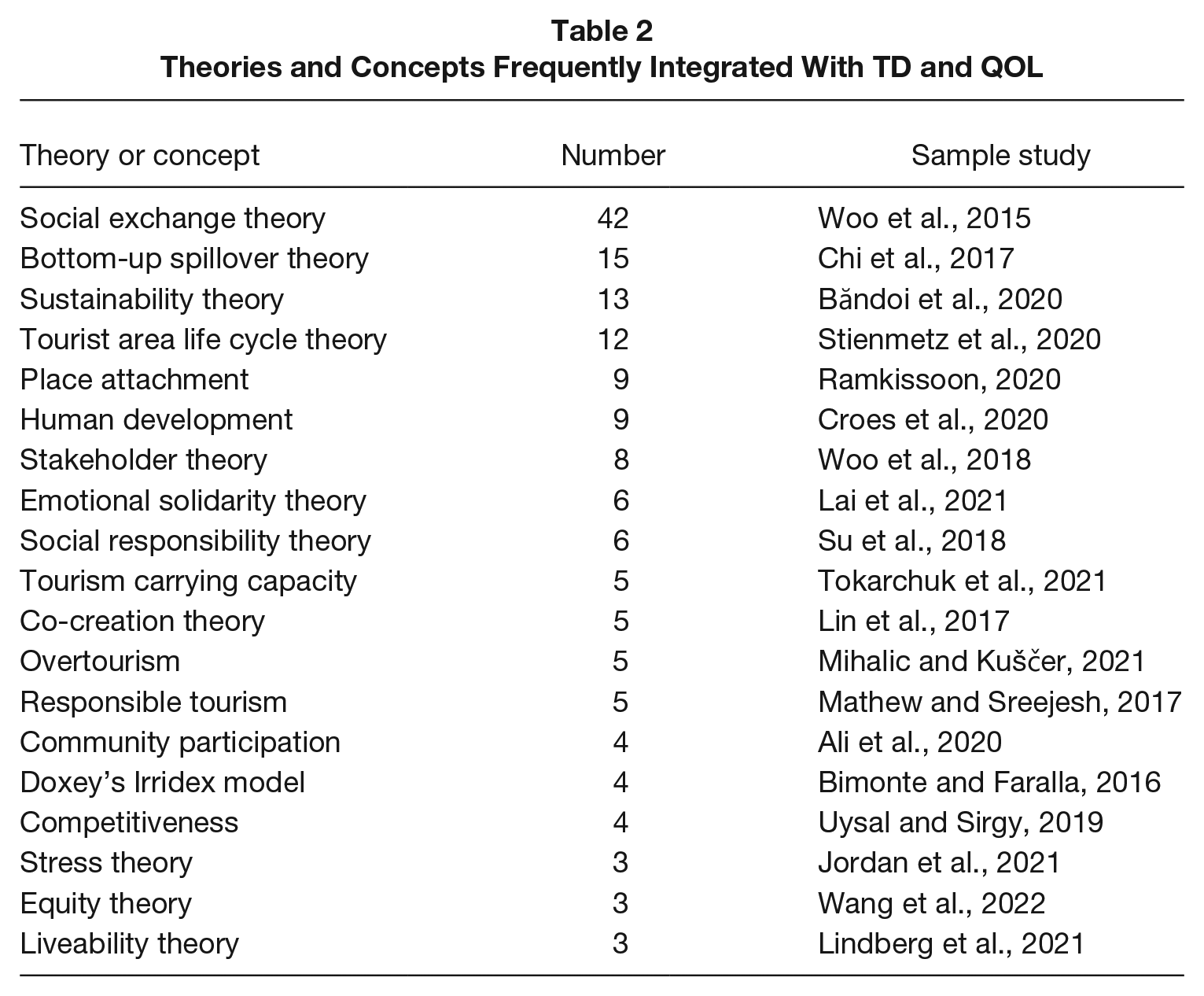
New theories and concepts from other disciplines have also been introduced in the literature to describe the nuances of residents’ QOL–TD nexus. For example, sustainability emphasizes one’s capacity to endure relatively continuous development across various life domains (Kuhlman & Farrington, 2010). Despite shifts in the term’s meaning, the idea of sustainability has been incorporated into discussions of sustainable tourism and responsible tourism as a potential way to enhance sustainable TD and residents’ QOL in line with SDGs. Social capital and liveability represent other salient concerns (e.g., Vogt et al., 2020). The human development framework, focusing on fundamental aspects such as expanding individuals’ opportunities to live long and healthy—as well as meaningful and creative—lives, marks another major turn in understanding the association between TD and residents’ QOL. Emotional solidarity has been introduced as a predictor of TD given its indirect effects on residents’ overall well-being and personal QOL (Suess et al., 2021). Emotional solidarity has also been identified as a predictor of residents’ leisure and spiritual well-being, subsequently influencing residents’ attitudes towards TD (Wang et al., 2021). Jordan et al. (2021) delineated the impacts of psychological stress related to residents’ perceptions of tourism impacts and QOL. Liveability theory, which presumes that the fulfillment of human needs (depending on one’s inner abilities and external living conditions) affects subjective well-being, has been applied to interpret the role of tourism growth in residents’ subjective well-being as well (Lindberg et al., 2021).
Residents’ QOL Measurement
QOL can be measured across numerous dimensions and unit levels. The construct is generally assessed along two axes: objective and subjective (Cummins, 1996). The objective QOL notion utilizes objective indicators to reflect the extent to which human needs are met, while subjective scales investigate self-reported or subjective evaluations of happiness and life satisfaction (Rapley, 2003). Residents’ QOL can be measured across diverse levels, from individual or household to community or country (Sirgy & Cornwell, 2001). When QOL research emerged in the 1960s, QOL scales were typically evaluated on the bases of aggregated objective indicators. The 1970s–1980s witnessed a shift to individual-level subjective indicators (Noll, 2004) following criticism of objective scales’ incapacity to capture people’s perceptions of their own life conditions. Some scholars have described community well-being as individuals’ perceptions of how tourism affects a community, whereas personal well-being reflects tourism’s perceived impacts on people (e.g., Rivera et al., 2016). Others have defined community well-being as a life domain of an individual’s QOL (e.g., Andereck & Nyaupane, 2011; Woo et al., 2015). To account for a broad scope of literature, residents’ QOL was considered with respect to residents and host communities (vs. visitors’ and tourism employees’ perspectives) in this study to collectively address QOL research involving residents and communities.
In a tourism context, subjective QOL scales have dominated the literature. Comparatively few studies have adopted objective QOL scales—with the exception of work such as that by Urtasun and Gutiérrez (2006). Between 2015 and November 2021, 15 of the 171 empirical studies examining residents’ QOL and TD employed objective QOL scales, as indicated in Supplement Figure 3. Among those, 13 applied the human development index (HDI) from the United Nations Development Program as a QOL construct at an aggregated (macro) level (e.g., Croes et al., 2018, 2020). Of the remaining two papers, Naidoo et al. (2019) used human well-being (with two indicators) and Băndoi et al. (2020) used the Numbeo index. The recent introduction of human development (Croes, 2012) has spurred the popularity of the HDI as an objective composite scale to measure residents’ QOL.
The well-developed notion of subjective QOL features a primarily hedonic perspective. Its scale construct has evolved in three directions: holistic, domain-specific, and hierarchical. The holistic approach generally employs an overall or global QOL scale, often represented by one or multiple survey questions on residents’ generic QOL satisfaction (e.g., Lin et al., 2017). The domain-specific approach covers multiple life domains and frames residents’ QOL as a composite of satisfaction with these domains; in other words, overall QOL is a latent construct that is defined or measured through satisfaction with key life domains (e.g., Liang & Hui, 2016). Some scholars (e.g., Woo et al., 2015) have adopted a mixed approach, incorporating a holistic scale and domain-specific composite scales into a hierarchical scale system and then treating each life domain’s satisfaction as an antecedent of overall QOL.
Holistic approaches were common in early QOL and TD research, whereas only one third of post-2015 studies have referred to a holistic construct to measure residents’ perceived QOL (e.g., Vogt et al., 2016). Scholars have moved toward more comprehensive domain-specific QOL constructs for precise measurement: two fifths of the 171 chosen studies have employed domain-specific QOL scales. A variety of domains/dimensions have been investigated. The tourism-related QOL (TQOL) scale, introduced by Allen et al. (1988) and developed by Andereck and Nyaupane (2011), has been used in two ways. In the first, a list of TQOL scores is assembled by computing respondents’ initial scores regarding the “significance” and “satisfaction” of a range of life domains tailored to the tourism context (e.g., Liang & Hui, 2016). The second is simplified: only the domains and indicators of the TQOL construct are considered (e.g., Jordan et al., 2020). Roughly one fifth of studies in our sample included a hierarchical construct for the QOL scale, with many based on bottom-up spillover theory. In a conventional TD–residents’ QOL model with a hierarchical QOL construct, TD influences specific life domains vertically and then spills over to overall QOL. The pathway of perceived TD impacts through a particular life domain onto overall QOL is revealed accordingly. The early bottom-up spillover QOL model only tested the influence of one TD dimension within one life domain, which could be a limitation as Kim et al. (2013) pointed out. Subsequent studies (e.g., Sirgy, 2019; Woo et al., 2015) have overcome this potential constraint by considering the dynamic interactions among TD dimensions and life domains. Scholars have also applied a reverse top-down approach to QOL evaluation by dividing TD’s effects on overall QOL into multiple life domains (Manhas et al., 2021).
Despite the pervasiveness of subjective QOL constructs in tourism settings, researchers have identified several drawbacks. For example, feelings and emotions represent mental appraisals of physical conditions rather than objects themselves. Self-reported values therefore vary with individuals’ life experiences, knowledge, and situations, thereby discouraging interpersonal, inter-regional, or inter-temporal comparisons and generalization of results (e.g., Croes et al., 2018; Ivlevs, 2017). Moreover, studies based on perceptions of residents’ QOL and perceived impacts often undervalue the effects of objective living standards, a core domain in QOL measurement; biased policy implications may follow. Some scholars have made progress in improving results’ generalizability and mapping out realistic policy implications by i) adopting objective scales (e.g., the HDI) to assess residents’ QOL (e.g., Croes et al., 2020); ii) incorporating objective TD indicators into evaluations of residents’ subjective QOL scales (e.g., Ivlevs, 2017; Lindberg et al., 2021); and iii) aggregating subjective QOL constructs at a national level, such as within the gross happiness index (e.g., Pratt et al., 2016) and country happiness index (Lee et al., 2020). In the latter case, the characteristics of TD are merged at a national level and are then further evaluated based on indicators of tourist intensity. Instruments could be designed in the future to measure residents’ QOL with an emphasis on objectivity while striking a balance between preciseness and generalizability. Uysal and Sirgy (2019) similarly noted that, ideally, subjective indicators can complement objective indicators in scales on residents’ QOL.
Data and Methods
Among the 184 chosen papers, 13 were conceptual studies based on purely theoretical analysis without data collection; 171 were empirical studies dominated by quantitative methods, followed by qualitative approaches and mixed methods (see Supplement Figure 4).
As empirical studies represented 93% of this research sample, it is worth investigating the data used for QOL measurement and modeling in greater detail. The data from empirical studies were first divided into individual and aggregated data, respectively. “Individual” denotes studies whose data were obtained from individual respondents without aggregating or merging results at a higher level. Individual data can be differentiated into three sub-categories, namely longitudinal, repeated cross-sectional, and one-off cross-sectional. Most empirical studies included one-off cross-sectional data (see Supplement Table 2). Nine studies were longitudinal and involved multiple rounds of survey data collection from the same people over time (e.g., Bimonte & Faralla, 2016). The other seven studies consisted of a series of two or more surveys, with each survey round involving different respondents and samples (i.e., repeated cross-sectional surveys; e.g., Ivlevs, 2017).
The “aggregate” group contains studies that used either personal survey data aggregated at a higher level (e.g., Tokarchuk et al., 2017) or aggregated secondary statistical data (e.g., Fu et al., 2020). These studies were thus labelled as using either panel data (e.g., Tokarchuk et al., 2017) or time series data (e.g., Ridderstaat et al., 2016b). Although one-off cross-sectional data have dominated recent studies, other categories of data are gaining academic attention (36 out of 171, see Supplement Table 2). Conversely, prior to 2015, most studies employed cross-sectional data; few focused on residents’ QOL and TD based on longitudinal survey data (Cecil et al., 2010) or aggregated time series data (Croes, 2012).
Regarding research methods, in-depth interviews were the most common means of qualitative data collection. Thematic analysis was most popular for qualitative data analysis. Regarding quantitative analyses, confirmative factor analysis, structural equation modeling (SEM), partial least squares (PLS) regression, and analysis of variance continue to prevail. Several other methods have emerged from more recent studies as well. For instance, Naidoo et al. (2019) adopted propensity score matching, a quasi-experimental method, and Bayesian hierarchical regression with two large-scale panel datasets in a two-stage modeling process. Fuzzy set qualitative comparative analysis was introduced for asymmetrical configural modeling (e.g., Cheng & Xu, 2021; Olya & Gavilyan, 2017). Scholars have also used second-order SEM with hierarchical structures in either TD (e.g., Lai et al., 2021) or QOL scales (e.g., Suess et al., 2021).
Residents’ QOL–TD Nexus: Emerging Trends
The increasing diversity in research areas and contexts, from scale constructs and theoretical foundations to data and methods, has contributed to a more nuanced TD–residents’ QOL nexus. Figure 2 presents a synthesis system containing all relationships discussed in recent research. The directions of paths suggest that the nexus of TD and residents’ QOL identified in the literature spans four strands: (i) TD influencing QOL (i.e., TD→QOL); (ii) QOL influencing TD (i.e., QOL→residents’ support toward TD [RSTD]/TD); (iii) implicit two-way relationships between TD and QOL (i.e., TD→QOL→RSTD); and (iv) reciprocal relationships between TD and QOL (i.e., TD↔QOL). Table 3 lists specific nexuses derived from these strands with representative examples from the literature.
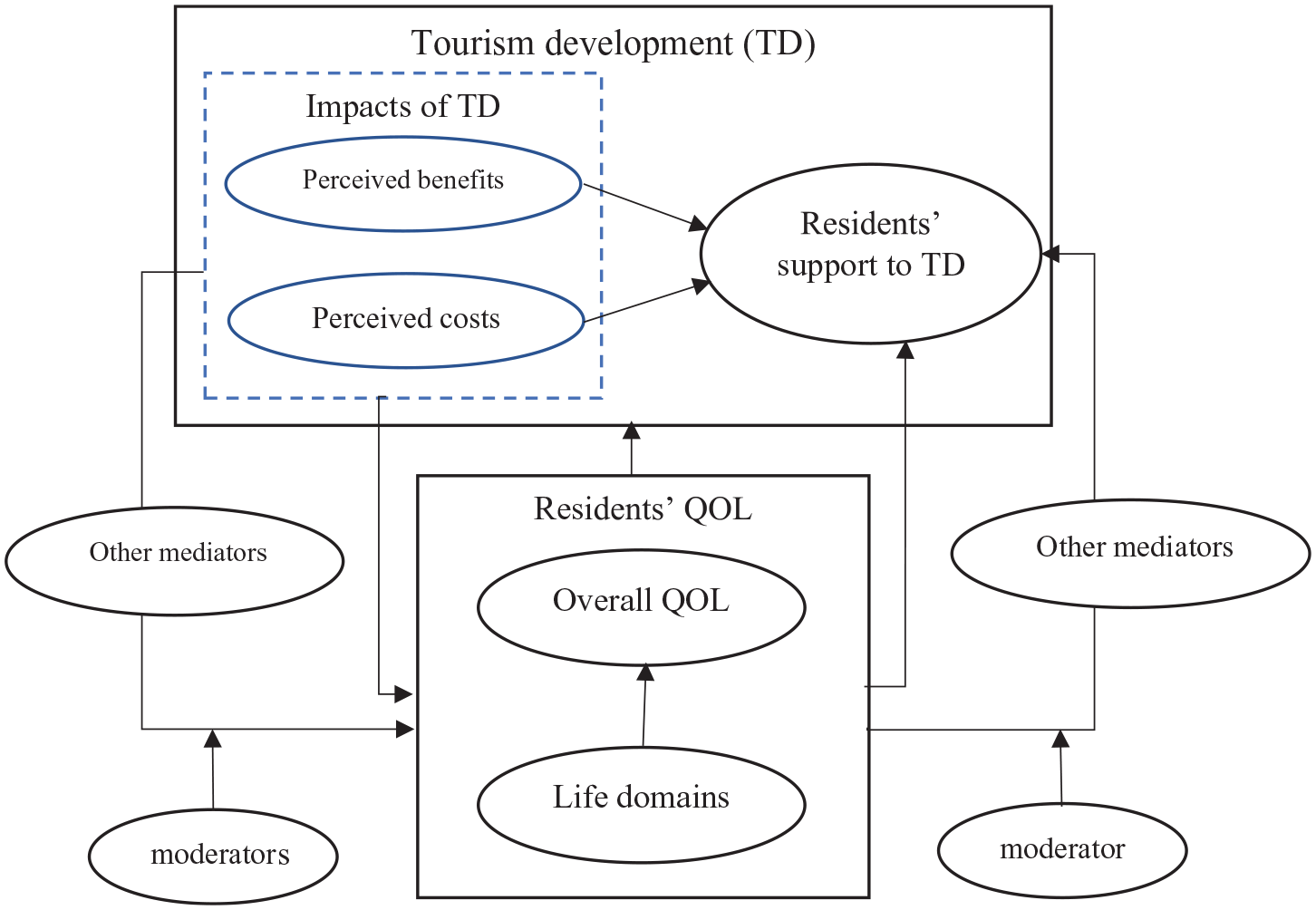
TD–Residents’ QOL nexuses
TD–Residents’ QOL Nexuses Identified in Recent Literature
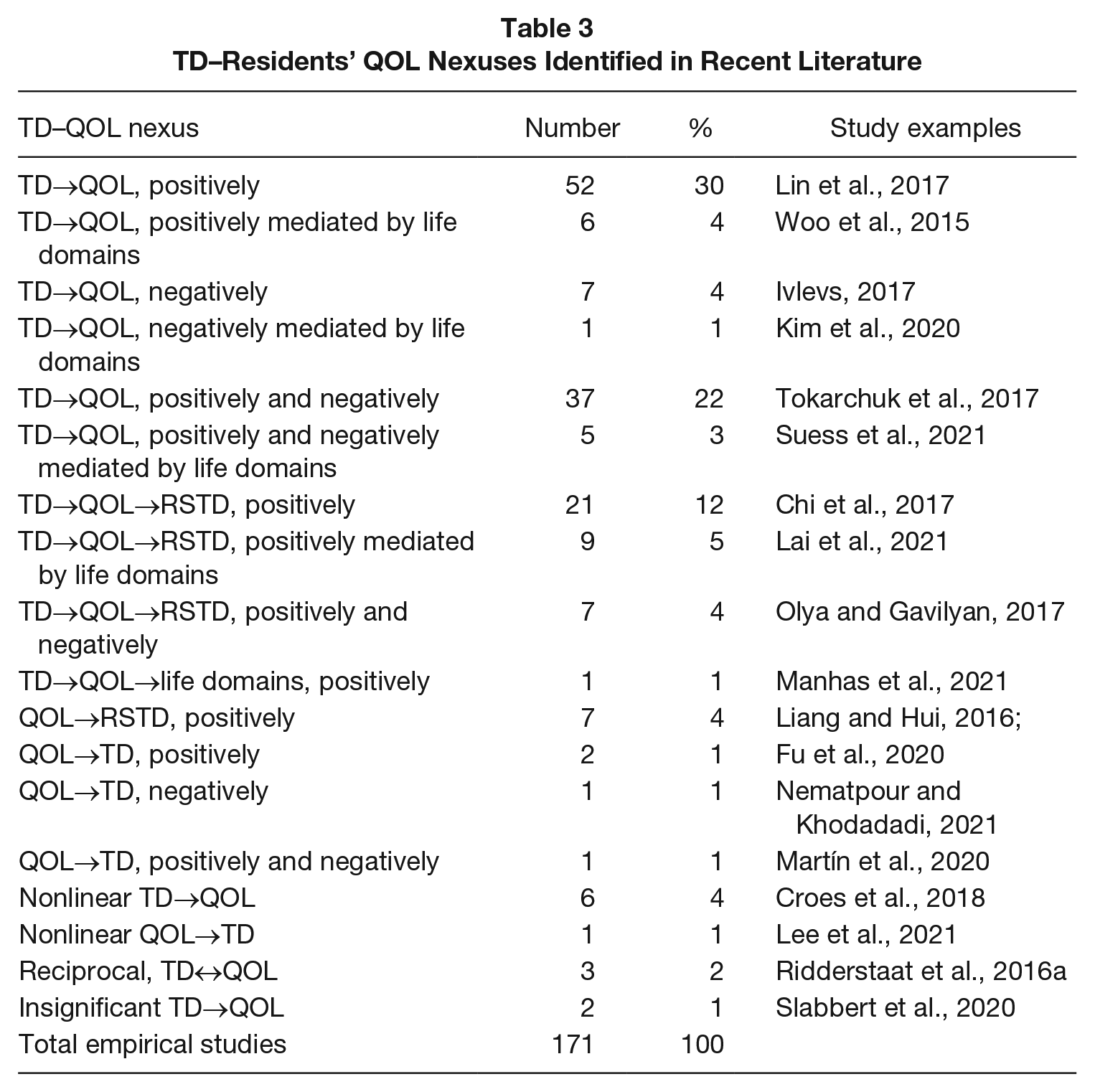
The one-way strand of TD influencing QOL (whether positively, negatively, or both) has dominated studies prior to and after 2015, reflecting two thirds of the identified nexuses. Some are mediated by life domains and assume separate lines. Other factors, such as the government’s role (Ali et al., 2020) and residents’ affiliations with tourism (Koh et al., 2020), moderate the effects of TD on QOL improvements. Meanwhile, the one-way strand of QOL implicitly influencing either RSTD or TD was common both before 2015 (e.g., Milman & Pizam, 1988) and thereafter (e.g., Fu et al., 2020; Liang & Hui, 2016).
Apart from one-way strands, emerging studies have reflected two types of intricate two-way nexuses. One is the implicit two-way residents’ QOL–TD nexus, which captures the impacts of TD on RSTD, mediated by residents’ QOL. Scholars have also observed indirect effects apart from QOL domains, including the following: i) community identification as a mediator between perceived impacts of TD and QOL and the direct effects of QOL on RSTD (e.g., Su & Swanson, 2020); and ii) “prior tourism experience” as a moderator between QOL and RSTD in certain cases of Airbnb (Suess et al., 2021). A few studies have pertained to the reciprocal nexus between TD and QOL. For instance, Ridderstaat et al. (2016a) uncovered a seemingly mutual relationship between TD and residents’ QOL based on survey data, pinpointing economic development as a mediating variable in the island of Aruba. They also observed a short-run reciprocal negative relationship between TD and residents’ QOL in the same area using secondary HDI and tourism revenue data (Ridderstaat et al., 2016b). Kubickova et al. (2017) unearthed a positive bidirectional relationship between tourism competitiveness and QOL with human agencies as a moderator, indicating a negative impact on this association.
In addition, several novel nexuses have supported predictions from traditional tourism theories. For example, an inverted U-shaped relationship manifested between tourism intensity and residents’ satisfaction with life in 63 European Union cities (Perucca, 2019) as well as in the city of Berlin, Germany (Tokarchuk et al, 2021). Scholars also discovered a significant, negative, nonlinear relationship between tourism specialization and residents’ QOL, although the long-term effect faded over time (Croes et al., 2018). Salient, nonlinear impacts of QOL (country happiness index) on TD (both tourist arrivals and revenue) were later observed in non-European countries (Lee et al., 2021).
In summary, recent studies of TD and residents’ QOL have uncovered several notable trends: i) a one-way nexus of “residents’ QOL influencing TD” and, in the opposite direction, “QOL influencing RSTD/TD” nexus; ii) two-way and reciprocal TD–residents’ QOL nexuses; and iii) multiple nonlinear relations that substantiate the theories of TALC and TCC. Meanwhile, compared to various mediators identified in the literature, little light has been cast on the moderators of TD–residents’ QOL nexuses. Therefore, accounting for additional moderating effects when exploring the TD–residents’ QOL nexus can advance theoretical development and provide actionable policy implications.
Discussion and Conclusions
By systematically reviewing 184 refereed journal papers on residents’ QOL and TD via a detailed manual review and gross bibliometric analysis, this study has unveiled the dynamics and emerging shifts in research published since 2015. Descriptive and bibliometric analyses revealed information about journals, authors, and keywords; a detailed review mapped the evolution and emerging perspectives related to theoretical foundations, QOL scale measurement, data and methods, and residents’ QOL–TD nexuses in more recent research on residents’ QOL and TD.
The major findings point to several mainstream tendencies in terms of geographic regions, research contexts, and theoretical frameworks. Geographic areas of study have shifted from developed economies to developing economies; overtourism, ecotourism, and responsible tourism have become popular topics; and SET is the dominant theoretical foundation into which other theories and concepts have been incorporated. An array of theoretical foundations, QOL assessment approaches, data and methods, and QOL–TD nexuses represent emerging perspectives. The framework of SET has been combined with bottom-up spillover theory, TALC, and TCC, alongside newly introduced concepts and theories such as emotional solidarity, place attachment, social responsibility, and value co-creation. In terms of measuring residents’ QOL, composite domain-specific subjective QOL scales have dominated the recent literature. Hierarchical scales based on bottom-up spillover theory have also demonstrated increasing importance. One-off cross-sectional survey data and traditional methods (e.g., confirmatory factor analysis, SEM, analysis of variance, and regression) have remained popular empirically. At the same time, longitudinal individual-level data, aggregate panel data, and time series data have appeared in a rising number of studies. Composite QOL and TD scales and comprehensive research designs have also contributed to the highly intricate nexuses identified between TD and residents’ QOL. The TD–residents’ QOL nexus was most common in recent studies; even so, reverse-direction relationships as well as implicit and reciprocal two-way relationships also manifested in certain cases.
Several other emerging trends were observed over the study period. First, researchers began to borrow a number of novel concepts or theories from other disciplines (e.g., sustainability, psychological stress, and liveability theory) for applied integration. Second, in the human development framework, objective HDI has been increasingly adopted for objective QOL measurement. Third, large-scale secondary data have been employed to evaluate QOL and tourism-related impacts. Fourth, subjective QOL scales have started to be regressed on objective TD variables. Fifth, a few studies have attempted to use large-scale data and innovative methods, such as quasi-experimental approaches, to examine causal relationships. Lastly, second-order SEM modeling has been applied with hierarchical QOL and TD structures.
These myriad perspectives have enriched understanding of the relationship between TD and residents’ QOL and have opened fertile grounds for future research. Possible avenues of interest include the following: i) devising a conceptual framework linking tourists’ and residents’ QOL; ii) combining subjective and objective scales to improve results’ generalizability; iii) longitudinal research involving innovative methods to clarify the dynamics of the TD–QOL nexus over time; and iv) broader investigations of QOL/well-being from the eudaimonic tradition to accommodate both the self and others as well as short- and long-term elements of well-being with a focus on self-realization and community development. Importantly, in the context of COVID-19, society and industry are facing sweeping economic, social, and environmental changes. Few scholars have pondered TD and potential consequences for residents’ QOL amid the pandemic (e.g., Lindberg et al., 2021; Ramkissoon, 2020). Subsequent work can outline ways to respond effectively to this crisis while harnessing opportunities to foster resilient, inclusive, and sustainable tourism development.
Finally, this study has certain limitations that can inform additional research. First, books and book chapters on the residents’ QOL–TD nexus were not included for analysis or review due to limited access. Second, only English-language journal articles were considered; relevant publications in other languages were not.
Supplemental Material
sj-docx-1-jht-10.1177_10963480221081382 – Supplemental material for Emerging Research Trends on Residents’ Quality of Life in the Context of Tourism Development
Supplemental material, sj-docx-1-jht-10.1177_10963480221081382 for Emerging Research Trends on Residents’ Quality of Life in the Context of Tourism Development by Ruijuan Hu, Gang Li, Anyu Liu and Jason Li Chen in Journal of Hospitality & Tourism Research
Footnotes
Authors’ Note:
The authors are grateful for comments and suggestions from the anonymous reviewers and the editors.

Supplemental Material
Supplemental material for this article is available online.
References
Supplementary Material
Please find the following supplemental material available below.
For Open Access articles published under a Creative Commons License, all supplemental material carries the same license as the article it is associated with.
For non-Open Access articles published, all supplemental material carries a non-exclusive license, and permission requests for re-use of supplemental material or any part of supplemental material shall be sent directly to the copyright owner as specified in the copyright notice associated with the article.
