




Abstract
Dark rides are archetypal theme park attractions that provide compelling experiences through carefully structured experience designs. In a literature review, we follow and slightly modify Langhof and Güldenberg’s conceptualization of the dark ride experience (DRE) and suggest that the DRE mostly consists of narrative transportation, presence, flow, and emotions. However, to what extent these conceptualizations match actual dark ride supply remains unexamined. Therefore, we evaluate 238 dark rides in the EMEA region on product determinants of the DRE and compare literature-based conceptualizations of the DRE against actual dark ride supply. Findings indicate that dark rides highly vary in terms of storytelling, theming, and pervasive interactivity, thus questioning whether all components of the DRE always apply to the full dark ride spectrum. Proposing the Dark Ride Cube as a dark ride typology, Langhof and Güldenberg’s conceptualization of the DRE is largely confirmed, as well as the currently suggested modifications.
Highlights
First article to empirically evaluate dark rides in theme and amusement parks
Compares literature-based conceptualizations of the dark ride experience with supply
Presents the Dark Ride Cube to model variation in design elements in dark ride supply
Confirms extant conceptualizations of the dark ride experience with several additions
Introduction
Theme parks form one of the most thriving sectors of the tourism industry (TEA/AECOM, 2020). Compared with amusement parks, which focus on functional elements of attractions (such as the thrills from a roller coaster), theme parks focus on providing compelling experiences by emphasizing on communicative aspects, such as theming and storytelling (Cornelis, 2017). Arguably, the pinnacle of these practices is formed by a particular type of theme park attraction: the dark ride (Baker, 2018).
Dark rides have been defined as rides in enclosed buildings (that may also go outside) where visitors sit in guided vehicles that go past scenes of animation (Langhof & Güldenberg, 2019). The most famously known examples of dark rides come from the Disney parks, such as the Haunted Mansion, Pirates of the Caribbean, and “it’s a small world”, although other examples abound. The distinguishing feature of dark rides is the rigorous control of environmental factors because of their enclosed and heavily staged environment. This allows for thorough manipulation of every element of a dark ride to bring the lived experience of the guest as close to the intentions of the designer as possible. Dark rides can therefore be seen as an archetype of structured experience: A co-creation between consumer and provider, for which consumers bring their thoughts, emotions, values, memories of past experiences and personal characteristics, and in which providers manipulate objective design elements with attention to the experience as a whole (Duerden et al., 2015). As experience is a core concept in tourism and hospitality (Scott et al., 2017), the nature of dark rides as structured experiences forms a potentially valuable case to advance our understanding of the relationship between experience and experience design.
Research on dark rides is still in its infancy. In a pioneering review article on the dark ride experience, Langhof and Güldenberg (2019) found only a handful of academic publications on the topic. In the theme park literature, there is little extant work on dark rides (Anton Clavé, 2007; Lukas, 2012; Samuelson & Yegoiants, 2001; Younger, 2016). Authors have mostly described the functional characteristics of dark rides in comparison with other types of rides. The definitions used are thus primarily about the functional elements of a dark ride, rather than about the experience. Based on the available dark ride literature, Langhof and Güldenberg (2019) have proposed a first conceptualization of the dark ride experience in which storytelling, immersion, and emotional attachment are key components. Langhof and Güldenberg (2019) conclude their article with several recommendations for a deductive approach as the next step in dark ride experience research. However, a shortcoming of the used dark ride literature is that the dark ride phenomenon has never been empirically investigated in its entirety and that most accounts are based on anecdotal evidence or best practices of key industry players, thus introducing a form of anchoring bias. Thus, we propose to first explore the supply of existing dark rides to examine to what extent the proposed conceptualization of the dark ride experience mirrors the dark ride phenomenon itself. A typological approach toward dark rides is crucial to understanding the dark ride phenomenon as a whole (Stone, 2006). In building such an approach, we follow Duerden et al.’s (2015) structured experience framework and take objective design elements as a starting point for a dark ride typology, as they form the product determinants of the dark ride experience. In the present work we explore these objective design elements in a large sample of dark rides in the EMEA (Europe, the Middle East, and Africa) region, with the objective of comparing literature-based conceptualizations of the dark ride experience to actual dark ride supply. Thus, the current intention is not to build a new conceptualization of the dark ride experience. Rather, we compare Langhof and Güldenberg’s (2019) existing conceptualization—which we propose to slightly refine below—against extant dark ride supply.
Theory
Langhof and Güldenberg (2019) identify three recurring themes that are considered integral elements of a dark ride experience: storytelling, immersion, and emotional attachment. Their conclusions illustrate the importance of storytelling as the starting point of dark ride design which, depending on the culture and prior knowledge of participants, may lead to the subjective state of immersion. Immersion may result in emotional attachment as the third essential element of a dark ride experience. Finally, emotional attachment may result in such experience outcomes as consumer loyalty, word of mouth and sales (Langhof & Güldenberg, 2019).
The relationship between storytelling and immersion has frequently been acknowledged by various other theme park scholars (see, e.g., Cornelis, 2011; Freitag, 2017; Lukas, 2012). Immersion, however, is a concept that severely suffers from the jingle-jangle effect (Reschly & Christenson, 2012): On one hand, the word is associated with different meanings and on the other, different words are used to refer to the same phenomenon. Before one can understand the relationship between storytelling and immersion, conceptual clarity about the immersion concept is needed.
Arguably, the most advanced understanding of immersion can be drawn from the literature on video games, as immersion is generally perceived as the archetypal gaming experience (Cairns et al., 2014). However, even in this field, immersion comes with a variety of definitions (Cairns et al., 2014). In a review, Cairns et al. (2014) conclude that while it remains unclear what immersion exactly is, it involves a confluence of different psychological faculties that lead to a focused state of mind. Instead of considering immersion as a singular concept, it should thus be regarded as an umbrella concept for a series of psychological functions that together result in the sensation of “being in the game” (Cairns et al., 2014). Consequently, to identify the design elements that serve as product determinants of immersion, one should first distinguish its constituent psychological functions and in turn identify the product determinants of these psychological functions instead.
In the broader entertainment literature, three such psychological functions have been proposed: narrative transportation, presence, and flow (Hennig-Thurau & Houston, 2019). Hennig-Thurau and Houston (2019) argue that it is through these “imagery-related” states that we can escape our own realities and connect with alternative ones. This is in line with Langhof and Guldenberg’s (2019) understanding of immersion as the extent to which guests are being drawn into another world. Below, we therefore briefly define the imagery-related states of narrative transportation, presence, and flow.
Narrative transportation is defined as the extent to which a story consumer empathizes with the characters in a story and the extent to which the story plot activates his or her imagination (Van Laer et al., 2014). The concept of presence, then, refers to the sensory impression of being surrounded by another (often virtual) world (Hennig-Thurau & Houston, 2019). Note that the term “presence” is often used interchangeably with the term “immersion” (Cairns et al., 2014; Hennig-Thurau & Houston, 2019). However, in their review of the immersion literature, Cairns et al. (2014) note that presence forms only one of the constituent psychological functions of immersion and that the two should not be equated. In an experimental setting, for example, immersion remained unaffected for different levels of presence (Cairns et al., 2014). This is commensurate with other notions in the video gaming literature, where being surrounded by another world forms only part of the experience of immersion (Ermi & Mäyrä, 2005). To reach full immersion, besides narrative transportation and presence, flow is necessary as well. Flow is defined as being engaged in an optimal combination of challenges and personal skills (such as motor skills or mental skills) (Csikszentmihalyi & Csikszentmihalyi, 1992). This optimal combination provides people with a feeling of energized focus and a sense of timelessness (Csikszentmihalyi & Csikszentmihalyi, 1992). In the video gaming literature too, the optimal match of skill and challenge has been likewise acknowledged as an important component of immersion (Cairns et al., 2014; Ermi & Mäyrä, 2005).
While all aforementioned concepts refer to the notion of “being into something,” (into a story for narrative transportation, into another world for presence, into skill-challenge combinations for flow) dissecting the umbrella concept of immersion into its constituent psychological functions makes sense because they have different antecedents and different consequences (Ermi & Mäyrä, 2005; Hennig-Thurau & Houston, 2019). With regards to consequences, consumers may choose to visit different dark rides because they anticipate different types of experiences with a different mix of narrative transportation, presence, and flow. In turn, different experiences may lead to different outcomes such as perceived value, affect and delight (Ellis et al., 2019). With regards to antecedents, narrative transportation, presence, and flow are all triggered by different objective design elements (Hennig-Thurau & Houston, 2019). For example, narrative transportation requires a story to be dragged into and characters to empathize with, whereas presence does not require a story or characters at all (Hennig-Thurau & Houston, 2019). Similarly, flow requires challenging the consumer, which is not necessary for either narrative transportation or presence (Hennig-Thurau & Houston, 2019). As narrative transportation, presence, and flow have different antecedents, this distinction should be maintained in discussions of dark ride experience, marketing, and design.
Product Determinants of Narrative Transportation, Presence, and Flow
In their review of entertainment experiences, Hennig-Thurau and Houston (2019) list several product determinants of narrative transportation, presence, and flow. To our knowledge, up to date, these product determinants have not been applied to dark rides or theme and amusement parks. In the following sections, we therefore attempt to explicitly couple these product determinants to objective design elements in the context of theme parks and where possible to those of dark rides.
Story as product determinant of narrative transportation
A story with identifiable characters is an antecedent of narrative transportation (Van Laer et al., 2014). Like entertainment products in general, dark rides employ various stories, from self-developed to existing stories (Langhof & Güldenberg, 2019). Relying on existing stories from other media is often referred to as employing intellectual property (IP). Langhof and Güldenberg (2019) illustrate this notion by referring to a dark ride based on a fairy tale. Another form of IP is stories from film or book media, such as in Star Wars: Rise of the Resistance, a Star Wars dark ride offered by Disney. Arguably, fairy tales cannot be considered IP in the same way as stories within the Star Wars franchise. However, in both cases, the ride appeals to prior knowledge of and a prior emotional connection to a story. Younger (2016) therefore identifies two types of IP: public and private IP (the latter in the form of licensed or owned IP).
Regardless of the type of story, the extent to which a story is present may also influence levels of narrative transportation. Instead of attempting to provide a general definition for the term story that classifies a set of stimuli as either story or nonstory, we follow Langhof and Güldenberg’s (2019) assertion that there is no consensus on what exactly makes a story. Prince (2008) argues that we can already speak of “narrativity” when there does not appear to be a complete story in the conservative sense of the word, but when clear elements of storytelling are still present, nonetheless.
In our operationalization of storytelling into objective design elements, we draw from the field of narratology, which has identified various story elements. First, the transition from an initial state to a later state or outcome through a series of connected events is often referred to as the narrative arc (Campbell, 1949; Propp, 1968). In theme parks, attraction designers often employ a backstory as well, which refers to the events which happened before the narrative arc of the story as depicted in an attraction (Younger, 2016). Knowledge of a backstory might be necessary to follow the narrative arc within an attraction (Younger, 2016). Lukas (2012) notes that in theme parks, stories can be told both explicitly and implicitly. When there is an explicit narrator of some kind, this is referred to as explicit storytelling. When no such narrator exists, but participants can still reconstruct a story in their minds based on the stimuli provided, this is referred to as implicit storytelling. The notion of implicit versus explicit storytelling is in line with Langhof and Güldenberg’s (2019) observation that not every dark ride contains an explicit and evident storyline. Instead, some dark rides allow for ambiguity or multiple interpretations due to their implicit way of conveying a story.
In terms of characters, every story needs a protagonist: someone or something who lives through the events that are told or shown (Campbell, 1949), which in the case of dark rides could be the guests themselves. In many cases, there is an opposing force working against the protagonist, known as the antagonist (Campbell, 1949). Finally, dialogue encompasses words spoken by characters (Bordwell & Thompson, 2008). The relationships between individual story elements, characters, and narrative transportation have been empirically supported (see Van Laer et al., 2014, for review). The extent to which the aforementioned story elements are present in a dark ride may reflect to what extent it tells a story and to what extent dark ride attendees may experience a sense of narrative transportation.
Theming as product determinant of presence
Hennig-Thurau and Houston (2019) suggest that presence can be achieved by offering a set of rich and multisensory cues that allow a consumer to cognitively create an alternate world to act in. This is what Langhof and Güldenberg (2019) refer to as orchestration. In the context of theme parks, orchestrating various objective design elements to create an alternate world is referred to as theming (Younger, 2016). Like storytelling, theming has frequently been related to the sensation of immersion (see, e.g., Cornelis, 2011; Freitag, 2017; Lukas, 2012). On the one hand, theming can be used as an instrument to help tell the story of a dark ride (Langhof & Güldenberg, 2019). On the other hand, theming is not always employed to convey a story to the guests. In the case of Droomvlucht, a dark ride at Efteling, creative director Ton van de Ven explicitly mentions that he did not intend to tell a story (Hover, 2013). Van de Ven draws a parallel with movie director Sergio Leone, who regarded story as subordinate to the staging of his movie scenes (Hover, 2013). In that sense, theming is not always used as a tool for storytelling. The two should thus be regarded as separate design elements. Note, however, that Van de Ven mentions that visitors can still imagine a story to make sense of the scenes presented to them (Hover, 2013). This suggests that, regardless of the explicit design of a story by the experience designers, visitors may still come up with stories themselves. However, given that this is a process taking part within visitors themselves, this should not be seen as an objective design element.
To operationalize theming into objective design elements, Cornelis (2011) proposed a list of several theming indicators for assessing whether various attraction features are in line with its theme: name, signage, landscaping, entrance, external architecture, queue, internal architecture, ride/transport system, staff members, live entertainment, sound/music, ambient conditions, and food and beverage and merchandise locations. Ambient conditions are further defined as the background characteristics of the physical environment such as temperature, lighting, noise, music, scent, and color (Cornelis, 2011), which reflect the multisensory cues as mentioned by Hennig-Thurau and Houston (2019). The work of Younger (2016) allows for further specification of these multisensory cues into objective design elements that are specific for dark rides, such as: 2D set pieces, 3D set pieces, interchangeable set pieces, diegetic lighting, extradiegetic lighting, cued light effects, diegetic sound, extradiegetic sound, cued sound effects, special effects (i.e., water effects and pyrotechnic effects), projection mapping effects, moving set pieces, static figures, animatronics (i.e., animated and robotic figures) with a low or a high movement profile, speaking figures, props, movie screens, interactive elements, and 3D glasses. While the relationship between these individual elements and immersion has not been empirically examined before, at the very least, these indicators point toward the multisensory richness of a dark ride environment. Exploratory statistical analyses may be useful in uncovering the underlying dimensions of such theming indicators, which can then be used to generate a typology of dark rides. Subsequently, this typology may serve as a frame of reference to further refine conceptualizations of the dark ride experience.
Challenge-based gaming as product determinant of flow
Flow requires that a consumer product contains challenges that relate to a consumer’s cognitive, aesthetic, or motor skills (Ermi & Mäyrä, 2005; Hennig-Thurau & Houston, 2019). Cognitive skills refer to being able to understand one’s experience as well as to problem solving; aesthetic skills refer to being able to see the beauty of something and motor skills refer to being able to operate something (Hennig-Thurau & Houston, 2019). In the context of dark rides, it is difficult to straightforwardly identify challenges that relate to cognitive and motor skills. From the gaming literature, however, motor skills are often related to the active participation in gameplay (Ermi & Mäyrä, 2005). In some dark rides, attendees are also asked for participation in gameplay; usually through interactive, challenge-based gaming elements (such as a dark ride in which attendees operate a gun to shoot at various targets in the decor). Given the parallels with gaming (Baker, 2018), it is likely that such gameplay elements in dark rides lead to flow. Langhof and Güldenberg (2019) do not include interactive elements or flow as part of the dark ride experience. Examining to what extent dark rides include challenge-based gaming elements may point to the role of flow in the dark ride experience.
The Role of Emotions in the Dark Ride Experience
Emotional attachment is suggested as an important experience outcome of the dark ride experience, resulting from being immersed into the alternate world as staged by the dark ride (Langhof & Güldenberg, 2019). While it is not explicitly mentioned in their conceptual model, Langhof and Güldenberg (2019) argue that emotions also play a key role directly during the dark ride experience. This is in line with notions in the broader tourism literature (Bastiaansen et al., 2019), in which emotions are considered a core building block of the experience itself and not just as an outcome.
Emotions are generally understood as brief, personally significant responses to both external and internal stimuli (Frijda, 1986). However, recent developments in the literature suggest that emotions are not merely a response to a stimulus, but a simulated anticipation of what that stimulus is going to be and how, given prior experience, the internal milieu (i.e., mental and bodily states) can best respond to this stimulus in terms of body budget (Feldman Barrett, 2017). These mental and bodily states are available to consciousness through the dimensions of emotional valence and arousal (Russell, 2003). Mental models based on prior experiences of emotion then allow for an interpretation of these dimensions in terms of discrete emotion labels which are used in daily language (Feldman Barrett, 2017).
In entertainment, emotions have been found to be highly predictive of satisfaction ratings and box-office success (Hennig-Thurau & Houston, 2019). This is in line with insights from the tourism literature (Li, 2020; Strijbosch et al., 2021). Also, in the context of movies, Fowdur et al. (2009) found that the emotional complexity and extent to which negative emotions are triggered are also predictive of movie success. In tourism, negative emotions can also lead to positive evaluations for specific contexts, such as dark tourism (e.g., Nawijn & Biran, 2018). To what extent these findings can be generalized to rides remains unknown.
In addition, dark rides may trigger emotions not only based on their scenery but also based on the ride system. Dark rides may thus evoke a relatively complex emotion profile due to multiple sources of emotion. Examining to what extent existing dark rides are able to trigger a variety of emotions could yield an emotion typology of dark rides, which can subsequently be used to further enhance Langhof and Güldenberg’s (2019) conceptualization of the dark ride experience.
Reconceptualizing the Dark Ride Experience
As mentioned before, the limited literature pertaining to dark rides has mostly used dark ride definitions that focus on functional aspects of the attraction type. Given the hedonic nature of dark rides, we posit that an experience-driven definition should prevail over a function-based definition. In building a definition of dark rides, we follow Langhof and Güldenberg’s (2019) conceptualizations. Based on the theoretical reflections above, we propose to add some slight modifications to this conceptualization by distinguishing immersion into the concepts of narrative transportation, presence, and flow. Also, we explicitly include emotions in the model as a direct effect of dark ride design elements, besides the long-term outcome of emotional attachment. We then come to the following stipulative definition of dark rides: Dark rides are rides in enclosed buildings (which may also go outside) where visitors sit in guided vehicles that go past scenes of animation, which primarily evoke a complex experience of narrative transportation, presence, flow, and/or emotions mainly due to the exposed imagery, rather than to the functional ride system.
The basis for current conceptualizations of the dark ride experience mostly comes from a limited body of dark ride literature. A shortcoming of this literature is that dark ride supply as a whole has never been empirically investigated. Most accounts are based on anecdotal evidence or best practices of key industry players, which are not necessarily representative of the full dark ride supply. While it is tempting to empirically examine the proposed conceptualization of the dark ride experience by measuring it directly from dark ride attendees, we argue that a logical in-between step is to first explore the presence of relevant product determinants in a large sample of dark rides. This allows for observing to what extent the proposed conceptualizations of the dark ride experience are in line with existing dark ride supply. In the current article, we therefore extensively explore the objective design elements of a large sample of dark rides in the EMEA region, with the aim of comparing the proposed conceptualization of the dark ride experience with a typology of actual dark ride supply.
The Present Study
In the present work, we quantitatively inspect the on-ride video footage of 238 dark rides across the EMEA region for the presence of various objective design elements pertaining to story, theming, and challenge-based gaming elements. We chose to use on-ride videos instead of firsthand visit data, as this allows for studying a relatively large set of dark rides at reasonable cost. As this procedure resulted in a large list of objective design elements, we used a series of multiple correspondence analyses (MCA) to distil these elements into a workable amount of several underlying dimensions. MCA is a type of analysis that is well-suited to the reduction of large sets of categorical data, which is ideal for reducing the list of objective design elements in the current study. Using the underlying dimensions from the MCAs, the present article aims to construct a typology of currently existing dark rides, which is then compared with the literature-based conceptualization of the dark ride experience as described above.
Materials and Methods
Sample
The sample of dark rides in the present study was drawn from the Dark Ride Database (DRdb; http://www.darkridedatabase.com) in February 2021. DRdb is a fan-operated database that includes information on existing dark rides that are permanently located in entertainment venues across the globe. While it is unknown whether DRdb provides an exhaustive list of all existing dark rides, it is arguably the best source available.
The current study focuses on rides in the EMEA region. In line with our stipulative definition of dark rides, show rides (e.g., 3D cinemas, flight simulators or animatronic shows) were not considered for the present study. Semidark rides that are predominantly outdoors with only brief sections passing for a dark ride were also excluded. Rides consisting of rollercoasters in the dark without any significant scenery and rides requiring participants to wear virtual reality devices for the full ride were excluded from the sample as well. The final sample comprised 238 dark rides.
Data Collection
Based on the various operationalizations of story, theming, and challenge-based gaming elements (see the Theory section), we composed a list of 36 objective design elements (27 for theming, 8 for story, and 1 for challenge-based gaming elements). Using the dimensions of emotional valence and arousal, we also included six items to assess the emotional nature of the dark rides: four items to assess the emotional nature of the scenery (emotionally positive, emotionally negative, emotionally calm, and emotionally arousing) and two items to assess the emotional nature of the ride system (emotionally calm and emotionally arousing). This resulted in a list of 42 elements (for an overview of the list and the respective references, see Supplement Table 1, available online).
Using this list, all 238 dark rides in the sample were evaluated for the presence of all 42 items by inspecting on-ride video footage that is freely available on YouTube. Being mostly produced by theme and amusement park fans, on-ride videos consist of a recording of the full ride from start to end from the viewing point of the ride attendee. On-ride video footage therefore serves as a pragmatic alternative to visiting all dark rides firsthand. A researcher checked for the presence of all listed 42 objective design elements and emotions. In case of doubt, other researchers were also involved to watch the video, followed by a discussion on whether the respective element was present or not. Corresponding to the 238 dark rides, this procedure resulted in 238 lists of 42 items. In digitizing these lists, all items were coded with a 1 when the respective objective design element was observed and with a 0 when it was not observed. The digitized lists then served as the input for further analyses.
For descriptive analyses, per dark ride, we noted the park hosting the ride, the country, the theme, and the ride system type. Also, following Cornelis’ (2017) definition of theme and amusement parks, we noted whether the park was a theme park or an amusement park.
Data Analysis
In order to reduce the list of 42 objective design elements into a workable number of underlying dimensions, we performed two MCAs for both theming and story modalities separately. Note that in MCA, an item that can vary between 0 and 1 (such as the 42 items on the list in the current article) is referred to as a modality. While we first considered performing one grand MCA for all modalities together (theming, story, challenge-based gaming, and emotion), the output yielded a series of factors that proved to be uninterpretable. As challenge-based gaming elements and emotions consisted of only very few items (i.e., 1 and 6), MCAs were not performed for these modalities.
MCAs were conducted using the FactoMineR package in R (Lê et al., 2008). Following Lê et al. (2008), missing values were imputed with a two-dimensional MCA model. MCA is often considered to be a version of a principal component analysis that can deal with categorical data specifically. The analytical procedures, however, are relatively similar. To determine how many factors to consider for retainment, we calculated the average inertia of each modality and considered those factors whose amounts of inertia were higher than the average, which is analogous to maintaining Kaiser’s criterion in a principal component analysis (Di Franco, 2015). To decide which of the considered factors to eventually retain, we consulted the scree plots. For the retained factors, we report the explained level of inertia per factor (denoted by λi) and the factor map: a biplot representing how the cloud of modalities maps onto two of the retained factors. Following Le Roux et al. (2008), factors were interpreted by using modalities whose contributions exceeded the average contribution.
The coordinates of each individual ride on all the retained factors were saved as factor scores. Differences in factor scores between rides in theme and amusement parks were assessed using independent-samples t tests. χ2 tests of association were used to test for differences in challenge-based gaming elements and hypothesized emotions.
Results
The 238 rides that were analyzed are spread across 22 countries in the EMEA region (see Supplement Table 2, available online). The highest numbers of dark rides were found in the United Kingdom (25.2%), followed by Germany (10.0%), the United Arab Emirates (8.4%), and France (8.8%). Within these countries, Europa-Park has the highest number of dark rides, with nine on offer. Disneyland Paris offers nine dark rides as well (seven in Disneyland Park and two in Walt Disney Studios Park). Other parks with high numbers of dark rides are Wiener Prater, Warner Bros. World Abu Dhabi, Motiongate Dubai, Blackpool Pleasure Beach, Efteling, and Movie Park Germany.
The most frequent themes were fairy tales, antiquity, underwater, pirates, Medieval, Western, haunted houses, and dinosaurs. The remaining 88 dark rides are spread across a spectrum of some 70 widely varying themes, including 1001 Nights, Christmas, ninja, safari, space, time travel, and the tropics. The most frequent ride system is a car ride, followed by a boat ride and the omnimover.
Of all 238 examined rides, 92 have a haunted house theme. With some exceptions, 86 of those rides are highly similar in their characteristics (flat airbrushed facades, no interior architecture, scenes that are almost entirely dark except for sudden cued light or sound effects) and are often colloquially termed “ghost trains.” These homogenous characteristics make ghost trains a deviant category from all other dark rides in the sample. Considering that the portion of ghost trains is relatively high (>35%), we decided to leave these 86 ghost trains out of further analyses and reporting. Below, we thus discuss the results of the MCAs on story- and theming-related modalities for the 152 remaining rides after discarding the 86 ghost trains.
MCA Results
Story-related MCA
Based on the number of factors exceeding the average level of inertia for story-related modalities (≥11.11%), three factors were initially considered. Based on the scree plot, we decided to retain only one factor (λ1 = 37.98%). Figure 1 shows the 10 modalities contributing most to this factor, contributing to 78.7% of its variance.
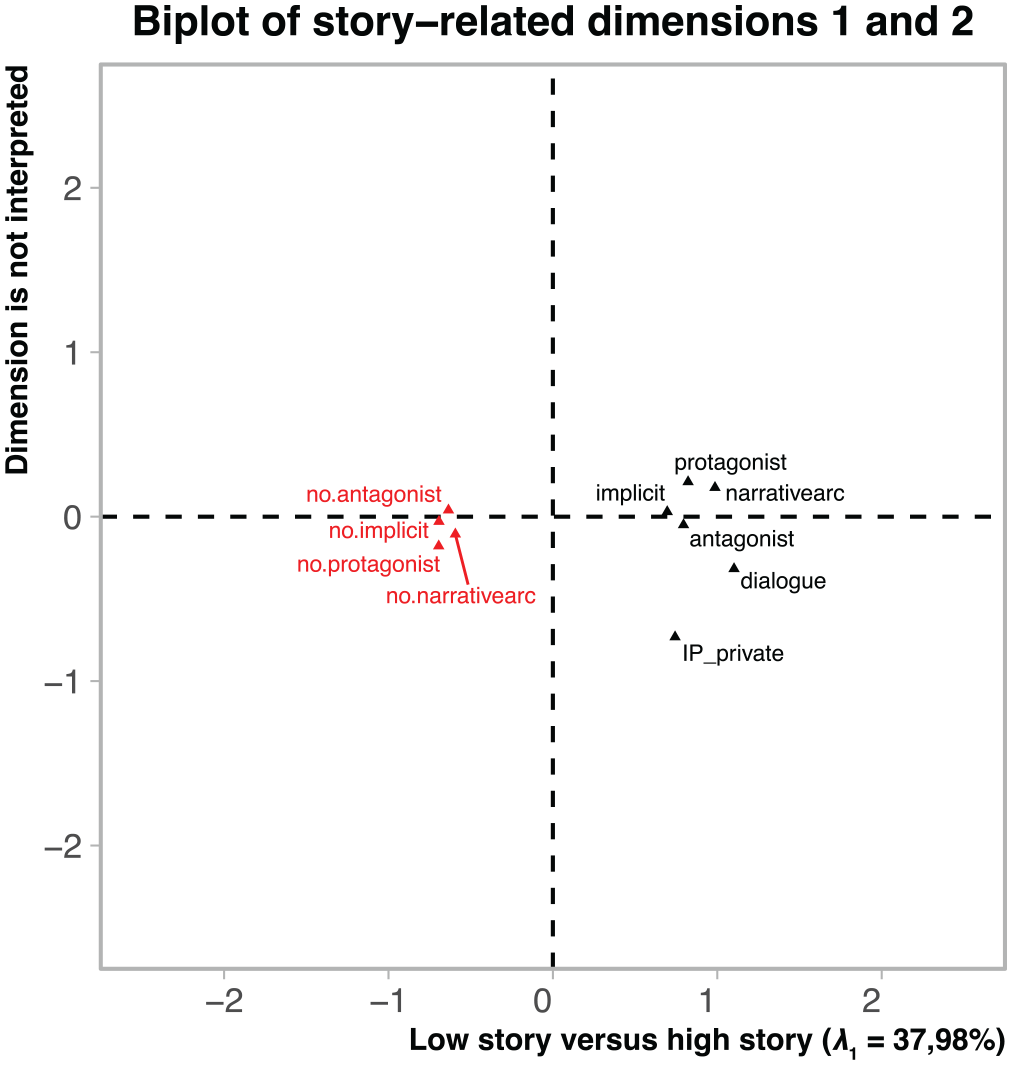
Biplot Displaying the Cloud of Modalities With a Higher-Than-Average (≥5.556%) Contribution to the “Low Versus High Story” Dimension of the Story-Related Modalities
Dimension 1 in Figure 1 separates nonstory modalities from story modalities. This factor thus seems to group together rides that are high in the use of story-elements versus those that are lacking story-elements. Following this interpretation, we label this factor “degree of story.” Examples of rides on the high-story side are Shrek Merry Fairy Tale Journey (Motiongate Dubai), Pirates of the Caribbean (Disneyland Park), and Sesame Street—Street Mission (PortAventura Park). Examples of low-story rides are Magic Train (SantaPark), Plohnis Tauchfahrt (Freitzeitpark Plohn), and Kosmikar (Parque de Attraciones Monte Igueldo).
Theming-related MCAs
Based on the number of factors exceeding the average level of inertia for theming-related modalities (≥3.57%), nine factors were considered. Based on the scree plot, we decided to retain two factors (λ1 = 15.01%; λ2 = 11.87%). Figure 2 shows the 24 modalities that contribute most to the first factor, contributing to 81.94% of its variance. Figure 3 shows the 17 modalities contributing most to the second factor, contributing to 78.11% of its variance.
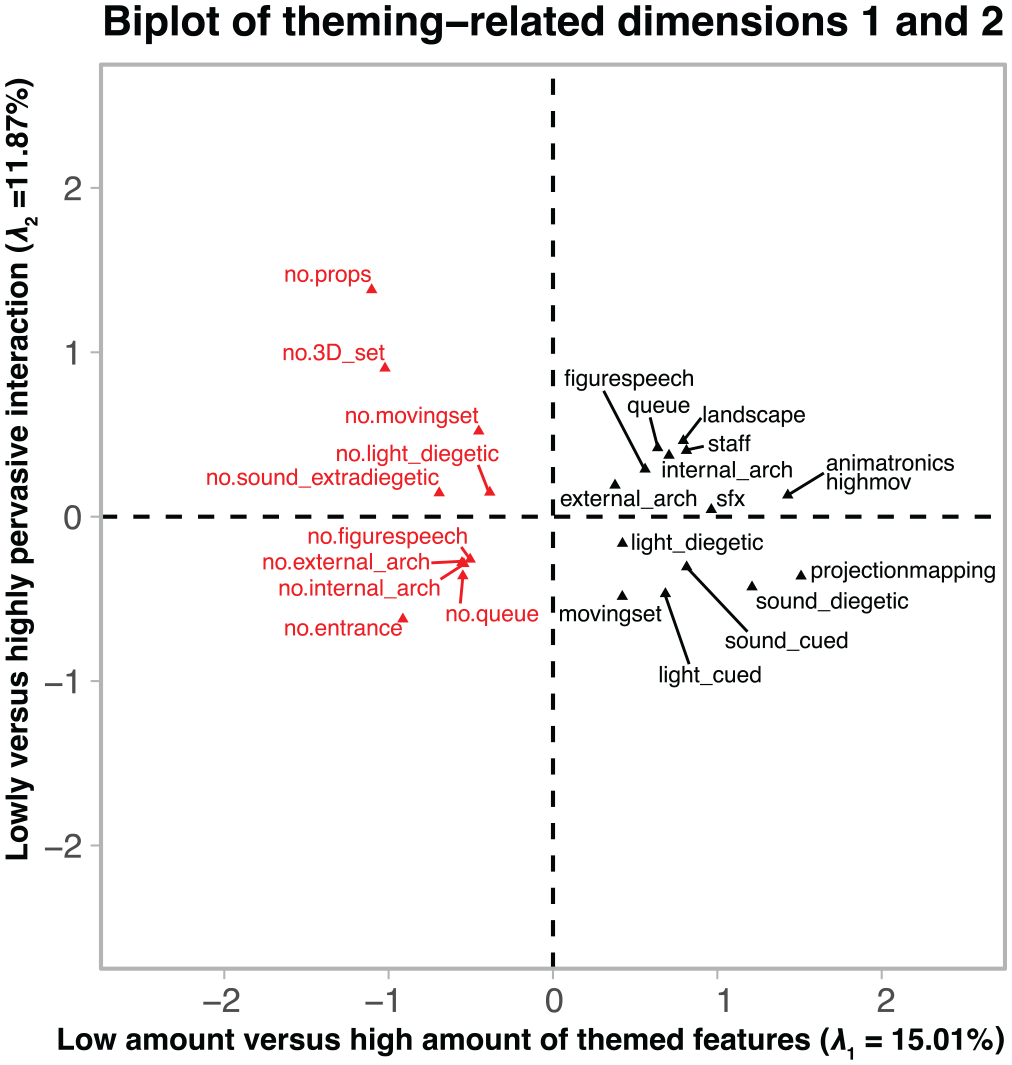
Biplot Displaying the Cloud of Modalities With a Higher-Than-Average (≥1.786%) Contribution to the “Low Versus High Amount of Themed Features” Dimension of the Theming-Related Modalities
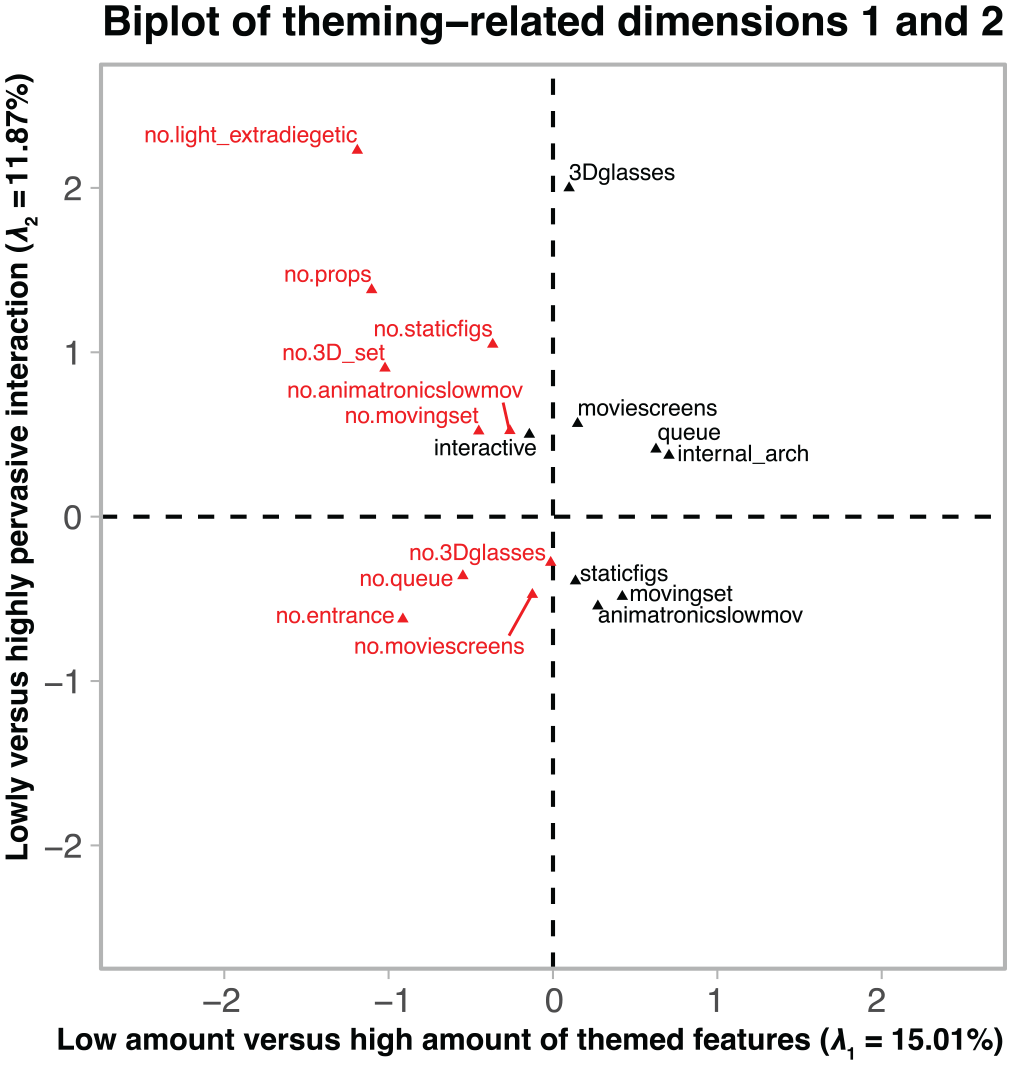
Biplot Displaying the Cloud of Modalities With a Higher-Than-Average (≥1.786%) Contribution to the “Pervasive Interaction” Dimension of the Theming-Related Modalities
The left side of Dimension 1 in Figure 2 mostly groups modalities together that indicate the absence of various theming properties, in particular the lack of three-dimensional scenery and moving set pieces. Furthermore, the scenes lack the use of diegetic light and the use of extradiegetic music, and the figures that are represented in the scenes lack speech. In addition, rides on this extreme of the dimension lack several environmental theming properties, such as themed exterior and interior architecture, a themed queue and a themed entrance. Examples of rides that load high on this side of the dimension are Pinocchio (Tivoli World), Ziggy’s Blast Quest (Milky Way Adventure Park), and Gilly’s Princess Ride (Gulliver’s World).
In contrast, modalities that group together on the right side of Dimension 1 indicate the presence of environmental theming properties. In terms of their scenery, rides on this side of the dimension generally obtain kinetic elements, fluently moving and talking figures and diegetic light and music. Examples of rides loading high on this side of the dimension are Fata Morgana (Efteling), Arthur (Europa-Park), and Hotel Transylvania (Motiongate Dubai).
Modalities on the left side of the axis tend to represent dark rides that use a lower-than-average amount of theming features, whereas the modalities on the right side of the axis tend to represent dark rides that use a higher-than-average amount of theming features. We thus label the current dimension as “amount of theming features.”
Dimension 2 in Figure 3 separates two other groups of modalities. The top side of Dimension 2 clusters modalities indicating the absence of physical scenery elements as well as a lack of lighting to illuminate them. This end of the dimension also groups modalities together that indicate a heavy use of screen-based interactivity. Examples of rides that score high on this end of the dimension are Sholay: The Hunt for Gabbar Singh (Bollywood Parks Dubai), Ghostbusters 5D—Die Ultimative Geisterjagd (Heide Park), and NINJAGO The Ride (Legoland Billund).
On the other extreme of this dimension, modalities group together that explicitly indicate the absence of screen-based scenery, but hint at the presence of physical elements to fill the scenes. Environmental theming features such as a themed queue and entrance seem to be lacking. Examples of rides that score high on the scenery-dominated side of the dimension are Silberbergwerk Grottenbahn (Wiener Prater), Carnaval Festival (Efteling), and Kärlekstunneln (Gröna Lund).
Arguably, the modalities on the top side of the axis tend to represent dark rides that are dominated by interactive screen-based sets, whereas the modalities on the bottom side of the axis tend to be dominated by scenery-based sets. Further inspection shows that in the middle of the dimension, dark rides tend to provide interactive elements that do not contain movie screens or that do not require 3D glasses. Examples of such rides are Challenge of Tutankhamon (Walibi Belgium). There is a gradient going from no interaction at all, via scenery-based interaction to screen-based interaction. Arguably, screen-based interaction allows for more pervasive interactivity than scenery-based interaction. In the screen-based Maus au Chocolat (Phantasialand), for example, guests shoot at mice that are plaguing a Berlin bakery. Hitting several elements on the screen easily triggers various things to happen (e.g., when hitting a gear on a steam pipe, the gear flies off, a steam cloud blows out of the pipe and mice are running around at the same time). By contrast, in El Paso Special (Bobbejaanland), guests shoot at physical scenery, triggering relatively minor scenery movements (e.g., an animatronic moves one or two limbs, a mannikin rotates on a turntable). Following these examples, we thus label this dimension as “pervasive interaction.”
Characterizing the Product Determinants of Dark Rides
Factor scores of the 152 rides on the extracted MCA dimensions highly vary. The story dimension is platykurtic (−1.344, standard error [SE] = 0.397) and although skewness is not affected (0.265, SE = 0.200), there are more rides that score low on the application of story elements than those that score high (mode = −0.755). The dimension pertaining to the amount of theming features is normally distributed (D147 = 0.042, p = .200) and is equally distributed around the center of the dimension (M = 0.000; SD = 0.393). Finally, the dimension for pervasive interactivity is positively skewed (1.263; SE = 0.200) and leptokurtic (1.852; SE = 0.397), indicating that there are more rides that score low in terms of pervasive interactivity than those that score high (mode = −0.142).
Further characteristics of dark rides follow from categorical data and relate to the presence of challenge-based gaming elements and hypothesized emotions. In terms of challenge-based gaming elements, there are more rides that do not contain such elements (70.4%) than those that do (29.6%). In terms of hypothesized emotions, most dark rides are characterized as inducing low ride-based arousal (94.1%), positive emotional valence (80.3%) and low show-based arousal (79.6%), although high show-based arousal (59.9%) and negative emotional valence (55.9%) also frequently occur (see Supplement Table 3, available online). Findings show that dark rides can similarly yield both negative and positive emotional valence as well (36.2%). The same goes for low and high emotional arousal (both ride-based [21.7%] and show-based [39.5%]). An example of this is Blanche-Neige et les Sept Nains (Disneyland Park), which arguably triggers both positive and negative emotions with high and low show arousal, but only low ride arousal. Droomvlucht (Efteling), on the other hand, is an example of a ride with both low and high ride arousal. After guests are gently transported past four fantastical scenes, the final scene rushes by at 18 km/h on a 13-meter descent.
Differences Between Theme and Amusement Parks
In addition to giving an overall image of the aforementioned dark ride characteristics, we tested for differences on these characteristics between theme and amusement parks. The 152 rides in our sample seem to be spread roughly evenly across theme (46.7%) and amusement parks (53.3%). Nonetheless, t tests on the saved factor scores of the MCA-dimensions demonstrate that theme parks score significantly higher than amusement parks on story: (t149.575 = 7.921, p < .001) amount of theming features (t150 = 5.827, p < .001) and pervasive interaction (t144.008 = 3.999, p < .001).
There was no significant difference between theme and amusement parks for challenge-based gaming elements (χ21 = 0.132, p = .716). Furthermore, theme parks make significantly more use of high show arousal than amusement parks (75.3% vs. 42.3%; χ21 = 17.207, p < .001), while the latter use significantly more low show arousal than theme parks (90.1% vs. 70.4%; χ21 = 9.109, p = .003). For the remaining emotion dimensions, no significant differences were observed.
Discussion and Conclusion
In the current article, we explored the objective design elements of a large sample of dark rides in the EMEA region to compare literature-based conceptualizations of the dark ride experience against a typology of actual dark ride supply. After proposing to refine Langhof and Güldenberg’s (2019) model of the dark ride experience to include narrative transportation, presence, flow, and emotions, we explored to what extent the existing dark ride supply obtains the objective design elements that have been argued to induce these states. To that end, we evaluated on-ride footage of 238 rides on the presence of story, theming, challenge-based gaming elements, and emotional content, which we then reduced to a smaller number of underlying dimensions. Results indicate that story-related and theming-related elements can be boiled down to three underlying dimensions which dark rides tend to vary on: low versus high story, low versus high amount of theming features and lowly versus highly pervasive interaction. Also, we found that dark rides may mostly trigger positive emotional valence and low show and ride arousal, but that high show arousal is also often triggered. Finally, we found significant differences between dark rides in theme and amusement parks.
Presenting the Dark Ride Cube
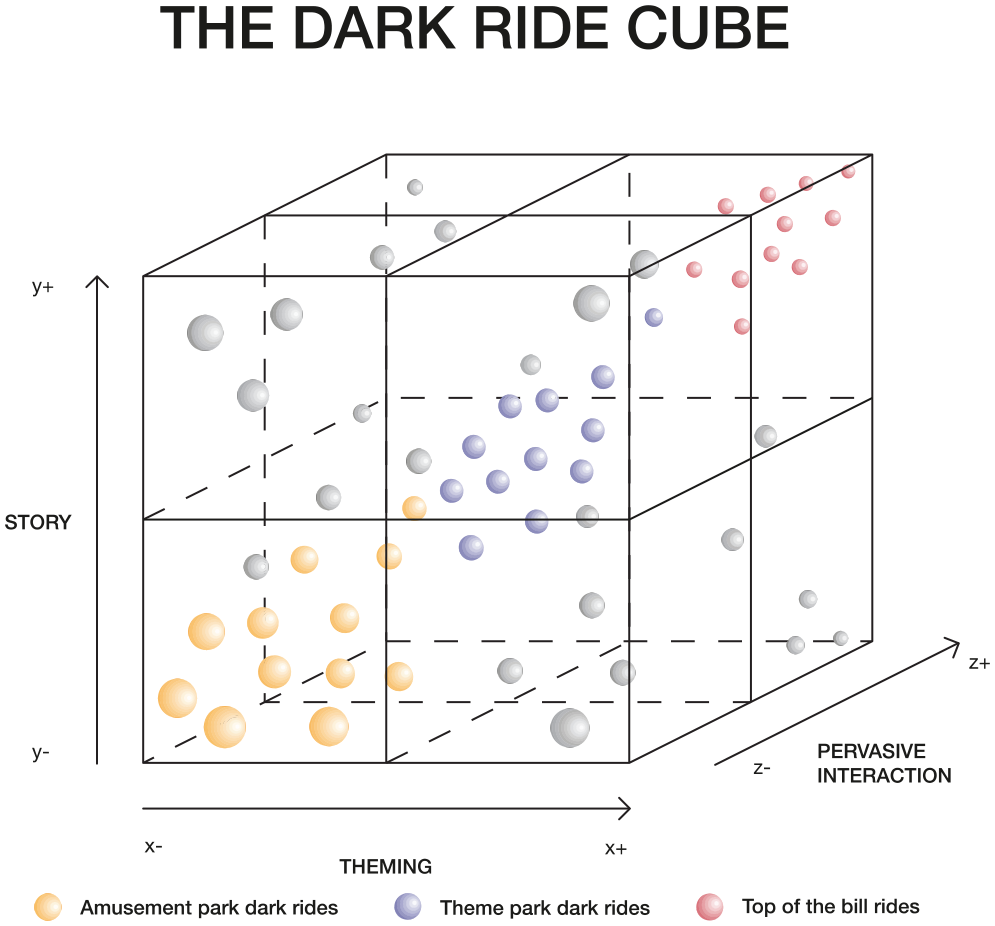
From the MCAs, three dimensions have come to the fore which can be considered as the constituent elements for a dark ride typology. Combining these three dimensions, we present the Dark Ride Cube (DRC; see Figure 4) as a model for classifying dark rides in terms of their design elements.
The Dark Ride Cube
The Y-axis of the DRC consists of the continuous spectrum of story-related modalities. The X-axis represents the number of theming features, which can be low or high along a continuous spectrum as well. These two dimensions are in line with the most characteristic product determinants of presence and narrative transportation (Hennig-Thurau & Houston, 2019). Also, they are in line with the theme park literature, which suggest storytelling and theming to be two key elements of themed entertainment (Cornelis, 2017; Freitag, 2017; Langhof & Güldenberg, 2019; Lukas, 2012). In turn, the Z-axis of the DRC represents a spectrum of pervasive interaction. With some exceptions, almost all rides that score high on this dimension also contain challenge-based gaming elements. Additional analyses support this notion: the factor scores on the pervasive interaction dimension for rides with challenge-based gaming elements are significantly higher than those for rides without such elements (t62.383 = −4.047, p < .001). Note, however, that while it is tempting to link this dimension to the state of flow (Emri & Mäyrä, 2005, Hennig-Thurau & Houston, 2019), care should be taken in making this link explicit. Although a strong relationship between flow and challenge-based elements has been suggested elsewhere (Hennig-Thurau & Houston, 2019), arguably, pervasive interactivity does not quite cover the entire load of the flow concept. At best, this dimension describes the pervasiveness of interaction, representing theming blended with challenge-based gaming elements, rather than an indication of how challenging these elements actually are.
Theme Versus Amusement Parks
Results indicate that there is a significant difference between dark rides in amusement parks and those in theme parks. On the XY-plane of the DRC, rides in theme parks tend to cluster in the upper right quadrant, whereas those in amusement parks tend to fall into the lower left corner. When ghost trains are included, this difference becomes even more extreme, because all ghost trains can be positioned in the lower left corner of the XY-quadrant and more than 95% of these rides are in amusement parks. In addition, a little over half (53.7%) of all dark rides in the EMEA region are in theme parks, while only 10% of the 300+ parks in the EMEA region are theme parks (Cornelis, 2011). Dark rides can therefore be considered as archetypal theme park attractions, as noted previously in the theme park literature (Younger, 2016). Using the Z-dimension of the DRC, another difference in rides between amusement parks and theme parks can be observed. In sum, theme parks offer more and different kinds of dark rides than amusement parks.
Defining the Top of the Bill
Previously, storytelling and theming have been suggested as successful strategies for themed entertainment (Cornelis, 2017; Freitag, 2017; Lukas, 2012). When considering rides that score in the upper quartiles of the DRC’s story and theming axes, 18 rides remain. Disneyland Paris counts for most of these 18 dark rides. Out of the 9 dark rides in the French Disney parks, 6 are part of this top 18. The remaining 12 dark rides are in Motiongate Dubai (4), Europa-Park (3), Warner Bros. World Abu Dhabi (2), Gardaland (1), Movie Park Germany (1), and Walibi Belgium (1). Given the success of storytelling and theming, these rides can be considered as top of the bill.
Notably, all 18 rides are situated in theme parks, of which Disney has the largest share with 6 dark rides. Of the remaining 12 dark rides in this top 18, 9 have opened over the past 7 years. None of the top-of-the-bill dark rides opened before 1992, the year Disney opened its gates in Europe. Naturally, newer dark rides score higher when it comes to the application of more recent technologies (e.g., projection mapping), but this represents only a limited part of the variables we researched. Furthermore, they are only of influence on the X dimension of the DRC. The fact that newer top-of-the-bill dark rides score higher on the XY dimension might support previous suggestions of a general quality impulse resulting from Disney’s entrance to the European market (Anton Clavé, 2007; Cornelis, 2011).
Comparing the Proposed Dark Ride Experience to Dark Ride Supply
From the positions of individual dark rides across the planes of the DRC, it follows that dark rides are highly scattered across the three dimensions of storytelling, theming, and pervasive interactivity. Furthermore, they are distributed in a particular way: Whereas the dimension of theming follows a normal distribution, the dimensions of storytelling and pervasive interactivity tend to be positively skewed. This has two implications.
First, the current evidence suggests that our distinction of immersion into narrative transportation, presence, and flow seem worthwhile. Three different dimensions of the DRC form the product determinants of these different psychological phenomena. The scatteredness of the various rides across the DRC dimensions indicates that these product determinants are present to varying degrees. Narrative transportation, presence, and flow can thus be triggered in a variety of ways, leading to qualitatively very different experiences (Brown & Cairns, 2014) and outcomes (Hennig-Thurau & Houston, 2019). The current findings corroborate Langhof and Güldenberg’s (2019) notion of immersion as an overarching concept in the dark ride experience. At the same time, the findings suggest that distinguishing between immersion’s constituent psychological faculties makes sense. In Figure 5, we therefore present a slightly modified version of Langhof and Güldenberg’s (2019) model of the dark ride experience, in which immersion is included as a core element, but is now further separated into its three constituent psychological functions.
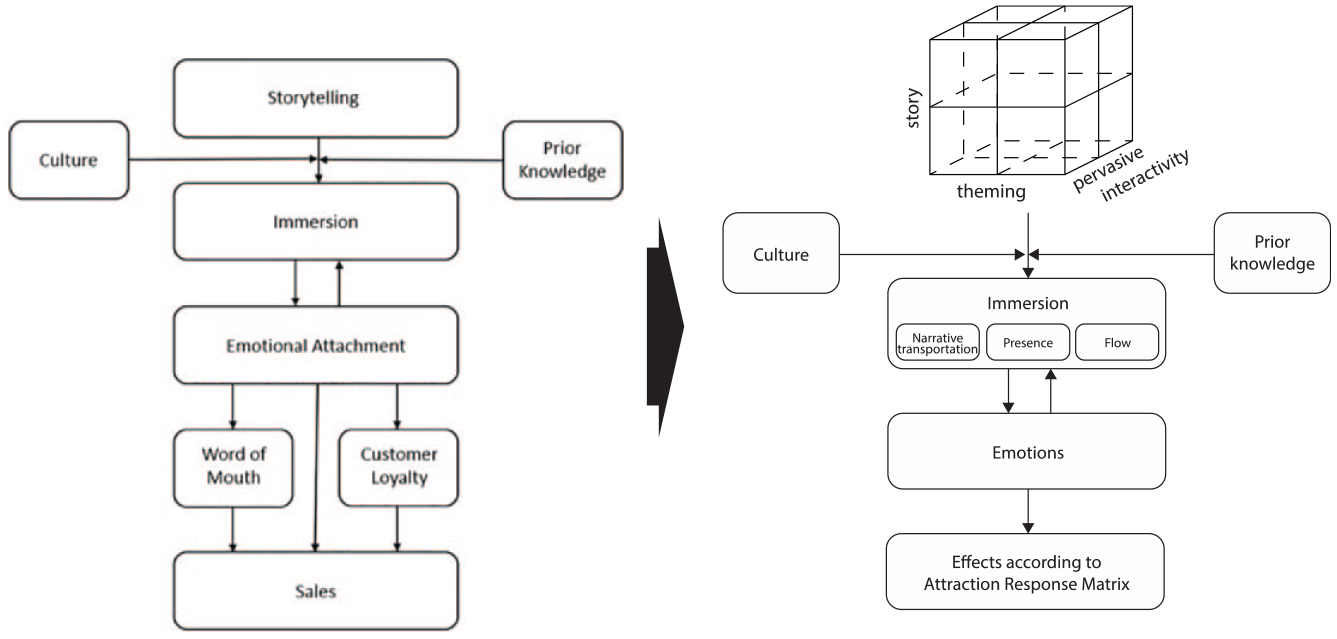
Confirmations of and Slight Modifications to Langhof and Güldenberg’s (2019) Model of the Dark Ride Experience
Second, we argue that the ascribed importance to storytelling as the cornerstone of the dark ride experience should be critically reviewed. From the distribution of individual rides across the planes of the DRC, it follows that the storytelling dimension is positively skewed. This means that there are relatively more rides that score low on storytelling than those that score high. While for some type of dark rides, storytelling may indeed form a key design element that everything else is built on, the empirical evidence suggests that storytelling is not central to the entire dark ride phenomenon. This partly confirms Langhof and Güldenberg’s (2019) conceptualization of storytelling as a crucial design element in the dark ride experience. To emphasize that other elements such as theming and pervasive interactivity could be of importance when storytelling has a less pivotal role, we propose to embed storytelling in the DRC by adding it to the model of the dark ride experience (see Figure 5). The ascribed importance to storytelling might stem from the exclusive focus on best practices of key industry players in the literature. These key players tend to score exceptionally high on the story dimension (see Defining the Top of the Bill section). At the very least, the current typology of dark rides suggests that there is no singular dark ride experience. Instead, there may be several types of dark rides. Based on their unique combination of storytelling, theming, and pervasive interaction, different rides lead to different experiences, with different levels of narrative transportation, presence, and flow.
In sum, the current effort of comparing literature-based conceptualizations of the dark ride experience against actual dark ride supply both confirms Langhof and Güldenberg’s (2019) conceptualization of the dark ride experience and adds some slight modifications to it. The present work is not the first to build a typology of a tourism phenomenon to enrich a theoretical debate. For dark tourism, for example, a Seven Dark Supplier framework has been proposed (Stone, 2006). This framework laid the groundwork for a cascade of follow-up studies on dark tourism experiences. As we demonstrate in the current article, comparing literature-based conceptualizations against supply is a worthwhile venture for dark rides too. Furthermore, we support the use of MCAs to reduce a vast numbers of objective design elements into a workable number of underlying dimensions.
Practical Implications
The findings in the current study come with two practical implications. First, the DRC typology provides suppliers with an overview of the underlying dimensions on which existing dark rides vary. The factor plots resulting from the MCA display several design elements that differentiate the various extremes of the DRC against one another. For example, from Figure 4, it follows that rides on the “high theming” side of the dimension mostly differ from the average dark ride by containing projection mapping effects and animatronics with a high movement profile. Suppliers who seek to differentiate from the market average by means of theming may thus consider applying such design elements as well.
A second practical implication is that different park contexts have different dark rides. According to the DRC, amusement parks offer a different type of dark ride than theme parks. For designers, designing a dark ride for amusement parks may thus imply different design elements than dark rides for theme parks. However, further research is needed to empirically establish the relationship between design elements and subjective states during dark ride experiences. Such findings would allow for more accurate practical recommendations on which design elements to employ to evoke a specific intended dark ride experience.
Further Considerations
In modeling the DRC, we have mostly focused on product determinants of narrative transportation, presence, and flow. Given the prominent role of emotions in experience (e.g., Bastiaansen et al., 2019), in the literature review, we argued that dark rides might also be typologized on the basis of consumer emotions. We therefore explicitly added it to our definition of dark rides and to our conceptualization of the dark ride experience (see Figure 5). Nonetheless, while emotions were included in our methodological procedure, the findings regarding these items were less clear-cut in their interpretation. Furthermore, in this study, we hypothesized about emotions that are likely to occur during rides, based on a subjective assessment of the researchers with regard to the emotional nature of the dark rides’ sceneries and ride systems. Because of the subjective nature of emotions, results in the current study are therefore rather hypothetical. To study whether dark rides can also be typologized in terms of emotions, future research should focus on measuring emotions from consumers themselves.
A limitation in our research is that the analysis took place using on-ride video footage. We chose this approach as an alternative to visiting all dark rides firsthand. Of course, nonvisual elements such as smell, temperature differences and source locations of sound could not be observed from video footage. To see how such ambient factors further contribute to the classification of dark rides, future research should include such additional sensory experience elements as well. Also, we argue that additional research is needed on the theming scale, in which observations are to be made regarding not only the presence of theming features but also regarding the level of theming (e.g., macro vs. micro theming; Cornelis, 2011; Lukas, 2012). As operationalizations of theming remain limited, future research should be aimed at further operationalizing the theming concept. Finally, the current research is limited to the EMEA region. As parks in other regions are in a different phase of the product life cycle (Anton Clavé, 2007), comparative research in these regions could lead to different results.
With the current confirmations of and slight modifications to Langhof and Güldenberg’s (2019) conceptualization of the dark ride experience, the present work contributes to laying the groundwork for future research on the dark ride experience, as suggested by Langhof and Güldenberg (2019). Arguably, in further research on the dark ride experience, more substance should be given to the various effects as identified in the Attraction Response Matrix (Cornelis, 2010), which we suggest to add to the conceptualization of the dark ride experience (see Figure 5). The Attraction Response Matrix distinguishes between four levels of impact (attraction, park, brand, and economic response) along different temporal dimensions (preexperience, direct, short-term and long-term response). Distinguishing the various levels of impact makes sense, because dark rides are always embedded within the larger context of a park. As consumers generally make their buying decision for theme parks as a whole, it would be relevant to see how the responses to individual dark rides contribute to the larger park experience on various temporal dimensions. For example, what is the link between a specific dark ride experience on the memory and evaluation of this ride and (with it) on the decision-making process concerning future park visits? How are a dark ride experience and the image of a park related? Does a strong ride experience embolden the brand positioning? What are the consequences for revisit intentions? What determines the optimal ride experience? Addressing such questions would bring dark ride research up to speed with existing research on theme park experiences (see, e.g., Ali et al., 2018; Cornelis, 2011; Dong & Siu, 2013; Liang & Li, 2021; Milman & Tasci, 2018; Wu et al., 2014).
Supplemental Material
sj-docx-1-jht-10.1177_10963480221080331 – Supplemental material for Conceptualizing the dark ride experience through the Dark Ride Cube: Evidence from the Emea region
Supplemental material, sj-docx-1-jht-10.1177_10963480221080331 for Conceptualizing the dark ride experience through the Dark Ride Cube: Evidence from the Emea region by Pieter C. M. Cornelis, Wim Strijbosch and Philip Corsius in Journal of Hospitality & Tourism Research
Footnotes
Authors’ Note:
The authors would like to thank Johan van Ruijven, Erik Huijing, and Luc Jenniskens from DRdb for providing us with a comprehensive datafile of the dark rides listed in the database.

Supplemental Material
Supplemental material for this article is available online.
References
Supplementary Material
Please find the following supplemental material available below.
For Open Access articles published under a Creative Commons License, all supplemental material carries the same license as the article it is associated with.
For non-Open Access articles published, all supplemental material carries a non-exclusive license, and permission requests for re-use of supplemental material or any part of supplemental material shall be sent directly to the copyright owner as specified in the copyright notice associated with the article.
