



Abstract
With empirical insights gained across a series of studies, the current research examines the technology-facilitated preservice tipping encounter. Drawing on the tip-enhancing literature and the spatial crowding theory, this research reveals the divergent impacts of tip suggestion on consumers’ tipping behaviors and their satisfaction with the digital payment experience. Our findings show that, while effective in elevating tipping amount, the presence of tip suggestion can frustrate consumers and impose a detrimental impact on their satisfaction with the online payment experience. Particularly, this effect is contingent on the design of the digital payment page: The negative effect of tip suggestion on satisfaction with the payment experience is more profound when the digital payment page follows a crowded layout but mitigated when the layout is spacious. Findings from the current research offer timely contributions to theory and practice with an evolving perspective on the technology-facilitated preservice tipping encounter.
Highlights
Tip suggestion has divergent effects in technology-facilitated preservice context.
Tip suggestion is effective in increasing tipping amount to service employees.
Tip suggestion frustrates consumers and impose a detrimental impact.
This detrimental effect is contingent on the layout design of digital payment page.
Introduction
As a classic consumer behavior phenomenon, tipping has long been a prominent research topic in hospitality management literature. Consumer tipping constitutes a considerable portion of service employees’ income (Hilkenmeier & Hoffmann, 2021). With technology continues to advance the global hospitality and service industry, the phenomenon of consumer tipping is also facing new changes and trends that deserve scholarly attention. Previous research has mainly discussed tipping as a postservice behavior (Lynn & McCall, 2016). Recent advancement in technology, however, is rescripting this long-accepted consumption ritual, changing how and when consumers tip (Warren et al., 2021). The emerging technological innovations, especially the rising power of remote service platforms and mobile order and payment technology (e.g., DoorDash, Grubhub, and Uber Eats), have changed the tipping encounter from more “touch-oriented” to more “tech-oriented” (Fan & Mattila, 2021). Consumer tipping is thus less reliant on the interpersonal and interactive processes between consumers and service employees but more shaped by the intermediary technology interface (Warren et al., 2021). In fact, those consumers who tip via technology intermediaries may not have any direct interactions with their servers. In addition, consumer tipping may happen before service provision, as more and more businesses request for consumer tipping at the time of payment rather than at the end of the service session (Khan, 2020; Warren et al., 2021). For example, food ordering-delivery service platforms such as Uber Eats and DoorDash prompt consumers to tip at the time of order, before the delivery service is even initiated.
Despite the exciting research opportunities it presents, the technology-facilitated preservice tipping encounter is yet to attract scholarly attention (Warren et al., 2021). With the emerging practices attaining divergent market responses, this evolving practical realm offers tremendous opportunities for researchers to advance theory with new contextual insights (Miao, 2021). As service interactions become increasingly mediated by technology, behavioral principles governing consumer behaviors in the classic in-person tipping encounters may become less relevant, giving prominence to new mechanisms and processes that present higher predictive power for tipping behaviors in the new era (Warren et al., 2021). To that end, research-backed practical insights will also help guide practitioners better navigate the new practical reality and more effectively handle the rising challenges in technology-facilitated preservice tipping encounters (Levitz, 2018). After all, not all consumers are equally excited by the novel etiquette of technology-facilitated preservice tipping, where a mobile phone platform nudges you to tip between 15%, 20%, or 25% on top of service fees for a take-out order (McCorvey, 2021).
Against such a broader backdrop, the current research takes a novel approach to examine the impact of tip suggestion and digital payment page layout on consumer’s tipping behaviors and experiences in the technology-facilitated preservice tipping encounter. Drawing on the tip suggestion literature and the spatial crowding theory, we propose that the presence of tip suggestion may exert divergent impact on consumers’ tipping amount and their satisfaction with the online payment experience. Effective in elevating tipping amount, the presence of tip suggestion may frustrate consumers and hence impose detrimental impact on their satisfaction with the digital payment experience. In particular, this effect will be more profound when the digital payment page follows the design of a crowded layout but mitigated when the layout is spacious. In previous literature, layout design has been demonstrated as a significant driver for positive consumer responses and behaviors in the context of online consumption environment (Y. Zhou et al., 2020). While existing empirical evidence is in favor of the advocacy toward a lean and spacious page layout design, in practice the designer has a loaded volume of information that needs to be disclosed (e.g., ordered items, price, promotions, taxes and fees, rules and policies on delivery, payment information, delivery address and time, etc.) and often cannot design the page in its most lean and spacious form. With the empirical focus on consumers’ payment experience satisfaction, our research presents another reason why digital payment page should follow a lean and spacious design style rather than a loaded and crowded design style. A spaciously designed payment page can mitigate the negative impact of tip suggestions on consumers’ satisfaction with the digital payment experience, without lowering the tipping amount. With insights gained from a series of studies, the findings from the current research present valuable contributions to theory and practice with an evolving perspective on the technology-facilitated preservice tipping encounter.
Theoretical Background and Hypothesis Development
Tip-Enhancing Factors and Strategies
Although the general perception is that consumers’ tipping amount reflects the quality of service received (Lynn & Sturman, 2010), the meta-analysis by Lynn and McCall (2016) has found that tipping behaviors are only weakly related to service quality and the impact of service quality on tipping amounts is marginal at best (Karniouchina et al., 2008; Lynn, 2018). Rather than service satisfaction, consumers may decide to tip because of many other reasons such as emotion and mood, social norm and obligation, impression management, quality control, generosity, and reciprocity (Becker et al., 2012; Lynn, 2006; Seiter & Weger, 2018). The major stream of tipping research thus focuses on factors and strategies, beyond service quality, that can enhance consumer’s tipping amount (Lynn, 2018). The extant tip-enhancing research revolves around three groups of factors and strategies: business related, server related, and consumer related.
The first group of research investigates businesses’ strategic level factors and/or efforts to enhance consumer tipping. For instance, some restaurants use servicescape design to subtly influence consumer’s tip-enhancing behavior (e.g., background music—Jacob, Guéguen, & Boulbry, 2010; color of tablecloths or check holders—Lee et al., 2018). In addition, some businesses may take direct, explicit strategies to enhance the overall consumer tipping scale. For example, some restaurants may automatically add a tip to the bill (Seiter et al., 2011). Moreover, others adopt a relatively indirect method of tip enhancement by printing tipping guidelines on the bill (Karniouchina et al., 2008).
The second group of tip enhancement studies discusses server-related factors and tactics. Servers with certain qualities or approaches may earn more tips than others, including their personal appearances (e.g., makeup—Jacob, Guéguen, Boulbry, & Ardiccioni, 2010), and their purposeful tipping tactics to consumers such as addressing of names (Garrity & Degelman, 1990), smiling (Bujisic et al., 2014), complimenting (Seiter, 2007), touching (Crusco & Wetzel, 1984), squatting at eye level (Davis et al., 1998), leaving various positive/cheerful/funny/thankful images or messages on checks (Rind & Bordia, 1995, 1996; Rind & Strohmetz, 1999), handling leftover (Seiter & Weger, 2018), and offering a gift (Hilkenmeier & Hoffmann, 2021).
The third group of tipping research examines the impact of various consumer-related factors on tipping, including consumers’ demographic backgrounds (e.g., age, gender, ethnicity, nation, education and income level, and lifestyle; Lynn, 2006, 2014; Lynn et al., 1993; Lynn & Lynn, 2004; Lynn & Thomas-Haysbert, 2003), and their dining features (e.g., party size—Freeman et al., 1975; alcohol consumption—Lynn, 1988; method of payment—Lynn & Latané, 1984). This stream of literature suggests that the norms and behaviors of tipping are more profound among consumers who are White, middle-aged, highly educated, wealthy, and living in metropolitan areas (Lynn, 2006), and that consumers tend to give larger tips when paying bills with credit cards than with cash (Lynn & Latané, 1984).
Among various tip-enhancing factors and strategies, one practice has been recognized as particularly effective, that is, to add “tip suggestions” or “tipping guidelines” on the bill (Karniouchina et al., 2008; Seiter et al., 2011; Strohmetz & Rind, 2001). This tactic has also been adopted in the technology-facilitated tipping encounter where service providers present tip suggestions to prompt consumers to tip for the requested service, often before the service is provided (Kim, 2018). Such a new practical phenomenon of technology-facilitated preservice tipping has drawn increasing attention (Levitz, 2018; Warren et al., 2021) but yet deserves further examination. In particular, little is known about the impact of tip suggestions on consumers’ tipping amount as well as their satisfaction with the payment experiences in such technology-facilitated preservice tipping encounters. We thus review the streams of literature on technology-facilitated preservice tipping encounters and the effect of tip suggestions to guide our theorization.
Technology-Facilitated Preservice Tipping Encounters and the Effect of Tip Suggestions on Tipping Amount
Technology-facilitated preservice tipping encounters depict those occasions where service providers request consumers to tip before service provision via technology-facilitated platforms, devices and/or systems (Warren et al., 2021). As a pioneering effort in the literature to examine the emerging technology-facilitated preservice tipping encounter, Warren et al.’s (2021) study finds that a preservice (vs. postservice) tip may undermine consumer responses, leading to smaller tips, lowered return intentions, and diminished word-of-mouth intentions and online ratings. Given that changing tip sequence lowers consumer’s tipping amount, further research is necessary to understand the impact of other tip-enhancing tactics (i.e., providing tip suggestions) in today’s technology-facilitated preservice tipping encounters.
The extant research regarding the effects of tip suggestions on tip amounts is limited and provides mixed findings (Dyussembayeva et al., 2022). Some studies indicate that tip suggestions can significantly increase tip amounts (Karniouchina et al., 2008; Seiter et al., 2011) possibly through three social influential mechanisms: an educational cue to remind consumers to give adequate gratuity for service (Karniouchina et al., 2008), a normative cue appealing to people’s desire to conform to societal standards regardless of individual preferences (Bernheim, 1994; Karniouchina et al., 2008), or a heuristic cue to save consumers’ efforts in determining the tipping amount (Seiter et al., 2011) and make them willing to be generous (Karniouchina et al., 2008). On the contrary, Dyussembayeva et al. (2022) suggest that consumers could react negatively to attempted social influences and the social pressure induced by tip requests might threaten consumers’ freedom to tip, which leads to a reverse (negative) effect on tip amount; however, the physical presence of service staff could moderate (alleviate) such a negative effect of the explicit tip suggestions on tip amounts through the possible effective social pressure instead of reactance.
Nevertheless, all the existing studies of tip suggestion effect on tip amount are conducted in the in-person postservice tipping encounter context, except Warren et al.’s (2021) preservice investigation. While in practice, restaurant chains such as Jimmy John’s Sandwiches and Papa John’s Pizza have long included the tip request as part of their online ordering and payment process on their websites, and consumers have to specify their tipping amount before their food is made and delivered (Warren et al., 2021). The emerging third-party service apps, such as DoorDash and Uber Eats, also adopt the same “tip before service” practice for their online food ordering-delivery services. Overall, the technology-facilitated preservice tipping encounters alter the long-accepted “service first, tip later” sequence of practice (Becker et al., 2012) and reduce the social influence of individual servers in the tip request encounters. To date, no research has investigated the effectiveness of such a tip-enhancing tactic as including explicit tip suggestions in the technology-facilitated, contactless preservice tipping context. To fill this research gap, the current research aims to investigate how adding tip suggestions on the online payment page may affect the tipping amount. On one hand, the social and heuristic cues induced by tip suggestions may augment consumer tipping amount (Karniouchina et al., 2008; Seiter et al., 2011); on the other hand, consumers may react negatively to attempted social pressure by tip suggestions and reduce their tip sizes (Dyussembayeva et al., 2022). Therefore, to explore the effect of tip suggestions on tipping amount in the context of technology-facilitated preservice tipping encounters, we propose the exploratory research question as follows.
Technology-Facilitated Preservice Tipping Encounters and the Effect of Tip Suggestions on Consumer’s Satisfaction With the Digital Payment Experience
Although previous studies indicate that tip suggestions may elevate tipping amount (Karniouchina et al., 2008; Seiter et al., 2011), it is not clear how its presence may affect consumers’ satisfaction with their online payment experiences. Anecdotal claims by the press speculate that presenting tip suggestions could be seen as tacky or pushy by consumers and trigger strong consumer reactance (Hesser, 1999; Will, 2020). The speculation of tip suggestions arousing consumer reactance is in line with the consumer reactance theory. Consumer reactance theory cautions the possibility that marketing persuasive efforts can arouse consumers’ resistance to the attempted influence (Dillard & Shen, 2005). According to this theory, consumer reactance occurs when the marketing persuasive influence poses a threat to one’s free behaviors (Dillard & Shen, 2005). A recent postservice tipping encounter research by Dyussembayeva et al. (2022) also implies that explicit tipping requests may pose a threat to consumers’ freedom to tip and make consumers feel manipulated (Strohmetz & Rind, 2001) resulting in psychological reactance. In addition, consumer inferences of manipulative intentions induced by service environments and actions (e.g., tip requests) are connected to negative evaluations and responses (Warren et al., 2021). Negative emotions such as anger and frustration are a core component of the psychological state of reactance (Dillard & Shen, 2005; Quick et al., 2015). Such negative emotions further lead to resistant attitudes and behaviors against marketing persuasive influences such as promotions and advertisements (Chen et al., 2019; Dillard & Shen, 2005). At the same time, the satisfaction/dissatisfaction literature identifies the negative emotions of anger, frustration, and irritation as strong antecedents to consumer dissatisfaction (Oliver, 1993). Applying the reactance theory to the current research, we posit that the presence of tip suggestions on the payment page could induce perception of manipulativeness, which will elicit consumers’ resistance and adverse responses expressed as intensified negative emotions (e.g., frustration, irritation, and anger) toward the payment experience and the consequent increased dissatisfaction with the online payment experience. Therefore, the basic effect regarding tip suggestions on consumers’ evaluations of their digital payment experience is proposed.
Furthermore, we propose that the negative effect of tip suggestions on consumers’ satisfaction with the payment experience shall be contingent on the design of the technology interface, in particular, the spatial layout of the payment page being crowded versus spacious. By manipulating the size and the layout of interface elements (e.g., frame, text, and button), user experience designers can influence consumers’ perception of a particular digital page being crowded or spacious (Messer & Leischnig, 2015; Y. Zhou et al., 2020). According to previous research, spatial crowding perception is defined as a “subjective unpleasant feeling and a state of psychological stress or cognitive overload” (Y. Zhou et al., 2020, p. 355). Research in psychology, environmental behavior, consumer behavior and retailing has proved the negative effects of spatial crowding—it triggers an unpleasant, stressful psychological status (Eroglu & Machleit, 1990), which leads to negative responses in terms of evaluation, attitude and behavior (Blut & Iyer, 2020).
Spatial crowding perception is found to moderate the impact of individuals’ negative emotional responses toward service experiences. Environmental stimulus can shed profound impact on individuals’ emotional processes (Mehrabian & Russell, 1974). In particular, research finds that spatial crowding can augment consumers’ experience of negative emotions, which sequentially lowers shopping enjoyment (Baker & Wakefield, 2012) and satisfaction (Blut & Iyer, 2020). On the contrary, a spacious layout may mitigate the intensity of negative emotions experienced by individuals (Y. Zhou et al., 2020) as the perceived spaciousness is able to induce spatial control and pleasure (van Rompay et al., 2012). Specifically, drawing on spatial crowding perception theory to the context of interface design, Y. Zhou et al. (2020) indicates that a perceivably crowded interface design increases the intensity of consumers’ complaints submitted through a small-screen device (i.e., mobile phone). On the other hand, a spacious interface design was able to alleviate the intensity of consumers’ complaints (Y. Zhou et al., 2020).
In line with the above-reviewed research, we propose that the negative effect of tip suggestions on consumers’ satisfaction with the digital payment experience will be particularly salient when the payment page is designed following a crowded layout. As the crowded layout generates an unpleasant state of psychological stress, it may further exacerbate the psychological reactance consumers experience as they undergo resistance against tip suggestions in the preservice tipping encounter (Hesser, 1999; Warren et al., 2021; Will, 2020). As a result, consumers’ felt negative emotions toward the payment experience (resulted from the perceived manipulativeness of explicit tip suggestions) may become increasingly salient (Dillard & Shen, 2005). Thus, presenting tip suggestion information (vs. not) on a digital payment page that is designed with a crowded layout can have increasingly negative effects on consumers’ satisfaction with the digital payment experience, which is mediated by intensified negative emotions such as frustration, irritation, and even anger. Designing the digital payment page following a less crowded interface layout, however, may mitigate the intensified negative emotions toward the payment experience (Blut & Iyer, 2020; Y. Zhou et al., 2020). As a spacious layout induces control and pleasure (van Rompay et al., 2012), it may also complement consumers’ threatened sense of freedom and hence alleviate the psychological reactance process. As such, the negative impact of tip suggestions on consumers’ satisfaction with the payment experience should be attenuated when the layout of the digital payment page is spacious. Specifically, the relevant hypotheses are posited as follows:
In addition, we further explore the downstream effects to investigate how consumers’ satisfaction with their digital payment experience may further affect their continuance usage of both the digital media and service providers. The online consumption literature suggests that consumers would be reluctant to make purchase if they are not satisfied with the online consumption environment including how the online payment process is designed and experienced (T. Zhou, 2013). Thus, user satisfaction with their digital experiences, including digital payment experience, is a crucial factor in e-commerce success (Wang, 2008), and mobile payment satisfaction is a fundamental drive for the continuance usage intention of the digital application (Humbani & Wiese, 2019; T. Zhou, 2013). Continuance usage intention reflects to what extent consumers who use a digital application (e.g., online payment webpage or mobile payment app) to purchase products or services have developed conscious plans to continuingly use the same or similar application in the future (Humbani & Wiese, 2019). When digital application users’ satisfaction escalates, they not only tend to use the application again (Susanto et al., 2016), the enhanced satisfaction may also prompt users’ repeated business from the same service provider (Hong et al., 2006) and their positive word-of-mouth to attract other new users for the service provider (Thong et al., 2006). Altogether, it indicates that consumers’ satisfaction with their digital experience, specifically, their digital payment experience in the current context, is important in establishing consumers’ long-term relationships (Susanto et al., 2016) with the digital application as well as with the service provider utilizing such an application. Accordingly, we propose the following hypothesis examining the downstream effects.
Figure 1 presents the proposed conceptual model.
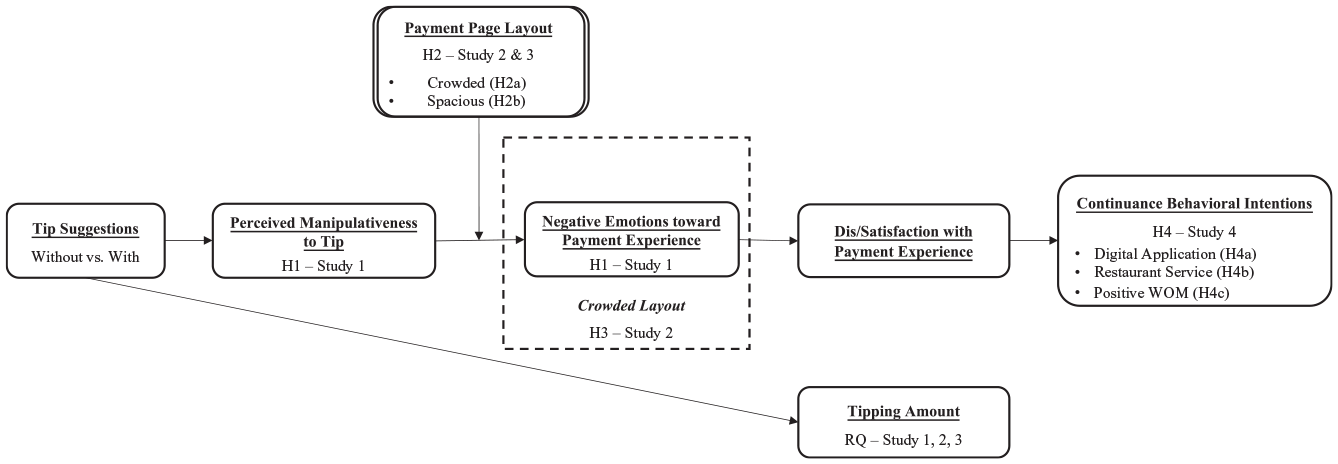
Conceptual Model
Methodology and Results
We conducted a series of five studies to examine the proposed theoretical framework. A pilot study was first administered to explore consumers’ payment patterns, shedding light on the design of the study stimuli. Study 1 tested the basic effect as well as the underlying mechanism. Studies 2 and 3, respectively, examined the moderation effect in the mobile phone and computer (desktop/laptop) interfaces. Study 2 also tested the page layout moderated psychological mechanism. Throughout the three main studies, we also explored the answer to the proposed research question regarding tipping amount. Last, Study 4 was conducted to examine the relationship between payment experience satisfaction and the downstream continuance usage intentions.
Pilot Study
To ensure the field realism of the experimental design study, we conducted a pilot study to explore consumers’ payment patterns. Specifically, two questions were asked: preference of digital payment, and preferred digital payment device among computer (desktop or laptop), tablet, and mobile phone. A total of 52 participants were recruited from Amazon Mechanical Turk (MTurk). To qualify for this study, the participants must be a U.S.-based adult consumer who has had restaurant service, either in person or by remote order, in the past 12 months and has given tips when using restaurant services. The results showed that 75% consumers tend to use digital payment for restaurant food delivery service. Among the three digital devices for payment, most consumers preferred mobile phone (54%) followed by computer (37%), and the least preferred tablet with only 9% participants indicating preference. The pilot study results set the experiment foundation for the following main studies.
Study 1: Basic Effect of without versus with tip Suggestions on Digital Payment Page
Method
Design and scenario
A scenario-based experiment was conducted to test the basic effect. The scenario depicted an online food ordering experience where consumers were ordering dinner from a local pizza restaurant via a mobile app interface. The payment page was designed to reflect a mobile phone food ordering interface mimicking contemporary market practices (stimuli are available in the online Supplemental Material). Participants were randomly assigned to one of the two scenarios: without or with tip suggestion on the payment screen. In the without tip suggestion condition, we noted “tipping optional” and provided an open box for consumers to freely input the tipping amount as they wished. In the with tip suggestion condition, we provided a suggested tipping choice banner with the amount ranging 15%, 20%, and 25% as well as a “Custom” option, highlighting the 20% tipping option as the suggested default.
Participants
The study recruited participants from MTurk. To qualify for this study, the participants must be a U.S.-based adult consumer who has had restaurant service, either in person or by remote order, in the past 12 months and has given tips when using restaurant services. To ensure an adequate level of field realism, we ensured that participants assessed the study via the device of mobile phone by both explicitly asking them what device they were using and recording participants’ device information (e.g., device browser and device operating system). To prevent lack of participant engagement due to idiosyncratic food preferences, we also asked participants their attitude toward pizza (the sample food used in the scenario) and only recruited those who did not hold strong resistance toward pizza. Filtering out those who did not meet the above qualification criteria, we recruited a total of 134 participants for this study. The average age of the sample was 39 years. The sample consisted of 51% women and 49% men. Approximately 78% of the participants identified themselves as Caucasian or White, 8% African American, and 7% Asian. In addition, about 69% of the participants reported holding a bachelor’s degree or higher. Around 71% reported themselves with an annual household income higher than $50,000.
Measures
Participants were asked to answer several questions following the scenario. Specifically, dissatisfaction with the payment experience was measured with a three-item scale adapted from T. Zhou’s (2013) mobile payment services study to fit the current context with questions as “I do not feel satisfied with/comfortable with/good about the paying experience.” (7-point Likert-type scale: 1 = strongly disagree to 7 = strongly agree; Cronbach’s α = .92). To test the underlying psychological mechanism via the serial mediation effect, we asked participants questions about the two mediators. The mediator of perceived manipulativeness to tip was measured with a four-item scale adapted from Warren et al. (2021) including questions such as “The way the tip is requested tries to manipulate customers in ways that I do not like.” (7-point Likert-type scale: 1 = strongly disagree to 7 = strongly agree; Cronbach’s α = .90); the other mediator of negative emotions toward payment experience was measured by asking participants: “How do you feel when you use the mobile phone for payment in the scenario?” with a three-item, 7-point scale adapted from Prayag et al. (2020) (frustrated/irritated/angry; 1 = not at all to 7 = very much; Cronbach’s α = .92). We also asked participants how much they were willing to tip in the given scenario with the question of “Thinking about the scenario, how much would you give for a tip?” In addition, we asked participants to what extent they believed that their tipping amount would be influenced by the bill size (i.e., “In general, when you pay for the restaurant bill, do you think how much you have paid for the food will affect your tipping amount?” 7-point Likert-type scale: 1 = strongly disagree to 7 = strongly agree). The bill size was included as control variable because previous tipping research shows that the bill size or total consumption cost affects consumers’ tipping percentage and amount (Lynn & Latané, 1984). To control for the possible variance caused by device resolution (Y. Zhou et al., 2020), we recorded participants’ device resolution as control variable. Finally, we assessed the perceived realism of the scenarios by asking participants: “How do you rate the realism of this service scenario?” on a 7-point bipolar scale (1 = not realistic at all, 7 = highly realistic). Participants across conditions rated the scenarios being highly realistic (M = 6.31).
To ensure success of manipulation and participants’ attentiveness, we employed a series of manipulation check and attention check questions along the study. To check the manipulation of tip suggestion, we asked participants to recall if there was a suggested tipping amount shown on the device screen (1 = Yes, 2 = No). Additionally, we randomly asked questions to assess participants’ attentiveness, for instance: “for this item, please select three.” Inattentive participants who answered any of the manipulation check and attention check questions incorrectly were filtered out from further participation.
Results
ANCOVA analysis of payment experience dissatisfaction
One-way analysis of covariance (ANCOVA) (tip suggestion: without vs. with) was conducted on payment experience dissatisfaction with perceived bill size influence and screen resolution as control variables. Results revealed a significant difference between the two tip suggestion conditions: the presence of tip suggestion on the payment page significantly increased participants’ dissatisfaction with their payment experience (Mwithout = 1.94, Mwith=2.50; F(1, 130) = 4.18, p < .05).
PROCESS analysis
We conducted a serial mediation analysis using the PROCESS macro, Model 6 (Hayes, 2018). The analysis found that the indirect effects of tip suggestion on payment experience dissatisfaction were significant following the causal link of perceived manipulativeness to tip → negative emotions toward payment experience → payment experience dissatisfaction (indirect effect = 0.16, 95% CI [0.04, 0.33]). Together, Hypothesis 1 was supported.
ANCOVA of tipping amount
Similarly, one-way ANCOVA was conducted on tipping amount, with perceived bill size influence and screen resolution as control variables, to examine if the presence of tip suggestion might impact on tipping amount. Results showed a significant increase of tip amount in the with (vs. without) tip suggestion condition (Mwithout = 4.25, Mwith = 5.08; F(1, 130) = 7.23, p < .01).
Discussion
Results of Study 1 confirmed our theoretical estimation: participants’ satisfaction level with their digital payment experience was significantly lower due to the perceived manipulativeness to tip and negative emotions toward payment experience induced by the presence of tip suggestion on the payment page compared with no such a tip suggestion (Hypothesis 1 supported). On the other hand, tip suggestion effectively increased participants’ tipping amount regardless of the reduced satisfaction. Furthermore, we theorized that the payment page layout might moderate consumers’ emotional responses although it could not change their perceived manipulativeness caused by the presence of tip suggestion. As such, Study 2 was executed to test the moderated mediation effect via negative emotions (Hypotheses 2 and 3).
Study 2: Mobile Phone Interface Design
Method
Design and scenario
Study 2 used a 2 (tip suggestion: without vs. with) × 2 (page layout: crowded vs. spacious) between-subjects experiment design. The scenario depicted the same online food ordering experience as Study 1 via a mobile phone app interface. Participants were shown with the payment screen in which tip suggestion and page design was manipulated: the with versus without tip suggestion conditions were presented in the same way as in Study 1; the payment information was displayed in either a crowded or a spacious design layout.
Participants
Study 2 also recruited participants from MTurk with similar qualification settings. After filtering out those who did not meet the qualification criteria, a total of 280 U.S.-based adult consumers participated in this study. The average age of the sample was 37 years. The gender profile of the sample was about 51% women and 49% men. About 73% of the participants reported their ethnic association being Caucasian or White, 10% African American, and 11% Asian. Approximately 69% of the participants had a bachelor’s degree or higher and about 69% hold an annual household income higher than $50,000.
Measures
After reviewing the scenario, participants were asked to answer questions for the study. Participants were asked about their satisfaction with the payment experience following a three-item, 7-point semantic scale adapted from Choi et al. (2020) with the question of “Overall, how would you rate the payment experience with the payment page in the scenario?” (1 = bad/unfavorable/negative to 7 = good/favorable/positive; Cronbach’s α = .93). Following the same measures and procedures as Study 1, tipping amount, control variables (perceived influence of bill size, and device resolutions), and realism/manipulation/attention check questions were asked. Participants across conditions rated the scenarios being highly realistic (M = 6.23). The same negative emotions related questions as Study 1 (i.e., frustrated, irritated, and angry) were asked following the 7-point scale (Cronbach’s α = .90).
Results
ANCOVA of payment experience satisfaction
A 2 (tip suggestion: without vs. with) × 2 (page layout: crowded vs. spacious) ANCOVA was conducted on payment experience satisfaction to test the proposed hypotheses of Hypotheses 2a and 2b, with perceived bill size influence and screen resolution as control variables. Results of the analysis revealed a significant main effect of tip suggestion (F(1, 274) = 4.65, p < .05). The means plot of experiment conditions (see Figure 2) showed that, when the layout of the payment page was crowded, tip suggestion significantly lowered participants’ satisfaction with the payment experience (Mwithout = 5.94, Mwith = 5.46; F(1, 274) = 4.92, p < .05). Hence, Hypothesis 2a was supported. On the other hand, when the payment page layout was spacious, the effect of tip suggestion on payment experience satisfaction was attenuated (Mwithout = 5.74, Mwith = 5.55; F(1, 274) = 0.69, p = .41). As such, Hypothesis 2b was supported.
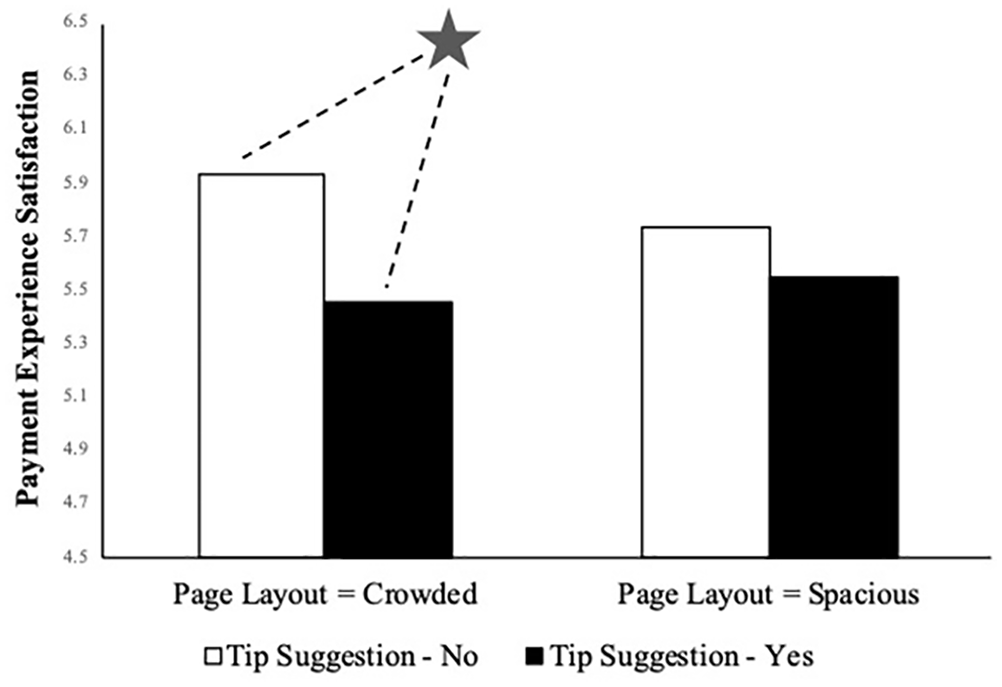
Study 2: Interaction Plot of Payment Experience Satisfaction
PROCESS analysis
We conducted a moderated mediation analysis using the PROCESS macro, Model 7 (Hayes, 2018) to test Hypothesis 3. The analysis found that negative emotions mediated the effect of tip suggestion on payment experience satisfaction only when the page layout was crowded (indirect effect = −0.27, 95% CI [−0.59, −0.01]). When the page layout was spacious, the indirect effect via negative emotions toward payment experience was attenuated (indirect effect = −0.16, 95% CI [−0.42, 0.07]). Therefore, Hypothesis 3 was supported.
ANCOVA of tipping amount
We ran a 2 (tip suggestion: without vs. with) × 2 (page layout: crowded vs. spacious) ANCOVA analysis on tipping amount, with perceived bill size influence and screen resolution as control variables. Results of the analysis only revealed a significant main effect of tip suggestion (Mwithout = 4.28, Mwith = 4.82; F(1, 274) = 7.50, p < .01). Neither the main effect of page layout (F(1, 274) = 2.88, p = .09) nor the interaction effect (F(1, 274) = 0.36, p = .55) was significant.
Discussion
Overall, the findings from Study 2 suggest that, while tip suggestion effectively increased participants’ tipping amount across crowded versus spacious page layout conditions, its presence introduced detrimental impact on participants’ satisfaction with the digital payment experience. In particular, when the page layout was crowded, displaying tip suggestion significantly lowered participants’ satisfaction with the payment experience (Hypothesis 2a supported). When the page layout was spacious, however, the effect of tip suggestion on payment experience satisfaction was alleviated (Hypothesis 2b supported). In addition, moderated mediation tests confirmed negative emotions toward payment experience as the underlying psychological mechanism explaining how tip suggestion reduced consumers’ satisfaction with their digital payment experience in the crowded layout condition (Hypothesis 3 supported). With both Studies 1 and 2 lending support to the proposed psychological process, we then focused on replicating the moderation effect with the computer interface and hence conducted Study 3.
Study 3: Computer Interface Design
Method
Design and scenario
Another experiment study was conducted featuring the computer interface. The same as in Study 2, a 2 (tip suggestion: without vs. with) × 2 (page layout: crowded vs. spacious) between-subjects experiment design was employed for Study 3. The study featured the same scenario as that depicted in Study 2, with the exception of the ordering via a computer interface of the restaurant’s website. As the settings in Study 2, we displayed the payment screen either in a crowded or a spacious layout, and either with tip suggestion or not. The payment page was designed to reflect a computer food ordering interface mimicking contemporary market practices. The manipulation of the computer webpage layout was pilot tested to ensure there was significant difference in the crowded versus spacious conditions (n = 82; the layout of information displayed on this page looks . . . to you? 1 = crowded, 7 = spacious; Mspacious = 5.93, Mcrowded = 5.27; F(1, 81) = 5.52, p < .05). The with versus without tip suggestion conditions were also presented in the same way as in Studies 1 and 2.
Participants
Study 3 also recruited participants from MTurk with similar qualification settings. A total of 201 U.S.-based adult consumers participated in this study. The average age of the sample was 42 years. The sample consisted of 48% women and 52% men. Approximately 74% of the participants identified themselves as Caucasian or White, 14% African American, and 9% Asian. About 79% of the participants reported holding a bachelor’s degree or higher. Around 55% reported themselves with an annual household income higher than $50,000.
Measures
Using the same measures as those in Study 2, we asked participants about their tipping amount, satisfaction with the payment experience (Cronbach’s α = .90), and perceived influence of bill size. We also asked participants how realistic they would rate the scenario and found out that participants across conditions rated the scenarios being highly realistic (M = 6.12). The same as in Studies 1 and 2, we recorded participants’ device resolution as a control variable and conducted the same manipulation and attention check procedures as well.
Results
ANCOVA of payment experience satisfaction
To further verify Hypotheses 2a and 2b, we ran a 2 (tip suggestion: without vs. with) × 2 (page layout: crowded vs. spacious) ANCOVA on payment experience satisfaction with perceived bill size influence and screen resolution as control variables. Results of the analysis revealed a significant interaction effect between tip suggestion and page layout (F(1, 195) = 4.68, p < .05). None of the other effects were significant. As shown in Figure 3, when the layout of the payment page was crowded, exerting tip suggestion on the payment page significantly lowered participants’ satisfaction with the payment experience (Mwithout = 6.05, Mwith = 5.52; F(1, 195) = 4.62, p < .05). Thus, Hypothesis 2a was supported. When the layout of the payment page was spacious, however, tip suggestion did not influence participants’ satisfaction with the payment experience (Mwithout = 5.55, Mwith = 5.77; F(1, 195) = 0.81, p = .37). Therefore, Hypothesis 2b was supported as well.
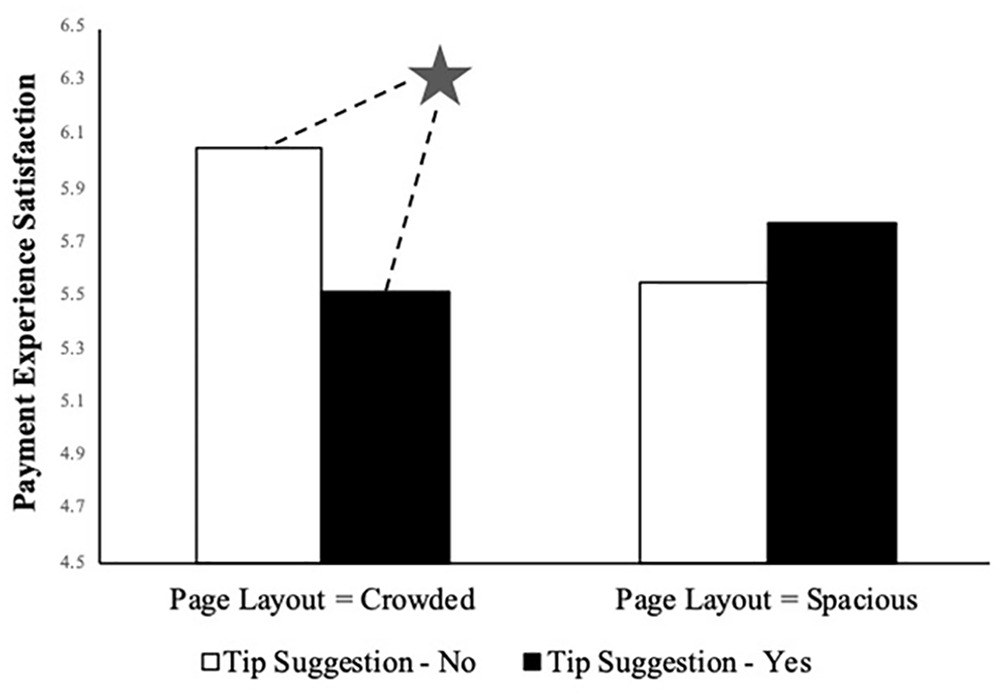
Study 3: Interaction Plot of Payment Experience Satisfaction
ANCOVA of tipping amount
The same as in Study 2, we conducted a 2 (tip suggestion: without vs. with) × 2 (page layout: crowded vs. spacious) ANCOVA on tipping amount with perceived influence of bill size and screen resolution as covariates. Consistent with Study 2, results revealed a significant main effect of tip suggestion (Mwithout = 3.74, Mwith = 5.29; F(1, 195) = 34.79, p < .01). Neither the main effect of page layout (F(1, 195) = 0.00, p = .97) nor the interaction effect (F(1, 195) = 0.12, p = .73) was significant.
Discussion
Results of Study 3 replicated those of Study 2 in demonstrating the impact of tip suggestion on consumers’ payment experience satisfaction and tipping amount on the computer interfaces. Findings suggested that tip suggestion significantly lowered participants’ digital payment experience satisfaction when the page layout was crowded (Hypothesis 2a supported) but not when the page layout was spacious (Hypothesis 2b supported). Nevertheless, tip suggestion consistently significantly increased participants’ tipping amount regardless of the payment page layout conditions.
Study 4: Downstream effects of payment experience satisfaction on continuance usage intentions
Method
Furthermore, a survey-based Study 4 was conducted to verify payment experience satisfaction’s positive downstream effects on consumers’ continuance usage intentions in terms of both digital applications (i.e., mobile app/website) and service providers (i.e., restaurant). Participants were asked to call back their recent online food ordering and payment experience, based on which they answered several questions reflecting the behavioral intentions (i.e., continuing usage of the digital payment applications, repatronage of the restaurant service, and positive word-of-mouth about the restaurant on social media) related to their digital payment experiences.
Participants
Same as the other three studies, Study 4 recruited participants from MTurk with similar qualification settings. 100 U.S.-based adult consumers participated in this study. The average age of the sample was 38 years. The gender profile of the sample was about 35% women and 65% men. About 89% of the participants reported their ethnic association being Caucasian or White, 5% African American, and 2% Asian. Approximately 94% of the participants held a bachelor’s degree or higher and about 52% had an annual household income higher than $50,000.
Measures
We asked participants about their satisfaction with the payment experience following the same scale used in Studies 2 and 3 (Cronbach’s α = .79). The continuance usage intentions of the same digital applications and restaurant were assessed via three-item bipolar scale adapted from Yi (1993): “What is the likelihood that you would continue using this digital application/you would order food from this restaurant again?” (1 = unlikely/improbable/impossible, 7 = likely/probable/possible; Cronbach’s α = .80/.81). Word-of-mouth on social media was measured with a four-item scale adapted from Eisingerich et al. (2015), including questions like “Based on the experience of ordering and paying for food on this digital application, I am likely to say positive things about this restaurant on social media (e.g., Yelp, Instagram, Facebook, Twitter)” (7-point Likert-type scale: 1 = strongly disagree to 7 = strongly agree; Cronbach’s α = .86).
Results
A series of regression analysis were conducted with payment experience satisfaction as the independent variable and three dependent variables. The results showed that payment experience satisfaction extended significantly positive effects to all the three downstream variables: continuance usage of digital application (b = 0.80, t = 13.22, p = .00), continuance patronage of restaurant (b = 0.81, t = 13.77, p = .00), and positive word of mouth on social media (b = 0.57, t = 6.92, p = .00). Thus, Hypotheses 4a, 4b, and 4c were all supported.
Discussion
Study 4 confirmed the important role of consumers’ satisfaction with digital payment experience by revealing its significant positive impacts on the downstream behavioral intentions in terms of loyalty toward both the digital application and the service provider. Altogether, the results supported Hypothesis 4.
Implications
Theoretical Contributions
Drawing on the tip-enhancing literature and the spatial crowding theory, this research takes a novel approach to examine the underexplored technology-facilitated preservice tipping encounter. The current findings present valuable contributions to the technology-facilitated service literature and also provide updated perspectives to existing tipping research. First, three main studies consistently confirm that displaying tip suggestions can effectively enhance consumer’s tipping amount as an effective tip-enhancing tactic in the emerging technology-oriented preservice tipping condition. This research shows that the tipping phenomenon and the related behavioral norm remain strong in the digital environment where the consumer has no direct interactions with the server. Our findings suggest that, unlike that in the traditional brick and mortar environment, consumer tipping may be less contingent on a retrospective evaluation of the interpersonal service quality. In fact, our research shows that, in contactless service scenarios, consumers’ tipping amount can be situationally influenced by factors such as the presence of tip suggestions and the layout design of the payment page. Such findings reflect a need to update theoretical perspectives in reflection of the evolving marketing conditions and practices around tipping solicitation. As the global hospitality industry continues its climb in digitalization, our research opens up opportunities for future tipping research to further explore tip-enhancing factors/strategies in the technology-mediated, preservice tipping encounters.
To date, most tipping literature focuses on examining factors and strategies that can enhance tipping amount, with limited research investigating the impact of such tip-enhancing factors/strategies on the general service experiences (Warren et al., 2021). In today’s digital service era where an increasing number of service encounters are becoming contactless and technologically mediated, understanding the impact of tip-enhancing factors/strategies on consumers’ service experiences and specifically their experience with the payment process merits significant theoretical and practical implications. Without such empirical efforts, further theoretical and practical endeavors may be blinded of the potential detrimental impact of tip-enhancing factors/strategies on other important aspects of business performance and in particular the business’ bottom line (Levitz, 2018; McCorvey, 2021). In that regard, our research contributes to the tipping research and the digital service experience literature by revealing the double-sided impact of tip suggestions in the technology-mediated, preservice tipping encounter. We find that, in such contexts, although the presence of tip suggestions is effective in elevating consumers’ tipping amounts, it can also undermine consumers’ satisfaction with the digital payment experience.
In addition, our findings pinpoint perceived manipulativeness to tip and negative emotions toward payment experience as the psychological mechanism explaining the negative impact of tip suggestions on consumers’ satisfaction with their digital payment experience. In line with reactance theory about people’s resistance to marketing influence (Dillard & Shen, 2005), our research shows that while the presence of tip suggestions can nudge consumers to conform to a normative anchor in forming tipping decisions, consumers may also experience reactance in the form of perceived manipulativeness and negative emotions (Dillard & Shen, 2005; Dyussembayeva et al., 2022; Quick et al., 2015; Warren et al., 2021). As such, our findings indicate the theoretical possibility of a dual-process function driving consumer responses toward their service experiences with technology-mediated service platforms: Consumers may treat the physical service process delivered by individual service employees (e.g., the physical process of an individual employee delivering service order to the consumer’s doorstep) and the digital service process facilitated by a firm or platform (e.g., the digital process of consumers remotely placing orders/delivery services on digital platforms) as two separate service events and hence follow distinct accounts to form attributive evaluations and behavioral responses.
Dovetailing the service design literature in the physical realm (Bitner, 1992) to that in the emerging digital context (Y. Zhou et al., 2020), our findings make an important extension to the existing research on spatial crowding effects. Drawing on the spatial crowding effects which have been pervasively studied in the brick-and-mortar servicescape research (Blut & Iyer, 2020), the current research shows that the crowdedness versus spaciousness of the payment page can moderate the adverse effect of tip suggestion on consumer satisfaction with the payment experience. When the payment page follows a crowded design, the negative effect of tip suggestion on consumer satisfaction with the payment experience is particularly salient. When the payment page follows a spacious layout design, however, the effect is mitigated. Such findings are in consistency with previous research that reveals the moderating impact of spatial perceptions on consumers’ emotional responses toward service experiences (Baker & Wakefield, 2012; Blut & Iyer, 2020; Y. Zhou et al., 2020). Highlighting the importance of page layout design in the e-servicescape research (Y. Zhou et al., 2020), our research identifies an important factor that contributes to consumer satisfaction in technology-mediated digital service encounters—the spatial layout of the payment page. Similarly, this research also confirms that consumers’ satisfaction with online payment experience can significantly influences their loyalty to both the digital media and service providers (Humbani & Wiese, 2019; Susanto et al., 2016), which is manifested as their intentions of digital application continuance usage, service repatronage, and spreading positive word of mouth on social media. As such, our research also stresses the importance for future research to deconstruct the digital consumer experience in order to further our understanding of consumer satisfaction and experiences in the digital service realm.
Managerial Implications
The findings of our research offer relevant and timely managerial implications. The proliferation of technology has changed many facets of the hospitality service industry and accordingly rescripted the service processes and behavioral etiquettes in service encounters. In relevance to consumer tipping, the rise of the technology-mediated tipping encounter has prompted the need to advance practical guidance. As the long-standing tipping etiquette has been rescripted from postservice to preservice, from service-interaction-based to increasingly technology-mediated, research-backed insights are in urgent need to ensure servers’ financial welfare. After all, more than 50% of the servers’ income is sourced from consumer tipping (Tung & Reyes, 2018; Yau, 2017). As more and more service providers add tip suggestions via technological interfaces to prompt consumer tipping as a part of the preservice transaction process (Warren et al., 2021), our research conducts timely examination on such practice’s effectiveness and its impact on consumers. Our findings confirm that, in a preservice tipping encounter where the service delivery is technology-mediated, the presence of tip suggestion can effectively increase consumers’ tipping amount. Rather than presenting tipping-reminding message as “optional tip,” restaurants and third-party food ordering delivery services are suggested to clearly display and highlight the suggested tip percentages or amounts to remind consumers of the tipping etiquette. According to the findings of our research, the latter approach will help enhance service employees’ tipping income.
At the same time, technology can bring both opportunities and challenges depending on whether it is properly used. The online consumption environment literature identifies that technological application layout design (e.g., webpage and mobile app interface) has significant effects on consumers and their consequent behaviors: device interfaces with different size and slightly different designs of the focal visual area style and the peripheral visual cue style can lead to significantly varying consumer responses (Y. Zhou et al., 2020). Findings from the current examination of various digital page layouts further indicate the importance of a well-designed page layout. When the digital payment page has a crowded layout, consumers would feel particularly frustrated during the mobile payment experience as triggered by the presence of tip suggestion. This negative psychological experience would result in consumers’ dissatisfaction with their payment process. In turn, as indicated in previous research, the resulted dissatisfaction triggered by various layout design could make consumers unwilling to use the interface and service in the future (T. Zhou, 2013). Therefore, service providers need to understand consumer psychology in using various technology devices and provide the optimal online experience through decently designed digital interface to enhance consumer satisfaction and retention.
At minimum, our research presents good news to service employees: Consumers do not spill over their negative reactions and dissatisfaction toward the online payment experience to their intended tipping amount to servers. It seems that consumers may follow a dual-process account to determine how much to tip and how satisfied they are with the payment experience. In sum, we suggest that service providers aiming to enhance employee welfare may highlight suggested tips in the payment process. At the same time, they also need to justify various technologic levers and interface design techniques such as page layout design to optimize consumer satisfaction with the digitalized service experiences.
Limitations and future research
The current research has limitations that could be addressed by future research. Although this research has examined the impact of tip suggestions on tipping amount, future in-depth research is needed to pinpoint the specific underlying mechanism to explain why the presence of tip suggestion increases tipping amount in the technology-facilitated preservice tipping encounter. Another limitation is related to the scenario stimulus. The current studies employ static webpages for the scenario stimuli, which may not be reflective of the sense of interactivity that consumers experience when ordering food service online. Therefore, future research could use dynamic designs and interactive stimuli or collect field data to further verify the current findings and conceptual model as an integral process. Relatedly, future research may recruit participants from various platforms and field study for cross validation. Finally, the effect of tip suggestion and page layout design may be contingent on the evolution of marketing practices. Certainly, the more familiar the general market becomes with a certain marketing practice, the less prone they are to its intended influence. Future tipping research thus is encouraged to further our speculations on the evolving marketing practices, pinpoint the limitations and indicate directions for further innovations.
Concluding Summary
Across a series of studies, the current research examines the impact of tip suggestion and payment page layout on consumers’ tipping amount and their satisfaction with the digital payment experience. Findings from this research demonstrate that while displaying tip suggestion on the payment page can increase consumers’ tipping amount, it may also lower their satisfaction with the digital payment experience due to perceived manipulativeness to tip and the consequent negative emotional states. Especially when the payment page is designed following a crowded layout, the detrimental effect is driven by the psychological process of tip suggestion presented in a crowded spatial design eliciting negative emotions toward payment experience. As such, the effect of tip suggestion on digital payment experience satisfaction can be exacerbated (alleviated) by a crowded (spacious) layout design of the payment page. Finally, our findings show that such effects hold across both mobile phone and computer interfaces.
Supplemental Material
sj-docx-1-jht-10.1177_10963480221076467 – Supplemental material for To display tip suggestion or not? Examining tip suggestion’s impact in technology-facilitated preservice tipping encounters
Supplemental material, sj-docx-1-jht-10.1177_10963480221076467 for To display tip suggestion or not? Examining tip suggestion’s impact in technology-facilitated preservice tipping encounters by Alei Fan, Laurie Wu and Yiran Liu in Journal of Hospitality & Tourism Research
Footnotes

Supplemental material
Supplemental material for this article is available online.
References
Supplementary Material
Please find the following supplemental material available below.
For Open Access articles published under a Creative Commons License, all supplemental material carries the same license as the article it is associated with.
For non-Open Access articles published, all supplemental material carries a non-exclusive license, and permission requests for re-use of supplemental material or any part of supplemental material shall be sent directly to the copyright owner as specified in the copyright notice associated with the article.
