




Abstract
This article profiles the travel behavior of sport fans against the transtheoretical model of change (TTM) and its application to sport events. Using the four constructs of the TTM, we distributed a self-reporting survey to sport fans prior to home fixtures. There is some synergy with the theorized stages of change and processes of change in this context. Notwithstanding, the results showed a high level of commitment to others in the early stages of change—a movement away from the prescribed theory. Results from decisional balance and self-efficacy items reaffirmed the congruence with theory and the application of the TTM to sport fans and their travel behavior. This study assessed the application of a stage-based model of change within a sport event context; it provides an exploration of the antecedents of behavior change indicators relevant to sport fans, thus enabling policy makers to make informed decisions about future travel behavior change.
Introduction
Atmospheric emissions arising from road traffic continue to increase and contribute to climate change (Borgstede et al., 2013, Gardner & Abraham, 2008; May, 2013). Ettema and Schwanen (2012) and Holden and Linnerud (2011) suggested that travel for social and leisure pastimes will increase across Europe. These trends were also supported by Valek et al. (2014). According to their study, 75.3 million adult Americans traveled for or because of sport and leisure. Conversely, the largest share of carbon emissions attributable to a leisure event is typically from transportation (Bottrill et al., 2009; Harvey, 2009). Collins et al. (2007) found that visitor travel was the largest environmental impact in staging a major sport event (FA Cup, 2004), citing 73,000 attending the FA cup at the Millennium Stadium, resulting in an estimated 43 million kilometers traveled, with 47% of that distance covered by private car. More recently, Collins et al. (2012) assessed the Tour De France, Grand Depart, 2007. They found that visitor travel accounted for 75% of the total ecological footprint of the event. By attending the event, visitor’s travel footprint was 2.6 times greater than their ecological footprint at home for the same period.
Despite these externalities, there is a lack of research determining underlying behaviors in leisure travel due to factors such as traveling in the company of others, frequency of travel, modal choice, timing of the event, and seasonal effects. Yet the combination of these attitudes, environmental, and behavioral factors have frequently been used in transport behavior research (see, e.g., Anable et al., 2006; Bamberg & Schmidt, 2003; Gardner, 2009; Spears et al., 2013). Models such as transtheoretical model of change (TTM), have examined attitude, norms, perceived behavioral control, and considered how these factors have influenced the travel decision-making process. Yet there has been little application to sport events.
This lack of research provides limited insight and a poorly constructed understanding of why certain travel choices are made and how travel behavior in an event setting can be influenced. This lack of understanding has led to broad assumptions and has created inappropriate transport policies at regional and national levels (Borgstede et al., 2013; House of Lords Science and Technology Select Committee, 2011; May, 2013). Therefore, in this exploratory study, we are interested in three things. First, to ascertain the current behavior of fans traveling to a sport event. Second, to ascertain their openness to changing their travel behavior and third, to explore the reasons why they travel the way they do. We have used the constructs of the TTM to synthesize these themes and hypothesized as follows:
Evidently, there is a precedent of using TTM constructs in the analysis of travel behavior and change programs. Yet studies using the TTM have often been incomplete in their analysis and methods have fallen short of testing the relationship across the TTM constructs including self-efficacy, decisional balance, process of change (PoC), and stage of change (SoC; see, e.g., Aveyard et al., 2009; Hutchison et al., 2009; Kim & Bradley, 2009). In investigating the travel behavior of sport fans and determining antecedent factors that may influence their travel behavior, this study will utilize the four constructs of the TTM and contribute to the realization of sustainable tourism. As Wheeller (2012, p. 39) cited in Higham et al. (2013, p. 949) states “All tourism involves transport, all travel involves tourism, and no form of transport is sustainable.”
The first section will evaluate existing studies into travel behavior change, followed by a critical review of the evidence related to sport fans’ travel choices. The next section will outline the application of the TTM to a travel behavior context and underline the theoretical position of this article.
Theoretical Perspectives: The Travel Behavior Debate
While Taniguchi and Fujii (2007) suggest there is limited understanding of how individuals modify their travel behavior, evidence suggests otherwise. For instance, in Higham et al. (2013), they establish a linear relationship between information setting and an individual’s values and norms that encourage voluntary travel behavior change. These values and norms are negotiated by specific attitudes and habits that may lead to a change in mobility patterns. Empirical evidence also points to a more heuristic and contextual viewpoint where social and cultural settings derived from institutional, political, and legislative patterns can shape early learning and influence personal intentions to travel (Schwanen & Lucas, 2011). Alongside these factors, Murtagh et al. (2012) purport an individual desire for autonomy, status, self-identity, and privacy as mediating factors in travel behavior.
Conversely, Anable (2005) suggested that the ability to reach agreement in how to change travel behavior is diminished due to the diverse situational and psychological factors that affect travel choice within different segments of the population. Davies (2012) and Thornton et al. (2011) agreed that a lack of consensus is due, in part, to the range of factors that affect choices in travel mode behavior including cognitive beliefs, feelings of responsibility, perceived effectiveness of changes, personal norms, social orientation, and aspirations and trust in the type of information received. Murtagh et al. (2012) accepted that there is a melting pot of factors that can influence travel mode. Indeed, these instrumental, affective, and symbolic factors are also found within studies by Spears et al. (2013). They stated that individuals adapt their travel as a direct result of their perceptions, attitudes, and preferences. But do these factors apply to sport fans traveling to a sport event?
Is There an Understanding of How and Why Sport Fans Make Their Travel Choices?
According to Regan et al. (2012) leisure travel is complex, with many related thoughts, decisions, behaviors, and evaluations occurring pre and post the event. Kaplanidou et al. (2012) added that sport tourism arises from unique interactions between people, the place, and the activity. In terms of sport, this can be prearranged meetings/rituals with friends, the discussion of the sport before the event, and the walk to the stadium. Fairley and Gammon (2005) cited tailgating (pregame meal in the boot of the car) as an example of these interactions between people, place, and the activity. While tailgating may influence travel choices, it is not a ubiquitous concept and does not apply directly to this study (U.K. based). Notwithstanding, these examples further the sense of realism as described by Green (2008) in that modal choice is a bodily, social, and political practice and linked to space, ethnicity, and class. These interactions are also influenced by motives such as excitement, escapism, and socialization (Trail & James, 2001). Indeed, there is evidence of the existence of “communitas” at sport events. Burke and Woolcock (2009) found that increased use of public transport services to sport venues represents an “intense moment of travel and co-presence.” Similarly, Mokhtarian et al. (2001) referred to the positive utility of travel. And that travel can be perceived as having positive outcomes but that these outcomes depend on personality, lifestyle, and nature of the specific trip. Regan et al. (2012) broadened this. They suggested that travel for a leisure purpose provides an opportunity for social interaction, companionship, being guided by experts, meeting counterparts, and exploring one’s own identity often with like-minded people. Furthering this, Fairley (2009) and Fairley and Gammon (2005) found that the mode of transport is central in creating and maintaining the identity of groups that travel and follow a sports team.
But what psychological benefit does the sport fan get from attending sport events? According to Smith and Stewart (2007) and Wann et al. (2002), the sport consumer experiences a satisfaction of psychological, social, and cultural needs. These ranged from escapism, stimulation, entertainment, national pride, and cultural celebration to a sense of collective and personal identity. These helped categorize sport fans and through categorization enabled a deeper understanding of sport fan traits and behaviors to be obtained. Snelgrove et al. (2008) reaffirmed the view that sport can socialize the individual into the attitudes, beliefs, and values distinctively associated with that sport. In turn, this socialization develops “self-identification” and “description of self by others” within the group of sport fans. The reinforcing fashion of one’s self, cultivated by the attendance at a sport event, further strengthens loyalty to the subculture associated within the sport. Furthermore, sport fan volition is influenced by objects of identification. For example, Fairley and Gammon (2005), Shamir (1992), and Valek et al. (2014) suggested that self-identification and categorization leads to an ethnocentric conformity that includes adherence to goals, norms, and possible behaviors.
It should be noted that these types of behaviors are not isolated to sport fans, and arguments of ethnocentric conformity can be applied to other leisure groups in society such as music and movie fans (Bennett, 2012; Larson et al., 2013; Morey, 2012) and also in business whereby business and leisure consumers take on homogenous characteristics in travel settings (Marcucci & Gatta, 2011; Murtagh et al., 2012). Nonetheless, the review of literature suggests limited attention given to the act of travel to a sports venue and the decision-making process related to travel by sport fans. Existing studies such as Funk and Bruun (2007); Uysal and Jurowski (1994); Wann et al. (1999); and Yu (2010) focused on the underlying motivation of fans to travel to a destination (intent) to see their sport rather than travel behavior itself. For example, Yu (2010) found pride in sport fans and an affinity with sport to be the underlying motivational factors on intent to travel to watch their sport. Findings from Funk and Bruun (2007) reported a continuum of cultural education and social–psychological motives to travel to and participate in a sport event. These findings are symptomatic of existing work where modal choice and the act of traveling within sport fans are not discussed and where studies focus more on the broad area of motivation to travel to watch sport.
An exception to this is Fairley’s (2009) study on the influence of sport fandom on a group travel setting. Her study suggested that the interaction of group members, group cohesion, and group reinforcement are at the forefront of travel choices and raise the question of whether “group identity” can influence the travel choice of sport fans traveling to a sport venue. Her findings contrast with the generalized view taken by Barff et al. (1982) and more recently Innocenti et al. (2013) where price, comfort, convenience, and scenery were seen as dominating factors of travel choice. This exhaustive combination of attitude–behavioral factors related to sport fans and travel can be applied to social and environmental psychology models such as the theory of planned behavior (TPB); its forerunner the theory of reasoned action (TRA), the norm activation model (NAM), social cognitive theory (SCT), and the transtheoretical model (TTM). These models have been frequently used in transport and behavior change research and are seen to capture the factors articulated earlier (Adams & White, 2004; Gatersleben & Appleton, 2007; Kenyon & Lyons, 2003; Kim & Bradley, 2009; Rose & Marfurt, 2007; Spears et al., 2013).
Transtheoretical Model of Change
This study uses the TTM to assess change behavior within sport fans. There are two reasons why the model is appropriate in this context: (a) According to Prochaska and Norcross (2007) the TTM has been described as an integrative and comprehensive model as it draws from a spectrum of psychotherapy and behavior change, thus it is transtheoretical in nature. The comprehensiveness of the TTM is attributed to a variety of methods used to assess and assist in change; it is a model of intentional behavior change which can address individual and group change and professional intervention; it can cover the whole range of change. (b) The TTM recognizes that the individual or group of participants may not acknowledge their “problem” behavior and to change the behavior participants do not need to be in a “therapy” program.
There are four components to the TTM: the SoC, the PoC, self-efficacy, and decisional balance. The SoC is the central construct of the TTM and establishes when particular shifts in attitudes, intentions, and behaviors are most likely to occur. The version of the model in this study specifies four stages: precontemplation, contemplation, action, and maintenance. These stages are represented as a spiral—people start at the bottom the spiral in precontemplation then move through the stages in order but will typically relapse back across numerous stages. The PoC identifies how the change occurs and integrates cognitive, affective, and behavioral processes from leading theories of psychotherapy and health psychology and can be categorized further as experiential or behavioral processes. See Table 1 for definitions of each process of change.
Process of Change Definitions
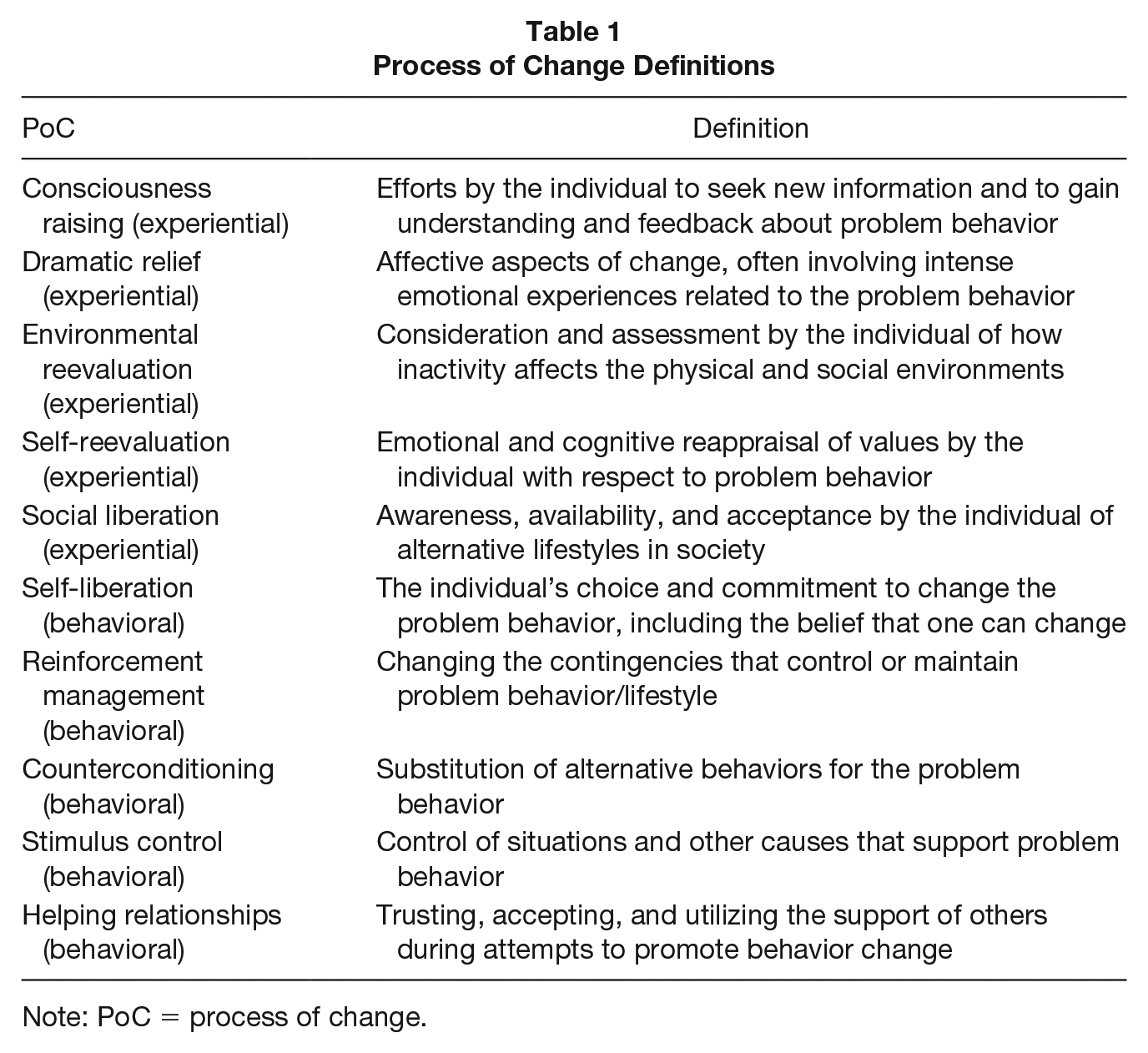
Note: PoC = process of change.
Reiterating the theoretical framework, Prochaska and DiClemente proposed that the integration of stages and processes of change create an important guide to altering behavior. Once it is clear what SoC a person is in, theoretically one would know which process to apply in order to help the individual progress to the next SoC. Decisional balance relates to the evaluation of outcome and can facilitate progression through the stages of change. Finally, self-efficacy constructs are taken from social cognitive theory and reflect individual perception toward competency and control. Presenting tools to support control and progression of behavior change is crucial to self-efficacy.
Method
The researchers had to gain access to sport fans and identify a sport stadium with a “home team” where home supporters made regular journeys to the stadium. A professional Rugby League team (U.K. based) agreed to participate in this cross-sectional study and allowed access on match days but requested anonymity. The rugby league team has a multiuse venue that is supported well by local public transport infrastructure. Home matches are organized at regular intervals and advertised throughout a program of matches across a typical season. Unfortunately, access to ticket holder information such as name and addresses was not possible. Thus, the opportunity to use probability sampling was restricted. While Kellow (1998) argued that a large sample size does not necessarily guarantee integrity or statistical significance, it does exert pressure on the chosen nonprobability sampling techniques to the targeted population (sport fans). To increase the likelihood of responses, convenience sampling was employed. The research team was granted access to the stadium during three home matches in March through May 2014. Seventeen volunteers were enlisted to help with the distribution of the self-reporting questionnaire to the sport fans before the start of each match. Only home team supporters were approached as there are more home supporters than away supporters and they travel frequently to the stadium. In order to increase participation, incentives were offered to participants in the form of a prize draw. Indeed, 192 usable surveys were collected.
A self-reporting questionnaire was designed for this study using the four aspects of the TTM (a) SoC, (b) PoC, (c) self-efficacy, and (d) decisional balance. All TTM measures used within this study demonstrate validity and reliability in a number of studies (see Migneault et al., 2005). The survey was tailored to modal choice and behavior change to ascertain sport fans current travel behaviors and their openness to change.
Measures
Stages of Change
The SoC measures are based on studies using the University of Rhode Island Change Assessment (URICA). This measurement tool reflects the four stages of change model (precontemplation, contemplation, action, and maintenance). The four stage model presents a valid and reliable evidence trail (see, e.g., Dixon et al., 2009 and Field et al., 2009) and continues to be one of the most reviewed and well regarded measures for assessing and categorizing participants in change behavior studies, thus reinforcing it as a valid and reliable measurement of change. Where the “problem” was noted within the 12 items across the stages, these were then contextualized to traveling to the stadium; more specifically driving to the stadium (e.g., precontemplation item “As far as I’m concerned, there is nothing wrong with the way I get to the stadium” and contemplation item “I know I should look into alternatives to get to the stadium”). A 5-point Likert-type scale was employed (1 = strongly disagree to 5 = strongly agree).
PoC
Based on Prochaska et al.’s (1988) study on smoking cessation, a 20-item questionnaire to test aspects of the 10 processes of change was used. The 20 items were contextualized to traveling to the stadium, for example, counterconditioning “I think about how traffic pollution can affect friends and family” and social liberation “I recognize the impacts traffic pollution has on me, my friends and family.” An even spread of experiential and behavioral processes were assessed within the measure. A 5-point Likert-type scale was employed (1 = strongly disagree to 5 = strongly agree).
Self-Efficacy
Given the constraints of the sample outlined earlier, this study used a single item of measurement for self-efficacy as presented by Annis (1986) cited in Breslin et al. (2000) and focused on situational confidence levels rather than situational and temptation items as described by Schwarzer (2014). It tested negative affect, social/positive, physical, and other concerns, cravings, and urges. Di Noia and Prochaska (2010) suggested that the two-factor structure has been successfully tested in a variety of health-related studies and as such, presents a robust construct. The underlying statement was “Given the scenarios below, we would like to know how confident you may feel in using an alternative to the car.” Each scenario was tailored to situations that might influence participants travel behavior (e.g., negative affect “When I see others driving to the stadium,” social/positive affect “When I want to celebrate the match with my friends and family,” physical affect “When I am physically tired,” and cravings “When I simply want to use the car to get the stadium”). A 5-point Likert-type scale was employed (1 = not at all confident to 5 = extremely confident).
Decisional Balance
The 10 decisional balance items were based on original work from Janis and Mann (1977) and applied to different behaviors by Di Noia and Prochaska (2010) and Velicer et al. (1985), whereby a two-component structure was identified—pros and cons. Con items reflected barriers to changing travel behavior decisions such as “Driving to the stadium is a pleasure,” while pro items reflected affirmative items that may encourage a change in travel behavior decisions such as “I would be healthier if I walked to the stadium.” A 5-point Likert-type scale was employed (1 = never to 5 = always).
Results
Sample Descriptors
However, 192 responses were received of which 83% stated that they travel to the stadium by car. Indeed, 73% of participants traveled with up to three people and 20% traveled with four to six people. Nearly, 29% traveled more than 16 miles to the stadium and 25.5% of the sample took 26 to 35 minutes to get to the stadium. However, 59% of responses were male. Nearly, 30% of all response was from participants aged 35 to 44 years. More evenly, the results showed 50.9% of participants class themselves as the main driver to the stadium as opposed to being a passenger. Just over 65% of the sample were employed full time, with 12.5% employed part-time.
Stages of Change
The findings represent stages of change and apply the stages of change measure to the sports fan context to assist in answering the Hypothesis 1a.
Cronbach’s α for the scale across the 12 items measured .71, suggesting internal reliability with the scale and in line with Carey et al. (1999) who suggested that internal consistency (α) for the four scales range from .70 to .83. To obtain a stage of change score, the authors followed DiClemente et al.’s (2004) original method whereby mean score for each subscale was calculated, then the sum means from the contemplation, action, and maintenance subscales were subtracted from the precontemplation mean. Cutoff scores were then applied as discussed by DiClemente et al. (2004) and Teixeira et al. (2013). Those scoring less than 8 were categorized as precontemplation; 8 to 11 were coded as contemplation, 12 to 14 were categorized as action, and those above 14 were categorized as maintenance. The majority of participants were categorized as precontemplators (92%) with some categorized as contemplators (7.5%). Given the significant drop in action and maintenance stages, no analysis was undertaken for these categories and reduced the sample to 191. Chi-square tests were used to examine relationships between SoC and gender, season ticket holders, and having dependents. Assumptions and conditions for the use of chi-square were met namely (a) the data for the variables was independent, (b) data were treated as nominal, and (c) frequencies were larger than 5 in each cell. The chi-square test proved gender not to be significant at the 0.05 level (χ2 = .006, degrees of freedom [df] = 1, N = 191, p = .93) across precontemplation and contemplation. No significance was also reported between season and nonseason ticket holders across precontemplation and contemplation (χ2 = .263, df = 1, N = 191, p = .61). Moreover, having dependents was not significant across precontemplation and contemplation (χ2 = 4.09, df = 1, N = 191, p = .52). Chi-squared reports no significance within drivers (χ2 = 1.57, df = 1, N = 191, p = .21) across the two SoC. Finally, chi-square reported no significance within season ticket holders (χ2 = .263, df = 1, N = 191, p = .61).
Process of Change
Using methods by Prochaska et al. (1988) to obtain a PoC score for experiment and behavioral processes, sum item scores were calculated and divided by 10. Cronbach’s α for the scale across the 20 items measured .88, suggesting good internal reliability. The mean PoC scores were assessed against participants categorized in precontemplation and contemplation. Data are mean ± standard deviation, unless otherwise stated. Reinforcement management, counterconditioning, helping relationships, and dramatic relief scored highest within precontemplation respondents. Conscious raising, dramatic relief, social liberation, helping relationships, and counter conditioning scored highest within contemplation respondents (Table 2). The higher scored PoC items in precontemplation certainly reflected a concern for others. Yet these are more commonly seen in the latter SoC. For example, reinforcement management focuses on reward sought after by others; self-liberation requires a commitment to oneself and others, and counter conditioning suggest travel alternatives can be sought.
Mean Scores Across Precontemplation and Contemplation
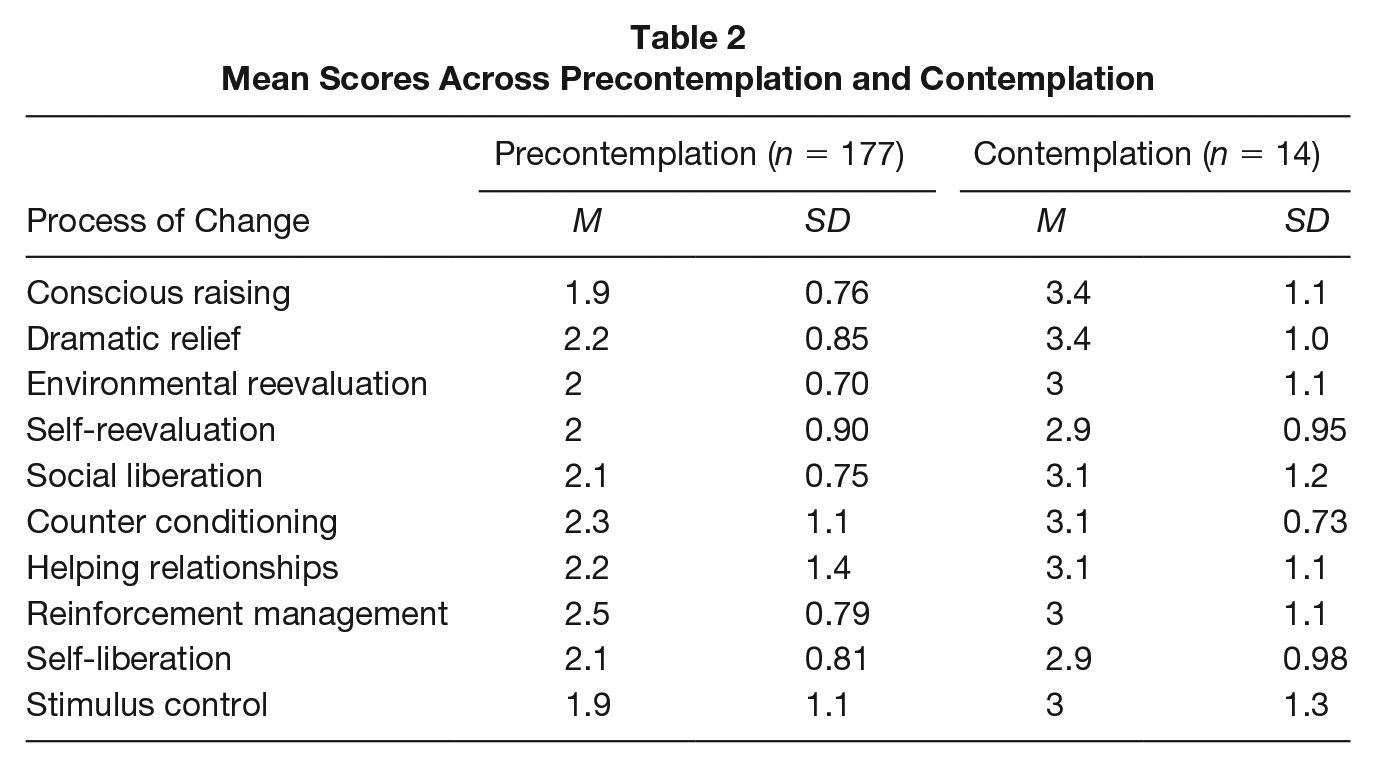
Mean PoC scores within contemplators show some alignment to theory. For example, social liberation items are expected to be present within contemplation. However, high means were reported for helping relationships (M = 3.1) and social liberation (M = 3.1). Helping relationships is a process that encourages action through to maintenance by combing elements of trust, strong relationships, and a caring environment.
An independent samples t test was run to determine if there were differences in PoC scores between those in precontemplation and contemplation. Levene’s test of homogeneity reported significance for environmental reevaluation, social liberation, and conscious raising, thus the assumption of equal variance was violated. These PoC items were not reported in Table 3. In all other PoC items, the assumption of equal variance was maintained. Significance was found in the PoC scores between precontemplation and contemplation, except for dramatic relief. For example, the variation between the mean of counterconditioning was statistically significant, −.779 (95% confidence interval [CI: 1.4, 0.2]), t(189) = −2.55, p = .011. The mean score in precontemplation was 2.3 (±1.4) and in contemplation the mean score was 3.1 (±0.2). This suggests a higher engagement with PoC items in contemplators. It reinforces the theoretical stance whereby individuals differ between early change behaviors. The effect size d was smaller than typical (d = .3), suggesting a small change in counter conditioning on account of SoC groups. Small effect size was also found for reinforcement management (d = .3) and helping relationships (d = .3). Typical effect size was found for self-liberation (d = .5), stimulus control (d = .5), and self-reevaluation (d = .5).
t Test and Descriptive Statistics for PoC Items Across SoC
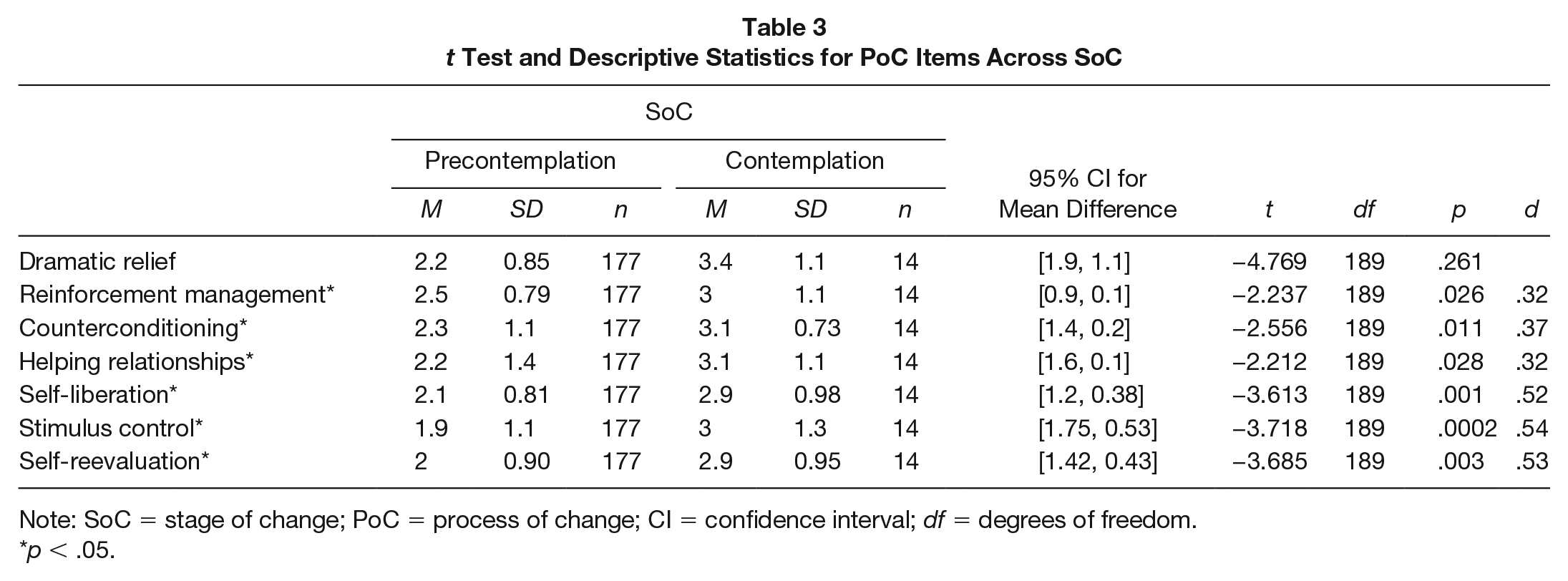
Note: SoC = stage of change; PoC = process of change; CI = confidence interval; df = degrees of freedom.
p < .05.
SoC and PoC Correlation
The intention here was to test the relationship between the scores and ascertain if the findings reflect the theory. In other words, do the PoC Scores increase as the SoC increases? According to Prochaska and Norcross (2007) change process associated with experiential and cognitive persuasions are most useful during the earlier precontemplation and contemplation stages. Indeed, Horiuchi et al. (2012) purported the use of experiential processes tend to peak at the contemplation stage. Behavioral PoC items are traditionally associated with those in action and maintenance. In this study, most of the participants were categorized as either precontemplators or contemplators, so there was an expectation of high engagement with experiential items as the scores increased.
A Spearman rank-order correlation was used to investigate if there was a statistically significant association between SoC scores and behavioral and experiential PoC scores. For the experiential score, Spearman rank correlation showed rs(189) = .33, p = .001, suggesting respondents with a higher SoC score tended to have a higher experiential PoC score. Using Morgan et al. (2012) guidelines, the r effect size was medium for studies in this area. The same approach was taken for behavioral PoC scores −rs(189) = .36, p = .001. Once again, the r effect size was medium. These results support earlier findings, which reported higher PoC, mean score for those categorized as contemplators against precontemplators. Indeed, these findings support the premise that levels of engagement in PoC items move in parallel with higher SoC scores.
Self-Efficacy
Cronbach’s α for the scale across the 12 items and between precontemplation and contemplation suggested internal reliability. Given the dominance of precontemplators (92%) and contemplators (7.5%) within this study, it was important to explore where the responses sat across each SoC. According to Schwarzer (2014), results should reflect a low score in precontemplation and as participants move toward changing their behavior, their confidence levels to abstain from particular behaviors (in this case driving to the Rugby League Stadium) should increase. The underlying statement within this Situational Confidence Questionnaire (SCQ) was “Given the scenarios below, we would like to know how confident you may feel in using an alternative to the car.” The assumption here was that those in precontemplation would not feel confident (present a lower mean) and those in contemplation would feel more confident (a higher mean).
There was a defining pattern with the results that showed a low mean in precontemplation through to a high mean in contemplation. This was a repeating pattern across each SCQ subscale (refer to Table 4). These results supported the expected trends where confidence levels of participants to abstain increased through SoC.
Self-Efficacy Mean Score and Standard Deviation
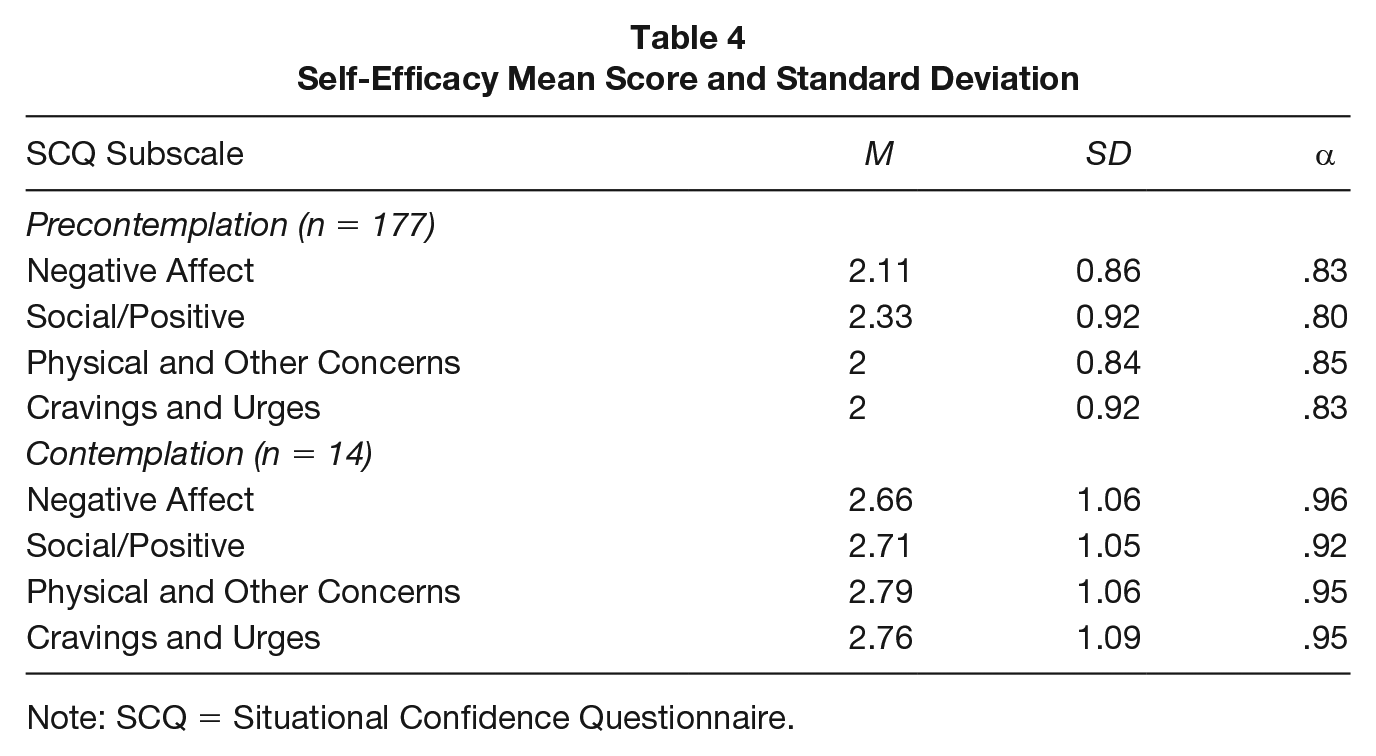
Note: SCQ = Situational Confidence Questionnaire.
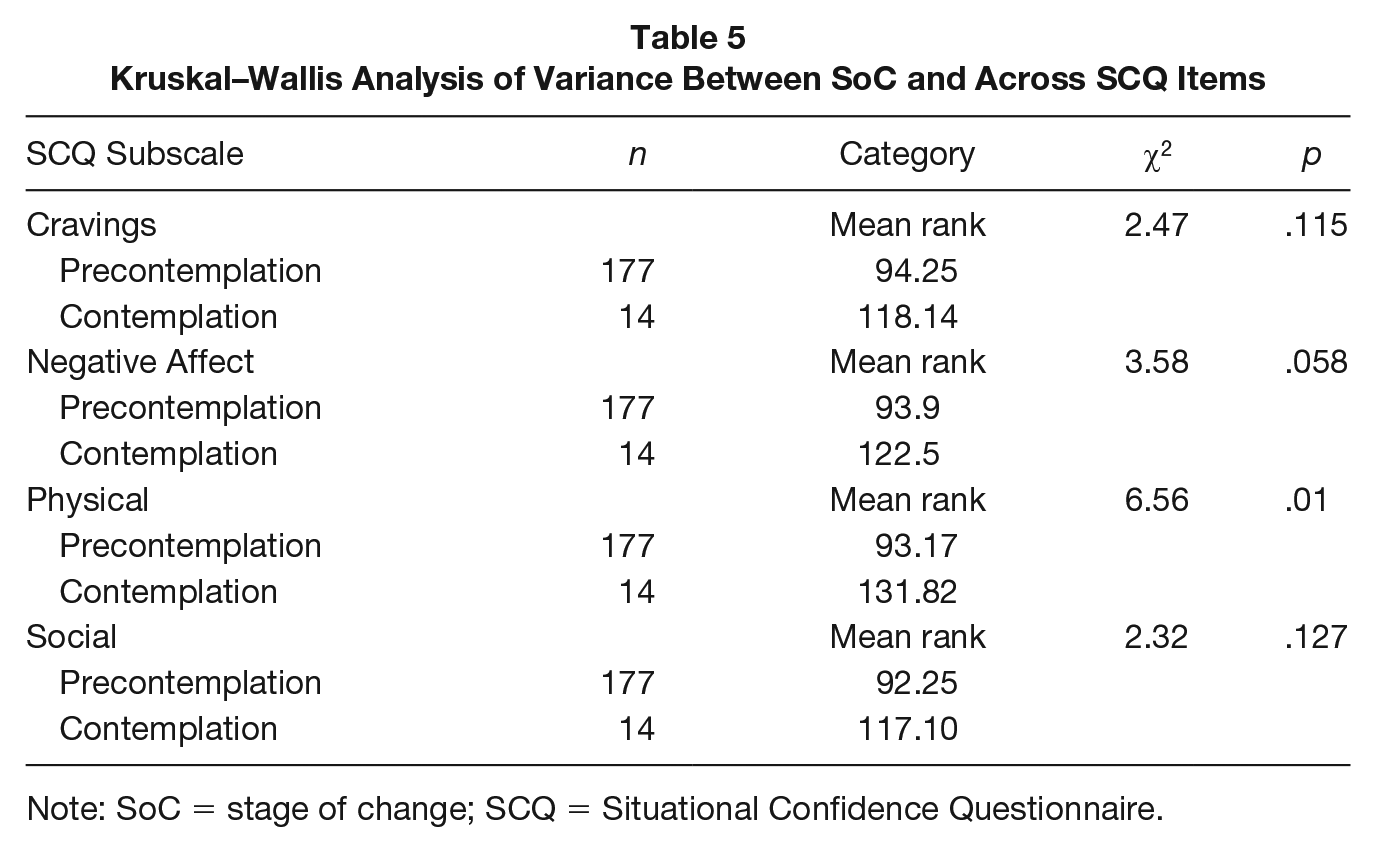
An analysis of variance (ANOVA) was considered to determine the effect of SoC on SCQ scores. However, when running the tests, homogeneity of variance was violated for some of the SCQ items. Therefore, to explore the difference between SoC and SCQ subscale, a nonparametric Kruskal–Wallis ANOVA was employed. While not ideal, Derrick et al. (2018) suggested the combination of parametric and nonparametric tests is appropriate for small samples and when assumptions are markedly violated. Assumptions of the Kruskal–Wallis test were met whereby the data were independent and there was an underlying continuity in the Likert-type scale. First, the median scores for each group were listed in rank order and shown in Table 5. As there were only two groups (precontemplation and contemplation), no post hoc analyses were used to explore where the significant differences were between the SoC. The only SCQ subscale to show significance was physical SCQ χ2(1, N = 191) = 6.57, p = .010 with precontemplation showing a lower mean of 93 against a contemplation mean of 131. These items referred to the physical situation of the individual (tiredness, injury, or time to plan) and their willingness to consider alternatives based on the item descriptions. It appears that the ease and availability of travel alternatives and creation of a positive social message may have an impact on the decision making of those in contemplation and assist in behavior change movement.
Kruskal–Wallis Analysis of Variance Between SoC and Across SCQ Items
Note: SoC = stage of change; SCQ = Situational Confidence Questionnaire.
Decisional Balance
A 10-item measure was used to test pros and cons of traveling to the Rugby League Stadium for home matches. Con items reflected barriers to changing travel behavior decisions such as “Driving to the stadium is a pleasure,” while pro items reflected affirmative items that may encourage a change in travel behavior decisions such as “I would be healthier if I walked to the stadium.” Within this study Cronbach’s α for the scale across the 10 items measured .69 suggesting internal reliability.
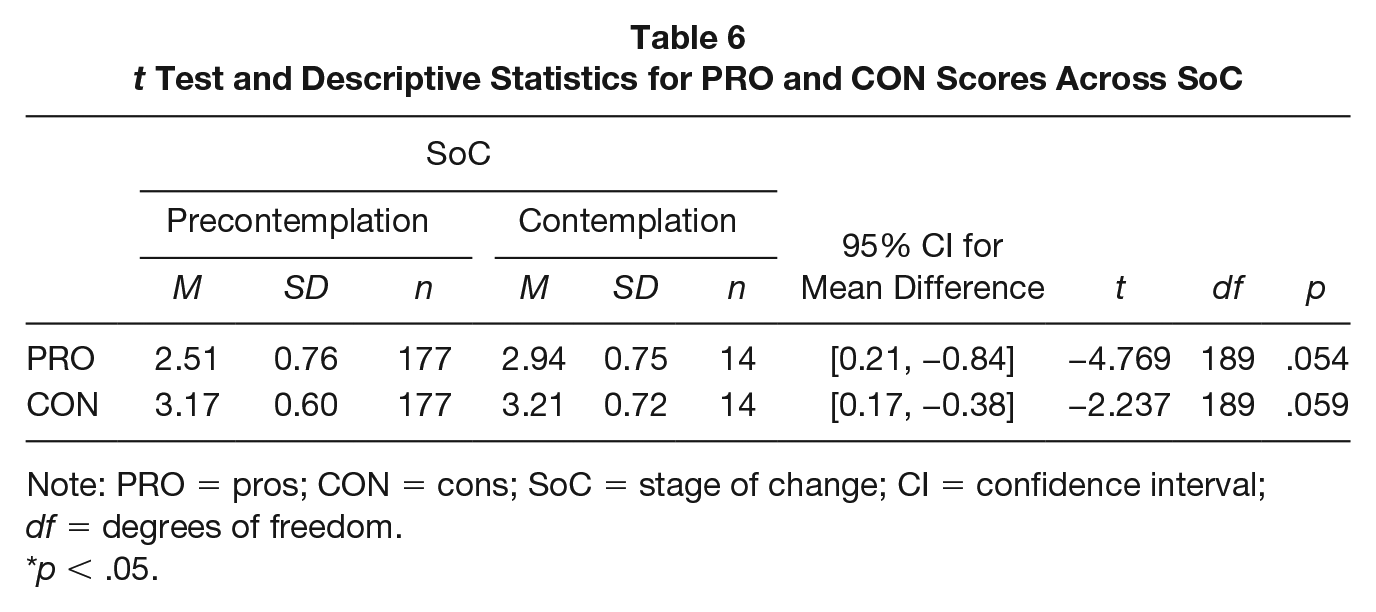
Table 6 presents the mean of pro and con items within each SoC. To determine if there was a stage-based difference between the Decisional Balance scores, an independent-samples t test was run. In this case, the independent variable was the SoC (with two levels). There were no significant outliers in the data. There was homogeneity of variances, as assessed by Levene’s test for equality of variances (Con p = .752, Pro p = .506). Table 6 underlines that no significance was found in the mean scores of pros and cons scores across the SoC. These findings support the prescribed theory where decisional balance crossover is usually found between contemplation and action.
t Test and Descriptive Statistics for PRO and CON Scores Across SoC
Note: PRO = pros; CON = cons; SoC = stage of change; CI = confidence interval; df = degrees of freedom.
p < .05.
To ascertain if there was an association between decision balance score and overall SoC scores, a Kendal’s Tau was completed. Z scores were used for pro and con scores as well as SoC scores. There was a strong positive association between SoC scores and pro item scores, τb = .159, p = .002. In other words, as the SoC scores increased so did the pro items suggesting an alignment with the prescribed theory; however, there was a negative association between con Items and SoC score as you might expect, τb = −.194, p = .00025.
Discussion
The following section explores the results of the TTM survey applied to sport fans, their travel behavior, and the extent to which the existing model may need adapting for this context.
The majority of sport fans travel to the stadium by car with others. They are certainly committed to the sport, with 29% traveling over 16 miles and taking up to 35 minutes to get the stadium. Given this context, it is not surprising that 92% of the participants were categorized as “precontemplators” and according to the TTM, do not recognize travel by car to the stadium as a problem behavior.
Notwithstanding, further analysis suggested the predominance of “precontemplators” may reflect the arbitrary nature in which participants are classified in the SoC and/or represent a rejection of the notion that the car is seen as an underlying “problem behavior.”
In analyzing whether sport fans in different stages of change vary in their processes of change in line with the TTM theory, the findings support the premise that levels of engagement in PoC items move in parallel with higher SoC scores, thus supporting Hypothesis 1a. Yet there were a few anomalies. Those in precontemplation have a high concern for others, which is usually seen in participants moving from action to maintenance SoC. For example, participants scored highly on reinforcement management items that focus on reward sought after by others and self-liberation items that requires a commitment to oneself and others. Clearly, the synergy between the stages and processes of change might not fit with the context of this study; sport fans look toward relationships with their traveling group to gain support and encouragement far earlier than what is seen in other studies of problem behaviors and social change. Given this, questions remain over the synergy between PoC and SoC constructs and their applicability to the context of travel behavior of sport fans. It is clear that sport fandom and communitas is a fundamental characteristic of this group and may assist in future travel behavior change interventions, and that central to creating and maintaining the identity of groups that travel and follow a sports team is to promote “group identification.”
This argument may exemplify the challenge in applying SoC categorization to a particular behavior and/or context. DiClemente et al. (2004) accepted that the categorization of SoC is more complicated when the target behavior is complex and or the potential goals are multifaceted. The current study certainly reflects this commentary. For example, many as multifaceted recognize travel (see, e.g., Green, 2008; Kaplanidou et al., 2012; and Regan et al., 2012). These multifaceted interactions are between people (shall I travel with others?), place (where are we traveling to and for how long?), social institutions (does the rugby team promote alternative travel modes?), and political institutions (does the local council support and provide incentives to use alternative travel modes to the car?). Contemporaneously, travel decisions are placed against broader considerations such as time, frequency, family circumstances, cost, status, safety, and convenience (Innocenti et al., 2013). Moreover, travel mode choices are made against a backdrop of motives such as excitement, escapism, and socialization of the sports fan. And in this study, participants may be armed with all the facts (both precontemplators and contemplators scored high on social liberation items such as “I recognize the impacts traffic pollution has on me, my friends, and family”) but continue to see the car as the answer to their problem rather than the problem behavior itself. Thus, the sheer complexity of the decision in traveling to the stadium (refer to earlier considerations of people, place, social, and political institutions) may be so overwhelming to each participant that they simply do not consider alternatives and default to ingrained habit. This may go some way to explaining the lack of consideration to alternative modes of travel and the dominance of “precontemplators” in these results.
While it is premature to dismiss the application of the SoC to the context of sport fan travel, it is worth noting that these findings endorse Rhodes et al. (2004) and Sutton’s (2001) views that discrete SoC are difficult to establish given the arbitrary nature of cutoff scores and simplified item-based algorithms that ascertain self-reporting behavioral intentions. It highlights the underlying contextual challenges that face the TTM when the “problem behavior” moves beyond the realms of addiction and health.
Overall participants had low levels of confidence to abstain from the car when traveling to the stadium. The findings reflected the theorized progression of low mean in precontemplation to a higher mean score in contemplation. Moreover, the results indicated little significance of stage effect on the results, thus supporting Hypothesis 1a. While it has been stated by Prochaska and Norcross (2007) that participants do not need to accept they have a problem behavior, it may be a variable that clearly affects the effect of the TTM within the decision-making process of modal choice and how to get to a sport venue.
Decisional balance results support Hypothesis 1a. As the SoC score increased, so did the Pro items (affirmative change). To recap, decisional balance explores the comparative gains and losses of certain behaviors. These gains and losses are a mix of personal losses for oneself, gains for significant others, and self-approval or disapproval and approval from others. It is clear from the results that the respondents have an awareness of the social (“driving has a negative impact on health”) and moral complexities (“local air pollution and family and friends suggest looking at alternatives”) that travel decisions can generate. But ultimately, and as Sheeran (2002) purported, participant’s ability to change is constrained by the context he or she finds himself in and the resources available. In this case, getting to the match on time together and leaving the match on time together. Thus, decisional balance may be superseded by perceived levels of control. Indeed, for these participants, evidence suggests that there is a social acceptance of the car and therefore they may be less likely to change. So, applying simplistic pros and cons statements to decision making simplifies what is a complex and socially constructed process. Indeed, Green (2008) argued that modal choice sits within a social and political framework that is linked to physical space, ethnicity, and class. Given the limited control over such factors as availability and cost, participants’ perceptions of the cons may persist beyond any pro items (affirmative behaviors). Therefore, it may be easier to increase this awareness than it is to decrease preexisting beliefs in order to generate cognitive dissonance and form proenvironmental behaviors.
Limitations
The small sample size has had an impact on the level of analysis surrounding SoC categories, such as those in action. Given the fragility of the sample, under and over estimation of the impacts can occur. However, where necessary, caution was noted throughout the findings and in discussion of the study. These results are also moderated by the self-reporting method used in this study. Given the complex nature of items in the survey such as personal losses for oneself and gains for significant others, there may be disconnect between the participants’ interpretations of each item. Consequently, future studies may look at adopting alternative techniques, such as motivational interviewing, to explore items from a participant led approach across PoC, decisional balance, and self-efficacy. Finally, debate could be applied to the choice of case study. There are many constraints that context can put on a person’s ability to change. In this instance, those constraints are the timing of the match, location of the venue, and relative infrequent nature of the trips. Thus, the underlying cause of participant behavior may have been due to the characteristics of the case study and not just the design of the items or challenges in operationalizing aspects of the TTM. A single case design and small sample can provide overestimates and underestimates as noted by Moser and Bamberg (2008). While the author accepts these limitations, it has never been suggested that a case study approach should be seen as representative of the entire sector.
Concluding Summary
Sport fans do not see the car as a problem behavior—in other words, getting to the stadium. They recognized the impact their behavior has, but appeared committed to using the car in the future. Underlying these decisions are the physical considerations such as location and distance, convenience, a concern for others, and the value of traveling together.
Overall, the TTM model behaves as theorized—the expected behavior of low levels of confidence within precontemplators and a higher level of confidence in abstaining as one progresses through the stages of change is prevalent. Yet there are some anomalies. For example, the mixture of behavioral and experiential PoC items found with precontemplators and contemplators is more commonly seen in the latter stages of change. This study has argued that the characteristics of those in the lower stages of change may need reviewing given the context of this study. For example, the strong affinity toward others and the concern toward the group within this specific population may have influenced the response to PoC items and the context of the study may have influenced the way in which participants perceived their current travel decision as a problem.
Nonetheless, further research is needed to clarify the existence of mediating factors on a larger scale. Moreover, supporters of different sports may react differently and therefore a future area of research could be to explore fan reaction in other sports such as football, cricket, and tennis. Indeed, exploring the underlying demographic influences may also influence utility of change behavior policies. For instance, analysis showed that there is no demographic influence between the stages of change. This trend is repeated in PoC, where gender showed no difference between the mechanisms that in theory should influence movement between the stages. However, there is less engagement in PoC items from drivers versus passengers, suggesting a strong attachment to the car from this group. These characteristics will assist any future policies or interventions related to travel behavior within a sport event context.
