



Abstract
“Reflection is a continuous process that is an essential par of an educators work, and their commitment to being a lifelong learner, actively working to prove professional practice (DEC, 2022)”
Shereen waved at the last departing early educator and began to gather her items. As program director of an inclusive early childhood center, Shereen looked forward to facilitating regular meetings with the team of four educators. Together, they usually used this time to make decisions on schedules, shared activities, and center events. They also often brainstormed about issues that emerged such as supporting a specific child and family, or obtaining resources and needed support. The meetings were effective in many ways and they looked forward to connecting (and eating shared food) together.
However, as Shereen walked back to her office, she couldn’t help but wonder how she could carve time out in the meetings that extended past logistics and emerging issues. Specifically, she thought about how they could use this time to reflect and even learn together. Shereen knew her team was working hard and, in many cases, continued to feel the prolonged impact of the COVID-19 pandemic both in their own lives as well as in their work. Shereen reflected on the need for time to honor what they were doing, share what they wanted to learn, and try new things together. The hope would be that it felt meaningful but also accessible. As she packed up to go for the day, Shereen felt motivated to try to find a way to intentionally grow as a team.
Reflection is a continuous process that is an essential part of an educator’s work and their commitment to being a lifelong learner, actively working to improve professional practice (Division of Early Childhood [DEC], 2022). Reflective practice allows practitioners to continue to refine their knowledge and skills to become more effective in their work. At times, reflective practice happens in real time, or what has been coined as “reflection-in-action” (Schon, 1987). For example, an educator momentarily observes how children are responding to an activity and then makes decisions as to how to adapt or continue the process on the spot. At other times, reflective practice may be better described as “reflection-on-action” as situations or events are contemplated at a different time, permitting educators to retrospectively examine their practice and plan for adjustments in future similar situations (Schon, 1987). The desire for an accessible way to foster meaningful “reflection-on-action” is seen in our vignette with Shereen, as she contemplates how to make space for reflection within regular team meetings.
In this article, we detail a cyclical, reflective practice framework (Rolfe et al., 2001) to promote professional growth for Early Intervention and Early Childhood Special Education (EI/ECSE) practitioners. Throughout the process, there are intentional opportunities to consider the assumptions or beliefs one holds that may be supporting or challenging decision-making and current practices (Brookfield, 2017). It is recognized that there are many available reflection frameworks. Our goal is to provide an accessible and flexible process that promotes awareness of diverse perspectives, supports the acquisition of new knowledge and skills, and considers biases and systemic inequities (DEC, 2022).
Professional Growth Through Reflective Practice
Engaging in ongoing professional development to support growth in knowledge, skills, and dispositions is essential for EI/ECSE practitioners’ ability to implement DEC Recommended Practices (DEC, 2014; Leadership, L2, L7). Professional development may take a variety of formats, including formal and informal training, workshops, coaching, consultation, and collaborative work among practitioners (Jensen & Rasmussen, 2019). Research focused on synthesizing the features of effective in-service training identified the importance of providing opportunities for practitioners to reflect on their understanding and proficiency in using recommended practices (DEC, 2014; Dunst et al., 2015; Leadership, L2, L7). The process of reflection can occur within the individual, as educators consider their own practice, or with others (e.g., mentors, supervisors, peers), as educators examine problems, exchange ideas, and extend their understanding in collaboration with others (Gatti et al., 2011).
Ongoing reflective practice can support practitioners working with young children with delays and/or disabilities to identify areas of growth, develop inclusive early learning environments (Bjørnsrud & Nilsen, 2019), and access evidence-based knowledge to continually improve their practice (Council of Exceptional Children [CEC] & DEC, 2020). The importance of reflective practice is supported by its inclusion as a component of Professionalism and Ethical Practice within the Initial Practice-Based Professional Standards for EI/ECSE personnel preparation programs (Standard 7; CEC & DEC, 2020). Furthermore, the DEC Code of Ethics (2022) states that to provide the most effective services for young children with disabilities and their families, EI/ECSE practitioners should “engage in individual reflection as a personal and professional development process regarding their personal background, professional strengths and challenges, and individual biases.” (p. 7). Research supports the use of reflective practice to support practitioners’ professional growth, including promoting reflective practices in EI/ECSE settings (e.g., Bradshaw, 2013; Kashinath et al., 2015; Ruming & McFarland, 2022). The use of a model or framework for reflective practice can enhance both individual and team reflection for in-service early educators (e.g., Ruming & McFarland, 2022) and assist early childhood pre-service teachers to engage in on-going reflective practice and develop professional knowledge and skills (e.g., Roberts et al., 2021).
“Assumptions can be thought of as beliefs that one holds about the world and their role within it that guides personal decision-making and actions.”
Acknowledging Assumptions in Reflective Practice
A key component necessary in reflective practice is acknowledging and addressing one’s assumptions (DEC, 2022; Liu, 2015). Assumptions can be thought of as beliefs that one holds about the world and their role within it that guide personal decision-making and actions. The assumptions one holds can come from a variety of sources, including their own personal learning experiences, advice or teachings from trusted sources, what is generally accepted as best practice or research-based, and/or how someone sees others respond, such as the children they are teaching (Brookfield, 2017). Furthermore, assumptions are undoubtedly influenced from the intersectional social identities that one holds including, but not limited to, race, language, socioeconomic status, culture, sexual orientation, gender, disability, and more (DEC, 2022; Oluo, 2018), and the systems of bias that privilege some identities and are unjust to others (National Association of the Education of Young Children [NAEYC], 2019). This awareness is critical to developing cultural understanding in regard to others’ perceptions and behaviors, and why these may be different than one’s own (Friesen et al., 2015).
It is critical to include a process of identifying and acknowledging assumptions into reflective practice as they can be deeply embedded, taken for granted, and integral in how one views themselves and others (Bradshaw, 2013). This is a continuous process, recognizing that the assumptions one holds can be dynamic and change over time, and are undoubtedly affected by the culture and identities to which one ascribes and experiences. It is through consistently embracing, and when needed challenging one’s assumptions, that reflective practices can lead to transformative learning and broader systemic and equitable change for all children, including those that are from traditionally marginalized backgrounds (Blanchard et al., 2021; Liu, 2015).
Reflections on assumptions can be guided by distinguishing broad categories including paradigmatic, prescriptive, and causal assumptions (Brookfield, 2017). Paradigmatic assumptions refer to ways in which we organize information into categories, often uncontested and thought of as fact, for better or worse. For example, families know their children the best, might be regarded as a paradigmatic assumption. Prescriptive assumptions include what we think should happen. This could include believing that a supportive family should read to their child for 20 min each day or always be available to infuse activities into their daily routines. Finally, causal assumptions refer to how others do things and how this could be changed, both positively or negatively. For example, having regular parent-teacher conferences allows meaningful collaboration for all.
“It is through consistently embracing, and when needed challenging one’s assumptions, that reflective practices can lead to transformative learning and broader systemic and equitable change for all children, including those that are from traditionally marginalized backgrounds (Blanchard et al., 2021; Liu, 2015).”
Engaging in Reflective Practice: A Framework
In the opening vignette, we describe Shereen’s desire to use the time together as a team to engage in reflection and learning in a manner that has the potential to transform practice. This may feel like a relatable but daunting process. The demands on time and resources can make meaningful reflection challenging and, at times, superficial and short-lived. Although brief workshops are known to be ineffective for improving teachers’ practice in comparison to more extensive models of professional development (e.g., coaching), they continue to be a primary type of professional development for early educators, likely due to the lower cost (Schachter, 2015; Wei et al., 2009). In turn, having a clear, accessible process that can be adapted to the specific focuses of an educator and/or team, is important.

In the following, we describe and illustrate a reflective practice framework (Table 1) that can be used to support the practice of “reflection-on-action.” Specifically, the framework leads educators through a cyclical reflection process that includes a triad of questions, What? So What? Now What?, that was developed by Rolfe and their colleagues (2001). This framework has benefited both pre-service and in-service early educators (e.g., Kostoulas-Makrakis & Makrakis, 2020; Slade et al., 2019). A study examining the impact of reflective practice on teacher candidates’ understanding of student development in the context of poverty applied Rolfe and colleagues’ (2001) framework to guide reflective thinking. An analysis of teacher candidates’ written reflections indicated positive impact on learning, with candidates showing growth in knowledge, skills, and dispositions as they connected university course content to related field experiences (Slade et al., 2019). Focusing on training teachers of refugee learners, Kostoulas-Makrakis and Makrakis (2020) designed a learning framework that emphasizes student-driven learning activities and includes critical reflection following Rolfe and colleagues’ (2001) cyclical questions as an important process. Such training enables early educators to engage in critical reflection that promotes responsive teaching through increased awareness of the refugee learners’ experiences and cultural backgrounds (Kostoulas-Makrakis & Makrakis, 2020).
Reflective Practice Framework
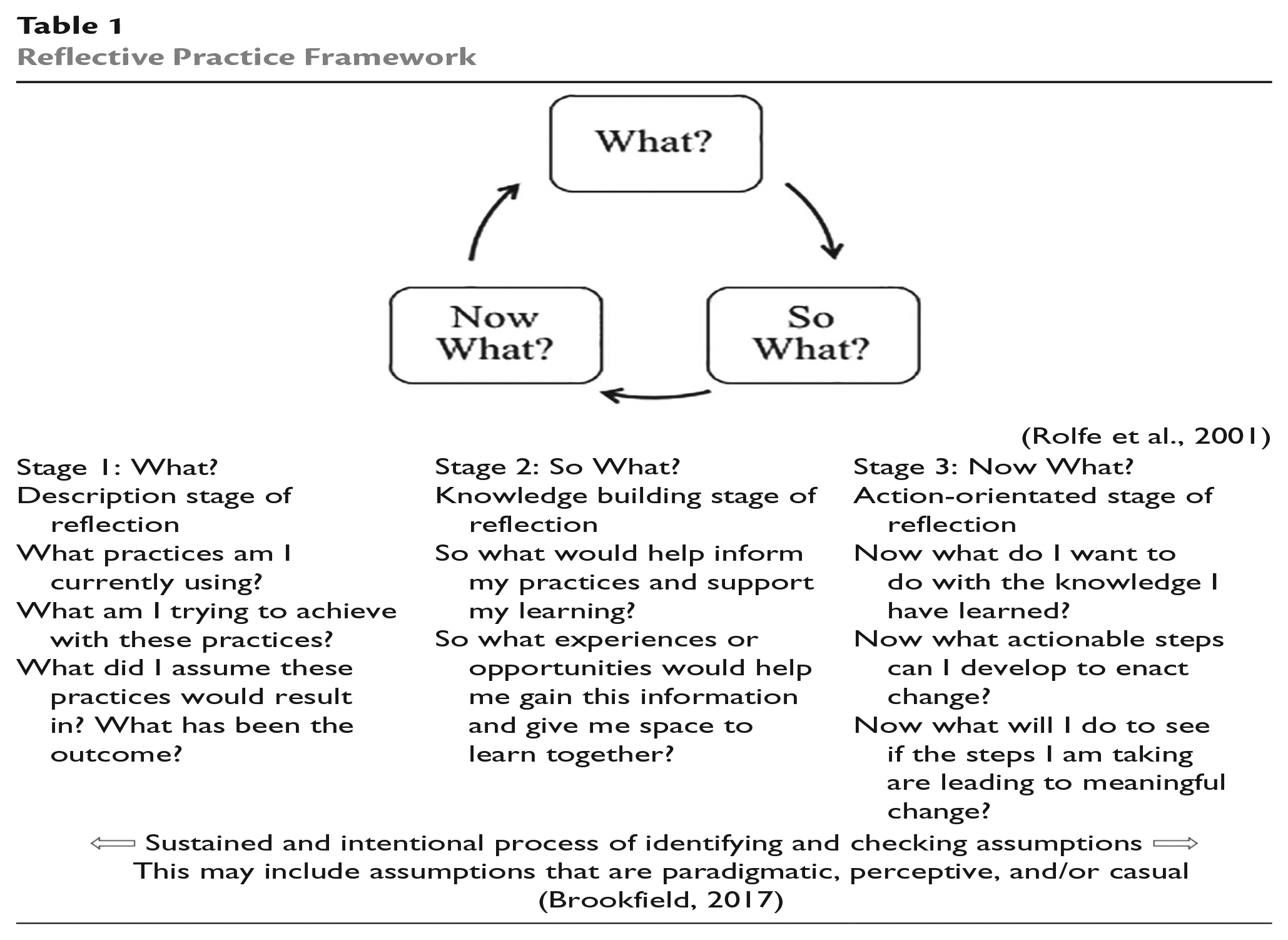
In the description, we have embedded ongoing opportunities to address the assumptions one holds that will inevitably influence reflections and subsequent action (DEC, 2022; Liu, 2015). Specifically, we have sought to systematically hold space at each stage of reflection to examine different types of assumptions individuals may hold that are undoubtedly affecting their perceptions, plans, and actions, both intentionally and unintentionally (Brookfield, 2017). Throughout the description, we return to the vignette focused on Shereen and her team to provide a concrete example of what this process may look like for educators that are striving to infuse reflective practice into their routines as a means of professional growth.
In their next meeting, Shereen shared the desire with her team to more intentionally center reflection and learning as part of their regular meetings. She had spent some time investigating different ways to do this and had decided to get feedback on a simple, reflective practice framework that could guide this work (Table 1). Shereen was excited when the early educators responded positively, sharing the sentiment that it would feel empowering to be proactive and choose areas of their practice to really consider and improve. Shereen stressed that the reflective practices framework could be used with a wide range of topics and recommended practices, both individually or as a team. This would help focus the first stage of the reflection framework, the “What?”
As discussion continued, a common theme that emerged was the desire to reflect upon partnerships with families. For example, one of the teachers named Daniel shared about a poster project he had sent home to all the families in his class called “Who Is in Your Family?” His intent with this project had been to get to know the families of children in his classroom and begin to build community. It had resulted in some wonderful, creative works, yet there were some families that did not participate. Daniel noted that he had assumed that all families would have the time and materials to complete this, and that families would want or be able to share about their families through the poster project. Daniel recognized that these assumptions were undoubtedly influenced by the identities he did and did not hold. For example, his family constellation was widely accepted in society so he had not considered that some families may not feel comfortable widely sharing. He was also not a parent to a child with a disability and had not considered how a project like this may add stress to existing schedule demands of appointments and interventions, or how it may need to be differentiated to be meaningful.
After everyone had a chance to share like Daniel had, Shereen suggested that they take time to individually reflect on the family partnership practices they were using, both in their classrooms and as a program. This included considering what assumptions were guiding these decisions. For example, what beliefs were they holding about families and their role in the classrooms and programs (paradigmatic assumptions)? How were they expecting families to be involved or take part in the activities planned (prescriptive assumptions)? Were there ways that they could begin to engage and partner with families that were different from what was usually done (causal assumptions)?
To help guide these reflections about family partnerships, Shereen offered everyone the free Family-Centered Practices Checklist (Early Childhood Technical Assistance Center [ECTAC], 2018) in order to consider the extent to which they were implementing recommended practices in EI/ECSE related to building trusting and respectful partnerships, supporting families, and demonstrating responsiveness (DEC, 2014; F1, 2, 3, 4, 5, 7) in their interactions with families. Shereen stressed that the purpose of the tool would be to guide reflection and help focus conversation in the next meeting as they continued to consider the “What?” and move to the “So What?” stage of the framework.
The So What? stage of the reflective practice framework includes the critical piece of continuing to consider the assumptions that are inevitably affecting our decisions. This may include considering where knowledge is being sought and if there are ways that this could be expanded or diversified. For example, are there opportunities to learn from individuals who have lived experiences that are essential to further understanding, including voices that are traditionally marginalized and underrepresented? This may also include reflecting on who is getting the opportunities to take part in learning experiences, and advocating for equitable access.
To begin the next team meeting, Shereen reviewed the reflective framework (Table 1) with the team, welcoming everyone to share reflections about “What?” practices they had been focusing on around family partnerships since they last met. As they all took turns sharing, Shereen sought opportunities to try to pose questions regarding underlying assumptions they may be holding that were guiding these practices. For example, as Daniel shared about the family projects he had chosen to reflect upon, the team brainstormed about how this project had assumed that all families would have the time and materials to participate (paradigmatic assumption), that families should partake in this project to be involved (prescriptive assumption), and that this was a meaningful activity as it has been used by other teachers/programs (causal assumption). An important catalyst to realizing these assumptions required reflection was from a conversation with a family member who shared that it had been hard to find the time to do this project amongst their child’s appointments/intervention services, and that they had not felt confident in understanding the instructions, given that English was not the primary language used at home. In turn, they had decided not to complete it.
Shereen expressed her appreciation for the candor and vulnerability that had been expressed, as well as the clear evidence of the shared desire to work towards more meaningful family practices. She shifted the team’s attention to the second stage of reflection, “So What?,” asking the team what they would like to learn or experience to help inform their practice around family partnerships. To help prompt ideas, Shereen shared some resources around family/community partnerships (Table 2). She encouraged teachers to take a look, but also not feel limited to this, welcoming them to come to her with ideas. The meeting concluded by Shereen noting that at their next meeting, she hoped they could share what they learned in this stage (So What?) and begin to think about action steps (Now What?).
Example of Resources to Guide Reflective Practice in Stage 2 (So What?)
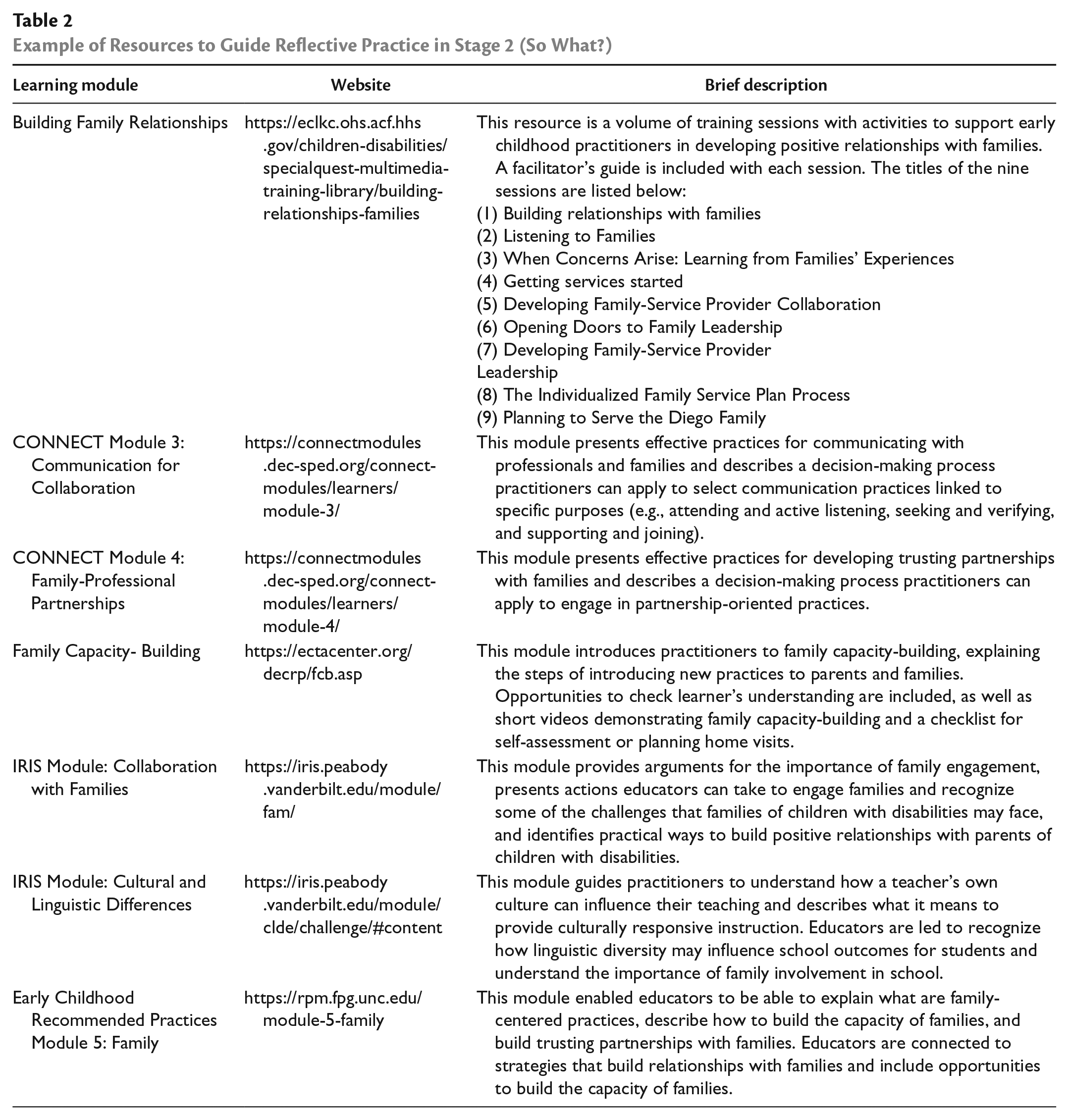
At the next team meeting, Shereen again reviewed the reflective practice framework (Table 1) and began by giving space for the teachers to share how they had sought to inform their practices (So What?). As they talked, she recorded their different learning activities, hoping it could become a resource for them all to refer to through this process. For example, Daniel shared how he had tried one of the resources that Shereen had provided at the last meeting (Table 2), the Early Childhood Recommended Practices Module on Family (RPM Project, 2018). An aspect of this that resonated deeply with Daniel was the practice of building family-capacity by learning and supporting all of the families’ existing knowledge and skills, including the family that had shared the challenges they faced with the poster project. Daniel shared how he wanted to consider how to better connect with families and design/redesign family projects to include opportunities and experiences that build capacity and enhance families’ sense of self-efficacy.
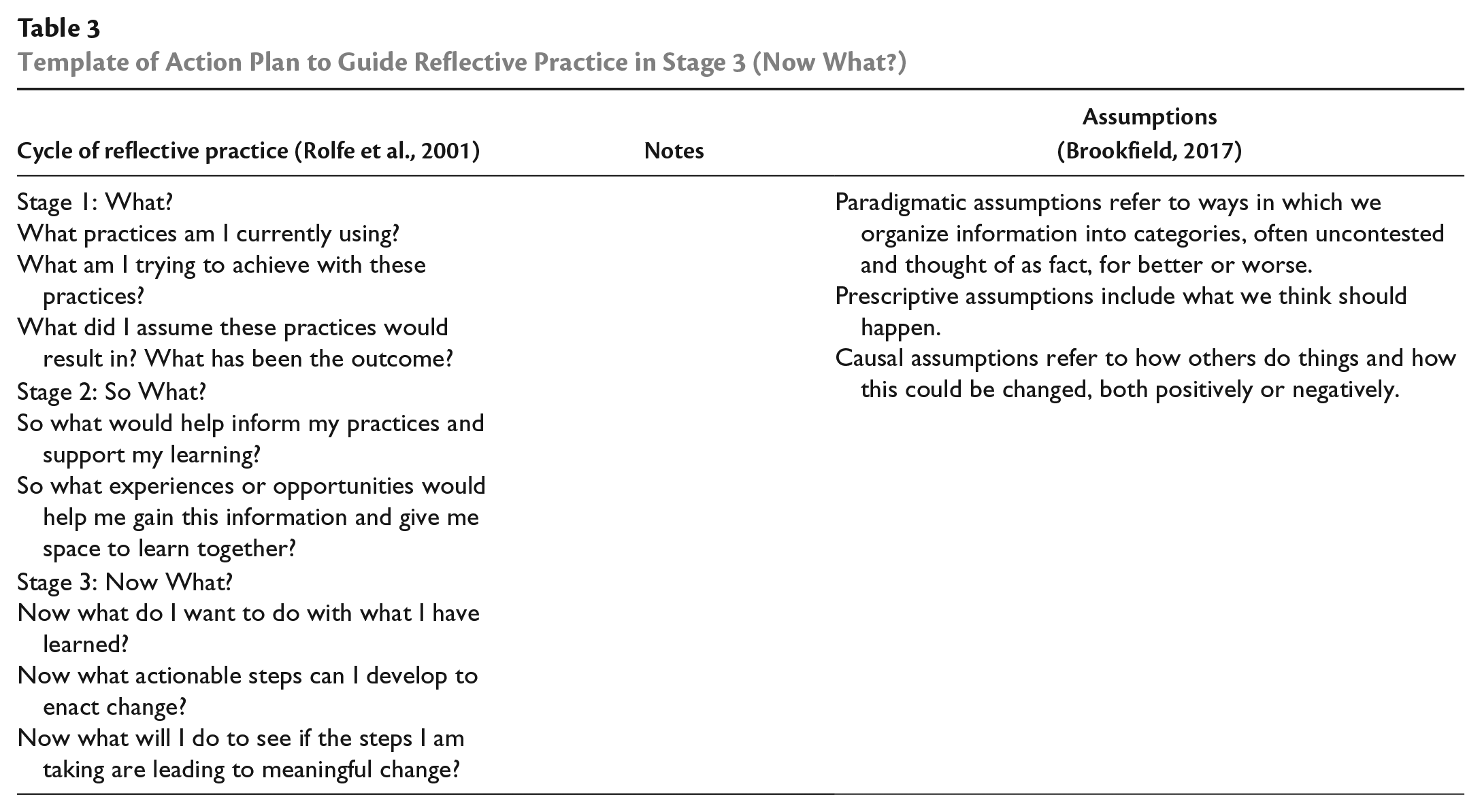
Facilitating the conversation forward, Shereen wondered now how they could take the reflections and information learned and consider what they wanted to put into practice as part of Stage 3: Now What? To support this work, Shereen provided an action plan template (Table 3), sharing that it may be an effective tool to document their process, and plan their action steps. She encouraged teachers to take intentional time to consider why they are focusing on certain practices in their action plans and what their expectations are with their plan. Shereen suggested that when they meet once again, they would share their plans.
Template of Action Plan to Guide Reflective Practice in Stage 3 (Now What?)
Conclusion
While we provide an example within the vignette of how the reflective practice framework could be a catalyst for more meaningful family partnerships, the process could be applied to a variety of situations and practices. The goal is to provide educators with a process to reflect on what is occurring (What?), consider how to inform change (So What?), and then initiate action (Now What?). Embedded throughout, is the continual need to examine assumptions that affect practice. Rather than a linear process, this framework is cyclical and ongoing. In turn, it becomes a tool for providing a means to develop a consistent and meaningful reflective practice to support professional growth and action (DEC, 2022).
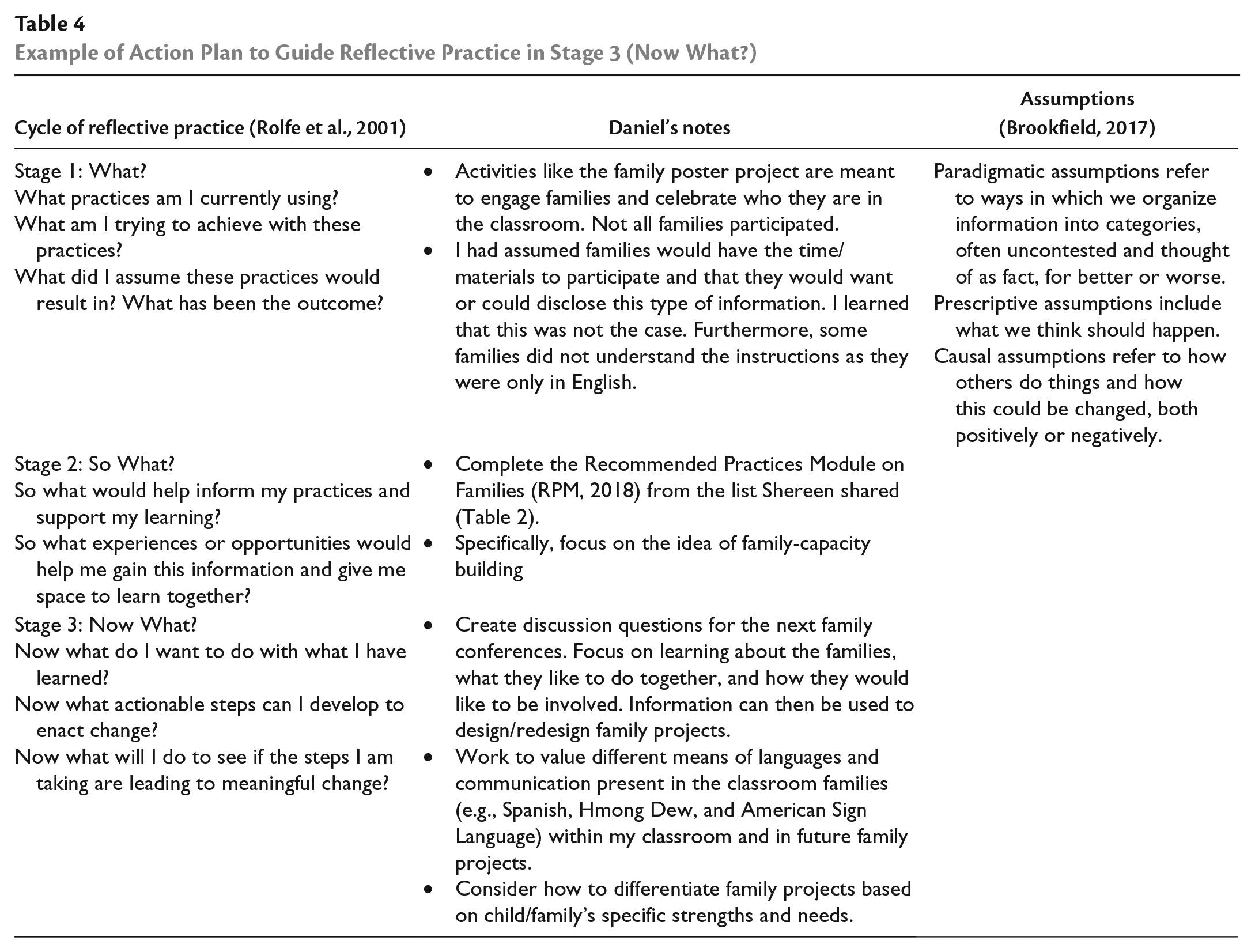
Shereen took a swig of coffee and gathered her things. Another team meeting had concluded and she was filled with immense gratitude for the work her team was engaging in through reflection. During this time together, they had taken time to share about how the action steps had been progressing for everyone in regards to their work with family partnership practices. For example, Daniel had shared his action plan (Table 4) including how he had decided to try to develop a short list of questions to help focus discussion on families’ existing strengths and priorities at the upcoming family meetings. Daniel had shared that he wanted to act upon his assumption that families had existing strengths that he could learn from and help guide subsequent activities or events in the classroom. In the meantime, he also wanted to take a tangible step in honoring families’ strengths and home practices more immediately. For example, he had realized that he had only been sending information home in English, and that this was the language primarily represented in the materials in his classroom. He had realized in this process that he could do so much more to honor different languages and means of communication represented in the children and families in his classroom. Furthermore, he wanted to consider how he could provide more choice and time in family projects like the poster, and differentiate them based on a child and family’s strengths and needs.
Example of Action Plan to Guide Reflective Practice in Stage 3 (Now What?)
Shereen looked forward to the next team meeting and continuing the reflection process. For some of the team members, work was continuing on family partnerships as part of their reflective practice focus. For a couple of the educators, this work had led to reflection about other practices including collaboration with other professionals and in turn, the reflective practice framework had begun again. Shereen looked forward to learning more about what Daniel and the other practitioners were reflecting, learning, and trying within their practice. She made note to ensure that conversation did not just focus on the actions taken but also reflection on the beliefs guiding the change and the perceptions of what was now occurring. Shereen felt a growing confidence to facilitate her teaching team through reflection, and looked forward to ensuring this was an ongoing, meaningful focus within the team.
