




Abstract
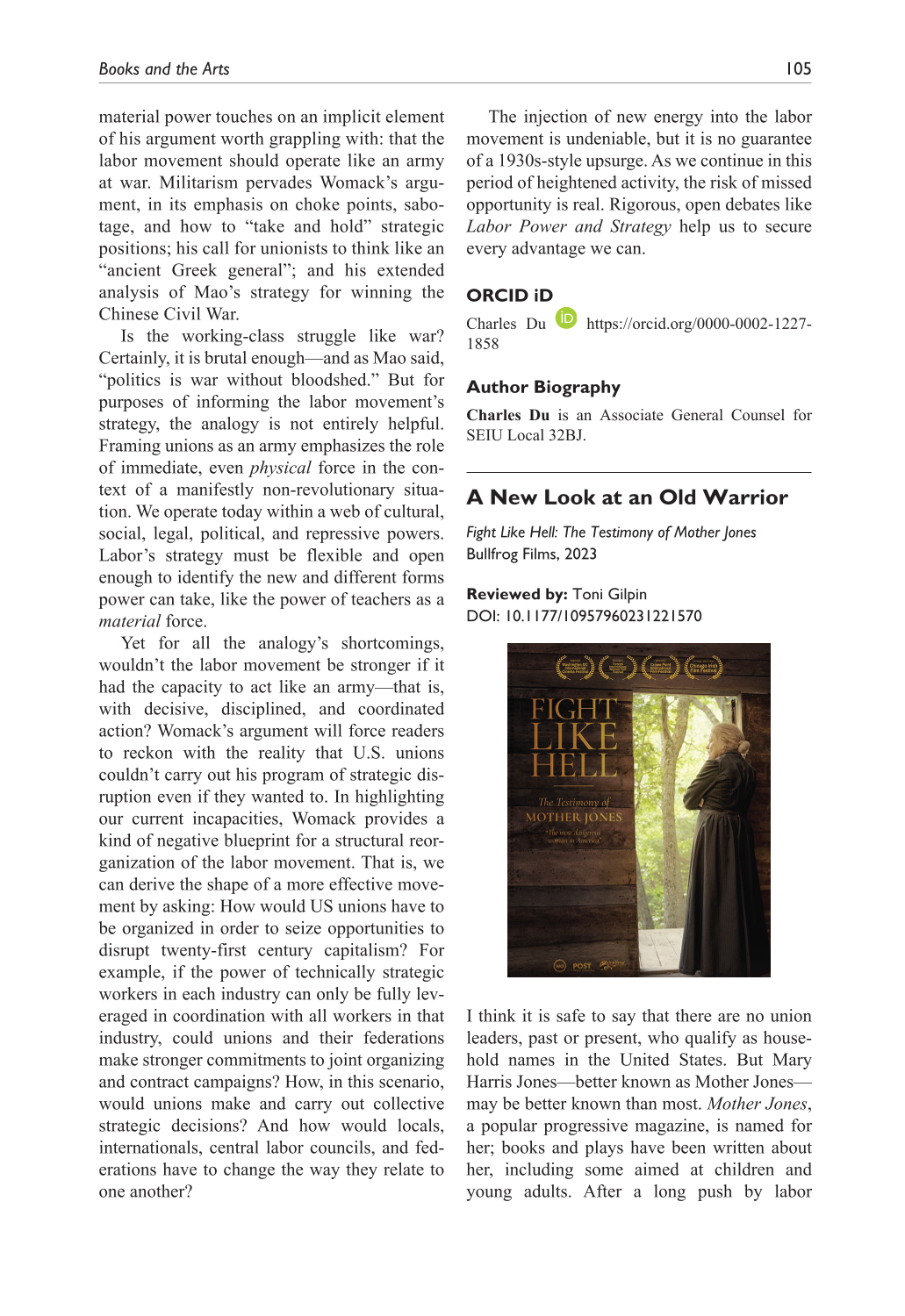
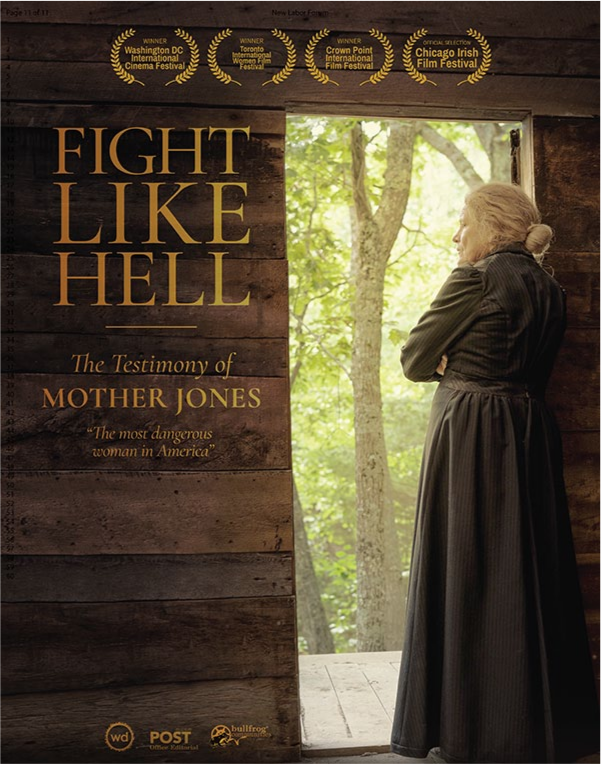
I think it is safe to say that there are no union leaders, past or present, who qualify as household names in the United States. But Mary Harris Jones—better known as Mother Jones—may be better known than most. Mother Jones, a popular progressive magazine, is named for her; books and plays have been written about her, including some aimed at children and young adults. After a long push by labor historians and union officials, the city of Chicago recently pledged to erect a monument to Mother Jones just off North Michigan Avenue, the city’s swanky, heavily touristed shopping strip. Tote bags and t-shirts emblazoned with her likeness, along with one of her rousing exhortations—“Pray for the dead and fight like hell for the living”—are easy to score online.
On the face of it, Mother Jones seems an unlikely labor legend: in the late nineteenth century, when she first came to national attention, she was a white-haired widow, partial to prim black dresses accented with a touch of lace. But her genteel appearance belied her ferocious advocacy for the working class. She fought for, and alongside, cruelly exploited miners and mill workers across the United States back when union organizing was a life-threatening occupation, facing down robber barons and the cops and vigilantes who served them. Brassy and sharp-witted, Mother Jones might be labeled a Gilded Age girl-boss, except she was decades past girlhood and devoted herself to defeating the bosses, not becoming one. All this helps explain why Mother Jones registers some level of recognition today, but that’s not saying much. She remains unknown to most Americans. Even those familiar with her meme-worthy quotations may actually know little about her. A new film—Fight Like Hell: The Testimony of Mother Jones—thus provides a valuable introduction to this extraordinary woman.
Fight Like Hell was written by actor Kaiulani Lee, who also plays Mother Jones. It is an adaptation of Lee’s earlier Obie-winning play, Can’t Scare Me, and is drawn entirely from Mother Jones’s autobiography and her other writing and speeches. The film was directed by Ian Cheney. Like the play Fight Like Hell is a one-woman show, running less than one hour. As such, it demands a riveting performance.
On that score, Kaiulani Lee delivers. She is the right age to play Mother Jones in her heyday, so she doesn’t need to resort to gray wigs and pasted-on wrinkles to play the part. But the power of Lee’s portrayal derives principally from her sensitive realization of Mother Jones and the deep understanding she brings to her subject. Lee eschews the temptation to gin up the histrionics; we get Mother Jones the storyteller as much as the speechmaker. While Lee certainly presents occasions when Jones roars with righteous indignation, there are equally engaging moments of quiet reflection. One of the more affecting of these centers on the loss of Jones’s husband and her four young children to yellow fever in 1867. Lee’s portrayal of such incalculable sorrow feels utterly genuine and is thoroughly gripping.
At least I hope it is: Fight Like Hell lacks the action sequences and elaborate set design common to popular big-budget historical dramas. But Lee’s compelling performance, coupled with the deft camerawork of director Ian Cheney, should hold viewers’ attention nonetheless. Fight Like Hell takes place in a single location, a sparsely-furnished mountain cabin—opening titles indicate we’re in West Virginia, in 1921—with only a few props: some photographs, a map, a tin cup. That it’s an actual cabin in the woods, and not a stage set, contributes to the authenticity. Real flies buzz about. Cheney has filmed Lee in a single unedited shot, enhancing the sense that we are actually spending time with Mother Jones.
And while the film is devoid of battle scenes, there is a good deal of brutal warfare in Fight Like Hell, namely the sort between capital and labor, brought to life through the words of Mother Jones. The film is at its informative best through Jones’s vivid depictions of the hellish conditions imposed on workers by the captains of American industry; and Lee is especially moving as she delivers Mother Jones’s lyrical tribute to coal miners, for whom Jones felt a special affection. We hear also of the horrors of child labor, since in the early twentieth century, two million children—meaning those fourteen and under—worked long hours in the nation’s mines and factories.
Such suffering engendered struggle, and Fight Like Hell touches on many of the major strikes of the era, from “the march of the mill children” in Pennsylvania; to the Ludlow Massacre in Colorado; and finally to Blair Mountain, West Virginia, where defiant miners took up arms against the coal company owners and their hired guns—and ultimately the U.S. Army—in what was, as the film indicates, “the largest battle on American soil since the Civil War.” Fight Like Hell thus serves both as a tribute to a courageous working-class warrior and a primer in Gilded Age history. Its short run time makes it perfect for instructive and inspiring viewing in classrooms, union halls, and at community meetings. The film is not without shortcomings, however, which stem from its source material: Mother Jones’s own words.
When Mother Jones published her autobiography in 1925, even her allies recognized that it was riddled with errors and omissions. Minor inaccuracies might be waved away, but more problematic is the way in which Mother Jones often makes herself the wellspring of the resistance she describes. This is reflected in episodes detailed in Fight Like Hell. They go like this: Mother Jones encounters a group of downtrodden workers; she goads them out of complacency; and, from her, they learn how to fight back. Activists should take issue with this top-down schema, because social movements require solidarity, constructed through the protracted efforts of working people themselves. Mother Jones herself understood that full well, so the self-centered aspects of her autobiography may be chalked up to ego (an attribute common to forceful leaders) or a desire to condense events. But for lessons in effective organizing, Fight Like Hell—somewhat ironically—is not the best place to look.
There’s something else missing in Fight Like Hell: political ideology. There are references to legislation and elected officials, but no mention of the anticapitalist ideologies—anarchism, socialism, and communism—that were mobilizing workers and panicking elites in this era. This oversight can again be attributed to the source material. In her autobiography, Mother Jones ignores these movements and fails even to mention the most radical union of her time—the Industrial Workers of the World—even though she was directly involved in its founding. The film concludes with these words from Mother Jones: “It’s a fighting age.” But Mother Jones herself chose to exclude from the story many of those on the front lines of the battlefield.
In other respects, it is Kaiulani Lee who has skirted some of the more contradictory aspects of Mother Jones’s political perspective. “There were very few women organizers,” Mother Jones says in Fight Like Hell, but in fact there were many in her day, in the labor movement, in the battle for civil rights, and in the struggle for women’s equality. And some women were organizing for all three at once—Ida B. Wells and Elizabeth Gurley Flynn are just two of Jones’ contemporaries who fall into that category. In the film, Mother Jones comes across as a feminist firebrand; but in her writings, Jones made clear that she strongly opposed women’s suffrage and felt that if working women were freed from economic oppression, they would choose to devote themselves solely to their husbands and children. Mother Jones, labeled “the most dangerous woman in America” for her union activities, believed that a woman’s place was in the home. Such traditional thinking might come as a surprise to those who know Mother Jones only as a radical avatar.
Grappling with these questions, though, could stimulate meaningful discussion among those who have seen the film. How did workers fight back against the seemingly insurmountable power of the robber barons? What allowed them to succeed at some moments, and what led them to fail at others? What does effective working-class organizing entail, and what role does leadership play? Can you challenge capitalists, individually, without challenging capitalism? How do we assess workers’ advocates—or workers themselves—who may be radical on some matters and retrograde on others? Should today’s union activists look to labor history solely for rousing inspirational episodes; or are there other reasons those fighting for a more just future should engage with the past?
These complexities do not undercut the film’s value. Mother Jones, an indomitable champion of human dignity, deserves to be at least as well-known as the bloodthirsty tycoons she despised. Hopefully, Fight Like Hell can help raise her profile. Corporate greed and yawning inequality plague us still, and so the words of Mother Jones—“You educate, you agitate, you organize, and you win”—are as urgent today as they ever were.
