




Abstract
Keywords
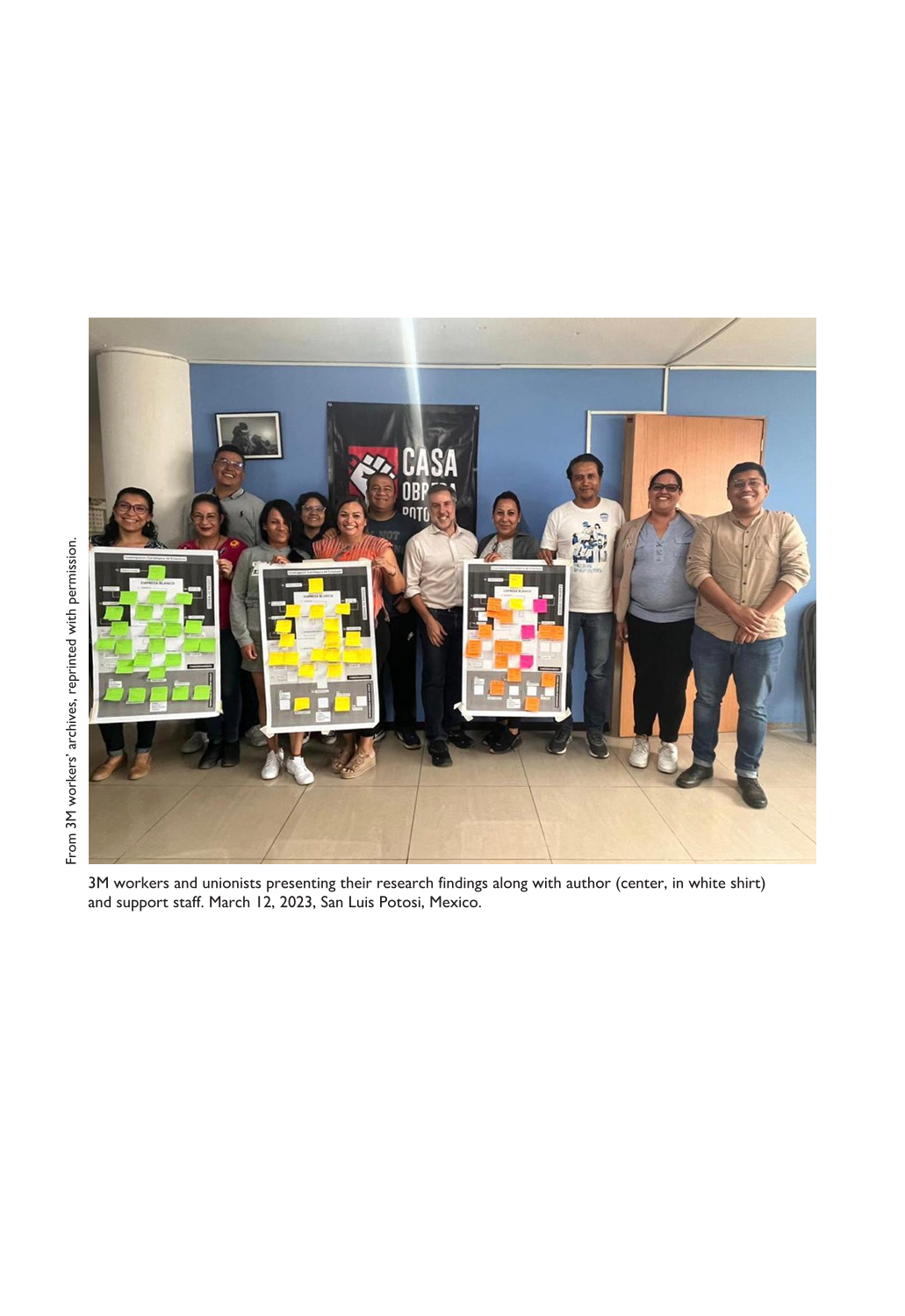
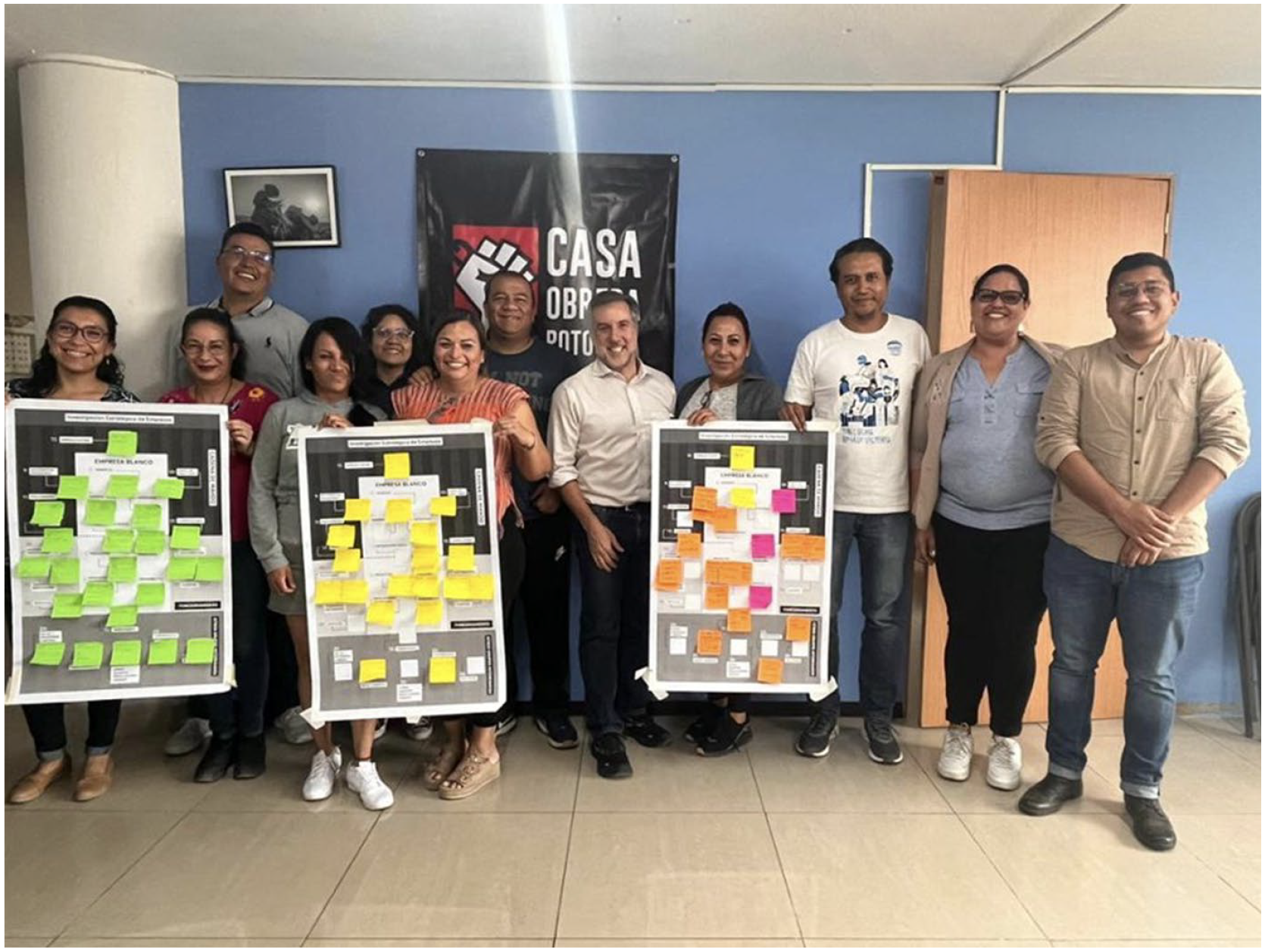
3M workers and unionists presenting their research findings along with author (center, in white shirt) and support staff. March 12, 2023, San Luis Potosi, Mexico.
From 3M workers’ archives, reprinted with permission.
In the increasingly complex dynamics of global production, labor activists face a challenge: How to research corporations and design organizing strategies while also ensuring workers’ engagement and ownership over that strategy? It has long been understood that the most effective strategies combine local worker organizing with strategic corporate research and comprehensive campaigns. 1 What needs to be more deeply explored is how to involve workers, particularly in the Global South, more systematically in research on the global supply chains (GSCs) to which their workplaces are associated. A worker-driven co-research approach not only ensures better-quality research findings, but it also raises awareness among workers about the relationship between local working conditions and global production while contributing to social and political transformations.
Unlike some forms of participatory research, worker-driven research is an approach in which workers not only participate in the gathering of data for someone else’s project, but they also are fully involved in establishing research questions and are engaged in the analysis and the dissemination of the findings. It takes us away from forms of extractive research in which researchers take information from the researched without giving back. 2 Second, the inclusion of GSCs in this research approach means workers are engaged not only in gathering information on their workplaces and communities but are also researching operations across countries as well gathering information on global corporate headquarters, ideally to design comprehensive campaigns and bargain more effectively. Finally, worker-driven is not meant to suggest an alternative to trade union driven. Rather, it is meant as an inclusive term to cover the research engagement of unionized workers and workers who are not unionized.
Three cases of worker-driven co-research in Latin America (in which I played a direct role) provide examples of this approach. They involve banana workers in Guatemala, garment workers in Honduras, and mixed export manufacturing workers in Mexico. In the first two cases, workers participated in the design, administration, and analysis of worker surveys. In all three cases, but most especially in the Mexican case, workers also learned the fundamentals of researching the financial structures of their GSCs. The combination of strategic research and worker organizing had real impacts. In Guatemala, in 2020, banana unions stopped an effort by Del Monte to squeeze down on wages. In Honduras, in 2021, garment workers managed to push back on management’s claim that they needed to freeze wages because of the Covid pandemic. In Mexico, in 2022 and 2023, workers combined organizing, legal leverage, and research to organize independent unions and negotiate first contracts.
The impacts of these achievements were felt in the workplace and more broadly in workers’ homes and communities. And, in the case of Honduras, worker organizing spilled over to the political sphere as labor contributed to the electoral success of progressive candidate, Xiomara Castro, the wife of Manuel Castro who had been removed from office twelve years earlier in a coup d’état supported by the military and economic elites.
Roots of Worker-Driven Co-Research
Participatory research has roots in numerous academic fields and takes many forms that are often inspired by Brazilian educator Paulo Freire’s theory and practice of ensuring marginalized people have a voice in the research and education that impact them. 3 In health research, participatory research is carried out, as noted by social scientists Andrea Cornwall and Rachel Jewkes, “with and by local people rather than on them” where “local knowledge and perspectives . . . form the basis for research and planning.” 4 By giving local actors more control over the research process—setting the research question, analyzing and interpreting the data, and disseminating the findings—participatory research involves a shift in the location of power in the research process. 5 Names for these research methodologies vary, including “Participatory Action Research,” 6 “co-operative inquiry,” 7 and “Community Based PAR (participatory action research).” 8 According to community psychology professor Jarg Bergold and social research methods professor Stefan Thomas, what these approaches share is the goal of changing, “social reality on the basis of insights into everyday practices that are obtained by means of participatory research—that is, collaborative research.” 9
The field of Labor Studies has its own traditions of participatory research, much of it influenced by experiences in the industrial city of Turin, Italy in the 1960s and 1970s. Italian scholars and left political activists Mario Tronti, Raniero Panzieri, and Romano Alquati introduced the concepts and practice of “worker inquiry” and “co-research” (conricerca) to describe a research process aimed at capturing the reality of workers through a close collaboration between workers and theorists. 10 The goal was also to transform this reality not only by informing terms and conditions of labor through action-oriented research, but also by mobilizing workers beyond the workplace to contribute to broader social and political changes. Education professor Patrick Carmichael’s “emancipatory research and development” 11 and labor sociologist Michel Thiollent’s “action research” follow this tradition by linking knowledge and actions in ways that transform working conditions under capitalism.
For sociologist Jamie Woodcock, the common thread of these approaches is to connect the theorization of capital with the experiences of the workplace. 12 Co-research between activists and theorists is about mitigating power asymmetries between labor and management by leveraging research to inform and drive action. In this tradition, the process of co-research gives workers protagonism and raises consciousness. It is a process of research (inquiry) from below in which knowledge is produced on the functioning of capitalism to better organize against it. This includes action in the political and social spheres, as well as in the workplace. 13
In contemporary U.S. Labor Studies, there are a plethora of examples of participatory worker research in organizing campaigns. Tom Juravich and Kate Bronfenbrenner, in their detailed account of the Steelworkers’ successful campaign in 1991-1992 at the Ravenswood Aluminum Company, observed that the Steelworkers union “did not make the mistake of partitioning off the research and the strategizing from the militancy and commitment of local union members.” 14 Indeed, not only did workers document the poor working conditions inside the plant, but they also used personal connections with administrative personnel to obtain internal financial data, and they followed company trucks, leaving the factory, to map out the distribution network of the company. Such worker-driven research contributed to the success of that comprehensive corporate campaign.
During anti-sweatshop campaigns in Central America and Los Angeles in the 1990s, workers in subcontracted apparel plants would sneak the labels they sewed into the clothing out of their factories. 15 This allowed movement activists to identify and target the corporate buyers in their campaigns to address labor abuses. One reason for the need to adapt such methods is the dramatic lack of transparency in corporate structures and finance. International Labour Organization (ILO) guidelines recommend that enterprises and public authorities should provide workers with the necessary information for meaningful negotiations. 16 However, in most countries of the world, such information is not forthcoming. Of seventeen Latin American countries, only two grant workers the right to information on corporate finances to facilitate collective bargaining. 17
In some cases, workers find innovative and, at times, unanticipated ways to acquire relevant information. A food workers’ union at a Nestlé facility in El Salvador during a tense period of contract negotiations in the mid-1990s acquired important data on productivity increases when they organized a one-hour work stoppage. Management became furious during the action and told a union leader that, as a result of the work stoppage, the factory lost a lot of production. He then provided the details of losses by department. The shop steward responded, “We were looking for the productivity data, and now you have given it to us!” A week later, management settled with the union on highly favorable terms to the workers. 18
Even with sufficient foresight and planning, there is no one best way to conduct worker-driven research. This is because conditions vary; the status of organizing efforts vary; and workers’ research needs vary. Moreover, sociologist Orlando Fals Borda writes that research outputs are not a “final product, as occurs in academic research,” but rather an ongoing process of inquiry, discussion, and new initiatives. 19 What unifies worker-driven co-research methodologies is that they are concerned not only with research quality, but also with worker inclusion and with how the research process itself can change consciousness and contribute to deeper social and political transformations.
Worker-Driven Co-Research in the Guatemalan Banana Sector
In 2020, the AFL-CIO Solidarity Center 20 sought out research on working conditions on banana farms in Guatemala. The assumption was that conditions were dramatically better on unionized farms on the Atlantic coast relative to the unorganized farms on the Pacific coast, and that documenting these differences would contribute to organizing efforts on the Pacific coast. Workers and unions associated with the Solidarity Center in Guatemala wanted to know how different the conditions were in terms of wages, hours of work, health, and safety, and so on; and how collective bargaining impacted women workers, including in addressing gender-based violence at work.
An ideal research method to answer such questions is to survey workers with an adequate distribution among unionized and unorganized factories and male and female workers across all major banana companies. But Guatemala remains a very dangerous country for trade unionists, and this is particularly true of the countryside. Most notably, between 2004 and 2018, 101 trade unionists and worker rights advocates were killed in Guatemala. 21 For this reason, seeking the collaboration of graduate students from a major university—a common approach in such research—did not seem appropriate. The question of trust was paramount, which is particularly salient in a country that parallels Colombia as the most dangerous place in the world to be a trade unionist.
In 2019, I worked with local labor activists in Guatemala and the Guatemala Solidarity Center to establish a research team of worker advocates whom I would train and supervise. All of them lived in the banana regions and were once banana workers. One worker still worked in production. As the academic researcher on the team with access to multiple university data sources, I added a macro analysis of production trends and corporate structures. Once we started working together, we carefully discussed how to word the questions. The survey team’s work experience and knowledge of working-class culture were crucial in this regard. We then conducted several practice and pilot runs. We ensured that women workers would be surveyed by women surveyors. We did not send out survey links by email or by text message. Rather, surveys were conducted in person with surveyors asking workers the questions. Given the preference of the surveyors, responses were recorded on paper printouts of the survey. Responses were later entered by computer into the survey program.
Interviewing the unionized workers proved relatively easy. There was a lot of trust among the workers and the surveyors, and it was safe and easy to reach them. The challenge was surveying the unorganized workers on the Pacific coast. These workers labored long hours, often twelve hours a day and six days a week. Finding a safe place to conduct the interview was hard. In the end, surveyors organized worker get-togethers in towns near the banana-growing regions and used spaces provided by community centers to conduct the surveys on weekends. We also organized focus group discussions during my visits, which added greatly to the research findings.
In the end, the team collected two hundred surveys. Some of the general trends shown in the findings were not surprising, but the extent of the union difference was notable. Workers covered by collective bargaining agreements relative to unorganized workers earned 2.4 times more per hour ($2.52 per hour versus $1.05) and worked 19 percent less (fifty-four hours per week vs. sixty-four hours per week). They were also 45 percent less likely to face verbal abuse, and women workers were 84 percent less likely to face sexual harassment on the job. 22 In the weeks that followed, we spent considerable time discussing and analyzing the findings. A nongovernmental organization (NGO), Banana Link—which works for fair and equitable production and trade in bananas—collaborated by providing a cost breakdown of global production in which it was found that workers received 5.5 percent of the final sale prices of bananas. We published a report on these findings in English and Spanish. 23 We then organized several virtual events to co-disseminate the findings.
The process of co-research did not end there. During the writing process, one of the surveyors reached out to say that his union was negotiating with Del Monte and that the company was saying there could not be a wage increase due to economic hardship to the company caused by the Covid pandemic. The surveyor asked whether the company was indeed in financial stress. This took the research in a different direction, from conditions of work at the production level to the profit levels and market share of the lead firm at the global level.
Del Monte is a publicly traded company, so it was possible to review the latest financial statements. I found that the company globally had a very small drop in market share during Covid. It was certainly not the crisis that the company was portraying in negotiations. I shared this information with union colleagues and told them how to directly look up the company’s financials in the future. On the Pacific coast, organizers aimed to leverage data findings to inform comprehensive organizing campaigns in the banana sector.
Going forward, it became clear that there was a need to combine the survey research with co-research on the entire GSC. Indeed, while the survey helped to systematize findings and raise consciousness on working conditions, many workers already had a general sense of their conditions of labor. What they wanted to know was how their conditions of labor were linked to the dynamics of global production and how they could leverage such information to design organizing campaigns.
Worker-Driven Co-Research in the Honduran Apparel Sector
The Guatemala research was soon followed by a worker-driven research project in Honduras in 2021. With support from the Solidarity Center, we explored the impact of collective bargaining in the country’s garment and textile export sectors. Two labor centers participated in the process: the Independent Workers’ Federation of Honduras (FITH) and the General Workers Central (CGT). 24 We decided we would focus on the northern industrial corridor of San Pedro Sula, Villanueva, and Choloma. The initial idea was to have a relatively small team of four, with two representatives from each labor center. However, due to violence in the region, unionists noted that it was not safe for teams to travel frequently between zones, and thus it would be better to have separate research teams in each urban area. This made for a much larger Honduran team that needed to be trained, but it was necessary given conditions in the region.
With the teams in place and the geographic scope of the research established, we began discussing the survey objectives. The main goal was to document the impact of the agreement between labor and the clothing company, Fruit of the Loom. The agreement had been signed in 2009 after an intense local organizing effort and a comprehensive international corporate campaign. 25 Importantly, the legally binding agreement committed the company to neutrality in the face of future union organizing campaigns, and trade unionists were granted access to all production facilities to conduct trainings. In the years that followed, dynamic local organizing supported by targeted international solidarity, unionization, and collective bargaining spread throughout all Fruit of the Loom factories and then to garment factories of other international brands and local suppliers. By 2021, a remarkable 44 percent of garment export workers had union representation and were covered by collective bargaining agreements. Our research goal was to document the impact of this achievement by surveying workers covered by collective bargaining and workers who were not.
The research team consisted of production workers with union responsibilities and ex-production workers who now worked as union staff. Through weekly Zoom meetings that lasted from one to two hours, we discussed each research question in detail to ensure not only that we included all the right questions but also that we worded the questions in a way that would be accessible to the workers. The local worker-researchers were critical in this regard.
Once we had a good list of questions, members of the team began doing practice surveys with each other. This led to more suggestions for revisions. (Unlike the surveyors in Guatemala who used paper surveys, surveyors in Honduras preferred to enter survey responses via a link on their smartphones.) We then piloted the survey with teams of two, going into working-class neighborhoods and interviewing three or four workers each. This piloting process led to additional revisions. Finally, we were ready to implement the full survey. Since many of the surveyors were working full time in factories and had long commutes and family obligations, it took several months to gather the approximately four hundred surveys we needed for a statistically significant sample.
About halfway through the process, I noticed a curious finding that I shared with the group: the data were suggesting that workers with trade union representation were more likely to have an occupational illness relative to workers without union representation. I would have expected the opposite, and I had no idea how to explain this finding. When I brought it up to the group on our weekly call, one unionist immediately knew the answer. She explained that the categorization of having an occupational illness was determined by the government and that achieving such a determination is a long and bureaucratic process. Trade unions assist workers by taking them to the government offices and walking them through the process. Thus, unionized workers were more likely to have documented occupational illnesses not because they were more likely to be ill relative to unorganized workers, but because their illness was more likely to be properly documented. Local knowledge was fundamental to properly analyze and interpret the findings.
The process of conducting the survey raised awareness among all of us involved in the project. One lead member of the team noted, “I was a garment worker for a decade, and I’ve been a union leader in this sector for two decades. And I learned a tremendous amount about working and living conditions.” One question that she found particularly insightful was the open-ended question, “When your wages do not cover your basic living expenses, what do you do to get by?” Worker responses included buying less nutritious food for their families, taking out loans, and not buying needed medicine. Several workers indicated that they did domestic work when they were not working in the factory. One worker said he did sex work on the weekends. Thus, the questions took the inquiry beyond the workplace and into homes and communities and revealed worker and family survival strategies.
The final survey results were written up in a report and, as in Guatemala, published in English and Spanish. The report showed the considerable positive impacts of collective bargaining in the areas of wages, benefits, gender-based violence, working time, among other things. Upon request of the Honduran workers, more traditional academic research was added to the report to provide an analysis of the sector, profits margins for lead firms, and a breakdown of who gets what from the final sale of the product. Thus, while the worker-driven survey process documented the conditions of labor at the workplace level, academic collaboration provided an analysis on the financial dynamics of entire GSCs. In the weeks that followed, Zoom and in-person activities were organized in which unionist-surveyors and I, as the academic participant, shared the research findings.
During the process of conducting research, workers mentioned that they were having a hard time bargaining with Gildan, a Canadian company that produces activewear products, including T-shirts. Gildan was organized in Honduras in 2017. During 2022 negotiations for a contract renewal, the company informed the union that they were in crisis and could not afford a wage increase. “Just look at the newspapers,” the manager told the workers, “and you will see everything is still in crisis due to Covid.” It turns out, that Gildan’s quarterly financial reports showed that not only was the company well into the black, but it also had record profits. When the workers learned of this through our academic research collaboration, they became intrigued and asked where they could find this information for themselves. We then turned to the website Yahoo Finanzas Español (Yahoo Finance Spanish). 26 Soon the entire group of workers gathered around, pulled out their smartphones, and began looking up Gildan’s finances.
At that point, we decided to do a short course on strategic corporate research for unionists over the weekend. We conducted the exercise, using case studies of several publicly traded garment manufacturers with operations in Honduras. Meanwhile, unionists from Gildan brought documentation of Gildan’s record profits to their negotiations with the company. After an initial push back and a two-week delay by managers, who said they need the time to study the two-page document of their own company, they eventually agreed to a 14 percent wage increase. As in the case of Guatemala, the lesson was clear: worker-driven co-research needed to incorporate workers not only in the process of gathering and analyzing data at the workplace and community level, but also throughout the entire GSC.
What was also clear from the Honduran case was how economic struggles can transition into the political sphere. Over the course of a twelve-year organizing period (from 2009 to 2021), the union movement in Honduras had become stronger. It mobilized its members and put its support behind a progressive presidential candidate, Xiomara Castro. She won her campaign in 2022 and—albeit with many limitations—enacted labor-friendly reforms.
Worker-Driven Co-Research in Mexico
In 2022, the Mexico Solidarity Center sought to adapt the worker-driven co-research model developed in Guatemala and Honduras to Mexico. Given the size of the country and the limits of doing directly engaged research on multiple sectors and regions, we decided to start with a two-day train-the-trainer program. Forty participants signed up for the course, including production workers, unionists, worker rights advocates, graduate students, and university professors. This time we began not with the exercise of designing a survey but rather with a mapping out of corporations and their supply chains.
To facilitate the process, we turned to a model developed by Tom Juravich—a model of strategic corporate research and comprehensive campaigns with twenty-four boxes of research questions. 27 A member of the Mexican research team familiar with the model found a Spanish version of the Juravich model, which we then printed out in poster-size copies. After some discussion on methodology and how GSC research fit in with debates on development and dependency theories, we divided the participants into breakout groups, with each group assigned a particular corporation. We then divided the twenty-four boxes into blocks and shared publicly accessible websites where information could be found.
Starting with Yahoo Finanzas Español, participants mapped out CEO pay, corporate governance, profits, financial trends, major product segments, and the like. When discussing CEO pay, participants—based on their prior knowledge—noted average worker pay at corresponding facilities in Mexico and then divided this amount into the CEO pay to get a sense of the wage gap in corporate structures. Over the course of two days, groups dug deeper into corporate finances. In each group, there was at least one person who was fully bilingual who assisted their groups by reviewing annual corporate financial reports (10-Ks). Participants also used their preferred translation app to translate text from English to Spanish.
The more participants learned about the company, the more they wanted to learn. A particular point of interest was investors in the company. Using the public website WhaleWisdom, groups looked up the investors to find potential sources of leverage. In the final session of the second day, we discussed the importance of worker surveys and how data gathered from workers could assist in further mapping out corporations.
Following the exercises in Mexico City, a workshop was organized in San Luis Potosí with 3M workers and their union. The 3M union is part of a broader movement of independent and democratic unions that are in an intense struggle against bureaucratic unions controlled by employers. 28 3M produces a broad range of products in Mexico, including adhesive tape, protective equipment, post-it notes, and abrasive material such as its Scotch-Brite products. Unlike the Mexico City training of trainers, in this workshop, most participants were production workers. After completing the first exercise on CEO and worker pay ratios, one worker reflected on how she felt angry the more she learned about the corporate structure. This led to a discussion on the importance of research not only to gather data but also to raise consciousness, mobilize workers, and strengthen the union.
The exercise with workers also allowed for gathering data not available through public financial data. Sources such as company 10-Ks paint a global picture of a company’s financials but not a picture of specific production facilities. At the time, 3M’s 10-K indicated a slight decline in sales globally. Yet, workers were quickly able to indicate, plant-by-plant, what products were made and whether production was increasing or declining. Not surprisingly, in most plants, production was increasing. The workers came to see that the slight global decline faced by 3M in 2022 was not due to a drop in production in Mexico. Thus, the company could not use global decline (which was concentrated in Russia, Ukraine, and China) as an excuse to keep wages low in Mexico.
After the training was over, a long-time organizer who sat in on the training commented, I’ve always been an organizer. When we started new campaigns, the research team would hand me their strategic research reports. But until now, I didn’t fully appreciate how this research was done. For the first time, I have a better understanding of the role of investors.
Of course, organizers do not have the time or the need to participate in all the strategic research work. But it is important to understand the fundamentals of strategic research and to know enough about the methodology to be able to direct researchers to gather the information they need for their organizing efforts.
In the case of 3M, due to union organizing, workers were able to form their union inside the plant and, with the support of some initial research findings, negotiate a first contract with an 11 percent increase in wages and benefits. Going forward, as in Central America, the goal is to better leverage strategic research to inform the development of comprehensive corporate campaigns, while also mapping out how these processes might contribute to broader social and political transformations, which would include social protections, better labor law enforcement, more effective regulation of foreign investors, and the election of local, regional, and national political advocates who are committed to such transformations.
Some Final Reflections
Participatory, engaged, action-oriented, and community-based research have been an important part of research methodologies for decades in fields as varied as health care, education, and social work. In the field of Labor Studies, worker inquiry and co-research have a robust tradition going back fifty years with roots in Turin, Italy. In the United States, Kate Bronfenbrenner and her team at Cornell University have worked in coordination with the AFL-CIO for more than two decades to train staff on the fundamentals of strategic corporate research and comprehensive campaigns.
Worker-driven co-research in GSCs seeks to contribute to these efforts through partnering among academics, researchers, workers, and unionists to explore processes that connect workplace conditions to dynamics at the very top of GSCs and to leverage that research to inform local and cross-border campaigns. This form of worker-driven co-research and campaigns takes on greater relevance in the current era in which an increasing number of workers are situated in networks of services, production, and distribution tied to multinational corporations and tiers of suppliers that span countries and world regions. Worker-driven co-research is a process that increases worker ownership over research, improves findings, raises awareness, and contributes to larger societal transformations.
Footnotes
Author’s Note
Thanks to the workers and activists in Guatemala, Honduras, and Mexico who joined me in these research initiatives. Without their trust and full engagement, this work would not have been possible or, more importantly, meaningful. Solidarity Center offices in Mexico and Central America provided invaluable support and insights. Finally, I am deeply grateful to Maurizio Atzeni, Sarah Brothers, Paolo Marinaro, Nicolas Pons-Vignon, Samir Sonti, and Rebecca Tarlau, who helped to shape my thinking on participatory co-investigation in the field of labor studies and beyond.
Declaration of Conflicting Interests
The author(s) declared no potential conflicts of interest with respect to the research, authorship, and/or publication of this article.
Funding
The author(s) received no financial support for the research, authorship, and/or publication of this article.
