




Abstract

Keywords
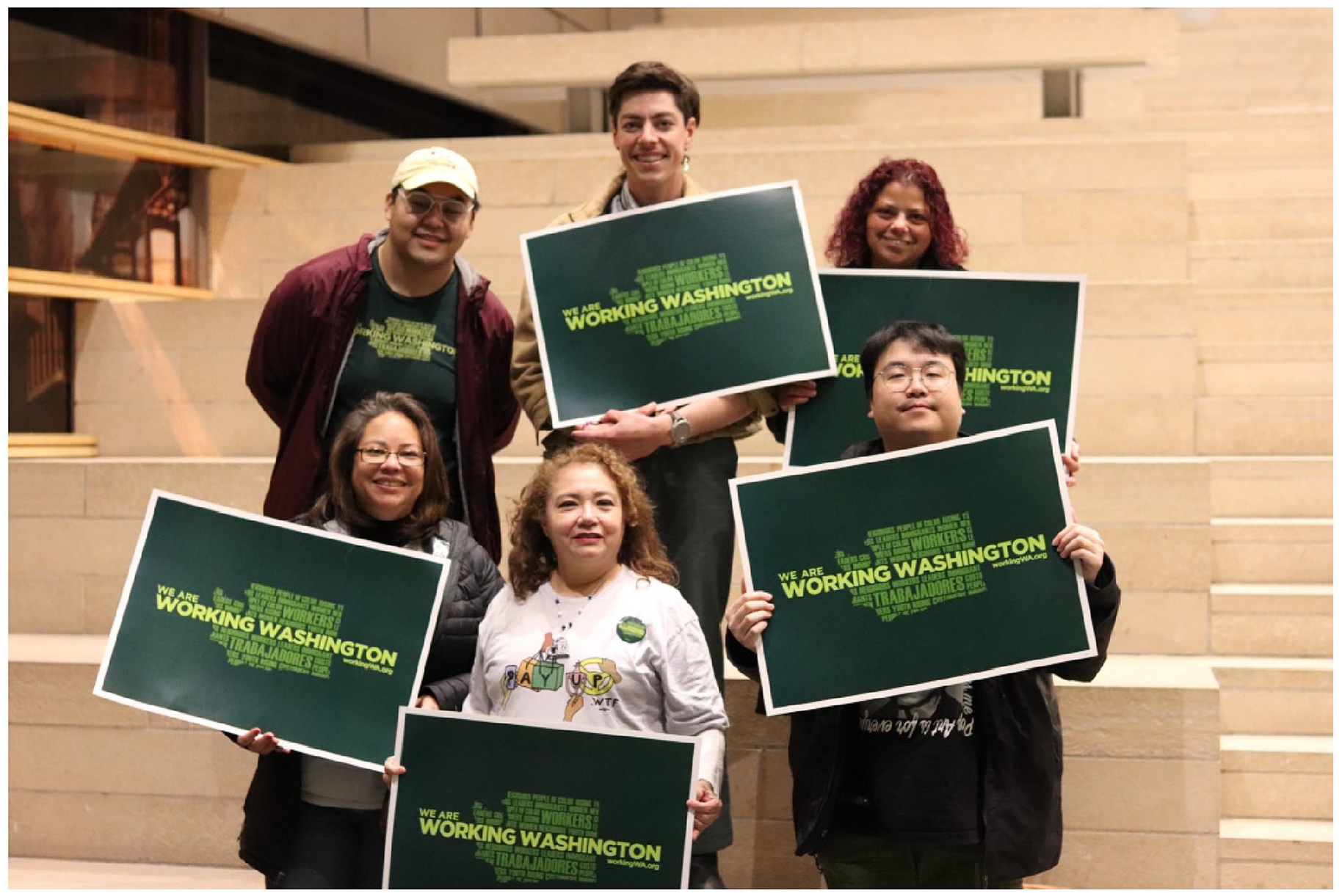
Workers and staff from Working Washington and the Fair Work Center turned out to the Seattle City Council budget hearing on November 13, 2023, to fight for workers’ rights enforcement funding.
Photo courtesy of the Fair Work Center
Despite the exciting uptick in support for union organizing, the vast majority of workers in the private sector are not unionized, unlikely to be so in the foreseeable future and thus largely dependent on public labor laws and their enforcement. Study after study demonstrates that wage theft is widespread and that low-wage Immigrant, Black, Indigenous, and People of Color (IBIPOC), especially women, are the most vulnerable to violations of their employment rights. 1 It is critically important to pay attention to the innovative work that has been taking place within this arena to drive standards and structures back into the labor market, and yet all too often it is dismissed as a sideshow. This work is not as sexy as major union campaigns or strikes, but the truth is, in terms of achieving dignity and respect in the neoliberal labor market, especially for Black and Brown workers, it is as important.
At the forefront of this work are worker centers that are stronger than ever 2 and have been leading the way to new approaches to governance of the labor market. These include experimenting with local policy as a means of strengthening labor standards protections that are not achievable at the federal or state levels and also as a means of trying out new strategies to regulate destructive labor and employment practices; the establishment of new city and county agencies; strategic enforcement that focuses on systemic, sectoral improvements; co-enforcement partnerships that bring those agencies together with worker justice organizations; sectoral worker standards boards; and strategies for membership recruitment and power-building. 3 The field is alive with possibility.
Labor and employment policy is no longer the sole domain of the federal government and has moved beyond the purview of states as well. The strategic pivot has been to push the limits of what is possible in politically hospitable jurisdictions. To date, forty-eight cities and counties have enacted minimum wage laws requiring employers within the jurisdiction to pay all workers higher than the federal level. 4 Twenty-four cities and counties have paid sick leave laws, requiring most or all employers to provide pay to employees who could not attend work due to their own illness or, often, the illness of family members. Eight cities have fair scheduling laws, which require large retail employers to provide advanced notice of work schedules to workers, and to pay them if they cancel a shift on short notice. Two cities, Seattle and Philadelphia, have legislation protecting domestic workers specifically, and across the country a variety of other creative ordinances providing standards and protection to workers in specific sectors (including fast food, nail salons, freelancers, drivers, and food delivery) have emerged.
These policies create new employment protections that often apply to workers who have historically been disadvantaged in the employment market and left out of federal and state policies along with those who are embedded in new, as well as old forms of exploitative employment relationships. 5 Furthermore, these new laws require that employers extend protections—typically provided voluntarily to middle-class workers—to low-wage workers, many of whom are Black or foreign-born women, 6 who are unlikely to receive such rights without an external mandate. These new laws are profoundly feminist in their orientation, 7 accounting for the realities of who does what types of work across formal employment and within the home and family, and how work in each of these domains affects the other.
While local labor standards policies are promising, worker centers and their allies know that for low-wage workers, they would be only as strong as their enforcement. Too often, worker advocates put off conversations about enforcement just to get basic laws on the books, reasoning, “We’ll come back and figure that out later.” This is a mistake. Innovative policies are too often hitched to backward enforcement regimes that assume that if workers have a problem, they’ll come forward and make a complaint. That’s why worker centers, some unions—especially the SEIU—and worker justice coalitions have been at the forefront of campaigns to establish local offices of labor standards enforcement with co-enforcement partnerships at the city and county levels.
Innovative local labor standards policies that are enforced by new local agencies in partnership with worker centers, unions, and community organizations hold the best possibility of impacting job quality in low-wage sectors of the labor market. Specifically, we see the possibility of a model for regulation that could set or establish the forum for facilitating organizing, negotiating, and then enforcing minimum sectoral labor standards at the local level. Already, some of the local sectoral initiatives and minimum standards policies are suggestive of this approach, and local enforcement agencies have the potential to function as the institutional foundation within which new models of organization, representation, and bargaining could be incubated. 8
Enforcing Labor Standards at the Local Level
City-level labor standards enforcement in the United States is a new phenomenon. All told, there are now twenty-seven local and county offices of labor standards enforcement, most of which were the result of campaigning by worker centers, worker justice coalitions, and unions. 9 Some of the first and most notable of these offices are the following:
While the struggle to establish these agencies has been critical, equally important have been the statutory and administrative powers they have had to acquire. Critical enforcement powers include the authority to: (1) conduct on-site investigations and inspection of company records; (2) extend an investigation beyond an individual complainant to the entire workforce (companywide); (3) initiate an investigation without a complaint (directed); (4) impose significant damages, fines, and civil penalties; (5) investigate and remedy retaliation; and (6) publicly identify or “name and shame” egregious violators.
Co-Enforcement Partnerships That Workers Trust
State and local departments of labor simply do not have the staffing to be a dominant presence in exploitative sectors where there are large numbers of small workplaces. They also don’t have the trust of workers who need them the most. Many immigrant workers fear government, which means they are unlikely to come forward and alert agencies about problem businesses, unless they are doing so through trusted organizations.
Thus, co-enforcement, or enforcement that actively partners with worker justice organizations, is not a nice “extra.” It is essential. This is why, along with establishing these new city agencies, worker centers, community organizations, unions, and legal justice groups in cities across the United States have campaigned and won funding for co-enforcement partnerships in San Francisco, Seattle, Minneapolis, Chicago, and others. Labor standards agencies are funding groups to do outreach and education to workers and small businesses in high-violation sectors, and in some cases to work together to identify violations and conduct investigations.
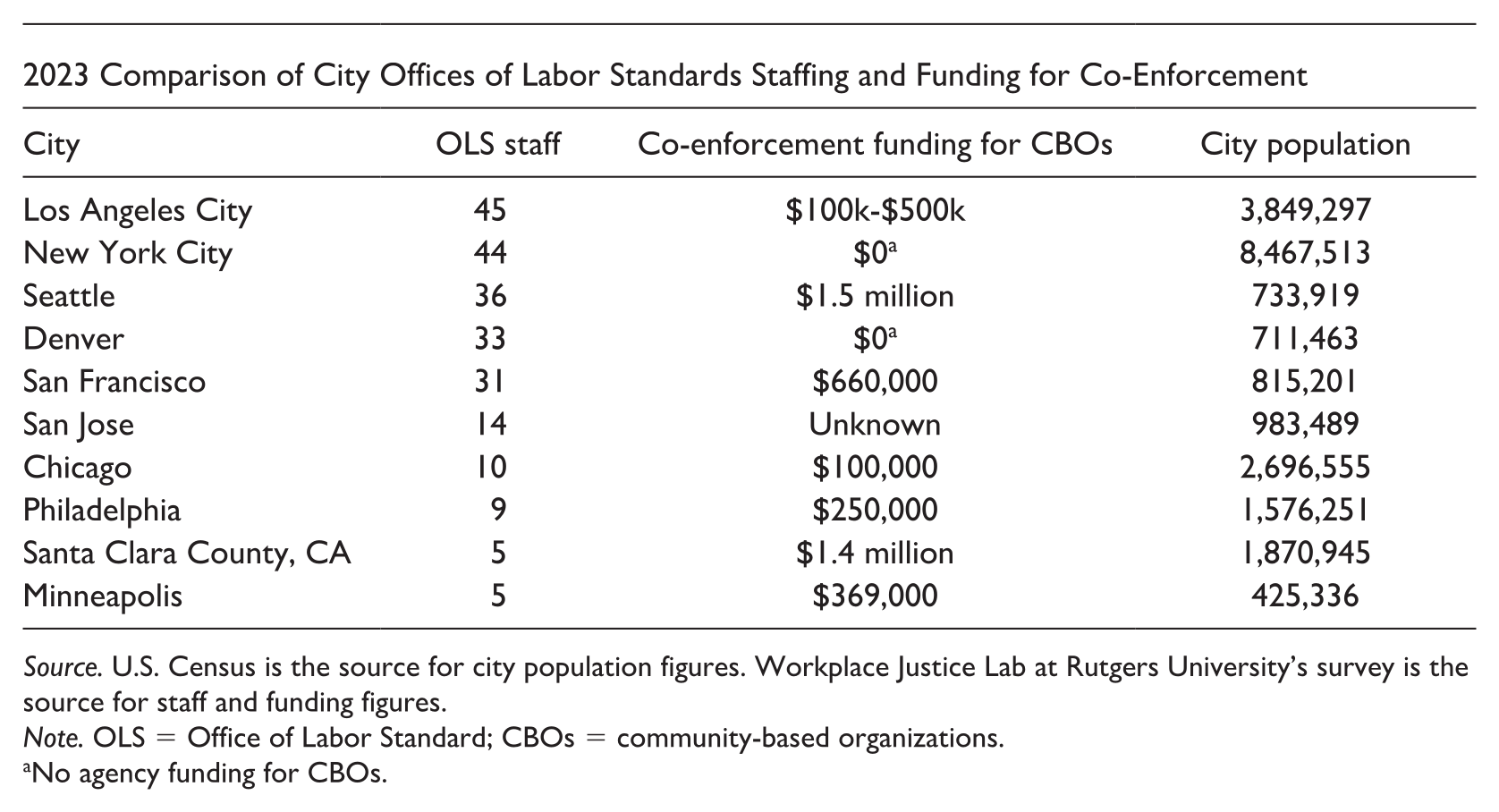
Source. U.S. Census is the source for city population figures. Workplace Justice Lab at Rutgers University’s survey is the source for staff and funding figures.
Note. OLS = Office of Labor Standard; CBOs = community-based organizations.
No agency funding for CBOs.
The Chinese Progressive Association (CPA) led the way in establishing the first co-enforcement partnership in San Francisco. CPA concluded that the agency needed more staffing and stronger regulatory teeth, but most of all it needed a way to expand its ability to reach low-wage workers in high-violation industries. In 2006, the Board of Supervisors amended the minimum wage ordinance to mandate the establishment of a community-based outreach program to “conduct education and outreach to employees.” 13 Since 2007, OLSE has contracted with a collaborative of organizations to assist in reaching out to low-wage immigrant workers. Annual funding for these contracts has risen from $200,000 to over $800,000.
Co-enforcement led to some landmark cases in the Chinese and Filipino communities. In 2013, employees of Yank Sing, a popular dim sum restaurant in San Francisco, reported widespread violations to the Chinese Progressive Association, but at the beginning of the investigation, not a single worker would speak with investigators. The CPA conducted house visits and one-on-one meetings with front- and back-of-the-house employees to develop relationships and persuade workers to come forward. Yank Sing ultimately agreed to pay $4 million in back wages and damages to 286 employees, and instituted a workplace change agreement that included rights well above those required by law. During the height of the pandemic, CPA worked with a group of workers at Z & Y, a long-established Sichuanese restaurant in Chinatown. The owners ultimately agreed to pay twenty-two employees $1.61 million including nearly $600,000 in tips that were withheld from them. Five worker leaders received $70,000 for the restaurant’s retaliatory actions against them. In addition to the settlement money, the owners also agreed to implement new policies, such as paid workers’ rights training, fair scheduling practices, transparent tip distribution, and bilingual employee manuals. 14
Seattle followed San Francisco’s lead. On the heels of the first successful $15 minimum wage campaign, unions and worker centers succeeded in making the city set up a Labor Standards Community Outreach and Education Fund to ensure outreach to demographic populations most likely to occupy low-wage jobs and experience workplace violations. Through this fund, the Office of Labor Standards contracts with the Fair Work Center, with Casa Latina (the city’s landmark worker center in the Latinx community), and with Chinese, Eritrean, West African, First Nations, South Asian, and LGBTQ worker and community organizations who have a relationship with low-wage workers in high-violation sectors. At approximately $1.5 million per year since 2017, Seattle has consistently provided the most co-enforcement funding in the United States. The Seattle Office of Labor Standards recently reached a $1.6 million settlement with DoorDash for violations of the Gig Workers Paid Sick and Safe Time ordinance, requiring direct payment to 648 workers and Paid Sick and Safe Time credits to roughly twenty-six thousand workers.
New partnerships between municipal agencies and worker organizations in Minneapolis and Chicago have built on the pioneering efforts of San Francisco and Seattle. Centro de Trabajadores Unidos en la Lucha (CTUL)—a worker-led organization that organizes non-union construction workers and workers in other low-wage industries—was a partner in the successful campaign to establish the Minneapolis Labor Standards Enforcement Division and place a strong worker advocate as its director. Following that success, the organization won a co-enforcement partnership that included $360,000 in funding for itself, the Minnesota Restaurant Opportunities Center, Awood (the East African worker center that waged a groundbreaking campaign at Amazon for daily prayer breaks), and New Justice Project Minnesota (which focuses on the Black community in North Minneapolis) for worker rights outreach, education, training, and close cooperation on investigations in specific sectors. The co-enforcement partnership has led to the recovery of $3 million since 2018 (in the city and surrounding suburbs). Half of total wages recovered have been in targeted sectors in which partners are actively focusing, including 50.8 percent in the restaurant industry and 34.5 percent in construction. 15 Together, the organizations have brought McDonald’s, Subway, and Little Caesars franchise restaurants into higher compliance with minimum wage and the paid sick ordinance.
In Chicago, Arise won co-enforcement funding in 2021 after gaining the support of the mayor’s office, the Office of Labor Standards, and the Chicago Foundation for Women. It has enjoyed an exceptionally close relationship with OLS leadership, with whom it has worked on increasing enforcement in the domestic worker sector and developing new worker protection policies. The OLS further committed to develop processes to conduct targeted investigations in the food manufacturing industry. In comparison to other big cities, all businesses are required to apply for licenses from the City of Chicago, which provides another lever of power for Arise and OLS to wield in their joint work. Newly elected Mayor Johnson, a former Chicago Teachers Union organizer, signaled strong support for Arise’s recommendations by creating a position of Deputy Mayor of Labor by executive order on his first day of office. His policy team has engaged Arise and its allies in the conversations around budgeting, policy, and the future of the OLS.
As it has evolved over time, we have seen examples of both “thick” and “thin” co-enforcement. Organizers engaged in co-enforcement don’t want to be offered small, short-term contracts for carrying out specific activities, they don’t want it to be busy work, such as indiscriminately handing out know your rights flyers, that isn’t strongly linked to their constituencies and campaigns, and they don’t want to be held to strict metrics that lose the forest for the trees. They find that their work is most impactful when agencies are willing to share information on cases and when they view worker organizing as a positive that defends a “wage floor” and leads to higher rates of compliance, rather than something that interferes with agency “neutrality.” They feel strongly that while funding is a good in and of itself, to truly fulfill its promise, the ambit of co-enforcement must go beyond education and training to joint targeting and investigations focused on enforcing standards in specific sectors. They are interested in ways that labor standards laws and co-enforcement can be creatively combined with sectoral wage-setting, bargaining, and the like.
Building a New Enforcement Paradigm in the Service of a Just Economy
This work begins with a change in mindset. Often even when “progressives” are appointed to lead agencies, they default to doing things the same way they have always been done. In the case of labor enforcement, this means taking a reactive and individualized approach rather than one that is systemic: focused on permanently cleaning up low-wage/high-violation industries and raising standards. We must cultivate a mindset among agency leaders that it is reasonable and appropriate for them to see their role as upholders and defenders of worker rights and to recognize the inherent power asymmetry between workers and their employers, while carrying out fair investigations that are decided on their merits.
The progressive movement must go beyond talking about what government should do, to how government should do it, and equip administrators to be able to realize our goals. To succeed, we need to build the infrastructure to make it real through doing the granular work of analyzing administrative powers and practices and providing administrative leaders blueprints, training, coaching, ongoing research, planning, management, and peer networking. Our work in the Workplace Justice Lab at Rutgers University focuses on these aspects of labor enforcement. 16
At the Workplace Justice Lab, we work with agencies to shift away from a solely reactive complaints-based approach. Agencies with whom we work are embracing strategic enforcement practices that target specific sectors for focused enforcement and are working in co-enforcement partnerships with organizations that are in relationship with the workforce. This approach makes it harder for wage floors to be undermined because it targets the bottom-feeders who are lowering standards and competing unfairly against scrupulous companies and contractors. Impactful enforcement makes examples of them, forcing them to comply or be driven out of the labor market. This is the groundwork that is necessary for raising standards.
To choose the right targets and to broadly impact the sector, agencies need to possess or access strategic research capacity. A powerful example of an organization that provides this capacity to agencies is the Maintenance Cooperation Trust Fund, a California statewide watchdog, founded in 1999 by janitorial contractors that are signatory to a union contract. The Fund identifies contractors that are violating the rights of their workers and works very closely with local and state labor enforcement agencies to gather information and investigate them. At the Workplace Justice Lab, recognizing this need, we are building the capacity to support agencies and worker centers. 17
Organizations are leading campaigns to set up local labor standards and wage boards that focus on raising standards in specific sectors. 18 For example, sectoral minimum wage and standards policies have been set for airports and large hotels in the city of SeaTac in Washington State, as well as in Los Angeles and Long Beach, California. Domestic worker standards boards have been established in Seattle and Philadelphia, which provide a forum for domestic workers, their employers, worker organizations, and the public, to deliberate about strategies for improving working conditions in a very challenging industry. Although ultimately limited to an advisory role, Seattle’s wage board is empowered to make recommendations on legislation and policy changes on a wide range of issues that must be reviewed by the mayor and city council.
Organizations can use the establishment of the board and its standards-setting and enforcement process to organize a deeper base of workers within the sector. To facilitate organizing, legislation should empower worker justice organizations to communicate directly with workers in communities and on worksites. Talking with workers about their rights is the beginning of an organizing conversation empowering workers to participate in enforcing standards, which is a powerful collective action. Sectoral boards without worker power behind them, and without meaningful enforcement, will have little impact. Organizations must have a base of workers in the sector before the board is established in order to successfully pass strong enabling legislation and secure the appointment of strong worker leaders, high-road employers, and community and governmental stakeholders. 19
Standards boards can also create mechanisms that facilitate the process of enabling workers in targeted sectors to actually join and pay dues to organizations, be they unions or worker centers or other organizational forms. The New Deal system recognized and institutionalized worker representation in many industries, even while it made a devil’s bargain with racist southern congressional leaders to exclude domestic and agricultural workers. For those workers who were covered, the system not only provided formal recognition to trade unions and defined their role in the collective bargaining process, but it also made possible a dues-paying membership that provided the means to associational power necessary for the union to be an effective advocate of worker rights in the collective bargaining process. 20 We need mechanisms for the establishment of worker organizations based on the financial support of members baked into labor standards policies.
Organizers can push agencies to maximize their own impact and support raising standards in the labor market by investigating and publicizing egregious violations by the targets of organizing drives. For example, alerted to significant safety hazards and accidents, OSHA pursued complaints against McDonald’s in nineteen cities. Likewise, in its long-running organizing effort to improve conditions at Amazon staffing agencies and warehouses, the Warehouse Workers Resource Center has, over the years, filed large numbers of wage theft and safety and health complaints with the U.S. Department of Labor and worked closely with the California Labor Commissioner’s office on strategic cases. 21
Agencies can facilitate organizations’ ability to access workers and workplaces. In high-violation industries, they can require employers to distribute Know Your Rights pamphlets online and in person to their employees, with contact information for their community partners. Agencies can give violators a choice between paying large fines for violations or allowing organizations to conduct know your rights trainings for workers, as they do in Minneapolis. Ideally, organizations could collect names and phone numbers. At a minimum, they could pass out their cards to workers.
Finally, organizations can campaign for policies that support organizing and labor standards compliance through prohibitions on city/state contractors that have outstanding wage judgments, service-sector prevailing wage requirements, and suspension of licenses for unpaid wage and health and safety judgments. Another method is making a requirement that city or state contractors sign neutrality pledges in order to bid on jobs, which has been employed in San Francisco. In 2018, the Board of Supervisors passed the “Labor Peace Agreements for Excursion Vessel Operations Under Lease with the Port,” which requires neutrality agreements from employers operating the ferries that take tourists from mainland to Alcatraz Island. This appears to be working, as ferry workers are organizing for a union. 22
Enforcement matters. Union organizing will not reach most private sector workers. Between 2022 and 2050, based on a private sector employment growth rate of 5 percent, and a private sector unionization rate of 200,000 workers a year, private sector unionization will reach 8.69 percent. 23 Even if unions double the rate of private sector unionization, it will reach just 12.5 percent by 2050. 24 Thus, most workers in the United States will continue to rely entirely on public laws and their enforcement. When wage floors are lowered and minimum wage violations become the norm, when subcontracting arrangements allow lead companies to evade responsibility for employment conditions, and when workers are retaliated against with impunity for speaking out, it becomes infinitely harder to organize workers. The enforcement of labor law and the unionization of the workforce are intrinsically linked.
Footnotes
Declaration of Conflicting Interests
The author(s) declared no potential conflicts of interest with respect to the research, authorship, and/or publication of this article.
Funding
The author(s) received no financial support for the research, authorship, and/or publication of this article.
