




Abstract

Radek Czajkowski
Chola woman waves the Indigenous flag, the wiphala, during a protest against the Áñez government, July 2020.
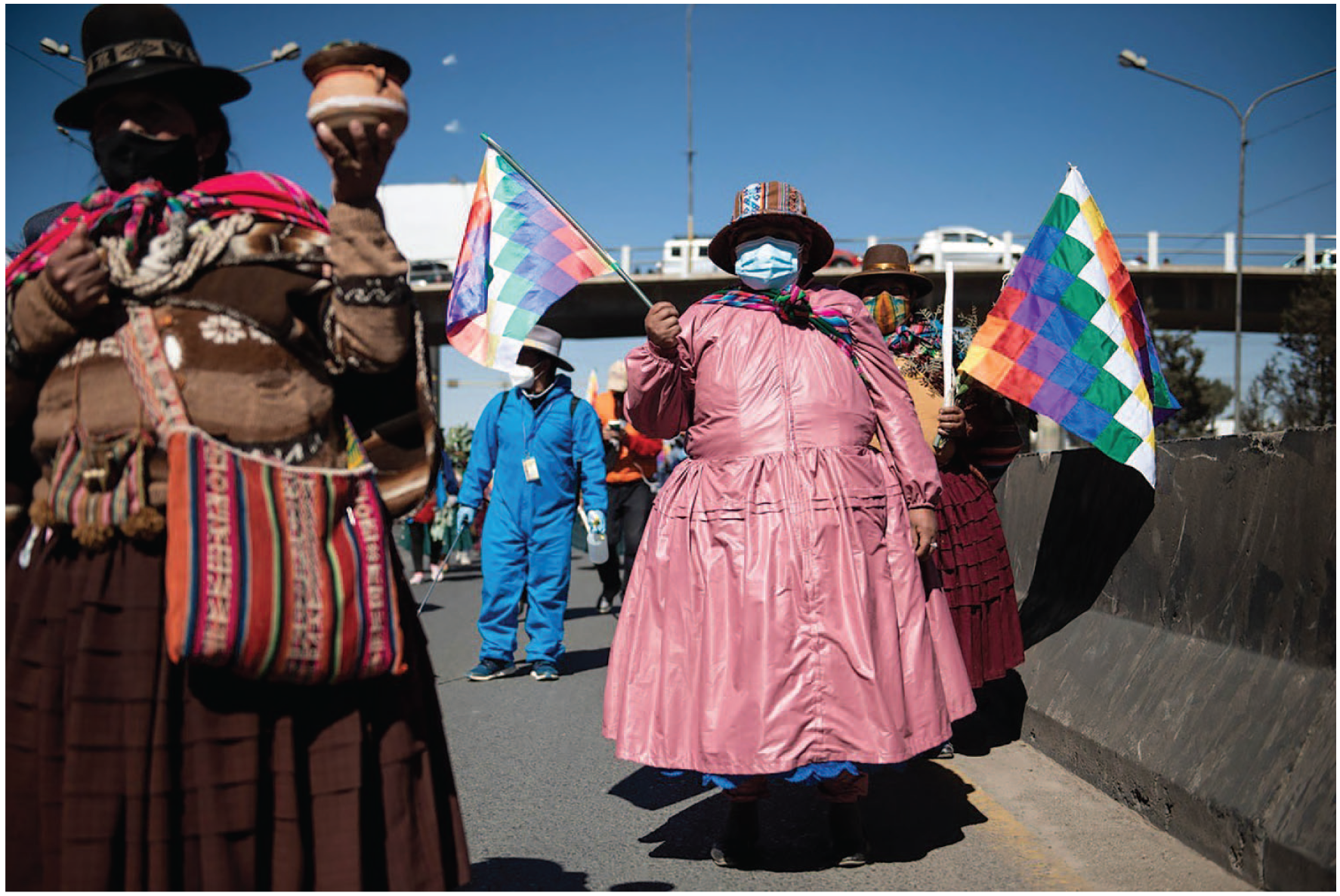
Almost a year after former President Evo Morales was ousted in a coup d’état, his political party, Movement Toward Socialism (MAS), reassumed power under the leadership of Luis Arce Catacora in November 2020. Videos of MAS supporters celebrating outside the party headquarters on election night warmed the hearts of the party’s support base and sympathetic foreign observers alike. 1 Bolivian democracy, it appeared, had prevailed.
Former coca grower Evo Morales had managed to maintain stability and popularity for the first decade of his fourteen-year tenure, with many Bolivians thinking of him as hermano Evo, brother Evo. After coming to power in 2006, his regime formed a central part of the group of progressive governments in Latin America known collectively as the pink tide, and oversaw massive reductions in poverty and inequality, largely owing to the global commodity boom (2002-2011). However, his presidency ended at the behest of the military in the face of widespread violence across the country. What caused this fall from power? And now that his party is back in power, what are the prospects for the future?
While it is tempting to compare President Arce’s election with that of Morales some fifteen years earlier, the context today is quite different. Although the MAS has a social movement base, it is not broadly representative, and a political economy centered around extractivism, coupled with the limitations of a postcolonial state, has eroded the cross-class support that it formerly enjoyed. The return of the left to power in the form of Arce is not a panacea, and the country remains in the grip of an economic and health crisis with roots in broader dynamics in the global economy and the Covid-19 pandemic.
Situating Bolivia
Bolivia is often overlooked when envisioning Latin America. Some think of this landlocked country that spans from the high peaks of the Andes to the sprawling expanse of the Amazon rainforest as a small country, despite the fact that it has a geographical area comparable to that of France and Germany combined. This is partly because Bolivia was once much bigger and has lost approximately half of its landmass since its independence from the Spanish Empire in 1825, with Argentina, Brazil, Chile, and Paraguay all claiming chunks of its territory as spoils of a series of regional conflicts. It is also partly because Bolivia has a relatively small population of just over 11 million people, a large proportion of whom are Indigenous. In the 2012 census, over 41 percent of Bolivians self-identified as Indigenous, down from 62 percent in the 2001 census due to a change in methodology. 2 The largest Indigenous group is the Aymara followed by the Quechua, who have historically lived on the Andean highland plateau and in the tropical valleys of Cochabamba at the center of the country. For centuries, the Indigenous population was excluded from national politics. In the post-colonial period, political rights were tied to land titles and literacy, denying political rights to Indigenous communities and reproducing the apartheid system formed under Spanish colonial rule. Evo Morales was welcomed by many as the country’s first Indigenous president and marked a watershed moment in the erosion of these old colonial structures of domination.
Since the discovery of silver in the city of Potosí in 1545, Bolivia’s political economy has been shaped by extractivism. During the sixteenth and seventeenth centuries, the Spanish crown took silver from Cerro Rico (Rich Hill) in Potosí to pay off its debts to the British and Dutch. Later, the second silver boom in the 1850s brought British commercial interests to the country, and with them, the first railways. The twentieth century was the century of tin, which formed the material basis of the powerful tin barons and, after the 1952 revolution, the National Revolutionary State. Although the 1952 revolution displaced the power of the tin barons, the nationalized tin mines remained the basis of the country’s political economy. As such, it helped to forge a labor movement in the mining centers, which, influenced by different strands of Marxism, became one of the most radical working-class movements in the world. 3 During this period, the Bolivian Workers’ Center (COB) became, along with the central government, one of the two central pillars of the National Revolutionary State, demonstrating the strength of the Bolivian labor movement. Hydrocarbons also shaped the historical trajectory of Bolivia during the twentieth century, with oil playing a part in the Chaco War between Bolivia and Paraguay in the 1930s and natural gas becoming increasingly important during the 1990s following the construction of two pipelines to the large markets of neighboring Argentina and Brazil. Struggles over how to exploit natural gas resources and distribute the revenues, coupled with a contentious plan to export Bolivian gas through Chilean seaports, were central to the emergence of social movements that carried Morales to power in 2005. Morales announced the nationalization of gas on May Day in 2006 through a spectacular occupation of the Margarita gas field, although in reality nationalization entailed only a renegotiation of gas contracts with multinational oil firms. 4 Natural resources, then, are central both to Bolivia’s political economy and to its politics.
The Social Base of the MAS
When Morales was in power, the MAS famously declared itself “the government of social movements.” 5 At its heart are the coca growers of the Chapare region in the department of Cochabamba. When neoliberal reforms forced the tin miners from their encampments in the late 1980s, many found their way to the tropical valleys of the Chapare in search of new livelihoods. They brought with them their radicalism and strong organizations, leading the coca growers to become the vanguard of the resistance to neoliberalism by the early 1990s. The coca growers pushed the Trade Union Confederation of Bolivian Peasant Workers (CSUTCB) to create a political instrument, which eventually became the MAS. Evo Morales rose through the ranks of the coca growers’ movement and maintained his position as the leader of the Six Federations of the Tropics of Cochabamba during his time in office. The genesis of the MAS as the political instrument of the CSUTCB and the coca growers’ role in its formation mean that these both have an “organic” relationship with the party. In other words, they will support the party no matter what because it is their political instrument. 6
While the MAS has a solid foundation in peasant organizations, its relationship with other movements is more complicated. Away from the CSUTCB, there are a number of social movements, including the COB, which are merely contingent supporters. Unlike the organic relationship between the MAS and the CSUTCB, the relationship between the MAS and these groups is constantly being renegotiated and is mediated in several ways. 7 One is through the incorporation of social movement leaders into government, creating a symbiotic relationship between the two and recasting social organizations as routes into formal politics. Another is the creation of formal channels linking social movements and the state, such as the National Coordinator pro Change (CONALCAM) and the Vice-Ministry for the Coordination with Social Movements and Civil Society. This amounts to what political economists Federico Rossi and Eduardo Silva label “state managerialism,” whereby social movement demands are technically fulfilled, giving the MAS legitimacy in the eyes of some and stripping the more radical factions of movements of their mobilizing demands. 8 This was central to Morales’ first term and although it has since declined in importance, it has not entirely disappeared as the presence of social movement leaders in the administration suggests. At the same time, the MAS also used another form of incorporation, informal contestation, whereby social movements can only react to government policy after its implementation, rather than playing a role in shaping the policy process itself. This came to be the predominate form of relationship between the MAS and social movements from 2010 onward.
Together, these modalities of incorporation built the coalition of social movements that was so important in ensuring the return to democracy with the elections in October 2020. However, the coalition of social movements behind the MAS had changed significantly over the past decade, in part because of the contradictions contained in its development model, in part due to the dynamics of incorporation outlined above. The economic development strategy of the MAS was to foster capital accumulation in mining and hydrocarbon extraction and then use increased revenues to redistribute natural resource wealth through social programs such as conditional cash transfers, higher minimum wages, and an expanded state bureaucracy. 9 While this met one of the major social movement demands of the years 2000-2005, these demands largely emanated from Indigenous movements in the highlands and discounted (or ignored) the experiences of lowland movements based in territories directly affected by extractivism. In 2011, Morales’ government violently repressed an Indigenous march protesting the construction of a highway through the Isiboro Sécure National Park and Indigenous Territory (TIPNIS). 10 This marked the beginning of divisions between the MAS and, in particular, the lowland Indigenous movement CIDOB leading the march. The TIPNIS conflict shattered the image of the MAS as the representative of Indigenous people, undermining its support in lowland regions and among groups that do not share its growth-oriented development view.
The decision to incorporate social movements into the state has also fragmented the support base of the MAS, limiting the capacity for renewal within certain movements and tying many organizations to the MAS. In some cases—such as CIDOB, the highland Indigenous movement CONAMAQ, and the Yungas-based coca growers ADEPCOCA—organizations have fractured into pro- and anti-MAS factions, dividing their bases into two and leading to confrontations within movements. In the labor movement, the COB has been aligned with CONALCAM and the MAS since 2018, when Juan Carlos Huarachi became executive secretary following an internal purge of union leaders not aligned with the MAS, breaking the ties between individual unions and the national COB in the process. The COB has long held dear its principle of political independence, and Huarachi’s opponents contend the COB’s alliance with the MAS is undermining its independence, hampering its role as “defender of the rights of all the workers of the country.” 11
The ways in which social organizations, including the COB, have been incorporated into the MAS create a tendency for them to become empty shells unable to mobilize their bases, which is in effect why the COB could not defend Morales in October-November 2019. But why did Morales need defending in the first place?
Changing Political Winds
Despite growing divisions between the MAS and some Indigenous movements following the 2011 TIPNIS march, the MAS won the 2014 national elections comfortably. Although the relationship between the movements and the MAS changed after 2011, this did not translate into a political challenge to the MAS until February 21, 2016, when Morales made a political miscalculation and organized a referendum to change the constitutional limits on presidential terms to allow him to stand for re-election. The referendum represented a serious political defeat for Morales, with the “no” vote narrowly winning.
The vote happened in the context of the end of the pink tide and the growing political attacks on progressive governments in the region, including most notably Brazil, through the politicization of corruption charges. 12 In Bolivia, the fall in commodity prices, and resulting fall in revenues, from 2013 onward pitted the MAS government against agribusiness and transnational companies working in mining and gas extraction, leading to growing political tensions before the referendum and worsening the fiscal position of the Bolivian state.
The seeds of what was to come were planted in the campaigns around the referendum, with opposition groups inventing a love child from one of Morales’ past relationships, decrying fraud in the vote before the count was complete, and politicizing the use of state funds through discourses around corruption. A new constitution, adopted in 2009, had replaced the National Electoral Court (CNE) with a new Supreme Electoral Tribunal (TSE), enabling opposition forces to erode public trust in electoral institutions in the period preceding the vote. Although the opposition “no” campaign won and so the issue of electoral fraud was quietly dropped, the precedent had been set. By September 2019, such was the ferocity of the attacks on the electoral organs of the state that 68 percent of Bolivians believed that there would be electoral fraud in October’s elections. 13
The opposition to Morales, broadly speaking, comprised three currents: urban middle classes and aspirational working classes; environmental and lowland Indigenous communities; and lowland elites linked with agribusiness. The first was articulated through discourses around “democracy” and comprising the urban middle classes and university students, most of whom were under the age of twenty-five and concerned with limited formal employment opportunities. They are either children of the upper middle classes who view formal positions (particularly within the state apparatus) as a birthright or the first in their family to go to university, frustrated that this has not led to promised social mobility. The second oppositional current were environmentalist and Indigenous groups, mainly from the eastern lowland regions, who found themselves at odds with the development project of the MAS. Members of the final oppositional group are the lowland elite, which mounted opposition to the MAS political project on a regional scale, particularly during Morales’ first term. The lowland departments of Beni, Pando, Santa Cruz, and Tarija—home to most natural gas reserves and the majority of the country’s agribusiness—threatened to split the country into two when faced with nationalization and the new constitution. While they ultimately overplayed their hand in 2008 when the governors of the lowland departments headed a failed coup d’état against Morales, concerns about the internal distribution of resources and, ultimately, political power did not disappear entirely. After a period of alliance between the MAS and the lowland elite, following the 2016 referendum this group saw an opportunity to recapture state power. These three oppositional currents were at the heart of the protests that led to Morales’ downfall in 2019.
The Interim Government of Jeanine Áñez
The 2019 elections were a tumultuous affair, marred by largely unfounded accusations of electoral fraud and widespread violence. Morales was forced by the military to leave the country on November 10, allowing a politician from a minor political party, Jeanine Áñez, to assume power three days later. Áñez’s conservative political party, the Social Democratic Movement (MDS), won only just over 4 percent of the national vote in the parliamentary elections, which translated into four seats in the lower chamber. However, pressure on the MAS forced several prominent MAS-affiliated politicians to step aside, leaving her route to power open. More important than her party in Áñez’s rise to power was her support from lowland oppositional groups, including the right-wing Pro-Santa Cruz Committee, led by Luis Fernando Camacho. Although Catholic himself, Camacho has become a magnet to which Bolivia’s quietly growing evangelical movement is aligning, marking the early signs of its influence in politics.
The interim government of Áñez oversaw a year marked by violence, corruption, and administrative missteps. In the days that followed the coup, her regime directed state violence at the main MAS support groups, killing scores of coca growers in Sacaba and working-class people at Senkata in the city of El Alto. 14 The 2020 elections were repeatedly delayed—first from January to May, then from May to September, finally from September to October, during which time her government tilted toward the United States by joining the Lima Group (a right-wing coalition against Venezuelan President Nicolas Maduro) and breaking diplomatic ties with, among others, Cuba and Iran. 15 Áñez also attempted to lock in a neoliberal economic program, liberalizing agricultural production, privatizing state-owned enterprises, and revising hydrocarbon contracts. 16
During this time, the naked self-interest of Áñez’s ministers and supporters became increasingly evident. 17 Consecutive health ministers were ensnared in corruption scandals after overpaying for ventilators to tackle the Covid-19 pandemic. 18 During her final days in office, Áñez awarded over 3400 hectares of land titles to her economic minister, Branko Marinković, one of the perpetrators of the coup against Morales in 2008. Returning from exile in Brazil, he had joined Áñez’s cabinet in August 2020, apparently the only man willing to step into her cabinet as her regime became more and more beleaguered. 19
Áñez did not have total free rein, however. The MAS still controlled the legislature and, led by Senate President Mónica Eva Copa, it did its best to hold her government to account. Actions by MAS senators were a major reason why elections finally went ahead last October, the other being the push from social movements—including the labor movement. After the government announced further delays to elections set for September 6, MAS-aligned social movements headed by the Unity Pact (a coalition of country-wide rural Indigenous and urban movements) and the COB sprang into action. 20 The COB recovered some of its strength following its impotence during the coup against Morales and led marches against the Áñez government in six departments on July 15, and again on July 28, when it spearheaded a march from Senkata, the site of the massacre of November 2019 in El Alto, to the city’s central zone, La Ceja. 21 Faced with the prospect of further election delays, the Unity Pact and the COB organized a national blockade that was sustained for twelve days between August 2 and August 14. 22
While not all groups responded to the COB’s call to action—citing concerns over the continuing pandemic and economic situation 23 and the criminalization of movement leaders 24 —social movements mounted enough political pressure that further election delays proved politically unviable. The conflicts were ostensibly about the date of the elections, but they revealed the widespread discontent with Áñez and helped solidify a coalition of social forces capable of pushing for the return to democracy. 25 In the words of Juan Carlos Huarachi, executive secretary of the COB, “the people are asking [the Áñez government to] respect democracy, respect healthcare, respect education and respect our dignity.” 26 After almost a year, it was this pushback that enabled Arce to assume office.
The Road Ahead
Now that Arce is in office, his government faces a number of interconnected challenges. First, Bolivia remains dependent on primary commodity exports for state revenues. Even before the pandemic arrived, falling commodity prices had hit the economy and state coffers hard. The value of hydrocarbon exports fell by half in the past five years, from over US$2.2 billion in 2015 to a projected US$1.1 billion in 2020. 27 This has been accompanied by a reversal of Foreign Direct Investment (FDI) flows as capital flees the country in search of greener pastures. Net FDI flows have fallen from over US$700 million in 2014 to a projected US$190 million in 2020. 28 Foreign reserves fell from a high of over U.S.$15 billion in 2014 to a little over US$6 billion five years later, even before Arce’s unwisely suggested devaluation wiped a further US$1.2 billion from the national accounts. 29 If Morales inherited the country during a time of plenty, the opposite is true of Arce, who faces the challenge of managing an economy exposed to the volatile global commodity market during an international health crisis.
The Covid-19 pandemic hit Bolivia hard, with the country recording one of the highest excess death rates per capita of anywhere in the world during its first wave. 30 There are a number of reasons for this. First, the healthcare system is chronically underfunded, and the country lacks a public health system, leaving many without healthcare coverage and hospitals at risk of being overrun from the slightest increase in demand. Most of the economically active population (EAP)—by some estimates over 80 percent 31 —works in the informal economy with no social security. The national lockdown measures presented many with a Hobson’s choice: death by the virus or death by hunger. This has limited the impact of social distancing measures while also weakening the immune systems of the poorest through an increase in malnutrition.
Arce has worked hard to procure the Russian Sputnik and the British AstraZeneca vaccines for the Bolivian population during his first months in office—an astute move given Bolivia’s previous position at the back of the vaccination queue. However, the country’s healthcare system remains weak and it lacks the infrastructure to distribute the vaccines to all parts of its vast territories. A shipment of vaccines arriving in one major city in the back of a food truck demonstrates the logistical difficulties. Although the director of the departmental healthcare system insists the truck complies with the vaccine requirements, not all makeshift solutions will, and coordinating the program, especially in sparsely populated regions with poor roads and no hospitals, will present multiple challenges. This is especially true given the fact that much of Arce’s support is conditional on his government being able to honor its promises to different sectors and to keep the majority of the population protected from the sharp end of the crisis. When the economy is doing well, it is easy to keep everyone happy, but in contexts of crisis, building and maintaining political alliances is much harder. Increased hardship will quickly burn through any political capital Arce has banked with those groups not organically tied to the MAS.
Another salient question concerns Evo Morales. Now that he is back in the country, how will the internal dynamics of the party play out? Morales continues to be the head of the MAS and has always ruled the party with an iron fist, repeatedly curtailing the prospects of potential leadership contenders. In a disturbing example, in late 2020 Morales ran a vicious campaign against Senator Mónica Eva Copa, one of the most popular of the new generation of MAS leaders, during the selection of the party’s mayoral candidate in the city of El Alto. The result was that Copa left the party and ran on the ticket of the Indigenous party Jallalla, winning 67 percent of the vote in El Alto. 32 This dynamic—between the party led by Morales and the government under Arce—could be a challenging one for the current president, especially given the vigorous opposition to Morales among his political opponents. Morales may be back in the country, but it remains to be seen whether this is a blessing or a curse for Arce’s government.
A third critical question is whether the Arce government can keep the opposition in check. The lowland elite in particular will seek to maximize their share of shrinking agribusiness and hydrocarbon revenues and the urban middle classes will not continue to support (or at least tolerate) him if jobs are lost and their social standing is threatened. The government recently detained former president Jeanine Áñez for her role during the 2019 putsch, along with the former justice minister, 33 leading to accusations, including by new U.S. President Biden’s administration, that it is interfering with the justice system. 34
There are still unanswered questions about the reach of imperial power into Bolivian politics. 35 Groups within all three oppositional currents have links to external forces, with the U.S. government funding parts of the opposition to the MAS in the name of democracy promotion and environmental sustainability. 36 One of the conspirators behind the 2019 coup has publicly said that the transition to power from Morales to Áñez was planned by oppositional groups coalesced around democracy, the lowland elites, and sections of the military in coordination with representatives from Brazil and the European Union. 37 Whether or not this is true, it demonstrates what Arce is up against, and while he does have some allies in the region, he does not enjoy the geopolitical alliances forged by former pink tide governments.
In sum, although the MAS has returned to power, whether it has fully weathered the storm remains to be seen. Arce’s government faces a dire economic situation and, despite the promise of a future vaccine, a rampant pandemic. The political landscape, although not as explosive as it was a year ago, remains divided. Opposition groups lie in the wings, biding their time, while many of the 55 percent who gave Arce their vote did not do so unconditionally. A worsening of the current crisis could place Arce under enormous strain. The MAS is not out of the woods just yet.
Footnotes
Declaration of Conflicting Interests
The author(s) declared no potential conflicts of interest with respect to the research, authorship, and/or publication of this article.
Funding
The author(s) received no financial support for the research, authorship, and/or publication of this article.
