



Abstract
Voice shopping is on the rise. However, with the absence of visual stimuli, consumers face difficulties in processing brand and product information during the shopping process. Drawing on the load theory of attention and the literature on imagery and information processing, the authors conducted two studies to examine how the level of imagery in auditory product descriptions and the number of product attributes shape consumer responses. The results indicate that high-imagery descriptions increase brand stimulation, which in turn improves brand attitude, purchase intention, and actual product purchase. Additionally, the imagery level of an auditory product description positively influences brand recall directly. These results provide new insights into how auditory message design shapes consumer evaluation and decision-making in voice-based shopping contexts.
The market for devices powered by artificial intelligence (AI), such as chatbots and voice assistants (e.g., ChatGPT, Amazon's Alexa), is experiencing rapid growth (Haan 2026). Among these, voice-based applications are particularly noteworthy, because they enable convenient, hands-free access to information and services, with global adoption reaching 8.4 billion devices as of 2024 (Kumar 2026; Statista 2022). One expanding application of voice assistants is shopping: 49.6% of U.S. consumers used voice search for shopping in 2025 (Capital One Shopping 2025), with global voice shopping spending projected to reach $186.26 billion worldwide by 2030 (Grand View Research 2024).
Despite this growth, voice shopping poses unique challenges for both consumers and marketers. Unlike traditional online shopping, voice interactions lack visual cues, making it more difficult for consumers to process product information (Munz and Morwitz 2019; Ryan 2020), because shoppers usually receive product descriptions derived from websites, which are rarely tailored for voice-based shopping (Hörner 2019). One particular challenge is the loss of brand visibility, as the lack of comprehensible product and brand information makes it harder to differentiate between brands and to build brand-related associations (Mari 2019). Marketers therefore face the question of how to design auditory product messages that effectively enhance processing of product and brand information. In such contexts, vivid verbal descriptions that stimulate mental imagery may become particularly important for helping consumers visualize and evaluate products (Bolls and Muehling 2007).
Previous research on auditory communication, however, has primarily examined how something is said (e.g., Lowe and Haws 2017), rather than what is said. Likewise, research on imagery level, the extent to which a message evokes sensory experiences and mental representations, has so far focused on text ads or (auditory) radio ads, which differ significantly from the decision context and design options in voice shopping. Unlike radio, voice shopping involves concrete product choices, where the level of imagery in the message can directly affect brand perception and purchase decisions. Voice shopping also lacks supplementary elements such as music, making verbal design features even more critical.
Our article addresses this gap by examining two research questions: (1) how the imagery level of the product description influences brand stimulation, brand attitude, brand recall, and acceptance of product recommendations in voice shopping, and (2) how the number of product attributes presented, that is, the information load, affects consumers’ evaluations and how it interacts with imagery level.
Our research contributes to the literature on auditory communication by emphasizing what is said rather than how it is said. While prior studies have mainly focused on paralinguistic voice features such as tone, pitch, or voice numerosity (e.g., Lowe and Haws 2017), our work highlights the impact of imagery level and the number of product attributes on consumers’ evaluations and responses in voice-based decision contexts. It further expands on existing work on auditory imagery, which has primarily focused on radio advertising, by applying it to the interactive environment of voice shopping (e.g., Bolls 2006). Our findings offer practical guidance for designing voice-based product descriptions that help consumers process information more effectively, thereby enhancing brand recall, favorable evaluations, and acceptance of product recommendations.
Literature Review and Hypothesis Development
Voice Shopping
Voice shopping refers to the process of searching for, evaluating, and purchasing products or services via voice-based interfaces (Wang and Bae 2025). Therefore, consumers rely primarily on auditory input for conveying information and guiding decisions.
In audio-based interactions, both content (what is said) and delivery (how it is said) can influence consumer judgments. Research on the latter demonstrates that AI-generated voices with differing vocal tract lengths impact advertising performance (Efthymiou et al. 2024), while exposure to multiple, diverse voices can enhance persuasion (Chang, Mukherjee, and Chattopadhyay 2023). Acoustic features like pitch also shape perceptions, such as making products seem larger (Lowe and Haws 2017). The use of auditory images also suggests that listeners can retain various characteristics of the auditory information, which affects their response to the message (Hubbard 2012).
Despite the recently growing research on auditory communication in voice shopping, findings in terms of the content of the message (what is said) remain sparse. Previous work has examined different drivers of purchase decisions, such as mood (Halbauer and Klarmann 2022) and product involvement (Tassiello, Tillotson, and Rome 2021). Other studies have identified decision-making challenges, given that consumers can only process a limited amount of information during an interaction and do not consider all options at once (Dellaert et al. 2020; Penha et al. 2022). Further, the loss of brand visibility is associated with voice shopping, as brand information is harder to perceive and compare, challenging differentiation and the formation of brand associations (Mari 2019). Suggested remedies include personalizing messages (Rhee and Choi 2020) and optimizing the sequence of brand recommendations (Halbauer, Jacob, and Klarmann 2022) (for more details, see Web Appendix A).
As yet, influencing consumers’ product and brand perceptions in voice shopping without having to personalize the message to each consumer has received little scholarly attention (Mari 2019; McLean, Osei-Frimpong, and Barhorst 2021). We address both challenges (i.e., the loss of brand visibility and the limited capacity to process information) by examining the effectiveness of two adaptations in message design: the imagery level and the number of product attributes used.
The Effect of Imagery Level in Voice Shopping Messages
Bolls and Lang (2003) describe imagery processing as a sensory method of encoding, processing, and evoking information, resulting in sensory experience. The mental state associated with a higher imagery level can be achieved through vivid verbal messages (Miller and Marks 1997) and instructions to imagine (Babin and Burns 1997) (e.g., “imagine us as your little place of retreat”).
Previous research has shown that mental imagery can evoke cognitive, affective, and behavioral responses. High imagery (vs. low imagery) can improve memorization of brand attributes (cognitive response) (e.g., Bolls 2006), as storing information visually and/or verbally enhances ease of information recall (Paivio 1969). Unnava, Agarwal, and Haugtvedt (1996) support this idea, noting that information in a high-imagery condition provokes consumers to generate mental images.
The influence of mental imagery on attitudes follows this line of argument. According to Tversky and Kahneman (1973), consumers rely on the most accessible information when forming attitudinal judgments. High-imagery messages increase the mental availability of such information, resulting in stronger brand attitudes, particularly when the content is positive (e.g., Bone and Ellen 1992).
Regarding behavioral responses, mental imagery strengthens purchase intentions (Aydınoğlu and Krishna 2019) and can lead to actual behavioral changes (Andrade et al. 2016; Miller and Stoica 2004). Based on these findings, we expect high-imagery voice-based product descriptions to enhance brand-related cognitive and affective responses, to strengthen behavioral intentions, and ultimately to affect consumer choice. Hence, we hypothesize:
While mental imagery may shape behavioral intentions, Bone and Ellen (1992) suggest that this effect is indirect, operating through affective responses. Research has supported this indirect connection, showing that brand stimulation, a specific form of affective response to a brand, can drive purchase intention (Krishna 2012).
Research further suggests that the imagery level influences affective stimulation. Imagining products in a retail context can strongly influence consumer emotions (Compeau, Higgins, and Huff 1999). Similarly, high-imagery processing of positive events increases positive emotions and reduces anxiety, compared with low-imagery conditions (Holmes et al. 2006). Thus, the degree of mental imagery influences the intensity of the emotion (MacInnis and Price 1987). Building on this, we hypothesize that brand stimulation mediates the relationship between imagery level and our outcome variables:
The Moderating Role of Product Description
A voice assistant's product recommendation contains different levels of information load, defined as the amount and variety of product information given (e.g., Wang and Benbasat 2009). Previous research on its effects is mixed: Some authors have found that higher information load facilitates information processing and results in more competent decision-making (Chewning and Harrell 1990), while others have reported cognitive overload, leading to poorer purchase decisions (e.g., Jacoby, Speller, and Berning 1974). In voice shopping, consumers need sufficient product information to evaluate items and make decisions (Penha et al. 2022). This implies descriptions must be detailed enough to meet informational needs.
Since both the imagery level and the number of product attributes are key elements of auditory product descriptions, their interaction is likely to shape consumer responses. The load theory of attention and cognitive control (Lavie et al. 2004) suggests that the processing of central (task-relevant) versus peripheral stimuli (indirectly relevant or irrelevant) depends on perceptual load. Under low perceptual load, spare cognitive resources allow peripheral cues (like imagery) to be processed. Under high perceptual load, when many attributes are presented, peripheral information is more likely to be neglected (Lavie and De Fockert 2005; Macdonald and Lavie 2011). A similar logic applies to information load, the amount of cognitive effort required to process product information. Thus, while high imagery and extensive product information may enhance message effectiveness when presented individually, their combination may diminish the processing of imagery due to attentional constraints. We therefore hypothesize:
Figure 1 depicts an overview of our conceptual model.
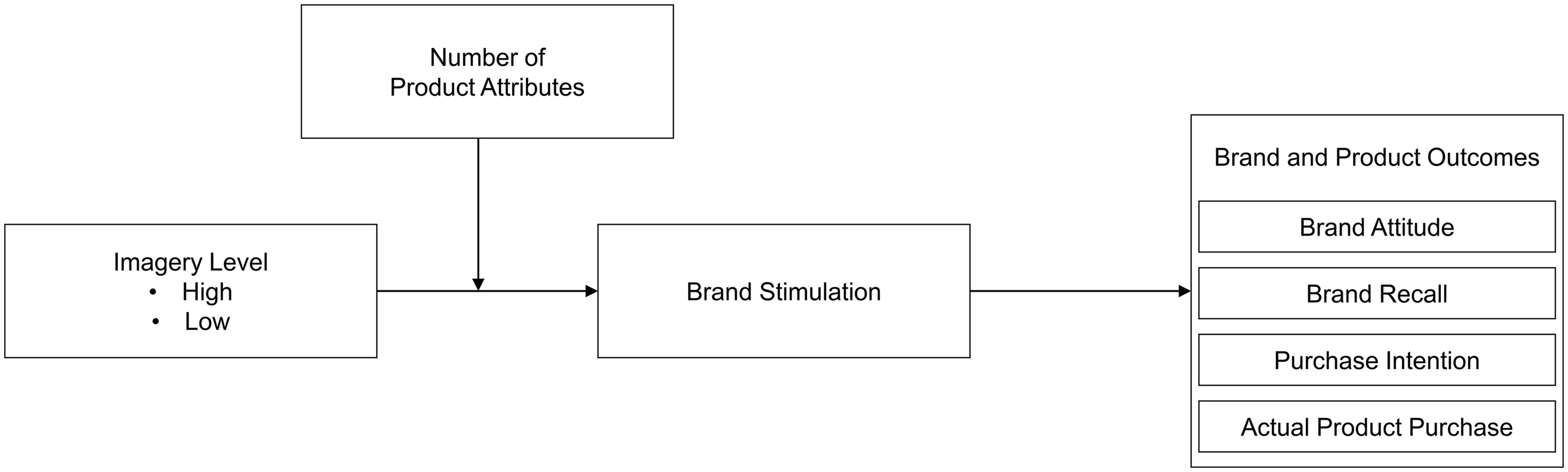
Conceptual Model for Studies 1–2.
Empirical Studies
Pilot Study
We conducted a pilot study (N = 170) to test that visual (vs. auditory) product descriptions generally lead to better information intake and recall. The results supported our assumption: Both product and brand recall were significantly higher for the visual manipulation. These findings highlight the need to adapt auditory messages in voice shopping (for more details, see Appendix A).
Study 1
Building on these insights, we conducted two Institutional Review Board–approved experimental studies. Raw data, analysis code, and preregistrations are available at https://researchbox.org/4792. Study 1 aimed to measure the influence of the imagery level on brand attitude, brand recall, and purchase intention and the underlying effects of brand stimulation. We further examined whether and how the number of product attributes moderates this effect. To test these hypotheses, we conducted an online study featuring a 2 (imagery level: low vs high) × 2 (number of product attributes: five vs. ten) between-subjects design.
Stimuli
Given that low-priced household goods are among the items most commonly purchased via voice shopping in the United States (Southern 2019), we selected two products—laundry detergent and pralines—in this category after pretesting. We ensured that the participants perceived the fictional brand names, Lodex and Sugarland, to be equal regarding complexity.
We designed and generated auditory messages using the default female voice in Amazon Polly's text-to-speech application (Deloitte 2018). To manipulate information load, messages contained either five or ten named product attributes (e.g., scent, weight). We stayed below the 12-attribute overload threshold (Jacoby, Speller, and Berning 1974) and centered conditions around Miller's (1956) seven blocks. As one popular method involved doubling the information load (Varan et al. 2020), a comparison of five versus ten attributes seemed appropriate to distinguish between low and high information load.
Brand descriptions followed established imagery manipulations (Babin and Burns 1997). High-imagery messages used instructions to imagine (e.g., “Imagine us as your support team”), descriptive language (e.g., “Lodex: Taking care of your dirty deeds”), and concrete words (e.g., “Your little helper for your everyday laundry madness”) (Bolls and Lang 2003). To ensure consistency, we kept product information and audio message lengths equal across conditions. For the low-imagery condition, we included neutral product information to balance the message length. Moreover, we priced our products based on current market prices to prevent biases in product evaluations caused by discounts or other pricing distortions.
For more details on the pretests and manipulations, see Appendices A and B.
Participants and procedure
We recruited participants using an online panel (Prolific), targeting U.S.-based users who shop online at least once a month. To ensure careful listening to voice messages, access was limited to desktop devices. The participants received approximately $2.50 for their participation plus a 25% bonus for attentive listening, verified via platform logs. We excluded three participants for failing at least one of the attention checks, yielding 391 participants and thus 782 observations (Mage = 40 years, SD = 11; 49.4% female, 50.1% male, .5% other gender), as each participant evaluated two product recommendations, one for detergent and one for pralines, within one condition. Of the participants, 64.5% reported owning a voice assistant, and 35% stated they had purchased a product from a voice assistant at least once.
Study 1 had two parts. First, participants were introduced to “Eve,” a smart home assistant for online shopping, and familiarized themselves with it by requesting jokes. Then, they watched a short video explaining the voice shopping process.
In the second part, participants were randomly assigned to one of four groups and were instructed to initiate a voice shopping process for laundry detergent and pralines (presented in random order) using Eve. For each product, they submitted a textual request and then received auditory product recommendations based on the experimental manipulation. All brands were fictitious.
Measures
Following each recommendation, we measured purchase intention, brand attitude, and brand stimulation using seven-point Likert-type scales (1 = “strongly disagree,” and 7 = “strongly agree”). To assess unaided recall, we asked participants to recall the brand name of the recommended product (with 1 = recall, 0 = no recall); we tolerated minor misspellings and closely related variants of the brand name. We adapted the scales from previous studies with high internal consistency (see Table 1 for scale details).
Overview of Scales Used.

Notes: (r) = reverse-coded.
For our analyses, we calculated the average of the responses from multi-item scales to create composite scores for all constructs. Table 2 reports the means and standard deviations of the variables according to imagery conditions.
Overview of Means and Standard Deviations.

Notes: N = 782 (low imagery: 392; high imagery: 390).
Results
To test our hypotheses, we estimated three mediation models to examine the effect of imagery level on purchase intention, brand attitude, and brand recall via brand stimulation (see Table 3). All models accounted for the nonindependence of observations by clustering standard errors at the participant level. For purchase intention and brand attitude, we used structural equation modeling with 1,000 bootstrap resamples to obtain inference on indirect effects. Because brand recall is binary, we fitted a generalized structural equation model with a logit link.
(Generalized) Structural Equation Model.
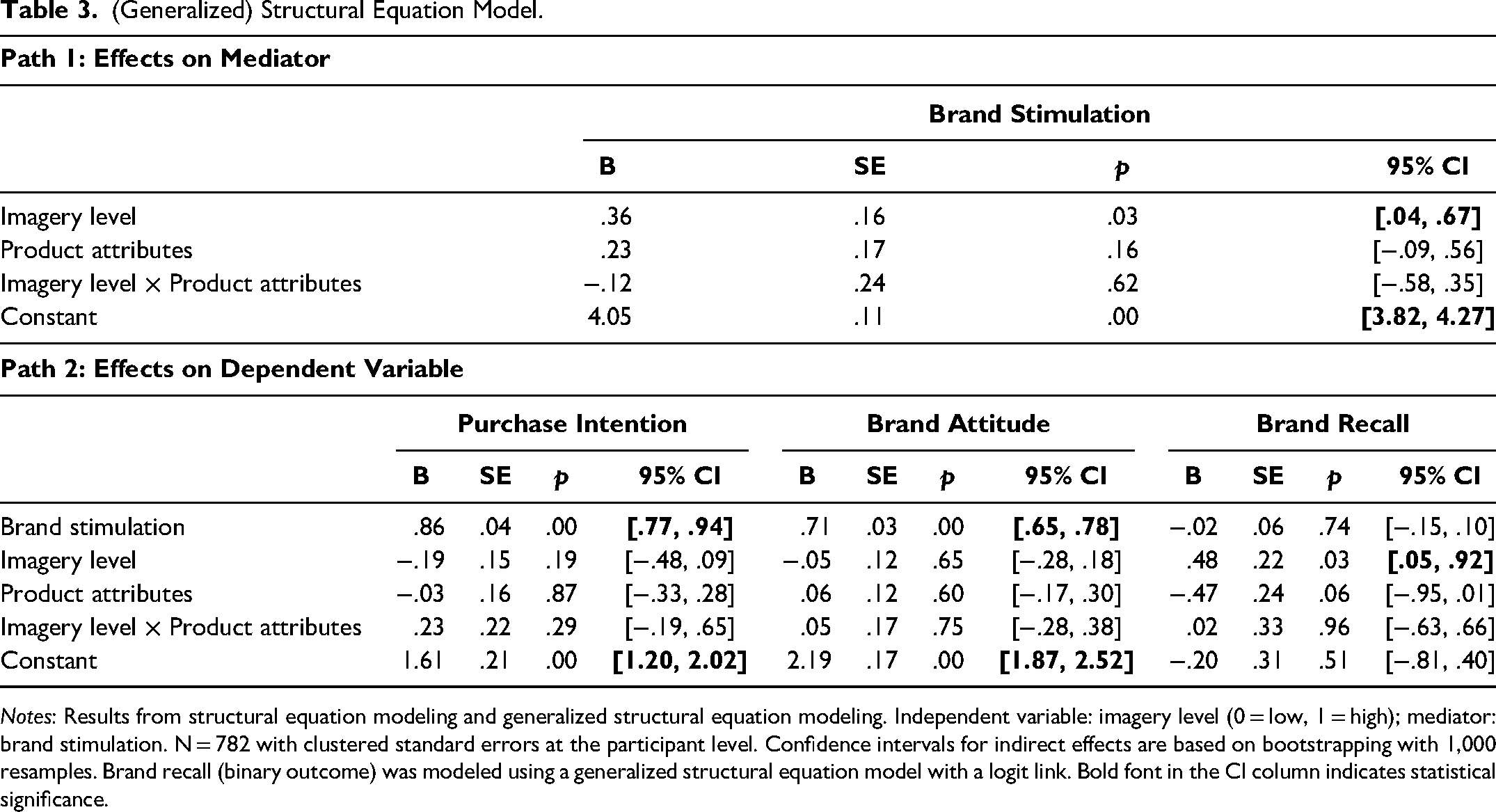
Notes: Results from structural equation modeling and generalized structural equation modeling. Independent variable: imagery level (0 = low, 1 = high); mediator: brand stimulation. N = 782 with clustered standard errors at the participant level. Confidence intervals for indirect effects are based on bootstrapping with 1,000 resamples. Brand recall (binary outcome) was modeled using a generalized structural equation model with a logit link. Bold font in the CI column indicates statistical significance.
Consistent with H1, imagery level had a direct positive effect on recall, suggesting that higher imagery improves memorability (see Table 3). Recalling a brand increases its likelihood of inclusion in the consumer's consideration set, thereby enhancing its potential for future purchases (e.g., Nedungadi 1990).
Neither the level of imagery nor the number of product attributes had a direct effect on purchase intention or brand attitude. However, higher imagery significantly increased brand stimulation, which in turn positively affected purchase intention and brand attitude, supporting imagery level having an indirect effect on purchase intention (ab = .304, 95% CI: [.033, .575]) and brand attitude (ab = .254, 95% CI: [.019, .489]), consistent with H2.
We also examined whether the interaction between imagery level and the number of attributes influences brand stimulation (H3). While we hypothesized that this interaction might attenuate the effect, our analysis yielded no significant result (ab = −.008, 95% CI: [−.053, .038]). However, Table 3 shows that the number of product attributes has a marginal negative effect on brand recall (p = .056), suggesting that more attributes may dilute attention to central information (here, the brand name).
For additional robustness checks, see Web Appendix B.
Study 2
In Study 2, we conducted a laboratory experiment simulating a realistic voice shopping scenario, presenting participants with different products available for purchase. The aim of this study was to replicate the findings from Study 1 in a more controlled yet realistic setting, and to test whether these effects persisted when participants directly compared products and made an actual purchase decision rather than merely reporting their intentions. As with Study 1, we investigated the influence of imagery level on brand stimulation and its subsequent effects on attitude and recall; on purchase intention; and, ultimately, on acceptance of the product recommendation. The results provided support for H1 and H2, successfully replicating the effects observed in Study 1. Importantly, we extended these findings by demonstrating that the effect of imagery level persists in actual behavioral outcomes.
Stimuli
We employed a mixed design that incorporated a purchase observation task. We randomly assigned participants to one of four between-subjects treatment conditions, each representing a different combination of audibly presented imagery levels (low vs. low, high vs. high, high vs. low, or low vs. high). Within each condition, participants sequentially evaluated two products, presented in a randomized order. This resulted in repeated measures of the dependent variables captured for each presented product.
Replicating Study 1's design, participants interacted with a recommendation agent in a simulated voice shopping scenario. After pretesting, we used chocolate bars as low-priced household goods. We selected real but unfamiliar brands whose names were of equal complexity (see Appendix A). The imagery manipulation followed Study 1, but because we had found no significant interaction with the number of attributes, we held this factor constant at seven attributes (see Appendix B for manipulations).
Participants and procedure
We recruited student participants at a major German university. After exclusion of two participants following failed attention checks, the final sample consisted of 121 participants (Mage = 22 years, SD = 4.0; 65.3% female, 34.7% male). This yielded 242 observations, based on two product evaluations per participant. Of the participants, 15.7% reported owning a voice assistant, and 2.5% had previously used one for voice shopping.
Each participant received €5 compensation at the start of the experiment. To simulate a realistic voice shopping experience, we used a “Wizard of Oz” design (e.g., Tsai et al. 2021). Participants believed they interacted with an autonomous voice assistant named Eve, but all responses were prerecorded and remotely triggered by a hidden human operator. Participants were tested individually in a lab setting, seated at a desk with a monitor and a branded voice-assistant device (a dummy), which played audio via a hidden Bluetooth speaker (Canalys 2019).
The experiment consisted of two parts. First, participants were introduced to Eve and completed a warm-up task (requesting jokes). Participants then engaged in the core shopping task. They initiated the interaction by saying, “Eve, please order a chocolate bar,” triggering the first product description. Participants would then request an alternative, prompting the second product description. To ensure deeper processing, after both product presentations, they were instructed to ask Eve to repeat both descriptions. Following each presentation, we conducted manipulation checks, and participants responded to brand-related questions.
At the end of the session, participants could make an actual purchase. The experimenter re-entered the room and asked whether or not they would like to buy one of the chocolate bars presented for €1.50, using their €5 compensation.
Measures
We measured brand stimulation, attitude, and recall (0 = no recall, 1 = recall), following the same procedure as in Study 1 (see Table 1). All multi-item scales demonstrated good internal consistency (Nunnally and Bernstein 1994).
We measured product recommendation acceptance (0 = recommendation not purchased, 1 = recommendation purchased) by observing participants’ actual purchase decisions. For an overview of the scales used in the manipulation checks (i.e., imagery elaboration and quality), refer to Appendix C. Table 4 provides a summary of the means and standard deviations of the study variables.
Overview of Means and Standard Deviations (Study 2).

Notes: N = 242 observations (121 participants who evaluated two stimuli).
Results
To test whether the effect of imagery level on brand attitude, purchase intention, brand recall, and product recommendation acceptance was mediated by brand stimulation, we estimated four separate multilevel mediation models (see Table 5). These followed the path-analytic framework for within-participant designs outlined by Montoya and Hayes (2017), consistent with PROCESS Model 4 (Hayes 2018) logic. All models included participant-level random intercepts to account for repeated measurements within participants. We modeled continuous outcomes using linear mixed modeling, and binary outcomes with generalized linear mixed modeling and a logit link. We estimated indirect effects via clustered nonparametric bootstrapping with 1,000 participant-level resamples. We restricted all analyses related to actual product choice and recommendation acceptance to conditions in which we presented both high- and low-imagery descriptions, to ensure sufficient variation in the independent variable. Robustness checks including covariates (see Web Appendix C) confirmed the results.
Mediation Path Estimates for Effects of Imagery Level via Brand Stimulation on Four Dependent Variables (Study 2).

Notes: Results from linear mixed modeling and generalized linear mixed modeling with random intercepts for participants. Independent variable: imagery level (0 = low, 1 = high); mediator: brand stimulation. N (purchase intention, brand attitude, brand recall) = 242 observations. N (recommendation acceptance) = 121 observations. Confidence intervals for indirect effects are based on 1,000 bootstrapped samples clustered by participant. The p-values for the linear mixed models are based on Satterthwaite approximations.
The manipulation check confirmed the success of the imagery manipulation. Products presented at a high imagery level elicited significantly higher scores for imagery elaboration (F(1, 239) = 36.17, p < .001) and imagery quality (F(1, 239) = 23.89, p < .001). The mediation analyses revealed a full mediation of the effect of imagery level on brand attitude (ab = .99, 95% CI: [.83, 1.16]), purchase intention (ab = 1.09, 95% CI: [.93, 1.26]), and product recommendation acceptance (ab = .92, 95% CI: [.61, 1.33]) via brand stimulation. In contrast, brand stimulation did not significantly mediate the relationship between imagery level and brand recall (ab = −.05, 95% CI: [−.22, .14]). However, the direct effect of imagery level on brand recall was significant (see Table 5).
Together, these findings support our hypothesized mediating role of brand stimulation in the effects of imagery level on brand attitude, purchase intention, and product recommendation acceptance (H2). For brand recall, as in Study 1, the effect appears to be direct (supporting H1) with no evidence of mediation.
To further evaluate the influence of imagery level on actual product choice, we conducted a series of pairwise Fisher's exact tests, applying Bonferroni correction to control for multiple comparisons. A significantly greater proportion of participants chose the high-imagery product (59%) compared with the low-imagery product (23%; p < .001) and no product (18%; p < .001). There was no significant difference between choosing the low-imagery product and choosing no product (p = 1.00). Among those who made a purchase decision, a binomial test revealed that 72% chose the high-imagery product over the low-imagery option (p = .001, 95% CI: [.60, 1.00]).
General Discussion
With the increasing popularity of voice assistants in voice shopping, appropriate product presentation is becoming ever more important for retailers. Across two studies, we demonstrate how practitioners will benefit from adapting the imagery level of product descriptions. High-imagery messages enhanced brand stimulation, which in turn improved brand attitude, purchase intention, and product recommendation acceptance. Participants also showed a behavioral preference for products described with high imagery, indicating that mental imagery influences not only perceptions but actual choices. Additionally, imagery level had a direct, positive effect on brand recall. Overall, these findings highlight the role of mental imagery in shaping both attitudinal and behavioral responses, emphasizing the value of vivid, sensory-rich product descriptions in marketing communication.
Theoretical and Practical Implications
Our study contributes to the growing literature on voice commerce in several ways. Our pilot study supports Mari's (2019) proposal that voice shopping may reduce brand visibility. However, our research offers a solution to mitigate this problem by adapting the product description's imagery level. Further, our findings extend research on auditory communication by shifting the focus from how messages are spoken to what is said.
For practitioners, the results offer clear guidance: Retailers like Amazon and developers of voice-based applications (e.g., Alexa Skills) can leverage our findings to enhance voice assistant presentations. The concrete, vivid language can be applied to any product or service presented through auditory channels, leading to enhanced consumer engagement and brand effectiveness. In competitive settings, this can allow voice shopping retailers to create meaningful differentiation and gain a competitive edge in an increasingly saturated channel.
Limitations and Future Research
Our study has several limitations suggesting future research directions. First, our findings are based on two low-involvement, everyday products. This restricts generalizability of our results to high-involvement categories, in which imagery may play an even greater role. Future research should extend this work to a broader set of product types. Secondly, we standardized the length of the voice messages to 30 seconds, which may have influenced the participants’ cognitive processing. Third, we focused on purely auditory assistants. Future work should investigate whether adding visuals enhances or overloads consumers’ processing. Finally, since our data came from online and laboratory settings, field studies could prove valuable for confirming the external validity of our findings.
Supplemental Material
sj-pdf-1-jnm-10.1177_10949968251410949 - Supplemental material for Brand and Product Presentation in Voice Shopping: Investigating the Effects of Message-Design Adaptations
Supplemental material, sj-pdf-1-jnm-10.1177_10949968251410949 for Brand and Product Presentation in Voice Shopping: Investigating the Effects of Message-Design Adaptations by Lea Sollfrank, Sophie Feldner and Ju-Young Kim in Journal of Interactive Marketing
Footnotes
Appendix A: Pilot Study and Pretests.

|
|
|
|
|
|
|---|---|---|---|---|
| Pilot study |
Text versus voice Product and brand recall |
Presentation of laundry detergent and pralines with two product options each Between-subjects design: Group 1 = text Group 2 = voice |
Product recall:
“Please recall as much product information from the two product options that you can remember” |
Product recall: MText = |
| Brand recall:
“Can you recall the brand of the [product] the voice assistant suggested?” |
Brand recall = 1.226,
Exp(B) = 3.406, p = |
|||
| Pretest 1 N = 30 | Complexity of the brand names | Textual presentation of the brand names | “How complex do you feel the name [brand name] is?” | Lodex: MComplex = |
| Pretest 2 N = 21 | Utilitarian and hedonic product option | Presentation of two product options: chocolate bars and cereal bars | Hedonic:
Not fun/fun Dull/exciting Not delightful/delightful Not thrilling/thrilling Enjoyable/unenjoyable |
MCereal = |
| Pretest 3 N = 20 | Complexity of the brand names | Presentation of several product options for chocolate bars | “How complex do you feel the name [brand name] is?” | Sugar Rebels:
MComplex = |
Notes: Bold indicates p < .05.
Appendix B: Exemplary Manipulations of Imagery Level and Number of Product Attributes.

|
|
|
|
|---|---|---|
| Pralines (Study 1) | “Sugarland |
“Sugarland |
| Laundry detergent (Study 1) | “Lodex |
“Lodex |
| Chocolate bar: Little Love a (Study 2); analogous for Sugar Rebels | “Little Love, |
“Little Love, |
Translated from German.
Notes: Underlined text refers to product attributes. Both example stimuli shown here include a high number of product attributes.
Appendix C: Manipulation Checks.

|
|
|
|
|---|---|---|
| Imagery quality | Overall the images that came to mind while I listened to the suggestion were sharp/dull. |
.94 (Study 1) .94 (Study 2) |
| Overall the images that came to mind while I listened to the suggestion were intense/weak. | ||
| Overall the images that came to mind while I listened to the suggestion were clear/unclear. | ||
| Overall the images that came to mind while I listened to the suggestion were vivid/vague. | ||
| Overall the images that came to mind while I listened to the suggestion were fuzzy/well-defined. | ||
| Imagery elaboration | The mental images that came to mind made me feel as if I was actually experiencing the featured brand. |
.94 (Study 1) .91 (Study 2) |
| The descriptions made me fantasize about having the opportunity to experience the brand. | ||
| I could easily construct a story about myself and the brand based on the mental images that came to my mind. | ||
| It was easy for me to imagine using this brand product. | ||
| While listening to the description, I found myself daydreaming about the brand. | ||
| The images that came to mind acted as a source of information about the brand. | ||
| I could actually see myself using the brand product. |
Coeditor
Peeter Verlegh
Data Availability

Declaration of Conflicting Interests
The authors declared no potential conflicts of interest with respect to the research, authorship, and/or publication of this article.
Ethics Approval and Informed Consent Statements
The study was approved by the Ethics Committee of Goethe University Frankfurt on January 27, 2022. All participants provided written informed consent prior to participating.
Funding
The authors received no financial support for the research, authorship, and/or publication of this article.
References
Supplementary Material
Please find the following supplemental material available below.
For Open Access articles published under a Creative Commons License, all supplemental material carries the same license as the article it is associated with.
For non-Open Access articles published, all supplemental material carries a non-exclusive license, and permission requests for re-use of supplemental material or any part of supplemental material shall be sent directly to the copyright owner as specified in the copyright notice associated with the article.
