



Abstract
Recently, customer engagement in social media has received great attention in the literature, with the aim of understanding its impact on brands and product performance. However, little attention has been given to the potential dark side of engagement, especially in the context of new product launches. This article thus examines the relationships among customer engagement in social media, new product fit, brand longevity, and new product performance. Using the music industry as a context, this research shows that the small but positive effect of prerelease social media engagement on record sales becomes strong when the level of fit is high; for newer artists, engagement can even have a negative effect when fit is very low. This study uses a sample of 181 albums launched by 158 artists in the Canadian market between 2016 and 2017 and a data set that combines weekly record sales, social media activity, and Spotify's audio features analysis. A regression discontinuity–inspired model that accounts for endogeneity concerns is applied to test the hypotheses. This study contributes to the literature by providing robust empirical evidence of a possible negative side of engagement. Although engagement can help artists succeed, it might interfere with their artistic freedom.
Keywords
Since their rise in importance at the turn of the 2010s (Perrin 2015), social media platforms have had a major impact on consumer behavior: in 2022, more than 4.5 billion people worldwide used social networks (Statista 2023b), and each of those users spent, on average, more than two hours a day watching videos and sharing or liking content on platforms such as Facebook, Instagram, or Twitter (now known as “X”; Statista 2023a). The music industry is one of the sectors most impacted by social media. According to a study by MusicWatch (Crupnick 2018), nine out of ten social media users engage in social media to share music videos with friends, to discover new artists, or to give their opinion on the newest song of their favorite musicians. Therefore, it is not surprising to see artists, especially emerging ones, use social media as a privileged means to create a strong bond with fans, hoping to boost album sales and foster loyalty (Buli 2014). Using social media can be particularly useful for them, because strong levels of social media engagement typically enable firms to generate better consumer insights (Moe and Schweidel 2017), exchange directly with their customers (Tiago and Veríssimo 2014), and increase the success of new product launches (Baum et al. 2019), particularly when combined with social media communication campaigns (Gruner, Homburg, and Lukas 2014).
Fostering social media engagement activity—for example, encouraging customers to like Facebook posts, share tweets, or comment on Instagram reels—seems even more important in today's highly competitive music industry. Indeed, contemporary artists must navigate a market where the number of available products is massive and constantly increasing. For instance, users streamed 36.3 million songs at least once in 2018 (Stein 2020), and Spotify added 60,000 new songs daily in 2021 (Ingham 2021). Moreover, this increased competition happens in an industry that until recently was struggling to recover from the crisis in the 2000s (IFPI 2023).
In this context, customer engagement in social media can help artists stand out and increase the success of their new products (Santini et al. 2020). For example, international stars such as Justin Bieber and Charlie Puth built mainstream audiences thanks to the intense engagement of their first YouTube fans (Hoffman 2009; Koehler 2012). The effect of engagement on new product performance results from highly engaged music fans wanting to know everything about their favorite artists, seeking to interact with them on social media, and promoting them actively (Dessart, Veloutsou, and Morgan-Thomas 2016; Hollebeek, Malthouse, and Block 2016), which makes those fans more likely to adopt new products (Perron-Brault, Dantas, and Legoux 2020).
However, strong engagement may also hurt brands. The release of New Coke and the following backlash from outraged customers and PepsiCo’s rejected overhaul of Tropicana juice packaging are prominent examples of the negative consequences of having highly engaged customers (Andrivet 2015; Klein 2015). This type of reaction is also what happened to Linkin Park, a band best known for its nu metal sound, after the release of its seventh album, One More Light, in 2017. The album, which featured a hip-hop/pop style that was far from the original sound of the band, was negatively received by hard-core Linkin Park fans, who saw it as proof that the band had sold out (Cook-Wilson 2017). Although the case of Linkin Park may seem trivial, it hints at a potential dark side of engagement: strong brand–customer links can create high expectations, which may be hard to fulfill (Harmeling et al. 2017). Interestingly, despite the large number of studies dedicated to understanding how to create and nurture engagement (Dimitriu and Guesalaga 2017; Harrigan et al. 2017; Hollebeek, Glynn, and Brodie 2014; Santini et al. 2020), we know little about the conditions required for engagement to have a positive effect, for instance, on the success of new entertainment products such as music albums.
In this article, we argue that if customer engagement in social media can positively affect new product performance, this effect is also moderated by new product fit. In other words, engagement's benefits are materialized only when a new product fits well with the brand's earlier releases. In contrast, new products that deviate greatly from the existing ones (i.e., have a low fit) will not gain from high levels of engagement. To test these propositions, we use a sample of 181 albums launched in the Canadian market between 2016 and 2017 by 158 artists. We gathered record sales and stream data for each album, data about social media engagement on Facebook, and fit metrics via Spotify's audio features. We analyzed this longitudinal data set in a regression discontinuity–inspired model, while accounting for the possible endogenous nature of social media activities.
Our research makes three main contributions to theory and practice. First, our results bring nuance to the literature by demonstrating that if the prerelease level of social media engagement can help generate more sales, this effect is relatively small and only impactful during new product launches. Second, and more importantly, this study suggests a double-edged sword effect of social media engagement. Our results show that to benefit from social media engagement, artists must offer new products with a high fit (i.e., a product similar to the ones released previously). When confronted with a new product significantly different from the usual, highly engaged customers may feel betrayed and react negatively, thus nullifying the positive effect of the engagement on new product performance. Lastly, this study establishes that brand longevity is an additional boundary condition. Indeed, we find that new product fit is particularly important for early and mid-career artists but not as much for experienced musicians. This condition enables us to identify which types of artists should pay the most attention to the relationship between customer engagement and new product fit.
Theoretical Framework and Hypothesis Development
Customer Engagement in Social Media and Entertainment Product Performance
In the relationship marketing literature, there are four definitions of “engagement”: (1) a psychological state of mind, (2) an intrinsic motivation, (3) customer activities, and (4) customer-added firm value (Harmeling et al. 2017; Santini et al. 2020). In our case, we adopt a practical approach that mixes the third and fourth perspectives and posits that in the context of social media, customer engagement is made up of customer activities (Hollebeek, Glynn, and Brodie 2014; Van Doorn et al. 2010) and customer contributions to firm value (Pansari and Kumar 2017). Hence, in this research, a highly engaged customer will comment on an artist's Facebook page, retweet its content, and share it with friends on Instagram, to name a few examples. These interactions lead to improved sales performance by generating more word of mouth (WOM) and boosting behavioral intentions (Santini et al. 2020). We focus on social media because of its importance in today's marketing efforts (e.g., brands spend, on average, approximately 13% of their marketing budget on social media [Moorman 2020]), but also due to its observable and functional nature. Although a psychological state of engagement can be difficult to monitor in a consumer base, the number of Facebook comments, for instance, is a readily usable measure that can be employed to describe and assess the impact of engagement on performance.
According to the literature, we can expect that the more engaged the customers of a brand are, the more successful the new products of that brand will be. In other words, brands with highly active social media customers should see their products perform better than those with less engaged customers. This hypothesis first echoes the results of a recent meta-analysis that reviews 97 studies on customer engagement in social media (Santini et al. 2020). In their study, the authors indeed show that engagement through Facebook and Twitter can significantly improve firm performance directly and indirectly via an increase of behavioral intentions (i.e., willingness to continue interacting with a brand, including through purchases).
In the specific context of entertainment science (Hennig-Thurau and Houston 2019), other studies also converge toward this prediction, even if the results are a bit fuzzier. First, “prerelease consumer buzz,” defined as “the aggregation of observable expressions of anticipation by consumers for a forthcoming new product” (Houston et al. 2018, 349) seems to be usually associated with the performance of entertainment products (Dhar and Chang 2009; Houston et al. 2018; Morales-Arroyo and Pandey 2010; Xiong and Bharadwaj 2014). More specifically, Saboo, Kumar, and Ramani (2016) have studied the relationship between social media activities on networks such as Facebook, Twitter, MySpace, and Last.fm, and human brands’ sales in the specific context of recorded music. In their analysis of 36 musicians’ sales and social media data, they show that the number of social media followers has an inverted U-shaped effect on music sales: an increase in Twitter and Facebook followers has a strong effect for lesser-known artists but becomes unproductive, even slightly negative, when an artist becomes too popular. Meanwhile, the effect of the social media WOM on music sales follows an exponential curve—that is, the more customers discuss and share opinions about an artist's music, the more these comments’ effect on sales increases.
Using a data set that includes all major movies released between 2012 and 2014 in North America, Kupfer et al. (2018) report a similarly positive effect on box-office performance corresponding with the number of Facebook fans and their activity level (e.g., number of likes, comments, and shares) on actors’ pages three months before the release of a movie. For instance, when controlling for other factors such as brand power, genre, and product-related posts, an increase of 10% in the engagement activity on a movie's main actor's Facebook page generates an average of .5% higher revenues. Some marketing and IT researchers have also studied the impact of social media on entertainment product performance from the perspective of firm marketing actions. For instance, Gong et al. (2017) analyze the effect that messages posted on Weibo (a top social media website in China) by firms and influencers had on TV shows’ viewing. To do so, they collaborated with a major Chinese television production company to develop an experiment in which they tracked information about TV shows that was not posted at all, posted by the company, or posted by the company and reposted by an influential Weibo user. Findings from Gong et al. indicate that the company's posts increased TV viewing by .6%. Influencers’ reposts had a similar effect.
Overall, despite the recent changes in the music industry caused by the rise of streaming, customer engagement in social media should positively affect new album performance.
The Importance of Fit
In this article, we expect that the positive effect of engagement is moderated by new product fit. In other words, engagement's effect should be more positive when musicians release new albums with characteristics that are similar to their earlier albums. In contrast, we hypothesize that a new product that deviates greatly from an artist's earlier product portfolio will be negatively perceived by its engaged customers and will not benefit from the same engagement boost.
To explain this hypothesis, we first rely on the brand extension literature, in which it is commonly accepted that the fit between a new product and its parent brand is a key component of its success (Bouten, Snelders, and Hultink 2011; Dens and De Pelsmacker 2016; Moon and Sprott 2016; Völckner and Sattler 2006). Indeed, a new product with a good level of fit is generally perceived as more familiar to customers (Bouten, Snelders, and Hultink 2011), is easier to evaluate, and is more likely to benefit from the positive associations with the brand that launched it (Aaker and Keller 1990; Völckner and Sattler 2006). Among entertainment science research, we find similar results. For instance, Shi, Lim, and Suh (2018) show in their study of the impact of boundary crossing on music customer evaluations that musicians are generally rewarded for making the same music repeatedly. Indeed, after comparing iTunes album ratings for more than 10,000 musicians, the authors observed that artists who specialize in a particular genre get better ratings than those who regularly switch genres. Moreover, Yalcinkaya and Aktekin's (2015) study of experience product franchises suggests that for motion picture sequels, continuity (i.e., whether a sequel employs the same main actor and the same director as a parent movie, in addition to using a numbering title strategy) is an important success factor.
Although fit may be valuable for many customers, we expect that it is particularly the case for engaged customers. Indeed, because engaged customers are more familiar with their favorite artists than anyone and are deeply attached to their music, they should prefer when their beloved musicians release new albums that are in continuity with the earlier ones. To explain this aspect of our hypothesis, we rely on social exchange theory (Blau 1964; Thibaut and Kelley 1959), a framework first developed in sociology. This theory suggests that individuals engage in social exchanges through a cost–benefit analysis in which reciprocity is key (Guo, Gruen, and Tang 2017). Hence, when customers engage in a relationship with a brand, they expect the positive feelings and behaviors conveyed toward that brand to be returned as benefits for themselves (Braun et al. 2016; Harrigan et al. 2018). Moreover, in a social exchange, partners aim to always maintain balance, undertaking balance-restoring actions when equilibrium is disturbed (Hollebeek 2011). Based on the social exchange theory, we propose that when music fans display a high level of engagement for a musician—notably by commenting, liking, and sharing posts on social media—they also expect that this same musician will return the favor in the future by offering new music they will enjoy. If not, customers could be under the impression that the musician has not honored their part of the bargain and may therefore engage in balance-restoring endeavors, such as not purchasing the new album, bashing the artist, and even reducing earlier albums’ listening time.
Brand Longevity
We propose that, in addition to the moderating role of new product fit, brand longevity, which refers to how long a brand has existed and endured in a specific market (Moulard, Raggio, and Folse 2016; Preece, Kerrigan, and O’Reilly 2019), may play a moderating role. One could argue that older brands are more likely to have a strong brand heritage or, in other words, to be characterized by unique methods, distinct referents, and well-known attributes (Spiggle, Nguyen, and Caravella 2012). Honoring brand heritage and showing consistency are both important drivers of brand authenticity (Moulard, Garrity, and Rice 2015; Moulard, Raggio, and Folse 2016). In turn, brand authenticity is associated with positive brand extension responses (Spiggle, Nguyen, and Caravella 2012). Hence, one could expect that for older brands, brand heritage can act as a burden, forcing them to stay the same and reducing their creative leeway.
Nevertheless, recent findings from the literature lead us to believe that older brands will instead be less punished by their engaged customers in the event of a weak new product fit. First, in their study of the success of 92 movie franchises, Heath et al. (2015) find that earlier sequels (i.e., the first or second sequel) perform better when they are similar to the first installment of the franchise, because customers are then still excited about the franchise and impressed by its novelty. In contrast, later sequels (i.e., the fourth or fifth sequel) show better performance when they diverge significantly from the first chapter of the franchise, because this divergence compensates for the boredom that can set in with time.
In the context of our study, we can therefore expect that for experienced artists, who have launched many songs during their existence, a weaker new song fit will be appreciated by engaged customers because it refreshes the novelty associated with the artist image. Moreover, Chun et al. (2015) suggest that for strong reputation brands, new product evaluations and spillover effects are higher in the case of low-fit extension. The idea is that when a strong reputation brand launches a product that is not in line with what it is known for, it creates surprise among customers, who are then more motivated to process information about the new product thoroughly and detect its qualities. Because reputation is earned over time (Veloutsou and Moutinho 2009), we can expect that established artists are more likely to benefit from the positive effect of reputation than are newer artists, who have less time to establish a strong reputation.
Method
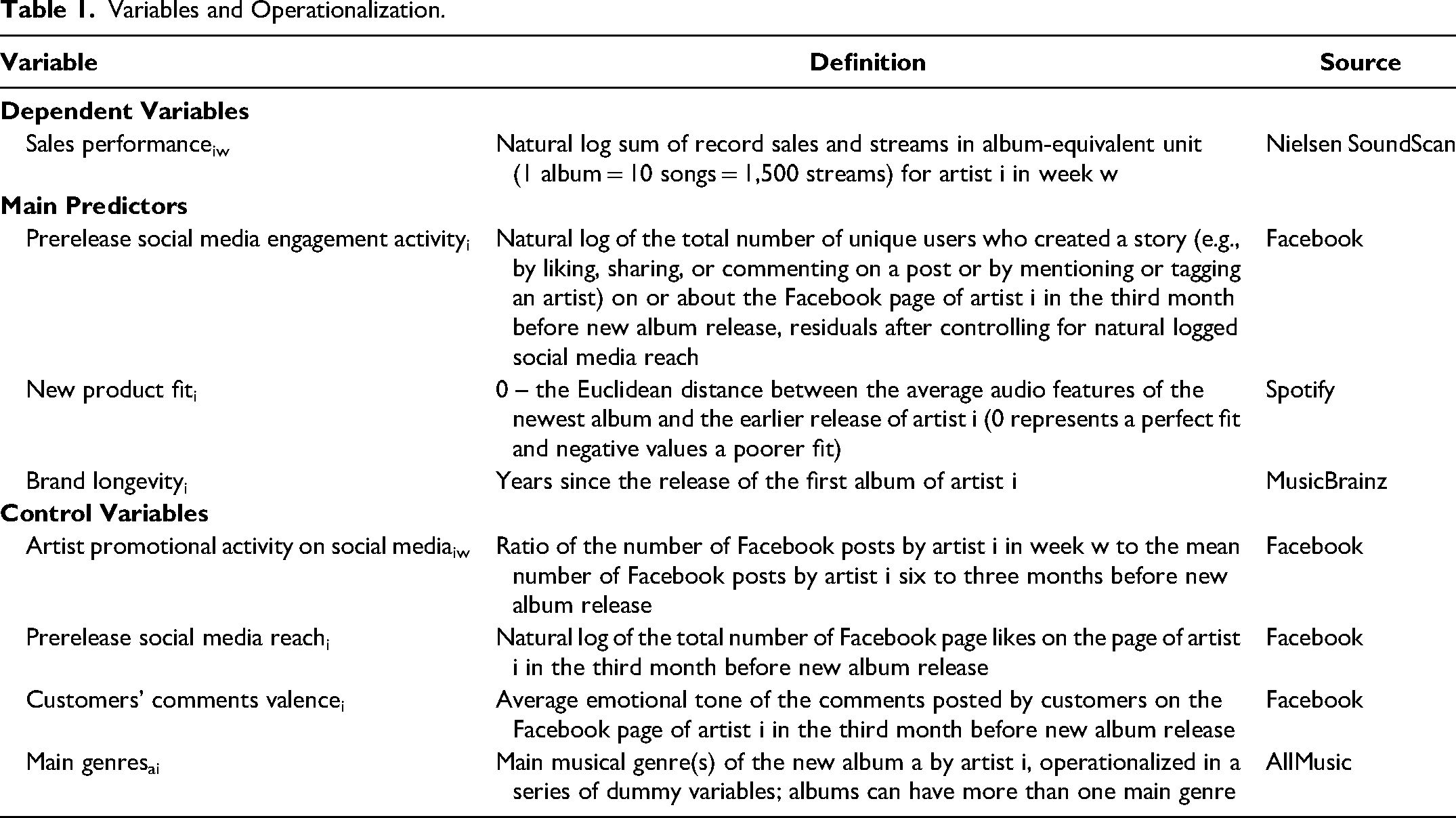
To test the conceptual model (see Figure 1), we use the Canadian music industry for both local and international artists as the study context. This is a substantial market composed of artists of various stages and statuses: the Canadian recorded music market is the eighth largest in the world and grossed U.S. $394 million in 2018 (FYI Music News 2021; IFPI 2021). Because we needed to assess the impact of customer engagement and fit on new album performance, we first created a sample of artists for which we collected sales data, engagement numbers, and the list of albums released by those artists during our data collection period (2016–2017). The next sections describe the data collection process. Table 1 presents the variables of interest, their definitions and operationalizations, and the source from which they were obtained. We also report descriptive statistics of our variables in Table 2.
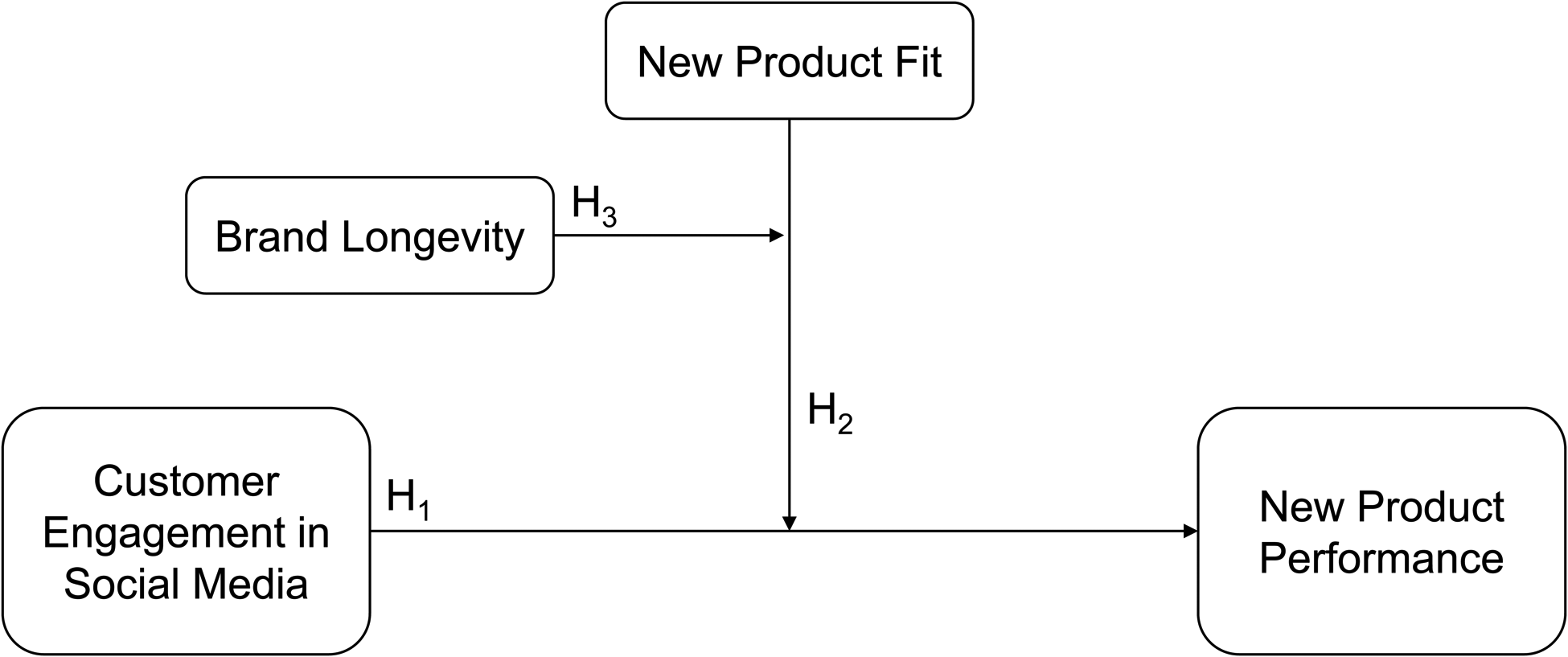
Conceptual Model and Hypotheses.
Variables and Operationalization.
Descriptive Statistics.
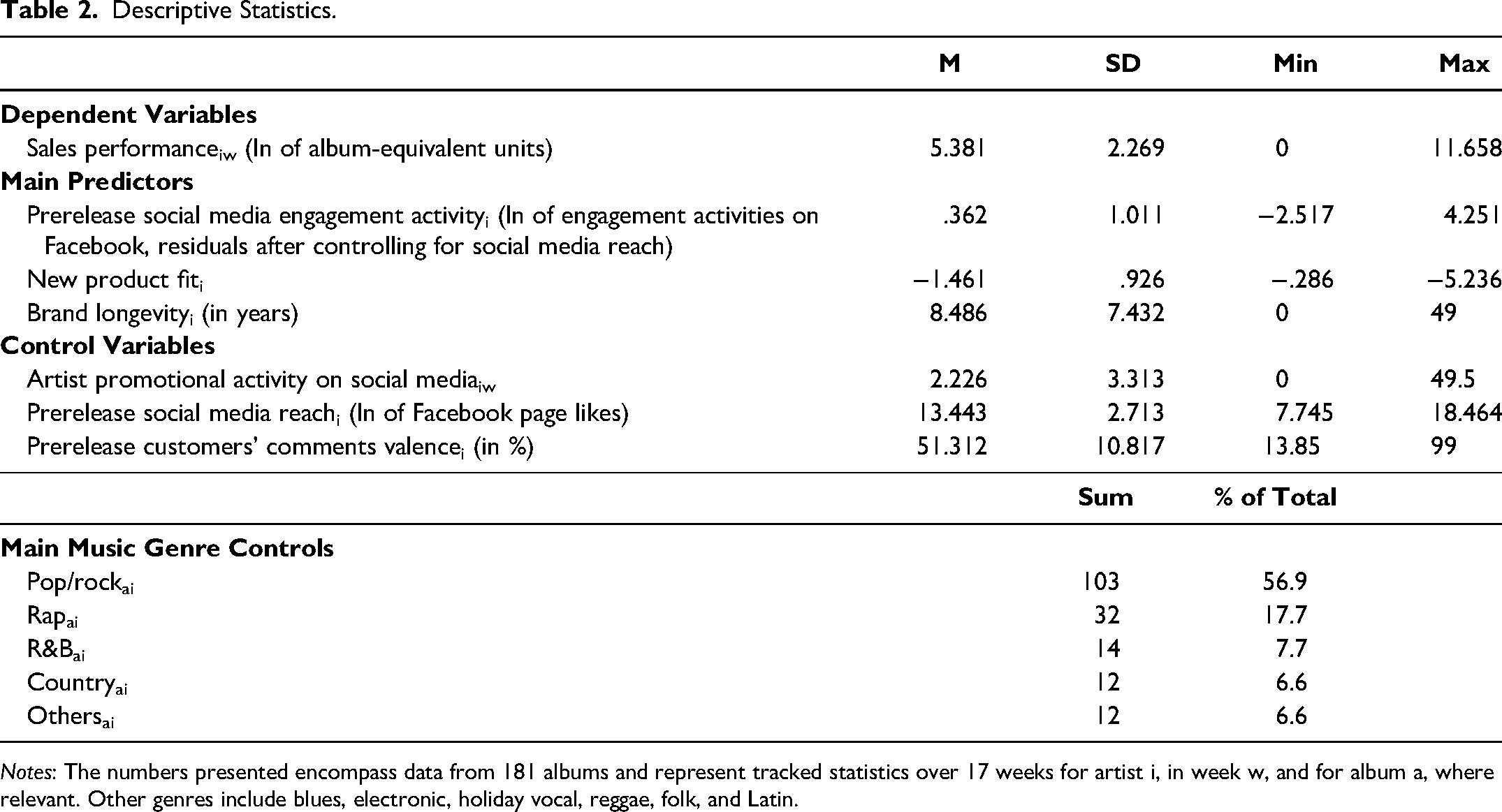
Notes: The numbers presented encompass data from 181 albums and represent tracked statistics over 17 weeks for artist i, in week w, and for album a, where relevant. Other genres include blues, electronic, holiday vocal, reggae, folk, and Latin.
Sample and Album-Related Data
To compile the sample for the study, we employed a stratified convenience sampling strategy. Thus, we created five categories of Facebook reach (more than 5 million page likes, between 1 million and 5 million, between 100,000 and 999,999, between 10,000 and 99,999, less than 10,000) to obtain a sample of artists with a significant variance in terms of social media reach. We first looked for artists with more than 5 million page likes and retrieved 87. We then selected artists for the other categories, intending to create groups of roughly similar size. In total, we selected 405 artists for whom we obtained sales data for 2016 and 2017 (104 weeks). We subsequently dropped 22 artists because sales or social media data were incomplete or missing. For the remaining 383 artists, we collected the data for each variable of interest. We then used MusicBrainz's application programming interface to assemble a list of all the albums released between 2016 and 2017 by the musicians in our sample and the exact date of their Canadian release. MusicBrainz is a collaborative music database that captures information about more than 2.1 million musicians, as of May 2023; this makes MusicBrainz an ideal source for obtaining music-related metadata. To ensure the validity of our MusicBrainz record inventory, we triangulated the list of releases with our sales database, with informational websites such as Wikipedia, and with the data collected via Spotify. In our sample, 226 artists released at least one album between 2016 and 2017, for a total of 329 albums. For those 226 artists, we then gathered information about their earlier album (title, list of songs, and release date) that was essential to the new product fit calculations, as well as the year of release of the first album of each artist in the sample, to calculate the brand longevity. We also collected information about the main genres of those albums via AllMusic (https://www.allmusic.com/), a privately owned, comprehensive database dedicated to recorded music (refer to Web Appendix A for more details). After discarding compilations or live music albums, albums that were the first effort of an artist (which makes it impossible to compute a fit), and albums that were characterized by missing values or invalid information, we compiled a final sample of 181 albums released by 158 different artists.
Record Sales and Streaming Data
For every artist in the final sample, we obtained weekly record sales and streaming data for every week between January 2016 and December 2017. The data source is Nielsen SoundScan, the main information supplier on recorded music performance in North America (Elberse 2010). To monitor music consumer behavior, Nielsen compiles weekly album and single sales information for physical and digital formats and on-demand and programmed audio and video streams from more than 39,000 outlets worldwide, including brick-and-mortar stores and online platforms such as iTunes and Spotify. Those performance numbers are then published by Billboard, a U.S. entertainment media brand, in multiple charts, such as the Billboard Global 200 for singles, the Billboard Artist 100, or the Billboard Canadian Hot 100.
We aggregated record sales and stream numbers to create an album-equivalent unit measure, following the standard used from 2014 to 2018 by Billboard and the Recording Industry Association of America. One album-equivalent unit corresponds to one album sale, ten digital song sales, or 1,500 streams. The 383 artists in our first sample (i.e., the sample before removing artists without any new release) generated 24.5 million album-equivalent units. Our data set aggregated sales at the artist level: the sales and streams of all albums and songs contained in an artist's portfolio are combined every week. Although this prevented us from having the precise number of album-equivalent units generated by the most recent album of a given artist, it enabled us to see its impact of a new product on the performance of the whole portfolio of that same artist.
By using album-equivalent units, our approach differs from Elberse (2010) and Papies and Van Heerde (2017), who use revenue as their dependent variable by multiplying unit sales by the average price of their corresponding format (e.g., a digital track download is typically priced $.99). We deviated from their choice due to the nature of our sales data. Indeed, our period of analysis (2016–2017) is characterized by the rising importance of streaming as a means of consuming music—streaming represents approximately 60.5% of the album-equivalent units generated by the artists of our sample. This was not the case for Elberse’s and Papies and Van Heerde’s data, which were collected before the rise of streaming services (respectively, 2005–2006 and 2004–2010). The inclusion of streaming in recorded music revenue calculation raises a problem because there are important discrepancies in the amount paid by streaming services to artists for each stream. For instance, payouts tend to differ for songs streamed by a paying subscriber and those streamed by an ad-supported user, even for streams with the same streaming service (Sisario 2018). Moreover, although Apple Music pays $.10 per stream as of 2022, Spotify offers around $.40 and YouTube $.07 (Sanchez 2024). Because our data do not enable us to identify through which service a song was streamed, it would be difficult, and risky, to determine a reliable mean value for each stream. Therefore, the choice of album-equivalent units seems the most relevant, considering the nature of the data.
Social Media Engagement
We obtained Facebook social media engagement data for the artists in our final sample via Next Big Sound, a music analytics firm based in New York. 1 Next Big Sound collects and analyzes social media engagement data across several websites—such as Facebook, Pandora, X, and Songkick—to predict the likelihood of success of various musicians. For our study, we chose to focus on Facebook, because it is the most widely used social media network by Canadian consumers (Gruzd and Mai 2020)—in 2017, more than 65% of Canadians were Facebook users—and because Facebook is often employed to consume, create, and share music-related content (Crupnick 2018). To measure social media reach, we gathered the weekly number of Facebook page likes for every artist in our sample during 2016 and 2017. To measure social media engagement activity, we collected the weekly numbers for Facebook's “People Talking About This” metric, which sums up the number of unique people who created a story of any kind about or on a specific page. Stories, as described by Facebook, include actions such as commenting, sharing, and liking a post, as well as tagging or mentioning someone. Because the total number of engaged users is directly linked with the number of page likes, we followed the steps of Kupfer et al. (2018): in our model, we used as our measure of social media engagement activity the residuals of a regression in which the weekly number of Facebook page likes is the independent variable and the weekly total of Facebook “People Talking About This” is the dependent variable. 2 This technique is interesting because it enables us to determine, for each artist–week pair, if the level of engagement of an artist's fan base is greater or lower than what can be expected from an artist with a similar level of reach.
We also used Facebook's application programming interface to gather the comments made by fans on each post produced by the artists in our sample during the study period. For each of the identified comments, we also collected their textual content and then used LIWC (Tausczik and Pennebaker 2010), software created to conduct automated text analysis, to evaluate the emotional tone of those comments. This technique enabled us to evaluate the valence of an artist's social media engagement and to add this valence as a control variable in our model. Of note, as a robustness check, we also ran models using the VADER dictionary (Hutto and Gilbert 2014). The results were, overall, similar to those obtained using LIWC. Lastly, to control for the use of social networks by the artists themselves, which can have a strong effect on sales (Papies and Van Heerde 2017) and engagement, we also gathered the weekly number of Facebook posts for each artist in our sample.
New Product Fit
To evaluate new product fit, we used Spotify's audio features, which are available via Spotify's application programming interface. Since it bought The Echo Nest (a music intelligence platform created to improve music identification and recommendation via machine learning) in 2014, Spotify has employed proprietary algorithms to analyze the music content of the platform's songs. Moreover, the audio features are also used by Spotify in the design of Discover Weekly, a personalized playlist offered for each Spotify user that includes new music suggestions in line with the user’s personal preferences. Spotify's audio features consist of 12 criteria divided into three categories. The first category consists of confidence interval measures that determine whether a song is likely to be acoustic, recorded live, or instrumental, or to contain spoken words. The second category includes perceptual measures of a song's energy level, loudness, danceability, and valence, while the third category comprises objective musical descriptors (duration, tempo, key, and mode). To compute our fit measure, we obtained the audio feature numbers for every song included in the albums released by our artists between 2016 and 2017 and every song in their earlier studio album. We did not include compilations or live albums in our sample because they usually do not offer new songs. For each of these albums, we calculated the albumwide means for each audio feature, to have a series of unique measures for each album. Lastly, we use the Euclidean distance to calculate the musical difference between the newest album and the earlier one by first standardizing three of the variables (i.e., “loudness,” “tempo,” and “duration”) and excluding key, time signature, and mode, to have only interval variables. In contrast to Askin and Mauskapf (2017), we decided to standardize only the audio features characterized by a large range of values (e.g., “loudness,” “tempo,” and “duration”) to bring them to the same scale as the others (i.e., between 0 and 1). Indeed, for the majority of the audio features extracted by Spotify's analysis, the different values between 0 and 1 have a precise meaning that we preferred to keep intact (see https://developer.spotify.com/documentation/web-api/reference). For instance, the variable “speechiness” detects the presence of spoken words in a track so that values close to 1 indicate tracks that are most likely audiobooks or poetry, values between .33 and .66 indicate tracks that contain both music and speech, and values below .33 indicate tracks that are most likely music (which included sung lyrics). As our sample includes only music albums, the average speechiness across the sample is very low (about .08), and the standard deviation is relatively small (about .07). Thus, if there are two albums, and one has a mean speechiness of .05 and the other .20, they could appear distant after standardization, although the real values indicate in both cases that they are most likely music-only albums and that they do not differ significantly on this level.
Modeling Challenges
To test our hypotheses properly, we adjusted our model in a specific way to address four main issues: First, because of the aggregated nature of our sales variable (weekly sales are at the level of the artist and not of specific releases), we could not use a traditional linear growth model, which estimates the sales from the first week of release. Instead, we built a generalized estimating equation model inspired by regression discontinuity (Jacob et al. 2012) using SAS's PROC GENMOD procedure. Hence, for each of the new albums in our sample, we tracked weekly sales from eight weeks before to eight weeks after the release of the new album. This enabled us to analyze the impact of the release of a new product on the sales growth of an artist’s whole portfolio of music. Looking at the whole sample, we can see in Figure 2 that the variations of mean weekly record sales from eight weeks before to eight weeks after the release fit well with a regression discontinuity model. Indeed, we observed a slow increase in sales in the weeks preceding the release, followed by a strong jump at the release (week 0) and a gradual decrease in sales in the following weeks. To assess the robustness of our results, we also performed analyses using linear growth models and SAS's PROC MIXED procedure, following Singer's (1998) method. The complete results, which confirm our hypotheses, are available in Web Appendix C.
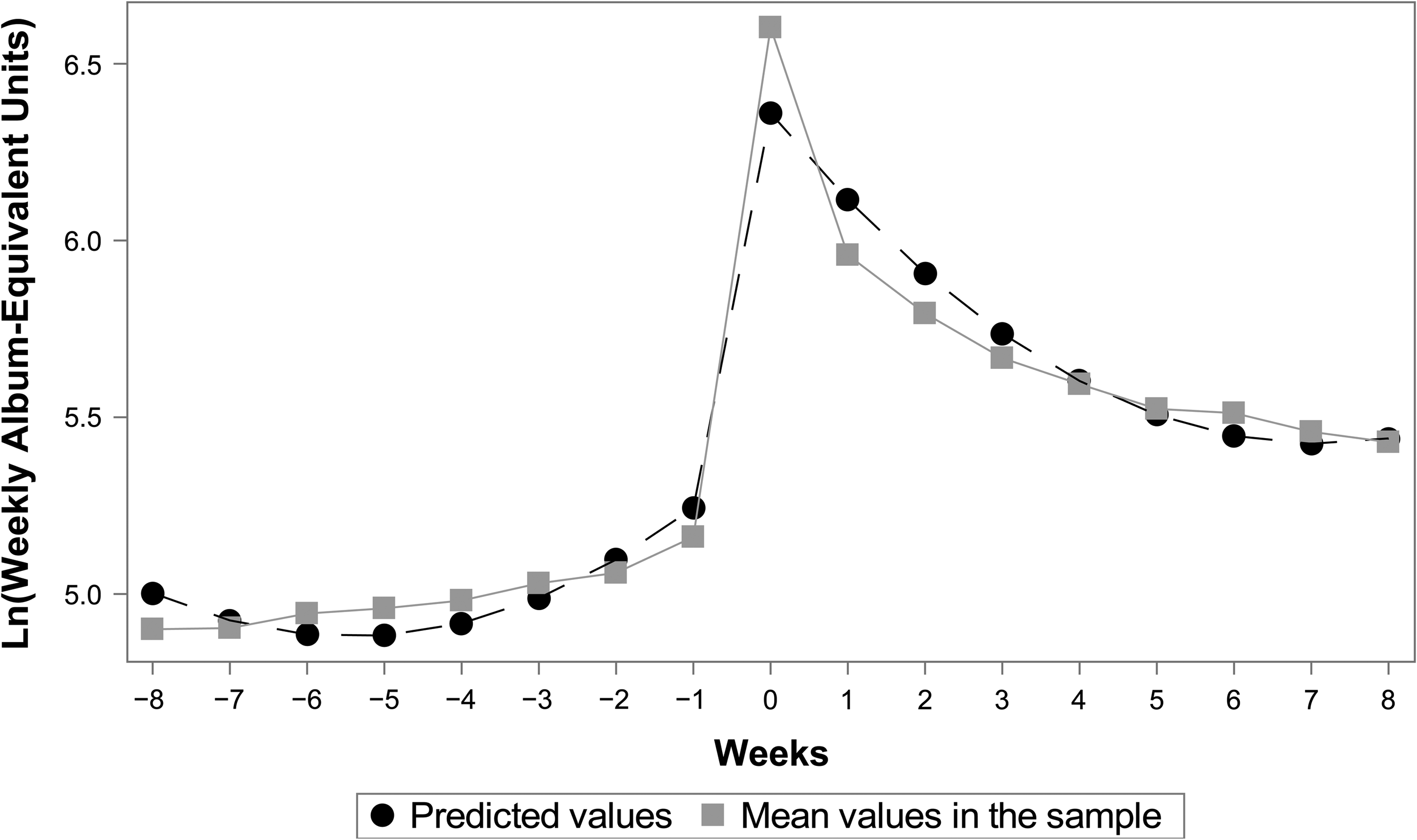
Total Weekly Record Sales (in Thousands) by Week After New Album Release.
Second, because social media engagement and sales can have simultaneous effects on each other (Facebook comments and shares can generate a buzz that boosts sales, which then lead more customers to engage in social media and post new comments and so on), we followed Kupfer et al. (2018) and isolated for each album the mean level of engagement activity on the artist's Facebook page three months before its release (i.e., 9 to 12 weeks before the release) and used those means in our model instead of weekly engagement numbers. This technique is interesting because it circumvents a possible endogeneity problem caused by simultaneity bias while being more relevant from a managerial point of view. Indeed, it is interesting for artists and their managers to know which promotional strategy to use, considering the level of engagement of their audience a few months before the release, when it is still possible to make adjustments. For consistency, we used the same approach with our customers’ comments valence and social media reach control variables, thus using the mean emotional tone of comments and the number of Facebook page likes in the third month before the new album release.
Third, we needed to control for the possible endogeneity of new product fit in our model. Indeed, it is possible that new product fit is associated with an unobserved variable, such as promotional intensity, which impacts weekly sales. When artists release new albums that diverge strongly from their usual style, they may promote those albums less on social media because of their riskier nature, which in turn may reduce overall sales. To control for this phenomenon, we created a variable called “artist promotional activity on social media” and added it to our model. This variable consists of a ratio between the average number of posts published on Facebook by each artist from 26 to 9 weeks before the release of the new album and the number of weekly publications during our period of interest (i.e., 8 weeks before and 8 weeks after the album release). In other words, our promotion variable enabled us to determine if an artist made more (or fewer) Facebook posts during the period associated with the new album release than they usually do.
Model Specification
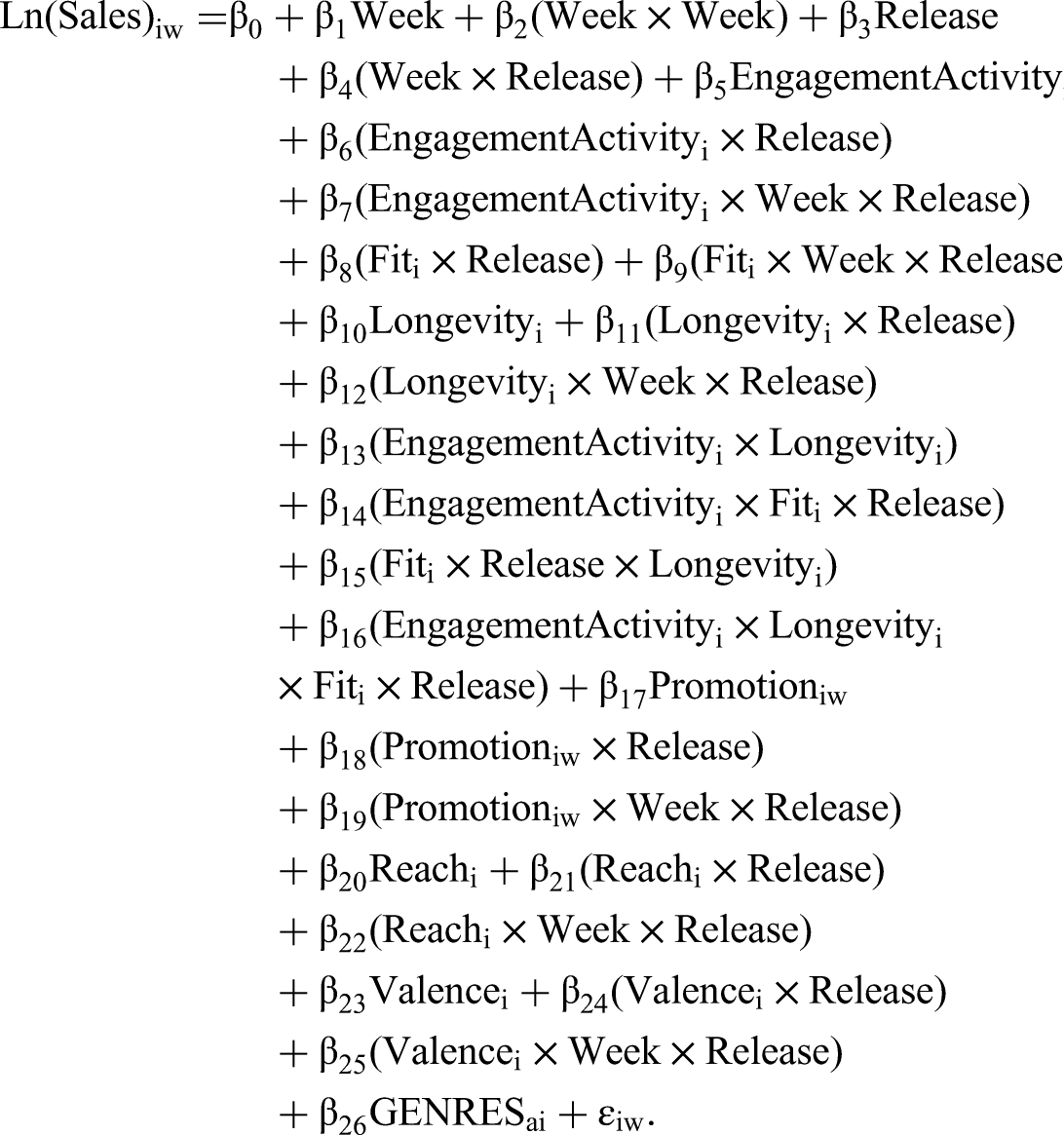
For our complete model, we used a log-level approach where the weekly recorded music sales for artist i in week w is
Results
Hypothesis Testing
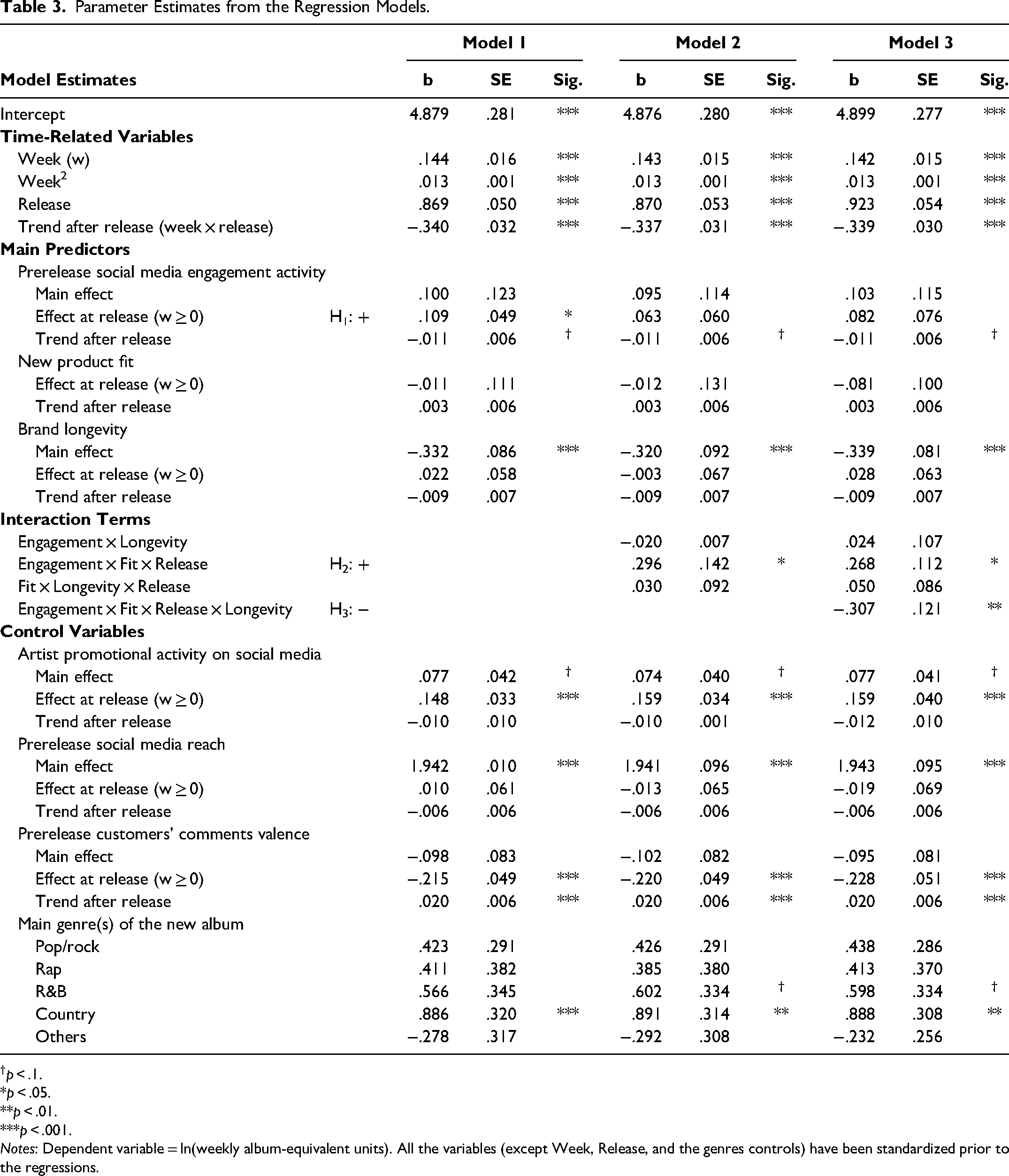
In Table 3, we report the parameter estimates from three regression models, used respectively to test for H1, H2, H3a, and H3b:
1. A partial model with the main predictors and control variables; 2. A complete model with main effects, two-way interactions between the main predictors, and control variables; and 3. A complete model with main effects, two-way and three-way interactions among the main predictors, and control variables.
Parameter Estimates from the Regression Models.
p < .1. *p < .05. **p < .01. ***p < .001.
Notes: Dependent variable = ln(weekly album-equivalent units). All the variables (except Week, Release, and the genres controls) have been standardized prior to the regressions.
H1
To test for H1, we analyzed the results of Model 1 (see Table 3). As expected, the prerelease level of social media engagement activity (three months before the release of a new album and when controlling for social media reach) had a significant, but small, positive effect on new product performance during the release period (βmodel_1_engagement_effect_at_release = .109, p < .027). This supports H1. Interestingly, the level of social media engagement activity did not significantly affect weekly record sales in the months preceding the release period (βmodel_1_engagement_main_effect = .100, p < .426). This suggests that although engagement activity is a useful tool to improve new product success, it is not the case all year long for the whole portfolio of an artist.
H2
To test for H2, we looked at the results of Model 2 (see Table 3). We found a significant positive effect when looking at the interaction between fit and engagement activity from week 0 to week 8 (βmodel_2 = .296, p = .037). Figure 3 displays the conditional effect of social media engagement activity on weekly record sales as a function of new product fit. We learned that a high level of engagement activity (one standard deviation above average) combined with a high level of new product fit (one standard deviation above average) can positively affect sales. Indeed, when both fit and engagement are strong, an artist will generate, on average, 641 album-equivalent units during the first week of release, which is more than 1.57 times as much as an artist with an average level of engagement (409 album-equivalent units), 4 all other things being equal. Moreover, when the fit is low (one standard deviation below the mean), the conditional effect of engagement activity is nonsignificant (see Figure 3); a low-fit album released by an artist with highly engaged customers will thus generate a similar number of album-equivalent units in the first week of release than a similar album launched by an artist with weakly engaged customers, all other things being equal. Overall, those results support H2, because they show that the effect of social media engagement depends on the level of new album fit.
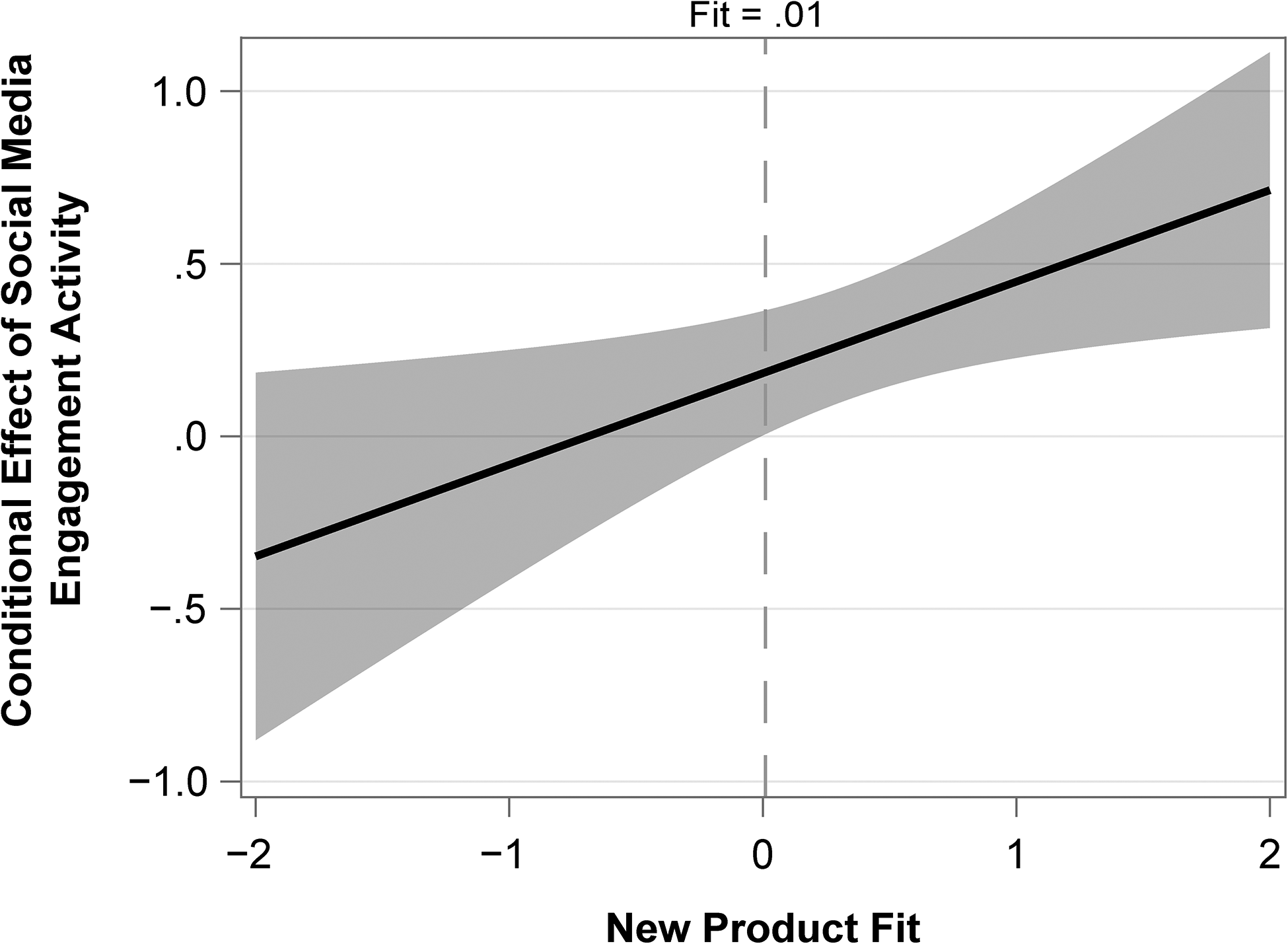
Engaged Customers Prefer Continuity.
H3
To test H3a and H3b, we looked at the interactions among social media engagement activity, new product fit, and brand longevity in Model 3 (see Table 3). As expected, we found a negative and significative effect (βmodel_3 = −.307, p = . 011). Figure 4 displays the conditional effect of social media engagement activity on weekly record sales as a function of new product fit for artists with low (one year of experience) and high (15 years) brand longevity. As expected, we found that for newer artists, strong levels of engagement and fit significantly increase weekly record sales (approximately 1.8 times more than for the average artists), which supports H3a. Moreover, as displayed in Figure 4, social media engagement activity can even have a significant negative effect on weekly record sales in the context of releasing a new album with a very low fit (more than 1.61 standard deviation below average). In contrast, there is no significant difference in the weekly record sales of experienced artists, regardless of the level of fit of their new album and their customers’ engagement level. These results provide evidence for H3b. This suggests that although engagement and fit are important variables for artists in the first stages of their career, this is not the case for experienced musicians.
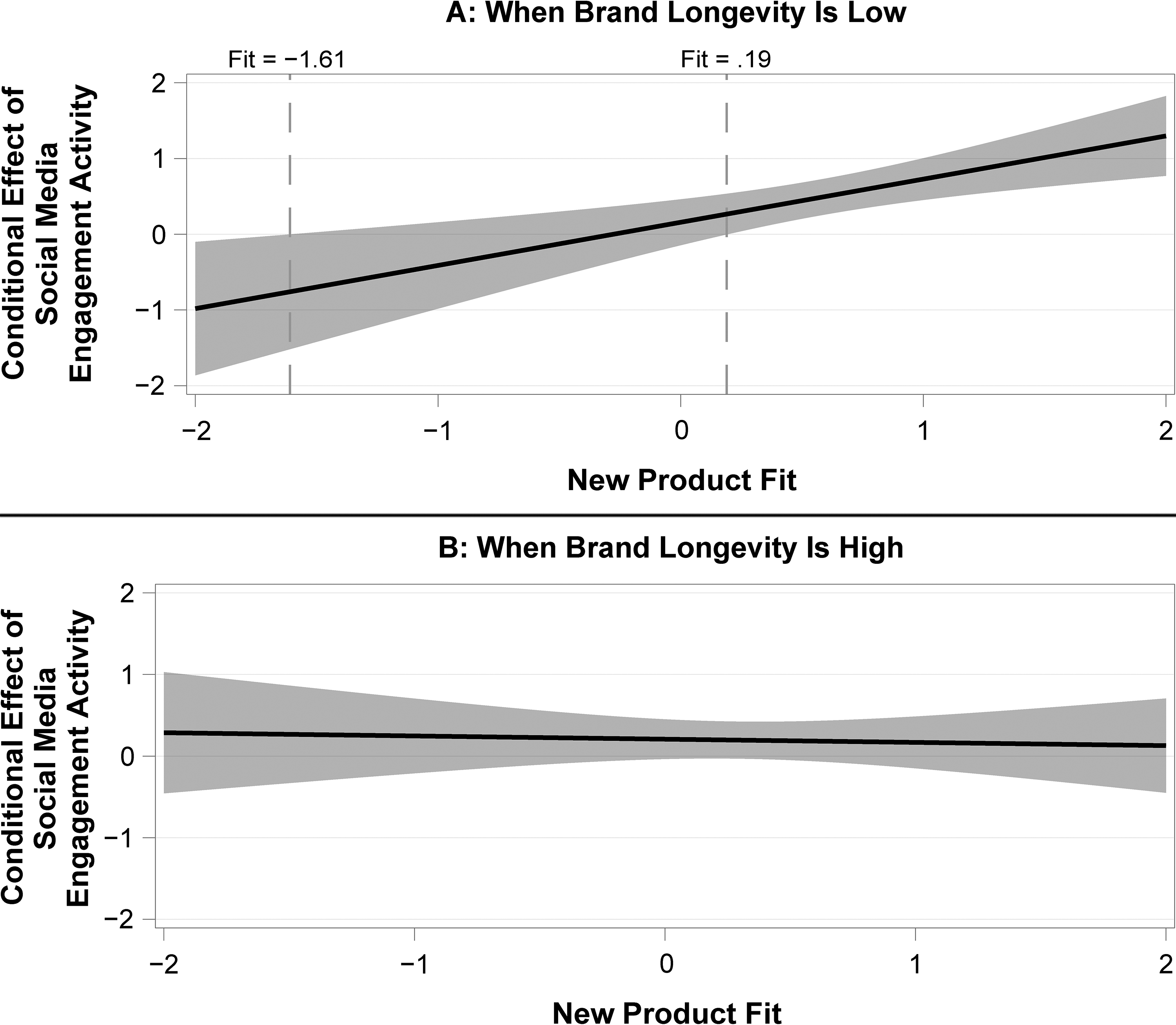
Social Media Engagement Is a Double-Edged Sword for Newer Artists (Panel A), but Not for Established Ones (Panel B).
Interestingly, the results show that older artists tend to generate fewer record sales than newer ones (βmodel_3 = −.339, p = .001), all other things being equal. This surprising result can be explained by the strong association between an artist's longevity and social media reach (r = .40, p < .001). In other words, the more experienced artists are, the more likely they are to have a large number of followers on Facebook—and therefore to generate more sales. Hence, when an experienced artist has the same level of followers as a newer artist, it is likely that the former exploits a niche genre or is simply a less popular artist, because it took them much longer to have the same level of reach as the latter. Refer to Web Appendix D for a complete correlation table.
Control variables
As for the control variables, we found that artists who create more posts than usual on Facebook during the release period (−8 to 8 weeks) will generate more records than others (βmodel_3_effect_at_release = .159, p < .001), a sign that posting content on Facebook mainly during the launch period is an effective strategy, even if the effect is relatively small. Refer to Web Appendix E (Table W6) for additional analyses modeling our promotion variable as a stock variable. These analyses also suggest a small, but positive, effect of artist promotional activity on social media, especially after launch.
Then, we found that prerelease social media reach is strongly associated with weekly recorded sales (βmodel_3_main_effect = 1.943, p = .001) and that this relationship stays stable during the release period (βmodel_3_effect_at_release = −.019, p = .786). As for prerelease customers’ comments valence, we found an unexpected effect. Indeed, our model suggests that the more an artist's audience expresses negative sentiments (βmodel_3_effect_at_release = −.228, p = .001), the more it will generate sales, which is counterintuitive. In further analyses (see Web Appendix F for a comprehensive discussion), we found that effect of prerelease social media engagement valence is positively correlated with engagement activity. Thus, if a positive prerelease social media engagement valence can significantly impact record sales, it is true only when the level of engagement activity is low; for artists with a high level of engagement activity, valence has no effect. This suggests that in some circumstances, controversy might be good. For albums launched by artists with low levels of engagement, negative comments can help generate more consumer awareness—consumers tend to perceive negative reviews as more helpful than neutral ones and give more attention to them (Park and Nicolau 2015)—and thus compensate for their lack of engagement volume. This is a finding shared by Berger, Sorensen, and Ramussen (2010), who found that negative reviews in the New York Times are good for the sales of books released by authors with lower earlier awareness. Lastly, recent research has provided evidence that in the right conditions, negativity and toxicity might increase product usage (Nepomuceno et al. 2023), whereas negative reviews might increase brand preferences (Ordabayeva, Cavanaugh, and Dahl 2022).
Robustness Checks
To ensure the robustness of our results, we first performed extensive analyses regarding possible omitted variable bias related to our “new product fit” variable (see the “Modeling Challenges” section). Because of the hierarchical nature of our data set, we used the R package REndo (Gui et al. 2021) to apply Kim and Frees’s (2007) instrument-free generalized method of moments technique. This method exploits the hierarchical data structure to check for an omitted variable bias without the need for an external instrumental variable. Using a test inspired by the Hausman test for panel data, this method compares a reference random-effects model with a more robust fixed-effects model and a generalized method of moments model. We find a nonsignificant omitted variables test for the comparison between the reference random effects and the generalized method of moments model (χ2(34) = −21,231.5, p > .05), but a significant omitted variable test for the comparison between the reference random effects and the fixed-effects models (χ2(18) = 165.4, p < .001). This suggests that the random-effects estimators may be biased and that the fixed-effects model should be used. However, when comparing the parameters of the three different models, we note that they are all similar (to the third decimal place) and converge to the same results, as presented in Table 3. This result indicates that although there may be an omitted variable bias, our results are virtually unaffected and should be considered robust.
To cross-check our results, we also performed analyses using another data source to evaluate the fit, namely the website AllMusic and its classification of albums by subgenres and musical styles. We used this data source to compute a measure of distance between the subgenres and musical styles of the new album of each artist and their earlier one. More details about this measure can be found in Web Appendix A. Once this new fit measure was calculated, we performed our analyses again, using the model presented in the “Model Specification” section and substituting the original “fit” variable with the newly calculated genre-based fit measure. The complete results of these new models can be found in Web Appendix A (Table W1). Overall, the results obtained with the alternative fit measure are exactly in line with those presented in Table 3. Once again, prerelease social media engagement positively impacted weekly record sales (βmodel_4_effect_at_release = .120, p = .023), thus supporting H1. Furthermore, the effect of social media engagement activity was stronger when the genre of an artist's new album was similar to its earlier release (βmodel_5 = .222, p = .011). This is, again, mainly true for newer artists (βmodel_6 = −.165, p = .001). The result is consistent with our main model and offers strong evidence for H2, H3a, and H3b.
Because streaming represents 67% of worldwide recorded music industry total revenue in 2022 and represented only 39% of this revenue in 2017 and 50% in 2018 (the years in which our data are based), we also ran two other robustness checks to assess whether our results still hold. First, we reran our analyses with a new control variable that we named “music consumption liquidity,” in accordance with the liquid consumption concept proposed by Bardhi and Eckhardt (2017). This variable is calculated as follows:
Discussion
One of our main objectives was to better understand the conditions in which artists can benefit from social media engagement, especially in the context of new releases. In recent years, studies have mainly focused on the positive aspects of social media engagement, linking engagement to a boost in the performance of music records (Saboo, Kumar, and Ramani 2016) and movies (Kupfer et al. 2018; Tajvidi and Karami 2021), to name a few examples. However, engagement may have a dark side, and there is a need to understand better the limitations of engagement and how firms can deal with them (Beckers, Van Doorn, and Verhoef 2018; Harmeling et al. 2017). This reality is particularly important in the context of entertainment product releases, such as music albums, considering that the effects of social media engagement tend to be three times more important for hedonic products than for utilitarian products (Santini et al. 2020) and that a failed launch can be costly. Relying on social exchange theory (Blau 1964; Thibaut and Kelley 1959), and in response to the previously mentioned calls from Harmeling et al. (2017) and Beckers, Van Doorn, and Verhoef (2018), our study contributes to the literature by highlighting an important limitation of social media engagement. Indeed, if it is true that having highly engaged customers can reduce the risks associated with the release of a new product, our results show that engagement creates important expectations, especially in terms of new product fit. The following paragraphs present, in a more detailed fashion, the theoretical and managerial implications of our study, its limitations, and avenues for future research.
Theoretical Implications
In our study, we chose to analyze specifically the effect of prerelease social media engagement activity and reach—that is, an artist's engagement level three months before the launch of a new album. This choice is based on the importance of prerelease consumer buzz to the success of new entertainment products (Divakaran et al. 2017; Houston et al. 2018) and on the fact that artists have greater agency during the prerelease period, because it is much easier to make strategic adjustments before a new product launch than it is to do so after. Our results show that the level of prerelease engagement activity has a small, positive impact on weekly record sales, but only during the release period (i.e., in the first eight weeks after the release of the new album). This contrasts with some of the conclusions found in the literature, notably those of Saboo, Kumar, and Ramani (2016), who found a constant effect (after, but also before, new product launches) of social media WOM on human brands’ sales. This difference can be explained by the fact that contrary to Saboo, Kumar, and Ramani's study, we chose to analyze social media engagement while controlling for the level of social media reach instead of focusing on absolute totals of page likes and comments. In other words, we compared artists with a similar total of social media followers, but those artists differed in their respective followers’ activity levels.
Remarkably, our results suggest that to take full advantage of social media engagement activity, artists should release new products that present a high level of fit—that is, be similar to the product launched earlier. More precisely, when an artist with a high prerelease level of social media engagement launches a new product similar to their earlier one, their weekly record sales will greatly increase. On the contrary, an artist who has an engaged fan base and launches an unorthodox new album may be penalized by their fans and obtain disappointing sales results. In other words, although engaging customers can be beneficial, it might incentivize artists to do the same thing repeatedly.
Lastly, this study highlights that brand longevity acts as an important boundary condition in the relationship among new product fit, social media engagement activity, and sales performance. Our results suggest that the record sales of an artist with more than 15 years of experience are not negatively affected by the combination of a weak new product fit and a highly engaged fan base. On the contrary, new artists who wish to benefit from social media engagement must offer a new album with a style close to their earlier effort. Well-established artists may have more room to innovate, because a rupture of fit in their case creates a sense of renewal and offsets the fatigue that may have accumulated over time. This would align with Heath et al.'s (2015) study on movie sequels, which shows that later sequels were more successful when they were distant from their parent movie. However, the negative three-way interaction across engagement activity, new product fit, and brand longevity might also be driven by “catalog track” sales. Indeed, catalog tracks (i.e., songs that are more than 18 months old) are becoming more and more popular—33% of songs appearing on Spotify's Weekly Top Songs Global chart were catalog tracks (Spotify for Artists 2022)—and experienced artists might be less affected by a poor engagement–fit combination simply because they have a larger catalog of songs on which they can rely to generate sales and streams. The nature of our data set does not enable us to distinguish sales of individual albums—only the sales of an artist's whole portfolio—but it would be interesting to tackle this issue in future research.
Managerial Implications
This study provides relevant insights for managers concerned with social media engagement in the context of new entertainment product launches, such as a music album, and whether it is wise to specialize in a specific genre or explore multiple avenues. First, by developing a fan base of engaged customers, entertainment human brands specializing in a specific genre can reduce the risks associated with a new product release and benefit from a loyal fan base eager to see a new iteration of one of their favorite artists. However, managers must accept that if they rely on strong social media engagement to foster sales performance, they should settle for incremental innovation and thus reiterate the same kind of product. At the least, artists and their managers should be aware of the risks associated with the release of unorthodox products. In the specific case of musicians, especially those in the early or mid-career stages, following this research translates to making new albums that differ only slightly from earlier ones and accepting that they will make artistic changes slowly and gradually. However, important artistic changes may still be a good option at times, despite the potential pitfalls previously mentioned. The benefit of making such changes can be seen when switching from a niche genre to a popular one (e.g., switching from acid jazz to pop music), because the loss of some “original” fans can be compensated by the reach of a new and much larger audience. Changes can also be necessary for creative development: as put by John Lasseter, former chief creative officer of Pixar's and Disney's animation studios, “Sequels are financially less risky. But if that's all we did, we would become creatively bankrupt” (Franklin-Wallis 2015). Thus, it may be preferable for artists and entertainment brands to innovate periodically to preserve their artistic sustainability, even if it may result in a short-term decrease in sales performance. Another possibility for musicians with strong social media engagement is to innovate not by changing their own musical style, but by collaborating with artists from different backgrounds in what is known in the music industry as a “featuring.” Indeed, a study by Ordanini, Nunes, and Nanni (2018) suggests that songs combining artists from distant genres perform better in music charts. For instance, the collaboration between rapper Lil Nas X and country singer Billy Ray Cyrus on the song Old Town Road was a huge success in 2019, accumulating over 18 million in equivalent song units (Cirisano 2020). The featuring strategy is valuable because with it, songs can benefit from each artist's audience while enabling each musician to maintain their own positioning. The featuring strategy is a prevalent practice in the music industry, a sign that artists know its strength (The Economist 2018).
Second, for musicians who want to diversify and explore multiple genres, our results suggest it is best not to put too much emphasis on social media engagement—at least by activating the existing fans—to avoid unnecessary and nonproductive expenses. Because, in that case, fans’ love for their favorite artist will not have been returned in the form of a new album that follows their preferences, highly engaged customers will want to rebalance by not buying the future album, by reducing their listening to earlier songs, and perhaps by sharing negative WOM. This situation could especially be the case for new artists, probably because the relationships with their customers are more fragile due to their recent nature. Therefore, it is advisable for those new artists to explore different genres of music first and then aim for stronger levels of social media engagement or to wait until they reach a stage of maturity to innovate and switch genres.
Limitations and Future Research
Our study focused on the short-term performance of artists and their albums (i.e., within eight weeks of the new record's release). Therefore, our research provides no insights regarding the long-term effects of social media engagement, fit, longevity, and their interactions on the performance of entertainment products, an important limitation. Interestingly, a study by Parker et al. (2018) suggests that introducing a distant brand extension early in a portfolio expansion strategy (as opposed to later in that process) is beneficial for brands, particularly in terms of final brand attitudes and brand concept fluency. Indeed, the longer it takes for a brand to launch a distant brand extension, the more difficult it is for customers to integrate it into the brand concept, thus resulting in poorer results. Following the logic of Parker et al., artists who wish to explore different musical genres should start doing so in the early stages of their career, even if this comes, as our results show, with negative effects in the short term. With this strategy, artists may make significant gains in terms of both artistic freedom and brand attitudes in the long run. It would therefore be interesting to study further the differences among the short-, medium-, and long-term effects of engagement and fit on the sales performance of artists and other entertainment brands.
Furthermore, because of the nature of our data set, we could not measure brand innovativeness (i.e., the propensity for brands to innovate and to offer products that are strongly distinguished from one another; Boisvert and Ashill 2011; Pappu and Quester 2016). This is a notable limitation, because the results of a study by Perron-Brault, Dantas, and Legoux (2020) suggest that when a brand is perceived as innovative, it is less likely to be penalized by its engaged customers in the event of a low-fit new product launch. Similarly, a study by Gerrath and Biraglia (2021) suggests that congruence has no impact on new product evaluations for nontraditional brands (i.e., brands that are already known to launch less congruent products). It would therefore be interesting to deepen our research model to see if artists who tend to innovate regularly have more room to maneuver and can thus benefit from high social media engagement levels without having to restrict their creativity.
Moreover, although we suggest that the relationship between social media engagement activity and fit could have the consequence of reducing the artistic freedom of musicians, we do not actually measure their perceptions of the phenomenon. Hence, if anecdotal evidence suggests that artists do feel this tension—Doja Cat and Charli XCX, two musicians who owe a large part of their success to their popularity on social media, recently shared that they feel a great deal of pressure from the high expectations of their engaged audiences (Jones 2022; Umansky-Castro 2022)—it would be interesting to examine those perceptions in future studies. Likewise, artists might also feel pressured by record companies that do not wish to risk losing their asset's (i.e., artist’s) popularity.
Lastly, our study only looked at the issues linked with the limits of engagement—especially in terms of its impact on the creativity of entertainment brands—without exploring potential strategies to overcome them. However, we can see that in the recent past of the music industry, several artists have adopted strategies to compensate for a major stylistic change. First, some have used a rebranding strategy and launched different albums under different brand names, depending on the main musical genre of each album. This is the case of Damon Albarn, first known as the front man of the Brit-pop band Blur, who explored hip-hop and electro-pop music with his band Gorillaz and art-rock with his project The Good, the Bad & the Queen. Other artists have preferred to strengthen the fit by adjusting the marketing communication campaign supporting the new album. This is notably what Lady Gaga and her label Interscope Records did for the launch of Cheek to Cheek (2014), an album of jazz standards performed by Gaga and jazz singer Tony Bennett. During the publicity campaign surrounding the launch of the album, emphasis was placed on Gaga's jazz education: “I’ve been singing jazz since I was a child and really wanted to show the authentic side of the genre” (Interscope Records 2014). The objective was probably to try to convince her engaged customers that the album, contrary to what one might think at first glance, fits well with Lady Gaga and is in line with her brand, her positioning, and her artistic personality. In the future, it will be useful to explore these different strategies to measure their effectiveness and better understand how artists can benefit from social media engagement without losing creative freedom.
Supplemental Material
sj-pdf-1-jnm-10.1177_10949968231223111 - Supplemental material for The Effect of Online Engagement on New Product Performance: Why Fit and Brand Longevity Matter
Supplemental material, sj-pdf-1-jnm-10.1177_10949968231223111 for The Effect of Online Engagement on New Product Performance: Why Fit and Brand Longevity Matter by Alexis Perron-Brault, Renaud Legoux, Danilo C. Dantas, and Marcelo Vinhal Nepomuceno in Journal of Interactive Marketing
Footnotes
Editor
Arvind Rangaswamy
Declaration of Conflicting Interests
The author(s) declared no potential conflicts of interest with respect to the research, authorship, and/or publication of this article.
Funding
The author(s) received no financial support for the research, authorship, and/or publication of this article.

Notes
References
Supplementary Material
Please find the following supplemental material available below.
For Open Access articles published under a Creative Commons License, all supplemental material carries the same license as the article it is associated with.
For non-Open Access articles published, all supplemental material carries a non-exclusive license, and permission requests for re-use of supplemental material or any part of supplemental material shall be sent directly to the copyright owner as specified in the copyright notice associated with the article.
