

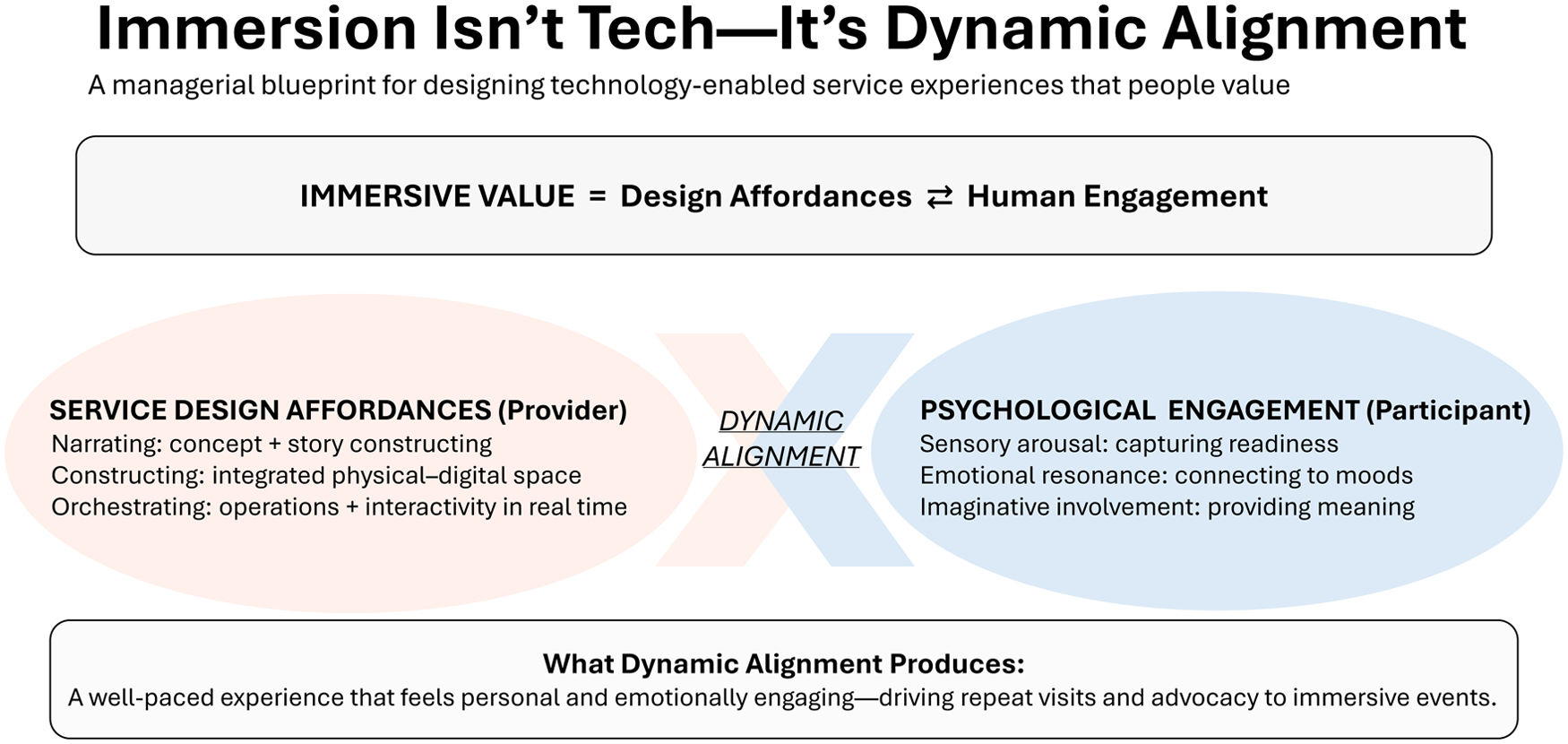
This paper conceptualizes immersive experience as a service phenomenon that arises from the alignment of service design (concept, spatial, and interactive design) and psychological engagement and is manifested in contemporary entertainment settings, sports events, retail, and hospitality spaces. Building on this conceptualization, the paper develops a theoretical framework showing how continuous alignment between service design and participants’ psychological processes is dynamically achieved at service delivery in these environments. From the provider side, immersive experiences are curated, technology-mediated, and entertainment-oriented; from the participant side, they elicit patterns of sensory arousal, emotional resonance, and imaginative involvement that evolve in real time as the experience unfolds. At their intersection, immersion emerges as dynamically co-created and characterized by personalized journeys, collaborative sense-making, temporal integration, and value-in-context. Theoretically, the paper advances service research by linking design affordances, alignment, and psychological engagement as mechanisms that explain how immersive experiences emerge and create value. Managerially, the framework suggests service-delivery levers and individual regulatory processes for balancing sensory, affective, and cognitive tensions.
AhmedSohelSharifTaimurTingDing HooiSharifSharmin Jamal (2024), “Crafting Emotional Engagement and Immersive Experiences: Comprehensive Scale Development for and Validation of Hospitality Marketing Storytelling Involvement,” Psychology & Marketing, 41 (7), 1514–529.
2.
AndersonLaurelVon KoskullCatharinaMendeMartinGummerusJohanna (2025), “Immersive Service: Characteristics, Challenges, and Pathways to Consumer Agency,” Journal of Marketing, 89 (5), 152–74.
3.
BaiwirLisaDessartLaurenceDelcourtCécile (2025), “When Immersive Technologies Drive Service Brand Outcomes: The Role of Episodic Future Thinking,” Journal of Service Theory and Practice, 35 (5), 723–48.
4.
BarreraBibianaFeliuAriadnaEspinaCarolinaBrandTilmanZeebHajoAhmedFurqan (2025), “Leveraging AI to Enhance Qualitative Research: Experiences and Recommendations From Case Studies in Cancer Prevention Literacy Across the European Union,” International Journal of Qualitative Methods, 24, 16094069251365766.
5.
BatatWided (2024), “What Does Phygital Really Mean? A Conceptual Introduction to the Phygital Customer Experience (PH-CX) Framework,” Journal of Strategic Marketing, 32 (8), 1220–43.
6.
BhattacharjeeAmitMogilnerCassie (2014), “Happiness From Ordinary and Extraordinary Experiences,” Journal of Consumer Research, 41 (1), 1–17.
7.
BitnerMary Jo (1992), “Servicescapes: The Impact of Physical Surroundings on Customers and Employees,” Journal of Marketing, 56 (2), 57–71.
8.
BlasinaNiki (2024), “Step Into the Most Mind-Bending, Sense-Scrambling Arts Happening in the World,” Financial Times, May24.
9.
BlockerChristopher P.BarriosAndrés (2015), “The Transformative Value of a Service Experience,” Journal of Service Research, 18 (3), 265–83.
10.
BoltonRuth N.McColl-KennedyJanet R.CheungLilliemayGallanAndrewOrsingherChiaraWitellLarsZakiMohamed (2018), “Customer Experience Challenges: Bringing Together Digital, Physical and Social Realms,” Journal of Service Management, 29 (5), 776–808.
11.
BrakusJ. JoškoSchmittBernd H.ZarantonelloLia (2009), “Brand Experience: What Is It? How Is It Measured? Does It Affect Loyalty?,” Journal of Marketing, 73 (3), 52–68.
12.
ButtazzoniAdrianEllardColinSadioraSukhmaniMinakerLeia (2022), “Toward Conceptualizing ‘Place Immersion’ as a Spatial Neuropsychosocial Phenomenon: A Multidisciplinary Meta-Review and -Synthesis,” Journal of Environmental Psychology, 81, 101810.
13.
CarùAntonellaCovaBernard (2003), “Revisiting Consumption Experience: A More Humble but Complete View of the Concept,” Marketing Theory, 3 (2), 267–86.
14.
CarùAntonellaCovaBernard (2006), “How to Facilitate Immersion in a Consumption Experience: Appropriation Operations and Service Elements,” Journal of Consumer Behaviour, 5 (1), 4–14.
15.
ChandlerJennifer D.LuschRobert F. (2015), “Service Systems: A Broadened Framework and Research Agenda on Value Propositions, Engagement, and Service Experience,” Journal of Service Research, 18 (1), 6–22.
16.
CharmazKathy (2008), “Constructionism and the Grounded Theory Method,” Handbook of Constructionist Research, 1 (1), 397–412.
17.
ChebatJean-CharlesMichonRichard (2003), “Impact of Ambient Odors on Mall Shoppers’ Emotions, Cognition, and Spending: A Test of Competitive Causal Theories,” Journal of Business Research, 56 (7), 529–39.
18.
ChristouProkopis A. (2023), “How to Use Artificial Intelligence (AI) as a Resource, Methodological and Analysis Tool in Qualitative Research?,” The Qualitative Report, 28 (7), 1968–80.
19.
CiuchitaRobertMedbergGustavPenttinenValeriaLutzChristophHeinonenKristina (2022), “Affordances Advancing User-Created Communication (UCC) in Service: Interactivity, Visibility and Anonymity,” Journal of Service Management, 33 (4/5), 688–704.
20.
CostaAntónio PedroBrydaGrzegorzChristouProkopis A.KasperiunieneJudita (2025), “AI as a Co-Researcher in the Qualitative Research Workflow: Transforming Human-AI Collaboration,” International Journal of Qualitative Methods, 24, 16094069251383739.
21.
CsikszentmihalyiMihaly (1996), Flow and the Psychology of Discovery and Invention. New York: Harper Collins.
22.
CunninghamJ. Barton (1993), Action Research and Organizational Development. Westport, CT: Praeger.
23.
De KeyserArneVerleyeKatrienLemonKatherine N.KeininghamTimothy L.KlausPhilipp (2020), “Moving the Customer Experience Field Forward: Introducing the Touchpoints, Context, Qualities (TCQ) Nomenclature,” Journal of Service Research, 23 (4), 433–55.
24.
Del VecchioPasqualeSecundoGiustinaGarzoniAntonello (2023), “Phygital Technologies and Environments for Breakthrough Innovation in Customers’ and Citizens’ Journey: A Critical Literature Review and Future Agenda,” Technological Forecasting and Social Change, 189, 122342.
25.
EppAmber M.HumphreysAshlee (2025), “Collaborating With Generative AI in Consumer Culture Research,” Journal of Consumer Research, 52 (1), 32–48.
26.
EscalasJennifer Edson (2007), “Self-Referencing and Persuasion: Narrative Transportation Versus Analytical Elaboration,” Journal of Consumer Research, 33 (4), 421–29.
27.
FeltonWilliam M.JacksonRussell E. (2022), “Presence: A Review,” International Journal of Human–Computer Interaction, 38 (1), 1–18.
28.
FloridiLuciano (2015), The Onlife Manifesto: Being Human in a Hyperconnected Era. Cham: Springer Nature.
29.
GaultPhilippe (2025), “La Philharmonie de Paris Propose un Concert Immersif Avec la Pianiste Yuja Wang,” Radio Classique, November5.
30.
GibsonJames J. (1977), “The Theory of Affordances,” in Perceiving, Acting, and Knowing: Toward an Ecological Psychology, ShawR.BransfordJ., eds. Hillsdale (NJ): Lawrence Erlbaum Associates, 67–82.
31.
GlaserBarneyStraussAnselm (1967), “Grounded Theory: The Discovery of Grounded Theory,” Sociology: The Journal of the British Sociological Association, 12 (1), 27–49.
32.
GohAmanda (2022), “This Just Might Be the World’s Most Luxurious Public Bathroom, and It’s Tucked Away in the 6th Floor of a Shopping Mall in China,” Business Insider, October21.
33.
GoldsteinSusan MeyerJohnstonRobertDuffyJoAnnRaoJay (2002), “The Service Concept: The Missing Link in Service Design Research?,” Journal of Operations Management, 20 (2), 121–34.
34.
Grand Magic Hotel (2025), “Grand Magic Hotel: The Themed Hotel Near Disney That Turns Your Stay Into a Multisensory Experience,” Grand Magic Hotel, June03.
35.
GreenMelanie C.BrockTimothy C. (2000), “The Role of Transportation in the Persuasiveness of Public Narratives,” Journal of Personality and Social Psychology, 79 (5), 701–21.
36.
GrönroosChristianVoimaPäivi (2013), “Critical Service Logic: Making Sense of Value Creation and Co-Creation,” Journal of the Academy of Marketing Science, 41 (2), 133–50.
37.
HadiRhondaMelumadShiriParkEric S. (2024), “The Metaverse: A New Digital Frontier for Consumer Behavior,” Journal of Consumer Psychology, 34 (1), 142–66.
38.
HagtvedtHenrikChandukalaSandeep R. (2023), “Immersive Retailing: The In-Store Experience,” Journal of Retailing, 99 (4), 505–17.
39.
HelkkulaAnuKelleherCarolPihlströmMinna (2012), “Characterizing Value as an Experience: Implications for Service Researchers and Managers,” Journal of Service Research, 15 (1), 59–75.
40.
HuangMing-HuiRustRoland T. (2017), “Technology-Driven Service Strategy,” Journal of the Academy of Marketing Science, 45 (6), 906–24.
41.
HuangMing-HuiRustRoland T. (2018), “Artificial Intelligence in Service,” Journal of Service Research, 21 (2), 155–72.
42.
HuangMing-HuiRustRoland T. (2021a), “A Strategic Framework for Artificial Intelligence in Marketing,” Journal of the Academy of Marketing Science, 49 (1), 30–50.
43.
HuangMing-HuiRustRoland T. (2021b), “Engaged to a Robot? The Role of AI in Service,” Journal of Service Research, 24 (1), 30–41.
44.
HuangMing-HuiRustRoland T. (2025), “The GenAI Future of Consumer Research,” Journal of Consumer Research, 52 (1), 4–17.
45.
HuiMichael K.DubeLauretteChebatJean-Charles (1997), “The Impact of Music on Consumers’ Reactions to Waiting for Services,” Journal of Retailing, 73 (1), 87–104.
46.
JaakkolaElinaHelkkulaAnuAarikka-StenroosLeena (2015), “Service Experience Co-Creation: Conceptualization, Implications, and Future Research Directions,” Journal of Service Management, 26 (2), 182–205.
47.
JalaliMohammad S.AkhavanAli (2024), “Integrating AI Language Models in Qualitative Research: Replicating Interview Data Analysis With ChatGPT,” System Dynamics Review, 40 (3), e1772.
48.
JeonYunkyungKimDaehwanHanSeungjinHuangYihanKimJinjae (2021), “How Does Service Environment Enhance Consumer Loyalty in the Sport Fitness Industry? The Role of Servicescape, Consumption Motivation, Emotional and Flow Experiences,” Sustainability, 13 (11), 6414.
49.
KaartemoValtteriHelkkulaAnu (2025), “Human–AI Resource Relations in Value Cocreation in Service Ecosystems,” Journal of Service Management, 36 (2), 291–306.
50.
KandelEric R. (2000), Principles of Neural Science. New York: McGraw-Hill.
51.
KimSungeun AngeCrystal YapSheau Fen (2025), “Psychological Mechanisms Behind the Influence of Immersive Technologies on Consumer Well-Being,” Psychology & Marketing, 42 (11), 2748–66.
52.
KozinetsRobert V.FerreiraDaniela AbrantesChimentiPaula (2021), “How Do Platforms Empower Consumers? Insights From the Affordances and Constraints of Reclame Aqui,” Journal of Consumer Research, 48 (3), 428–55.
53.
KranzbühlerAnne-MadeleineKleijnenMirella H. P.MorganRobert E.TeerlingMarije (2018), “The Multilevel Nature of Customer Experience Research: An Integrative Review and Research Agenda,” International Journal of Management Reviews, 20 (2), 433–56.
54.
KrishnaAradhna (2012), “An Integrative Review of Sensory Marketing: Engaging the Senses to Affect Perception, Judgment and Behavior,” Journal of Consumer Psychology, 22 (3), 332–51.
55.
KrishnaAradhnaSchwarzNorbert (2014), “Sensory Marketing, Embodiment, and Grounded Cognition: A Review and Introduction,” Journal of Consumer Psychology, 24 (2), 159–68.
56.
KuehnlChristinaJozicDanijelHomburgChristian (2019), “Effective Customer Journey Design: Consumers’ Conception, Measurement, and Consequences,” Journal of the Academy of Marketing Science, 47 (3), 551–68.
57.
KwortnikRobert J.ThompsonGary M. (2009), “Unifying Service Marketing and Operations With Service Experience Management,” Journal of Service Research, 11 (4), 389–406.
58.
LemonKatherine N.VerhoefPeter C. (2016), “Understanding Customer Experience Throughout the Customer Journey,” Journal of Marketing, 80 (6), 69–96.
59.
LewinKurt (1946), “Action Research and Minority Problems,” Journal of Social Issues, 2 (4), 34–46.
60.
LorenzJohannaReckerJanKruseLeona Chandra (2025), “How Physical–Digital Experiences Are Designed,” Business & Information Systems Engineering, 1–21.
61.
LunardoRenaudPonsignonFrédéric (2020), “Achieving Immersion in the Tourism Experience: The Role of Autonomy, Temporal Dissociation, and Reactance,” Journal of Travel Research, 59 (7), 1151–67.
62.
MardonRebeccaDenegri-KnottJaniceMolesworthMike (2023), “‘Kind of Mine, Kind of Not’: Digital Possessions and Affordance Misalignment,” Journal of Consumer Research, 50 (2), 255–81.
63.
MehrabianAlbertRussellJames A. (1974), An Approach to Environmental Psychology. Cambridge, MA: MIT Press.
64.
MeleCristinaRusso-SpenaTiziana (2025), “Agencement of Onlife and Phygital: Smart Tech–Enabled Value Co-Creation Practices,” Journal of Service Management, 36 (2), 217–40.
65.
MouXinyiDingXuanwenHeQiWangLiangLiangJingcongZhangXinnongSunLiboLinJiayuZhouJieHuangXuanjingWeiZhongyu (2024), “From Individual to Society: A Survey on Social Simulation Driven by Large Language Model-Based Agents,” arXiv, arXiv:2412.03563.
66.
MurrayJanet H. (1997), Hamlet on the Holodeck: The Future of Narrative in Cyberspace. New York: The Free Press.
67.
Nahum-ShaniInbalShawSteven D.CarpenterStephanie M.MurphySusan A.YoonCarolyn (2022), “Engagement in Digital Interventions,” American Psychologist, 77 (7), 836–52.
68.
NilssonNiels ChrNordahlRolfSerafinStefania (2016), “Immersion Revisited: A Review of Existing Definitions of Immersion and Their Relation to Different Theories of Presence,” Human Technology, 12 (2), 108–34.
69.
OberauerKlaus (2019), “Working Memory and Attention–A Conceptual Analysis and Review,” Journal of Cognition, 2 (1), 1–23.
70.
OliverRichard L. (2010), Satisfaction: A Behavioral Perspective on the Consumer. New York, NY: M.E. Sharpe.
71.
OppenheimerD. M. (2008), “The Secret Life of Fluency,” Trends in Cognitive Sciences, 12, 237–41.
72.
OstromAmy L.ParasuramanA.BowenDavid E.PatrícioLiaVossChristopher A. (2015), “Service Research Priorities in a Rapidly Changing Context,” Journal of Service Research, 18 (2), 127–59.
73.
ParkJoon SungZouCarolyn Q.ShawAaronHillBenjamin MakoCaiCarrieMorrisMeredith RingelWillerRobbLiangPercyBernsteinMichael S. (2024), “Generative Agent Simulations of 1,000 People,” arXiv, arXiv:2411.10109.
74.
ParkerSuzanne C.NelsonBenjamin W.EpelElissa S.SiegelDaniel J. (2015), “The Science of Presence,” in Handbook of Mindfulness: Theory, Research, and Practice, Kirk Warren Brown, J. David Creswell, and Richard M. Ryan, eds. New York, NY: Guilford Press, 225–44.
75.
PatrícioLiaFiskRaymond P.Falcão E CunhaJoão (2008), “Designing Multi-Interface Service Experiences: The Service Experience Blueprint,” Journal of Service Research, 10 (4), 318–34.
76.
PatrícioLiaFiskRaymond P.Falcão E CunhaJoãoConstantineLarry (2011), “Multilevel Service Design: From Customer Value Constellation to Service Experience Blueprinting,” Journal of Service Research, 14 (2), 180–200.
77.
PatrícioLiaGustafssonAndersFiskRaymond (2018), “Upframing Service Design and Innovation for Research Impact,” Journal of Service Research, 21 (1), 3–16.
78.
PatrickVanessa M. (2016), “Everyday Consumer Aesthetics,” Current Opinion in Psychology, 10, 60–4.
79.
PengTianyGuiGeorgeMerlauDaniel J.FanGrace JiaruiSlimanMalek BenBrucksMelanieJohnsonEric J.MorwitzVickiAlthenayyanAbdullahBellezzaSilviaDonatiDanteFongHortenseFriedmanElizabethGuevaraArianaHusseinMohamedJerathKinshukKogutBruceKumarAkshitLaneKristenLiHannahPerkowskiPatrykNetzerOdedToubiaOlivier (2025), “A Mega-Study of Digital Twins Reveals Strengths, Weaknesses and Opportunities for Further Improvement,” arXiv, arXiv:2509.19088.
80.
PineB. JosephGilmoreJames H. (1998), Welcome to the Experience Economy. Harvard Business Review Press. Boston, MA: Harvard Business Publishing, 97–105.
81.
PöyryEssiHolopainenJaniParvinenPetriMattilaOsmoTuunanenTuure (2025), “Design Principles for Virtual Reality Applications Used in Collaborative Service Encounters,” Journal of Service Research, 28 (4), 563–79.
RustRoland T.OliverRichard L. (1994), Service Quality: New Directions in Theory and Practice. Thousand Oaks, CA: Sage Publications.
84.
RustRoland T.HuangMing-Hui (2014), “The Service Revolution and the Transformation of Marketing Science,” Marketing Science, 33 (2), 206–21.
85.
SabatMagdalenaDe DampierreCharlesTallon-BaudryCatherine (2025), “Evidence for Domain-General Arousal From Semantic and Neuroimaging Meta-Analyses Reconciles Opposing Views on Arousal,” Proceedings of the National Academy of Sciences, 122 (6), e2413808122.
SchmittBernd H. (2012), “Bridging Theory and Practice: A Conceptual Model of Relevant Research,” in Cracking the Code: Leveraging Consumer Psychology to Drive Profitability, PosavacSteve, ed. Armonk, NY: M.E. Sharpe.
88.
SilviaPaul J. (2012), “Curiosity and Motivation,” in The Oxford Handbook of Human Motivation, Vol. 550, R. M. Ryan (Ed.) pp. 157–66.
89.
SinhaRaviSololaIdrisNguyenHaSwansonHillaryLawrenceLuEttaMae (2024), “The Role of Generative AI in Qualitative Research: GPT-4’s Contributions to a Grounded Theory Analysis,” in Proceedings of the Symposium on Learning Design and Technology. Delft, Netherlands: ACM, 17–25.
90.
SlaterMelWilburSylvia (1997), “A Framework for Immersive Virtual Environments (FIVE): Speculations on the Role of Presence in Virtual Environments,” Presence: Teleoperators and Virtual Environments, 6 (6), 603–16.
91.
SpenceCharlesGallaceAlberto (2011), “Multisensory Design: Reaching Out to Touch the Consumer,” Psychology & Marketing, 28 (3), 267–308.
92.
Sphere Entertainment Co. (2023), “Sphere Entertainment Unveils the Most Advanced Concert-Grade Audio System in the World: Sphere Immersive Sound, Powered by HOLOPLOT,” Sphere, July24.
93.
StrongDiane M.VolkoffOlgaJohnsonSharon A.PelletierLori R.TuluBengisuBar-OnIsaTrudelJohnGarberLawrence (2014), “A Theory of Organization–EHR Affordance Actualization,” Journal of the Association for Information Systems, 15 (2), 53–85.
94.
TeixeiraJorgePatrícioLiaNunesNuno J.NóbregaLeonelFiskRaymond P.ConstantineLarry (2012), “Customer Experience Modeling: From Customer Experience to Service Design,” Journal of Service Management, 23 (3), 362–76.
95.
ToubiaOlivierGuiGeorge Z.PengTianyiMerlauDaniel J.LiAngChenHaozhe (2025), “Database Report: Twin-2K-500: A Data Set for Building Digital Twins of Over 2,000 People Based on Their Answers to Over 500 Questions,” Marketing Science, mksc.2025.0262.
96.
TownsendClaudiaSoodSanjay (2012), “Self-Affirmation Through the Choice of Highly Aesthetic Products,” Journal of Consumer Research, 39 (2), 415–28.
97.
VargoStephen L.LuschRobert F. (2008), “Service-Dominant Logic: Continuing the Evolution,” Journal of the Academy of Marketing Science, 36 (1), 1–10.
98.
VargoStephen L.LuschRobert F. (2016), “Institutions and Axioms: An Extension and Update of Service-Dominant Logic,” Journal of the Academy of Marketing Science, 44 (1), 5–23.
99.
VerhoefPeter C.LemonKatherine N.ParasuramanAnanthanarayananRoggeveenAnneTsirosMichaelSchlesingerLeonard A. (2009), “Customer Experience Creation: Determinants, Dynamics and Management Strategies,” Journal of Retailing, 85 (1), 31–41.
100.
VoorheesClay M.FombellePaul W.GregoireYanyBoneSterlingGustafssonAndersSousaRuiWalkowiakTravis (2017), “Service Encounters, Experiences and the Customer Journey: Defining the Field and a Call to Expand Our Lens,” Journal of Business Research, 79, 269–80.
101.
WachingerJonasBärnighausenKateSchäferLouis N.ScottKerryMcMahonShannon A. (2024), “Prompts, Pearls, Imperfections: Comparing ChatGPT and a Human Researcher in Qualitative Data Analysis,” Qualitative Health Research, 10497323241244669.
102.
WeaverShaye (2023), “I Had Dinner Inside a ‘Volcano’ at This New Immersive Restaurant and Bar,” Time Out New York, January25.
103.
WeldenRomanHaenleinMichaelHewettKellySmithKeith MarionHullandJohn (2025), “Quest for Insights: Leveraging Data From the Video Game Ecosystem in Marketing,” Journal of the Academy of Marketing Science, 53 (4), 1135–56.
YanLixiangEcheverriaVanessaFernandez-NietoGloria MilenaJinYueqiaoSwieckiZachariZhaoLinxuanGaševićDraganMartinez-MaldonadoRoberto (2024), “Human–AI Collaboration in Thematic Analysis Using ChatGPT: A User Study and Design Recommendations,” in Extended Abstracts of the CHI Conference on Human Factors in Computing Systems. Honolulu, HI: ACM, 1–7.
106.
YueYongjieLiuDongLvYilinHaoJunyiCuiPeixuan (2025), “A Practical Guide and Assessment on Using ChatGPT to Conduct Grounded Theory: Tutorial,” Journal of Medical Internet Research, 27, e70122.
107.
ZhangHeWuChuhaoXieJingyiLyuYaoCaiJieCarrollJohn M. (2025a), “Harnessing the Power of AI in Qualitative Research: Exploring, Using and Redesigning ChatGPT,” Computers in Human Behavior: Artificial Humans, 4, 100144.
108.
ZhangYingshaZhangNingZhouYueyinZhouJunyu (2025b), “Tour Game-Likeness and Immersive Tourism Experience: The Role of Arousal Need and Gamification,” Journal of Travel Research, 00472875251379413.
109.
ZhuHaoLuoMan-DiWangRuiZhengAi-HuaHeRan (2021), “Deep Audio-Visual Learning: A Survey,” International Journal of Automation and Computing, 18 (3), 351–76.
110.
ZomerdijkLeonieke G.VossChristopher A. (2010), “Service Design for Experience-Centric Services,” Journal of Service Research, 13 (1), 67–82.