




Abstract
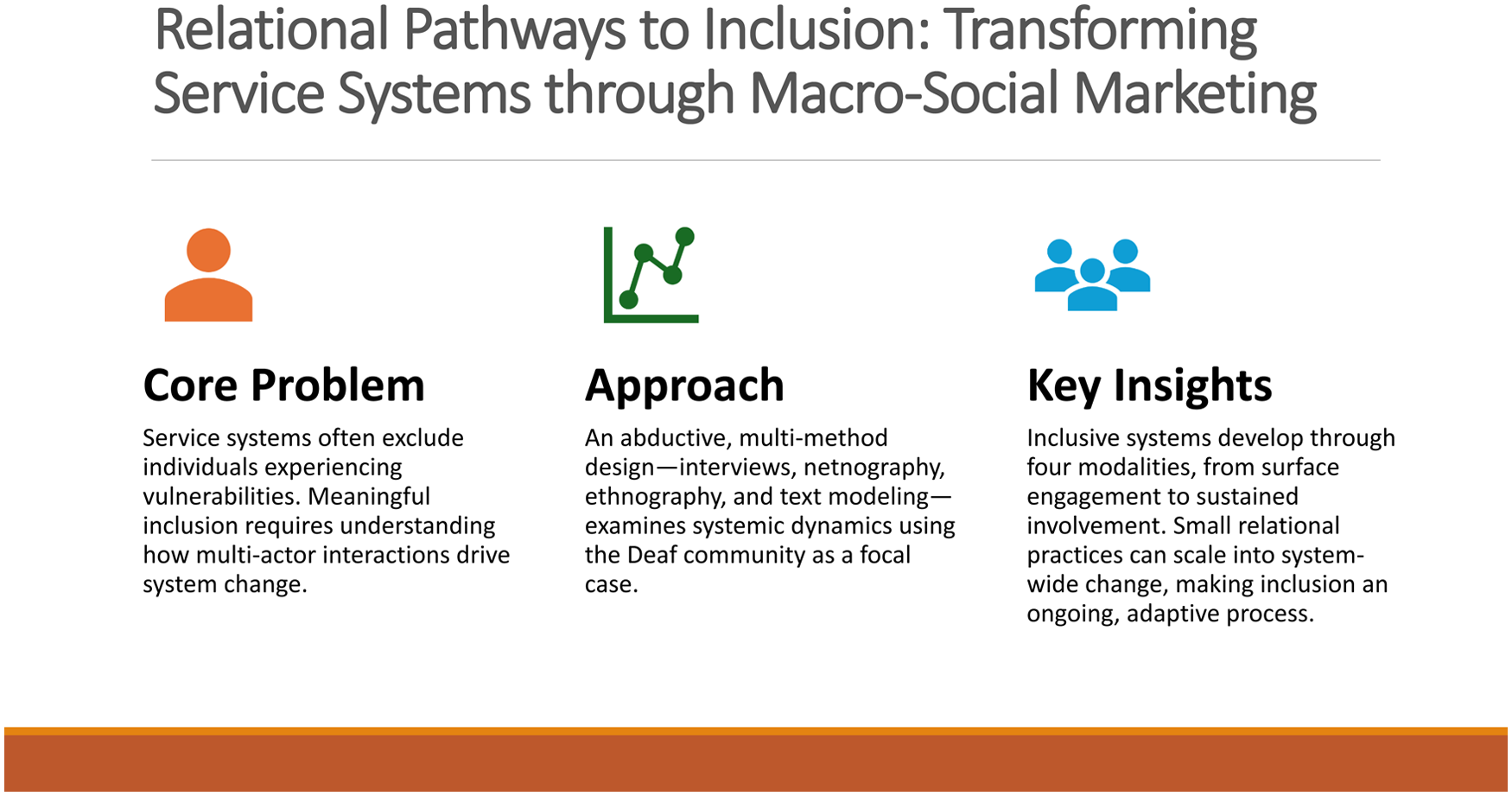
Systemic exclusion remains a significant barrier for individuals experiencing vulnerabilities, limiting their participation in service systems—configurations of interdependent actors, institutions, and infrastructures that shape service environments. This study examines how inclusive service systems evolve through dynamic, multi-actor engagement by integrating systems thinking, transformative service research, and macro-social marketing. Using an abductive, multi-method design, we focus on the Deaf community in Indonesia as a salient case and combine interviews with Deaf and hearing individuals, netnographic analysis of Deaf-oriented online content, rapid ethnographies at community events, and computational topic modeling of user-generated discourse. The analysis uncovers four evolving modalities of system transformation—Surface-Level Engagement, In-Depth Exploration, Co-Creative Participation, and Sustained Involvement—which trace how micro-level relational practices and communicative adjustments accumulate into meso- and macro-level shifts in structures and norms. We conceptualize inclusion as an emergent, iterative process rather than a stable end-state and propose a scalable framework to diagnose and facilitate inclusive transformation in complex service environments. The study advances theoretical perspectives on inclusive service systems and macro-social marketing and offers actionable guidance for designing and governing service systems that give marginalized groups an active role in shaping services.
Keywords
Get full access to this article
View all access options for this article.