




Abstract
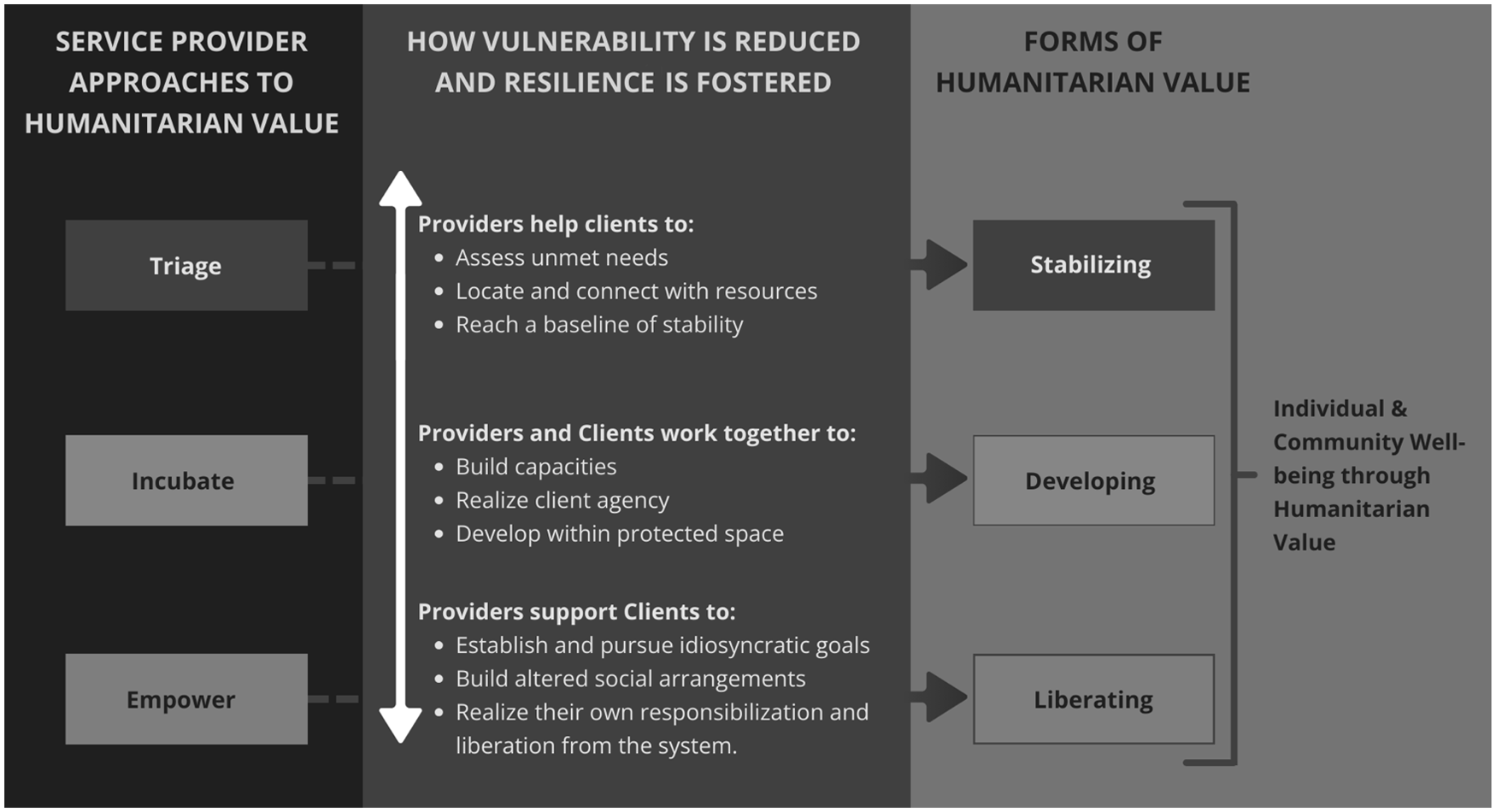
This multicity, qualitative study provides a nuanced understanding of how social service providers deploy human-centered service design approaches and the respective intended value creation through a diverse set of social services. This work makes three central contributions. First, it offers an initial typology of social service design approaches based on their intended value: (1) triaging to stabilize, (2) incubating to develop, and (3) empowering to liberate. Second, we demonstrate the imperative to focus on the experiences of both vulnerability and resilience for disadvantaged consumers, allowing sensitivity to consumers’ resource deficits and capabilities. Third, we introduce the concept of humanitarian value, a dynamic, adaptive, and encompassing value that addresses immediate and long-term needs, recognizes human strengths and resource deficits, and serves to enhance the well-being of individuals and communities. The findings provide a guide for social service organizations, which often operate in unstable, precarious environments, to address the idiosyncratic needs of their clients and holistically assess the persistent wicked problems and social needs in their respective communities.
Get full access to this article
View all access options for this article.
References
Supplementary Material
Please find the following supplemental material available below.
For Open Access articles published under a Creative Commons License, all supplemental material carries the same license as the article it is associated with.
For non-Open Access articles published, all supplemental material carries a non-exclusive license, and permission requests for re-use of supplemental material or any part of supplemental material shall be sent directly to the copyright owner as specified in the copyright notice associated with the article.
