




Abstract
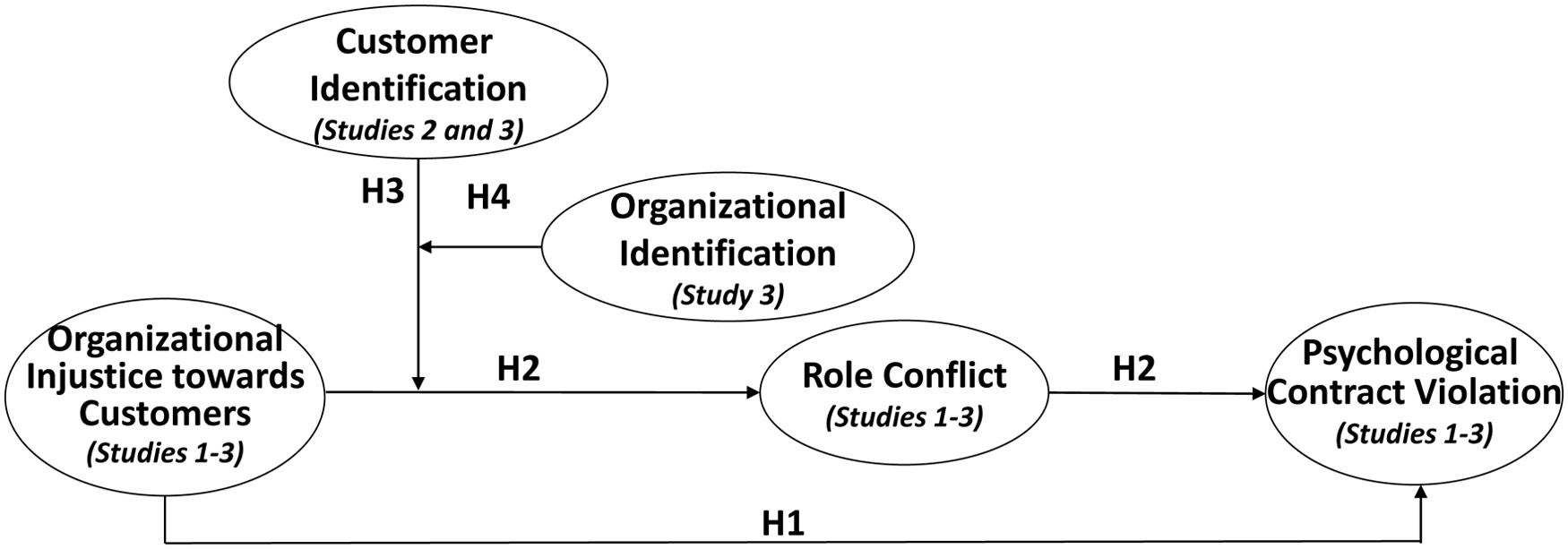
The conventional wisdom in service and organizational frontline research suggests that if a firm treats employees well, its employees will treat customers well. Combining survey data of current frontline employees (FLEs) with experimental data, our research suggests that, in addition to this “trickle-out effect,” there is also a “trickle-in effect,” wherein the exchange quality of the customer–organization interface may inversely influence that of the employee–organization interface. As boundary-spanners, FLEs may feel betrayed when they perceive organizational injustice toward customers by their firms. This effect is mediated by role conflict. This is because organizational injustice toward customers often prevents FLEs from fulfilling their dual role expectations of serving both organizations and external customers. Other times, these policies may be inherently incompatible with FLEs’ own job expectations. Intensified inter- and intrarole conflict could, in turn, lead to FLEs’ feelings of betrayal and contract violation. In addition, we found that the mediating effect of role conflict is simultaneously moderated by both organizational and customer identification. Only when FLEs hold strong identification with both parties are the negative consequences of organizational injustice toward customers carried through role conflict.
Keywords
Get full access to this article
View all access options for this article.
References
Supplementary Material
Please find the following supplemental material available below.
For Open Access articles published under a Creative Commons License, all supplemental material carries the same license as the article it is associated with.
For non-Open Access articles published, all supplemental material carries a non-exclusive license, and permission requests for re-use of supplemental material or any part of supplemental material shall be sent directly to the copyright owner as specified in the copyright notice associated with the article.
