




Abstract
The role of chief marketing officers (CMOs) for service innovation has mostly been overlooked in empirical research. Particularly unclear is how CMOs’ personal career experiences shape their firms’ pace of service innovation. We address this issue by examining whether and when specialist CMOs (with a limited variety of career experiences) and generalist CMOs (with a wide variety of career experiences) influence service innovation outcomes, arguing that a “sweet spot” of career variety—a mix of specialist and generalist experiences—is most beneficial. Drawing on service innovations that 209 U.S. firms introduced between 2009 and 2020, we find support for the sweet-spot proposition: Adding generalist experiences to specialized insights increases the pace of service innovations, but only up to an inflection point. Introducing CMOs’ (1) strategic, (2) financial, and (3) operational discretion as important contingencies, we show that service innovation in stable industries, in which CMOs’ strategic discretion is reduced, benefits from specialists. Contrary to our expectation, career experience effects are attenuated in situations of high financial leeway, possibly because money helps overcome any disadvantages in CMOs’ ability to innovate. Finally, mixed-career CMOs shine especially bright with high operational discretion, that is, when organizational processes favor service innovation over selling existing products.
Graphical abstract
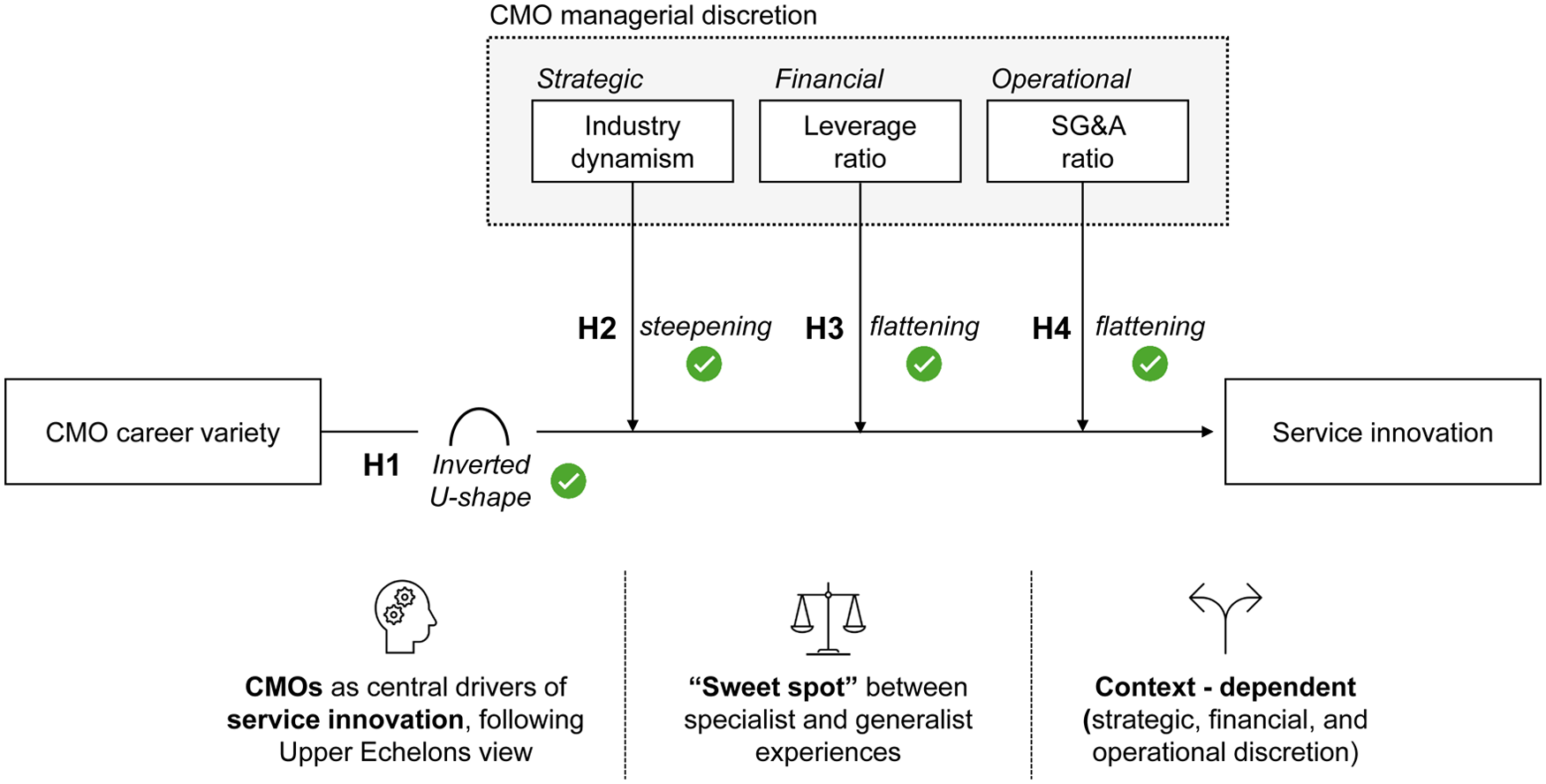
Introduction
The chief marketing officer (CMO) role is critical in guiding firms to the forefront of innovation (You et al. 2020). Bock et al. (2015, p. 1) characterize CMOs as “the nexus of market knowledge and innovation output,” with initial evidence indicating that CMO involvement can increase innovation efforts almost twofold, highlighting the significance of this role for organizational innovation capabilities. Prior research has argued that CMOs’ critical importance stems from the idea that the successful development and release of new offerings requires comprehensive insights into customer preferences and competitor positioning, regarded as core competencies of executives with a marketing background (Boyd, Chandy, and Cunha 2010; Whitler, Krause, and Lehmann 2018).
This holds true especially in the service domain, where innovation relies uniquely on marketing expertise, for several reasons. First, given their intangible and variable nature, extensive pre-market testing of service innovations is challenging (Kuester et al. 2013). Second, the inseparability of service consumption and provision mandates a strong emphasis on customer centricity, including a profound understanding of relationship management and value co-creation to craft experiences that resonate with customers (Grinstein 2008). Notably, customer service journeys typically encompass more touchpoints than product journeys, making an integrated customer experience essential for service innovation success (Ostrom et al. 2015). Third, although product innovation is often the result of extensive research and development (R&D) in engineering departments (Sundbo 2009), service innovation commonly occurs outside these domains, with its value-creation potential hinging on managerial vision and business process integration. Fourth, service innovation is often prone to imitation and difficult to protect from competition (Gustafsson, Snyder, and Witell 2020), underscoring the importance of pursuing continuous improvements to maintain a competitive edge.
CMOs’ in-depth knowledge of customer needs and market dynamics positions them uniquely to address these challenges and craft distinct service-based value propositions (Morgan, Vorhies, and Mason 2009). Their capabilities are relevant not only for pure-play service firms but also for product manufacturers that engage in servitization, as differentiation through product innovation alone is becoming increasingly challenging (Gustafsson, Snyder, and Witell 2020). Thus, across industries, CMOs play a key organizational role, serving as the primary advocates of customer value creation through service innovation.
Despite this central role, empirical evidence on CMOs’ influence on service innovation is lacking. Research instead focuses on how chief executive officers (CEOs) affect innovation outcomes mainly in the product domain (Whitler et al. 2021), examining factors such as CEO tenure, career backgrounds, and personality traits (Cannella, Park, and Lee 2008; Li and Patel 2019). For example, several studies find that CEOs’ diverse career experiences are positively correlated with innovation and patent generation (Crossland et al. 2014; Custódio, Ferreira, and Matos 2019), although findings on their impact on commercialization success are mixed (Li and Patel 2019; Nasirov, Li, and Kor 2021). These insights underscore the significance of executive career experience in fostering innovation. Still, research has largely neglected the distinct role of CMOs in promoting innovation as well as their effect on service innovation in particular. We therefore follow recent calls to “investigate the effect of CMOs’ differential functional expertise in value creation (e.g., innovations, new product development)” (You et al. 2020, p. 1248), focusing on the service domain where their influence might be of extraordinary relevance.
To this end, we introduce the upper echelons view, which posits that the traits, experiences, and worldviews of single senior executives may shape organizational choices and outcomes (Hambrick and Mason 1984), to the service innovation literature. Specifically, we investigate whether and how CMO career variety, a central construct capturing some of these experiences, fosters service innovation, an important organizational outcome. 1 We propose that CMOs with a mix of specialist (i.e., having worked in a limited number of firms, functions, and industries) and generalist (i.e., having worked in a variety of firms, functions, and industries) experiences are likely to introduce more service innovations than those on either end of the spectrum (Wang, Saboo, and Grewal 2015; Wang et al. 2016). In other words, specialist CMOs with in-depth market knowledge and a focused set of marketing skills also tend to be more resistant to change and lack the ability to assume novel perspectives (Geletkanycz and Black 2001). These features are critical for service innovation and typical for generalists (Crossland et al. 2014). The benefits of generalist experiences, however, could be subject to diminishing returns, likely rendering diverse experiences with a lack of any specialized knowledge inferior in fostering service innovation.
The resulting inverted U-shaped relationship between CMO career variety and service innovation might, furthermore, be contingent on CMOs’ exercised managerial discretion—that is, their ability to implement decisions in three areas (Holland, Shore, and Cortina 2017; Kim et al. 2016): strategic, by setting marketing objectives that navigate customer preferences and competition (Mueller et al. 2021); financial, by steering long-term investments toward marketing projects that promise future payouts (Kim et al. 2016; You et al. 2020); and operational, by orchestrating marketing tactics and short-term resources (Bansal et al. 2016).
Our analysis covers archival data on service innovations introduced by large U.S. service and manufacturing firms listed in the Standard & Poor’s (S&P) 500 index between 2009 and 2020, comprising 1,087 firm-year observations from 209 firms. The findings show that a mix of specialist and generalist career experiences optimizes the pace of service innovation, supporting our argument for a “sweet spot.” This relationship varies with the level of discretion granted to a CMO: Specialists do better in stable industry environments that give CMOs low strategic discretion. The benefits of mixed career experiences are more pronounced in firms with low financial leeway, contradicting our theorizing, and less organizational focus on selling existing goods, in line with expectations.
Our study offers three important contributions. First, we introduce a functional top management perspective to service innovation research, with the CMO at its center. Whereas most prior work has studied the CEOs’ impact on (product) innovation, our study unpacks the peculiarities of service offerings, demonstrating the CMO’s pivotal role in shaping these. We thus join and extend the upper echelons view and service literatures by showing that the organizational impact on important service outcomes depends on the individuals occupying the managerial role at the helm. Research in the service domain has discussed several frameworks to explain innovation outcomes (e.g., dynamic capabilities, exploration versus exploitation), yet it has conceptualized service innovation as part of traditional frameworks for tangible goods (Ordanini and Parasuraman 2011). Consequently, these frameworks focus on organizational drivers of service innovation, viewing firm differences and behavior as exogenous or, at the very least, rooted in some anonymous strategic decision-making process. Instead, we focus on the single executive as a crucial driver of such firm behavior. This perspective change is important because it allows companies to make concrete hiring and career development decisions that help shape innovation strategy.
Second, instead of dichotomizing the CMO’s presence or absence in the leadership team, as previous research has done, we introduce CMO career variety to garner nuanced insights into how CMOs foster or hamper the pace of service innovation. In this way, we contribute to the specialist versus generalist debate (e.g., Nasirov, Li, and Kor 2021). Given services’ distinctive features (e.g., intangibility, inseparability), CMOs’ managerial skills are particularly important. Proposing a balanced mix of specialized and generalist experiences to be most effective in driving service innovation, this research contrasts with prior studies outside the service domain that favor either specialists (e.g., Li and Patel 2019) or generalists (e.g., Custódio, Ferreira, and Matos 2019). We thus offer new insights into executive career impacts and address gaps where (CEO) career variety effects were inconclusive.
Third, we shed light on important contingencies of the CMO–service innovation relationship, introducing the concept of managerial discretion to the domain of service innovation research. Specifically, we delineate three distinct forms of CMO discretion (i.e., strategic, financial, and operational) and analyze them through a service lens. This approach allows us to gain a more granular understanding of the circumstances under which organizational leaders effectively influence service innovation outcomes.
Related Literature
Our study joins two distinct research streams in the management and marketing literature that have recently garnered increasing interest: service innovation research (e.g., Gustafsson, Snyder, and Witell 2020), which aims to understand how services can be designed, delivered, and improved to create value for both customers and organizations, and upper echelons research on CEOs, CMOs, and top management teams (Whitler et al. 2021), which examines how senior executives influence company strategy and performance outcomes (see Table WA1 in Supplemental Web Appendix 1 for an overview of related work from both areas). Empirical studies stress several key factors that influence service innovation, including a firm’s innovation orientation, external collaborations, and information technology capabilities (Chuang and Lin 2015; Walker 2007). In addition, the structure of an organization and its culture (e.g., Kuester et al. 2013; Storey et al. 2016), effective knowledge management mechanisms (e.g., Ordanini and Parasuraman 2011), employee motivation (e.g., Cadwallader et al. 2010), and collaborative practices with customers and business partners (e.g., Cheng and Krumwiede 2012) are important antecedents of service innovation. Customer engagement, frontline staff involvement, and an innovation-supportive culture also require tailored approaches to navigate the unique challenges of service sectors (Storey et al. 2016).
Building on these insights, we introduce an upper echelons perspective to the service innovation literature, emphasizing the importance of top executives, specifically the CMO, in fostering the pace of service innovation. Prior evidence on the effects of managers’ innovation and customer orientations on firm capabilities that enable service innovation shows mixed results (Kirca, Jayachandran, and Bearden 2005). Notably, the specific role of individual executives in shaping such capabilities has not been thoroughly investigated. This omission highlights the need for further research to examine how top executives influence service innovation outcomes.
We review related work on executive influence to (1) understand what is known about executives’ roles in related contexts, (2) carve out relevant knowledge gaps, and (3) clarify our approach to integrating these insights into our examination of service innovation. Upper echelons research traditionally focuses on the role of CEOs, underscoring how their characteristics influence firm strategy and performance outcomes (You et al. 2020). In addition to CEOs, research examines the role of board members, further broadening the scope of upper echelons studies (e.g., Ferrari et al. 2022). These research foci highlight the diverse influences of high-ranking executives in various positions on firm performance, but leave gaps in understanding the impact of functional leaders other than the CEO on important outcome variables (Crossan and Apaydin 2010).
CMOs, as the highest-ranking marketing executives, bring a strategic marketing perspective to the executive suite, as they affect organizational outcomes through their roles in market identification (Kerin 2005), customer-oriented decision-making (Nath and Mahajan 2008), and stakeholder relationship management (Boyd, Chandy, and Cunha 2010). Still, empirical studies struggle to reach a consensus on CMO relevance for firm outcomes. Recent studies suggest a positive influence on firm performance (e.g., Nath and Bharadwaj 2020; You et al. 2020). However, these studies focus on the presence or absence of CMOs in top management teams (TMTs), neglecting heterogeneity in their skills and experiences.
A distinctive feature between executives in the same functional role is that of specialist versus generalist experiences. The debate on which type of experience is more favorable to firm outcomes is central to understanding executive impact. Specialists with deep domain expertise can provide cognitive depth and stability (Gounopoulos and Pham 2018; Hambrick, Geletkanycz, and Fredrickson 1993). However, their limited scope of experience can lead to incrementalism and resistance to new ideas (Piller and Antons 2015). Conversely, generalists’ broad experience may foster adaptability and innovation (Crossland et al. 2014). The concept of career variety has been studied primarily in the context of CEO careers, yielding mixed results. Custódio, Ferreira, and Matos (2019) show that generalist CEO backgrounds contribute to greater innovation; Nasirov, Li, and Kor (2021) expand on this by illustrating that CEO types vary in their effectiveness to commercialize technological inventions. Conversely, Li and Patel (2019) observe that generalist CEO experience negatively affects firm performance. Further supporting the benefits of generalist experiences, related research on the composition of executive teams suggests that diverse teams, which include members with varied career experiences, can enhance firm performance through the integration of different perspectives and expertise (Østergaard, Timmermans, and Kristinsson 2011). However, this supposedly positive impact of diversity has been critically challenged (Li and Patel 2019).
Overall, diversity in career experiences seems to foster rather than hamper innovation, although the results are still inconclusive. Insights into the specific role of CMO career variety in the context of service innovation are missing. Research demonstrates some connections between CMO attributes and innovation (e.g., Bock et al. 2015; Kashmiri and Brower 2016), yet the predominant focus is on product innovation. Meanwhile, the impact of CMO characteristics on service innovation remains unknown (Gustafsson, Snyder, and Witell 2020).
Theoretical Development
We use an upper echelons lens to develop our conceptual framework (Figure 1). Upper echelons view posits that the experiences and worldviews of executives wield significant influence on the strategic choices and performance outcomes of entire companies (Hambrick and Mason 1984). The key argument is that executives are unable to make rational decisions based on perfect information, but instead apply idiosyncratic filters to the world. Prior experiences are thus a major determinant of executives’ choices and firm outcomes as they shape the information these individuals prioritize and perceive, how they interpret it, and how they leverage it in decision-making (Hambrick and Mason 1984). In line with the upper echelons view, we propose that CMOs’ career variety critically shapes their experiences and worldviews, rendering it a potentially important determinant of how executives identify and exploit market opportunities, which are important areas of service innovation (You et al. 2020; Nath and Mahajan 2008). To summarize, we expect CMOs with a mix of specialist and generalist career experiences to have a positive impact on the number of service innovations released. Yet this impact should depend on the strategic, financial, and operational discretion of the CMO, reflected by industry dynamism, firm financial performance, and marketing spending, respectively. We detail our framework next.
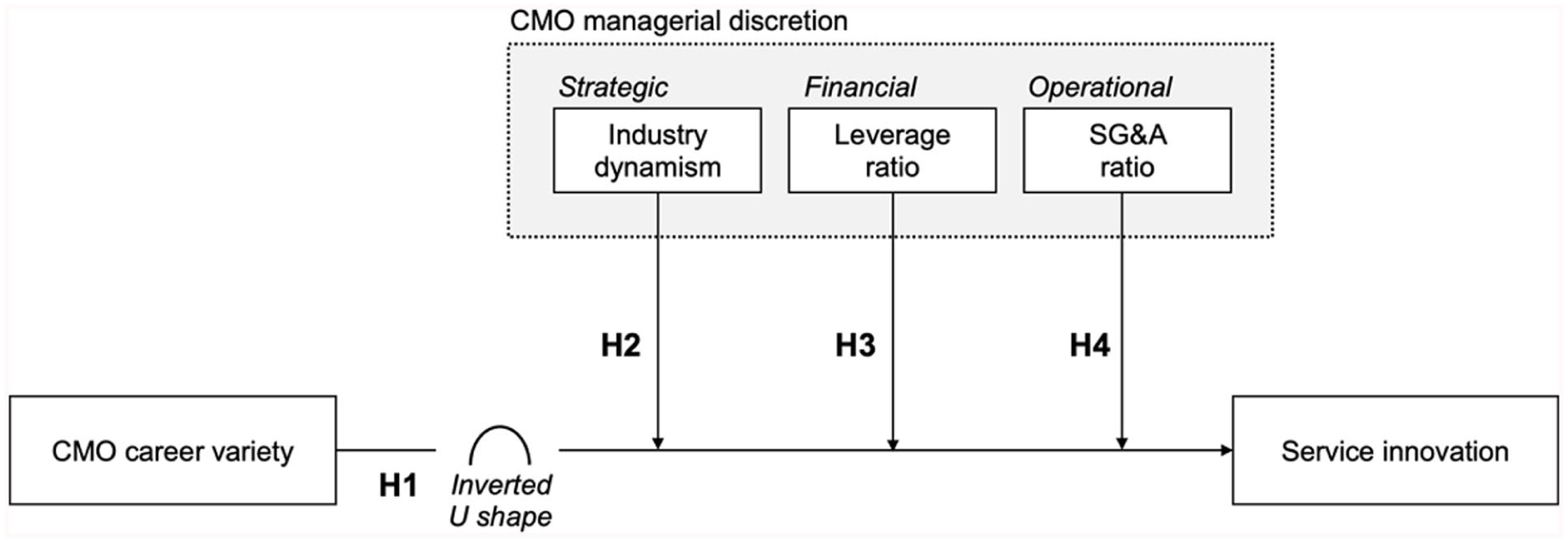
A conceptual framework linking CMO career variety to service innovation. CMO = chief marketing officer.
CMO Career Variety and Service Innovation
An executive’s career variety typically pertains to three key dimensions (Gounopoulos and Pham 2018): variety in (1) industry sectors, (2) firm affiliation, and (3) professional functions. Executives may obtain experience across these dimensions on a spectrum ranging from highly specialized (i.e., spending their entire career in a single industry, at a single firm, in the marketing function) to broadly generalized (i.e., working across different industries, firms, and organizational functions). In line with prior work (Crossland et al. 2014; Gounopoulos and Pham 2018), we combine all three dimensions to arrive at a comprehensive conceptualization of CMO career variety, allowing us to capture the different facets that an executive’s career may encompass.
Our key proposition is that specialized insights and capabilities, which are important for deep knowledge of function, firm, and industry (e.g., Boyd, Chandy, and Cunha 2010), but limit creativity and problem-solving ability, can be enriched by diverse experiences, which are important for broad knowledge across functions, firms, and industries (Chen et al. 2021). The benefits of adding diverse experiences, however, are subject to diminishing returns and likely to reverse beyond a certain point, as executives increasingly lack the benefits that specialized knowledge and skills undoubtedly provide (Boyd, Chandy, and Cunha 2010). Because time and learning capacities are finite, more generalist experience naturally diminishes the ability to gain specialized experience. We detail these mechanisms with each of our three career variety dimensions.
First, the upper echelons view states that industry-specific knowledge and capabilities are important for understanding customer needs, industry regulations, and competitive developments, all of which are critical for service innovation (De Luca and Atuahene-Gima 2007; Song, Wei, and Wang 2015). Specialists with deep sector expertise are well equipped to detect subtle market shifts and recognize unaddressed customer needs (You et al. 2020). These skills are particularly important for contested markets in which service innovation becomes integral to a firm’s competitive advantage (Cusumano, Kahl, and Suarez 2015). At the same time, highly specialized knowledge has been shown to hinder creativity and out-of-the-box thinking (Geletkanycz and Black 2001) due to executives’ limited range of solutions from other industry contexts from which to draw. Broad industry experience enhances CMOs’ problem-solving toolsets and allows them to transfer pioneering solutions to the focal market (Bunderson and Sutcliffe 2002; Calantone, Cavusgil, and Zhao 2002) or recombine aspects of solutions from different contexts to create something new (Xiao, Makhija, and Karim 2022). Services lend themselves particularly well to these innovation approaches, as similar solutions often apply to vastly different markets (Cusumano, Kahl, and Suarez 2015). For example, many service innovations have been pioneered in business-to-consumer markets (e.g., self-service, chatbots, mobile applications) before being applied in business-to-business markets. On the flip side, having acquired very broad industry experiences at the expense of specialized insights is likely to hurt service innovation, because generalist CMOs might overlook service innovation opportunities that more specialized ones would not miss. A balanced career experience allows CMOs to integrate a deep understanding of market needs and trends with cross-industry inspiration for innovative solutions.
Second, effective service innovation relies on integrating diverse organizational functions and individual perspectives to produce unified results (Grinstein 2008). Firm-specific knowledge about internal processes, people, assets, and capabilities should help navigate the innovation process and yield outcomes that align with the company’s strategic goals (Engelen, Lackhoff, and Schmidt 2013; Li and Patel 2019). CMOs not deeply rooted in the firm may be less effective in driving projects forward, potentially reducing their influence over strategic decisions (Engelen, Lackhoff, and Schmidt 2013). In contrast, CMOs with high firm specificity are at risk of becoming stuck in a rut: failing to identify opportunities for innovation or generate solutions beyond those already ingrained in firm processes. Specialized CMOs might thus forego (more radical) service innovation that lingers outside their firm’s sphere. Therefore, some variety in firm experience can help CMOs better identify existing inefficiencies and suggest “alternative strategic recipes” (Crossland et al. 2014, p. 657). Furthermore, it may increase the external validity of their ideas (Mueller et al. 2021) and earn the trust and respect of other executives (Custódio, Ferreira, and Matos 2019). These advantages should help CMOs with more varied careers identify and push through service innovations effectively, whereas limited firm-specific knowledge can hinder navigating internal processes for success.
Third, expertise often develops through prolonged exposure to a particular field (De Luca and Atuahene-Gima 2007). CMOs with more specialist functional (marketing) knowledge thus have a deeper understanding of customer preferences, competitors’ abilities to address them, and their own firms’ resources (Li and Patel 2019), which, following the upper echelons view, should positively affect their ability to generate service innovations. However, specialized CMO profiles are more constrained to a marketing lens, which sacrifice experience in other functions that could help identify service innovation opportunities across different organizational units (e.g., finance, operations). CMOs with varied functional experiences are less likely to follow existing strategic directions, allowing them to consider a broader set of options and apply more flexible decision-making (Crossland et al. 2014; Geletkanycz and Black 2001). These features should be beneficial, especially for services, given their intangible and processual nature, which increases their transferability from one functional context to another (Bunderson and Sutcliffe 2002; Calantone, Cavusgil, and Zhao 2002). Without some specialized marketing knowledge, however, generalist CMOs face difficulties in bringing together service innovation ideas with customer needs while differentiating their ideas from those of competitors, which could prevent service inventions from becoming market-ready innovations.
In conclusion, specialized and generalist experiences complement each other, with CMOs on either end of the spectrum likely underperforming their balanced peers in fostering service innovation. Some specialized experience is important to craft differentiated value propositions and navigate innovation processes within the organization, yet too much specialization hinders opportunity identification and reduces the solution space. Adding some diverse experiences brings versatile capabilities to enhance creative thinking and adaptability to novel situations, but overly generalist CMOs miss the nuances necessary to identify and exploit service innovation opportunities. CMOs with balanced experiences integrate broad strategic insights and an ability to transfer solutions from different contexts with a focused industry, firm, and functional marketing understanding (Barile, Saviano, and Simone 2015). This blend fosters innovative yet practical solutions, enhancing the pace of service innovation by reconciling the breadth and depth of knowledge.
Moderating Effects of CMO Discretion
According to the upper echelons view, CMOs can only exert strategic influence on firm outcomes if they are able to act upon their experiences and worldview in an organizational context (Finkelstein and Hambrick 1990). In other words, without managerial discretion (i.e., the autonomy awarded to a CMO in making and carrying out decisions) to realize their vision, which is a result of the career experiences they have accumulated, CMOs’ influence on firm outcomes might remain limited. Importantly, the impact of the career variety of CMOs could vary depending on their discretion. We therefore examine managerial discretion as a potential boundary condition that may strengthen or attenuate the effects of CMO career variety on service innovation. We distinguish between CMOs’ strategic, financial, and operational discretion (Kim et al. 2016), each of which is vital for service innovation (Hambrick and Finkelstein 1987).
Strategic Discretion: The Role of Industry Dynamism. Higher industry dynamism, measured as the five-year industry market share change, increases a CMO’s discretion in crafting marketing strategies that advance the firm’s value proposition because it provides the CMO with more degrees of freedom to create innovative offerings (Kim et al. 2016). Dynamic markets are characterized by changing customer preferences and rapid competitive and technological change, attracting new entrants (Henderson, Miller, and Hambrick 2006). As a result, executives’ skills and knowledge today may not be directly applicable tomorrow (March 1991), and CMOs are required to come up with novel ideas to maintain a competitive edge. Here, the influence of CMOs’ mixed career experiences should become most pronounced, as they encounter a high degree of freedom to realize service innovation ideas, which should spur the innovative drive that CMOs exert on their companies. For example, shifts in customer preferences and technological advances, including mobile self-service applications or artificial intelligence (AI)-driven personalization tools, create new opportunities for service innovation. CMOs can leverage these technologies to launch innovative initiatives such as new digital platforms and service delivery models (Gustafsson, Snyder, and Witell 2020).
This situation starkly contrasts that of stable industries, where future developments are fairly predictable and fewer emerging opportunities confine CMOs to pursuing incremental service improvements (Nath and Bharadwaj 2020). Thus, the advantages of a varied career for propelling service innovation should become less salient.
Notwithstanding this general shift, we also expect the high (low) strategic discretion present in dynamic (stable) industries to favor generalist (specialist) career experiences because generalists should be better able to exploit the additional degrees of freedom dynamic environments offer. Specifically, in-depth industry knowledge and skills, specialists’ main advantage (Malhotra and Harrison 2022), quickly become obsolete in dynamic industries. Instead, CMOs need to constantly adapt to new market realities, which generalists are better equipped to do through their diverse set of managerial experiences. Generalists possess the ability to formulate a range of different perspectives and thus achieve superior performance in creative tasks (e.g., Geletkanycz and Black 2001), which becomes all the more important, the more uncertain future developments are. Furthermore, they are less susceptible to strategic inertia and more open to deviating from the company’s current course (Crossland et al. 2014). Specialist CMOs, in contrast, should do well in stable environments, in which their focused experience gives them an advantage in detecting subtle shifts in market needs and competitor positioning as well as in implementing incremental adjustments to marketing strategies to address these shifts (Malhotra and Harrison 2022; Nath and Bharadwaj 2020).
Financial Discretion: The Role of Capital Leverage. A CMO’s discretion to direct investments toward long-term, value-enhancing service innovations depends on the firm’s leverage ratio (i.e., total debt to total assets). High leverage often entails tighter budget constraints and reduced risk tolerance, limiting the CMO’s ability to allocate resources to ambitious or untested service innovation projects, such as adopting new technologies to automate customer service or increase personalization. Hence, in highly leveraged firms, all CMOs, regardless of whether they are generalist or specialist, face greater obstacles when attempting to promote new services, limiting them to more incremental improvements rather than ambitious service innovations.
However, even within these constraints, CMOs with broad career backgrounds retain a relative advantage over their specialist counterparts. Past research suggests that individuals with diverse experiences can draw on multiple frames of reference and a wider range of solutions (Taylor and Greve 2006), enabling them to adapt quickly to budgetary constraints. These generalist CMOs can explore alternative, less capital-intensive avenues for growth and creatively repurpose existing assets, practices that reduce the need for large financial commitments (Karaevli and Hall 2006; Zhu, Jia, and Li 2022). Their broader skill sets also facilitate better risk management, as they are used to assessing multiple types of challenges and constraints (Mueller et al. 2021). Accordingly, although higher leverage ratios limit the overall level of service innovation, a generalist’s capacity for resource allocation and cross-functional integration can help sustain service innovation under these conditions.
Operational Discretion: The Role of SG&A Expenses. A CMO’s operational discretion to foster service innovation depends on the firm’s focus on selling existing products and services vis-à-vis prioritizing business development. SG&A expenses (e.g., office payroll, travel costs, salespeople salaries) represent budget allocation decisions that, by and large, favor the former, as they do not pertain to developing specific products or services (Nath and Bharadwaj 2020). Research on the alignment between SG&A and marketing concepts finds that SG&A expenses are a valid measure of a firm’s intensity of sales efforts (Ptok, Jindal, and Reinartz 2018). Thus, a high SG&A ratio (SG&A expenses relative to firm assets) indicates a focus on selling existing products and services, constraining CMOs’ operational discretion to foster service innovation. For example, CMOs must navigate extensive hurdles, such as multiple signoffs, legal reviews, and TMT committee presentations, to explore new ways of interacting with customers and introduce service innovations (Kim et al. 2016). Conversely, CMOs with high operational discretion (i.e., low SG&A ratio) have broader autonomy, requiring minimal internal approval and encountering fewer bureaucratic hurdles to realize service innovation.
Analogous to the former cases, decreased CMO discretion should give rise to two effects: (a) a reduction in the overall importance of CMO career variety and (b) an advantage of more generalist CMOs. Because operational resources are allocated to sell existing products and services when SG&A expenses are relatively high, both specialists and generalists have fewer means to create innovative services. Thus, moving from a specialized to a more balanced career should be less consequential than in the case of low SG&A expenses, when CMOs can pursue their ideas more freely and with fewer organizational hurdles. However, generalist CMOs should be more creative when ideating innovative services on a tighter budget due to their diverse experiences in other industries and their tendency toward out-of-the-box approaches (Geletkanycz and Black 2001). Furthermore, as noted, they are less inclined to rely on existing company strategies (Hambrick, Geletkanycz, and Fredrickson 1993).
Methodology
Sample
To test our hypotheses, we assembled a panel dataset that combines information on service innovation, TMT characteristics, and firm financials. We followed prior research and manually gathered company press announcements from Business Wire and PR Newswire via LexisNexis (Kashmiri, Nicol, and Arora 2017; Mudambi and Swift 2014). To achieve maximum accuracy and consistency, we developed a standardized search string to identify relevant press announcements. Subsequently, a team of three researchers evaluated the identified press releases, assessing whether a release announced a service that was new to the firm. We also cross-validated the results with announcements on company websites.
We sourced TMT characteristics from companies’ Form 10-Ks and complemented them with publicly available information from sources such as Bloomberg biographies, company websites, and executives’ LinkedIn profiles. Our definition of TMT follows Nath and Bharadwaj’s (2020) recommendation and accounts for all executive officers listed in a company’s Form 10-K. Although this approach involves more extensive data collection than other TMT operationalizations, it provides significant advantages, including greater comprehensiveness and objectivity (Nath and Bharadwaj 2020). Finally, we obtained firms’ financial data from Compustat North America.
Our sample comprises U.S. service (Standard Industrial Classification [SIC] codes between 7000 and 8999) and manufacturing (SIC codes between 2000 and 3999) firms listed in the S&P 500 index between 2009 and 2020. We focus on service and manufacturing firms that introduced service innovations during this time frame to ensure that firms had managerial control over service design and to enhance comparability across announcements (Bendig et al. 2020). This emphasis also links our study to prior innovation research (e.g., Mudambi and Swift 2014; Noordhoff et al. 2011), facilitating the contextualization and integration of findings on the increasing degree of servitization. The focus on large U.S. firms ensures sufficient data availability, especially new service announcements, given the relatively extensive media coverage these firms receive. After merging the individual datasets and eliminating observations with missing data, we arrived at a sample of 1,087 firm-year observations from 209 firms.
Measures
Dependent Variable
Extant innovation research offers a broad range of measures that investigate either innovation inputs, such as R&D spending and patents, or innovation outputs, such as new product and service introductions (Rubera and Kirca 2012). Importantly, innovation inputs do not always translate into actual new offerings and thus are less suitable for capturing the revenue-generating potential of innovation activities. Only by converting innovation inputs into commercially meaningful offerings can firms achieve sustained market success (Hauser, Tellis, and Griffin 2006; Tellis, Prabhu, and Chandy 2009). Unlike prior research emphasizing primarily physical products from manufacturing firms (e.g., Artz et al. 2010; Bendig et al. 2023; Bendig et al. 2024), we focus on new service announcements as an output measure for service innovation. We follow previous research to capture these data and collect press releases announcing new service introductions (Chandy and Tellis 2000; Kashmiri, Nicol, and Arora 2017; Mudambi and Swift 2014). We gathered these releases via LexisNexis using a standardized search string and then manually screened them to ensure that they announced a new service to the firm. We conducted a binary coding process by assessing whether each announcement represented an innovation (“new to the firm”) and then categorizing it as a service innovation. A team of trained researchers triple-coded every announcement to ensure an accurate and consistent classification of whether a new service was mentioned and if it was new to the firm. Announcements were classified only if all raters agreed on both (1) that it was new to the firm and (2) the service categorization. Accordingly, our dependent variable, service innovation, captures the number of new services a firm introduces in a given year.
Independent Variable. Our independent variable, CMO career variety, comes from Crossland et al. (2014) and is defined as

Each sum is captured for the time before the CMO appointment, indicating the career variety of CMO j at time t. To identify CMOs, we label executives as CMOs if their title includes the term “marketing” or, in select instances, related keywords such as “customer” or “brand” (Nath and Mahajan 2008). We classify industry-sector experience by the SIC codes of the firms for which a CMO has worked (at the SIC division level, distinguishing 10 industry sectors). In determining functional experience, we distinguish among eight functional areas: production/operations, R&D/engineering, accounting/finance, management/administration, marketing/sales, law, personnel/labor relations, and others (Cannella, Park, and Lee 2008). As in the original measure, we count experience in any functional area only once, so that moving back and forth between two functional areas does not inflate the functional variety score.
The index provides a quantitative measure of the diversity of a CMO’s career experiences, with lower scores indicating more specialized career experiences and higher scores reflecting more generalist experiences. This scaling provides a quantitative measure of the degree to which an entity focuses on a narrow versus a broad range of functions or activities. Specialists excel in a specific domain, whereas generalists demonstrate versatility across a wider spectrum.
Moderating Variables
To measure CMOs’ strategic discretion, we adopt the index of dynamic industry concentration introduced by Grossack (1965). We regressed the terminal-year market shares (Yi) of all firms in a given four-digit SIC industry (k) on their market shares 5 years earlier (Xi) (Keats and Hitt 1988). With xi and yi being the deviations in firm market share from their respective means, the resulting regression coefficient is

The variable captures structural changes at the industry level that results from incumbents gaining or losing market share, either to new entrants or to each other. To ease interpretation, we multiply the regression coefficient by a negative one (Heeley, King, and Covin 2006). Consequently, higher values reflect increasing strategic discretion.
We operationalize CMOs’ financial discretion using the leverage ratio, defined as the ratio of total debts to total assets (following Deb, David, and O’Brien 2017), reflecting the financial resources that can be taken from the firm to finance investments and thus promote service innovation. A higher leverage ratio reflects lower financial discretion. We dropped cases whose debts were larger than their assets to rule out bias from highly indebted firms (Alti 2006):

Finally, we define CMOs’ operational discretion as the SG&A expenses divided by total assets (following Nath and Bharadwaj 2020). A higher SG&A ratio indicates lower operational discretion.

Control Variables
We control for a set of firm-, TMT-, and industry-level factors previously linked to innovation outcomes or firm performance in general. At the firm level, we control for firm total assets as a measure of firm size, a moderating factor influencing firms’ ability to benefit from innovation (Rubera and Kirca 2012). Moreover, we control for firm inventory slack, or firms’ potential to adapt to dynamic markets (Kovach et al. 2015). We also include firm cost leadership strategy to control for the strategic counterpart of a differentiation strategy and a resulting focus on operational efficiency (Homburg et al. 2017). In addition, we control for firm market share to account for potentially deviating innovation incentives for more dominating incumbents (Blundell, Griffith, and van Reenen 1999). Firm sales growth, measured as the one-year lagged average change in sales in the last 2 years, indicates whether a firm is currently pursuing a growth strategy and thus captures a higher-level dimension of firm strategy (Cannella, Jones, and Withers 2015). R&D intensity, defined as R&D expenses in relation to sales, reflects a firm’s investment in R&D as a precursor to service innovation, with missing values for R&D expenses replaced by zeros (Kim and Bettis 2014).
At the TMT level, we control for CEO age, CEO gender, CEO role tenure, and CEO marketing experience (marketing CEO), all of which are linked to firm innovativeness (Custódio, Ferreira, and Matos 2019; You et al. 2020). We control for CMO age, as it directly affects a CMO’s ability to attain (varied) career experience, and marketing CMO, as CMOs with less marketing experience likely possess fewer specialist skills regardless of their career variety (Srinivasan and Ramani 2019). We include CMO gender to account for differences in innovation-related risk aversion (Varma, Bommaraju, and Singh 2023). Finally, we control for a CMO outsider status as it may affect CMOs’ ability to initiate and implement change (Zhang and Rajagopalan 2010), their embeddedness in the TMT, and their overall person–firm match (Nath and Mahajan 2017). For the remaining TMT members, we control for TMT size because it may affect CMOs’ power relative to other executives and, thus, their influence on innovation outcomes (Nath and Mahajan 2011). We also consider the proportion of other TMT members with marketing experience (TMT marketing share) to unpack the extent of marketing-centric TMT environments (Nath and Mahajan 2017). In addition, as TMT members’ educational levels might influence firm innovativeness, we incorporate TMT education into our regression models, quantified on a scale from 1 (no degree) to 6 (professor). Finally, according to Nath and Bharadwaj (2020), the presence of other C-level executives may affect the influence of CMOs on service innovation. Therefore, we include dummy variables to account for the presence of a chief strategy officer (CSTO), a chief supply chain officer (CSUPO), a chief technology officer (CTO), and a chief operating officer (COO) as additional controls in our model.
At the industry level, we control for industry market turbulence as an indicator of the volatility of customer demands and preferences that affect the relevance of marketing-related capabilities (Chung, Low, and Rust 2023). Table 1 presents a summary of all variables included in the study.
Variable Definitions.
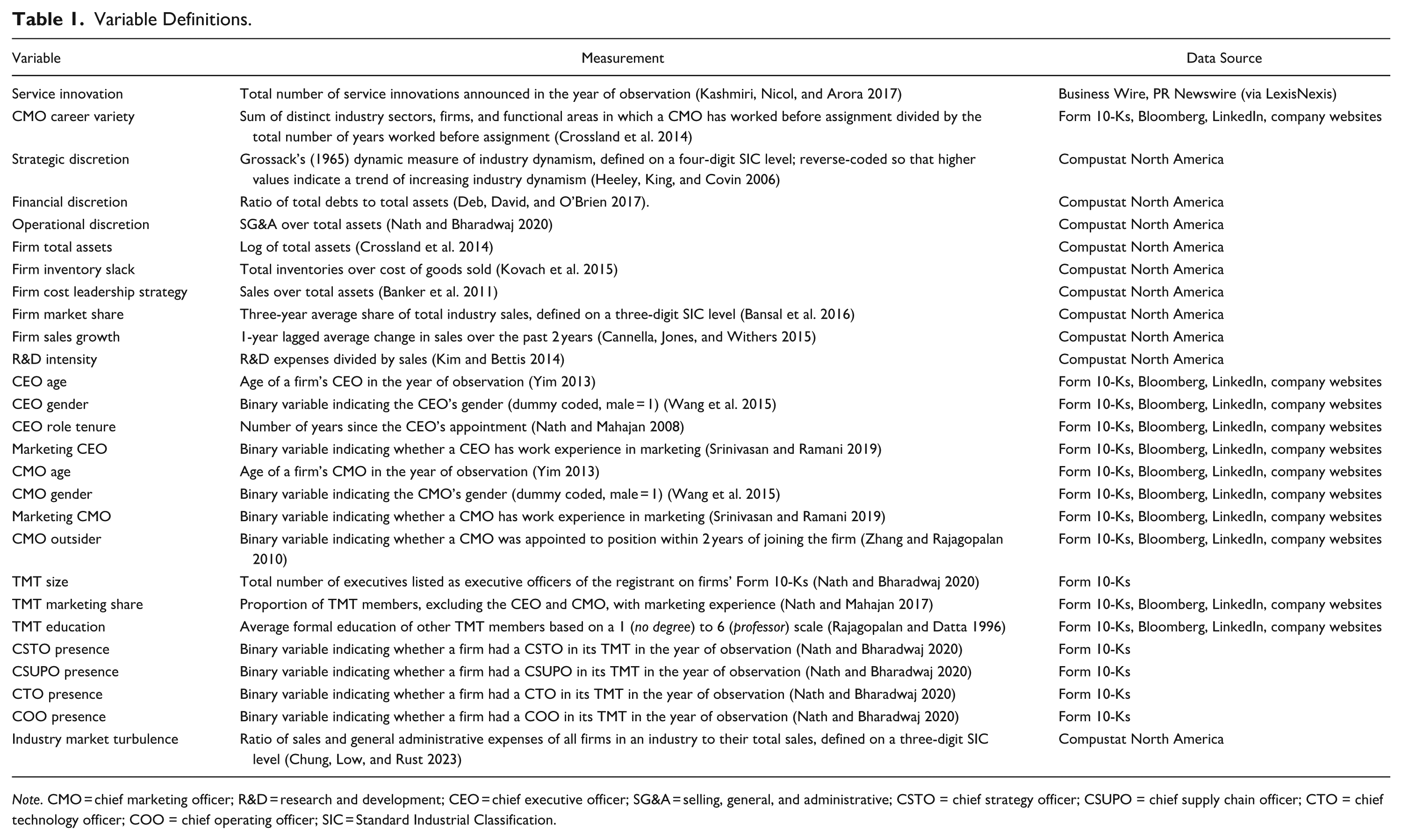
Note. CMO = chief marketing officer; R&D = research and development; CEO = chief executive officer; SG&A = selling, general, and administrative; CSTO = chief strategy officer; CSUPO = chief supply chain officer; CTO = chief technology officer; COO = chief operating officer; SIC = Standard Industrial Classification.
Model
We use a generalized estimating equation (GEE) model to analyze our hypotheses, accounting for the unbalanced panel data and addressing the nonindependence of observations along with the count nature of our data. GEE regression offers three main advantages in our research context (Heyden, Reimer, and van Doorn 2017). First, it ensures the precision and interpretability of estimates even when the response variable diverges from a normal distribution. This divergence is likely the case for our dependent variable, service innovation, which is of a count nature with a significant number of zeros. Second, it accommodates serial correlation of responses, which are frequently encountered in panel data with repeated measurements. Third, by design, it estimates population-averaged coefficients. As our interest lies in gauging the average effect of CMO career variety among a cohort of firms (rather than a particular firm), GEE regression is more pertinent than alternative approaches, such as generalized linear mixed models.
Following related studies (e.g., Rubera and Kirca 2017; Srinivasan, Wuyts, and Mallapragada 2018), we assume that our dependent variable, service innovation, is overdispersed—that is, it has a conditional mean surpassing the conditional variance. Following Cameron and Trivedi (2005), we find that our dependent variable is significantly overdispersed (p < .01) (Fávero et al. 2020). Consequently, we apply a negative binomial distribution, most suitable for modeling overdispersed count data (Hausman, Hall, and Griliches 1984).
We use the quasi-likelihood under the independence model criterion for GEE model selection. Our data best fit a model with a log link function and an exchangeable correlation structure (Cui 2007). We also employ robust standard errors to accommodate heteroskedasticity. In addition, we add year fixed effects to capture time-variant unobserved shocks (Papies, Ebbes, and van Heerde 2017). Finally, we winsorize all continuous variables at the 1st and 99th percentiles to adjust for outliers (Nath and Mahajan 2017) and lag all independent, moderator, and control variables by one year to alleviate concerns of reverse causality (Menz and Scheef 2014). We further address possible bias from sample selection by using Heckman’s (1979) two-stage method as well as simultaneity bias with a two-stage least-squares instrumental variable approach. Supplemental Web Appendix 2 includes detailed descriptions of potential endogeneity issues and our empirical approaches to mitigate them.
Results
We present descriptive statistics and pairwise correlations for all variables in Supplemental Web Appendix 3. Results of our main analyses are in Table 2. Model 1 is controls-only, while Models 2 and 3 investigate the main effect of CMO career variety, not including any moderating variables. Models 4, 5, and 6 introduce the respective moderators and interaction terms for industry dynamism, leverage ratio, and SG&A ratio, reflecting strategic, financial, and operational discretion. Finally, Model 7 is the full model, including all interactions. Supplemental Web Appendix 4 supplements these results by showing additional robustness checks.
Results From the GEE Models With Service Innovation as the Dependent Variable.
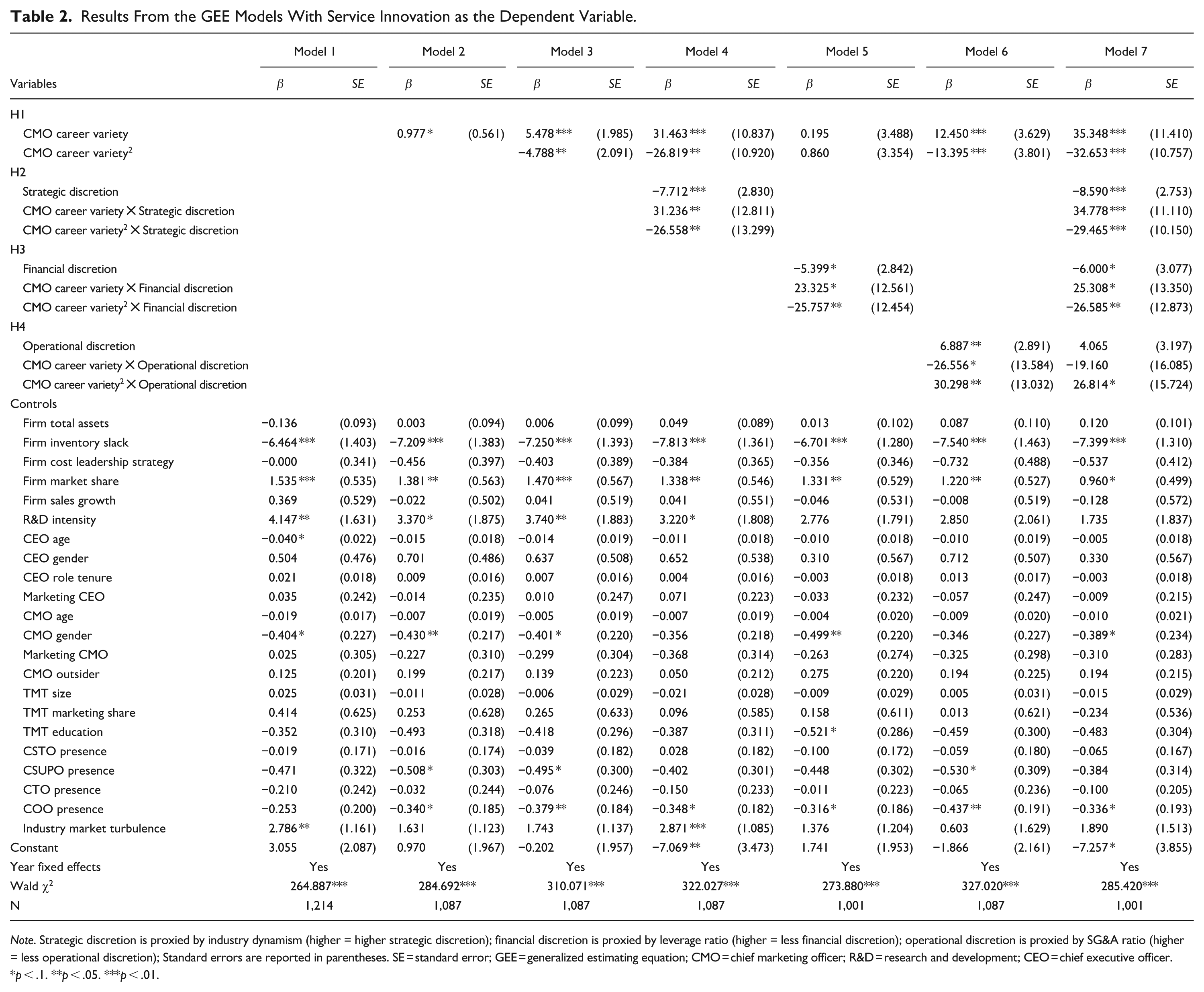
Note. Strategic discretion is proxied by industry dynamism (higher = higher strategic discretion); financial discretion is proxied by leverage ratio (higher = less financial discretion); operational discretion is proxied by SG&A ratio (higher = less operational discretion); Standard errors are reported in parentheses. SE = standard error; GEE = generalized estimating equation; CMO = chief marketing officer; R&D = research and development; CEO = chief executive officer.
p < .1. **p < .05. ***p < .01.
In H1, we predicted an inverted U-shaped relationship between CMO career variety and service innovation. We find initial support for our reasoning, with a statistically significant, positive linear term of CMO career variety (Model 3: β = 5.478, p < .01) and a statistically significant, negative squared term of CMO career variety (Model 3: β = −4.788, p < .05). Although these results indicate an inverted U shape, additional tests are necessary for a conclusive statement: (1) The slope at the lower bound must be positive and significant, (2) the slope at the upper bound must be negative and significant, and (3) the turning point as well as (4) the 95% confidence interval must fall within the data range (Haans, Pieters, and He 2016; Lind and Mehlum 2010). As detailed in Table WA6 in Supplemental Web Appendix 5, the model meets the requirements, confirming an inverted U shape in support of H1. Moreover, by incorporating a cubic term, we examine the presence of higher-order exponential terms, such as an S-shaped link (Haans, Pieters, and He 2016). The statistical nonsignificance of this term suggests that the relationship is more likely to be inverted U-shaped rather than S-shaped. Figure 2 plots the inverted U shape.
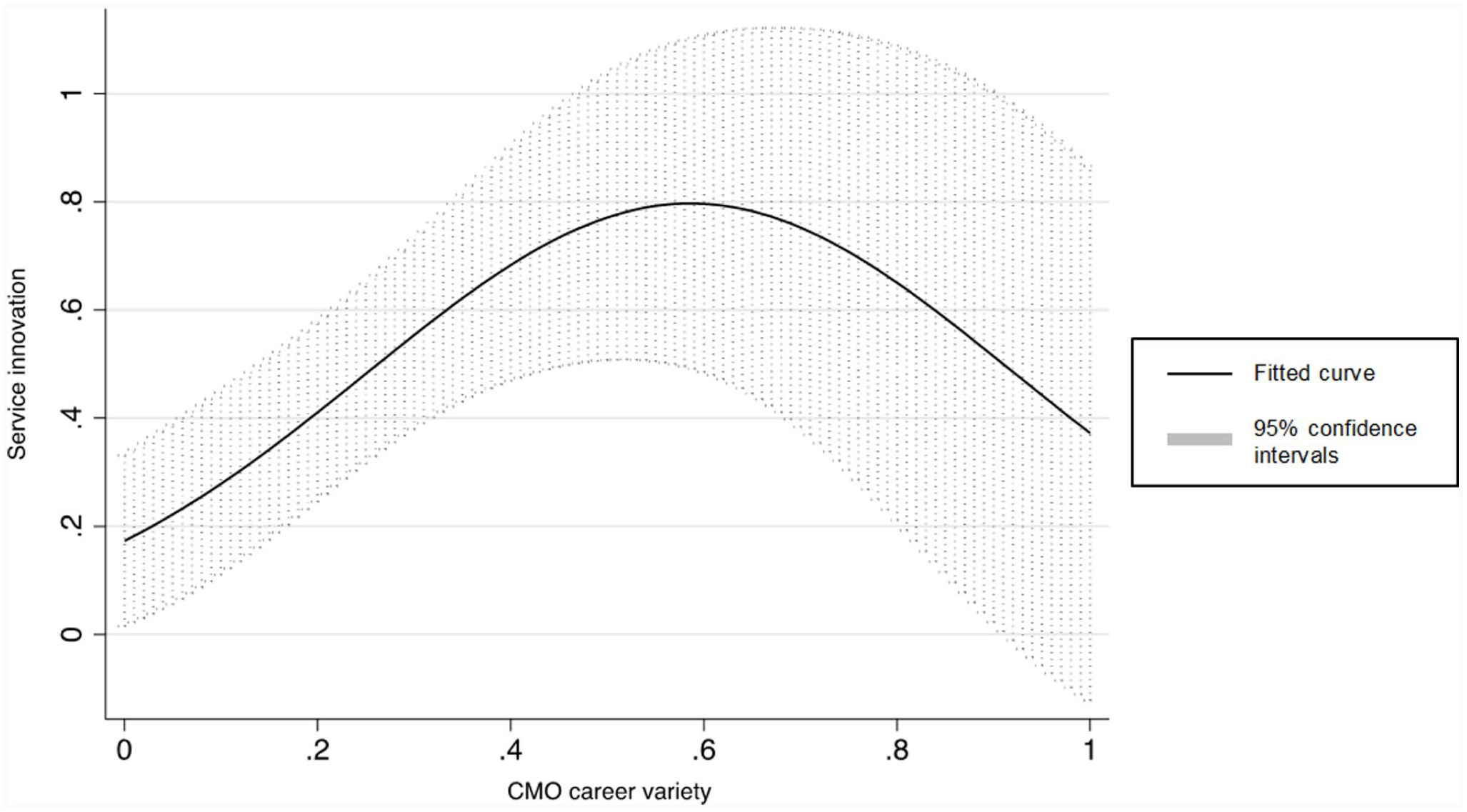
Plot of the relationship between CMO career variety and service innovation.
We also hypothesized that lower strategic discretion weakens the inverted U-shaped relationship between CMO career variety and service innovation (H2a) and that specialist (generalist) career experience has a stronger impact on service innovation in situations with lower (higher) strategic discretion (H2b). The results from Model 4 in Table 2 provide support for H2a, but only partially support H2b. Specifically, we find a significant, positive interaction between the linear term of CMO career variety and strategic discretion (Model 4: β = 31.236, p < .05), revealing a possible shift in the turning point and a significantly negative interaction with the squared term of CMO career variety (Model 4: β = −26.558, p < .05). Figure 3(a) shows that specialist CMOs are indeed more likely to introduce service innovations in low-strategic discretion environments; however, we find no empirical evidence of a pronounced disposition of generalist CMOs in highly strategic discretion environments, leading us to only partially accept H2b.
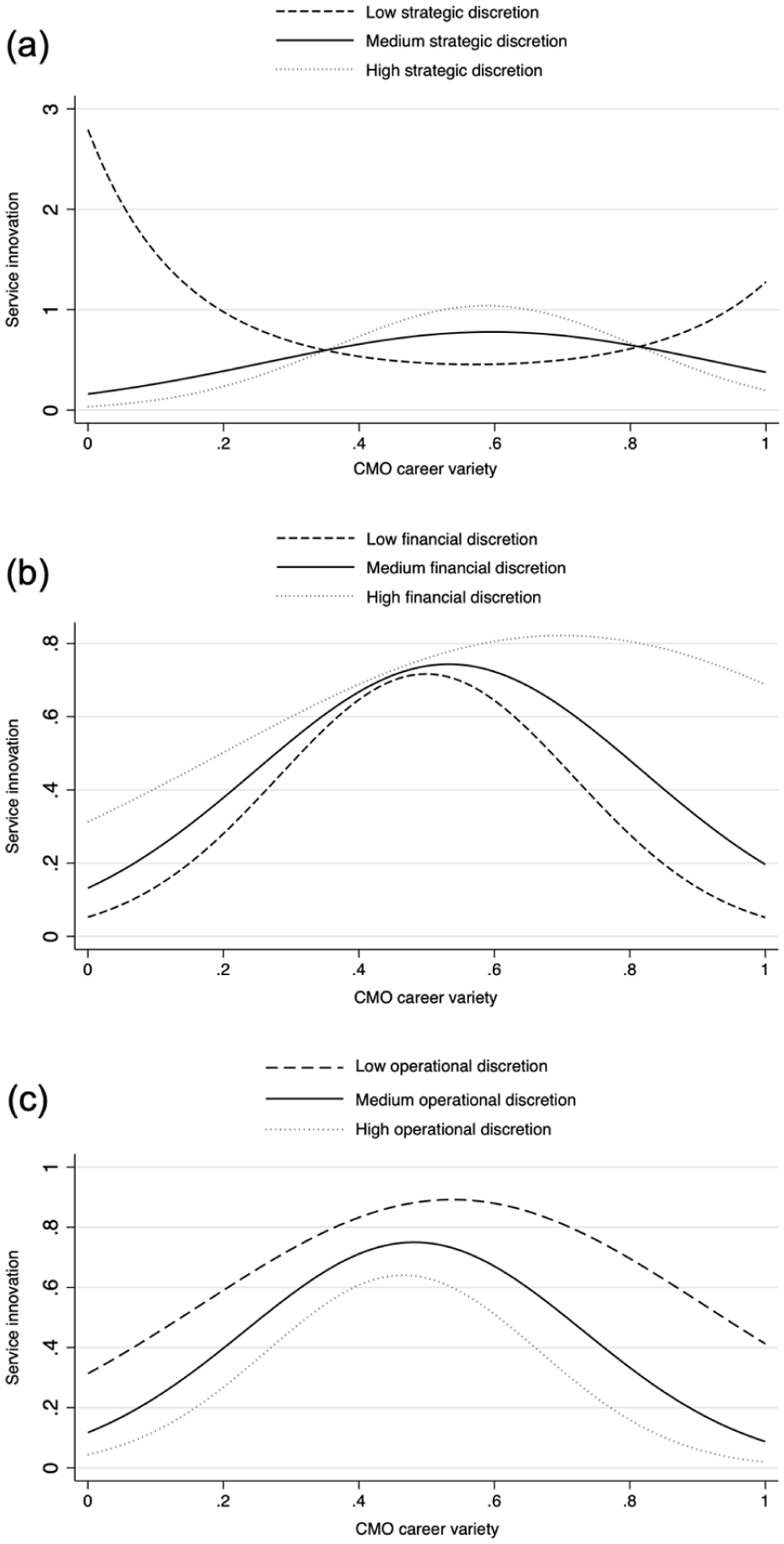
Relationship of CMO career variety and service innovation: interaction effects. Interaction effects of (a) strategic (b) financial (c) operational discretion.Note. Graphs are plotted at ±1 SD from the mean. “High” corresponds to mean + 1 SD for (a) strategic discretion and mean – 1 SD for (b) financial and (c) operational discretion.
We hypothesized that lower financial discretion weakens the inverted U-shaped relationship between CMO career variety and service innovation (H3a) and that generalist career experience has a stronger impact on service innovation in situations with lower financial discretion (H3b). The results from Model 5 in Table 2 lead us to reject H3a and H3b. We observe a (marginally) significant and positive interaction between the linear term of CMO career variety and financial discretion (Model 5: β = 23.325, p < .1) as well as a statistically significant negative interaction with the squared term of CMO career variety (Model 5: β = −25.757, p < .05). These results indicate, contrary to H3a, that higher financial discretion flattens the inverted U-shape (Haans, Pieters, and He 2016), and suggest a possible shift in its turning point. To further examine this shift, we computed the derivatives of the turning point for the relative financial discretion at various moderator levels. Despite a clear tendency toward more generalist CMOs at higher values of financial discretion, our findings do not reveal a statistically significant shift in the turning point, leading us to reject H3b. Figure 3(b) graphically illustrates the effects, showing both a flattening at high financial discretion and a rightward movement of the turning point; however, the rightward shift is not statistically substantiated. 2
For our last hypothesis, we suggested that lower operational discretion weakens the inverted U-shaped relationship between CMO career variety and service innovation (H4a) and that generalist career experience has a stronger impact on service innovation in situations with lower operational discretion (H4b). The results from Model 6 in Table 2 provide support for H4a, but not for H4b. Our models show a marginally significant and negative linear (Model 6: β = −26.556, p < .1) and a statistically significant positive quadratic (Model 6: β = 30.298, p < .05) interaction term. Thus, we again observe a flattening of the inverted U-shaped pattern, thereby supporting H4a. Figure 3(c) depicts the flattening and rightward shift in the curve; however, despite the visual indication, calculating the curve’s derivatives provides no statistical evidence for the rightward shift of the curve, leading us to reject H4b.
Overall, we identify a “sweet spot” for the role of CMO career variety in service innovation, with a mix of experiences performing best. Specialist CMOs perform better under conditions of limited strategic discretion. However, the tendency for generalist CMOs to be more innovative when financial discretion is restricted was not statistically significant. In general, constraints in CMOs’ strategic and operational discretion make their career variety less important for service innovation; by contrast, greater financial discretion attenuates the effect.
Discussion
Despite the growing recognition of CMOs’ positive contribution, whether CMOs matter for service innovation and, if so, which CMOs are most likely to succeed remains to be determined. This study addresses this gap by examining the effects of CMO career variety on service innovation. Our findings show that a CMO’s career experience significantly affects the number of service innovations a firm introduces to the marketplace. We find consistent support for our argument that firms benefit from a mix of specialist and generalist careers. Importantly, this effect varies depending on the discretion granted to the CMO. In environments where CMOs’ strategic discretion is limited (i.e., those with low industry dynamism), specialist skills benefit service innovation, enabling CMOs to better detect and act on subtle shifts in market needs and competitor positioning (Malhotra and Harrison 2022). With increasing strategic discretion, adding some generalist experiences becomes favorable, up to an inflection point. For limited financial and operational discretion, the results are nuanced.
We find that CMO career variety is less important (reflected by a flattening of the inverted U-shaped curve) when they have more financial leeway, rejecting our original argument. One explanation for this result could be that in situations with more financial discretion, CMOs can finance a broad range of service innovation projects without the need to allocate resources to the high-conviction projects only. The innovation skills that come with a varied career experience could, therefore, be less important. Conversely, a broad range of experience paired with specific market knowledge seems to be beneficial when looking for ways to use more limited financial resources and direct them toward a few meaningful service innovation projects only (cf. Karaevli and Hall 2006; Zhu, Jia, and Li 2022). Put simply: Anybody can innovate with lots of money, but only few can do it with little.
On the other hand, higher operational discretion, that is, less focus on selling existing products, strengthens the inverted U-shaped effect of varied career experience, in line with our reasoning that CMOs can exercise their innovation potential more freely when organizational support is strong. It is then that varied careers really shine. By contrast, when selling existing services is the priority, being a specialist or generalist matters less for service innovation.
Theoretical Implications
Our study adds to the service innovation and upper echelons literatures. First, we uncover a nonlinear effect of CMO career variety on service innovation, which further hinges on different types of managerial discretion as important contingencies. This outcome reveals the complexity of the relationship between the executive role and innovation outcomes. Simply extrapolating relationships observed in one context (i.e., CEOs’ impact on product innovation) to another (i.e., CMOs’ impact on service innovation) yields an incomplete picture. This risk is partly rooted in the intangible nature of service innovation, which uniquely relies on the deep integration of customer touchpoints (Kuester et al. 2013) and whose ideation and implementation processes contrast starkly with the engineering-driven processes that characterize product innovation (Sundbo 2009). Our findings generally reinforce the upper echelons’ view assumption that executives affect organizational outcomes, but add nuance in the service context by demonstrating the emergence of a “sweet spot” between specialist and generalist experiences. This finding contrasts with the results of studies examining CEOs in nonservice contexts (e.g., Crossland et al. 2014; Custódio, Ferreira, and Matos 2019). It also provides support for recent arguments from knowledge management research in favor of so-called “T-shaped” innovators who are “endowed with both ‘vertical’ competencies in specific disciplines/systems, and ‘horizontal’ capabilities to deal with different problematic contexts effectively addressing change” (Barile, Saviano, and Simone 2015, p. 1178).
Second, we advance the specialist–generalist debate (e.g., Li and Patel 2019; Nasirov, Li, and Kor 2021) by introducing CMO career variety as a key predictor of service innovation outcomes (Whitler et al. 2021). Services’ distinctive features (e.g., intangibility, inseparability) increase the importance of CMOs’ managerial breadth, making their career backgrounds especially critical in ways distinct from product-based contexts. Our findings indicate that a balanced mix of specialized and generalist experiences yields the highest level of service innovation, challenging prior “black-or-white” perspectives (e.g., Custódio, Ferreira, and Matos 2019; Li and Patel 2019). Importantly, we introduce a threshold perspective by examining nonlinear effects, which confirm an inverted U-shaped relationship with service innovation. Whereas moderate levels of generalist and specialist experience boost service innovation, exceeding a threshold in either direction diminishes it. This finding reconciles the specialist–generalist debate, underscoring a more integrative rather than strictly one-sided approach.
Third, our study underscores the importance of incorporating managerial discretion into the context of service innovation research, a domain in which this concept has been notably underexplored. Our distinction between strategic, financial, and operational discretion allows for a fine-grained understanding of the varying influence of organizational leaders on service outcomes under environmental and firm-specific constraints (Hauser, Tellis, and Griffin 2006; Nath and Bharadwaj 2020). Furthermore, this approach suggests mechanisms through which different types of managerial discretion can affect service innovation processes, which scholars should consider when examining the role of firm executives.
Finally, our findings also allude to several theoretical lenses put forth in the service innovation literature. For one, they add nuance to the predictions of dynamic capabilities theory (Teece 2007) by implying that a CMO’s career portfolio can help enhance an organization’s ability to sense, seize, and transform offerings marked by intangibility and inseparability. Especially in dynamic markets, CMOs with diverse experiences can substantially contribute to their firms’ dynamic capabilities, which are crucial to rapidly adapting to changing competitive environments (Nath and Mahajan 2011). The results also link to the exploration versus exploitation framework (March 1991), indicating that a CMO’s career variety influences a firm’s capacity to prioritize one or the other. On average, a mix of specialized and generalist experiences seems to provide an optimal setup for exploration to flourish, sparking new service concepts or radical process change (Calantone, Cavusgil, and Zhao 2002), while a higher focus on exploitation emerges around the edges. Moreover, our findings can also be interpreted through the lens of absorptive capacity theory (Cohen and Levinthal 1990; Zahra and George 2002). CMOs with a balanced mix of experiences might be better able to combine external knowledge with internal, firm-specific expertise, which benefits their ability to ideate and implement service innovation projects (De Luca and Atuahene-Gima 2007). Overall, the upper echelons view lens and our empirical findings align with and extend widely accepted theoretical frameworks put forth in the service innovation literature, proposing the influence and background of single executives as important drivers of organizational behavior and outcomes.
Managerial Implications
Our study’s findings are instrumental in guiding the TMT to enhance service innovation, a key determinant of sustained organizational prosperity (Rubera and Kirca 2012). In general, our research reveals two key determinants of service innovation: the CMO’s career experience and the discretion to act on it. In other words, the optimal mix of career experiences is only a necessary condition to foster service innovation, but it does not yield the desired results if the resources and autonomy necessary to implement a managerial vision are insufficient. Thus, for firms seeking to boost service innovation, leadership needs to think through and invest in both factors jointly when hiring, training, and equipping CMOs for maximum impact.
Once TMT members realize this dependency, what can they do concretely? First, when evaluating the careers of potential CMOs during hiring and promotion decisions, they can look beyond the breadth or depth of candidates’ experiences and consider the strategic value of their combined expertise. To operationalize this, we propose that firms include a structured career variety index in their executive selection process. This index could quantify the number of distinct industries, firms, and functional areas in which a candidate has worked relative to their total career years (e.g., Crossland et al. 2014). During hiring processes, the search committees could then calculate and compare candidates’ career variety scores against a predefined optimal range based on the company’s service innovation goals and industry characteristics, following either a balanced or skewed target mix of experience. Applying this metric in succession planning may help identify candidates in the optimal range, thereby streamlining the selection process to reduce bias and enhance strategic fit.
Second, consider the case where a company’s current CMO is on the extreme ends of the specialist–generalist spectrum of career experience (i.e., the CMO has either highly specialized or broadly generalist experience). Here, firm leadership aiming to maximize service innovation outcomes has two primary options: One approach is to develop the CMO through dedicated training programs or (cross-industry) exchanges, enhancing their skills and compensating for any experience gaps. For example, to instill more generalist knowledge and skills, companies from different industries could collaborate to offer temporary “internship” programs in which CMOs learn from executives with vastly different backgrounds. The board could then either mandate or incentivize participation in rotational programs with partner firms from different sectors, ensuring that the CMO gains exposure to diverse operational contexts. To start, such exchanges could also be internal, with the CMO gaining some variety in functional expertise by working outside the marketing department. Companies could also look for external exchanges, implementing temporary rotation programs that span different industries. In these initiatives, CMOs could be assigned to projects beyond their primary scope, enabling them to gain cross-functional insights and develop a deeper understanding of different markets and industries. These programs could be particularly valuable for highly dynamic industries such as digitalization services, where generalist knowledge and skills become more important for service innovation to thrive. For maximum impact, managers can further support this by integrating these programs into the CMO’s performance evaluation, setting clear objectives for acquiring new skills (e.g., leading a cross-functional project) and tying them to career trajectories, such as by prioritizing them as part of the CMO’s quarterly management goals and periodic reviews.
The other approach is to hire or promote co-executives with complementary skills and knowledge to that of the CMO. For example, boards could revise TMT structures to explicitly create shared positions, such as appointing two co-CMOs with different backgrounds (e.g., placing a marketing specialist alongside a more generalist CMO), to achieve a balanced mix of experiences while clearly separating responsibilities to avoid overlap or conflict. For example, a board could recruit a generalist CMO with cross-industry experience to focus on strategic innovation initiatives while retaining a specialist CMO to oversee customer-centric marketing execution. This approach ensures that the organization benefits from a wide array of perspectives and expertise and that the weaknesses of one executive are compensated for by the strengths of the other, fostering firm innovativeness (Bantel and Jackson 1989).
Third, the leadership team needs to evaluate and prioritize the different dimensions of discretion available to CMOs. In times of tight budgets (i.e., low financial discretion), mixed-experience CMOs can help maintain a high pace of service innovation. Furthermore, granting CMOs with mixed-experience high operational discretion is pivotal to unlocking their full service innovation potential. Boards can operationalize this by conducting reviews of discretion or tracking metrics that capture bureaucratic hurdles (e.g., required signoffs) for new service initiatives. CEOs can support their CMOs by streamlining approval processes for service innovation initiatives, minimizing operational constraints.
Whereas financial and operational discretion are largely shaped by firm leadership, strategic discretion is shaped by industry conditions that must be monitored and addressed. In stable industries characterized by low dynamism, specialist CMOs may reach superior service innovation outcomes over generalist CMOs or even CMOs with a mix of experiences. Leadership needs to scrutinize whether this slow pace of change in their industry is permanent or fleeting and, consequently, whether a specialized CMO would be the better choice for an industry characterized by long-term stability. Periodic assessments can help ensure that the current CMO’s expertise (still) aligns with the industry’s demands, thereby maintaining effective leadership.
Fourth, when appointing and replacing a CMO, firm leadership could mitigate the prevalent issue of CMO turnover by facilitating a more aligned approach to executive selection processes (Nath and Mahajan 2017). If the requirements of the role in driving service innovation match the career experiences of appointed CMOs, it could be a win–win situation for the company and the CMO: Successful CMOs, well-matched to their roles, are likely to have greater job satisfaction (Christen, Iyer, and Soberman 2006) while also exerting a more significant, positive impact on the organization. This symbiosis fosters long-term, stable, and fruitful relationships that might drive continuous service innovation. The alignment of CMOs’ experiences with the requirements of their role is therefore crucial to optimize their sustained effectiveness in navigating their firms toward superior service innovation outcomes.
Importantly, although this study examines the role of the CMO specifically, these implications may also offer tentative insights for other top executive roles. For instance, our results appear broadly consistent with recent research suggesting that CTOs who combine deep technical expertise with cross-functional managerial experience tend to be better positioned to drive technology innovation and integrate emerging technologies into firm strategy (Gu, Wang, and Mai 2024). Likewise, this observation resonates with earlier studies into the role of CFOs, whose blend of rigorous financial acumen and strategic management skills enables them to more effectively manage risks and allocate resources to support innovation initiatives (Graham and Harvey 2001). More research is required to confirm the generalizability of our findings to other roles in the C-suite; however, it is plausible that the optimal blend of career variety might not be limited to the marketing function.
Limitations and Avenues for Future Research
Our study has several limitations that offer promising avenues for future research. A natural next step would be to examine the impact of other CMO characteristics, such as narcissism (e.g., Kashmiri, Nicol, and Arora 2017) or future focus (e.g., Yadav, Prabhu, and Chandy 2007), on service innovation to establish a more comprehensive picture of the “ideal” CMO in a service context. Considering the complex interplay between CMO traits and other organizational drivers of innovation, such as corporate culture and internal structures, could also provide important insights.
Moreover, our focus on large U.S. public firms within the manufacturing and service sectors was intended to align with existing research for better comparison. However, this focus might also limit the generalizability of our findings. Examining how CMOs’ impact varies across different industries, including private firms, small companies, or startups, could provide valuable new perspectives. In these environments, specialist knowledge may be less relevant due to lower (technical) sophistication (e.g., in retail) or a more dynamic environment (e.g., for startups). Cultural and institutional differences in international firms may also qualify the effects of career variety. Future studies could expand the scope to these contexts, including global companies and emerging markets, to determine whether and to what extent the patterns observed in large publicly traded U.S. firms are transferable. Although our study supports a balanced mix of specialist and generalist career experiences as optimal, it is plausible that the ideal “sweet spot” varies across industries (Crossland et al. 2014; Custódio et al. 2019). For example, highly regulated and knowledge-intensive industries such as pharmaceuticals, which require deep technical expertise and strict compliance with regulatory standards, may favor a more specialized CMO background, whereas dynamic sectors like software technology may benefit more from a generalist approach that enables rapid adaptation and cross-functional innovation (Li and Patel 2019).
Methodologically, future work could explore different ways to measure and operationalize key variables. For example, although we followed established approaches from prior work to operationalize our moderator variables for managerial discretion, other valid approaches may exist whose exploration could add robustness to our findings. Strategic discretion could be measured using alternative indicators of industry change or competitive volatility, financial discretion could be gauged through different accounting ratios or financial flexibility indicators, and operational discretion might consider a broader range of resource allocation metrics.
Finally, we acknowledge that relying exclusively on the number of service announcements to measure service innovation has its limitations. Although this quantitative metric captures the pace of innovation, it does not fully reflect the quality or impact of these innovations. The number of announcements does not necessarily equate to the effectiveness, profitability, or alignment of the services with customer needs and preferences. To address this weakness, future research should expand beyond mere quantity to include qualitative aspects of service innovation. This approach could involve examining how new services meet customer needs, their profitability, and their impact on customer satisfaction and retention. Incorporating qualitative metrics, such as customer feedback and service effectiveness surveys, would provide more nuanced insights into how service innovations tangibly benefit firms and their customers.
Supplemental Material
sj-pdf-1-jsr-10.1177_10946705251386793 – Supplemental material for Specialist, Generalist, or Both? How Chief Marketing Officers’ Career Experiences Shape the Pace of Service Innovation
Supplemental material, sj-pdf-1-jsr-10.1177_10946705251386793 for Specialist, Generalist, or Both? How Chief Marketing Officers’ Career Experiences Shape the Pace of Service Innovation by David Bendig, Thomas Schäper, Lucas Mantke and Nico Schauerte in Journal of Service Research
Supplemental Material
sj-pdf-2-jsr-10.1177_10946705251386793 – Supplemental material for Specialist, Generalist, or Both? How Chief Marketing Officers’ Career Experiences Shape the Pace of Service Innovation
Supplemental material, sj-pdf-2-jsr-10.1177_10946705251386793 for Specialist, Generalist, or Both? How Chief Marketing Officers’ Career Experiences Shape the Pace of Service Innovation by David Bendig, Thomas Schäper, Lucas Mantke and Nico Schauerte in Journal of Service Research
Footnotes
Declaration of Conflicting Interests
The authors declared no potential conflicts of interest with respect to the research, authorship, and/or publication of this article.
Funding
The authors received no financial support for the research, authorship, and/or publication of this article.

Supplemental Material
Supplemental material for this article is available online.
Notes
Author Biographies
References
Supplementary Material
Please find the following supplemental material available below.
For Open Access articles published under a Creative Commons License, all supplemental material carries the same license as the article it is associated with.
For non-Open Access articles published, all supplemental material carries a non-exclusive license, and permission requests for re-use of supplemental material or any part of supplemental material shall be sent directly to the copyright owner as specified in the copyright notice associated with the article.
