




Abstract
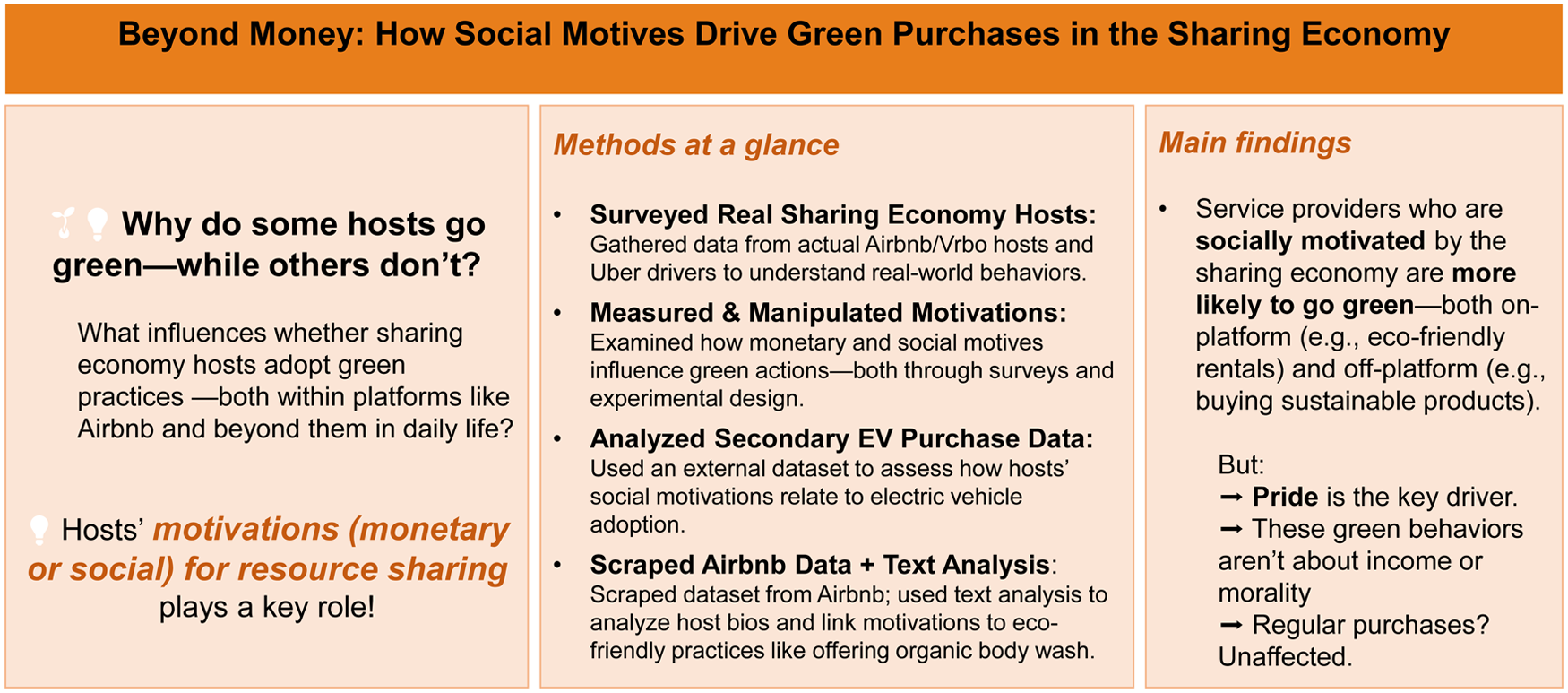
While the sharing economy has been described as a potential pathway to enhancing sustainability and reducing hyper-consumption, scholarly inquiry into this linkage remains limited. In this research, we examined whether and how service providers’ motivations (monetary and social) for resource sharing influence their green consumption both outside and on sharing platforms. We conducted a series of eight studies that involved surveys, lab experiments, and large-scale secondary datasets across various sharing economy platforms. Results showed that service providers who are strongly motivated by the sharing economy’s social benefits are more likely to engage in green consumption, reflected in purchases made outside the platform (e.g., buying green products) and on the platform (e.g., adopting eco-friendly practices). However, service providers’ motivations have no bearing on their regular (non-green) purchases. We identified sense of pride as an underlying process and ruled out household income, perceived financial resource availability, sense of morality, and environmental concerns as alternative accounts. The findings not only contribute to the literature on the sharing economy and pro-environmental behavior but also provide actionable insights for policymakers, sharing platforms, and marketers seeking to promote sustainable lifestyles and environmentally responsible practices among service providers.
Keywords
The sharing economy is transforming ecosystems, markets, and consumption patterns on a large scale (Lamberton and Rose 2012; Zervas, Proserpio, and Byers 2017) and, therefore, has garnered significant academic and industry attention (So, Oh, and Min 2018; Wirtz et al. 2019). It has also been described as a “potential pathway to sustainability” (Martin 2016, p. 149); it disrupts the unsustainable nature of hyper-consumption in capitalist economies (Botsman and Roger 2011). Airbnb (2022), in fact, has recently launched a sustainable hosting plan to promote eco-friendly practices (e.g., reducing waste and conserving energy) on its platform. The sharing economy represents a fundamental paradigm shift from traditional market models: it enables consumers to engage as demanders (e.g., booking on Airbnb) and as suppliers (e.g., hosting on Airbnb; Wirtz et al. 2019; Zervas et al. 2017). This dual-role capability differentiates the sharing economy from conventional market structures. For instance, Airbnb has more than 5 million hosts worldwide (Airbnb 2024). Regarding transportation, in the United States alone, more than 1.7 million people were registered as Uber/Lyft drivers in 2023 (Flynn 2023).
Service providers engage in the sharing economy for various reasons. Many are attracted to the financial advantages associated with providing services via sharing platforms. For example, according to an Airbnb (2023) survey, 62% of hosts appreciated the platform’s monetary benefits: they intended to use their earnings to combat the rising cost of living. A Pew survey similarly demonstrated that 29% of service providers are motivated to use sharing platforms to help fulfill basic needs (Smith 2016), suggesting that these platforms serve as a financial lifeline for many. However, the sharing economy’s allure extends beyond monetary benefits: in the same Pew survey, more than 40% of respondents said that they did not necessarily need their hosting income to live comfortably. Finances thus do not constitute the sole driver of one’s decision to participate on the supply side (Bremser and Wüst 2021; Karlsson and Dolnicar 2016). Seminal work on Airbnb hosts’ motives revealed that even though financial gains partly inspire hosts’ engagement, profit-earning potential is usually supplementary to one’s social motives for joining the sharing economy (Ikkala and Lampinen 2015). Social experience and sense of belonging significantly correlate with usage intensity as well (Hawlitschek, Teubner, and Gimpel 2016). Moreover, social interaction positively influences residents’ intentions to participate in the sharing economy as hosts (Kahraman et al. 2023). Chung et al. (2022) further suggested that service providers’ motivations subsequently affect their engagement with sharing platforms. Airbnb hosts with greater intrinsic motivations (e.g., socializing with guests) generate more customer engagement and, therefore, receive higher customer ratings than those who are extrinsically (e.g., financially) motivated. Based on these findings, our research centers on monetary and social motivations as drivers of service providers’ participation. Sustainability has been cited as a key reason for the sharing economy’s emergence (Tussyadiah 2015); however, there is scarce evidence that it serves as a major impetus for hosts. Sustainability is mainly platform-driven rather than being an intrinsic aspect of hosts’ engagement.
The current paper advances this stream of work by assessing whether and how service providers’ motivations (i.e., monetary vs. social) shape their green consumption both outside and on sharing platforms. Green consumption refers to the purchase and use of environmentally friendly products (Luchs et al. 2010). We carried out eight studies, including two secondary datasets, surveys, and lab experiments and discovered that service providers seeking social (vs. monetary) benefits from the sharing economy are more inclined to engage in green consumption; meanwhile, service providers’ motivations have no bearing on non-green purchases. We specified sense of pride as the underlying process and ruled out service providers’ household income, perceived availability of financial resources, environmental concerns, and sense of morality as alternative accounts.
We are particularly interested in green consumption, as consumers are becoming increasingly aware of the impact their purchasing decisions have on the environment, economy, and society. Furthermore, the sharing economy model came into existence partly to reduce the squandering of unused resources and prevent excessive resource utilization. Other than facilitating the reuse of resources, it is possible that the sharing economy could also benefit sustainability by influencing the spending behaviors of its service providers. With a significant number of service providers, understanding how hosts spend their hosting income, particularly on green consumption, can help both scholars and practitioners gain a more comprehensive understanding of the societal impact of the sharing economy both within and beyond the confines of the sharing economy platforms.
Theoretically, the current research contributes to the sharing economy literature (Chung et al., 2022) by identifying how service providers’ underlying motives influence their green consumption behaviors. In doing so, the findings also advance the literature on pro-environmental behavior (Rowe et al., 2019; Schneider et al., 2017; Shipley & van Riper, 2022) by demonstrating that pride derived from intrinsic motivations—such as social motives—is stronger than pride rooted in extrinsic motivations. As a result, hosts with social (vs. monetary) motives are more likely to engage in green consumption. Practically, our findings provide actionable insights for policymakers, sharing platforms, and marketers seeking to promote sustainable lifestyles and environmentally responsible practices among service providers. Specifically, our results suggest that emphasizing the social benefits of hosting can encourage service providers to adopt greener consumption behaviors both on and off the platforms.
We next review the literature on the sharing economy in relation to service providers’ motivations and their effects, as well as pride and green consumption. We then present the results of eight studies in which we empirically tested the predicted effects and explored underlying mechanisms. This paper concludes with a discussion of its theoretical contributions, practical implications, limitations, and avenues for future research.
Theoretical Background
Sharing Economy and Motivations of Service Providers
The sharing economy is a “socioeconomic system that employs technology-enabled platforms to provide users with temporary access to tangible and intangible resources that may be crowdsourced” (Eckhardt et al. 2019), allowing people to serve as consumers and/or providers and to participate in coproduction activities via online platforms (Narasimhan et al. 2018).
The sharing economy’s growth has inspired scholars to evaluate this ecosystem from diverse perspectives. The consumer side has been described most often; topics include users’ motivations/constraints (So, Oh, and Min 2018), the user experience (Tussyadiah and Pesonen 2016), customer value co-creation (Scaraboto and Figueiredo 2022), the consumer production journey (Dellaert 2019), and marketing communications’ effects on consumers (Costello and Reczek 2020). In seeking to expand knowledge on the two-sided sharing economy, scholars have also begun exploring service providers’ motivations (e.g., among Airbnb hosts). Studies have consistently identified financial incentives and social interaction benefits as sparking service providers’ participation (Bremser and Wüst 2021; Karlsson and Dolnicar 2016). Bremser and Wüst (2021) distinguished motives related to “money” and motives related to “love (e.g., social interactions),” remarking that Airbnb hosts are more willing to offer their property upon realizing financial advantages than when social ones are made salient. Others have contended that many Airbnb hosts are not motivated solely or even primarily by profit generation; rather, social benefits constitute a core reason for hosts’ participation (Böcker and Meelen 2017; Karlsson and Dolnicar 2016). These findings are in line with Zhang et al.’s (2019) qualitative research, which identified social, financial, and cultural assets as important to Airbnb hosts’ microentrepreneurial activities. Karlsson and Dolnicar (2016) similarly classified service providers’ motivational factors as being related to income (e.g., paying bills, making money, and affording luxuries) and to social interaction and sharing (e.g., meeting and socializing with guests from various backgrounds via the sharing of space). Table A1 in Web Appendix A summarizes the literature on service providers’ motivations and how our research contributes to this line of research.
More recently, Chung et al. (2022) shed further light on service providers’ motivations for joining the sharing economy. Text-mining techniques showed that the motives fall into extrinsic (i.e., monetary) and intrinsic categories, such as “to share beauty with others” and “to meet people.” Although extrinsic drivers (e.g., to earn cash) commonly represent a reason why people engage in the sharing economy, approximately 42% of service providers in the authors’ sample reported being intrinsically motivated; about 64% of Airbnb hosts who wished to make money indicated at least one other motivation. Chung et al. (2022) also examined the consequences of service providers’ motives and noted that those with stronger intrinsic motivations (e.g., to interact with guests) were usually more active on the sharing platform and garnered higher guest satisfaction ratings, leading to greater customer lifetime value.
We consider another outcome of service providers’ motivations: green consumption. We specifically focus on social and monetary motivations, the two main forms documented in the literature, and evaluate their impacts on service providers’ green consumption outside and on sharing platforms.
Service Providers’ Motivations and Pride
According to self-determination theory (SDT; Deci and Ryan 1985), humans have innate psychological needs for competence, autonomy, and relatedness. Intrinsic motivation is the desire to perform activities for fulfillment of these needs, whereas extrinsic motivation is the desire to perform activities for external rewards (e.g., money or approval from others). Seeking financial gains is a well-established extrinsic drive. Deci, Koestner, and Ryan (1999) conducted a meta-analysis of 128 studies about the effects of extrinsic rewards on intrinsic motivation. Ninety-two of those studies (72%) included tangible rewards (e.g., money) as the extrinsic motivation. The pursuit of economic incentives is a consistent extrinsic driver in the sharing economy (Chung et al. 2022; Lang et al. 2022). By contrast, service providers’ motivations for building relationships are intrinsic: doing so engenders relatedness—one of the three fundamental needs outlined in SDT (Böcker and Meelen 2017; Chung et al. 2022; Urbonavicius and Sezer 2019). Relatedness refers to the natural human desire for interpersonal connection, which is instrumental in facilitating or hindering intrinsic motivation depending on whether this need is satisfied (Ryan and Deci 2000).
We propose that service providers who participate in the sharing economy with stronger social (vs. monetary) motives will experience greater feelings of pride, thus fostering green consumption. Pride, a self-conscious emotion concerning one’s self and behavior, is “generated by appraisals that one is responsible for a socially valued outcome or for being a socially valued person” (Mascolo and Fischer 1995, p. 66). According to Tracy, Shariff, and Cheng (2010), pride’s primary function is to inspire people to pursue success in areas that society deems important. Unlike other positive emotions such as joy, which is linked to short-term hedonic and appetitive stimuli and lacks complex social-cognitive reflections on the self or others (Karsh and Eyal 2015), pride is the only emotion that helps people feel good about themselves; it is enjoyable and, hence, reinforcing. People learn early on to link their sense of pride with praise for achievements that society values. People are, therefore, prompted to pursue accomplishments and forge identities that suit social norms due to pride’s reinforcing qualities. Pride’s social-cognitive dimension makes it pertinent to the sharing economy, where social interaction is vital.
A robust association exists between extrinsic and intrinsic motivational orientations and one’s sense of pride across various domains, although intrinsic motivation and pride are especially closely correlated. For instance, regarding creative achievement, pride aligns with both intrinsic and extrinsic motives (Damian and Robins 2013). This relationship extends to the sharing economy context. Buhalis, Andreu, and Gnoth (2020) found through a qualitative study that hosts “take pride in providing hospitality and showing location and culture” (p. 693). Zhang et al. (2019) delineated five positive outcomes of hosting: cultural learning, financial gains, social connections, personal growth, and a sense of achievement. Achievement, a key antecedent of pride, interrelates with other favorable outcomes such as financial benefits and social interaction. Hosting’s multifaceted nature also aligns with SDT under the assumption that intrinsic and extrinsic factors contribute to hosts’ sense of pride.
Even though social and monetary motives can both generate pride, the former type normally leads to greater and more sustainable feelings. Intrinsically motivated behavior, such as making social connections, is more likely to satisfy deep-rooted needs (relatedness, autonomy, and competence) and thus fortify one’s sense of pride. First, intrinsic drivers such as social motivation stem from one’s passion for a task, leading to a clear sense of self-worth and personal accomplishment (i.e., competence) when goals are attained (Heyman and Dweck 1992). Second, the autonomy (e.g., Airbnb hosts as micro-entrepreneurs) associated with intrinsic motivation (Ryan and Deci 2000) enables people to match their actions to their core values; pride in their endeavors develops accordingly. Finally, pride arising from intrinsic motivations tends to be stable because it becomes integrated into one’s self-concept (Ryan and Deci 2020). An Airbnb host who is motivated to socialize with guests may prioritize being welcoming and communicative to relate to them. Socially motivated service providers may also view their participation in the sharing economy as contributing to the platform and user community (Hawlitschek, Teubner, and Gimpel 2016), thereby enhancing social relatedness. Providing guests with satisfying experiences can fuel service providers’ need for competence—especially when accomplishment of this motive is reflected in positive customer reviews. Service providers may then see their sharing economy participation as a way to generate enduring value and, by extension, pride.
Whereas economic goals can foster pride via personal achievement or outside recommendations, pride derived from extrinsic (vs. intrinsic) motivations may be less stable: it is contingent on continuous validation and comparison. One’s sense of pride diminishes as external rewards disappear. The pride accompanying extrinsic motivation is transient, superficial, and susceptible to external factors; that is, it wanes more rapidly than that accompanying intrinsic motivation. Furthermore, introducing external rewards, particularly money, can undermine one’s intrinsic drive to perform a task as well (i.e., the “crowding-out effect”; e.g., James 2005).
Pride and Green Consumption
We argue that a greater sense of pride will compel service providers with stronger social (vs. monetary) motives to engage in green consumption. According to appraisal theory, emotions are not merely automatic responses to external stimuli but are elicited based on one’s evaluation of a situation (Scherer, Banse, and Wallbott 2001; Smith and Ellsworth 1985). Pride develops when one appraises an event as reflecting well on oneself or one’s accomplishments according to what society deems important. Pride then motivates people to continue engaging in future positive behaviors that align with the standards or objectives desired by society (Williams and DeSteno 2008). Past research indicates that individuals who engage in sustainable behaviors are frequently viewed by others as more cooperative, altruistic, and ethical (Mazar and Zhong 2010), and that green behavior is often perceived as a signal of status (Griskevicius, Tybur, and Van den Bergh 2010). These social perceptions provide a foundation for viewing green consumption as a behavior aligned with socially desirable standards. Because people expect green consumption to help them continue feeling good about themselves due to its societal value, socially motivated service providers with strong pride are prone to this style of consumption. A behavioral feedback loop then emerges such that people are compelled to perform actions that previously evoked a sense of pride. Prior literature supports this argument: it has been found that pride is positively associated with various prosocial activities, such as supporting cause-related marketing campaigns (Kim and Johnson 2013), volunteering for charity (Boezeman and Ellemers 2007), seeking sustainable purchases (Rowe et al. 2019), and making pro-environmental decisions (Schneider et al. 2017). Shipley and van Riper’s (2022) meta-analysis showed that, across 23 correlational studies and 12 experimental studies, anticipated pride was closely tied to pro-environmental behavior (correlational studies, r = .47; experimental studies, r = .17).
The prediction that pride facilitates green consumption also coincides with emotion-as-information theory (Schwarz and Clore 1983). Feeling pride might be interpreted as a sign that one is on the right track, potentially leading to choices that one sees as morally just or commendable (e.g., consuming green products, as per emotion-as-information theory; Ballew 2018). In contrast, conventional (non-green) products typically lack the moral or status-signaling qualities associated with green products and, therefore, do not necessarily lead consumers to realize higher standards or feel good about themselves. This limits their capacity to elicit pride among socially motivated individuals. As such, service providers’ social versus monetary motives should not affect consumers’ inclination to buy regular products.
In summary, based on theoretical links between (a) social motivation and a heightened sense of pride and (b) pride and green consumption, we expect service providers who are primarily socially (vs. monetarily) motivated to experience elevated pride. This enhanced sense of pride will likely spark green consumption. Figure 1 depicts the conceptual model.
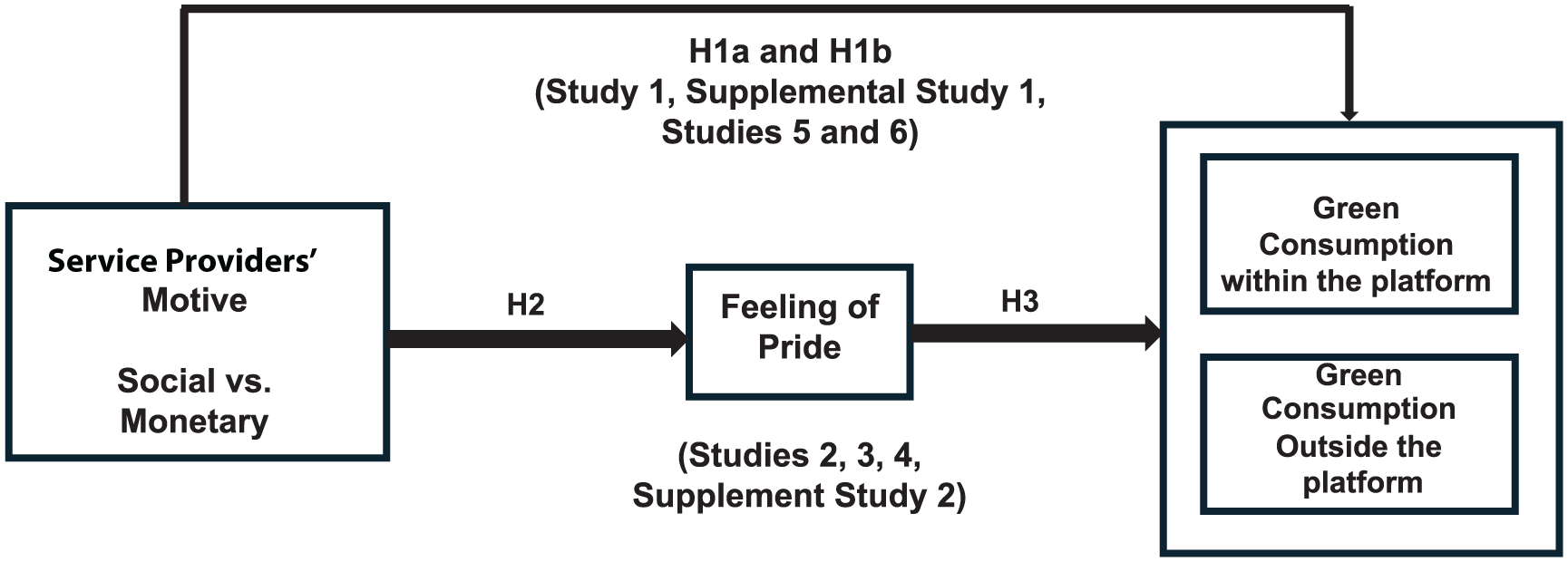
Conceptual model.
Study Overview
We tested our hypotheses via two large secondary datasets, four main laboratory studies, and two Supplemental studies. Study 1 and Supplemental Study 1 manipulated service providers’ motivations in a laboratory setting and found that emphasizing the social (vs. monetary) benefits of service provision increased hosts’ green product purchases but did not affect their regular product purchases. Studies 2 and 3 surveyed real Uber/Lyft drivers and Airbnb/Vrbo hosts, providing ecological evidence for our main proposition and the mediating role of pride. Study 4 and Supplemental Study 2 further tested this pride-based mechanism in the lab by measuring (Study 4) and manipulating the mediator (Supplemental Study 2). Finally, Studies 5 and 6 used two large secondary datasets to test the proposed effect in the field. Study 5 employed a secondary dataset examining individuals’ electric vehicle (EV) purchases. Rental hosts with stronger social motives were more likely to purchase EVs, even when controlling for plausible alternative variables; the positive effect of social motivation on green consumption was weaker for non-hosts. Study 6 used a large dataset scraped from the Airbnb site. We used hosts’ eco-friendly practices (e.g., provision of organic body wash) to measure their green consumption behavior and performed linguistic text analysis (via LIWC software) on their personal introductions on the platform to identify their degree of social motivation.
Study 1: Manipulating Motivation to Become Uber Drivers
Study 1 tested our main proposition that service providers with strong social (vs. monetary) motives are more likely to engage in green consumption, but service providers’ motivations have no bearing on regular product purchases (H1a and H1b). We manipulated motivation by highlighting either the social or monetary benefits of hosting. We then presented participants with either a green or a regular (i.e., non-green) product. We predicted that participants driven by a social (vs. monetary) motivation would be more likely to purchase the green option. Conversely, we posited that service providers’ motives would not influence the likelihood of choosing the regular option. In addition, one may argue that a strong social motivation may cause people to emphasize morality, leading to more green behavior (Rai & Fisk, 2011; White et al., 2019). The alternative account of morality was thus also addressed here.
Method
We employed a 2 (service provider motivation: social vs. monetary) × 2 (product type: green vs. regular) between-subjects design. A total of 595 U.S. residents (Mage = 41.11, 41.7% men) from Amazon Mechanical Turk (MTurk) participated in this study in September 2022.
All participants first imagined that they were considering becoming a part-time Uber driver. We manipulated motivation by highlighting different benefits of driving for Uber. In the social motivation condition, participants read that “One of the main benefits of becoming a part-time Uber driver is to meet new people and make new friends from around the world.” In the monetary motivation condition, they read that “One of the main benefits of becoming a part-time Uber driver is to make some extra income to supplement your income.” All participants were then asked to describe how they would feel about driving for Uber part time. The scenario and the writing task were meant to increase one’s sense of driving for Uber with a focus on either meeting people or making additional money.
Next, participants imagined that they had earned some income from driving for Uber and were asked to consider purchasing a pair of running shoes. They were shown a photo along with a brief description of the shoes. The brand and image of the shoes were the same in the green and regular product conditions, and both descriptions included the text “Comfort sockliners” and “Tire-inspired outsoles deliver flexible and reliable traction.” However, in the green product condition, the description also said the shoes used sustainable (e.g., recycled or biodegradable) materials, and the ad featured an “ECO Friendly” icon. In the regular product condition, the shoe materials were identified as polyester and nylon mesh; no “ECO Friendly” icon was displayed (see Web Appendix B for stimuli). Participants answered the question “How interested are you in purchasing this pair of shoes?” (1 = not at all, 7 = very much) regarding the main dependent variable. We next asked participants to estimate the extent to which the experience of driving for Uber part time would make them feel like a moral person (1 = not at all, 7 = very much).
Results
Pretest
We validated the effectiveness of our motivation manipulation through an independent pretest (N = 126). Participants engaged in the same writing task and then indicated their agreement with the statements “My objective of driving with Uber is to make some extra money” and “My objective of driving with Uber is to meet some new people” (1 = strongly disagree, 7 = strongly agree). Focusing on social (vs. monetary) advantages may arguably heighten participants’ environmental consciousness, leading to more green consumption. We accounted for this possibility with the statement “My objective of driving with Uber is to help save the environment.” As expected, three separate between-subjects Analyses of Variance (ANOVAs) (service provider motivation: social vs. monetary) revealed that participants in the social (vs. monetary) motivation condition had a weaker motivation to earn income (Msocial = 4.97, SD = 2.23 vs. Mmonetary = 6.44, SD = 1.17; F(1, 124) = 21.15, p < .001) and a stronger motivation to meet new people (Msocial = 4.44, SD = 2.17 vs. Mmonetary = 2.39, SD = 1.75; F(1, 124) = 34.03, p < .001). However, the manipulation of social versus monetary motivation did not affect participants’ pro-environmental motives (Msocial = 2.34, SD = 1.50 vs. Mmonetary = 2.19, SD = 1.57; F(1, 124) = .30, p = .584), ruling out the possibility that the proposed effect occurred because a social (vs. monetary) motivation also strongly activated one’s drive to save the environment.
Purchase Intention
A 2 (service provider motivation: social vs. monetary) × 2 (product type: green vs. regular) between-subjects ANOVA on purchase intention revealed a significant main effect of product type (Mgreen = 4.00, SD = 1.64 vs. Mregular = 3.67, SD = 1.69; F(1, 591) = 5.85, p = 016; ηp2 = .01), a significant main effect of service provider motivation (Msocial = 4.05, SD = 1.61 vs. Mmonetary = 3.63, SD = 1.71; F(1, 591) = 9.35, p = .002; ηp2 = .02), and a significant interaction effect (F(1, 591) = 4.84, p = .028; ηp2 = .01). As predicted in H1a and H1b, when the product was green, participants in the social (vs. monetary) motivation condition indicated a stronger purchase intention (Msocial = 4.35, SD = 1.51 vs. Mmonetary = 3.64, SD = 1.70; F(1, 591) = 13.71, p < .001; ηp2 = .02). However, the impact of motivation disappeared in the regular product condition (Msocial = 3.73, SD = 1.66 vs. Mmonetary = 3.61, SD = 1.72; F(1, 591) = 0.37, p = .543).
Further contrast analyses suggested that when social benefits were highlighted, participants’ purchase intentions were higher in the green (vs. regular) product condition (Mgreen = 4.35 vs. Mregular = 3.73; F(1, 591) = 10.31, p = .001; ηp2 = .02). Conversely, when monetary benefits were underlined, purchase intentions did not vary between the green and regular product conditions (Mgreen = 3.64 vs. Mregular = 3.61; F(1, 591) = .02, p = .876; see Figure 2).
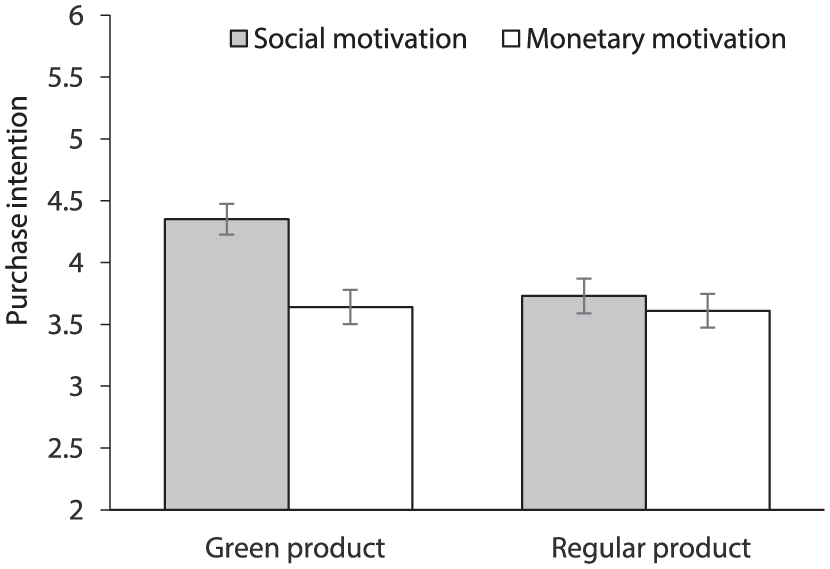
Effects of product type and service provider motivation on purchase intention (Study 1).
Alternative Account
The same ANOVA on one’s sense of morality showed no main effect of product type, no main effect of service provider motivation, and no interaction between the two (Fs < 1.87, ps > .17). Feelings of morality were thus unlikely to generate the effect of service provider motivation on purchase intention.
Discussion
Study 1 provided initial evidence for H1a and H1b, showing that service providers were more inclined to purchase a green (vs. regular) product when inspired by the social benefits of participating in the sharing economy. However, with monetary benefits as a motivator, service providers expressed no preference for green over regular products.
Study 1 ruled out a few alternative explanations. We found that social versus monetary motives for participating in the sharing economy did not influence hosts’ morality or drive to save the environment; these accounts probably did not activate the proposed effect. Participants with stronger social motivation might perceive themselves as having more financial resources and be less sensitive to prices, increasing their purchase likelihood. The positive role of social motivation in purchase intention should hold in both the green and regular product conditions if so. Given that strong social motives boosted participants’ likelihood of buying both green and regular products, the effect was unlikely to be driven by perceived resources or price sensitivity.
We conducted a Supplemental study (Web Appendix C) to test the proposed effect in a home sharing (Airbnb) context. This study (Amazon MTurk; N = 403) had the same design as Study 1 apart from participants imagining themselves as Airbnb hosts rather than Uber drivers. Replicating Study 1, being socially (vs. monetarily) motivated increased Airbnb hosts’ likelihood of buying green but not regular products. Supplemental Study 1 also directly measured participants’ perceived availability of financial resources. Service provider motivation did not affect this variable, further ruling it out as an alternative account.
Study 2: Survey of Real Uber/Lyft Drivers
Study 1 tested the proposed effect through a controlled laboratory experiment by manipulating service providers’ motivations. Findings confirmed the effect’s internal validity. We aimed to demonstrate its external validity in Study 2 by recruiting actual Uber/Lyft drivers and assessing their past purchase behavior. We also sought to provide evidence for the proposed pride-based mechanism (H2–H3). In brief, we evaluated real Uber/Lyft drivers’ social and monetary motives. We then surveyed their green purchases across nine consumption domains (e.g., paper products, bath products). Furthermore, we measured their feelings of (authentic and hubristic) pride related to driving with Uber. We predicted that Uber drivers with greater social motivation would be more likely to engage in green consumption, with this effect being largely attributable to a stronger sense of pride.
Methods
A total of 293 Uber/Lyft drivers recruited from CloudResearch took part in this study (Mage = 34.64, 70.0% men) in November 2024. We used a platform filter question to recruit only Uber or Lyft drivers. 1 We also included a question (“Do you currently work as an Uber/Lyft driver?” 1 = Yes. I am a full-time Uber/Lyft driver, 2 = Yes. I am a part-time Uber/Lyft driver, 3 = No. I am not an Uber or Lyft driver) at the start of the survey to exclude participants who did not report being Uber/Lyft drivers.
All participants first indicated their motivations for working as an Uber/Lyft driver via a pair of statements (“My objective for working as an Uber/Lyft driver is to make some extra money,” “My objective for working as an Uber driver is to meet new people and make new friends from around the world”; 1 = strongly disagree, 7 = strongly agree). We next determined their feelings of pride. Researchers distinguish two types of pride: (1) authentic pride, which arises from achievements tied to one’s actions (“I am proud of what I did”); and (2) hubristic pride, a positive view of one’s global self that is based on strengths such as natural talent without any particular effort (“I am proud of who I am”; Tracy and Robins 2007). We measured both types using established scales (Tracy and Robins 2007). In terms of authentic pride, participants rated the extent to which working as an Uber/Lyft driver made them feel “accomplished,” “like I am achieving,” “confident,” “fulfilled,” “productive,” “like I have self-worth,” and “successful” (α = .96). To indicate hubristic pride, participants rated feeling “arrogant,” “conceited,” “egotistical,” “pompous,” “smug,” “snobbish,” and “stuck-up” (α = .98). A factor analysis confirmed that items related to authentic and hubristic pride loaded on separate factors.
Next, participants were asked to recall their purchases over the past 3 months across nine product categories and state how often they chose organic/green options in each category. They read the following definition of green/organic options: “Green/organic options are products with at least one environmental attribute, e.g., products made from recycled materials, biodegradable products or organic products.” The categories were (1) skincare products; (2) paper products (e.g., toilet paper, paper towels); (3) bath products (e.g., shampoo, conditioner, body wash); (4) clothing (e.g., shirt, T-shirt, shorts); (5) footwear (e.g., sneakers, running shoes); (6) batteries; (7) detergent; (8) dairy products (e.g., eggs, milk); and (9) vegetables. All of these items were scored on a five-point scale (1 = I never purchased green/organic options, 2 = I rarely purchased green/organic options, 3 = I sometimes purchased green/organic options, 4 = I often purchased green/organic options, 5 = I always purchased green/organic options; α = .91). The composite of these nine measures served as an index for participants’ green consumption. We chose these categories because they are common in grocery shopping, such that people typically have a choice between regular and green versions of products. Demographics such as one’s household income, education level, gender, and age can influence green purchases (Brough et al. 2016); therefore, these aspects served as control variables.
Results
Past Green Consumption
We first regressed participants’ frequency of buying green products in the past 3 months on their social motivation, which revealed a significant effect as predicted (β = .18, SE = 0.03, t(291) = 7.03, p < .001): Uber/Lyft drivers who held stronger social motivations purchased green products more often. As a robustness check, we ran another regression model including monetary motivation, household income, education level, gender, and age as control variables. The impact of social motivation remained significant (β = .15, SE = 0.03, t(281) = 5.81, p < .001). The effect of monetary motivation was not significant (β = −.08, t(281) = −1.72, p = .086). While age also had a significant impact (β = −.02, SE = 0.01, t(281) = −4.36, p < .001), gender, education, and household income did not (ts < 1.51, ps > .13).
Feelings of Pride
We regressed participants’ authentic pride on their social motivation while controlling for monetary motivation, gender, age, education, and household income. As anticipated, we observed a significant effect of social motivation (β = .39, SE = 0.05, t(281) = 8.57, p < .001). The role of monetary motivation was non-significant (β = .04, SE = 0.08, t(281) = 0.45, p = .652). Household income had a significant effect (β = .15, SE = 0.06, t(281) = 2.51, p = .013), but gender, education, and age did not (ts < 1.43, ps > .15).
The same regression on hubristic pride revealed a significant effect of social motivation (β = .13, SE = 0.03, t(281) = 4.27, p < .001). We also noted significant effects of monetary motivation (β = −.45, SE = 0.05, t(281) = −8.30, p < .001) and gender (β = −.26, SE = 0.12, t(281) = 2.18, p = .030). The impacts of age (β = −.01, SE = 0.01, t(281) = −1.86, p = .064), income, and education were not significant (ts < .38, ps > .70).
Mediating Effect of Pride
We tested whether feelings of pride mediated the effect of social motivation on green consumption. A mediation analysis featured service providers’ social motivation as the independent variable, feelings of authentic and hubristic pride as parallel mediators, and green consumption as the dependent variable while controlling for monetary motivation, gender, age, education, and household income (PROCESS Model 4; Hayes 2017). The indirect effects via both authentic and hubristic pride were significant (authentic pride: β = .05, SE = 0.02, 95% CI [0.02, 0.08]; hubristic pride: β = .01, SE = 0.01, 95% CI [0.001, 0.03]). We further conducted a pairwise comparison of the indirect effects to test which mechanism served as a stronger mediating path. Authentic pride was a significantly stronger mediator than hubristic pride (β = .04, SE = 0.02, 95% CI [0.01, 0.07]).
Discussion
By surveying real Uber/Lyft drivers, Study 2 provided more evidence for the relationship between service providers’ social motives and green consumption. It also offered initial evidence for the pride-based mechanism. Supporting H2 to H3, we found that service providers with strong social motives tended to express stronger authentic and hubristic pride, which led to greater green consumption. While authentic pride demonstrated a stronger mediating effect in this relationship compared to hubristic pride, both types were found to serve as significant mediators. In the following two studies, we adopt a more generalized measure of pride, rather than distinguishing between the two subtypes, to offer a broader understanding of its influence on green consumption behavior. In addition, in Study 3, we recruited actual Airbnb hosts and evaluated their green consumption outside and on the platform.
Study 3: Survey of Real Airbnb Hosts
Whereas Uber/Lyft drivers were recruited for Study 2 through an online platform (CloudResearch), Airbnb hosts were recruited for Study 3 via snowball sampling and social media. We thus reached a wider group of participants to supplement our current pool. Similar to Study 2, we surveyed Airbnb hosts about their green purchases outside the sharing economy across nine consumption domains. Additionally, because hosts are responsible for providing supplies to their guests, we measured the number of green products they offered in their Airbnb properties and used this metric as another indicator of green consumption. Doing so further generalized the proposed effect. Finally, we assessed hosts’ pride to test its mediating role.
Methods
We used multiple approaches to recruit Airbnb hosts in February 2025. First, we used snowball sampling by reaching out to real estate agents and Airbnb hosts known to the research team. We asked these individuals to share the study flyer with other hosts in their network. Second, we posted the study information across multiple social media platforms as well as in social media groups that Airbnb hosts frequented. We asked participants to upload a screenshot of their host profile to ensure that they were indeed hosts. Additionally, to confirm that they were currently active, we asked participants at the beginning of the survey whether they had worked as a host in the past 12 months. Only those who answered “yes” proceeded to the main study. The sample included 510 hosts (Mage = 31.72, 60.4% men).
Like Study 2, all hosts first answered two questions about their motivations for hosting (“My objective for working as an Airbnb host is to make some extra money,” “My objective for working as an Airbnb host is to meet new people and make new friends from around the world”; 1 = strongly disagree, 7 = strongly agree). Participants also rated the extent to which working as an Airbnb host made them feel “proud, “a sense of self-worth,” and “a sense of respect” (1 = not at all, 7 = very much), the composite of which captured their sense of pride (α = .74; adapted from Wilcox, Kramer, and Sen 2011).
Next, participants were asked about their everyday purchases outside the sharing economy across nine product categories based on the same items as in Study 2 (α = .85). To further evaluate green consumption, we assessed the extent to which hosts adopted “sustainable hosting practices” in their listings. We specifically listed 12 eco-friendly options that Airbnb hosts could provide (Airbnb 2021) and asked them to choose the ones they currently offered to guests. The list included labeled recycling bins; recycled paper products; organic body wash; organic shampoo; organic body lotion; EV chargers; reusable/washable shopping bags; reusable cups; reusable food storage containers; refillable containers for hand soap, dish soap, and/or cleaning products; coffee makers that do not use plastic pods; and organic textiles. Finally, like Study 2, we used household income, education, gender, and age as control variables.
Results
Past Green Consumption
We first regressed participants’ frequency of buying green products in the past 3 months on their social motivation. As in Study 2, a significant effect emerged (β = .23, SE = 0.02, t(507) = 11.84, p < .001): Airbnb hosts with stronger social motives purchased green products more often. We ran another regression model with monetary motivation, household income, gender, and age as control variables, and the effect of social motivation remained significant (β = .21, SE = 0.02, t(336) = 8.60, p < .001). Monetary motivation had no significant impact (β = .04, SE = 0.02, t(336) = 1.79, p = .074), nor did gender, age, education, or income (ts < 1.20, ps > .23).
Sustainable Hosting Practices
Another regression model applied to hosts’ provision of eco-friendly items/services in their properties (M = 5.07). Consistent with their own purchase behavior, social motivation played a significant role (β = .26, SE = 0.06, t(507) = 4.06, p < .001). Controlling for the control variables yielded a similar effect of social motivation (β = .26, SE = 0.08, t(336) = 3.10, p < .001). Monetary motivation, household income, gender, and age had no significant impacts (ts < 1.93, ps > .05).
Feelings of Pride and the Mediation Analysis
We regressed participants’ pride on their social motivation while controlling for monetary motivation, gender, age, income, and education. H2 was supported given social motivation’s significant main effect (β = .28, SE = 0.04, t(336) = 7.49, p < .001). Monetary motivation had a significant impact as well (β = .24, SE = 0.04, t(336) = 6.59, p < .001); household income, gender, age, and education did not (ts < 1.03, ps > .30).
To test whether feelings of pride mediated the role of social motivation in hosts’ past green purchases, we conducted a mediation analysis with social motivation as the independent variable, pride as the mediator, and past green consumption as the dependent variable; monetary motivation, gender, age, education, and income were controlled for (PROCESS Model 4). The indirect effect via pride was significant (β = .07, SE = 0.01, 95% CI [0.04, 0.09]), supporting the proposed pride-based mechanism. In another mediation analysis, with provision of eco-friendly items as the dependent variable, the indirect effect of pride was again significant (β = .06, SE = 0.03, 95% CI [0.002, 0.13]).
Discussion
Study 3 involved Airbnb hosts outside the lab and online platforms. Their green consumption was measured within and outside the sharing economy, further generalizing the proposed effect and illustrating its external validity. Studies 2 and 3 both measured service providers’ motivations and pride to test the underlying mechanism. In Study 4 and a Supplemental study, we manipulated service providers’ motives to provide additional evidence for the underlying mechanism.
Study 4: Testing the Mediating Role of Pride
Study 4 was intended to offer more evidence for the proposed process (H2 and H3) by manipulating service providers’ motivations. Different from Study 1, where we manipulated product type using a between-subjects design, Study 4 contained a choice measure (green vs. regular product) to assess participants’ preference for green products. A binary measure still allowed us to investigate how service providers’ motives influenced their green (vs. regular) product purchases. It also mimicked a category of decisions that consumers often face in real life (i.e., simultaneously encountering green and regular options).
Method
We recruited 407 U.S. residents (Mage = 40.75, 49.4% men) via Amazon MTurk in November 2024 and randomly assigned them to one of the two motivation (social vs. monetary) conditions. The manipulation in this study was similar to that in Study 1. All participants were asked to imagine that they were considering driving for Uber part time. In the social motivation condition, they read that the main purpose was to meet new people and make friends around the world. In the monetary motivation condition, they read that the main purpose was to supplement their income. Participants were again asked to report their feelings about driving for Uber.
Next, participants read that they had received some income from driving for Uber and were asked to consider two types of batteries. They were shown images of two different four-packs of Energizer AAA: Energizer Advanced and Energizer Eco Advanced (Web Appendix B; adapted from Yan, Keh, and Chen 2021). Regarding the main dependent variable, participants answered the question “If you were to choose a battery to purchase, which option would you like to choose?” (0 = Energizer Advanced, 1 = Energizer Eco Advanced). We measured pride using two items: “To what extent would you feel proud of your experience of driving for Uber?” and “To what extent do you think the experience of driving for Uber would make you feel confident in your abilities to achieve success?” (1 = not at all, 7 = very much; r = .85). Finally, as a manipulation check, participants rated their agreement with the following items: “My objective of driving for Uber is to make some extra money” and “My objective of driving for Uber is to meet some new people” (1 = strongly disagree, 7 = strongly agree).
Results
Manipulation Check
A pair of two (service provider motivation: social vs. monetary) between-subjects ANOVAs revealed that participants in the social (vs. monetary) motivation condition reported a weaker drive to earn income (Msocial = 3.25, SD = 2.09 vs. Mmonetary = 6.69, SD = 0.77; F(1, 405) = 499.27, p < .001; ηp2 = .55) and a stronger drive to meet new people (Msocial = 6.43, SD = 1.15 vs. Mmonetary = 2.16, SD = 1.79; F(1, 405) = 801.44, p < .001; ηp2 = .66). Our service provider motivation manipulation was hence effective.
Purchase Choice
We conducted a binary logistic regression on product choice, which uncovered a significant effect of service provider motivation (β = .51, SE = 0.22, Wald(1) = 5.50, p = .019). As predicted, a greater percentage of participants in the social (vs. monetary) motivation condition chose to purchase the green option (Psocial = 74.2% vs. Pmonetary = 63.4%).
Feelings of Pride
As expected, two (service provider motivation: social vs. monetary) between-subjects ANOVAs on pride showed a significant main effect (Msocial = 5.11, SD = 1.32 vs. Mmonetary = 4.60, SD = 1.63; F(1, 405) = 11.83, p < .001; ηp2 = .03). H2 was again supported.
Mediating Effect of Pride
To test pride’s mediating role, we carried out a mediation analysis in which service provider motivation was the independent variable, feelings of pride constituted the mediator, and purchase choice was the dependent variable (PROCESS Model 4). We observed a significant indirect effect of pride (β = .11, 95% CI [0.04, 0.23]), supporting H3.
Discussion
Study 4 provided further evidence for the pride-based mechanism (H2 and H3). We noted that service providers with strong social (vs. monetary) motives felt prouder about their service provision, leading to a greater likelihood of buying green products. Another Supplemental study (N = 772, undergraduate students) furnished additional evidence for this mechanism through a moderation-of-process paradigm (Spencer, Zanna, and Fong 2005) by directly manipulating feelings of pride. We reasoned that if the effect of social (vs. monetary) motivation on green consumption occurs because greater social motivation boosts people’s sense of pride, then this effect should be attenuated when an experimental manipulation artificially inflates pride. In this case, even participants with weaker social motivation should report greater green consumption.
We asked participants to choose between a green and a regular set of batteries (the same as in Study 4). Feelings of pride (boosted vs. baseline; Tracy and Robins 2007) and service provider motivation (social vs. monetary) were manipulated in an Airbnb context. We found that the previous result pattern was replicated in the baseline condition. That is, participants with social (vs. monetary) motives were more willing to purchase eco-friendly batteries (Psocial = 52.9% vs. Pmonetary = 38.3%; χ2(1) = 8.21, p = .004). However, when participants’ pride was experimentally increased, service provider motivation had a non-significant impact (Psocial = 49.4% vs. Pmonetary = 50.5%; χ2(1) = .04, p = .839; Web Appendix D).
In the last two studies, we tested the effect of social motivation on green consumption using large secondary datasets to provide further evidence of its role in the field.
Study 5: Field Evidence from a Major Developing Economy
Study 5 produced evidence for our main proposition (H1) in the field based on the China Household Finance Survey (CHFS, 2019; publicly available at https://chfs.swufe.edu.cn). The CHFS dataset captures various aspects of consumer demographics, financial conditions, and consumption behaviors. It has been widely used to investigate household financial decision-making and consumption patterns (e.g., Fisman et al. 2023; Huang, Tani, and Zhu 2021).
To address our research question, we examined the relationship between social motivation (proxied by participants’ social spending proportion) and green consumption (operationalized by whether a recent automobile purchase was an EV or a fuel-powered vehicle) while controlling for various predictive factors. Our final dataset included 21,094 participants from 170 cities across 29 provinces in China after removing missing values. Additionally, we compared the effects of social motivation on green consumption between hosts (those who rent out a property) and non-hosts (those who do not) to determine whether the impact of social motivation was specific to service providers or applied more broadly.
Variable Description
Green Consumption
We used car purchase type (1 = EV, 0 = fuel-powered vehicle) as the dependent variable. Descriptive statistics for key variables are summarized in Table 1. Overall, 1,047 participants (2.03%) purchased EVs.
Summary Statistics (Study 5).
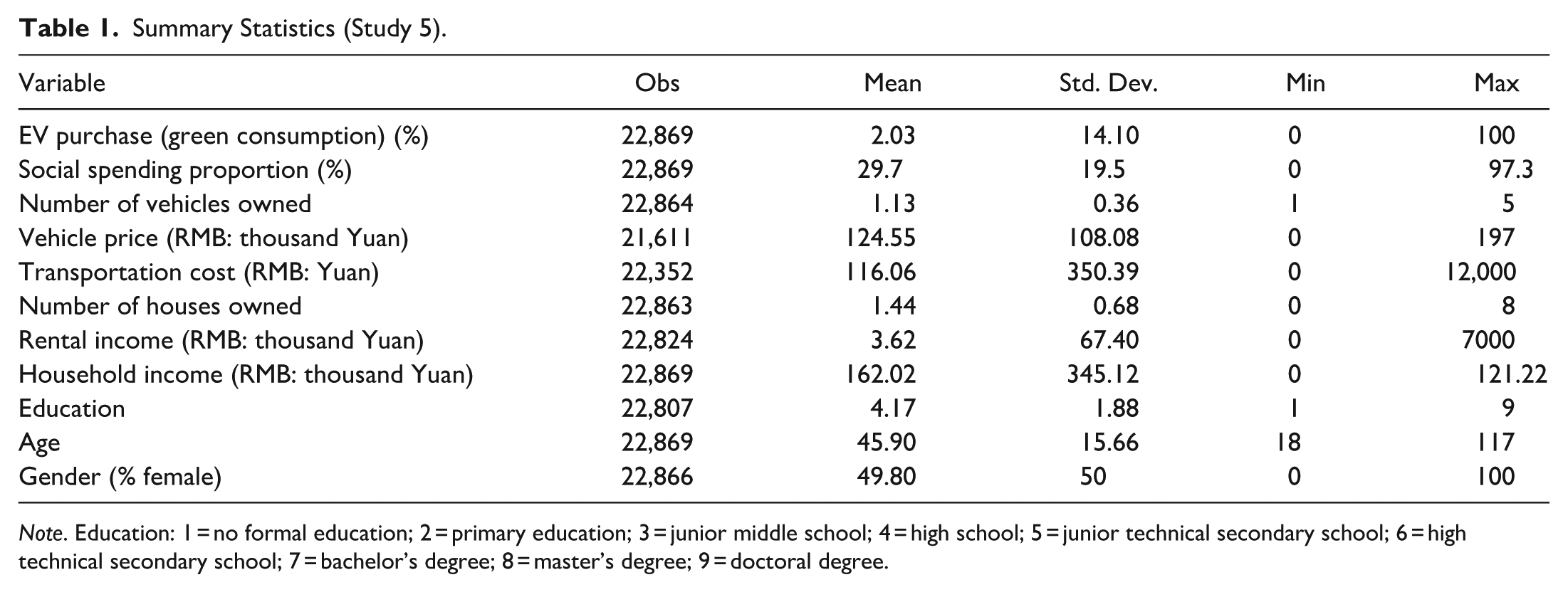
Note. Education: 1 = no formal education; 2 = primary education; 3 = junior middle school; 4 = high school; 5 = junior technical secondary school; 6 = high technical secondary school; 7 = bachelor’s degree; 8 = master’s degree; 9 = doctoral degree.
Social Motivation
Following prior literature (Wang, Cheng, and Smyth 2019), we used the proportion of participants’ spending on social activities (i.e., “How much do you spend on social activities, including expenses related to social communication?”) over the past year relative to their total consumption expenditure as a proxy of social motivation. A larger proportion of social spending suggested a stronger drive to socialize with others.
Furthermore, because our research focuses on service providers’ social motivation, we included a binary variable indicating whether a participant worked as a service provider. Those who rented out a property were considered hosts, and those who did not were considered non-hosts (1 = host, 0 = non-host). We integrated an interaction term between social motivation and participants’ host status to better understand how this motivation influenced both groups’ green consumption. Hosts’ stronger social motivation could potentially be associated with higher green consumption, whereas this relationship might be weaker for non-hosts.
Control Variables
We first controlled for factors that could shape one’s decision to purchase an EV, including vehicle price, the number of vehicles already owned, and one’s average monthly transportation expenditure. We also controlled for the number of houses that participants owned and their rental income to account for the potential role of additional economic gains from renting out properties in EV purchases. Multiple demographic variables, including gender, age, household income, and education level, were controlled for as well. Finally, we controlled for regional fixed effects to consider the influence of the surrounding environment on EV purchase preferences: the availability of EVs and charging infrastructure may vary geographically.
Regression Models
We estimated the effect of participants’ social motivation on their green consumption (measured by an EV purchase) via a logistic regression model while accounting for the control variables mentioned above. We calculated participant i’s green consumption as follows:
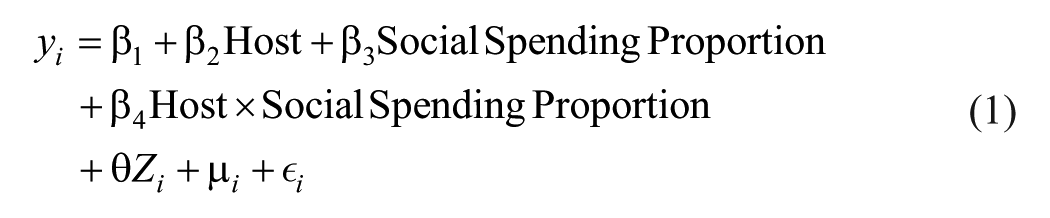
where
Results
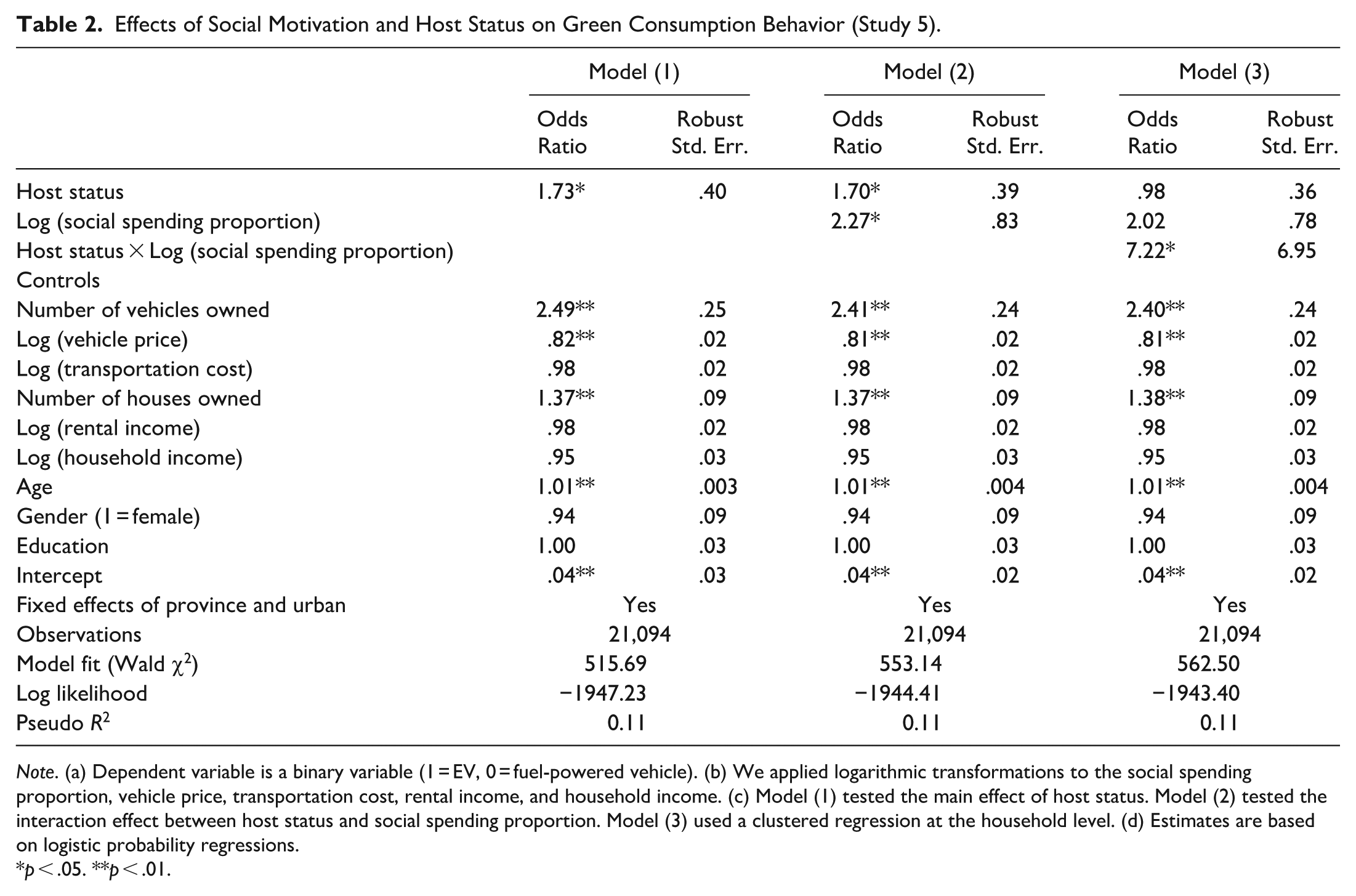
As shown in Table 2, hosts were 72% more likely to purchase an EV than non-hosts (odds ratio = 1.72, p = .017) when controlling for covariance and region-based fixed effects (Table 2, Model [1]). Similarly, as we predicted, social motivation positively influenced their inclinations to purchase an EV (odds ratio = 2.27, p = .026; Table 2, Model [2]).
Effects of Social Motivation and Host Status on Green Consumption Behavior (Study 5).
Note. (a) Dependent variable is a binary variable (1 = EV, 0 = fuel-powered vehicle). (b) We applied logarithmic transformations to the social spending proportion, vehicle price, transportation cost, rental income, and household income. (c) Model (1) tested the main effect of host status. Model (2) tested the interaction effect between host status and social spending proportion. Model (3) used a clustered regression at the household level. (d) Estimates are based on logistic probability regressions.
p < .05. **p < .01.
Next, to examine whether social motivation differentially affected hosts and non-hosts’ green consumption, we ran another logistic regression model predicting participants’ EV purchases. This model included the interaction term between host status and social spending proportion, which was significant (odds ratio = 7.22, p = .040; Table 2, Model [3]). Figure 3 depicts that the more socially motivated hosts were, the more likely they were to purchase an EV (
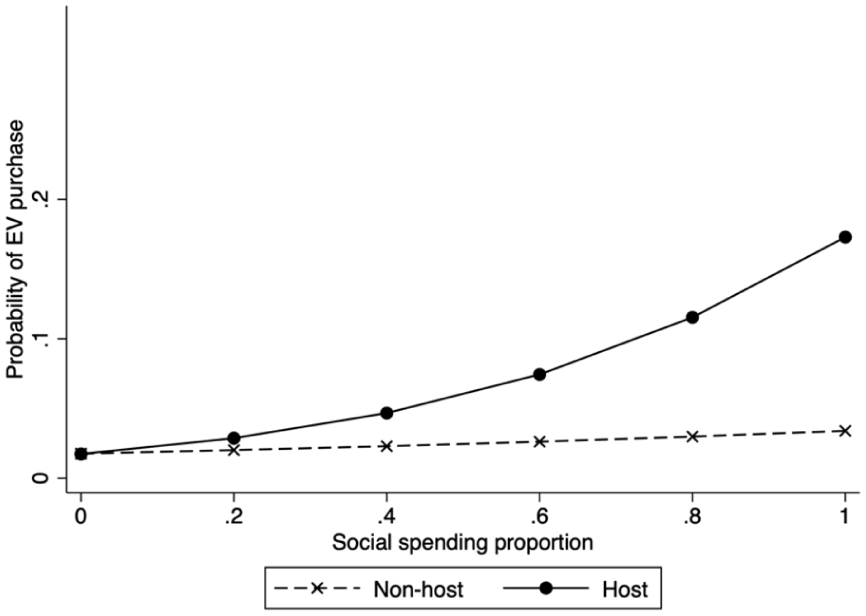
Effects of social motivation on green consumption for hosts and non-hosts (Study 5).
Discussion
Study 5 provided field evidence for the supposition that hosts’ social motivation increases their green consumption (H1). We used EV purchases, which occur outside the sharing platform, as the dependent variable and found that hosts with stronger social motives were more apt to buy an EV. The positive effect of social motivation on green consumption was far weaker for non-service providers. The next study provided additional ecological evidence for the proposed effect by employing a large dataset from Airbnb.com. Different from Study 5, we used participants’ in-platform eco-friendly practices as the primary measure of green consumption.
Study 6: Secondary Data from Airbnb Hosts
Study 6 was based on a large dataset from Inside Airbnb (publicly available at https://insideairbnb.com/), which consists of listings scraped from Airbnb.com. We used a sample from Asian countries to diversify our data and avoid relying on North American accommodation information. Because Airbnb has exited the Chinese market, we considered locations including Bangkok, Thailand; Singapore; and Tokyo, Japan. Data were scraped in September 2024 and downloaded on December 18, 2024, totaling 47,196 observations. As Airbnb employed an internal “translation engine” that automatically translated listing descriptions and reviews into English for users, the dataset we used contained content that had already been translated into English by the platform, ensuring consistency across different language environments. We retained 46,557 observations after removing professional hosts (e.g., professional hotel or apartment managers; Chung et al. 2022). We measured hosts’ green consumption behavior based on their provision of eco-friendly items/practices and used linguistic text analysis (via LIWC software) to analyze each host’s personal profile to identify their social motives. This study, therefore, supplements the prior studies by implementing an alternative measure of social motivation and another operationalization of hosts’ green consumption behavior.
Variable Description
Green Consumption
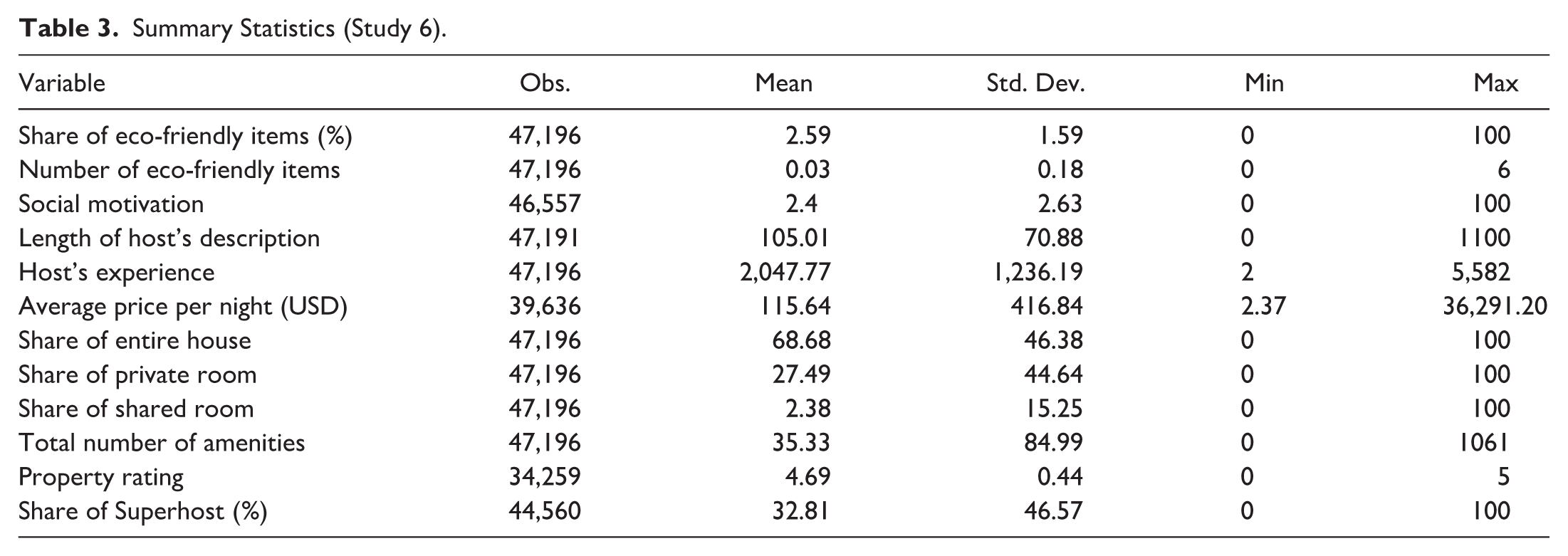
We coded hosts’ eco-friendly products/practices (e.g., organic shampoo, organic body wash, EV chargers, recycling services, energy-efficient lighting, and green building features as described in rentals’ amenities). A binary variable indicating whether eco-friendly products/practices were provided served as a proxy for hosts’ green consumption (1 = eco-friendly products or practices provided; 0 = none provided). Table 3 summarizes the descriptive statistics. In all, 1,223 hosts (2.59%) provided eco-friendly products or practices.
Summary Statistics (Study 6).
Social Motivation
We measured hosts’ social motives based on their personal profiles on the Airbnb website. These profiles serve as a way for hosts to introduce themselves to potential guests and often include personal information, hobbies, and what they hope to gain from the hosting experience. In this study, we used the content of these profiles to assess hosts’ social motivation. A computerized text analysis in LIWC determined the linguistic patterns in hosts’ descriptions (Boyd et al. 2022). LIWC counts and classifies different words, using these categories to give linguistic insights into emotional states, motivations, and thinking styles. We focused on the degree to which hosts’ personal descriptions reflected social motivation, captured through LIWC’s “social behavior” category. “Social behavior” (e.g., say, love, said, care etc.) is an LIWC-generated score that reflect a broad set of social behaviors, or references to them. We used it as a proxy for hosts’ social motivation. It is calculated as (the number of social-related words/total number of related words in the LIWC dictionary) × 100 (0–100 scale, see Table 3); higher scores denote stronger social motives. An example of a profile reflecting high social motivation is: “Greetings to you fellow people! Originated from Bangkok, I love hosting and meeting new people from all around the world learning and exchanging cultures with each and everyone of my guest! Please don’t be shy and say hi if we crossed path!” (LIWC-generated score: 14.71; higher than 99% of the samples). An example reflecting moderate social motivation is: “I am a very easy person who trying to give positive vibe to other people. You will enjoy staying in my dream house. ” (LIWC-generated score: 1.82; representative of 50% of the sample). Finally, a profile reflecting low social motivation is: “I like travelling a lot, as well as good food. Singapore is not only a place for the future, but has an incredible rich history, which I think people should know about. Contact me if you have any questions.” (LIWC-generated score: 0; lower than 1% of the samples).
Control Variables
We controlled for several variables that could affect hosts’ social motives and sustainable practices. For example, we considered personal descriptions’ length (M = 105 words), as longer descriptions might be more likely to include social-related language. We also controlled for hosting experience (the number of days between joining Airbnb and the date of data collection; M = 2,047) and “Superhost” certification (31.81% of participants were Superhosts); both factors could influence hosts’ decisions about offering eco-friendly products.
We also controlled for listing-related aspects, such as the average price per night (M = $115.63); hosts charging higher prices can presumably more comfortably afford eco-friendly items. Listing type (68.68% entire homes, 27.49% private rooms, 2.38% shared rooms, 1.46% hotel rooms) was also controlled for, although we excluded hotel rooms because agencies rather than individual hosts tend to operate them. We additionally controlled for the total number of amenities listed in the property (M = 35.33) and the overall property rating on Airbnb (M = 4.69). Lastly, because local awareness of green consumption and peer pressure may influence hosts, we considered the impacts of the city and neighborhood in which a property was located by using cluster analysis to group neighborhoods.
Results
We applied a logistic regression model with city- and neighborhood-level clustering to test how social motivation affected hosts’ green behavior. As predicted, we found a significant positive impact of hosts’ social motives on the provision of eco-friendly items or practices (Table 4). Hosts displaying greater social motivation were more inclined to offer eco-friendly products, even after controlling for various covariates and city–neighborhood fixed effects (odds ratio = 1.08, p = .005; Model [1]).
Effects of Airbnb Hosts’ Social Motives on Provision of Eco-Friendly Items (Study 6).
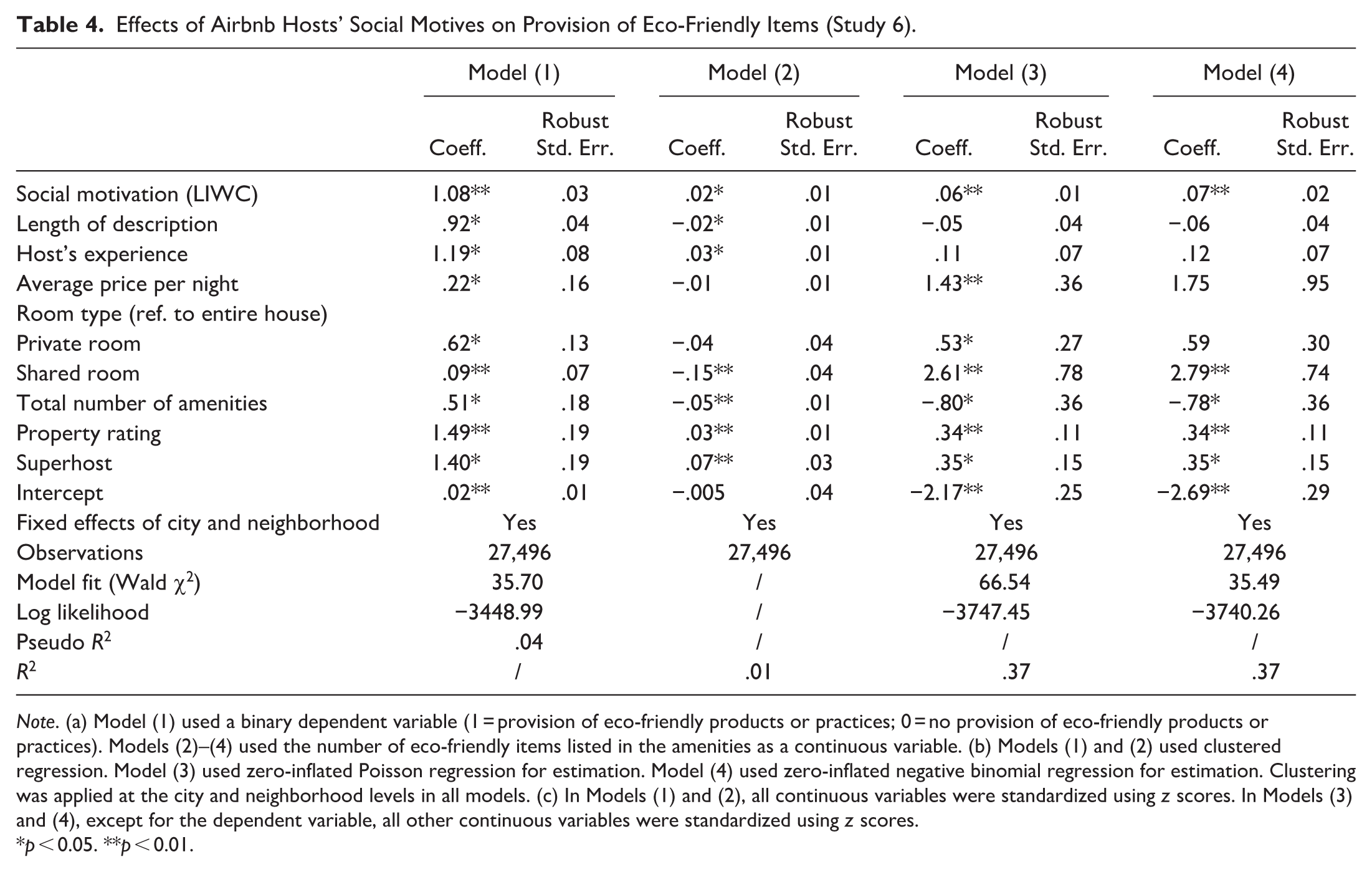
Note. (a) Model (1) used a binary dependent variable (1 = provision of eco-friendly products or practices; 0 = no provision of eco-friendly products or practices). Models (2)–(4) used the number of eco-friendly items listed in the amenities as a continuous variable. (b) Models (1) and (2) used clustered regression. Model (3) used zero-inflated Poisson regression for estimation. Model (4) used zero-inflated negative binomial regression for estimation. Clustering was applied at the city and neighborhood levels in all models. (c) In Models (1) and (2), all continuous variables were standardized using z scores. In Models (3) and (4), except for the dependent variable, all other continuous variables were standardized using z scores.
p < 0.05. **p < 0.01.
Robustness Checks
We conducted three robustness checks. The previous analysis featured a binary variable to reflect whether sustainable practices were present. In our first robustness check, we used the number of eco-friendly items/practices listed in properties’ amenities as a continuous variable to measure hosts’ green tendencies. Every 100 hosts provided three eco-friendly products or practices on average. The clustering regression results aligned with our prior analysis. After controlling for covariance and city–neighborhood fixed effects, hosts with stronger social motives offered more eco-friendly products (β = .02, p = .021; Table 4, Model [2]).
Our second and third robustness checks involved alternative estimation models, namely zero-inflated Poisson regression and zero-inflated negative binomial regression. For our dependent variable (the number of eco-friendly items provided), 97.41% of the observations were zeros. These alternative models helped address the high proportion of zero values. Consistent with our earlier results, the positive impact of social motivation on hosts’ provision of eco-friendly items remained robust under both models (Poisson: β = .06, p < .001; Table 4, Model [3]; negative binomial: β = .07, p < .001; Table 4, Model [4]).
Discussion
Using real Airbnb listings, Study 6 provided more ecological evidence for the impact of social motivation on service providers’ green consumption. This study, along with Study 3, revealed that hosts’ social motives promote sustainable practices on the platform. These results suggest that the positive effect of social motivation applies outside and on Airbnb, offering practical implications for sharing platforms seeking to encourage hosts’ sustainable behavior.
General Discussion
Across eight studies using surveys, lab experiments, and large-scale secondary datasets on various sharing economy platforms, we examined the downstream effects of service providers’ social (vs. monetary) motives on their green consumption. Our multi-method research reveals a consistent trend: service providers who participate in the sharing economy with stronger social motives are more likely to engage in green consumption, both within (through green hosting practices) and outside (through green consumption) these platforms. We also found that hosts’ feelings of pride mediated the impact of social (vs. monetary) motivation on green consumption.
Study 1 and Supplemental Study 1 tested our main proposition via controlled experiments. The results established causality in that service providers’ motivations affect green consumption but have no bearing on choosing regular (non-green) products. Studies 2 and 3, which surveyed real service providers’ past green consumption, offered more ecological evidence for our theorization. Findings also supported the mediating role of pride. Study 3 further examined Airbnb hosts’ eco-friendly practices on the sharing platform (i.e., the number of green products/services offered in listings) as another indicator of green consumption, demonstrating the proposed effect’s generalizability. Study 4 and Supplemental Study 2 provided greater evidence for the pride-based mechanism in a lab setting by measuring (Study 4) and manipulating the mediator (Supplemental Study 2). Studies 5 and 6 included two secondary datasets to test the proposed effect in real-world settings. Study 5 used secondary data from a major developing country to assess EV purchases; rental hosts with stronger social motives appeared more likely to purchase EVs, while the positive effect of social motivation was weaker for non-hosts. Study 6, based on ample data from Airbnb listings, uncovered a significant positive impact of hosts’ social motivation on their provision of eco-friendly items or practices.
These studies jointly ruled out several alternative explanations, including that pronounced social motivation might lead people to emphasize morality or inspire environmental concerns. We observed that social (vs. monetary) motives did not inform consumers’ sense of morality or environmental concerns. Second, we ruled out perceived resource availability and household income by (1) showing that social (vs. monetary) motives boosted purchase intention in the green product condition but not in the regular product condition; (2) finding that the social (vs. monetary) motivation manipulation did not affect perceived resource availability; and (3) controlling for household income in studies where motivation was measured. One may wonder whether social motivation’s favorable role in green consumption is exclusive to the sharing economy or extends to other contexts. Study 5 suggested the former, providing preliminary evidence that the positive effects of social motives may not be as strong for non-hosts. We conducted Supplemental Study 3 (N = 239, Mage = 38.53, 43.9% men; Prolific) employing a 2 (motivation: social vs. monetary) × 2 (working context: working part time at a retailer vs. working at a community center) between-subjects design (see Web Appendix E). As the dependent variable, we asked participants to indicate their preference between regular and eco-friendly batteries (the same stimuli as in Study 4). Results indicated no significant main effects of working context or motivation or a significant interaction between the two (Mretailer-social = 5.24, Mretailer-monetary = 5.47, Mcommunity-social = 5.29, Mcommunity-monetary = 5.40; all ps > .45). In conclusion, social motivation’s positive effect on green consumption is likely context-dependent and may not readily generalize to other work environments. Several factors could account for this difference. First, in the sharing economy—especially platforms like Airbnb—social motivation is a core driver of participation. Many hosts choose to engage in hosting not merely for income, but to interact with diverse guests, share local culture, and derive personal fulfillment through meaningful social exchange (Zhang, Bufquin, and Lu 2019). These interactions foster intrinsic motivation, which is closely linked to value-consistent behaviors such as sustainable consumption. In contrast, in other work settings (e.g., community centers or retail), social interaction may be more routine, role-bound, or externally regulated, and thus less likely to activate the same intrinsic, value-based orientation. Even in contexts where social motivation is present, the quality of social engagement—whether it promotes autonomy, relatedness, and personal growth—may not effectively lead to strong sustainable behavior. Therefore, the observed effect of social motivation on green consumption may be context-contingent, shaped by the nature of social interaction and the degree to which it satisfies core psychological needs. Future research can investigate when and why the proposed effect manifests in other contexts.
Our research makes several contributions to the sharing economy literature. First, we have elaborated on the consequences of service providers’ reasons for hosting (Chung et al. 2022) by identifying how these drivers influence green consumption. Eight studies showed that service providers in the sharing economy who have stronger social motives tend to engage in more green consumption. This effort extends prior work by unveiling how service providers’ motives can have far-reaching effects beyond platform engagement (Chung et al. 2022).
Many scholars have attended to consumers (Costello and Reczek 2020; Dellaert 2019; Scaraboto and Figueiredo 2022; So, Oh, and Min 2018), to the point that service providers have been relatively overlooked (Mody et al. 2021; Wu et al. 2023). We have narrowed this gap by demonstrating that service providers’ green consumption depends on their motives for sharing. These findings shed light on a somewhat hidden but important aspect of consumer spending. Our research also offers a broader view of the interplay among motives, behavior, and consumption in the sharing economy. We have partly compensated for the previous emphasis on this economy’s demand side (Belk 2010, 2013; Lamberton and Rose 2012).
Our research additionally bolsters the literature on pro-environmental behavior (Rowe et al. 2019; Schneider et al. 2017; Shipley and van Riper 2022). Our findings echo prior work (Damian and Robins 2013; Harper et al. 2019) by confirming that service providers’ social motives are intrinsic. These drives can satisfy one’s need for relatedness, thereby heightening one’s sense of pride and prompting green consumption. Scholars have discerned linkages between pride and prosocial behavior (Kim and Johnson 2013; Schneider et al. 2017; Shipley and van Riper 2022). We found that pride stemming from intrinsic motivations such as social motives is stronger than that derived from extrinsic motives. Service providers with a social (vs. monetary) motives are hence more inclined to engage in green consumption.
Our findings offer valuable insights for policymakers and marketers aiming to promote sustainable lifestyles and service providers’ green practices. Financial benefits have been heavily highlighted, yet our research suggests that governments, sharing platforms, and policymakers could implement strategies such as using words or imagery to stress the social benefits of participating in the sharing economy in articles, blogs, and host forums (e.g., Airbnb host clubs). These practices could persuade service providers to move toward green consumption on and outside platforms. Sustainability has become a focal point in this economy; for example, Airbnb has voiced a commitment to “operate as a net-zero company by the end of 2030.” Our results are, therefore, relevant for sharing platforms aiming to foster sustainable activities.
Also on the supply side, green product manufacturers can consider featuring their products in Airbnb host forums. Numerous social groups exist for service providers, whether platform-sponsored (e.g., Airbnb host clubs/communities) or host-coordinated (e.g., Facebook pages created by Airbnb hosts in different areas). These groups allow hosts to exchange knowledge and experience. Based on our findings, companies can underline their products’ sustainable attributes or present green versions when advertising (e.g., via Facebook ads). This approach will appeal to service providers driven by social benefits without undermining the purchase intentions of hosts with monetary motives. To make the campaigns more effective, companies can highlight the social benefits of participating in the sharing economy first and then run ads that promote green consumption.
Although our research contributes theoretically and practically to the sharing economy, several limitations must be acknowledged. First, we concentrated on social motivation. Scholars can next examine if other intrinsic motivations, such as enjoyment (which is more salient than social motives in other settings), similarly influence consumers’ spending habits. Second, the sharing economy comprises various services and has both capacity-constrained (e.g., rooms, cars, bicycles) and capacity-unconstrained (e.g., music, information) assets. We addressed the former category. Follow-up research could explore the differences between diverse shared resources and how contextual factors may play into the effects we identified.
Supplemental Material
sj-docx-1-jsr-10.1177_10946705251374531 – Supplemental material for Beyond Money: How Social Motives Drive Green Purchases in the Sharing Economy
Supplemental material, sj-docx-1-jsr-10.1177_10946705251374531 for Beyond Money: How Social Motives Drive Green Purchases in the Sharing Economy by Yuechen Wu, Kevin Kam Fung So, Xiang Fang and Ruijuan Wang in Journal of Service Research
Supplemental Material
sj-docx-2-jsr-10.1177_10946705251374531 – Supplemental material for Beyond Money: How Social Motives Drive Green Purchases in the Sharing Economy
Supplemental material, sj-docx-2-jsr-10.1177_10946705251374531 for Beyond Money: How Social Motives Drive Green Purchases in the Sharing Economy by Yuechen Wu, Kevin Kam Fung So, Xiang Fang and Ruijuan Wang in Journal of Service Research
Footnotes
Acknowledgements
The first three authors contributed equally to this research.
Declaration of Conflicting Interests
The authors declared no potential conflicts of interest with respect to the research, authorship, and/or publication of this article.
Funding
The authors received no financial support for the research, authorship, and/or publication of this article.

Supplemental Material
Supplemental material for this article is available online.
Notes
Author Biographies
References
Supplementary Material
Please find the following supplemental material available below.
For Open Access articles published under a Creative Commons License, all supplemental material carries the same license as the article it is associated with.
For non-Open Access articles published, all supplemental material carries a non-exclusive license, and permission requests for re-use of supplemental material or any part of supplemental material shall be sent directly to the copyright owner as specified in the copyright notice associated with the article.
