




Abstract
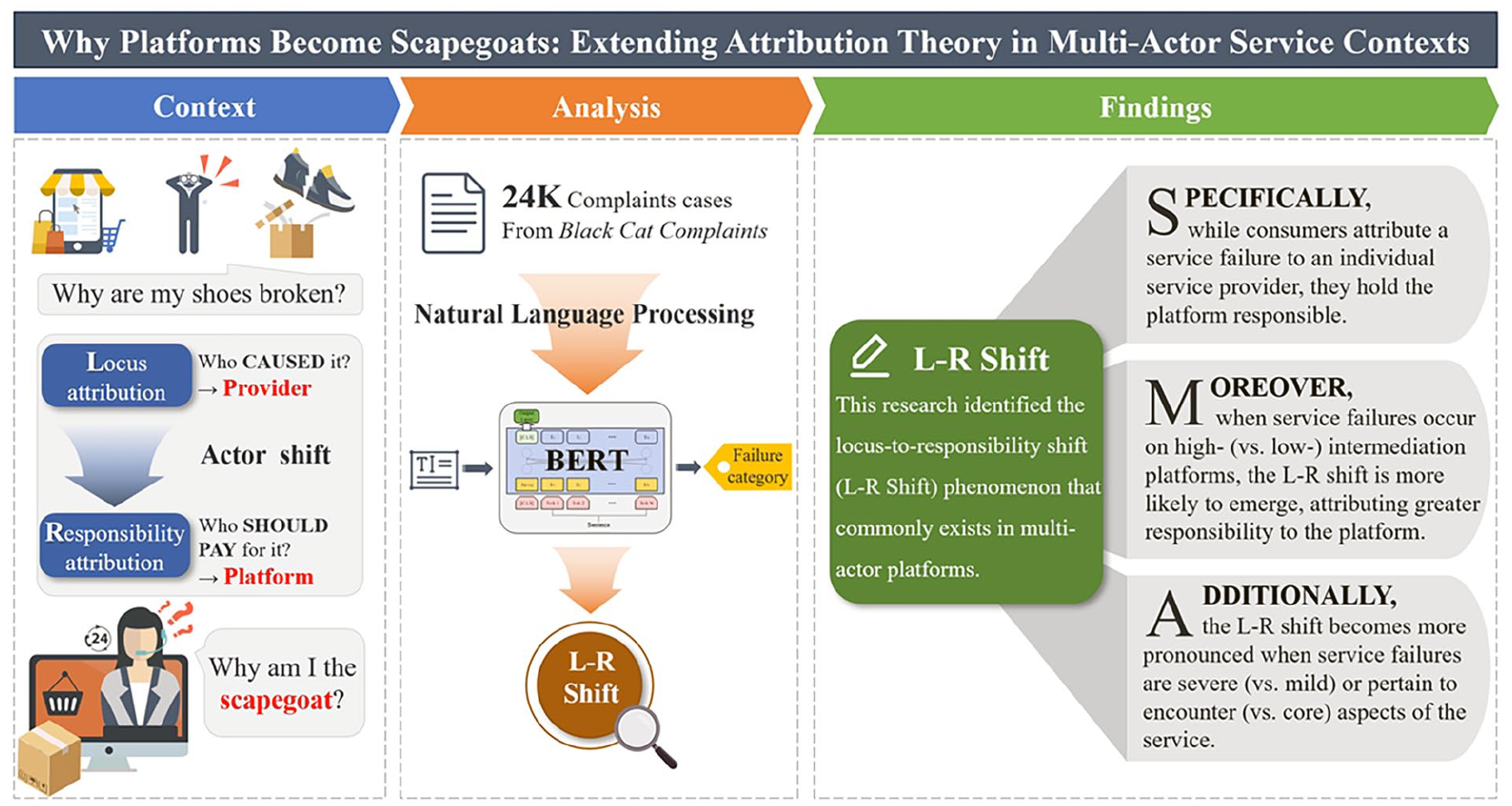
Multi-actor exchange relationships involving platforms and individual service providers have become increasingly common in the online service sector. Drawing on attribution theory, this study identifies a phenomenon called the “locus-responsibility shift,” a form of scapegoating in which consumers transfer responsibility for service failures to a platform, even after recognizing the individual provider as the source of the problem. By uncovering this phenomenon, we challenge the traditional understanding of attribution and highlight the unique challenges platforms face in dealing with service failures. A text analysis of 24,183 consumer complaints and 4 experimental studies reveals that consumers on high (vs. low) intermediation platforms, those who experience severe (vs. mild) service failures, and those dealing with encounter (vs. core) service issues are more likely to attribute responsibility to the platform. These findings have important managerial implications for platform managers and offer guidance for developing effective platform strategies and service recovery practices to enhance customer satisfaction and safeguard platform’s reputation.
Keywords
Get full access to this article
View all access options for this article.
References
Supplementary Material
Please find the following supplemental material available below.
For Open Access articles published under a Creative Commons License, all supplemental material carries the same license as the article it is associated with.
For non-Open Access articles published, all supplemental material carries a non-exclusive license, and permission requests for re-use of supplemental material or any part of supplemental material shall be sent directly to the copyright owner as specified in the copyright notice associated with the article.
