




Abstract
Understanding how to enhance service recovery performance is crucial for service-oriented organizations, as it contributes to resolving service failures and addressing customer complaints. This study aims to develop a multilevel curvilinear model that explores the relationship between ethical leadership and service recovery performance, as well as the mediating and moderating effects underlying this relationship. Results from both Study 1 (dyadic and two-waved data from hotels) and Study 2 (triadic data from IT service organizations) revealed that ethical leadership had a curvilinear (inverted U-shaped) effect on service recovery performance. There was a curvilinear mediating effect of ethical self-efficacy between ethical leadership and service recovery performance, such that ethical leadership enhanced ethical self-efficacy, and an intermediate degree of ethical self-efficacy predicted the highest degree of service recovery performance (Studies 1 and 2). Results from Study 1 showed that internal knowledge transfer moderated the curvilinear relationship between ethical leadership and service recovery performance. Both internal knowledge transfer and task interdependence moderate the curvilinear relationship between ethical self-efficacy and service recovery performance (Study 1). Results from Study 2 showed that both internal knowledge transfer and task interdependence moderate the curvilinear relationship between ethical leadership and service recovery performance.
Keywords
Introduction
The intense competition within today’s market compels organizations across sectors to prioritize service excellence and customer experience (Grégoire and Mattila 2021). While extensive research has explored the drivers of customer satisfaction and loyalty, recent studies called for more attention to the critical role of addressing customer dissatisfaction and outrage from service failures. These service failures encompass a wide range of scenarios, such as flight delays, hotel booking errors, and billing mistakes. Recognizing the potential for reducing customer dissatisfaction, organizational reputation damage, and financial loss from service failures (Van Vaerenbergh et al. 2014), organizations acknowledge the pivotal role of service recovery (Liao 2017). Service recovery not only mitigates negative word-of-mouth but also informs service delivery process improvements (Van Vaerenbergh et al. 2019). Due to their direct role in handling customer complaints (Grégoire and Mattila 2021), the research underscores the vital role of employees’ service recovery performance, defined as an employee’s ability and actions to rectify service failures and restore customer satisfaction (Babakus et al. 2003), in fostering successful recovery.
In recent years, scholars have explored the factors influencing service recovery performance (e.g., Van Vaerenbergh and Orsingher 2016). As outlined in Supplemental Appendix A, leadership has emerged as a significant determinant of this outcome. While the connection between leadership and service recovery performance is established, the findings of prior research are inconsistent. Various leadership styles, such as servant and charismatic leadership, have shown positive effects (Luu and Vo 2017), while transformational leadership has produced both positive and negative effects on service recovery performance (e.g., Hoang, Thi Kim Quy et al. 2023; Punjaisri et al. 2013). Hence, this study responds to the pressing call by Van Vaerenbergh and Orsingher (2016) to investigate the complex impacts of leadership on service recovery performance. Our study centers on ethical leadership due to its important role in contemporary service management.
This study views ethical leadership, which refers to “the demonstration of normatively appropriate conduct through personal actions and interpersonal relationships, and the promotion of such conduct to followers through two-way communication, reinforcement, and decision-making” (Brown et al. 2005, 120), as an environmental factor interacting with employees’ characteristics to shape their service recovery performance. Ethical leadership is particularly relevant in service-focused organizations, where employees frequently grapple with ethical issues, such as heavy workloads, bullying, and harassment, which can lead to service failures, including unfair treatment of customers, overcharging, and dissemination of misleading information (Hoang, Giang et al. 2023). During such failures, customer satisfaction significantly depends on their perception of fairness across various facets of the recovery process. Den Hartog (2015) highlighted that ethical leaders exhibit high ethical values characterized by fairness, justice, honesty, trustworthiness, and authenticity, and they foster ethical behavioral norms by creating an ethical work environment. Ethical leadership, therefore, emerges as a pivotal force in fostering an environment where employees are inclined to uphold fairness in their dealings with customer complaints, thus safeguarding the endeavors to address service failures (Ma et al. 2022).
Building upon social cognitive theory (SCT), which posits that human behavior is shaped by a dynamic interplay of cognitive processes (Bandura 1986), we conducted two multilevel studies, with one utilizing dyadic and two-waved data from hotels, and another employing triadic data from IT service organizations, to address three critical gaps in the literature. First, inconsistent findings in prior research on leadership styles and service recovery performance (e.g., Luo et al. 2019; Punjaisri et al. 2013) raise the question of whether ethical leadership enhances service recovery performance. Recent studies suggest a “too-much-of-a-good-thing” effect, where excessive ethical leadership may lead to undesirable outcomes, such as reduced creativity (Mo et al. 2019). In service failure situations, the levels of ethical leadership exhibited by managers create both benefits and costs. When managers demonstrate an intermediate level of ethical leadership, employees are inclined to trust them due to their consistent ethical behavior (Mo et al. 2019). Consequently, employees emulate these ethical standards, ensuring that they address service failures with utmost dedication, thereby prioritizing service recovery performance.
Conversely, managers who exhibit higher levels of ethical leadership tend to enforce strict adherence to ethical standards among their employees (Brown et al. 2005). As a result, employees are influenced to adhere more rigorously to the established code of ethics, potentially compromising their ability to resolve service failures flexibly and appropriately, which limits their service recovery performance (Feng et al. 2018). Therefore, different from previous studies, we submit that the effect of ethical leadership on service recovery performance is curvilinear (inverted U-shaped) in the context of service failures.
Second, this study explores the curvilinear mediating role of ethical self-efficacy in translating ethical leadership into service recovery performance. Building on the general concept of self-efficacy (Bandura et al. 1988), ethical self-efficacy refers to “people’s beliefs in their own capabilities to mobilize their motivation, resources, and actions in an ethical manner” (Huang and Lin 2019, 34). While the general concept of self-efficacy refers to one’s overall ability to handle challenges, ethical self-efficacy concentrates on the belief in one’s capability to act ethically in different situations (Yang et al. 2023). This focus on ethical conduct is crucial in the service failure context because when employees act with integrity and transparency by acknowledging mistakes and providing reasonable and fair solutions, it can influence customer perceptions of fairness and trust, and ultimately impact service recovery performance. However, recent research suggests a curvilinear effect of self-efficacy on employee work outcomes, such as creativity (Lee et al. 2019). This raises the possibility of a similar curvilinear impact of ethical self-efficacy on service recovery performance. We thus propose that ethical self-efficacy acts as a personal determinant, mediating the curvilinear relationship between ethical leadership and service recovery performance.
Third, achieving exceptional service recovery hinges upon the concerted efforts of team members. For instance, managing a flight cancellation mandates collaboration among personnel to rebook passengers on alternative flights, distribute meal vouchers, and handle inquiries. Consequently, research on the relationship between ethical leadership and service recovery performance requires a multilevel theoretical and analytical approach (Eluwole et al. 2022), yet contemporary discourse lacks this perspective (Van Vaerenbergh and Orsingher 2016). The limited multilevel analysis in existing studies, with only one study in Supplemental Appendix A exploring this relationship across both team and individual levels, results in an incomplete comprehension of service recovery dynamics. To bridge this gap, our study takes a multilevel perspective, exploring the moderating roles of two pivotal team factors—internal knowledge transfer and task interdependence.
Internal knowledge transfer refers to the extent to which employees exchange work-related knowledge within organizations or teams to complete tasks and enhance performance (Molina et al. 2007). Increased internal knowledge transfer enables employees to better perceive their team managers’ ethical leadership, thereby strengthening the curvilinear impact of ethical leadership on service recovery performance. It also facilitates learning from others’ service experiences and thus improves skills, leading to a greater willingness to translate ethical self-efficacy into service recovery performance. Task interdependence is defined as the level of collaboration and interaction among employees in accomplishing work tasks (Campion et al. 1993). In service-oriented teams, heightened interaction with managers results in a more substantial influence of their ethical leadership, consequently strengthening the curvilinear impact of ethical leadership on service recovery performance. This, in turn, amplifies employees’ intent to translate ethical self-efficacy into service recovery performance, thereby bolstering this curvilinear effect.
To address these research gaps, this study seeks to answer the following overarching research question: How and when does ethical leadership affect service recovery performance? This question can be broken down into two sub-questions: (1) How does ethical leadership curvilinearly shape service recovery performance (U-shaped or inverted U-shaped)? and (2) What are the mediating and moderating mechanisms underlying this relationship? The next section explores how SCT informs our research model and presents the literature review and hypothesis development.
Literature Review and Hypothesis Development
Social Cognitive Theory
We adopt social cognitive theory (SCT) as the foundational framework for explaining the curvilinear effect of ethical leadership on service recovery performance and the complex mechanisms underlying this phenomenon. In this framework, individual behavior is entwined within a triadic structure where behavioral, environmental, and personal determinants interact (Bandura 1986). Environmental determinants include external elements that provide opportunities or support to individuals, while personal determinants include internal attributes such as cognitive traits and personality facets (Bandura 2009). These components influence each other, shaping cognitive processes governing behavioral responses (Bandura 2009).
SCT can underpin the mechanisms underlying the curvilinear relationship between ethical leadership and service recovery performance (Figure 1) on some grounds. First, SCT focuses on an individual’s moral agency (i.e., their capacity to act on behalf of the organization). SCT underscores moral agency as a self-regulatory system that enables agentic behaviors by scrutinizing and evaluating the internal standards of a situation. According to Bandura (1989), moral agency underscores an individual’s willingness and capability to contribute to and support the organization and its members, aligning with the principle of duty orientation, as well as their moral capacity for agentic functioning (Bandura 1989). Following this principle, we posit that ethical leadership communicates a distinct set of values that affects employees’ determination and behaviors to address service failures and handle service-related complaints.
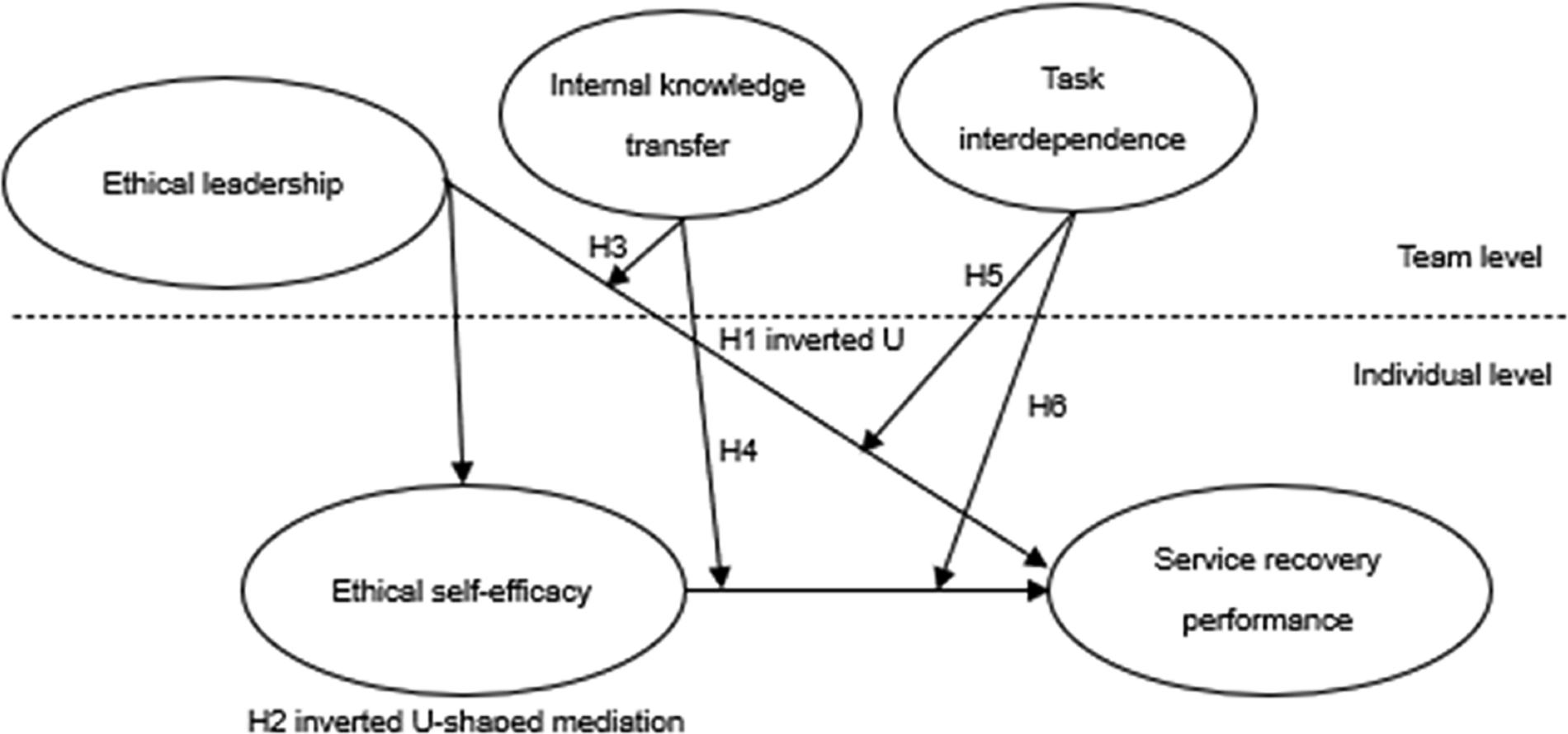
Research model.
Second, ethical leaders establish and communicate norms as well as encourage and support employees to act appropriately and ethically, thereby fostering their confidence in such a capacity, which is a personal determinant we refer to as ethical self-efficacy (Fischbach 2015). Consequently, we argue that ethical self-efficacy serves as a pivotal-mediating mechanism in channeling ethical leadership into service recovery performance.
Third, we delve into the critical consideration of when ethical leadership is most effective in fostering service recovery performance. SCT suggests that agentic moral functioning arises from the interplay between personal attributes and the prevailing social context (Bandura 1986, 1989, 2009). The prominence of ethical leadership in shaping service recovery performance may thus depend on contextual factors. These contextual elements are captured within our model through the constructs of internal knowledge transfer and task interdependence. Teams characterized by high degrees of internal knowledge transfer tend to encourage frequent knowledge exchange among employees, thus enhancing their awareness of ethical standards and how to enact ethical actions. Similarly, teams exhibiting a high degree of task interdependence may create more opportunities for employees to interact with their ethical leaders and colleagues, fostering a deeper understanding of ethical standards and values through collaborative task-related interactions (Fortin et al. 2016). Therefore, we propose that these contextual factors serve as important boundary conditions, influencing how employees interpret and respond to moral cues conveyed by ethical leadership, thereby shaping their service recovery performance.
Curvilinear Relationship Between Ethical Leadership and Service Recovery Performance
Recovering service failures is key to reducing customer dissatisfaction and mitigating customer loss. Service recovery performance refers to an employee’s ability and actions to rectify service failures and restore customer satisfaction (Babakus et al. 2003). It also refers to problem-solving interactions between frontline service employees and customers (Marinova et al. 2018). Actions taken by employees, such as effectively communicating solutions to service issues and expressing empathy for service failures (Roschk et al. 2023), play a crucial role in employee-customer relationships. Consequently, employees’ service recovery performance contributes to sustaining good relationships with customers, benefiting customer loyalty and further achieving service excellence (Luo et al. 2019). Additionally, service recovery allows employees to learn from service failures and improves their ability to complete future service tasks successfully (Hall and Hyodo 2022). Therefore, it is salient to investigate the triggers of service recovery performance in service-centered organizations.
In service management literature, ethical leadership emphasizes addressing customers’ service needs and prioritizing their interests by improving service quality and recovering service failures, rather than emphasizing short-term profitability (Frisch and Huppenbauer 2014). In Supplemental Appendix B, we compare ethical leadership with other potential antecedents, including various leadership styles (e.g., servant leadership and transformational leadership) and ethical climate, to justify the selection of ethical leadership as a key antecedent of service recovery performance.
In the current study, we propose a curvilinear (inverted U-shaped) relationship between ethical leadership and service recovery performance. In service-oriented teams, managers who exhibit low to intermediate levels of ethical leadership tend to be more sensitive to ethical standards in their work, rather than focusing solely on short-term profitability (Frisch and Huppenbauer 2014). Ethical leadership can serve as a contextual factor that influences individual behavior by shaping individual cognition. Hence, employees are likely to trust their managers because of their ethical conduct and learn to act ethically when serving customers. This includes prioritizing customers’ interests by effectively addressing service failures and complaints to ensure customer satisfaction. Therefore, service recovery performance is enhanced when ethical leadership ranges from low to intermediate levels.
Nevertheless, managers exhibiting intermediate to high levels of ethical leadership tend to require employees to strictly adhere to ethical norms and standards (Brown et al. 2005). As a result, employees are more rigidly influenced by their managers to comply with the code of ethics, making them less likely to flexibly and appropriately resolve service failures based on customers’ individualized demands and characteristics (Feng et al. 2018). Consequently, intermediate to high levels of ethical leadership can diminish service recovery performance. Taken together, ethical leadership exerts a curvilinear (inverted U-shaped) effect on service recovery performance. We thus propose that:
Hypothesis 1. There is a curvilinear (inverted U-shaped) relationship between ethical leadership and service recovery performance.
Curvilinear Mediating Effect of Ethical Self-Efficacy
Derived from the general concept of self-efficacy (Bandura et al. 1988), ethical self-efficacy is defined as “people’s beliefs in their own capabilities to mobilize their motivation, resources, and actions in an ethical manner” (Huang and Lin 2019, 34). In Supplemental Appendix C, we justify the selection of ethical self-efficacy as a mediator in the curvilinear relationship between ethical leadership and service recovery performance by comparing it with customer orientation, which is another potential mediator.
As discussed above, ethical leadership emphasizes that managers act as role models to behave ethically and encourage their employees to follow high ethical standards to achieve ethical work outcomes (Brown et al. 2005). When managers act ethically, employees tend to internalize these ethical values and behaviors, adjust their cognitive frameworks to prioritize ethics, and exert more effort in ethical conduct. This process enhances their confidence in their ability to behave ethically, thereby improving their ethical self-efficacy. Therefore, ethical leadership may foster ethical self-efficacy.
In a service-oriented context, when employees’ ethical self-efficacy varies from low to intermediate levels, they are inclined to treat customers and ethically address their needs and concerns (Fischbach 2015). This focus leads employees to fairly address customers’ feedback and complaints by sincerely admitting their service failures and proactively recovering them (Frisch and Huppenbauer 2014). As a result, these employees are more attentive to customers’ feedback and complaints, proactively identifying and addressing service issues, admitting their mistakes, and putting in extra effort to resolve service failures. Therefore, as ethical self-efficacy increases from low to intermediate levels, service recovery performance might be enhanced.
According to Brockner (1988), individuals with low general self-efficacy are more susceptible to external situations, while those with high general self-efficacy often become overconfident and less attentive to feedback and suggestions from others. In a service-centered context, employees with intermediate to high levels of ethical self-efficacy, which is a specific form of general self-efficacy, may become overly confident in their ability to serve customers appropriately and morally. Hence, their solutions to service issues, though ethical, may not adequately address customers’ needs and interests. Overconfident individuals tend to rely heavily on their own knowledge and perspectives, often disregarding input from others (e.g., suggestions from colleagues regarding service solutions and advice from customers regarding customized service solutions) and failing to thoroughly explore external factors (Lee et al. 2019). Thus, intermediate to high degrees of ethical self-efficacy may attenuate service recovery performance. Overall, ethical self-efficacy may exert a curvilinear (inverted U-shaped) effect on service recovery performance.
Given that ethical leadership enhances ethical self-efficacy and ethical self-efficacy has a curvilinear (inverted U-shaped) effect on service recovery performance, it can be concluded that ethical self-efficacy curvilinearly mediates the relationship between ethical leadership and service recovery performance. Based on this, the following hypothesis is framed:
Hypothesis 2. Ethical self-efficacy has a curvilinear (inverted U-shaped) mediating effect on the relationship between ethical leadership and service recovery performance, such that ethical leadership is positively related to ethical self-efficacy and an intermediate degree of ethical self-efficacy predicts the highest degree of service recovery performance.
Moderating Role of Internal Knowledge Transfer
Internal knowledge transfer refers to the exchange of work-related information within organizations or teams to enhance efficiency and performance (Molina et al. 2007). This process facilitates the efficient dissemination of knowledge among employees, such as work policies, procedures, and goals, thereby benefiting organizational and team operation efficiency (Molina et al. 2007). In Supplemental Appendix D, we compare internal knowledge transfer with other potential variables (i.e., intra-firm communication and collaborative feedback) to justify the selection of internal knowledge transfer as a moderator behind service recovery performance.
In service-focused teams with high levels of internal knowledge transfer, employees frequently exchange policies, work-related and customer-related information, and their own experiences (Molina et al. 2007). Internal knowledge transfer enhances employees’ understanding of workplace ethical values and standards, as well as the expected ethical actions. With a strong cognition and belief in ethical standards, shaped through internal knowledge transfer, employees are more likely to value ethical leadership from managers and internalize these ethical values. This results in a more pronounced effect of ethical leadership on its outcomes. As previously posited, ethical leadership exerts a curvilinear (inverted U-shaped) impact on service recovery performance, with an intermediate level of ethical leadership predicting the highest performance. Thus, at higher levels of internal knowledge transfer, an intermediate level of ethical leadership has a more pronounced effect on service recovery performance compared to lower levels of internal knowledge transfer.
Moreover, situational factors (e.g., internal knowledge transfer) can moderate individuals’ decisions about their ethical behaviors (Lussier et al. 2022). In service-oriented teams, high levels of internal knowledge transfer help employees better understand the ethical standards emphasized by their teams and expected by ethical managers. Influenced by ethical leadership, employees are more likely to invest efforts in recovering services when they recognize the values of ethical leadership and understand its importance in service recovery performance through internal knowledge transfer. Consequently, their service recovery performance is more likely to be influenced by ethical leadership. As proposed earlier, there is a curvilinear (inverted U-shaped) link between ethical leadership on service recovery performance, with performance peaking at an intermediate level of ethical leadership. Consequently, internal knowledge transfer might be a moderator strengthening the curvilinear relationship between ethical leadership and service recovery performance. Hence, the following hypothesis is formulated:
Hypothesis 3. Internal knowledge transfer moderates the curvilinear (inverted U-shaped) relationship between ethical leadership and service recovery performance, such that this curvilinear relationship is stronger when there are higher rather than lower degrees of internal knowledge transfer.
In service-centered teams with high levels of internal knowledge transfer, employees tend to be influenced by this contextual factor and actively share service-related knowledge and experiences with teammates (Molina et al. 2007). In these teams, employees not only acquire more knowledge and skills when serving customers but also gain valuable insights into customers’ interests and demands. Consequently, they recognize the importance of investing their own resources, such as ethical self-efficacy, in service recovery efforts. This results in a stronger impact of ethical self-efficacy on service recovery performance. As previously proposed, ethical self-efficacy exerts a curvilinear (inverted U-shaped) impact on service recovery performance. Therefore, it can be concluded that the curvilinear (inverted U-shaped) impact of ethical self-efficacy on service recovery performance is positively moderated by internal knowledge transfer.
Additionally, situational factors such as internal knowledge transfer can moderate individuals’ ethical decision-making processes when these factors align with individual attributes like ethical self-efficacy (Lussier et al. 2022). In teams with higher levels of internal transfer knowledge, employees might gain a deeper understanding and appreciation of ethical standards and norms in customer service. Thus, employees with high ethical self-efficacy are more likely to find these standards and norms align with their personal ethical values (Huang and Lin 2019). This alignment enhances the influence of ethical self-efficacy on their outcomes. Given the potential curvilinear (inverted U-shaped) relationship between ethical self-efficacy and service recovery performance, we propose that internal knowledge transfer may strengthen this curvilinear relationship. We therefore hypothesize that:
Hypothesis 4. Internal knowledge transfer moderates the curvilinear (inverted U-shaped) relationship between ethical self-efficacy and service recovery performance, such that this curvilinear relationship is stronger when there are higher rather than lower degrees of internal knowledge transfer.
Moderating Role of Task Interdependence
Task interdependence is defined as the degree to which “group members interact and depend on one another to accomplish the work” (Campion et al. 1993, 827). High levels of task interdependence indicate that employees work in an interdependent manner to complete team tasks, whereas low levels reflect a more independent approach. In service-centered organizations, delivering and recovering services to achieve customer satisfaction relies not only on individual efforts but also on collaboration in executing interdependent tasks (Yang et al. 2022). Therefore, task interdependence is essential and highly valued in service-oriented organizations.
In service-focused teams, when managers adopt ethical leadership, they act as role models and encourage employees to uphold high ethical standards in customer service. Task interdependence, which involves employees’ mutual support to complete work tasks in an interdependent manner and promotes frequent interactions within teams (Campion et al. 1993), enhances these dynamics. In teams with higher task interdependence, employees have more opportunities to interact with their ethical managers and understand ethical standards through their interactions with them. Consequently, task interdependence can act as a moderator, which strengthens the curvilinear (inverted U-shaped) effect of ethical leadership on service recovery performance.
Furthermore, task interdependence helps employees understand ethical values as they interact with both their ethical managers and colleagues. This interaction fosters a recognition of the importance of ethical leadership in serving customers effectively. Consequently, ethical leadership exerts a stronger impact on its outcomes in environments characterized by higher levels of task interdependence. Given our proposition that ethical leadership serves as an antecedent that curvilinearly predicts service recovery performance, task interdependence may serve as a positive moderator of the curvilinear relationship between ethical leadership and service recovery performance. Therefore, this study postulates that:
Hypothesis 5. Task interdependence moderates the curvilinear (inverted U-shaped) relationship between ethical leadership and service recovery performance, such that this curvilinear relationship is stronger when there are higher rather than lower degrees of task interdependence.
Task interdependence enables mutual support through frequent communication and interactions within teams (Anand et al. 2018). In service-oriented teams with higher degrees of interdependence, employees are more likely to obtain valuable service-related resources, such as support and feedback for serving customers and recovering services, through intensive communication and interactions with colleagues. The conversion of ethical self-efficacy into actions, such as service recovery, is influenced by contextual factors like support and feedback from colleagues. Specifically, through interactions facilitated by task interdependence, employees can learn from others’ ethical values, such as prioritizing customers’ interests, and expand their cognitive framework of ethical self-efficacy. Furthermore, task interdependence enables employees to acquire the experiences and skills necessary for serving customers and addressing service failures to achieve utmost customer satisfaction. Accordingly, task interdependence positively moderates the curvilinear (inverted U-shaped) effect of ethical self-efficacy on service recovery performance. Thus, we posit that:
Hypothesis 6. Task interdependence moderates the curvilinear (inverted U-shaped) relationship between ethical self-efficacy and service recovery performance, such that this curvilinear relationship is stronger when there are higher rather than lower degrees of task interdependence.
Overview of Studies
To comprehensively assess employees’ service recovery performance from both managerial and customer viewpoints, we conducted two independent studies to validate our research model. In Study 1, we utilized multi-waved and multi-sourced data (i.e., two-waved dyadic data collected from managers and employees) to validate the model in which employees’ service recovery performance was assessed by their corresponding managers. In Study 2, we employed multi-sourced data (i.e., triadic data gathered from managers, employees, and customers), which allowed us to validate the model where employees’ service recovery performance was evaluated by their corresponding customers.
Study 1
Methods
Sample and Procedures
In Study 1, we chose to collect data from hotels as our research context to investigate service recovery performance. Hotels were selected because they prioritize customer satisfaction by continuously improving service quality and effectively addressing service issues, such as resolving complaints and rectifying service failures. This commitment is crucial for maintaining competitiveness and ensuring business success in the dynamic and uncertain industrial environment. Our data collection focused on hotels in China. Leveraging our existing connections with twelve hotels, we expanded our network to include seventy-five Chinese hotels. Of these, human resource managers of fifty-four Chinese hotels agreed to participate in this study and provided relevant information about the managers and their employees. Given our emphasis on service recovery performance, we specifically collected data from managers and employees from frontline service teams in these fifty-four hotels.
To ensure data quality, attention check items were strategically embedded within both the manager and employee questionnaires. The attention check items were scattered throughout both manager and employee questionnaires. Participants who failed these checks were promptly excluded from further participation in the study. As we employed a multi-sourced and multi-waved approach for data collection, matching codes were utilized to link manager and employee data, as well as to match data collected from different waves. To uphold anonymity and confidentiality, all the matching codes were permanently deleted upon finalizing the dataset. Our final dataset comprised multiple waves and levels, encompassing 409 valid dyadic responses from fifty-three managers and their 409 employees across two distinct time points. Detailed procedures regarding data collection are provided in Supplemental Appendix E.
Measures
The questionnaires were initially prepared in English and then translated into Chinese using back translation procedure. All scales employed five-point Likert scales ranging from 1 (strongly disagree) to 5 (strongly agree). Detailed psychometric properties of Study 1 are presented in Supplemental Appendix F.
Consistent with recent multilevel design studies (e.g., Radanielina-Hita et al. 2023), variables in the research model were measured at both team and individual levels. Ethical leadership, a team-level variable, was measured using the ten-item scale by Brown et al. (2005). Service recovery performance, an individual-level variable, was assessed with the five-item scale by Babakus et al. (2003). Huang and Lin’s (2019) four-item scale was applied to measure ethical self-efficacy, which is an individual-level variable. Internal knowledge transfer, a team-level variable, was estimated with the five-item scale by Molina et al. (2007), while task interdependence, also a team-level variable, was measured using Campion et al.’s (1993) three-item scale.
The study included several control variables: age, gender, educational level, and tenure of employee, all at the individual level. Additionally, variables that could potentially influence service recovery performance were included as control variables. These comprised three team-level control variables (i.e., transformational leadership, servant leadership, and ethical climate) and one individual-level control variable (i.e., customer orientation). Transformational leadership was measured using the seven-item scale by Carless et al. (2000). Servant leadership was assessed with Liden et al.’s (2015) seven-item scale. Ethical climate was evaluated using Mulki and Lassk’s (2019) five-item scale, and customer orientation was measured using Kumar et al.’s (1998) six-item scale.
Common Method Variance
To reduce the impact of common method variance (CMV), we applied a multi-sourced and time-lagged data collection approach. After collecting the data, we assessed the influence of CMV using Harman’s one-factor test. Harman’s test showed that the percentage of variance accounted for by a single factor was 33.01%. Thus, CMV did not affect our data.
Aggregation
Following Preacher et al. (2010), we ensured that individual-level data on ethical leadership and internal knowledge transfer were nested within team units by calculating intraclass correlations (i.e., ICC(1) and ICC(2)), and Rwg(j). The ICC(1), ICC(2), and Rwg(j) values for ethical leadership were 0.21, 0.68, and 0.67 respectively, and for internal knowledge transfer were 0.32, 0.79, and 0.76 respectively, supporting the aggregation to the team level. Similarly, we assessed the aggregation of data for the team-level control variables of transformational leadership, servant leadership, and ethical climate were collected from employees. The ICC(1), ICC(2), and Rwg(j) values for transformational leadership were 0.38, 0.83, and 0.76 respectively; for servant leadership were 0.24, 0.71, and 0.73 respectively; and for ethical climate were 0.37, 0.82 and 0.77 respectively, all supporting data aggregation.
Analytical Strategies
We conducted several confirmatory factor analyses (CFAs) to assess the factor loadings of each scale item and to evaluate the model fits of both the hypothesized research model and alternative models. We then conducted multilevel structural equation modeling (MSEM) to test the hypotheses and validate the multilevel research model. Both CFAs and MSEM were performed using Mplus version 8.10.
Results
Normality, Reliability and Multicollinearity
The skewness range of our data was −1.35 to 1.44, which falls within the suggested range of −2 to 2 (Hair et al. 2019). The kurtosis range was −1.82 to 1.55 also within Hair et al.’s (2019) recommended range of −7 to 7. These satisfactory skewness and kurtosis values indicate that our data was normally distributed. As detailed in Supplemental Appendix F, all Cronbach α values exceeded the 0.70 thresholds suggested by DeVellis (2017), indicating that every scale in this study had adequate scale reliability. The highest VIF was 1.44, below the highest acceptable value of five (Hair et al. 2019). The lowest tolerance was 0.69, surpassing the minimum requirement of 0.30 (Hair et al. 2019). These satisfactory VIF and tolerance values indicated that there was no multicollinearity in our data.
Convergent and Discriminant Validity
As shown in Table 1, all composite reliability (CR) and average variance extracted (AVE) values respectively surpassed the cut-off values of 0.70 and 0.50 (Hair et al. 2019), revealing satisfactory convergent validity. Furthermore, the square root of each variable’s AVE was greater than its correlations with other variables (Table 1), satisfying Fornell and Larcker’s (1981) criterion and thus supporting discriminant validity.
Descriptive Statistics, Correlations, and Reliabilities (Study 1).
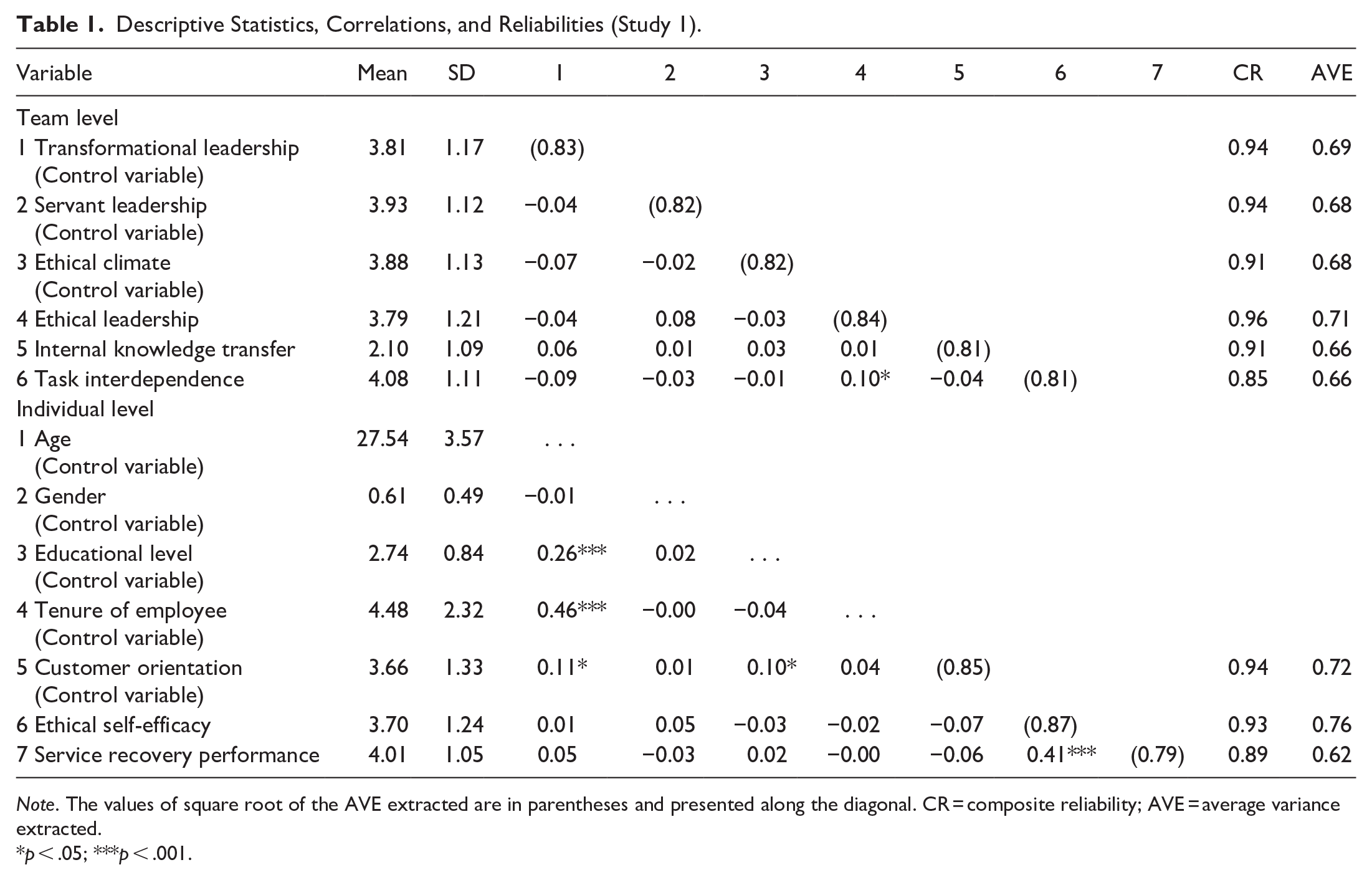
Note. The values of square root of the AVE extracted are in parentheses and presented along the diagonal. CR = composite reliability; AVE = average variance extracted.
p < .05; ***p < .001.
Measurement Models
As presented in Supplemental Appendix G, the hypothesized model demonstrated the best model fit indices compared to alternative models that combined some or all the variables (χ2/df = 435.05/314 = 1.39; Root Mean Square Error of Approximation [RMSEA] = 0.031 (90% CI [0.023, 0.037]); Standardized Root Mean Square Residual [SRMR] = 0.03; Comparative Fit Index [CFI] = 0.99; Tucker–Lewis Index [TLI] = 0.98). This indicated that the five-factor hypothesized model had the best model structure. Moreover, the model fits of the alternative models deteriorated as more variables were combined, further supporting the discriminant validity of the hypothesized model.
Model Validation
Direct curvilinear analysis (Hypothesis 1)
As shown in Table 2, squared ethical leadership negatively affected service recovery performance (β = −0.35, p < 0.001), indicating a curvilinear (inverted U-shaped) effect and thus supporting Hypothesis 1. Moreover, the linear effect of ethical leadership on service recovery performance was positive (β = 0.47, p < 0.001). By utilizing these results, we plotted this curvilinear effect in Figure 2, which further confirmed the inverted U-shaped relationship between ethical leadership and service recovery performance.
Model Validation Results (Study 1).
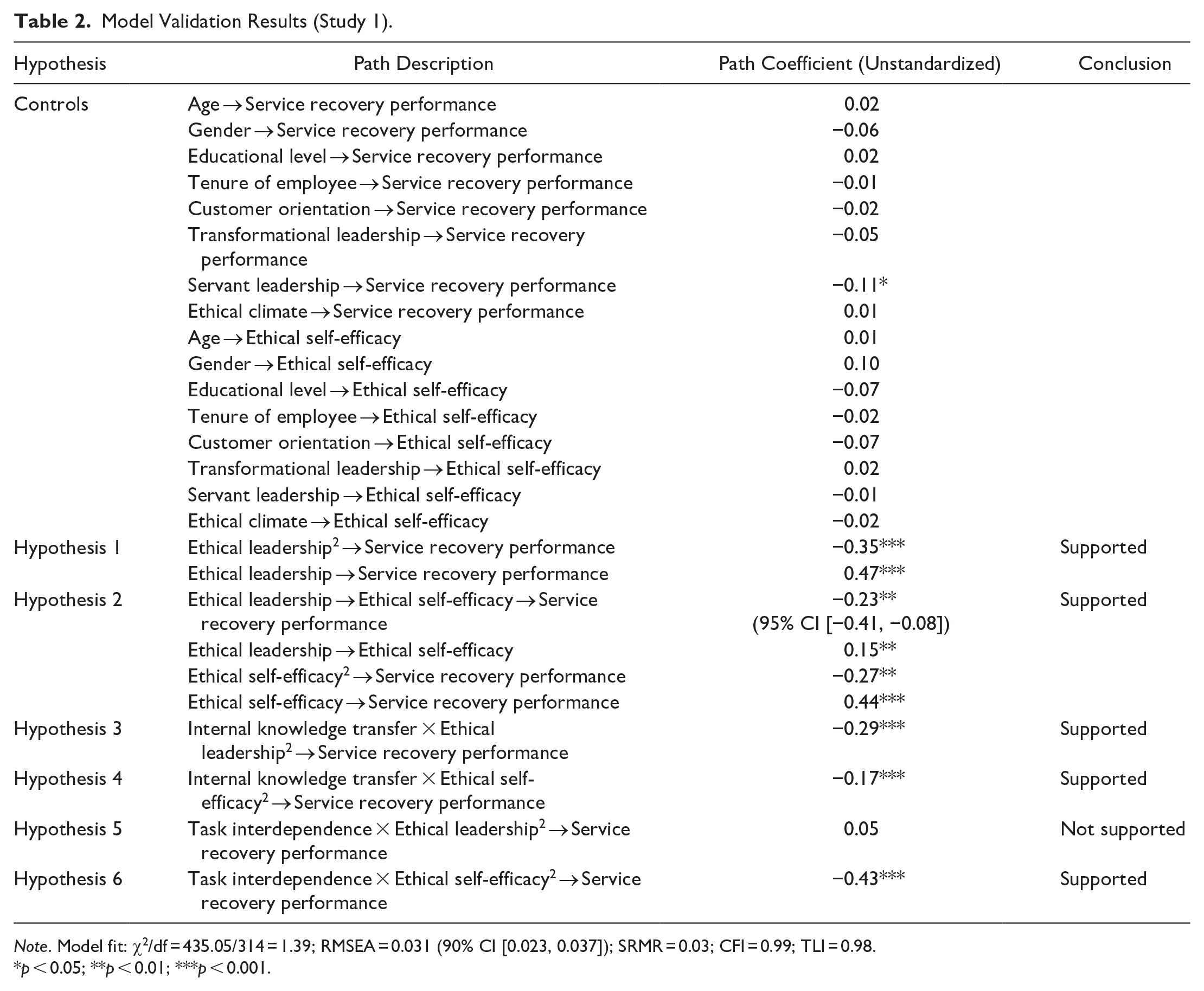
Note. Model fit: χ2/df = 435.05/314 = 1.39; RMSEA = 0.031 (90% CI [0.023, 0.037]); SRMR = 0.03; CFI = 0.99; TLI = 0.98.
p < 0.05; **p < 0.01; ***p < 0.001.
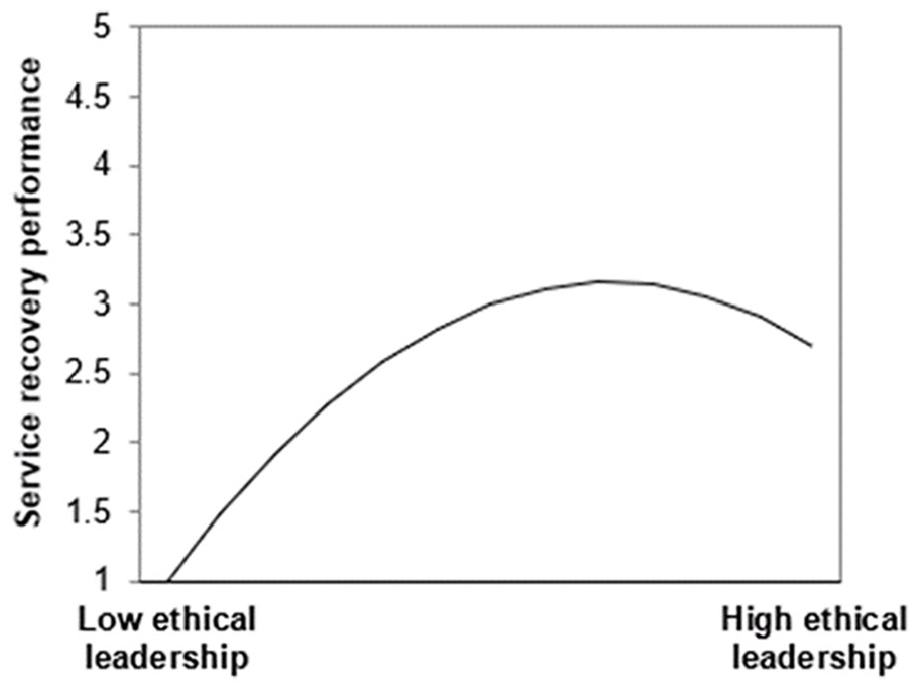
The curvilinear relationship between ethical leadership and service recovery performance (Study 1).
Mediation analysis (Hypothesis 2)
Ethical leadership positively affected ethical self-efficacy (β = 0.15, p < 0.01). Squared ethical self-efficacy was negatively associated with service recovery performance (β = −0.27, p < 0.01), indicating a curvilinear (inverted U-shaped) effect. Moreover, the linear effect of ethical self-efficacy on service recovery performance was positive (β = 0.44, p < 0.001). By using these results, we plotted this curvilinear effect in Figure 3, which further confirmed the curvilinear relationship between ethical self-efficacy and service recovery performance.

The curvilinear relationship between ethical self-efficacy and service recovery performance (Study 1).
Given the observed significant positive relationship between ethical leadership and ethical self-efficacy as well as the significant curvilinear (inverted U-shaped) relationship between ethical self-efficacy and service recovery performance, we proceeded to test the curvilinear mediation mechanism of ethical self-efficacy between ethical leadership and service recovery performance. As ethical leadership was a team-level variable, and ethical self-efficacy and service recovery performance were individual-level variables, this mediation was a 2-1-1 mediation and the mediating effect occurred at the upper level (i.e., the team level) (Rockwood 2019).
Moreover, as the second phase of this mediation involved a curvilinear relationship between ethical self-efficacy and service recovery performance, we followed Hayes and Preacher’s (2010) recommendation for estimating non-linear mediation when running 2-1-1 mediation through MSEM with random slopes for latent covariates (Rockwood 2019) using Mplus 8.10. The result, based on Monte Carlo bootstrap simulation with 20,000 replications, showed that the estimate of the curvilinear indirect effect was −0.23 (95% CI [−0.41, −0.08]). Since zero was not within the confidence interval, it indicated a significant curvilinear mediating effect, thus supporting Hypothesis 2. Additionally, because both the direct curvilinear relationship (Hypothesis 1) and the indirect curvilinear relationship via ethical self-efficacy (Hypothesis 2) were significant simultaneously, this curvilinear mediation was identified as a partial mediation.
Moderation analyses (Hypothesis 3 to 6)
The interaction between internal knowledge transfer and squared ethical leadership attenuated service recovery performance (β = −0.29, p < 0.001), revealing that internal knowledge transfer served as a moderator, supporting Hypothesis 3. As shown in Figure 4a within Figure 4, the curvilinear effect of ethical leadership on service recovery performance became stronger when there were higher rather than lower degrees of internal knowledge transfer, and an intermediate degree of ethical leadership was related to the highest degree of service recovery performance when there were higher (+1SD) rather than lower (−1SD) degrees of internal knowledge transfer, further supporting Hypothesis 3.
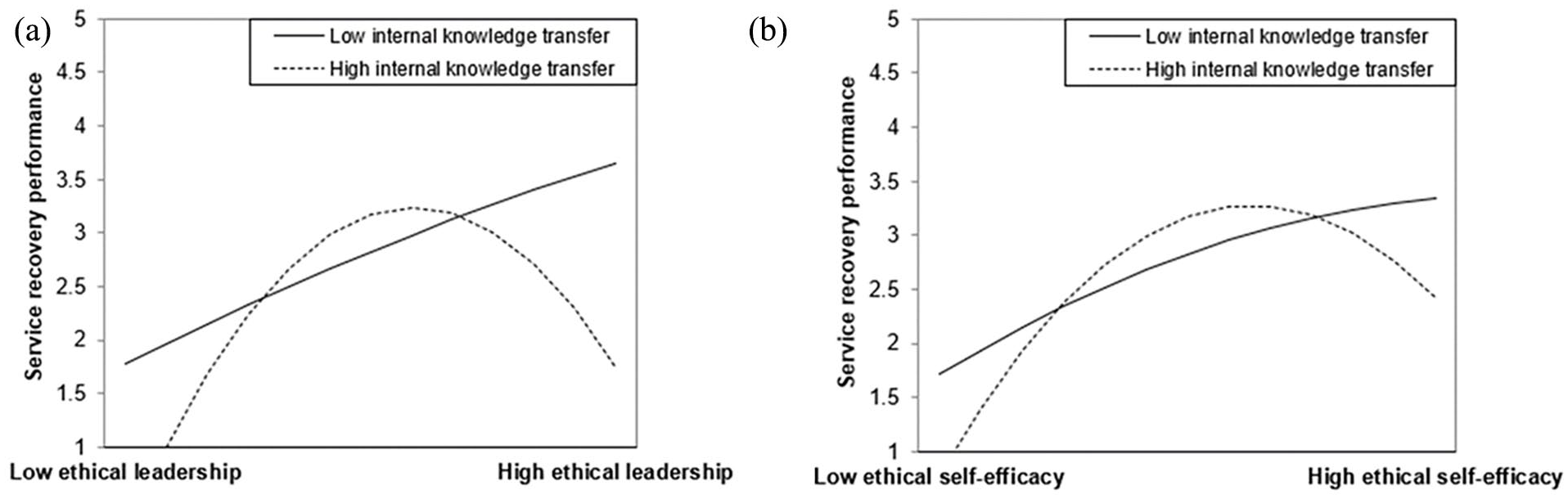
The moderating effects of internal knowledge transfer (Study 1). (a) the moderating effect of internal knowledge transfer on the curvilinear relationship between ethical leadership and service recovery performance (Study 1). (b) The moderating effect of internal knowledge transfer on the curvilinear relationship between ethical self-efficacy and service recovery performance (Study 1).
The interaction between internal knowledge transfer and squared ethical self-efficacy was negatively related to service recovery performance (β = −0.17, p < 0.001), indicating that internal knowledge transfer acted as a moderator, thereby supporting Hypothesis 4. As illustrated in Figure 4b within Figure 4, the curvilinear effect of ethical self-efficacy on service recovery performance was stronger when there were higher rather than lower degrees of internal knowledge transfer. Moreover, an intermediate degree of ethical self-efficacy was linked to the highest degree of service recovery performance when there were higher (+1SD) rather than lower (−1SD) degrees of internal knowledge transfer, further supporting Hypothesis 4.
The interaction between task interdependence and squared ethical leadership was not significantly associated with service recovery performance (β = 0.05, p > 0.05), indicating that task interdependence was not a moderator. Hypothesis 5 was not supported.
Nonetheless, the interaction between task interdependence and squared ethical self-efficacy exerted a significant negative impact on service recovery performance (β = −0.43, p < 0.001), supporting Hypothesis 6. As shown in Figure 5, the curvilinear effect of ethical self-efficacy on service recovery performance was stronger when there were higher rather than lower degrees of task interdependence, and an intermediate degree of ethical self-efficacy was related to the highest degree of service recovery performance when there were higher (+1SD) rather than lower (−1SD) degrees of task interdependence, which further advocated Hypothesis 6.

The moderating effect of task interdependence (Study 1).
Effects of control variables
To validate the robustness of the effects of ethical leadership on the dependent variables (i.e., service recovery performance and ethical self-efficacy), several variables were controlled. As shown in Table 2, only servant leadership was significantly related to service recovery performance (β = −0.11, p < 0.05). Age, gender, educational level, tenure of employee, customer orientation, transformational leadership, and ethical climate did not significantly influence service recovery performance (all p’s > 0.05). Similarly, all the control variables (i.e., age, gender, educational level, tenure of employees, customer orientation, transformational leadership, servant leadership, and ethical climate) were not significantly associated with ethical self-efficacy (all p’s > 0.05).
Based on the effects observed for these control variables, it could be concluded that in comparison to other types of leadership, as well as ethical climate and customer orientation, ethical leadership demonstrated significant and stronger effects on ethical self-efficacy and service recovery performance. Therefore, selecting ethical leadership as the independent variable for the research model was deemed appropriate. Detailed information regarding the effects of the control variables is provided in Supplemental Appendix I.
Study 2
Recognizing the significance of customers’ perspectives in reflecting employees’ service recovery performance, we measured service recovery performance from the customer perspective in Study 2 (e.g., Hall and Hyodo 2022; Roschk et al. 2023). By utilizing multi-sourced data (i.e., triadic data gathered from managers, employees and customers of IT service organizations) with the service recovery performance data provided by customers, we aimed to empirically strengthen the validity of the results obtained in Study 1. All the details of Study 2, including sample, procedures, methods and results, were outlined in Supplemental Appendix H.
Results
Direct Curvilinear Analysis (Hypothesis 1)
As shown in Table 3, Squared ethical leadership was found to diminish service recovery performance (β = −0.26, p < 0.001), indicating a curvilinear (inverted U-shaped) effect and thus supporting Hypothesis 1.
Model Validation Results (Study 2).
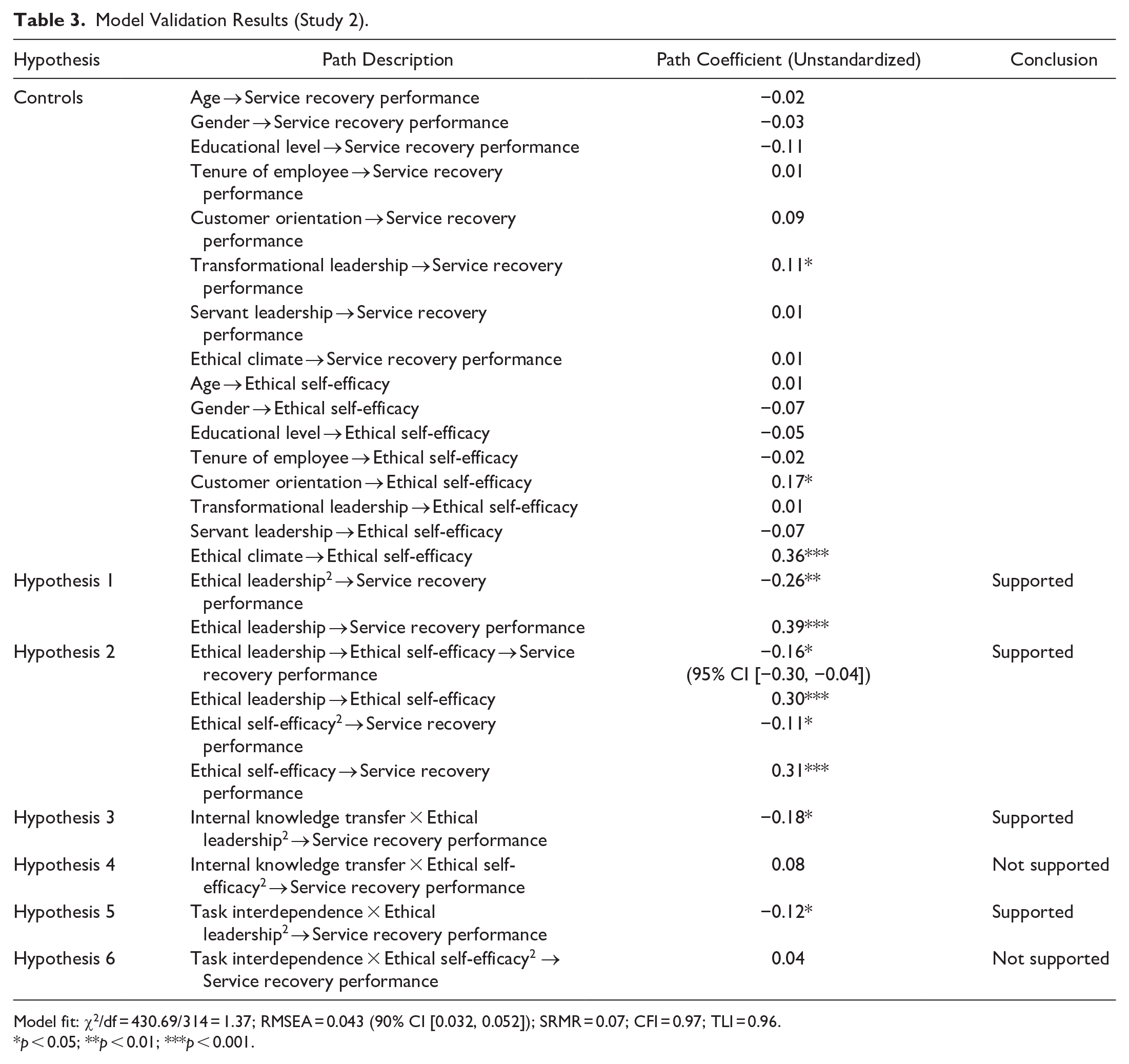
Model fit: χ2/df = 430.69/314 = 1.37; RMSEA = 0.043 (90% CI [0.032, 0.052]); SRMR = 0.07; CFI = 0.97; TLI = 0.96.
p < 0.05; **p < 0.01; ***p < 0.001.
Mediation Analysis (Hypothesis 2)
Ethical leadership was found to foster ethical self-efficacy (β = 0.30, p < 0.001). Furthermore, squared ethical self-efficacy was negatively associated with service recovery performance (β = −0.11, p < 0.05), indicating a curvilinear (inverted U-shaped) effect. Using the same mediation analytical approach in Study 1, we estimated the curvilinear indirect effect of ethical self-efficacy on the relationship between ethical leadership and service recovery performance. The result, based on Monte Carlo bootstrap simulation with 20,000 replications, revealed that the curvilinear indirect effect of ethical leadership on service recovery performance via ethical self-efficacy was −0.16 (95% CI [−0.30, −0.04]). As zero was not within the confidence interval, it indicated a significant curvilinear mediation, thus advocating Hypothesis 2. Additionally, because both the direct curvilinear relationship (Hypothesis 1) and the indirect curvilinear relationship via ethical self-efficacy (Hypothesis 2) were simultaneously significant, this curvilinear mediation was identified as a partial mediation.
Moderation Analyses (Hypothesis 3 to 6)
The interaction between internal knowledge transfer and squared ethical leadership was found to attenuate service recovery performance (β = −0.18, p < 0.05), supporting Hypothesis 3. Nevertheless, the interaction of internal knowledge transfer and squared ethical self-efficacy was not significantly related to service recovery performance (β = 0.08, p > 0.05). Thus, Hypothesis 4 was not supported. Similarly, the interaction of task interdependence and squared ethical leadership decreased service recovery performance (β = −0.12, p < 0.05), supporting Hypothesis 5. However, the interaction of task interdependence and squared ethical self-efficacy was not significantly associated with service recovery performance (β = 0.04, p > 0.05). Hence, Hypothesis 6 was not supported. We provided detailed information regarding the effects of control variables in Supplemental Appendix I.
Discussion
Theoretical Implications
This study makes various crucial contributions to the service recovery literature. First, while previous research has examined the role of leadership in the context of service failures (e.g., Luu 2020), the influence of ethical leadership on service recovery, particularly in service-oriented industries, has been rarely explored, as indicated in Supplemental Appendix A. Furthermore, inconsistencies are found regarding positive and negative associations of leadership with service recovery (e.g., Luo et al. 2019; Punjaisri et al. 2013). Given the importance of ethical leadership in maintaining fairness when addressing customer complaints in the context of service failures, it is essential to address the aforementioned gaps. The significance of these gaps is further highlighted by the calls from Eluwole et al. (2022) and Hoang, Giang et al. (2023) to explore the nuanced effects of ethical leadership in the service context. The current study bridges such research gaps and advances the service recovery literature by unearthing the mechanisms through which ethical leadership curvilinearly shapes employees’ service recovery performance. Through such a finding, the present research also extends some prior studies that have unpacked “too-much-of-a-good-thing” effect in ethical leadership on undermining some employee positive outcomes (e.g., creativity [Mo et al. 2019)).
Second, studies in the context of service recovery have largely concentrated on relationship-oriented variables, such as trust in the organization (Eluwole et al. 2022) and perceived organizational virtuousness (Ma et al. 2022), in mediating the linear effects of leadership in general or ethical leadership on service recovery performance. Given the importance of exploring nuanced mechanisms underlying the effects of ethical leadership in the service context (Eluwole et al. 2022; Hoang, Giang et al. 2023) beyond relationship-oriented mechanisms, and recent findings highlighting the significance of curvilinear effects of self-efficacy (Lee et al. 2019), the current study addresses this crucial gap in the service recovery literature by complementing the existing set of relationship-oriented mediation mechanisms with the mediating mechanism of employee confidence in acting ethically (i.e., ethical self-efficacy) to address issues experienced by customers. While relationship-oriented variables tend to linearly shape service recovery performance and linearly mediate leadership and service recovery performance, this study highlights ethical self-efficacy as an effective explanation on how ethical leadership curvilinearly shapes service recovery performance.
Third, this study advances our understanding of the effect of the social cognitive mechanism of ethical leadership on employees’ service recovery performance. Our findings support SCT by indicating that a social cognitive mechanism (i.e., ethical self-efficacy) can underpin the curvilinear association between ethical leadership and service recovery performance. Furthermore, while previous works have utilized SCT to formulate the linear effects of ethical leadership on employee service performance (e.g., Hoang et al. 2022), our study expands the use of this theory by casting light on the curvilinear links between ethical leadership/ethical self-efficacy and service recovery performance.
Additionally, our findings regarding the curvilinear effects of ethical leadership and ethical self-efficacy on service recovery performance support the principle of SCT (Bandura 1986, 1989) that posits moral agency as a self-regulatory system enabling agentic behaviors, such as service recovery performance, through scrutinizing and assessing internal standards and situational contexts cultivated by different levels of ethical leadership. Service recovery performance is most effectively enabled when this self-regulatory system finds ethical leadership and ethical self-efficacy reach an intermediate level.
Fourth, the current study extends the service recovery literature by uncovering contextual boundary conditions, namely internal knowledge transfer and task interdependence, for the curvilinear effects of ethical leadership and ethical self-efficacy on service recovery performance. These findings respond to calls for more attention to social boundary mechanisms in understanding how the effects of leadership (Afsar et al. 2019) or self-efficacy take shape (Jan et al. 2021). Study 1 reveals that the curvilinear effects of ethical leadership and ethical self-efficacy are strongest in a work environment where internal knowledge transfer is high. Hence, our findings indicate the need to rethink the largely held assumption that ethical leadership activates service recovery performance (Eluwole et al. 2022; Ma et al. 2022) or ethical self-efficacy leads to positive service behaviors (Yang et al. 2023). With the above findings on social boundary mechanisms, the current inquiry also extends few studies that have considered knowledge sharing as a moderator only for the linear effect of leadership or the general concept of self-efficacy in the context of innovative work behavior (e.g., Jan et al. 2021).
In addition to the moderating mechanism of internal knowledge transfer, the current study unveils that service recovery performance can be augmented by adopting an intermediate level of ethical self-efficacy (internal force) and high levels of task interdependence (compositional force). Accordingly, this study contributes to the service recovery literature by establishing task interdependence as a boundary condition of compositional force that may influence employees’ translation of their intermediate level of ethical self-efficacy into service recovery performance in Study 1. Employees with an intermediate level of ethical self-efficacy are more likely to engage in service recovery when, through high levels of task interdependence, they can learn effective ways from others to recover service failures in an ethical manner. Such a finding extends prior studies that have solely delved into the moderating role of task interdependence for the linear effects of self-efficacy in the context of victimization at work (Dadaboyev et al. 2019).
Nonetheless, no support was found for the moderating effect of task interdependence on the curvilinear effect of ethical leadership on service recovery performance in the hospitality industry (Study 1), nor for the moderating effects of task interdependence and internal knowledge transfer on the relationship between ethical self-efficacy and service recovery performance in the IT service industry (Study 2). The divergence in findings between the two studies can potentially be explained by the differing characteristics of these service industries. In Study 1, unlike the IT service industry, the hospitality industry tends to have stronger hierarchical relationships between leaders and employees. As a result, employees in this industry are more likely to be influenced by their ethical leaders rather than by their colleagues through task interdependence, leading to a non-significant moderating effect of task interdependence on the relationship between ethical leadership and service recovery performance in the hospitality industry compared to the IT service industry.
In Study 2, unlike the hospitality industry which requires interdependence and collaboration in service duties, interaction, and teamwork among members, employees in the IT service industry tend to work with individual customers on specific IT needs. Consequently, their decision to invest in ethical self-efficacy for service recovery performance may be less contingent on task interdependence in this industry. Furthermore, since knowledge workers in the IT service industry tend to rely on their expertise to create solutions, rather than on credential systems to establish their expertise, the manifestation of ethical self-efficacy in service recovery performance is less contingent on internal knowledge transfer compared to those in the hospitality industry.
Last, the current research advances the service recovery literature by adopting a manager-employee dyadic and multi-waved approach as well as a multilevel method in Study 1 and employing a manager-employee-customer triadic approach and a multilevel method in Study 2. Moreover, while prior studies in the service recovery literature have tended to undertake employee perspective (Luo et al. 2019) or manager perspective (Eluwole et al. 2022; Ma et al. 2022) to rate employees’ service recovery performance, our study adopts both manager and customer perspectives. This underscores the key roles of both managers and customers in rating employees’ service performance in general and service recovery performance in particular. Through gaining crucial insights into employee service recovery from the customer perspective (Study 2), the current research investigates service recovery through the customer lens and extends previous studies largely focusing on the manager perspective in assessing service recovery performance (Eluwole et al. 2022; Ma et al. 2022).
Practical Implications
The findings of this study unveil crucial insights for service-centered organizations seeking to promote employee engagement in service recovery efforts. First, our findings on the curvilinear (inverted U-shaped) effect of ethical leadership reveal that an imbalance in ethical leadership—either excessive or lacking—can have a detrimental effect on service recovery performance. To mitigate the adverse consequences of strong or weak ethical leadership on service recovery performance, we recommend that managers convey their appreciation for employees’ ethical values and approach employee behaviors with respect. In practice, this means that managers should make a concerted effort to show genuine care and commitment to assisting employees in upholding ethical standards in their roles. Managers should not only communicate the expected ethical standards but also engage in open discussions about how these standards are put into practice. By encouraging employee input and giving them a voice, managers can strengthen their rapport with their team and cultivate a sense of belonging, thus narrowing the perceived moral gap between employees and managers.
To further maximize service recovery performance among employees working under ethical leadership, these employees should be equipped with the necessary skills to adeptly handle customer complaints. This necessitates organizations to provide comprehensive training aimed at enhancing service employees’ problem-solving, interpersonal, and perspective-taking skills when handling customer complaints. Organizations should evaluate employees’ service performance based on their proficiency in service recovery, which could be sought from direct feedback from customers rather than solely relying on traditional cost efficiency metrics (Liao 2007). By implementing these strategies, organizations, and managers can cultivate an environment conducive to effective service recovery, thereby enhancing both employee engagement and customer satisfaction.
Second, the results highlight the curvilinear mediating effect of ethical self-efficacy on the relationship between ethical leadership and employee service recovery performance. Accordingly, managers should take proactive steps to bolster their employees’ ethical self-efficacy by both acknowledging and endorsing ethical conduct among employees. Nevertheless, it is crucial to strike a balance, as excessively elevated levels of ethical self-efficacy can potentially hinder service recovery performance. Therefore, managers should implement well-suited service strategies to guide their staff effectively. For example, to maintain an intermediate level of ethical self-efficacy within their team, managers should avoid rigidly imposing stringent ethical standards on the employees. Instead, they should foster a culture where employees are encouraged to actively engage with customers and colleagues, listening and learning from them to discover ethical solutions for addressing customer concerns. This approach aims to ensure the utmost satisfaction and the harmonization of interests among all parties involved.
Third, our research unpacked the moderating roles of internal knowledge transfer and task interdependence. To cultivate effective internal knowledge transfer, organizations should actively create channels, such as informal meetings and social media platforms, which facilitate the exchange of knowledge and information among employees. Managers play a critical role in this process by not only encouraging but also acknowledging employees’ active participation in the transfer of knowledge, particularly knowledge related to service recovery. Furthermore, organizations can promote personality traits, such as extroversion, proactiveness, and openness, among employees through targeted training programs. These traits serve to further stimulate the flow of knowledge and information within organizations and teams.
Furthermore, it is important to design team tasks in a manner that promotes interdependence and interactions among employees. For instance, in the food and beverages department of a hotel, tasks related to seating customers, taking orders, and food preparation should be interdependent and interactive. This design approach minimizes issues in the services delivered to customers. To ensure that employees are aware of the salience of interdependence among their tasks, organizations should invest in training and regular team meetings that emphasize the interconnected nature of their duties and responsibilities.
Limitations and Future Directions
Several limitations are acknowledged. First, although this study unpacks an intermediate level of ethical self-efficacy that predicts the highest level of service recovery performance, future research should explore whether employees with an intermediate level of ethical self-efficacy might perform better across various types of service failures from a customer perspective. Second, although this study controlled various individual and team factors, we did not include industry-level control variables. Future studies are advised to add industry-level control variables, such as industry type, labor intensity and industry service regulation, into the current model. Last, our data were collected from Chinese hospitality and IT service industries. Therefore, it may not be appropriate to generalize the research model validated by this study to other cultural and industrial backgrounds. Future studies should re-test the model using data from other countries (e.g., Australia and USA) to enhance the generalizability of our findings. Furthermore, future research is encouraged to explore how ethical leadership affects customers’ perceived effectiveness of service recovery across different industries.
Supplemental Material
sj-docx-1-jsr-10.1177_10946705241304221 – Supplemental material for Enhancing Service Recovery Performance Through Ethical Leadership: A Multilevel Curvilinear Investigation
Supplemental material, sj-docx-1-jsr-10.1177_10946705241304221 for Enhancing Service Recovery Performance Through Ethical Leadership: A Multilevel Curvilinear Investigation by Mingjun Yang, Tuan Trong Luu and Giang Hoang in Journal of Service Research
Supplemental Material
sj-docx-2-jsr-10.1177_10946705241304221 – Supplemental material for Enhancing Service Recovery Performance Through Ethical Leadership: A Multilevel Curvilinear Investigation
Supplemental material, sj-docx-2-jsr-10.1177_10946705241304221 for Enhancing Service Recovery Performance Through Ethical Leadership: A Multilevel Curvilinear Investigation by Mingjun Yang, Tuan Trong Luu and Giang Hoang in Journal of Service Research
Supplemental Material
sj-pptx-3-jsr-10.1177_10946705241304221 – Supplemental material for Enhancing Service Recovery Performance Through Ethical Leadership: A Multilevel Curvilinear Investigation
Supplemental material, sj-pptx-3-jsr-10.1177_10946705241304221 for Enhancing Service Recovery Performance Through Ethical Leadership: A Multilevel Curvilinear Investigation by Mingjun Yang, Tuan Trong Luu and Giang Hoang in Journal of Service Research
Footnotes
Acknowledgements
The authors would like to express their gratitude to the three anonymous reviewers for their insightful comments throughout the three rounds of review. The authors also wish to express their deepest appreciation to the Co-Editors of the Special Issue on “Smart Service Failure-Recovery,” Professor Yany Grégoire, Professor Katja Gelbrich, Professor Chiara Orsingher, and Professor Yves Van Vaerenbergh, for their invaluable guidance and steadfast support throughout the development of this paper.
Declaration of Conflicting Interests
The author(s) declared no potential conflicts of interest with respect to the research, authorship, and/or publication of this article.
Funding
The author(s) received no financial support for the research, authorship, and/or publication of this article.

Supplemental Material
Supplemental material for this article is available online.
Author Biographies
References
Supplementary Material
Please find the following supplemental material available below.
For Open Access articles published under a Creative Commons License, all supplemental material carries the same license as the article it is associated with.
For non-Open Access articles published, all supplemental material carries a non-exclusive license, and permission requests for re-use of supplemental material or any part of supplemental material shall be sent directly to the copyright owner as specified in the copyright notice associated with the article.
