




Abstract
The use of digital employees (DEs)—chatbots powered by artificial intelligence (AI)—is becoming increasingly common in the service industry. However, it is unclear whether collaborations between the human employee (HE) and DE can influence customer outcomes, and what the mechanisms behind such outcomes are. This research proposes and tests a theoretical model that explains how the communication of HE-DE collaboration in the form of interdependent behavioral cues can influence customer evaluations of the service they received from such a team. Five experimental studies involving a total of 1403 participants demonstrate that making HE-DE collaboration visible to customers during the service encounter can reinforce their perception of HE-DE team cohesiveness and service process fluency, driving satisfaction. The communication of coordination and team goal cues are two strong stimulants that strengthen such impressions. Further, this research also reveals that the HE-DE collaboration (vs. augmentation or substitution) appeals to customers thanks to their perception of a transparent process, which is induced through collaborative cues. This research provides theoretical implications for a transparent collaborative process between HE and DE and practical advice for firms seeking to integrate DE into their organizations’ workflows.
Keywords
Introduction
Many companies deploy digital employees (DEs) to coordinate with human employees (HEs) in service provision. Digital employees are robotic software powered by machine learning algorithms and artificial intelligence (AI). They are distinguishable from conventional chatbots such as FAQ bots, which are capable only of simulating conversations so that users feel as though they are talking to a human—they have a very limited capability for processing rule-based tasks. In contrast, DEs (e.g., Chatsonic; Microsoft 365 Co-pilot) are characterized by a high-level agency, which enables them to manage service processes autonomously, perform a wide range of complex tasks (e.g., scheduling meetings, processing incoming data, and coordinating with humans), and to make decisions independently. For instance, Stitch Fix—an online personal styling service—uses their digital agent to collect information about clothing preferences and give initial suggestions, then it transfers those suggestions to a stylist to pick the most suitable ideas before presenting them to the customer (Lake 2018). Likewise, the Bank of America uses their virtual assistant, Erica—supervised by HEs—to help customers manage their money (Fuscaldo 2019). Furthermore, DEs are also being investigated for their potential to share goals with teachers in managing students in education settings (Hew et al. 2022). Microsoft has recently unveiled its new DE, based on a large language model—Microsoft 365 Co-pilot, which is capable of working simultaneously with HEs on complex tasks such as analyzing spreadsheets, in real time (Spataro 2023). These examples demonstrate companies’ ubiquitous efforts to deploy HE and DE as the collaborative service frontline, revolutionizing the future of customer service.
Prior research into DEs has already underlined the importance of humans collaborating with non-human agents (Huang and Rust 2022; Le, Sajtos, and Fernandez 2023; Noble et al. 2022; Wirtz et al. 2018). However, such research has not yet examined this collaboration empirically by outlining its components and processes from the customer’s viewpoint. In contrast to the dominant perception of replacement or augmentation, which can only take place at either task or role level (De Keyser et al. 2019), the collaboration view emphasizes how actors undertake their tasks at the process level (Le, Sajtos, and Fernandez 2023). This research has two objectives. The first objective is to conceptualize and study the impacts of HE-DE collaborative cues on customers’ perception of a fluent service process and of HE-DE team cohesion, and ultimately of customer satisfaction with such a service team. The second objective is to explore how a transparent process, induced through HE-DE collaborative cues, could play a role in influencing the likelihood of adoption (i.e., use and recommendation) rather than the augmentation and substitution types of service delivery mode. This research draws on the behavioral aspect of interdependence (Rusbult and Van Lange 2008) and proposes to examine how collaboration cues are communicated. Specifically, it focuses on conceptualizing the task and entity connection signals when the HE and DE work together in service teams
1
to handle customer requests. An overview of key concepts, hypotheses, illustrative examples, and the results is presented in Figure 1. An overview of core concepts, hypotheses, and testing results.
The current research makes three contributions to the research stream in human-robotic agent collaboration in service (De Keyser and Kunz 2022; Huang and Rust 2022; Noble et al. 2022; Van Doorn et al. 2017, 2023; Wirtz et al. 2018). First, this research complements empirical studies on DEs (Garvey, Kim, and Duhachek 2023; Huang and Dootson 2022; Jeon 2022; Longoni, Bonezzi, and Morewedge 2019; Longoni and Cian 2022; Yalcin et al. 2022) by investigating how the collaboration between HEs and DEs can be depicted through interdependent cues. It aims to demonstrate the benefits of displaying such cues in the service process, thereby reinforcing positive service evaluations.
Second, prior research has not yet examined empirically the mechanisms that enable effortless customer experience, particularly in services provided jointly by human-robotic agent teams (Le, Sajtos, and Fernandez 2023; Wirtz et al. 2018). This research identifies and tests mechanisms that explain how communicating HE-DE collaboration cues impacts customer outcomes, through perceived HE-DE team cohesion and service process fluency. This research finds that not only is the smoothness of the service process important to customer experience but also the manner in which the HE-DE service team manages this process in the customer’s presence.
Lastly, this research extends previous studies that have examined the conditions under which customers prefer services provided by a team of humans and robotic agents (Longoni, Bonezzi, and Morewedge 2019; Longoni and Cian 2022; Yalcin et al. 2022). It demonstrates that customers’ perceptions of a transparent service process, managed collaboratively by an HE-DE team, can significantly influence their response to the service provided. Consequently, practitioners can gain a deeper understanding of the benefits of integrating these collaborative cues into a new HE-DE joint service delivery mode.
HE-DE Collaboration Cues and Mechanisms
Research in marketing examining the role of robotic technologies has underlined the debate over whether these technologies will replace (De Keyser et al. 2019; McLeay et al. 2021) or augment humans (Grewal Dhruv et al. 2020; Noble et al. 2022). This research stream considers robotic technologies as tools that either take over or enhance the completion of individual tasks (Huang and Rust 2018). However, this task-focused approach, utilizing the machine-as-a-tool principle, overlooks the interaction, collaboration, and intricate interdependencies between the HE and DE within a workflow and customer service process (Le, Sajtos, and Fernandez 2023). On the other hand, previous research has also suggested that these non-human agents can be perceived as partners, especially when people attribute human-like traits to them (Seeber et al. 2020; Van Doorn et al. 2017). This research aims to explore the collaboration between HEs and DEs from this partnership perspective, focusing on how they share the work process. Consequently, it underlines the need to develop a new theoretical approach to conceptualize the foundational elements and mechanisms of HE-DE collaboration, and more importantly how such collaboration is perceived by customers during a service episode. Further, it is necessary to note that collaboration and augmentation are related yet distinct concepts (Le, Sajtos, and Fernandez 2023). This research proposes that these two concepts differ in two crucial ways.
First, the underlying agency of a robotic agent in collaboration and augmentation is distinguishable. In the case of collaboration, robotic agents have a significant level of agency to act independently (Seeber et al. 2020). For example, generative AI-based applications such as ChatGPT, Microsoft Co-Pilot, DALL-E, or Bing Chat can create answers to users’ questions on their own terms, and users have no control over how the final answer looks. Second, collaboration is imbued in an actual working process that is shared between an HE and a DE with a clear working structure (e.g., division of labor and coordination) (Le, Sajtos, and Fernandez 2023) whereas augmentation emphasizes task-based enhancement of human ability, requiring that the human and the augmenting technology are fused together (e.g., exoskeleton and bionic eye) (Garry and Harwood 2019; Grewal Dhruv et al. 2020). Making such a distinction between the two related concepts is necessary because these theoretical perspectives serve different purposes. Collaboration requires a new conceptual approach that highlights its process-based nature and the machine-as-a-partner principle (Le, Sajtos, and Fernandez 2023). From the customer viewpoint, in augmentation, an actual working process between the two agents might or might not be observable depending upon how such technologies are utilized by HEs, whereas in collaboration, the process is clearly observable to customers through HE-DE collaborative cues.
Interdependence Theory
In developing our HE-DE collaboration framework, we draw on the interdependence theory, which originated in management, psychology, and research on team management (Courtright et al. 2015; Rusbult and Van Lange 2008; Wageman 1995, 1999). Interdependence theory posits that an individual’s behavior is determined by their own and their collaborator’s actions (Rusbult and Van Lange 2008; Wageman 1999). The theory delineates the way that interdependence in collaboration consists of goal interdependence (presence of a joint goal) (Courtright et al. 2015; Wageman 1995) and task interdependence (information exchange required to complete a task). These are the aspects of structural interdependence (Courtright et al. 2015), which help explain the emergence of helping behaviors that influence team cooperativeness (Courtright et al. 2015; Van Der Borgh, De Jong, and Nijssen 2019; Wageman, 1999); and these behaviors influence how members act as a team. In behavioral interdependence, members engage in two discrete activities—taskwork and teamwork (Marks, Mathieu, and Zaccaro 2001). This research deliberately draws on behavioral interdependence and posits that such behaviors can be served as behavioral cues that can be utilized in signaling the HE-DE collaboration to customers.
Further, the mechanisms explaining the impacts of behaviorally interdependent cues can also be drawn from the theory (Courtright et al. 2015). As individuals engage in collaboration, they commit their shared efforts toward the work process to achieve their joint objective (Courtright et al. 2015; Johnson and Johnson 2009; Rusbult and Van Lange 2008; Wageman 1995, 1999). Prior research suggests that displaying such interdependent behavioral cues can foster the customer’s recognition of (a) a positive alliance and (b) effortless HE-DE teamwork through their awareness of the team’s joint efforts in handling service requests (Le, Sajtos, and Fernandez 2023). This research refers to these mechanisms as team cohesion and process fluency, respectively. Perceived HE-DE team cohesion is referred to as the customer perception of the HE-DE team’s “…bonding in which members share a strong commitment to one another and/or to the purpose of the team” (John Mathieu et al. 2015, p. 714). This is an entity connection mechanism, as it highlights the emergent state of members’ relationship dynamics (Marks, Mathieu, and Zaccaro 2001). Process fluency is referred to as customer perception of “the subjective experience of the ease and speed with which an incoming stimulus is processed” (Orth and Wirtz 2014, p. 296). This is a task connection mechanism as it emphasizes the perception of service continuity. These two mechanisms represent how the team and the process functioned and render the customer’s evaluation of the effectiveness and efficiency of the team’s service quality (Le, Sajtos, and Fernandez 2023), and they also act as facilitators of customer outcomes (Cassab and MacLachlan 2006; Marinova, Ye, and Singh 2008; Shen et al. 2018).
In sum, this research first utilizes the interdependence theory and draws on the behavioral aspect (taskwork and teamwork activities) to conceptualize the collaboration cues (task and entity connection cues). Second, it proposes that these collaboration cues will impact team mechanisms, which consist of task connection (process fluency) and entity connection (team cohesion) mechanisms. These, in turn, will drive customer outcomes, such as satisfaction, in a service process actively managed by a HE-DE team.
Task Connection Cues
Taskwork activities consist of behavioral actions that emphasize members’ joint efforts to complete tasks (Wageman 1995, 1999). These activities include coordination efforts and the scheduling of the work sequence (Marks, Mathieu, and Zaccaro 2001). In our research, we examine how, from the customers’ perspective, these activities provide cues that enable them to understand the progression through the tasks scheduled by the HE-DE team, leading to the desired outcome. We identify this first activity as the task connection cue, as it signals to customers the orchestration of the HE-DE team’s taskwork. Within this cue, this study advances two components: HE-DE frontline co-presence and coordination cues, which reflect the interconnectedness of the service workflow managed by the HE-DE service team.
This research proposes the concept of HE-DE frontline co-presence, defining it as the visible sequencing of the co-presence of HE and DE in a customer-facing process. This component represents the workflow of the HE-DE team, which can be either simultaneous (both agents serving the customer concurrently) or a sequential (one agent serving the customer at a time) (e.g., Shrestha, Ben-Menahem, and Von Krogh 2019). For example, Botnation.ai (2022) designs their DEs to assign conversations to an HE, enabling the HE to manage the conversation simultaneously.
Further, this research defines a coordination cue as the visible communication regarding the orchestration of work handover between DE and HE. A coordination cue specifically highlights to customers the act of being transferred between agents. For example, Kasisto, a DE solution provider, enables its DEs to notify customers when they are being transferred to an HE, who in turn acknowledges the information received from the DE. In a HE-HE collaboration context, Wang, Hoegg, and Dahl (2018, p. 195) conceptualized coordination as a subtle “referring action” to a partner, typically used when the first employee cannot answer customer requests. In the HE-DE context, this is akin to human support stepping in where a robot cannot complete a task (Choi, Mattila, and Bolton 2021). Previous studies have associated coordination with helping behavior and considered it an optional action, not a formal part of the workflow. In contrast, this research emphasizes the proactive communication of coordination. It posits that service agents (HE-DE) should notify customers about their transfer as a formal requirement of the workflow, which makes the interconnectedness of the allocated tasks more noticeable.
Entity Connection Cues
Teamwork activities consist of behavioral actions that emphasize members’ joint efforts to maintain their relationship (John Mathieu et al. 2020). These activities include supervising their partners’ work progress and setting shared goals (John Mathieu et al. 2020). From the customer’s perspective, these activities serve as cues for recognizing the nature of the HE-DE work relationship. We refer to this second activity as the entity connection cue. Within this context, supervisory and team goal cues inform customers about the hierarchical relationship (supervisor-subordinate) between HE and DE, as well as the HE’s motivation to work effectively with the DE.
We define the supervisory cue as the visible communication that informs customers about which party, either the DE or HE, is in charge of overseeing their partner’s work. The supervisory cue represents the supervisor-subordinate structure to customers (Shanks et al. 2021). For example, Hana, a DE on One New Zealand’s website, informs customers at the start of a chat session that they can escalate their request to an HE at any time. This arrangement gives the impression that the HE is monitoring the interactions between the DE and customers. Recent research suggests that when the DE’s name is accompanied by the job title “manager,” participants perceive the DE as having a position of authority (Jeon 2022). Similarly, Shanks et al.’s (2021) experimental study found that participants attributed more power to a robot leading a nutrition counseling session. These findings indicate that a DE can also be perceived as the supervisor of an HE. This supervisory arrangement can be recognized by customers through the supervisory cues displayed to them.
Further, drawing on goal interdependence research (Courtright et al. 2015; Wageman, 1995, 1999), we define team goal cue as the visible communication which informs the customer that HE and DE share a customer-related performance objective. This cue signals to customers the shared commitment of the HE-DE team in delivering services (Le, Sajtos, and Fernandez 2023). For example, Virtual Vet Nurse, a DE solution provider, designs its agents to communicate the team’s joint intention to provide the best possible veterinary support. It is important to note while the DE is programmed to fulfill specific organizational objectives, the key factor is the HE’s willingness to collaboration with the DE and in serving customers. When this shared motivation is communicated to customers, they can sense the united effort between the agents, based on the HE’s willingness to work with the DE as a team to achieve their shared goal. Figure 2 illustrates the conceptual framework. Conceptual framework.
An Overview of Empirical Research on Human-Robot Collaboration in Service
A Review of Relevant Empirical Research on Human-Robotic Agent Interplay in the Services Marketing Discipline.
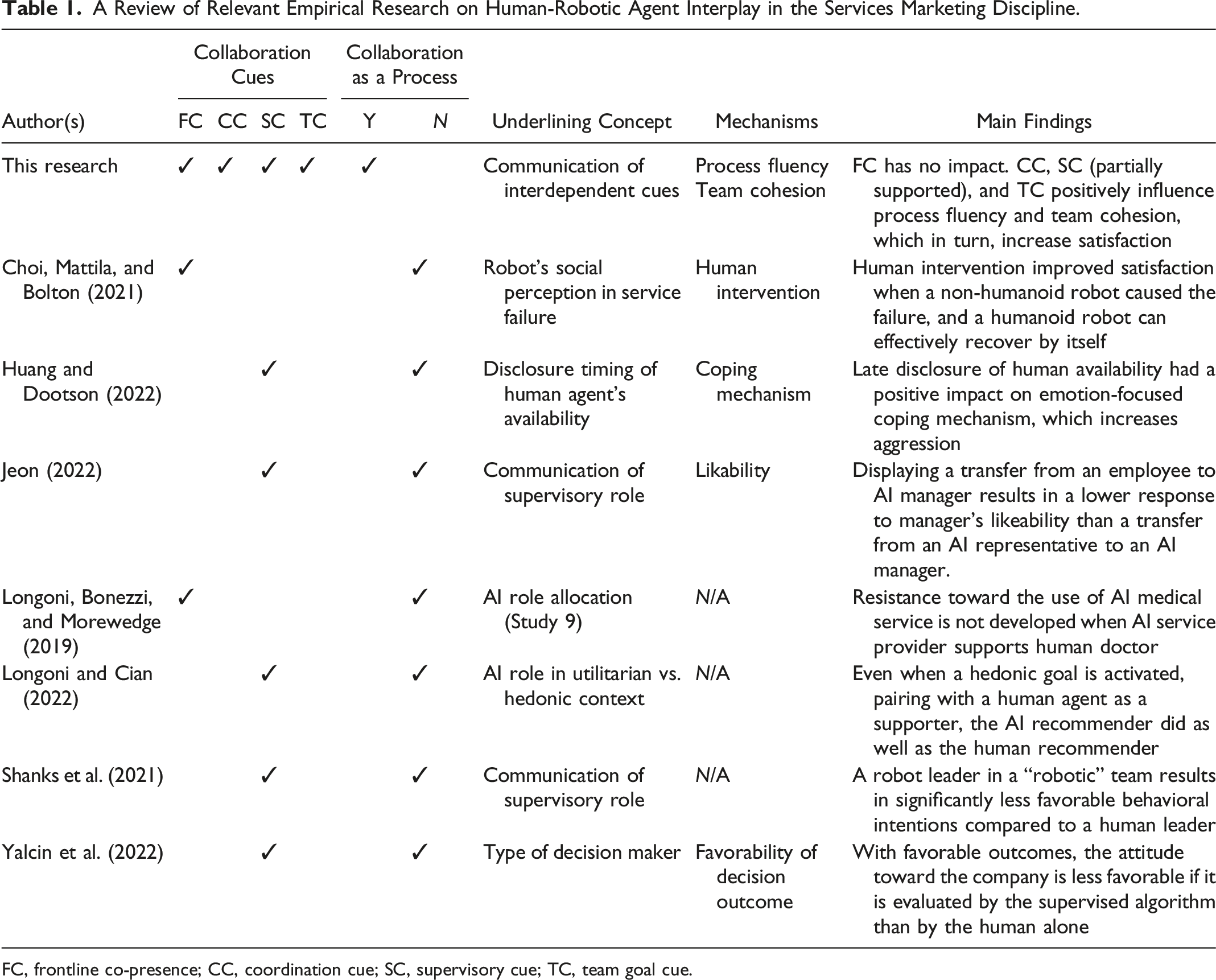
FC, frontline co-presence; CC, coordination cue; SC, supervisory cue; TC, team goal cue.
Only a few empirical studies have investigated when and how the interplay between employees and robotic agents can improve customer experience. Choi, Mattila, and Bolton (2021) and Longoni, Bonezzi, and Morewedge (2019) found that a sequential workflow where HE can intervene or make the final decision appeal to customers. Several studies focused on the supervisory cue and found that the HE as a leader generates a more positive attitude in service provision (Huang and Dootson 2022; Longoni and Cian 2022; Yalcin et al. 2022) than displaying a robotic agent as the team leader (Jeon 2022; Shanks et al. 2021). Further, these empirical studies examined only the aspects of such collaboration at the role level (see Table 1). These studies also emphasize only the augmenting nature of robotic agents rather than actual teamwork between the two in a service process. This leads to an observation that prior research has not examined other aspects, such as coordination or team goal and how communicating such cues could enhance customer experience.
The current research extends this stream in two ways. First, this research will examine the collaboration as a process with an emphasis on communicating HE-DE teamwork to customers through interdependent behavioral cues to explain how customers evaluate such teamwork in an actual work process that is managed by both agents. Second, this research proposes process fluency and team cohesion as the mechanisms that explain how the communication of such cues can transform the customer experience.
Hypothesis Development
The Impact of Task Connection Cues
Figure 3 depicts our analytical framework. Within the context of an HE-HE team, a process with a highly interdependent workflow requires more time and effort (Van de Ven, Delbecq, and Koenig 1976). In a sequential process, the downstream member must wait for the upstream member’s output (Cannon-Bowers and Bowers 2011), whereas in a simultaneous sequence, team members can complete their tasks concurrently (Van de Ven, Delbecq, and Koenig 1976). Although in human-robot task sequencing, the sequential (vs. simultaneous) presence increases the required time for task processing (Zhao, Henrichs, and Mutlu 2020), and such research did not predict how human-robotic agent collaboration can influence the evaluation of work process fluency, especially from a third-person view. The impacts of communicating collaborative cues on customer-perceived satisfaction in HE-DE service team context.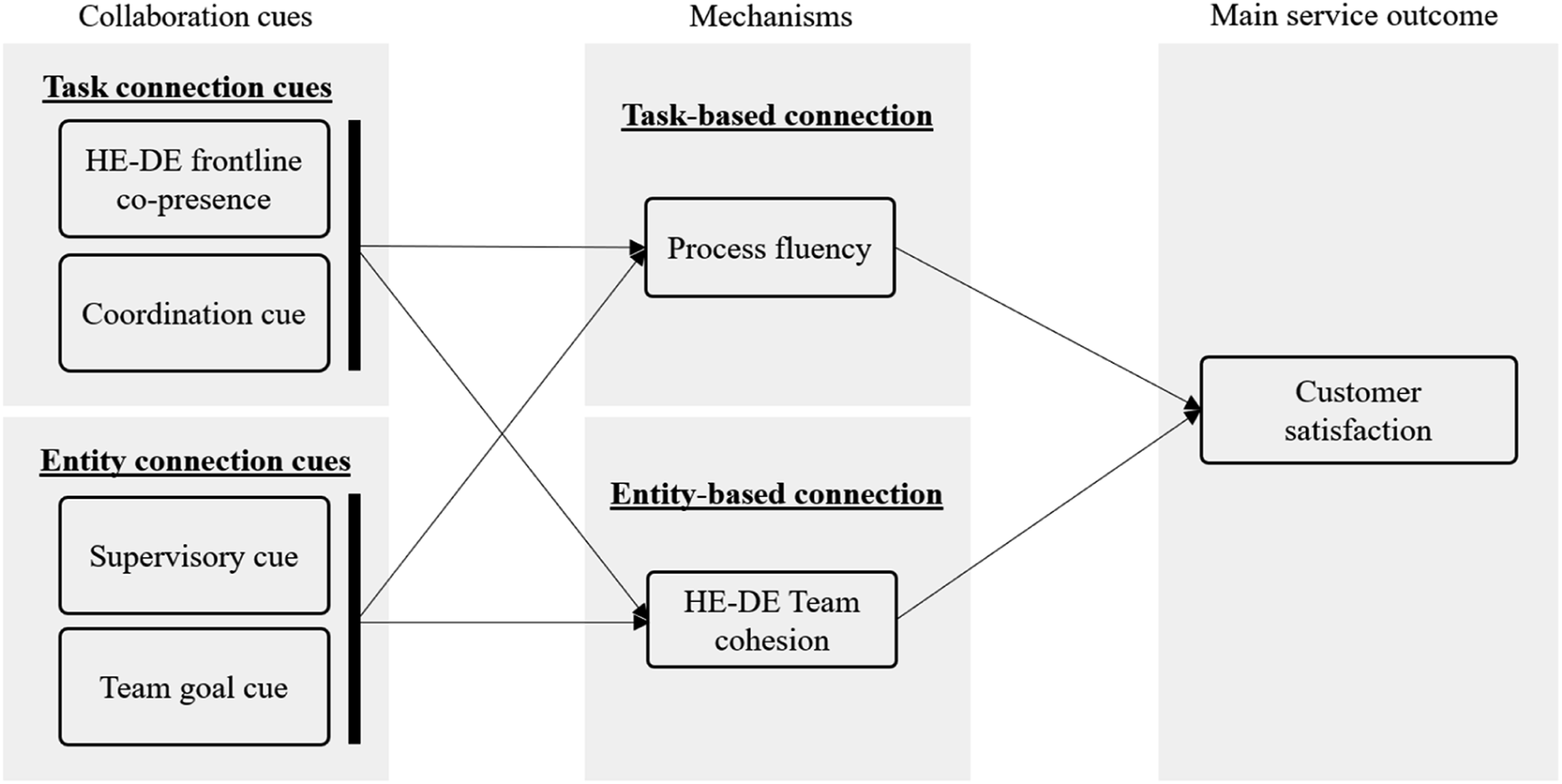
Customers generally do not like to wait to be served (Durrande-Moreau and Usunier 1999). Consequently, we propose that the sequential (vs. simultaneous) presence will have a greater negative influence on perceived process fluency because sequential sequence dictates that the downstream agent relies on the output of their upstream partner, which results in a delay in information exchange between agents. In contrast, a simultaneous process could result in a greater sense of fluency as HE and DE can work independently and concurrently.
An interdependent workflow should create a greater sense of team cohesiveness in human work teams (Beal et al. 2003; Johnson and Johnson 2009). A sequential presence denotes a mutual resource exchange and reliance among team members which promotes unity (Wageman 1995), whereas a simultaneous co-presence might create a sense of independence rather than interdependence (Cannon-Bowers and Bowers 2011). Unlike in a HE-HE team setting, such an effect is unique to an HE-DE context due to the involvement of the non-human agent that acts as a partner. Despite this, prior research has not examined how an interconnected workflow can affect the evaluation of the partnership between the human and robotic agent. This research proposes that a sequential (vs. simultaneous) co-presence could foster the development of the customer’s impression of a cohesive HE-DE team. Although simultaneous sequence emphasizes that both the DE and HE will appear concurrently in front of the customers, they will likely be working on different aspects of a process to optimize division of labor (Le, Sajtos, and Fernandez 2023), which gives an impression of independent rather than interdependent. In contrast, a sequential presence could give an impression of a cohesive HE-DE team due to the required interaction nature of the sequential workflow (Shrestha, Ben-Menahem, and Von Krogh 2019).
A sequential HE-DE frontline co-presence (vs. simultaneous presence) will have a negative impact on process fluency.
A sequential HE-DE frontline co-presence (vs. simultaneous presence) will have a positive impact on perceived HE-DE team cohesion.
Further, in prior literature of collaboration between humans, coordination effort is necessary to maintain a smooth workflow in an HE-HE team (Johnson and Johnson 2009; Marks, Mathieu, and Zaccaro 2001). Communicating such an effort through a coordination cue to customers could create an impression of a well-organized and efficient team (Wang, Hoegg, and Dahl 2018). The emergence of intelligent systems like DEs can also exhibit the capability to coordinate with humans (Noble et al. 2022). We propose that the presence of a coordination cue in HE-DE collaboration will have a positive impact on perceived fluency (Le, Sajtos, and Fernandez 2023). Unlike the coordination in an HE-HE team context, which features flexibility where human collaborators can adapt to the different situations in teamwork (Van de Ven, Delbecq, and Koenig 1976; Wang, Hoegg, and Dahl 2018), the coordination in an HE-DE team context is rigid and rule-based, since it is strictly scheduled and planned (Zhao, Henrichs, and Mutlu 2020). Hence, in the HE-DE context, the presence of the coordination cue can also serve as the signal of a timely and well-managed process. When customers recognize such a cue, it could create a sense that the HE understands how to work with the DE to create an efficient team, which may lead to an impression that their requests are being handled in a streamlined manner.
Further, the presence of the coordination effort can also foster the emergence of the cooperative attitude among team members (Courtright et al. 2015; Johnson and Johnson 2009; Wang, Hoegg, and Dahl 2018), which is an important factor in creating a cohesive team (John Mathieu et al. 2015). From the customer point of view, the communication of the coordination cue could have a positive impact on perceived team cohesion (Le, Sajtos, and Fernandez 2023). Previous research has found that a coordination cue between employees when being prompted (i.e., reactive coordination) enhances customer perception of such a team’s cohesion (Wang, Hoegg, and Dahl 2018). In the context of HE-DE collaboration, the presence of the coordination cue could create an impression that the HE is required to work with the DE rather than by themselves and has been trained to work with the DE without any problem. Thus, the cue signals to customers an impression of the HE’s professionalism and willingness to work cooperatively with the DE.
The presence of a coordination cue in HE-DE collaboration will have a positive impact on perceived process fluency.
The presence of a coordination cue in HE-DE collaboration will have a positive impact on perceived HE-DE team cohesion.
The Impact of Entity Connection Cues
In contrast to the power dynamic in an HE-HE team context, research on human-robotic agent collaboration suggests that giving more power to the human agent in order for them to intervene in the robotic agent’s operating cycle to correct its actions, when necessary, could ensure a smooth operation (Johnson, Bradshaw, and Feltovich 2018). Prior research has documented that customers prefer the HE to be in the authority position (Longoni, Bonezzi, and Morewedge 2019; Yalcin et al. 2022) as the HE can intervene and redirect the DE if the agent is not performing as expected (Le, Sajtos, and Fernandez 2023). Human intervention can also enhance satisfaction when a robot fails to perform its task properly (Choi, Mattila, and Bolton 2021), and customers generally prefer a human adviser when the task is highly consequential (Castelo, Bos, and Lehmann 2019). By having the HE as a supervisor, customers can be reassured that an actual human being is monitoring their interaction with the DE, ensuring the continuity of the engagement. In contrast, customers report less positivity when the DE acts as the supervisor of the HE (Jeon 2022; Shanks et al. 2021) as they may feel uncomfortable seeing the DE acting like a boss and find such a process disquieting. Thus, signaling the HE (vs. DE) as the supervisor may enhance customer-perceived process fluency.
In the HE-HE team context, an imbalanced power distribution activates a high sense of responsibility for the power holder (vs. the subordinate), which shapes the commitment of both entities toward a joint goal (Rusbult and Van Lange 2008). In an HE-DE team context, such an imbalanced power distribution not only shapes human responsibility in teaming with DE (Le, Sajtos, and Fernandez 2023), it also demonstrates the HE’s capability to manage intelligent systems in service provision (Noble et al. 2022). From the customer’s perspective, by communicating that the HE is in the position of authority, customers may be reassured that the HE will be responsible for the team’s actions. This human-based leadership eliminates the perception of risk associated with incompetent teamwork since HE can intervene and help if the robot fails (see also Choi, Mattila, and Bolton 2021). Such behaviors can be considered as a sign of a cooperative and cohesive team (Marks, Mathieu, and Zaccaro 2001). In contrast, distributing more power to DE may not create an impression of a cohesive team because customers generally perceive DEs as incompetent to manage human agents (Jeon 2022), and know that a DE is not capable of intervening to help the employee when they are stuck, especially where tasks are intuitive and complex in nature.
The supervisory cue where the HE (vs. DE) acts as a supervisor will have a positive impact on process fluency.
The supervisory cue where the HE (vs. DE) acts as a supervisor will have a positive impact on perceived HE-DE team cohesion.
In the context of our research, DEs by default carry the firm’s goal in their design for better serving customers. Current automated systems might not be able to set goals that differ from the firm’s goal. However, this does not equate to a situation where a DE does not have the capacity to share a performance objective with a HE. In fact, modern DEs are fully capable of sharing work goals with HEs (Kim et al. 2022; Noble et al. 2022; Walliser et al. 2019). For example, a teacher can set a desirable grade level with a DE as a joint objective in improving a student’s performance (Hew et al. 2022). Hence, our interest is customer perception when this team goal cue is activated, telling the customer that the HE is sharing a service goal with the DE, rather than investigating a situation where the DE could have different objectives from the HE. The presence of a shared goal between the DE and HE facilitates the belief that such a team has a high sense of collective efficacy. A shared goal motivates members to work smoothly and cooperatively (Johnson and Johnson 2009). In human-robot interaction, the presence of a shared goal helps humans to orchestrate a smooth coordination with their robotic partner (Johnson, Bradshaw, and Feltovich 2018). When customers see that the two agents share a common goal, they may take it as a sign of an efficient team as it indicates that the HE is committed in their effort to work with the DE to ensure a smooth encounter (Le, Sajtos, and Fernandez 2023). Further, displaying such a cue may also reinforce the customer’s belief that the agents orchestrate their effort effectively to serve them—the cue serves as a signal that the team knows what to do and can avoid delays.
In addition, sharing a common goal can foster the emergence of cohesion perception through prosocial motives (Courtright et al. 2015; Johnson and Johnson 2009). Hence, a team goal can be the driver of cohesion and the tendency to support one another (Courtright et al. 2015; Menguc, Auh, and Uslu 2013). In contrast to the HE-HE context, goal sharing in the HE-DE team context also implies a sense of machine agency and autonomy, which implies that the robotic agent has the intention to work cooperatively with the human partner (Le, Sajtos, and Fernandez 2023). Communicating the cue that signals that the HE is sharing a service goal with DE may strengthen customer perception of a cohesive HE-DE team (Le, Sajtos, and Fernandez 2023), because it implies mutual support—the DE is an agent capable of cooperating with an HE (Walliser et al. 2019) while the HE is capable of managing teamwork with the machine agent to achieve their mutual service objective (Noble et al. 2022). As customers are the beneficiaries of the HE-DE teamwork, the commitment of HE to work with DE as a team to serve them may be important for their experience.
The presence of a team goal cue in HE-DE collaboration will have a positive impact on process fluency.
The presence of a team goal cue in HE-DE collaboration will have a positive impact on perceived HE-DE team cohesion.
The Impacts of Process Fluency and Team Cohesion
A seamless service experience will create a strong impression of good service (Lemon and Verhoef 2016). Customers are more easily satisfied when the service is undisrupted (Cassab and MacLachlan 2006; Shen et al. 2018; Sun et al. 2020). The perception of an effortless experience could make customers appreciate the effort that the HE-DE team puts in. Hence, customers may be inclined to be more satisfied when they perceive smooth teamwork. Further, research suggests that cooperativeness among service providers is an important factor in enhancing service quality (Gracia, Cifre, and Grau 2010). A strong cohesive team affords a greater perception of cooperation, which directly and positively influences customers’ perception of service quality (Wang, Hoegg, and Dahl 2018). In an HE-DE team, cohesiveness is a sign that HE understands how to work effectively with DE. It reinforces the customer’s impression that the HE-DE team is motivated to serve them as a united team in resolving their requests.
Customer perception of process fluency will have a positive impact on their perceived satisfaction.
Customer perception of HE-DE team cohesion will have a positive impact on their perceived satisfaction.
An Overview of Empirical Studies
A detailed overview of the design, measurement, and justification of the empirical studies can be found in the Web Appendix. The structure of the empirical investigations is as follows. First, we investigate the hypothesized effects in Figure 3. This is the main investigation which consists of four main studies. Study 1 focuses on the impact of task-based connection cues (frontline co-presence and coordination). Study 2 adds an additional layer of entity-based connection cues (supervisory). Studies 3A and 3B focus on both task-based and entity-based connection cues (coordination, supervision, and team goal). Study 4 aims to replicate the impacts of coordination and team goal cues in a different setting (main analysis). Complementing this main analysis, Study 4 also explores the potential influence of type of collaboration (HE-HE vs. HE-DE). Further, beyond measuring the impacts on satisfaction, Study 4 also explores the potential influences of these cues on behavioral outcomes. In particular, this research measures two additional behavioral outcomes—acceptance of the HE-DE team’s recommendations and email subscriptions. These behavioral outcomes were selected because they are among many behavioral manifestations of engagement during the service provision (response to the HE-DE team) and post-engagement (email subscription) (e.g., Van Doorn et al. 2010). To streamline the investigation, the detailed results on these behavioral outcomes are documented in Web Appendix F. Second, Study 5 aims to extend the scope of this research and explores the additional impacts of collaboration (as manifested through coordination and team goal cues) compared to augmentation and substitution as a type of service delivery mode. The main investigation of this extension is the role of perceived process transparency—the extent to which a service provider makes the details of their service process visible to their customers (see also Le, Sajtos, and Fernandez 2023). This is the concept of interest of the extended study because the conceptualization of collaborative cues in this research focuses on revealing to the customers how HE and DE work together. Thus, this process transparency mechanism can complement the current investigations by extending the scope of the impact of revealing those collaborative cues. Study 5 also diverges from prior studies and focuses on exploring the impacts of different service delivery modes on usage and recommendation likelihoods, which helps to capture the overall adoption tendency. This could be a useful insight when HE-DE collaboration becomes popular in the future. Taken together, the series of empirical studies in this research aims to capture the complexity and nuances of communicating HE-DE collaborative cues.
Study 1
Design and Procedure
Participants recruited from MTurk (N = 117) were asked to read about an education program’s advisory service. The participants were asked to play the role of a prospective student looking for a data science program to enhance their career prospects and to imagine interacting with the advisory team, which consisted of a human advisor (HE) and a chatbot advisor (DE). Frontline co-presence was manipulated by altering whether HE and DE appeared simultaneously or sequentially in serving the participants. The coordination cue was manipulated by communicating the transfer of the task between them.
Manipulation Check
The manipulation check for frontline co-presence was undertaken by asking participants to indicate a simultaneous or sequential presence (1 = “I felt like I was being accompanied by EduBot and Sam at the same time” and 7 = “I felt like I was being accompanied by EduBot and Sam one after the other”). An independent-samples t-test confirmed the manipulation (MSimultaneous = 2.36, MSequential = 6.33), t (115) = 15.48, p < .001. The coordination cue manipulation check was tested by asking participants whether they observed EduBot and Sam working together (1 = strongly disagree; 7 = strongly agree). The result confirmed the manipulation (MAbsence = 2.60, MPresence = 5.96, t (113.43) = 13.91, p < .001).
Results
Regression Analysis Results Across Studies 1–4.
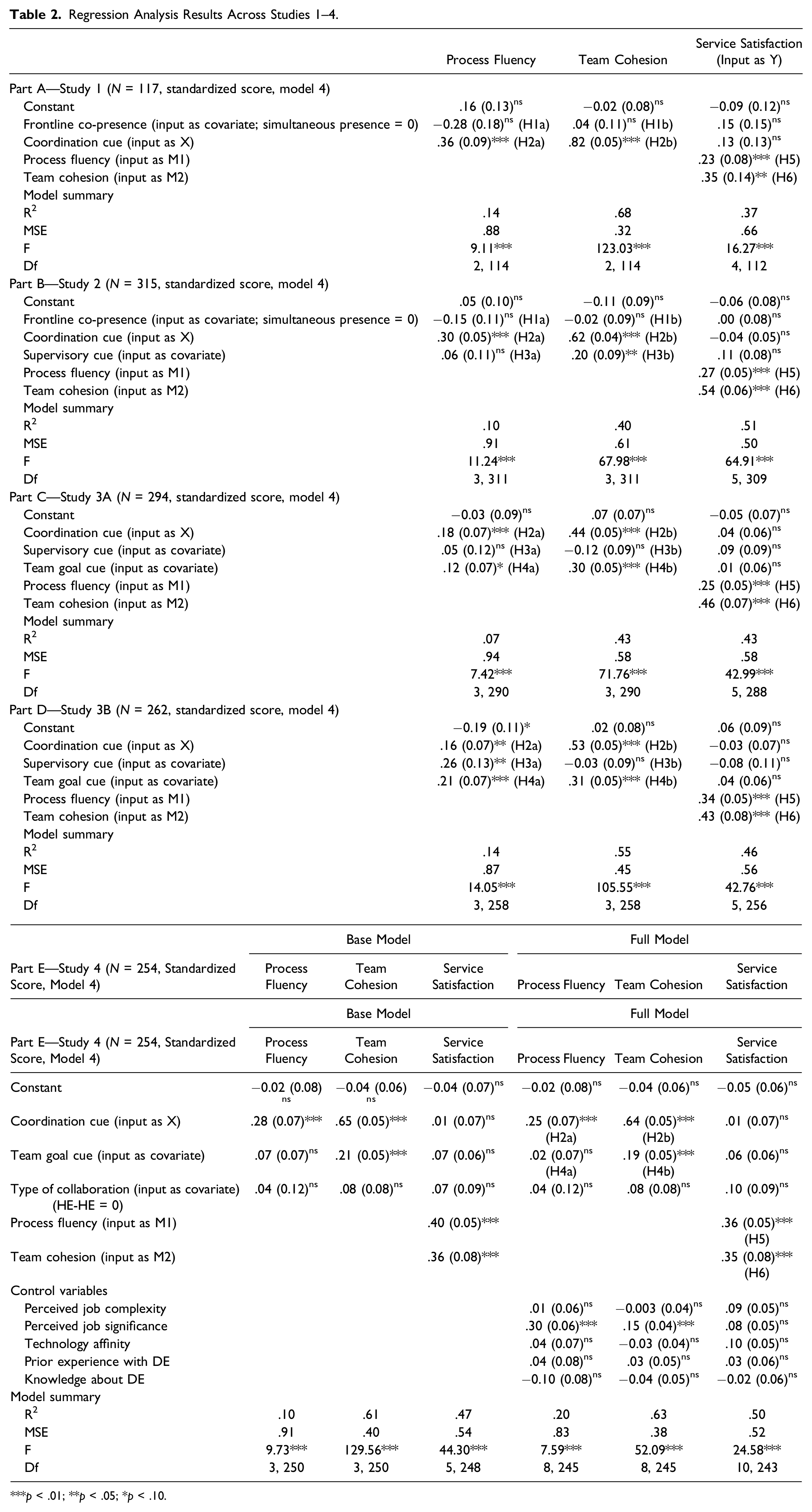
***p < .01; **p < .05; *p < .10.
This study found a negative but insignificant effect of sequential presence on process fluency (b (SE) = −0.28 (0.18), p > .10). We did not find evidence to support hypothesis 1b, which proposed that under sequential (vs. simultaneous) presence, team cohesion is higher (b (SE) = 0.04 (0.11), p > .10). Thus, we found no support evidence for both H1a and H1b. However, we found a significant positive effect of coordination cue on process fluency (b (SE) = 0.36 (0.09), p < .01) and on perceived HE-DE team cohesion (b (SE) = 0.82 (0.05), p < .01), which supports H2a and H2b. Both process fluency (b (SE) = 0.23 (0.08), p < .01) and team cohesion (b (SE) = 0.35 (0.14), p < .05) positively influenced satisfaction, which supports H5 and H6.
Discussion
Study 1 aimed to establish the impact of task connection cues. We find that the coordination cue improves both perceived fluency and team cohesion, whereas frontline co-presence as sequential (vs. simultaneous) has no impact on perception of process fluency or team cohesion. Previous research has found some beneficial effects of reactive coordination (i.e., one service agent who, being unable to help, refers the customer to another agent) in increasing customer perception of service quality (Wang, Hoegg, and Dahl 2018). This research provides evidence of the positive effects of proactive communication about HE-DE coordination on the positive evaluation of the fluency of the process as well as of the cohesion of the HE-DE team. Further, our study extends current research on human-robot interaction in the service context (Choi, Mattila, and Bolton 2021; Huang and Dootson 2022; Yalcin et al. 2022) by identifying two critical factors, namely, process fluency and team cohesion, which exert a positive effect on service satisfaction.
Study 2
Design and Procedure
Participants were recruited from MTurk (N = 315). We used the same scenario and procedure as for Study 1. We manipulated the supervisory cue by placing the word “supervisor” next to the icon for HE or DE (See Web Appendix for details).
Manipulation Check
Study 2 used the same manipulation and measurement for coordination cue and frontline co-presence as in the previous study. The manipulation of the supervisory cue was checked by asking the participants to indicate whether EduBot or Sam had greater control over the process on a 7-point scale (−3 to 3 with 0 as the midpoint, implying a balanced power distribution). The manipulations for coordination cue (MAbsence = 3.16, MPresence = 5.51, t (307.52) = 15.24, p < .001), frontline co-presence (Msimultaneous = 2.36, Msequential = 5.98, t (249.38) = 19.54, p < .001), and supervisory cue (MEdubot (DE) = −0.95 MSam (HE) = 0.93, t (313) = 13.32, p < .001) worked as intended.
Results
Study 2 did not find evidence to support H1a (b (SE) = −0.15 (0.11), p > .10) or H1b (b (SE) = −0.02 (0.09), p > .10), but confirmed H2a (b (SE) = 0.30 (0.05), p < .01), H2b (b (SE) = 0.62 (0.04), p < .01), H5 (b (SE) = 0.27 (0.05), p < .01), and H6 (b (SE) = 0.54 (0.06), p < .01) (for detailed results see part B in Table 2). When HE (vs. DE) acted as a supervisor, our findings showed a significant positive effect on perception of team cohesion (b (SE) = 0.20 (0.09), p < .05) but not on process fluency (b (SE) = 0.06 (0.11), p > .10), which support H3b, but not H3a.
Discussion
This study successfully replicated the results of Study 1. Prior research has examined the role of HE (vs. DE) being in the position of authority and found that it is likely to lead to a higher preference for and reduced resistance towards accepting the service (Longoni, Bonezzi, and Morewedge 2019; Longoni and Cian 2022; Shanks et al. 2021). Aligning with previous research, this study also found the positive effect of HE as a supervisor, but our study does this in a collaborative as opposed to a comparative (HE vs. DE) environment. Additionally, our study also suggests that HE’s effectiveness as a supervisor lies in increasing the customer’s perception of a cohesive team.
Study 3A
Design and Procedure
Study 3A aimed to test the joint effect of task and entity connection cues. Participants were recruited from MTurk (N = 294). The manipulations for coordination and supervisory cues were the same as in our previous studies. The team goal cue was manipulated by displaying the following message to the participants: “Sam and I work together as a team, and our team’s goal is to find you the program and course options that best match your profile,” whereas in the absence condition, this sentence was not displayed.
Manipulation Check
The manipulation checks for coordination cue (MAbsence = 3.23, MPresence = 5.68, t (227.96) = 14.04, p < .001) and supervisory cue visibility (MHE as supervisor = 1.03, MDE as supervisor = −1.09, t (242.50) = 13.58, p < .001) worked as intended. The team goal cue was checked by asking participants to indicate their agreement with whether Edubot and Sam had a team goal (1 = strongly disagree and 7 = strongly agree). The manipulation worked as intended (MPresence = 5.72, MAbsence = 3.21, t (233.05) = 15.14, p < .001).
Results
The results are in part C in Table 2. With the exception of H3a (b (SE) = 05 (0.12), p > .10) and H3b (b (SE) = −0.12 (0.09), p > .10), this study replicates and confirms previous hypotheses including H2a (b (SE) = 0.18 (0.07), p < .01), H2b (b (SE) = 0.44 (0.05), p < .01), H5 (b (SE) = 0.25 (0.05), p < .01), and H6 (b (SE) = 0.46 (0.07), p < .01). This study tested two new hypotheses and found a weak significant positive effect of a team goal cue on process fluency (b (SE) = 0.12 (0.07), p < .10) and a strong positive effect of the team goal on team cohesion (b (SE) = 0.30 (0.05), p < .01), which confirms H4a and H4b.
Discussion
In addition to confirming the findings of our previous studies, this study also shows that the presence of a team goal enhances perception of team cohesion. Building on previous research that underlined that DE is considered to be a partner to HE (Noble et al. 2022), this study provides evidence that creating a visible partnership between HE and DE can lead to enhanced customer evaluation of the service due to increased perception of cohesion. The insignificant effect of HE as a supervisor on process fluency and team cohesion, compared to its significant effect in Study 2, could be due to Study 3A examining this effect under a simultaneous presence condition. That is, the DE and HE are present at the same time throughout the process, and the customer may automatically perceive that the human co-worker is in charge during the engagement. Thus, such a cue might be redundant.
Study 3B
Design and Procedure
We recruited participants from MTurk (N = 262). We used the same procedure and context as for Study 3A (see Web Appendix B) with the exception that sequential presence was held constant across all conditions. The difference between Studies 3A and 3B is that we held frontline co-presence constant as a simultaneous sequence in Study 3A, and as a sequential sequence in Study 3B.
Manipulation Check
We used the same manipulation checks for coordination, supervisory and team goal cues as in Study 3A. An independent t-test confirms that our manipulations were effective for coordination cue (MAbsence = 2.93, MPresence = 5.58, t (156.06) = 14.24, p < .001); supervisory cue (MHE as supervisor = 1.12, MDE as supervisor = −1.09, t (260) = 13.03, p < .001), and team goal cue (MAbsence = 3.14, MPresence = 5.66, t (222.11) = 15.77, p < .001).
Results
The results are in Part D of Table 2. The coordination cue had a positive impact on process fluency (b (SE) = 0.16 (0.07), p < .05) and team cohesion (b (SE) = 0.53 (0.05), p < .001), which reinforces H2a and H2b. We found evidence that HE as supervisor enhances process fluency in this study (b (SE) = 0.26 (0.13), p < .05) but not team cohesion (b (SE) = −0.03 (0.09), p > .10), which provides support for H3a, but not for H3b. The team goal cue enhanced process fluency (b (SE) = 0.21 (0.07), p < .001) and cohesion (b (SE) = 0.31 (0.05), p < .001), which supports H4a and H4b. We also found a significant positive effect of process fluency (b (SE) = 0.34 (0.05), p < .001) and team cohesion (b (SE) = 0.43 (0.08), p < .001) on service satisfaction, which support H5 and H6.
Discussion
Study 3B successfully replicated the results of Study 3A under sequential presence. Regarding the inconsistent impact of the HE as the supervisor, this might be due to the sequential setting implying that the HE is handling more critical tasks and is responsible for monitoring the interaction (see also Longoni, Bonezzi, and Morewedge 2019). However, the impact of the HE as the supervisor is not strong enough to influence perceived team cohesion as this cue alone might not be a strong signal compared to the coordination cue. Although the sequencing of how the HE and DE process their tasks (simultaneous or sequential) has been proposed as an important aspect of HE-DE team design (Le, Sajtos, and Fernandez 2023) in a customer-facing setting, the role that the supervisory cue plays may depend upon the way in which the work processing plan is designed, as to whether it influences either customer perception of team cohesion or process fluency.
Study 4
Design and Procedure
Our previous studies have shown that both coordination and team goal cues have a consistent impact on perception of process fluency and team cohesion. We decided to examine the generalizability of these effects in a different context (a finance consulting setting). Study 4 also extends our previous studies by examining the impact of these cues under sequential co-presence (similarly to Study 3B) and by comparing HE-DE and HE-HE collaboration. Further, we employed two binary outcomes reflecting the customer’s behavioral intention, by asking the participants whether or not they would be willing to accept or reject the team’s recommendation (Longoni, Bonezzi, and Morewedge 2019), and to subscribe to the company’s mailing list (i.e., post-engagement behavior). We employed a 2 (Coordination: Presence vs. Absence) x 2 (Team goal: Presence vs. Absence) x 2 (Type of collaboration: HE-HE vs. HE-DE) between-subject design. The design of this study is in the Web Appendix. We recruited participants from Prolific. In the experiment, we also controlled additional job characteristics (complexity and significance—e.g., Castelo, Bos, and Lehmann 2019), and the customers’ technology affinity (Belanche, Casaló, and Flavián 2021) and prior experience with and knowledge about DEs (Luo et al. 2019). The results of measurement validity of the additional control variables are in Web Appendix D.
Manipulation Check
We checked the manipulation of coordination and team goal cues by using the same approach as in the previous studies. Results confirmed that the manipulations (coordination cue – MAbsence = 3.41, MPresence = 5.58, t (252) = 12.37, p < .001; team goal cue – MAbsence = 3.10, MPresence = 5.43, t (252) = 13.68, p < .001) had been successful.
Results
The results are in Table 2, part E. Results confirm the replication of the effects of coordination cue on process fluency (b (SE) = 0.25 (0.07), p < .01) and on team cohesion (b (SE) = 0.64 (0.05), p < .01) in a different setting. 2 The results also confirm the impact of team goal cue on team cohesion (b (SE) = 0.19 (0.07), p < .01), but not on process fluency (b (SE) = 0.02 (0.07), p > .10). The results also demonstrate the robust effect of team cohesion (b (SE) = 0.35 (0.08), p < .01) and process fluency (b (SE) = 0.36 (0.05), p < .01) on satisfaction. Types of collaboration (HE-HE = 0; HE-DE = 1) have no major direct impact (see Table 2, part E).
Discussion
Study 4 replicates all previous results in a different context, other than the influence of team goal on process fluency. This might be due to the nature of the service offering—that is the financial advising context is information-oriented whereas educational advising is people-oriented. In people-oriented services, human relationship is the focus, and such a cue might signify a joint motivation from the service team, which might affect a customer’s confidence in the team’s capability to provide consistent service and minimize potential mistakes (Wang, Hoegg, and Dahl 2018). In information-oriented services, efficiency is the focus. Customers may be less sensitive to the team goal cue in evaluating fluency—in this context, they may be more concerned about the accuracy of the work. Thus, a subjective stimulus like a team goal cue might not be necessary to activate the perception of fluency.
Previous research has underlined the importance of disclosing whether the provider is a human or non-human agent (Huang and Dootson 2022; Luo et al. 2019), and our study complements this stream by highlighting that disclosing the types of team composition can cause customers to behave differently in a HE-DE collaborative service setting. In the presence of a team goal cue, the HE-DE team (vs. HE-HE team) generates the highest likelihood of accepting the team’s recommendation. As there is likely to be a certain degree of bias in human team decision-making, communicating such a shared goal in an HE-DE team setting might lead to a better impression of the HE-DE’s team ability to minimize such human bias, thus improving customer confidence in the HE-DE team’s recommendation. Additionally, we observed that the overall likelihood of subscribing to the provider’s e-mailing list is significantly smaller compared to the likelihood of accepting service team’s recommendation. However, the presence of a coordination cue in HE-DE team makes customers more likely to subscribe than when in the presence of such a cue in HE-HE team.
Study 5
Design and Procedure
Earlier we underlined the differences between substitution, augmentation, and collaboration approaches. In this study, we aim to compare the impact of HE-DE collaboration (through coordination and team goal cues) to that of substitution and augmentation. We utilized a similar experimental setting as in Longoni, Bonezzi, and Morewedge (2019). Participants were recruited from Prolific (N = 161) to read an advertisement about a hypothetical new medical screening service for lung cancer, offered by the National Health Service (see Web Appendix B for the scenario). Our outcome variables were the likelihood of using and recommending the medical service. Since this study underlines the importance of communicating the HE-DE collaboration cues to customers, we measured perceived service process transparency (see also Le, Sajtos, and Fernandez 2023). We measured this concept on a single item, where participants indicated how would they rate the level of transparency of the process (1 = extremely not transparent and 7 = extremely transparent). We anticipated that the communication of coordination and team goal cues in an HE-DE collaboration would lead to a greater sense of transparency, as customers can observe the steps and actions that the service agent executes, which will eventually lead to better service outcomes.
Results
Regression Results of Process Transparency as the Mediation Mechanism.
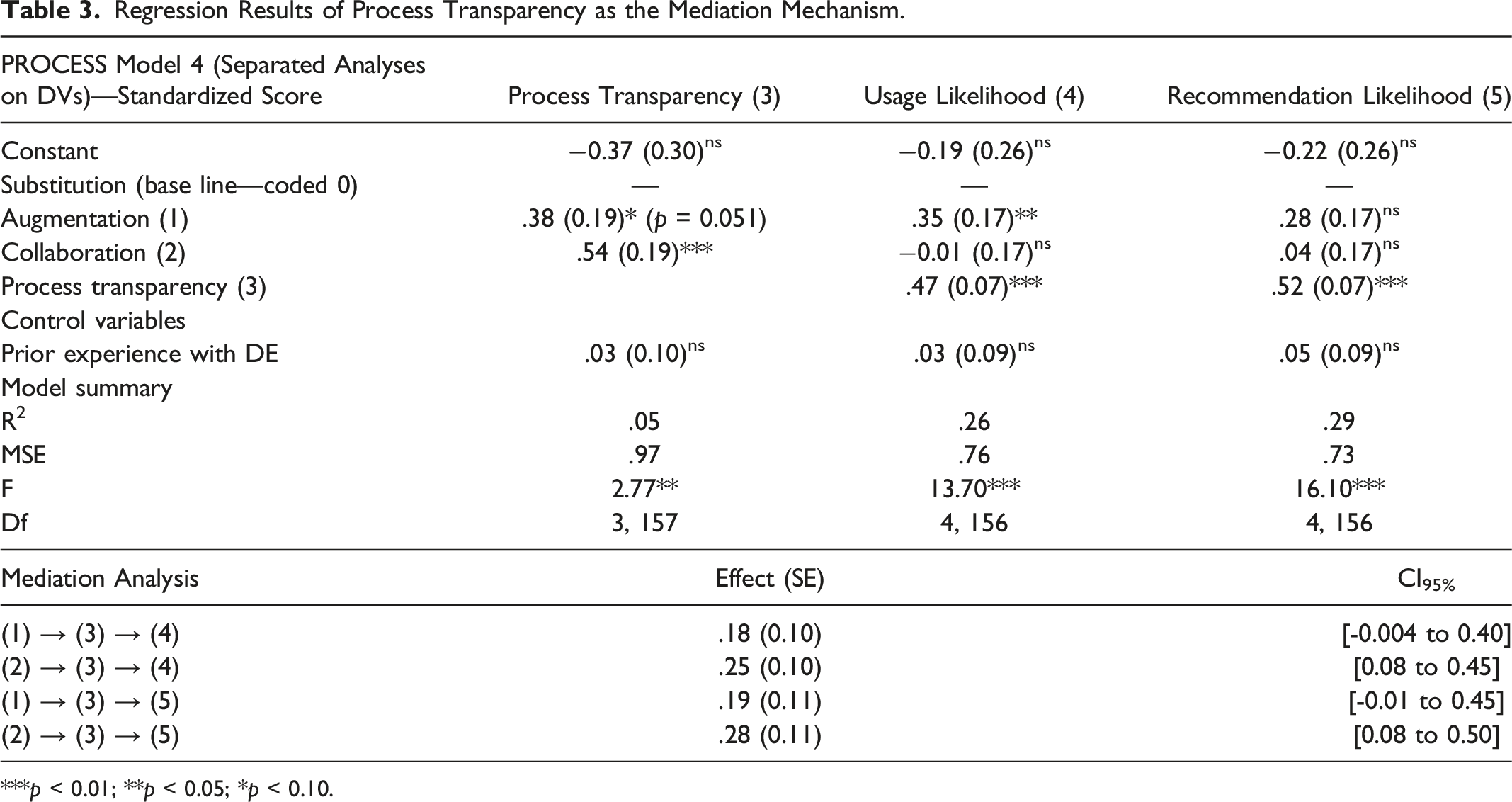
***p < 0.01; **p < 0.05; *p < 0.10.
Discussion
In the literature, Longoni, Bonezzi, and Morewedge (2019) found that customers prefer a service provision where a human employee plays a major role in making decisions and DE plays the support role. Our first analysis corroborates the result: we found that customers are more inclined to use and recommend the service under the augmentation setting. Further, although prior research has discussed the importance of a transparent service (Grewal Dhruv et al. 2020; Le et al. 2023), no research has provided empirical evidence as to the role of transparency in explaining the impact of collaboration between HE and DE. We have shown that communicating HE-DE collaboration (manifested through coordination and team goal cues) creates the most transparent service as perceived by customers. We also revealed that the effects of HE-DE collaboration on usage and recommendation likelihoods are due to process transparency.
General Discussion
As service provision is increasingly being managed by both the HE and DE (Huang and Rust 2022; Noble et al. 2022), this research aimed to understand the effectiveness of HE-DE collaborative cues in service provision. Prior research has highlighted how DEs can, in some circumstances, replace HEs entirely in service provision (Xiao and Kumar 2021) or how they can augment HEs in the decision-making process (Longoni, Bonezzi, and Morewedge 2019). However, such research has not fully explored the actual collaboration process between the two agents and how customers perceive it.
The experimental studies illuminate insights into the dynamics of HE-DE collaborative cues as perceived by customers. The frontline co-presence cue was tested in Study 1 and Study 2, and it has an insignificant impact on either process fluency or team cohesion. The HE-DE coordination cue was tested in Study 1 to 4, and we observed a consistent and positive impact of this cue on both mechanisms. The robustness of the HE-DE coordination cue underscores its potential as a cornerstone in showcasing the effectiveness of a hybrid HE-DE service team to customers in the future. The insignificant impacts of frontline co-presence cue should not lead to a dismissal of its value. Instead, it should motivate future work to examine the conditions under which frontline co-presence might be more influential.
The effect of supervisory cue was tested in Study 2, 3A, and 3B and it was not consistent. In Study 2, it has a positive impact on team cohesion, but not process fluency. In Study 3A, holding the workflow sequence as simultaneous presence in the experiment, the supervisory cue has no significant impact on either process fluency or team cohesion. In Study 3B with a sequential presence, the supervisory cue has a positive impact on process fluency, but not on team cohesion. The team goal cue was tested in Study 3A, 3B, and 4. This cue has a positive impact on both process fluency and team cohesion (Study 3A and Study 3B), but only the positive impact on team cohesion was replicated in Study 4. The inconsistent impact of the supervisory cue highlights the possible influence of sequencing the presence of HE and DE, which can affect how customers perceive the power dynamic of the two entities. The team goal cue demonstrates to the customers a commitment of HE-DE service team to meeting customer needs and it reassures customers that the DE is being used to enhance their experience, not replace the human touch in service delivery. Additionally, in Study 5, the HE-DE collaboration as a service delivery mode has a positive impact on process transparency, which in turn, drives usage and recommendation likelihoods. This result shows that HE-DE collaborative cues can also help build confidence in the HE-DE team through the notion of process transparency, which allows customers to understand how decisions within the HE-DE service team are made. These findings suggest that when consumers are effectively informed about the collaborative nature of a HE-DE team, it could enhance their outcomes.
Taken altogether the empirical studies, this research highlights the innovative nature and efficacy of conveying collaborative cues to customers in the context of the HE-DE service team. This research underscores the growing importance of strategic preparation for a future workforce landscape that increasingly relies on human and robotic technology collaboration, which is essential for optimizing service delivery. Hence, this research serves as a starting guide for future initiatives aiming to harness the full potential of human-robot collaboration in the service industry.
Theoretical Implications
This research draws on interdependence theory (Courtright et al. 2015; Rusbult and Van Lange 2008) to conceptualize HE-DE collaborative cues through the notion of task- and entity-based interdependent behavioral cues. The insight from this research is novel in several ways. First, we develop the concept of HE-DE collaboration using two types of behavioral cues, namely task and entity connection cues. Unlike previous research (Choi, Mattila, and Bolton 2021; Longoni, Bonezzi, and Morewedge 2019), our research takes a process view of collaboration and distinguishes it from augmentation and substitution. Our research reveals that HE-DE service team collaborative cues influence customers’ likelihood of using and recommending due to their perception of a transparent process.
Second, this research also responds to previous calls (Huang and Rust 2022; Wirtz et al. 2018; Xiao and Kumar 2021) by identifying the mechanisms that are effective in enabling a smooth integration of DEs into human work structure, namely, process fluency and team cohesion. Our research finds that task connection (manifested through coordination cue) has the greatest impact on customers’ evaluation of the service through a perception of HE-DE team cohesion over process fluency (Web Appendix H). To this end, this is the first study that explores the HE-DE team cohesiveness as perceived by the customers, and not only highlights its importance in driving satisfaction, but also reveals how this cohesion is created. While prior research highlights the importance of enhancing the experience of customers by providing them with a smooth and effortless process (Lemon and Verhoef 2016), our research suggests that the impression of a united service team (i.e., cohesion) is far more important.
Third, considering only task-connection cues, our research finds that the coordination cue has a significant, large, and consistent effect in creating an impression of a smooth process and a cohesive HE-DE team. Prior research has demonstrated that revealing the coordination when the initial service agent is unable to address a customer’s request can yield favorable results for customer-related outcomes within a human team environment (Wang, Hoegg, and Dahl 2018). However, this result primarily underscores the reactive aspect of coordination, as it is exposed to the customer only when there is a service issue. Our research conceptualizes coordination cues as a proactive communication of taskwork orchestration. Through this communication, including the transparent tasks assignment and clear task handovers between the HE and DE, the customer’s perception of a seamless process and a cohesive HE-DE team can be improved significantly, which result in heightened satisfaction.
In terms of the frontline co-presence cue, while previous research has highlighted the importance of frontline co-presence in influencing customer attitude (Choi, Mattila, and Bolton 2021; Peng et al. 2022), this research finds no support for the impact of a frontline co-presence cue. This may be because prior research focused only on social co-presence in either an augmentation or a substitution setting (e.g., Longoni, Bonezzi, and Morewedge 2019), where the DE could either replace human presence completely or play only a supportive role (e.g., Peng et al. 2022). These approaches are likely to magnify the importance of the frontline co-presence cue of the DE. In contrast, the collaboration approach is likely to diminish the role of the individual and shifts the customer’s attention to the HE-DE service team as a whole and to the team collaborative cues. However, the cross-studies meta-analysis of the overall effect size of frontline co-presence illustrates a negative impact on process fluency in the sequential setting (see Web Appendix I). Thus, the potential of frontline co-presence cue in HE-DE collaboration requires further examination.
Fourth, regarding entity connection cues, previous research has highlighted the importance of having the HE in the position of authority (Longoni, Bonezzi, and Morewedge 2019; Peng et al. 2022; Yalcin et al. 2022). Our research adds to the literature by suggesting that the benefits of an HE as the supervisor may depend on the sequence of co-presence. In a simultaneous co-presence setting, the supervisory cue might be redundant. However, in a sequential setting where the HE acts as the downstream agent who receives information from the DE, this supervisory cue could have an impact on process fluency (Study 3B). The presence of a human supervisor as a communication signal seems relevant only when the human is not ‘in sight’ and is involved only in the latter part of an interaction. In complementing previous research that highlighted the importance of human supervision (Choi, Mattila, and Bolton 2021), this research underlines that the presence of a human supervisor could lead to the team being perceived as more cohesive (Study 2) and the process being perceived as more fluent under a sequential presence (Study 3B). However, this inconsistent result needs to be interpreted with care and takes into account the role of workflow sequencing as we can only partially verify these hypotheses in individual studies.
In terms of team goal cues, showcasing HE-DE team commitment to serve the customers can enhance their perception of a fluent process and a united team. Research has highlighted the importance of a shared goal in human-robotic agent teams (Noble et al. 2022). Our findings complement this literature stream demonstrating that communicating the shared goal of the HE-DE service team to customers can enhance their perception of both a fluent process and a cohesive HE-DE team.
Managerial Implications
This research investigates the potency of communicating HE-DE collaborative cues in service provision. We offer several suggestions that may assist managers and practitioners to embrace HE-DE collaboration, and to a larger extent to improve customer experience with such a service team in the future. Both task- and entity-based connection cues represent different ways that firms can showcase the HE-DE collaboration to customers. Firms can choose to infuse this collaboration through the service process with task-based connection cues or through the HE-DE service team relationship with entity-based connection cues. Either approach could lead to a better experience for customers.
In terms of task-based connection cues, only coordination has a consistently positive impact on both process fluency and team cohesion. Hence, firms should develop a clear communication strategy for the HE-DE team as they are interacting with the client. In particular, this communication strategy should include the task allocated to each service agent, and more importantly, the information that each entity captures, handles, transfers, and receives. This could create a better impression of a fluent process and a cohesive team as we hypothesized and tested. For instance, AiChat, a DE solution provider from Singapore, creates DEs that are capable of notifying customers when their requests are being transferred to a human employee through a ticketing system. This notification is made visible to the customer through a live chat console. Information such as attached documents and photos that the customer provides to the DE is stored and associated with their ticket, and when the DE is ready to be handed over, it notifies the customer that they are being transferred to an HE. All the associated files are also handed over to the HE so that they can pick up the case in the same chat console and work on the customers’ request immediately without the need to ask customers to repeat that information or upload the files again.
Firms should also communicate to customers a message about a joint service goal, which represents the HE-DE team’s commitment to provide high service standards and it is also an indication of a well-trained team that is capable of handling customer requests. For instance, Virtual Vet Nurse partners with Dandenong Ranges Veterinary Centre to deploy a DE—Sophie—that works with onsite veterinarians. The DE communicates to the customers that the vet team has a joint intention to provide accessible and the best possible veterinary support for pets. Our research suggests that firms should frame such a message at a team level to include the DE in the communication more explicitly. Such a signal in service provision will reinforce customer confidence in the team’s capability and motivation, which would ultimately enhance the impression they give of team cohesion and process fluency.
The explicit communication of both the coordination and goals underlines the importance of process transparency. Our Study 5 also directly supports the importance of process transparency. In addition to the collaborative cues that we examined in this research, firms could also enhance process transparency by providing customers with a summary of all of their interactions (e.g., between the customer and the service team or between HE and DE) at the end of their chat session so that they can review the conversations for any information provided by the service providers. This will also reduce customer effort, as all activities in the conversation are tracked and documented, so customers do not have to memorize information provided by the service agents after the chat.
Further, we have also demonstrated that both mechanisms (process fluency and team cohesion) play important roles in explaining the impact of communicating HE-DE collaborative cues on customer satisfaction. We showed through a comparison that the mediation effect of an HE-DE team cohesion is consistently larger than that of process fluency in terms of explaining the impact of the collaborative cue on satisfaction (see Web Appendix H). Accordingly, we suggest that firms should prioritize improvements in collaborative cues that enhance team cohesion.
Limitations and Future Research
This research also has several limitations that need to be acknowledged when interpreting the results. First, this research uses scenario-based experiments, which could have consequences on the findings. Participants might find it difficult to imagine the simultaneous sequence because of its unpopularity in practice. Despite having satisfactory scores on the realism and believability checks in all studies (see Web Appendix), the results of this research should be interpreted with care. Previous research has provided evidence that the physical presence of robots creates anxiety, resulting in compensatory behavior (e.g., Mende et al. 2019). The lack of significant effects from the presence of DEs in our research could be attributed to DEs being digital. Physical robots are more noticeable when in close proximity to humans and might elicit a stronger response to their frontline co-presence.
Second, although the manipulations across all of our studies worked as intended, this research acknowledges that the results should be interpreted with care. We demonstrated in the Web Appendix that the manipulations of team goal and coordination cues were not independent. Further, the utilization of single-item measurements such as satisfaction is another limitation of the current research. Thus, scholars and practitioners need to take these limitations into account when interpreting the results.
Third, the effect of a supervisory cue on process fluency or team cohesion can only be partially verified in individual studies. Ultimately, we reject the hypothesized effects based on the synthesized effect size (see Figure 1). When tasks are perceived as highly consequential, customers do not trust algorithms to make the decision (Castelo, Bos, and Lehmann 2019). Further, evidence also suggests that customers prefer a human to be in the position of authority (Longoni, Bonezzi, and Morewedge 2019). Future research should explore the circumstances under which the impact of supervisory cues is important to customer evaluations of cohesiveness and fluency. Future research could also examine the conditions under which the effects of behavioral interdependence cues on either process fluency or team cohesion are amplified or mitigated. For example, future research could examine how customers perceive who (HE or DE) defines the goals (Noble et al. 2022).
Fourth, the current research aims to understand the impacts of these collaboration cues mainly in the HE-DE team context. We acknowledge that these cues could also be applicable to human-based collaborations (e.g., HE-HE team context). In this current research, the additional analysis of Study 4 (see Web Appendix F) did not indicate support evidence for the effect of team setting (HE-HE vs. HE-DE) in moderating the impacts of the collaboration cues on process fluency and team cohesion and the subsequent impacts of the mediators on customer satisfaction. This could be due to our Study 4 examining collaborative cues from the customer perspective. This means that participants did not engage in the collaboration and hence, they might not have been sensitive to the difference of team settings. Future research could focus explicitly on this research avenue, comparing the effectiveness of these collaboration cues on process fluency and team cohesion in two different team settings, especially from the employee perspective. Further, we encourage such investigations to be conducted in conjunction with other potential variables or in different situations. Given the recent emergence of human-robotic agent collaboration in the literature, this research only scratches the surface of this phenomenon. Thus, it is possible that there are other situations where the impacts of these cues might be different between the HE-DE and HE-HE team setting (e.g., handling complaints), which could be fruitful for future research.
Supplemental Material
Supplemental Material - The Future of Work: Understanding the Effectiveness of Collaboration Between Human and Digital Employees in Service
Supplemental Material for The Future of Work: Understanding the Effectiveness of Collaboration Between Human and Digital Employees in Service by Khanh B. Q. Le, Laszlo Sajtos, Werner H. Kunz, and Karen V. Fernandez in Journal of Service Research.
Supplemental Material
Supplemental Material - The Future of Work: Understanding the Effectiveness of Collaboration Between Human and Digital Employees in Service
Supplemental Material for The Future of Work: Understanding the Effectiveness of Collaboration Between Human and Digital Employees in Service by Khanh B. Q. Le, Laszlo Sajtos, Werner H. Kunz, and Karen V. Fernandez in Journal of Service Research.
Footnotes
Declaration of Conflicting Interests
The author(s) declared no potential conflicts of interest with respect to the research, authorship, and/or publication of this article.
Funding
The author(s) received no financial support for the research, authorship, and/or publication of this article.

Supplemental Material
Supplemental material for this article is available online
Notes
Author Biographies
References
Supplementary Material
Please find the following supplemental material available below.
For Open Access articles published under a Creative Commons License, all supplemental material carries the same license as the article it is associated with.
For non-Open Access articles published, all supplemental material carries a non-exclusive license, and permission requests for re-use of supplemental material or any part of supplemental material shall be sent directly to the copyright owner as specified in the copyright notice associated with the article.
