




Abstract
Artificial intelligence (AI) is a significant part of digital transformation that signifies new requirements for middle managers in AI-integrated work contexts. This is particularly evident in financial service industries. Given the significance and rapidity of this technological transition, this case study investigated how middle managers perceived the impacts of AI system integration on their work characteristics. Interview data were gathered from 25 middle managers of a company providing financial services. The data were analyzed using the Gioia method. The findings showed that the AI systems applied in the case company were perceived as technical tools (mechanical AI) or coworkers (thinking AI and feeling AI), which had different impacts on middle managers’ work characteristics and the relationship between humans and AI systems. The middle managers’ work characteristics included contextual, task, competence, social, and relationship characteristics. Regarding the relationship characteristics, this study shows theoretically distinct human–AI relationship types. The findings are organized into a conceptual framework. AI system integration in service teams is a complex phenomenon that makes middle managers’ work more demanding and requires balancing and managing multiple challenges and dialectical tensions. The findings inform the selection and training of managers according to changing work characteristics in the digital age.
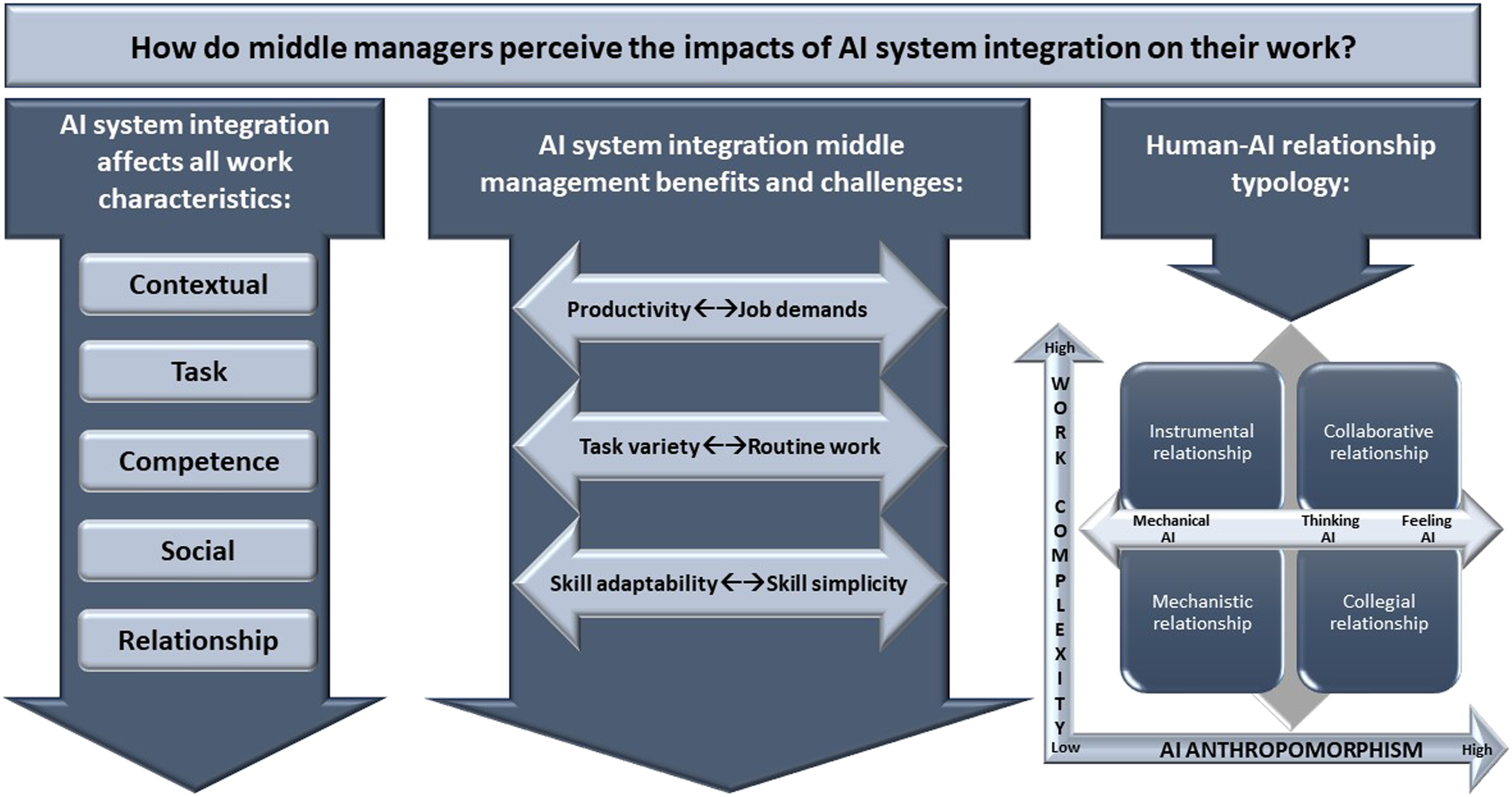
Introduction
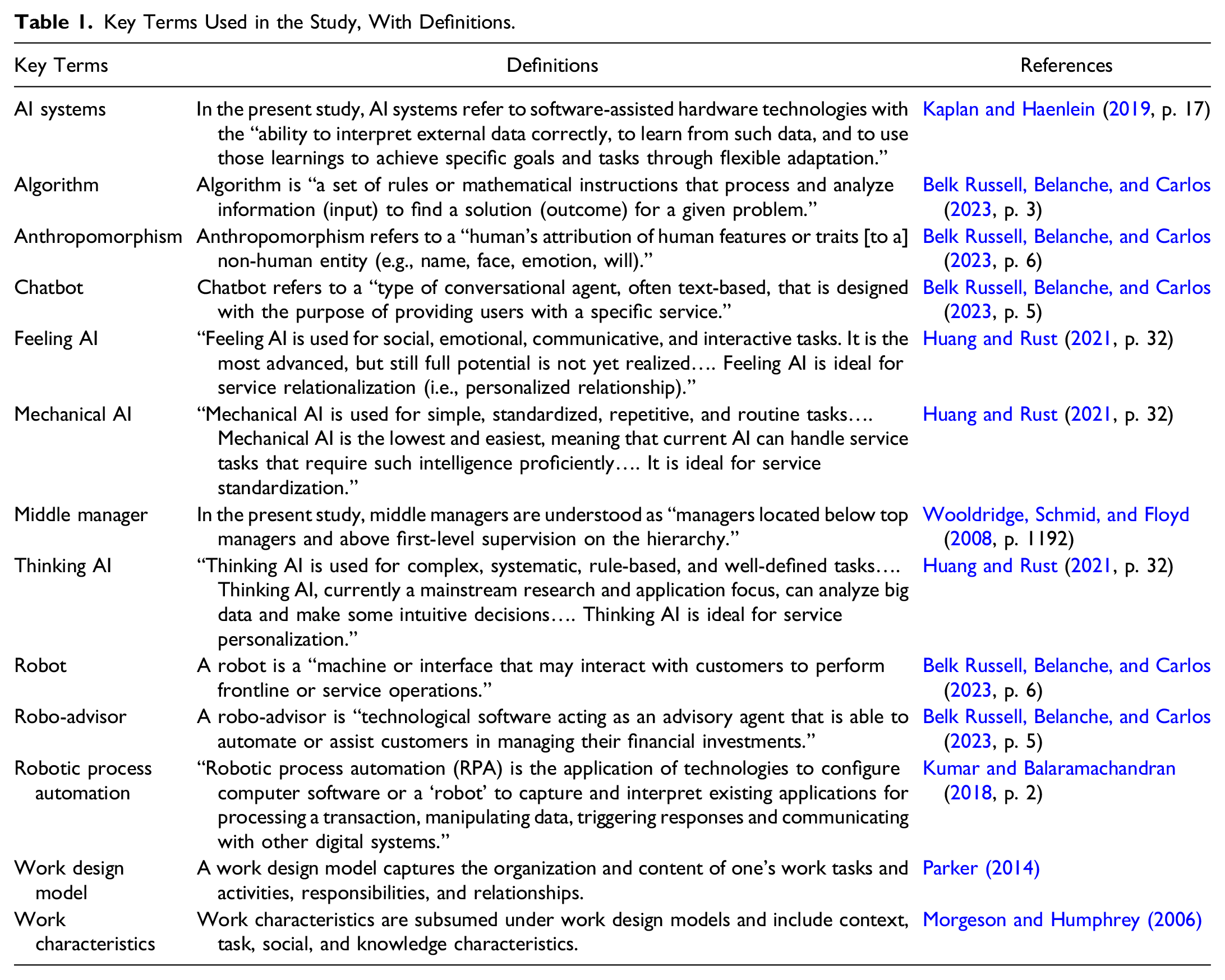
Key Terms Used in the Study, With Definitions.
Research on how AI system integration affects the work characteristics of middle managers in the financial sector is needed for several reasons. First, previous studies have demonstrated that service professionals’ work changes due to the increased use of robots and AI (Belk Russell, Belanche, and Carlos 2023; Huang and Rust 2018; Pemer 2021). For example, mechanical AI performs much of the routine work previously performed by humans. Aside from the wide-scale potential workforce displacement effects of the increased use of AI and service automation, many service professionals work in teams with humans and AI systems, involving new expectations for interactions and relationships within the teams. Middle management will likely face the most immediate challenges in day-to-day decision-making because of AI system integration. However, little is known about how different types of AI (mechanical, thinking, and feeling AI) affect financial service teams’ work and what its consequences are for middle managers’ work.
Second, research is needed because middle managers are the key persons who implement the change processes caused by AI system integration in service teams. Middle managers are often in a challenging position since they need to implement a strategy or technology imposed by upper management, while dealing with frontline employees who are not eager to change their current ways of working. Therefore, middle managers are required to develop the necessary competencies to adapt to new situations, solve new problems, and manage diverse team combinations (Huang and Rust 2018; Pemer 2021). When AI systems completely or partially perform human tasks in service teams, task replacement directly implies employee replacement (Huang and Rust 2018). In other words, fewer employees are needed to perform the tasks; therefore, leading service teams becomes even more crucial than before. If upper management is not fully aware of how AI system integration affects service team management, it is difficult to provide adequate support and guidance for middle managers to succeed in their work. However, little is known about how the work characteristics of middle managers change when they lead teams utilizing AI systems (Richter and Resch 2021). There is a recognized need for investigating how AI integration changes middle managers’ work characteristics (Coombs et al. 2020; Vorobeva et al. 2022), involving contextual, task, social, as well as knowledge and skill aspects (Fréour, Pohl, and Battistelli 2021; Morgeson and Humphrey 2006; Parker and Grote 2022).
Third, in the present study, we focus on the financial service sector as it will be one of the first to be totally automated in the near future (Belk Russell, Belanche, and Carlos 2023). There is a need to study this sector as an exemplary industry for the introduction of AI systems (Belk Russell, Belanche, and Carlos 2023; Hentzen et al. 2021). In this case study, professional service teams are primarily responsible for providing financial services, increasingly with the help of AI systems, which include mechanical, thinking, and feeling AI, as defined in Table 1 (Huang and Rust 2021). While substantial research has focused on the consumer perspective on the presence of AI, particularly service robots (see Flavián et al. 2022; Hentzen et al. 2021; Schepers et al. 2022), as well as employees’ perspectives related to AI in the service sector (Bagdasarov, Martin, and Buckley 2020; Paluch et al. 2022; Pemer 2021; Vorobeva et al. 2022) and even AI as a customer (Esmaeilzadeh and Vaezi 2022; Huang and Rust 2022), relatively little attention has been paid to back-office contexts or the competencies needed by managers when leading teams that integrate AI systems in their daily work (Bagozzi, Brady, and Huang 2022; Hentzen et al. 2021).
Given the insufficient focus on how AI systems (involving mechanical, thinking, and feeling AI) are integrated into financial service teams’ work and will potentially change middle managers’ work characteristics, we posit the following research questions (RQs):
How do middle managers perceive the impacts of AI system integration on their work characteristics?
What are the challenges and benefits of these changes, as perceived by middle managers?
How are different types of AI (mechanical, thinking, and feeling AI) integrated into service teams’ work?
To answer the RQs, we used a case study design and interviewed 25 middle managers of a company providing financial services. The data were analyzed using the Gioia method. Our findings showed that the AI systems applied in the case company were perceived primarily as technical tools (mechanical AI) or as coworkers (thinking AI and feeling AI), which had different impacts on middle managers’ work characteristics and the relationship between humans and AI systems. The middle managers’ work characteristics included contextual, task, competence, social, and relationship categories. Our findings were organized into a conceptual framework.
Our inquiry contributes to existing service research (Belk Russell, Belanche, and Carlos 2023; Caron 2019; Flavián et al. 2022; Hentzen et al. 2021; Huang and Rust 2018, 2021; Vorobeva et al. 2022) in the following ways. First, we show that AI system integration in service teams implies managing five domains of middle managers’ work characteristics, namely, contextual, task, competence, social, and relationship categories. With our findings, we contribute to the theory of work characteristics by extending previously defined categories (Morgeson and Humphrey 2006) and showing that relationship characteristics become extremely crucial when leading AI-integrated service teams.
Second, we show that AI system integration brings both benefits and challenges. There are dialectical tensions between job demands and productivity, between task variety and task monotony, and between skill variety and skill simplicity. With these findings, we contribute to the work design theory (Parker and Grote 2022) and reveal that middle managers’ work becomes cognitively more demanding, even though AI system integration may enhance their company’s efficiency and productivity.
Third, our findings indicate that systems involving theoretically diverse AIs (mechanical, thinking, and feeling AI) are perceived differently by middle managers and applied in various ways in service teams. When AI systems involve mechanical AI, middle managers perceive them as technical tools, and an objectified relationship is developed between humans and AI systems. However, when middle managers regard AI systems as coworkers (involving thinking AI and feeling AI), work processes are conducted in collaboration with AI systems. Then, AI systems tend to be treated more as authentic persons, and an anthropomorphized relationship is established between humans and AI systems. To advance future research, we conjecture theoretically distinct human–AI relationship types based on the work complexity and AI anthropomorphism dimensions.
Fourth, our findings are practically relevant and inform the selection processes employed to hire and promote middle managers in the financial sector, in line with the requirements of the evolving digital age. Our study’s results indicate that AI integration raises ethical concerns; therefore, financial service companies are advised to consider corporate digital responsibility (CDR) norms (see Wirtz et al. 2023).
The remainder of this article is structured as follows. In Section 2, we briefly review the literature on AI in the service sector, followed by a discussion of middle managers’ work characteristics. First, we briefly review the literature on AI in the service sector, followed by a discussion of middle managers’ work characteristics. Second, we present our research method and main findings, respectively. Third, the findings are discussed to show the theoretical contributions of this study. Finally, the conclusions and managerial implications are presented.
Theoretical Background
In this section, we introduce the theoretical background of this study, including the theoretical idea of different types of AIs (Huang and Rust 2021), the benefits and challenges of AI systems, and AI systems in the financial sector. Next, we present the theory of work characteristics.
Different Types of AIs in the Service Sector
The definitions of AI have changed in recent years and will continue to evolve over time. As indicated in Table 1 and consistent with the concept presented by Kaplan and Haenlein (2019), we define AI systems as software-assisted hardware technologies with the abilities to (1) correctly interpret externally supplied data, (2) learn from such data analytics, and (3) use such learning to adapt flexibly to institutionally directed tasks and goals. AI-based systems exist as programmed symbolic codes (i.e., software and algorithms) and do not need a manifest physical form with which its users interact directly (e.g., Belk Russell, Belanche, and Carlos 2023; European Commission 2019). As such, AI works most of the time in the background of ordinary workplace routines, shaping and guiding everyday decisions (Esmaeilzadeh and Vaezi 2022; Salmon-Powell, Scarlata, and Vengrouskie 2021).
In the present study, we apply the theoretical idea of different types of AIs in service research, where AIs are classified into three general forms: mechanical, thinking, and feeling AIs (Huang and Rust 2021; see Table 1). These are not entirely mutually exclusive but describe various affordances that differentiate AI applications. First, according to Huang and Rust (2021), mechanical AI can learn and adapt only minimally, and it is designed to maximize efficiency and minimize variability, making it ideal for service standardization. Examples of mechanical AI applications include self-service, budget service, and customer service for routine issues.
Second, thinking AI is capable of learning and adapting based on input data, and it can be analytical (i.e., by exploring customer diversity to identify meaningful patterns) or intuitive (i.e., by maximizing decision-making accuracy). Thus, thinking AI is suitable for service personalization, for instance, by helping customers make informed and complex shopping decisions when problems are well-defined and data are available.
Third, feeling AI possesses all mechanical and thinking AI capabilities. It can also learn and adapt from experience, referring to the data received from contextually and individually specific interactions. Feeling AI is suitable for service relationalization and generally expected to be critical for maintaining customer relationships. Feeling AI can be applied in many ways, for example, in virtual agents and chatbots. Additionally, feeling AI can be used for customer care when empathy and understanding are required. In such cases, the AI system should be able to read human emotions and react to them like a human would do (Huang and Rust 2021). Interestingly, Schepers et al. (2022) illustrated customers’ different emotional responses to the three types of AI, in which feeling AI related more strongly to customers’ positive emotions compared to mechanical AI.
Benefits and Challenges of AI Systems
As AI is increasingly utilized in the service sector, it has obviously brought benefits. AI systems are reshaping services and human work by automatically performing various tasks that used to be done by humans (Huang and Rust 2018; Pemer 2021). Work itself is increasingly shared between AI and humans (Brock and von Wangeheim 2019) since AI performs routine tasks at speeds and efficiencies well beyond most human capabilities (Huang and Rust 2022). AI has already altered some common functions, such as summary and algorithm-based calculations, record keeping and reporting, data formatting, forecasting, sales practices, and customer service (Hentzen et al. 2021). For example, algorithms represent “a major force in allowing employers to reconfigure employer-worker relations of production and across organizations” (Kellogg, Valentine, and Christin 2020, p. 366).
Furthermore, research indicates that employees may find robots more collegial when these are programmed to be emotionally expressive (e.g., Blut et al. 2021; Nyholm and Smids 2020; Yam et al. 2021). Existing research has also provided evidence that human workers become exhausted and thus need to take some rest, breaks, and holidays, while AI team members’ performance tends not to be influenced by these constraints (Backlund et al. 2018). Adaptive task expectations and performance evaluations of and from AI and human workers are therefore critical for work design and management (Backlund et al. 2018).
However, other studies suggest that the presence of AI has negative outcomes for service employees engaging in thinking tasks (vs. feeling tasks) due to its adverse social comparison effects on their perceived ability (e.g., Vorobeva et al. 2022). When AI is capable of processes analogous to cognitive thinking, human workers who are doing thinking tasks may find that these can now be taken over by AI (Huang and Rust 2018; Huang, Rust, and Maksimovic 2019). Researchers have also found employee resistance to accepting AI as a teammate. Working in such a team can be stressful and poses unfamiliar challenges to interacting with AI as a teammate (Wilson and Daugherty 2018; Yam Kai et al. 2022). The increased use of AI systems in the service sector has also raised the question of AI job displacement. Research in the US estimates “that 80% of workers belong to an occupation with at least 10% of its tasks exposed to LLMs [AI large language models], while 19% of workers are in an occupation where over half of its tasks are labelled as exposed” (Eloundou et al. 2023, p. 11). Service researchers have introduced a theory of AI job replacement (Huang and Rust 2018), incorporating a move toward the feeling economy (Huang, Rust, and Maksimovic 2019). This theory anticipates that AI first replaces mechanical service workers’ tasks, progressing to replace human labor when it acquires the ability to take over all tasks required in each job (Huang and Rust 2018). The idea of the feeling economy is that as AI becomes more capable of performing many analytical and thinking tasks, human workers are left to concentrate on empathetic and interpersonal tasks (Huang and Rust 2018; Huang, Rust, and Maksimovic 2019).
AI Systems in the Financial Sector
In the financial service sector (Belk Russell, Belanche, and Carlos 2023; Caron 2019; Hentzen et al. 2021), international and national rules and laws, common regulatory procedures, and regulatory reporting are part of everyday work. AI has been identified as an effective tool for supporting and facilitating these tasks, and it is sometimes even considered a coworker (Nyholm and Smids 2020). Research on AI adoption in financial services includes a wide variety of actions (e.g., credit scoring, risk management and cybersecurity, algorithmic trading, chatbots, asset and wealth management, and robo-advisory) (see Hentzen et al. 2021). In the banking context, Manisaligil et al. (2023) have found that employees gain real time savings by using and combining multiple technologies. The interviewed professionals explained that when they perceived themselves as having an internal locus of control, they were able to accept changes in their work characteristics. Moreover, AI outperforms humans in some mechanical and analytical tasks, such as robo-advisory services that analyze investment parameters (Flavián et al. 2022). Robotic process automation in banking has typically been applied to routine and repetitive processes (Kumar and Balaramachandran 2018). However, instead of examining managerial concerns, most studies in this business sector have relied on experimental research designs, focused on testing AI algorithms’ accuracy and performance in assisting with credit scoring, or have investigated consumers’ AI adoption behaviors in the banking context (e.g., Hentzen et al. 2021).
For managers in the financial sector, AI systems may bring benefits as they can employ various methods to enhance operational processes, use data to augment decision-making and analysis (Salmon-Powell, Scarlata, and Vengrouskie 2021), or apply algorithms in supervising workers (Kellogg, Valentine, and Christin 2020). Robots may even perform managerial tasks, such as giving feedback to employees (Yam Kai et al. 2022). At the same time, AI system integration is assumed to pose various managerial challenges since employees may be afraid of losing their jobs (Gillath Omri et al. 2021) and need more emotional support from their managers. AI also brings technical challenges (e.g., finding effective technical solutions for customer interactions), as well as moral and ethical challenges (e.g., risks related to privacy, fairness, discrimination, and justice), as it is incorporated into the workplace (see Wirtz et al. 2023). For these reasons, managers in service organizations are called to create and maintain CDR norms and rules (Wirtz et al. 2023).
Middle Managers and Work Characteristics
Middle managers play a key role in leading strategy implementation and putting organizational change (Henderikx and Stoffers 2022) into practice through daily operations. They also carry out the vital task of supporting the process of switching to digitalization (Brock and von Wangenheim 2019). Indeed, middle managers’ position in an organization involves performing operational functions in between the top management level and the rank-and-file workforce.
Management has both task and relationship functions. Because managerial tasks in teams often aim at strategic development in an organization, as well as the transformation of people (e.g., Mansaray 2019), the digital revolution has revealed new and often unexpected requirements for middle managers, for example, in terms of supporting employees if they fear losing their jobs (Gillath Omri et al. 2021). Although it may be difficult to examine the effects of technologies separately from other drivers of change, the work design model emphasizes the effects of technology introduction on context-specific work characteristics (Fréour, Pohl, and Battistelli 2021).
The work design model (Morgeson and Humphrey 2006; Parker and Grote 2022) provides a theoretical grounding for our investigation. The theoretical perspective of the work design model refers to the content and organization of the work characteristics, including tasks, activities, relationships, and responsibilities (Parker 2014). Work design models can be used to examine the effects of technology on work characteristics (Parker and Grote 2022) by capturing the contextual, task, social, as well as knowledge and skill aspects of the work (Fréour, Pohl, and Battistelli 2021). Supported by meta-analyses (Humphrey, Nahrgang, and Morgeson 2007), work design models assume that work characteristics contribute to job performance and job satisfaction.
Depending on the study, work design models may have any number of categories (e.g., see Fréour, Pohl, and Battistelli 2021; Morgeson and Humphrey 2006; Parker and Grote 2022). The most complete and validated model of work design to date consists of four main categories (see Morgeson and Humphrey 2006). First, contextual characteristics refer to the physical and environmental contexts in which the work is performed, including ergonomics, physical demands, work conditions, and equipment use. Second, task characteristics are primarily concerned with the nature and range of the procedures associated with a particular job and how the work is accomplished, including autonomy, task variety, task significance, task identity, and feedback from the job as key task characteristics. Third, knowledge characteristics represent “the kinds of knowledge, skill, and ability demands that are placed on an individual as a function of what is done on the job” (Morgeson and Humphrey 2006, p. 1323). Knowledge characteristics cover aspects related to job complexity, information processing, problem-solving, skill variety, and specialization. Finally, social characteristics reflect the social environment of the work, including social support, interdependence, interaction outside the organization, and feedback from others.
While this work model seems reasonably comprehensive, Morgeson and Humphrey (2006) did not explicitly cover the impacts of technology on work design or work characteristics. While there is theoretical work on understanding how digital technologies affect work design (see Parker and Grote 2022), Morgeson and Humphrey’s (2006) work design model has been applied in only a few empirical studies. Fréour, Pohl, and Battistelli (2021) investigated how digital technologies modified employees’ work characteristics. In addition to the four previously identified work characteristics, the classification of technologies (arresting or assisting) and the relationship with technology (agentic or non-agentic) were important when drones and robotic automation processes were introduced to a European transportation company (Fréour, Pohl, and Battistelli 2021). In their survey on the effects of digital transformation on work design and leadership, Schwarzmüller et al. (2018) identified four key themes: the use of information and communication technology, changes in work life and health, performance and talent management, and organizational hierarchies. However, their study did not pay attention specifically to AI systems.
In the present study, we address three RQs. First, we answer the question of how middle managers perceive the impacts of AI system integration on their work characteristics. Second, we identify the challenges and benefits of these changes, as perceived by middle managers. Third, we explain how different types of AI (mechanical, thinking, and feeling AI) are integrated into service teams’ work. Our research method is presented in the next section.
Method
To gain an in-depth understanding of the middle managers’ work characteristics, we chose a single case study approach (Dyer and Wilkins 1991; Yin 2018) based on rich qualitative data. Single case studies are suitable for situations that afford an in-depth contextualized understanding of a complex social phenomenon in real-life settings (Eriksson and Kovalainen 2008). A single case approach enabled us to capture and compare the work characteristics of multiple middle managers and to track how AI system integration influenced them.
Given the limited research in this area, we aimed for a preliminary understanding and a heuristic conceptualization of the research phenomenon (Croucher and Cronn-Mills 2015; Fritz 2014). Our ontological assumption is that most relevant realities experienced by humans are socially constructed (Guba and Lincoln 1994), with the epistemological implication that work characteristics are understood through actors’ subjective descriptions (Ritchie et al. 2013) that follow the logic of people’s ways of organizing and understanding real-life events and environments. Therefore, we obtained the findings by exploring the social world as perceived by middle managers.
Case Selection and Description
To collect the data, we searched for a company that represented the financial services that utilized AI systems and would allow collaboration with the research team. We applied theoretical and purposive sampling logic to select a case (Patton 2014) that would provide relevant and information-rich insights on the effects of AI system integration on the work characteristics of middle managers. This led us to collaborate with one of the leading corporations in the Scandinavian banking and insurance industry. With more than 100 years of history, the case company’s strategic focus on banking and insurance is intended to deliver continuously improving results. According to its latest annual report (2022), the company has 13,000 employees. Its important assets include highly skilled and satisfied personnel, as well as systems and services that support customer experiences. The company is known as a responsible user of data, and a partner with a strong capital base.
AI systems have been integrated intensively with work tasks and processes in the case company over the past 8 years. One of its long-term strategic aims is to invest significantly in AI expertise, data utilization, and cloud services. The management is organized around self-managing hybrid teams, requiring middle managers to accept and lead the way with new and sometimes unexpected solutions in their team practices related to AI systems. For instance, the company has developed and introduced versatile mobile payment services and financial self-services for its customers. This company and two other major firms in the Scandinavian banking industry recently announced plans for a new mobile payment platform combining mobile wallets used by millions of Nordic customers. Given this background, this case company, at the forefront of integrating AI systems into service teams’ work, provided a powerful authentic context for our inquiry (Dyer and Wilkins 1991).
Data Collection and Analysis
In line with the single case study approach (Yin 2018), we collected information from the case company’s website and via expert interviews (Croucher and Cronn-Mills 2015) with 25 middle managers who had experience in leading self-managing hybrid teams (team size: 9–40 members), where service professionals utilized AI systems in their work. Information from the company’s website was used to build an understanding of the company’s history, the work context, and the latest innovations related to banking and insurance services. The interviewed middle managers were encouraged to describe their subjective perspectives (Ritchie et al. 2013) on the changes in their work practices in the AI-assisted context. The interviewer asked questions designed to acquire a holistic yet detailed understanding of the phenomenon. The interview questions are shown in Web Appendix 1. The interviewees’ background information is presented in Web Appendix 2.
Each interview was recorded, transcribed, and further analyzed. The Gioia method (Gioia, Corley, and Hamilton 2013) was used in the data analysis. In this method, the analysis of qualitative data involves a systematic three-step process that begins with the formation of the first set of categories, proceeds to the identification of the second-order categories, and ends with the presentation of broader coherent topics (Gioia, Corley, and Hamilton 2013). Our analysis and interpretation phases mostly followed the inductive Gioia methodology (Gioia, Corley, and Hamilton 2013), as applied by Ingmar (2017); Koponen and Julkunen (2022). This approach allowed us to ground the emerging insights from the data in existing theoretical categories and then to develop and expand these categories when our empirical observations offered new insights.
AI System Integration in Service Teams in the Case Company.
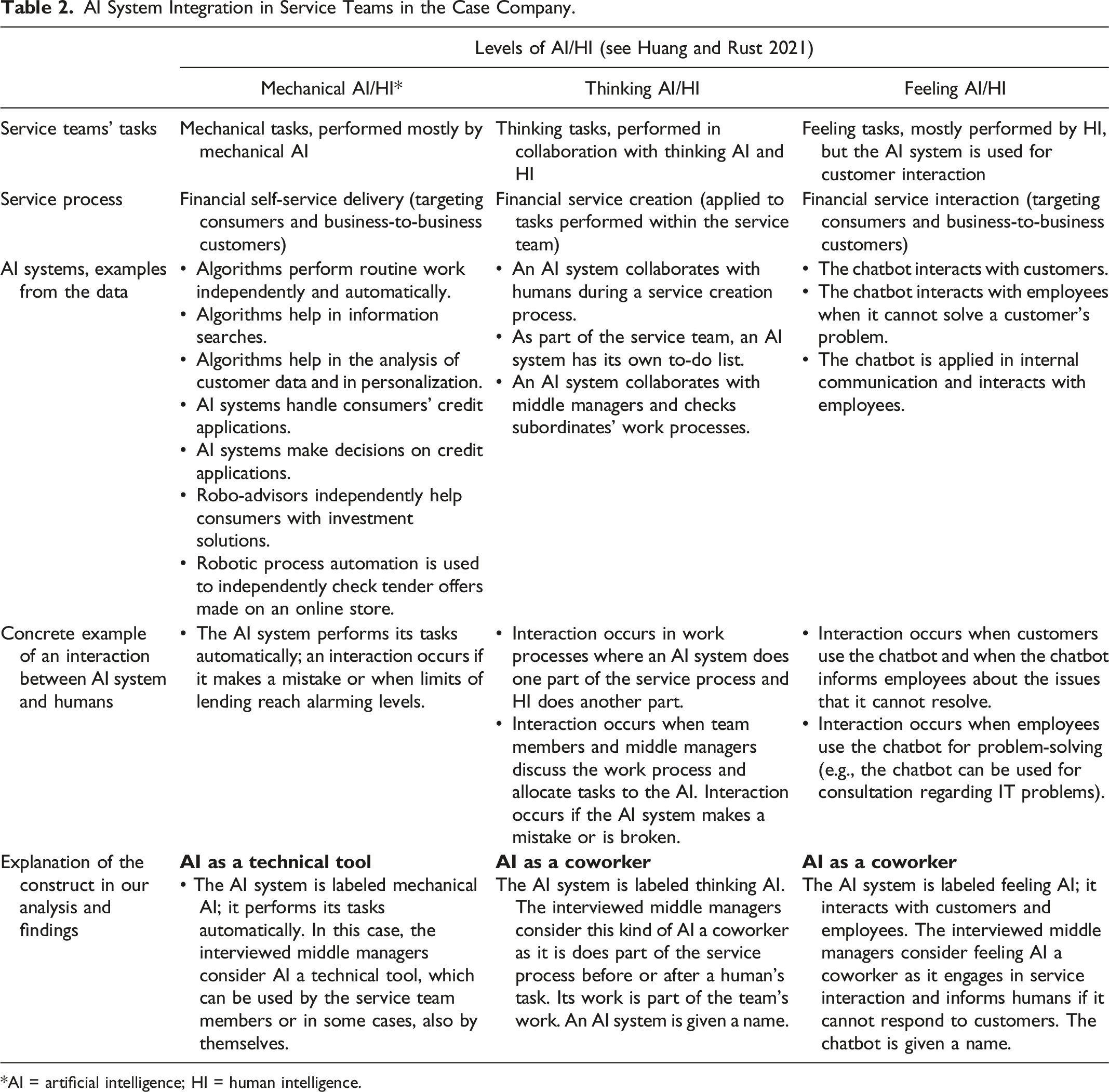
*AI = artificial intelligence; HI = human intelligence.
Second, to answer RQ1, we analyzed the middle managers’ perceived impacts of AI system integration on their work characteristics when leading service teams. Again, in the open-coding phase, we first conducted an analysis, using the interviewees’ own terms to represent their thoughts, insights, or patterns of reasoning (Ingmar 2017). The analysis process included researcher triangulation. Our team of five researchers compared the in-vivo codes to find similarities and differences (Gioia, Corley, and Hamilton 2013; Koponen and Julkunen 2022). Our research team discussed our differences in interpretations and resolved our disagreements through further discussion and analysis of the data.
Third, similar in-vivo codes were connected and formed as first-order concepts (shown in Web Appendix 3). The previously formulated constructs of AI as a technical tool and a coworker were then added to Web Appendix 3, based on the AI type to which each first-order concept referred.
Fourth, our research group compared the first-order concepts to form second-order themes. These were largely expressed in the researchers’ terms (Ingmar, 2017) and included only those first-order concepts mentioned by multiple middle managers (see Koponen and Julkunen 2022). As explained in the rationale, we applied theoretical categories based on an existing validated work design model (see Morgeson and Humphrey 2006), concentrating on four facets: (a) contextual, (b) task, (c) social, and (d) knowledge and skill characteristics. The knowledge and skills were combined as competence because the latter more comprehensively described our findings. A new category also emerged, namely, (e) relationship characteristics. We conceptualized social characteristics as distinct from relationship characteristics. Social characteristics represent social support, interdependence, interactions outside the organization, and feedback from others (Morgeson and Humphrey 2006). As the middle managers explained how interpersonal relationships were triangulated with AI, employees, and middle managers, we recognized that relationship characteristics comprised the types of interactions that the employees developed with AI and the technology itself. The various degrees to which the technology was objectified or anthropomorphized revealed a common feature of the managers’ characterizations of their workplace. This novel category seemed particularly relevant and distinct from the social characteristics of work, as described by Morgeson and Humphrey (2006). Our research group subsequently compressed the second-order themes into large aggregate dimensions that represented the top-level categories in the analysis (Ingmar, 2017; see Web Appendix 3).
To answer RQ2, the benefits and challenges of AI integration were analyzed by applying a similar Gioia methodology, as explained above (Gioia, Corley, and Hamilton 2013). The first-order concepts were formulated by one researcher, respecting the interviewees’ own terms. The second-order categories were created collaboratively by our entire research team and subsequently compressed into more theory-driven aggregate dimensions. The analyses are presented in Web Appendix 4.
Our research team returned to the case company and presented our summarized findings to the interviewees who were able to attend the face-to-face meeting. Based on our discussions with the interviewees, the findings, where needed, were sharpened, refined, elaborated, and confirmed. We also presented our findings to fellow academics in national scientific conferences and collected their feedback prior to finalizing this paper.
Findings
The findings related to RQ1 are presented in Web Appendix 3 and further elaborated in the following sections. These results explain how middle managers perceive the impacts of AI system integration on their work characteristics. Then, the findings related to RQ2—challenges and benefits of the AI system integration—are presented in Web Appendix 4 and elaborated in the following sections. Finally, the findings related to RQ3 are presented in Table 2 and further elaborated in the following sections. These results explain how different types of AI (mechanical, thinking, and feeling AI) are integrated into the service teams’ work.
Contextual Characteristics
Based on our findings, the middle managers did not discuss ergonomics, physical demands, or work conditions, which were introduced in Morgeson and Humphrey’s (2006) work design model. However, the middle managers emphasized ethical considerations regarding AI integration (see Web Appendix 3), which are important industry-related contextual characteristics because in the financial industry, middle managers need to consider rules and regulations in their work (Hentzen et al. 2021). The interviewed middle managers were concerned about whether AI systems would be able to consider General Data Protection Regulation (GDPR) and other rules and regulations in data sharing and whether AI system designers would understand and remember the rules and regulations related to the banking industry. Furthermore, given how legislation lags behind market developments, the middle managers expressed concerns about whether the AI system designers properly took into account information security issues and had the capability and inclination to consider continuity issues and risks over the long term. The middle managers often worried about whether the correct limits for AI could be determined to calculate loan offers correctly. The following quotations express this sentiment: Do we know how to take GDPR regulations and all other legislation into account? It is important to consider what can be done when we are a financial group. (Interviewee 9) If a customer applies for a loan from our bank, at the moment, the first offer is made by the robot. I am in charge of determining what the price is for the first offer. We have to be quite careful that it hits a tolerable limit because the robot does not recognize the customer relationship. (Interviewee 17)
Task Characteristics
Task characteristics involve the nature and range of the procedures associated with a particular job, including autonomy, task variety, task significance, task identity, and feedback from the job (Morgeson and Humphrey 2006). According to the middle managers, AI system integration had diminished task autonomy (see Web Appendix 3) because strategic decisions about AI systems and their implementation were made centrally and higher up in the organization, basically in the information technology department. Middle managers or their teams were not allowed to independently make decisions regarding AI systems; neither could they change nor modify these systems. Instead, the teams were supposed to integrate the selected AI systems as part of their work routines. In the marketing department, AI systems were involved in decision-making. In the financing department, AI systems handled and decided 90 percent of the loan offers. Furthermore, they conducted managerial oversight. The following quotations articulate this category of work characteristics: In a company, the division of labor is clear in such a way that those who work in the local offices, of course, make use of everything that is done and decided in the [case company’s] central community, where they are responsible for the development of these systems and all other such work. (Interviewee 19) To help with supervisor monitoring, we have an AI system that checks certain things about customer encounters to see if the employee is doing things as required by the guidelines and the law. It’s kind of like a pre-examiner. Then a more accurate interpretation can be made by the manager. (Interviewee 21)
In contrast to the prospect of AI routinizing job content, task variety was described as increasing as more sophisticated/advanced tasks were gaining greater prominence. The middle managers and their teams were able to concentrate on more complex, interesting, and challenging tasks, which made the work more meaningful. They had more time for various customer interaction tasks and work process development. Moreover, the middle managers had new tasks, such as ensuring that a supervisor was always appointed for each AI system.
These benefits in task variety were partially counterbalanced by the middle managers’ increased dull tasks related to checking the AI systems’ work. This was because the AI systems sometimes broke down or failed, in which case, a human had to do routine work. Checking and correcting errors made by an AI system was a new job routine that took a lot of time. Therefore, a tension between task variety and task monotony emerged. The following interview excerpts illustrate these aspects: In practice, this means that familiar and safe routine tasks have to be abandoned, leaving behind challenging, complex tasks. (Interviewee 2) When [the AI system] doesn’t work, when a bug appears, it shows up in the fact that people will mention it to their own managers. This is concretized for me, too, when for a moment, there is a blockage and nothing moves when the AI does not do its stuff. Then, it means we have to start doing the work process in the old-fashioned way. (Interviewee 20)
Task significance refers to the degree to which a job influences other people’s lives (Morgeson and Humphrey 2006). Because AI system integration directly affected the customer experience, the middle managers reported that task significance had increased and that the AI systems provided faster self-service to customers. However, the middle managers were concerned about whether customers were happy with the impersonal aspect of self-service alone. The middle managers also believed that AI systems might make mistakes that would affect more customers’ lives than previously, especially if the mistakes were not recognized and corrected quickly.
AI system integration was perceived as transforming task identity, which refers to the degree to which a job involves doing the whole piece of work (e.g., a complete unit of service) (Morgeson and Humphrey 2006). The middle managers pointed out that when AI was viewed as a coworker, it performed certain tasks related to a particular service process. Therefore, instead of being responsible for the entire service process, humans put the whole service together in collaboration with the AI system. The designated persons supervised the AI systems and were responsible for the work process to which each system was connected. The following quotation illustrates this aspect: AI can act as some kind of pre-processor, or it can be involved in some part of the process, such as an intermediate part. For example, in one process that has four phases, two phases are done by AI, and two phases are done by a human. AI can do things like pre-processing work or monitoring work, going through control lists, and then inform human users about mistakes. (Interviewee 3)
Competence Characteristics
Competence characteristics reflect both knowledge and skills (see Morgeson and Humphrey 2006; Web Appendix 3). The middle managers explained that when AI systems collected large amounts of information, they required increased information processing from humans. Managing a work process integrated with AI systems would require processing information related to disruptions. Information processing would be needed as middle managers should understand at least the basics of AI systems. Furthermore, AI system integration allowed more time for problem-solving and tasks that would create customer value. The middle managers had to decide which tasks were too complex or challenging for an AI system to perform and should be left to humans.
As AI system integration evolved, task variety increased, and the middle managers described their need for increased skill variety in their work. At the same time, dull tasks increased, implying skill simplicity. Therefore, a tension between skill variety and skill simplicity was observed. Due to constant changes, the middle managers were required to apply change management skills and adapt to leading continual change processes. When AI system integration (thinking AI and feeling AI) changed the team members’ tasks, the middle managers needed to monitor their employees’ work performance, stress levels, and coping skills in a state of constant change. Furthermore, the need for interpersonal communication skills, such as presenting arguments, negotiating, listening, and motivating and committing people to work with AI, was evident. Because AI system integration caused constant change and the employees experienced anxieties and even fear of working with AI, the middle managers needed to show emotional intelligence and empathy. The following quotations express these sentiments: You have to be able to better justify things, to be at least consistent, unambiguous, clear enough in your communication, and at the same time, be able to read those quiet moments and thoughts that may not be said out loud. (Interviewee 13) It is really important to be able to identify with that person or those persons [and put yourself in their] shoes, to think how they are different... You can’t just say things in the same way to an individual or individuals or teams or an organization. You always need to think about who you’re talking to. (Interviewee 9)
Social Characteristics
In the original model, the social characteristics of work include social support, interdependence, interactions outside the organization, and feedback from others (Morgeson and Humphrey 2006). Social support reflects the degree to which a job provides opportunities for advice and assistance from others (Morgeson and Humphrey 2006). The middle managers talked about an increased demand to receive social support for themselves and at the same time, support their subordinates. They discussed receiving social support from top management, other middle managers, and an internal coach (see Web Appendix 3), as one manager emphasized: I can proudly say that we receive support for communications, marketing, importing, HR, or legal issues. (Interviewee 14)
At the same time, the middle managers needed to provide social support to their subordinates because some team members were uncertain about their own positions due to the AI system integration and about their competence in using AI or even feared losing their jobs, given the increased layoffs due to the AI integration. These aspects are illustrated in the following quotation: One big challenge is people’s uncertainty about their future jobs. It’s a bit like a double-edged sword when we develop AI systems from the perspective of making operations more efficient and doing the same job with a smaller group. Therefore, dealing with uncertainty is one of the most essential daily challenges in my work. (Interviewee 1)
According to the interviewees, human interactions outside the organization diminished since AI systems took care of broad aspects of customer interactions. Although the case company offered its customers self-service options operated by AI systems, the customers also wanted interactions with humans. The middle managers reported the customers’ longing for face-to-face interactions with company representatives, for instance, when thinking about their future investments. The following quotation illustrates this aspect: In the private corporate business, personality plays a pretty big role in the direction of things. After all, they have these private asset managers, corporate bank account specialists, and account managers, who have their own client portfolios that they handle. There are familiar clients who have been in the portfolios for years. It’s not about taking care of the customer masses; it’s about taking care of individuals. Of course, face-to-face encounters are needed for this. (Interviewee 23)
The middle managers reported their need to respond to employee resistance to change and technology, which required constantly motivating their subordinates to use AI systems. The middle managers explained that some team members did not want to be required to adopt and start using and relying on new AI systems. Furthermore, as AI systems had occasionally broken down or failed, employees could not fully trust them. Employee resistance to technology made it challenging to maintain staffs’ motivation and enthusiasm for AI system-integrated work. I think it is very important to involve everyone in the change. Even the last one who wants to resist. I want to engage in dialogue and motivate [the employees] as long as they are really involved in this digital change. So, being inspiring and inspiring others are important. (Interviewee 6)
Furthermore, AI system integration created an increased demand for supporting the staff’s self-management. The middle managers needed to give their teams the responsibility, freedom, and space for independent decision-making. They had to encourage the employees to change their work tasks and habits when the AI systems had been programmed to carry out some of their old tasks.
Relationship Characteristics
In the analysis, we separated social characteristics from relationship characteristics since the middle managers explained how relationships were triangulated with AI, employees, and middle managers. Morgeson and Humphrey (2006) did not include relationship characteristics as a category in their work design model. Based on our analysis, the AI system integration was perceived in two ways (see Table 2). Some of the interviewed managers viewed the AI system purely as a technical tool, while others lent it the status of a coworker in their teams.
When the AI system was considered a technical tool, it referred to the situation when the system with mechanical AI (see Huang and Rust 2021) automatically and autonomously focused on recurrent operational tasks. For example, AI systems could help with searching for information, analyzing customer data and personalization, handling and making decisions about consumer credit applications, and personalizing services for customers. Furthermore, the robo-advisors independently helped consumers with investment solutions (self-service offered via the company’s website). AI systems also independently checked the tender offers made on an online store. The following quotations illustrate this aspect: AI system integration has perhaps been taken the furthest of all, so if we think about it, [AI systems] handle 90% of consumer credit applications. And these applications are made through self-service electronic channels. (Interviewee 25) If I’m thinking about advertising, for example, it’s that we have algorithms that make it easier to optimize advertising, whether it’s programmatic buying or social media advertising or targeting. (Interviewee 10)
Instead, when a system, including thinking or feeling AI (see Huang and Rust 2021), was considered a coworker, anthropomorphism and triangular manager–employee–AI relationships emerged. In this context, anthropomorphism means that an AI system (e.g., chatbot) is perceived as “a virtual person,” “an equal colleague,” and even “a subordinate,” indicating that people attribute human characteristics to an AI system (Belk Russell, Belanche, and Carlos 2023). The middle managers mentioned that some employees gave human names to the AI systems and acted as if the chatbot and other AI systems each had a persona or personality. Some employees overseeing workplace AI and chatbots talked about the technology as if they were its parents. Their AI descriptions were sometimes even emotional. These aspects are illustrated in the following quotations: All robo-advisors and robotic process automation programs have human names. And we talk about them as persons; you know, I might ask, “Did you give him a mandate [to do something]?” And if you don’t know their names, you just cannot follow the conversation. (Interviewee 16) It is a big change within many other changes, that artificial intelligence is just as equal a colleague in the work community as humans. In that sense, it is like a person, even if it is not seen. It is a strong link in the team, just like any other virtual team player. (Interviewee 8) We want to add personality to it; for example, here is chatbot [Finnish name]. We easily say that an employee who trains the chatbot [Finnish name] and takes care of it is the chatbot’s parent. (Interviewee 11)
In our findings (see Web Appendix 3), AI was considered a part of the relationship (middle manager–employee–AI system) and played an important role when perceived as a coworker, led and organized by middle managers and their teams. When AI systems were regarded as coworkers, they were considered as collaborating with humans during the work process. Moreover, AI systems had their own “to do” lists as part of the service team. They also collaborated with the middle managers and checked the subordinates’ work processes. Then, the middle managers needed to concentrate on task division in a new way so that the respective roles of AI and humans were clear, avoiding work duplication. The following interview excerpts illustrate this: These AI systems collaborate with us. They almost have their own bench at the team meetings. (Interviewee 4) If we think about, say, our chatbots, these take care of easy chat conversations, depending a bit on the business area, and then people will take care of more complex issues after that. (Interviewee 15)
The middle managers reported that the combination of the AI system and human work could lead to disagreements that would need to be managed, as the following quotations show: And once you’ve gotten used to the AI system smoothly working, if that process gets bumpy, it will cause indignation in people. It’s visible and audible to me when I talk to people in Teams and they ask me, “How shall we solve these issues when they can’t do these things in the same time frame as the AI system does?” So yes, I have to sort out conflicts. (Interviewee 20) I lead a team with a few people and robots. It’s a strong interaction with these team members. If the robot has any challenges, it will be solved immediately. In my team, people complain to me right away if [Finnish name] robot has not done its part and collaboration is not working. Then, it has to be solved. (Interviewee 4)
Challenges and Benefits of AI Integration in Service Teams
According to the interviewed middle managers, AI integration brought both challenges and benefits (see Web Appendix 4). The middle managers needed to tackle additional workloads, even though AI integration had been predicted to boost companies’ productivity (see Flavián et al. 2022; Manisaligil et al. 2023; Nyholm and Smids 2020). Overall, we found a tension between work productivity and middle managers’ job demands, as explained next. Productivity benefits were related to improvements in everyday task output, customer service, and fair treatment of customers. Regarding everyday task productivity, the middle managers reported that AI system integration made human work easier, replaced routine work, and saved person-years and time. As customer service delivered by a robo-advisor was not dependent on humans, it was also thought to be more equal for customers, as illustrated in the following quotation: [The robo-advisor] treats customers equally; there is no human there [providing the service], and the loan recommendation does not depend on whether the relationship between people is good or bad. (Interviewee 18)
At the same time, AI integration caused challenges, such as more time being spent on checking AI system mistakes, contemplating ethical issues, and responding to employees’ fear, anxiety, or resistance related to AI systems. Some middle managers brought up fears concerning the increasing speed of changes in the organization, as the following quotation shows: I’d like to have less efficient periods so that people would have time to stop and talk in peace. It feels like we’re going so hard and are so hectic now, and there are a million things to do… at the moment, I think it’s a bit too effective. (Interviewee 25)
Constrained specialization referred to the managers’ experiences of being unable to specialize in AI system development as only a few managers were involved in the development process.
Discussion
Theoretical Contributions
Our study responds to the call to investigate the demands of working with AI systems (Coombs et al. 2020; Vorobeva et al. 2022) in the financial sector (Belk Russell, Belanche, and Carlos 2023; Richter and Resch 2021), where automation is substantially integrated into routine employee activities (Flavian et al. 2022) and where middle managers’ work has changed due to the increased use of AI systems. This inquiry contributes to the service research (Caron 2019; Flavián et al. 2022; Hentzen et al. 2021; Huang and Rust 2018, 2021; Vorobeva et al. 2022) in the following ways.
First, to answer RQ1, we provide an empirical study of middle managers’ work characteristics in the financial sector when leading AI system-integrated teams. Over the past 60 years, scholars in human resource management (HRM) have examined the impacts of technology on jobs and organizations, the utilization of technology in HRM activities, and the management of technology workers (Kim, Wang, and Boon 2021). Nonetheless, there is scarce research on middle managers’ work characteristics in terms of leading AI-integrated service teams. While theoretical studies on AI integration and how it shapes human jobs are found in the service literature (see Huang and Rust 2018, 2021) and in the organizational behavior literature (Kim, Wang, and Boon 2021; Parker and Grote 2022; Parker, Van den Broeck, and Holman 2017), our research is one of the few empirical studies relying on naturalistic data and investigating how AI system integration (Belk Russell, Belanche, and Carlos 2023) modifies middle managers’ work characteristics. Based on our findings, AI system integration in service teams implies managing five domains of work characteristics: context, task, competence, social, and relationship. Previous studies on work characteristics have often introduced contextual, task, social, and knowledge and skill characteristics (see Fréour, Pohl, and Battistelli 2021; Morgeson and Humphrey 2006). Therefore, our findings contribute to the theory of work characteristics by extending the previously defined categories (Morgeson and Humphrey 2006), which is achieved by showing that relationship characteristics are crucial when leading AI-integrated service teams.
Second, to answer RQ2, we show the benefits and challenges of AI system integration. The benefits were related to productivity, which is supported by previous findings (see Flavián et al. 2022; Manisaligil et al. 2023; Nyholm and Smids 2020). It was also believed that customer service and fair treatment of customers were improved. At the same time, the middle managers’ work became more demanding due to the additional time spent on checking AI system mistakes and considering ethical issues. Furthermore, the middle managers reported that the employees were afraid of AI systems and even resisted using new technology (see also Gillath Omri et al. 2021). All these indicate a dialectical tension between productivity and job demands. Dialectical tensions between middle managers’ task variety and task monotony and between skill variety and skill simplicity were also found. With these findings, we contribute to work design theory (Parker and Grote 2022) and show that middle managers’ work becomes cognitively more demanding, even though AI system integration may enhance the efficiency and productivity of the company. With the increasing complexity caused by the introduction of AI integration into the workplace, the more unlikely it is that managers can be replaced by AI, at least until AI becomes more empathetic and relationally capable (Huang and Rust 2018, Huang, Rust, and Maksimovic 2019; Rust and Huang 2021).
Third, in response to RQ3, our findings show that systems involving theoretically diverse AIs (mechanical, thinking, and feeling AI) (Huang and Rust 2021) are applied by service teams in various ways and perceived differently by middle managers. Instead of using a procrustean conceptualization of AI integration from relatively general perspectives in the field of organizational behavior (e.g., Parker and Grote 2022), we examine AI integration from a theoretical perspective, specifically seeking to account for AI characteristics. We frame our empirical study according to the theoretical understanding of the categories of mechanical, thinking, and feeling AI in the service sector (Huang and Rust 2018, 2021). Our findings indicate that when AI systems involve mechanical AI, middle managers perceive them as technical tools, and an objectified relationship between humans and the AI system is established. However, when middle managers regard AI systems as coworkers (involving thinking AI and feeling AI), work processes are conducted in collaboration with AI systems, and an anthropomorphized relationship between humans and AI systems emerges. This new information helps service researchers and managers understand the nuances of how different types of AI influence service team leadership.
To extend the theoretical value of these findings, a constant comparison of all findings was conducted to organize all of them into a conceptual framework, following the slightly revised list of dimensions identified by Morgeson and Humphrey (2006), with the addition suggested in the present study (see Figure 1). Figure 1 illustrates the perceived impacts of AI system integration on work characteristics, the benefits and challenges brought about by AI integration, as well as the major dialectical tensions related to AI system integration. Conceptual framework illustrating how AI system integration affects middle managers’ work characteristics.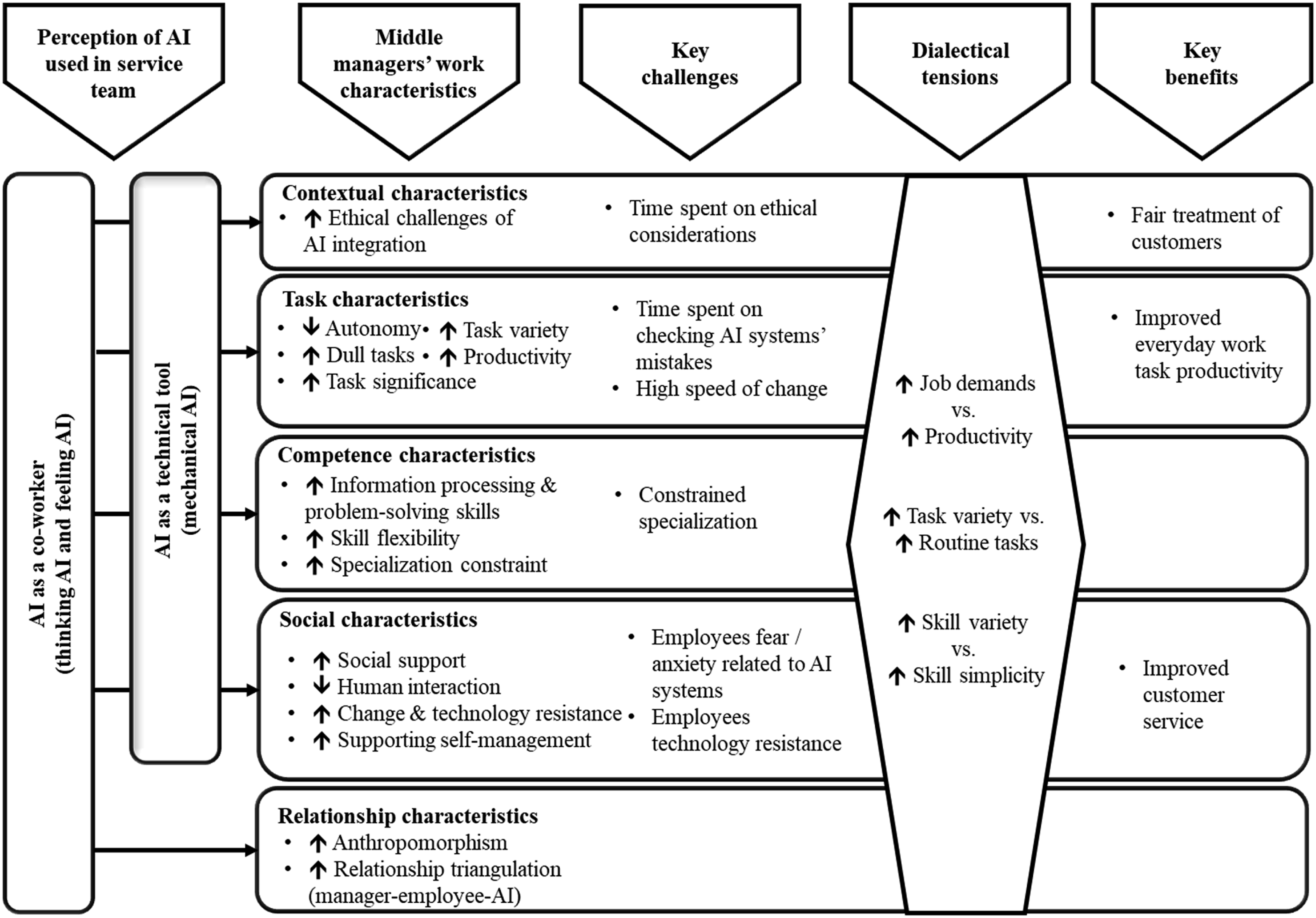
Regarding the theoretically different types of AIs shown on the left side of Figure 1, mechanical AI, thinking AI, and feeling AI all have impacts on middle managers’ contextual, task, competence, and social work characteristics. However, only thinking AI and feeling AI have effects on the relationship characteristics of the middle managers’ work.
Referring to the contextual work characteristics shown on the left side of Figure 1, AI integration raises ethical considerations. This finding is in line with the fact that financial services are highly regulated (Belk Russell, Belanche, and Carlos 2023; Caron 2019; Hentzen et al. 2021); therefore, AI system applications must be meticulously planned and implemented with regulatory oversight and liability in mind.
Related to the middle managers’ task characteristics, a dialectical tension between task variety and task monotony has to be managed. While AI systems perform routine work, managers can concentrate on more meaningful tasks (Fréour, Pohl, and Battistelli 2021); however, routine tasks increase because middle managers need to check AI systems’ work. Therefore, managers face the task of finding the optimum balance between routine and variety and between significance and insignificance in work delegation and management.
Related to social and competence characteristics (see Figure 1), a dialectical tension between skill variety and skill simplicity should be managed. Middle managers need to focus more on supporting and motivating service team members, which require communication skills and emotional intelligence. This issue is due to employees’ resistance to change and technology and their fear of losing their jobs; the latter is a challenge identified in previous studies (Gillath Omri et al. 2021; Vorobeva et al. 2022). Such technology resistance (Blut and Wang 2020) and fear of job losses may undermine the trust between humans and AI (Gillath Omri et al. 2021). All these increase the importance of expressing emotional support and creating a climate conducive to it.
Regarding the relationship characteristics of the middle managers’ work, our study’s findings show how the relationship between the AI system and humans could be understood as either objectified or anthropomorphized, depending on the perceived nature of the AI system integration (as a technical tool or a coworker). Our findings indicate that the more advanced AI is (thinking AI and feeling AI), the more interactional the AI system becomes and the easier it gets to anthropomorphize it. When the AI system is considered a technical tool that automatically and independently performs its own work, middle managers do not anthropomorphize it. Rather, the AI system is objectified as a tool. In contrast, when the AI system is perceived as a coworker, it tends to be regarded as a real (although virtual) person, including giving it a human name and treating it as a team member or subordinate with its own task list. This phenomenon relates to anthropomorphism, referring to the attribution of human features or traits to a nonhuman entity (e.g., name, face, emotions; Belk Russell, Belanche, and Carlos 2023; Blut et al. 2021). Whereas a tool tends to be viewed as subservient to its user, a colleague tends to be regarded as a peer.
Previously, it has been found that anthropomorphism can facilitate social interactions between humans and nonhumans (Blut et al. 2021). Compared to mechanical AI, feeling AI relates more strongly to positive emotions (Schepers et al. 2022), and employees can find robots more collegial when they are programmed to be emotionally expressive (Blut et al. 2021). To contemplate our findings further, it seems that one of the key ways in which middle managers and employees manage the integration of technologies is to personify them in order to relate to them as entities. Therefore, over time, interactions between humans and AI may naturally begin to resemble ordinary real-space relationships in the natural world. Working with entities, be they humans or AI systems, signifies developing a sense of familiarity, connection, interdependence, and understanding, all core constructs involved in close interpersonal relationships at the workplace (Finkel, Simpson, and Eastwick 2016). Employees will approach technologies in ways that will likely allow them to map their orientation along two dimensions, closely paralleling task-versus-relationship or vertical-versus-horizontal (Abele et al. 2021) evaluations, such that some employees will utilize technologies as merely tools to serve the tasks, whereas others will orient themselves to the technologies as partners or colleagues with whom they can relate. Rather than a single dimension of tool-versus-coworker, we propose theoretically distinct human–AI relationship types based on the work complexity and AI anthropomorphism dimensions. We also provide a more differentiated, potential four-category typology: high work complexity/high AI anthropomorphism (i.e., collaborative relationship, in which complex work is co-constructed, with technologies treated as peers), high work complexity/low AI anthropomorphism (i.e., instrumental relationship, in which complex work is accomplished through technologies treated as tools), low work complexity/high AI anthropomorphism (i.e., collegial relationship, in which tasks are shared with technologies, understood by employees as colleagues), and low work complexity/low AI anthropomorphism (i.e., mechanistic relationship, in which tasks are conducted with tools that lead the employees to feel objectified or mechanized in their roles). These are illustrated in Figure 2. Human–AI relationship types associated with work complexity and AI anthropomorphism dimensions.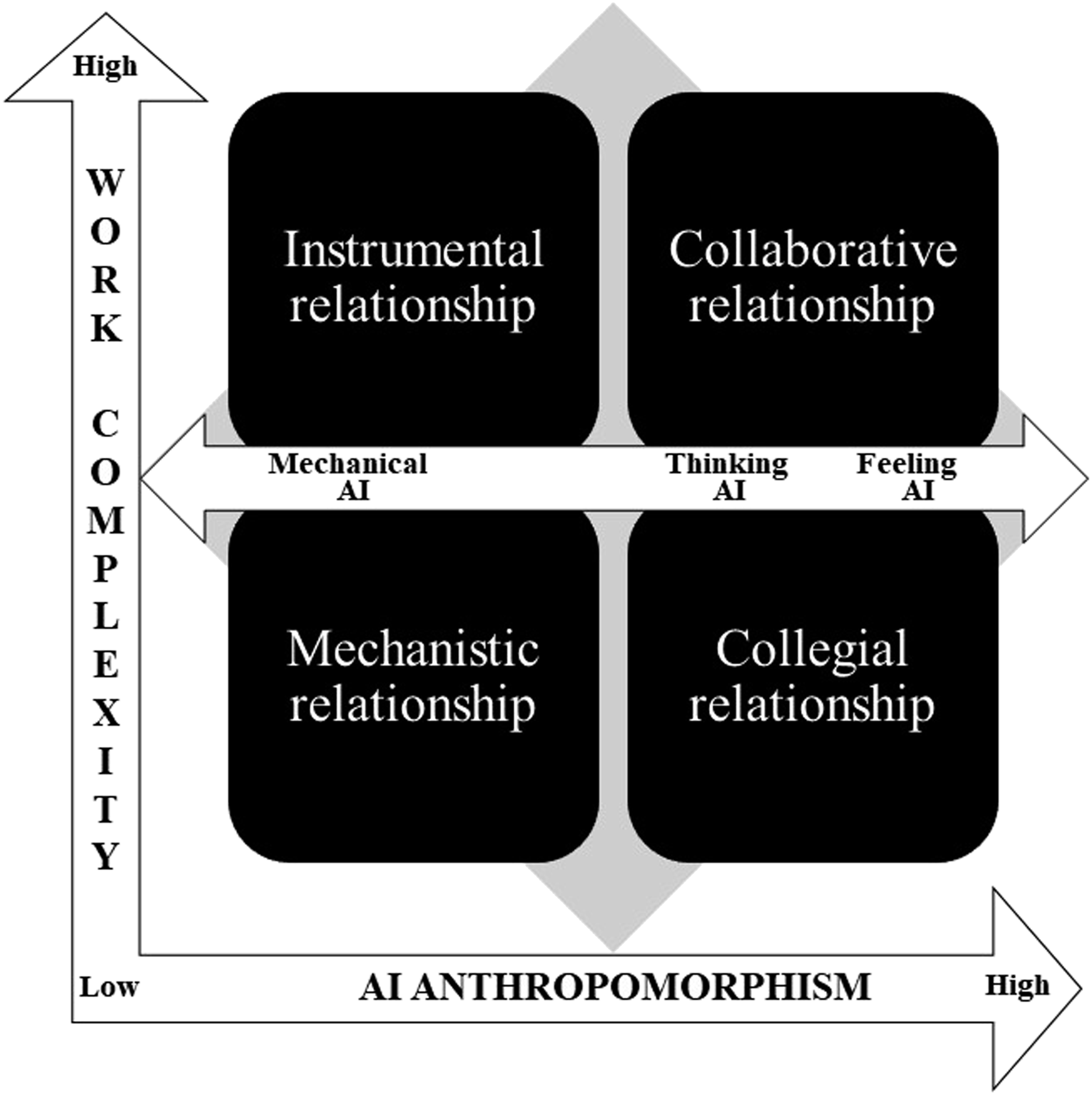
Managerial Implications
Our study’s findings can be applied when addressing the demands of middle managers’ work and designing their work in the service sector in numerous markets and industries. For example, this study’s results inform the selection of new middle managers in the banking and insurance sector, in line with the requirements of the digital age. Our findings show that social and relationship characteristics are highly important in middle managers’ work; therefore, at least in our case company, AI systems do not substitute social leadership functions, such as motivating and inspiring team members (see Schwarzmüller et al. 2018). Thus, interpersonal communication skills (Spitzberg 2013, 2015) and empathetic skills (Huang and Rust 2018) should be considered when selecting new employees for middle managerial positions. Our observations are in line with previous service studies’ predictions that interpersonal communication skills, empathy, and emotional intelligence (Huang and Rust 2018, 2021) will be crucial skills as AI develops. Even studies in the consumer context show that a digital assistant expressing emotional support improves customers’ satisfaction or persistence when they succeed or fail in a task, respectively (see Gelbrich, Hagel, and Orsingher 2021). In team management, interpersonal communication skills are vital for managing leader–follower relationships and for expert work on creating a positive organizational climate and improving job performance (Johansson, Miller, and Hamrin 2014).
Based on our findings, we offer some recommendations to the top management of service organizations. When AI systems are integrated into financial companies, their top management should focus on training their middle managers to be aware of their changing work characteristics. To do so, work characteristics should be introduced to the middle managers, and the demands of their tasks should be openly discussed in terms of competencies and social and relationship-related dimensions. When training middle managers, they should be urged to reflect on their strengths and weaknesses related to work characteristics, including the types of relationship competencies (i.e., mechanistic, instrumental, collegial, and collaborative) that employees need most. Then, through training sessions, middle managers should be coached in assessing their areas for improvement.
Moreover, our study’s results indicate that ethical considerations are tied to middle managers’ everyday work. Therefore, considering how to handle ethical, privacy, and fairness issues should be part of financial companies’ CDR strategy since managing ethical digital processes is a corporate-level challenge (Wirtz et al. 2023), particularly in the highly regulated financial sector (Caron 2019; Hentzen et al. 2021). CDR is critical in service contexts because of the vast streams of customer data involved and digital service technology’s omnipresence, opacity, and complexity (Wirtz et al. 2023). To be consistent, service firms need to build company-wide norms regarding ethical practices, both internally and externally (McLeay et al. 2021). Therefore, middle managers and employees should fully understand the company’s ethical norms and practices (Wirtz et al. 2023) that AI systems and humans need to uphold. Managers need to be motivated and incentivized in reporting ethical concerns quickly if they recognize such issues. Furthermore, it will be valuable for middle managers to consider how to discuss ethical issues with their team members to enhance employee commitment to ethical practices.
Conclusion
To conclude, with this study, we contribute to existing service management literature (Caron 2019; Flavián et al. 2022; Hentzen et al. 2021; Huang and Rust 2018) by identifying how middle managers perceive the key tasks and competencies involved in leading AI-integrated service teams. Our findings show that the work characteristics of middle managers in the financial sector comprise five main dimensions: contextual, task, social, relationship, and competence characteristics. We have organized these work characteristics into a conceptual framework to facilitate the subsequent theory development (see Figure 1). AI system integration in service teams is a complex phenomenon that makes middle managers’ work more demanding and requires them to balance multiple simultaneous challenges. Our study’s results inform the selection and training of middle managers according to the requirements of changing work characteristics in the digital age.
Limitations and Future Research Recommendations
Given that this empirical inquiry is a single case study, it should be noted that it is limited to a single firm in one industry. Our study has focused on the financial sector as it is one of the leading service sectors in AI adoption (Caron 2019; World Economic Forum 2020). The selected case is one of the leading corporations in the Scandinavian financial industry, allowing our research team to investigate middle managers’ perceptions of AI system integration. Due to these context-specific limitations, our study’s findings should be interpreted with caution.
Despite researcher triangulation, we have relied primarily on qualitative interview data. We have provided important insights into the changing work characteristics of middle managers in the financial sector. As researchers, we have no relationship with the organization or the study participants. We have followed the transparency criteria introduced by Aguinis and Solarino (2019). Therefore, the applied qualitative method and the research setting have been described as transparently as possible. The sampling procedure has been explained in detail, and each participant is important in this study. All interviews were transcribed, and their durations are listed in Web Appendix 2. The saturation point was reached when we believed that new information would not add any new categories to the coding scheme. The data analysis and coding have been explained and illustrated in detail.
The interviews were conducted between 2019 and 2021, thus partly during the COVID-19 pandemic. Although this situation may increase the realism of the context and its circumstances, assuming the extensive labor disruption caused by the COVID-19 crisis in 2020, this factor could have affected the findings. However, because the rapid digital adoption and changes during the COVID-19 pandemic have influenced the transformation of middle managers’ leadership, we call for further research on this topic.
We offer three key suggestions regarding future research agenda. First, as this investigation focused on middle managers, we encourage service researchers to examine the changes occurring in back-end and frontline service employees’ work characteristics, roles, and identities since they increasingly apply different technologies in their everyday work and in customer interactions. Customers increasingly avail of self-services and technology-integrated services and therefore need to be taught, guided, and supported in using such technologies. Therefore, changes in work characteristics, as well as the knowledge, skills, and attitudes (KSAs) (Parker and Grote 2022) of service employees, could be studied to enhance a meaningful job design, appropriate recruitment, employee commitment, and customer interaction. Second, as humans and AI increasingly need to function interdependently (Parker and Grote 2022), research on human–AI relationship development has emerged (Pentina, Hancock, and Xie 2023). However, there is a need for longitudinal studies on the forms of human–AI interactions and the stages of development of human–AI relationships. It is important to investigate how human–AI relationships develop over time and what kinds of ethical and social challenges are implicated in these processes. Service researchers should also test the human–AI relationship dimensionality found in the present study through measurement development and factor structure validation. Third, when AI systems are increasingly adopted in various service sectors, ethics and CDR warrant more attention (Wirtz et al. 2023). These issues call for a more in-depth understanding of how service firms can effectively manage the impacts of AI systems and other technologies on their businesses and on human lives.
Supplemental Material
Supplemental Material - Work Characteristics Needed by Middle Managers When Leading AI-Integrated Service Teams
Supplemental Material for Work Characteristics Needed by Middle Managers When Leading AI-Integrated Service Teams by Jonna Koponen, Saara Julkunen, Anne Laajalahti, Marianna Turunen, and Brian Spitzberg in Journal of Service Research
Supplemental Material
Supplemental Material - Work Characteristics Needed by Middle Managers When Leading AI-Integrated Service Teams
Supplemental Material for Work Characteristics Needed by Middle Managers When Leading AI-Integrated Service Teams by Jonna Koponen, Saara Julkunen, Anne Laajalahti, Marianna Turunen, and Brian Spitzberg in Journal of Service Research
Footnotes
Declaration of Conflicting Interests
The author(s) declared no potential conflicts of interest with respect to the research, authorship, and/or publication of this article.
Funding
The author(s) disclosed receipt of the following financial support for the research, authorship, and/or publication of this article: This work was supported by the Academy of Finland (342265).

Supplemental Material
Supplemental material for this article is available online.
Author Biographies
References
Supplementary Material
Please find the following supplemental material available below.
For Open Access articles published under a Creative Commons License, all supplemental material carries the same license as the article it is associated with.
For non-Open Access articles published, all supplemental material carries a non-exclusive license, and permission requests for re-use of supplemental material or any part of supplemental material shall be sent directly to the copyright owner as specified in the copyright notice associated with the article.
