




Abstract
Service firms are increasingly trying to make their offers more sustainable. In this paper, we contribute to the literature on sustainability in service by investigating the impact of the shopping channel on consumer purchases of alternatives labeled as environmentally and socially sustainable. We theorize that the salience of self-oriented (vs. other-oriented) motives in the online (vs. in-store) channel has a higher fit with self-oriented (vs. other-oriented) benefits signaled by environmental (vs. social) labels, especially for utilitarian (vs. hedonic) products. To test this expectation, we conduct three studies using real-world grocery and beauty retailer datasets that include almost 900,000 purchases either in-store (“bricks”) or online (“clicks”). Using both between-consumer and within-consumer analysis, we find empirical support for our hypotheses. Our conceptual framework and findings suggest that service firms that want to promote environmentally and socially sustainable alternatives will benefit from adapting their strategies to different domains of sustainability labels and shopping channels.
Introduction
To reach the UN Sustainable Development Goal of sustainable production and consumption (SDG12: United Nations 2023b), sustainability should be a top priority across all business sectors, including services and service research (Huang et al. 2021). To this end, many service firms are looking for ways to translate their sustainability goals into consumer purchase decisions, but this has proven difficult (Huang and Rust 2011; White, Habib, and Hardisty 2019). For example, in a recent industry survey, nearly 80% of consumers said sustainability was important in their purchase decisions (IBM 2020), but the market share of sustainability labels is far below that, at around 16% (Kronthal-Sacco and Whelan 2020). Sustainability efforts have also been shown to have less impact on consumer perceptions in services (Aksoy et al. 2022; Bhattacharya et al. 2021), making empirical insights into how consumers react to sustainability in this context especially important.
The current paper aims to contribute novel insights on sustainability in service by investigating the impact of the shopping channel on purchases of sustainability-labeled alternatives. Although there is a rich literature on the consumer attitude–behavior gap in sustainability (Carrington, Neville, and Whitwell 2014; White, Habib, and Hardisty 2019) as well as how sustainability labels do (or do not) impact consumer behavior in the offline channel (e.g., Bezawada and Pauwels 2013; Mai, Hoffmann, and Balderjahn 2021; van Doorn and Verhoef 2015), less is known about the relative demand for sustainability labels in a multichannel setting. This is surprising given the growth of the online channel in contemporary service offerings (Hammerschmidt, Falk, and Weijters 2016; Reinartz, Wiegand, and Imschloss 2019) and that research has identified significant differences between in-store and online service offerings (Falk et al. 2007). Previous sustainability research also highlights that sustainable consumer behavior is impacted by the salience of others (e.g., Griskevicius, Tybur, and Van den Bergh 2010; Luchs et al. 2010; Peloza, White, and Shang 2013), suggesting that results from an in-store setting might not be directly translatable to the online channel.
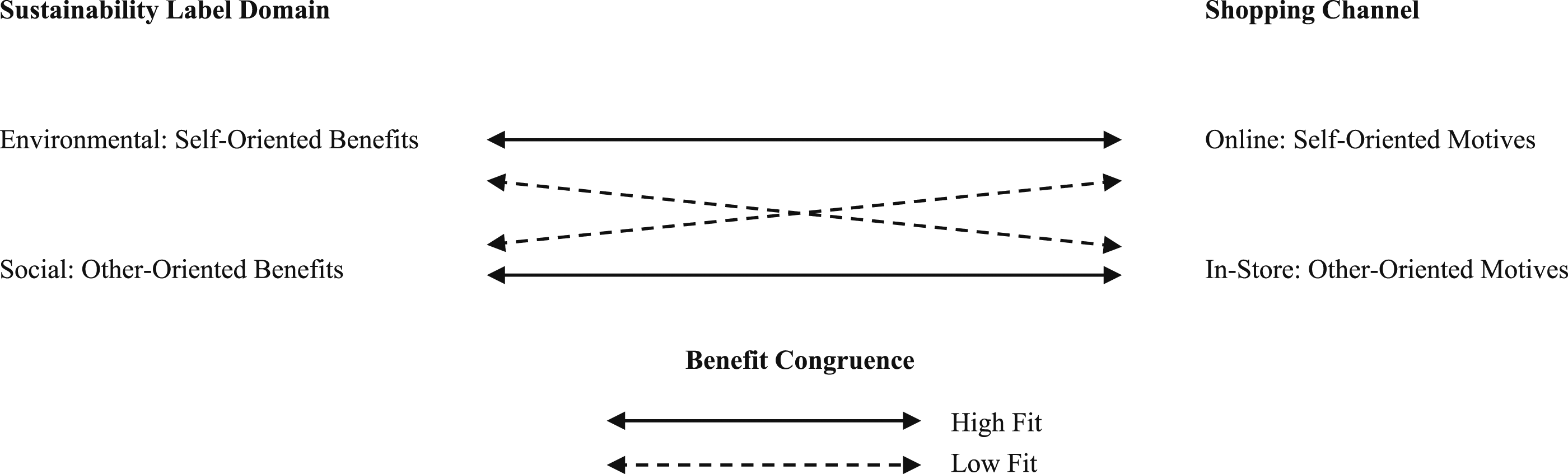
We also contribute to the literature by empirically examining how the (online vs. in-store) shopping channel impacts demand for environmental and social labels, respectively. We argue that a distinction between environmental and social sustainability labels is needed, as these two domains differ in their signaled self-oriented benefits vs. other-oriented benefits and thus offer attributes that are more or less salient in different shopping channels. When shopping online (i.e., mobile, desktop, “clicks”), consumers are generally alone and use self-service functions, increasing salience of functionality and the self. In contrast, in-store shopping (i.e., “brick-and-mortar,” “bricks”) increases the salience of others, as consumers are in a social context surrounded by other consumers and frontline employees. We theorize that there is a higher fit between self-oriented benefits signaled by environmental labels and the salience of self-oriented shopper motives in the online channel. Conversely, there should be a higher fit between other-oriented benefits signaled by social labels and the salience of other-oriented shopper motivations in-store.
Our proposed logic is tested in three empirical studies using data on actual purchase behavior in multichannel retail contexts. By relying on behavioral data, we complement previous empirical work on sustainability, which tends to rely on controlled experiments and self-reported attitudes and intentions (Carrington, Neville, and Whitwell 2014). We thus avoid the intention-behavior gap documented in such studies and offer findings that have practical implications for the real-world behaviors that service firms care about (Hulland and Houston 2021). However, given our empirical approach, we are unable to directly measure or manipulate the salience of self-oriented (vs. other-oriented) benefits of environmental (vs. social) labels. To provide some evidence of this process, we instead conduct exploratory tests where we propose that purchases of utilitarian (vs. hedonic) offerings should make self-oriented (vs. other-oriented) benefits especially salient. Analyzing data from three different datasets, covering in total nearly 900,000 purchases by grocery consumers (Studies 1 and 2) and beauty consumers (Study 3), we find empirical support for the proposed logic. The findings suggest that service firms seeking to promote environmentally and socially sustainable consumption through labels will benefit from adapting their strategies accordingly.
Our investigation makes three important contributions to the sustainability in service literature. First, by comparing environmental and social sustainability labels in the same study (van Herpen, van Nierop, and Sloot 2012), we add to previous research that has focused on either environmental or social labels (e.g., Bezawada and Pauwels 2013; Schuldt, Muller, and Schwarz 2012; van Doorn and Verhoef 2015). Second, by examining how the shopping channel influences demand for environmental or social labels, we extend the existing literature that has mainly focused on sustainable consumption in physical stores (e.g., Bezawada and Pauwels 2013; van Doorn and Verhoef 2015) and allow novel insights into how to employ different service channels (e.g., Cambra-Fierro et al. 2020). Third, by highlighting the importance of fit (Bodur, Gao, and Grohmann 2014; Reczek, Trudel, and White 2018; White and Peloza 2009) in a real-world setting, we provide insights into the relationship between the shopping channel and demand for sustainability labels without risks for overestimation due to the intention-behavior gap and go beyond the immediate (short-lived) effects of a single purchase or choice (cf. Carrington, Neville, and Whitwell 2014; Hulland and Houston 2021; White, Habib, and Hardisty 2019). Our empirical findings come from a retail context, yet the insights gained could inform a large range of multichannel service firms that use online and offline channels to sell their offers to consumers.
Conceptual Framework
The United Nations define sustainability as “meeting the needs of the present without compromising the ability of future generations to meet their own needs” (United Nations 2023a). The term sustainability is commonly used in business practice (Luchs et al. 2010), but here its meaning often varies. Following Huang and Rust (2011), we conceive sustainability in terms of the triple bottom line, meaning that it combines economic profitability with respect for the environment and social responsibility.
From a service firm perspective, one way to become more sustainable is to encourage purchases of environmentally and socially sustainable products and services (cf. SDG12: United Nations 2023b). In this paper, we focus on sustainable consumption in terms of consumers purchasing alternatives that are certified to be environmentally or socially sustainable by different sustainability labels. This approach is similar to Mai, Hoffmann, and Balderjahn (2021), but whereas they focus on environmental (organic) labels only, we investigate both sustainability domains: environmental and social (for similar reasoning, see van Herpen, van Nierop, and Sloot 2012).
In the next sections, we develop our conceptual framework, which builds on previous work related to sustainable consumer behavior (for reviews, see e.g., Trudel 2019; White, Habib, and Hardisty 2019). Although a rich body of work has investigated sustainability in terms of different consumer responses to corporate social responsibility, cause-related marketing, and/or different sustainability appeals (for a review, see Sen, Du, and Bhattacharya 2016), our research focuses specifically on sustainability labels and actual purchase behavior. Whereas corporate social sustainability and cause-related marketing can be linked to consumers’ (un)willingness to be more sustainable in terms of donations or other forms of support for various causes (e.g., Kuo and Rice 2015; Zdravkovic, Magnusson, and Stanley 2010; White and Peloza 2009), labels certify a specific domain of the production process and thus have immediate effects on perceived product quality. Labels can thus be considered as product attributes that signal specific benefits and costs to the consumer.
Sustainability Labels in Two Domains
Selection of Related Work on Sustainability Labels and Consumer Behavior.
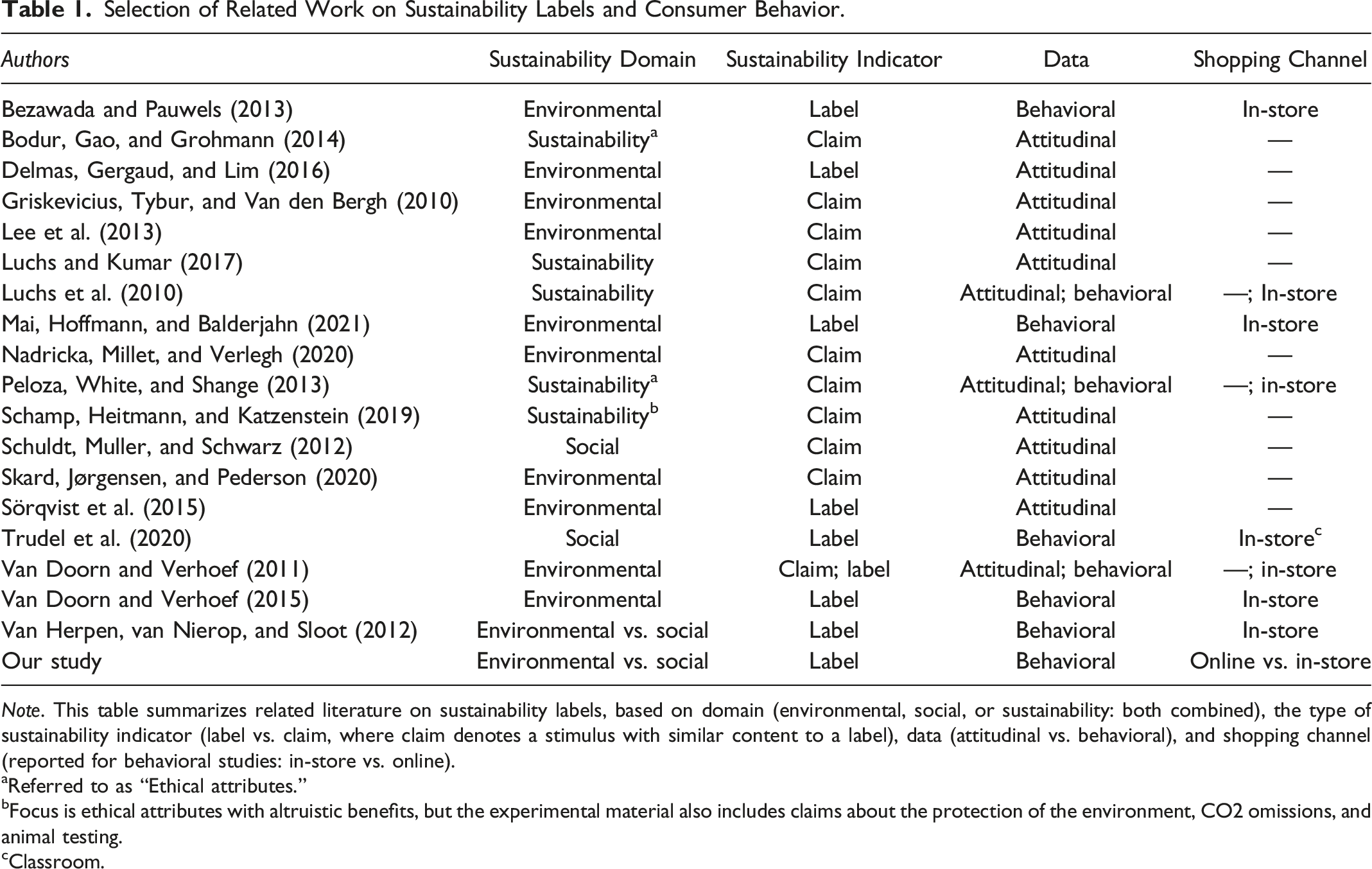
Note. This table summarizes related literature on sustainability labels, based on domain (environmental, social, or sustainability: both combined), the type of sustainability indicator (label vs. claim, where claim denotes a stimulus with similar content to a label), data (attitudinal vs. behavioral), and shopping channel (reported for behavioral studies: in-store vs. online).
aReferred to as “Ethical attributes.”
bFocus is ethical attributes with altruistic benefits, but the experimental material also includes claims about the protection of the environment, CO2 omissions, and animal testing.
cClassroom.
Environmental labels such as “USDA [U.S. Department of Agriculture] Organic,” the EU organic logo, and “EU Ecolabel” certify the use of natural substances and processes and/or high environmental standards in raw material extraction, production, distribution, and disposal (European Commission 2020). In the literature, various terms have been used to denote such labels, including “organic” (Bezawada and Pauwels 2013; Lee et al. 2013; Mai, Hoffmann, and Balderjahn 2021; van Doorn and Verhoef 2015), “eco” (Delmas, Gergaud, and Lim 2016; Pancer, McShane, and Noseworthy 2017), and “green” (Griskevicius, Tybur, and Van den Bergh 2010). Here, we will not distinguish among such labels but rather focus on the environmental domain broadly.
Meanwhile, social labels such as “Fairtrade” and “UTZ Certified” certify that internationally agreed standards for fair prices, working conditions, and trade agreements for workers in developing countries have been considered in production (e.g., Fairtrade International 2020), emphasizing social responsibility. Social labels thus emphasize social issues related to the human side of production. In the literature, various terms have been used to denote such labels, including “ethical” (Trudel et al. 2020) and “fair trade” (Pancer, McShane, and Noseworthy 2017; Schuldt, Muller, and Schwarz 2012). Here, we will not distinguish among such labels but rather focus on the social domain broadly.
Self-Oriented and Other-Oriented Benefits Signaled by Sustainability Labels
The sustainability literature often points to the trade-off between current needs of the self and future needs of others as a key tension for moving towards more sustainable consumption (for a comprehensive review, see White, Hardisty, and Habib 2019). This literature also identifies environmental concern and altruism (conceptualized as the needs of others) as key motivators for sustainable purchases (Mai, Hoffmann, and Balderjahn 2021; van Doorn and Verhoef 2015) and points to generally higher costs of sustainable products than conventional products because sustainable alternatives tend to be more expensive (e.g., Hughner et al. 2007; Schamp, Heitmann, and Katzenstein 2019).
Similarly, the literature on sustainability labels distinguishes between self-oriented and other-oriented benefits (see e.g., Mai, Hoffmann, and Balderjahn 2021; Peloza, White, and Shang 2013; van Doorn and Verhoef 2015), sometimes also referred to as self-interest vs. self-transcending (Evans et al. 2013), and proposes that sustainability labels in general signal other-oriented benefits.
On an overall level, environmental and social sustainability labels can be seen as similar in that they help to guide consumers to alternatives that do not compromise the ability of future generations to meet their needs. However, the more concrete meaning of the two label domains as signals of product attributes might differ. For example, sustainability labels have been found to be perceived as both benefiting (e.g., Delmas, Gergaud, and Lim 2016; Skard, Jørgensen, and Pedersen 2020; Sörqvist et al. 2015) and hurting product quality (Skard, Jørgensen, and Pedersen 2020)—“the sustainability liability” (e.g., Luchs et al. 2010)—thus providing direct self-oriented benefits or costs. Another example is the health halo effect, which suggests that labeling can lead products to be perceived as healthier (Schuldt and Schwarz 2010), and similar effects have been demonstrated for both environmental labels (e.g., Lee et al. 2013; Luchs et al. 2010; Nadricka, Millet, and Verlegh 2020; Sörqvist et al. 2015) and social labels (Schuldt, Muller, and Schwarz 2012). Relatedly, when consumers choose sustainability over economic value, they have been found to trade off guilt for pride (Luchs and Kumar 2017), which in turn leads to (hedonic) self-oriented benefits such as altruism/warm glow (Andreoni 1989; Tezer and Bodur 2020; Strahilevitz and Myers 1998) or self-image/status (Griskevicius, Tybur, and Van den Bergh 2010; Peloza, White, and Shang 2013; Trudel et al. 2020).
Thus, although sustainability labels might always signal other-oriented benefits such as being better for the social community, nature, and future generations (Mai, Hoffmann, and Balderjahn 2021; van Doorn and Verhoef 2015) compared to conventional products, there is also evidence of self-oriented benefits driving purchases and that the effects depend on the sustainability domain and the salience of self-oriented and other-oriented benefits (see e.g., Bodur, Gao, and Grohmann 2014; Luchs and Kumar 2017; Peloza, White, and Shang 2013). To study specific mechanisms underlying these relationships, lab studies and experiments usually manipulate appeals and claims to make self- or other-oriented benefits of labels more or less salient, but our approach is different, as we theorize benefits signaled by the two sustainability labels in general and empirically study the effects in the aggregate. Such concrete differences between environmental and social labels are, however, often overlooked by previous research (for a similar argument, see Choi, Duhan, and Dass 2023; van Herpen, van Nierop, and Sloot 2012). Thus, although our conceptual framework is informed by the mechanisms that have been identified in previous literature, our approach differs, as we theorize around benefits signaled by the two kinds of sustainability labels in general and empirically assess the effects in the aggregate.
Environmental Labels Signal Self-Oriented Benefits
Previous research documents several benefits of purchasing products with environmental labels, such as perception of better health and taste, a way to handle concerns for the environment, food safety and animal rights, as well as norms and ethical concerns, but also that they are traded off for costs such as higher price, lower availability, and possible mistrust in certification (see Hughner et al. 2007 for a comprehensive review and conceptualization).
Although conflicts may arise between self- and other-oriented benefits—for example, animal welfare may come at the expense of product quality or with higher costs—we argue that this conflict is less pressing because previous research has found that environmental labels signal positive product-related implications by using specific ingredients, technologies, or production methods (see Delmas, Gergaud, and Lim 2016; Luchs et al. 2010; Sörqvist et al. 2015). In addition to other-oriented benefits, environmental labels thus signal self-related benefits based on attributes with close links to the actual product. This means that environmental labels are generally seen to offer functional benefits (Choi, Duhan, and Dass 2023) and thus are bought not only for environmental motives but also for personal motives such as health or taste (van Herpen, van Nierop, and Sloot 2012; for a similar argument, see Schamp, Heitmann, and Katzenstein 2019). We thus propose that environmental labels are more closely linked to the function of the product and thus offer more self-oriented benefits.
Social Labels Signal Other-Oriented Benefits
Social labels signal social justice and benevolence, and consumers who buy products with social labels are thinking about other people. Consumers choose products with social labels based on (other-oriented) prosocial values and motives (Doran 2009). Still, social labels can also lead to self-related benefits such as warm glow, empathy, moral satisfaction, and reduced guilt (Schamp, Heitmann, and Katzenstein 2019; Trudel et al. 2020). For example, there is evidence of a “fair-trade halo effect” (Schuldt, Muller, and Schwarz 2012). Products with social labels also suffer costs such as higher prices (cf. Schamp, Heitmann, and Katzenstein 2019).
In general, social labels focus on social impacts throughout the product lifecycle and are primarily signaling other-oriented benefits that are only remotely related to the actual attributes of products. As argued by van Herpen, van Nierop, and Sloot (2012), social labels are thus weakly connected to functionality and mainly offer other-oriented benefits, such as warm glow and symbolic benefits (Choi, Duhan, and Dass 2023). We thus propose that social labels mainly signal other-oriented benefits because the label is more closely associated with the conditions of others by whom the product was produced.
Fit Through Benefit Congruity
The notion of other-oriented and self-oriented benefits to understand sustainable consumption was initially developed by White and Peloza (2009) to understand different appeals to promote donations for causes (i.e., promoting benefits to the donor or the beneficiaries). In the context of appeals, promoting either self-oriented benefits or other-oriented benefits is superior to highlighting both (Evans et al. 2013; Goldsmith et al. 2022). Research has also highlighted the importance of “benefit congruity,” meaning that a fit between the type of sustainability offered by the product attribute and product category increases the salience of the benefit shared by the product attribute and product category (Bodur, Gao, and Grohmann 2014). For example, in a social setting, donors care more about self-image and status, making appeals focused on other-oriented benefits more efficient (White and Peloza 2009). Interestingly, this research shows that participants are more likely to choose a product with environmental claims when in a private (vs. social) setting and when appeals are self-oriented (vs. other-oriented) (Peloza, White, and Shang 2013), suggesting that self-oriented (other-oriented) benefits likely have better fit in a private (social) setting, such as when shopping online (in-store).
We believe that benefit congruity has implications also for sustainability labels. However, whereas the previous literature typically discusses self-oriented benefits in terms of economic benefits and views both environmental and social labels as other-oriented (Reczek, Trudel, and White 2018), our review of the literature also highlights self-oriented benefits signaled by sustainability labels, especially when it comes to taste and quality, comparing environmental labels with social labels. As discussed above, environmental labels are closely linked to the product and as such more likely to signal self-oriented benefits, whereas social labels do not have the same direct link to the product and thus primarily signal altruistic benefits that are focused on others. In line with previous research, we expect that self-oriented (vs. other-oriented) motives have better fit with benefits signaled by environmental (vs. social) labels and that this in turn will have implications for the impact of the shopping channel on consumer purchases of environmental and social sustainability-labeled alternatives.
Salience of Self-Oriented Benefits Online
Previous literature identifies several differences between shopping channels in a service context (Hammerschmidt, Falk, and Weijters 2016; Falk et al. 2007). A key feature of the online channel is that it is inherently private and functional; consumers are typically sitting alone in front of a screen and are task-oriented, that is, without salience of social or hedonic benefits (Bartl, Gouthier, and Lenker 2013). There are also several other characteristics of shopping online compared to shopping in-store. Consumers are more likely to purchase products that are bulkier, heavier, less sensory (Campo and Breugelmans 2015; Chintagunta, Chu, and Cebollada 2012), and healthier (Huyghe et al. 2017; Zou and Liu 2019). Consumers are less sensitive to prices and promotions (Chu, Chintagunta, and Cebollada 2008). Finally, search cost and display format differ online compared to in-store (Degeratu, Rangaswamy, and Wu 2000). We argue that these features make the online shopping context functional and self-oriented. In general, the online channel thus has high fit with the self-oriented benefits of environmental labels and thereby is likely to enhance the perceived value of the benefits offered by this domain of sustainability label. Thus, we hypothesize:
Consumers purchase more products with environmental labels online compared to in-store. In our empirical approach focusing on actual purchases, it is unknown if consumers perceive that labels signal self-oriented benefits. Still, we reason that utilitarian offerings (i.e., providing functional benefits) and hedonic offerings (i.e., providing benefits of joy and pleasure) (e.g., Dhar and Wertenbroch 2000), sometimes conceived as virtues and vices (cf. O’Curry and Strahilevitz 2001), should prime self-oriented and other-oriented benefits differently. The potential trade-off between sustainability and functional product quality is especially large for utilitarian product categories (Luchs and Kumar 2017; Skard, Jørgensen, and Pedersen 2020). Thus, utilitarian products gain more from priming self-oriented benefits, that can help counter such trade-offs. In fact, there is some empirical evidence supporting this logic. Bezawada and Pauwels (2013) find that purchases of environmental labels increase when price is lower or promotions are higher—thus, when self-oriented benefits are higher. Similarly, empirical evidence from in-store scanner data shows that consumers are less likely to purchase hedonic products with environmental labels than utilitarian products with environmental labels (Bezawada and Pauwels 2013; van Doorn and Verhoef 2015). Finally, Bodur, Gao, and Grohmann (2014) show in lab experiments that utilitarian products have benefit congruity with a sustainability attribute that highlights the use of natural substances and processes. Thus, we propose that purchases of utilitarian offerings should make self-oriented benefits salient, and we expect that H1 holds especially for utilitarian products.
Salience of Other-Oriented Benefits In-Store
In store, the situation is the opposite from the online shopping channel. Even when shopping alone, consumers are surrounded by other people (both employees and consumers), making the shopping situation inherently social and more experientially oriented. We argue that other-oriented motives are more salient in-store compared to online and that self-oriented motives are more salient online (cf., e.g., task orientation, fewer distractions, private nature). Thus, the in-store channel has higher fit with other-oriented benefits signaled by social labels. This is analogous to other-oriented appeals making consumers more likely to donate in public settings (White and Peloza 2009).
Based on in-store purchases, related research shows that the motives for purchasing environmental labels are other-oriented rather than self-oriented (Bezawada and Pauwels 2013; Mai, Hoffmann, and Balderjahn 2021; van Doorn and Verhoef 2015). We expect that other-oriented motives documented in previous research are more salient in-store. However, we reason that self-oriented benefits of environmental labels are less salient in-store compared to online, thus providing a better fit between the salience of other-oriented motives in-store and the other-oriented benefits signaled by social labels. Peloza, White, and Shange (2013) have shown that priming others through a social setting (vs. self through a private setting) caused participants to choose products with environmental claims priming other-oriented benefits of no degradation to the soil and environment (vs. self-oriented benefits of outstanding flavor). This is in line with how we reason, but we differ in studying labels instead of claims and conceive social labels as generally signaling more other-oriented benefits (in comparison to environmental labels that also signal functional quality). We hypothesize:
Consumers purchase more products with social labels in-store compared to online. Even if we cannot know whether consumers perceive the social labels to signal other-oriented benefits at the point of purchase, we reason that the more social and hedonic shopping motives stimulated in-store primes other-oriented benefits. Previous research shows positive effects when hedonic consumption is linked to other-oriented sustainability, such as charity-giving (e.g., Lee-Wingate and Corfman 2010; O’Curry and Strahilevitz 2001; Strahilevitz 1999). One reason could be that consumers do not make trade-offs between sustainability and functional quality. Instead, choosing hedonic products with a sustainability label is guilt-reducing (Luchs and Kumar 2017), and hedonic products are more effective in promoting prosocial behavior (Strahilevitz and Myers 1998). In our framework, we conceive hedonic offers as having better fit with other-oriented benefits. There is also empirical evidence to support this logic. Bodur, Gao, and Grohmann (2014) show in lab experiments that hedonic products have high benefit congruity with sustainability attributes related to the human side of production. Van Doorn and Verhoef (2011) find that hedonic products with an environmental (organic) claim lead to negative quality perceptions but simultaneously are perceived to provide more other-oriented benefits than utilitarian products with an environmental claim. Given that consumers are more likely to trade self-oriented benefits for other-oriented benefits when purchasing hedonic products, we propose that hedonic product types should make other-oriented benefits salient and expect that H2 holds especially for hedonic products.
Overview of Studies
To test our hypotheses, we conducted three studies using behavioral data of online and in-store purchases of environmental and social labels. In Study 1, we used a quasi-experimental design to test the effect of the shopping channel on purchases of environmental and social labels. We exploited the introduction of an online channel by a grocery retailer, using it as an experimental treatment, and followed a difference-in-differences approach with propensity score matching (PSM). In Study 2, we used data from an established grocery retailer with an online and in-store channel offering to make within-consumer tests. Specifically, we compared online and in-store purchase behavior of the same multichannel consumers and conducted exploratory tests based on (utilitarian vs. hedonic) product types. In Study 3, we replicated our findings using data from a beauty retailer with hedonic offerings. Web Appendix E provides a description of the R packages that were used for the statistical analyses.
Study 1
Study 1 tests H1 and H2: whether consumers purchase more products with environmental (vs. social) labels online (vs. in-store) compared to in-store (vs. online). Our approach offers three main advantages. First, we studied actual consumer behavior; hence, our results are not limited to attitudes or intentions. Second, the introduction of the online channel allows for a causal interpretation of the difference (once measures were taken to address the endogeneity issue of self-selection). Third, the retailer offered the same prices, products, and discounts in both channels, allowing us to examine the influence of the shopping channel per se.
Method
Our dataset comprises point-of-sale data from a Scandinavian grocery retailer. Specifically, it comes from loyalty card data of consumers from one of its stores in a mid-sized town. 1 The retailer operates a big-box store with a wide range of food and non-food items. Our data cover a 2-year period, around the launch of their online channel in October 2015. During this time, the online channel offer mimicked the in-store offer and there was full integration in the marketing mix between the two channels.
The dataset includes 320,158 shopping baskets (5,280 online and 314,878 in-store) by 2,776 households. Of the households, 717 made online purchases. Each data entry contains a household identifier, 2 the shopping channel, the identity of all products in the basket (including category, subcategory, price, and discount), and household information (age and postcode of the primary member). Of interest to the current study, the data also provided an indicator of sustainability labels for every product (environmental/organic label: 1 = yes, 0 = no; social label: 1 = yes, 0 = no). A dataset with all categories and their availability and demand for the different types of sustainability labels by channel is openly available on Figshare (https://doi.org/10.6084/m9.figshare.23694375). Out of the 688 categories, 387 categories (46 categories) offer at least one product with an environmental (social) label.
To ensure that any effect detected reflects actual persistent behavior and to enable statistical inference, we only included households that made at least 12 purchases (i.e., on average one purchase per month) both before and after the introduction of the online channel (for a similar approach, see Mai, Hoffmann, and Balderjahn 2021). In the analysis, we only included purchases from categories that were purchased in both channels. 3 The retailer charged a picking and delivery fee for the online channel, but this fee is not included in the analyses.
To overcome self-selection issues, we conducted robustness tests using PSM to restrict the sample to matched pairs of multichannel and in-store consumers. We present descriptive statistics in Table A1 in the Web Appendix. The “pre” period measurements are more similar between the control and treatment groups using the PSM approach, but it reduces our sample to 332 households.
Our dependent variable is monthly spending on products with environmental or social sustainability labels. Taking the natural logarithm allows us to use a panel regression to study changes in actual consumer purchases. Our main independent variable is the shopping channel. To test the effect of the shopping channel on our dependent variable, we employed a difference-in-differences approach (see, e.g., Card and Krueger 1994), using the following equation
Treat is a dummy variable, taking the value of 1 for households that make online purchases and 0 if otherwise (i.e., control group);
Post is a dummy variable, taking the value of 1 for all months after the online channel is introduced and 0 if otherwise (i.e., pre-period);
Treat
X are control variables, including size and price differences; and
To control for the possibility that online shopping baskets might be larger and less sensitive to the price differences of sustainable products (Chu, Chintagunta, and Cebollada 2008), we added two controls. Size is the natural logarithm of total monthly spending. PriceDiff is calculated in two steps. First, we calculate an average price difference between products with and without sustainability labels. Then, for every consumer and month, we calculate the sum of all paid premiums/savings accrued by aggregating the price differences for all purchased products. 5
We visually examined (see Figure A1 in the Web Appendix) whether the parallel trend assumption was valid under the difference-in-differences approach. 6 Multichannel consumers purchased more products with environmental labels before starting shopping online, but the trends of both groups were the same over time. The trend is also similar for socially labeled products, although declining. The shared trends support using the quasi-experimental approach.
Results
Study 1: Descriptive Statistics of Monthly Purchases, Group and Period.
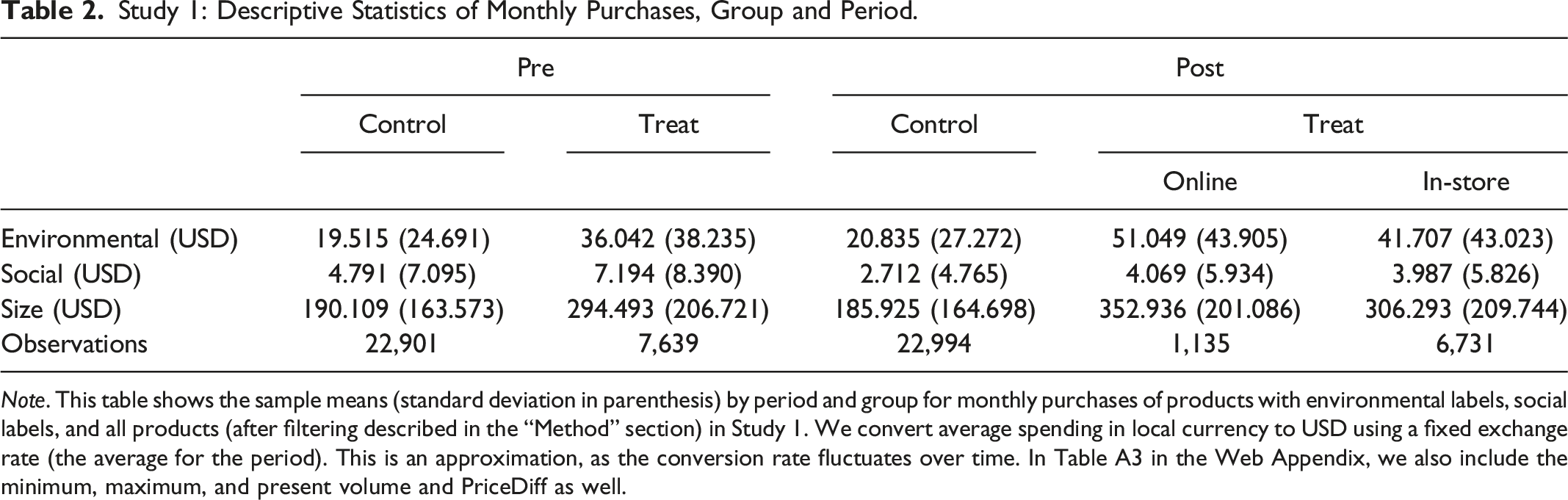
Note. This table shows the sample means (standard deviation in parenthesis) by period and group for monthly purchases of products with environmental labels, social labels, and all products (after filtering described in the “Method” section) in Study 1. We convert average spending in local currency to USD using a fixed exchange rate (the average for the period). This is an approximation, as the conversion rate fluctuates over time. In Table A3 in the Web Appendix, we also include the minimum, maximum, and present volume and PriceDiff as well.
Study 1: Impact of the Shopping Channel on Purchases of Products with Environmental and Social Labels.
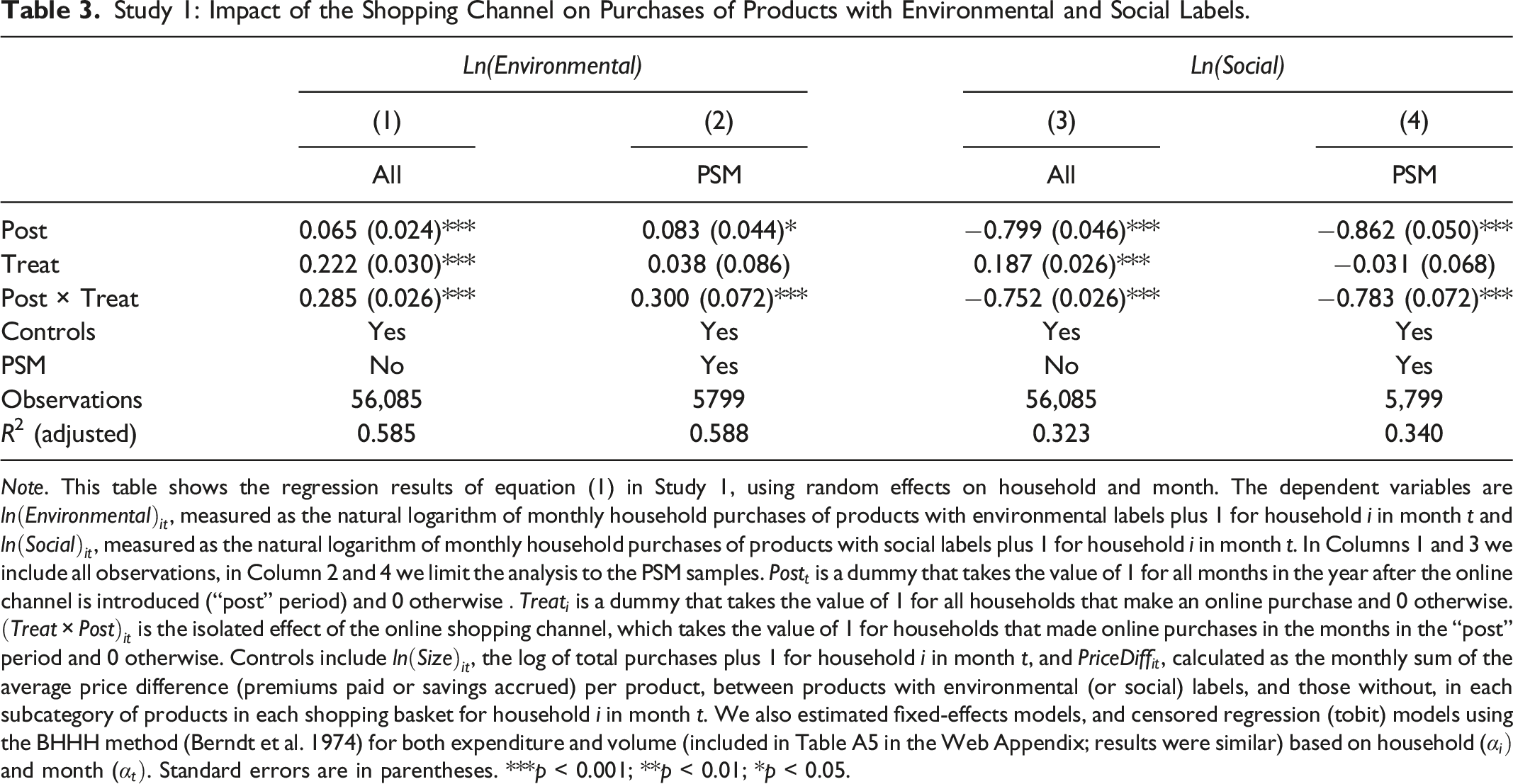
Note. This table shows the regression results of equation (1) in Study 1, using random effects on household and month. The dependent variables are
Columns 3 and 4 show the tests of the effects of the shopping channel on social labels (H2). In line with our hypothesis, the online channel has a negative effect on social labels (
Robustness Checks
We ran several robustness checks, available in the Web Appendix. In Table A5, we estimate fixed-effects models and censored regression (tobit) models using the BHHH method (Berndt et al. 1974), using both expenditure and volume based on household and month. In Table A6 in the Web Appendix, we compare the average baskets of consumers that made fewer than 12 purchases to those included in our analysis but find no major differences (the households with fewer purchases will naturally spend less per month, but if baskets are similar, at least they behave similarly when they make purchases). We also ran robustness checks using a cutoff of 5 purchases (Table A7) and 20 purchases (Table A8), to ensure that our results are not sensitive to the cutoff we use (see Mai, Hoffmann, and Balderjahn 2021 for a discussion of erroneous conclusions based on including too few or too many observations). Finally, we ran the tests only on the subset of categories that offer environmental labels (Table A9, Panel A) or social labels (Table A9, Panel B). Our results are similar in all these different robustness checks.
Discussion
Study 1 finds empirical evidence in support of our two hypotheses; consumers purchase more environmental labels online (H1) and more social labels in-store (H2). The quasi-experimental approach and the PSM analysis give strong external validity to our findings, especially as our data are based on a setting where prices and availability are the same across the two channels. Nonetheless, labels might be more easily identifiable online by the product image and description, while they are less noticeable in-store because they are surrounded by a large number of competing marketing stimuli. Therefore, products with a sustainability label should be more conspicuous and attractive to online consumers than consumers buying in-store. However, if this were the case, we would expect the same effect to apply to both environmental and social labels.
Our theoretical explanation for the findings is that self-oriented benefits of environmental labels are more salient online, whereas other-oriented benefits of social labels are less salient online. However, given the data available we are not able to provide a direct test of this theoretical account. What is more, the multichannel consumers in our dataset are early adopters, and these tend to behave differently than other adoption groups (Li et al. 2015). Thus, it might be that there are short-term effects of the introduction of an online offering that reverts in the long run (see Bilgicer et al. 2015) that affects our results. Even though we used PSM to account for self-selection, it could also be that consumers with a preference for environmental sustainability were more likely to become multichannel consumers. Finally, it could be that the change in consumer purchases of products with sustainability labels instead reflects a change in the consumer’s basket composition of categories (where the categories have a larger or smaller share of available products with sustainability labels). Study 2 was designed to address these concerns.
Study 2
In Study 2, we conduct exploratory tests of the salience of self- and other-oriented benefits, focusing on utilitarian offers and self-oriented benefits. Groceries are typically conceived as primarily utilitarian, although, for example, store atmosphere could prime hedonic benefits (Yim et al. 2014). We explain in the next section the different tests we use to operationalize salience of self-oriented benefits based on utilitarian product offers.
To address the concerns of Study 1, we use data from a grocery retailer with established online and in-store channel offerings, thus overcoming potential issues of early adopters and short-term effects of the introduction of a new shopping channel. The new data also allow us to make within-subject comparisons of multichannel consumers. Thus, Study 2 isolates the effect of the shopping channel on differences in purchases of products with social and environmental labels within the same consumer, thus controlling for the consumers’ preferences for sustainable consumption (Mai, Hoffmann, and Balderjahn 2021; van Doorn and Verhoef 2015). Finally, to address the fact that category composition may change depending on shopping channel, we focus on specific product categories and products.
Method
We used point-of-sale data from loyalty cards from the same retailer as in Study 1. The data were from a more recent 2-year period (August 1, 2017, to July 31, 2019) and included 78,027 shopping baskets (22,479 online and 55,548 in-store) purchased by 700 multichannel consumers. 7 A dataset with all categories and their availability and demand for the different types of sustainability labels by channel is openly available on Figshare (https://doi.org/10.6084/m9.figshare.23694375). Table B1 in the Web Appendix illustrates the top 10 categories that offer the largest number of distinct (Panel A) and total (Panel B) purchased products with social labels. Out of the 844 categories, 454 categories (55 categories) offer at least one product with an environmental (social) label.
We filtered the data in the same way as in Study 1. Summary statistics can be found in Table B2 in the Web Appendix. Our investigation is based on actual purchase behavior of many product categories (n = 844), meaning that we have high external validity but possibly low internal validity. That is, we cannot measure whether the self-oriented benefits of utilitarian products are salient, and we cannot include category fixed effects to rule out that category composition has changed. To deal with this limitation, we use two different approaches. Specifically, we compare (a) specific product categories (utilitarian vs. hedonic) and (b) one single product (utilitarian).
Product Categories
We identify product categories that offer products with environmental and social labels and can be characterized as either utilitarian or hedonic (cf. Table B1). We sorted all categories in ascending order based on the sales of products with social labels (fewer categories offer products with social labels than with environmental labels, and we wanted to use the same categories for all analyses). The top five categories were bananas, ground coffee, chocolate, (single-)portion tea bags, and ice cream. We chose not to include tea bags because they could be considered both utilitarian and hedonic. Thus, as utilitarian products, we used bananas and ground coffee in vacuum packs. 8 We excluded products that also have social labels and vice versa. 9 As hedonic products, we used chocolate and ice cream. The subcategory level is quite detailed, ensuring that we are comparing similar products (e.g., ice cream is always a package of ice cream, not sometimes ice cream by the piece). In our data, purchases of utilitarian products (i.e., bananas, coffee) with environmental labels are higher online, while the purchases of hedonic products are higher (i.e., chocolate) or lower (i.e., ice cream) in-store, before accounting for consumer heterogeneity and basket size (refer to Table B2 in the Web Appendix).
Product
The tests on product categories were limited to small categories, and thus the compositions of products ought to have been similar across channels. Still, it could be that certain ice cream packages that happen to hold social labels are more popular in-store. Thus, we attempted to mimic a lab experiment by isolating the effects to only one utilitarian product. We identified one specific utilitarian product (see Figure B1) that is available as (a) conventional/without label, (b) with environmental label, or (c) with social label. We considered these products as “perfect substitutes,” as the label is the main difference. 10 For a household to be included in the analysis, we require at least one online purchase and one in-store purchase of any of the three products (see Figure B1).
Results
Study 2: Regression Results of Within-Consumer Effect of the Shopping Channel.
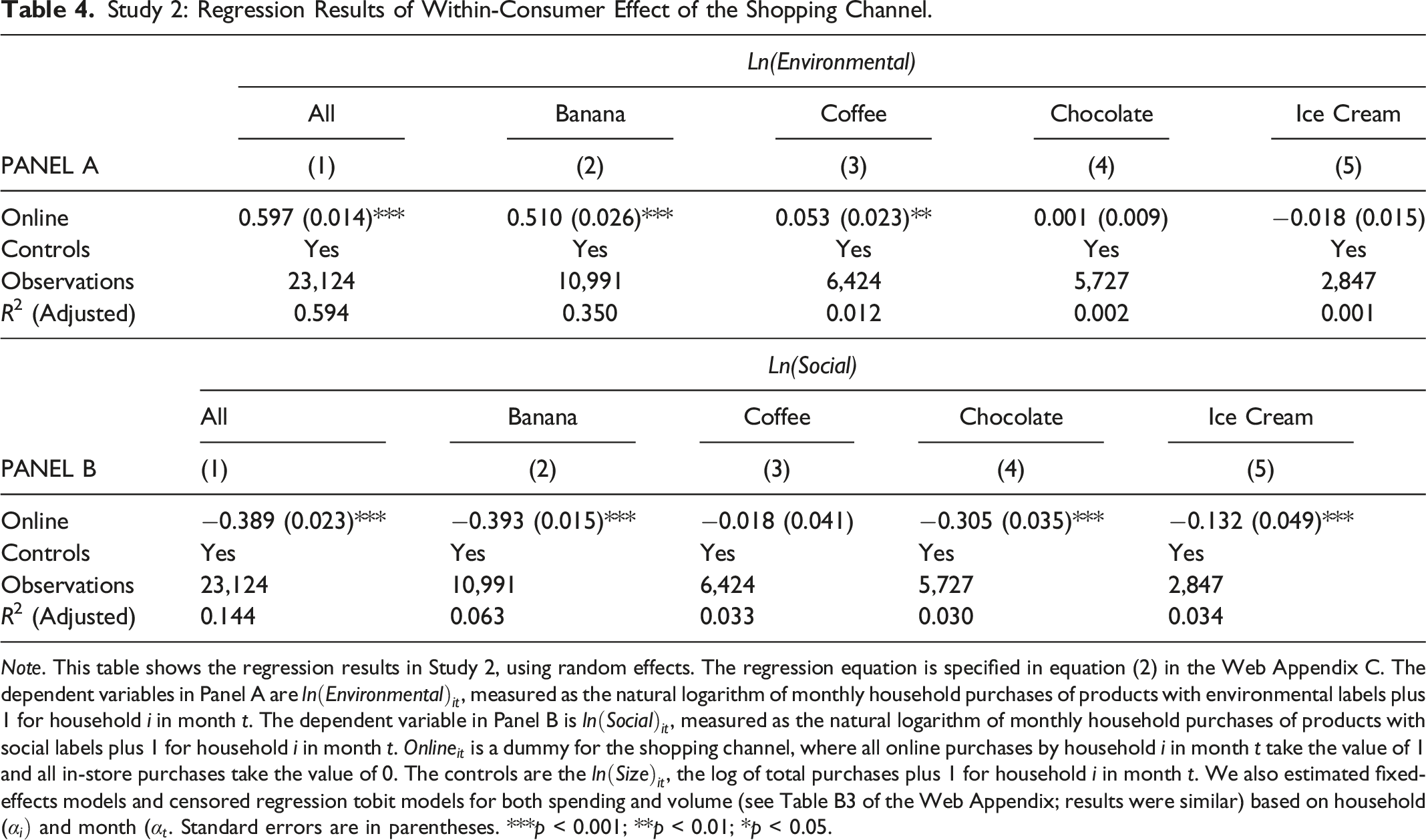
Note. This table shows the regression results in Study 2, using random effects. The regression equation is specified in equation (2) in the Web Appendix C. The dependent variables in Panel A are
In Columns 2 and 3, we tested the influence of the shopping channel on the purchase of products with environmental and social labels based on product category. Consumers bought more products with environmental labels online than in-store when shopping for utilitarian products. For social labels, there was no difference for coffee, but more purchases of bananas (which have both an environmental and a social label) were made in-store. In Columns 4 and 5, we also compared the results to hedonic products. For hedonic products, the result was the opposite. There was no influence of the online channel on the social labels, while there was a positive influence of the in-store channel on the social labels. Taken together, the results provide support that H1 especially holds when self-oriented benefits are primed. (We also ran the same analysis on the dataset in Study 1 and found similar results.)
Finally, we tested whether the same consumer is more likely to choose the substitutable product with the environmental label when shopping online. For each consumer, we calculated the number of purchases of each of the three products by channel. Out of 131 consumers, 15, 3, and 113 purchase, respectively, a higher, a lower, or the same proportion of coffee with the environmental label online compared to in-store. That is, most consumers buy the same proportion of coffee with an environmental label in both channels. Yet, interestingly, consumers are more likely to buy the environmental labels when shopping online. In our test, the difference between the online and in-store proportion is positive (M = 0.031, SD = 0.160, t(143) = 2.33, p = 0.021) and we reject that there is no difference by channel in a two-sided one-sample t-test. Instead, among 120 consumers, 9, 4, and 107 purchased, respectively, a higher, a lower, or the same proportion of coffee with a social label online compared to in-store. There is no statistical difference in the proportion with a social label (M = 0.007, SD = 0.119), t(129) = 0.710, p = 0.479. Admittedly, our sample size is small, and our analytical approach is simple. Still, our exploratory test seems to support our proposed logic.
Discussion
Study 2 replicated the findings of Study 1. We found consistent empirical support that consumers purchase more products with environmental labels and utilitarian benefits online. We provide some evidence against an interpretation that consumers purchase different categories online compared to in-store with different availability of sustainability labels, given our focus on specific product categories and products. A key question is whether the differences we found are the result of differences in online and in-store shopping behavior. First, online shopping baskets contain bulkier, heavier, and less sensory products (Campo and Breugelmans 2015; Chintagunta, Chu, and Cebollada 2012). If bulkier, heavier, and less sensory products are more likely to have environmental labels, this could explain our results. However, comparing identical products, we still find that the same consumers are more likely to choose the same environmentally labeled products when shopping online than when shopping in-store.
Second, consumers perceive that products with environmental labels are healthier (Schuldt and Schwarz 2010), and they are less likely to choose unhealthy product categories when shopping online, suggesting they are more health-conscious when delivery is delayed (Huyghe et al. 2017; Zou and Liu 2019). This is also consistent with a focus on the self when shopping online. However, we also note that our results hold for unhealthy functional products (coffee) and that the same consumer responded differently to environmentally labeled healthy products than to socially labeled healthy products (bananas) when shopping online than when shopping in-store.
Third, consumers are less price-sensitive and less influenced by price promotions when shopping online, resulting in fewer unplanned purchases (Chu, Chintagunta, and Cebollada 2008). While this would explain why in-store consumers are more likely to buy ice cream and chocolate, which typically carry social labels, it does not explain why ice cream and chocolate with environmental labels are not purchased more in-store.
Study 3
Study 3 sought to provide additional insight by testing our findings in non-grocery context. Specifically, we used purchase data from a beauty retailer to explore whether consumers purchase more products with social labels in-store compared to online.
Method
In Study 3, we used point-of-sale data from loyalty cards of a beauty retailer to explore whether our results hold when the service provider offers mainly hedonic products. The beauty retailer operates one central online shopping channel and several physical stores in Scandinavia. We tested the effect of the shopping channel by studying the same consumers’ purchases of products with environmental or social labels as a function of their shopping channel. The data are from a period of over two and a half years (March 18, 2013, to November 30, 2016) and include 479,563 baskets (191,451 online and 288,112 in-store) purchased by 9,271 multichannel consumers. Of interest to the current study, every purchased product included a sustainability identifier. A dataset with all categories and their availability and demand for the different types of sustainability labels by channel is openly available on Figshare (https://doi.org/10.6084/m9.figshare.23694375). Out of the 11 categories, 6 categories (2 categories) offer at least one product with an environmental (social) label.
Study 3: Descriptive Statistics of Monthly Purchases by Multichannel Customers.
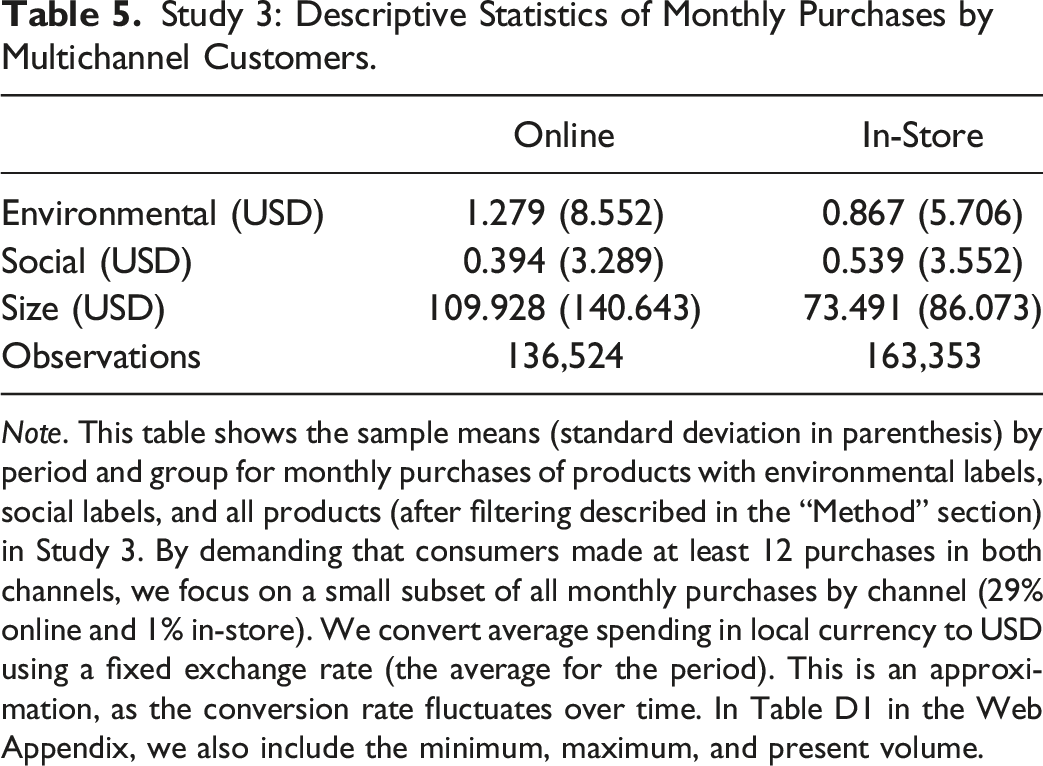
Note. This table shows the sample means (standard deviation in parenthesis) by period and group for monthly purchases of products with environmental labels, social labels, and all products (after filtering described in the “Method” section) in Study 3. By demanding that consumers made at least 12 purchases in both channels, we focus on a small subset of all monthly purchases by channel (29% online and 1% in-store). We convert average spending in local currency to USD using a fixed exchange rate (the average for the period). This is an approximation, as the conversion rate fluctuates over time. In Table D1 in the Web Appendix, we also include the minimum, maximum, and present volume.
Results
We report all regressions in the Web Appendix (Table D2-4). In the within-comparisons, consumers spend more in-store (
Discussion
In Study 3, we find that consumers purchase more hedonic products with social labels in-store compared to online. Interestingly, our findings again show that the type of label is important when considering how to promote sustainability in different channels.
General Discussion
With increasing attention paid to sustainability in society, service providers need to find ways to promote sustainable consumption. This study highlights the role of the shopping channel in such efforts. Our findings show that consumers spend more on environmental labels online than in-store but more on social labels in-store than online. These results hold both when comparing the baskets of multichannel consumers to a corresponding sample from in-store consumers (Study 1) and when comparing online vs. in-store purchases for the same multichannel consumers in a grocery context (Study 2) and in a beauty context (Study 3). We also find initial evidence that the influence of the online (vs. in-store) shopping channel on environmental (vs. social) labels holds especially for utilitarian (vs. hedonic) offerings. We explain these results by the fit, where the online shopping channel primes self-oriented benefits that fit with self-oriented benefits of utilitarian products with environmental labels. In contrast, the in-store shopping channel primes other-oriented benefits that fit other-oriented benefits of hedonic products with social labels.
Theoretical Implications
This paper makes three significant contributions to the sustainability in service literature. First, by distinguishing the two different types of sustainability, environmental and social (see Huang and Rust 2011), we address the conflict between self-and other-oriented benefits and theorize that environmental or social labels signal more of the former or the latter, respectively. Given that their benefits differ, service strategies should also be adjusted accordingly.
Second, we theorize that the shopping channel has a differential influence on purchases of sustainability labels by relating the salience of the self-oriented or other-oriented benefits in the online or in-store shopping channel, respectively. Our focus on the impact of shopping channels on demand for sustainable alternatives offers a novel perspective, as previous literature has focused primarily on in-store consumer behavior (Bezawada and Pauwels 2013; van Doorn and Verhoef 2015; Mai, Hoffmann, and Balderjahn 2021) or has found differences in laboratory experiments (Luchs et al. 2010; Peloza, White, and Shang 2013). The results suggest that consumer behavior differs by shopping channel, highlighting the need to better understand sustainable consumption as a function of the shopping situation but also providing additional insights to the growing literature on differences in consumer behavior across service channels (Cambra-Fierro et al. 2020).
Third, we add to the previous literature that also relies on fit to promote sustainable consumption (Bodur, Gao, and Grohmann 2014; Reczek, Trudel, and White 2018; White and Peloza 2009), by providing empirical evidence based on actual purchases using behavioral data. This feature of our work is especially important given the gap between sustainability intentions and purchasing behavior found in previous research (Carrington, Neville, and Whitwell 2014; White, Hardisty, and Habib 2019). Studying actual (as opposed to self-reported) purchase behaviors by a large sample of consumers across several categories (rather than a few selected categories) and comparing grocery and beauty retailers allows us to get an overview of consumers’ real-life sustainable purchases. In all three studies, we avoid overestimating the impact of sustainable attributes, a flaw that can occur in studies that include only a few product categories (Schamp, Heitmann, and Katzenstein 2019). Our findings, which support our conceptual framework, underscore the importance of not only adjusting strategies by shopping channel, even when considering the same consumers, but also linking them to the different domains of sustainability and their benefits associated with the type of offering (utilitarian vs. hedonic).
Although we have studied shopping channels in particular, our conceptual framework could also be applied to other service configurations, such as store formats, in-store technology, and atmospherics. Similarly, it may also be applied to other aspects of sustainability, such as product use, packaging, and disposition (cf. Mai, Hoffmann, and Balderjahn 2021). We suggest that service providers can promote sustainability through the fit between the services they offer and self- or other-oriented benefits, highlighted, for example, by labels. Related literature has used appeals or claims to promote sustainable consumption (Reczek, Trudel, and White 2018; White, Macdonnell, and Dahl 2011; White and Simpson 2013). Appeals can be designed to emphasize the benefits to self or others associated with sustainability labels. Another interesting recent avenue of study is to mitigate the perception of the self-other trade-off and thus create a “win-win” situation (see Goldsmith et al. 2022). In this way, sustainable consumption is promoted regardless of the salience of the self or others resulting from the service situation.
Our research also demonstrates the difference between multichannel and in-store consumers and between purchase decisions made by the same consumers in both channels (cf. Campo and Breugelmans 2015; Chintagunta, Chu, and Cebollada 2012). By investigating purchasing behavior across shopping channels, we provide robust evidence of differences in sustainable consumption online compared to in-store shopping. This finding is particularly important, as it highlights the need for service firms to adapt sustainability strategies to different shopping channels and situations rather than simply targeting consumers in a personalized way.
Managerial Implications
Fostering sustainable consumption has been repeatedly cited as a top priority, and firms that find ways to embrace sustainability are more likely to achieve long-term profits (Huang and Rust 2011; Huang et al. 2021; White, Habib, and Hardisty 2019). Our findings suggest that such efforts can be improved by adapting channel strategies. If a firm wants to focus on environmental sustainability, then the online channel provides a good fit to promote environmental labels; if the focus is on social sustainability, then the in-store channel promotes social sustainability through social labels. Specifically, service providers should strive to increase fit between the shopping channel and the benefits of sustainable alternatives offered. Our suggestions are consistent with previous literature that has emphasized the role of appeals in product positioning and market communication, particularly whether to emphasize self- or other-oriented benefits (Bodur, Gao, and Grohmann 2014; White and Peloza 2009).
When establishing strategies for products with environmental labels, service providers are more likely to increase purchases through the online channel, especially for utilitarian offerings that prime self-oriented benefits. Other approaches could be to highlight the quality and health benefits of products with such labels, for example, by drawing attention to information about health benefits in the product description, which should also be signaled by visible labels. In the online channel, information search attributes are easier to obtain and, therefore, easier to highlight (Degeratu, Rangaswamy, and Wu 2000). Another option is to allow consumers to sort their online search results by environmental labels, thus attracting more attention to such products (see Chang 2011 for a thorough study on the effects of sorting options).
According to our framework and findings, the salient benefits of products with environmental labels have less fit with the social aspects of in-store shopping, while environmental labels do fit well with the self-oriented aspects of online shopping. To encourage in-store purchasing of offerings with environmental labels, the benefits to others could be emphasized more, for instance, by informing consumers about how pesticides have negative impacts on their society and how certified processes through environmental labels can positively reduce these destructive impacts on others (cf. Mai, Hoffmann, and Balderjahn 2021).
For products with social labels, the recommendations would be the opposite. Our findings suggest that the in-store shopping channel primes other-oriented benefits that offer a better fit than the primed self-oriented benefits in the online channel, especially for hedonic offerings. To promote in-store purchases of products with social labels, other-oriented benefits should be highlighted to ensure congruence. For example, in-store campaigns could inform consumers about the prosocial impact of social labels.
Overall, our findings could guide many service providers seeking to offer sustainable solutions to consumers. For example, small-scale service providers that focus their business on selling sustainable products directly to consumers could use the findings to provide tailored offerings and services. If their main offering consists of products with environmental labels, they might be well advised to focus predominantly on online channels and not to devote significant resources to opening physical stores, as their consumers are more likely to be interested in their online offerings. On the other hand, if their main offering includes products with social labels, they should invest more in physical stores.
Limitations and Future Research
Our study has several limitations that could be used to guide further studies. First, although the reliance on real-life data from retailers gives high external validity, it also means that we were limited in terms of data availability as well as in our ability to causally test the proposed conceptual framework. Whereas the empirical patterns generally follow our conceptual reasoning, we are unable to track the mechanisms underlying the effects in detail. We thus call for future studies using experiments to further examine the role of fit in driving purchases of products with environmental and social labels across channels (see Gill 2008 for an example). We encourage such efforts to further assess what aspects of the different shopping channels are driving the effects. We conclude that fit is the most important mechanism that ultimately leads to more environmentally sustainable consumption online and more socially sustainable consumption in stores, but the current approach does not allow for a fine-grained dissection of the actual drivers of such effects (e.g., self vs. other; social vs. private; utilitarian vs. hedonic).
Second, although product availability was the same online as in-store in Study 1 and we focused on product categories that were sold in both channels in all three studies, there are distinct differences between purchase behaviors across channels that might have impacted our findings. One important concern with the current empirical approach is thus whether the results reflect a change of basket composition, where online (vs. in-store) baskets are more likely to contain certain categories that offer more products with environmental (vs. social) labels. We attempt to overcome this concern in Study 2 by comparing specific categories and products, but we encourage future research to study category effects more in-depth. Future studies should also run more conclusive analyses related to the potential moderating effect of utilitarian and hedonic product categories and further control for both category and household level effects to provide more conclusive evidence of any such effects. In doing so, a more through coding of product categories is needed.
Finally, we have discussed how services, such as those available in different shopping channels, influence the salience of self- and other-oriented benefits at the point of purchase. Future research could also evaluate the role of the expected/anticipated consumption context (Bearden, Netemeyer, and Teel 1989) and how firms could adapt their services accordingly. Another particularly interesting avenue for future service research is an automated social presence that could make both the self (i.e., automated self-service) and others (i.e., with social presence) more salient and how to then promote fit with sustainable consumption (van Doorn et al. 2017). It is our hope that the current study will contribute to additional work in this regard.
Supplemental Material
Supplemental Material - Does the Label Fit the Channel? How “Bricks” and “Clicks” Influence Demand for Environmental and Social Sustainability Labels
Supplemental Material for Does the Label Fit the Channel? How “Bricks” and “Clicks” Influence Demand for Environmental and Social Sustainability Labels by Emelie Fröberg, Svetlana Kolesova, and Sara Rosengren in Journal of Service Research
Supplemental Material
Supplemental Material - Does the Label Fit the Channel? How “Bricks” and “Clicks” Influence Demand for Environmental and Social Sustainability Labels
Supplemental Material for Does the Label Fit the Channel? How “Bricks” and “Clicks” Influence Demand for Environmental and Social Sustainability Labels by Emelie Fröberg, Svetlana Kolesova, and Sara Rosengren in Journal of Service Research
Footnotes
Acknowledgements
EF gratefully acknowledge Hakon Swenson Stifelsen and the Axel and Margaret Ax:son Johnson Foundation for Public Benefit. We thank Anne Roggeveen, Alexander Mafael, Claes-Robert Julander, two anonymous reviewers and the editor of the ACR Conference 2020, participants in the workshop for junior scholars at AMA, participants in the ISMS Marketing Science Conference 2022, and participants in two industry webinars for valuable comments on earlier versions. We especially thank the co-editors Lerzan Aksoy, Timothy Keiningham, and Edward Malthouse, one anonymous area editor, and three anonymous reviewers for thorough and constructive feedback through the revision process. We also thank the anonymous retailers for data access and collaboration. We used R for all statistical analyses and visualizations. All packages and their references are listed in the Web Appendix.
Declaration of Conflicting Interests
The author(s) declared no potential conflicts of interest with respect to the research, authorship, and/or publication of this article.
Funding
The author(s) disclosed receipt of the following financial support for the research, authorship, and/or publication of this article: EF is supported by Hakon Swenson Stiftelsen. SK is supported by Svensk Dagligvaruhandel.

Supplemental Material
Supplemental material for this article is available online.
Notes
Author Biographies
References
Supplementary Material
Please find the following supplemental material available below.
For Open Access articles published under a Creative Commons License, all supplemental material carries the same license as the article it is associated with.
For non-Open Access articles published, all supplemental material carries a non-exclusive license, and permission requests for re-use of supplemental material or any part of supplemental material shall be sent directly to the copyright owner as specified in the copyright notice associated with the article.
