




Abstract
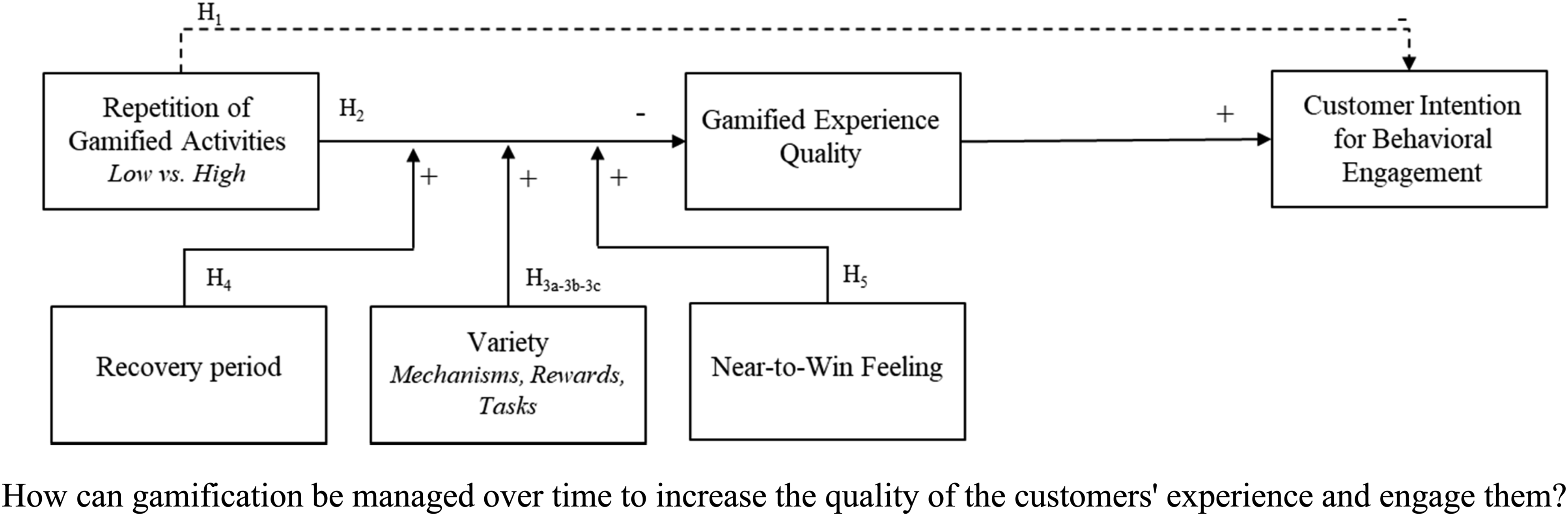
Despite the popularity of gamification to improve the quality of experience in a variety of services, there is a lack of evidence on its effective integration into service design and the long-term impact of repeated gamified activities on customer experience. Using 10 studies, including behavioral data, survey, field, and laboratory experiments, this research investigates the effects of repeated gamified activities on customer experience quality and behavioral engagement. We examine the phenomenon through the lens of satiation theory, which explains the declining enjoyment for initially pleasurable activities. Supported by this theory, our results show evidence for a negative impact of gamified services that are highly repeated on experience quality and behavioral engagement. Further, we demonstrate strategies to compensate for such satiation by introducing mechanism and reward variety, a recovery period, and a sense of being near-to-winning. This research makes theoretical and managerial contributions by showing the potential backfire effects of gamification when gamified activities are repeated. Furthermore, this paper feeds the ongoing debate on standardization and personalization of service experiences. This paper demonstrates how high exposure to the same service experience can become counterproductive and increase risks of satiation.
Get full access to this article
View all access options for this article.
References
Supplementary Material
Please find the following supplemental material available below.
For Open Access articles published under a Creative Commons License, all supplemental material carries the same license as the article it is associated with.
For non-Open Access articles published, all supplemental material carries a non-exclusive license, and permission requests for re-use of supplemental material or any part of supplemental material shall be sent directly to the copyright owner as specified in the copyright notice associated with the article.
