




Abstract
Making service provisioning significantly more sustainable is crucial if humankind wants to make a serious effort to operate within the boundaries of what the planet can support. The purpose of this paper is to develop a systemic understanding of sustainability in service provision and shed light on the mechanisms that drive unsustainability and hinder service providers in their efforts to be more sustainable. To contextualize our study, we focus on a significant sustainability problem: food waste stemming from food retail at the retailer-consumer interface. We make two theoretical contributions to the service research on sustainability. First, we offer a systemic conceptualization of sustainability in service as a dynamic ability of a focal system (e.g., a service firm) to sustain the system(s) that contains it. Second, we explicate the mechanisms—stocks and flows, feedback and mindsets—that contribute to (un)sustainable service provision as a systemic behavior, and which can thus be used as intervention points when designing sustainability initiatives. Our work also has significant practical implications for food retailers and policymakers working towards reaching UN’s Sustainable Development Goal 12.3, as we specify the feedback loops that drive food waste and hinder efforts to reduce it at the retailer-consumer interface.
Introduction
Humankind faces several planetary crises, such as climate change, biodiversity loss, pollution, and waste (UNEP 2021). Despite wide-ranging plans for a more sustainable future, such as UN Agenda 2030 (UN 2015), we are still far from operating within the boundaries of what the planet can support (Persson et al. 2022; Steffen et al. 2015). Due to their pervasive nature within societies, services have a substantial impact on how the world operates both now and in the future (Anderson and Ostrom 2015). A sustainable future, therefore, cannot exist without sustainable service provisioning (Huang, Malthouse, Noble, and Wetzels 2021a). Yet the persistence of the many man-made environmental and societal challenges testifies that even when there are good intentions to make service provisioning more sustainable, in many cases services remain unsustainable, especially when sustainability is evaluated in an ecological sense (see Whiteman, Walker, and Perego 2013).
Although sustainability has recently been identified as a core research priority within the service field (Field et al. 2021; Huang, Malthouse, Noble, and Wetzels 2021a), it was previously a rather marginal research area within service research (Saviano et al. 2017). The sustainability-related studies in transformative service research (TRS) have mainly focused on issues connected with social sustainability (e.g., Boenigk et al. 2021; Mende and van Doorn 2015). As such, there is only a limited amount of service literature that theorizes on service provisioning in relation to environmental sustainability. In addition, the few prior studies that report on the best practices or business logics of service providers identified as more sustainable than their peers (e.g., Zhang, Joglekar, and Verma 2012; Enquist, Sebhatu, and Johnson 2015) rarely explicitly define or conceptualize sustainability. Service research, as a result, displays a lack of theoretical understanding of sustainability and the mechanisms that lead to unsustainable outcomes.
In this paper, we ask two questions: 1) What is sustainability in the context of service provisioning? And 2) Why is sustainable service provisioning so difficult to achieve in practice? To address these research questions, we draw on a systems-based theorization of sustainability (Manderson 2006) from within the broader sustainability literature. We use system dynamics (Forrester 1961; Meadows 1997), a major research stream within systems thinking, as a theoretical lens to 1) uncover the underlying drivers of unsustainability in service provision, and 2) identify the mechanisms that hinder service providers in their efforts to be more sustainable. In doing so, our work advances the recent “systems turn” in service research (Anderson and Ostrom 2015; Spohrer and Maglio 2010) and answers the call for understanding sustainability in service as a systemic phenomenon (Field et al., 2021; Saviano et al. 2017).
To contextualize our study of sustainability in service provisioning, we focus on the issue of food waste 1 reduction in which a major service sector—food retailing—plays a central role (e.g., Aschemann-Witzel et al. 2015; Williams et al. 2020). As food retailers both represent a notable source of food waste in their own right and hold a key role in influencing households (Kulikovskaja and Aschemann-Witzel 2017), who represent the largest source of food waste of all (UNEP 2021), we particularly focus our study on this interface within the food system.
We make these choices for two reasons: first, they allow us to conduct an in-depth investigation of the mechanisms that lead to unsustainable outcomes in specific service provisioning instances, rather than speaking about sustainability in service only in abstract terms. In fact, the system dynamics approach requires a focus on a specific problem, rather than trying to model a system in its entirety (Sterman, 2000). Second, we purposely focus on food waste as it is an unwanted yet prevailing sustainability problem that has serious environmental consequences. To illustrate, neither the retailers nor the consumers want to waste food, yet together they still generate around 700 million tons of food waste per year (UNEP 2021). Tackling this systemic problem is of critical importance because not only does food waste aggravate food insecurity, it also carries a significant environmental cost (FAO 2011; UNEP 2021).
Using an abductive research methodology that combines empirical insights from prior academic literature on food waste and a case study of a Swedish food retailer with theoretical insights from system dynamics, our study makes two novel theoretical contributions to service research, particularly in light of the recent calls for addressing sustainability in service. First, it offers a systemic conceptualization of sustainability in service as the focal system’s (e.g., a service firm’s) ability to sustain the broader system(s) that contains it; it is, thus, depended upon. Second, it explicates the systemic mechanisms that contribute to (un)sustainable service provision and, therefore, indicates several potential intervention points that sustainability initiatives can be designed to address. As its practical contribution, this study clarifies the complex nature of the food waste problem at the retailer-consumer interface by developing an integrative model that specifies nine feedback loops that drive food waste and hinder retailers in their efforts to reduce food waste. As such, the paper directly informs food retailers and policymakers working towards addressing the UN’s Sustainable Development Goal (SDG) 12.3 to “halve per capita global food waste at the retail and consumer levels.”
Next, we give an overview of the existing literature on sustainability within service research and, with the help of theoretical insights from system dynamics, develop a systemic conceptualization of sustainability and its drivers in service provision. We then introduce the research context, which is food waste reduction from the retailers’ perspective, as part of the abductive research design of the paper, and specify the academic and empirical sources that serve as the input into the analysis process. The findings section is followed by a discussion of the theoretical and practical implications, and the paper concludes with an account of the limitations of our study.
A Systemic Understanding of Sustainability in Service
Sustainability has been identified as a core research priority in service research following the realization that a sustainable future cannot be achieved without more sustainable service provisioning (Field et al. 2021; Huang, Malthouse, Noble, and Wetzels 2021a). According to Field et al. (2021, p. 464), their analysis “revealed a need for research to examine the impact of global service ecosystems on human and planet welfare.” However, in the past, sustainability has not represented a major focus area of service research. For example, in a review on the use of the terms “sustainable” and “sustainability” in service research, Saviano et al. (2017, p. 954) conclude that while there is a positive trend, “the interest in the issues of sustainability and sustainable development does not appear particularly significant.”
In the previous studies that have drawn an explicit connection between service and sustainability, a key focus has been on social outcomes and how service research can become a more socially aware and responsible discipline (Field et al. 2021). For example, there is a strong ongoing interest in transformative service research (TSR) that aims to improve well-being among individuals and collectives, meaning the “social dimension of value creation” (Blocker and Barrios 2015, p. 256). Examples include transformative service initiatives to serve vulnerable consumers (Boenigk et al. 2021); service innovations to alleviate (food) poverty (Baron et al. 2018); and understanding the relationship between coproduction (customers’ roles and activities) and well-being outcomes (Mende and van Doorn 2015), to name a few. Hence, while TSR increasingly attempts to understand the unintended consequences resulting from service provisioning aimed at promoting human well-being (Blocker, Davis, and Anderson 2022), the consideration of these consequences typically remains within the social sustainability realm. Therefore, less service literature exists that links, and theorizes on, service provisioning and environmental sustainability.
Beyond the TSR stream, some service management studies report on the best practices, performance standards, or business logics of service providers identified as more (environmentally) sustainable than their peers (e.g., Zhang, Joglekar, and Verma 2012; Enquist, Sebhatu and Johnson 2015). However, these studies tend not to define or conceptualize sustainability explicitly, leaving the concept open for different interpretations and meanings. Furthermore, service research lacks a theoretical understanding of sustainability that conceptualizes and explains the mechanisms that connect service provisioning to unsustainable outcomes (such as the pollution and exploitation of natural resources) in the context of large-scale and complex service ecosystems (Field et al. 2021). To further the theorization on sustainability in service and provide a more systemic understanding of it (e.g., Field et al. 2021, Saviano et al. 2017), we turn to the literature on sustainability in other fields, and especially examine systems-based developments.
One of the most frequently cited definitions of sustainability originates from the Brundtland Commission report, which describes sustainable development as a “development that meets the needs of the present without compromising the ability of future generations to meet their own needs” (WCED 1987, p. 43). Over the years, this definition has been specified further by connecting it to the limits of the environmental resource stocks in ecological economics (Daly 1990), defining planetary-wide boundaries (Rockström et al., 2009), and creating principles for a socially equitable society in relation to those ecological boundaries (e.g., Robèrt 2008). These developments all indicate the importance of approaching sustainability issues from a systemic perspective. Yet these conceptualizations of sustainability and sustainable development are often positioned on a macro-level of aggregation (e.g., the entirety of humankind or the planet). This macro-level understanding of sustainability stems from the fact that sustainability can only be assessed at this level, since the resource boundaries are common to the whole planet (Rockström et al., 2009). However, this creates problems for operationalizing and assessing sustainability at the level of individual firms and other stakeholders. For example, when departing from the definition provided by the Brundtland Commission report (WCED 1987), it is difficult to establish what specific measures can (or should) be taken to transition towards more sustainable modes of service production and consumption.
Therefore, we argue that a definition of sustainability in service research should a) capture the complex and systemic nature of sustainability issues, and at the same time b) provide a relatable understanding allowing individual actors to work towards specific sustainability objectives. Such a definition requires a strong systems anchoring in order to provide an understanding of sustainability that is not restricted to a single-level aggregation, but acknowledges the nested nature of systems and effectively allows zooming-in and zooming-out within these systems to capture the complexity of sustainability issues. Our argument is in line with recent developments and references the broader corporate sustainability literature, including sustainable business model development (e.g., Abson et al. 2017; Fehrer and Wieland 2021). As Fehrer and Wieland (2021, p. 616) conclude: “adopting a systemic perspective to address sustainability can enable firms to analyze complex problems across multiple interacting subsystems, to reframe the impacts and responsibilities of their activities and behaviors beyond their organizational boundaries, and to include consideration of biospheric limits across their entire ecosystem.”
To develop a concept of sustainability in service, and a framework that is suitable and actionable for service provision, we depart from Manderson’s (2006) systems-based definition of sustainability. We argue that this definition not only has a strong systems-anchored theoretical background, but importantly it also offers a scale-independent understanding of sustainability that can be applied across levels of aggregation in nested systems of service provision (e.g., Barile et al. 2016; Vargo and Lusch 2016). Manderson (2006, p. 85, italics in the original) defines sustainability as “the changing ability of one or many systems to sustain the changing requirements of one or many systems, over time.” This definition presents a literal interpretation of sustainability as “the ability to sustain.” It highlights that the sustainability of a focal system (e.g., a service firm, a household) refers to its ability over time to sustain the requirements of other system(s) that contains it and upon which it therefore depends. For example, a service firm’s long-term survival depends on its ability to ensure the wellbeing of the community in which it is embedded, as well as the viability of the biological ecosystems of which it is a part. In addition, consistent with the literature on service (eco)systems (Barile et al. 2016; Vargo and Lusch 2016), this concept of sustainability acknowledges that such systems are dynamic, which means that the requirements for sustainability also change over time and according to the different time-space scales of the systems involved (Manderson 2006). Due to this, sustainability in service should not be considered a fixed aim, but rather an ability that requires continual contextual interpretation to become actionable.
A System Dynamics Lens on the(Un)Sustainability of Service Provisioning
To uncover the mechanisms that drive and hinder (un)sustainability in service provision as a focal system’s ability to sustain its containing system(s), we draw on system dynamics literature (e.g., Forrester 1961; Meadows 1997; Sterman 2000). System dynamics is one of the major approaches in the multi-disciplinary field of systems thinking (Sterman 2000) that stems from the work of Jay Forrester (1961). Forrester discovered that there was a need for a systems science with a strong anchoring in real-world problems, supporting decision-makers in pragmatic strategizing. System dynamics can model a real-world problem, computerized or analog, providing insight into the decisions and dynamics that created the problem in the first place (Forrester 1994). Hence, one of the main contributions of system dynamics is the visual mapping not only of the elements in a system but also how they influence one another and, on an emergent level, give rise to the behavior of a system as a whole (Meadows 2008). With its detailed elaboration of the role and function of feedback within and among systems, system dynamics also allows micro-level processes, such as service provisioning, to be linked to more macro-level processes and planetary boundary conditions (Whiteman, Walker, and Perego 2013), which is crucial for understanding the wider consequences of service and determining its (un)sustainability on an ecological level.
Figure 1 presents the theoretical framework that integrates insights from system dynamics on systems behavior with the concept of sustainability as the ability of nested systems to sustain each other. Service provision in the framework represents the behavior of sub-systems, such as service firms, that are embedded within multiple layers of broader, containing systems (e.g., the food system and the Earth’s biosphere) upon which the sub-systems depend. According to system dynamics, unsustainable behavior, such as service provisioning that generates food waste, can be seen as an emergent outcome of “the system structures that produce them” (Meadows 2008, p. 4). A common characteristic of such sustainability problems is that they are not deliberately created and no one wants them to persist, yet they continue to arise. Furthermore, while external forces might influence a system, they can only suppress or allow behavior that is already latent within the system’s structure (Meadows 2008). A systemic framework of sustainability in service provision.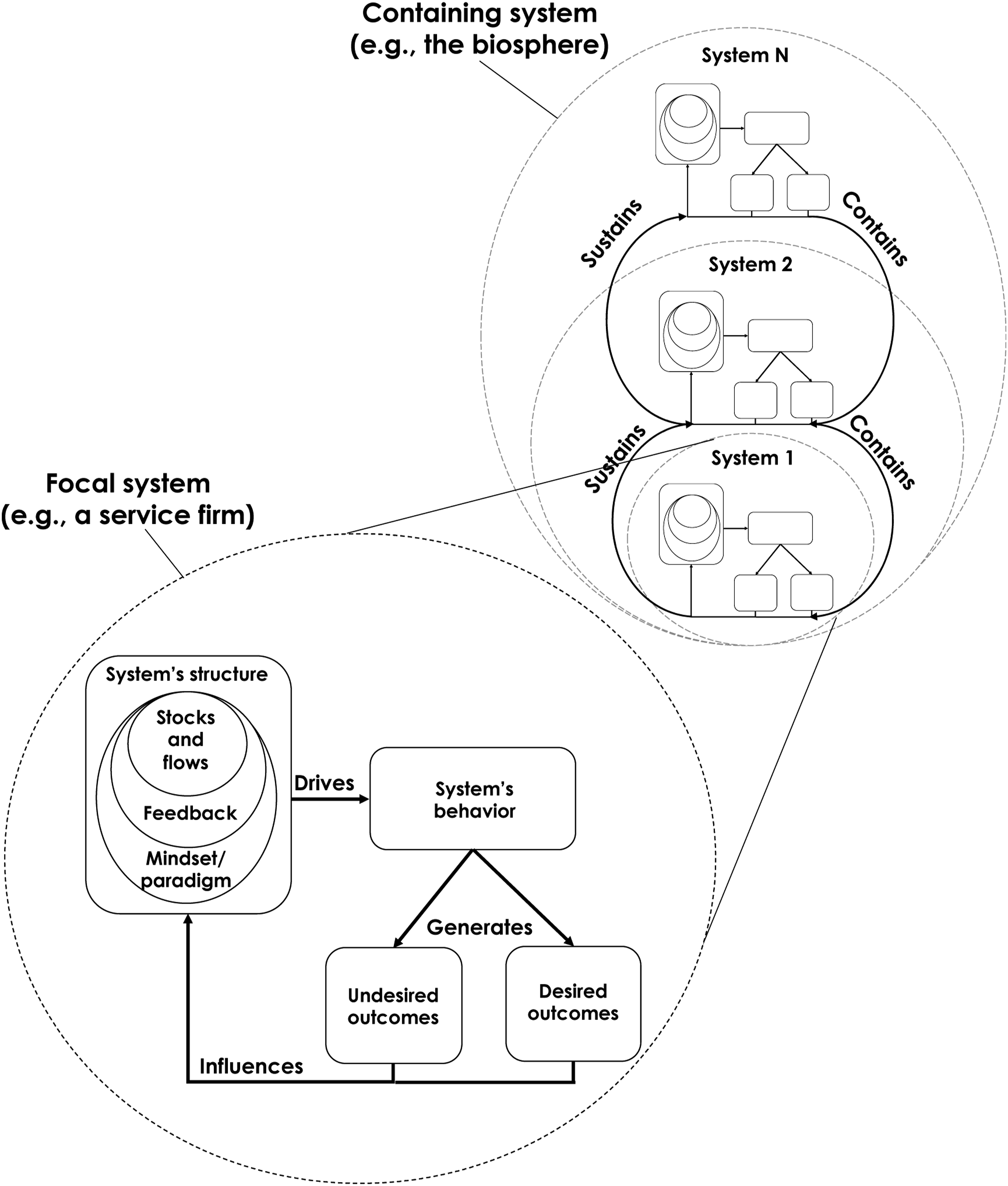
System dynamics highlights three core mechanisms that comprise the system’s structure and drive its behavior. These mechanisms are 1) stocks and flows, 2) feedback, and 3) mindsets or the system paradigm (e.g., Forrester 1961; Meadows 1997). Stocks are elements of the system that can be seen or measured at a given time (e.g., profit, resources, waste), while flows are the in- and outflows that determine the level of such stocks over time. Stocks and their flows are connected to one another through feedback (Forrester 1961). Feedback within a system can be both positive and negative. While positive feedback reinforces a certain system trajectory (e.g., an accumulation of a stock such as profit), a negative feedback balances or slows it down. Feedback loops can also be characterized by delays and other disturbances that limit or hide the feedback loops’ effect within the system. Finally, the system’s mindset or paradigm is the source from which the system’s structure of stocks, flows and feedback loops arises (Meadows 1997; 2008). In social systems, such mindsets or paradigms shape everything from epistemological to ontological questions, and also determine what is or is not considered valuable, fair or desirable. For non-human systems, a paradigm describes, for example, the characteristic pattern of a specific period in its evolution (e.g., Paleocene or Anthropocene). The system’s mindset or paradigm also identifies what the system strives for; in other words, its purpose (Meadows 2008). A system’s purpose can either be an explicit or implicit goal, or simply the function that the system fills while embedded in a larger, containing system. Hence, when looking for drivers of unsustainable service provisioning, that is, systemic behavior that is not able to sustain other systems over time, system dynamics draws attention to these mechanisms as fundamental for generating such systemic outcomes (Abson et al. 2017).
To contextualize our study of sustainable service provision, we focus on food retailing and the food waste that arises at the retailer-consumer interface. The systemic framework of sustainability in service provision assists us in moving beyond the reductionistic approach of focusing on individual or strictly material drivers generating food waste. Instead, system dynamics allows a broader assessment of the issue of retailer- and consumer-related food waste by recognizing more of its relevant constituents, how they are interconnected with one another, and the broader ecological systems and outcomes. Furthermore, from a systems perspective, parts of the system, such as the retailer’s employees or individual consumers, are never the root cause of the systemic problem; rather, the root causes lie in the underlying mechanisms that drive their, and the overall system’s, behavior (Meadows 2008).
Research Design: Abductive Methodology
This study sets out to answer the questions of what sustainability is in the context of service provision and why it is so difficult to achieve in practice. To do so, we focus on a particular sustainability problem—food waste—that results in food insecurity as well as environmental degradation (UNEP 2021). Food waste is a systemic problem desired by no one but whose reduction has proven challenging. Nevertheless, the food system of which we are all part wastes nearly a third of the food produced in it (FAO 2011) and in doing so endangers, or at least severely challenges, the future of the planet (UNEP 2021). When applying our systemic framework of sustainability in service provision, food waste represents an undesired and unsustainable outcome generated by a specific form of service provisioning—food retailing—as it places a significant strain on the ecological boundaries of its containing system, the biosphere (see Figure 1). Food waste is therefore not only suitable as a specific sustainability problem, but also serves as an urgent setting for better understanding the underlying mechanisms that hinder sustainable service provision, despite the efforts to achieve it.
In studying these systemic mechanisms, we have chosen to focus on the retailer-consumer interface as this is where most of food waste arises (UNEP 2021; Aschemann-Witzel, De Hooge, and Normann 2016). Previous research shows that food retailers have a critical role in reducing not just retailer-related food waste but also consumer-related food waste, due to their central position in the food system (Aschemann-Witzel et al. 2015; Gruber, Holweg, and Teller 2016; Kulikovskaja and Aschemann-Witzel 2017). Food retailers assess consumers’ preferences and translate these into orders and order specifications, such as by transmitting aesthetic standards in fruit and vegetables to producers (de Hooge et al. 2017). They also represent the part of the food system that has the most interaction with consumers, as the main source of food waste creation, and have been shown to influence consumers’ often habitual purchase of foods via their marketing activities (Calvo-Porral, Medín, and Losada-López 2017). Thus, we are not interested solely in retailer-related food waste, but want to gain a deeper understanding of the feedback dynamics that arise at the retailer-consumer interface and generate both retailer- and consumer-related food waste.
In our study, we adopt an abductive research methodology that operates between empirical and conceptual domains (Van Maanen, Sørensen, and Mitchell 2007). Abduction involves a process of systematic combining, where the “researcher, by constantly going ‘back and forth’ from one type of research activity to another and between empirical observations and theory, is able to expand [their] understanding of both theory and empirical phenomena” (Dubois and Gadde 2002, p. 55). Such approaches are becoming increasingly common in service research especially with work that follows a more systemic understanding of the phenomenon under study (e.g., Danatzis, Karpen, and Kleinaltenkamp 2021). In our abductive analysis process, theoretical insights from the system dynamics literature and the systemic framework of sustainability and its drivers in service provision (Figure 1) are combined with input from both empirical data from a Swedish retailer and previous academic literature on food waste at the retailer-consumer interface.
Empirical Input: Case Study of a Food Retailer
The empirical input in our abductive research process consists of a qualitative case study of a major food retailer in Sweden that is actively working for food waste reduction. We chose to focus our case study on a single retailer both to be able to capture more holistically the diversity of perspectives on the issue of food waste within a retailing organization and to gain an in-depth understanding of its causal antecedents from various parts of the organization. To achieve this, we held interviews with employees across departments at the regional headquarters and in several different stores to gain an understanding of the thoughts and actions connected with food waste, on both the level of strategic intentions and daily operations. The specific retailer was selected for the case study for two reasons: 1) we had access to a wide range of informants within the organization due to an ongoing collaboration, and 2) the retailer is actively working with multiple food waste reduction initiatives. The retailer’s sustainability reports show how their interest in the food waste issue has grown over recent years. While food waste was not mentioned at all before 2014, it has been increasingly mentioned since, and today the retailer has a goal of cutting food waste by 50% by 2025. Web Appendix 2 provides a more detailed overview of the food waste reduction initiatives adopted by the retailer in recent years.
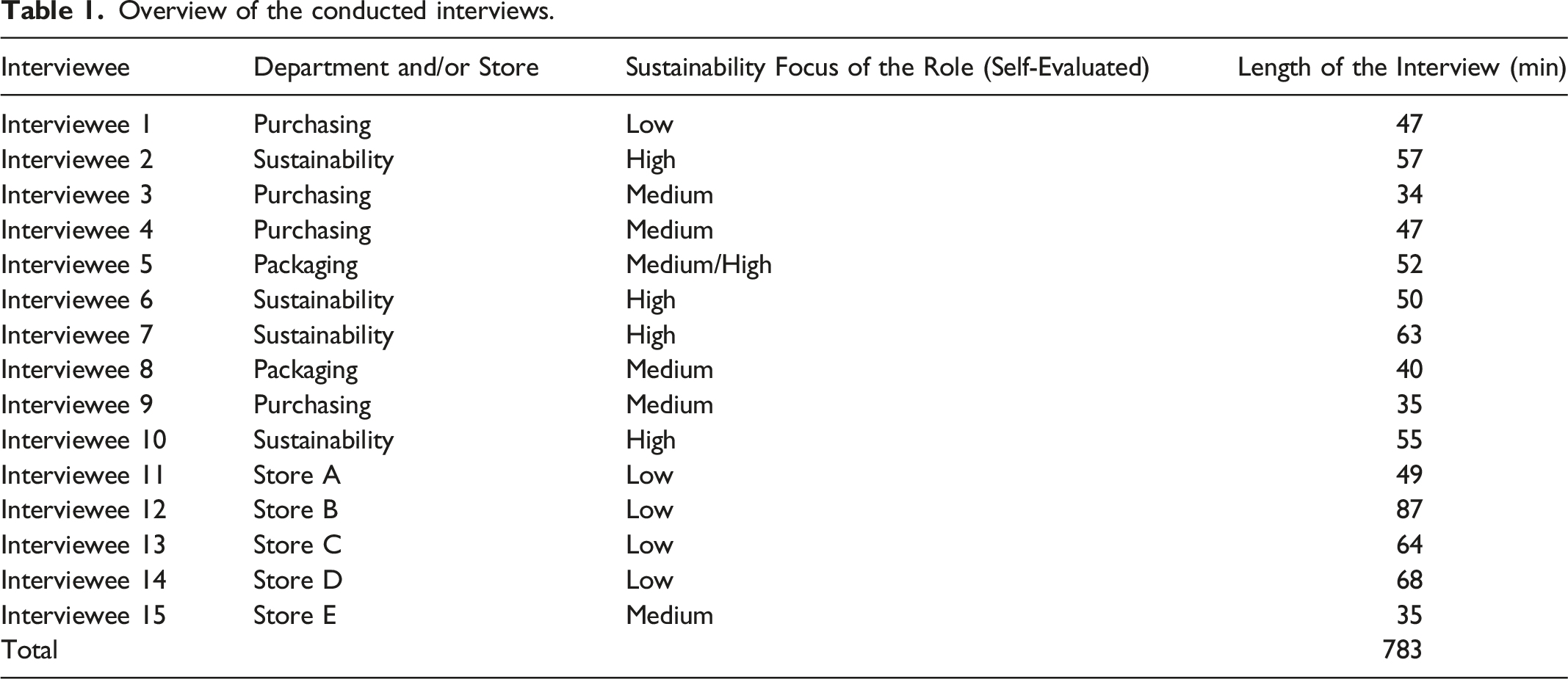
Overview of the conducted interviews.
Academic Input: Previous Literature on Food Waste at the Retailer-Consumer Interface
In addition to the empirical data, we also use prior academic literature on food waste as a source of input in our abductive study. The relevant food waste literature was identified through a literature review. To narrow down the literature selection, we focused only on articles that specifically study food waste that occurs at the retailer-consumer interface. To gather the relevant scientific articles for analysis, a Scopus keyword search was conducted using the following search phrase [“food waste” AND consumer* AND retailer*]. The search resulted in a total of 168 papers, each of which was carefully assessed and included in the final sample if it met the following criteria. First, the paper must have taken an explanatory approach, specifying drivers for retailer-and/or consumer-related food waste and/or hinderers to their reduction. In other words, descriptive papers that, for example, simply measured the amount of retailer- and consumer-related food waste or described their content were excluded. Second, the paper must have addressed drivers and/or hinderers that stemmed from the interaction between retailers and consumers. In other words, papers that had a strict single actor focus (i.e., they only discussed the retailer or the consumer without any consideration of the influence of the other actor in the interface) were excluded. Finally, the paper must have adopted a similar socio-economic research context to ours. In other words, papers that focused on developing countries or emerging markets were excluded. The use of these selection criteria resulted a final sample of 18 articles that were included in the abductive analysis. Web Appendix 1 lists all the 18 papers and includes a brief overview of their main focus, research design and key findings.
Data Analysis Through Systematic Combining
In analyzing our data, we took a systematic combining approach (Dubois and Gadde 2002) in which we moved back and forth between the theoretical and empirical domains and integrated insights from multiple sources to develop an understanding of our focal phenomenon: food waste at the retailer-consumer interface. Such an abductive approach is both intuitive and common in qualitative research (Alvesson and Sköldberg 2009). The data analysis occurred iteratively and partially overlapped with the data collection (Dubois and Gadde 2002) as we performed interpretations continuously, using insights from system dynamics.
In the first coding, quotes were selected from the transcribed interview data guided by the purpose of the study. They were put into a Microsoft Excel file where the created first order codes were iterated among the first two authors. The data was then coded a second time, this time specifically informed by the system dynamics literature and focusing on identifying potential drivers of food waste or hinderers of food waste reduction. The codes that emerged from this process were then compared with the systemic mechanisms highlighted in the system dynamics literature, resulting in four initial second order themes (system mindset, feedback and interaction, element responsibility, and system’s behavioral outcomes). These themes and their associated codes were gathered in a master sheet with a description of the main patterns for each. The themes and codes were iterated several times by the first two authors and occasionally with the full team, in a constant movement between the theory, empirical data, and the selected literature on food waste.
Finally, when saturation was reached and nothing new seemed to emerge, the process of model-building began, guided by the system dynamics’ causal loop modeling method (for details, see Meadows 2008; Sterman 2000). The causal loop diagram is a tool for diagramming the feedback structure of a system, demonstrating causal links between variables using arrows and a “plus” sign to indicate a reinforcing relationship, and a “minus” sign to show a balancing one (Sterman, 2000). The purpose of the model was to depict the intricate nature of the retailer and consumer relation generating food waste at both ends. The model depicting the feedback structure of the focal system went through many iterations to reach a sufficiently judicious representation of the immense complexity of the phenomenon.
Findings
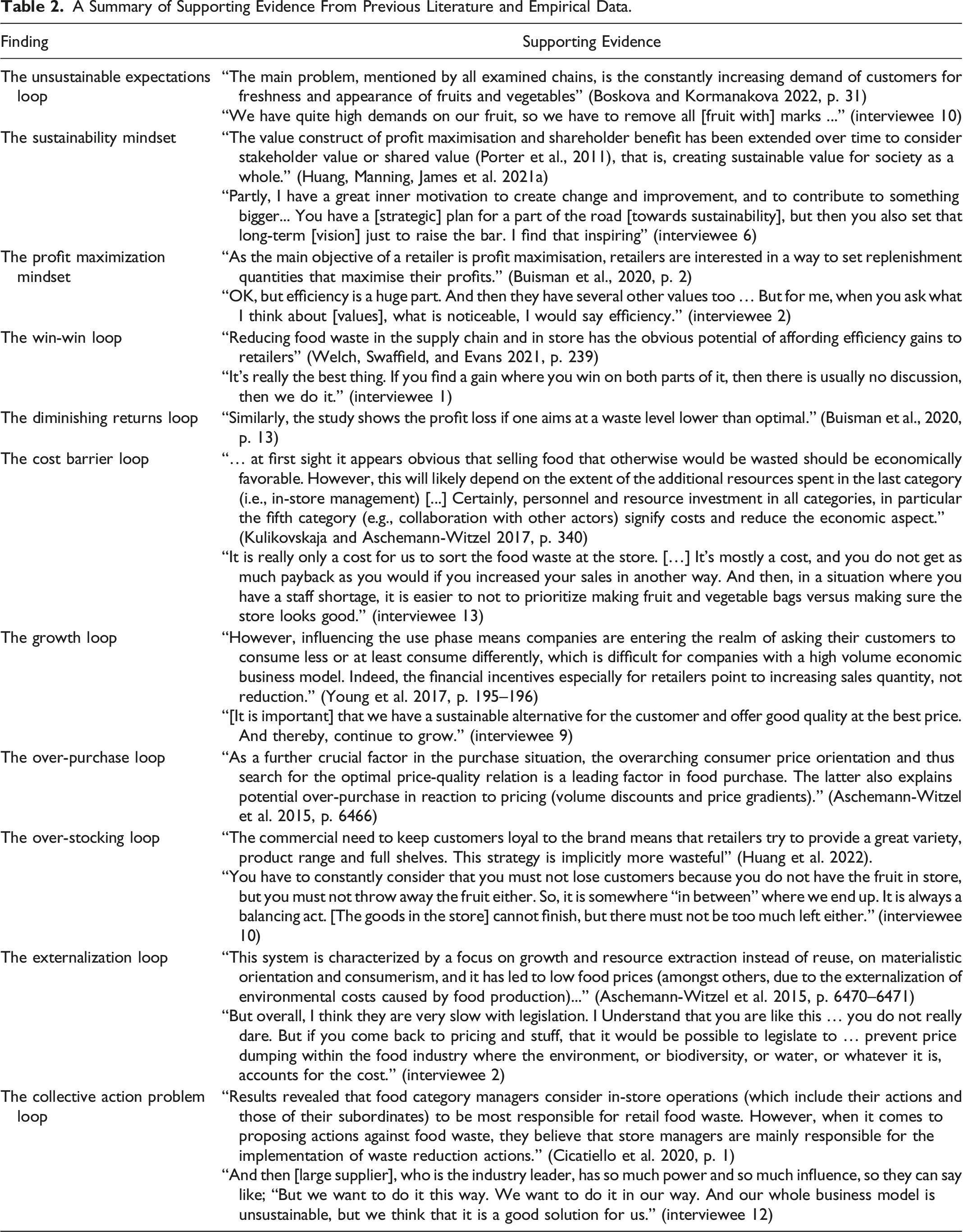
A Summary of Supporting Evidence From Previous Literature and Empirical Data.
Drivers of Retailer- and Consumer-related Food Waste
To identify the hinderers of food retailers’ food waste reduction initiatives, we first needed to gain an understanding of the drivers of food waste. In our analysis, we have focused on the drivers that exist within the focal system (the retailer-consumer interface) and which contribute to both retailer-related food waste (R-FW) and consumer-related food waste (C-FW), that in turn lead to increased environmental degradation within the containing system (Earth’s biosphere). In other words, while there are other drivers in the macro-environment, such as the tendency of household sizes to decrease and culturally embedded food preparation practices that generate waste, these are beyond the scope of our research. The main drivers identified in the systemic combining of both the food waste literature and empirical data boil down to retailers’ marketing activities and consumers’ expectations. Phase 1 in Figure 2 visualizes both of these drivers as well as the “Unsustainable Expectations” loop that connects the two so that they reinforce one another. Four initial phases of the causal loop model building.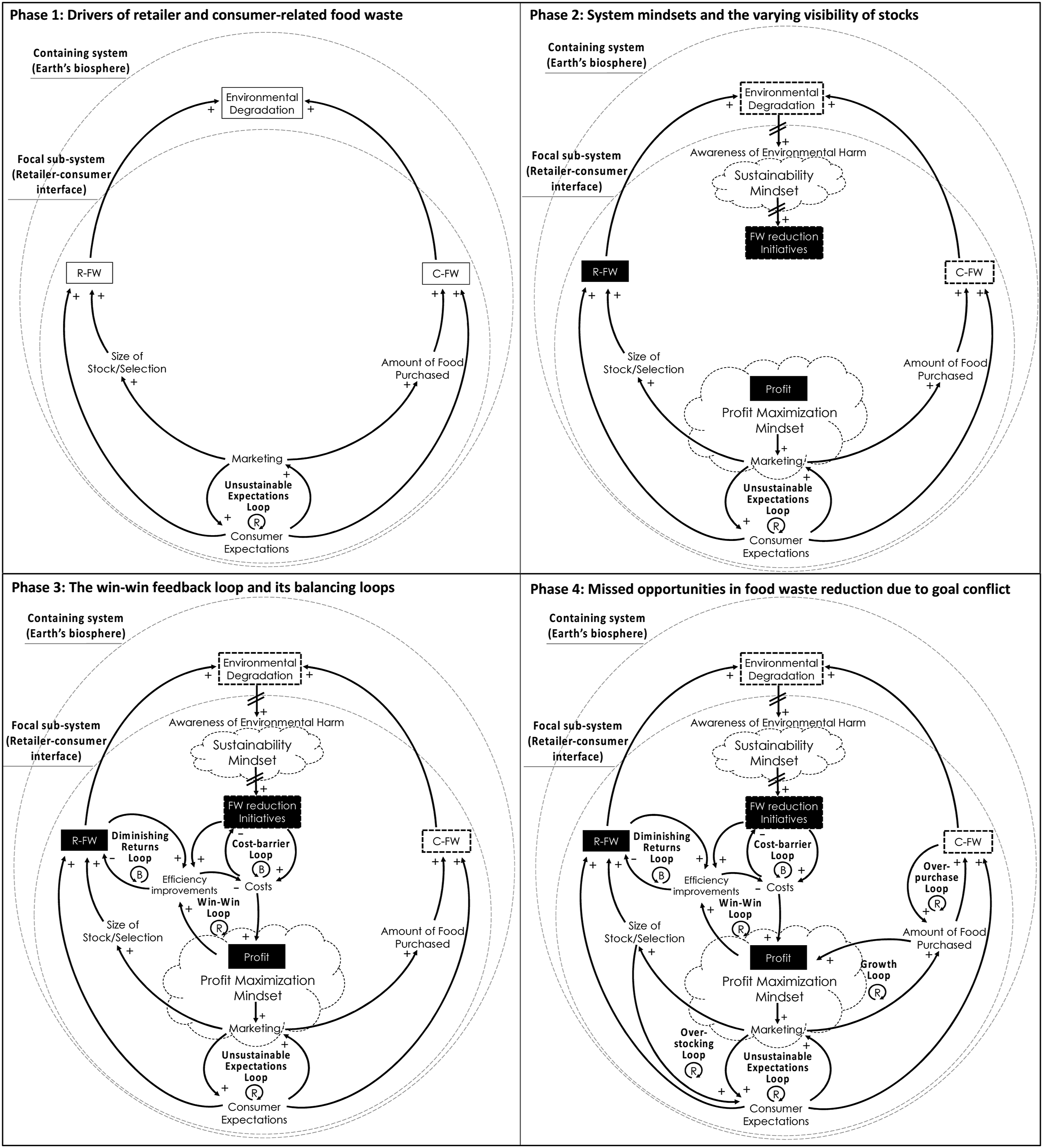
Food retailers marketing activities are a significant driver of both C-FW and R-FW. Marketing drives C-FW via decisions on date labeling, packaging sizes, and packaging design (e.g., Aschemann-Witzel et al. 2015; Aschemann-Witzel, De Hooge, and Normann 2016). Retailers are also shown to use pricing strategies as part of their marketing activities that encourage consumers to purchase large amounts of food, which leads to increasing amounts of C-FW. Examples of such pricing strategies include multi-item offers or discounts for big amounts (e.g., “buy three for two”), lower price per kilogram for large quantities, and large portions of foods (Stenmarck et al. 2011). These pricing strategies lead to food waste in consumer households, not only due to the increased amount of food purchased, but also due to the general devaluation of food (e.g., Kulikovskaja and Aschemann-Witzel 2017). Marketing activities are also connected with increasing R-FW as promotions and pricing strategies cause retailers to overstock. This, when coupled with inaccurate forecasting and overordering fresh products with a short shelf-life, directly contributes to R-FW (e.g., de Moraes et al. 2020).
Consumer expectations are a second major driver of both C-FW and R-FW. First, consumer expectations are shown to contribute to increasing amounts of R-FW. According to Kulikovskaja and Aschemann-Witzel (2017), consumers may disregard food items at the food retailer due to their non-compliance with quality requirements, for example, visual and quality defects (e.g., misshapen, blemished, or wrong-sized foods), inappropriate or damaged packaging, packaged food expiration dates, or unpackaged product deterioration. Consumers also expect a wide range of products to be available in retail stores and for store shelves always to be filled when shopping, which leads to greater food waste (Boskova and Kormanakova 2022; Stenmarck et al. 2011). Second, consumer expectations also drive C-FW, as the consumers engage in the same food-discarding practices at home when the food does not meet the aesthetic expectations originally created by marketing activities (Calvo-Porral et al. 2017).
Our system dynamics perspective on the analysis additionally reveals a reinforcing feedback loop driving food waste at the consumer-retailer interface. We call this the “Unsustainable Expectations” loop. This feedback loop stems from the connection between marketing and customers’ food quality expectations, as demonstrated in previous literature (e.g., Calvo-Porral et al. 2017; Lee 2018; see also Table 2). Marketing communications by retailers shift consumer expectations and priorities to the detriment of food waste avoidance (Calvo-Porral et al. 2017). These expectations feed back to retailers and generate beliefs about consumer needs that are followed in further marketing activities, making it a reinforcing feedback loop.
One such unsustainable consumer expectation is characterized in previous research as “freshness orientation” (Aschemann-Witzel, De Hooge, and Normann 2016). Consumers expect high levels of perfection in appearance and freshness in modern supermarkets, as this is what they are taught to expect through various marketing activities (Aschemann-Witzel et al. 2015). Our empirical evidence clearly demonstrates the pressure the retailer feels to meet customers’ expectations regarding the quality of the food produce, and shows how this leads to increasing levels of R-FW. For example, in trying to meet the quality standards set by the marketing activities, the retailer has to remove all damaged packaging and marked fresh fruits and vegetables. The same aesthetic requirements set by the retailer’s marketing activities are then upheld by the consumers in their homes, leading to C-FW as well. The interconnection here shows the importance, and possibility, of tackling both R-FW and C-FW with the “Unsustainable Expectations” loop.
Two Mindsets at Play in Retailers’ Food Waste Reduction Initiatives
Our findings reveal that two mindsets exist within the focal system and act as the source of its behavior. In system dynamics, the system’s mindset or paradigm is seen as the most important source of its behavior, entailing a high leverage point for systems change (Meadows 1997). The two identified mindsets, which we call the “Sustainability mindset” and the “Profit Maximization mindset.” are visualized in Phase 2 in Figure 2.
Sustainability Mindset. The sustainability mindset acts as a driver of food waste reduction initiatives for the food retailer. This mindset is rooted in the increasing awareness of environmental degradation and the surpassing of planetary boundaries that have taken place in recent years (Steffen et al. 2015). The extent of a sustainability mindset varied greatly among the employees of the focal retailer. Not surprisingly, the self-evaluated “importance of sustainability for their role” score (Table 1) reveals that the people hired to work specifically on sustainability issues had a strong awareness of the challenges at hand, and thus a strong sustainability mindset. These managers were motivated to drive the retailer towards a transition to sustainability, and felt inspired by ambitious sustainability targets. The sustainability mindset was found to have spillover effects on employees’ private lives, and vice versa. In contrast, other employees did not feel that sustainability was important for their role, and mainly supported the sustainability initiatives that contributed to the financial bottom line. However, a third group intuitively saw the importance of tackling food waste, although they were confused by and uninterested in sustainability on a global scale. This demonstrates the great variety of forms that the sustainability mindset can take. This variation was particularly noticeable in our data between the head office employees and the store managers. These varying forms of the sustainability mindset sometimes created tensions within the organization. For example, communicating sustainability issues was challenging as it needed to satisfy the various interpretations of sustainability. There was, however, a common denominator of the sustainability mindset, which was the awareness of the world’s environmental and social challenges, and a willingness to change to a more sustainable society.
In relation to the sustainability mindset, what stood out from our data was the varying visibility of the different stocks in the model. As described earlier, the sustainability mindset is connected to the stock of environmental degradation and the awareness created around this problem, leading to food waste reduction initiatives. However, the “Environmental Degradation” stock and the “C-FW” stock are the ones least visible for the retailer and therefore, marked with a dashed-line in Phase 2 in Figure 2. It was very clear from multiple sources of input that the information flow from the “Environmental Degradation” stock was characterized by significant delays, shown with the lines over the flow arrow in the model. A delay indicates that while the environmental degradation is taking place, it takes significant time for feedback to create awareness about the issue. The lack of clear and timely information creates uncertainty for the retailer, which has consequences for how they deal with food waste. One example is the retailer focusing on reducing plastic, without recognizing the consequences that that has for food waste creation with a generally higher environmental impact (Williams et al. 2020). Information is crucial for targeted decision-making and, therefore, this was seen as a hindrance to building a sustainability mindset, and for reducing R-FW as well as C-FW.
Profit Maximization Mindset. We call the second mindset guiding the activities taken on by the employees of the food retailer the “Profit Maximization” mindset. This mindset is related to the neoliberal capitalistic ideology of the firm as a profit-maximizing entity (e.g., Kulikovskaja and Aschemann-Witzel 2017). Today, such a mindset strongly permeates the running of organizations, which further dictate the market-place (Schneider 2020). In fact, it has become a dominant ideology that the primary, or only, goal of an organization is the maximization of profits. In turn, this leads to strong pressure to make money, both through increased revenue and by reducing costs in order to increase margins.
In the present study, the profit maximization mindset was apparent in several different ways. Unlike most of the stocks related to the sustainability mindset, the profit stock, to which profit maximization is closely connected, was highly visible and prominent for the retailer. The profit stock was emphasized through the values, goals, and both the direct and indirect measurement instruments institutionalized throughout the organization. It was particularly visible in how profit was viewed as the primary goal, which had ripple effect on the approach to sustainability. For example, several employees described how efficiency, which is the better use of resources in order to save costs, was the most noticeable value for the retailer. The profit maximization mindset was also displayed in how employees are assessed mainly in terms of revenue and efficiency, or cost reduction. Employees working with sustainability issues like food waste sometimes found that they had to convince the rest of the organization that it was something important that should be prioritized, especially when it did not contribute to the goals stemming from the profit maximization mindset.
The profit maximization mindset was also apparent in the strong focus on customers as the ultimate driver of sustainability initiatives. The retailer was customer-driven in their sustainability initiatives, seeing them as meeting customer demands. From this perspective, the customer either had to pay more for a sustainable product, or solutions were implemented that also offered financial benefits, although these were communicated as environmental initiatives. In this case, the main driver is the profit maximization mindset and the sustainability framing is more of an afterthought, making sustainability merely a necessary means to a financial end. At the same time, the communicative efforts of the sustainability department and its causal link to the profit stock made R-FW more visible for the retailer as a stock, particularly after it was made a key performance indicator (KPI) for the organization. Visibility is an important factor for drawing attention to a stock within the system, and is usually a prerequisite for being able to deal with an issue. Therefore, the interplay between the two mindsets have prioritized certain types of food waste initiatives over others. Next, we will describe the feedback loops that stem from the interacting mindsets that both enable and hinder the focal retailer’s engagement with food waste initiatives.
Win-Win Food Waste Reductions Initiatives
Several balancing and reinforcing feedback loops stem from the interplay of the two identified mindsets at play within the focal system. Our findings show that there is one reinforcing feedback loop that acts as an enabler for the food retailer to engage in FW reduction initiatives. We call this the “Win-Win” loop. However, the existing literature and the empirical data also indicate that the win-win loop will eventually be slowed down by a “Diminishing Returns” loop, while some food waste initiatives are characterized by a “Cost Barrier” loop. All three feedback loops are depicted in Phase 3 in Figure 2.
Win-Win Loop. The win-win loop describes the benefits that arise from making efficiency improvements. Efficiency is about finding ways to avoid wasting material or resources. The win-win loop contributes to furthering food waste reduction initiatives, rather than acting as a hindrance like the other loops. The loop starts with recognizing that food waste constitutes an environmental problem, and that it also comes with the financial cost of resource depletion. As a result, an efficiency-oriented food waste reduction initiative is implemented. One example of such an initiative is the freshness checks implemented by the retailer in this study. Freshness checks mean that some employees are taught to be “freshness experts.” and control the quality of fresh food several times a day in order to intervene early in case of deterioration. The freshness checks also include separating fruit and vegetables at risk of going bad or packaged with other fruit or vegetables that have already gone bad. These can then be put in paper bags and sold at a reduced price. This is a win-win initiative as it allows the retailer to save money by becoming more efficient in their organizational processes, while at the same time reducing their food waste.
Efficiency improvements are characterized by reduced costs and hence more profits. The reduced waste and increased profit lead the retailer to further invest in efficiency improvements, further decreasing the food waste, and so on. In fact, the win-win represents a common way of solving the conflict that might occur between the sustainability mindset and the profit maximizing mindset, by demonstrating that they go hand-in-hand. However, as demonstrated by the supporting evidence for this loop in Table 2, as this originates in a profit maximizing mindset, the only sustainability initiatives implemented are the ones that meet the cost-saving requirements. For the sustainability initiatives that do not fulfill this requirement, a cost barrier is created (which we will discuss later). For the present, the win-win loop has another limitation on its continuation: the “Diminishing Returns” loop.
Diminishing Returns Loop. Efficiency improvements are appreciated as they provide simultaneous value creation: reduced harm to the environment, and reduced costs and increased profits for the organization. However, efficiency improvements are not infinite. Eventually they will start to experience limits to their success or diminishing returns (Kim 1995). In other words, although the win-win loop spurs food waste reduction initiatives, it is eventually balanced out by the diminishing returns loop that hinders the initiatives. This is because the more efficiency improvements the retailer makes, the less R-FW there will be, and the less R-FW there is, the fewer opportunities for further efficiency improvements there are. Returning to the example given above: once the store has implemented freshness checks, separated fruit and vegetables about to go bad and re-sold those it can, it will reduce the R-FW and there will be less available space to make further improvements. This is also referred to as the “law of diminishing returns.” or diminished marginal productivity, which is a common feedback loop archetype in system dynamic models (Kim 1995; Meadows 2008). The law predicts that the retailer will reach a point where further efficiency improvements will lead to diminished marginal returns on that investment, meaning that it becomes a marginal cost. This brings us to the second balancing factor on the win-win loop: the “Cost Barrier” loop.
Cost Barrier Loop. The cost barrier loop represents the increased costs that accrue from the food reduction initiatives. Some initiatives (and eventually all, as predicted by the law of diminishing returns described above) will become a cost to the retailer. This means that retailers will not make any money on their food reduction initiatives, making their implementation a pure “do-good” choice. This creates a tension between the profit maximization mindset and the sustainability mindset, as it implies that the organization has to voluntarily take on increased costs to do something that helps the environment or society. One example is the donation of R-FW. A sustainability manager stated that the donation collaborations with which they are working poses a direct cost to them. Instead of directly throwing the food in the bin, the retailer has to prepare the food for delivery to the charity, call the charity, and have them come and pick it up; before all of this, they also have to spend time formalizing an agreement with charities in each town where they operate.
Ultimately, the profit maximization mindset means that everything that has a negative impact on profits is to be avoided, so food waste solutions that may incur higher costs will be ignored (Huang, Manning, James et al. 2021b). Thus, dealing with food waste in this manner creates a cost-center, and when prioritizations have to be made, profit-centers always come first, as explained by the sustainability manager. This applies to any type of social or environmental cost, which creates a collective action problem at a higher level of abstraction, as we will see in the next section.
Missed Opportunities for Food Waste Reduction due to Goal Conflict
While the sustainability mindset is growing in influence, the dominant mindset within the system is still that of profit maximization. This creates several missed opportunities for food waste reduction, especially C-FW reduction as it creates a direct conflict with the goals and behavior driven by the profit maximization mindset. This behavior is very difficult to change as it is grounded in several reinforcing feedback loops. We call these feedback loops, visualized in Phase 4 in Figure 2, the “Growth” loop, the “Over-purchase” loop, and the “Over-stocking” loop. As a consequence of these feedback loops, food waste reduction initiatives aimed at reducing C-FW are almost non-existent.
Growth Loop. Marketing activities by the retailer are usually driven by the profit maximizing mindset, meaning they are done to increase sales and hence profits. Based on previous literature, it is known that marketing increases the amount of food purchased by consumers (e.g., Lee 2018; Tsalis et al. 2021). The amount of food purchased, in turn, drives the profits, which leads the retailer to invest in more marketing, creating the basic logic of the growth loop. It is characterized here as a reinforcing loop, even though growth cannot go on forever (Meadows 2008). Yet this does not stop growth from being a highly viable goal for the retailer. From this perspective, sustainability offers are something that allows the retailer to grow, and with that, growth rather than environmental values becomes the end goal for their implementation (Cicatiello et al. 2020). A sustainability manager described the vision of the company, in which the growth goal is implicit. There is nothing particularly novel about this loop; growth has long been the primary end-goal for organizations (e.g., Meadows 1997; Hinton 2020). What is interesting is recognizing how it connects to C-FW. We will examine this more closely in the following sections.
Over-Purchase Loop. The over-purchase loop highlights how the amount of food purchased is linked to how much food is wasted at a consumer level, which is also known from previous literature (e.g., Aschemann-Witzel, De Hooge, and Normann 2016). The more over-purchasing that occurs, the more consumers will have to throw away at home at a later stage (Lee 2018). This is spurred by retailer marketing practices designed to drive consumption and stemming from the profit maximization mindset, described in the growth loop above. However, how C-FW feeds back into the growth loop is seldom recognized. The more C-FW in households, the more food consumers have to buy to replace the wasted food, which in turn supports the profit goal of the retailer. Thus, for retailers committed to reducing C-FW, yet another goal-conflict arises. As the retailer seeks to help the customer to reduce their food waste, they are indirectly committing to reducing the amount of food they sell, something that in their current business model will directly impact their profit margins. From the short-term perspective that dominates the profit maximization mindset, this is a problem, further hindering the food waste initiatives adopted by retailers.
Profit mindset-driven marketing has another important consequence besides directly influencing the amount of food purchased: it contributes to the devaluation of food. It does so by creating a price pressure dynamic in which retailers cut prices to attract customers. The low prices of food make it possible for consumers to buy large amounts. Furthermore, the price of a product also impacts the value customers place on that product (Aschemann-Witzel, De Hooge, and Normann 2016). The low price of food leads the consumers to place very little value on it, as it costs so little to replace whatever is thrown away. Hence, indirectly, the retailers’ profit maximization mindset drives C-FW, and it does so through marketing, both by devaluation and by creating aesthetic expectations on how fruit and vegetables should look.
Overstocking Loop. As seen earlier, marketing impacts the amount of stock held by retailers, as well as the selection practices around what goods to stock (Cicatiello et al. 2020; Huang et al. 2022). The result is an overstocking of goods which, in turn, leads to increasing R-FW. Overstocking arises partly from prediction difficulties regarding demand levels (Stenmarck et al. 2011). Furthermore, several employees said that it does not look good for the store to “finish” all fruit and vegetables as, aside from missing out on potential sales, it is embarrassing in front of customers who expect to see full shelves. As a result, it is generally preferred to overstock goods, so as not to risk running out despite the potential for increased R-FW. Store managers find it particularly difficult to predict demand for fresh goods such as fruit and vegetables; they also struggle with campaigns for which previous data is unavailable or sparse. Hence, predicting demand is a great problem for the retailer, leading to over-stocking. However, previous literature has failed to recognize how retailers’ overstocking and goods selection feeds back into consumer expectations. As depicted in the model (Figure 2), the large amount of stock and the selection practices lead to increased consumer expectations of the stock and selection, creating a reinforcing loop encompassing the interaction of the overstocking loop and the unsustainable expectations loop described earlier. This, in turn, leads to the continuous recreation of R-FW and, by extension, C-FW. These loops hinder food waste reduction as the retailer becomes caught in the loops of overstocking and unsustainable expectations, without really being aware of it.
Collective Action Problems in Food Waste Reduction
In this final section, we focus on highlighting two additional feedback loops that act as systemic hinderers to retailers trying to engage with food waste reduction initiatives. These feedback loops are the “Externalization” loop and the “Collective Action Problem” loop. They are depicted in Figure 3, which gathers all the identified systemic mechanisms driving the generation of food waste and hindering retailers’ engagement with food waste reduction initiatives within one causal loop model. The systemic mechanisms driving food waste and hindering food retailers’ engagement with waste reduction initiatives.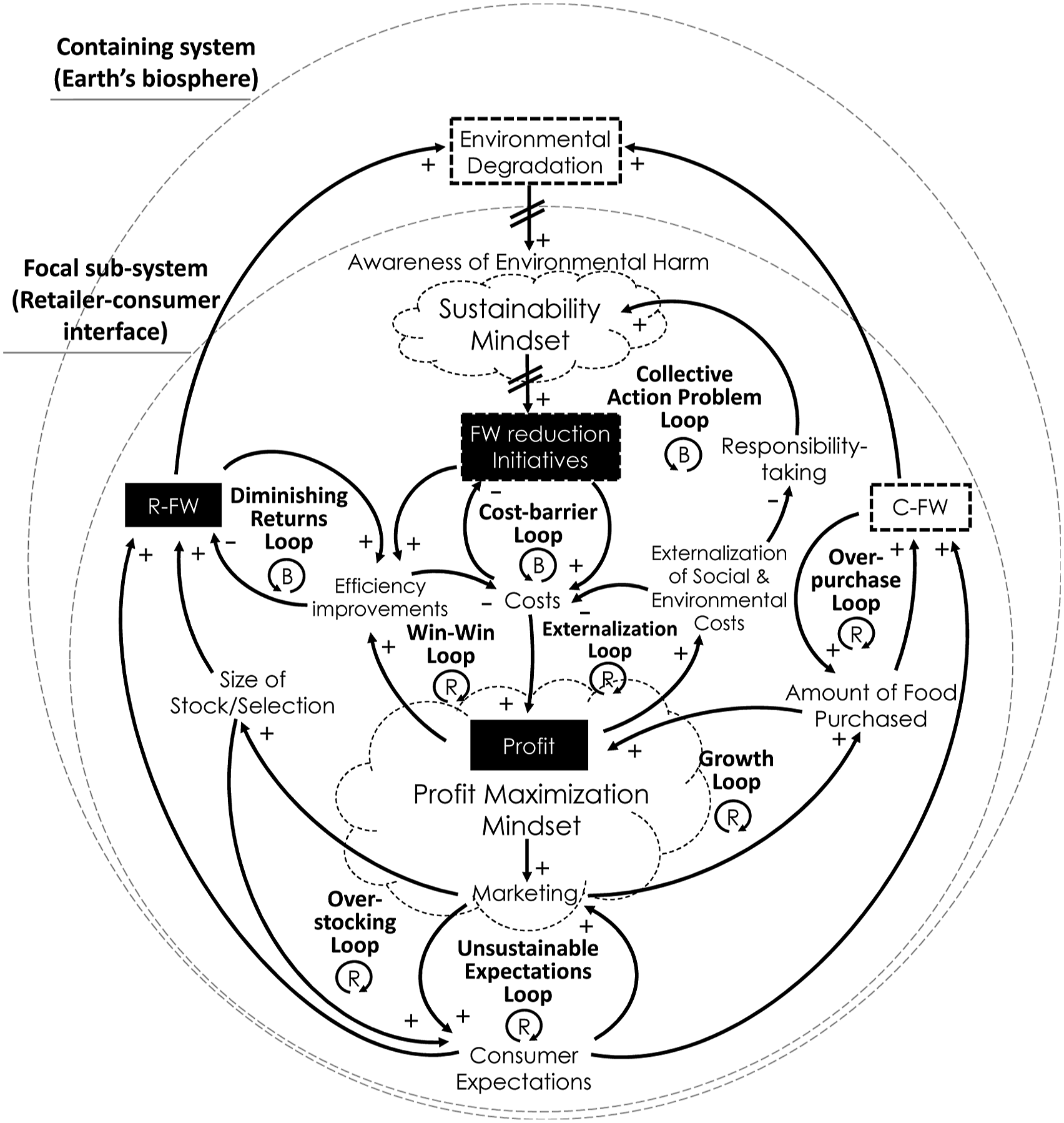
Externalization Loop. The retailer is mainly guided by a profit maximizing mindset. The profit maximizing mindset is not so much a choice, but a necessity required to survive and thrive in today’s market (Hinton 2020; Schneider 2020). As seen above, the profit maximizing mindset leads to attempts to reduce costs in order to increase profit margins. One way of reducing costs is to externalize them to society or the environment (Daly 1987). Today, this has become common practice among organizations (Hinton 2020), enabling them to lower prices, attract more customers, and, thereby, stay competitive. In the case of food waste, this results in increased pressure not to adopt any initiatives that entail increased costs, or internalize previously externalized costs. There are many examples of externalized cost within retail, but it is general price dumping that has the highest environmental impact (Aschemann-Witzel et al. 2015). The pressure to externalize costs to be able to offer lower prices and attract customers is so strong that several of our respondents pled for increased regulation to limit or end the issue. Another example of externalizing cost is the reduction of single-use plastics, where the retailer responded by removing the plastic forks from “ready-to-eat” salads, externalizing the cost of that initiative onto customers in order to avoid the increased costs of finding an alternative solution. The externalization of social and environmental costs leads to decreased economic costs, which has a positive impact on the profit stock. This is a dynamic that is found to lead to further environmental degradation (Hinton 2020). In order to properly deal with sustainability issues that cause environmental degradation, like food waste, it is important that retailers begin, voluntarily or otherwise, to take into account all the associated costs, instead of externalizing them.
Collective Action Problem Loop. The externalization of social and environmental costs leads to narrow responsibility-taking, which has a negative impact on the sustainability mindset. In turn, a narrow sustainability mindset leads to fewer food waste initiatives. Considering these two loops together demonstrates the collective action problem that arises for private organizations attempting to deal with the food waste issue. A collective action problem is one that suggests a group of actors would be better off by working together to achieve a goal, like reducing food waste, but conflicting interests prevent them from doing so (Olson, 2009). They become stuck in a behavioral trap, where each actor maximizes private gains and prioritizing their short-term interests, while the group as a whole would be better off dealing with the issue and preventing negative long-term outcomes.
This behavioral trap is demonstrated in how retailers work with partners or suppliers when dealing with food waste. As demonstrated by the quote from our empirical study (see Table 2, and the Collective Action Problem Loop), there is a power dynamic at play between the retailer and suppliers, where the market’s dominant actor sets the rules that most benefit them. This tendency to “look after your own back” instead of collaborating to deal with the food waste issue goes both ways. Previous literature has found that when retailers are approached by suppliers who have food soon to expire and asked if they can sell it, the retailer usually does not want to take the risk, which leads to the food being wasted (Huang et al. 2022). If the retailer decides to deal with the food after all, our respondents describe how it is done on the condition that the non-sold goods are returned to the supplier to avoid creating higher food waste numbers for the retailer. Thus, the responsibility for the food waste is passed on to others. This process of responsibilization has also been found to take place by framing food waste on the policy level, introducing a wider group of stakeholders (Mesiranta, Närvänen and Mattila 2022).
A similar conflict was also found to occur internally with the retailer. For example, a central warehouse might send goods to stores that they have not ordered because the goods are nearing expiration. In these cases, the stores are reluctant to accept these goods as they know it will make them responsible for the food waste. This shows that despite being within the same organization, departments sometimes struggle to collaborate to reduce food waste. The collective action problem loop illustrates the high-level issue that arises when an entity’s pursuit of its own self-interest, be it the retailer, an employee, or a department, stands in the way of dealing with the common issue of food waste. The individual incentives are not aligned with the collective goal of food waste reduction. Yet in order to significantly reduce food waste, collaboration that transcends self-interest is essential.
Discussion
While there are a growing number of calls to address sustainability in service research (e.g., Field et al. 2021; Huang, Malthouse, Noble, and Wetzels 2021a), to date, there has only been a limited effort to theorize about sustainability within service provision. To guide service researchers and practitioners on the path toward improved sustainability, this study makes two theoretical contributions. First, it offers a systemic conceptualization of sustainability in service; second, it provides a framework that explicates the mechanisms that contribute to (un)sustainable service provisioning as a systemic behavior. In addition, our study carries significant practical implications for the efforts of reaching SDG 12.3 to “halve per capita global food waste at the retail and consumer levels” by developing an integrative model of the drivers of food waste and the hinderers of its reduction at the retailer-consumer interface.
Theoretical Implications
With our first contribution, we answer the calls to address sustainability in service as a systemic phenomenon (Field et al. 2021; Saviano et al. 2017). By building on Manderson’s (2006) systemic framework of sustainability, we define sustainability in service as the focal system’s ability to sustain the broader system(s) it depends upon. This concept implies that the sustainability of a service provisioning system, such as a service firm, can be determined by evaluating whether or not it is able to sustain the viability requirements of the broader system(s) in which it is embedded. Put simply, it implies that a service provider cannot be sustainable within an unsustainable system. With this theoretical lens, it also becomes clear that food retailing is currently a highly unsustainable service industry when the Earth’s biosphere is considered as the containing system, because of the well-documented connection between food waste and environmental degradation (UNEP 2021).
The systemic conceptualization of sustainability in service reveals why the various meanings given to sustainability do not always align with one another (e.g., Saviano al. 2017) as they can be based on different interpretations of the containing system (e.g., national economy vs. ecosphere) and varying containing system prioritizations (e.g., is it more important to keep the economy running or to ensure the viability of the ecology?). We, therefore, argue that studying sustainability in service research always requires the specification of at least two systems: the focal system whose sustainability is evaluated, and the containing system that is to be sustained. This conceptualization of sustainability points to the potential tensions in interventions that simultaneously aim to fulfill economic, social and environmental sustainability goals in service research, as sustaining all these containing systems simultaneously can be difficult. Furthermore, it reveals that there are inherent conflicts embedded within the Agenda 2030 SDGs as fulfilling all the goals requires the successful sustainment of several different containing systems that currently have a very unsustainable relationship with one another.
Conceptualizing sustainability as the focal system’s ability to sustain the broader system(s) in which it is contained challenges service researchers not only to zoom out to understand the multi-actor and macro-level constellations of large-scale service (eco)systems (Field et al. 2021), but also to zoom in on the microprocesses of service provisioning in order to fully understand the mechanisms driving the environmental and social consequences. In other words, our proposed conceptualization demonstrates how oscillating foci (Chandler and Vargo 2011) can be embraced and operationalized in studying the sustainability of service (eco)systems (Field et al. 2021). In addition, it acknowledges that since these nested systems adapt and change over time, what is considered sustainable behavior must also be continually re-evaluated. For service researchers, this implies that sustainability cannot be treated as a static characteristic of a service firm (or other focal system), but as an ability that requires continuous reflection and clarification across service contexts and levels of analysis. There is consequently a significant need for further studies that examine the context-specific requirements of sustainability in service over time.
As our second contribution, we combine the systemic concept of sustainability with the literature on system dynamics to develop a theoretical framework that depicts the mechanisms that lead to (un)sustainable service provision. These mechanisms are theoretically and practically important because they offer a foundation for guiding the transition towards more sustainable modes of service production and consumption (Field et al. 2021; Huang, Malthouse, Noble, and Wetzels 2021a). Specifically, our framework (Figure 1) depicts how three types of elements, comprising the system’s structure, drive its behavior and are therefore crucial in determining its ability to sustain its containing system(s). As we show in the context of food retailing, stocks and flows, feedbacks, and mindsets drive the focal system (i.e., the retailer-consumer interface); they also make the current service provisioning result in undesired outcomes, such as food waste that has a degrading effect on the containing system (i.e., the Earth’s biosphere). Our findings illustrate how the visibility of stocks significantly varies and show how some stocks can remain invisible and unaccounted for, thus explaining why a service provider, despite having good intentions, may still act in an unsustainable way. This finding provides a new angle on the unintended consequences of service provision as currently discussed in TSR (Blocker, Davis, and Anderson 2022) and implies the importance of uncovering invisible stocks and flows in (service) systems to evaluate their sustainability.
Our theoretical framework additionally identifies both reinforcing and balancing (hindering) feedback loops as important drivers of systems’ behaviors. Based on our findings, these feedback loops can be broadly categorized into three types: (1) win-win loops, (2) goal-conflict loops, and (3) externalization loops. While the win-win loops offer relatively easy ways for the focal system to improve its sustainability due to synergistic effects, the opposite is true for the two other feedback loops. Both the goal-conflict and externalization loops require external intervention from the broader system (e.g., in form of consumer pressure, or new policies and regulations) in order to be acknowledged and acted upon by the focal system.
Our findings also show that the interlinkage of feedback loops with the system mindset(s) generally adds to the difficulty of attending to them. The system mindset fundamentally influences the focal system’s feedback structure and subsequent behavior in terms of sustainability outcomes. For example, our study illuminates how the prevailing profit maximization mindset, which focuses the focal system on optimizing benefits for itself rather than sustaining the broader system upon which it depends, drives the service provisioning to be unsustainable through its influence on the feedback structure of the system. By showing how the system’s mindset and the multiplicity of such mindsets are connected with feedback loops, we provide a novel way to study the influence of institutionalized mental models and other institutional arrangements in service research (Koskela-Huotari et al. 2020) beyond their constraining and enabling influence on individual actors’ behavior.
Furthermore, we illuminate how the reinforcing nature of feedback loops, feedback delays, and the invisibility of some crucial stocks lead the focal system to be “locked-in” to its unsustainable behavior. This locked-in state persists even though the feedback from the broader system contributes to the emergence of an alternative sustainability mindset that would imply a very different way for the focal system to behave. With that, our study underscores why achieving sustainability is so difficult: apart from often benefiting from the status quo, the most influential actors perceive no need to change their behavior because of a cognitive locked-in state. In our case, the retailer had a clear and well-expressed intention to reduce food waste, yet the prevailing system mindset and related goal conflicts actively hinder them from doing so. Achieving sustainability in service provision will therefore require a radical paradigm shift (i.e., change in long-held mindset) on various aggregation levels of (service) systems, from value creation focused on individuals’ benefit or usefulness, or a strict human-centeredness, to a more pro-social and common-oriented focus, centered on intricate social and ecological outcomes.
Practical Implications
Practically, our study informs the efforts to tackle food waste by developing an integrative model of the systemic mechanisms that drive food waste at the retailer-consumer interface and hinder food retailers in achieving food waste reduction (see Figure 3). As food waste is a highly complex phenomenon that has multiple sources and effects (de Moraes et al. 2020), a systems perspective is essential to avoid reductionistic solutions that fix the problem on one end but exacerbates it at another. Contrary to previous studies examining the causes of food waste (e.g., Aschemann-Witzel, De Hooge, and Normann 2016; Lee 2018; do Carmo Stangherlin, and de Barcellos 2018), our study does not merely identify these drivers, but also elaborates the relationships between the various systemic mechanisms at play. Hence, our integrative model provides a useful tool for creating awareness among industry professionals and other actors in the food system about the feedback dynamics and unwanted outcomes that result from the prevalent mindset. Essentially, our model reframes the food waste problem as a systemic outcome that is unintentionally co-created and, therefore, emphasizes that any type of solution would have to be a common one. In addition, the model can guide policymakers in directing innovation activities aimed at tackling the identified hindrances and enabling sustainability transitions within the food retailing sector through, for example, a transformative innovation policy program linked to SDG 12.3.
For food retailers specifically, our findings suggest that the strategies for food waste reduction should differ depending on the type of feedback loop with which the retailers are dealing. The win-win loops allow for relatively easily implementable interventions (e.g., selling products that are close to their expiry date at a reduced price) as soon as the opportunity is acknowledged; these can be considered low-hanging fruits for food waste reduction. The goal-conflict and externalization loops are, however, more challenging. For example, within the current market system it is difficult for retailers to refrain from aggressive price campaigns that lead to increased food waste both for the retailer (because of the overstocking loop) and households (due to the over-purchase loop), as the current dominant mindset considers this important for attracting customers in. In such cases, policymakers and other food industry actors need to explore how they can set interventions that contribute to removing or reducing these barriers, and, through that, pave the way towards more sustainable service provisioning. This might require new regulations (e.g., restrictions for campaigns on fresh food) and establishing a stronger link between food prices and the environmental costs of food production.
While we acknowledge that tackling the food waste problem to the fullest cannot be achieved by any single actor alone, we still call for food retailers to work actively to counter-balance all feedback loops that reinforce food waste generation. In connection to the feedback loops resulting in food waste at the retailer’s end, food retailers can significantly decrease their amount of food waste by rethinking their marketing campaign strategies, and using local and responsive price campaigns for occasions when food is surplus due to overstocking. Furthermore, to overcome the cost barrier loop, retailers need to recognize that what might seem like increased costs in the short-term could contribute to their long-term viability by improving the wellbeing of the systems in which they are embedded. In connection to the feedback loops driving food waste at the consumers’ end, there is huge untapped potential in the retailers’ ability to shape consumption patterns. Retailers should explore how they can educate their customers to reduce food waste in their homes. For example, how can marketing communications be used to change the perception of the value of food? Much further work is also needed to identify attractive value propositions and related business model designs that are driven by the sustainability mindset. Guided by these considerations, retailers should use their powerful position within the food system to create demand for change on the consumer side, and subsequently collaborate with actors across the food system to meet this demand.
Conclusions and Limitations
There is an increasing consensus in service research that “Service should be sustainable” (Huang, Malthouse, Noble, and Wetzels 2021a, p. 469, emphasis added). With this paper, we hope to provide a theoretical foundation for the study of sustainability in service that gives concrete conceptual tools for service researchers to attend to the systemic nature of sustainability problems without overly reducing their complexity. Specifically, we hope that our study encourages the service research community to continue the important discussion of what (un)sustainability in service provisioning means in different contexts, and what are its consequences across the nested systems comprising our shared planet. Our work also points to the need to move beyond the individualistic and human-centric conceptualizations of value and wellbeing in service research, as these will otherwise cause problems for studying sustainability issues that necessarily require a more holistic understanding of the interconnected entities and multiple system scales to be considered. Doing so will lay an important foundation enabling service researchers to guide policymakers and industry actors in setting the mindsets and conditions needed for service provisioning that can contribute to a more sustainable future.
In empirically studying the systemic mechanisms of (un)sustainability in service, we have limited our focus to the food retailing context and the drivers and hinderers that stem from the mutual interaction of two specific types of actors—retailers and consumers—within this context. This means that we have excluded from our analysis broader socio-economic drivers or dynamics that stem from retailers’ interactions with other actors, such as suppliers, in the food system. An additional limitation of our study is the fact that our empirical data was collected from a single retailer, even though the abductive research design has enabled us to validate the findings stemming from our case study with other empirical studies. There is therefore a need for future research to include additional retailers in its studies from within and across socio-economic contexts and with different orientations, as well as broadening the gaze of the analytical lens of the focal system and investigating actors beyond food retailers and consumers. In so doing, future studies might reveal additional mindsets and feedback loops at play in connection to food waste generation and reduction that were not revealed in our study due to the limitations of its scope.
Supplemental Material
Supplemental Material - Drivers and Hinderers of (Un)Sustainable Service: A Systems View
Supplemental Material for Drivers and Hinderers of (Un)Sustainable Service: A Systems View by Kaisa Koskela-Huotari, Kristin Svärd, Helén Williams, Jakob Trischler, and Fredrik Wikström in Journal of Service Research
Footnotes
Declaration of Conflicting Interests
The author(s) declared no potential conflicts of interest with respect to the research, authorship, and/or publication of this article.
Funding
The author(s) disclosed receipt of the following financial support for the research, authorship, and/or publication of this article: The author team has received funding from Lidl Future Initiative (project 2020–2023). In addition, Kaisa Koskela-Huotari was supported by Jan Wallander and Tom Hedelius foundation research scholarship (W18-0013).

Supplemental Material
Supplemental material for this article is available online.
Note
Author Biographies
References
Supplementary Material
Please find the following supplemental material available below.
For Open Access articles published under a Creative Commons License, all supplemental material carries the same license as the article it is associated with.
For non-Open Access articles published, all supplemental material carries a non-exclusive license, and permission requests for re-use of supplemental material or any part of supplemental material shall be sent directly to the copyright owner as specified in the copyright notice associated with the article.
