




Abstract
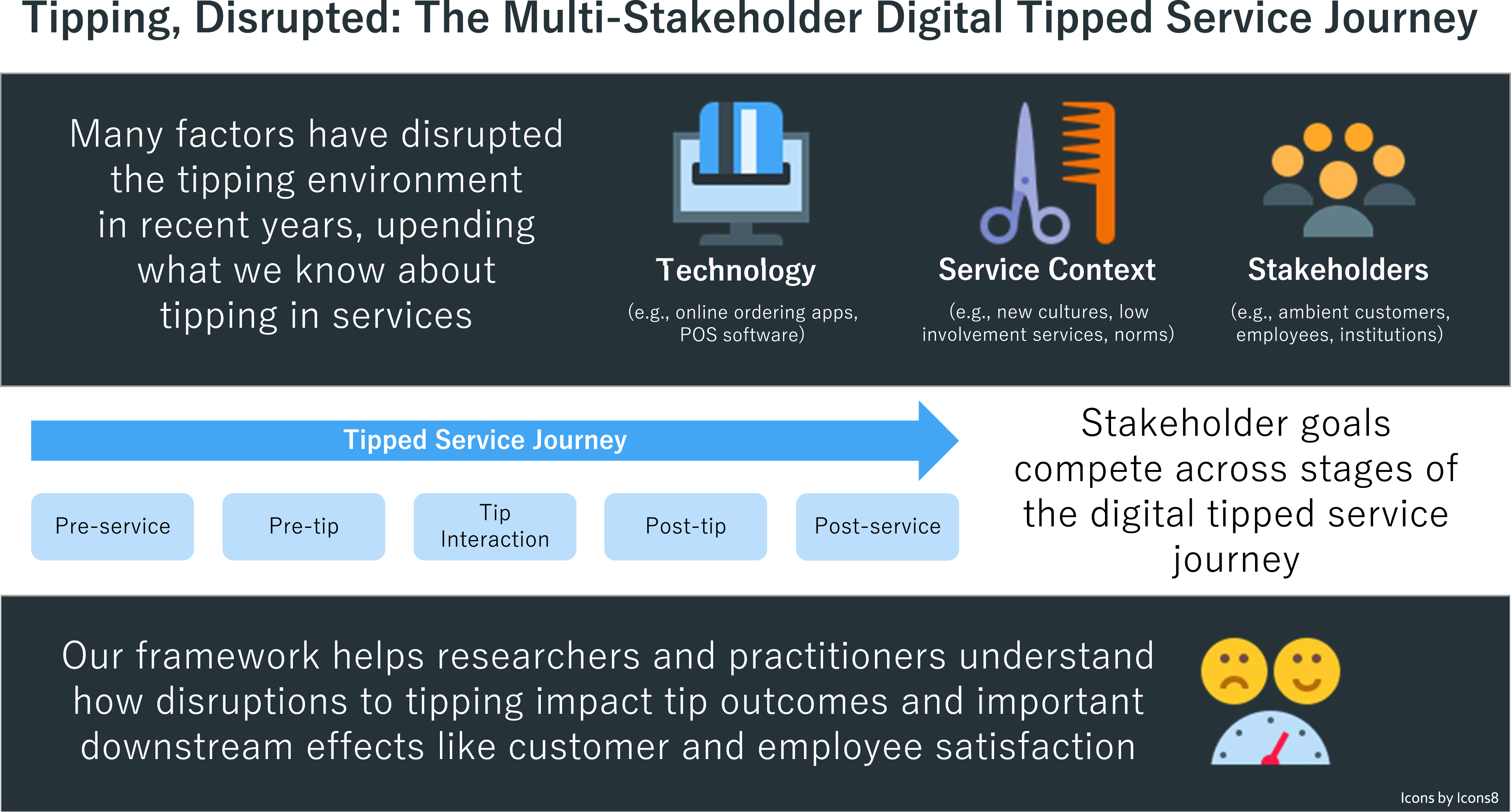
The shift from analog to digital point-of-sale systems (e.g. Square) and app-based service platforms (e.g. Uber) disrupted frontline services by creating new tipping processes that occur in an ever-expanding range of service contexts and involve new stakeholders. The increasing importance of tipping in the global economy and the uncertainty regarding tipping practices suggest the need for a comprehensive framework that accounts for evolving tipped service networks. We introduce the multi-stakeholder service journey lens to build a conceptual framework that accounts for the competing interests of customers, employees, frontline service managers, technology providers, and other stakeholders in emergent tipped services. This framework examines interactions between stakeholders at different points along the tipped service journey, while accounting for the technologies and contexts that shape stakeholder interactions and the sometimes divergent outcomes that result. Stakeholder interactions at each stage of the tipped service journey suggest theoretically rich research questions, such as “How do digital tipping technologies diffuse into and realign cultural practices?”, and important practical questions, such as “Which tip request framing and formatting choices result in the highest tips, most customer satisfaction, and optimum employee outcomes?” Our conclusion emphasizes the importance of multi-stakeholder service journey perspectives for examining digitally disrupted services.
Introduction
The shift from analog to digital point-of-sale (POS) systems and app-based service platforms, such as Square and Uber, disrupted frontline services. Emerging technology has created new tipping processes and practices, which occur in new service contexts and involve expanded stakeholder networks. Press accounts suggest new tipping technologies have resulted in “tip creep,” “guilt tipping,” and “tipflation” (Kim 2018; Morales 2022; Washington 2022). Customers in North America and around the world feel increasing pressure to tip higher amounts and for a wider variety of services. Press reports question the appropriateness of service providers expecting 20% tips for low-service work (Levitz 2018) and pressuring customers to tip for services that have not historically been tipped, such as retail (Kim 2018). The expansion of tipping impacts many stakeholders, and the impacts are not clearly positive. For example, gig workers, a new stakeholder group, accused app-based service platform Instacart of allowing customers to lure delivery drivers “with big tips – and then changing them to zero” (O’Brien and Yurieff 2020).
Past tipping research largely focuses on the historically-normative context of full-service restaurants, where customers use analog technology to tip a server following the service. The above examples suggest disruptions to past assumptions about how and where tips are requested, and which stakeholders are affected by tipped service interactions. To address this gap in understanding emergent digital tipped service networks, this paper examines the full range of stakeholder interactions, including the technological and contextual factors that shape them as well as the diverse and sometimes divergent outcomes of those interactions.
Focusing on the substantive domain of tipping, our work answers calls for research on disruptions created by emergent technologies, including how service providers can leverage technology to improve the experiences of customers, employees, and society (Huang et al. 2021; Ostrom et al. 2015; Yadav and Pavlou 2020), and the Marketing Science Institute’s call for research accounting for broader stakeholder perspectives (MSI 2022). Accordingly, our foremost contribution is to tipping scholarship (Alexander, Boone, and Lynn 2021; Lavoie et al. 2020; Warren, Hanson, and Yuan 2020), where we identify nascent and underexamined phenomena and then integrate those into a unified conceptual framework (MacInnis 2011; Yadav 2010). Our secondary contributions are to broader literature on multi-stakeholder and service journey theories (Hollebeek et al. 2022; Hollebeek, Kumar, and Srivastava 2022; Ostrom et al. 2021) and frontline service technologies (Marinova et al. 2017; Singh et al. 2017). By integrating service journey theory with multiple-stakeholder perspectives while also recognizing the important roles of technology and context in shaping stakeholder interactions, we provide a unique and useful lens for examining other digitally-mediated multi-stakeholder services, such as changes in retail and donation services.
This paper uses a multi-stakeholder lens to develop a comprehensive framework for understanding and examining digital tipping interactions along the service journey. First, we review tipping literature in light of recent technological disruptions. This reveals significant gaps in understanding tipping technologies, contexts, and stakeholders. To interrogate these gaps, we introduce the lens of the multi-stakeholder service journey, which emphasizes the competing interests of different stakeholders (Hollebeek, Kumar, and Srivastava 2022) and how these interests come into contact at sequential touchpoints throughout the journey (Hollebeek et al. 2022b). We build our framework by considering the unique interests of different stakeholder groups and how stakeholders interact at different stages of the tipped service journey. After, we propose a research agenda composed of theory-driven questions with clear and meaningful managerial implications. Our conclusion suggests the importance of considering the gestalt tipped service experience and the usefulness of the multi-stakeholder service journey lens.
Review of Tipping: Technology, Context, and Stakeholders
This section reviews research relevant to the new digital tipping environment. It is organized into three themes as follows: technology, context, and stakeholders. As the goal of this paper is to develop a new conceptual framework for examining emergent tipping practices, we do not review the history of tipping, nor do we attempt to review the corpus of tipping research. For scholarship on these topics, see Azar, 2020; Azar (2007); Lynn (2017); Lynn (2006); and Segrave (2009).
Technology
Past research largely assumed that tipping involved a customer using analog technologies, such as cash or paper receipt, to pay the tip. Until recently, the primary changes to tipping technology were the introduction of credit card processing machines and tip jars. Research finds that credit customers tip more generously than cash customers, likely due to the diminished psychological impact of credit cards (Lynn and Latané 1984). The introduction of paper receipts resulted in a stream of inquiries into tip guidelines, including sample calculations (e.g. 15% = $2.00), service quality suggestions (e.g. 15% for adequate service), and default tip suggestions (e.g. 10, 15, 20% vs. 18, 20, 25%). Sample calculations on paper receipts generally increase tip amounts (Karniouchina, Verma, and Mishra 2008; Seiter, Brownlee, and Sanders 2011), while service quality suggestions reduce tip variance (Strohmetz and Rind 2001). Recent research on digital payment screens finds that higher (vs. lower) levels of default tip suggestions result in higher tip amounts (Alexander, Boone, and Lynn 2021; Chandar et al. 2019), though they may also reduce repatronage and cause customers to refuse tip requests (Haggag and Paci 2014; Warren et al. 2021b). Except for research on tip guidelines, prior research has largely overlooked the technologies used to collect tips.
Service Context
Service context refers to the cultural context, service or industry type, and servicescape of a service. A small stream of literature investigates cultural context effects, including research concluding that local tipping norms are the strongest predictor of tipping behaviors (Azar, 2007; Conlin, Lynn, and O’Donoghue 2003). Differing beliefs about norms, duty, and social pressure help to explain variation across cultures (Lynn and Starbuck 2015). Nations with high tolerances for status and inequality tip more, as do nations that value economic achievement more than social relationships (Lynn, Zinkhan, and Harris 1993).
At the level of service type, most tipping scholarship examines full-service restaurants, which has historically been the most prominent tipped service context. The small amount of research in taxi, ridesharing, and other service contexts (e.g. dry cleaning) does not consider context effects (Alexander, Boone, and Lynn 2021; Chandar et al. 2019; Haggag and Paci 2014). The servicescape is another important contextual factor. Research in full-service restaurant settings reveals that diverse atmospheric variables, ranging from weather and time of year (Cunningham 1979; Greenberg 2014) to ambient music and presence of the color gold (Jacob, Guéguen, and Boulbry 2010; Lee, Noble, and Biswas 2016) affect tip amounts. The general takeaway from these findings is that factors that improve customers’ moods, such as making customers feel more comfortable, generous, or higher status, can increase tip amounts.
Stakeholders
Tipping research almost exclusively focuses on the interaction between the paying customer and the employee who is serving that customer, with a few notable exceptions. Customer-focused research reveals that demographic factors (e.g. age; Conlin, Lynn, and O’Donoghue 2003) and different motivations for tipping (e.g. reciprocity, altruism, impression management, and duty) can predict tip amounts (Becker, Bradley, and Zantow 2012; Bluvstein Netter and Raghubir 2021; Lynn 2021). Employee-focused research similarly finds demographic factors, such as gender and native language, influence tip amounts (Rind & Bordia, 1996; Van Vaerenbergh & Holmqvist, 2013).
Research on the interplay between employees and customers finds that employees earn higher tips by touching customers (Crusco and Wetzel 1984), writing notes on receipts (Rind and Bordia 1995), giving customers candy (Strohmetz et al. 2002), or predicting good weather (Rind and Strohmetz 2001). These findings generally suggest that customers tip more when employees develop surface-level relationships (e.g. by using names; Garrity and Degelman 1990). Lynn et al. 2011 provides a more encompassing review of ways employees can increase tip revenue.
A small number of studies have explored employees’ purposeful use of emotionally manipulative tactics, or “venture emotionalism,” to elicit higher tips through power dynamics and feigned intimacy, especially in the sex work industry (Deshotels and Forsyth 2006; Thompson 2014, 737). These studies tend to focus on the emotional labor costs for tipped employees (Chi et al. 2011; Deshotels and Forsyth 2006; Hochschild 1983) and find that service quality may be compromised when employees feel forced to engage in manipulative persuasion tactics (Luangrath, Peck, and Gustafsson 2020).
The few studies examining other tipping-related stakeholders consider how the practice of tipping impacts firms and society. Several scholars discuss whether the benefits of hiring tipped employees (e.g. lower wages, prices, and monitoring costs) outweigh potential misalignments wherein employees may prioritize customers over the firm (Lynn 2017; Lynn et al., 2011). Complex firm-employee-customer dynamics remain empirically underexamined, with the notable exception of Brady, Voorhees, and Brusco (2012), who find that “service-sweethearting” between customers and employees costs firms billions of dollars annually. Research considering society as a stakeholder includes examinations of the financial (Lynn 2017) and social (Hochschild 1983) implications of the U.S policy that allows employers to pay tipped employees significantly below the minimum wage. In another example, Bodvarsson and Gibson (1997) argue that the tax evasion opportunities of tipping benefit the whole restaurant industry.
In sum, prior research on tipping generally assumes analog payment systems, set in full-service restaurants in the United States, with either the customer, employee, or occasionally both as focal stakeholders. The following section discusses how digital tipping technologies disrupted these assumptions about how and where tips are collected, and who is impacted by tipping.
Emergent Factors in Tipping Practice
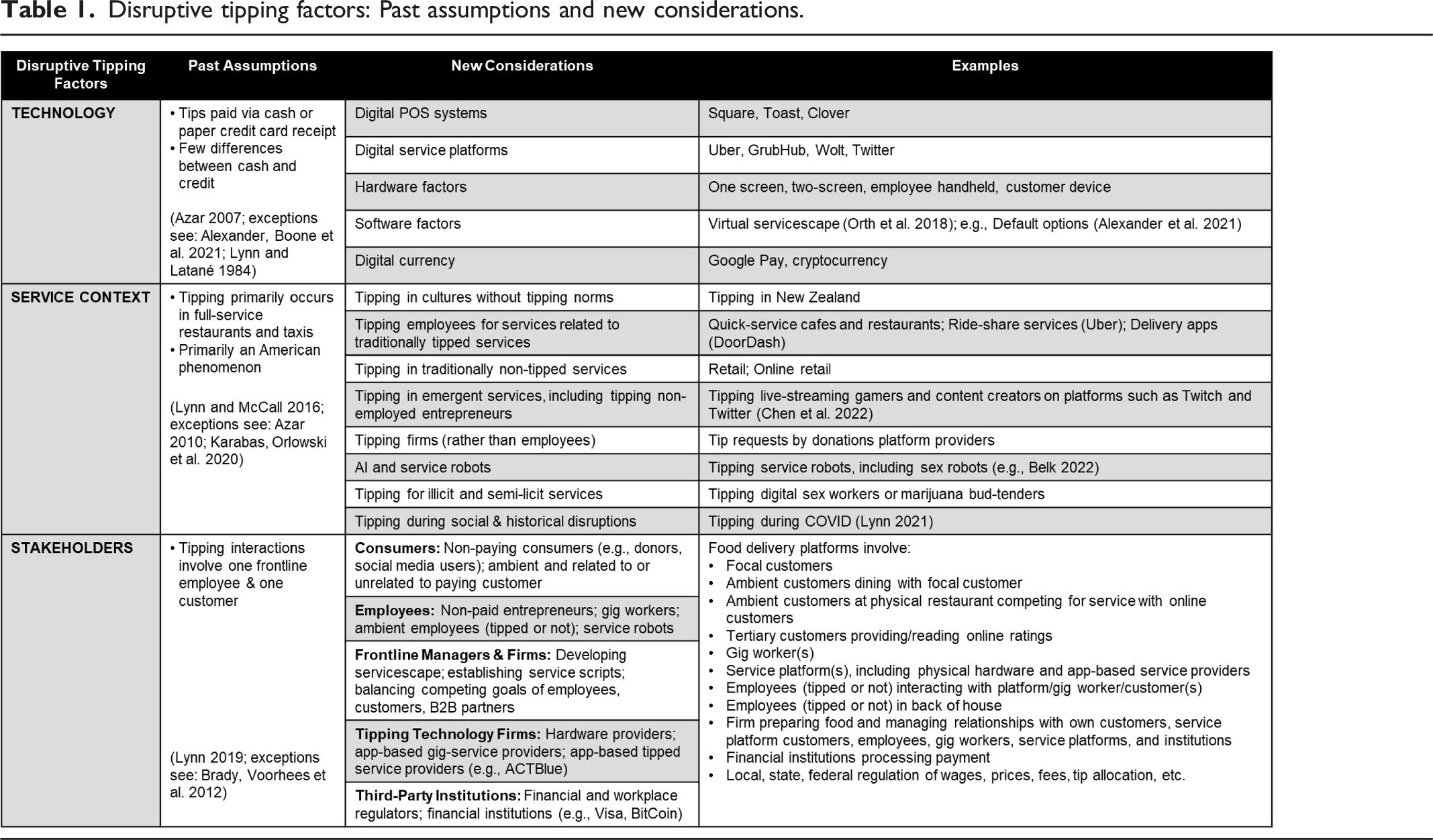
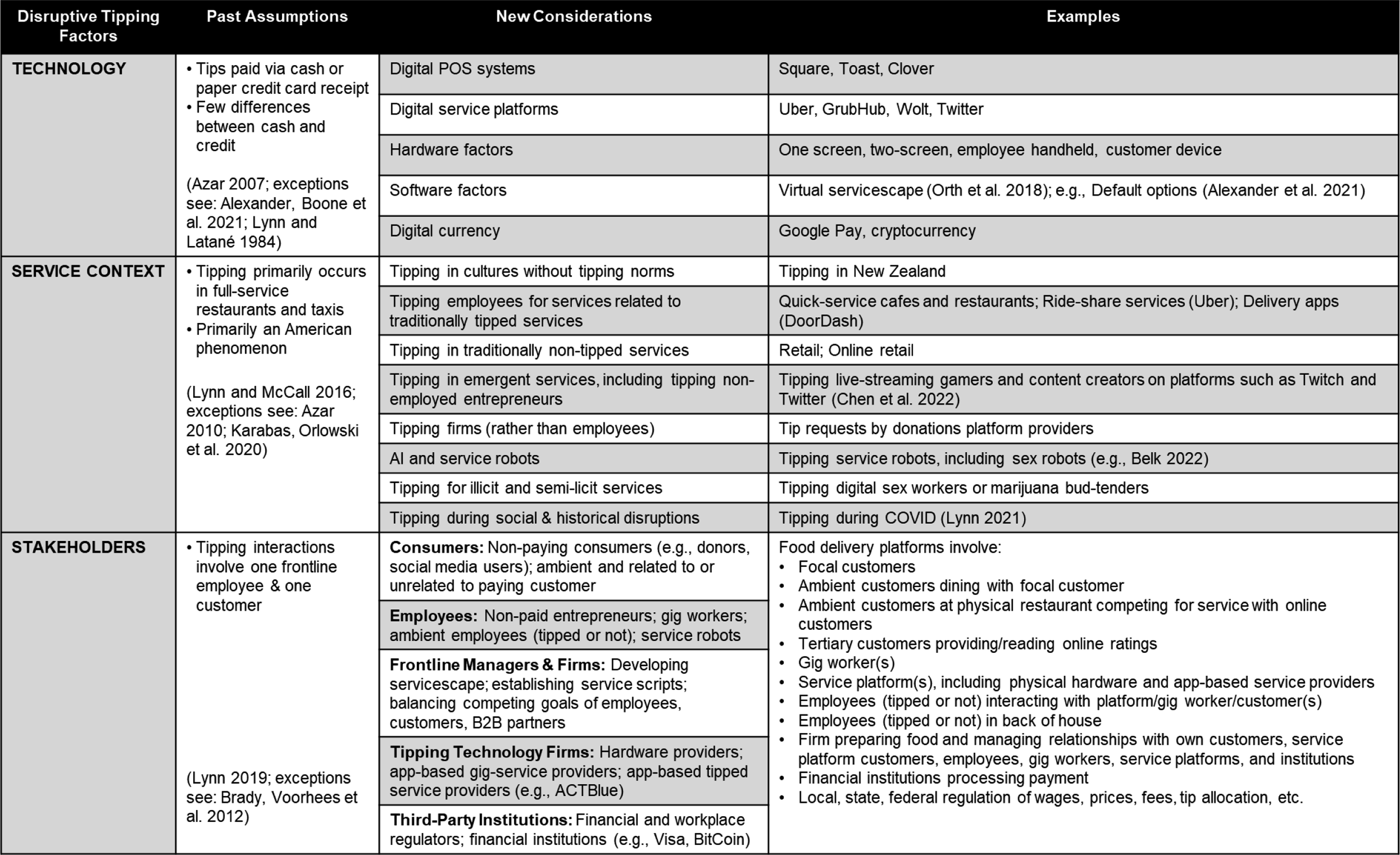
Disruptive tipping factors: Past assumptions and new considerations.
Illustrative Examples of Emergent Digital Tipped Service Interactions
Consider examples of a counter-service café with a digital POS system on-site and of an app-based service platform used to facilitate online orders. In full-service restaurants, customers are seated privately, and they interact with one server. After the meal, customers use cash or paper receipts to discreetly leave tips, which servers see after the customer leaves. Using a digital POS system at a café alters customer–employee interactions and incorporates additional stakeholders. First, because payment screens are often mounted on counters, they are less discreet than paper bills, which can cause paying customers to feel like they are being observed (Warren, Hanson, and Yuan 2021a). This feeling could result from the presence of ambient customers, who paying customers may or may not know, from the employee processing the payment, or from ambient employees. Ambient actors remain almost entirely overlooked in the tipping literature, despite the fact that they are an integral part of the social servicescape of tipping (Karabas, Joireman, and Kim 2019; Line and Hanks 2019). Cafés and similar frontline firms adopting tipping platforms may upset customers by requesting tips where they once did not (Karabas, Orlowski, and Lefebvre 2020), but could also upset employees if they do not request tips. Firms that provide digital POS systems take a percentage of each transaction and are thus incentivized to maximize tip revenue. At a policy level, digital tipping may reduce tax evasion from cash tips (Bodvarsson and Gibson 1997) and increase employees’ supplemental income.
App-based service platforms suggest an even more complicated web of stakeholders. In the past, customers would order directly from a firm, who paid their own employees to deliver orders. Now, customers use independent app-based platforms to place orders, which are forwarded to privately contracted gig workers, and frontline firms, who employ their own workers to prepare orders (Castillo et al. 2022). The diverse goals of different stakeholders in app-based gig services can result in service failures at different interaction points. For example, press reports describe how customers used DoorDash to order food from McDonald’s and decided to not include a tip. McDonald’s employees prepared the orders, but the untipped gig workers refused to pick up and deliver the food (Sjoberg 2022). Further, customers are often confronted with a range of potentially confusing fees as they are checking out, including fees to account for local regulations.
Emergent Technologies
Payment platforms for tipped services are no longer limited to cash, credit, and the occasional tip jar (Rifkin et al. 2021). In fact, these payment options may no longer be available to customers. For example, customers using service platforms such as Uber or DoorDash are not able to pay with cash. There are no receipts for customers to sign and nowhere to add a written tip. Accordingly, this section considers how new technologies, in particular digital service platforms and POS systems, disrupted the low-tech norms of tipping. We consider changes that are unique to digital service platforms or POS systems, and broader changes caused by the adoption of new technologies, such as virtual servicescapes (Orth et al. 2018; Vilnai-Yavetz and Rafaeli 2006) and digital currency.
Customers, gig workers, and service firms face the decision of which digital POS systems and digital service platforms to use or adopt. The amount of variation across these platforms suggests those decisions may be quite consequential. For example, customers on the Postmates food delivery platform can tip delivery drivers after their food has been delivered versus before delivery as on a similar platform like Grubhub. Research exploring tip sequencing effects has revealed that customers tip more after service (Warren, Hanson, and Yuan 2020), but service workers provide better service when they are tipped before service (Lavoie et al. 2020). Some platforms allow customers to renege pre-service tips after the service is completed, a practice which frustrates employees and led to the ire of the media during the COVID pandemic (O’Brien and Yurieff 2020). Frontline firms need to decide which platforms to partner with, and platforms need to convince customers, gig workers, and frontline firms that they provide a worthwhile service. These examples suggest that small differences between platforms may dramatically shift service scripts, with different effects for customers, employees, frontline firms, and service apps.
For the firm, digital POS systems introduce a number of new considerations, including choosing a POS provider, selecting hardware options, customizing the virtual servicescape, and integrating the hardware into the physical servicescape. For example, a business that adopts the Square POS system can choose between a low-cost and easy-to-transport card scanner that plugs into a handheld device or more costly countertop systems. Press reports suggest such differences in POS systems can make employees feel awkward and customers feel pressured (Kim 2018).
Tipping technologies further vary in the software they use to request tips, which can result in substantial differences in virtual servicescapes, including tip request formatting. The most notable differences relate to the default tip options provided to customers. These may vary based on range (e.g. 10–20% vs. 10–30%), number of options (2+), currency format (e.g. % or $), preselected options (e.g. GrubHub automatically picks 22% and customers can change the choice), and level (e.g. 10–20% vs. 20–30%). Tip default level may be the most impactful, as it positively affects tip amounts (Haggag and Paci 2014) and negatively affects downstream customer responses (Warren, Hanson, and Yuan 2021b). Tipping software can include special tipping options, such as “no tip” and “0%,” which may result in different outcomes (Bluvstein Netter and Raghubir 2022), or “custom” tip options, which often require extra steps to select.
New tipping systems often display sample calculations, labels, or symbols. For example, tipping screens from the ridesharing app Lyft inform customers that “100% of tips go to drivers,” while others label the 15% tip option as “Good” and the 30% option as “Best Service Ever!” Perhaps, the most basic consideration, which is often overlooked by frontline firms and technology providers, is whether to explicitly prompt customers for a tip. While prompting is standard on many POS systems, customers sometimes dislike such prompts (Dyussembayeva et al. 2022; Fan et al. 2023; Karabas, Orlowski, and Lefebvre 2020). While some of these factors occur in non-digital tipping contexts, their pervasiveness and customizability in digital tipping is quite novel.
A final new tipping technology factor with broad potential implications is the availability of payment through a range of digital currencies, most notably cryptocurrencies such as bitcoin. So far, this practice has been relatively uncommon, though press reports describe how Twitter started allowing readers to tip content creators with cryptocurrency (Dang 2021) and adult content sites are adopting crypto-tipping to circumvent the rules of traditional banking services (Das 2021).
Emergent Contexts
As frontline services around the world adopt digital technologies, the practice of tipping is spreading into new contexts, including new cultures, service types, and servicescapes. At a cultural level, app-based services, such as ridesharing and delivery apps, are introducing tipping to geographies where tipping was previously rare or nonexistent. For example, in Europe, where tipping is less common than in the United States, online delivery apps have started prompting customers to tip gig workers. Similarly, the decision by Domino’s Pizza to add a tip request to its delivery platform in New Zealand resulted in widespread consumer backlash, including a Reddit post captioned “Dominoes (sic) are trying to bring tipping culture to NZ - pay your staff properly instead please” that garnered over 17,000 upvotes and 1400 comments (Taunton 2020). These reports suggest that as tipping is introduced to new cultures, the practices of tipping will need to be negotiated between customers, employees, frontline firms, and policymakers.
A second major shift is the adoption of tipping into a wide range of previously untipped service types, including quick-service dining, brick-and-mortar retail, online retail, and digital donation platforms such as the Democratic fundraising site ActBlue. These newly tipped services range from close parallels of traditionally tipped services to services that draw into question many of the basic assumptions about who should get tipped and why customers choose to tip.
Of these new contexts, quick-service food establishments, food delivery apps, and ridesharing apps are most similar to traditionally tipped services, such as full-service restaurants, food delivery, and taxis. Despite these parallels, there are no consistent patterns in the marketplace to predict where or how tipping may be adopted by a firm. For example, small, local quick-service cafés, restaurants, and food trucks often prompt customers for tips, while larger chains with nearly identical business models, such as Chipotle, often do not. The regional coffee chain DutchBros uses tablets to prompt customers for a tip before they are served; Starbucks generally discourages tips but allows customers using the app to opt-in to tipping before or after service; customers at a chain such as McDonald’s would be baffled if they were prompted to tip for a coffee or anything else. Yet, drivers who deliver McDonald’s receive tips via apps like GrubHub. Even delivery apps vary. Generally, food delivery drivers earn tips, package delivery drivers do not, and a new group of package-delivering gig workers using apps like Spark and Roadie may be hired and tipped—or not—by businesses or customers.
Even more uncertain are the effects of requesting tips in services which have no clear parallel in historically tipped services. For some of these, such as farmers’ markets, farm stands, brick-and-mortar retail, and online retail, the closest parallels are in historically untipped services (i.e. grocery stores) where the link between service quality and tipping is unclear. Live streaming, wherein a broadcaster streams a live interaction with peer viewers, is another uncertain context that has quickly adopted tipping norms, such as continuous, repeated, and observable tipping throughout the interaction (Chen et al. 2022). Perhaps more surprisingly, tip requests have been integrated into online donation requests. For example, after committing to a donation on the ActBlue website, donors are prompted to provide a tip. Though the language on the tip request screen implies the tip will support the political candidate, elsewhere the platform reveals that tips pay the platform operators. This suggests an instance of tipping for white-collar services, which are historically not tipped in western cultures. It is also surprising as the service provided (operating the website) involves no personal interaction with the customer (in this case, a person making a donation), and because there is no variation in service quality, there is no way for tips to influence service quality.
The versatility of digital tipping makes it well suited to adapt to contextual disruptions, such as the COVID pandemic. Digital technology initially disrupted this by moving the payment and tip online, often before the delivery was completed. COVID further complicated the service script by spurring the interaction-free (i.e. “contactless”) delivery.
Emergent Stakeholders
Emergent digital tipping systems involve a wide array of stakeholders, many of whom were overlooked by previous research that focused on paying customers and tipped restaurant servers. This section first defines and elaborates on the expanded roles of each stakeholder group, including customers, employees, firms, and institutions (see also Figure 1). Multi-stakeholder framework for digital tipping.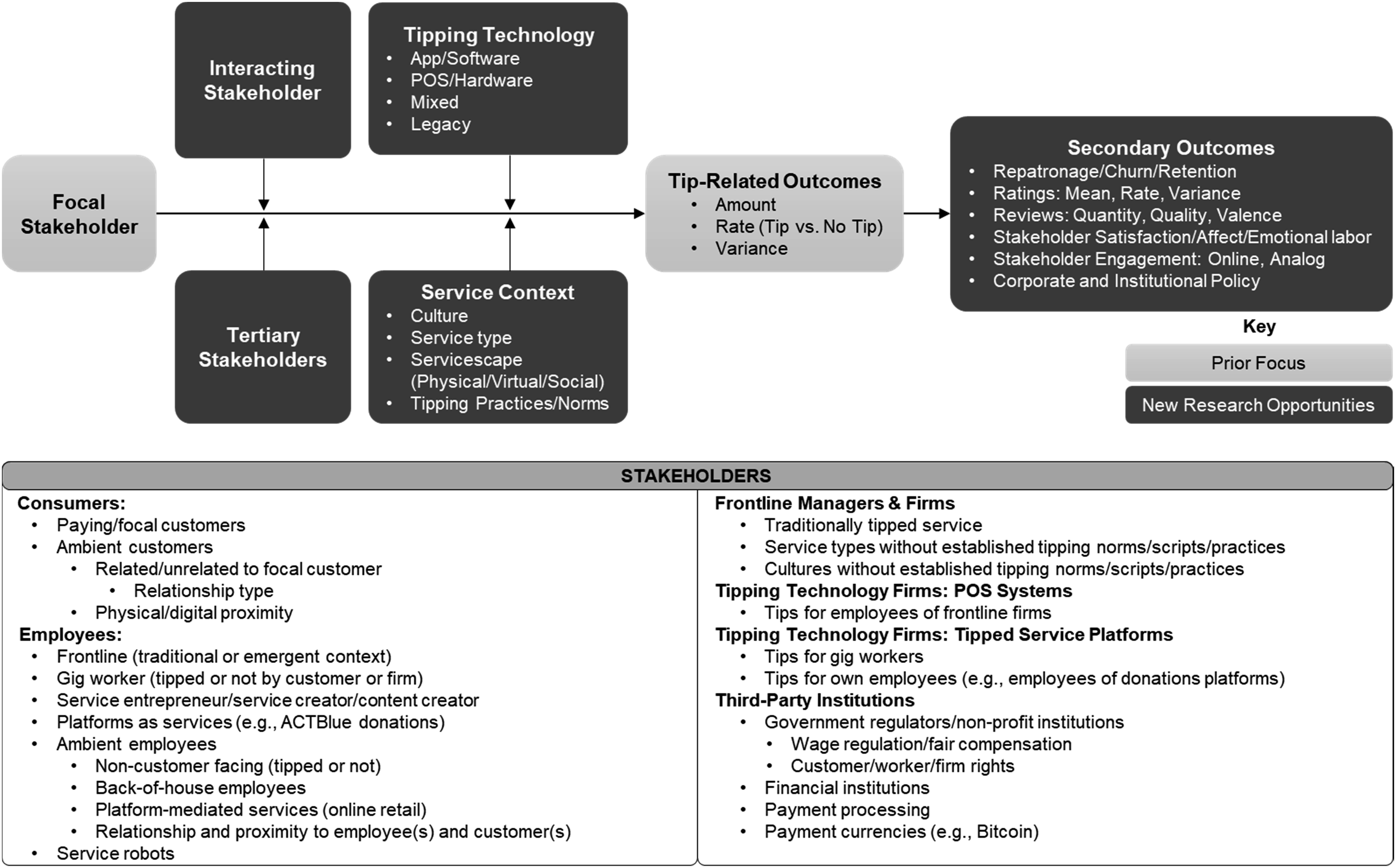
Emergent customer types
While the focal customer is arguably the most important stakeholder, it is critical to also consider other (i.e. ambient) customers who may influence or be influenced by a tipped service interaction. Ambient customers vary based on their relationship to the focal customers and other stakeholders. For example, ambient customers may be strangers, clients, or friends of a focal customer, or they may be new or regular customers at a given firm. Ambient customers also vary in their proximity to a tipped service encounter, which includes physical proximity and digital proximity, such as when online tip amounts are visible to others.
Emergent employee types
Digital tipping has dramatically expanded the number of employee stakeholders that tipped service researchers must consider. First, the range of traditional frontline service workers, who are employed directly by the frontline firm and earn tips directly from the customer, has dramatically expanded as tipping is adopted in new service (e.g. retail) and cultural (e.g. New Zealand) contexts. Gig workers represent a major new group of employee–stakeholders who are generally independent contractors. They are usually employed by a service platform (e.g. GrubHub) to complete a service transaction between a frontline firm (e.g. McDonald’s) and a focal customer, who uses the service platform to request the service. Service entrepreneurs, such as social media content creators, are another emerging group of tipped employees who generally use existing platforms (e.g. Twitch) to collect payments from peer-users. Platforms-as-services, such as the donations platforms ACTBlue and Givebutter, sustain themselves by collecting tips from donors. Digital tipping has also expanded the importance of ambient employees, most notably because these employees often share in the pool of digital tips. Finally, service robots represent an emerging category of employee stakeholders. For example, tipping practices are uncertain for customers who use digital devices to order food prepared by human workers but delivered by robots, such as Domino’s fleet of autonomous delivery vehicles.
Emergent firm types
Historically, frontline service firms were the only firm stakeholder. Digital tipping introduces tipping POS systems and app-based tipped service platforms as new stakeholders. Tipping POS systems are built by a technology company (e.g. Square) and purchased for use by a frontline firm (e.g. a café). Tipped service platforms, such as DoorDash, Foodora, Uber, and Twitch match gig workers, content creators, customers, and sometimes frontline firms, then manage the service delivery process.
Emergent third-party institution types
Third-party institutions include government regulators and policymakers, and financial institutions such as payment processing firms (e.g. VISA) and payment currencies (e.g., Bitcoin). For example, regulators determine if and how tips and wages are related, while financial institutions are impacted by the payment formats adopted by customers and service providers.
These examples suggest that digital tipping has expanded the types of tipping technologies, the range of tipping contexts, and the breadth of stakeholders. For additional examples of emergent tipping phenomena, see Web Appendixes A and B. This section also hinted at two key aspects of the multi-stakeholder theoretical framework we elaborate on next: the unique interests of individual stakeholders and how those interests may create or diminish value at different interaction points across the tipped service journey.
The Multi-Stakeholder Service Journey
In this section, we develop our conceptual lens of the multi-stakeholder service journey, which combines multi-stakeholder and service journey perspectives. When applied to digital tipping, this lens reveals the multi-stakeholder digital tipped service journey. Our primary focus is in line with Hollebeek, Kumar, and Srivastava (2022), who suggest that a multi-stakeholder perspective emphasizes the unique goals of different stakeholders, and how those goals may conflict or align, depending on the circumstances of a given interaction. Considering the different points of interaction between different stakeholders suggests the need for our secondary perspective, that of the service journey (Hollebeek et al. 2022). The tipped service journey that emerges includes pre-service, pre-tip, tip interaction, post-tip, and post-service stages, which are similar to the service journey described by Lemon and Verhoef (2016).
Though similar to service-dominant logic and actor-engagement theories’ emphasis on value co-creation (Brodie et al. 2019; Vargo and Lusch 2016), multi-stakeholder perspectives also emphasize stakeholders’ diverging goals, which may result in value co-creation or destruction at different stakeholder interactions (Hollebeek, Kumar, and Srivastava 2022), and that these interactions are shaped by the technologies (Viglia, Pera, and Bigné 2018) and contextual environments (Chronis 2019) in which they are situated. Thus, our multi-stakeholder perspective accounts for the digital technologies and environmental contexts that shape stakeholder interactions.
We recognize that stakeholders are nested within an immersive social servicescape, such that the goals and behaviors of any individual actor must also account for the people around them (Bettencourt et al. 2021; Hollebeek, Kumar, and Srivastava 2022). Thus, we add to Hamilton et al.’s (2020) emphasis on “traveling companions” (e.g., customer group) by considering both parallel (e.g., two employees) and distinct (e.g., employee and manager) social actors. While our theoretical lens examines the whole multi-stakeholder journey, we place particular emphasis on stakeholder goals and interactions, and secondarily on the journey perspective that emerges from mapping those interactions.
The Multi-Stakeholder Digital Tipped Service Journey
This section employs the multi-stakeholder service journey lens to illustrate how the unique goals of each stakeholder group may align or misalign with other stakeholders’ goals at different touchpoints along the tipped service journey. We first focus on customer interactions with other stakeholders, then on non-customer interactions, such as between traditional frontline workers and gig-workers or frontline firms and technology platform providers. First, we identify major goals of each stakeholder group, then highlight key interactions with other stakeholders across the tipped service journey. Our descriptions are intended to be illustrative rather than exhaustive, as our objective is to demonstrate the usefulness of our conceptual framework for understanding the gestalt tipped service encounter.
Stakeholder Goals
Customer goals
Customers have many goals, most notably obtaining adequate service at a fair price (Parasuraman, Zeithaml, and Berry 1988). They also desire to maintain their self-concept, be positively evaluated by others, and avoid unwanted influence. These goals suggest a major tension for tipped service customers: how to tip an amount that makes the customer feel good about themselves and feel they are positively evaluated by others without giving away unnecessary sums of money. To resolve this tension, customers often rely on norms when determining tip amounts (Conlin, Lynn, and O’Donoghue 2003). Importantly, norms are generally less certain for customers using emergent technologies in emergent contexts. This uncertainty suggests that customers, and particularly ambient customers, may have heightened goals of determining what tipping behaviors are expected and normative, for example, by observing the tipping behaviors of other customers and the responses of employees to those tips. Customers additionally tip to reward or incentivize high service quality, due to individual goals and motivations related to altruism, obligation, and status (Lynn 2015). Customers’ fairness and price-sensitivity goals are reflected in decreased tips when they desire to keep money for themselves and when they find the status differences implied by tipping aversive (Lynn 2015).
Employee goals
Employees generally aim to provide adequate service, satisfy customer and employer needs, maximize income, maintain a positive self-image, and reduce emotional labor. Thus, the primary tension for tipped employees is how to earn the highest tips from customers while satisfying managers and fellow employees, and maintaining a positive self-image. The association between service quality and tip amounts helps align employee income motivations with the service quality desires of customers and managers (Kwortnik, Lynn, and Ross 2009), but this association may also have detrimental impacts on employee welfare (Hochschild 1983).
Past research emphasizes employee motivations to earn tips (Lynn 2011) and, to a lesser degree, the unseen costs of the persuasive tactics employees rely on (Luangrath, Peck, and Gustafsson 2020). Emerging tipped service platforms also incentivize employees to focus on earning high ratings, developing positive digital reputations, and building a base of repeat customers. Ambient employees, who may earn tips indirectly or may not earn tips at all, have many of the same goals as focal employees, but they have less direct influence over and often less interest in specific tipping interactions. These employees may influence consumers’ mood and satisfaction (Grewal and Sharma 1991), while their number and proximity may influence service quality perceptions (Parasuraman, Zeithaml, and Berry 1988).
Firm goals
In general, stakeholder firms involved in digital tipping desire long-term profits, growth, and market share, though priorities may shift by firm type. For example, a new service platform may focus on market share, while established frontline firms often focus on profits. Firms may experience tension as they try to balance profitability with employee desires for higher wages and customer desires for better service at lower prices.
More specifically, frontline firms aim to design a social and physical servicescape that will assist in fulfilling the customer journey (e.g., convenience; Berry, Seiders, and Grewal 2002; Lemon and Verhoef 2016), maximize satisfaction and loyalty, ensure adequate service to customers by employees (Panagopoulos and Dimitriadis 2009), and maintain employee satisfaction and retention regardless of the customer’s tip decision. Though they likely have similar motivations, online service platforms are embedded in digital servicescapes, while POS systems need to consider physical, social, and digital servicescapes. Both POS systems and service platforms aim to facilitate frontline firms’ ability to meet customers at touchpoints along customers’ tipped service journeys (Lemon and Verhoef 2016) by providing frontline service firms, gig workers, and customers with optimized and easy-to-implement apps and technology platforms (Berry, Seiders, and Grewal 2002). Firms also need to balance the competing interests of customers, employees, partner firms, and third-parties. For example, they may adopt tipping practices designed to maximize tip revenue, enhance consumer and employee satisfaction, optimize ease of use for partner firms, or minimize the likelihood of a negative interaction with a third-party, such as a government regulator or a press report.
Third-party institution goals
Government and other regulatory organizations have a goal to minimize abuse of customers and employees (e.g. managers keeping employee tips), curtail financial evasion, and create opportunities for market growth (U.S. Department of Labor 2022). They also aim to minimize barriers to firms and to protect societal interests. Financial institutions are primarily motivated to earn profits and market share through increased use of their services.
Stakeholder Interactions Along the Tipped Service Journey
Next, we consider specific interactions between stakeholders at each phase of the tipped service journey. Figure 1 maps potential interactions between stakeholders, which involve technology and are shaped by context. See also Figure 2, located in the future research section, for specific stakeholders at each stage of the tipped service journey and associated questions for future research. For each phase of the tipped service journey, we consider customer interactions with other stakeholders and interactions that do not directly involve customers. Focal stakeholders and research questions along the tipped service journey.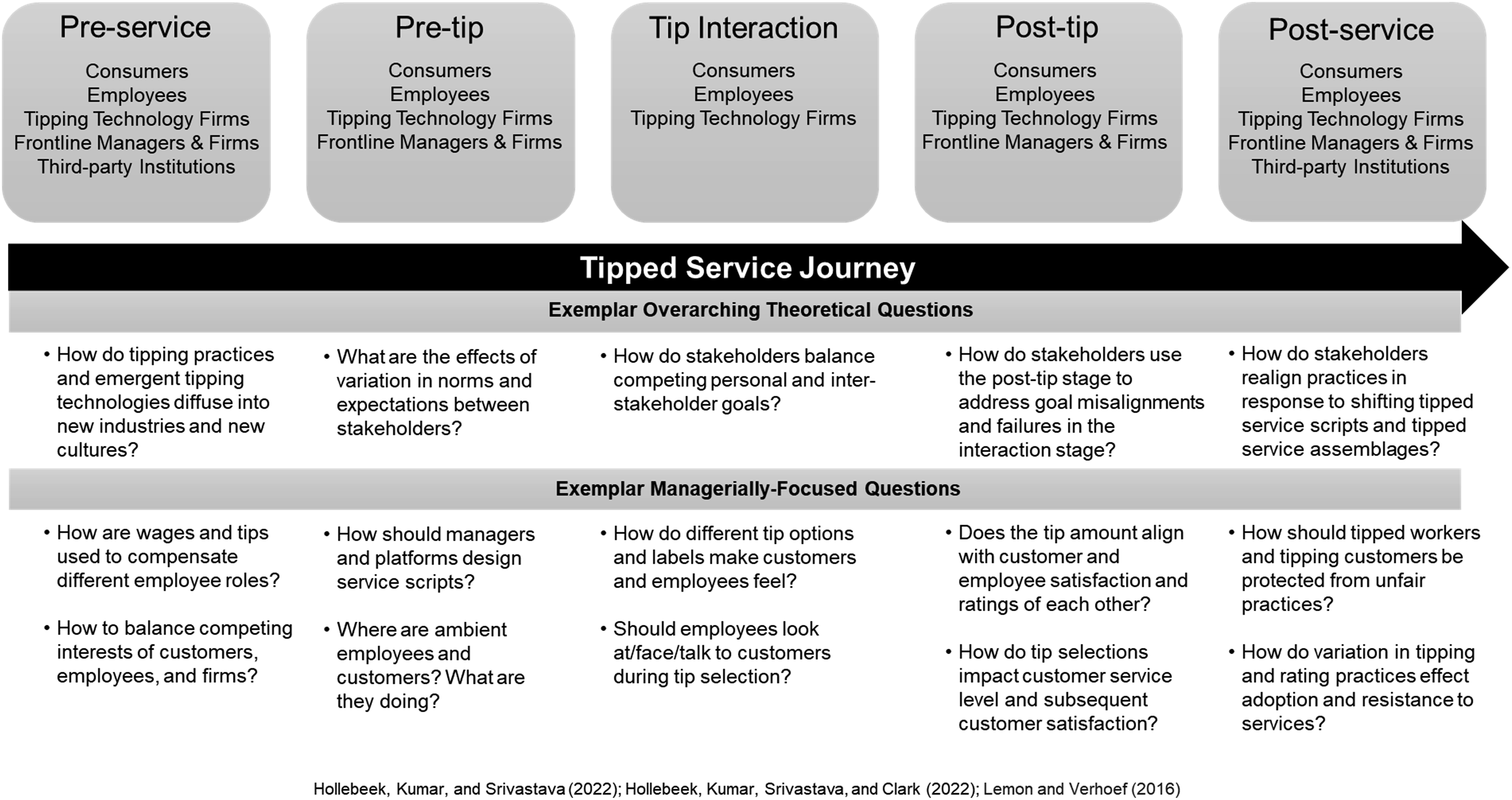
Pre-service interactions
Pre-service interactions occur before a specific service is selected. This stage encompasses customers’ previous experiences and the aspects of the pre-purchase stage (Lemon and Verhoef 2016) that occur before a specific service encounter begins. Pre-service interactions also include consumer interactions with firms’ online and analog reputations, and corporate policies shaping firm-level interactions between stakeholders. This stage considers interactions shaping the larger cultural milieu, such as cultural debates and regulatory frameworks shaping tipping norms, policies, and practices, including how these diffuse and shift over time.
At the customer level, pre-service interactions may be with frontline firms, technology firms, and third-party institutions, which range from specific firms, such as online review platforms, to institutions shaping the broader culture, such as regulators. Customers’ pre-service interactions are informed by cultural beliefs (Lynn, Zinkhan, and Harris 1993), industry-level beliefs (Lynn 2019), and beliefs about specific cultural events, firms, technologies, and employee roles. For example, a customer’s pre-service interactions will shape their responses to tip requests during a pandemic, at fast-service restaurants like McDonald’s, while paying with apps or cash, and for employees who fit or do not fit customers’ normative assumptions about who is tipped.
Interactions between other stakeholders include those between employees, frontline firms, technology firms, and regulators, who create policies shaping the balance between wages, tips, and other worker rights. Payment and tip-requesting scripts are formed by interactions between tipping POS firms and frontline firms, as well as between tipped service platforms and gig employees. When service scripts don’t align with cultural expectations, such as when Domino’s introduced tipping in New Zealand, third-party news and social media institutions may respond by drawing public attention to those misalignments.
Pre-tip interactions
Pre-tip interactions include all the service interactions occurring between the start of service until the tip is requested. When tips are collected at the end of service, the pre-tip stage encompasses much of the traditionally construed pre-purchase stage of the service journey (Tax, McCutcheon, and Wilkinson 2013; Zomerdijk and Voss 2009). However, as firms are increasingly requesting tips at the beginning rather than the end of a service encounter (Warren, Hanson, and Yuan 2020), the pre-tip stage may be very short. Regardless of duration, a key aspect of interactions during the pre-tip stage is that they can pre-emptively reinforce or shift stakeholder expectations for and responses to the tip interaction.
Interactions between other stakeholders at the pre-tip stage involve employees, frontline firms, and technology providers. Pre-tip interactions can include multiple parties within a given stakeholder group (e.g. employees). For example, a gig worker, a frontline employee, and a back-of-house employee may all interact when providing a service, and this interaction will likely be further shaped by both the technology firm that hires the gig worker and mediates the interaction, as well as the frontline firm that directly employs other workers.
Tip interactions
The tip interaction stage includes the tip request, selection, and any interactions immediately following the selection (e.g., an employee saying, “Thank you!”). This stage involves customers, employees, and the tipping platform providers who design the technologies that mediate the tip selection interaction. The tip interaction is the shortest and perhaps most important stage of the tipped service journey.
Because customers are sensitive to real and perceived social presence (Argo and Dahl 2020) and the feeling of comfort that customers experience varies across device types (Melumad and Pham 2020), differences between a firm-owned device held by an employee and a customer-owned or customer-controlled device may affect the tip interaction. Further, technology-mediated interactions will likely be influenced by employee behaviors, which may vary not only in what is done but also how it is perceived (e.g. authentic vs. not; Lechner and Mathmann 2020; Lechner, Mathmann, and Paul 2020). Relatedly, the importance of ambient customers and employees on tipped services interactions, while also relevant to traditional tipped services (Karabas, Joireman, and Kim 2019), is particularly relevant to digital tipping, where customers are often closer together and observation of selections is more likely. Similarly, customers who are motivated to tip as a signal of status or generosity may respond positively when other customers and employees are nearby, while customers who prefer to tip in privacy may respond poorly to increased social presence.
The tip interaction stage also includes interactions between employees and technologies. For example, employees need to decide how they will interact with the technology during the tip interaction. They may choose to step away from the technology, frame the technological interaction for the customer, or remain attentive to the customer to guide or pressure the customer towards different tipping decisions.
Post-tip interactions
Post-tip interactions include all interactions that occur after a tip is selected until a service is concluded. As with pre-tip interactions, the duration of this stage varies depending on whether tips are requested before or after the primary service is completed (Warren, Hanson, and Yuan 2020). The post-tip interaction stage may include customers and employees interacting with technology to provide feedback on the service encounter and may include service recovery journeys (Van Vaerenbergh et al. 2019), which could involve customers interacting with employees, technology firms, or frontline firms. Further, this stage can extend beyond a physical service encounter to include ratings of specific interactions, such as rating an Uber driver (or passenger). Broader evaluations of service firms, such as reviews on Google, may be post-tip or post-service interactions, depending on whether the review reflects a specific service encounter.
The most interesting post-tip interactions likely occur after pre-service tip requests. For customers, these will include interactions with employees whom the customer may expect to behave a certain way, depending on the customer’s normative expectations and tipping behaviors. If a customer’s interaction with an employee does not align with their expectations, the customer may attempt to repair the misalignment by interacting with the technology provider or frontline firm, or may attempt to self-repair through customer retribution, such as a negative evaluation. Conversely, if the customer does not align with employee expectations, for example by providing a poor tip, not responding to employee communications, or by changing the tip amount post-service, the employee may interact with the customer, frontline firm, or technology firm in an attempt to repair a perceived misalignment. Alternatively, the employee may interact with other employees, sharing information about a customer’s tipping or other behavior that may influence the quality of service provided by the employee team, similar to the effect of pre-service tips on focal employee service quality (Lavoie et al. 2020).
Even for services with relatively brief post-tip stages, customers may interact with technologies to express negative evaluations of the service or tipping process. For example, if a customer feels pressured to tip more than they expected due to the presence of an employee or the default options included in the tip request, the customer may use the technology to provide a negative evaluation of the service provider. Interestingly, some online service platforms make the post-tip interaction phase bi-directional, as employees may also rate customers after the tip, which creates a novel form of employee-empowerment that is largely lacking in traditional tipping contexts (Hochschild 1983).
A final employee-firm interaction of note is how firms use ratings to evaluate and distribute work to employees, particularly how tipped service platforms use ratings to allocate work to gig workers. Employees need to consider not only how to best elicit tips from customers but also how to elicit positive evaluations, which may or may not correlate with tip amounts (Warren, Hanson, and Yuan 2021b). Extending this suggests that some employees may pursue ratings-optimization strategies while others try to optimize tips, and that these optimization strategies vary across service platforms.
Post-service interactions
Post-service interactions occur after a specific service has concluded and may involve all stakeholders. Similar to conceptualizations of the customer service journey as a loop where post-service experiences inform future service expectations and choices (Lemon and Verhoef 2016), pre-service and post-service interactions are interrelated. Post-service interactions reflect how stakeholders respond to shifting tipping practices and emergent tipping assemblages. At the customer level, post-service interactions include the ways customers update and realign practices and beliefs after they encounter new tipping technologies and processes. For example, customers may start using cryptocurrency to enable tipping for gray-market services, pay with cash to avoid tip requests on digital devices, or choose to interact with firms based on their tipping policies.
Post-service interactions between non-customer stakeholders are responses to existing practices that seek to shape relationships between employees, firms, and third-parties. For example, Uber’s decision to introduce tipping requests as part of its service platform represents a post-service response to high rates of employee churn (Chandar et al. 2019; Kumar, Lahiri, and Dogan 2018). More broadly, decisions by frontline firms and gig workers about ending relationships with POS system providers and tipped service platforms can reflect post-service attempts to realign expected and realized practices (e.g., switching from Uber to Lyft), or to resist practices that stakeholders find troublesome. Third-parties, including regulators and financial institutions, may interact with firms and employees to reshape tipped services. For example, regulators and employees interact with firms to determine the status and rights of gig workers, while frontline social media firms partner with digital currency platforms to build tipping platforms that are favorable to content creators and may also undermine government oversight.
Future Research: Multi-Stakeholder Tipped Service Journeys
Digital tipping has dramatically shifted tipping practices, resulting in a range of theoretically and managerially important questions. In this section, we identify key questions across the breadth of stakeholders at all stages of the service journey, as depicted in Figure 2. In general, and as argued throughout this paper, a multi-stakeholder approach suggests the need to better account for stakeholder heterogeneity, such as how different types of customers and employees respond to variation in tip sequence, observability, or tip amounts, or how small differences between firms may explain large differences in effects caused by tipping factors (e.g. Starbucks vs. Dunkin’ vs. DutchBros).
Research Agenda for the Multi-Stakeholder Tipped Service Journey
Pre-service stage
Tipping behaviors are primarily influenced by norms (Conlin, Lynn, and O’Donoghue 2003), but new technologies have disrupted those norms. The pre-service stage of the tipped service journey suggests the importance of technology as a norm-disrupting and practice-disrupting force. At a broad level, researchers should examine the diffusion of tipping technologies and practices into new industries and cultures. Tips were once associated with relatively low-status service employees in service contexts with highly-varied service quality that customers could easily evaluate. These assumptions no longer hold, suggesting a need to re-examine when and why customers tip or, perhaps more tellingly, when they do not. For example, why might customers feel obligated to tip for a cup of coffee at a café but not a McDonald’s? Or why don’t certain service providers, such as professors, dentists, and lawyers, request tips, and what would be the results were they to do so? More broadly, how do technology and culture co-evolve to disrupt, shift, and diffuse tipping practices? Conversely, when and where does tip diffusion encounter resistance, and what are the outcomes of that resistance? While the above examples emphasize shifts into new service industries, nearly identical questions can be posed regarding the diffusion of tipping technologies and practices into cultures, such as European and Asian cultures, where tipping is less common or even considered rude. Whether focusing on diffusion into new industries or cultures, researchers will need to consider how third-party institutions, such as regulators, news organizations, and payments firms (Humphreys 2010), shape cultural responses shifting tipping norms.
The pre-service stage also suggests practical challenges for stakeholders, mostly relating to how tipping practices and policies should balance competing interests both within and between stakeholders. Within individual stakeholders, researchers should investigate how to integrate tipping into services to optimize individual goals, for example, by increasing customer’s perceived control over and ability to reward service providers based on service quality. Within employees, researchers should investigate how to balance employees’ need for stable wages and safe workplaces with their desire to maximize income. Between-stakeholder research can examine how managers, firms, and regulators balance the competing interests of each stakeholder group. For example, employees may desire high base wages coupled with large tip amounts, employers may prefer to rely on tipped income to reduce base wages and upfront costs for customers, and regulators may need to balance firms’ desires to pay workers only for the (gig) work they perform with employees’ desires for stable wages.
Pre-tip stage
Research focusing on the pre-tip stage should examine the different norms and expectations between and within stakeholders. For example, customers at a quick-service dining establishment may not normally tip for service and may not expect a tip request, whereas if those same firms adopt digital POS systems, their employees may believe that tip requests are normative and expect customers to provide tips. Frontline managers, tipping platform providers, and employees may all influence expectations. For example, employees and managers may introduce signs or service scripts that explain tipping norms to customers (Berry and Hoffman 2023), similar to the practice among river rafting guides who sometimes tell customers about tipping norms or place signs at touchpoints along the service journey (e.g., the banks of rivers). Alternatively, managers may design servicescapes so that queuing customers observe tipping interactions between other customers and employees, thus preparing them for forthcoming encounters and reducing tension.
Tip stage
Research focusing on tip interactions should examine how these stakeholders balance competing personal and inter-stakeholder goals within the tip-selecting process. For example, employees may seek to pressure customers into providing higher tips, such as by observing while customers select tip amounts (Dyussembayeva et al. 2022; Warren, Hanson, and Yuan 2021a), though employees may also feel that doing so is unfair or goes against their personal service ethics, similar to employees who experience discomfort when instructed to touch customers (Luangrath, Peck, and Gustafsson 2020). In another example, tipping platforms may need to balance customer interests in easy and choice-enabling formatting and employee interests in formats that increase tip income by presenting a limited set of high percentage default options.
Research focusing on competing goals suggests the importance of adopting multi-stakeholder perspectives when considering managerial questions at the tip interaction stage. The most apparent research questions will examine how firms can most effectively increase tip amounts, for example, by adjusting the structure of the tip interaction. However, a more holistic understanding of the tip interaction suggests the importance of outcomes beyond tip amounts, rates, and variance, such as ease of use for customers and employees, the perceived transparency of payment and tipping policies, or the amount of emotional labor that an employee puts into an interaction (see Figure 1 for an additional outcomes).
Post-tip stage
Research on the post-tip phase should identify and examine strategies stakeholders adopt for resolving tensions that remain after the tip is determined. Researchers need to abandon their reliance on the tip as the only outcome of interest. Historically, dissatisfied customers could self-repair service failures by providing low tips. Pre-service digital tipping platforms often make adjusting tips difficult and may punish low-tipping customers with lower ratings, jeopardizing subsequent service opportunities (e.g. Lyft drivers may refuse to pick up low-rated customers). This suggests that customer decisions regarding tip selections and employee ratings may not be related to each other or to other outcomes, such as customer satisfaction.
Taking an employee perspective reveals similar tensions. For example, after the tip interaction concludes, employees may adjust their behaviors directed at tipping customers or other stakeholders, particularly in instances of pre-service tipping (Lavoie et al. 2020). In another example, how do gig workers rate customers who are well-behaved but poor tippers, and how does that decision impact those customers and other gig workers?
Practical questions at the post-tip stage examine the relationships between tip selections, ratings of employees, ratings of service platforms, ratings of customers, and other stakeholder outcomes. Initially, researchers should determine if, when, and how these outcomes are related. The most interesting research will identify instances when outcomes diverge (e.g. high tips and low ratings), understand why those occur, and provide guidance to managers to prevent or repair such occurrences. For example, if customers provide high tips but are then dissatisfied with the service quality, firms may be able to avoid negative eWOM by offering customers the opportunity to adjust tips or by engaging in other forms of service recovery. Relatedly, researchers need to examine how firms balance customer and employee needs to ensure that employees, and particularly gig workers, continue to provide adequate service. At a more grounded level, research focused on the post-tip stage can examine how to optimally provide customers and employees with non-tip feedback opportunities (Chen et al. 2023). For example, how and when should customers, gig workers, and other tipped service workers be prompted to provide ratings and reviews of customers, employees, and firms?
Researchers should also focus on understanding which processes explain shifts in tipping practices. This should highlight all types of stakeholders, as there is very little research examining the processes explaining other stakeholder behaviors and outcomes (for exception, see Luangrath, Peck, and Gustafsson 2020). Past research identifies multiple tipping motivations, but is overly reliant on survey measures (Becker, Bradley, and Zantow 2012; Lynn 2015). Motivations are generally assumed to be static attributes which affect downstream tipping decisions. Motivations, beliefs, attitudes, attributions, and related cognitive and affective measures have rarely been considered as potential outcomes impacted by a tipping encounter. Moving forward, we urge scholars to examine not only the historical tipping motivations outlined by Lynn (2015), but also other emergent tipping motivations, beliefs, attributions, attitudes, and emotions, particularly fairness and self-image.
Post-service stage
As new digital tipping practices are established in new industries and new cultures, how do stakeholders realign their norms and behaviors, and in what ways do stakeholders resist or attempt to alter emergent tipping practices? For example, as customers, employees, and firms normalize pre-service tip requests, do the cultural meanings associated with tipping also shift, perhaps from a reward for good service to a bribe for superior service or to avoid bad service? How do firms and employees redistribute the quality of service provided in response to shifting service scripts and tipped service assemblages that incorporate new technologies? For example, does introducing a tip request into an online retail or donation encounter shift stakeholder understanding of what tipping means or what level of service to expect? Similarly, does introducing a tip-requesting digital POS system in a brick-and-mortar influence customer preferences for online services? As with many of the shifts to tipping practices, there are few clear answers.
Another important question at the post-service stage is how realigned tipping practices address societal issues of bias, abuse, and emotional labor, which have long been associated with tipping (Brewster 2015; Hochschild 1983; Lechner, Mathmann, and Paul 2020) and are generally suffered by employees but also by other stakeholders. It is unclear how disruptions caused by digital tipping might alleviate or exacerbate these problems, and it is similarly unclear what different stakeholders should do about it. For example, tipping often results in power imbalances. Tipped employees may subject themselves to abusive customer behaviors to avoid jeopardizing potential tips. Relatedly, this shift in power can reduce a firm’s control over employees, resulting in service sweethearting (Brady, Voorhees, and Brusco 2012). Will newly tipped employees, gig workers, entrepreneurs, and influencers encounter greater emotional and psychological costs? If so, what is the role of service platforms in addressing these increased costs? How should social institutions regulate these power dynamics to protect workers and minimize externalities, such as worker burnout or abuse?
Practically-focused researchers may also focus on specific instances where the design and integration of digital tipping platforms into service scripts create or exacerbate power imbalances between stakeholders, often by leveraging cognitive biases or feelings of guilt. Social media and press accounts regularly discuss these design and integration misalignments. For example, a viral social media post debates the fairness of Disney Cruise Lines’ new policy of requesting employee-specific discretionary tips in addition to mandatory tips that are pooled among employees (Pomarico 2022). Web Appendix C provides additional marketplace examples of potential dark patterns and manipulative shifts to platform design, platform integration, and tipping practices.
Conclusion
This article argues that digital technologies disrupted tipping norms and resulted in a range of new tipping practices involving a wide net of stakeholders whose interests are not always aligned. This paper contributes to research on tipping by introducing the multi-stakeholder framework as a lens for examining emergent tipped service networks, and using this lens to develop a conceptual framework integrating the many stakeholders involved in modern tipped services, the technologies that connect them, the contexts that may differentiate them, and the diverse outcomes that are relevant to these complex service networks.
Our conceptualization and applied use of the multi-stakeholder service journey lens contributes to broader service research by unifying the important multi-stakeholder and service journey perspectives (Bettencourt et al. 2021; Hollebeek, Kumar, and Srivastava 2022; Hollebeek et al. 2022; Ostrom et al. 2021). It may also prove useful when examining stakeholder responses to digitally disrupted practices in other services and voluntary payments, such as retail and donations, and when examining the shifts in stakeholder relationships caused by the introduction of AI into service networks (Huang and Rust 2018; Marinova et al. 2017; Ostrom et al. 2021). Our application of this lens to the substantive domain of tipping reveals the ecological validity of the multi-stakeholder service journey lens and its usefulness for conceptualizing complex service networks, particularly those that have been disrupted by emergent service technologies (Marinova et al. 2017; Singh et al. 2017).
Supplemental Material
Supplemental Material - Tipping, Disrupted: The Multi-Stakeholder Digital Tipped Service Journey
Supplemental Material for Tipping, Disrupted: The Multi-Stakeholder Digital Tipped Service Journey by Nathan B. Warren, and Sara Hanson in Journal of Service Research.
Footnotes
Acknowledgements
The authors would like to thank the Harold and Muriel Berkman Charitable Foundation, the Organization of Frontlines Research, and Robin and Roger Best for their generous support of this research. The authors are grateful to Linda L. Price, Josh Beck, Sarah Hodges, Anders Gustafson, Priya Raghubir, and the marketing faculties at BI Norwegian Business School, the Robins School of Business at the University of Richmond, and the Lundquist College of Business at the University of Oregon for their support and guidance throughout the development of this paper.
Declaration of Conflicting Interests
The author(s) declared no potential conflicts of interest with respect to the research, authorship, and/or publication of this article.
Funding
The author(s) received no financial support for the research, authorship, and/or publication of this article.

Supplemental Material
Supplemental material for this article is available online.
Author Biographies
References
Supplementary Material
Please find the following supplemental material available below.
For Open Access articles published under a Creative Commons License, all supplemental material carries the same license as the article it is associated with.
For non-Open Access articles published, all supplemental material carries a non-exclusive license, and permission requests for re-use of supplemental material or any part of supplemental material shall be sent directly to the copyright owner as specified in the copyright notice associated with the article.
