




Abstract
Prior research shows that consumers act in ways to avoid associating with conflicting social identities. However, it is unclear how such conflicting social identities influence the behaviors of service providers when interacting with consumers experiencing vulnerabilities, leading to potential marketplace discrimination. Additionally, research has yet to adequately identify what type of intervention strategy may be introduced in order to improve service quality when discrimination occurs. Across six studies, within the context of highly religious service providers or highly conservative service employees interacting with LGBTQIA + consumers, we demonstrate that the motivation to avoid being associated with undesirable social identities negatively influences their service quality toward these consumers experiencing vulnerabilities, leading to discrimination against such consumers. This occurs because of an increase in social identity threat perceptions associated with providing service to these consumers. We also identify an important boundary condition, such that this effect manifests when providing service that is high (vs. low) in identity relevance. Importantly, we provide evidence for a common identity intervention (i.e., focusing on the commonalities between actors) as a strategy that increases service quality and show its effectiveness across multiple contexts and using real businesses.
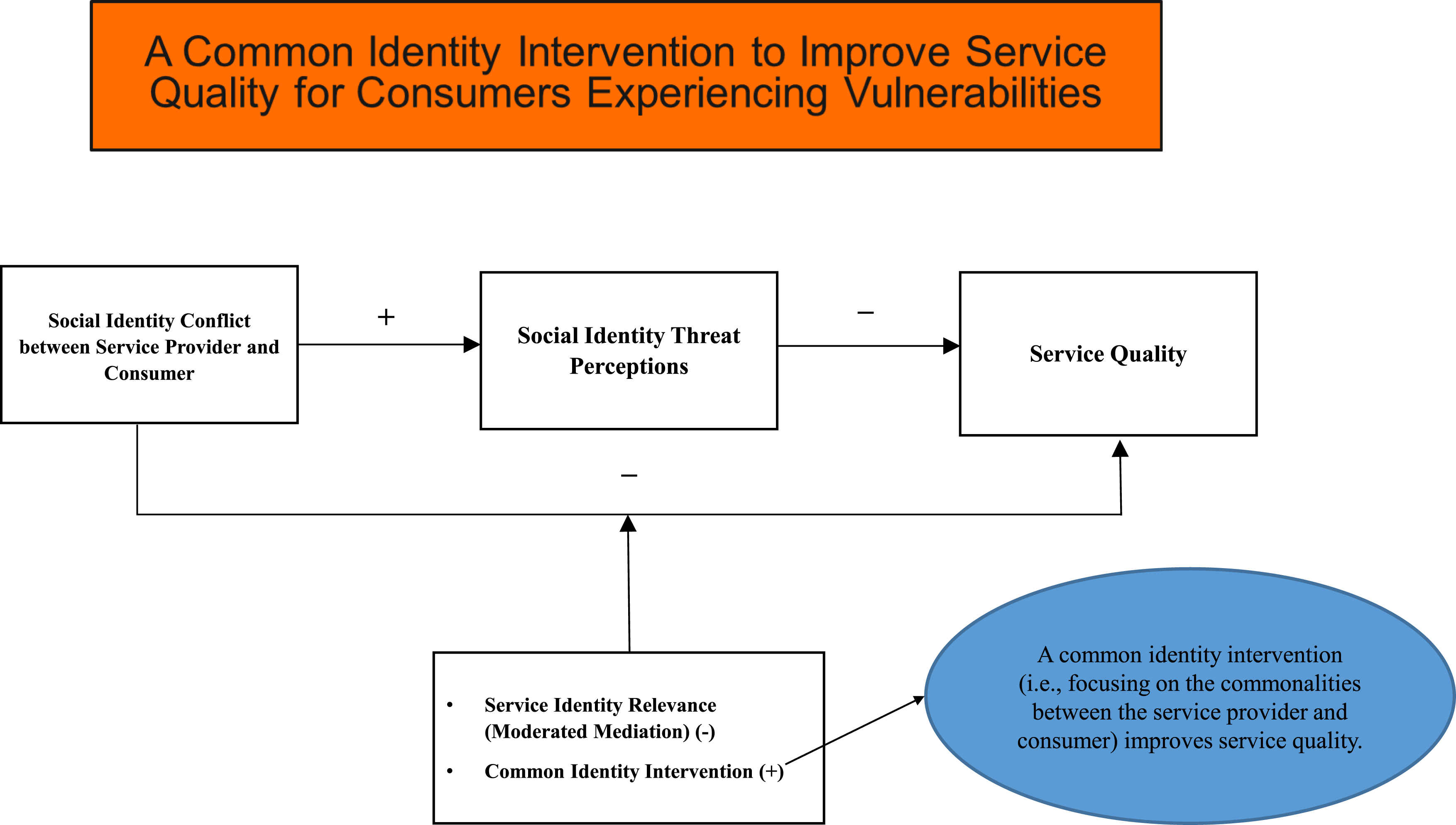
The behavior of consumers is often motivated by the desire to avoid association with social identities that are perceived to be undesirable to the self. For instance, male consumers may exhibit lower product evaluations toward a pink (vs. neutral) colored shirt because they want to avoid being associated with a perceived incongruent (female or gay) social identity. Indeed, there is a large body of research that reveals that consumers often take actions to avoid being associated with conflicting social identities (i.e., social identities that are perceived to be incongruent with an individual’s self-concept) or avoidance groups (Han, Nunes, and Drèze 2010; White and Dahl 2006). Here, we ask might service providers that are simultaneously operating by profit generation motives also behave in ways to avoid being affiliated with such groups, leading to discrimination against these consumers? If so, what type of intervention strategy may be introduced in order to improve the service quality that service providers display toward such consumers experiencing vulnerabilities?
The current research investigates these questions primarily in the substantive domain of the ongoing marketplace inclusion versus religious freedom conflict and, in so doing, builds upon previous conceptual research in this area (Minton et al. 2017). We chose this context because currently the U.S., as well as other nations such as the United Kingdom and South Africa (Adebayo 2020; Bowcott 2018), are witnessing significant tension between LGBTQIA+ (lesbian, gay, bisexual, transgender, queer, intersex, and asexual) consumers/advocates and some religious groups regarding the right of service providers to discriminate in their service behavior toward LGBTQIA + consumers. There have been many cases that have elucidated this conflict over the past few years and have important implications for service providers whose service quality is often a determinant of revenue. In 2016, for example, a bakery in Texas refused to bake a wedding cake for a same-sex wedding (Wong 2016). More recently, a wedding dress designer based in New York refused to serve a lesbian couple who were looking for garments for their nuptials (Palmer 2019). In these various examples, these highly religious service providers are discriminating in their service behavior to avoid being affiliated with a self-perceived avoidance group (LGBTQIA + consumers) because they claim that their religious identities would be threatened if they served such consumers.
While it may seem in this context that LGBTQIA + consumers would not even want to receive service from a business that is clearly against LGBTQIA + consumers, concerns arise because these consumers often do not have other options. Identifying a solution to this conflict is an important area of investigation because marketplace discrimination limits access to consumers who may be excluded from a service’s marketplace altogether if there is only one service provider in their town, or may be forced to choose a different provider that does not offer the same level of service or service options. In addition to the obvious moral and ethical concerns that arise from discrimination (Gillett 2016), prior literature also shows negative effects on consumers’ psyche from social exclusion (Heinz, Zhao, and Liu 2020). As such, marketplace discrimination not only inhibits access but can also have long-term negative effects on one’s mental well-being.
Across six studies, the current research documents several major findings. First, we show that the motivation to avoid being associated with undesirable social identities negatively affects service providers’ service quality toward consumers from an avoidance group, despite these service providers operating by profit generation motives. Second, we demonstrate that social identity threat perceptions mediate this effect. Third, we highlight an important boundary condition, such that service quality intentions are only reduced when the level of identity relevance of the service is high (vs. low). Fourth, we document an intervention strategy, drawing on the common ingroup identity model (Gaertner and Dovidio 2012), that encourages service providers to focus on commonalities between themselves and consumers from an avoidance group. Such an intervention can help to promote service inclusion and resulting marketplace well-being (Fisk et al. 2018).
As such, we introduce a new method that can be used in service settings to improve the service quality that consumers experiencing vulnerabilities receive, moving beyond past research that has only focused on different forms of service business training, such as sensitivity or diversity training (e.g., Brumbaugh and Rosa 2009) and empathy training (Cowart and Darke 2014), or other methods such as feedback systems (Walsh 2009) and greater interactivity with community members to design more inclusive service environments (Demangeot et al. 2013). Therefore, this research has substantial implications for service firms, consumers, and public policy officials. We also provide specific implications for the service and identity literature by building on the transformative consumer interventions theory (Bieler et al. 2022). Importantly, we also answer prior calls for research to understand the impact of conflicting social identities in situations when identities are made salient or are strongly held (e.g., religious and LGBTQIA + identities), and in which situations identity conflict may subside due to reduced identity conflict (White and Dahl 2006).
To begin, we briefly review the literature on service business-based discrimination before turning to discuss conflicting social identities as a source of such discrimination.
Conceptual Background
Service Business-Based Marketplace Discrimination
Prior research on discrimination among service providers has focused on racial discrimination, also known as consumer racial profiling (e.g., Baker, Meyer, and Johnson 2008; Sierra et al. 2010). However, research also calls for further examination of marketplace discrimination beyond such a sole focus on race (Field et al. 2021; Ostrom et al. 2021), with some research examining age and gender-based discrimination in the marketplace (e.g., Cowart and Darke 2014; Grougiou and Pettigrew 2011; Walsh 2009). Not surprisingly, consumer perceptions of discrimination influence marketplace outcomes, such that consumers who feel they may be discriminated against will alter their behavior in an attempt to control the level of discrimination that could occur (Brumbaugh and Rosa 2009). Further, prior research has shown the important negative influences of marketplace discrimination on how consumers engage in the marketplace and construct views of their selves related to stigma, self-esteem, self-efficacy, and self-autonomy (Bone, Christensen, and Williams 2014; Crockett 2017, 2022).
However, this previous work has not adequately examined the role of the service provider in these contexts nor examined forms of discrimination that are not so immediately observable (i.e., age, gender, and race can all be viewed immediately upon a consumer entering a service establishment, but one’s sexual orientation cannot). Indeed, more recent research argues that an LGBTQIA + identity is an important consumer characteristic to examine in terms of marketplace discrimination today (Minton et al. 2017; Ro and Olson 2020). As such, in the current research, we address this call by investigating a theoretical model of marketplace discrimination and specifically examine our model primarily within the context of discrimination by highly religious service providers or highly conservative service employees toward LGBTQIA + consumers.
Conflicting Social Identities in the Marketplace
According to social identity theory, individuals often define themselves in terms of the social groups to which they belong (Tajfel and Turner 1986). There is a growing body of marketing research that demonstrates that consumers often take actions to avoid being associated with undesirable social identities or avoidance groups (Han, Nunes, and Drèze 2010; White and Dahl 2006). For example, White and Dahl (2006) showed that men were less likely to choose a product associated with women (a lady’s cut steak) than a neutral product (a chef’s cut steak). In such contexts, consumers’ behaviors are motivated by the desire to disassociate from social identities perceived to be incongruent with one’s self-concept.
This extant literature on avoidance groups in marketing has primarily focused on how consumers’ social identities may conflict with those of other consumers in shaping their behaviors in the marketplace, often involving avoiding purchase of items that produce identity conflict and pursuing opportunities that further cement a desired social identity (e.g., Coleman, Williams, and Morales 2019; Dalton and Huang 2014). However, the reverse can also be true, which has been left inadequately examined in the literature. Specifically, service providers can also behave in ways to avoid consumers’ social identities that they perceive to be incongruent with their self-concepts, despite the fact that they operate by profit generation motives. In other words, service providers desiring to stay true to their core values can refuse service or reduce service quality to customers who they believe violate these values, which can lead to marketplace discrimination. This is directly relevant to the service literature not only in understanding why service behavior changes in these circumstances, but also in identifying a practical intervention that can help meet the needs of all parties involved. That is, such an intervention can be used to improve marketplace inclusion for consumers experiencing vulnerabilities as well as help increase profit generation for the service providers.
In addition, prior conceptual research calls for further examination regarding the important conflict between service providers and consumers’ social identities, which is important from a transformative consumer research perspective because it can help to promote consumer well-being and that of other involved parties (e.g., the service provider and business community) (Minton et al. 2017). This phenomenon can be prominently seen in the context of highly religious service providers interacting with LGBTQIA + consumers. Not surprisingly, religiosity often represents a very important social identity that people, including service providers, possess (Ysseldyk, Matheson, and Anisman 2010). In addition, those with a strong (vs. weak or no) religious identity across all major world religions (Christianity, Islam, Hinduism, and Buddhism) have been shown to have more negative views of LGBTQIA + individuals (Janssen and Scheepers 2019) and, consequently, same-sex marriage (Adamczyk and Pitt 2009). Therefore, it is likely that highly religious service providers view LGBTQIA + consumers as an avoidance group, which we predict causally decreases service quality intentions toward these consumers. We propose that this occurs due to social identity threat perceptions (i.e., perceptions that an individual’s social identity is compromised or damaged) that arise from interacting with consumers who possess social identities that are perceived to be incongruent with the service providers’ self-concepts. Thus:
Greater identification with a social identity (e.g., religion) will decrease service quality intentions toward consumers from an avoidance group (e.g., LGBTQIA + consumers).
Social identity threat perceptions will mediate the negative effect of identification with a social identity (e.g., religion) on service quality intentions toward consumers from an avoidance group (e.g., LGBTQIA + consumers).
Common Identity Intervention to Improve Service Quality Toward Consumers From an Avoidance Group
An important question arises at this point: How can service providers’ service quality toward consumers from an avoidance group be improved? Prior research has examined various methods for reducing discrimination, thereby enabling more positive service quality to emerge. For example, Baker, Meyer, and Johnson (2008) suggest that encouraging service employees to observe contextual factors (e.g., through sensitivity training), such as the race of other customers in the store, can help to reduce discrimination toward minority groups. Similar suggestions for sensitivity and diversity training are also made in other service business-based discrimination research (e.g., Brumbaugh and Rosa 2009). Sierra et al. (2010) propose that broader training related to organizational citizenship behavior may be beneficial in reducing discrimination by improving the desire for positive employee-customer relationships. Cowart and Darke (2014) tested an empathy-based solution to discrimination, showing that encouraging sales people to feel empathy toward the discriminated group and incorporate the discriminated group’s perspective into their development of a sales pitch can help to reduce discrimination.
Outside of training, Walsh (2009) proposes the need for a feedback system where discriminated against consumers can inform the service business about the discrimination, so the service business is made aware of what improvements need to be made. Additionally, Demangeot et al. (2013) highlight the need for more interactivity with community partners to design inclusive marketplace settings, thereby leveraging the expertise of others as to how discrimination can occur and ways to address such discrimination. Related to this perspective of utilizing other groups to reduce discrimination, Bennett, Hill, and Oleksiuk (2013) encourage public policy changes to encourage equal access to goods and services for all consumers, regardless of common discriminating factors.
Despite this research and these many different methods for reducing service business-based discrimination, such discrimination is becoming even more commonplace for some consumers (e.g., Repko 2020), which is why we propose a new solution in the current work. Additionally, the present solution to the religious-LGBTQIA + conflict usually involves either the LGBTQIA + consumer switching to a different provider or initiating a lawsuit (Palmer 2019). From a service provider perspective in this conflict, the service provider may not have motivation to change their discriminatory behavior given that changing their behavior can result in a strong personal value conflict. Therefore, a new solution is needed that addresses the limitations of prior interventions and that clearly shows benefits to both the service provider (e.g., increased revenue) and the consumer (e.g., enhanced likelihood of receiving quality service) at the same time.
We propose this new intervention, building on the common ingroup identity model (Gaertner and Dovidio 2012; Minton et al. 2017) and transformative consumer interventions theory (TCI theory; Bieler et al. 2022). The main idea behind the common ingroup identity model is that when members of conflicting groups, such as highly religious people and LGBTQIA + individuals, emphasize existing shared memberships, more positive interactions can occur (Gaertner and Dovidio 2012; Thompson and Sinha 2008). This model directly aligns with TCI theory, which posits that consumers’ lack of resources and integration of those resources negatively influences the value received from interventions. Further, TCI theory emphasizes the importance of consumer “boosts” that aid consumers in using their resources more effectively, which we argue that our common identity intervention is one such form of a boost (Bieler et al. 2022). This boost can be used on behalf of consumers in explicitly identifying commonalities with service providers to likely increase the service quality that they receive, and also by service providers and public policy officials in providing strategies to identify commonalities that help boost consumers’ access in the marketplace. As such, we provide novel contributions to TCI theory (Bieler et al. 2022) by investigating how a focus on common identity elements shared with an individual who has a conflicting social identity influences feelings, thoughts, and behaviors toward that individual, such that these commonalities serve as a novel way to boost the resources and marketplace capabilities of consumers experiencing vulnerabilities.
In reference to the marketplace inclusion versus religious freedom conflict, we propose a common identity intervention that involves highly religious service providers acknowledging the commonalities that they share with LGBTQIA + consumers, thereby likely mitigating the social identity threat associated with the transaction. This mitigation should lead these service providers to exhibit more positive service quality intentions toward LGBTQIA + consumers due to the consumers being perceived as more similar to themselves and in alignment with their social identity. For instance, if highly religious service providers focused on the commonalities that they share with LGBTQIA + consumers, such as both parties being Americans or human beings, then these service providers should be more likely to view LGBTQIA + consumers positively and display more positive service quality intentions toward them. To increase service providers’ motivation to pursue such a tactic, this can be framed as an opportunity to increase revenue, for example, rather than a way to decrease discrimination. Either way, by highly religious service providers identifying with LGBTQIA + consumers using more global or inclusive identities that are mutually shared, the salience of their differences or conflicting social identity should be reduced. As a result, these service providers should not feel that their identity is threatened by serving these consumers, thereby increasing service quality intentions. Thus:
Identification with a social identity (e.g., religion) will moderate the effect of a common identity intervention on service quality intentions toward consumers from an avoidance group (e.g., LGBTQIA + consumers), such that a common identity intervention will only increase service quality intentions for individuals high (vs. low) in identification with a social identity (e.g., religion).
We systematically test our hypotheses across a series of six studies, including experiments online, in the lab, and in the field. Figure 1 depicts the conceptual framework. Conceptual figure.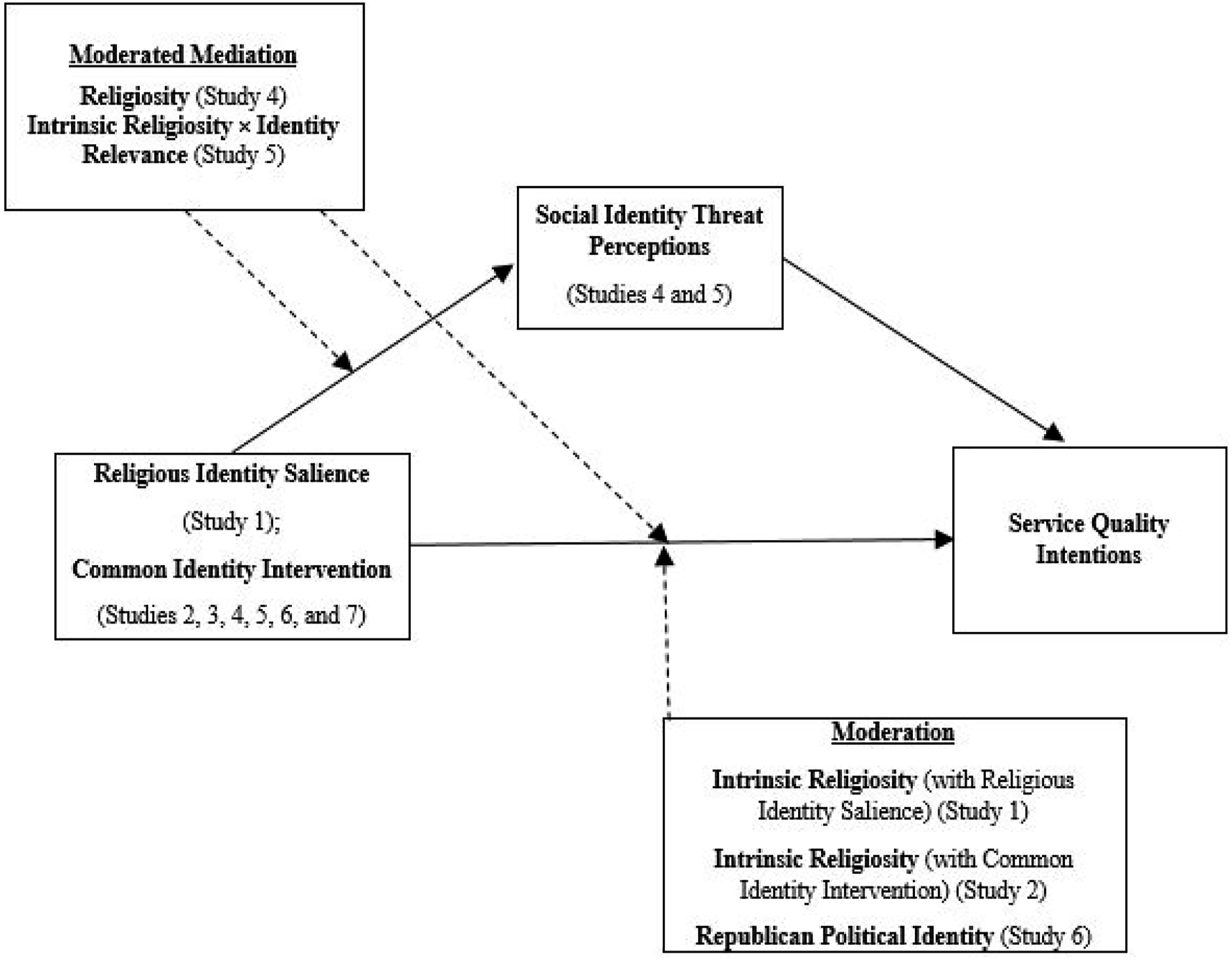
Study 1: Demonstrating the Basic Effects
Study 1 tested the causal relation between intrinsic religiosity and service quality intentions toward LGBTQIA + consumers (H1). We expected that identification with a social identity (e.g., religion) will moderate the effect of identity salience (e.g., religious identity salience), defined as the extent to which a social identity is activated in the individual’s working self-concept (Arnett, German, and Hunt 2003), on service quality intentions toward consumers from an avoidance group (e.g., LGBTQIA + consumers). Specifically, we predicted that identity salience (e.g., religious identity salience) will only decrease service quality intentions toward such consumers for those high (vs. low) in identification with a social identity (e.g., religion). Note that in the current study and in the other relevant studies, we measured intrinsic religiosity and controlled for extrinsic religiosity. Given that our theorizing involves religiosity (i.e., the strength of one’s religious beliefs), we focused on intrinsic religiosity as it refers to the extent to which one actually believes in and lives out his or her religion, as opposed to extrinsic religiosity that refers to people using their religion to fulfill other needs such as social relations or status (Allport and Ross 1967). As a result, previous research has shown that intrinsic religiosity is associated with more prejudice toward LGBTQIA + individuals, while extrinsic religiosity is not (Arli, Badejo, and Sutanto 2020). Therefore, in the current research, intrinsic religiosity is our construct of interest, while we control for extrinsic religiosity given its relevance to identity-based behaviors (Hood, Hill, and Spilka 2009; Schmidt et al. 2014).
Method
Participants and design
Two hundred and seven paid participants (47.83% male; Mage = 36.23, SDage = 12.10) completed the survey on Amazon’s MTurk. Note that Web Appendix 1 includes a table of the sample characteristics and Web Appendix 2 includes a table of means of the conditions across our studies. Participants were randomly assigned to one condition of a two-cell (religious identity salience: yes vs. no) between-subjects design.
Procedure
Like in all of the survey-based studies reported, participants were told that they would be taking multiple ostensibly unrelated studies. The first task was described as a study that was interested in people’s writing styles and word selection. They were told that they would be given a writing topic at random. In the control condition, participants were instructed to write about “today’s activities” by discussing what they had done so far that day. In the religious identity salience condition, they wrote about “religion’s influence on daily life” by explaining how a personal connection with God can provide meaning for life and affect everyday behaviors.
Participants then took part in an imagination task where they were instructed to imagine that they were the owner of a jewelry store in their hometown. Their jewelry store specialized in providing rings for major occasions in people’s lives, especially engagements, weddings, graduations, and birthdays. They were told to “imagine that one day, a man comes into your jewelry store to shop for an engagement ring to give to his long-time boyfriend. The man would like your help and expertise in picking out the perfect engagement ring for his future husband.” Subsequently, participants completed four items measuring their service quality intentions on a 1 (strongly disagree) to 7 (strongly agree) scale: “I would actively try to help this customer find the perfect engagement ring for his boyfriend”; “I would find pleasure in assisting this customer to find an engagement ring”; “I would avoid helping this customer find an engagement ring” (reverse-scored); and “I would be willing to help pick out an engagement ring for this customer.” We averaged responses to these items to create a composite measure of service quality intentions (M = 5.93, SD = 1.35; α = .92).
On a 1 (strongly disagree) to 7 (strongly agree) scale, participants then responded to an eight-item measure of intrinsic religiosity (e.g., “It is important to me to spend time in private thought and prayer” and “I try to live all my life according to religious beliefs”; M = 3.96, SD = 1.31; α = .77) and a six-item measure of extrinsic religiosity (e.g., “I go to church because it helps me to make friends” and “What religion offers me most is comfort in times of trouble and sorrow”; M = 3.14, SD = 1.51; α = .90) (Gorsuch and McPherson 1989). Finally, participants indicated their political orientation on a 1 (very liberal) to 7 (very conservative) scale (M = 3.65, SD = 1.78), religious affiliation (Protestant Christian, Roman Catholic, Evangelical Christian, Jewish, Muslim, Hindu, Buddhist, Atheist/Agnostic/Spiritual, or Other; dummy-coded such that Christian was the reference group), and basic demographics.
Results
Service quality intentions
The religious identity salience factor was coded as 0 = control and 1 = religious identity salience. Service quality intentions were regressed on religious identity salience (independent variable), intrinsic religiosity (moderator), the interaction between religious identity salience and intrinsic religiosity, and extrinsic religiosity as the covariate. Results revealed a main effect of intrinsic religiosity (B = −.41, t(202) = −4.45, p < .001), which was qualified by a significant religious identity salience × intrinsic religiosity interaction (B = −.30, t(202) = −2.31, p = .02). As intrinsic religiosity is a continuous measure, the analyses were repeated using a spotlight analysis at one standard deviation below and above the mean (Aiken, West, and Reno 1991). The analysis revealed a significant simple effect of religious identity salience among individuals high in intrinsic religiosity (B = −.72, t(202) = −3.01, p < .01), such that they expressed lower service quality intentions in the religious identity salience (vs. control) condition. As expected, the effect was not significant for those low in intrinsic religiosity (B = .06, t(202) = .26, p = .79).
In addition, to show that intrinsic religiosity rather than extrinsic religiosity was driving the effects, we tested an alternative model by interacting religious identity salience and extrinsic religiosity. Notably, as expected, this interaction was not significant (B = −.04, t(202) = −.35, p = .73). In addition, we tested whether extrinsic religiosity interacted with our manipulated factors in the other relevant studies, and the results were not significantly meaningful. Thus, we do not discuss these alternative models in the studies that follow.
Discussion
These results demonstrate that intrinsic religiosity was negatively related with service quality intentions toward LGBTQIA + consumers, thereby supporting H1. This effect was exacerbated when one’s religious identity was made salient, suggesting that intrinsic religiosity causally reduces service quality intentions toward such consumers experiencing vulnerabilities. As such, this study helps to demonstrate that social identity conflict plays a causal role in decreasing service quality intentions toward consumers from an avoidance group. It is important to note that despite these observed effects, we do not always expect that highly religious service providers will discriminate in their service behavior toward LGBTQIA + consumers. As such, we introduce a boundary condition in Study 5 that elucidates that these effects do not manifest in all service contexts. It is also important to note that the pattern of results in this study and the other relevant studies remain the same if we control for participants’ political orientation and religious affiliation. As such, the results reported in this study and across our studies do not contain these covariates for the sake of clarity.
In addition, one alternative account, albeit unlikely, that the first study cannot rule out is that service providers high in intrinsic religiosity do not just exhibit lower service quality intentions toward LGBTQIA + consumers, but they may do so toward all consumers. Therefore, we conducted a post-test to effectively rule out this alternative explanation (see Web Appendix 3).
Study 2: Common Identity Intervention With a Wedding Invitation Card Behavioral Experiment
In the current study, we tested a common identity intervention as a mechanism by which highly religious service providers’ service quality toward LGBTQIA + consumers can be improved. Specifically, we ascertained whether instructing participants high in intrinsic religiosity to focus on the commonalities between themselves and LGBTQIA + consumers would lead to more positive service quality (testing H3). In this study, we also aimed to provide initial evidence for the external validity of the observed effects. To do so, we conducted a behavioral study where participants were instructed to perform an actual service behavior, rather than just report their behavioral intentions. Finally, it is important to note that this study sampled college students rather than the general population. Given that young adults are generally more liberal and more accepting of LGBTQIA + individuals than other age groups in society are (Parker, Graf, & Igielnik, 2019), the current study offered a more stringent test of our hypotheses.
Method
Participants and design
Eighty-eight undergraduate students (46.59% male, Mage = 23.35, SDage = 5.36) participated in the study in return for course credit. Participants were randomly assigned to one condition of a two-cell (common identity: yes vs. no) between-subjects design.
Procedure
Prior to the start of the study, participants were provided with a blank sheet of paper and a box of colored pencils that they were told would be used later in the study. The participants then began the study. The first task was described as a study that was interested in people’s word choices and sentence structures. They were told that they would be given a writing topic at random. In the control condition, participants were instructed to write about the activities they do on an average day. In the common identity condition, they were instructed to “write about the commonalities that you and LGBT (lesbian, gay, bisexual, and transgender) individuals hold. Some similarities that you could focus on are that both are human beings, both seek to love others, both have families and friends, etc.”
Next, participants were introduced to the card-making task. Participants were instructed to imagine that they were the owner of a card-making store in the city of their university and that the store “specializes in creating hand-crafted invitation cards, for weddings, birthdays, anniversary parties, etc.” Then they were told to imagine that one day, two female customers came into their store to purchase handcrafted wedding invitation cards for their upcoming wedding, but before they purchased the invitations, they had asked the participants to create their best sample for what the wedding invitation cards might look. Participants were instructed, “using the paper and colored pencils given to you by the researcher, please create a sample of a wedding invitation card for this couple’s wedding.”
After the card-making task, participants moved on to the “opinions and personality” portion of the study. To better disguise the nature of the study, participants responded to many different filler items. Among these, they completed the same eight-item intrinsic and six-item extrinsic religiosity scales as in the previous study (intrinsic religiosity: M = 3.85, SD = .99, α = .69; extrinsic religiosity: M = 3.81, SD = 1.11, α = .76). They also responded to a two-item self-reported measure of service quality: “What quality do you think the card that you made was” (1 = very low quality to 10 = very high quality) and “How much effort did you put in making the card” (1 = very low effort to 10 = very high effort). Responses to these two items were averaged to form a self-reported service quality composite (M = 4.74, SD = 2.40; r = .66, p < .001). In addition, participants indicated their political orientation (M = 3.28, SD = 1.45), religious affiliation, and basic demographics.
Two independent judges, who were blind to the conditions and hypotheses of the study, rated the quality of the cards as well. The judges evaluated each card on how much they thought the card could sell for in a store that sells handcrafted products (between $0 and $5 in 25 cent increments) and how good they would feel if they received the card (1 = not good at all to 7 = very good). These were standardized, averaged for each judge, and then averaged across judges to create an external rating of service quality (r = .55, p < .001). Note that one of the participants did not turn in their card; thus, our sample size was 87 (rather than 88) for this measure.
Results
The common identity factor was coded as 0 = control and 1 = common identity. We regressed self-reported service quality on common identity (independent variable), intrinsic religiosity (moderator), the interaction between common identity and intrinsic religiosity, and extrinsic religiosity as the covariate. There were significant main effects of common identity (B = −4.58, t(83) = −2.28, p = .03) and extrinsic religiosity (B = .63, t(83) = 2.32, p = .02), and a marginally significant main effect of intrinsic religiosity (B = −.64, t(83) = −1.73, p = .09). These were qualified by a significant interaction between common identity and intrinsic religiosity (B = 1.29, t(83) = 2.52, p = .01). Probing this interaction using a spotlight analysis at one standard deviation below and above the mean revealed a significant positive effect of common identity (vs. control) on self-reported service quality for participants high in intrinsic religiosity (B = 1.65, t(83) = 2.28, p = .03), such that they reported significantly higher service quality in the common identity (vs. control) condition. Conversely, there was no difference in self-reported service quality between the common identity and control conditions for those low in intrinsic religiosity (B = −.90, t(83) = −1.29, p = .20).
We ran the same analyses as described above on the external rating of service quality. There were significant main effects of common identity (B = −2.29, t(82) = −3.30, p < .01), intrinsic religiosity (B = −.57, t(82) = −4.45, p < .001), and extrinsic religiosity (B = .19, t(82) = 2.03, p = .05). These were qualified by a significant interaction between common identity and intrinsic religiosity (B = .58, t(82) = 3.32, p < .01). Probing this interaction using a spotlight analysis at one standard deviation below and above the mean showed that the common identity (vs. control) condition significantly increased the external rating of service quality for participants high in intrinsic religiosity (B = .54, t(82) = 2.17, p = .03). Conversely, there was a negative effect of the common identity (vs. control) condition for participants low in intrinsic religiosity (B = −.62, t(82) = −2.56, p = .01).
Discussion
This study leverages a behavioral study and measures actual service quality, rather than behavioral intentions. Importantly, it demonstrates that focusing on commonalities with LGBTQIA + individuals leads highly religious service providers to display more positive service quality (both self-reported and as rated by independent judges) toward this consumer group. Indeed, examining the responses that participants wrote to the common identity manipulation revealed that participants focused on various commonalities that they share with LGBTQIA + individuals, such as common characteristics (e.g., “we both have feelings” and “we both love”), interests (e.g., “we share some interests in sports, food, music, etc.” and “fashion and dance”), values (e.g., “we stand for things we believe in, no matter the opinion of others” and “we all believe everyone deserves to find true love”), and goals (e.g., “we both are humans that are trying to better themselves and prosper” and “we want to become successful people”). As such, our findings show the effectiveness of a common identity intervention and support H3. In addition, by leveraging actual service behaviors and measuring actual service quality, this study also provides initial support for the external validity of our findings.
Study 3: Emailing Companies Field Study
The main objective of Study 3 was to provide more support for the effectiveness of a common identity intervention (H3) and further demonstrate the external validity of the observed effects by surveying actual businesses. To do so, we conducted a field study where a random sampling of businesses that mentioned religious statements/values on their website were asked to provide services for an upcoming wedding of an LGBTQIA + couple. A real LGBTQIA + couple was used as the email sender, and one of two messages was sent to each business—a control message asking for wedding favors or a common identity message identifying commonalities between the couple and business owner that also asked for wedding favors. In this study, we substitute the level of religiosity for identification of religious statements/values on the business’ website, given no way to measure service providers’ religiosity while still masking the study’s purpose. We acknowledge that mentioning religious statements/values does not automatically mean that a business has a conflicting identity with LGBTQIA + consumers, but it serves as a proxy for an increased likelihood of this in comparison to a business that contains no mention of religious statements/values.
Method
Participants and design
Fifty businesses from across the U.S. that mentioned religious statements/values on their website were emailed as part of this study. All businesses produced items that could be provided as wedding favors, including paper products, baked goods, candies, apparel, dried flowers, trinkets, bags, water bottles, and candles. Businesses were randomly assigned to one condition of a two-cell (common identity: yes vs. no) between-subjects design.
Procedure
A new email account was created that included the name of the sender to enhance the match between the email address and content of the email. To increase the study realness, an actual LGBTQIA + couple soon to be married was used as the focal couple for the study, including their actual names and wedding date. This couple was contacted, and they approved us sending emails on their behalf. The couple helped to generate the content of the email that was sent to businesses based on how they would ask for favors for their upcoming wedding. The control email read, “My future husband and I are interested in purchasing favors for our upcoming wedding. We would like these customized to say, ‘Congrats to [names of couple]’. We’re excited to be getting married at a destination wedding in February in California (since it’s more supportive there to get married as a gay couple) and would therefore like to obtain our favors soon. With that being said, is this something you can do for us, and if so, what would the cost be for 100 favors?” The common identity email also included, “While we realize that some people have hesitation serving gay consumers like us, I encourage you to think about how you and we are similar in so many ways. Like you, we have a compassionate heart and want to make a difference in the world for the better.” The particular wedding favor mentioned in the email (e.g., invitations and baked goods) was adapted to the products the business sold.
Businesses were sent the email corresponding with their randomly assigned condition. If no response was received after 1 week, one follow-up email was sent asking if they had received the previous email and kindly asking them to respond to the request.
Businesses that mentioned either a religious statement or religious values on their website were included in the sample. Examples of this included websites that listed religious verses, made statements related to God (e.g., “we do it all for the glory of God”; “may God comfort all”; “tied together with God”; or “we join hands in God’s love”), or explicitly mentioned operating by a religious value system (e.g., “To let you know a little about our family values, we’re Christians, and we run our business on Christian principles”).
Our dependent variable was whether or not the business agreed to provide service. As control variables, we included the business’ service category (1 = customized products, 2 = cake, 3 = flowers, 4 = invitations, 5 = miscellaneous; dummy-coded such that customized products was the reference category) and whether a follow-up email was sent (1 = follow-up email was sent; 0 = no follow-up email was sent).
Results
The common identity factor was coded as 0 = control and 1 = common identity, and the responses were coded as 0 = will not provide service and 1 = will provide service. Using binary logistic regression, we regressed service provision on common identity, the dummy-coded variables for product category, and the dummy-code for whether a follow-up email was sent or not. As expected, there was a significant positive effect of common identity (B = 1.49, Wald = 3.72, p = .05), such that businesses receiving the common identity email were more likely to agree to provide service than businesses receiving the control email (64% vs. 40%) (see Web Appendix 4 for a graph of the results). Analyses were repeated excluding the 12 emails that received no response, and as expected, there was still a significant positive effect of common identity (B = 1.94, Wald = 4.49, p = .03), such that businesses receiving the common identity email were more likely to agree to provide service than were those receiving the control email (84% vs. 53%).
Discussion
This study measures actual business response, rather than behavioral intentions or responses to lab stimuli. Findings again show that the common identity (vs. control) condition significantly increases service quality for religious businesses. More precisely, religious businesses receiving a common identity-based email from an LGBTQIA + couple were more likely to agree to provide service to the couple desiring favors for their wedding in comparison to businesses receiving a control email. This finding provides further support for H3 with a behavioral measure of service quality in the field.
However, an alternative explanation for the results of this study is that a common identity intervention may increase service quality for all businesses, rather than just religious businesses. Therefore, we conducted a post-test in order to rule out this alternative account of our findings.
Post-Test
We followed the same procedure as above, but this time we randomly sampled 50 businesses from across the U.S. that did not mention any religious statements/values on their website. These control businesses were randomly assigned to either the common identity or control email condition.
Like we did for the religious businesses, using a binary logistic regression, we regressed service provision on common identity, the dummy-coded variables for product category, and the dummy-code for whether a follow-up email was sent or not. As predicted, there was no significant effect of common identity on service provision for the control businesses (B = .82, Wald = 1.10, p = .30) (see Web Appendix 5 for a graph of the results). In addition, the analyses were repeated excluding the four emails that received no response. As expected, there was again no significant effect of common identity (B = 1.04, Wald = 1.22, p = .27).
With these results, we effectively rule out the alternative account of our findings that a common identity intervention increases service quality for all businesses. Rather, we demonstrate that a common identity manipulation only increases service quality for religious businesses, while it has no effect on control businesses.
Study 4: Mediation by Social Identity Threat Perceptions
The goals of Study 4 were fourfold. First, we wanted to directly test the role of social identity threat perceptions as the psychological process underlying the observed effects (testing H2). Second, we sought to rule out the alternative account that social distance perceptions from LGBTQIA + individuals, rather than social identity threat perceptions, may be the underlying psychological mechanism. Third, in this study, we aimed to further generalize the observed effects by using a transgender consumer who was interested in purchasing invitation cards for her baby shower. Indeed, a baby shower is high in identity relevance for many highly religious individuals, particularly for Christians, given the importance that religion places on family life and relationships (Schmidt et al. 2014). Finally, we utilized another established religiosity scale (Li et al. 2010) to show that the effects are generalizable to other measures of religiosity and not just intrinsic religiosity.
Method
Participants and design
Two hundred and eight paid participants (43.3% male, Mage = 30.21, SDage = 10.92) completed the survey on Prolific. Twenty participants either failed the attention check (“What kind of store did the study ask you to imagine that you owned?”) or did not follow the instructions of the writing task manipulation, leaving us with a final sample of 188 participants (41% male, Mage = 30.48, SDage = 11.18). Participants were randomly assigned to one condition of a two-cell (common identity: yes vs. no) between-subjects design.
Procedure
The first task was described as an imagination task. Similar to Study 2, it asked participants to imagine that they were the owner of a card-making store that specialized in creating hand-crafted invitation cards. They were instructed to “now imagine that one day, two recently-married female customers, one of whom is transgender (please see the LGBT couple’s picture below), come into your store to purchase invitation cards for their upcoming baby shower.” A picture of the couple was also shown to the participants.
Next, participants were randomly assigned to either the control or common identity condition. In the control condition, participants were instructed to write about five activities that they had done so far that day. In the common identity condition, they were asked to write about five similarities between themselves and the consumers who were interested in purchasing invitation cards for their upcoming baby shower.
Subsequently, they responded to a two-item measure of service quality intentions (“I would find pleasure in assisting these customers in producing the perfect invitation cards for their baby shower” and “I would feel uncomfortable to help these customers in producing the perfect invitation cards for their baby shower” (reverse-scored)). Responses were made on a 1 (strongly disagree) to 7 (strongly agree) scale and were averaged to form a service quality intentions composite (M = 6.06, SD = 1.42; r = .65, p < .001).
Next, participants responded to a four-item measure of social identity threat perceptions (“Providing service to these customers would threaten my identity”; “Providing service to these customers would make me feel less secure in my identity”; “Providing service to these customers would go against my identity”; and “Providing service to these customers would be at odds with my identity”). Responses were made on a 1 (strongly disagree) to 7 (strongly agree) scale (M = 1.44, SD = .95; α = .90).
Participants then responded to a three-item measure of religiosity taken from previous research (Li et al. 2010): “I believe in God”; “We’d be better off if religion played a bigger role in people’s lives”; and “Religious beliefs are important to me in my everyday decisions.” Responses were made on a 1 (strongly disagree) to 7 (strongly agree) scale (M = 3.50, SD = 2.01; α = .92). Subsequently, participants responded to a seven-item social distance perceptions measure that was adapted from previous research (Mather, Jones, and Moats 2017) to fit LGBTQIA + individuals (e.g., “I would be willing to accept an LGBTQIA + individual as a close personal friend” and “I would be willing to accept an LGBTQIA + individual as a coworker”). Responses were made on a 1 (strongly disagree) to 5 (strongly agree) scale, were reverse-scored, and then averaged to form a social distance perceptions composite (M = 1.66, SD = .28; α = .60). Finally, participants indicated their political orientation (M = 5.09, SD = 1.59), religious affiliation, and basic demographics.
Results
Service quality intentions
The common identity factor was coded as 0 = control and 1 = common identity. We regressed service quality intentions on common identity (independent variable), religiosity (moderator), and the interaction between common identity and religiosity. There were main effects of common identity (B = −.74, t(184) = −1.96, p = .05) and religiosity (B = −.40, t(184) = −6.17, p < .001), which were qualified by a significant interaction between common identity and religiosity (B = .23, t(184) = 2.49, p = .01) (see Web Appendix 6 for a graph of the results). We probed the significant common identity × religiosity interaction using a spotlight analysis at one standard deviation below and above the mean. This analysis revealed a significant simple effect of common identity on service quality intentions among individuals high in religiosity (B = .55, t(184) = 2.05, p = .04), such that they expressed higher service quality intentions in the common identity (vs. control) condition. Conversely, the effect of common identity on service quality intentions was not significant for those low in religiosity (B = −.40, t(184) = −1.48, p = .14).
Social identity threat perceptions
A similar analysis was conducted with social identity threat perceptions as the dependent variable. A main effect of religiosity (B = .25, t(184) = 5.63, p < .001) emerged, as religiosity was associated with higher social identity threat perceptions. This main effect of religiosity was also qualified by a significant interaction between common identity and religiosity (B = −.17, t(184) = −2.57, p = .01). Probing this interaction using a spotlight analysis at one standard deviation below and above the mean revealed a significant effect of common identity on social identity threat perceptions for those high in religiosity (B = −.49, t(184) = −2.71, p < .01), such that they perceived less social identity threat in the common identity (vs. control) condition. Conversely, this effect was not significant for those low in religiosity (B = .17, t(184) = .93, p = .36).
In addition, analyses as described above were repeated with social distance perceptions as the dependent measure. The only significant effect that emerged was that of religiosity (B = .05, t(184) = 3.51, p < .01). Importantly, the common identity × religiosity interaction was not significant (B = −.02, t(184) = −1.20, p = .23).
Moderated mediation
Finally, a moderated mediation analysis using model 8 of the PROCESS macro with 10,000 bootstrap resamples (Hayes 2013) tested whether social identity threat perceptions mediated the interactive effect of common identity and religiosity on service quality intentions. Consistent with our prediction, social identity threat perceptions emerged as a significant mediator of this relationship (indirect effect = .12; 95% CI: .01 to .24). Moreover, when running the same model with social distance perceptions added as a competing mediating variable, social identity threat perceptions again emerged as a significant mediator (indirect effect = .10; 95% CI: .01 to .21), while social distance perceptions did not (indirect effect = .03; 95% CI: −.03 to .09).
Discussion
In this study, we show that social identity threat perceptions serve as the psychological mechanism underlying the observed effects, thereby supporting H2. Indeed, again examining the responses that participants wrote to the common identity manipulation revealed that participants focused on similar commonalities that they share with the LGBTQIA + couple, such as common characteristics (e.g., “both in a relationship” and “they live in America”), interests (e.g., “they enjoy weddings” and “they like having parties”), values (e.g., “probably very liberal” and “they are accepting of others”), and goals (e.g., “they want to be happy” and “they want to have kids”). Importantly, our results also demonstrate that the alternative account of social distance perceptions is not a tenable explanation of our findings. Finally, this study uses a transgender consumer and another established religiosity scale, demonstrating that our findings are generalizable across the LGBTQIA + spectrum and to other measures of religiosity besides intrinsic religiosity.
Study 5: Identity Relevance of the Service as a Boundary Condition
We do not expect that LGBTQIA + consumers are vulnerable to being discriminated against by highly religious service providers in all contexts. As such, in this study, we focus on an important boundary condition that relates to how the degree of social identity conflict moderates the observed effects. Specifically, services requested by consumers from an avoidance group that are higher in identity relevance (i.e., something that is relevant to or represents an individual’s core social identity; Sheehan and Dommer 2020) should produce a higher perceived social identity threat, leading to more negative service quality intentions (Minton et al. 2017). This is because such services are more invoking of the service providers’ core social identity, which would likely be threatened when providing these services to consumers from an avoidance group. Thus, we expect that identification with a social identity (e.g., religion) will moderate the effect of identity relevance on service quality intentions toward consumers from an avoidance group (e.g., LGBTQIA + consumers), such that a service high (vs. low) in identity relevance will only decrease service quality intentions toward such consumers for those high (vs. low) in identification with a social identity (e.g., religion). For example, a request for photography services from a Republican service provider for a Democratic election party should produce higher perceived social identity threat and, consequently, lower service quality intentions compared to that same service provider receiving a request for photography services for a birthday party from a Democratic consumer. In addition, it follows that a common identity intervention should only increase service quality intentions for services that are high (vs. low) in identity relevance.
Along these same lines, according to our theorizing, intrinsic religiosity should only reduce service quality intentions when there is a perceived threat to one’s religious identity. Providing LGBTQIA + consumers with services that are high in identity relevance, such as a wedding, likely threatens a service provider’s religious identity more so than the provision of services to less identity-relevant events, such as a birthday. Thus, this study tested the effects in a scenario where there is specific religious scripture guidelines (i.e., wedding) as well as a scenario where there are no specific religious scripture guidelines (i.e., birthday). Note that we also conducted a pre-test of our identity relevance manipulation, which confirmed the success of the manipulation used in this study (see Web Appendix 7).
Method
Participants and design
Two-hundred and four paid participants (48.53% male, Mage = 32.20, SDage = 9.24) completed the survey on Amazon’s MTurk. Participants were randomly assigned to one condition of a 2 (common identity: yes vs. no) × 2 (identity relevance: wedding—high identity relevance vs. birthday—low identity relevance) between-subjects design.
Procedure
The first study was described as a pictorial analysis task in which the participants would have to write about a randomly generated picture from a recent event. Participants in the control condition were given a picture of two men kissing each other and were asked to "write about what you see in the picture above." Participants in the common identity condition were given the same picture and were asked to "write about how the individuals in the above picture may be similar to you.”
The next study was described as an imagination task where participants imagined themselves in a certain situation and then answered questions based on the scenario. Similar to Study 1, all participants imagined that they were the owner of a jewelry store in their hometown and that 1 day, a man came into the store to shop for a ring to give to his long-time boyfriend. Those in the wedding (birthday) condition were told that the customer was looking for a piece of jewelry, a ring in particular, to give to his boyfriend at their wedding (as a birthday present). For these scenarios, the wedding (birthday) condition represented high (low) identity relevance.
Subsequently, participants responded to a three-item measure of service quality intentions on a 1 (strongly disagree) to 7 (strongly agree) scale: “I would actively try to help this customer find the perfect ring for his boyfriend”; “I would feel uncomfortable to help this customer find a ring for his boyfriend” (reverse-scored); and “I would avoid helping this customer find a ring for his boyfriend” (reverse-scored). Responses to these three items were averaged to form a service quality intentions composite (M = 5.99, SD = 1.36; α = .85). After this measure, participants responded to the same four-item measure of social identity threat perceptions as in the previous study (M = 2.02, SD = 1.53; α = .96). Next, participants responded to the same eight-item intrinsic and six-item extrinsic religiosity measures as in the previous studies (intrinsic religiosity: M = 3.57, SD = 1.31, α = .75; extrinsic religiosity: M = 2.85, SD = 1.65, α = .92). Finally, participants indicated their political orientation (M = 3.40, SD = 1.84), religious affiliation, and basic demographics.
Results
Service quality intentions
The common identity factor was coded as 0 = control and 1 = common identity, and the identity relevance factor was coded as 0 = birthday/low identity relevance and 1 = wedding/high identity relevance. We regressed service quality intentions on common identity (independent variable), identity relevance (moderator), intrinsic religiosity (moderator), all possible two-way interactions, and the three-way interaction between common identity, identity relevance, and intrinsic religiosity, while controlling for extrinsic religiosity (model 3; Hayes, 2013). The model revealed significant effects of the identity relevance × intrinsic religiosity interaction (B = −.39, t(195) = −2.06, p = .04) and extrinsic religiosity (B = −.23, t(195) = −3.33, p < .01). Importantly, as predicted, the model also revealed a significant common identity × identity relevance × intrinsic religiosity interaction (B = .64, t(195) = 2.37, p = .02). To decompose this three-way interaction, we first examined the effects in the wedding (i.e., high identity relevance) condition. The model revealed significant effects of intrinsic religiosity (B = −.34, t(195) = −2.35, p = .02), common identity (B = −1.39, t(195) = −2.05, p = .04), extrinsic religiosity (B = −.29, t(195) = −3.02, p < .01), and the common identity × intrinsic religiosity interaction (B = .43, t(195) = 2.38, p = .02) (see Figure 2). Service quality intentions as a function of common identity and intrinsic religiosity in each identity relevance condition (Study 5).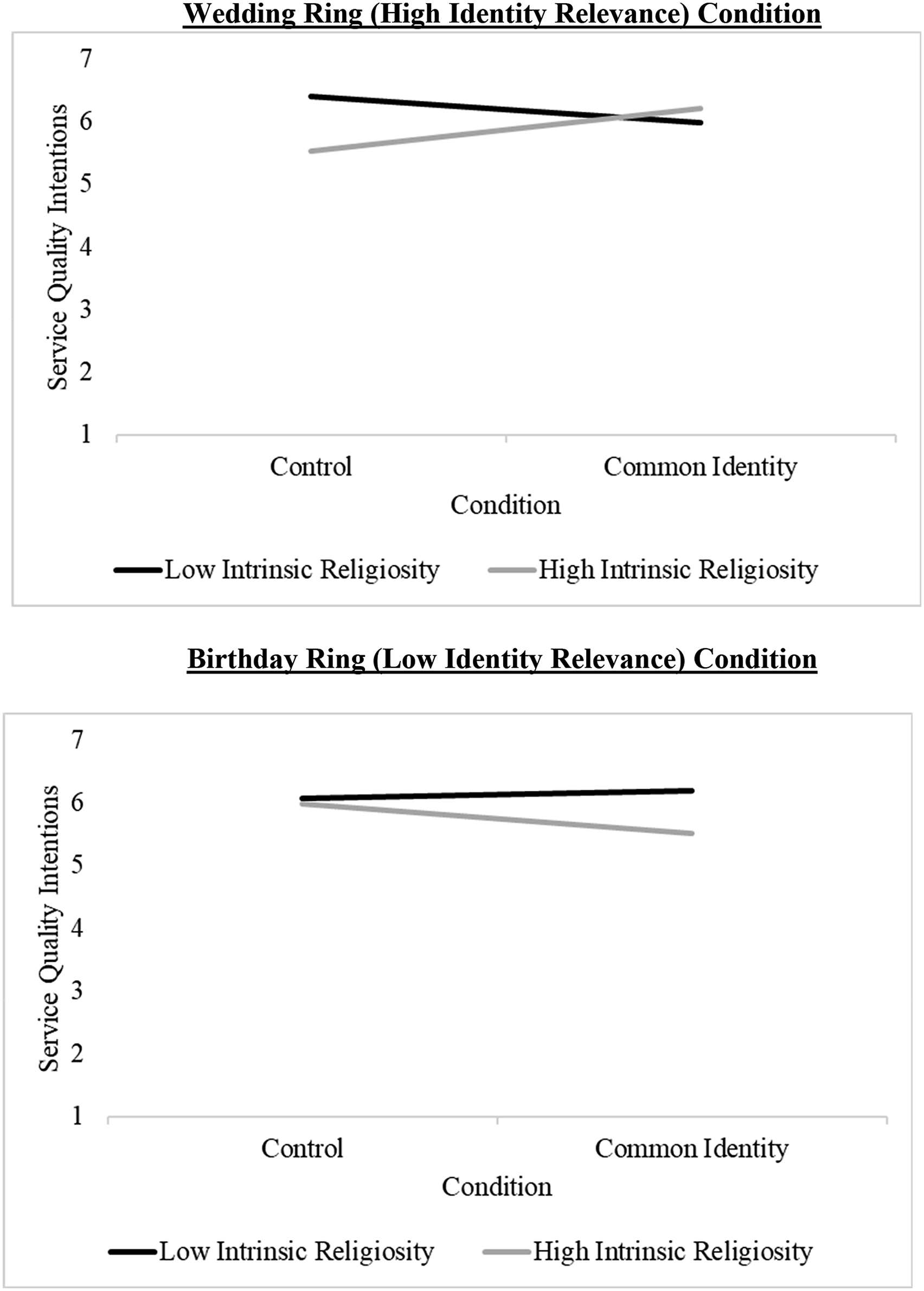
Probing this interaction using a spotlight analysis at one standard deviation below and above the mean revealed a significant simple effect of common identity among participants high in intrinsic religiosity (B = .68, t(195) = 2.09, p = .04), such that they expressed higher service quality intentions in the common identity (vs. control) condition. As expected, the effect was not significant for participants low in intrinsic religiosity (B = −.42, t(195) = −1.30, p = .20). When examining the effects in the birthday (i.e., low identity relevance) condition, none of the variables emerged as significant predictors of service quality intentions (intrinsic religiosity: B = −.03, t(195) = −.18, p = .86; common identity: B = .64, t(195) = .82, p = .41; extrinsic religiosity: B = −.19, t(195) = −1.85, p = .07; common identity × intrinsic religiosity interaction: B = −.23, t(195) = −1.13, p = .26) (see Figure 2).
Social identity threat perceptions
Next, we ran parallel analyses as described above on the social identity threat perceptions measure. The model revealed significant effects of identity relevance (B = −1.54, t(195) = −2.04, p = .04), extrinsic religiosity (B = .45, t(195) = 6.28, p < .001), identity relevance × intrinsic religiosity interaction (B = .58, t(195) = 2.98, p < .01), and the common identity × identity relevance × intrinsic religiosity interaction (B = −.66, t(195) = −2.40, p = .02). To decompose this three-way interaction, we first examined the effects in the wedding (i.e., high identity relevance) condition. The model revealed significant effects of intrinsic religiosity (B = .37, t(195) = 2.36, p = .02), extrinsic religiosity (B = .53, t(195) = 4.98, p < .001), common identity (B = 1.53, t(195) = 2.06, p = .04), and the common identity × intrinsic religiosity interaction (B = −.51, t(195) = −2.57, p = .01). Probing this interaction using a spotlight analysis at one standard deviation below and above the mean revealed a significant simple effect of common identity among individuals high in intrinsic religiosity (B = −.92, t(195) = −2.57, p = .01), such that they reported lower social identity threat perceptions in the common identity (vs. control) condition. As expected, the effect was not significant for those low in intrinsic religiosity (B = .39, t(195) = 1.09, p = .28). When examining the effects in the birthday (i.e., low identity relevance) condition, only extrinsic religiosity emerged as a significant predictor of service quality intentions (extrinsic religiosity: B = .39, t(195) = 3.99, p < .001; intrinsic religiosity: B = −.10, t(195) = −.64, p = .52; common identity: B = −.27, t(195) = −.37, p = .71; common identity × intrinsic religiosity interaction: B = .17, t(195) = .90, p = .37).
Moderated mediation
Finally, a mediation model with 10,000 bootstrap resamples (model 4; Hayes 2013) tested whether social identity threat perceptions significantly mediated the relationship between the common identity × identity relevance × intrinsic religiosity three-way interaction and service quality intentions, controlling for extrinsic religiosity. The results supported this model by revealing a significant indirect effect of the three-way interaction on service quality intentions via social identity threat perceptions (indirect effect = .46; 95% CI: .06 to .89). In addition, as predicted, social identity threat perceptions significantly mediated the relationship between high intrinsic religiosity and service quality intentions in the control (i.e., no common identity intervention) and wedding (i.e., high identity relevance) conditions (indirect effect = −.89; 95% CI: −1.49 to −.34). Further, as expected, the interaction between the common identity and identity relevance conditions was significantly mediated by social identity threat perceptions for participants high in intrinsic religiosity (indirect effect = 1.03; 95% CI: .14 to 1.99). There were no significant effects in other conditions.
Discussion
The findings of the current study elucidate an important boundary condition to the observed effects, such that intrinsic religiosity does not have a negative influence on service quality intentions toward LGBTQIA + consumers when the service requested is low in identity relevance (e.g., selling a ring as a birthday present to an LGBTQIA + consumer). However, as expected, when one’s religious identity is perceived to be threatened due to a high level of identity relevance (e.g., selling a wedding ring to an LGBTQIA + consumer), then intrinsic religiosity produces lower service quality intentions. We find that a common identity intervention is successful in improving service quality intentions from highly religious service providers toward LGBTQIA + consumers for services high (vs. low) in identity relevance, and that social identity threat perceptions serve as the psychological mechanism underlying these effects. Similar to our prior studies, we again examined the responses that participants gave to the common identity manipulation, revealing that participants focused on similar commonalities that they share with the LGBTQIA + couple, such as common characteristics (e.g., “we are both human beings” and “both have a home”), interests (e.g., “they also like the color blue” and “we both like to have a good time”), values (e.g., “the people in the photo believe in equality and so do I” and “they have liberal values and believe they are entitled to the same type of love everyone else is”), and goals (e.g., “we both want to be loved” and “we both want to feel friendship and happiness”).
Study 6: Demonstrating Generalizability of the Observed Effects
The main objective of this study was to demonstrate the generalizability of our findings to individual front-line service employees, rather than service providers, and to a different, albeit similar, context of conflicting social identities. To do so, we examined conflicting social identities between a highly conservative political identity of front-line service employees and LGBTQIA + consumers. We expected that for highly conservative front-line service employees, a common identity intervention would improve their service quality intentions toward LGBTQIA + consumers.
Method
Participants and design
One-hundred and ninety-six paid participants (71.9% male, Mage = 34.95, SDage = 9.46) completed the survey on Amazon’s MTurk. Thirty-five participants failed the attention check (“To show that you are paying attention, please select somewhat disagree”), leaving us with a final sample of 161 participants (70.2% male, Mage = 34.43, SDage = 9.53). Participants were randomly assigned to one condition of a two-cell (common identity: yes vs. no) between-subjects design.
Procedure
The first study was described as a writing task where participants would be presented with a randomly generated writing task to which they would be asked to respond. In the control condition, participants were instructed to “think back to and write about what you have done so far today.” Conversely, given that there is a strong association between LGBTQIA + individuals and liberalism (Worthen 2020), in the common identity condition, participants were asked to “write about how liberals (usually Democrats) and conservatives (usually Republicans) in the United States (U.S.) are alike. Some similarities that you could focus on are that both live in the U.S., both want the best for the U.S., both are human beings, both have families and friends, etc.”
The second study told participants that they would be asked to imagine themselves in a certain situation and answer some questions based on the scenario. Participants were instructed to “imagine that you work at very successful jewelry store in your hometown. The store is a big supporter of diversity and inclusion, as the business consistently donates to organizations that support LGBT rights.” The instructions continued, “Now imagine that one day, a woman comes into this jewelry store that you work at to shop for an engagement ring to give to her long-time girlfriend. The woman would like your help and expertise in picking out the perfect engagement ring for her future wife.”
Next, participants responded to the same four-item service quality intentions measure as in Study 1 with only minor wording adaptations to refer to the lesbian, rather than gay, customer used in the current study. However, given the low Cronbach’s alpha that was observed with all four items in the measure (α = .51), we conducted an analysis to determine if any of the items in particular were substantially decreasing the alpha. This analysis determined that the third item (“I would avoid helping this customer find an engagement ring”), which is reverse-scored, was substantially reducing the alpha of the measure. Therefore, we dropped this item, and leveraged a three-item measure of service quality intentions: “I would actively try to help this customer find the perfect engagement ring for her girlfriend”; “I would find pleasure in assisting this customer to find an engagement ring”; and “I would be willing to help pick out an engagement ring for this customer” (M = 5.64, SD = 1.02; α = .78). Note that the pattern of effects remained the same and significant whether the three or four item service quality intentions measure was used.
Subsequently, on a 1 (strongly disagree) to 7 (strongly agree) scale, participants responded to a four-item measure of conservative political identity, adapted from previous research with relevant items to fit a political, rather than religious, identity (Worthington et al. 2003): “My Republican political beliefs lie behind my whole approach to life”; “I make financial contributions to the Republican Party”; “I enjoy spending time specifically with other Republicans”; and “I regularly volunteer/work in activities involved with the Republican Party” (M = 4.98, SD = 1.60; α = .91). Finally, participants indicated their basic demographics.
Results
Service quality intentions
The common identity factor was coded as 0 = control and 1 = common identity. We regressed service quality intentions on common identity (independent variable), conservative political identity (moderator), and the interaction between common identity and conservative political identity. There were marginally significant main effects of conservative political identity (B = −.12, t(157) = −1.71, p = .09) and common identity (B = −.93, t(157) = −1.80, p = .07). These were qualified by a significant interaction between common identity and conservative political identity (B = .24, t(157) = 2.38, p = .02). Probing this interaction using a spotlight analysis at one standard deviation below and above the mean of conservative political identity revealed a significant positive effect of common identity (vs. control) on service quality intentions for participants high in conservative political identity (B = .63, t(157) = 2.78, p < .01), such that they reported significantly higher service quality intentions in the common identity (vs. control) condition. Conversely, there was no difference in service quality intentions between the common identity and control conditions for participants low in conservative political identity (B = −.13, t(157) = −.59, p = .55).
Discussion
This study demonstrates the generalizability of the observed effects to individual front-line service employees, rather than service providers, and to a different context of conflicting social identities besides highly religious service providers and LGBTQIA + consumers. Specifically, we examine how a highly conservative political identity would influence service employees’ service quality intentions toward LGBTQIA + consumers. In addition, we leverage a stringent test of our effects by informing participants that the service business that they work at is a large supporter of diversity and inclusion and regularly donates to organizations that support LGBTQIA + rights. Still, we find that a highly conservative political identity decreases service employees’ service quality intentions toward LGBTQIA + consumers and, importantly, a common identity intervention significantly improves their service quality intentions toward such consumers.
General Discussion
Across six studies, within the context of highly religious service providers or highly conservative service employees interacting with LGBTQIA + consumers, we find support for the notion that the motivation to avoid being associated with undesirable social identities can exert a strong negative influence on service providers’ service quality toward consumers from an avoidance group, despite these service providers operating by profit generation motives. This occurs because of an increase in social identity threat perceptions associated with providing service to these consumers. We also identify an important boundary condition, such that the effect manifests when providing service that is high (vs. low) in identity relevance. Importantly, we show that a common identity intervention (Gaertner and Dovidio 2012) can improve service providers’ service quality when they interact with such consumers experiencing vulnerabilities due to reduced social identity threat perceptions.
By doing so, we introduce a new intervention strategy that can be used in service environments to improve the service quality that consumers experiencing vulnerabilities receive. By doing so, we move beyond prior research that has focused on different forms of service business training, such as sensitivity or diversity training (e.g., Brumbaugh and Rosa 2009) and empathy training (Cowart and Darke 2014), or other methods such as feedback systems (Walsh 2009) and greater interactivity with members of the community to implement more inclusive service practices (Demangeot et al. 2013).
Theoretical Contributions
The current research contributes to the literatures on social identity, service business-based discrimination, the common ingroup identity model, and the transformative consumer intervention theory (TCI theory; Bieler et al. 2022). There is a growing body of marketing research leveraging social identity theory that shows that not only are consumers’ attitudes, preferences, and behaviors motivated by their desired selves, but they are often strongly shaped by undesired selves that they wish to avoid (Han, Nunes, and Drèze 2010; White and Dahl 2006). To this literature, we add that not only are consumers’ behaviors influenced by these factors, but service providers’ behaviors are also influenced by such considerations. At the consumer level, consumers can choose to not associate without severe consequences. In contrast, at the service provider level, discriminating in one’s service behavior toward certain consumers could lead to lawsuits, public shaming, lower sales, and even loss of one’s business. The fact that this phenomenon occurs for service providers, who are simultaneously operating by profit generation motives, underscores the strong influence that avoidance groups have on people’s behaviors more broadly.
We also contribute to work on service business-based discrimination toward consumers. There is a longstanding body of research on marginalized and stigmatized consumer groups that has investigated the effects of racial discrimination faced by consumers in the marketplace (e.g., Baker, Meyer, and Johnson 2008; Sierra et al. 2010). Additionally, some more recent research in this area has examined discrimination on the basis of age and gender in the marketplace (e.g., Cowart and Darke 2014; Walsh 2009). Indeed, this prior literature focuses on immediately observable discrimination factors (e.g., age, gender, and race) as opposed to other discrimination factors that usually require verbal interaction with a customer to identify (e.g., sexual orientation). As such, there is a paucity of work that investigates service business-based discrimination toward LGBTQIA + consumers (Minton et al. 2017), despite this group being an increasingly frequent target of discrimination as discussed earlier. In the current research, we examine both antecedents of and a potential solution to such discrimination in the marketplace, thereby contributing to work that focuses on marginalized and stigmatized consumer groups. Finally, with regards to intervention strategies and given the growing prevalence of discrimination experienced in the marketplace by some consumers (e.g., Repko 2020), we introduce a common identity intervention as a new strategy that has the potential to improve the service quality of service providers toward consumers experiencing vulnerabilities. Importantly, our intervention can be used for situations of discrimination against LGBTQIA + consumers as well as more broadly for other forms of discrimination in the marketplace, thereby contributing insights to the service inclusion literature as well (e.g., Fisk et al. 2018).
Finally, we add to the literature on the common ingroup identity model (Gaertner and Dovidio 2012) and TCI theory (Bieler et al. 2022) by demonstrating that leveraging a common identity intervention can increase service quality from service providers toward consumers experiencing vulnerabilities, which serve as a way to “boost” consumer resources. We contribute to TCI theory (Bieler et al. 2022) in showing how boosts can be initiated by the consumer or service provider and showing empirically the effectiveness of the specific common identity boost. We also identify a relevant boundary condition to the effectiveness of the common ingroup identity model in these contexts, namely that it only increases service quality intentions when a service is high (vs. low) in identity relevance.
Practical Implications
Our research also has important practical contributions. We provide evidence for an efficient and cost-effective intervention, a common identity strategy, that has the ability to improve marketplace relations between and outcomes for service providers and consumers experiencing vulnerabilities. As such, our research provides practical contributions to service providers, public policy officials, and consumers alike. First, service providers would be wise to focus on the similarities, rather than differences, between themselves and consumers from an avoidance group in order to likely increase service quality and, consequently, consumer satisfaction and future patronage intentions. Specifically, service providers should be prepared to mentally bring awareness to the commonalities that they share when interacting with such consumers, thereby reducing their social identity threat perceptions and improving the service quality that they render. For example, like in our studies, service providers could focus on commonalities such as frequent common characteristics (e.g., “we are both American”), interests (e.g., “we both like to have a good time”), values (e.g., “we both believe in individual freedoms”), and goals (e.g., “we both want to be happy”). Indeed, these were effective commonalities that individuals focused on in our studies, leading to improvement in service providers’ service quality toward consumers experiencing vulnerabilities.
Further, service managers should train their employees to also psychologically take note of the similarities between themselves and consumers in order to increase their service quality and performance. Moreover, service providers may want to post reminder bulletins of this common identity approach in employee breakrooms in order for this strategy to be consistently emphasized and practiced. Finally, if service providers implement this intervention strategy and do not discriminate in their service behavior toward consumers experiencing vulnerabilities, they will also benefit from knowing that they behaved in an appropriate and ethical manner.
Additionally, public policy makers should target such a strategy to service providers who are likely to interact with consumers experiencing vulnerabilities. For example, messages could target highly religious service providers in a wide variety of industries, such as photography, baking, catering, floral, jewelry, party planning, and others that may be asked to provide a product and/or service to a same-sex wedding. Policy makers can do so by creating messaging that highlights the commonalities between highly religious service providers and LGBTQIA + consumers, or that encourages these service providers to identify and focus on the commonalities themselves. They can highlight commonalities such as common characteristics, interests, values, and goals that the service providers and consumers likely share. In addition, public policy officials would be wise to especially focus their targeting efforts on service providers that have previously received discrimination complaints from consumers in order to hopefully reduce their discriminatory behavior toward consumers experiencing vulnerabilities going forward. As mentioned in our research motivation at the outset of this paper, policy makers can also frame the common identity approach as an opportunity to increase revenue, rather than a way to decrease discrimination, in order to increase service providers’ motivation to pursue such a tactic.
Finally, our work also suggests that consumers experiencing vulnerabilities should seek ways to establish common ground with service providers who possess a conflicting social identity, such as in short conversations or emails before proposing a request for services, thereby likely increasing service quality. The effectiveness of this suggestion is particularly evident in the findings from our field experiment in Study 3, showing that consumers simply introducing commonalities in an email message is enough to significantly increase service likelihood.
Limitations and Future Research
This research is limited by its examination in a Western context with a predominately Christian and non-religious sample. Future research should examine these effects with samples from other countries and with other religious groups (e.g., Muslims, Hindus, and Buddhists). Given that not all highly religious individuals are biased or discriminate against LGBTQIA + people, future work should measure and control for service providers’ overall opinions of LGBTQIA + people and rights. Future research should also conduct more field studies, as we did in Study 3, to provide further evidence in the field for our observed effects as well as examine how employees’ views may differ from a business’ views regarding religious beliefs and response to LGBTQIA + consumers. Further, other research should examine whether a common identity intervention would be effective specifically for service providers who are adamantly opposed to the given group of consumers experiencing vulnerabilities, such as for religious extremists who believe that LGBTQIA + people should be severely punished for their sexual orientation or gender identity. In addition, future work should examine how long the positive effects of a common identity intervention persist. Finally, future research can investigate other interventions besides a common identity intervention that could be more subtle and also help to reduce discrimination in the marketplace.
Supplemental Material
Supplemental Material - A Common Identity Intervention to Improve Service Quality for Consumers Experiencing Vulnerabilities
Supplemental Material for A Common Identity Intervention to Improve Service Quality for Consumers Experiencing Vulnerabilities by Frank G. Cabano and Elizabeth A. Minton in Journal of Service Research
Supplemental Material
Supplemental Material - A Common Identity Intervention to Improve Service Quality for Consumers Experiencing Vulnerabilities
Supplemental Material for A Common Identity Intervention to Improve Service Quality for Consumers Experiencing Vulnerabilities by Frank G. Cabano and Elizabeth A. Minton in Journal of Service Research
Footnotes
Declaration of Conflicting Interests
The author(s) declared no potential conflicts of interest with respect to the research, authorship, and/or publication of this article.
Funding
The author(s) received no financial support for the research, authorship, and/or publication of this article.

Supplemental Material
Supplemental material for this article is available online.
Author Biographies
References
Supplementary Material
Please find the following supplemental material available below.
For Open Access articles published under a Creative Commons License, all supplemental material carries the same license as the article it is associated with.
For non-Open Access articles published, all supplemental material carries a non-exclusive license, and permission requests for re-use of supplemental material or any part of supplemental material shall be sent directly to the copyright owner as specified in the copyright notice associated with the article.
