




Abstract
Service encounters nowadays are increasingly characterized by customer-to-customer (C2C) interactions where customers regularly become targets of other customers’ misbehavior. Although previous research provides initial evidence of the contagiousness of such C2C misbehavior, it remains unclear whether, how, and why C2C misbehavior spreads when frontline employees (FLEs) are involved and what FLEs can do to curb it. Two online and one field experiment in the context of co-working and transportation services reveal that FLE-directed blame attributions drive the spread of C2C misbehavior while perpetrator-directed blame attributions reverse it. These blame attributions are greater the more severely customers judge other customers’ misbehavior. Findings further rule out alternative contagion mechanisms (social norms and emotional contagion) and show that contagion spills over to C2C misbehavior unrelated to the initial transgression. By specifying how contagion unfolds and by explicating the central role blame attributions play in C2C misbehavior contagion, this research uncovers its social dynamics, thus extending existing theory on customer misbehavior and attribution theory in multi-actor settings. Managerially, this research provides FLEs with explicit guidance on what they should do (personalized FLE interventions delivered either in person or remotely) and avoid doing (disapproving looks, FLE service recovery) when faced with C2C misbehavior.
Keywords
Customer misbehavior is part of firms’ daily business (Fisk et al. 2010). Generally understood as acts by customers that violate generally accepted codes of conduct (Fullerton and Punj 2004), customer misbehavior occurs regularly across industries. Examples range from shoplifting, vandalism, and physical abuse to online trolling or harassment on social media. Research on customer misbehavior has traditionally focused on misbehavior targeted toward firms (e.g., Tonglet 2002) or frontline employees (FLEs) (e.g., Bitner, Booms, and Mohr 1994). However, service experiences today are increasingly characterized by customer-to-customer (C2C) interactions, a development fueled by technological advances and the rise of the sharing economy (Eckhardt et al. 2019). As a result, customers themselves—whether online or offline—increasingly become targets of other customers’ C2C misbehavior, be it through direct acts of C2C misbehavior targeted at them personally or through indirect acts of C2C misbehavior directed at shared assets (Schaefers et al. 2016). Accordingly, we define C2C misbehavior as any behavioral act by a customer directed against other customers personally or against shared resources that violates prevalent social norms in a service setting.
The COVID-19 pandemic further exacerbated C2C misbehavior, often amplified by political polarization and partisan differences (Kerr, Panagopoulos, and van der Linden 2021). Stories of violence involving customers fighting over mask use and social distancing policies continue to make headlines worldwide as planes, trains, or supermarkets become sites of ideological, cultural, and often physical conflict regarding public health practices (BBC 2022; Walsh 2021). Naturally, such behavior adds strain on store employees, grocery workers, flight attendants, and other FLEs. Besides their usual job duties, firms expect FLEs to deal with customer conflicts despite often unclear or insufficient management guidelines and safety protocols. As a result, FLEs run the risk of increased infection exposure but also of enhanced psychological distress and decreased workplace safety when attempting to de-escalate (Mayer et al. 2022). Thus, effectively curbing C2C misbehavior is a managerial priority, not only because of the damage it may cause to affected customers but also because of the considerable toll that it may have on the physical safety and well-being of FLEs.
Despite its increasing prevalence, empirical research on C2C misbehavior remains very limited. This sparseness is even more concerning given that initial evidence (e.g., Schaefers et al. 2016; Shen et al. 2020) suggests that C2C misbehavior can be contagious, at least in the absence of FLE supervision, and thus, in anonymous, rather disinhibiting environments (i.e., video games and car-sharing). Yet it remains unknown whether, how, and why C2C misbehavior spreads when FLEs are involved and what FLEs can do to curb or even reverse its spread. Accordingly, we seek to answer the following three research questions: (1) Is C2C misbehavior contagious and how does it spread when FLEs are involved? (2) Do customers blame the FLEs for other customers’ C2C misbehavior and how does this blame affect C2C misbehavior contagion? (3) What can FLEs do to effectively curb or even reverse the spread of C2C misbehavior?
To answer these questions, we ground our research in social information processing theory (Salancik and Pfeffer 1978) and attribution theory (Weiner 1985, 2001) to explain both the complex social dynamics among misbehaving customers and FLEs in such multi-actor settings and the cognitive processes underlying the contagion. Drawing on self-reported data and observed behavior from two online experiments and one field experiment in the context of co-working and transportation services, our findings reveal that FLE-directed blame attributions drive the spread of C2C misbehavior while perpetrator-directed blame attributions reverse it. Thus, when FLEs are involved, C2C misbehavior spreads because customers blame FLEs for other customers’ wrongdoings. We further rule out alternative contagion mechanisms (i.e., social norms and emotional contagion) and show that contagion entails more than simple tit-for-tat reciprocity, as the spread may spill over to C2C misbehavior unrelated to other customers’ initial transgression. Moreover, our results indicate that personalized FLE interventions (delivered in person or remotely) are most effective in curbing contagion while FLE service recovery is not a substitute for interrupting C2C misbehavior.
Theoretically, this research extends prior work on C2C misbehavior (e.g., Fisk et al. 2010; Fullerton and Punj 2004) and its contagion effect (Fombelle et al. 2020; Schaefers et al. 2016; Shen et al. 2020; Su et al. 2022) by specifying whether, how, and why C2C misbehavior spreads when FLE supervision is present. Specifically, it is the first to provide experimental evidence that FLE-directed blame attributions mediate C2C misbehavior contagion while ruling out rival contagion mechanisms. By explicating the central role blame attributions play in driving such contagion when FLEs are involved, this research critically extends attribution theory to multi-actor settings (Harvey et al. 2014) while specifying the cognitive underpinnings of the social dynamics that lead to contagion (Zalesny and Ford 1990). Managerially, this paper provides FLEs with explicit guidance on what they should do, the interventions they should prioritize both to curb contagion and ensure their safety, and what they should avoid when faced with C2C misbehavior.
The remainder of this paper is structured as follows: We first provide a conceptual background before deriving our hypotheses and discussing the findings of our three studies. We conclude with a discussion of our contributions, limitations, and future research avenues.
Conceptual Background
C2C Misbehavior Contagion
Fullerton and Punj (2004, p.1239) define customer misbehavior as “behavioral acts by consumers, which violate the generally accepted norms of conduct in consumption situations.” Individuals exhibiting such behavior are also often referred to as dysfunctional customers (Gong, Yi, and Choi 2014; Harris and Reynolds 2003), deviant customers (Fombelle et al. 2020), or problem customers (Bitner, Booms, and Mohr 1994).
Customer misbehavior can be differentiated by three main characteristics. First, it can be distinguished according to its target. While prior research focuses on misbehavior directed at firms (Tonglet 2002) or its FLEs (Bitner, Booms, and Mohr 1994), customers themselves increasingly become the target of other customers’ misbehavior as advances in technology and the rise of the sharing economy provide misbehaving customers additional avenues to target other customers. We refer to such negative C2C interactions as C2C misbehavior. Second, customers can be direct or indirect targets of C2C misbehavior. Direct acts of C2C misbehavior target other customers personally, and range from minor norm transgressions such as line-cutting (Mitchell and Chan 2002) or territorial behaviors (Griffiths and Gilly 2012), to more aggravated instances like verbal or physical harassment (Grove et al. 2012), refusal to wear face masks (Northington et al. 2021), toxic online behaviors such as stalking or trolling (Shen et al. 2020), or serious physical or psychological abuse that might even lead to death (e.g., Black Friday rushes, sporting events, Kristofferson et al. 2017). Indirect acts of C2C misbehavior are directed at shared resources such as littering shared spaces (Su et al. 2022) or damaging shared facilities or assets (e.g., rental cars) that other customers use successively (Schaefers et al. 2016). Third, C2C misbehavior occurs in either the presence or absence of FLEs. This distinction is key as underlying social dynamics, cognitive processes, and mitigation possibilities are likely to differ substantially when FLEs are involved—regardless of whether customers are directly or indirectly affected by C2C misbehavior.
For instance, initial evidence suggests that C2C misbehavior can be contagious in the absence of any FLE supervision, and thus, in anonymous, rather disinhibiting environments (e.g., car-sharing, video games) in which engaging in C2C misbehavior carries little personal or immediate consequences (Schaefers et al. 2016; Shen et al. 2020; Su et al. 2022). Notably, prior research understands contagion as the spread of C2C misbehavior beyond the initial perpetrator as victims target other innocent customers. However, it remains unclear whether this contagion effect also holds in settings where FLE supervision is present. It also remains unknown what contagion mechanisms are at play that drive the spread of C2C misbehavior in such multi-actor settings, since customers likely expect FLEs to intervene and halt such behavior. Finally, it remains unclear whether C2C misbehavior contagion entails more than simple tit-for-tat reciprocity of observed C2C misbehavior.
Previous research generally discusses three contagion mechanisms potentially driving C2C misbehavior contagion. The first suggests that contagion arises because of changes in perceived social norms, either by directly observing another customer’s misconduct, which leads, for example, to the normalization of toxic behaviors in video games (Shen et al. 2020) or by interpreting environmental cues such as littered shared cars (Schaefers et al. 2016). The second mechanism is emotional contagion (Du, Fan, and Feng 2014; Hennig-Thurau et al. 2006), suggesting that other customers’ C2C misbehavior, such as online trolling, infuses groups with negative moods, which thus increases the victims’ likelihood to equally engage in C2C misbehavior (Cheng et al. 2017). The third mechanism involves causal attributions of blame (Weiner 2001). Attributions have been previously suggested—though not empirically tested—to be “crucial to understanding deviant customer behavior (…) because individuals typically interpret the cause of others’ behavior and then respond (deviantly) according to that interpretation” (Fisk et al. 2010, p. 421). While we account for the impact of the first two contagion mechanisms, this research focuses on the role of FLE-directed blame attributions in driving contagion because we seek to shed light on how FLE actions may influence and ultimately reduce such behavior. Yet, little is known about how FLEs should best respond to C2C misbehavior to exert deescalating social influence.
Frontline Employee Responses to C2C Misbehavior
Firms rarely provide FLEs with specific guidelines for how to best respond to C2C misbehavior, or customer misbehavior more broadly (Northington et al. 2021). Customer misbehavior thus often accelerates occupational stress in FLEs, leading to emotional exhaustion, enhanced turnover, and negative work attitudes (Goussinsky 2012; Yue et al. 2021). In the absence of clear firm guidelines, FLEs often resort to coping strategies, broadly described as emotion-focused and problem-focused coping (Lazarus and Folkman 1984).
Emotion-focused coping seeks to reduce affective distress caused by customer misbehavior. Reynolds and Harris (2006) identify numerous emotional coping strategies FLEs employ, including ignoring difficult customers, using emotional labor to psychologically distance themselves, engaging in efforts to physically isolate themselves from both the misbehaving customer and other FLEs, or conversely, seeking emotional support from co-workers. Other studies stress seeking emotional support, behavioral disengagement, and venting negative emotions as important emotional coping tactics (Gong, Yi, and Choi 2014; Goussinsky 2012). Problem-focused coping addresses misbehaving customers themselves, and thus the root cause of the problem. Corresponding coping strategies range from displaying subservient behaviors (Shamir 1980) and bribing misbehaving customers (Reynolds and Harris 2006), to reciprocating “in-kind” with uncivil FLE behavior (Walker, van Jaarsveld, and Skarlicki 2017), including sabotaging the misbehaving customer (Huang et al. 2019). While many of these strategies may provide temporary relief to FLEs, they run the risk of perpetuating C2C misbehavior and triggering an “incivility spiral” (Andersson and Pearson 1999).
What is more, there is limited research examining FLE responses that involve the active enforcement of service rules. Sometimes also referred to as a “necessary evil,” enforcing service rules describe “work-related tasks whereby frontline employees must, as part of their job, intentionally and knowingly cause unpleasant experiences to dysfunctional customers for the benefit of other customers, employees and the organization as a whole” (Huang, Fang, and Liu 2021, p. 2–3). Although prevalent in the service sector, service rule enforcement is academically not sufficiently understood. While Habel, Alavi, and Pick (2017) and Henkel et al. (2017) provide first valuable insights into how FLEs should reprimand customers and announce service rules more effectively, it remains unclear how FLEs should respond to C2C misbehavior in ways that curb its spread and are safe for FLEs to deliver. Similarly, little is known about whether FLEs can reduce victims’ tendency to also commit C2C misbehavior, by engaging in service recovery, understood as all actions FLEs can perform to restore the damage caused by service deficiencies (Hess, Ganesan, and Klein 2003)—such as other customers’ C2C misbehavior (Huang 2008). This research sheds light on these gaps.
Theoretical Foundations
The theoretical foundations of this research are social information processing theory (Salancik and Pfeffer 1978) and attribution theory (Weiner 1985, 2001). Both theories account for the role of the social environment without neglecting the influence of cognitive processes on human behavior. Recent studies highlight their importance in explaining how other customers’ and FLE behavior can impact customers’ cognitive beliefs in eliciting both pro-social and deviant customer behaviors (e.g., Chen et al. 2020; Huang 2008; Huang, Lin, and Wen 2010; Yi, Gong, and Lee 2013). More specifically, social information processing theory posits that individuals look to their social environment for cues to make sense of reality (Zalesny and Ford 1990). By gathering information from their social surroundings, people “adapt attitudes, behavior, and beliefs to their social context” (Salancik and Pfeffer 1978, p. 226). Accordingly, we draw on this theory to argue how customers use social information (i.e., other customers’ misbehavior, FLE reactions) to adapt their behavior to social stimuli, including whether to engage in C2C misbehavior themselves (H1, H3b, H4b).
Attribution theory (Weiner 1985, 2001), in turn, explains how people make attributions to understand the causes of external events, their behavior, and the behavior of others (Weiner 1985). Characterized as an innate human tendency, attributions describe people’s causal ascriptions that can generally be differentiated along three dimensions: locus of causality (whether a perceived cause is internal or external), stability (whether a perceived cause is permanent), and controllability (whether a perceived cause is under volition) (Weiner 1985). Controllability judgments, that is, customers’ perceptions of the extent to which FLEs are able to control other customers’ behavior, are of special interest in understanding C2C misbehavior contagion when FLEs are present because they can impact one’s responsibility evaluations and justification of deviant behaviors (Harvey, Martinko, and Borkowski 2017). Accordingly, we draw on attribution theory to explain the contagion mechanisms underlying the spread of C2C misbehavior and, particularly, why customers are likely to blame FLEs for other customers’ C2C misbehavior, how FLE measures moderate the degree to which FLEs are blamed, and the way these attributions drive C2C misbehavior contagion (H2, H3a, H4a).
Thus, using both theories allow us to explain how the actions of misbehaving customers and FLEs drive or curb C2C misbehavior contagion by exerting (competing) social influence on customers through mimicry or the modification of their cognitive controllability judgments. The following section details the theoretical rationale for each relationship to derive corresponding hypotheses (for an overview of our conceptual model, see Figure 1). Overview of the conceptual model and hypotheses studied in this research.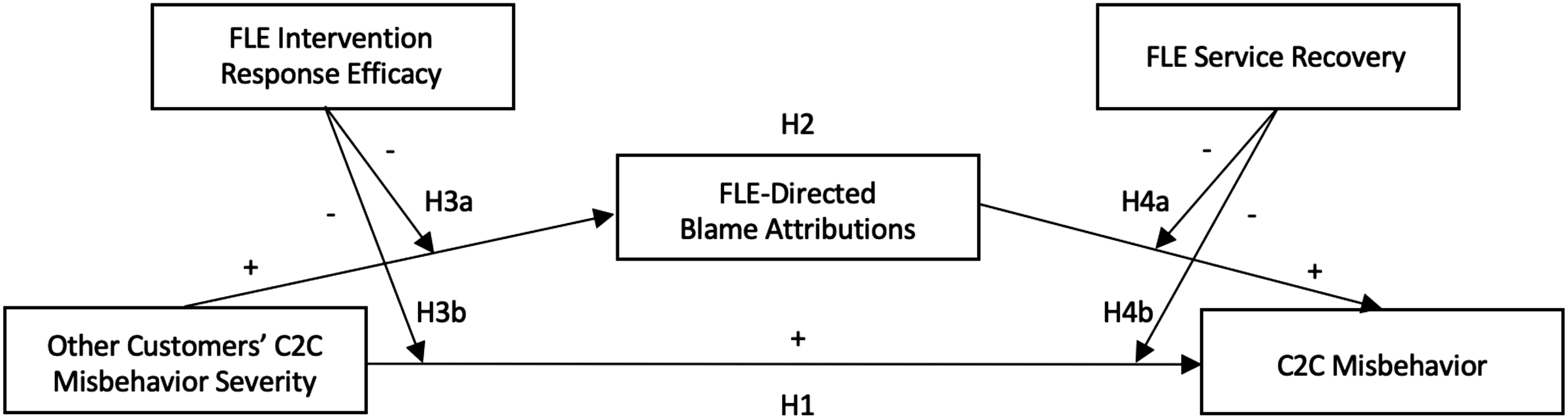
Hypothesis Development
C2C Misbehavior Severity and Contagion
According to social information processing theory, social information serves a dual purpose: (1) it forms norms and expectations and justifies reasoning about the acceptability of certain behaviors in social contexts, and (2) it determines whether these behaviors are worthy of mimicry given their consequences (Ferguson and Barry 2011). In settings in which C2C interactions are integral, one of the most salient social cues customers may use to inform their conduct is the behavior exhibited by other customers. Direct observation of C2C misbehavior consequently offers rich and salient cues about behaviors deemed acceptable and worthy of imitation, especially if negative consequences such as (in)formal sanctions imposed by people with higher source credibility because of power or authority (e.g., FLEs) remain absent (Zalesny and Ford 1990).
Prior research offers empirical support that observing deviant employee behavior can prime observers with antisocial thoughts so that they also display deviant behaviors toward innocent third parties such as coworkers (Porath and Erez 2007), family members (Hoobler and Brass 2006), or bystander customers. This contagion effect has also been observed in customer misbehavior. Harris and Reynolds (2003) provide initial qualitative evidence of how illegitimate complaints by other customers can have a negative “domino effect” on the conduct of nearby customers who witness this behavior. Similarly, Chen et al. (2020) find how observing other customers’ complaint behavior increases customers’ complaint intentions while Shen et al. (2020) show that video game players’ mere exposure to toxic behavior increases their chances of becoming toxic themselves.
Social information processing theory further posits that more ambiguous situations will likely increase the impact of social cues on behavior (Zalesny and Ford 1990). Yet the situational ambiguity involved in observed C2C misbehavior is likely to vary depending on its outcome severity. Outcome severity can be understood as the magnitude of perceived harm that an act of misbehavior inflicts upon others (Fisk et al. 2010). Harm can be either tangible (e.g., financial loss) or intangible (e.g., inconvenience, frustration, or anger) (Huang 2008). Increased ambiguity will motivate customers to seek greater clarity from relevant social cues (e.g., misbehaving customers) and to engage in similar behaviors in line with what they deem appropriate in a given social context (Salancik and Pfeffer 1978). Thus:
The higher the perceived severity of other customers’ C2C misbehavior, the more likely will other customers’ C2C misbehavior be contagious.
The Mediating Role of FLE-Directed Blame Attributions
Following attribution theory (Weiner 1985, 2001), other customers’ C2C misbehavior can be understood as a negative outcome that FLEs “should” have controlled and that only occurred because FLEs were negligent in how they provided the service. That is, “a moral code of conduct has been broken” (Weiner 2001, p. 385) by the FLEs in the eyes of affected customers who subsequently are more likely to attribute responsibility, and thus blame, to FLEs. Previous empirical research supports this reasoning (e.g., Huang 2008; Huang, Lin, and Wen 2010). Notably, blaming FLEs for other customers’ C2C misbehavior does not preclude customers from also blaming the perpetrators (Rummelhagen and Benkenstein 2017). Tennen and Affleck (1990, pp. 219–221) further specify that people will be more likely to engage in attributional search “when the outcome is severe…because a more threatening event demands an explanation to help the victim create a sense of meaning.” This reasoning aligns with extant empirical work. For example, Shaver (1970) first found and formalized a positive link between outcome severity and responsibility attributions in his defensive attribution theory, while more recent meta-analyses confirm this positive relationship (Gilbert 2021; Robbennolt 2000). Thus, we posit controllability judgments (and thus FLE-directed blame attributions) to be greater, the higher customers judge the severity of other customers’ C2C misbehavior.
Attribution theory (Weiner 2006, p. 33) further suggests that an individual’s “judgment of responsibility, in turn, produces antisocial behavioral reactions including … retaliation.” This is because responsibility judgments fuel the victim’s sensitivities to perceived injustices related to harm caused by the moral violations of another person (Hegtvedt, Thompson, and Cook 1993; Kidd and Utne 1978). Thus, when customers blame FLEs for a controllable negative outcome such as other customers’ C2C misbehavior, customers seek retributive punishment to those they hold responsible for restoring justice. One form retribution can take is to equally engage in misbehavior against other innocent customers, especially when the victim and those held responsible for the misbehavior (i.e., FLEs) possess different levels of power (Marcus-Newhall et al. 2000). Additionally, other innocent customers are more convenient targets with whom customers interact more frequently and who are less able or likely to retaliate than FLEs. Finally, innocent others might represent less risky targets than the initial perpetrator (whose targeting would constitute direct revenge) given higher concerns of further retaliation by the perpetrator (Marcus-Newhall et al. 2000). Prior retaliation research provides ample empirical evidence on how immoral retaliation may “spill over” to innocent parties in response to inadequate supervision, both in the context of deviant customer behavior (e.g., Komarova Loureiro, Haws, and Bearden 2018; McColl-Kennedy et al. 2009) and deviant employee behavior (e.g., Mackey et al. 2018; Robinson, Wang, and Kiewitz 2014). Overall, we posit:
FLE-directed blame attributions mediate C2C misbehavior contagion in such a way that the more severe customers perceive other customers’ C2C misbehavior, the more they blame FLEs for it and the more they engage in C2C misbehavior themselves.
The Moderating Role of FLE Intervention Response Efficacy
When confronted with C2C misbehavior, customers typically expect FLEs to intervene and enforce service rules to halt it (Baker and Kim 2018). Building on social information processing theory, we argue that customers observing FLE interventions in response to C2C misbehavior will judge the misbehavior as less acceptable and less worthy of imitation considering FLEs’ display of disapproval (Ferguson and Barry 2011). FLE interventions, therefore, decrease the situational ambiguity involved in C2C misbehavior in a social setting because they serve as additional, more salient, social cues guiding one’s behavior (Zalesny and Ford 1990). Drawing on attribution theory (Weiner 2001), we also expect customers to hold FLEs less responsible for the occurrence of C2C misbehavior (and thus, judge the incivility of other customers to be less under their control) when they see FLEs actively enforcing service rules and sanctioning C2C misbehavior. Conversely, FLE inaction leaves ample room for interpretation of whether FLEs approve of the C2C misbehavior (thus, enhancing situational ambiguity) while also providing evidence for FLE negligence, which may subsequently fuel FLE-directed blame.
However, the degree to which FLE interventions will both discourage imitation and reduce controllability judgments (and thus, reduce contagion) depends on customers’ perceived response efficacy. Rooted in the concept of outcome expectancy (Maddux, Sherer, and Rogers 1982), response efficacy describes the extent to which a customer believes an FLE intervention can effectively mitigate C2C misbehavior. Customers will likely perceive FLE interventions as more effective the less ambiguous or “amenable to differential interpretation and evaluation” (Chaiken and Maheswaran 1994, p. 469) they are in terms of (1) their response action, (2) their target, and (3) their form of delivery. For instance, FLE interventions may be seen as more effective, the more explicit they are (e.g., disapproving looks vs. concrete actions), the more unequivocally they target misbehaving customers (e.g., general announcements, reminding everyone to adhere to applicable norms or rules vs. personalized announcements specifically targeting perpetrators), and the more the FLEs are personally involved in their delivery (vs. remote delivery), referring to the “proportion of total effort and responsibility [FLEs are seen to have] devoted to correcting the wrong” (McLain and Keenan 1999, p. 257). Notably, remote delivery (e.g., through loudspeakers) can be paramount to FLEs’ physical safety or psychological well-being, especially when FLEs need to enforce unpopular service rules (e.g., adherence to face-mask regulations) which may carry higher risks of hostile customer reactions (Northington et al. 2021). FLEs are consequently often confronted with a trade-off between safety and response-efficacy considerations when choosing between available response options. Overall, we posit:
The degree of perceived response efficacy of FLE interventions moderates C2C misbehavior contagion, such that as response efficacy increases, the effects of other customers’ C2C misbehavior severity on a) FLE-directed blame attributions and b) C2C misbehavior are attenuated.
The Moderating Role of FLE Service Recovery
Instead of focusing on misbehaving customers, FLEs could focus on the victims of such behavior by engaging in service recovery. Service recovery can entail only social compensation such as explanations, apologies, and acknowledgment of the problem but it may also include economic compensation such as refunds, vouchers, or discounts (Smith, Bolton, and Wagner 1999). Prior research suggests that customers form higher expectations about appropriate recovery levels, the higher they judge the severity of the C2C misbehavior (Huang 2008) and the more they blame the firm or its FLEs for controllable failures (Hess, Ganesan, and Klein 2003).
Accordingly, we posit that offering a combination of social and economic compensation will weaken the direct effect of other customers’ C2C misbehavior severity on C2C misbehavior. Building on social information processing theory, we argue that such FLE service recovery will generate strong organizational service climate perceptions, referring to a “customer’s perception of the extent to which a service organization teaches, prioritizes, and recognizes outstanding customer service through organizational practices and procedures” (Jung, Yoo, and Arnold 2017, p. 428). Strong climate perceptions, in turn, constitute critical social cues for customers, clearly signaling that FLEs consider C2C misbehavior a service failure as it is deserving of even economic compensation while also increasing FLEs’ source credibility who are seen to be willing to go the extra mile to address experienced losses (Zalesny and Ford 1990). A strong service climate therefore underscores FLEs’ commitment to building better customer relationships, acting as a situational enhancer that has also been found to temper negative customer behaviors in response to C2C misbehavior (Jung, Yoo, and Arnold 2017). In contrast, social compensation alone will fail to generate such strong perceptions of service excellence. Instead, FLEs will be regarded as incompetent or unwilling to adequately make up for customer losses which will reduce their source credibility, so customers will be less likely to comply with FLEs.
Drawing on attribution theory, we further expect FLE service recovery that entails both social and economic compensation to attenuate the negative effect of FLE-directed blame attributions on C2C misbehavior. This is because offering social and economic compensation will alleviate customers’ injustice perceptions associated with FLEs’ negligence in properly controlling other customers’ C2C misbehavior (Hegtvedt, Thompson, and Cook 1993; Kidd and Utne 1978). While customers will continue to blame FLEs for the misbehavior, they will be less likely to retaliate with C2C misbehavior given they are adequately compensated for losses experienced. In contrast, social compensation alone will fail to resolve such injustice perceptions. Not only will FLE-directed blame attributions continue to drive contagion but this effect might even be strengthened given social compensation alone may be seen as an insufficient, if not insincere, response to one’s voiced dissatisfaction, and thus as added evidence of FLEs’ incompetence (Hess, Ganesan, and Klein 2003). Attribution theory (Weiner 2001) also posits that repeated FLE failures (i.e., failure to prevent the misbehavior and failure to recover subsequent losses) may lead customers to infer these failures follow stable patterns. Such stable attributions, in turn, may lead to enhanced discontent and greater retributive actions, including more C2C misbehavior. Thus:
FLEs offering social and economic compensation (vs. social compensation alone) to the victims of C2C misbehavior will reduce (increase) C2C misbehavior contagion in such a way that it will attenuate (strengthen) the effects of a) FLE-directed blame attributions and b) other customers’ C2C misbehavior severity on C2C misbehavior.
Overview of Studies
We conducted two online experiments and one field experiment (see Web Appendix 1 for an overview). Study 1 examines our baseline model in a co-working context, investigating C2C misbehavior contagion when FLEs are present (H1) and whether FLE-directed blame attributions mediate this contagion (H2). Study 1 also examines the mediating role of perceived social norms as a rival contagion mechanism. Study 2 replicates Study 1 in an airline context and examines the moderating role of FLE intervention response efficacy and FLE service recovery in curbing C2C misbehavior contagion (H3a, H3b, H4a, and H4b). It also examines whether changes in affective states (i.e., emotional contagion) mediate C2C misbehavior contagion. Finally, Study 3 explores C2C misbehavior contagion in a real-world setting (i.e., rail travel) and compares FLE interventions that differ in their level of perceived response efficacy and FLE safety.
Study 1
Method and Materials
Study 1 employed an online scenario experiment with other customers’ C2C misbehavior severity as the between-subjects factor (low, medium, and high) in a co-working context. A total of 203 Prolific.co respondents from the U.S. participated in the study for monetary compensation in July 2021. To increase data quality, we used screeners (Arndt et al. 2022): 20 respondents failed the attention check and two sped through the survey (first percentile of the sample), resulting in a final sample of 181 respondents (48.6% female, Mage = 36.2 years).
First, we asked respondents to imagine they were members of a co-working space. They read that they share a large open table with other customers in a “quiet zone” where talking is prohibited as they work to meet an important deadline in a few hours. Respondents observe one FLE behind the reception desk and another FLE floating around the workspace. Next, a new customer arrives and takes a seat at their table beside another customer, who they seem to know. In Study 1, we manipulated other customers’ C2C misbehavior severity through the extent to which these two customers make noise in this “quiet zone.” In the low severity condition, respondents observe the two customers briefly greeting each other and occasionally whispering while one of them also starts quietly listening to a video call through headphones; a call everyone at the table can hear slightly. In the medium severity condition, both customers stand to greet and hug each other, casually joking and talking, while one of them also starts participating in a video call, speaking occasionally using headphones. Everyone else at the table can clearly hear the conversation. Finally, in the high severity condition, the two customers stand to greet and hug each other at length while continuing to talk loudly, often sharing jokes and bursting into loud laughter. Again, one of them also starts participating in a video call but this time without headphones, talking often and loudly, so that everyone at the table can clearly follow the conversation.
After reading the scenario, respondents indicated their intentions to engage in several C2C misbehaviors themselves, for example, starting to talk to other customers in the quiet zone, leaving some trash on the desk before leaving, taking a page from someone else’s writing pad while they are gone (seven items, 1 = extremely unlikely, 9 = extremely likely, α = .93). Next, respondents rated their attitudes toward the service provider (three items, 1 = very negative, 9 = very positive, α = .97), how much they blame the FLEs for the other customers’ C2C misbehavior (1 = not to blame at all, 9 = entirely to blame), how much they blame the misbehaving customers (1 = not to blame at all, 9 = entirely to blame), and their perceptions of prevalent social norms at this co-working space (three items, e.g., other customers would talk to other customers despite being in the designated quiet zone, 1 = extremely uncommon, 9 = extremely common, adapted from Schaefers et al. 2016, α = .84). Next, respondents rated other customers’ C2C misbehavior severity (three items, 1 = mildly severe, 9 = highly severe, α = .76), answered an attention check about others’ C2C misbehavior and four control variables: their tendency to respond in a socially desirable manner (six true-false-items, Donavan, Brown, and Mowen 2004), age, gender, and prior experiences using a co-working service.
Results
Manipulation Checks
Respondents evaluated the severity of other customers’ C2C misbehavior as expected (MLow = 4.62, SD = 1.83, MMedium = 5.47, SD = 1.70, MHigh = 6.50, SD = 1.81, F (2, 178) = 19.76, p < .001, all pairwise comparisons: p < .05).
The Effect of Other Customers’ C2C Misbehavior Severity on C2C Misbehavior and the Mediating Role of FLE-Directed Blame Attributions
We ran a mediation analysis (PROCESS model 4, 5000 bootstrap samples, and heteroscedasticity-consistent standard errors, 1 Hayes 2022) to test H1 and H2 with other customers’ C2C misbehavior severity as the independent variable, FLE-directed blame attributions as the mediator, C2C misbehavior as the dependent variable, and the control variables as covariates. Our results show no significant direct effect of other customers’ C2C misbehavior severity on C2C misbehavior (b = −.14, SE = .16, p = .36). Thus, H1 is not supported but we find strong support for H2. The main effect of other customers’ C2C misbehavior severity on FLE-directed blame attributions is positive and significant (b = .91, SE = .21, p < .001). That is, the higher customers judge the severity of other customers’ C2C misbehavior, the more they blame the FLEs for this misbehavior. Furthermore, the main effect of FLE-directed blame attributions on C2C misbehavior is positive and significant (b = .14, SE = .05, p < .01). Notably, we find a significant indirect-only mediation effect (Zhao, Lynch, and Chen 2010), i.e., the effect of other customers’ C2C misbehavior severity on C2C misbehavior is mediated by FLE-directed blame attributions (b = .13, SEboot = .06, CI95 [.04; .28], see Web Appendix 2). Overall, our results imply that C2C misbehavior is contagious, and that this contagiousness is driven by FLE-directed blame attributions. The more severely customers judge other customers’ C2C misbehavior, the more they blame FLEs for it, which subsequently drives C2C misbehavior contagion.
Post-hoc Analyses
We explored the role of perceived social norms and perpetrator-directed blame attributions as additional mediators. We tested a mediation model that was specified as above (PROCESS model 4) and added perceived social norms and perpetrator-directed blame attributions as parallel mediators. Results show that FLE-directed blame attributions (b = .08, SEboot = .05, CI95 [.01; .20]) and perpetrator-directed blame attributions (b = −.10, SEboot = .05, CI95 [−.21; −.01]) significantly mediate the relationship between other customers’ C2C misbehavior severity and C2C misbehavior. Notably, FLE-directed blame attributions increase C2C misbehavior while perpetrator-directed blame attributions decrease it. Social norms do not serve as a mediator (b = .04, SEboot = .04, n.s.).
To investigate whether C2C misbehavior contagion extends beyond simple tit-for-tat reciprocity of observed C2C misbehavior (e.g., Schaefers et al. 2016; Shen et al. 2020), we conducted a more fine-grained analysis of our contagion effects. Specifically, we ran the same mediation analysis as described above to test H1 and H2 but, a) with only “related C2C misbehavior” as our dependent variable, i.e., acts of C2C misbehavior identical in nature to the observed C2C misbehavior (e.g., talking in the quiet zone) and b) with “unrelated C2C misbehavior” as our dependent variable, i.e., acts of C2C misbehavior that differ from the observed C2C misbehavior (e.g., leaving trash). Results of both analyses show the same patterns: We find no support for H1 but support for H2 (see Web Appendix 2 for details). Thus, contagion is not limited to the spread of similar C2C misbehavior, as the spread can also spill over to C2C misbehaviors unrelated to the perpetrator’s initial transgression.
We were further interested in the effect of other customers’ C2C misbehavior severity on service provider attitudes and the mediating role of FLE-directed blame attributions. We specified a mediation model that equaled our test for H1 and H2 but with service provider attitudes as the dependent variable. We find a significant negative direct effect of other customers’ C2C misbehavior severity on service provider attitudes (b = −.59, SE = .19, p < .01) and a mediation via FLE-directed blame attributions (b = −.16, SEboot = .07, CI95 [−.31; −.03]). That is, the higher the customers judge the severity of other customers’ C2C misbehavior, the more they blame FLEs for other customers’ misbehavior (b = .91, SE = .21, p < .001) which decreases attitudes toward the service provider (b = −.17, SE = .07, p < .05).
Study 2
Study 2 intends to replicate Study 1’s findings in an alternative setting (H1, H2). In addition, we control for emotional contagion as a potential alternative mediator in our model, and we test whether FLE intervention response efficacy and FLE service recovery influence blame attributions toward FLEs (H3a, H4a) and C2C misbehavior contagion (H3b, H4b).
Method and Materials
A total of 894 Prolific.co respondents from the U.S. participated in a 3 (FLE intervention response efficacy: none: FLE inaction vs. low: general loudspeaker announcement vs. high: personalized loudspeaker announcement) × 2 (FLE service recovery: social compensation vs. social and economic compensation) between-subjects design online experiment for monetary compensation. Data collection took place in March 2022. To increase data quality, we used the same screeners as in Study 1 (Arndt et al. 2022): 95 respondents failed the attention check and eight respondents sped through the survey (first percentile of the sample), resulting in a final sample of 791 respondents (60.4% female, age-category median = 30–39 years).
At the start of the survey, respondents indicated their current positive and negative affective states (10 items, e.g., attentive, upset, 1 – not at all, 9 – extremely; Thompson 2007). After answering some sociodemographic questions (age, gender, and native language), respondents had to imagine they were on a flight. Because of the COVID-19 pandemic, face mask use on the plane was mandatory. They read that they were seated near a couple who removed their masks after take-off. Respondents read that they discreetly informed one flight attendant about the couple’s behavior. The attendant either thanked the respondent (service recovery: social compensation) or thanked them and gave them a $50 voucher (service recovery: social and economic compensation). After returning to their seats, the attendant either took no action (no response efficacy condition) or made a loudspeaker announcement in which either all passengers were reminded to adhere to face-mask regulations and non-compliance would yield a large fine (low response efficacy condition), or in which the couple was called out and threatened with a large fine (high response efficacy condition).
After the scenario, respondents were asked to recall the FLE’s reaction toward the couple. This question served as our attention check. Next, respondents indicated again their current positive and negative affective states (same items as above, Thompson 2007). Following prior research in capturing emotional contagion (e.g., Hennig-Thurau et al. 2006), we employed these measures before and after the scenario to calculate scores of changes in positive and negative affect resulting from reading the scenario. Next, respondents were shown a list of 10 behaviors common on airplanes and asked to indicate how likely they were to engage in the listed behaviors, for example, reading the onboard magazine (1 = very unlikely, 9 = very likely). Among these behaviors were five C2C misbehaviors (e.g., removing your face mask, leaving trash around your seat). We used the average scores of these misbehaviors to calculate our focal dependent variable (i.e., C2C misbehavior).
Next, respondents rated attitudes toward the service provider (three items, e.g., 1 = very negative, 9 = very positive, α = .98) and answered how much they blame the FLEs for the other customers’ C2C misbehavior (FLE-directed blame attributions; 1 = not to blame at all, 9 = entirely to blame) and how much they blame the misbehaving couple (perpetrator-directed blame attributions; 1 = not to blame at all, 9 = entirely to blame). Next, respondents indicated their perceptions of prevalent social norms on the described flight (10 items, including five C2C misbehaviors, e.g., other customers would take off their face masks, 1 = extremely uncommon, 9 = extremely common, adapted from Schaefers et al. 2016). We used the average of the five misbehaviors’ social norm perceptions to calculate “C2C misbehavior social norms” (α = .87). Next, we asked respondents to evaluate the response efficacy of the FLE’s intervention targeting the couple (1 = ineffective, 9 = effective) and to rate the FLE’s service recovery toward the respondent (three items, e.g., 1 = poor, 9 = excellent, α = .96, Hess, Ganesan, and Klein 2003). Next, respondents rated the couple’s behavior to measure “C2C misbehavior severity” (four items, e.g., 1 = mildly severe, 9 = highly severe, α = .91). Finally, as further control variables, respondents indicated their emotional expressivity (Berkeley Expressivity Questionnaire (BEQ), BEQ negative expressivity: four items, α = .79; BEQ positive expressivity: six items, α = .90; Gross and John 1997), their tendency for socially desirable responding (six items, 0 = false, 1 = true, Donavan, Brown, and Mowen 2004), and their previous experience with flying with a face mask (0 = no, 1 = yes).
Results
Manipulation Checks
Respondents evaluated the response efficacy of FLE interventions (MNone = 2.03, SD = 1.73, MLow = 5.82, SD = 2.53, MHigh = 6.91, SD = 2.52, F (2, 788) = 325.32, p < .001, all pairwise comparisons: p < .05) and FLE service recovery measures (MSocial compensation = 6.16, SD = 2.33, MSocial and economic compensation = 7.25, SD = 2.22, F (1, 789) = 45.46, p < .001) in line with our intended manipulations.
The Effect of FLE Intervention Response Efficacy on FLE-Directed Blame Attributions and C2C Misbehavior Contagion
We tested H3a and H3b with a moderated mediation model (PROCESS model 8, Hayes 2022). Other customers’ C2C misbehavior severity was included as the independent variable, FLE-directed blame attributions as the mediator, FLE intervention response efficacy (none: FLE inaction vs. low: general announcement vs. high: personalized announcement) as the moderator, C2C misbehavior as the dependent variable, and gender, age, FLE service recovery, experience with flying with a face mask, tendency for socially desirable responding, BEQ positive, and BEQ negative as covariates.
First, and contrary to H1, we find a negative direct effect of other customers’ C2C misbehavior severity on C2C misbehavior (b = −.09, SE = .03, p < .01). Second, we find a positive effect of other customers’ C2C misbehavior severity on FLE-directed blame attributions (b = .73, SE = .10, p < .001) and, in support of H3a, a significant interaction effect of FLE intervention response efficacy and other customers’ C2C misbehavior severity on FLE-directed blame attributions (b = −.28, SE = .04, p < .001). When the FLE does not act (no response efficacy condition, b = .45, SE = .06, p < .001) and when the FLE makes a general announcement (low response efficacy condition, b = .16, SE = .04, p < .001) we find a significant positive effect of other customers’ C2C misbehavior severity on FLE-directed blame attributions. However, this effect reverses when the FLE makes a personalized announcement (high response efficacy condition, b = −.12, SE = .05, p < .05, see Figure 2). The influence of FLE intervention response efficacy (RE) on the effect of other customers’ C2C misbehavior severity on (a) FLE-directed blame attributions, (b) C2C misbehavior, and (c) attitudes toward the service provider (Study 2).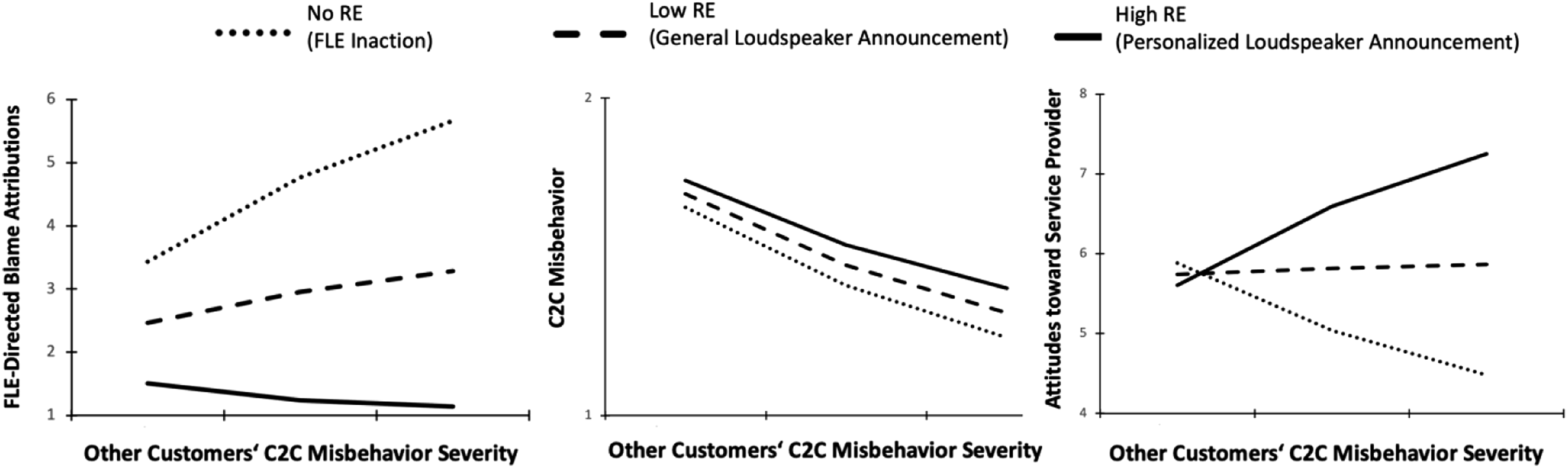
In support of H2, we find a mediation effect of FLE-directed blame attributions. This effect is moderated by FLE intervention response efficacy (Index = −.02, SEboot = .01, CI95 [−.03; −.01]). Specifically, FLE-directed blame attributions mediate the relationship between other customers’ C2C misbehavior severity and C2C misbehavior when the FLE does not act (no response efficacy condition, b = .02, SEboot = .01, CI95boot [.01; .04]), when the FLE makes a general announcement (low response efficacy condition, b = .01, SEboot = .003, CI95boot [.003; .02]), and when the FLE makes a personalized announcement (high response efficacy condition, b = −.01, SEboot = .004, CI95boot [−.02 ; −.001]). Note, in the latter condition, the effect reverses, that is, reduced blame attributions attenuate C2C misbehavior. Finally, we find no interaction between other customers’ C2C misbehavior severity and FLE intervention response efficacy on C2C misbehavior (b = .01, SE = .02, p = .65), thus H3b is not supported.
The Effect of FLE Service Recovery on the Effects of FLE-Directed Blame Attributions and C2C Misbehavior Contagion
We use a moderated mediation model (PROCESS model 15, Hayes 2022) to test H4a and H4b. We included other customers’ C2C misbehavior severity as the independent variable, FLE-directed blame attributions as the mediator, FLE service recovery (social compensation vs. social and economic compensation) as the moderator, C2C misbehavior as the dependent variable, and our control variables (including FLE intervention response efficacy) as covariates. H4a posits an interaction of FLE-directed blame attributions and FLE service recovery on C2C misbehavior. Our results do not support this hypothesis (b = .02, SE = .03, p = .35). Putting it differently, the mediation effect of FLE-directed blame attributions does not depend on FLE service recovery (Index = .004, SEboot = .01, CI95 [−.004; .01]) but is positive and significant in both service recovery conditions (bSocial compensation = .01, SEboot = .01, CI95 [.002; .01]; bSocial and economic compensation = .01, SEboot = .01, CI95 [.003; .02]). Furthermore, and contrary to H4b, FLE service recovery does not interact with other customers’ C2C misbehavior severity on C2C misbehavior (b = .04, SE = .03, p = .15). Stated differently, the negative direct effect of other customers’ C2C misbehavior severity on C2C misbehavior is independent of FLE service recovery (bSocial compensation = −.09, SE = .02, p < .001, bSocial and economic compensation = −.06, SE = .02, p < .01).
Post-hoc Analyses
To gain additional insights into alternative rival mediators, we ran a mediation model (PROCESS model 4, Hayes 2022) with other customers’ C2C misbehavior severity as the independent variable, C2C misbehavior as the dependent variable, our control variables as covariates, and five parallel mediators: FLE-directed blame attributions, perpetrator-directed blame attributions, C2C misbehavior social norms, change in positive affective state, and change in negative affective state. Results show that only FLE-directed blame attributions and perpetrator-directed blame attributions significantly mediate the relationship between other customers’ C2C misbehavior severity and C2C misbehavior but in opposite directions (bFLE-directed blame attributions = .01, SEboot = .003, CI95 [.001; .01]; bperpetrator-directed blame attributions = −.03, SEboot = .01, CI95 [−.04; −.02]). These results rule out social norm perceptions (b = .01, SEboot = .00, n.s.) and emotional contagion (bpositive change = −.003, SEboot = .00, n.s.; bnegative change = −.001, SEboot = .00, n.s.) as mediators.
As in Study 1, we repeated our hypotheses tests but, a) with “related C2C misbehavior” (i.e., remove face mask) and b) with “unrelated C2C misbehavior” (e.g., leave trash) as our dependent variables (see Web Appendix 3). For “related C2C misbehavior” we find the same result patterns as described above, that is, a significant negative direct effect of C2C misbehavior severity on “related C2C misbehavior” and we find support for H2 and H3a but not for H3b, H4a, and H4b. However, for “unrelated C2C misbehavior,” the direct effect of severity on C2C misbehavior on “unrelated C2C misbehavior” is absent (as in Study 1), yet again, we find support for H2 and H3a but not for H3b, H4a, and H4b.
Furthermore, we tested the effect of FLE intervention response efficacy and FLE service recovery on attitudes toward the service provider. First, we ran the moderated mediation model as described above (H3a and H3b) but with service provider attitudes as the dependent variable (PROCESS model 8, Hayes 2022). Results show a significant interaction between other customers’ C2C misbehavior severity and FLE intervention response efficacy on service provider attitudes (b = .31, SE = .05, p < .001). Specifically, service provider attitudes are negatively affected by other customers’ C2C misbehavior severity when the FLE does not act (no response efficacy condition, b = −.28, SE = .05, p < .001) but increase when the FLE makes a personalized announcement (high response efficacy condition, b = .33, SE = .07, p < .001). There is no effect when the FLE makes a general announcement (low response efficacy condition, b = .02, SE = .04, p = .51). Next, we find a moderated mediation effect of FLE-directed blame attributions on the relationship between other customers’ C2C misbehavior severity and service provider attitudes (Index = .11, SEboot = .02, CI95 [.07; .16]). Mirroring the findings for C2C misbehavior, the conditional indirect effects mediated by FLE-directed blame attributions are negative when the FLE does not act (no response efficacy condition, b = −.18, SEboot = .03, CI95boot [−.24; −.12]), and when the FLE makes a general announcement (low response efficacy condition, b = −.07, SEboot = .02, CI95boot [−.10; −.04]) but positive when the FLE makes a personalized announcement (high response efficacy condition, b = .05, SEboot = .02, CI95boot [.01; .10]). When looking at the effect of FLE service recovery on service provider attitudes using PROCESS model 15 (Hayes 2022), we find neither a direct effect of FLE service recovery on service provider attitudes (b = .79, SE = .48, p = .10), nor an interaction of other customers’ C2C misbehavior severity and FLE service recovery on service provider attitudes (b = −.03, SE = .08, p = .68), nor a moderated mediation effect (Index = −.02, SEboot = .01, CI95 [−.04; .01]).
Overall, our findings show that FLEs can reduce C2C misbehavior contagion and increase service provider attitudes through FLE interventions while service recovery is ineffective in curbing the spread of C2C misbehavior.
Study 3
In Study 3, we tested our main assumption of the prevalence of C2C misbehavior contagion and the effectiveness of FLE interventions in a real-world setting. We conducted a field experiment in cooperation with a large railway company in Germany. C2C misbehavior regularly occurs when customers are awaiting the arrival of their train on the platform, for example, customers smoke outside of designated areas or fail to properly dispose of garbage or adhere to face-mask regulations. FLEs are instructed to enforce service rules respectfully. However, verbal and physical aggressions against railway workers have increased considerably since the start of the pandemic, affecting not only FLEs’ stress levels and job satisfaction but also their very safety when asked to enforce often unpopular service rules (Northington et al. 2021). Thus, in Study 3, we test three FLE interventions that differ both in their response efficacy and FLE safety level. The interventions (and expected efficacy and safety levels) were determined in discussion with the FLEs of the railway firm.
Method and Materials
In this field experiment, we observed actual train customers at a large German train station on four weekdays in the first week of October 2021. We collected data on 980 train customers (47.2% female, age category <30 years = 40.1%, age category 30–60 years = 44.6%, age category >60 = 15.3%) across 81 separate experimental runs. We ran the experiment on two large platforms with multiple sections used for long-distance trains. We were able to change the platform and/or section between runs to avoid customers becoming aware of the study. This study employed a mixed design with one within-subjects factor (other customers' C2C misbehavior stage) and one between-subjects factor (FLE intervention response efficacy).
Specifically, we observed train customers as they awaited trains on the platform. We were interested in their response to another customer’s C2C misbehavior and subsequent FLE interventions. We engaged two male actors for the study who took turns acting as regular customers on the platform. Both actors were instructed to engage in C2C misbehavior by violating prevalent social norms and explicit service rules. To test FLE interventions, four actual FLEs of the service provider took turns in responding to the actor’s behavior. We employed different actors and different FLEs to avoid the unique effects of a particular person. Notably, our results do not change when we control for the specific actor and the specific FLE. Finally, we employed an experienced professional field study observer who covertly observed and coded instances of C2C misbehavior. Neither the actors, nor the FLEs, nor the observer were aware of our specific hypotheses.
Each experimental run comprised three stages in which we observed customers who waited near the actor. Observed instances of C2C misbehavior were counted as “1” when a customer on the platform engaged in at least one of the following C2C misbehaviors: improper garbage disposal, smoking outside the smoking areas, not wearing, or removing their face mask, verbal or physical harassment, and noisy behavior. Our dependent variable “C2C misbehavior” is a relative value of the number of customers who engaged in C2C misbehavior within one experimental run versus the number of customers who did not. Furthermore, we coded some contingent variables (age group; gender; and whether the customer waited alone, in twos, or in a group) for every customer. We had some missing data for the covariates, leading to a final sample of 967 customers.
Each experimental run started with an observation of about 10 customers who waited on the train platform for about 3.5 min as a baseline measure (Stage 1). Next, the actor began misbehaving (Stage 2, about 3.5 min). The actor’s behavior was the same across experimental runs. He received a call on a smartphone with a very loud and obtrusive ringtone to provoke the attention of surrounding customers. He answered the fake call and pretended to loudly talk to friends. During the call, he removed his face mask and began smoking, although he was far from any designated smoking area. While still on the phone, he visibly disposed of his face mask and continued smoking (see Web Appendix 4). Finally, we introduced an FLE intervention (Stage 3, about 3.5 min, with low, high, or very high response efficacy). An actual uniformed FLE walked along the platform and responded to the actor in three different ways. Either the FLE passed closely and looked disapprovingly at the actor (low response efficacy condition, n = 269). Alternatively, the FLE was not present on the platform (lower safety risk) but prompted a personalized loudspeaker announcement specifically calling out the actor, asking him politely yet assertively, to follow house rules. It was clear to other customers that the announcement was meant for the actor, as it referred to the specific train platform and section as well as to the color of the actor’s green baseball cap or bright yellow hat (high response efficacy condition, n = 229). Finally, we tested an intervention that FLEs of the railway firm assumed to be of higher response efficacy but of higher safety risk: the FLE directly approached the actor and asked him politely to follow house rules (very high response efficacy condition, n = 226). In response to all FLE interventions, the actor stopped misbehaving. As a control condition, we extended the observation duration of Stage 2 and measured C2C misbehavior when FLEs were neither present nor acted otherwise (no response efficacy condition, n = 243).
Results
As we observed behaviors by the same individuals across three points in time under various conditions, we submitted measures of C2C misbehavior at Stages 1, 2, and 3 to a repeated measures mixed ANOVA. We specified the three experimental stages (other customers’ C2C misbehavior stage) as the within-subjects factor, FLE intervention response efficacy as the between-subjects factor, and we included customers’ age category (three categories: <30 years, 30–60 years, >60 years), gender, and social constellation (alone, in twos, in a group) as covariates. Note that the manipulation of FLE intervention response efficacy was only introduced in Stage 3. Since we are interested in the interventions’ potential to reduce C2C misbehavior, we included this between-subjects factor for all three stages to control for C2C misbehavior differences before FLE intervention across response efficacy conditions. Our analyses applied Greenhouse–Geisser corrections and used follow-up tests with planned comparisons as simple contrasts and post-hoc tests using the Dunnett correction (Field 2018). Figure 3 illustrates the results of C2C misbehavior across the three experimental stages. Prevalence of C2C misbehavior (in percentages) across the three stages of the field experiment and dependent on FLE intervention response efficacy (RE) (Study 3).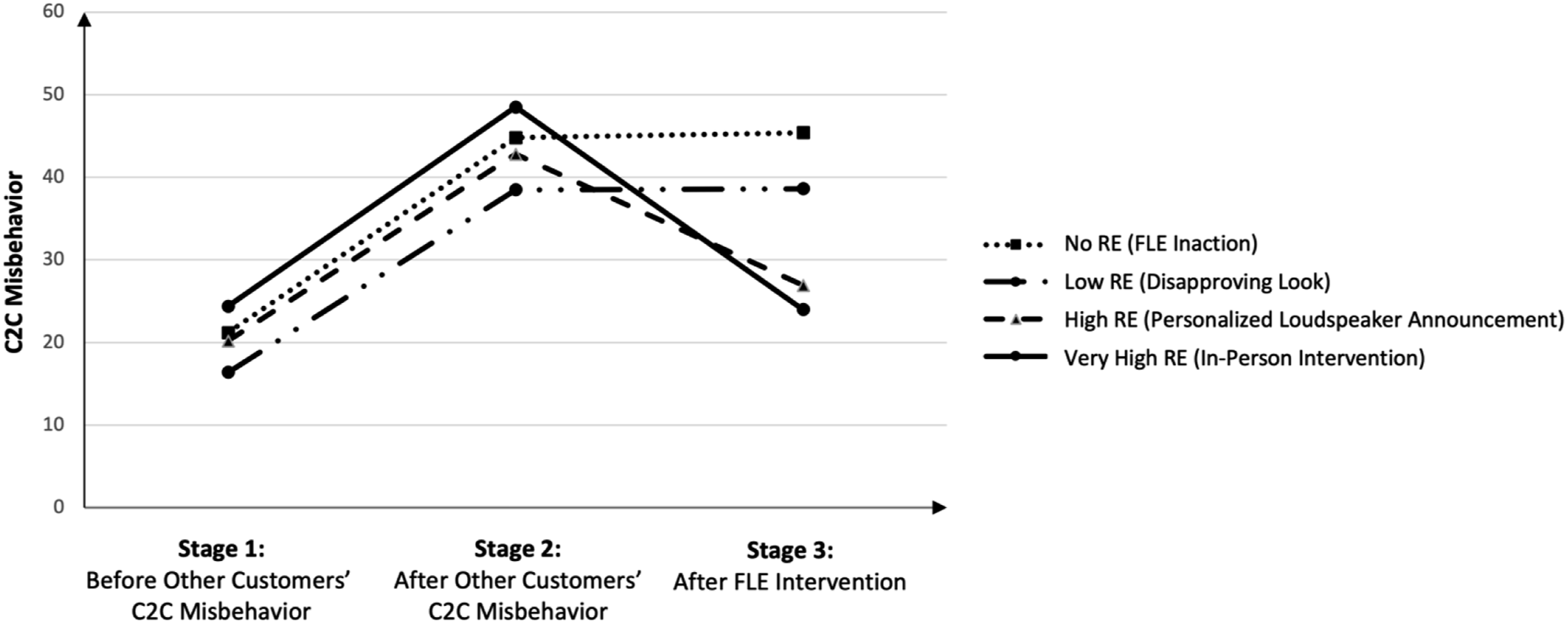
First, we tested for C2C misbehavior contagion. A significant main effect of the C2C misbehavior stage (F(2, 1883) = 20.514, p < .001, η2 = .021) shows an increase in C2C misbehavior from Stage 1 (M = .20, SD = .40) to Stage 2 (M = .43, SD = .50; F(1, 960) = 32.617, p = .001, η2 = .033). Thus, the results of the within-subjects contrasts provide real-life evidence of the contagiousness of C2C misbehavior.
Second, we analyzed the effect of the FLE interventions that differ in their response efficacy on C2C misbehavior (Stage 3). We find a significant interaction between response efficacy and other customers' C2C misbehavior stage on C2C misbehavior (F(6, 5648) = 11.208, p = .001, η2 = .034). Focusing on changes in C2C misbehavior between Stage 2 and Stage 3, we compared the estimated marginal means and their confidence intervals for C2C misbehavior in Stage 2 (before the intervention) and Stage 3 (after the intervention). Results show that the level of C2C misbehavior does not change when there was no FLE intervention (no response efficacy condition, estimated marginal meanStage 2 =.45, SE = .03; estimated marginal meanStage 3 = .45, SE = .03, confidence intervals overlap) and when the FLE looked disapprovingly (low response efficacy condition, estimated marginal meanStage 2 = .39, SE = .03; estimated marginal meanStage 3 = .39, SE = .03, confidence intervals overlap, see Web Appendix 5). In contrast, the personalized loudspeaker announcement (high response efficacy condition, meanStage 2 = .43, SE = .03; meanStage 3 = .27, SE = .03, confidence intervals do not overlap) and the in-person intervention (very high response efficacy condition, meanStage 2 = .49, SE = .03; meanStage 3 = .24, SE = .03, confidence intervals do not overlap) substantially reduce C2C misbehavior to a level equal to Stage 1 (before the actor began to misbehave).
A post-hoc ANOVA on the difference scores of C2C misbehavior between Stage 2 and Stage 3, including our control variables, confirms a main effect of FLE intervention response efficacy on the C2C misbehavior difference scores (F(6, 960) = 11.479, p = .001). Pairwise comparisons with Dunnett correction show that there is no significant difference in the effectiveness of FLE inaction (no response efficacy condition, M = .001, SE = .03) and when the FLE looked disapprovingly (low response efficacy condition, M = .001, SE = .02, p = .998). Notably, the personalized loudspeaker announcement (high response efficacy condition, M = −.159, SE = .03) and the in-person intervention (very high response efficacy condition, M = −.245, SE = .03, p = .055) are equally effective at reducing C2C misbehavior and both were superior compared to FLE inaction (no response efficacy condition) and disapproving looks (low response efficacy conditions) (for all comparisons p < .001).
In sum, Study 3 provides evidence for C2C misbehavior contagion and the efficacy of FLE interventions in a real-world setting. Importantly, our results indicate that FLEs can opt for interventions of lower response efficacy but higher FLE safety to curb C2C misbehavior.
Discussion
Theoretical Contributions
This paper critically advances research on C2C misbehavior in five important ways.
First, although recent studies provide initial evidence of C2C misbehavior contagion (e.g., Schaefers et al. 2016; Shen et al. 2020; Su et al. 2022), they disregard the complex dynamics underlying contagion in multi-actor settings when FLE supervision is present. In grounding our research in social information processing theory and attribution theory, we address this gap and account both for the social influence of misbehaving customers and FLEs alongside related cognitive processes. Our findings are the first to show that different forms of C2C misbehavior (e.g., noise, refusal to wear face masks) spread despite supervision by FLEs across both traditional (i.e., transportation) and access-based services (i.e., co-working). Hence, our research responds to calls to examine whether “the contagiousness of misbehavior found in the context of the sharing economy expands to other contexts” (Fombelle et al. 2020, p. 392) and specifically, to those in which FLEs are involved (Schaefers et al. 2016), thus contributing to a better understanding of the negative behavioral consequences of customer misbehavior both for FLEs and other customers (Fisk et al. 2010).
Second, our research clarifies how C2C misbehavior spreads by outlining the nature and direction of contagion. Specifically, we show that the severity of other customers’ C2C misbehavior (and not just its occurrence per se, see Schaefers et al. 2016) impacts the degree of contagion. Study 1 and Study 2 findings also show that C2C misbehavior is not simply reciprocated in a tit-for-tat fashion, as previous research suggests (e.g., Schaefers et al. 2016; Shen et al. 2020; Su et al. 2022). Instead, contagion can also “spill over” to misbehaviors unrelated to the initial transgression. Our findings consequently clarify the scope of C2C misbehavior contagion, which we define as the spread of C2C misbehavior both beyond the initial perpetrator and beyond simple tit-for-tat reciprocity, as victims target other innocent customers with misbehaviors that may be unrelated to the perpetrator’s initial transgression. Unexpectedly, Study 2 finds a negative direct effect of other customers’ C2C misbehavior severity on C2C misbehavior, suggesting that increased severity may also reverse contagion. Notably, we only observe this reversal for related (removal of face mask) but not unrelated misbehaviors (littering). Potential explanations might be increased personal health risks (masks are removed indoors in Study 2) or political identity signaling. That is, customers adhere to face mask regulations to showcase “correct behaviors” to perpetrators while signaling disassociation with the perpetrators’ identity group which they may suspect on the other side of the political spectrum. Either way, these findings add to social information processing theory by revealing customer-related conditions when one will not only disregard but act in opposition to salient social information (Zalesny and Ford 1990).
Third, this research is the first to uncover the psychological mechanisms underlying C2C misbehavior contagion, and thus why it spreads when FLEs are involved. Specifically, Study 1 and Study 2 findings show that contagion occurs because customers blame FLEs for other customers’ C2C misbehavior. Surprisingly, this positive mediation effect also holds in Study 2 where we observe a negative direct contagion effect. Such a competitive mediation is interesting as it suggests that customers are more willing to remove their face masks as a reaction to blaming FLEs despite their otherwise increased tendency to wear face masks. Additional mediation analyses reveal that perpetrator-directed blame attributions not only mediate but reverse contagion. That is, customers blame both the misbehaving customer and FLEs for the misbehavior of the former, however, blaming FLEs drives contagion while blaming the perpetrator reverses it, perhaps because customers disassociate themselves from the perpetrator which may lead to more benevolent actions toward innocent others (Shaver 1970). Importantly, we also rule out rival contagion mechanisms. Parallel mediation analyses (Study 1 and Study 2) show that social norms and emotional contagion do not mediate contagion while blame attributions do, thus contributing to a better understanding of why C2C misbehavior spreads when FLEs are involved as compared to when FLE supervision is absent (e.g., Cheng et al. 2017; Schaefers et al. 2016). Overall, our findings are significant as they outline the explanatory value of attribution theory in explaining the spread of C2C misbehavior in multi-actor settings as opposed to dyadic interactions—a key research area that leading attribution theory scholars predict to “have significant value for practitioners as well as scholars, but [that] has failed to gain traction.” (Harvey et al. 2014, p. 138).
Fourth, our findings show what FLEs can do to curb C2C misbehavior contagion by targeting the perpetrator. Extending limited research in this area (e.g., Fombelle et al. 2020; Habel, Alavi, and Pick 2017; Henkel et al. 2017), findings from Study 3 indicate that FLEs’ disapproving looks are not enough to reduce contagion. Instead, Study 2 findings show that personalized as compared to general loudspeaker announcements are not only more effective at reducing FLE-directed blame attributions (and thus contagion) but also at reversing the spread of C2C misbehavior. Study 3 also suggests that personalized interventions do not need to be delivered in person as both personalized announcements and in-person interventions are equally effective at reducing contagion; insights that are paramount to FLE safety, especially when FLEs need to enforce unpopular service rules. Overall, these findings critically advance research on FLE responses to customer misbehavior (Reynolds and Harris 2006) and outline how FLEs can opt for interventions that prioritize their safety while ensuring effectiveness in curbing contagion and reducing associated disruption and conflict (Mayer et al. 2022).
Finally, our findings show that providing service recovery to the victims of C2C misbehavior fails to curb contagion, either directly or via attenuating the negative effect of FLE-directed blame attributions. These findings are surprising given that prior literature suggests that customers expect some form of reparation to restore experienced losses caused by C2C misbehavior (Huang 2008). A possible explanation might lie in the timing of service recovery. Baker and Kim (2018), for example, find that customers prefer FLEs to focus on fixing the issue instead of wasting time and effort in apologizing or reimbursing victims. Thus, FLE service recovery might be more effective once the incident has been resolved.
Managerial Implications
Service firms should take C2C misbehavior seriously for three reasons: First, it causes damage both to affected customers and FLEs. Second, it results in negative evaluations of the service provider. Third, and most importantly, it has the potential to spread to other customers, thus amplifying its negative consequences for customers, FLEs, and the firm. Ignoring misbehaving customers or allowing FLEs to resort to emotion-focused (e.g., behavioral disengagement, venting negative emotions; Goussinsky 2012) or other spontaneous coping reactions (e.g., reciprocating “in-kind”; Walker, van Jaarsveld, and Skarlicki 2017) are hazardous for FLEs. Although such reactions may provide temporary relief to FLEs, they risk provoking further C2C misbehavior, thus perpetuating contagion. However, FLEs are not helpless, and our research is the first to provide explicit guidance on what FLEs can do (and what they should avoid doing) when faced with C2C misbehavior.
Specifically, our findings show that the best route to addressing C2C misbehavior contagion might not necessarily be pleasant for FLEs. For instance, Study 3 results indicate that disapproving looks alone are not enough to reduce contagion. Instead, FLEs need to step outside their comfort zone and actively interrupt misbehaving customers, particularly for more severe instances of C2C misbehavior given an enhanced risk of contagion. More precisely, Study 2 results show that FLEs should focus—whenever possible—on personalized interventions that publicly call out the misbehaving customer to significantly reduce FLE-directed blame attributions and curb contagion. Importantly, and given often reported aggressions against FLEs since the start of the pandemic (Mayer et al. 2022), Study 3 findings also suggest that prioritizing FLE safety is not detrimental to FLEs’ efforts in curbing contagion as FLE interventions do not need to be delivered in person to produce the same effect. Thus, instead of reprimanding customers in person, FLEs could deliver personalized announcements remotely from a safe distance through electric megaphones (e.g., in public parks), microphones (e.g., during speaking events), or loudspeakers (e.g., in planes or train stations). Importantly, in these announcements, FLEs need to clearly identify misbehaving customers (e.g., through salient visual cues such as clothing, by specifying their location such as seat numbers) and call out their behavior as unacceptable while preserving a polite yet assertive tone (Henkel et al. 2017). Finally, if personalized announcements are not possible or deemed too risky, Study 2 findings stress that FLEs should still make a general announcement to reduce some of the blame directed at them and slow contagion.
Moreover, Study 1 and Study 2 findings reveal that perpetrator-directed blame attributions reverse the spread of C2C misbehavior. FLEs could use this effect to increase the effectiveness of personalized interventions by combining them with shame appeals “that shine a spotlight on offenders in order to warn others of antisocial activity and of the miscreants perpetrating the deeds” (Netter 2005, p. 188). Thus, instead of simply calling out misbehaving customers, FLEs could highlight the perpetrators’ responsibility for negative consequences associated with their misbehavior (e.g., “To the passenger sitting in row 19A: You are the reason for making this plane unsafe. Please put on your face mask”). Following attribution theory (Weiner 2001), such shaming should adjust controllability judgments and thus reduce FLE-directed blame attributions and contagion.
Study 2 findings also suggest that FLEs should dedicate full attention to misbehaving customers instead of compensating victims, at least as long as the C2C misbehavior persists. Hence, while C2C misbehavior unfolds in a service setting, FLEs are better advised to devote their—often limited—time, energy, and efforts to halting such behavior, and to refrain from spending resources (monetary and otherwise) to compensate for the damage such behavior inflicts upon others. While dealing with victims instead of perpetrators may be less unpleasant for FLEs, our findings show that social and/or economic compensation is not a substitute for correcting C2C misbehavior if FLEs seek to curb its further spread.
Overall, our findings specify what FLEs should do (actively interrupt misbehaving customers), which interventions they should prioritize both considering their potential in curbing contagion (personalized over general interventions) and in ensuring FLE safety (remote over in-person personalized interventions), and what FLEs should avoid doing (i.e., nothing, look disapprovingly, and provide service recovery) when faced with C2C misbehavior. Given our findings, it appears advisable for firms to adequately equip FLEs with the necessary resources and training, including body-language and emotion display workshops, verbal de-escalation training focusing on conflict resolution skills, and mental health support. This would also demonstrate recognition of the additional strain and potential danger FLE interventions may place on often already over-stressed FLEs (Mayer et al. 2022).
Limitations and Future Research Directions
We note several limitations that may guide future exploration. First, this research focused on C2C misbehavior contagion when victims use a service alone. While train passengers in Study 3 were often accompanied by others, we were not able to determine group sizes or tie strengths. Yet prior research suggests that C2C misbehavior victims are less satisfied with service providers when accompanied by weak-tie companions (i.e., colleagues) (Huang and Wang 2014). In all our studies, perpetrators and victims were further unknown to each other, and it remains unclear how contagion unfolds if they are acquainted or belong to the same group. Investigating such inter- and intra-group dynamics appears highly promising.
Second, all our studies focus on utilitarian services (co-working and transportation). However, prior research shows how hedonic consumption goals can increase customers’ tolerance to C2C misbehavior (Huang and Wang 2014). Yet it remains unclear whether such consumption goals also influence blame attributions and ultimately contagion. Similarly, the dependent variable of two of our studies is the victim’s intention to equally engage in C2C misbehavior. Future research could explore whether the severity of experienced C2C misbehavior also affects the severity of subsequently displayed C2C misbehavior.
Third, customers from different cultures are likely to judge deviant C2C behavior and adequate FLE reactions differently. Individual differences such as customers’ (lack of) readiness to navigate multi-actor settings (Danatzis, Karpen, and Kleinaltenkamp 2022) may also impact how customers react to C2C misbehavior, especially when confronted with repeated instances of C2C misbehavior. Thus, we encourage future research into the role of customer and FLE differences and misbehavior frequency in impacting contagion.
Fourth, our results suggest that FLE service recovery fails to curb C2C misbehavior contagion while misbehavior unfolds. Nevertheless, future research may explore whether the timing of service recovery may impact its effectiveness (Smith, Bolton, and Wagner 1999).
Finally, exploring what firms can do to prevent C2C misbehavior in the first place is promising. Signage, in particular, is often hailed as a low-cost strategy for preventing C2C misbehavior (Fombelle et al. 2020). Thus, we encourage researchers to explore the effectiveness of signage alongside other measures (e.g., surveillance) in reducing contagion.
Supplemental Material
Supplemental Material - Stopping the Spread: How Blame Attributions Drive Customer-to-Customer Misbehavior Contagion and What Frontline Employees Can Do to Curb It
Supplemental Material for Stopping the Spread: How Blame Attributions Drive Customer-to-Customer Misbehavior Contagion and What Frontline Employees Can Do to Curb It by Ilias Danatzis and Jana Möller-Herm in Journal of Service Research
Supplemental Material
Supplemental Material - Stopping the Spread: How Blame Attributions Drive Customer-to-Customer Misbehavior Contagion and What Frontline Employees Can Do to Curb It
Supplemental Material for Stopping the Spread: How Blame Attributions Drive Customer-to-Customer Misbehavior Contagion and What Frontline Employees Can Do to Curb It by Ilias Danatzis and Jana Möller-Herm in Journal of Service Research
Footnotes
Acknowledgments
We thank the management and the frontline employees of the German railway company for allowing us to run our field study (Study 3) at their facilities and for their support throughout the study.
Declaration of Conflicting Interests
The author(s) declared no potential conflicts of interest with respect to the research, authorship, and/or publication of this article.
Funding
The author(s) received no financial support for the research, authorship, and/or publication of this article.

Supplemental Material
Supplementary material for this article is available online.
Note
Author Biographies
References
Supplementary Material
Please find the following supplemental material available below.
For Open Access articles published under a Creative Commons License, all supplemental material carries the same license as the article it is associated with.
For non-Open Access articles published, all supplemental material carries a non-exclusive license, and permission requests for re-use of supplemental material or any part of supplemental material shall be sent directly to the copyright owner as specified in the copyright notice associated with the article.
