




Abstract
Global e-tailers face product returns from across the world, but research on service strategies for successful product return handling in culturally diverse markets is virtually nonexistent. This study examines the drivers of product return–related customer behavior across Western and Eastern cultures. Using a multimethod approach comprising two surveys and one experiment, results from the major Western (United States) and Eastern (China) retail markets show varying patterns for product return behavior and a uniform pattern for repurchase intention. Specifically, return policies that imply high effort restrictiveness decrease product returns in Western but not Eastern cultures, while the perceived customer-oriented institutional environment increases product returns in Eastern but not Western cultures. For repurchase intention, we find that effort restrictiveness in both cultures decreases repurchase intention, while the perceived customer-oriented institutional environment increases repurchase intention. We also find self-interest and legitimacy as the mechanisms responsible for the effect of perceived institutional environment, an important context variable in international marketing that has been neglected in the product return context. These findings enhance our understanding of product returns in different cultural environments and offer valuable insights for an adequate service strategy in product return management by global e-tailers.
Keywords
A major challenge for international e-tailers is managing product returns through adequate return policies that serve as a service strategy. As a primary strategy, firms often implement lenient policies that signal quality, aiming to lower perceived risk and induce purchases (Bonifield, Cole, and Schulz 2010; Janakiraman, Syrdal, and Freling 2016). Yet many retailers are forced to put into place restrictive policies because of costly reverse logistics and low salvage values of returned items (Davis, Hagerty, and Gerstner 1998). Anecdotal evidence reveals diverging policies even within the same product category. An example of leniency is Blommingdales.com, which offers cost-free returns within 365 days and a refund in the original payment form. In contrast, Fashionnova.com is more restrictive, allowing returns within 30 days only and with a reshipment fee and the refund being given as store credit. Sometimes, even one and the same firm differs in its restrictiveness. Macys.com, for example, is lenient in general but restrictive with regard to designer or bridal merchandise.
The literature on product returns has established that restrictive policies curb product returns but—as a detrimental side effect—reduce orders (Janakiraman, Syrdal, and Freling 2016; Robertson, Hamilton, and Jap 2020). Yet these findings stem from Western customers, and cross-cultural research on product return behavior is virtually nonexistent. Hence, our understanding of return policies’ effectiveness is limited to a culturally homogeneous customer group. Thus, prior research does not account for the global scope of many e-tailers, which increasingly target Eastern markets such as China—the largest e-tail market in the world (Koch 2019). Questioning the transfer of Western study results to Easterners is reasonable because returns imply that customers are dissatisfied and that they want to reverse their order, which can be considered a firm-customer conflict. Yet members of both cultures cope differently with conflicts because of their different self-construal (Markus and Kitayama 1991; Ting-Toomey 2015).
Further, the product return literature has hardly addressed repurchases, which is a salient customer outcome. One study unveils that the mere experience of a successful product return (up to a certain threshold) fuels future purchases (Petersen and Kumar 2009), suggesting return behavior is an important customer lifetime metric (Petersen and Kumar 2015). Yet only Bower and Maxham (2012) directly link return policies to repurchase, finding a negative effect of restrictiveness, but their study only examines refund policies. Showing the detrimental effect of a comprehensive set of return policy dimensions (e.g., return process, deadlines) on downstream behavior is missing, let alone across cultures.
Finally, apart from return policies, prior literature has identified other retailer-specific factors affecting product returns (e.g., free shipping promotions; Shehu, Papies, and Neslin 2020), as well as purchase-specific (e.g., gift or holiday purchase; Petersen and Kumar 2009), product-specific (e.g., price and store assortment; Samorani, Alptekinoğlu, and Messinger 2019), and customer-specific ones (e.g., online customer reviews; Minnema et al. 2016). These factors represent microlevel variables that can be controlled by e-tailers, such as being more or less restrictive with product returns during holidays, offering free shipment, or encouraging customer reviews. However, our cross-cultural perspective requires considering macrolevel variables that capture a country’s environment (Kirca, Bearden, and Roth 2011). The perceived institutional environment (i.e., a set of societal conventions; Orr and Scott 2008) has recently received much attention in the service literature (Koskela-Huotari, Vink, and Edvardsson 2020) because people use it to legitimate decisions (Suchman 1995). As such, it might be an important driver of the return (and repurchase) decision.
Accordingly, we address three research questions, thus making the following contributions: First, what are the cross-cultural differences in the effects of return policies on the return decision? Answering this question enriches the product return literature by adopting a cross-cultural framework that accounts for Western versus Eastern customers’ distinct self-construal (Markus and Kitayama 1991). Taking this cross-cultural perspective is pressing because, in 2019, the total value of product returns worldwide was estimated at over US$1 trillion (IHL Group 2020); thus, it is important to learn whether service processes for product returns can be scaled beyond Western societies. Hereby, we examine the United States and China as the two leading but culturally diverse e-tail markets. Second, what are the cross-cultural differences in the effects of return policies on the repurchase decision? These examinations add to the return literature, which rarely addresses future purchases (Bower and Maxham 2012), let alone across cultures. We consider the effects of a comprehensive set of return policies (effort, time, and refund), captured both as customer perceptions and experimental factors. This combined approach allows for global hands-on recommendations on how to balance a lenient versus restrictive service design and retain customers without “giving away the store.” Third, what are the cross-cultural differences in the effects of the perceived institutional environment on the return and repurchase decision? Here, we introduce the perceived institutional environment (Scott 2013) as a novel driver to the product return literature that impacts customers beyond the effect of e-tailers’ return policies, and we identify the mechanism for its impact. This knowledge enhances our understanding of return-related customer behavior as being driven by higher level factors, showing how customers’ perceptions of these forces legitimate return behavior. Managerially, we recommend a global design for return policies and suggest communication tactics that help firms to possibly shape customers’ perceptions of institutional environments.
Theoretical Background
Overview of the Conceptual Model
Our conceptual model (Figure 1) proposes that return policies and the perceived institutional environment affect the return and repurchase decision, with a moderating role of culture in the former but not in the latter decision. The moderation hypotheses refer to whether an effect of the two independent variables is present in one but not in another culture rather than whether their effect is reinforced or attenuated across cultures. This is because, from a managerial point of view, it is pivotal to detect whether service design efforts and the considerations of perceived institutional environments are necessary. Prior to hypotheses development, we present the independent variables and the distinct self-construals across West and East.
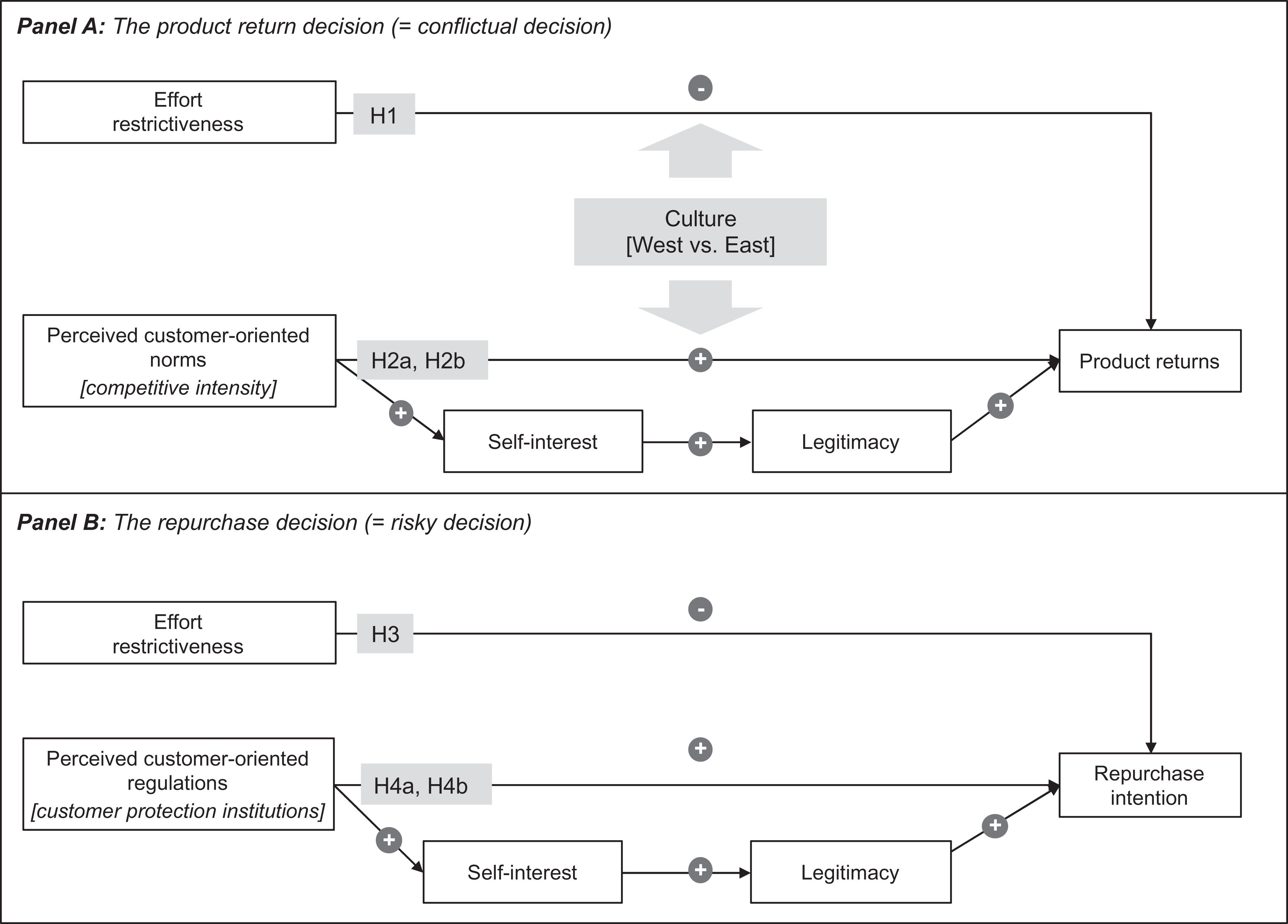
Conceptual model.
Effort Restrictiveness
Product return policies represent a service strategy that determines e-tailers’ handling of product returns (Bower and Maxham 2012); these policies differ in their degree of restrictiveness (vs. leniency) on different dimensions, which can be organized into three categories (Janakiraman and Ordóñez 2012). Based on the literature on information search, we label them as effort, time, and money (Dick and Basu 1994). Effort restrictiveness refers to the difficulty of return procedures (e.g., preprinted vs. self-printed return label; Janakiraman and Ordóñez 2012). Time restrictiveness specifies the return deadline (e.g., 30 vs. 14 days; Posselt, Gerstner, and Radic 2008). Refund restrictiveness reflects the reimbursement constraints of the returned products (e.g., money back vs. store credit; Powers and Jack 2013). Our research comprises all three dimensions, but the hypotheses focus on effort restrictiveness because it offers global e-tailers the highest flexibility in determining the degree of restrictiveness, for example, by making the return form more or less easy to access. In contrast, return deadlines and refund options are often subject to legal minimum standards. The European Union (2019), for example, has a law that states customers are entitled to return online purchases without giving any reason within 14 days. Likewise, credit notes as a refund option are prohibited in Australia if customers are legally eligible for a return (Australian Competition and Consumer Commission 2016).
Prior research supports that effort restrictiveness can reduce product returns (Janakiraman and Ordóñez 2012) because it incurs psychological return costs coming as a hassle and time investment (Anderson, Hansen, and Simester 2009). Yet meta-analytic work also reveals a strong detrimental effect on the preceding order (i.e., purchase) as an upstream behavior (Janakiraman, Syrdal, and Freling 2016). Hence, lenient policies are favored if firms emphasize promoting purchases, but the effect of effort restrictiveness on repurchase intention as a downstream decision has not been examined yet.
Institutional Environment
Perception of the institutional environment
We propose customers’ perceptions of a country’s market environment is a driver of product return-related decisions. Hereby, we draw on institutional theory (Scott 2013), which is suitable to explain service-related phenomena (Koskela-Huotari, Vink, and Edvardsson 2020). Rooted in the social sciences, this theory claims that a set of societal conventions, namely, the institutional environment, drives people’s behavior when they are interacting with others (Orr and Scott 2008). These institutions guide appropriate behavior whenever people are unsure about what to do. They empower or constrain people, lending stability to social life (Scott 2013) and legitimate behavioral decisions (Suchman 1995). Originally, the institutional environment was a societal-level concept, referring to the actual observations of collective environmental phenomena (Orr and Scott 2008). However, it can also be conceptualized at an individual’s perceptual level (Gómez-Haro, Aragón-Correa, and Cordón-Pozo 2011), which may vary within societies because of personal differences (Scott 2013). For example, people with a low (vs. high) need for order may perceive laws as appropriate (vs. too lax). A perceptual-level conceptualization may be more diagnostic in explaining decision making because people tend to base their behavior on subjective environmental evaluations (Boyd, Dess, and Rasheed 1993). Hence, marketing studies mostly draw on perceptions (e.g., Jia, Cai, and Xu 2014; Kirca, Bearden, and Roth 2011; Zhang et al. 2014), and we follow this approach because product returns and repurchases represent individual decisions.
Profile of the institutional environment
The institutional environment encompasses a regulative, normative, and cognitive pillar. The regulative pillar regulates behavior by setting rules and laws (what must [not] be done). The normative pillar guides socially obligated behavior based on values and norms (what should [not] be done). The cognitive pillar refers to taken-for-granted behavior grounded in a shared understanding and common beliefs (what is normally [not] done; Scott 2013). The literature recommends anchoring the pillars in a specific context (Zhang et al. 2014)—the so-called institutional profile (Kostova and Roth 2002). For example, when seeking to explain strike behavior, labor regulations (e.g., the right to strike), workforce norms (e.g., expected solidarity), or work-related cognitions (e.g., “We always go on strike to fight our rights”) may be relevant. Regarding product returns, we refer to perceived customer orientation as the relevant context. Customer orientation means that customer needs and interests are addressed in a satisfactory way (Blocker et al. 2011). Because returning unwanted items is in the customers’ interest, an institutional profile that protects this interest may serve a legitimating purpose claimed in institutional theory (Scott 2013).
Further, we propose that two pillars are pivotal in our context: norms and regulations. Although the three pillars may work simultaneously, a specific pillar may take precedence in certain situations (Scott 2013). Norms tend to be salient for moral decisions because they provide guidance on what ought to be done (Scott 2013), and we later present a product return as such a moral (i.e., conflict-laden) decision. Regulations may play a role in cases where people seek safety because laws may be supportive in risky situations (Busenitz, Gómez, and Spencer 2000), and we later present a repurchase as a risky decision.
Perceived customer-oriented norms
Previous marketing research conceptualizes the normative pillar as competitive intensity, that is, the degree of competition in a foreign market (Kirca, Bearden, and Roth 2011). In our context, we define perceived competitive intensity as the degree to which customers in the target market sense that retailers engage in competitive actions. This conceptualization is chosen because the normative pillar consists of norms that imply social obligation and binding expectations (Scott 2013). Competition sets industry norms (Li, Li, and Cai 2014) that reflect customer orientation (e.g., competitive prices, convenient services, and comprehensive product assortments). Hence, in markets that are perceived as highly competitive, firms are obliged to adhere to these customer-friendly actions to survive and meet customers’ expectations (Arnold, Kozinets, and Handelman 2001; Grewal and Dharwadkar 2002). As such, perceived competitive intensity unfolds a legitimating pressure—it determines what should be done to meet customers’ interests.
Perceived customer-oriented regulations
The regulative pillar has been conceptualized as legal institutions, defined as the degree to which formal rules are set up and compliance with these rules is ensured (Kirca, Bearden, and Roth 2011). Transferred to our context, we refer to perceived customer protection institutions, which are defined as customers’ sense that laws and regulations are set and enforced to safeguard customer needs. We have decided upon this conceptualization because the regulative pillar creates formal rules, monitors conformity, and sanctions deviance (Scott 2013). Customer protection institutions fulfill these attributes because they set quality instructions for services (e.g., hygienic regulations), install control mechanisms (e.g., health authority audits), and punish violations (e.g., monetary fines). Thus, they coerce firms to behave in a customer-friendly manner and determine what has to be done.
Western Versus Eastern Cultures
Our hypotheses are grounded in the different self-construals across Western and Eastern societies (Singelis 1994). Western cultures like the United States are associated with an independent self-construal. These societies are dominated by an individual value orientation: People are autonomous (Markus and Kitamaya 1991), without feeling a particular obligation to others (Singelis 1994). In contrast, Eastern cultures like China tend to fall into an interdependent self-construal. Members of these societies are concerned with maintaining harmonious relationships (Markus and Kitayama 1991) and with Confucian virtues, such as being good and respectful as well as doing the right thing (Chen and Moosmayer 2020). This principle is associated with Easterners’ concern for saving “face.” Face is an inherently Eastern concept that describes the proper relationships with one’s social environment and a positive social self-worth in the eyes of others (Ting-Toomey and Kurogi 1998). Face is lost when people fail to fulfill their social role (Lin and Yamaguchi 2011). In the following, we propose that self-construal plays a role in the product return decision (see Panel A of Figure 1) but not in the repurchase decision (see Panel B of Figure 1).
Hypotheses on the Product Return Decision
Product Return as a Conflictual Decision
When receiving an unwanted item, customers face the decision to keep or return it. Hereby, they find themselves in a conflict with firms. Firms want customers to keep items because of the lost revenue and the costly return handling (Robertson, Hamilton, and Jap 2020). Yet customers who keep an unsatisfactory item may feel cognitive dissonance and psychological discomfort. Thus, they may strive to reduce their dissonance and return the item (Powers and Jack 2013). In light of this conflict, with firms seeking customers to keep but customers seeking to return, we argue that culture works as a moderator impacting the product return decision because Westerners versus Easterners with their distinct self-construal cope differently with conflicts (Ting-Toomey 2015).
Effect of Effort Restrictiveness and Customer-Oriented Norms in Western Versus Eastern Cultures
A service policy comprising effort restrictiveness decreases return proclivity (Janakiraman and Ordóñez 2012), and we propose that this effect is true for Westerners but not for Easterners. This is because Westerners, with their independent self-construal, are generally tolerant of conflicts: They rely on their own resources and prefer a competing conflict resolution style in which each party seeks to dominate the other (Oetzel and Ting-Toomey 2003). As such, conflicting parties may see conflict resolution as a “fight,” where one party seeks to take advantage of the other. In the conflict at hand, a restrictive retailer is rather offensive, confronting customers with considerable effort when reshipping items (e.g., print out the return form). Thus, the psychological return costs are high (Anderson, Hansen, and Simester 2009). Western customers, who are used to resolving conflicts in a “fight” with the other party, may recognize that returning the item puts them in a bad position: A cumbersome return process might outweigh the advantage of a product return, and thus, they would rather keep the item. Hence, we expect that effort restrictiveness decreases product returns among Westerners.
In contrast, Easterners may base their return decisions on an external cue. The baseline for this claim is Easterners’ interdependent self-construal, which pertains to a different conflict-coping style (Ting-Toomey 2015). Easterners like Chinese seek to preserve harmony on the surface, even in conflicts (Chang, 2001), because they are concerned with their own and their counterparts’ faces, that is, for each party’s self-esteem in the eye of the other (Oetzel and Ting-Toomey 2003; Ting-Toomey 2015). Hence, they tend to avoid either embarrassing oneself or humiliating their counterpart through confrontational behaviors (Nguyen, Terlouw, and Pilot 2005) unless they receive approval for such actions from an external “moral authority,” thus settling the conflict (Ting-Toomey 2015). We propose that this authority comes from the perceived institutional environment, which encourages customers to pursue self-interest (i.e., satisfying their own needs, while ignoring how these actions might affect others; Liu and deFrank 2013); this then serves to legitimate a certain behavior (i.e., receiving social acceptance for it; Scott 2013). This is because all people tend to follow self-interest in exchange relations (Kirchgässner 2008), even Easterners—yet mainly if they perceive rightness for such a behavior (Ip 2009). Hence, they may need empowerment for being confrontational in a conflict, and institutions can serve this purpose (Scott 2013).
Related to the retail context, sending back an item represents a confrontational act, even more so when, in some cases, customers have to negotiate with service employees whether the return is warranted (Robertson, Hamiliton, and Jap 2020). In China, online retailers on the platform Taobao, for example, even require that customers contact them (e.g., via live chat) to justify their return. In such situations, perceived customer-oriented norms, which are conceptualized as perceived competitive intensity (Kirca, Bearden, and Roth 2011), lend themselves as an external moral authority. This is because a strong competition sets the industry norms (Li, Li, and Cai 2014), which in our context would be customer-friendly retail standards. Easterners may feel that firms ought to satisfy their needs and be inclined to follow self-interest, that is, getting rid of an unwanted item. As a result, they may consider a product return as a legitimate action, which drives the corresponding behavior, that is, an actual return.
In sum, perceived customer-oriented norms may foster product returns among Easterners (serially mediated by self-interest and legitimacy) because they primarily lean on a moral authority for this confrontational behavior. Westerners’ product return decisions may be driven by e-tailers’ effort restrictiveness because Westerners rely on their own judgment, not on external authorities. Formally (see Panel A of Figure 1):
Hypotheses on the Repurchase Decision
Repurchasing as a Risky Decision
The decision to repurchase from an e-tailer differs from the product return decision. It does not represent an open conflict. Customers may anticipate the possibility of again buying an item that falls short of expectations and that may have to be returned. Hence, they tend to perceive a high risk because they only get certainty about the performance of the ordered items in the future (Wood 2001). Thus, the repurchase decision centers on how to handle the associated risk. Risk research highlights that customers strive for risk reduction during decision making to minimize negative consequences (Mitchell and McGoldrick 1996). Because risk aversion has been demonstrated as a culturally universal phenomenon (Weber and Hsee 1998), we do not expect differences between Westerners and Easterners.
Effect of Effort Restrictiveness and Customer-Oriented Regulations Across Both Cultures
Based on the detrimental findings of restrictive refund policies on future spending (Bower and Maxahm 2012), we propose that effort restrictiveness may represent one potential factor that negatively affects repurchase intention. Our core argument is that customers’ experiences from the previous return episode linger: They remember the burden imposed when seeking to return an item (i.e., effort restrictiveness) and possibly regret their previous purchase decision (Bower and Maxham 2012). When thinking of repurchasing, they anticipate this effort again in case a product does not fit their needs. To avoid the anticipated psychological costs, they may refrain from repurchasing from this firm. In support, service research shows that negative incidents leave traces in consumers’ memories (Bitner, Booms, and Tetreault 1990) and, thus, are likely to affect future decisions. In particular, consumer risk research shows that using experience as a guidance for future behavior is one of the most pivotal risk-coping strategies used for consumer decisions (Mitchell and McGoldrick 1996). Given that risk aversion is a characteristic that has been shown to exist cross-culturally (Weber and Hsee 1998), Easterners and Westerners alike should base their repurchase decisions on effort restrictiveness.
Further, customers may also draw on the perceived institutional environment to cope with the risk associated with a repurchase, with customer-oriented regulations here being one key driver (again with a serial mediation through self-interest and legitimacy). Regulative institutions comprise laws and rules that guarantee stability, transparency, and order (Demirbag, Glaister, and Tatoglu 2007); indeed, they aim to reduce risk and provide support (Busenitz, Gómez, and Spencer 2000). Consequently, it has been shown that customers draw on governmental guidelines to reduce the risk associated with purchase decisions (Mitchell and McGoldrick 1996). We have conceptualized this pillar as perceived customer protection institutions that appear in the form of customer-friendly laws and regulations (Kirca, Bearden, and Roth 2011). This is because customers sense that their needs are safeguarded, so they may be reassured that firms cannot take advantage of them in case of another return episode. Thus, customer protection intuitions help reduce perceived risk, which is linked to customers’ self-interest (Kandampully and Butler 2001). Specifically, customers can feel free to pursue their self-interest when deciding on a product return. Given this increased self-interest level, they may likely perceive a product return as a legitimate option, thus showing a higher tendency to repurchase. Again, this mechanism should apply to Western and Eastern customers alike given that risk aversion is universal (Weber and Hsee 1998). Formally (see Panel B of Figure 1):
Overview of Studies
Hypotheses were tested in three studies with data from the United States and China (see Figure 1). Study 1 (students) and Study 2 (consumers) used retrospective experience sampling to test the moderating (Hypotheses 1 and 2a) and main effects (Hypotheses 3 and 4a). Study 2 further tested the mediations (Hypotheses 2b and 4b). Study 3 used an experiment to examine actual (rather than the perception) of return policy levels as a robustness check and to provide concrete managerial recommendations.
Study 1
Purpose
Study 1 was carried out to provide initial evidence that Westerners and Easterners respond differently to e-tailers’ effort restrictiveness and perceived institutional environment when deciding on a product return but uniformly when deciding on a repurchase.
Sampling
Participants
To examine the differences between West and East, respondents from the United States and China were recruited. Both countries represent the world’s largest e-tail markets (Lipsman 2019) and have been proposed as prototypes of both cultures (Patterson, Brady, and McColl-Kennedy 2016). To guarantee data collection equivalence and internal validity, we matched the convenience samples based on age, income, and education by surveying university students (Hult et al. 2008; Schumann et al. 2010). To ensure the quality of the participants’ responses, we discarded participants who gave meaningless (e.g., nonsensical letter sequences) or inconsistent (e.g., number of returned items exceeded that of ordered items) answers to the open-ended questions on the purchase episode. This yielded a final sample of 116 U.S. respondents (Mage = 22.8 years, 49.1% female) and 110 Chinese respondents (Mage = 23.2 years, 68.2% female).
Pretest
A pretest was conducted to confirm the predicted self-construal with 54 U.S. respondents (Mage = 34.1 years, 40.7% female) and 51 Chinese respondents (Mage = 31.4 years, 56.9% female). Respondents completed a five-item version of Singelis’s (1994) independent (α = .78) versus interdependent (α = .88) self-construal scale. Indeed, U.S. respondents were more independent (M = 5.29) than Chinese, M = 4.25, t(103) = 4.84, p < .001, while Chinese (M = 5.13) were more interdependent than U.S. respondents, M = 4.22; t(78) = −3.84, p < .001.
Data Collection and Measures
Procedure
Retrospective experience sampling was chosen because it provides insights into actual return behavior. Using an online questionnaire, respondents had to recall their most recent online order of apparel in which they returned at least one item or thought about doing so. As such, we encompassed the complete range of the dependent variable “return rate” (0%–100%). Asking for only actual return episodes would have omitted 0% return rate cases, thus ignoring cases where firm policies and perceived institutional environment fully prevent returns. Further, we focused on the apparel industry because it faces 30% or higher return rates (Maple 2017). Respondents provided information on their ordered items, dissatisfying items, reasons for dissatisfaction, and returned items. This detailed description enabled respondents to relive the experience, reducing memory lapses (Patterson, Brady, and McColl-Kennedy 2016). Respondents indicated their online shopping frequency within the last year (M = 10.85, standard deviation [SD] = 11.08). Given that they shopped online almost every month, memory lapses are rather unlikely. After reexperiencing the shopping episode, respondents answered closed-ended questions on the conceptual model variables.
Scales
Most scales were taken from previous studies, with minor adaptions to the context. In each country, academic experts checked the meaning and wording of all items, and back-translation procedures were conducted to ensure equivalent constructs (Hult et al. 2008). All items were measured on 7-point scales and were extensively pretested. For multiitem scales, we calculated the arithmetic mean (see Appendix A for all items and Online Appendix A for the means and SDs of measured items per country).
The independent variables were perceived effort restrictiveness and perceived customer-oriented norms and regulations. We captured effort restrictiveness using a two-item semantic differential scale asking respondents how restrictive they perceived the return process (self-developed). The perception of customer-oriented regulations was operationalized with a five-item customer protection institution scale (adapted from Kirca, Bearden, and Roth 2011) and perception of customer-oriented norms with a four-item competitive intensity scale (adapted from Kirca, Bearden, and Roth 2011; Özturan, Özsomer, and Pieters 2014).
For the sake of completeness, we also captured the other two policies (time and refund restrictiveness) and the other institutional pillar (perceived customer-oriented cognitions) as covariates. We measured time and refund restrictiveness, each with a two-item semantic differential scale, by asking participants how restrictive they perceived the return deadlines and the refund type (self-developed). In line with prior research, we operationalized perceived customer-oriented cognitions with one of Hofstede’s (2001) cultural dimensions, namely, uncertainty avoidance (two-item scale adapted from Lund, Scheer, and Kozlenkova 2013). This is because the cognitive pillar reflects common beliefs and shared attitudes, which are both inherent to individuals’ cultural dispositions (Scott 2013). We specifically chose uncertainty avoidance because it reflects the extent to which individuals feel intimidated by uncertain and unknown situations (Hofstede 2001). An online order represents such a situation (e.g., product quality is unknown) and, thus, could affect the return and repurchase decision. Yet we used it as a control variable because cognitions are less prescriptive than perceived norms and regulations (Scott 2013) and thus may play a minor role for opportunistic behavior like self-interest seeking, which should be a key mechanism that drives product return-related behavior.
Participants’ country served as the moderating variable, which we dummy coded (United States = 0, China = 1). Finally, the dependent variable product return rate was calculated as the ratio of returned items to ordered items. Repurchase intention was measured using a three-item scale (adapted from Maxham and Netemeyer 2002). Intention rather than actual repurchase behavior was measured because the latter would have required asking respondents about their next-to-last return episode, which bears the risk of false memory effects (Lakshmanan and Krishnan 2009): In reconstructing their memories, they may have mixed the last two shopping episodes.
Measurement Validation
We conducted a confirmatory factor analysis (CFA) for the above captured as respondents’ assessment mentioned scales to check for convergent and discriminant validity. Overall, the model fits the data well (χ2/df = 1.846; comparative fit index [CFI] = .968; Tucker-Lewis index [TLI] = .958; root mean square error of approximation [RMSEA] = .06). In support of convergent validity, all factor loadings are significant (p < .001) and substantial (>.7). Cronbach’s α and composite reliabilities are above the recommended threshold of .7 and .6, respectively, and all correlations of the two-item scales are above .8 (Bagozzi and Yi 1988; Nunnally 1978; see Appendix A). Discriminant validity according to Fornell and Larcker’s (1981) criterion is given. In additional analyses, we checked measurement invariance across the country samples and ruled out common method bias (see Online Appendix B).
Results
Analysis
Hypotheses are tested with moderated ordinary least squares regression analyses, here taking a two-step approach (Aiken and West 1991). First, differences between West and East are formally tested by examining the significance of the interaction between the focal independent variable (effort restrictiveness, perceived customer-oriented norms, or regulations) and the country dummy variable. Second, because the mere interpretation of the interaction term likely leads to uncertainty about whether an effect only becomes smaller or actually nonsignificant in one category, we analyze simple slopes in each country by conducting conditional effects analysis (Hayes 2018). Prior to creating the interaction terms, the independent variables were mean-centered. All other return policy dimensions and institutional pillars serve as covariates. Moreover, we control for a number of customer-specific variables that might be critical to customers’ product return and repurchase decisions. Specifically, we account for attribution of the product return by capturing the degree to which customers assign responsibility for the return to the retailer and previous relationship with the retailer by measuring the number of previous orders at the online shop. Further, we control for customers’ experience with online shopping and product returns by measuring the number of online orders and returns within the last year. Finally, income, which is captured as respondents’ assessment of their own income level compared with others in their country, serves as a covariate (see Appendix A).
Return Decision
Table 1 (left part) shows the regression results. Regarding effort restrictiveness, the results reveal a significant negative main effect (β = −.263, p < .026) on the return rate, while the interaction effect with country is not significant (β = .083, p < .424), which is not in line with Hypothesis 1. The results for customer-oriented norms reveal no significant main effect (β = −.042, p < .701) but a significant positive interaction effect (β = .238, p < .007). Conditional effect analysis sheds further light on the significant interaction: Customer-oriented norms increase the return rate in the Chinese sample (b = .091, p < .008) but not in the U.S. sample (b = −.012, p < .701), supporting Hypothesis 2a. Of the covariates, prior relationship with the retailer negatively (β = −.145, p < .031) and product return experience positively affect (β = .275, p < .000) return rate.
Repurchase Decision
The results for effort restrictiveness show a significant negative main effect (β = −.562, p < .000) on repurchase intention and a significant positive interaction with country (β = .224, p < .009). Inspecting the conditional effects shows a significant negative effect of effort restrictiveness on repurchase intention in both countries, which tends to be stronger in the U.S. (b = −.595, p < .00) than in the Chinese sample (b = −.279, p < .002). Thus, Hypothesis 3 is supported. Regarding customer-oriented regulations, we observe a positive main effect (β = .233, p < .010) but no significant interaction, supporting Hypothesis 4a. Of the covariates, product return attribution increases repurchase intention (β = .224, p < .000). Furthermore, a negative effect of the country variable is observed (β = −.165, p < .005).
Regression Results for Return Rate and Repurchase Intention (Studies 1–3).
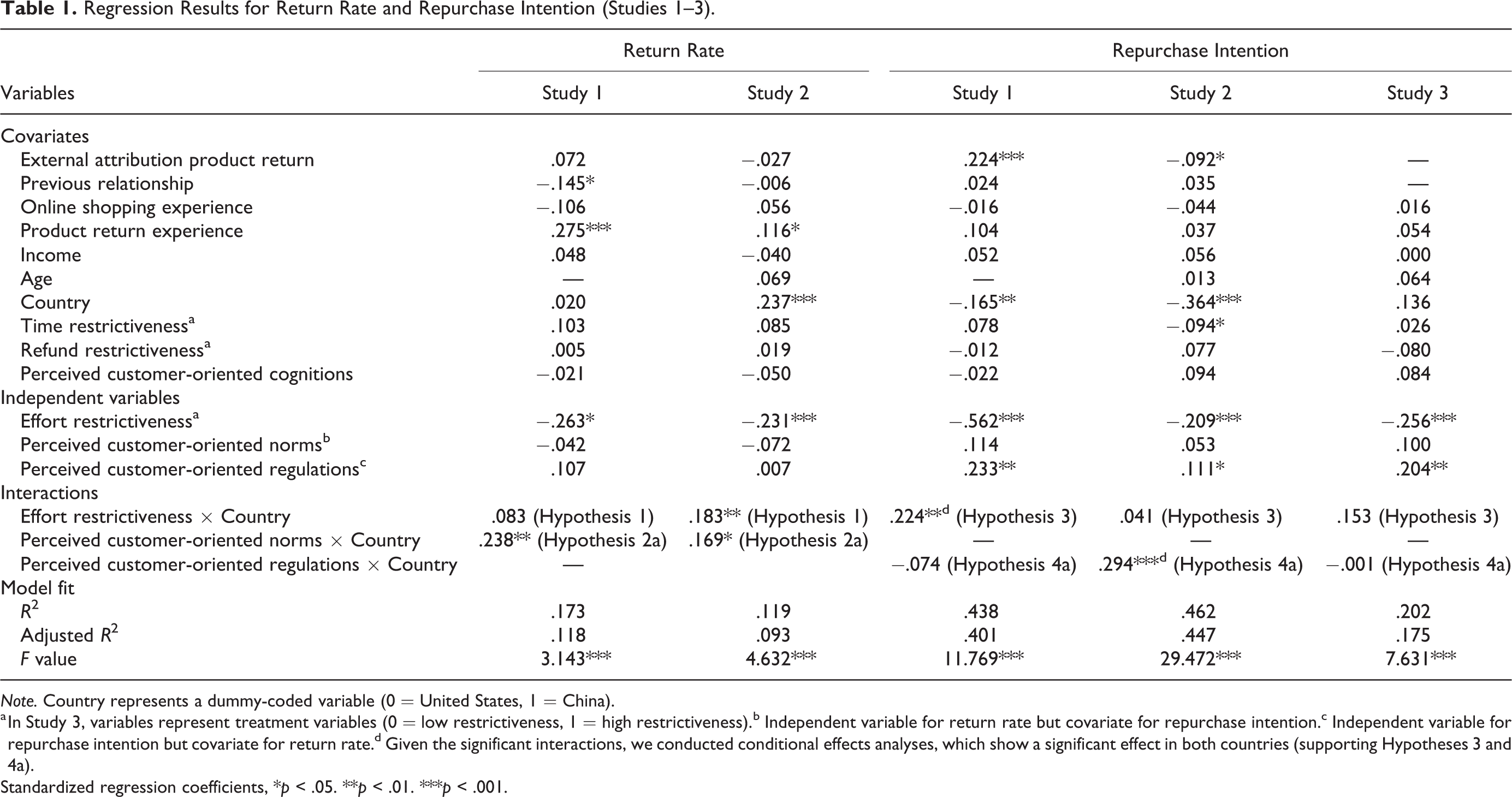
Note. Country represents a dummy-coded variable (0 = United States, 1 = China).
a In Study 3, variables represent treatment variables (0 = low restrictiveness, 1 = high restrictiveness).b Independent variable for return rate but covariate for repurchase intention.c Independent variable for repurchase intention but covariate for return rate.d Given the significant interactions, we conducted conditional effects analyses, which show a significant effect in both countries (supporting Hypotheses 3 and 4a).
Standardized regression coefficients, *p < .05. **p < .01. ***p < .001.
Discussion
Study 1’s results largely support the hypotheses. For the return decision, we find a negative main effect of effort restrictiveness. This finding is in line with our assumption that a troublesome return process decreases returns in Western countries—yet we find no significant differences across the studied countries (Hypothesis 1). We speculate that this unexpected result can be explained by the student sample, and we will substantiate this claim in the overall discussion. Indeed, studying a consumer sample may shed light on this issue. All other hypotheses are supported. As proposed, we find a significant interaction effect for customer-oriented norms (Hypothesis 2a), with Easterners feeling empowered to return products when perceiving intense competition, while Westerners do not. Furthermore, the results support the detrimental effect of effort restrictiveness on repurchase intentions in West and East (Hypothesis 3). Finally, we find the proposed culturally uniform effect of perceived customer-oriented regulations (Hypothesis 4a): In both cultures, strong customer protection institutions empower customers to consider a repurchase after a dissatisfying shopping episode.
Study 2
Purpose
We seek to validate the results of Study 1 by using a consumer sample. Beyond that, the main purpose of Study 2 is to examine the underlying processes that may explain the impact of the perceived institutional environment in Western and Eastern countries (Hypotheses 2b and 4b).
Sampling and Data Collection
U.S. consumers were recruited through Amazon Mechanical Turk and Chinese consumers through the panel 51diaocha. As in Study 1, we checked the data for meaningless and inconsistent answers to open-ended questions on the purchase episode and removed the respective participants. The resulting sample consisted of 288 respondents from the United States (Mage = 40.0 years, 55.9% female) and 242 from China (Mage = 34.0 years, 66.5% female). As in Study 1, we used an online questionnaire to ask respondents about the last online order of apparel in which they returned at least one item or thought about doing so. After reporting the shopping episode, they again completed closed-ended questions on the variables needed to test the hypotheses. As in Study 1, respondents indicated a high shopping frequency within the last year (M = 12.88, SD = 14.23), rendering memory lapses rather unlikely.
Scales and Assessment of the Measurement Model
Scales for the return rate, repurchase intention, return policy restrictiveness (effort, refund, and time), and perceived institutional environment (regulations, norms, and cognitions) were the same as in Study 1 (see Online Appendix A for the means and SDs per country). The CFA measurement model fits the data well (χ2/df = 2.704, CFI = .97, TLI = .96, RMSEA = .057). Convergent validity is confirmed by significant and substantial factor loadings. Cronbach’s α values and composite reliabilities satisfy the recommended thresholds (see Appendix A). Discriminant validity is given. We confirm measurement invariance across countries and rule out common method bias (see Online Appendix B).
Results
Replication of Study 1
As in Study 1, moderated regression analyses with a two-step approach are employed to test the effect of effort restrictiveness and perceived customer-oriented norms and regulations on the return and repurchase decisions, using the same customer-specific covariates. Given the consumer sample, we also control for respondent’s age. Prior to creating the interaction terms, the independent variables were mean-centered.
Regarding the return decision (see Table 1), we observe a significant negative main effect (β = −.231, p < .000) and a significant positive effort restrictiveness by country interaction (β = .183, p < .002). Conditional effects analyses show that effort restrictiveness decreases the return rate in the United States (b = −.063, p < .000) but not in China (b = .013, p < .551), supporting Hypothesis 1. For customer-oriented norms, the results reveal no significant main effect on the return rate but a significant positive interaction effect with country (β = .169, p < .047). This finding is consistent with Study 1, supporting Hypothesis 2a. Of the covariates, product return experience has a positive effect (β = .116, p < .017) on the return rate, and we observe a positive effect for the country variable (β = .237, p < .000).
Regarding the repurchase decision, the results reveal a significant negative main effect of effort restrictiveness on repurchase intention (β = −.209, p < .000), while the interaction effect with country is not significant (β = .041, p < .363), supporting Hypothesis 3. For customer-oriented regulations, the results reveal a significant positive main effect (β = .111, p < .037) and a significant positive interaction effect (β = .294, p < .000). Conditional effects analyses reveal a positive effect of customer-oriented regulations on repurchase intention in both countries, which tends to be stronger in China (b = .628, p < .00) than in the United States (b =.140, p < .037). Thus, Hypothesis 3 is supported. Of the covariates, both time restrictiveness (β = −.094, p < .023) and product return attribution exert a negative effect on repurchase intention (β = −.092, p < .020). Moreover, country negatively affects repurchase intention (β = −.364, p < .000).
Mediation Effects
Hypothesis 2b suggests a serial mediation of “customer-oriented norms → self-interest → legitimacy → return rate” for Eastern but not for Western cultures. Self-interest was captured with a single item adapted from Winterich, Mittal, and Morales’s (2014) self-protection focus scale as the degree to which the return decision is driven by customers’ need to protect their own interests (see Appendix A). Legitimacy was captured with one item (self-developed scale based on Suchman [1995]), reflecting the extent to which customers perceive that returning an item is a legitimate action (see Appendix A). A serial mediation analysis across the two samples is conducted using Model 92 of Hayes’s (2018) PROCESS macro and including the same covariates as above.
The results reveal a significant and positive index of moderated mediation at the 90% level (Index = .008; CI90% [.0005, .0157]). Further, there is a significant and positive serial indirect effect in the Chinese sample (b = .009; CI95% [.0008, .0194]) but not in the U.S. sample (b = .001; CI95% [−.0002, .0032]). A closer inspection of the significant indirect effect in China shows a significant positive effect of customer-oriented norms on self-interest (b = .430, p < .001), a significant positive effect of self-interest on legitimacy (b = .348, p < .001), and a significant positive effect of legitimacy on the return rate (b = .057, p < .023), supporting Hypothesis 2b.
Hypothesis 4b suggests a serial mediation for both cultures: “customer-oriented regulations → self-interest → legitimacy → repurchase intention,” which is tested using Model 6 of Hayes’s (2018) PROCESS macro, again using the same covariates as above. The results reveal a significant serial indirect effect (b = .008; CI95% [.0004, .0186]). Specifically, we observe a significant positive effect of regulative institutions on self-interest (b = .227, p < .001), a significant positive effect of self-interest on legitimacy (b = .240, p < .001), and a significant positive effect of legitimacy on repurchase intention (b = .143, p < .038), supporting Hypothesis 4b.
Discussion
Study 2 largely corroborates Study 1’s findings for a consumer sample (Hypotheses 2a, 3, and 4a). Importantly, and in contrast to Study 1, the consumer sample supports that effort restrictiveness affects the return decision among Westerners but not among Easterners (Hypothesis 1). Further, Study 2 unveils the underlying processes driving the impact of institutions across cultures. Consistent with institutional theory (Suchman 1995), legitimacy is the process at play for decision making during return episodes, and we reveal that it is triggered by customers’ self-interest. Specifically, a perceived customer-oriented environment empowers customers to pursue their self-interest, which then serves to legitimate their behavior. This is the case among Easterners facing a conflictful decision such as a product return and among both cultures when it comes to the risky decision of repurchase.
Studies 1 and 2 support our conceptual model but have one limitation: They are surveys, and thus, they only gather customers’ perceptions of e-tailers’ return policies, leaving a lack of knowledge on the impact of concrete return policy measures on customer responses. This restriction limits the robustness of our conceptual model and the presentation of hands-on recommendations on how global e-tail managers should actually design their return policies. Finally, one finding from Studies 1 and 2 deserves attention. As expected, the effect of restrictive policies goes beyond the focal return decision. However, the associated adjusted R2 values for the repurchase intention are considerably higher (up to .45) than for the return rate (up to .12). Obviously, restrictive policies reveal their full effect when it comes to the repurchase decision, and this effect is unintentional and detrimental. Thus, repurchase intention appears to be the salient dependent variable from a managerial point of view.
Study 3
Purpose
Study 3 serves to overcome the limitation of Studies 1 and 2, which examine customers’ restrictiveness perceptions. Perceptions are subjective in nature: The same stimuli may be presented to different customers under equal conditions, but the recognition and interpretation of these stimuli is a distinctive process and depends on an individual’s needs and expectations (Schiffman et al. 2014), which, in addition, are culture-bound (Hofstede 2001). Thus, up to this study, e-tailers understand the link between perceived policy restrictiveness and customer responses across countries but cannot be ascertained how to concretely design global policies to trigger the desired outcomes. Specifically, an apparently lenient process (e.g., return label is attached and needs to be glued on parcel) may be perceived as lenient in one country, while customers in other countries may expect even more convenience (e.g., self-adhesive return label is attached) and consider the policy as strict. Hence, as a first purpose, Study 3 aims to increase the robustness of the effort restrictiveness results (as our core dimension) and, more importantly, to derive straightforward managerial recommendations on policy design.
As a second purpose, we seek to derive comprehensive design recommendations that may imply trade-off considerations between the three policy dimensions (e.g., whether an effect of effort restrictiveness on repurchase intention is contingent on a short deadline across countries). Hence, we experimentally manipulate concrete policy actions reflecting distinct restrictiveness degrees, above all effort as our hypothesized variable (Hypothesis 3), but also time and refund, and we examine the interactions between these dimensions. Hereby, we account for the institutional environment (specifically the focal regulative pillar as per Hypothesis 4a, but also the two other pillars) to verify its role under the examined policies.
Given the observation in the previous studies that our independent variables more strongly affect the repurchase decision than the preceding return decision, we consider repurchase intention to be the focal outcome variable in Study 3. In support of this, the marketing literature highlights that repeat purchases are more salient for customer lifetime value than a single transaction (Petersen and Kumar 2015). Only if firms foster customer retention, they can achieve profit growth and waive costly customer acquisition (Reicheld and Sasser 1990). Likewise, committed customers are more tolerant in unsatisfactory service encounters (Evanschitzky, Brock, and Blut 2011).
Sampling and Study Design
Sample
Participants were consumers recruited through the international panel Lightspeed GMI. We checked the quality of the responses by asking open-ended questions on the experimental stimuli and removed those participants who gave meaningless answers (e.g., statements without any reference to the return episode described in the scenario), indicating that these participants were not truly involved with the study. The final sample constituted 192 respondents from the United States (Mage = 46.9 years, 58.9% female) and 215 respondents from China (Mage = 35.4 years, 53.5% female).
Audio-Visual Stimuli
To test concrete policy actions, we used video clips to simulate a return episode. This is because return policies imply hassle, time, and monetary investments for customers (Anderson, Hansen, and Simester 2009). These investments can be better illustrated by audio-visual simulation than by written scenarios, for example, by showing burdensome return steps or illustrating return time frames. Further, audio-visual stimuli evoke psychological and behavioral reactions that are similar to real service settings (Bateson and Hui 1992), allowing for holistic information processing, which, in turn, enhances reliability (Holbrook and Moore 1981). Although audio-visual stimuli might not be as realistic as actual episodes, they guarantee that all participants are exposed to exactly the same service encounter, eliminating confounding factors that likely skew data of real interactions.
Manipulations
The experiment was a 2 (low vs. high effort restrictiveness) × 2 (low vs. high time restrictiveness) × 2 (low vs. high refund restrictiveness) between-subjects design, resulting in eight different videos. At the beginning of all videos, participants saw a customer and a website of an online apparel store. They were asked to imagine that they have found a T-shirt they like a lot and can afford. They order the T-shirt and pay with their credit card. When the T-shirt arrives, it is explained that they like it, but it does not fit 100%, showing a sequence with a deliberating customer. Thereafter, it is explained that on the delivery note, they can read the online store’s return policy, and we manipulated the three restrictiveness dimensions by altering this note (see Online Appendix C).
Regarding time restrictiveness, the high (low) condition involved that items can be returned within 14 days (30 days), juxtaposed with a calendar sheet, where the 14th (30th) of a month was marked. Next, effort restrictiveness was manipulated by listing the return steps. The high condition involved a longer duration with six steps: (1) call the store to declare a return, (2) wait for the store to send a return label via email, (3) download the label and complete with the sender’s information, (4) print the label, (5) stick the label on the package, and (6) take the package to the post office. The low condition involved a shorter duration and simpler, uncomplicated actions, comprising two steps: (1) stick the return label—already attached by the store—on the package and (2) take the package to the post office. Each step was illustrated by a picture. Finally, refund was manipulated by high (low) restrictiveness through informing that the price will be refunded by a store gift card (will be credited to their credit card), which was illustrated by a gift card certificate (credit card).
The choice of the manipulations was guided by boundaries in global e-tailing practice to allow the transfer of the study results to any Western or Eastern markets. Fourteen days were chosen as an upper boundary for time restrictiveness because the European Union stipulates this deadline as a minimum requirement. Further, an explorative screening of international e-tailer policies served to determine the upper boundary condition for effort restrictiveness (i.e., burdensome process comprising multiple steps) and refund restrictiveness (i.e., a store credit that impedes free money disposition). For the lower boundaries (i.e., 30-day deadline, two-step return process, credit card refund), we chose lenient actions that can globally be observed.
We took a two-stage approach toward video creation (Victorino et al. 2012). First, we developed written vignettes that depicted the different conditions, and based on these, we produced the actual videos. We kept all conditions as similar as possible (e.g., video length, sequence of manipulation) and audio-taped the videos with a multinational speaker who had a native speaker level in English and Chinese. For video production, we chose a whiteboard animation tool, using line illustrations rather than real photographs to minimize confounds regarding potential product, brand, and retailer preferences. To ensure that participants could properly hear and see the video, they had to correctly answer questions on a test video to be forwarded to the actual video scenario, which was followed by the questionnaire.
Scales and Measurement Validation
As per our conceptual model and the focus on the repurchase decision (i.e., Hypotheses 3 and 4a in Figure 1, Panel B), we used repurchase intention as dependent variable, the experimental manipulation of effort restrictiveness (0 = low restrictiveness and 1 = high restrictiveness) and the measured perceived customer-oriented regulations as the independent variables and participants’ country (0 = United States, 1 = China) as the moderator. To test a comprehensive design of return policies, we included the experimental manipulation of time and refund restrictiveness into the analysis and used perceived customer-oriented norms and cognitions as covariates, using the same scales as before (see Appendix A for the scales and Online Appendix A for the means and SDs per country). A CFA with the measurement scales (i.e., repurchase intention and institutional pillars) indicates an appropriate model fit (χ2/df = 3.173; TLI = .949; CFI = .961; RMSEA = .073). Convergent validity is confirmed by significant and substantial factor loadings; Cronbach’s α values and composite reliabilities satisfy the recommended thresholds (see Appendix A). Discriminant validity is given. Analyses confirm measurement invariance across countries and rule out common method bias (see Online Appendix B).
Results
Manipulation Check
The manipulation check measures for policy restrictiveness were open-ended questions about the number of required steps for sending the T-shirt back (effort), the days allowed for the return (time), and the way a T-shirt return is refunded (refund). Regarding effort, respondents indicate a significantly higher number of steps in the high (M = 4.7 steps) than in the low restrictiveness condition, M = 2.7 steps; t(312) = −17.00, p < .001. Regarding time, respondents perceive a significantly shorter return deadline in the high (M = 12.9 days) than in the low restrictiveness condition, M = 25.2; t(280) = 16.30, p < .001. For refund, we coded respondents’ answers into three categories: money back on a credit card, store credit, and others. Crosstabs with the refund manipulation and this categorical check measure are significant, χ2(2) = 219.74, p < .001, and in the expected direction (high refund restrictiveness: 66.3% indicate “store credit,” low refund restrictiveness: 82.7% indicate “money back on a credit card”). Respondents perceive the shopping episode as realistic, M = 5.85, t(406) = 30.55, p < .001; the videos as believable, M = 5.91, t(406) = 31.27, p < .001; and themselves as easily adopting the customer’s role, M = 5.80, t(406) = 28.33, p < .001, with mean scores significantly above the scale midpoint, indicating effective manipulations.
Baseline Analysis
As per the first purpose of this study, this analysis tests the robustness of effort restrictiveness (Hypothesis 3) when accounting for perceived customer-oriented regulations as our second hypothesized predictor of repurchase intention (Hypothesis 4a) by using the same two-step approach as in previous studies. We used the same covariates as before, except for product return attribution and previous relationship with the e-tailer, which were held constant across scenarios. Prior to creating the interaction terms, the perceived customer-oriented regulations were mean-centered. The results reveal a significant negative main effect of effort restrictiveness on repurchase intention (β = −.256, p < .000), while its interaction with country is not significant (β = .153, p < .058), supporting Hypothesis 3. For customer-oriented regulations, there is a significant positive main effect (β = .204, p < .003), but no significant interaction effect (β = −.001, p < .991), supporting Hypothesis 4a. None of the covariates exert a significant effect on repurchase intention (see Table 1).
Additional Analysis
This analysis serves the second purpose of our study: testing the comprehensive set of policy dimensions across countries, including their interactions. For this, we conducted an analysis of covariance, with the manipulated policy restrictiveness (effort, time, and refund) and country as independent variables, testing whether the concrete policy actions interact with each other or whether they interact with participants’ countries. The institutional pillars and all customer-specific variables served as covariates. Results reveal a significant negative main effect of the effort manipulation on repurchase intention, F(1, 384) = 13.38, p < .001, Mlow rest = 5.31 versus Mhigh rest = 4.81, and a positive main effect of country, F(1, 384) = 17.63, p < .001, MUnited States = 4.72 versus MChina = 5.40, while the main effects of time and refund manipulations are not significant. None of the interactions are significant. Of the covariates, customer-oriented regulations have a significant effect, F(1, 384) = 14.81, p < .001.
Discussion
Study 3 focuses on repurchase intention as a relevant downstream customer outcome and, as a baseline finding, verifies our conceptual model with experimentally manipulated, concrete policy actions. Thus, our results reveal how these concrete actions, rather than the perceptions of some heterogeneous and unspecified measures, affect repurchase intention. Again, the effort dimension is crucial, with a lenient process fostering customer loyalty across countries. Our experimental manipulations, with the return steps being clearly described, shed light on an ideal lenient process, helping provide hands-on recommendations. Further, the examined time and refund policy actions have no effect on repurchase intention, leaving some leeway for the design of these dimensions (see Implications for Practitioners section for concrete design recommendations). Finally, no interactions occur between the examined policy actions, indicating that no trade-off considerations are necessary when determining each dimension.
Overall Discussion
Theoretical Contributions
This research largely supports our conceptual model (see Figure 1). It demonstrates that the product return decision of Western (U.S. American) consumers is driven by the effort restrictiveness in retailers’ return policies but not by the perceived customer-oriented institutions; a mirror-inverted pattern occurs for Eastern (Chinese) consumers. For the repurchase decision, both drivers exert an effect across cultures in our study. We explain these findings by the distinct self-construal of Westerners versus Easterners (Markus and Kitamaya 1991), which plays a role in a conflict-laden decision such as a product return 1 but not in a risky decision like a repurchase because risk aversion is universal (Weber and Hsee 1998). Our findings add novel insights to the product return literature.
Role of product return policies
The literature on product returns has examined retailer-related actions affecting the product return decision, be it general marketing activities such as free shipping promotions (Shehu, Papies, and Neslin, 2020) or directly related to unwanted products: return policies (Bower and Maxham 2012; Robertson, Hamilton, and Jap 2020; Wood 2001). Studies have established that these activities comprise a trade-off. On the one hand, being more lenient—especially regarding return effort—induces orders (Janakiraman, Syrdal, and Freling 2016). Specifically, it helps eliminate consumer resistance to not being able to inspect and, in the case of apparel, try on items to make sure they fit before buying them. On the other hand, this benefit comes at the expense of increased returns (Hess, Chu, and Gerstner 1996). However, because leniency increases orders more than returns, leniency is recommended as a primary strategy (Janakiraman, Syrdal, and Freling 2016). Still, some firms struggling with tight margins and costly reverse logistics may need to be restrictive.
We add to this knowledge in three ways. First, we examine return policies’ effects across cultures, considering both the focal return decision and the repurchase decision as an important but rarely examined downstream variable (Bower and Maxham 2012; Petersen and Kumar 2009). We reveal across cultures that effort restrictiveness is more diagnostic for this downstream behavior than for the preceding return decision. As such, we unveil the long-lasting effects of effort restrictiveness that are universal across cultures, thus highlighting its importance for ensuring profitability in the long run.
Second, examining West versus East shows that a trade-off between two desirable behaviors only occurs for Westerners: Effort leniency fosters repurchase intention at the expense of higher return rates. Eastern respondents’ behavior (in the consumer sample) is not in line with this presumingly well-established knowledge: Effort leniency increases Eastern consumers’ repurchase intention without boosting return rates. Unlike the term “return policies” implies, effort leniency does not affect Eastern consumers’ product returns but is a sheer and powerful marketing instrument that can be used to ensure customer loyalty. One exception is the student sample (Study 1). Here, we speculate that the observed effect of effort restrictiveness on the return rate in both countries may occur because of students’ specific life stage. It is not long ago that they were being “pampered” by their parents, and this convenience orientation may discourage them from returning items as soon as this process comprises too much hassle.
Third, we show that whenever return policies play a role (i.e., for product returns in Western cultures and for repurchase intention in both cultures), the effort dimension is salient, while the examined time and refund dimensions are mostly nonsignificant. These findings are noteworthy given that they occur both for the perceived restrictiveness levels (Studies 1 and 2) and for experimentally manipulated levels (Study 3). It seems that both Westerners and Easterners are tolerant toward the examined deadlines and refund types as long as they at least have a grace period to send items back and receive some form of a refund. One exception is a significant negative effect of time restrictiveness on repurchase intention in Study 2. Possibly, customers who are pushed to make a quick return decision remember the stressful episode and refrain from repurchasing, which is in line with consumer research stating that customers cope with stressful purchase episodes through avoidance (Moschis 2007). However, the effect is minor in scope, and along with the nonsignificant results in the two other studies, a burdensome return process (i.e., effort restrictiveness) seems to linger the most and, thus, is salient for customer loyalty.
Role of perceived institutional environment
Prior product return literature has identified various factors affecting product returns. We add to this knowledge in two ways. First, these factors are often limited to the retailer (i.e., return policies, shipping promotions) and its products (e.g., price and store assortment; Samorani, Alptekinoğlu, and Messinger 2019) and to customers (e.g., online customer reviews; Minnema et al. 2016) and their shopping behavior (e.g., gift or holiday purchase; Petersen and Kumar 2009). While these are microlevel variables that e-tailers can more or less easily control (e.g., by choosing a certain assortment or targeting specific customers), our research integrates institutional theory (Scott 2013) into the product return literature, presenting the perceived institutional environment as a macrolevel factor that needs to be accounted for in global e-tailing.
Second, we unveil the mechanism for this effect. Prior research explains the mechanisms for the effects of return policies. They center on a benefit that customers derive from leniency: It increases perceptions of quality (Bonifield, Cole, and Schulz 2010) and cost fairness (Bower and Maxham 2012) and reduces perceptions of risk (Petersen and Kumar 2015) and transaction costs (Davis, Hagerty, and Gerstner 1998). Effort leniency, in particular, reduces psychological return costs (Anderson, Hansen, and Simester 2009). A perceived customer-oriented environment, however, is an external driver whose benefit evolves from receiving guidance from “outside.” As derived from institutional theory (Suchman 1995), it lies in providing legitimacy for seeking self-interest whenever such an external justification is needed. Specifically, in conflicting situations like a product return, Easterners need moral justification (Ting-Toomey 2015) to follow their self-interest, which comes from perceived institutional norms. Specifically, a high perceived competitive intensity (Kirca, Bearden, and Roth 2011) makes them believe that firms must compete for customers, and thus, they feel entitled to follow their self-interest and return unwanted items. As assumed, the other institutional pillars are nonsignificant. These results support the salient role of perceived norms for legitimating moral decisions (Scott 2013). In risky situations such as a repurchase, customers from both cultures feel empowered by perceived customer-oriented regulations (i.e., customer protection institutions; Kirca, Bearden, and Roth 2011) to follow self-interest to make a safe repurchase decision. As assumed, the other pillars (perceived customer-oriented norms and cognitions) are nonsignificant. These findings conform to our expectations that regulations play a primary role in risky situations (Busenitz, Gómez, and Spencer 2000) because they provide legal protection against the trouble associated with unwanted products.
Finally, Easterners’ behavior is also driven by self-interest, which is interesting given that they are described as less ego-centric than Westerners (Markus and Kitayama 1991). Yet Easterners are influenced by Confucian values such as rightness and may engage in self-interest behavior if it is perceived as right (Ip 2009). Thus, the perception of the external environment seems to function as a signal of the rightness to engage in behaviors that serve self-interest.
Implications for Practitioners
Designing a global strategy for product return management
Our findings in the examined cultures allow for recommendations on how to design product return policies on a global scope. Here, e-tailers should focus on designing the effort comprised in a product return. Given that a lenient process fuels repurchase intention across cultures, firms should not consider return processes as a tool to prevent product returns but rather use it as a marketing tool to ensure customer loyalty. This holds particularly true for Easterners, where the effort dimension does not affect return behavior (at least in the consumer sample). Broadly speaking, e-tailers should design the return process to be as convenient as possible, and our manipulations in the experimental study allow for concrete recommendations. Customers should find a self-adhesive prepaid and preaddressed packing slip in their package requiring two easy steps only: (1) stick this return label onto the package and (2) take it to the post office, as is practiced, for example, by the online apparel e-tailer H&M in the United States (www.hm.com/us). Any further effort, such as making it mandatory to call the online store to declare the return, waiting for the online store to send a return label via email or retrieving it online, and having to print it out, should be avoided.
E-tailers should forcefully communicate the simple two steps for returning a product, for example, by placing this information prominently on the landing page of their website (e.g., illustrated by the graphical depictions used in our experimental study, see the Online Appendix), as a disclaimer in written or electronic conversations with customers or in follow-up customer care. For example, the Swedish online retailer NA-KD sends out follow-up emails upon product returns, apologizing for the inconvenience and asking customers to assess whether they were satisfied with the return handling process (www.NA-KD.com). These measures signal that firms acknowledge customers’ inconveniences and are concerned about reducing return effort. In designing such a lenient process, global brand online shops may even gain a competitive advantage over nonbranded local shops in China, which tend to offer their services through large e-commerce platforms, such as Taobao. These shops often require customers to contact them and engage in a conversation about whether they are entitled to return the item. Here, Easterners might fear a loss of face because these personal negotiations are potentially confrontational and embarrassing. Thus, if global e-tailers make returns easy and unconditional, as described above, they may even attract customers away from these shops.
If there is a drawback—but only among Western customers and possibly among Chinese students—it is that lenient processes may heighten product returns. Here, we recommend that firms strike a balance between making it easy for customers to return unsatisfactory items to induce repurchase and running up the costs incurred by returns. Specifically, e-tailers could employ preemptive measures such as offering technology-facilitated assistance (e.g., chatbots or augmented reality), where customers receive guidance on finding the perfect product (Robertson, Hamilton, and Jap 2020). Further, e-tailers can outsource return management to service firms specialized in cost-effective return handling and reusage (i.e., unpacking, restocking, and reselling returns). Firms such as AVIDES specialize in the reuse and redistribution of retailers’ unsold items. These firms manage cost-intensive redistribution more efficiently than e-tailers, finding ways to offer unsold products to price-sensitive customers, for example, with business models of the sharing economy using online platforms for secondhand use.
Further recommendations can be derived from the null effects of the examined time and refund policies. As these dimensions hardly count for customer behavior in the present study, neither among Westerners nor among Easterners, e-tailers have some leeway in designing them, and the experimental conditions from Study 3 provide concrete recommendations. For example, e-tailers may not extend deadlines from 14 days to 30 days because this has no positive effect; in addition, a shorter deadline enables them to more quickly resell the returned items, which is particularly important for seasonal items (e.g., summer dresses). Likewise, firms may not necessarily need to offer refunds as money back issued to credit card but may rather issue store credits, which relieves the cash flow. Alternatively, we recommend that e-tailers let customers choose between these refund types, given that the service recovery research suggests that letting customers participate in the recovery process increases their satisfaction and repatronage (Hazée, van Vaerenbergh, and Armirotto 2017).
Accounting for the perceived institutional environment
Originally, the institutional environment is a society-level phenomenon, meaning that all the citizens of a country face the same conditions (Scott 2013). Yet in line with prior research, we show that the perception of this environment can differ across individuals within countries (Gómez-Haro, Aragón-Correa, and Cordón-Pozo 2011). We acknowledge that it is challenging for firms to control customers’ perceptions of their environments. Specifically, firms cannot simply prompt customers to ignore evidence in front of their own eyes. Still, perception is a highly individual process that can be influenced by many factors. Therefore, we propose that firms can try to shape customers’ perceptions of environments through specific communication tactics.
Regarding customer protection institutions, we primarily recommend that across global markets, firms should communicate that protecting customer interests is important and that they strictly obey the respective laws. Presenting this information on the website, ideally with an explicit reference to the respective laws, may resemble a quality seal, reassuring customers that the firm makes every effort to account for customer interests. These measures would not only be consistent with the suggested lenient return handling policy across countries but also reflect e-tailers’ benevolent efforts. This is important because the perceived benevolence of providers has been shown across countries to be pivotal for trust building (Schumann et al. 2010). The use of approval seals like “Trusted Shops” might reinforce this positive effect. Customers may then trust that in the case of a return, their needs are protected.
The recommendations regarding perceived competitive intensity primarily concern Easterners as these perceptions increase product returns in this customer group. We recommend that e-tailers selling their products in markets such as China should be aware of this effect and refrain from communicating fierce competitive actions. In doing so, they can possibly attenuate their own customers’ tendencies to follow their self-interest and consider product returns as a perfectly legitimate action. Specifically, e-tailers may refrain from using overly aggressive advertising or pricing strategies. Low prices may attract customers, but they may be disloyal and also feel encouraged to return many items. Finally, although avoiding competitive marketing tactics can be beneficial, Eastern customers may still sense a high level of retailer competitiveness due to the behavior of major rivals in the market. Consequently, product returns might still be fostered. Thus, we recommend that firms take the necessary measures to cut costs, as described above (i.e., preemptive measures to avoid returns, optimizing back-office processes, or outsourcing reverse logistics to specialized firms).
Limitations and Future Research
Some limitations of our research offer avenues for future research. First, many other conceivable factors may drive product return-related behaviors at the individual and country levels. At the individual level, future research may examine the effect of return policies on the repurchase decision over and above customer satisfaction as the core driver of loyalty. Further, research conducted in Western countries suggests that the purchase occasion and purchase time are pivotal to product return episodes (Petersen and Kumar 2009); we encourage researchers to explore their role in other cultures. Future research could also examine whether Easterners, with their interdependent self-construal, more than Westerners see product returns as a signal to warn others that the product is wrong. Finally, competitors’ actions often serve as a reference point. For example, our results for the United States may occur because e-retailers like Zappos were the first to offer free shipping both ways. Customers may have used this policy as a benchmark and consider a burdensome return process as negative, deteriorating loyalty (Robertson, Hamilton, and Jap 2020). At the country level, we examined the United States and China, which differ regarding self-construal, but also regarding other factors such as national wealth. Possibly, Chinese consumers, being on average less affluent than Americans, cannot afford to keep items only because of a burdensome return process. Other factors may be quality, price level, or environmental consciousness in a country. Future research could examine more countries and account for country- and individual-level characteristics in a multilevel analysis.
Further, we focused on the effort dimension, but refund and time may also be relevant. Study 3 examined specific levels of refund (credit card vs. store credit) and time restrictiveness (30- vs. 14-day deadline). Refund restrictiveness may be confounded with refund type because store credit can only be used upon repurchase, which may compensate for a potential negative effect on repurchasing. Refund types not directly linked to repatronage (e.g., exchange) could be examined. Further, time restrictiveness may be nonsignificant for the return rate because of two diverging effects: A general notion that restrictiveness prevents returns vs. findings from the rebate literature (Inman and McAlister 1994) suggesting that longer time windows make people procrastinate and miss deadlines, thus increasing returns. Future research could unveil thresholds where one or the other effect becomes more salient.
Finally, we used retrospective experience sampling and captured repurchase intention rather than actual behavior to avoid false memory effects (Lakshmanan and Krishnan 2009). Although intentions predict behavior (Fishbein and Ajzen 1975), they represent a proxy variable only. Thus, future research may use archival data from e-tailers and capture actual repurchase after returns across stores with varying degrees of restrictiveness. In a similar vein, our study encompasses return episodes where customers actually returned or thought of returning. In fact, consumers may have distinct return dispositions (e.g., occasional vs. heavy returner; Foscht et al. 2013). Future research may investigate the distinct returner groups because being dissatisfied with an item but not returning it may cause anger and frustration that could heavily damage the firm--customer relationship. A systematic returner typology could be developed, segmenting customers based on psychographic, cultural, and consumption-specific criteria and examining this typology across international markets.
Supplemental Material
Supplemental Material, sj-pdf-1-jsr-10.1177_1094670521989440 - A Cross-National Service Strategy to Manage Product Returns: E-Tailers’ Return Policies and the Legitimating Role of the Institutional Environment
Supplemental Material, sj-pdf-1-jsr-10.1177_1094670521989440 for A Cross-National Service Strategy to Manage Product Returns: E-Tailers’ Return Policies and the Legitimating Role of the Institutional Environment by Jana Gäthke, Katja Gelbrich and Shan Chen in Journal of Service Research
Supplemental Material
Supplemental Material, sj-pdf-2-jsr-10.1177_1094670521989440 - A Cross-National Service Strategy to Manage Product Returns: E-Tailers’ Return Policies and the Legitimating Role of the Institutional Environment
Supplemental Material, sj-pdf-2-jsr-10.1177_1094670521989440 for A Cross-National Service Strategy to Manage Product Returns: E-Tailers’ Return Policies and the Legitimating Role of the Institutional Environment by Jana Gäthke, Katja Gelbrich and Shan Chen in Journal of Service Research
Supplemental Material
Supplemental Material, sj-pdf-3-jsr-10.1177_1094670521989440 - A Cross-National Service Strategy to Manage Product Returns: E-Tailers’ Return Policies and the Legitimating Role of the Institutional Environment
Supplemental Material, sj-pdf-3-jsr-10.1177_1094670521989440 for A Cross-National Service Strategy to Manage Product Returns: E-Tailers’ Return Policies and the Legitimating Role of the Institutional Environment by Jana Gäthke, Katja Gelbrich and Shan Chen in Journal of Service Research
Footnotes
Appendix A
Scales Used in Studies.
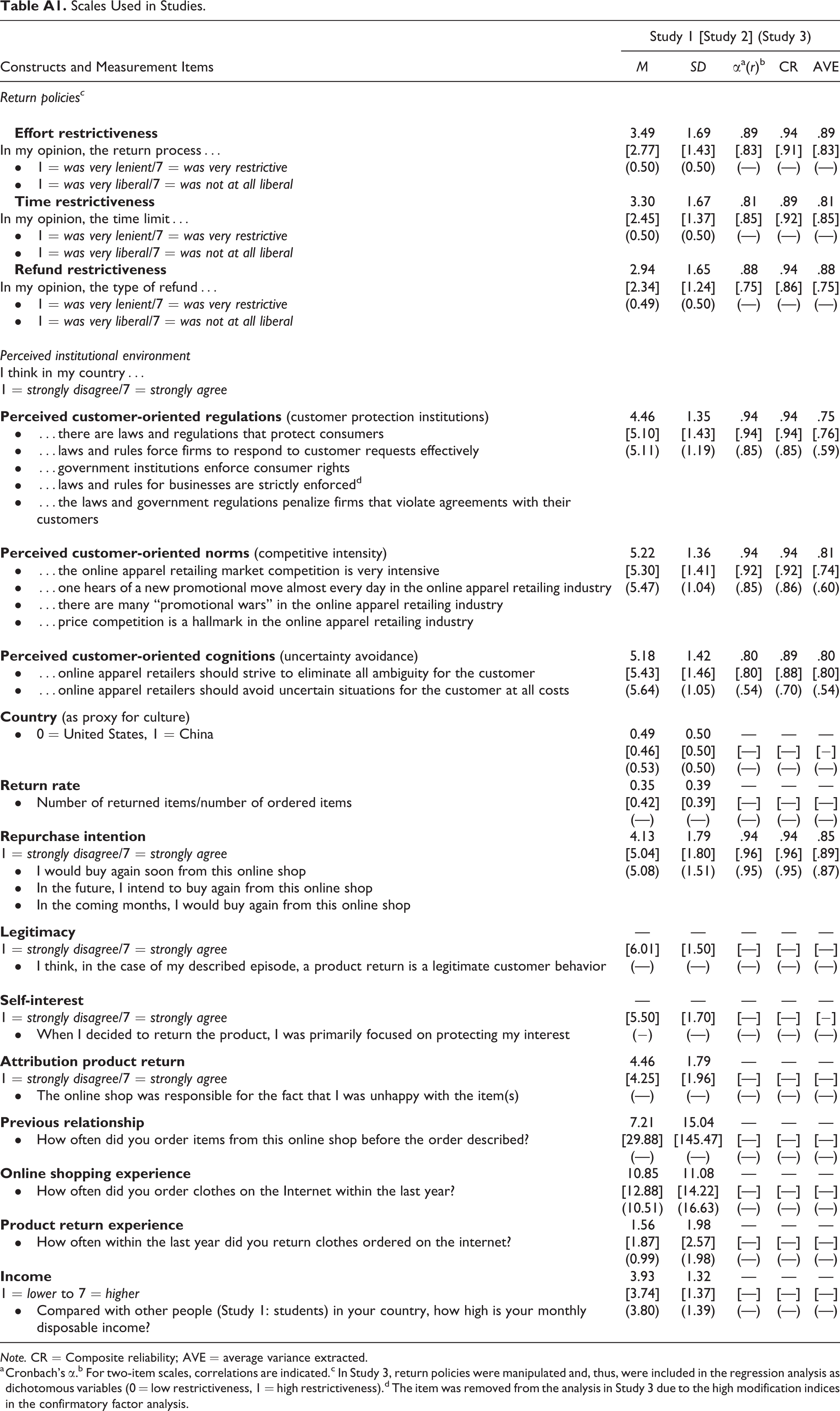
| Constructs and Measurement Items | Study 1 [Study 2] (Study 3) | ||||
|---|---|---|---|---|---|
| M | SD | αa(r)b | CR | AVE | |
| Return policiesc | |||||
| In my opinion, the return process… 1 = was very lenient/7 = was very restrictive 1 = was very liberal/7 = was not at all liberal |
3.49 [2.77] (0.50) |
1.69 [1.43] (0.50) |
.89 [.83] (—) |
.94 [.91] (—) |
.89 [.83] (—) |
| In my opinion, the time limit… 1 = was very lenient/7 = was very restrictive 1 = was very liberal/7 = was not at all liberal |
3.30 [2.45] (0.50) |
1.67 [1.37] (0.50) |
.81 [.85] (—) |
.89 [.92] (—) |
.81 [.85] (—) |
| In my opinion, the type of refund… 1 = was very lenient/7 = was very restrictive 1 = was very liberal/7 = was not at all liberal |
2.94 [2.34] (0.49) |
1.65 [1.24] (0.50) |
.88 [.75] (—) |
.94 [.86] (—) |
.88 [.75] (—) |
| Perceived institutional environment |
|||||
…there are laws and regulations that protect consumers …laws and rules force firms to respond to customer requests effectively …government institutions enforce consumer rights …laws and rules for businesses are strictly enforcedd …the laws and government regulations penalize firms that violate agreements with their customers |
4.46 |
1.35 |
.94 |
.94 |
.75 |
…the online apparel retailing market competition is very intensive …one hears of a new promotional move almost every day in the online apparel retailing industry …there are many “promotional wars” in the online apparel retailing industry …price competition is a hallmark in the online apparel retailing industry |
5.22 |
1.36 |
.94 |
.94 |
.81 |
…online apparel retailers should strive to eliminate all ambiguity for the customer …online apparel retailers should avoid uncertain situations for the customer at all costs |
5.18 |
1.42 |
.80 |
.89 |
.80 |
|
0 = United States, 1 = China |
0.49 |
0.50 |
— |
— |
— |
|
Number of returned items/number of ordered items |
0.35 |
0.39 |
— |
— |
— |
I would buy again soon from this online shop In the future, I intend to buy again from this online shop In the coming months, I would buy again from this online shop |
4.13 |
1.79 |
.94 |
.94 |
.85 |
I think, in the case of my described episode, a product return is a legitimate customer behavior |
— |
— |
— |
— |
— |
When I decided to return the product, I was primarily focused on protecting my interest |
— |
— |
— |
— |
— |
The online shop was responsible for the fact that I was unhappy with the item(s) |
4.46 |
1.79 |
— |
— |
— |
|
How often did you order items from this online shop before the order described? |
7.21 |
15.04 |
— |
— |
— |
|
How often did you order clothes on the Internet within the last year? |
10.85 |
11.08 |
— |
— |
— |
|
How often within the last year did you return clothes ordered on the internet? |
1.56 |
1.98 |
— |
— |
— |
Compared with other people (Study 1: students) in your country, how high is your monthly disposable income? |
3.93 |
1.32 |
— |
— |
— |
Note. CR = Composite reliability; AVE = average variance extracted.
a Cronbach’s α.b For two-item scales, correlations are indicated.c In Study 3, return policies were manipulated and, thus, were included in the regression analysis as dichotomous variables (0 = low restrictiveness, 1 = high restrictiveness).d The item was removed from the analysis in Study 3 due to the high modification indices in the confirmatory factor analysis.
Acknowledgments
The authors thank Yany Grégoire for his valuable feedback on this research project as well as Stanford Westjohn, Jiawen Liang, and Olen Johannsen for supporting the data collection. They also thank the editor, the area editor, and the three anonymous reviewers for their valuable feedback during the review process. Jana Gäthke thanks the Bavarian Academy of Sciences and Humanities for the financial support.
Declaration of Conflicting Interests
The author(s) declared no potential conflicts of interest with respect to the research, authorship, and/or publication of this article.
Funding
The author(s) disclosed receipt of the following financial support for the research, authorship, and/or publication of this article: This work was funded by the Bavarian Academy of Sciences and Humanities, Munich, Germany.

Supplemental Material
Supplemental material for this article is available online.
Note
References
Supplementary Material
Please find the following supplemental material available below.
For Open Access articles published under a Creative Commons License, all supplemental material carries the same license as the article it is associated with.
For non-Open Access articles published, all supplemental material carries a non-exclusive license, and permission requests for re-use of supplemental material or any part of supplemental material shall be sent directly to the copyright owner as specified in the copyright notice associated with the article.
