




Abstract
Our study applies legitimacy theorizing to service research, zooming in on co-prosumption service business models, which reside on significant direct contacts among provider-actors and customers as well as fellow customers in the service space. Our findings are based on a longitudinal flexible pattern matching method on 17 coworking spaces. The service cocreation nuances the double role of customers as evaluators and cocreators of legitimacy. This is because customers can have immediate perceptions of the actions and values of the services in their legitimacy evaluation while cocreating the service. Legitimacy shaped via social and recursive processes occurs in three stages: provisional, calibrated, and affirmed legitimacy. Findings inform four trajectory mechanisms of value-in-use pattern provenance, emergent Business Model development adaptive to the spatial context and loyal customers, visible trances as well as inside-out and outside-in identification processes. Further, the processes in the micro-ecosystem of an interstitial service space can develop a superordinate logic which overlays the potentially present coopetive and heterogenous institutional logics and interests of service customers.
Keywords
Introduction
Service research is increasingly embracing institutional theory (Koskela-Huotari Vink, and Edvardsson 2020), encouraged by research on how institutional arrangements determine value cocreation in nested service ecosystems (Vargo and Lusch 2016), on institutional determinants on service innovation (Vargo, Wieland, and Akaka 2015), and on market shaping through institutional arrangements (Baker, Storbacka, and Brodie 2018). From the viewpoint of institutional theory, service organizations’ progress and survival depends on the “endorsement” of organizational legitimacy (Deephouse 1996: 1025). Key audiences such as investors (Täuscher, Bouncken, and Pesch 2021) evaluate organizational legitimacy (legitimacy, hereafter) upon the organization’s values and actions (Zimmerman and Zeitz 2002). Surprisingly, customers have been overlooked as a key audience and this omission is particularly noteworthy for services because their customers are integrated in cocreation (e.g., Vargo and Akaka 2012). Henceforth, how does cocreation influence service legitimacy?
Cocreation imposes a double role of customers as evaluators and cocreators of legitimacy, as customers in their legitimacy evaluation can have immediate perceptions of the actions and values of the service provider while cocreating the service. The double role is particularly nuanced when cocreation occurs in direct and simultaneous production and consumption of customers as specified by prosumption (e.g., Parasuraman, Zeithaml, and Berry 1985) and in collective consumption contexts that define service encounters where fellow customers are directly co-present (e.g., Colm, Ordanini, and Parasuraman 2017). We introduce Co-Prosumption (CoP) services for specifying contexts where different customers are directly and physically co-present within the service space. CoP captures the two views of collective consumption research, such that customers coordinate with each other for cocreation and/or simply operate beside each other (e.g., observation and unitedness in a service climate). Legitimacy in CoP will evolve in recursive social processes among providers and different customers. The social context coalesces past, present, and future service encounters from the viewpoints of customers and providers and thus accounts for trajectories that play out on the service provider’s Business Model (BM). Generally, trajectories describe self-reinforcing directions of development (Jenkins and Floyd 2001) that determine technology and industry sectors (Castellacci 2008). Beliefs, artifacts, and evaluation routines (Henfridsson and Yoo, 2014) as well as organizational identification might imply trajectories (Conger et al. 2018). Hence, social processes of customers with one another and with the provider will be susceptible to trajectories, which yet have not been analyzed for services.
Considering the knowledge void on customer’ double role in the legitimacy process of CoP services and their proneness to trajectories, we aim to understand the legitimacy process in services and potential trajectory mechanisms. On this purpose, we initially develop a conceptual framework by combining service and recursive legitimacy research on the double role of customers in the recursive and socially embedded legitimacy processes that inform trajectory mechanisms, finally reflecting on service BMs. Then, we empirically explore our framework’s propositions through a flexible pattern matching approach that allows for both inductive and deductive theory building by iterating between theory and data on the basis of theoretically developed propositions (Sinkovics 2018). At last, we use the comparisons between deducted patterns and observed insights for further theory development.
Our longitudinal data are gathered from customers and providers in 17 coworking spaces analyzed over a period of 4 years. Interviews in three collection waves build our primary data source. Secondary data sources from narratives (e.g., websites), validated using the wayback machine (wayback.com), complemented our data. Coworking spaces offer shared office- and social space augmented with additional services related to food, leisure, events, entrepreneurship, or education, such as start-up coaching or joint workshops (Bouncken and Reuschl, 2018). Customers work alone and/or collaboratively with fellow customers and can create a sense of community (Garrett et al. 2017) and affective commons that form a “vibe” of the service space (Waters-Lynch and Duff 2021). For coworking space, customers evaluate narratives and the service potential in their purchase decision initially but then operate, interact, and communicate in the service space in which they evaluate and cocreate legitimacy, it is an ideal context within which to explore our research question.
In general, our findings endorse trajectories of service BMs. We gain partial support on the trajectory mechanism of a projection bound enactment, respective to the condition of pioneering providers. BMs develop iteratively, adaptive to the trajectories inherent in the real estate and local spatial context. Value-in-use pattern provenance as a trajectory mechanism is emphasized by a loyal customer base and when visible hooks are important to the service space. Visible hooks, bound to the prototypes of the category, make up socioemotionally laden visual traces in the service encounter that customers become acquainted with and then expect persistently. Hence, visible traces inform a trajectory mechanism. Customers as semi-internal carriers of identity inflict trajectories that further map out inside-out and outside-in identification as a trajectory mechanism. Emergent findings reveal that the service space hosts heterogenous, even coopeting institutional logics that can be bridged by a superordinate institutional logic of the interstitial service space. Extending our initial theoretical framework, our findings submit legitimacy as a recursive process consisting of three stages: provisional, calibrated, and affirmed legitimacy.
Our research contributes to service research in several ways. First, we contribute a legitimacy perspective to the emerging institutional theory in service research (Koskela-Huotari, Vink, and Edvardsson 2020). We answer the call of exploring audiences other than investors in legitimacy research (Zhao et al. 2017) by examining customers as key audiences, with their interesting immediate and double role of evaluating and cocreating legitimacy. We submit a legitimacy process view that can inform research on nested audiences (Chandler and Vargo 2011; Vargo, Akaka, and Vaughan 2017) and experience processes of customers as semi-internal audiences (Brodie et al., 2019). Second, service businesses are subject to different trajectory mechanisms that restrict fast experimentation with BMs. We extend the view of trajectories through organizational identification (Cloutier and Ravasi 2019) by discussing customers as semi-integrated audiences in outside-in and inside-out identification processes of services. Third, we suggest a superordinate logic in the interstitial space, a micro-level of service ecosystems, present in our coworking space context by the balance of collaboration and competition. Fourth, we generally contribute insights to the proliferating coworking space research (Waters-Lynch and Duff 2021; Bouncken et al. 2015).
Theoretical Background
Co-Prosumption Service Business Models
Traditionally, service research has discussed the specifics of services along the lines of the customer contact (Soteriou and Chase 1998) and the co-production among customers and services (Mills and Morris 1986), informing terms of “prosumption” and “prosumers” (Zeithaml, Parasuraman, and Berry 1985). Scholars have developed several service categorizations, such as pure services, mixed services, and quasi-manufacturing services (Chase and Aquilano 1977), through seven service categories (Mills and Margulies 1980), or according to their customer contact intensity (Kellogg and Chase 1995). Customer contact might occur as spatial, physical, knowledge, or emotional integration of the customer (Colm, Ordanini, and Parasuraman 2017). The greater the scale and scope of the customer contact, the more uncertainties arise from including customers with diverse behaviors (Chase 1981).
Recently, service research has focused on the service dominant logic (Lusch, Vargo, and O’Brien 2007) and service ecosystem which in a process of zooming out, broadens the view of services to a cocreation and network perspective (Vargo, Maglio, and Akaka 2008; Vink et al. 2021). Cocreation contains the systemic participation of different actors in value processes that stretch BMs beyond the focal firm (Fehrer, Woratschek, and Brodie 2018). The micro-, meso-, and macro-network levels (Vargo et al., 2015) incorporate dynamic, nested, and overlapping systemic processes rather than input–output relations led by institutional logics and arrangements (Vargo and Lusch 2016).
The current study considers the institutional embeddedness perspective of the service ecosystem research by zooming in on the micro-processes of a spatial service encounter where providers, customers, and fellow customers are co-present. We define this as a Co-Prosumption (CoP) service, leaning on a direct production and consumption of service customers as outset by prosumption (Zeithaml, Parasuraman, and Berry 1985) and by the direct “co”-presence of fellow customers by way of research on collective consumption context. Collective consumption contexts direct “settings within which multiple consumers, and optionally multiple other actors such as service personnel, are co-present (physically and/or virtually) and coordinate with one another during product/service consumption” (Kelleher et al. 2019, p. 120). Collective consumption can allow learning among customers through observations such as the flow of service (Colm, Ordanini, and Parasuraman 2017). Collective consumption research shows that the physical co-presence of others can create a warm social service context (Caru and Cova 2015). Hence, co-presence can cocreate value through a service atmosphere. As demonstrated within coworking spaces, the service context can create a collective sense of community (Garrett, Spreitzer, and Bacevice 2017) and affective commons, a “vibe” of the space (Waters-Lynch and Duff 2021). Co-presence of fellow customers may likewise reduce value, for example, through feelings of unfairness when a shared service space offers unequal treatment of different customers (Colm, Ordanini, and Parasuraman 2017) or when co-prosumers are irritated by others’ territory behavior, noise, or priority (Caru and Cova 2015).
Services differ on how significant the CoP is in their Business Models (BMs), which refer to structural, holistic, and systemic templates of how firms propose, create, and capture value (Teece 2010). Service BMs reflect service specifics, which primarily imply that value depends on interlocked activities on behalf of the service provider, the customer, and the interaction between service provider personnel and the customer and/or that value is cocreated in a service ecosystem (Vargo, Wieland, and Akaka 2015). Our theorizing relates to service BMs in which the CoP plays a dominant role. With the CoP context, we exclude the virtual interactions that are covered by collective consumption research and avoid a potential disagreement in collective consumption research concerning whether coordination among customers is included or not. Still, virtual or virtualized service elements can increasingly define the BM, as demonstrated in the COVID-19 pandemic. Typical CoP services might extend or re-position their business by virtual components. The combination of physical space and virtual space and its reflection in BMs might take on previous service research but might also differ from what we know so far and form future research opportunities (cf., future research).
Institutional Theory View on Services
Service research is increasingly embracing institutional theory (Koskela-Huotari, Vink, and Edvardsson 2020), as demonstrated by the concept of institutional arrangements that determine the nested value cocreation in service ecosystems (Vargo and Lusch 2016). The set of institutions encapsulated in institutional arrangements connects organizations and actors on the micro-, meso-, and macro-level within a service ecosystem (Vargo, Wieland, and Akaka 2015). Institutional arrangements influence value cocreation that crosses firm boundaries and/or moves beyond the customer-firm dyad (Fehrer, Woratschek, and Brodie 2018), and that occurs in dynamic, nested, and overlapping systemic circular processes rather than through input–output relations (Ng and Vargo 2018a; Ng, Sweeney, and Plewa 2018b). Institutional arrangements determine but also are recursively shaped by the institutional logics of organizations (e.g., service providers) and of individuals (e.g., service firm managers and customers). Institutional logics (Thornton and Ocasio 1999) refer to socially created models that guide behavior and reasoning. On the organizational level, they surface in goal patterns, organizational structures, and practices. Legitimacy characterizes if and how organizations gain support from external audiences (Suddaby, Bitektine, and Haack 2017).
Proposing the Initial Conceptual Model
Double Role of Service Customers in Legitimacy Evaluation and Cocreation
Some scholars assume that organizations can only passively receive legitimacy by granting audiences, others posit that organizations can actively prompt legitimacy evaluations of their audiences (Deephouse 1996). New ventures can aim to prompt legitimacy by way of their narratives to investors who operate as key audiences for nascent ventures (Täuscher, Bouncken, and Pesch 2021). When the venture has developed beyond a nascent stage, other key audiences become important, and for services, the customer is a key audience. The recursive legitimacy model aims to harmonize the disagreement concerning whether legitimacy is only granted by audiences or if it can be prompted by organizations, too (Soublière and Gehman 2019). Hence, organizational actions can first prompt behaviors of the legitimacy granting key audiences. The support of these key audiences advances legitimacy, which further legitimates the venture in the eyes of other audiences who might grant more support (Soublière and Gehman 2019).
We argue that service providers, like other organizations, can prompt legitimacy via storytelling in narratives but also through their service potential, suggesting a legitimacy posture. However, the service is not a one-stop purchase but rather a process that demands effort and information of the customer involved in cocreation. Hence, service customers initially evaluate and grant legitimacy in their purchase decision but then have a double role in evaluating legitimacy and cocreating legitimacy in the service encounter. In this double role, customers contribute information and action to the specific cocreation and in doing so, evaluate and cocreate legitimacy. Actions, interactions, and discourse of customers with the provider or with fellow customers might radiate to a collective legitimacy evaluation and granting (e.g., overlaying service impression), influencing others who are co-present in the service encounter. Taken together, customers assess, grant, and provide legitimacy in the service encounter when they experience, act, and influence others. Customers constantly evaluate and cocreate legitimacy. The direct co-presence that pertains to social interactions will set norms and expectations on an individual and collective level, which linger and inform future evaluations and cocreation of legitimacy while connecting past, present, and future encounters. Hence, trajectories in services evolve from the double role of customers in the socially embedded legitimacy process.
Service Legitimacy Process-Related Trajectories Mechanisms
The double role can inform trajectories that might surface in trajectory mechanisms and result in persistent service BMs. BM models reflect the core lines along which firms create, propose, and capture value and thus can additionally provide templates for innovating components of the BM (Foss and Saebi 2017). Previous trajectory research has centered on technological trajectories (Jenkins and Floyd 2001). A technological trajectory describes a pattern of regular problem-solving activities on the basis of a specific technological paradigm, making progress by drawing on the relevant technological variables and trade-offs (Dosi 1982). Only a few studies have considered trajectories of social exchanges. For services, servitization of manufacturing firms has been viewed as a trajectory. In the beginning, the BM focuses on products (including warranties or spare parts), then gradually moves toward services for those products (e.g., maintenance), and later extends to user-orientated or results-orientated BMs gradually (Kastalli and Van Looy 2013). Service ecosystems might drive BM change from diverse perspectives, encapsulated in the ecosystem’s institutional complexity (Siltaloppim, Koskela-Huotari, and Vargo 2016). Yet, empirical evidence suggests service BMs tend to be rather resilient to change. In CoP, there will be social and collective level routines and rigidities which determine customers’ provision and evaluation of legitimacy. Hence, for services with a significant CoP context, we propose that the double role of the customer in the legitimacy process sets boundaries of future developments centered on the path taken. We assume that service trajectories become manifest in the continuance of BMs (see Proposition 1) and surface through trajectory mechanisms that corroborate and specify the trajectory on the BM (Propositions 2.1–2.3).
Projection Bound Enactment
Previous research on technology trajectories assumes that managers and founders might break with prior trajectories in the technology field when they create a vision, motivate individuals, or mobilize supporters (Henfridsson and Yoo 2014). We assume that managers and founders (initiators, hereafter) of CoP services, instead, are likely to experience strong cognitive lock-ins from their holistic and multi-dimensional projection of the service space. Initiators will imagine the space’s functionality, its look and feel, its “multi-sensority” (Katila, Laine, and Parkkari 2019, p. 390), its atmosphere, and the interwoven service processes. Initiators will develop a holistic representation and projection of the potentially various interactions and process patterns of customers knowing that these influence customers’ legitimacy evaluation and cocreation. Hence, providers will be cognitively locked-in by their multi-dimensional projections of what customers will value, setting trajectories on the design of the space, the services process, and target customers, so reflecting on the BM.
Value-in-use pattern provenance
The value-in-use of services depends on physical, social, and emotional interactions among the provider, the customer, and, potentially, fellow customers (Brodie et al. 2019). In CoP, first, customers need to bring information and effort into cocreation. In reducing extra effort and learning how to act in the current service they use their experiences in previous service encounters. Second, the social context of cocreation, particularly the co-consumption, provides observation, communication, and socialization. The social context includes legitimacy evaluations in the social situation and legitimacy cocreation.
Co-presence in a service space delivers cues about meaning and behavior from observations of other customers. Observing different customers in the service space fertilizes imitation, which manifests meaning, expectations, and behavior (Thornton, Ocasio, and Lounsbury 2015). In addition, the potential discourse among cocreators can create and affirm cues about the collectively held service meanings and collectively referenced patterns of behavior. Also, the lingering collective social-emotional atmosphere, such as a vibe or the sense of community of the service space can influence newcomers toward a trajectory.
Identification Processes
Organizational identity research proposes that organizations are bound by the social identification processes of their members. In absence of significant events, change of the organization is unlikely (Cloutier and Ravasi 2019). We assume that organizational identity trajectories exist for services, yet, adding that there are two distinct process directions. First, in analogy to internal members, trajectories relate to the service personnel as carriers of the (internal) organizational identity. Second, organizational identity transcends to cocreating customers who build semi-internal subjects of the organizational identity. Identification processes of customers are likely to develop even though customers enter the social space with their diverse self-concepts and although customers might vary much more than employees who have been hired according to value correspondence with a firm.
Customers in CoP contexts consider others in the space as in-group or out-groups. They are semi-internal carriers of identification. When individuals categorize themselves as (in-)group members, they are motivated to assimilate with the social group and behave accordingly. The service space might include conflict or disagreement of customers, so limiting identification without affiliation. Still, the social and material service space allows collective identification of customers as semi-internals of the space and shapes trajectories.
Methodology
Empirical Setting: Coworking Spaces
Coworking spaces are an ideal context within which to explore our research questions. Coworking spaces provide office space and social space in which diverse customers, often from different institutional backgrounds and following diverse motives, can work beside each other or interact and socialize (Gandini 2015). Users can encounter like-minded people and easily initiate personal ad hoc communication (Garrett, Spreitzer, and Bacevice 2017).
The material and work context of coworking spaces differs from more traditional office elements, with the differences most apparent in the open-plan spaces that include more informal and shared areas, such as lounge, kitchen, and creativity corner. The shared facilities increase the transparency and face-to-face encounters of customers, often self-employed, freelancers, start-ups, or small ventures, and sometimes employees of corporations (Orel 2019). Besides, coworking spaces offer different forms of hospitality services (Spinuzzi 2012). Value capture of coworking spaces resides in pay-per-use, hourly, daily, weekly, monthly fees, or subscription-based models (Bouncken and Reuschl 2018).
Flexible Pattern Matching Approach
Qualitative research is powerful to understand complex and hidden concepts (Graebner, Martin, and Roundy 2012). For research questions where some prior theory knowledge permits the framing of propositions but where the context and relationships are not well understood, researchers have started to use a flexible pattern matching approach (Sinkovics 2018). It resides on comparisons of predicted theoretical patterns with observed empirical ones in several iteration rounds (Bouncken and Barwinski 2021a). Contrasting and matching can detect (in)consistencies and breakdowns between theories and reality, helping to develop theory.
The flexible pattern matching approach contains three key steps. First, it is based on theory deducted initial patterns, mapped out in propositions. Second, the initial patterns are compared with the data in several iterative steps. While comparing if and how the data cohere with the initial patterns, propositions might be not supported, partially supported, or fully supported by the data. For gaining new insights, it is of key interest how the observed patterns match or depart from initial patterns. In making sense of the findings, the researcher can search for additional primary and secondary data. When the data unravel findings that refine, enrich, or alter initial patterns, these might lead to the creation of emergent patterns and theory building in the third step. Especially, outstanding changes will inspire emergent patterns. Thus, third, the researcher compares the refined, enriched, altered, and potentially new findings with the supported initial patterns and iteratively develops the emergent patterns further, so aiming for inductive theorizing (Bouncken and Barwinski 2021a). Our study uses these additional data gatherings for sensemaking and further theorizing trajectories of coworking spaces. Further, for comparisons among and within cases over time, we employed longitudinal analyses.
Finding latent, aggregate, or second-order constructs can help understanding the support, partial support, or non-support of initial patterns. Disentangling concepts is particularly important when new findings emerge that might proliferate in emergent patterns and new theory. Accordingly, we followed the so-called Gioia method (Gioia, Corley, and Hamilton 2013a) for understanding and developing concepts (Bouncken, Qiu, and García 2021c). We used the Gioia method for disentangling the concepts related to trajectory mechanisms and previously not included important factors that can shape the legitimacy process of CoP services.
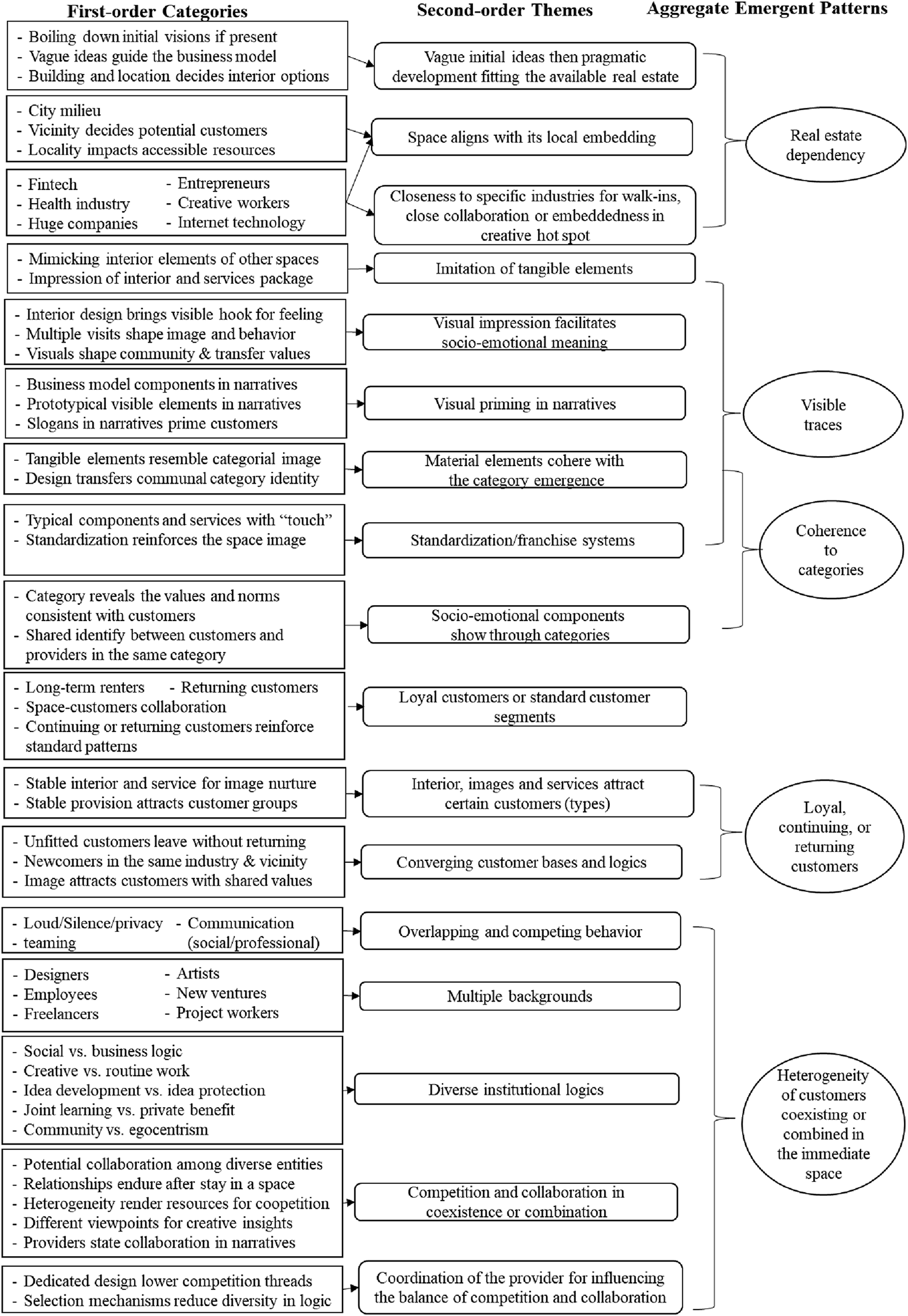
Our process (see overview in Figure 3 and the Supplementary Material Web-Appendix G) started with the deduction of initial patterns. Then, we compared the initial patterns (stated in the Propositions 1, 2.1, 2.2, and 2.3) with the data. As aforementioned, in the analysis of the initial patterns, we applied the Gioia method for disentangling the constructs, hence the trajectory mechanisms. In the comparison, we achieved information supporting our initial patterns but also refining and enriching them. Again, we applied the Gioia method to better disentangle the new insights. Our construct developments for the initial and emergent patterns are given in Figures 1 and 2. Then, we used our iterative analyses and comparisons within and across cases for inductive theory building, which we also compare with the existing theory for carving out the novel contributions. Tables and figures in the Supplementary Material Web-Appendix depict the cases and findings. Construct structure of the initial patterns. Construct structure of the emergent pattern.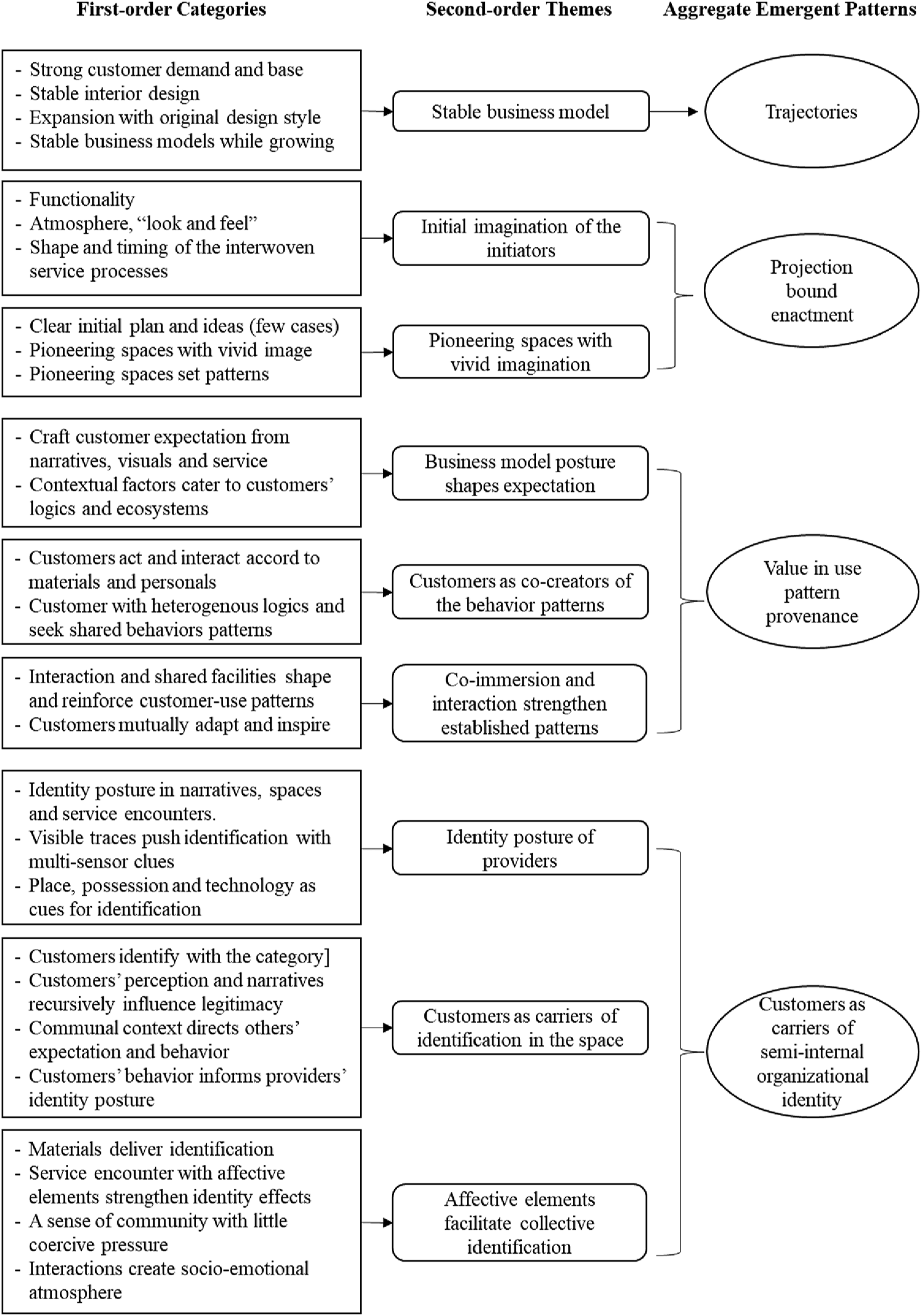
Data Collection
We collected data from multiple cases over 4 years (2017–2021), in three interview rounds plus gathering data in observations, from official websites and from other archival data. The longitudinal set up was necessary for understanding the trajectories. The Supplementary Material Web-Appendix (especially A) provides an overview of the data from each round of field research. Providers and customers of coworking spaces were interviewed, aiming for diversity and information-rich examples to corroborate our findings (see Supplementary Material Web-Appendix I for website changes, interview quotes, and observations). Specifically, we looked for informants with no less than 1 year of work experience in coworking spaces while striving to cover differences in their professions (e.g., experts in communication and social media, marketing, information technology, trading, fashion, and design) and positions (e.g., employees, managers, founders, entrepreneurs, and freelancers). All interviews were transcribed and then coded by two researchers independently. Completed transcripts were sent back to interviewees for approval. We investigated coworking spaces in China, the US, and Germany, seeking to consider influences from potentially different or similar national or cultural institutional backgrounds and diffusion of the coworking trend.
In a purposive sampling approach, following the principle of appropriateness and adequacy (Eisenhardt 1989), we selected spaces in California and New York for including the pioneering regions and for considering other spaces in Europe that accelerated the coworking spaces trend that was well received in China. We only included specialized coworking-providers, no corporate coworking spaces run by other incumbents. In addition, we only included coworking spaces that have baseline features of a common area, hosting events, and offering shared offices.
Specifically, we asked providers about the BM, daily activities in the space, and their interactions with customers. We asked customers what they value about coworking, how they use it, and what coworking means to them. Our questions were rather open in the first round, then in the second round focused on trajectories, and in the third round concentrated on effects supporting trajectories and understanding further the upcoming topics. In the first round (starting April 2017), we visited all coworking spaces for at least 7 days as observers, engaging in activities and events when access was available. We took pictures of the interior. In the second round (starting August 2018), we concentrated on retrieving changes and rigidities, for example, comparing pictures of the spaces at the different times. In the third round (starting September 2019), we aimed to revisit all the cases, which was challenging due to the COVID-19 pandemic. All spaces had personnel changes, and the provider of one case was not accessible due to facing a financial struggle. We complemented our dataset with rich secondary materials. Longitudinal tracking of each provider’s official website was an essential source, providing evidence on the value each coworking space proposed to the public, the image it presented, and changes over time (see Supplementary Material Web-Appendix H for more details). Other sources, including internal documents from management teams and external documents from media, industry associations, and government materials further enhanced the diversity of sources and, therefore, the validity of our findings (see Supplementary Material Web-Appendix A and E).
Data Analysis
Two researchers analyzed the data independently. We only included information that was (1) consistent in provider and customer information, (2) free from disputes to other resources, and (3) supported by at least four cases. These criteria enabled us to screen out untenable concepts. For a comprehensive and systematic analysis, we also adopted the MAXQDA software. Interview transcriptions and write-ups for each case were used to generate and compare first-order concepts, second-order themes, and aggregate dimensions. Again, the Supplementary Material Web-Appendix delivers rich information about the cases and the coding.
As aforementioned, considering that our topic is about socially embedded and potentially hidden aspects, we followed the template of Gioia et al (2013b) to match and compare our initial patterns and develop concepts from new information toward the emergent patterns. Our first pattern structure was not open and thus different to the general stages of a Gioia approach as our concepts were informed by initial patterns (hence, trajectories and trajectory mechanisms) set out in the framework of our propositions informed by theory. Hence, the first iterations between theory and data were led by the aggregate dimensions in our propositions. Following the theoretical framework, we searched for first-order concepts second-order themes or aggregate dimensions confronting findings and theory. Figure 1 shows the data structure. We used our iterative analyses and comparisons within and across cases for inductive theory building, which we also compare with the existing theory for carving out the novel contributions.
Supplementary Material Web-Appendix C shows the distribution of supported or not supported patterns with respect to the different cases and by indicating the second-order themes. Supplementary Material Web-Appendix D gives the distribution of new insights and emerging patterns with respect to the different cases related to the second-order themes. For the constructs in initial and emergent patterns, we categorized each code segment into the existing first-order concepts or into a new concept category. 96 percent of the codes were categorized under consensus of the two researchers, and agreement on the remaining four percent was also reached after discussion. For the creation of emergent patterns, we applied the open Gioia approach again, so searching for first-order concepts, second-order themes, and aggregate dimensions. Figure 2 illustrates the data structure related to the emergent patterns and Supplementary Material Web-Appendix G provides an overview of the information on the initial and emergent patterns and states the cases in which we retrieved the information.
Results
Case Stories for Contextualizing Insights and Patterns
MOBYLE is a successful space initiated by a biotech network manager in 2016: Its initiator specified in 2017: “First was the idea. We had the idea that creative workers, entrepreneurs, or potential entrepreneurs with a research background might need a collaborative environment, especially when pursuing ideas from their research” [MP1].
The operational manager of the space stated in 2018: “We face a strong demand. We have been searching to rent a bigger space, … our workspaces are all rented by loyal users, … we want to keep it near the center of our town. So far, we made what we could out of the rooms that were available. We have a common zone and single offices for temporary or long-term rent. In the past, we added some interior elements that seem to fit. We earn money by hourly, daily, or monthly renting fees. … Prices are stable. …We offer beverages at a low price so that provides little earning also” [MP2].
In 2019, the space and the BM had not changed, neither in components nor in general. Only the space was still facing strong demand and loyal customers. The initiator still in charge stated that he had been looking for a bigger building. The real estate expansion occurred in January 2021. Despite the tripled size, the BM remained. The initiator stated: “We offer a creative space for entrepreneurs, freelancers, and new ventures, increasingly from the health industry. … We visited other spaces in Europe and imitated the coolest ideas to pimp up the space, for example, with a stage, curtains, a digital room, and topic areas, see our San Francisco café. … We organized the customer journey in different zones. … We earn money by rents as before, but we have more entrepreneurs now. …. We hope to host events in the post-pandemic later. … We formed some collaboration with rural coworking spaces, for example, those in old castles where users come from X (a metropolis) and with S (a big health care company)” [MP1].
MOBYLE supports our proposition on stable BM components, even in growth. Yet, we find no hints about an initial vivid planning imagination of the initiator. Yet, as a new insight, we find the limiting respectively enabling factor of available real estate. Furthermore, customers are loyal, so shaping a trajectory. New customers only come short-term when they work in their holidays or in innovation projects of health care firms in the vicinity, when desks are available. There is some heterogeneity of customers’ backgrounds but most are internet freelancers, bio-material experts, or health care entrepreneurs. MOBYLE provides insights about the isomorphism related to tangible objects in the service space, which resemble prototypical elements of the category.
The idea for KREAM, a pioneering coworking space, was described by its founder in 2017 as follows: “I saw those garages in Silicon Valley and wanted a European one, in a cool area of X (a metropolis) with all that is needed. Then I found this building in the shabby upcoming quarter in X. … We have all for cool people. I laid it out. I designed it all. The cafeteria is on the first floor, then comes the offices, and the workbenches, cutters etc. on the third. … I just made a contract with L (a large company) who will rent team offices for becoming cooler and more innovative. … Earnings mostly come from the cafeteria. … I am not a money person – I live for the dream” [KP1].
Information about KREAM’s collaboration with institutional customers was spread through the media, making the space nationally known. Toward the end of 2018, KREAM had carried on with the concept and opened a similar, yet smaller, more upscale design language space in a different large city, but they had to shut down soon. Customers complained about the “atmospheric tensions” in the space. Meanwhile, the founder traveled around the world to find new ideas, especially on co-living and world-wide collaborations. By the end of 2020, KREAM was experiencing financial difficulties. In 2021, the space had somehow recovered, regardless of the pandemic. KREAM supports our proposed mechanism of projection bound enactment, but questions that it improves legitimacy. Possibly, incremental progress can fit in better with customers’ demand than the initial imagination of the BM. The case reveals collaboration with other spaces and with firms. In addition, we find cues on imitation activities hooked on visible and design elements. KREAM also portrays a case with highly heterogenous customers from diverse backgrounds and different interests, yet who identify with the idea of a vivid, very modern urban life.
NEWBIE is a coworking franchise system that follows a world-wide standardized approach. The BM is guided by social and organic logics. Earnings come from rents, events, and beverages. The design transfers the image of low budget “upcycling.” Customers strongly identify with the low budget “upcycling” idea, even if they have different job roles or operate in dissimilar areas with their ventures. The design language had not changed since 2016. NEWBIE has constantly grown in terms of locations in different countries.
PUZZLE belongs to a world-wide operating coworking space brand pursuing standardization in following the image of a cool workspace. Earnings mainly come from high rents. The provider has been growing since 2019 and is still in the market in 2021. Customers coming from diverse backgrounds complain about the lack of social events and the egocentrism and opportunism of many fellow customers. PUZZLE supports the BM trajectories and provides new insights about the important visible hooks of the interior, which shapes social-emotional influences and customer identification. The visible hooks of the interior shape trajectories and increase the coherence to the category. PUZZLE also informs us about conflicts and competitive interests that are not buffered by the (low) customers’ shared sense of community in the space.
OLIVELY is a fintech orientated coworking space in a large city: “We are just developing. I come from C (one of the big four) and had pushed the concept and implementation of a coworking space in C. But the other managers screwed the concept created by me and visionary experts, architects, designers, and psychologist. C just uses it for marketing – the place has no soul. … made our own project then, we wanted workbenches and social inspiration for fintech entrepreneurs. Each table a venture, all simple tables, but space to work and to meet – and have a beer together. We got support from the CM-Bank that had moved out of their high rise building that we are in. We also get support from the city council. … Our income comes from rents and from events of larger companies. Yes, we have a leisure stage-social space, host creative events, and soon we will offer coffee and so on also during the day” [OP1] in 2018.
In 2020, the visible appearance and the value capture of OLIVELY space has been unchanged but had grown by two stories, following the same interior idea that centers on simple furnishing. From 2020 onwards, OLIVELY introduced separate group offices for confidential projects and reducing knowledge spill-over and competition threats among customers. OLIVELY’s value capture is still focused on returns from rents and organizing external company events that aim to attract investors, business angels, and new customers. The space collaborates with other coworking space providers for capacity leverage, helping their customers in merging fintech expertise, and to connect investors, supporters, and other customers. Hence, it develops business ecosystems.
The OLIVELY case supports strong trajectories and visible hooks of the continued “simple” interior design language. We discovered that the initiator had a vivid version in his first project but then adopted it to “reality” in his own new project and the real estate available. The space set in a banking quarter concentrates on a specific audience, fintechs, hence, on customers that are primed by a similar industry logic but work on that from diverse professional backgrounds. Customers individually and collectively (on the venture group level) compete and have stated that they are concerned about unintended knowledge spill-overs. Customers were very cautious to protect their desks or offices. Further, the case shows that the socioemotional interlocks of customers build an overlaying socio-material meaning of the space (stated in quotes on “the soul of the space”), which allowed vivid socializing but keeping secrets on their business idea. The case revealed that a spatial design can lower competitive threats among customers. Finally, the collaboration of the provider with other firms shaped success, similar to the institutional arrangements in service ecosystems to shape the market (Brodie et al. 2019).
Trajectories Mechanisms: Iterative Comparisons on Patterns
Overview of results in support or extension of initial propositions
Findings reveal only partial support on the mechanism of a projection bound enactment for pioneering service providers. Different from the a priori planning, we note that BMs develop iteratively and adaptive to the real estate and local spatial context. Our findings bring support for the value-in-use pattern provenance in the service encounter while nuancing that they also reside in loyal customers. Collective level value-in-use patterns and multiple cocreation patterns emerge in the social interactions and remain unchanged, forming a trajectory mechanism. The value-in-use is aligned with visible traces of prototypical interior designs related to the category. Novel findings relate to the socioemotional interlocks of customers. Furthermore, there is rich support on the mechanism of customers’ identification processes as semi-internal carriers of identity. Findings map out inside-out and outside-in identification processes. Besides, we find heterogeneous logics, coopetition, as well a shared logic in the service space. The initial, observed, and emergent patterns are shown in Figure 3. Theory development in the research context.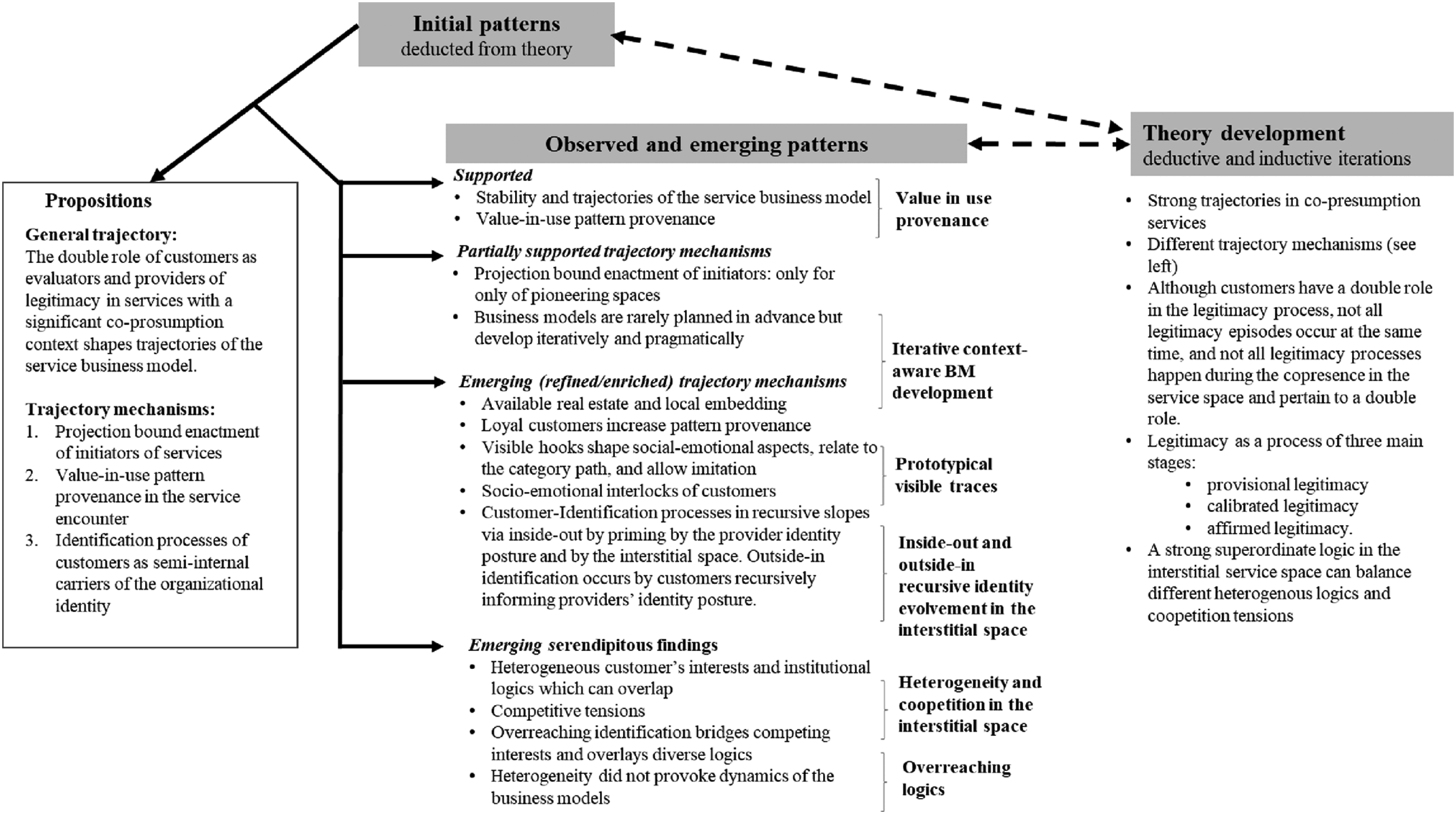
Trajectory mechanism: Projection bound enactment
We find some support but also contrasting insights on trajectories related to the founder’s cognitive and emotional lock-ins by their complex and multi-dimensional initial imagination of the space’s functionality, its look and feel, its atmosphere, and the shape and the timing of interwoven services processes. Only few coworking space founders/initiators and only of pioneering spaces espoused an initial vivid imagination of the complex and multi-dimensional space, one that further guides and restricts their plan and its implementation. Most seem to be sparked by a vague initial idea on which the BM iteratively and pragmatically evolved, restricted by available real estate. We newly gather that real estate determines the interior and aligns with its local embedding (e.g., in a city milieu, university, or inclusion in an incubator).
AU3 first working in another space near a university and later in AVEL states: “I worked in a coworking space next to the university. But it is too academic and totally different from here. You can feel the research from the space, the people working there, and how they work. … I did not feel like it was something for me. So, I left, even though it is cheap, and then moved here” [AU3].
The service BMs imitate tangible elements of other spaces or are integrated in standardized franchise systems. It seems, pioneering coworking spaces have set an industry template that followers imitate. Visible and accessible BM elements support imitation and category prototypes, informing our emergent pattern of visible traces.
Trajectory mechanism: Visible traces
Providers explicitly mention that they were mimicking interior elements (e.g., “relax” stages and coffee corners from other spaces) by visiting spaces, even world-wide. Entering other providers’ service spaces physically allows experiencing and mimicking the tangible but also the intangible components of other services BMs, even the social or emotional vibe of a service space. Even virtual access delivers cues of the interior and the service. Some spaces use overall cognitive anchors, as HELIO, in their marketing narrative, state: “Enjoying the Silicon Valley ambience in China.”
The manager of the HELIO space articulated: “We always accentuate the Silicon Valley gene in our space. … Certainly, from the space, you can see that we have very spatial open areas with a playful and young style. So, we intend to present our Silicon Valley ambience to the public and show them that we focus on connecting business between China and the US” [HP1].
Standardization and franchise systems manifest the typical in coworking spaces but allow some individual touch in the interior. The tangibles express the core meaning of the service space that reinforces itself. Customers talk about the “look and feel” of the space.
AU3 working in the AVEL space: “The interior and design here totally meet our expectation of a modern working place for young and creative people. There is a detail I have to stress, even all the plants here they are real. You see the wall covered with green plants? They are also all real plants. … All my teammates like it here. And it, more or less, creates the motivation that your work should also match the environment and other peers here. I find our working productivity improves, and (laughter) everyone cares more about their dress now” [AU3].
The social embedding and observation manifests established models of behavior and thinking as outset in traditional institutional theory on mimetic and structural isomorphism (DiMaggio and Powell 1983). Institutional customers expect certain elements. However, our interviewees did not mention this coercion. The visible traces relate to isomorphisms that stem from material objects. Still, these include social and emotional meaning for customer behavior. Our emergent pattern indicates that tangible aspects shape a trajectory mechanism related to atmospheric elements residing in the interior. In addition, the visible traces cohere with the service category and point to isomorphism that reflects on the BM. Prototypical visible traces diffuse the category and enforce trajectories on several providers in the category.
Trajectory mechanism: Value-in-use pattern provenance
All cases support the value-in-use pattern provenance. Providers craft narratives, visuals, and their production potential for shaping customer expectations. In their BM posture, providers consider specific contextual factors related to customers’ logics and ecosystems (e.g., fintech entrepreneurs, creative designers, and sustainability). Via the sharing of facilities and the interaction among customers, typical customer-use templates evolve. They become reinforced, when customers adapt and learn from each other (e.g., how to use spaces, infrastructure, and materials). We find additional support on the pattern provenance mechanism by our emergent insight about continuing or returning customers.
Trajectory mechanism: Customers as carriers of semi-internal organizational identity
The cases largely support that organizational identity is a trajectory mechanism that not only evolves from the founders, managers, and employees, but also from customers as semi-integrated carriers. Our interviews with customers reveal that they identify with a specific space. Customers also identify with the category’s main norms and values of openness, community, flexibility, and modern work vibe, and expect these in the service encounter. Categories explain how members define them as an entity and therefore inform how a business should be carried out (Bitektine et al. 2020). Considering the category linkage of legitimacy evaluation (Zhao et al. 2017), there might be a recursive reflection of categories via the narratives and the customer’s perception of prototypical components that influences legitimacy. Narratives inform about the identity posture. ENTRE’s slogan—“To make innovation easier, to make minds closer.” IMAGE presents a more formal business style from both its narrative of “Leading agile business one-stop solution” and its space with plant walls, smart office technologies, and business-style interiors.
AU3 stressed the image and reputation of AVEL among entrepreneurs: “It (AVEL) is a quite famous coworking brand for its entrepreneurship service platform. I have seen its ads on streets and flyers, so I already know that it is something for entrepreneurs” [AU3].
The normative elements and prosocial issues of coworking space narratives relate to findings on social ventures and their identity posture (Conger et al. 2018). The service space can further push identification due to its multisensory clues, as outset in the visible traces. In contrast to internal organizational members, there are little coercive pressures present in coworking spaces because customers can leave the space if they feel they do not fit in. Ongoing or repeating interactions create an atmosphere that recursively informs legitimacy.
HU3 recalled the experience of working in IMAGE and then moving to HELIO: “The space and the facilities there (in IMAGE) are generally fine, but… just the ambience and atmosphere are not that much my cup of tea. You know, most people dress quite formally and behave too business. I am more liberalism, and I prefer here (HELIO), the big open space and all young and lively people… I had stayed there for only three months and chose to move here” [HU2].
HU1 who has been working in HELIO for 3 years on two different projects stated: “There are different and many entrepreneurial teams and individuals here (in HELIO), so it gives you an environment and motivation of like we are in fact doing something and trying to make a difference. ... You know, here, everyone would not judge you if you succeed or fail. We are all in the process and share something deep in common” [HU1].
Identity effects will be strong, when the service encounter contains affective elements because affective interpersonal commitments strongly drive identity processes (Murnieks, Cardon, and Haynie 2020) and because the identification occurs in a material space that contains meaning for the design (Waters-Lynch and Duff, 2021). On a more general level, a service space contains identity reflexivity that forms along the social and material context. When customers communicate or interact repeatedly, they better learn about others’ values and norms, and through discourse and routines might form joint interpretations that relate to identity. Customers, as a semi-internal identification group, are receivers of the identification processes but also carriers of the identification in the space. Identification occurs inside-out through priming of customers by the provider identity posture via tangible objects, narratives, and the service personnel. In addition, there is an outside-in identification through the provision of identification by the customers that can recursively determine providers’ identity posture and future interactions of customers in the space.
Emergent finding: Heterogeneity and coopetition
Besides informing about trajectory mechanisms, our findings indicate that the immediate service space hosts diverse sub-audiences of freelancers, entrepreneurs, project workers, and firm employees. Customers in the service space come from diverse backgrounds, with different interests, embedded in diverse ecosystems, and are influenced by heterogenous institutional logics. For example, customers can follow social logics (e.g., sense of community, sustainability, and social entrepreneurship) or business logics (e.g., using facilities for improving their business). Customers might have diverse desires for vivid communication versus privacy, creative versus routine work, idea development versus idea protection, or pursue joint learning versus private benefits. For example, company employees might work in the coworking office as a remote team offsite from the corporate office or work in coworking spaces as their professional environment, possibly extending their home office following creativity targets. Being primed by their company, employees often follow logics different to those of freelancers or entrepreneurs. The heterogeneous customers’ interests and logics can be overlapping and work in a collaborative relationship but also compete. The joint identification with the coworking category and using the common areas allows overlapping institutional logics and collaboration. We find that customers can enjoy the vibe of diversity in the community and discourse among each other, even if they pursue different targets.
MU2-1 is a customer working in MOBYLE: “We don’t really work together… we inspire each other or provide comfort… see those yacht people that come in the summer, yeh, they are leisure sailors, mostly made their money already and just check in on managing investments,… but it’s much fun, they can tell stories. … It’s fun but takes me aback sometimes because their world is so different to my small freelance jobs” [MU2-].
Collaboration of customers relates to collective learning, a sense of community, the vibe, and shaping overlapping institutional logics. Competing aspects tie-in to different behavior (e.g., talk vs. silence/priorities for desks, communication vs. privacy), interests (e.g., knowledge transfer vs. knowledge protection), and different logics (e.g., social vs. business customers/different industry perspectives). Interview quotes picture the heterogeneity.
DU2 elaborated on the mixed feelings from working in the same office with others: “It is really nice to have so many peers working with you. It makes the working atmosphere totally different from traditional offices. … You might find someone quite pleasing your eyes, and you naturally get to know them after some eye contacts or greetings. … But also, your privacy and confidentiality are partly sacrificed because of the transparent glass walls. I see one team piled documents and boxes next to the glass wall. Maybe they try to increase security and privacy” [DU2].
AU2 in AVEL elaborated his concerns on business confidentiality:
“I have really a bit concern on protecting our business data. So, I checked with the management team that only the cleaning staff has the key of my room. Also, we have password and other technical ways to protect it” [AU2].
AU2 stated the benefits from working with diverse others, besides business:
“You know it is so exciting to work with so many different people. It is not necessarily that they have to support you in your project or collaborate with you. Only talking with them makes my horizon broadened. I got to know so many professions and types of jobs I did not know before, and in fact they are done in that way!” [AU2].
BU1 elaborated on the needs and power of working with peers: “I worked at home but find it is not the right place and ambience for productivity. … You are just next to your bed, you know? And you also get bored so easily. … But ..while watching others working on projects or discussing with teammates, I feel like much more motivated. … You can also discuss your ideas with peers here. I got a lot of helpful information from them” [BU1].
The collaborative relationships accompany knowledge exchange, understanding, and common benefits while competition can trigger ambition and private benefits. Collaboration can occur among individuals and collectives, such as among groups or ventures. Competitive tensions especially occur in spaces with a similar target group. Still, the tensions can contain positive effects, for example, when competitors pool or leverage resources, as stated for coopetition (Bouncken et al. 2015) or when different viewpoints trigger creativity. The coworking space category might inform the coopetition-heterogeneity logic and set a trajectory of the BM proposition about attracting and hosting heterogeneous customers. The logic can be flanked by provider actions (e.g., separation activities) that prime the service space in the eyes of audiences as a home for multiple and coopeting targets. However, we discover different forms and degrees of heterogeneity and of coopetition for theorizing.
Discussion
In respect of the institutional theory turn in service research (Koskela-Huotari, Vink, and Edvardsson 2020), our study was to analyze the double role of customers in the legitimacy process and the inherent trajectories of service BMs within a significant CoP context. Our study introduces legitimacy theorizing to service research while zooming in on the CoP context of services that informs about the immediate and double role of customers as both evaluators and cocreators of legitimacy. At large, our study views legitimacy as a recursive process among different actors in different episodes. The CoP context includes customers who have specific expectations led by their knowledge of the category and their potential ecosystem membership, primed by providers’ narratives and (direct and virtual) service potential impressions. Customers are influenced by experiences in previous encounters, too. The context allows potential physical, cognitive, social, and emotional interlocks of diverse customers and enfolds trajectory mechanisms that surface in BM.
In services, the customer represents a particularly important key audience for legitimacy that has been neglected in previous legitimacy research (Täuscher, Bouncken, and Pesch 2021). The customer focus of our study advances the view of recursive legitimacy processes (Soublière and Gehman 2019) extending it toward a double role of customers in the legitimacy process. The current study suggests that services have more opportunities but also demands in posturing (Conger et al. 2018) their legitimacy in narratives, in their service production potential, and in the service encounter. Service customers, especially within CoP contexts, directly perceive the actions and norms of a service. They can undergo direct interlocks with the provider or fellow customers in the service encounter. Interlocks can be physical, but also cognitive (e.g., knowledge exchange), social (e.g., community), and emotional (e.g., excitement/fun or anger). Observations, interactions, and discourse coin cocreation episodes between specific individuals, radiate on others, and can contribute to the atmosphere of the service, thus spreading to a collective level.
Our findings support the proposed trajectory mechanisms related to value-in-use pattern provenance and identification processes. Additionally, we submit the presence of visible traces as a trajectory mechanism that relates further to the imitation processes of tangible elements, laden with socioemotional value. The imitation links to “traditional” institutional research on mimetic isomorphism (DiMaggio and Powell 1983). CoP services allow observations of the interior but also of interactions of other customers. The service arena might enfold negative aspects. However, observation, action, and communication can help customers in pursuing their functional purposes. It also delivers cues for comprehending social patterns and absorbing the affective, even “atmospheric” expectations. This blend of observation and interaction frames valuations, expectations, and institutionalizations.
In the realm of identity-related trajectories, our study suggests viewing customers as semi-internal carriers of organizational identity. Previously, only organizational members were considered the main carriers of an organizational identity that conveys trajectories of organizational change (Cloutier and Ravasi 2019). We suggest that the organizational identity of services builds through inside-out processes as an identity posture of the provider and, additionally, by outside-in processes where behaviors of customers reflect on the provider. The recursive relation between inside-out and outside-in further informs how recursive processes form a trajectory mechanism. The recursive legitimacy and social trajectories proliferate because the cocreating customers interlock functionally, cognitively, and emotionally. In continued or repeated interactions, customers draw on their previous experiences, manifest evaluations, or calibrate and re-calibrate them in recursive stages. Experiences and interlocks in a service encounter linger and recursively inform interactions.
Legitimacy Stage Model for Services
In general, our insights advocate viewing legitimacy as a process rather than a state. Episodes and extensive process stages characterize the legitimacy process. Although customers have a double role in the legitimacy process, not all legitimacy episodes occur at the same time, and not all legitimacy processes take place during the co-presence in the service space. We suggest a stage-based legitimacy model for services that can apply to less significant CoP contexts (Figure 4). Stage-based recursive legitimacy model.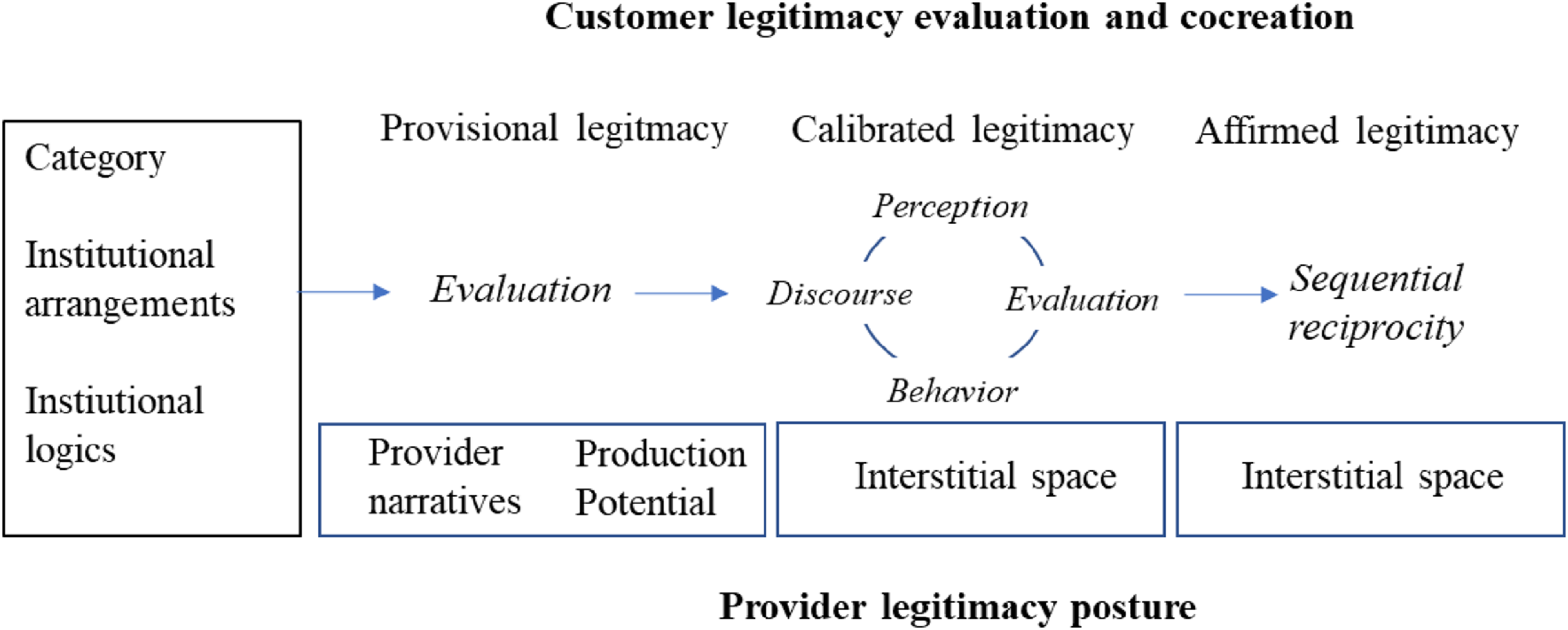
Provisional legitimacy
Customers evaluate legitimacy of the space by their expectations, informed by the narratives of the provider and by their knowledge of the category, and also by embeddedness in the logics or arrangements in ecosystems (Koskela-Huotari et al. 2016). Categories coin symbolic resources (Wry, Lounsbury, and Glynn 2011) that occur as visible traces of the service potential, having a high importance as a symbolic resource. These symbolic resources directly influence customers of providers that can immediately posture their physical space to “walk-ins” (e.g., hairdressers, shops, bars, and coworking spaces). Hence, providers can posture legitimacy through prompting in narratives (e.g., using texts and pictures as images of the value processes), but also by the service production potential.
Calibrated legitimacy
Once customers have purchased and entered the space, they grant legitimacy, which influences the co-present customers in their legitimacy evaluation and can contribute to the ongoing legitimacy evaluation and cocreation of present customers. The legitimacy evaluation manifests in episodes containing the social interactions and discourse that take place in the immediate service space. Evaluations and actions are recursively influencing customers. Hence, adjustments of customers might undergo several evaluation loops in which they (re-) calibrate legitimacy while they experience the services, act, perceive others, and enter discourse. Customers not necessarily but likely interact with each other, where they might espouse parts of their interests or logics. In interactions and discourse, they might develop or reinforce collective views and through this also cocreate or manifest legitimacy. Experiences calibrate and re-calibrate customers’ legitimacy evaluation, and further emphasize the double role that customers have in legitimacy evaluation and cocreation. Legitimacy evaluation and cocreation occur in working beside each other and just observing others. Interlocks can be physical, social, cognitive, and/or emotional. Interlocks can set not only supportive but also non-supportive legitimacy effects because customers might follow different targets, disturb each other, or concentrate on the discourse concerning the downsides of the service. Still, customers of coworking spaces might particularly enjoy the heterogeneity provided through fellow customers. This heterogeneity and its dynamics might characterize coworking spaces and separate them from corporate spaces of incumbents. The micro-service space might develop a superordinate logic, perhaps on multiplicity or coopetition.
Affirmed legitimacy
The continued support of the audience signposts affirmed legitimacy, for example, when customers repeatedly use the service and when the service BM experiences growth processes. Loyal customers affirm legitimacy to the service BM. Re-adjustments that lead to an affirmed legitimacy can come from different visits and service encounters of continuing or returning customers. Trajectories of the BM are manifested once a space has reached the state of affirmed legitimacy. The affirmed legitimacy contributes to identification processes and the recursive loops that socialize fellow customers and is based on customers as cocreators and evaluators of legitimacy.
Superordinate Logic and Interstitial Service Space
An emergent pattern in our study revealed that customers in the service space have diverse backgrounds and are associated with different ideas, diverse ecosystems, and heterogeneous institutional logics. Interests, behaviors, and logics might be in a collaborative but also in a competitive relationship. Customers might expect heterogeneity and consider it in their evaluations in the legitimacy process, even though the heterogeneity is only factually present during the service encounter. We deduct that the service space can represent a micro-level ecosystem. Service ecosystems research has shown that complexity can contain incompatible ways for integrating resources to cocreate value (Siltaloppi, Koskela-Huotari, and Vargo 2016). The heterogeneity from different institutional logics in service ecosystems points to dynamics and innovation among customers on the micro-level of an ecosystem. Interestingly, the heterogeneity did not provoke dynamics of the BMs. The multiplicity of the interactions of heterogeneous customers might explain greater creativity compared to internal open spaces by incumbents.
The service space of coworking spaces might be associated as a place for allowing heterogeneity, autonomy, and creativity, therefore informing an interstitial space. Furnari (2014) has suggested the term “interstitial” (p. 439) for spaces that host informal, occasional interactions between people from distant institutional fields. Our finding points toward different forms of heterogeneity. It might relate to interests, behaviors, logics, and ecosystem embeddedness. Additionally, we find that heterogeneous interests and logics might occur in collaborative and/or competitive relations. Collaborative or competitive aspects might coexist or be combined as shown by the multiple relationships that might allow coopetition.
To reduce the negative coopetition effects, coworking spaces use separation mechanisms, such as defined dedicated spatial areas for joint work and, also, private rooms for separating activities. They also define zones (leisure, communication, and silence) for reducing tensions. Competitive tensions seem greatest in spaces with more homogenous customers, as shown for our fintech case entrepreneurs whose high competition risks demanded separate office layouts, so that customers could actively join socializing and networking but also could retire in own offices. In steering the collaboration-competition balance, coworking spaces might use selection mechanisms (e.g., by attracting target groups) that manage heterogeneity and competitive overlap. Furthermore, providers might nurture the collaboration-competition balance by social and emotional interlocks, such as for a more intense discourse, connections, and friendship in social events. Initially, providers might prime collective values in their narratives. In addition, the interstitial space might have specific potentials to balance the opposing logics in coopetition, for the direct interaction includes diverse physical, cognitive, social, and affective interlocks. Mixtures of these interlocks might develop multi-dimensional equilibriums of the space but also of specific coopeting customers. We assume that the interstitial space as a micro-level of a service ecosystem has the potential to develop a superordinate logic that might link to other levels of related ecosystems. This superordinate logic can occur as coopetition. Other service spaces, potentially integrated in service ecosystems, might also create such a micro-level superordinate logic.
Limitations
Typical for a qualitative design, our key limitation is the generalizability of the results. As our study started in 2017, it might be too much orientated on pioneering coworking spaces that proceed with their successful path. The coworking trend is recently developing also into more suburban or even rural areas, which we did not cover, and which might differ from our cases that are urban and/or not far away from universities. Our selection of cases might be biased from our country selections and its different institutional frameworks. To limit the bias, we aimed to cover different locations of embeddedness, for example, where coworking spaces had started (San Francisco/New York) and where they strongly proliferated in Europe and China. Surprisingly, we could not detect significant differences of the designs or by the impression we got from customers. Only, by tendency, the Chinese cases seem to have a higher turnover of customers and the German cases reveal the lowest fluctuation of customer and relatively older customers. While coworking spaces are an interesting trend, our contribution might be limited to these or comparable service spaces. Our insights might be restricted to the typically strong (pro)social elements in coworking spaces.
Our results offer transfer potential to other service spaces, where customers share office facilities, such as incubators, accelerators, or science parks that also support entrepreneurs with social, educational, networking, and hospitality solutions. The key difference is that coworking spaces are open to a wider variety of customers, not only entrepreneurs. In addition, coworking spaces often lack a coherent function of the space directly demanded of the customers (e.g., as incubators on a certain entrepreneurial field). Coworking spaces often have makerspaces or fablab elements, but do not necessarily contain them. However, we assume that our findings are transferable to these contexts because they also emphasize active and direct cocreation and co-presence among customers.
Coworking spaces are mainly about work but also include educational, leisure, and entertainment aspects. The customers’ sharing of materials and space and their interaction in functional aspects (e.g., business and learning) and in social or emotional aspects show parallels to sport and edutainment (e.g., fitness studios and sport clubs). The social interactions among customers in the space reflect recreational and leisure services (e.g., clubs and bars). Legitimation of these services strongly resides on processes among customers during a service encounter, often throughout repeated CoP. We believe that our findings about the trajectories and the legitimacy process are strongly transferable to these contexts.
Our model on legitimacy processes might be stretched to nested levels of service ecosystems. Our ideas on the balance of competing and collaborating might also apply to other levels in service ecosystems. Yet, service ecosystems mainly include B2B relationships, while coworking spaces also include end-customers. Additionally, the interactions in coworking spaces are linked in a common physical space. In service ecosystems, only some of the cocreation might occur directly but still the customers’ actions and interactions might operate as evaluators and cocreators of legitimacy on the level of the ecosystem members and the meso-level of the ecosystem. Still, the joint discourse as well as emotional and social value components of customers might be less important than in coworking spaces. The cocreation in service ecosystems might relate to more focused economic activities that do not necessarily include emotional or affective ones.
Implications for Practice
Our findings point toward the importance of direct cocreation and social processes in the interstitial service space for legitimacy via recursive processes. Findings reveal trajectories that can relate to the socioemotional linkages between customers within the service space, offering socioemotional cues, for example, via its interior. Hence, service practice is supposed to focus on finding and implementing instruments that improve the positive especially emotional and social experience of customers, therefore the calibration and affirmation of legitimacy. This need indirectly ties in with shaping the customer expectations when they are in the stage of provisional legitimacy. This challenge is emphasized because trajectories limit re-positionings of the BM.
A baseline factor for the service practice is the localization and design of the service space. We assume that coherence with the milieu, in which the service space is located will be particularly important for CoP services and it might be a rather novel phenomenon. This is because virtual platforms provide goods and offer virtualized services which can substitute the CoP context or its elements. While virtual services might have less real atmospheric and social value, carving out the specificity related to a real context becomes more important for services in the future.
CoP services in urban areas might be situated in specific milieus. For coworking spaces, this could be the hip-vibrant, artistic, or university quarters, or even young family areas. A greater coherence with the vibe of the milieus might allow providers attracting walk-in customers who, as loyal customers, might manifest the legitimacy of the space. The trajectories then manifest customers’ legitimacy evaluations and their provision of legitimacy. For example, a well-aligned interior design, a good fit with other services, and community management of the CoP service space with the specific local milieu might improve its sustained success. In contrast, standard franchise solutions might less likely achieve legitimacy and be apt to localization. Like urban milieus, rural areas might have a specific character and alignment to this by the design of the service space might increase legitimacy. Yet, the standard service spaces or franchise spaces might still receive legitimacy when located in urban quarters that are less characterized by a specific milieu.
As aforementioned, the specificity of the service space might reside in the interior design, embedded other services, and community management practices. The vibe might be anchored in the affective commons of the interior and their socio-materiality (Bouncken, Aslam, and Qiu 2021b). Professional and heedful designing the service space according to the context is key for service providers. Especially for coworking spaces, the vibe could be supported by socializing events or customer collaboration workshops, perhaps managed by a community officer role that needs to be established.
Reliance on walk-in customers only might also not be ample for CoP service spaces that can utilize virtual media, for example, by grooming their website for influencing the provisional legitimacy by alignment to socio-emotional cues. As with the notion that pictures say more than a thousand words, the visual impressions are highly important for attracting customers. Recent and upcoming virtual technologies might be embedded for supporting the selection of the space or for follow-up services (see even medical health apps). For coworking spaces, which apparently reside in direct social interactions, new virtual technologies might support collaboration and matchmaking of customers.
Furthermore, considering that legitimacy of a CoP service also depends on the local ecosystem or the embedding in a service ecosystem, providers need to understand key institutional logics of the other system partners and carefully consider the match. Match does not necessarily mean a complete overlap. Greater heterogeneity might allow better seizing opportunities. Yet, as revealed in our findings on the overlaying interstitial logics, heterogeneity needs to be balanced by some superordinate logic. Specific liaison managers might be implemented in coworking spaces for shaping joint logics and partnering decisions.
Future Research
Our research bridges institutional theory to service research in a way that can help disentangle complex phenomena and provide additional insights to be analyzed in future research. Legitimacy evaluations and cocreation will also relate to its embedding in business ecosystems and spatial service firm agglomerations (e.g., medical centers, shopping malls, sports facilities, leisure parks, and even digitalized platforms). Further research might analyze the overlapping co-legitimation of these settings. It might analyze the interwovenness of a single BM’s distinctiveness with its context—how to fit in. The fit in might consider the ecosystem, local community, and/or local spatial ecosystem.
On the meso-level, future studies could analyze the distinctiveness of a service ecosystem context, consisting of different providers that are each connected by their cocreating customers in or outside a spatial/local context. These compositions might be localized or shaped by remote connections among firms. Considering the strong trajectories, future studies might reflect on the appearances and components of service BM’s distinctiveness, which might pertain to tangible and intangible elements. Distinctiveness and fit of services might be particularly dependent on social and emotional factors.
While we see heterogeneity of customers, we did not systematically analyze the different logics and their origins, for example, from their embeddedness in other ecosystems. The embeddedness in other ecosystems becomes especially important when considering not only end-customers but also business-to-business services. Future studies might explicitly consider the diversity of audiences and how services manage the different logics across different levels of audiences in the nested ecosystems. For instance, our findings in coworking spaces showed that there is less competition when customers follow diverse logics. Can this finding be generalized to other contexts or logics? In addition, future studies should analyze how CoP service spaces can influence legitimacy through collaboration or coopetition with other spaces. On this tone, service providers can pursue institutional work as their purposive and joint efforts toward creating, maintaining, and breaking institutions. Hence, we encourage research on the legitimacy within business ecosystems.
In addition, CoP is likely to have a strong overlap of value creation and value proposition stages that are usually separated in BM research. The overlap results from physical cocreation and walk-in customers. Still, BMs might include diverse levels of tangible elements that might occur in different configurations in the BM. For example, the CoP context can be focused on standardized tangible or service components but also have different degrees of individualization or servitization. Stronger individualized servitization might come with stronger trajectories and additional trajectory mechanisms related to the focus on specific customers or customer groups.
In addition, the composition of the service BM (SBM) might not be delivered by the service provider but by other external providers. For example, there might be integrated service providers such as catering, trainers, and business angles. Other services with a significant CoP context might also integrate offerings of other providers. Accordingly, the SBM can be tied to other providers in an ecosystem or spatial context. The overall service impression and legitimacy then increasingly depends on the composition of providers and their customer cocreation processes. Hence, the diverse compositions of a multi-provider BM, even within collective consumption context, might shape specific interdependencies and trajectories that are not understood so far. Accordingly, we encourage research on the multi-provider context and the business ecosystem effects of services in which micro-to-micro, but also micro-to-macro relationships will influence cocreation and the embedded legitimacy processes of customers. Such research can also contribute to a better understanding of the diverse audiences in the legitimacy process linked by cocreation.
Furthermore, previous institutional theory research has analyzed the question of optimal distinctiveness. A multi-provider or business ecosystem context will set specific interrelationships between each firm’s optimal distinctiveness in the context of others in the same spatial context or ecosystem. While there are potential merits of co-legitimation among providers but also among customers in such a setting, there are also concerns of how to fit in the context or how to stand out of the context. Hence, we motivate further research on co-legitimation and optimal distinctiveness in service ecosystems.
The digital solutions that proliferated during the COVID-19 pandemic moved teamwork, team meetings, and even socializing events to the virtual space. Virtual solutions could substitute but also complement physical CoP service elements. Further research could investigate in whether the virtual space will be more successful when implemented by a standard software solution or by an individualized solution transporting the vibe, identification, and social materiality of the real space. At last, reflecting on our findings at large (cf., urban vs. rural, different interests in service spaces, nested ecosystem layers), we encourage research on hybrid institutional logics, which might become manifest in different forms and occur in diverse configurations of balance or imbalance.
Conclusion
Our research on coworking spaces leverages to service research a legitimacy view of customers as a key audience, which has a double role of cocreating and evaluating legitimacy. Legitimacy is challenging and important for services because it spans interwoven processes of nested key audiences, depends on experience processes of customers who are semi-internal audiences, and its customers have physical, cognitive, social, emotional interlocks. The double role informs service BM trajectory mechanisms, questions a too simple positioning and re-positioning of them. The cocreation submits a three-stage–based legitimacy process of provisional, calibrated, and affirmed legitimacy. Relevance to the “real world” resides in that service providers can increase the survival of their BM by supporting legitimacy processes of customers and by providing an understanding to mechanisms that limit their adaptations or redirections of the BM.
Supplemental Material
sj-pdf-1-jsr-10.1177_10946705211050208 – Supplemental Material for Legitimacy Processes and Trajectories of Co-Prosumption Services: Insights from Coworking Spaces
Supplemental Material, sj-pdf-1-jsr-10.1177_10946705211050208 for Legitimacy Processes and Trajectories of Co-Prosumption Services: Insights from Coworking Spaces by Ricarda B. Bouncken and Victor Tiberius in Journal of Service Research
Footnotes
Declaration of Conflicting Interests
The author(s) declared no potential conflicts of interest with respect to the research, authorship, and/or publication of this article.
Funding
The author(s) received no financial support for the research, authorship, and/or publication of this article.

Supplementary Material
Supplemental material for this article is available online.
Author Biographies
References
Supplementary Material
Please find the following supplemental material available below.
For Open Access articles published under a Creative Commons License, all supplemental material carries the same license as the article it is associated with.
For non-Open Access articles published, all supplemental material carries a non-exclusive license, and permission requests for re-use of supplemental material or any part of supplemental material shall be sent directly to the copyright owner as specified in the copyright notice associated with the article.
