




Abstract
Tasked with a greater role in the coproduction of expert services, consumers often face an immense burden in coproducing service and well-being outcomes. While some prior research has explored customer work, we delineate unique aspects of expert services and articulate consumer efforts that transpire outside the dyadic service interaction. Through netnographic inquiry in a health care context, we find that coproduction efforts are job-like and require job crafting efforts. Upon this foundation, three major themes emerged: (1) consumers leverage their context expertise by adapting content expertise to their unique circumstances, (2) consumers develop and deploy strategies (hacks) through affordances in order to manage their coproduction jobs, and (3) consumers move through the expert service journey in a variety of ways that shift them toward or away from well-being outcomes. After assessing the transferability of our results by analyzing a second expert service context (financial services/debt management), we suggest implications for theory, practice, and future research.
Keywords
Consumers actually work: whether or not they are aware of being “workers,” they do work.
The very nature of most expert services (e.g., personal finance, health care) is critical to consumer well-being (Anderson et al. 2013). Despite being characterized by deep technical knowledge, consumers are increasingly being asked to take on more responsibility for parts of the expert service creation, delivery, and consequences (Mende et al. 2017). For example, financial service consumers are tasked with monitoring and deciding on retirement investments, understanding and selecting the most appropriate mortgage and credit options, and assessing potential risks and trade-offs among financial service providers and their offerings. Similarly, in health care, consumers are tasked to “know what’s in the IV drip, why it has been prescribed and whether the dose is correct” (Landro 2016).
Known as “responsibilization,” this trend represents the shift in functions and risks from the expert service system to the individual service consumer (Brown and Baker 2012; Harris and White 2013). While service providers clearly operate as experts, consumers are tasked with taking on more of the responsibility for processes in and outcomes of the expert services system, often without possessing the corresponding expertise (Mende et al. 2017). As a result, consumers in expert services (e.g., financial planning, tax advisory, health care) face obligations and tasks characterized by high complexity, ambiguity, and uncertainty (Spanjol et al. 2015), at times resembling those of employees (Bonsu and Darmody 2008; Eckhardt and Dobscha 2019).
In the midst of this responsibilization trend, there is rapid growth in expert services spanning the gamut from financial, health care, and nutritional services to physical therapy, relationship, and actuarial services (Business Wire 2019). At the same time, consumers often do not closely adhere to expert advice (Bonaccio and Dalal 2006; Guo et al. 2013) despite the connection to their well-being. In health care, for example, the number one legal and “fair” reason physicians may dismiss or fire their patients is noncompliance (O’Malley et al. 2017). Notably, however, Montori (2017) suggests that noncompliance is typically due not to consumers’ defiance, irresponsibility, or unreliability but rather to the burden or job they must take on. This begs the question of how consumers manage this burden in expert services, which is the focus of our research. What do consumers do in the face of this burden?
The responsibilization trend (Giesler and Veresiu 2014) highlights two critical shortcomings in extant services literature. First, most current conceptualizations and categorizations of expert services are descriptive and based either on service sectors (e.g., legal, health care, financial) or broad service characteristics (e.g., search, experience, adherence, credence services). Thus, prior treatments of expert services offer little insight into the expertise dynamics required to improve consumer well-being. Second, investigations into how responsibilization shapes consumer engagement in and experiences with expert services are sparse (Anderson et al. 2016), despite the increasing burdens responsibilization places on service consumers. The asymmetry of technical knowledge between consumers and providers in expert services combined with the increased demands on consumers from responsibilization creates a particularly challenging situation (a “double whammy”) for consumers seeking to realize greater well-being in expert services systems.
Together, these two shortcomings in extant services literature underscore the need for (1) a refined conceptualization of expert services taking into account responsibilization and consumer engagement and (2) a process-focused framework of how consumers manage their efforts in expert services. We take a transformative service research (TSR) approach as we address both shortcomings and seek to understand how consumers engage in coproduction jobs that may create a burden for them. This approach’s core concern lies in “creating uplifting changes and improvements in the well-being of consumer entities” (Anderson et al. 2013, p. 1204). In the process, we provide three main contributions to well-being research. First, we introduce a refined conceptualization and classification of expert services, taking into account the critical role consumers play in bringing their expertise to bear on such services. In the process, we develop a more nuanced view of consumer expertise and how it shapes the experiences and well-being of consumers within expert services. Specifically, we distinguish two types of consumer expertise: content (technical) and context (situational) expertise. In juxtaposition to the traditional assumption of provider expertise driving consumer (well-being) outcomes in expert services, our findings reveal that consumers’ contextual expertise is even more critical, an insight new to service research.
Second, to the still scant consideration of consumer responsibilization, we contribute novel insights into how consumers negotiate the burden of expert services. Our findings illuminate job-like traits in expert services coproduction and the related crafting activities used by consumers. Specifically, we discover three hacks that consumers use in their crafting efforts to contextualize: seeking supervision, developing scaffolding, and adopting an entrepreneurial mindset. These findings yield innovative insights that offer rich opportunities for service providers to enhance value creation with their customers.
Third, to the conceptualization of consumer journeys, we add the consumers’ efforts to contextualize or customize to their own context and situation. Specifically, through the novel use of affordance theory (Gibson 1954), we discern different categories of movements in the dynamic journey that service consumers experience in their efforts to contextualize.
In the remainder of the article, we first situate our research in the conceptual nest of the expert service consumer’s customization journey, consumer coproduction, the working consumer, and job crafting. A netnographic study and analysis of health care consumers, followed by a validation study with financial service consumers, leads to our findings and conceptualization regarding consumer expertise and how the consumer seeks to handle the burden of increased responsibilities in expert services. A discussion of implications concludes the article.
Conceptual Background
Expert Services Under Responsibilization: The Consumer’s Customization Journey
Service researchers have begun to recognize the need for a more holistic understanding of how consumers deal with responsibilities and burdens in expert services settings and how such responsibilities shape experiences over the entire consumer journey (Lemon and Verhoef 2016; Nakata et al. 2019). Fully understanding how consumers experience responsibilization within expert services requires accounting for the dynamic, longitudinal, and situated nature of the consumer journey (Bitner, Ostrom, and Morgan 2008; Hamilton and Price 2019; McColl-Kennedy, Cheung, and Ferrier 2015) and recognizing that services are critically and dynamically (re)shaped by and (re)shape consumer experiences and practices (Akaka and Vargo 2015). Yet current conceptualizations of expert services often lack such richness, thus restricting effective theorizing on consumer–provider expertise dynamics.
Expert services, also called professional services or complex services (Mills and Morris 1986; Seiders et al. 2015), are a frequent domain for services research and largely fall into two streams. In the first stream, studies focus on business-to-business (B2B) settings, examining strategies used by firms holding and providing highly specialized knowledge to clients (Von Nordenflycht 2010), such as accounting and consulting firms (e.g., Castaldi and Giarratana 2018). Prior studies have emphasized the importance of customized approaches (Madhavaram and Hunt 2017), continuously tailoring service delivery and communications to a customer’s focal needs (e.g., Nyadzayo, Casidy, and Thaichon 2020). The second stream examines business-to-consumer (B2C) settings, many exploring the personal finance and health care domains (e.g., Mende et al. 2017; Seiders et al. 2015; Sharma and Patterson 1999). In health care, in particular, recent studies have highlighted the importance of consumer-specific circumstances and how they shape a consumer’s interactions and experiences with service providers and service systems (McColl-Kennedy, Cheung, and Ferrier 2015; Nakata et al. 2019). This emerging stream strongly suggests that the B2B customization approach to effective service delivery and outcomes is woefully inadequate in practice in the B2C domain of expert services.
Both B2B and B2C settings highlight the asymmetry in technical knowledge held by service providers relative to their customers. Given that expert service providers in the B2C realm are unable or unwilling to fully customize their services to each customer, the likelihood of a disconnect increases sharply. Yet scholars in the B2C context have just begun to recognize the many and varied challenges consumers face to be able to achieve beneficial outcomes (and ultimately enhance well-being) from such services (e.g., Chan, Yim, and Lam 2010). The degree of adherence to expert advice and the firing of patients for noncompliance certainly raises such concerns.
The particular dynamic inherent in the B2C domain of expert services alludes to a central mechanism by which it is consumers who must “translate” or “fit” technical expertise residing in expert service advice provided to them—the customization of technical expertise. For example, a financial planner may recommend that a consumer maintain their debt-to-credit ratio below a certain level. Consumers must then translate this advice into their configuration of discretionary income, financial obligations, unexpected events, and the like. How they accomplish this customization job throughout the service journey is an under-researched area. Our study addresses this important lacuna by considering how expert service customization occurs in the consumer sphere. In contrast with B2B expert services, in which service providers customize offerings for each client, consumers in expert services are expected to initiate and enact “customization” largely by themselves. Thus, instead of the service provider leading the customization, it is consumers who bear the onus of making the technical service fit their circumstances. This “fitting” of services by consumers represents a very different dynamic than a “customization” of services by providers; we propose that this requires a revised perspective (MacInnis 2011) on expert services to better discern how consumers move through their service experiences. Two research streams, which we discuss next, directly inform our exploration of the (potentially substantial) investment of resources consumers face during these “customization” efforts in expert services: the literature on customer coproduction of services and a more critical literature at the intersection of marketing and sociology focused on the idea of “working customers.”
Consumer Coproduction of Services
Service literature offers various conceptualizations of consumer engagement in value creation, some relatively narrow, such as consumer coproduction and participation, and some broader, such as cocreation. (Our goal is not to review, assess, or reconcile the considerable diversity of conceptualizations on these different concepts; for corresponding reviews, see Dong and Sivakumar 2017; Mustak, Jaakkola, and Halinen 2013; Mustak et al. 2016; Oertzen et al. 2018.) We follow the established understanding of coproduction as consumers’ 1 provision of inputs (e.g., effort, time, knowledge, or other resources) related to service production and/or delivery, extending beyond service providers’ boundaries and activities (Batalden et al. 2016; Grönroos 2008; Mende and van Doorn 2015; Normann 2001; Ordanini and Pasini 2008; Xie, Bagozzi, and Troye 2008). This definition corresponds to the burden or work that consumers often feel in expert services under responsibilization, involving their efforts most often beyond the providers’ boundaries and activities.
Studies have identified a positive relationship between consumer coproduction and service outcomes, including perceptions of functional service quality (Gallan et al. 2013), the creation of economic value (e.g., service quality, customization), relational value (i.e., bonding with providers; Chan, Yim, and Lam 2010), and participation joy (Yim, Chan, and Lam 2012). However, coproduction research also highlights the complexities and potential burdens such expectations can put on customers. These coproduction burdens occur across consumption domains, and consumers who perceive the coproduction process as more effortful also experience lower satisfaction with both coproduction processes and outcomes (Haumann et al. 2015). Such burdens also increase with more complex coproduction demands and outcome uncertainty. For example, in economically challenging times, financial service consumers experiencing income insecurity and the decrease in available job opportunities must face coproduction challenges that may entail decreased resources and high uncertainty. Expert service consumers experiencing responsibilization face a set of expectations to fulfill (Anderson et al. 2016; Giesler and Veresiu 2014), which can be heavy burdens. Under responsibilization, demands on consumers’ coproductive activities expand and cease to be optional. When coproductive activities become (even partially) obligatory, they take on a job-like quality, turning consumers into quasi-employees. This is especially the case when consumers take on jobs that were previously performed by employees and providers. For example, consumers engaging in coproduction on pension fund websites (by researching, selecting, and enacting financial options) can feel disempowered or paralyzed (Harrison and Waite 2015).
Conceptualizing customers as partial employees is an established idea (Mills and Morris 1986). Bowen (1986, p. 379) posits that service providers can draw on human resource management principles to “provid[e] orientation for not only their employees, but their on-site customers as well,” train customers to perform according to provider expectations, and reward customers for performance. Similarly, Honebein and Cammarano (2005, p. viii) refer to “the work the customer does to maximize the value embedded in goods or services.” The use of the term “work” signals a parallel between consumer and employee responsibilities. Indeed, this notion is highly consistent with insights from the literature that proposes the concept of working consumers, as we discuss next.
From Prosumers to Working Consumers: Reflections of Contextualization Crafting
Our work is also informed by important research that examines “prosumption” and “working consumers.” Service logic’s premise is that consumers create value for themselves (Grönroos 2008) and that value does not occur without consumers’ involvement (Vargo and Lusch 2004). This premise is closely linked to the postmodernist idea of “prosumers” who consume what they produce (Toffler 1980). Specifically, similar to coproduction, prosumption refers to the process by which people provide and integrate resources (e.g., their time, physical skills, mental effort, money) to generate products for their own consumption (Xie, Bagozzi, and Troye 2008).
A more recent critical perspective at the intersection of marketing and sociology has further developed the idea of prosumption to propose the emergence of working consumers who are “systematically integrated into corporate structures, much as if they were employees” (Rieder and Voss 2010, p. 4, see also Bonsu and Darmody 2008; Cova and Dalli 2009; Dujarier 2016). It is proposed that the trend toward working consumers is driven by (1) firms’ goals to improve the efficiency of their service processes, (2) the availability of new (self-service) service technologies (e.g., online services), and (3) consumers’ desires to have more control in the consumption process and to receive customized products (Rieder and Voss 2010). In parallel with responsibilization, the reality of these working customers is indicated by the quantitative increase resulting from the systematic shift of tasks from employees to customers (e.g., self-checkout) and the qualitative changes to customer contributions, in which consumers not only serve themselves but also might frequently work for the benefit of companies; in other words, “the act of value creation is changed from a firm-dominated process to one of coproduction, involving the active participation of customers” (Rieder and Voss 2010, p. 4).
Our research, with its TSR approach, has great affinity with these efforts in their concern for the work and well-being of the consumer. Much of this literature takes a socioeconomic, critical stance and is concerned with the exploitation of the consumer (e.g., Charitsis, Yngfalk, and Skålén 2018; Zwick, Bonsu, and Darmody 2008; Zwick and Bradshaw 2016). We acknowledge that responsibilization may benefit the organization through greater efficiencies, the shifting of risk, and fewer tasks required to perform. However, rather than concern for the economic benefits and contributions to the marketing efforts of the organization, consistent with the purpose of most expert services, we focus on the impact of consumers’ coproduction on their well-being and how they handle the burden of this work. Responsibilization and the subsequent burden on consumers arose in great part from public policy (Giesler and Verasui 2014) rather than organizational efforts to exploit the consumer. Second, Dujarier (2016), a sociologist of work, notes that most of the studies on the work of the consumer concentrate on the service interaction, even though, increasingly, coproduction takes place beyond these boundaries. Our research addresses this gap by examining consumers’ work in the consumer sphere. Finally, as Dujarier (2016, p. 559) notes, marketing specialists suggest that the customization task should be handled by consumers because “they know better than anyone what they want.” This customization work, in the form of contextualization, is the first finding in our research and one on which we base the rest of our research.
Cova and Dalli’s (2009) conclusion that consumers actually work (as we note at the beginning of this article) is established in service management literature that considers customers as partial employees (Bowen 1986). Surprisingly, however, the literature offers little detailed understanding of how consumers’ coproduction attempts under responsibilized job-like conditions unfold and what strategies they might use to negotiate such work-related demands. To further illuminate this dynamic, we next consider research on job crafting.
Job Crafting: A Brief Overview
Management scholars have proposed an individual-level perspective on job (re)design, derived from the understanding that employees often modify their focal job to achieve a better fit with their abilities and needs, 2 thereby tailoring the job to their individual profile (Tims, Bakker, and Derks 2012; Wrzesniewski and Dutton 2001). This insight has resulted in the concept of job crafting—a process by which employees redesign their job to enhance personal (work) outcomes. In developing this concept, Wrzesniewski and Dutton (2001, p. 179) argue that “[i]ndividuals have latitude to define and enact the job” and, accordingly, define job crafting “as the physical and cognitive changes individuals make in the task or relational boundaries of their work.”
Although empirical job crafting research is relatively nascent, extant findings suggest that job crafting can lead to various positive outcomes and employee well-being (Berg, Dutton, and Wrzesniewski 2008). Given its promise and alignment with our initial finding that consumers must customize and contextualize expertise throughout their service journey, we explore the idea of job crafting as a conceptual backdrop for our study on consumer coproduction in expert services. While building on the idea of job crafting (given similarities between employees and consumers as coproducers; Cova and Dalli 2009), we revise this concept for the service consumer context. As “little empirical research has addressed job crafting as a socially embedded phenomenon” (Solberg and Wong 2016, p. 714), we address this limitation by examining the socially embedded nature of coproduction crafting by consumers.
Taken together, prior research on consumer coproduction has rarely examined the experiences of “working customers” as coproducers. When expectations are set for service consumers to effectively negotiate responsibilization by performing mandatory 3 coproduction jobs, these aspects need to be taken into account. As Biebricher (2011, p. 474) notes, the basic choice of complying with responsibilization can carry “potentially considerable personal costs,” as either meeting or rejecting responsibilized coproduction jobs can affect consumer well-being. Although research on employee job crafting highlights various benefits of job crafting (Berg, Dutton, and Wrzesniewski 2008), service research also needs to consider the risks and potentially negative outcomes of consumer coproduction crafting.
To flesh out the job crafting perspective in a consumer coproduction context, we focus on health care, which is a particularly fertile context for service research (Berry and Bendapudi 2007). Specifically, we explore the dynamics of consumer coproduction among people with type 2 diabetes (T2D) who have been thrust into a responsibilized coproduction job and need to negotiate its ensuing demands. Our empirical study focuses on identifying how consumers manage the burdens of the job and on examining the consumer coproduction crafting journey.
In summary, because our early findings alerted us to the work and burden that responsibilization in expert services places on consumers, we started with a coproduction lens and sought additional theoretical insights from the literature on consumers as workers and on job crafting. Our initial finding—that the major work efforts of these consumers are to customize service providers’ expertise to their contexts—aligned with the research on the consumer as a worker. Subsequently, our uncertainty with how the consumer accomplishes this job and their journey in that work led us to adopt the view of consumers as crafters on journeys who customize to their contexts. Thus, because of our concern for the increased burden that consumers are asked to carry, we build on the intersection of service coproduction theory that recognizes the resources consumers provide with the work literature that focuses on the burdens of the working consumer. However, rather than the usual focus on the benefits of the working consumer to the organization, we focus on consumer well-being. We extend the extant work, both in coproduction and the working consumer, to identify strategies (hacks) and movement patterns that consumers use and exhibit to manage the coproduction burden. Contrary to usual expert service coproduction theory where the focus is on the expert service provider, we recognize the load and problem-solving that consumers must undertake even, or perhaps especially, in expert services. We diverge from the accepted concepts of expert service coproduction to identify two types of expertise: content (which typically resides with the service provider) and context (which mostly resides with consumers). In this way, we add to these theories with the prevailing finding that the major consumer work burden and coproduction responsibility within expert services is to contextualize content expertise. In juxtaposition to the traditional assumption that expert service providers drive consumer (well-being) outcomes, this research observes that consumers’ contextual expertise is even more critical to well-being, an insight new to service research.
Method
Empirical Context
Our research is a qualitative study of people using online forums to discuss their experiences with T2D. We chose to examine diabetes because of the ongoing nature of the disease management process, the wide array of expert service providers involved, and the extent to which consumers in this space have been responsibilized for disease management. Furthermore, we elected to use online forums to access authentic, unadulterated insights into the phenomenon directly from the perspective of consumers, given that forum participants use the space to vent, work through concerns, and build bonds with similar others. Health care has commonalities with other service sectors (e.g., education, financial, legal, and technology service providers), including professional knowledge standards that distinguish providers from consumers, with prospects for transferability of the findings.
We purposely chose to study consumers with chronic conditions that perpetually and indefinitely interface with coproduction demands. Chronic conditions serve as an impetus for consumers to interact with various providers in the health care service system (including medical professionals, insurance providers, food retailers, and exercise vendors among others). At the same time, consumers must attend to multiple and potentially conflicting role expectations of others, such as doctors, family members, employers, friends, and society. As research indicates functions and risk shifting from physician to patient, we wanted to explore the impact of responsibilization on consumers coproducing in light of these chronic conditions.
Data Collection
After researching secondary sources to familiarize ourselves with the context, we began by immersing ourselves in several online health forums (acknowledged as important to chronically ill patients; Van der Eijk et al. 2013). We chose netnographic inquiry as the most effective route to accessing and understanding the lived experience—consumers’ interpretation and explanation of the experiences they encounter in life (Thompson, Locander, and Pollio 1989). Many consumers facing this illness turn to online forums for support and advice in this endeavor, which offered rich insights into key areas and issues critical to disease management. We gathered data from the American Diabetes Association (ADA) Community Support Group and the DailyStrength (DS) Diabetes Forum. These two public forums provided depth and breadth of T2D topics, given the diversity of conversational threads, levels of participation in the threads, community size, and open accessibility.
Our netnographic approach involved initiation, investigation, and immersion in the online communities (Kozinets 2019; Langer and Beckman 2005), systematically collecting more than 350 web pages of data from primarily U.S. participants (i.e., online postings). We observed and collected postings in an immersive but unobtrusive way (Reid and Duffy 2018), recording data without interjecting. Thus, we were able to capture raw sentiments, experiences, and concerns (Mkono and Markwell 2014), which are particularly important when addressing sensitive research contexts (Langer and Beckman 2005). These forums are public; however, we actively worked to anonymize participants to the extent possible, including the removal of names, usernames, professionals, providers, and other identifiers referenced by participants.
The date range (January 1, 2012–August 1, 2018) was sufficient to capture rich data and attain saturation from the most popular threads. While we read hundreds of pages initially, the inclusion criteria for capturing and retaining forum threads were (1) relevance, (2) popularity, (3) heterogeneity, and (4) uniqueness. Relevance to the project purpose became clear only after initial rounds of reading and analysis, as major themes emerged. This was critical for theory building and focus, given the vast pool of data, which narrowed as we moved between emergent ideas and extant theory. Popularity, in terms of number of thread comments and views, was an indication that the discussion was significant to disease management. Heterogeneity allowed for multiple voices, including novices, experts, and authority figures. Each forum exhibited both formal and informal hierarchies of participant contributors, signaling new members, seasoned leaders, and other types in between. Unique threads provided novel insights and perspectives during theory building.
As we collected and assimilated the data, themes related to T2D in job terms emerged. Thus, the lines of data collection and data analysis blurred. While the popularity of forum threads was a central focus from the start, we later began collecting relevant threads after the idea of “disease management as job” naturally emerged. The ADA threads tended to be deeper (more comments on fewer threads), whereas the DS threads tended to have more breadth (more threads with fewer comments); thus, we captured 10 ADA threads and 99 DS threads overall. With very popular threads (e.g., the most popular comprised 1,257 web pages, with 12,565 replies and 57,174 views), we reviewed the content for relevance and collected pages using NVivo NCapture until issues began to repeat, signaling saturation. The illustrative data (from which we extracted quotes and examples) are a sample of representative dialogues between 94 people across both forums (41 ADA and 53 DS). As with any public discussion forum, we have only the limited demographic information members disclosed in their public user profiles (57 women, 21 men, 16 undisclosed; ages 24–83 years).
Data Analysis
During data collection and initial deep reads, themes immediately began emerging. Within forum threads, consumers discussed their responsibilized roles in job-like language, veteran participants “trained” newcomers, and a variety of strategies for meeting job demands emerged. As we began recognizing these emergent ideas, the team subsequently focused on job-like matters and concerns. Furthermore, as we began recognizing these emergent notions, two themes stood out in particular: the need to craft and contextualize the job. As we delved deeper into the customization process that consumers must achieve in professional services, the concept of context expertise arose from the data. As discussed in the next section, we tacked to the contextualization literature and affordance theory in particular (Gibson 1954) to better understand the emerging data themes. With this in mind, three members of the research team coded the online forum data independently.
Using a grounded theory approach, we followed a three-stage coding process (Glaser and Strauss 1967). Because our research question focuses on how consumers manage their efforts in expert services, we applied the coding process to two themes that emerged sequentially: (1) job crafting (contextualization) hacks and (2) consumer journey movements. We first recognized the overarching contextualization process, which led to our discovery of specific “hacks” consumer crafters employ (Figure 1). As we learned more about these strategies, we then discovered specific types of movements by which consumers shift toward or away from well-being during the expert service journey (Figure 2). We applied the same analysis process to each emergent theme, developing a data structure (Gioia, Corley, and Hamilton 2012).
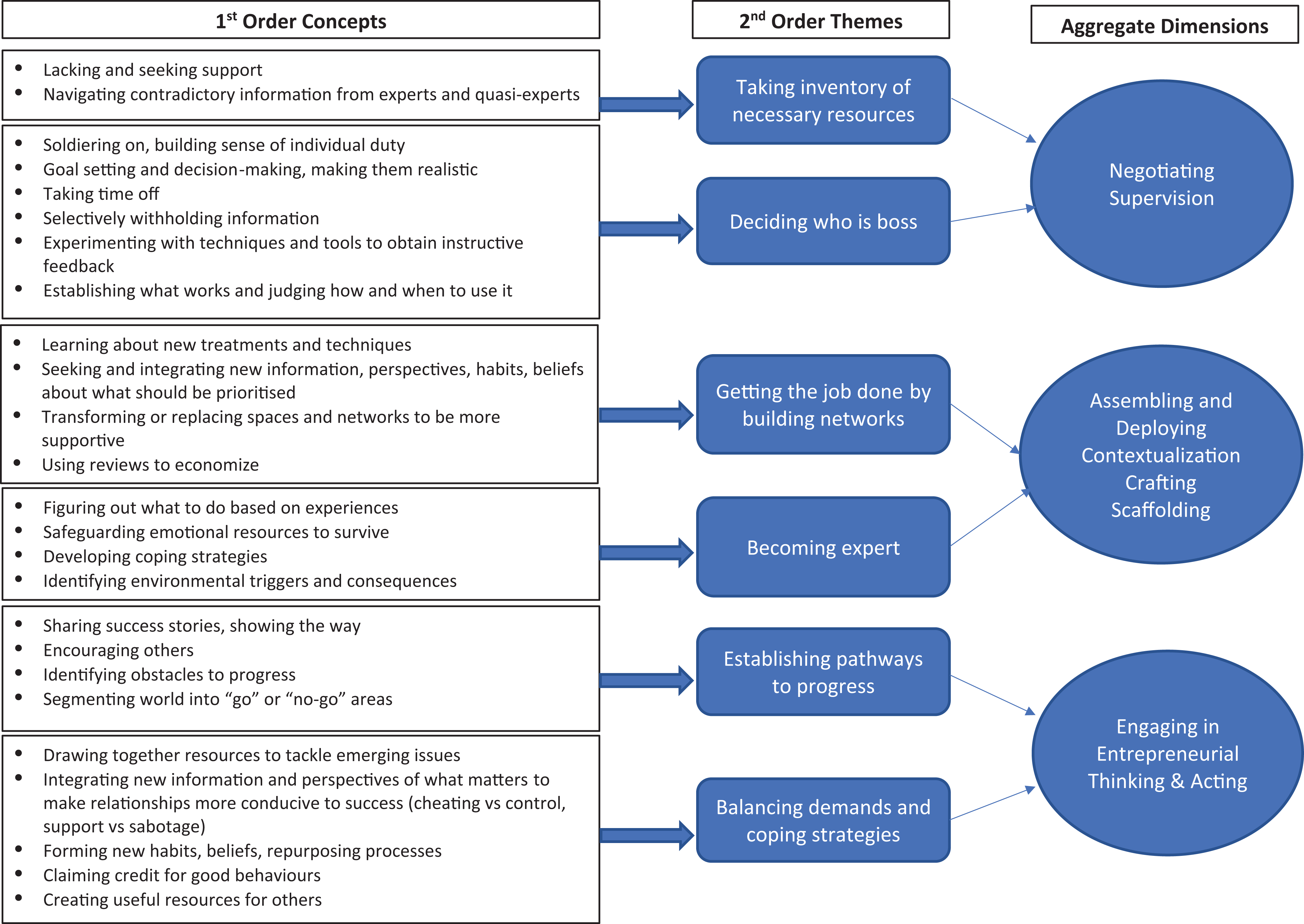
Data structure: Hacks.
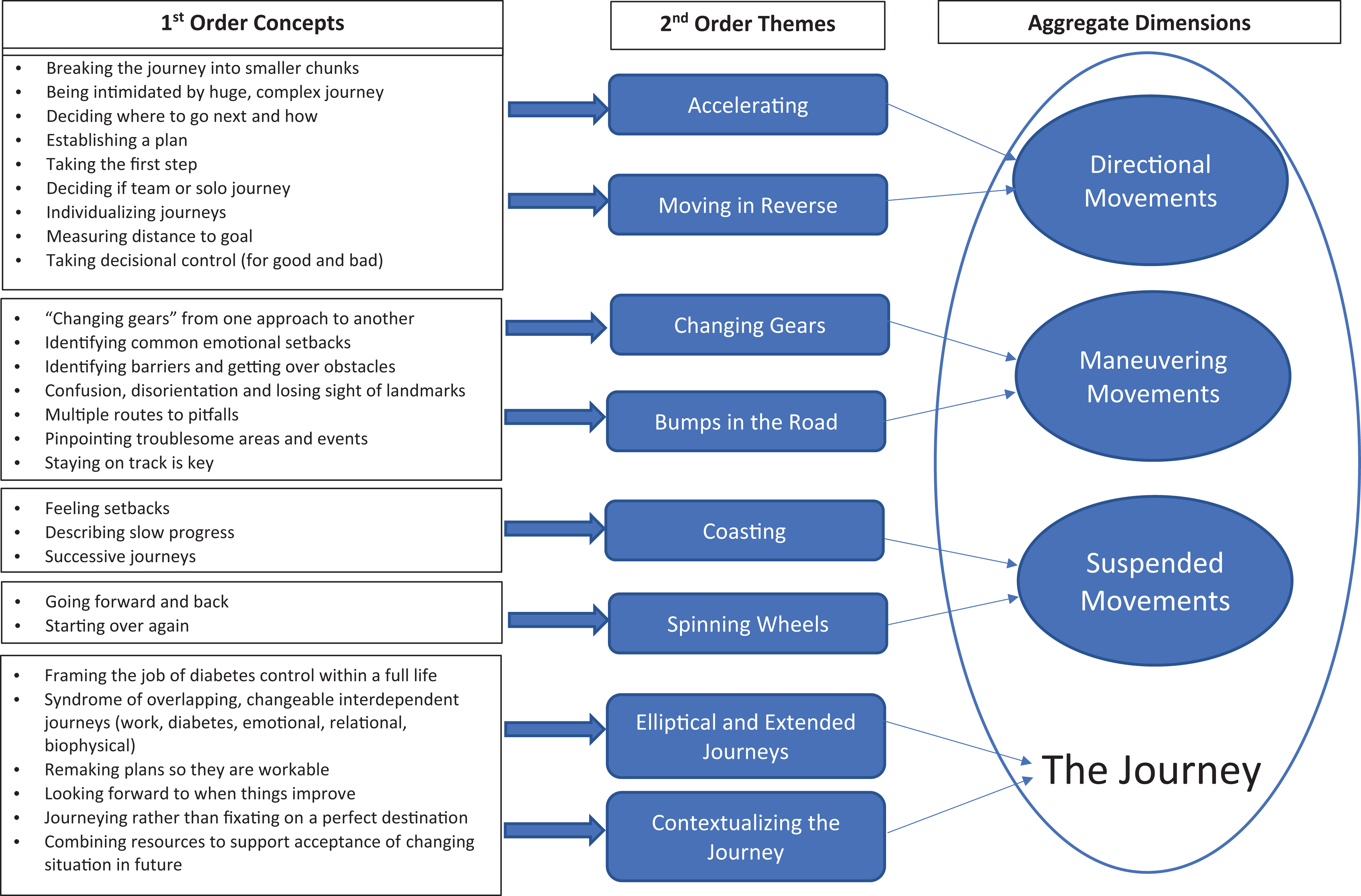
Data structure: Movements.
First, we employed open coding to label the raw data observed as we worked through the most popular threads. We achieved this by identifying key concepts that emerged from the data and then identifying related concepts in extant literature (e.g., consumer issues, emotions, blame and stigma, employment, exercise challenge, family, identity, travel, insurance, morning blood glucose readings, public policy, role models, professional service interactions). Coding individual forum entries produced our first-order concepts, revealing consumers’ contextualization hacks (Figure 1) and movements (Figure 2). Second, we used axial coding to conduct thematic analysis across forum threads and between forum participants, producing the second-order themes. Here, we collapsed our codes, focusing on the most salient topics and deriving a set of themes that spanned across the data. Third, we continued to condense and abstract the themes, focusing more on theoretical development until we derived the aggregate dimensions of consumers’ contextualization hacks and types of movement along the expert service journey. By tacking back and forth between our emergent findings and extant literature to generate grounded theory (Charmaz 2008), we developed our major theoretical themes. Job crafting literature, context theory, and customer journey research helped illuminate and conceptualize our themes.
Findings
Expert Consumer’s Work: Contextualization of Content Expertise
I don’t get any help. It is all on me. I’m sick of feeling sick. Sick of my stomach hurting for no reason and sick of people telling me I’m not trying when I’m working very hard. (DS18)
Expert consumers at work
With regard to how consumers managed the burdens of responsibilization demands, we were struck by how the notions of “job” and “work” were present in the forum discussions, with data characterizing coproduction activities in terms of a job or work. The participants made it clear that they felt that they had a “job” and “work” to be done in the coproduction of well-being. Furthermore, it was evident that this work was typically burdensome. Some were agitated by this burden: I exercise all the time goddamnit…I am always hungry…I have cut out everything that has bad carbs in it. Why don’t any of you believe me??????? I am not in denial over my diagnosis, I am in shock, I am shamed, I am frightened, I am miserable. WHY DOESN’T ANYONE UNDERSTAND???? I am NOT just putting off my efforts to help myself (as the articles that were suggested to me say). I AM DOING EVERY FUCKING THING I CAN. I am NOT a liar. I can’t take this anymore. I am so fucking miserable. And hurt. Hurt because I feel like no one on here is listening to a word I say. No one on here believes that I am doing everything I can. (DS50) I really never accepted the Diabetes and have not been in control since never! I test randomly and take my meds and insulin when I feel like it or remember…. I think of all the damage I have done to my body and can I fix it? Is it even worth it now?…I’ve been living in denial. (DS25) After my initial shock, I told myself two things: the first is that I must educate myself as much as possible on this disease, and secondly I have to do whatever I can do to try to control it…. It is the responsibility of the person with diabetes to take control of their care…. I have made it my goal in life to learn as much as I possibly can about diabetes, how my body reacts to various things, and am constantly “tweaking” my diabetes regime. (DS9)
Echoing Montori, we found that compliance was not the major work thrust of our participants, as they were not simply doing what their service providers said to do—they could not simply do that. Rather, we found that the job was more complicated, with the “burden” requiring consumers to know how to tailor the expert provider information so that it was more realistic and beneficial to their situations. Similar to job crafting, consumers tailored the responsibilized job to their capacities, preferences, and contexts, including at times ignoring various aspects and crafting the scope of work through opportunities and barriers in their context (Figure 3). Although the outcome may be that the job is finally tailored to consumers’ preferences, these various forms of crafting add significantly to the consumer jobs. Thus, challenges of job crafting emerged, as we found that consumers’ coproduction job involves contextualizing unfamiliar forms of professional expertise through a process we term “consumer contextualization crafting” (CCC)
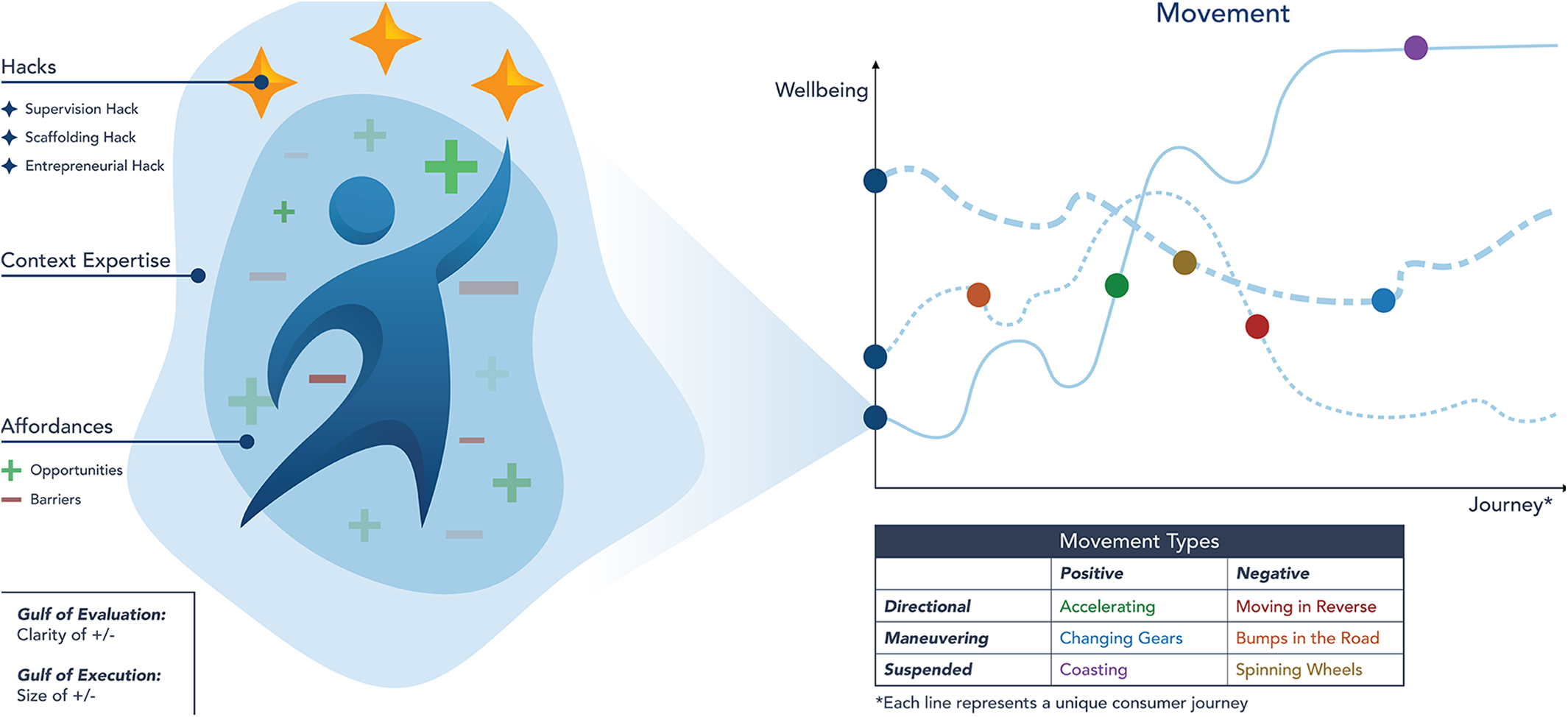
Consumer contextualization crafting. Note: Context expertise reflects consumers’ expert knowledge of their situation and context and is part of the consumer sphere. The consumer’s job is to contextualize the content expertise of the expert service provider. Affordances are aspects of the consumer context that can be perceived as opportunities and barriers to facilitate or hinder the accomplishment of well-being goals. This can include aspects of service systems within the consumer’s context. The gulf of evaluation is the availability and clarity that feedback in the environment presents, such that consumers can easily perceive and interpret it in terms of expectations and actions that will meet their well-being goals. The gulf of execution is the perceived difference between the goals and intentions of consumers and how well environments support or hinder their actions. Hacks are shortcuts or heuristics that consumers use to contextualize and customize to their context. Consumer Contextualization Crafting is an ongoing journey involving different movements that characterize the process of tailoring expertise to the consumer context.
Content and context expertise
Our research clearly shows that, in parallel to professional expertise, consumers also have various forms of expertise salient to and employed in the job of contextualizing expert services. In particular, we found that the consumers’ knowledge and expertise about their own context, taken in conjunction with the technical knowledge of the provider, are necessary for coproduction and customization of the service to take place. As we discuss in subsequent sections, the process by which consumers bring their expert knowledge about their own context to bear makes a difference to the outcomes they describe. Thus, consumer expertise appears to be an important counterpart differentiating it from the technical knowledge of the provider, as well as a necessary condition for the effective coproduction and customization of the service. We therefore operationalize consumers’ expertise as a process of using their context expertise to situate, or contextualize, the provider’s content expertise. In juxtaposition to B2B expert services in which the service organization customizes their expert offer to the customer’s requirements, B2C expert services require consumers to undertake the customization tasks. Thus, the primary consumer job is the contextualizing work. This corresponds to Spanjol et al.’s (2015) point that much of coproduction takes place in the consumer sphere and outside the dyadic interaction with an expert provider. Figure 3 illustrates this context expertise and consumers’ contextualization crafting job.
To differentiate between the expertise of the provider and that of the consumer, we call these two types “content expertise” and “context expertise.” Informed by Evers and Van der Heijden (2017), we define content expertise as technical knowledge or skill obtained through education, training, or experience as part of a profession (in our case, medical). This expertise corresponds to the knowledge and procedural resources of the expert provider. Such expertise can also be acquired, in part, by consumers through learning, reading, and exchanging views. Today, I looked at some stuff published for CDE’s [Certified Diabetes Educators]…. I think he thought I am stressing over the dx too much; I’m more stressed by my lack of knowledge…. I do understand that I have been a bit obsessive about learning about diabetes, but college students “obsess” about their classes, too, and this is a class I have put together for myself which includes learning from others.…I am a student of diabetes until I die, I suppose. (ADA25) My cardiologist said without factor V I wouldn’t have the heart attack. Both of my parents had heart attacks in the early 50s, my grandfather on mom’s side had a heart attack in his late 40s early 50s (he passed before I was born and grandma passed before I was born from diabetes complications)…. I’m type 2 with not great control over the past 5 years, overweight, not on low sodium diet.…Ate red meat nearly every day. And still it’s very rare to have a heart attack at 40. Cardiologist said most people no matter risk factors don’t have heart attacks this early without some other cause being behind it. (DS1) It is just my opinion after 40 years of being Diabetic and on Insulin…it’s 90% my responsibly to take care of “me” and 10% responsibility for the Doctor to write a script for my medication. (DS8) This disease is different for all of us, reacts differently, progresses differently. Sometimes we need the extra help. (DS2)
Contextualizing: attunement to environmental affordances
The previous section explains how the job of contextualizing became the main emphasis of our findings, suggesting that the job of the consumer is to make the prescribed job workable through a process of enmeshing content and context expertise. We hermeneutically tacked to context and ecological theories (e.g., Weick, Sutcliffe, and Obstfeld 2005) to understand and illuminate our findings regarding how consumers contextualize content.
Affordance theory (Gibson 1954) was most helpful in understanding the three consumer contextualization hacks we discovered: supervision, entrepreneurial, and scaffolding (Figure 3). Affordances are features of the environment perceived as potential opportunities or hindrances to moving through life. Applying affordance theory to our study of consumers as a dynamically contingent process is useful because it provides a theoretical basis for situating interactions between a person and his or her environment as a continuous, evolving act, describing a looped rather than linear process (Kaaronen 2017). According to affordance theory, processes of attunement, or learning how to do things in certain situations or contexts, are focused on the potential opportunities and hindrances that environments afford. In this way, affordance theory allows us to consider the types of burdens and assistance consumers’ context provides for them in their job of contextualization. For example, receiving a diabetes diagnosis can alter consumer perceptions of certain dining occasions as dangerous, illustrating how environments previously perceived as safe are made potentially inhospitable for sustaining well-being.
Two interaction feedback mechanisms are especially helpful in considering the processes of attunement between entities and their environments. The first is the process of attunement to the gulf of execution, which involves evaluating the difference between the intended actions of consumers and how well the context supports or allows those actions. The second is the process of attunement to the gulf of evaluation, or the degree of ease or difficulty in assessing the environment, recognizing what actions will lead to an intended goal or state, and receiving feedback from the environment on the viability of affordances pursued (Norman 1988).
We apply affordance theory as an analytical lens to assist in the interpretation of our results in the following ways: (1) to explain how consumer actions are situated in socioecological structures, (2) to use the observed actions as cues for how our participants perceive their environment, and (3) to understand that both perception of the environment and the evaluation of the actions it affords are potential triggers for further action. Affordance theory provides the theoretical underpinning from ecological psychology for our explanation of the dynamic processes of CCC we found. We utilize affordance theory in Figure 3 to provide a conceptual diagram that frames our key findings in an ecology of iterative and dynamic processes.
Building on the foundation of the emergent CCC, we find that consumer coproduction of expert services involves a process of contextualization, underpinned by three contextualization strategies (or hacks). Affordance theory helps suggest underlying mechanisms of attunement to contextual affordances to explain their deployment. In the following sections, we present and support our findings, conceptualized as CCC, that showcase three strategies (hacks) that are aggregated dimensions of consumers’ actions directed at managing the relationship between themselves and their environment that has been affected by their interactions with content expertise.
Hacks and Strategies for Effective Consumer Contextualization Crafting
In the course of our thematic analysis, we uncovered three categories of “hacks” (contextualizing actions) that consumer crafters use to develop and leverage opportunities in the environment: (1) negotiating supervision, (2) assembling and deploying scaffolding, and (3) engaging in entrepreneurial thinking and acting. Life hacks are clever tricks, shortcuts, skills, tips, or techniques that accomplish tasks more easily and efficiently—a heuristic (Merriam-Webster 2020). They provide temporary fixes that are particularly relevant for fluid circumstances, as crafters integrate context expertise. The three hacks we found represent sets of actions and responses to perceived challenges that consumers face in their coproduction jobs.
Negotiating supervision
Jobs in the formal work domain are typically structured with an immediate supervisor who provides appropriate feedback on job performance. Effective supervisors help crafters pinpoint potential affordances and provide essential feedback, particularly for consumers inexperienced at contextualization. However, of particular concern in CCC, where much of the consumer coproduction occurs in the consumer sphere, is the gulf of evaluation—a lack of feedback to consumers on which actions lead to more or less effective outcomes. Finding adequate supervision for consumers can prove difficult, especially for those who face resource constraints. But more times than I’d like to admit, I keep doing things I shouldn’t, and that I know I will regret, just to be able to feel like I have some kind of control. I just don’t feel good, at all, and it’s bringing me down even more. -Sigh- I’ll work on it…I’m still trying to find someone that might help as far as medication. Having diabetes and not having medical insurance (let alone not being able to afford it) is so difficult…. There just seems to be so many obstacles. (DS42) I have read that Diabetes is the number one self-administered disease. Our doctors can advise and guide us, but ultimately it is our responsibility to manage our Diabetes. In my opinion, each of us should weigh what our doctors tell us with information we get from all sources, and then come to a conclusion. (DS9)
We found that crafters seek supervisors who will provide a guiding hand, assist them in navigating their environments, help them perceive and act on opportunity affordances, and offer appropriate feedback mechanisms to reduce the gulf of evaluation. Tailored guidance is particularly important given that context changes are frequent, due to variations in demands at home or work, fluctuations in health, and shifts in resources, infrastructure, and the service ecosystem. The ever-evolving nature of the consumer context often widens the gulf of execution, making it difficult to match individual capabilities and external affordances, particularly without supervisory guidance. Has anyone got a straight answer from a Doctor or found a chart to go by on what is bad, good, ok or need to go to ER level? Everything I have read says your doctor and you can decide your range. My now ex doctor hasn’t told me anything hardly and she don’t listen to me about my concerns, she just says this is how it is so do it. I have found a new doctor that specializes in diabetes but she don’t open her office till Nov and I couldn’t get an appt until the 15th. (DS43)
To remedy supervisory voids and lack of feedback, other consumers may step in with more concrete guidance on how to effectively contextualize. We found that negotiating supervision was an essential hack for our consumer crafters, leveraging the experiences of peers in online forums, who became informal supervisors—they complement, rather than replace, service experts. Experienced peer supervisors behave both as feedback mechanisms and as curators of potential and relevant contextual affordances. Within the ADA forum, an experienced member assisted a newcomer by indicating potential affordances (classes and books) existing in the environment that have not yet been perceived or utilized by the inexperienced crafter: Was your husband diagnosed last year? Did his doctor refer him to diabetes classes? If not, I suggest he ask about that. There’s a lot to learn about diabetes. One book I’ve seen recommended here a lot is Think Like a Pancreas…. This is a good place to come for some informative posts/reading. The books that have helped me the most are the ones that focus on the emotional/psychological side of diabetes: 1) Living with Diabetes: Personal Stories and Strategies for Coping, 2) The Human Side of Diabetes: Beyond Doctors, Diets, and Drugs, 3) Psyching Out Diabetes: A Positive Approach to Your Negative Emotions. (ADA26) Where is your diabetes/pump educator? This is very poor service on the part of your pump company and the educator who should be available to you. I attended several classes before I got my pump and after. I had 24/7 access to my educator until she was sure I would not put myself in harm’s way. And yes you need the book by John Walsh, Pumping insulin. For my education it is the best, easiest to understand book on pumping…. It took me some time to adjust to a pump. I made mistakes but with time you will get the hang of it. There might be classes at your local hospitals too. I will tell you that my experience got so much better when I educated myself. I am now in control of my pump; not the other way around. (ADA24)
Drawing on our data, we suggest that negotiating supervision is a continuous process of finding and attuning to feedback so as to contextualize that expert advice into appropriate actions. When negotiating supervision, crafters must consider who should fulfill supervisory roles, the complementarity of formal and informal supervisors, and how to address supervisory voids. Supervisors have the ability to provide vital feedback, reduce the gulf of evaluation, and highlight other feedback mechanisms in the environment. Furthermore, they act as information filters, assisting in the contextualization of content expertise and attunement to affordances, as well as leveraging the experiences of veteran crafters. The need for supervision and lack of clear structures for job performance push consumers to creatively identify and combine resources.
Assembling and deploying contextualization crafting scaffolding
The scaffolding hack is a structural element on which crafters build capabilities and competencies. We found that consumers used scaffolds as temporary supporting constructions, enabling progression toward a level of self-sufficiency. Thus, scaffold hacks are timely, incremental, and temporary structures that are contingent on consumers’ individual context and needs, with the goal of movement toward independence. Our findings suggest that the scaffolding hack entails recognizing gaps in capabilities, attuning to opportunity affordances, and establishing supportive structures that boost proficiency in the accomplishment of contextualization jobs. Thus, the scaffolding hack involves the act of reorganizing the consumer context through the development of consumers’ capabilities.
The concept of scaffolds emerged from the education literature; it describes the role of more-knowing others (e.g., parents, teachers, older students) in providing support to move students incrementally toward stronger understanding, skills, and independence in the learning process (e.g., Vygotsky 1978; Wood, Bruner, and Ross 1976).
Given the dynamic, challenging nature of the job, participants often found themselves lacking knowledge, skills, and practices in how to meet contextualization demands. They recognized that forum participation allows them to construct scaffolds to assist them through the times they lack contextualizing capabilities. While this most frequently occurs when consumers are new to the demands of contextualization, it also occurs when they are confronted with notable changes in their context, new problems to solve, or recurring issues they have not been able to figure out. Have asked both GP & Pdoc to tell me if there is any relation to the blood glucose levels (I read every AM) and anxiety depression. Would like to here from other diabetics on there feelings in this matter…. Resumed going to gym to work on cycling machine at least 3 times weekly and my levels show it. Just would be great to gain direct insight on what benefits might be gaining in helping my mental health. Thanking you in advance. (DS48)
While the negotiation of supervision involves seeking feedback and guidance broadly, the hack of scaffolding entails mastering specific knowledge and skills to learn how to navigate certain issues. The end goal here is to obtain knowledge, integrate it through contextualization, and learn how to handle each issue on an ongoing and independent basis so that guidance (on a specific topic) is no longer required. We found that as consumers mastered certain elements of their contextualization processes, they often became the provider of scaffolding for others facing the same issues.
Consumers construct temporary scaffolds with online actors to gain supportive context expertise and to be better able to access alternative solutions, affordances, and paths for contextualization. In our data, the mobilization of context expertise resources as scaffolds was either monitored by forum hosts or collectively negotiated as lay experts emerged. Just want to welcome you and reiterate what others have already told you: this is the best place to hang out, learn, make friends who understand and are supportive, and every once in a great while, debate a topic…There is a real ‘brain trust’ here (I’m not one of them)….To mention just a few: [A, B, C, D, E,] and our recently passed dear friend [F]. You should be able to access much of the information she shared over the years on here and in her blog & website. (ADA5)
In addition to the peer group, important market actors (e.g., pharmacies, insurance companies, Medicaid/Medicare, medical suppliers, medical supply education/training providers, food manufacturers, employers/coworkers) provide preexisting scaffolds. In some cases, service providers are able to provide consumers with appropriate scaffolds and assist them in the contextualization process. I worked with the owner of the local mom and pop health food store who is qualified and has helped me get off metformin, cholesterol meds, and I am almost off blood pressure meds and I have excellent blood test results to back up my hard work. I have changed my diet completely (this takes time and persistance). I only eat organic chicken and lamb (red meat doesn’t agree with me…. as I have digestive issues that I am working on and is getting better)…I was VERY vitamin/mineral deficient as is most ppl due to poor quality soil and GMO foods and foods laden with all kinds of sugars and carcigens. Good quality supplements are essential as well as a diet change. It’s a lifestyle change and not just a temporary fad. (DS31)
Commonly, the workplace (the actual, income-earning job) environment creates barriers and conditions that require consumers to provide scaffolding to social others, to develop effective and stable contextualization strategies. In our data, crafters perceived potential barriers to successfully managing both “jobs,” particularly when the two were in conflict. We found that while employers have responsibilities to accommodate diabetic employees, both parties are often unfamiliar with those responsibilities. I have an office, but staff and students do come in often. The administration and my close work friends all know that I’m diabetic. Just in case you have any issues in the future at work please take a look at www.askjan.com. They are very helpful, and I have used this site over the years when an employer is unfamiliar with their responsibilities under the law. (ADA5)
In our research, specific scaffolds vary broadly and range from books about disease management strategies and cookbooks that explain healthy cooking skills to classes that teach how to exercise at home and forums that offer best practices for how to engage with expert services providers (e.g., medical professionals, insurance providers). As discussed in the next section, the most effective use of the scaffolding hack appears when crafters adopt an entrepreneurial mindset.
Entrepreneurial thinking and acting
Because consumers perceive supervisory voids and seek scaffolds to support their efforts, they often feel that they carry the brunt of the contextualization burden. This can be challenging, fatiguing work, exacerbated by the lack of desire for or acceptance of the job. While peers (at a regular job) provide training or indirect supervision, consumers are most often solely in charge of their well-being outcomes. We found that those who engage most extensively with CCC are self-starters, running their lives as their own health or well-being enterprises. One month ago today I was diagnosed. T2 diagnosis came out. I’d gone to the ER with an unrelated health crisis and in the course of dealing with that It’s been a hard month with one medical appointment after another, trying to learn everything about diabetes as fast as I can and making all the necessary changes to my life regarding diet, exercise and just plain taking better care of myself. (ADA8) Thank you, DS12, for all the knowledge you have shared with us. You have taught me a lot. I don’t think I will try the fasting end, but I am researching the main ideas you have stated. I think it is great to be able to get so much education from a forum like this, whether we agree with one another or not. I always learn something from someone out there. (DS38) BTW, not only did I take my blood pressure readings 3 times week for 3 weeks at the local pharmacy, I ended up investing in a device that blue-tooths to my smart phone. That way I don’t have to go to the pharmacy just for that (yeah!)…I haven’t been back to the Walk-in clinic yet. I think I’ve dodged the blood-pressure-reducing meds bullet:)))) I think’ On the up side—thank the Gods for the internet:)) I am finding more perspectives, doctors and resources for reversing this naturally. (DS23)
Peers in our data set viewed self-made experts who become recognized as key members of forum communities as authentic and credible. Those who adopted an entrepreneurial mindset and successfully attuned to affordances along the journey eventually stepped into the role of assisting others, by providing supervision and sharing scaffolds. This included sharing scaffolding through the network: I am hardly a medical expert. However, I have done a significant review of the available research and the things I am writing are based on current research done with large populations, over years (not just a few weeks or months), in credible institutions, have been replicated numerous times, and have very good study designs to begin with. I have been utilizing this, myself, with very very good results. I have lost 35 pounds since mid-December. All of my numbers (a1c, cholesterol, triglycerides, resting blood glucose, weight) have gone down markedly. I am sharing because I hope that others will do the research themselves and consider adopting the same type of dietary regimen. Good luck! (DS12) I urge all of you here to google Dr. Jason Fung…and start reading. When I was diagnosed in mid-December, I was TERRIFIED and started researching as fast and furious as I could. Having conducted research myself (on another topic-- not Diabetes), I know how to separate credible research from badly done research…. My search led me to this doctor and his Blog. Trying all of this out has no downside, in my opinion, except that if you are already taking insulin, you would, of course, need medical supervision so as to not go into hypo when you are fasting. (DS12)
Job crafting in the coproduction domain is essentially characterized by a forced entrepreneurial mindset, in which the perceived lack of resources and opportunity affordances occasions makeshift contextualization pathways and processes. However, this hack manifests as the most challenging to cultivate, as it can be extremely difficult for consumers to innovate and self-start. Entrepreneurial burnout (Perry, Penney, and Witt 2008; Shepherd et al. 2010) and the mental well-being of entrepreneurs (Stephan 2018) are major concerns, highlighting the need for proper support. There are no vacations from being chronically ill—no reprieve from the unrelenting demand for entrepreneurial thinking while contextualizing in a dynamic environment. Contextualizing content expertise amounts to a considerable burden. Acting in an entrepreneurial way to achieve successful CCC can also have significant unintended negative effects on well-being.
Developing hacks produces both positive and negative effects, given that the environment is ever-changing. This reinforces the nature of contextualizing hacks as temporary fixes rather than lasting solutions to dynamic conditions. The positive side of the three hacks is reflected in the identification and mobilization of potential resources and affordances, which ultimately leads to greater well-being. The negative side of contextualization crafting and hack development is a heavy burden that detracts from other elements of life. The dynamic nature of contextualization, based in temporary and evolving environmental conditions, results in movement toward and away from desired well-being outcomes along the consumer journey, as described in the next section.
Dynamic Movement Styles along the Consumer Contextualization Journey
Our process perspective highlights the contextualization journey consumers navigate in expert services, the associated crafting of hacks as responses to the environment, and various movements that characterize the journey. In our data set, consumers moved along their expert service journeys in different ways, sometimes toward and sometimes away from well-being goals.
Six types of movement, their valences, and how they influence the contextualization journey were evident in our data and addressed our research question of how consumers accomplish their contextualization job. We discerned six key movements—(1) accelerating, (2) moving in reverse, (3) changing gears, (4) bump in the road, (5) coasting, and (6) spinning wheels—that we collapsed into three movement types in conjunction with a positive or negative valence toward well-being and consumers’ ability to act on affordances (see Table 1): directional movement, maneuvering movements, and suspended movements.
Movement Along the Contextualization Journey.
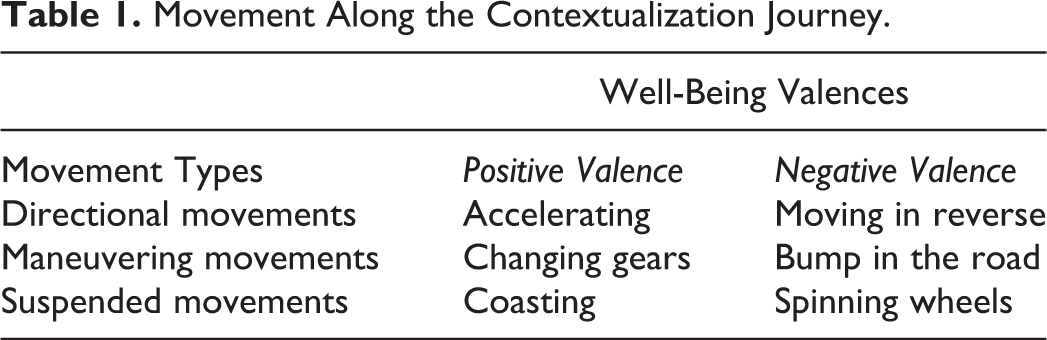
Directional movements capture conventional linear motion, either toward or away from well-being goals. Maneuvering movements epitomize adjustments—rapid, improvised, or temporary shifts in movement in response to a change in the interaction between the self and the environment. Suspended movements represent inactivity or inertia, a temporary lack of intentional movement. While the directional movements indicate purposeful trajectories (toward or away from well-being), maneuvering and suspended movements are marked by liminality and change. Furthermore, we found that those who successfully attuned to affordances and developed hacks were better able to trigger positive movement.
Directional movements
While navigating an expert service journey, crafters who trigger extended, intentional motion may accelerate toward or away from their intended well-being goals. On the positive side, accelerating movements describe key moments in the journey when highly effective contextualization enables purposeful movement toward well-being. We found that consumers successfully crafted and gained positive traction by attuning to relevant opportunity affordances, while also seeking cues for feedback (Norman 1988). It’s important to see an Endocrinologist (if you have the means). For a long time, until just recently, my primary doctor was helping me as much as he could, but he’s not an expert, and the “sliding scale” insulin schedule he gave me was not right…. I recently saw the Endo, and I am so glad I have. Your doctor can get you the help you need if you explain your financial situation. Even if you must borrow money to pay for your visit. Some doctors will even give you a payment plan (slim chance, but worth asking). Also, try the government clinic in your area. Important to just keep trying. Good Luck, and God Bless. (DS27)
When the environment changes, however, previously useful behaviors no longer work, and disoriented consumers lose sight of how to develop contextual hacks, which may leave them moving in reverse. Consumers who previously developed hacks for specific conditions may be at a loss when the environment presents new or unexpected opportunities or barriers. In the following example, the consumer successfully navigated the burden of contextualization; however, positive news from an expert service provider resulted in a perceived license to relinquish job responsibilities. Last October, after a pretty strict regimen, my doctor says, “good job, you’re no longer diabetic!” I felt at the time that this was too good to be true, but it was pretty nice to hear. Now I’ve gone back to my bad habits: sweets every day, eating when I’m not hungry, and my BC has started to rise (along with my weight). I’ve been trying to get back on track, with some limtied success in the last week. More exercise and at least monitoring my diet…, but when I saw the doctor on Friday for my six month checkup, she didn’t even do the A1C and repeated the old message, that I’m not diabetic any more. I’ve been off of Metformin since October, but she agreed that I could take it, “If I want to.” I know this is a useless question, but what do I need to tell myself to get back on track? At what point do you think its important to give up trying to maintain good levels with diet and exercise and go back on medication? I felt like such a success, and now I feel it all slipping away from me. (ADA32)
Changes in the environment can result in extended directional movements toward or away from well-being over time, accelerating crafters through contextualization hacks and opportunity affordances or moving them in reverse as they struggle to accomplish their job. Thus, the journey is dynamic and fluid, characterized by continuous contextualization and effortful re-attunement to affordances.
Maneuvering movements
While shifts in the environment may cause longer term trajectories, as described in the previous subsection, we also find that they can create the need for a quick, improvised, or temporary reaction to a modification internal or external to the consumer. The key to maneuvering movements, as a whole, is that they are more temporary and quicker than directional movements, and they act as a response to change.
When changing gears, these reactions serve as a catalyst toward well-being. Our findings indicate that crafters recognize changes in the environment, respond to perceived affordances, and develop contextualization hacks to make appropriate adjustments. For example, in the following excerpt, the supervisor (expert service provider) initially asks this family to manage carbs but subsequently suggests they count calories instead. This triggers the family to change gears and respond to this change by updating their behaviors. The doctor had told us no more than 12 carb points…we really did well, but did not worry about calories…and so now, we are changing gears. BUT he said forget about carbs, and count calories and the carbs will take care of themselves. I don’t think so. So we will try to be smart about both. for example, a low carb cake in a mug recipe…UGH. starting over. Progress not perfection…but we are back at square one…thanks everyone. and as a side note, I got a new cake in a mug recipe we tried today…180 calories and low carb…and for a first try, it came out great. I am learning as fast as I can…and I do think we need a new endo…But we do seem to be making these changes pretty easily…we are going back to what I was doing in the beginning…healthy non processed foods, watching carbs and calories. Just going back to my original hippy ways.:) (DS51)
Alternatively, we found that unexpected changes in the environment are sometimes perceived as impediments to well-being or temporary setbacks, especially when they are challenging or when hacks are difficult to develop. These bumps in the road moved consumers away from their well-being goals, along the contextualization journey. In the following example, increased work stress makes it difficult to maintain successful crafting, even for a consumer who is typically successful in disease management. I saw my endo Dr and she said that she thought that the stress, dehydration and fatigue along with an increase in blood sugar (because my sugars have been very tightly controlled) caused a “perfect storm.” I am under extreme stress at work. (DS32)
Changing gears and bumps in the road represent both new and unexpected shifts that interrupt the contextualization journey. As consumers navigate their roles as coproducers, they learn what to expect and how to navigate routine challenges within a stable environment. However, new or unexpected issues that arise require consumers to improvise and problem-solve in new ways, employing agility in their perceptions of and responses to affordances.
Suspended movements
Finally, some consumers become suspended in their motion along the contextualization journey. Some find themselves coasting along, effortlessly enjoying the success of effective contextualization; others end up spinning their wheels, effectively going nowhere and feeling stuck in place, despite their efforts. When coasting, consumers are not expending (additional) effort, yet they continue to move; when spinning their wheels, consumers are expending effort, yet they seem to get nowhere.
Those who reach a coasting status tend to achieve this over time through effective attunement to affordances and continued efforts in contextualization. By learning and mastering their craft, we find that these consumers ultimately reach a place in their journey that requires few additional demands beyond the existing structures and processes they have acquired, designed, or set up for themselves. Basically the sooner we accept and move on the better it is for us…Also the plus point is that we become more healthy in our choices in food and other things which really helps in the long run. Its not the end of the world, people with diabetes live full and normal lives if kept in control.:) Smile.:)…[That “the first step starts with you” is] true……but dont let things take over your thoughts and life…try to get over it. I use an antidepressant to take care of my mood along with other lifestyle modifications…Initially it was difficult for me when i was diagnosed with DM. But then with information and habit i am fine with it now. (DS5) I control with diet and exercise, since diagnosis in 2009. I had been having regular lab work every 3 months, so my MD could keep tabs on my progress. After a few years of this schedule, I asked if I could have labs every 6 months or perhaps yearly. My lab work had been within normal/non-diabetic range since 6 months after diagnosis. (ADA33)
Some crafters find themselves stuck spinning their wheels, at a loss for what to do next, as their crafting efforts result in no momentum. Appropriate affordances may not exist or are not readily perceived. Herein, we found crafters scrambling to find solutions and develop hacks, often unwilling or unable to attune to various affordances around them. Alternatively, they may perceive false affordances that are not actually beneficial, exerting meaningless efforts. I don’t really know what I’m doing. I just got my tester Monday and I have only gotten it to work once. I’ll figure it out…some how…All my doctor told me was Diabetics can eat anything everyone else can just less…well . I still looked up things because I didn’t think eating all the same food could be good for me and I’m still lossed…like…my suger goes up from eating and then an hour later I’m hungry but my sugers up? Now I’m starving and don’t know what to eat. (DS29)
Coasting and spinning wheels sometimes represent two ends of the journey timeline for our participants. Frequently, we noted that coasters were well into their journey, having picked up knowledge, skills, attunement capabilities, and hacks along the way. Conversely, those who were spinning their wheels were frequently just getting started, with limited understanding about their roles and responsibilities and narrow perceptions of potential affordances and how they might be purposed. Those later in the journey benefited from experience, while those early in the journey grappled with where to even begin.
This research allows us to understand the ways in which consumers move throughout the expert service journey. Those with congruent affordance and ability conditions, propensity for effective attunement, and robust feedback mechanisms tended to find success and positive movement along the customer journey. Ultimately, understanding the journey may assist consumers in successful contextualization and strategy development, while expert service providers may pinpoint ways by which they can support crafters along the way.
Validation Study
In order to assess the transferability of our results, our second (validation) study analyzed CCC in the context of credit repair where consumers work to improve their financial standing. Supporting our key conceptual insights, we found that consumers craft their coproduction jobs through contextualization, use the same hacks and affordances to assist in the process, and move toward or away from well-being along the journey. The Online Appendix discusses our validation study.
General Discussion
Our research, conducted in two of the arguably most relevant expert service settings (health care and financial services), shows that consumers indeed experience coproduction as (often burdensome) “work” to be undertaken with the goal of coproducing their well-being. Grounded in this general finding, our research points to theoretical and managerial implications while also identifying avenues for future research.
Theoretical Contributions
Consumer contextualization crafting advances the understanding of well-being efforts and the conceptual realm of TSR
Our research sheds light on the burden of work that consumers often must undertake in service coproduction (especially expert services). From a TSR perspective, our concern is with the impact of this job and coproduction burden on consumers’ well-being. The identification of how consumers manage their well-being efforts and coproduction journeys under this burden in terms of hacks and movements builds TSR theory. Most expert services exist to improve consumer well-being. However, as many consumers do not “comply” with their providers’ advice and may actually drop out of the service journey, conceptually understanding how consumers try to handle this burden is critical.
Consumer contextualization and context expertise enrich the conceptual realm of coproduction theory
We expand prior coproduction research by focusing on a key mechanism in the consumption of expert services: consumers’ “translation” of expert service advice into their lives. Illuminated by job-crafting theory (Wrzesniewski and Dutton 2001) and affordance theory (Gibson 1954)—two theories that are new to service coproduction research—we unearth the novel phenomenon of CCC. Expanding the established notion that consumers do work (Cova and Dalli 2009), our analysis reveals that consumers (must) take on contextualizing work that occurs in the consumer sphere. The notion of CCC not only reveals a revised perspective (MacInnis 2011) of coproduction in expert services but also helps better clarify how consumers move through their service experiences, consistent with recent calls for marketing research to better capture the consumer journey (e.g., Hamilton and Price 2019). In particular, we propose the distinction between provider content expertise and consumer context expertise, both of which are essential for successful coproduction journeys, with theoretical implications for both service providers/organizations and consumers. More broadly, conceptually developing the interplay between provider content expertise and consumer context expertise can help scholars and managers better understand the effectiveness of service coproduction.
Insights into consumer journeys: Hacks to contextualize content expertise
Although the emerging, critical literature on working consumers provides increasingly robust evidence for the reality of working consumers, it also points to a lack of understanding of the process of engaging in this work (e.g., Dujarier 2016), especially as it relates to consumer well-being versus benefits to the service organization. Our work helps address this void in the literature: By introducing the idea of consumer context expertise, we draw on affordance theory (Gibson 1954) to explain the process and manner by which consumers bring their expert knowledge about their own context to bear, based in their perceptions of opportunities and barriers in their environments. To our knowledge, our research is the first to examine working efforts and coproduction through this theoretical lens, which is particularly helpful to capture the dynamically contingent coproduction process. Scant service research encapsulates this nonlinear, dynamic nature of coproduction (for an exception, see Mende and van Doorn 2015).
We discover that consumers in the context of chronic diseases (as well as credit repair) use similar hacks (i.e., temporary fixes) to contextualize the provider’s content expertise in light of their dynamic life conditions. Specifically, we found evidence of three consumer crafting strategies (i.e., hacks) that have implications for a richer coproduction theory: (1) negotiating supervision, (2) assembling and deploying scaffolding, and (3) engaging in entrepreneurial thinking and acting. Our findings offer additional insights into consumers’ specific sets of actions and responses to their coproduction jobs.
Exploring coproduction dynamics through patterns of consumer movements
Service research that captures the dynamics of coproduction over time (Mende and van Doorn 2015) is scant. In order to identify and understand these dynamics better, we explore the fluid process of contextual crafting. We discovered that temporary and evolving environmental conditions result in consumer movements toward and away from desired well-being outcomes along the service journey (see Table 1). Our classification of the (positive and negative) movements provides inspiring insights into how consumers accomplish their contextualization job over time. In parallel, we introduce affordance theory to the coproduction arena, and propose that movements can be understood through the mechanism of attunement to contextual affordances in response to the gulfs of execution and evaluation. Further, we surmise that the movement types gleaned from this work would apply in a variety of consumer and service journeys—a potential avenue for future scholarly inquisition. Service scholars can further enrich our theoretical lens of when and why consumers switch between these movements, how they might be nudged toward well-being-driving movements, and, more broadly, how novel constructs from affordance theory can further inform coproduction research.
Managerial Implications
Consumers in expert services are frequently expected (by companies and policy makers) to take more responsibility for their service outcomes; that is, expert service firms increasingly place the onus of contextualizing the provider’s content expertise on consumers. However, our research suggests that this trend does not release firms from the responsibility of supporting their customers and their well-being throughout the coproduction journeys. Most especially, a fundamental managerial implication involves the question: How can (networks of) service firms help their customers with contextualization crafting to order to improve well-being? Our research points to a more proactive management of this coproduction relationship.
First, expert service firms need to recognize the relevance of CCC for effective coproduction. To do so, firms need to better account for the idea that coproduction crafting does not end with the customer–provider encounter; instead, this is where it begins and where more and novel forms of subsequent customer support are needed. For example, our findings on supervision and scaffolding suggest that service firms need to carefully consider how and when to provide feedback to their coproducing customers to move them toward well-being more effectively. At times, firms might use technology to provide supervision and scaffolds to their customers. In addition, they could build collaborative networks within the service ecosystem that can assist in providing scaffolds for consumers over time.
Second, expert service firms need to identify indicators of consumer context expertise, so that the firms themselves can develop an understanding of how certain contexts in consumers’ lives might affect their coproduction (an issue of increasing salience in medical research, e.g., Weiner and Schwartz 2016) and well-being, to support consumers accordingly and improve the service provided to their customer portfolio in general. To increase the effectiveness of coproduction, firms should understand whether their focal customers have a relatively high or low level of context expertise (and content expertise).
Third, firms should track consumer movements by identifying indicators of the distinct types of movements (see Table 1) and consider interventions to counteract negatively valenced movements that affect well-being. Our findings suggest the existence of distinct turning points that might affect the effectiveness of the service relationship; therefore, companies should aim to identify opportunities for preemptive interventions. Again, service firms can leverage technology (e.g., wearable health monitors that provide positive and negative feedback) to track consumer movements over the course of their coproduction journey.
Fourth and most important, to improve well-being, expert providers should work to align their interventions and service prescriptions more closely with the consumer context. Montori (2017) advocates for such an approach. Called “minimally disruptive medicine,” the affordances in patients’ contexts are considered by patients and providers as they design plans together that “respond well” to these patient situations and fit easily into their demanding lives.
Future Research
Our research provides rich insights but also points to promising opportunities for further research. First, follow-up research should examine the extent to which the three contextualization strategies (hacks) and the different movements affect consumer well-being and/or firm-related service outcomes. Our findings show that the three hacks can have both positive and negative effects, so it is crucial that service scholars identify factors that influence whether and when the hacks bolster or undermine consumer well-being. Second, the flip side is research that examines the impact of expert providers’ consideration of and alignment to the consumer context on the quantity of the hacks employed, the types of movements and the well-being of the consumer. On a related note, an intriguing question is whether consumers can always (accurately) assess the movement they are in or whether outside “supervisors” can and should help with that assessment. Third, particularly our insights into the distinct movements identify the need for research on interventions (e.g., Which interventions should service providers or informal supervisors use to nudge crafters away from negatively valenced and toward positively valenced movements?). Finally, we examined chronic diseases (health care) and credit repair (financial services), arguably two of the most relevant service sectors from a micro- and macro-lens. Further considering distinctions between health care and financial service settings is fruitful, as is investigating other expert service contexts (e.g., educational service journeys, legal services, adoption service agencies).
Supplemental Material
Supplemental Material, sj-pdf-1-jsr-10.1177_10946705211012474 - Consumers on the Job: Contextualization Crafting in Expert Services
Supplemental Material, sj-pdf-1-jsr-10.1177_10946705211012474 for Consumers on the Job: Contextualization Crafting in Expert Services by Courtney Nations Azzari, Laurel Anderson, Martin Mende, Josephine Go Jefferies, Hilary Downey, Amy L. Ostrom and Jelena Spanjol in Journal of Service Research
Supplemental Material
Supplemental Material, sj-pdf-2-jsr-10.1177_10946705211012474 - Consumers on the Job: Contextualization Crafting in Expert Services
Supplemental Material, sj-pdf-2-jsr-10.1177_10946705211012474 for Consumers on the Job: Contextualization Crafting in Expert Services by Courtney Nations Azzari, Laurel Anderson, Martin Mende, Josephine Go Jefferies, Hilary Downey, Amy L. Ostrom and Jelena Spanjol in Journal of Service Research
Footnotes
Declaration of Conflicting Interests
The author(s) declared no potential conflicts of interest with respect to the research, authorship, and/or publication of this article.
Funding
The author(s) received no financial support for the research, authorship, and/or publication of this article.

Notes
Supplemental Material
The supplemental material for this article is available online.
Author Biographies
References
Supplementary Material
Please find the following supplemental material available below.
For Open Access articles published under a Creative Commons License, all supplemental material carries the same license as the article it is associated with.
For non-Open Access articles published, all supplemental material carries a non-exclusive license, and permission requests for re-use of supplemental material or any part of supplemental material shall be sent directly to the copyright owner as specified in the copyright notice associated with the article.
