




Abstract
The role of virtual salesperson (VS) and the importance of customer reviews in facilitating online purchase decisions and sales have recently received much attention from technology companies, marketing practice professionals, and academics. However, customers’ willingness to follow the purchase advice of the VS when there is a conflict between these recommendations and those of other online customers is less understood. This research theorizes and investigates the extent to which customers’ relationship satisfaction with, and trust in, the VS helps explain customer willingness to follow VS advice in the context of recommendation conflict. Using four studies, our research explores how and when the VS’s avatar design mitigates the negative influence of conflict. An important theoretical and managerial implication of this research is that VS avatar designs that are high in automated social presence (ASP) help reduce the negative impact of conflict. However, we find that ASP mitigates the negative effects of conflict only for avatars that score low (vs. high) on cuteness.
To reduce online shoppers’ search efforts and facilitate efficient decision making, online vendors have increasingly started providing a virtual salesperson (VS), also called a “recommendation agent” (Rust and Kannan 2003), to assist customers in online shopping. A variety of companies, including Amazon.com, Booking.com, and Yahoo!, already offer their online customers VS services. Previous research notes that a VS plays an important role by providing advice based on customers’ interests, preferences, or needs (Ansari, Essegaier, and Kohli 2000; Huang and Rust 2018), thus aiming to alleviate customers’ cognitive load and facilitate customers’ online purchases. However, prior work has mainly focused on research contexts where no conflict exists between the recommendations of a VS and other online customers. However, what happens when the VS’s recommendation of an offering conflicts with the reviews of other online customers?
Our research has several goals. First, within the service research literature, we build on and complement prior work that has examined the impact of automated services on customer-firm relationships (Andreassen, van Oest, and Lervik-Olsen 2018; Bolton et al. 2018; Čaić, Mahr, and Oderkerken-Schröder 2019; Fan, Wu, and Mattila 2016; Hollebeek et al. 2018; van Doorn et al. 2017; Wirtz et al. 2018). The extant work informs our understanding of the influence of electronic word-of-mouth (WOM) and subsequent customer behaviors. To the best of our knowledge, however, there is limited research on how a conflict between online customer reviews and the purchase recommendations offered by the VS affects customers’ trust and their willingness to follow the VS’s recommendations. Our research contributes to the extant literature on conflicts in automated service/digital exchange by looking at the recommendation conflicts between the reviewer and system as well as building trust via interface design as a solution. We define “trust” as the customers’ belief that the VS can be counted on to render reliable service and has their best interest in mind. This definition is consistent with previous work (Garbarino and Johnson 1999; Hansen 2012). Prior research has noted trust as a decisive factor for success in encouraging customer engagement and adopting new offerings online (Komiak and Benbasat 2006).
On the other side of this conflict are customer reviews. We consider that not all “customer reviews” on e-commerce shopping sites such as Amazon, Booking.com, and Google’s YouTube may be objective, fair, balanced, or even from real customers (Mathwick and Mosteller 2016). Rather, at times, these may be commissioned by businesses to rank themselves higher on various shopping sites (Business Insider 2018). From the firm’s perspective, service system failures or unexpected human-robot interactions by untrained users may also frequently occur (Honig and Oron-Gilad 2018), and it is the way they are handled to determine the health of a business relationship to keep customers engaged. Thus, it is key to examine a customer’s trust in the VS when its purchase advice differs from other online customers’ recommendations, as this furthers the opportunities for e-commerce sites to broaden recommendations to their online customers and may give them another helpful source of information. This research builds on self-determination and social presence theories to develop novel ideas regarding the effects of conflict in an automated service consumption context and map them in a nomological network of customer-VS relationships.
Second, this study stimulates several relevant and important future research questions regarding VS avatar design and automated social presence (ASP). Specifically, we theorize and empirically demonstrate that the negative influence of conflict can be mitigated through VS avatar design. The current findings add to extant work on social presence in customer-automated service exchanges (Bolton et al. 2018; Čaić, Mahr, and Oderkerken-Schröder 2019; Fan, Wu, and Mattila 2016; van Doorn et al. 2017) by showing that strong levels of ASP can be evoked by VS avatar designs. In line with prior published research, we define ASP as the extent to which VS makes customers feel as if they are in the company of another social entity (van Doorn et al. 2017). Furthermore, we theorize and show that ASP helps weaken the negative effect of conflict on customer trust in VS and their subsequent willingness to follow its advice.
Third, our work extends current knowledge about the role of avatar design in facilitating human-automated service provider interaction. We define an avatar as the graphic representation and personification of the VS by means of computer technology (Holzwarth, Janiszewski, and Neumann 2006). We show that the mitigating effects of ASP are observed for both realistic avatar designs (i.e., the VS’s avatar resembles the appearance of a real person) and naturalistic avatar designs (i.e., the VS’s avatar resembles the appearance of an animated, cartoonlike person) to complement the design guidelines for enhancing online shoppers’ overall experience (Qiu and Benbasat 2009). Critically, we underscore the role of cuteness in VS avatar design by theorizing and empirically demonstrating that strong levels of ASP help reduce the negative influence of conflict only when it is through an avatar design that is low (vs. high) in cuteness. We define “cuteness” as the extent to which the VS is seen as innocent and attractive in an endearing way (Kringelbach et al. 2016; Sherman and Haidt 2011). Thus, a provocative finding is that cute avatar designs are less effective in mitigating the negative influence of conflict, despite high levels of ASP. Our study has several important managerial implications and stimulates future research questions regarding human-VS relationships specifically and human-automated service provider interactions broadly. Next, we discuss the theoretical background and develop five hypotheses, which we test in four studies (one pilot, Studies 1A and 1B and Study 2).
Conceptual Background
The Nature of Conflict
A VS is a web-based software that offers personalized suggestions and recommendations to online customers (Wang and Benbasat 2007). Thus, they can be viewed as talented sales assistants who know their customers well, offer purchase recommendations, and help screen less suitable or less desirable offerings available online (Ansari, Essegaier, and Kohli 2000; Marinova et al. 2017). By facilitating decision making and reducing the time and effort customers need to spend making a purchase decision online, VS acts as a potent automated support tool for customers in their online shopping experience (Bartl, Gouthier, and Lenker 2013). In addition to VS, customers pay attention to what other online shoppers have to say about an offering. Previous research highlights the powerful role played by online customer reviews or electronic WOM in the perceived usefulness of online shopping sites (Kumar and Benbasat 2006), customer online engagement (Keh and Sun 2018), and value cocreating activities (Breidbach, Brodie, and Hollebeek 2014; Sprott, Czellear, and Spangenberg 2009). Given the influence of the online sharing of content and electronic WOM (Borah et al. 2020; Eisingerich et al. 2015; Hennig-Thurau, Walsh, and Walsh 2014), customers may get confused or annoyed and question the VS’s legitimacy when its purchase recommendations disagree with the reviews offered by other online customers. Thus, a critical question to answer pertains to how the negative influence of conflict can be mitigated. By doing so, we add to the existing work on conflict in automated/digital service offerings, where the conflicts are not initiated directly by customers but by other online reviewers, salespeople, and/or service systems, as shown in Table 1. The majority of current research on automated service exchanges revolves around different pairs of conflicting actors (e.g., customer-system, customer-reviewer, salesperson-system), sources of conflicts (e.g., social norm violation or self-service technology failure), and distinct conflict solutions (e.g., ownership and verbal and nonverbal responses). We build our theoretical framework on self-determination theory and social presence theory.
Extant Literature on Conflict in Automated Service/Digital Exchanges.
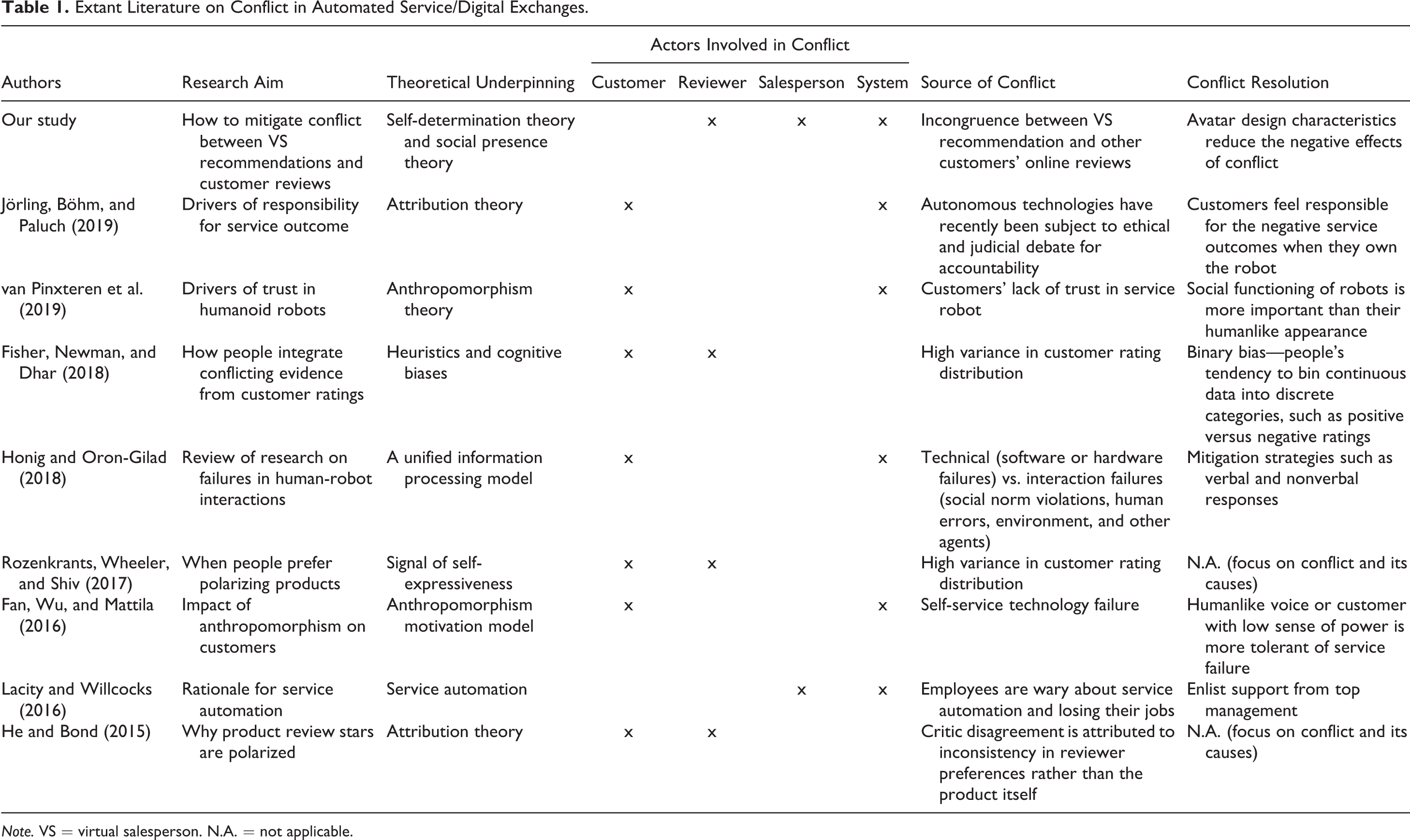
Note. VS = virtual salesperson. N.A. = not applicable.
Customer-VS Interaction and Fundamental Needs of Humans
According to self-determination theory, people have three essential psychological needs for optimal well-being: competence, autonomy, and relatedness. The fundamental human need for competence reflects a person’s need to feel effective in their lives and efforts and capable of achieving desired outcomes (Deci and Ryan 1980). For instance, previous research has theorized that people’s belief in making effective progress toward their goals is psychologically beneficial (Bandura 1977; Carver and Scheier 2000). Thus, VS has a vital role in making people’s lives easier and helping them make confident decisions. However, when VS recommendations conflict with other online customers’ purchase recommendations, customers have to put effort into evaluating these conflicting recommendations and may wonder whom or what to trust.
Autonomy is the fundamental human need to feel in control and as the originator of one’s own behavior (Ryan and Lynch 1989). By offering recommendations that are in conflict with other online customers, VS, on the one hand, forces customers to put more effort in their purchase decision making, while on the other hand, allowing them to make up their own minds by offering a different viewpoint to consider as part of the purchase recommendation evaluations. A burgeoning stream of literature shows that cuteness may trigger caregiving motivation and nurturing behavior (Kringelbach et al. 2016; Lorenz 1943; Sanefuji, Ohgami, and Hashiya 2007) as well as overindulgence in cute offerings due to reduced feelings of control (Nenkov and Scott 2014; Scott and Nenkov 2014). This may weaken feelings of autonomy. Thus, we posit that, in the context of conflict, the cute design of VS plays an important role in how customers respond to VS purchase advice.
Finally, relatedness is the fundamental need of people to feel connected to and understood by others (Baumeister and Leary 1995). Specifically, people have been shown to readily form interpersonal social attachments and resist the dissolution of existing bonds for improved health and well-being (Baumeister and Leary 1995; Reis et al. 2000). As we argue in the following section, social presence influences how close or distant customers feel to a technology and thus plays a critical role in customer-VS interactions.
Role of Social Presence in Customer-VS Interaction
The computers are social actors paradigm posits that people consider their interactions with technology as if they are interacting with another human when technologies possess humanlike characteristics (Nass and Moon 2000). A technology’s avatar, or its graphic representation and personification by means of computer technology (Holzwarth, Janiszewski, and Neumann 2006), plays a critical role in facilitating people’s consideration of the technology as a social actor (Reeves and Nass 1996). When customers interact with a VS or recommendation agent software, they treat their interactions with the VS in a way that is similar to how they communicate with humans. Qiu and Benbasat (2009) argue, for instance, that the social presence of a VS influences the extent to which customers interact and enjoy the VS experience. We draw on van Doorn et al.’s (2017) typology of ASP because VS automates the function that was previously mastered and carried out by a human salesperson; that is, trying to understand customers’ needs, help them make a purchase decision by reducing the options available, and giving an appropriate recommendation as to which offering to buy (Cabibihan, Williams, and Simmons 2014). Moreover, social presence has been considered particularly important in the automated service context (Čaić, Mahr, and Oderkerken-Schröder 2019; Nass and Moon 2000). Customers are more likely to perceive a new technology such as VS as a genuine social actor and treat it as if it had a thinking or intending mind (Epley, Waytz, and Cacioppo 2007). People are more likely to anthropomorphize (i.e., imbue nonhuman agents with humanlike qualities) when the appearance or movement of the target approximates those of other humans (Cabibihan, Williams, and Simmons 2014; Epley, Waytz, and Cacioppo 2007). Critically, the extent to which a technology is seen as a social actor and as possessing a mind influences the social value people perceive the technology to have and the bonds they are willing to form with it (Epley et al. 2008; Sherman and Haidt 2011). For instance, Fan, Wu, and Mattila (2016) note that customers are willing to forgive technology failures and are less likely to switch in self-service contexts when service agents are seen as social actors. This is consistent with the work of Epley et al. (2008) and Sherman and Haidt (2011), who suggest that social bonds with a new technology are stronger when people imbue the technology with a thinking, intending mind.
Hypothesis Development
Mediating Roles of Customer Trust and Relationship Satisfaction in the Link Between VS Recommendation Conflict and Customer Willingness to Follow VS Purchase Advice
Because of the various (e.g., social) risks involved, people have been noted to carefully consider whether to recommend something to others online (Eisingerich et al. 2015; Mathwick and Mosteller 2016). Given the powerful role of WOM (Borah et al. 2020; Hennig-Thurau, Walsh, and Walsh 2014), online shoppers may question the VS’s honesty and truthfulness when conflict exists (Pavlou, Liang, and Xue 2007) indicating that the greater the recommendation conflict, the lesser the customer trust in VS, which subsequently influences customer willingness to follow VS purchase advice.
In addition to the effects of conflict on customer trust in VS, our interest centers on the consequences that arise from customer-VS relationship satisfaction due to conflict. In accordance with prior work (Kim, Park, and Sundar 2013), we define “customer relationship satisfaction” as the extent to which VS is perceived as meeting customer needs. Specifically, probing sequential mediation offers a fuller picture of the underlying mechanism at play between conflict and customer willingness to follow VS purchase advice. We expect relationship satisfaction with the VS to bridge the effects of conflict on trust in it for several reasons. In the human-robot interaction setting, Kim, Park, and Sundar (2013) show that perceived benefit is an important driver of relationship satisfaction. People’s satisfaction with the relationship they have with a robot or automated service is drastically reduced when the relationship with the robot/automated service is not seen as beneficial (Cabibihan, Williams, and Simmons 2014; Čaić, Mahr, and Oderkerken-Schröder 2019; Dautenhahn 2007; Epley, Waytz, and Cacioppo 2007).
Moreover, Park, Eisingerich, and Park (2013) show that customers become strongly averse to offerings that make their lives more difficult (vs. easier). The conflict between the recommendation of the VS and the information provided by other online customers may make customers question the VS’s ability to meet their needs effectively (Pavlou, Liang, and Xue 2007; Wang and Benbasat 2007). Furthermore, service marketing has offered strong evidence for a link between customer satisfaction and service quality, trust, and subsequent purchase intentions (e.g., Eisingerich and Bell 2008; Garbarino and Johnson 1999; Hansen 2012). In addition to this, relationship satisfaction has been suggested to be weaker in social interactions when the exchange partner’s helpfulness and care are questioned (Cabibihan, Williams, and Simmons 2014; Čaić, Mahr, and Oderkerken-Schröder 2019; Dautenhahn 2007; Epley, Waytz, and Cacioppo 2007). Taken together, we propose the following hypotheses:
VS Avatar Design: The Effects of ASP in Mitigating Recommendation Conflict
Qiu and Benbasat (2009) propose that VS social presence can be enhanced through its avatar design and anthropomorphic images. Holzwarth, Janiszewski, and Neumann (2006) show that avatar VS is perceived more favorably by online shoppers. Previous research underscores the important role played by social presence in human-automated service interactions, including exchanges with robots (Čaić, Mahr, and Oderkerken-Schröder 2019; Dautenhahn 2007; Kim, Park, and Sundar 2013; Wirtz et al. 2018), self-service technologies (Fan, Wu, and Mattila 2016; van Doorn et al. 2017), and online recommendation agents (Epley et al. 2008). However, we ask a novel question: To what extent does ASP help to mitigate the negative effects of conflict?
We posit that ASP, evoked by the VS’s avatar, has the power to reduce the negative influence of conflict. Our hypotheses are based on Kim, Park, and Sundar’s (2013) social presence theory and Sherman and Haidt’s (2011) humanizing effects of emotions. Social presence affords customers the feeling of the socialness of a technology (Dautenhahn 2007; van Doorn et al. 2017). According to Meyerson, Weick, and Kramer (1996), when people interact with an exchange partner for the first time, the initial phase of trust-building is based on any cues they can observe, including sociality. Customers who feel stronger social presence during an exchange with a technology are more likely to perceive it as a genuine social actor by disregarding their artificiality (Čaić, Mahr, and Oderkerken-Schröder 2019). Further, prior research shows that people with strong feelings of a technology’s social presence tend to attribute human characteristics to, and form positive perceptions of, the technology, enhancing its desirability (Cabibihan, Williams, and Simmons 2014; Epley, Waytz, and Cacioppo 2007; Kim, Park, and Sundar 2013). This echoes recent work, showing that anxiety can lead to greater uptake of new product offerings when customers’ hope is also high (Lin, MacInnis, and Eisingerich 2020). Social entities become objects of greater human concern and caregiving (Epley, Waytz, and Cacioppo 2007). Sherman and Haidt (2011) also argue that social engagement elicits an affiliative behavioral disposition. Such an affiliative disposition toward the VS may help to manage the repercussions of a conflict. Thus, we further anticipate that ASP can diminish the negative effects of conflict to the point where customers’ subjective experiences and opinions about their relationships with VS can be sustained.
Social presence affects the extent to which a technology is seen as similar to oneself (“it is like me”; Epley, Waytz, and Cacioppo 2007), eliciting a desire for closeness (Sherman and Haidt 2011), and forgiveness (Fan, Wu, and Mattila 2016). We thus posit ASP to interact with conflict to weaken the negative impact of conflict on satisfaction with and trust in VS. For instance, Wirtz et al. (2018) indicate that customers are more acceptive of service robots when the interaction is perceived as humanlike and social presence exists in the human-robot interaction. Similarly, Meuter et al. (2005) argue that social presence influences the relationship between customers and self-serving technologies. Moreover, research shows that self-other/brand identity is a strong predictor of attraction and liking as well as psychological ownership and the adoption of various business offerings, including digital services (Fritze et al. 2020; Park, Eisingerich, and Park 2013). The extent to which an agent is perceived as possessing a mind and social presence affects people’s response and motivation to engage with the agent in a positive manner (Sherman and Haidt 2011). To the extent that social presence motivates sociality and a sense of similarity (Epley et al. 2008; Epley, Waytz, and Cacioppo 2007), we expect there is an interaction between conflict and ASP to mitigate the negative influence of conflict. Based on these arguments, we propose the following hypotheses:
VS Avatar Design: The Effects of Cuteness
Prior research has shown that the appearance of avatar sales agents affects customers’ perceptions of the agent’s social presence and their attitudes toward it (Holzwarth, Janiszewski, and Neumann 2006; Qiu and Benbasat 2009). Here, we advance the provocative and novel idea that ASP mitigates the negative influence of conflict on customer-VS relationship satisfaction only when the VS’s avatar is low (vs. high) in perceived cuteness. While cuteness may facilitate sociality (Kringelbach et al. 2016) and people’s approach motivation (Glocker et al. 2009; Hildebrandt and Fitzgerald 1978; Lorenz 1943), we predict that, in the context of recommendation conflict, cuteness hinders ASP from mitigating the negative effects of conflict on customer-VS relationship satisfaction, for at least two reasons.
First, our hypothesis is based on Lorenz’s (1943) work on “Kindchenschema” and Sherman and Haidt’s (2011) theory on cuteness. Previous work has suggested that cuteness unlocks instinctual behaviors such as caregiving and motivation to protect the other from harm (Glocker et al. 2009; Kringelbach et al. 2016; Lorenz 1943). Because of the enhanced protective and nurturing behavior, people’s responsiveness and attraction to cute and cuddly baby faces, for instance, have been noted to play an important role in offspring survival (Bowlby 1969). Smiling is, for instance, an adult’s initial reaction to infants (Hildebrandt and Fitzgerald 1978). Critically, Sherman and Haidt (2011) extend Lorenz’s (1943) work and propose that cuteness is an elicitor not only of care, affiliative, and friendly tendencies but also of play or playfulness.
While multibillion industries have been built on cuteness or the kawaii phenomenon, ranging from the inspirational and heartwarming manga character Uzumaki Naruto to Sanrio’s endearing Hello Kitty, which generates over US$6.5 billion a year (CNN 2015), cuteness is a double-edged sword. On the one hand, favorable attitudes toward cuteness and approach motivation (Sanefuji, Ohgami, and Hashiya 2007) have been observed across cultures. On the other hand, people may perceive something cute as merely playful, whimsical, less serious, and lacking in gravitas or competence (Jia, Park, and Pol 2015). In the context of VS recommendations, we posit that people are interested in the VS’s ability to help them make a purchase decision they will not regret rather than offer a playful environment.
Second, exposure to cute offerings has been noted to prime mental representations of fun or frivolity, subsequently increasing consumers’ overindulgence (e.g., in sweets, ice cream; Nenkov and Scott 2014). Interestingly, Scott and Nenkov (2014) note that cuteness-induced overindulgence may be reduced by enhancing feelings of personal control. Therefore, in the context of conflict, we theorize that customers generally respond less favorably to the cute design of the VS’s avatar. Grounded in the fundamental human need to feel in control (Ryan and Lynch 1989), customers may perceive this as weakening their autonomy, as they might exert extra effort in their relationship with the VS. More specifically, we posit that cuteness weakens the ability of ASP to mitigate the negative effects of conflict on customer-VS relationship satisfaction and, subsequently, customer trust in VS. Based on these arguments, we hypothesize the following:
Overview of Studies
Next, we report four studies designed to test the hypotheses. In the pilot study (N = 166), we manipulate conflict in an experimental lab setting and develop a parsimonious way to operationalize conflict. In Study 1A (N = 184) and 1B (N = 155), we again manipulate conflict and examine the moderating role of ASP in mitigating the effects of conflict on VS trust. Study 2 (N = 381) measures ASP and examines the role of VS avatar cuteness in mitigating the negative effects of conflict.
Pilot Study
Sample and Data-Collection Procedure
We follow a between-subject laboratory experimental design to test the role of customer trust in VS, mediating the link between conflict and customer willingness to follow VS purchase recommendations (Hypothesis 1). One hundred and sixty-six graduate students participate in this study in exchange for partial course credit. As part of this study, we develop a VS software that offers shopping advice for digital cameras based on a content-filtering method, following the approach not only in prior research (Qiu and Benbasat 2009) but also on leading commercial websites (e.g., www.myproductadvisor.com).
We also manipulate conflict between the VS’s recommendation and the recommendations offered by other online customers. We do so through three types of numerical ratings of online reviews: The VS recommends a digital camera with a 4.5 (out of five)-star rating, a 3-star rating, and a 1.5-star rating by other customers, denoting low, moderate, and high levels of conflict, respectively. Participants are randomly assigned to one of the three conditions (i.e., low, moderate, or high conflict). Upon arrival, participants completed simple background questions such as their age and gender. Next, a research assistant briefly informs participants about their task to shop online for a digital camera and how to use and navigate the assigned web interface. Participants are then directed to a shopping website, where the VS recommends a digital camera, highlighting different features of the camera (e.g., price, zoom, resolution, screen size, and camera weight). The participants are exposed to the star rating of the camera by other online customers (4.5-star rating for low, 3-star rating for moderate, and 1.5-star rating for high levels of conflict, respectively). This is followed by questions about participants’ willingness to follow the VS’s advice, trust in the VS, conflict, and control variables.
Measures
We rely on previously published scale items whenever possible. Specifically, we adapt five items from Komiak and Benbasat’s (2006) published scale to capture customer willingness to follow the purchase recommendation made by the VS (α = .93). Furthermore, we adapt several items from Wang and Benbasat’s (2007) customer trusting beliefs in VS measure. We retain two items with the highest factor loadings and minimal cross-loadings (“The VS is trustworthy” and “The VS is honest and truthful” [r = .80]). Conflict between the VS’s purchase recommendation and that of other online customers is captured with two measurement items (“Other customers who have used the digital camera recommended by the VS did not speak highly about it” and “Customer reviews for the digital camera were in conflict with the VS’s recommendation” [r = .92]). All items use a 7-point Likert-type scale, from 1 = strongly disagree to 7 = strongly agree.
We include two attention check questions asking about the focal brand (“What is the brand of the digital camera recommended by the VS?” [1 = Panasonic, 2 = Nikon, 3 = Canon, and 4 = Sony]) and online customers’ star rating (“What is the star rating of the recommended product by other customers?” [1= 1.5 stars, 2 = 3 stars, 3 = 4.5 stars, and 4 = 5 stars]) of the digital camera recommended by the VS.
Finally, we account for general quality perceptions (“I associate [brand name] with strong product quality,” “[Brand name] offers good quality products,” “[Brand name] is known for selling digital cameras of good quality,” where 1 = strongly disagree, 7 = strongly agree; α = .90) and participant’s attitude toward the camera brand recommended by the VS (“How much do you like [brand name]?” “How favorable are you toward [brand name]?” where 1 = not at all, 7 = very much, and r = .80) as well as digital cameras’ relevance to participants (“How relevant are digital cameras to you?” “How important are digital cameras to you?” where 1 = not at all, 7 = very much, and r = .83). Ten participants failed an attention check question; thus, their answers are excluded from further analysis. Therefore, the final sample consists of 166 participants (51.2% female; M age = 21.37, SD age = 2.34).
Validity and Reliability Assessment
We conduct a confirmatory factor analysis (CFA) to assess the validity and reliability of all the multi-item measures in our pilot study. The CFA indicates an overall adequate fit to the data (χ2 = 66.73, df = 64, p < .05; Tucker-Lewis index [TLI] = .99, comparative fit index [CFI] = .99, root mean square error of approximation [RMSEA] = .016 [.001–.050]). All factor loadings are significant (p < .001). Furthermore, the average variance extracted scores and composite reliability coefficients are higher than the recommended thresholds. Moreover, we follow Henseler, Ringle, and Sarstedt (2015) and examine the heterotrait-monotrait (HTMT) ratio of correlations. The HTMT score for trust in the VS and intention to follow the VS recommendation is .762. This is below the upper boundary of acceptable construct correlations (Henseler, Ringle, and Sarstedt 2015). Taken together, these findings indicate the discriminant and convergent validity of the constructs in our pilot study.
Results
A one-way analysis of variance (ANOVA) on recommendation conflict between the VS and online customers reveals a significant difference in perceived conflict among the three manipulation conditions, M 1.5star = 5.93, SD = 1.08; M 3star = 4.31, SD = 1.23; M 4.5star = 2.12, SD = 0.92; F(2, 163) = 174.18, p < .001. This indicates that the manipulation of conflict works as expected. Next, to examine whether customer trust in VS mediates the effect of conflict on customer willingness to follow VS purchase recommendations (Hypothesis 1), we use bootstrapping with a repeated extraction of 5,000 samples (Hayes 2018; PROCESS Version 3.4, Model 4), including the mean centering option (only for continuous variables that define products) and coefficient standardization. Specifically, we identify conflict as a categorical independent variable, trust as a mediator, and intention to follow the VS’s advice as the dependent variable. Consistent with our theoretical framework, the mediation results (R 2 = 49.46%) show that a high level of recommendation conflict significantly weakens customer trust in the VS (β = −.57, SE = .22, t = −3.07, p < .01, 95% bootstrap confidence interval [CI] = [−1.09, −0.24]). Customer trust in the VS positively influences customer willingness to follow the VS’s purchase recommendation (β = .53, SE = .06, t = 8.78, p < .001, CI [0.42, 0.66]). Conditional standardized relative indirect effects reveal a significant mediation for strong perceived conflict (indirect effect = −.30, bootstrap SE = .11, CI [−0.53, −0.10]) but not for weak perceived conflict (indirect effect = −.19, bootstrap SE = .10, CI [−0.39, 0.01]) since the 95% CI includes zero. The direct negative effect of conflict on customer willingness to follow VS purchase recommendations remains significant (p < .001). Thus, we observe a partial mediation of trust.
Discussion and Motivation for Study 1A
The results of the pilot study, in which we manipulate conflict between the recommendations provided by the VS and the reviews of other online customers, show that conflict weakens customer trust in the VS. We observe the critical mediating role played by customer trust between conflict and customers’ willingness to follow the purchase advice of the VS. Importantly, given the strong negative effect of conflict on customer trust in the VS, the question now is how such a negative impact might be mitigated. Thus, we conduct Study 1A with the following objectives in mind. First, we examine whether the effects observed in the pilot study generalize to a different participant population in a different research setting. To this end, we conduct Study 1A online (recruiting Mechanical Turk [MTurk] participants) rather than university students in a lab experimental setting. Second, we want to know whether the findings of the pilot study can be extended to a product category other than digital cameras. Hence, in Study 1A, we examine noise-canceling headphones. Third, we examine the extent to which the visual representation of the VS through a realistic avatar (i.e., the VS avatar resembling the appearance of a real person) can enhance perceived ASP and thus mitigate the negative effects of conflict on customer trust in the VS.
Study 1A
Sample and Data-Collection Procedure
Study 1A employs a 2 (conflict: low vs. high) × 2 (avatar: no image vs. realistic avatar image) between-subject experimental design. One hundred and eighty-four MTurk users (39.1% female; M age = 35.91, SD age = 9.69) participate in this study. All participants have postgraduate degrees and have passed the attention check question (“If you are paying attention then answer Amaranth when asked about your favorite color in the following question”). We manipulate conflict by presenting participants with four pairs of headphones that have received strong (3-star to 4.5-star rating) or weak (0.5-star to 1.5-star rating) recommendations by other online customers (see Appendix A). Furthermore, recommendations are displayed together with an image of the VS avatar (male) or no image. Participants are randomly assigned to the four conditions. We have designed the user interface to resemble current e-commerce websites and mimic current online shopping experience for consumers. First, participants are shown the recommended noise-canceling headphones (either low or high in recommendation conflict) together with the realistic avatar or no avatar image. Second, participants answer questions in relation to the focal constructs in the following sequence: willingness to follow VS purchase recommendation, trust in the VS, ASP, conflict, and covariates, including product relevance and online shopping frequency.
Measures
We use four items to capture customer willingness to follow VS purchase recommendation (“I am willing to rely on the VS for my decision about which product to buy,” “I am willing to use the VS as an aid to help me decide which product to buy,” “I am willing to let the VS assist me in deciding which product to buy,” and “I am willing to follow the VS’s purchase recommendations” [α = .94]). We measure trust in the VS with the same two items, from our pilot study (r = .91). We adapt four items from van Doorn et al.’s (2017) work to measure ASP (“When interacting with the VS, I felt like I was interacting with another human,” “I can imagine the VS as a living creature,” “Sometimes it seemed as if the VS had feelings,” and “The VS makes me feel as if I was in the company of another social entity” [α = .95]). Conflict is captured with three items (“There was a strong conflict between the VS’s recommendation and that of other customers,” “The VS recommended headphones were not rated highly by other customers,” and “There was a strong discrepancy in the star rating of the headphones recommended by the VS and those recommended by other customers” [α = .93]). Finally, we control for the noise-canceling headphones’ relevance (“How relevant are noise-canceling headphones to you?” and “How important are noise-canceling headphones to you?” [r = .88]) and frequency of online shopping (“How much of your shopping do you get done online?” and “To what extent do you frequently shop online?” [r = .82]). All measures use a 7-point Likert-type scale from 1 (not at all) to 7 (very much).
Validity and Reliability Assessment
As in our pilot study, we conduct CFA to assess the measures’ validity and reliability in Study 1A. Overall, the CFA indicates an acceptable fit to the data (χ2 = 218.19, df = 100, p < .05; TLI = .95, CFI = .96, and RMSEA = .080 [.066–.095]; see Table 2, Panel A for correlations and descriptive, validity, and reliability statistics).
Correlations and Descriptive, Validity, and Reliability Statistics.
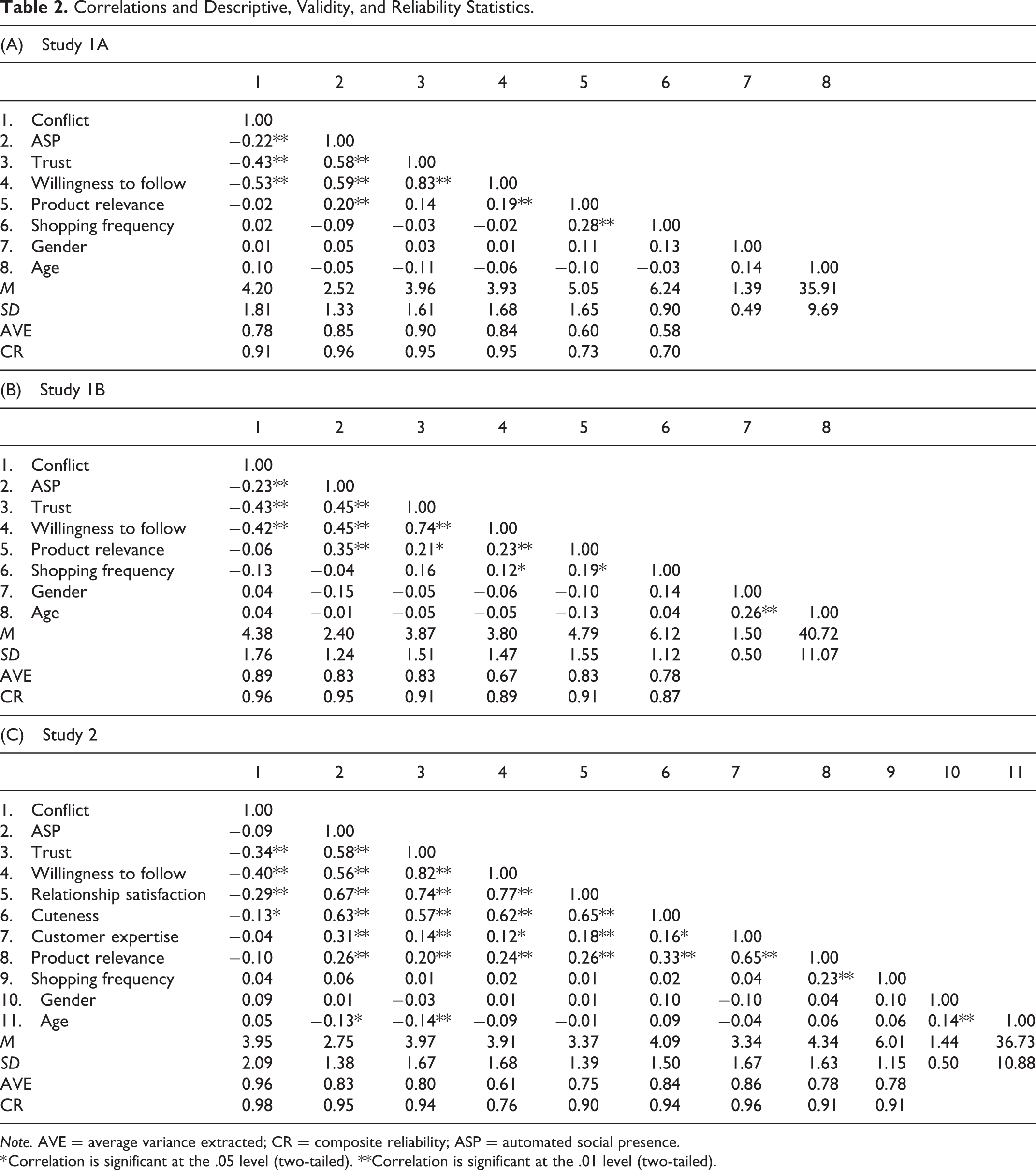
Note. AVE = average variance extracted; CR = composite reliability; ASP = automated social presence.
* Correlation is significant at the .05 level (two-tailed). **Correlation is significant at the .01 level (two-tailed).
Results
As predicted, participants in the high-conflict condition indicate higher conflict between the VS’s recommendation and that of other online customers (M = 5.16, SD = 1.77) than in the low-conflict condition, M = 3.28, SD = 1.29; F(1, 180) = 66.97, p < .001, η2 = .27. To test the mediating role of trust in the VS and the moderating role of ASP, we conduct a moderated mediation analyses with bootstrapping (Hayes 2018; Model 8 in SPSS Version 3.4; see Figure 1A). The results provide evidence of a significant mediating role of customer trust in the VS in the relationship between conflict and willingness to follow VS purchase recommendations (R 2 = 72.94%). As the results in Figure 1A illustrate, conflict negatively influences trust in the VS (β = −.48, p < .05). This, in turn, affects willingness to follow VS purchase recommendations (β = .73, p < .001). Together, the results replicate the findings of the pilot study, lending further support to Hypothesis 1. Critically, we find a two-way interaction between conflict and ASP on customer trust in the VS (β = .36, p < .05), showing that ASP significantly mitigates (moderates) the influence of conflict on trust. 1 Moreover, the indirect effects from conflict → trust → willingness to follow VS purchase recommendations are mitigated when ASP increases (i.e., the negative coefficients become smaller from −.706, −.352 to .001 at values of 1 SD below mean ASP, mean ASP, and 1 SD above mean ASP), suggesting that the negative effect of conflict on customer trust in VS and subsequently willingness to follow VS purchase recommendations is mitigated as a result of increased ASP.
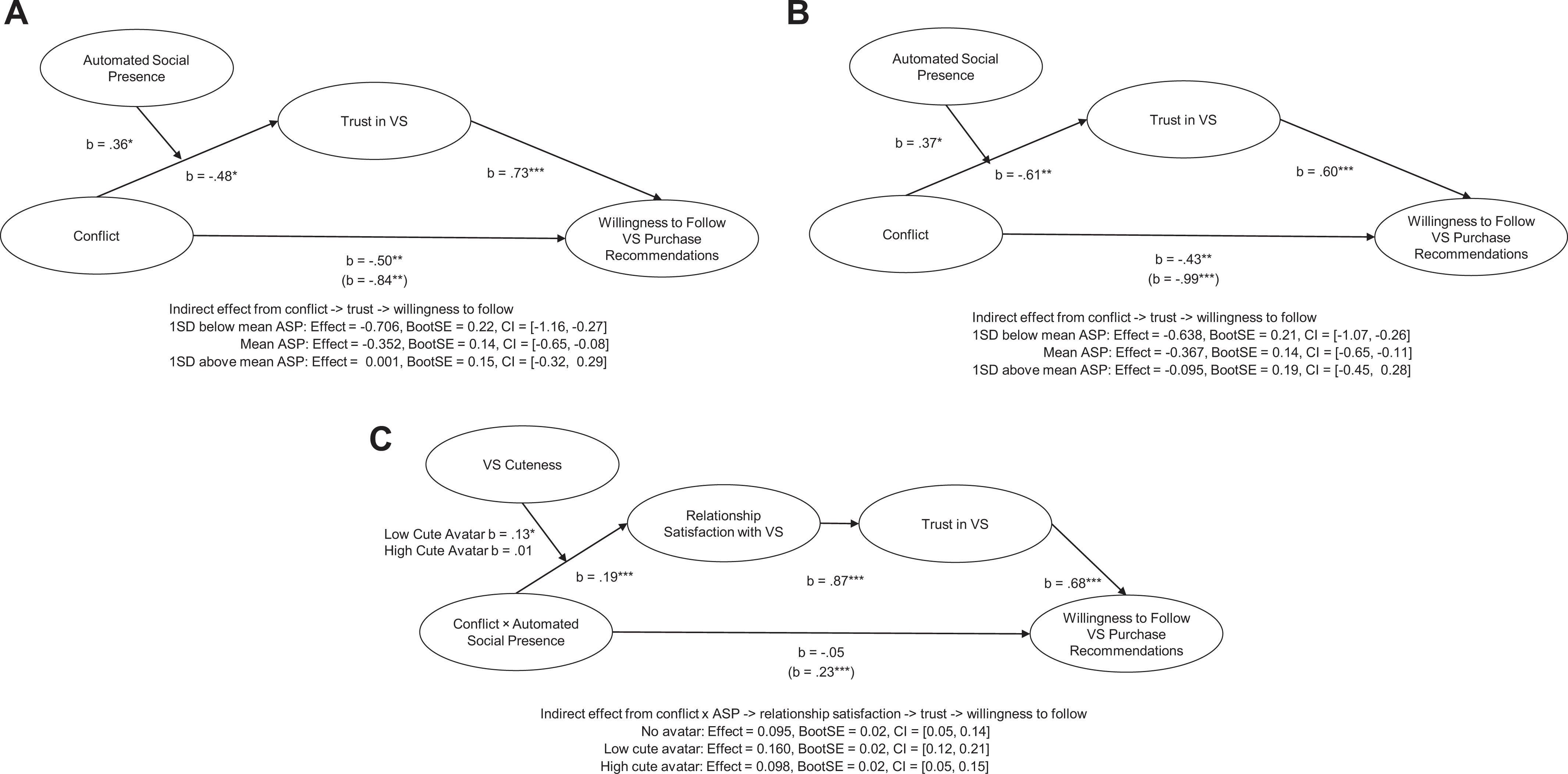
Moderated mediation effect of conflict on customer willingness to follow virtual salesperson purchase recommendations. (A) Study 1A. (B) Study 1B. (C) Study 2. Note. The path coefficients are unstandardized βs. The value in parentheses indicates the effect of conflict on the dependent variable without adding the mediator(s). *p < .05. **p < .01. ***p < .001.
To further examine and unpack the positive role of ASP in mitigating the negative effects of conflict on customer trust in VS, we plot the two-way interaction between ASP and conflict following the Johnson-Neyman method because of the continuous moderator (ASP) in our study (see Figure 2A). The findings further underscore the significant moderating role of ASP in the relationship between conflict and customer trust in VS. As ASP increased, the β coefficient for conflict becomes increasingly less negative, eventually wearing down at ASP > .28 (p = .05). Approximately, 37% of participants were at or above the Johnson-Neyman point, which is the point where the negative effect of conflict becomes insignificant. Together, the results support Hypothesis 3. Finally, as a post hoc analysis, we examine the extent to which ASP is elicited more strongly by a VS with a realistic avatar image, versus one with no image. The results show that participants who respond to the realistic VS note higher levels of ASP (M = 2.73, SD = 1.39) than do participants who respond to the VS without an image, M = 2.33, SD = 1.25; t(182) = 2.07, p < .05.
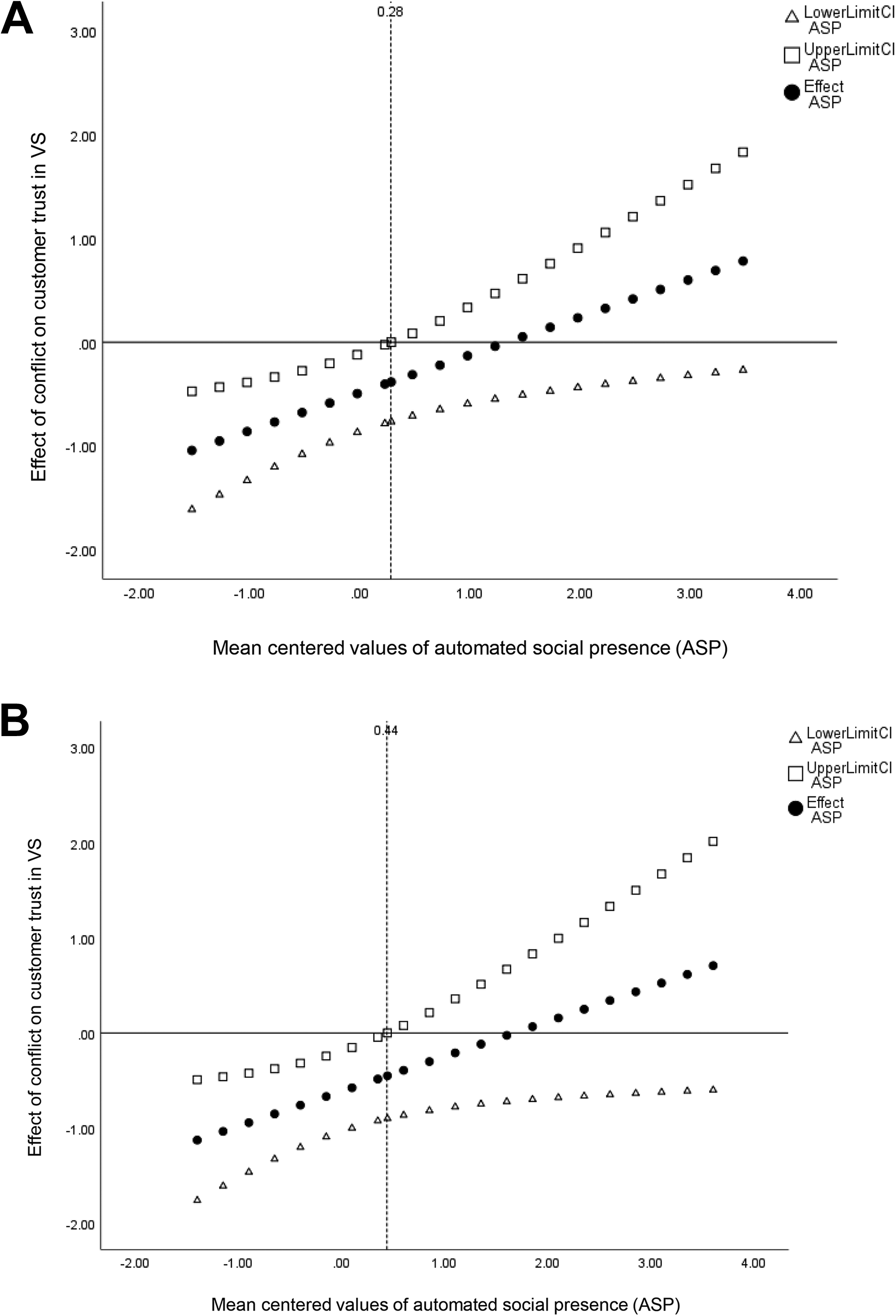
The negative conditional effects of conflict are mitigated at additional unit values of automated social presence (ASP) in Studies 1A and 1B. (A) Study 1A. (B) Study 1B. Note. The Johnson-Neyman technique shows that the negative effects of conflict on customer trust are reduced to the extent that negative coefficients become insignificant when ASP > .28 in Study 1A and when ASP > .44 in Study 1B.
Discussion and Motivation for Study 1B
Study 1A manipulates conflict and replicates the conjecture that customer trust in VS mediates the effect of conflict on willingness to follow VS purchase recommendations (Hypothesis 1). This is done by recruiting participants different from those who participated in the pilot study in an online (vs. a university lab experiment) research setting. Furthermore, we generalize the results of the pilot study to a different product context (noise-canceling headphones). A provocative finding of Study 1A shows the significant moderating role of ASP in reducing the negative effects of conflict on customer trust in VS, thus supporting Hypothesis 3. In addition, the post hoc analysis demonstrates that participants note higher levels of ASP for a realistic VS than for an avatar with no image. While the findings in Study 1A are thought provoking, we want to know whether they can be replicated with a female (vs. male) realistic avatar for the VS and another participant population. Specifically, the extant literature suggests that gender and educational background may influence conflict (Pelled 1996). Therefore, our aim is to replicate the findings of Study 1A using a different realistic avatar image (female). Furthermore, we study U.S. MTurk users who are not required to have a postgraduate degree. We thus conduct Study 1B.
Study 1B
Sample and Data-Collection Procedure
One hundred and seventy MTurk participants are recruited to participate in Study 1B. Fifteen participants failed the attention check question used in Study 1A and hence are excluded from this study. Therefore, the final sample consists of 155 participants (49.7% female; M age = 40.72, SD age = 11.07). As in Study 1A, participants are randomly assigned to conditions in a 2 (conflict: low vs. high) × 2 (avatar: no image vs. realistic avatar image) between-subject design. Conflict is manipulated similarly to Study 1A, and we again examine noise-canceling headphones.
Measures
All scales including willingness to follow VS purchase recommendations (α = .93), trust in the VS (r = .83), ASP (α = .95), conflict (α = .93), and controls (product relevance: r = .82; shopping frequency: r = .87) use the same measurement items as those used in Study 1A.
Validity and Reliability Assessment
The CFA results demonstrate an adequate fit to the data (χ2 = 174.16, df = 94, p < .05; TLI = .95, CFI = .97, and RMSEA = .074 [.057–.092]; see Table 2, Panel B for correlations and descriptive, reliability, and validity statistics.
Results
The manipulation of conflict works as expected. Participants in the high-conflict condition note higher levels of conflict between the recommendation of the VS and that of the other online customers (M = 5.24, SD = 1.69) than do participants in the low-conflict condition, M = 3.52, SD = 1.38; F(1, 151) = 48.44, p < .001, η2 = .24. Following the same procedure as that used in Study 1A, the moderated mediation analyses with bootstrapping (Hayes 2018; Model 8 of PROCESS, Version 3.4) replicate the mediating role of customer trust in the VS (see Figure 1B for details). The model results support Hypothesis 1 (R 2 = 60.80%). Furthermore, Study 1B underscores the moderating role of ASP in the link between conflict and customer trust in VS (β = .37, p < .05). Replicating the findings of Study 1A, the indirect effects from conflict → trust → willingness to follow VS purchase recommendations are mitigated when ASP increases (i.e., negative coefficients become smaller from −.638, −.367 to −.095 at values of 1 SD below mean ASP, mean ASP, and 1 SD above mean ASP). To further probe the two-way interaction between conflict and ASP on customer trust in VS, Figure 2B illustrates the mitigation pattern using the Johnson-Neyman method. As ASP increases, the β coefficient for conflict becomes less negative, wearing down statistically at ASP of .44 (p = .05). Approximately, 34% of participants were at or above the Johnson-Neyman point, which is the point where the negative effect of conflict becomes insignificant. Together, the results support Hypothesis 3. As a post hoc check to scrutinize the extent to which ASP is elicited by an avatar image, a t test suggests that participants who respond to the VS with the avatar image note higher levels of ASP (M = 2.70, SD = 1.36) than do participants who respond to the VS with no-avatar image, M = 2.11, SD = 1.04; t(153) = 3.06, p < .01.
Discussion and Motivation for Study 2
Studies 1A and 1B manipulate conflict and probe into the mitigating role of ASP in VS recommendation conflict. Study 1B further supports the mediating role of trust in the VS (Hypothesis 1) and the moderating role of ASP (Hypothesis 3) in the relationship between conflict and customer willingness to follow VS recommendations using a realistic female avatar image and a participant population different from that examined in Study 1A. While the finding that ASP helps mitigate the negative effects of conflict on trust is novel, we want to know what might help further explain the influence of conflict on trust. Moreover, we want to know whether the findings can be replicated with a naturalistic VS avatar design (i.e., a VS avatar resembling the appearance of an animated, cartoonlike person). We also want to assess a potential boundary condition for the noted moderating role of ASP. Therefore, we conduct Study 2.
Study 2
Sample and Data-Collection Procedure
We conduct a 2 (conflict: low vs. high) × 3 (avatar: “no avatar” vs. “low cuteness avatar” vs. “high cuteness avatar”) between-subject experimental design. Participants are randomly assigned to the six conditions. Three hundred and ninety-one participants are recruited from MTurk to participate in Study 2. Ten participants failed the attention check question used in Study 1A and hence are excluded from further analysis. Therefore, the final sample consists of 381 participants (44.4% female; M age = 36.73, SD age = 10.88). All participants watch a 20-second video demonstrating the current website design because this is a common experimental method employed in information system literature with the purpose of laying out a basis for the website. Subsequently, participants in the avatar condition watch a 50-second video in which the avatar (see Appendix B) shows how it might cater to customers by offering recommendation services. Participants in the “no avatar” condition do not watch the video. Across the avatar conditions, conflict is manipulated using the online customer star rating, as in Studies 1A and B; that is, 1.5-star and 4.5-star ratings are used in the high- versus low-conflict condition, respectively (see Appendix B). This time, digital cameras are used as the online product purchase context.
Measures
Willingness to follow VS purchase recommendations (α = .93), trust in the VS (r = .90), ASP (α = .95), conflict (α = .96), and controls are all measured as they are in Study 1A. We also account for customer expertise as a covariate since it could be argued that high levels of customer expertise might not need reliance on VS. Thus, participants are asked the following: “How knowledgeable are you about noise-canceling headphones?” and “To what extent do you consider yourself as an expert in noise-canceling headphones?” (r = .85). In addition, we adapt two items from the relationship satisfaction scale of Kim, Park, and Sundar (2013) to capture customers’ relationship satisfaction with the VS (“I think I will be satisfied with my sales relationship with the VS” and “I believe that my sales relationship with the VS will be beneficial for me,” where 1 = strongly disagree, 7 = strongly agree, and r = .67). Furthermore, for participants in the avatar conditions, we use three items to capture VS avatar cuteness (“The avatar of the VS is very sweet,” “The avatar of the VS is very endearing,” and “The avatar of the VS is very cute,” where 1 = strongly disagree, 7 = strongly agree, and α = .92).
Validity and Reliability Assessment
Overall, the CFA indicates an adequate fit to the data (χ2 = 767.53, df = 266, p < .001; TLI = .94, CFI = .95, and RMSEA = .070 [.065–.076]; see Table 2, Panel C for correlations and descriptive, validity, and reliability statistics). We employ multigroup CFA tests to examine the measurement invariance of the cuteness scale and to determine whether pooling the data from the female and male samples is justified. 2
Results
The manipulation of conflict is successful. Participants in the high-conflict condition indicate greater levels of conflict between the VS’s recommendation and that of other online customers (M = 5.42, SD = 1.66) than do participants in the low-conflict condition, M = 2.50, SD = 1.30; F(1, 375) = 364.26, p < .001, η2 = .49. Furthermore, participants perceive stronger levels of ASP in both the “low cuteness avatar” condition (M = 2.91, SD = 1.45) and the “high cuteness avatar” condition (M = 3.00, SD = 1.42) than in the “no avatar” condition, which has no visual representation of the avatar, M = 2.35, SD = 1.29; F(1, 375) = 8.74, p < .001, η2 = .05. As expected, there is no significant difference in ASP between the “low cuteness avatar” and “high cuteness avatar” conditions (p > .64). Finally, participants rate the avatar in the “low cuteness” condition as being less cute (M = 3.88, SD = 1.51) than do participants in the “high cuteness avatar” condition did, M = 4.30, SD = 1.46; t(250) = 2.23, p < .05. A separate test (N = 88) to ensure that humanlike avatars do not elicit other characteristics indicates that the low versus high cuteness VS avatars do not differ in perceived levels of beauty, “The avatar is very beautiful/aesthetically pleasing/appealing”; α = .77; M low cuteness = 4.43 versus M high cuteness = 4.21; t(86) = 0.78, p = ns, or sternness, “The avatar has a very angry/stern/disapproving look”; α = .88; M low cuteness = 2.45 versus M high cuteness = 2.33; t(86) = 0.41, p = ns, as per the 7-point Likert-type scale from 1 (strongly disagree) to 7 (strongly agree). In Hypothesis 2, we expect that participants would be less likely to follow VS purchase advice when they perceive a stronger recommendation conflict because the VS’s deviation from the product star review signals a larger cutback in customer-VS relationship satisfaction, which in turn decreases the perception that this VS is trustworthy. A serial mediation with bootstrapping (Hayes 2018; Model 6 of PROCESS, Version 3.4; R 2 = 73.47%) shows consistency with this notion (indirect effect = −.16, bootstrap SE = .04, 95% CI [−0.28, −0.06]), supporting Hypothesis 2.
Before investigating our proposed full-process model specified in Hypotheses 4 and 5, we run three separate sets of 2 (conflict: low vs. high) × 3 (avatar: “no avatar” vs. “low cute avatar” versus “high cute avatar”) ANOVAs on multiple outcome variables—(a) trust, (b) relationship satisfaction, and (c) willingness to follow VS purchase recommendation—to explore the sequence of multiple mediators. Although the first set of ANOVAs on trust (R 2 = 6.70%) shows only a main effect of conflict on trust, F(1, 375) = 21.01, p < .001, η2 = .05, the results showing no main effect of avatar cuteness on trust (p > .21) nor a two-way interaction between Conflict × Cuteness on trust (p > .24) are perhaps not surprising, as cuteness is distinct from ASP in lending credibility to the VS’s opinion. The second set of ANOVAs on relationship satisfaction (R 2 = 7.80%) demonstrates a main effect of conflict, F(1, 375) = 17.96, p < .001, η2 = .05; a main effect of avatar cuteness, F(1, 375) = 4.01, p < .05, η2 = .02; and a marginal significance of the two-way interaction between Conflict × Cuteness, F(1, 375) = 3.01, p = .051, η2 = .02; Figure 3A. As for the third set of ANOVAs on customer willingness to follow the VS’s recommendation (R 2 = 9.70%), the results reveal a main effect of conflict, F(1, 375) = 28.06, p < .001, η2 = .07, no main effect of avatar cuteness (p > .36), and an interaction between an avatar’s cuteness and conflict, F(1, 375) = 5.10, p < .01, η2 = .03; Figure 3B.
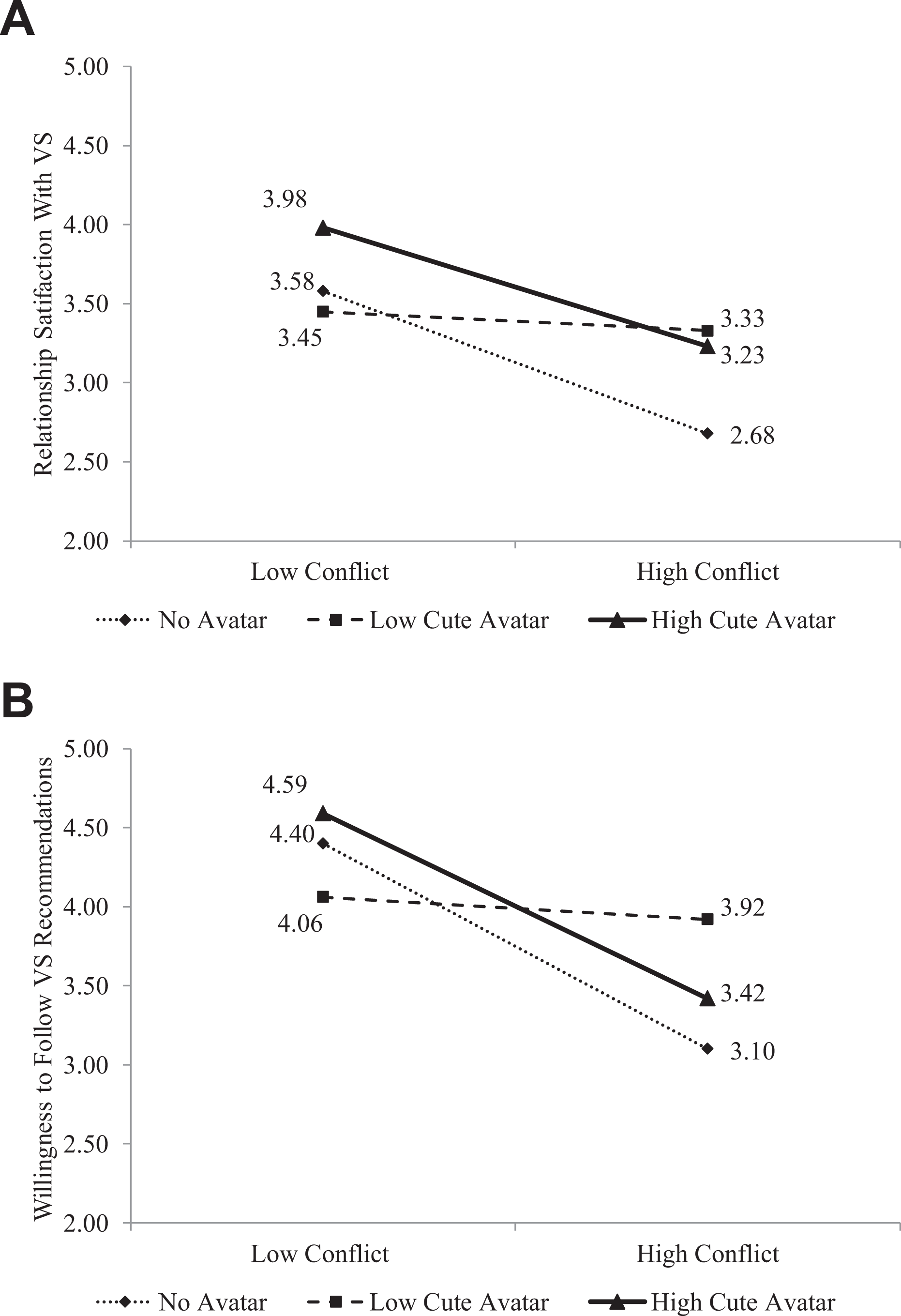
Interaction between avatar type and conflict on relationship satisfaction with virtual salesperson (VS) and willingness to follow VS purchase recommendations in Study 2.
To examine the full sequential and moderated process mechanism from Conflict × ASP → relationship satisfaction with the VS → trust in the VS → willingness to follow VS purchase recommendation, we multiply conflict by ASP as an independent variable, specify cuteness as a multicategorical moderator, and include two mediators in a serial mediation with bootstrapping analyses (Hayes 2018; Model 85 of PROCESS, Version 3.4). We test the overall decision-making model at the same time, F(7, 373) = 178.39, p < .001, R 2 = 77.00%. The results support the sequential mediation model from a significant interaction between conflict and ASP on relationship satisfaction with VS (β = .19, SE = .24, t = 3.79, p < .001) to customer trust in VS (β = .87, SE = .04, t = 20.37, p < .001) and subsequently on willingness to follow VS purchase recommendation (β = .68, p < .001), therefore supporting Hypothesis 4. Full mediation is observed without a direct effect (β = −.05, p > .09). Furthermore, the multiplication of Conflict × ASP on relationship satisfaction is observed in the “low cuteness condition” (β = .13, SE = .06, t = 2.07, p = .038) but not in the “high cuteness condition” (p > .91). In other words, when comparing with the no avatar condition, the index of moderated mediation shows that the difference between conditional indirect effects is positive and significant in the “low cuteness avatar” condition (Index = .065 [i.e., .160 − .095], 95% CI [0.01, 0.12]) but is not significant for the “high cuteness avatar” condition (Index = .003 [i.e., .098 − .095], 95% CI [−0.06, 0.07] because CI contains zero), thus supporting Hypothesis 5 (see Figure 1C). Taken together, Study 2 offers support for Hypotheses 2, 4, and 5.
Discussion
Study 2 extends Studies 1A and B by establishing the causal and mediating role of relationship satisfaction with the VS. In doing so, Study 2 replicates the findings of Studies 1A and B with a naturalistic (vs. realistic) VS avatar design. Additionally, we observe the interaction between Conflict × Cuteness on relationship satisfaction with VS, along with customers’ willingness to follow VS purchase recommendations (which could prove useful in future theory building). Importantly, the thought-provoking finding of Study 2 shows that conflict mitigation is significant only for avatars low (vs. high) in cuteness when both the avatars have similar levels of ASP.
General Discussion
Implications for Research
We build on the existing body of work on self-service in automated contexts and advance knowledge about customer-VS interactions in several important ways. First, we augment studies that investigate human-technology (service robots, self-service, and automated service solutions) interactions by exploring how potential conflict between the recommendations of a virtual sales agent and the advice offered by other online customers is mitigated. To the best of our knowledge, we are the first to demonstrate the important effects of VS avatar design in the recommendation conflict context. While previous research has examined some of the positive effects of human-robot interactions (e.g., Čaić, Mahr, and Oderkerken-Schröder 2019; van Doorn et al. 2017; Wirtz et al. 2018) as well as psychological ownership and attachment to different business offerings, including online access-based services (Fritze et al. 2020; Park, Eisingerich, and Park 2013), how conflict affects customer willingness to rely on VS for purchase advice is less understood. Furthermore, while He and Bond (2015) use star ratings to operationalize polarized views among reviewers’ recommendations, we offer additional methodological contributions by taking an identical approach to star ratings but operationalizing conflicts between reviewers and the system.
Second, highlighting the important roles of relationship satisfaction and customer trust in VS recommendations, this study advances prior research by adding to the knowledge about the quality of customer-service provider relationships in automated service contexts (Breidbach, Brodie, and Hollebeek 2014; Sprott, Czellar, and Spangenberg 2009). Critically, we thereby extend the literature on social presence in human-robot interactions (Fan, Wu, and Mattila 2016; Kim, Park, and Sundar 2013). We also contribute to the largely conceptual extant work on social presence in automated service settings (e.g., Bolton et al. 2018; Čaić, Mahr, and Oderkerken-Schröder 2019; van Doorn et al. 2017) by arguing and empirically demonstrating that ASP helps mitigate the negative effects of conflict on customer-VS relationships.
Third, whereas prior research suggests that avatars with high social presence tend to have a positive effect on customers (Holzwarth, Janiszewski, and Neumann 2006; Qiu and Benbasat 2009), we advance the provocative finding that an avatar’s strong ASP level helps to reduce the negative influence of conflict only when the VS avatar’s design is weak in cuteness. In addition, we demonstrate that strong levels of ASP can be evoked by VS avatars that resemble human beings or animated humanlike cartoons. Thus, we add to the current knowledge about the effects of cuteness and avatar design.
Managerial Implications
Trust in VS and customers’ willingness to follow VS purchase recommendations are of critical importance to services and relationship marketing given the increased importance and prevalence of online shopping (Huang and Rust 2018) as evidenced in the current COVID-19 crisis as well as the appearance of new technologies that facilitate automated service exchanges (Andreassen, van Oest, and Lervik-Olsen 2018; Bolton et al. 2018; Hollebeek et al. 2018). Indeed, automated service interactions through a VS may be an effective “path to customer centricity” (Shah et al. 2006) in the years to come. Our study shows the crucial role played by customer-VS relationship satisfaction and trust in driving willingness to follow VS purchase advice.
Differences in opinions, which occur between customers and salespeople or between customers and other customer reviews, are considered as integral (vs. incidental) disagreements to the customer. When the conflict emerges from a salesperson and other customer reviews, we find that such an incidental disagreement has a great influence on the customer’s perceptions of automated service providers and their subsequent purchase decisions. One effective and direct approach to mitigating conflict is to use VS’s avatar design. Instead of reprogramming the algorithms of the recommendation system (i.e., the “hard core” part of service ecosystem), online retailers can spend a fraction of the costs associated with conflict management by creating avatars for their virtual frontline employees.
More specifically, we observe that higher levels of ASP can be achieved by employing an avatar that is either realistic (Studies 1A and B) or naturalistic (Study 2) in appearance. The finding that both avatars are equally effective in boosting a VS’s ASP, thereby helping to mitigate the negative effects of conflict constantly well, is novel. This informs greater latitude and opportunity for online businesses to use avatar designs that best reflect their brand image. Given that many online e-commerce sites and online services currently do not trade upon the potential beneficial effects of VS avatars, our studies suggest that businesses are missing an opportunity to strengthen the relationships in automated service settings. Customers may not always support businesses’ push for automated services (Huang and Rust 2018), and, as in other service settings, conflict may arise between what a service provider and other online customers recommend. The finding that VS avatar designs help mitigate the impact of conflict on customer-VS relationship satisfaction is therefore highly encouraging.
Cuteness has been shown to trigger nurturing and caregiving motivations in people (Glocker et al. 2009; Kringelbach et al. 2016; Lorenz 1943). A stimulating finding of our study is that cuteness may hinder a VS avatar’s potential to fully take advantage of ASP. Such results echo those on growing technologies including the Internet of Things and home robots. Caudwell and Lacey (2019) find that the cute appearance of home robots creates mixed feelings of intimacy and attraction, which casts doubt on their durability and functionality. Additional research is needed to assess the critical role played by various chatbots’ or avatars’ appearance and visual features. Our findings caution service providers against employing avatar designs very high in cuteness when automated service contexts involve conflict. We have studied customer-VS relationships in an e-commerce setting. These findings may hold important implications for automated service interactions in contexts other than online shopping (e.g., handling customer complaints; collecting overdue loan repayments; offering professional advice regarding healthy diets, exercise, or financial investments) due to the promising artificial intelligence (AI) service agent techniques. Additional research on the role and design of VS in automated service interactions would be fruitful. We discuss the research limitations in the following section, which also points to avenues for future research.
Limitations and Future Research
Our current work has several limitations, which may stimulate future research. First, we focus on studying digital cameras and headphones. Search offerings (e.g., cameras, headphones, computers, laptops) are frequently characterized by attributes that can be assessed relatively easily (e.g., weight, size, battery life, price) when the information is made available by the sellers. By contrast, experience offerings (e.g., cosmetics, medicine, health care products) are characterized by attributes that are difficult to evaluate prior to purchase and trial (e.g., softness, touch and feel, fit, taste). Therefore, future research should examine the effects of conflict in other automated service contexts. While the low star ratings that appear in the recommendation list are a form of conflict, conflict may exist in various forms in automated service interactions, such as bipolar content reviews, behavioral changes required from customers, and emotional attachment losses. All these require a granular level of operationalization, such as text analysis or perceptual metrics. Moreover, in relationship marketing, interruptions that are initiated not only by brands but also by consumers or external events might be considered as another transformation of conflict to damage the relationships. Due to the idiosyncratic nature of each customer’s relationship with a brand, we encourage future research on additional forms of conflict.
Our findings are obtained by testing various avatars (realistic vs. naturalistic; male vs. female) via the third-party software as an animation-making tool (https://autochatpal.com/avatars-models-spokesperson/). Although we are able to generate basic VS avatar gestures such as nodding, hand waving, and simple smiles, the lack of rich facial expression greatly diminishes the vividness and warmth that customers might otherwise feel from the avatar. This might be the cause of the overall low mean ASP scores found in the current research since the look of the avatar and its interaction have not yet captured a living creature extensively. Thus, future research should use other powerful animation software to study fully interactive and stimulating VS avatars.
In the spirit of Wilson, Giebelhausen, and Brady’s (2017) study of negative WOM and customer self-brand connections, we also encourage scholars to examine possible moderators other than ASP that not only act as mitigators and “switch off” the negative effects of conflict (as we did in this research) but perhaps may turn conflict into a positive for customers’ willingness to follow VS purchase advice. In the context of recommendation conflict, we observe a negative effect of cuteness in a VS avatar design. However, cuteness may play a facilitative role in other automated services, such as home robots, caregiving, child nurturing, homeschooling, and romantic partnering. Future research should study the role of cuteness in VS avatar design and in the future of AI as human-technology interactions and relationships evolve.
Footnotes
Appendix A
Appendix B
Acknowledgments
The authors thank the editor-in-chief Michael K. Brady, special issue editors, and review team for their insightful and helpful comments. They also thank Abhishek Borah for his comments on an earlier version of this article.
Declaration of Conflicting Interests
The author(s) declared no potential conflicts of interest with respect to the research, authorship, and/or publication of this article.
Funding
The author(s) disclosed receipt of the following financial support for the research, authorship, and/or publication of this article: This work was partially supported by the Ministry of Science and Technology in Taiwan under the grant numbers MOST 106-2918-I-415-002.
