




Abstract
Customer discounts continue to be one of the most central promotional tools. While discounts effectively serve important corporate objectives, they may also exhibit additional unanticipated effects on internal stakeholders involved in the value creation process. This research examines the impact of customer discounts on frontline service employees. One experimental study and two field investigations are presented. The findings underline that customer discounts made salient by their redemption, frequency, and depth (i.e., magnitude) reduce frontline employees’ experienced task significance as well as their perceived appreciation by the firm. Discounts also exert destructive indirect effects on frontline employees’ workplace responses including their intrinsic motivation, ambivalent identification, and turnover intentions as mediated by task significance and appreciation. These indirect effects are for the most part driven by perceived appreciation, serving as a key mechanism in employees’ cognitive processing of customer discounts. The present findings provide first evidence that customer discounts can provoke undesired effects upon firms’ service workforce in tandem with fulfilling promotional objectives and stimulate the need for a better coordination between firms’ service and promotional activities.
Keywords
Representing one of the most central promotional tools used in marketing, customer discounts continue to act as a powerful and often superior determinant of customers’ purchase decisions (Guha et al. 2018). While discounts effectively serve critical corporate objectives such as balancing operational capacities, acquiring new customers, or meeting sales quotas (Blattberg and Briesch 2012), little is known about whether and how discounts may elicit undesired responses beyond the customer base. Since research on advertising has long established corporate employees as a responsive “second audience,” exhibiting previously unexpected emotional and behavioral reactions (Gilly and Wolfinbarger 1998; Hughes 2013), the perception of discounts seems likely to exert some kind of impact upon internal stakeholders as well. This notion is consistent with contemporary research in marketing which maintains that the multifaceted nature of promotional initiatives will also affect various actors involved in the value creation process (Hartmann, Wieland, and Vargo 2018). Frontline service employees, in particular, have been acknowledged to be subject to such influences (Homburg, Müller, and Klarmann 2011; Rapp et al. 2017). The present research builds upon this contention.
The purpose of this work is to examine how customer discounts affect frontline employees, thereby illuminating a potential dilemma between firms’ promotional practices and service delivery efforts. Addressing this issue seems critical because emerging theory on the meaning of work in the fields of behavioral economics (Ariely, Kamenica, and Prelec 2008) and organizational psychology (Barrick, Mount, and Li 2013; Grant 2008) suggests that customer discounts have the potential to jeopardize frontline employees’ motivational and behavioral inclinations. Accordingly, our mediating framework asserts that the impact of discounts on frontline employees is of a destructive nature, reducing their experienced task significance and their perceived appreciation by the firm, as well as subsequently shaping further downstream workplace responses in terms of intrinsic motivation, ambivalent identification, and turnover intentions. One behavioral experiment and two field studies are deployed to examine the impact of customer discounts made salient by their redemption, frequency, and depth (i.e., magnitude). The findings demonstrate that customer discounts reduce frontline employees’ experienced task significance and perceived appreciation and thereby also indirectly affect workplace responses in a negative way. These indirect effects are for the most part driven by perceived appreciation, emerging as a key mechanism in employees’ cognitive processing of customer discounts.
This research contributes to the relevant literature in the following ways. First, our work takes a first step toward answering the call for research by Norton, Mochon, and Ariely (2012) to examine valuations of work as a function of the selling prices of goods and services. To the best of our knowledge, our research is original and first to demonstrate that price cues, specifically, customer discounts effectively signal work valuations to employees and thereby elicit subsequent responses. As such, we introduce discounts (and potentially other price cues) as a significant determinant of the phenomena elaborated by the respective literature streams on work meaning (Barrick, Mount, and Li 2013), work motivation and self-determination (Cerasoli, Nicklin, and Ford 2014; Deci, Olafsen, and Ryan 2017), and organizational identification (Kreiner and Ashforth 2004). Our findings thereby have implications for these lines of work. Second, we enrich research on managing service employees by identifying key facets, drivers, and consequences of meaning of work experienced at organizational frontlines (Pugh, Brady, and Hopkins 2018; Singh et al. 2017). Since employees’ work meaning beliefs of task significance and appreciation elicit critical workplace responses, this work highlights meaning of work as an important principle in managing the frontline workforce. Our research also provides evidence of an important dimension regarding the interplay between promotional activities and service delivery. The present findings show that managerial decisions concerning discount practices can shape central motivational processes underlying delivery efforts, emphasizing the need for a better coordination among promotional initiatives, managing frontline employees, and other relevant domains involved in the value creation process (Lusch, Vargo, and O’Brien 2007). Third, our research adds an alternative perspective to a rich body of literature on the differentiated effects of discount primes (Aydinli, Bertini, and Lambrecht 2014; Mishra and Mishra 2011). The evidence provided by us shows that the impact of such economic cues translates beyond the customer base commonly investigated to also affect firms’ internal stakeholders. Fourth, our empirical findings and deliberation of the literature let us to suggest that appreciation is, in fact, underappreciated. That is to say, whereas employees’ sense of feeling appreciated for their efforts clearly corresponds to the principles maintained by prominent theories of work meaning and self-determination (Barrick, Mount, and Li 2013; Ryan and Deci 2017), appreciation is rarely acknowledged explicitly or distinguished as a relevant work-related cognition. In consequence, empirical insights identifying the effects of appreciation appear to be surprisingly limited. The findings presented herein contribute to this underrepresented body of knowledge. Finally, we wish to encourage reflections and subsequent initiatives on how to elevate frontline employees’ well-being by providing a meaningful work experience (Barrick, Mount, and Li 2013). We hope that our perspective will help to raise awareness that companies shape individuals’ emotional and cognitive responses in various and potentially unanticipated ways.
The remainder of this article is structured as follows. We begin by providing a theoretical background on the consequences of customer discounts and frontline employees as a second audience, followed by the introduction of our conceptual framework and a presentation of our initial hypotheses regarding the impact of discount redemptions. These propositions are tested by means of behavioral experimentation. Next, additional hypotheses surrounding discount frequency are derived and examined by a field investigation. Subsequent theoretical reflections result in our final hypotheses on the effects of discount depth. We test these propositions with a further field study and conclude, synthesizing our reflections on the overall implications and limitations of this work.
Theoretical Background
Consequences of Discounts for Firms
Customer discounts exhibit ambivalent consequences for firms. On the one hand, discounts allow firms to boost revenues and cash flows more rapidly than most other marketing initiatives (Guiltinan 1976). Price promotions are also very effective in swiftly attracting new customers, eliciting new product trials, avoiding operational overcapacities, and creating a favorable price image (Blattberg and Briesch 2012; Hamilton and Chernev 2013). On the other hand, discounts may diminish firms’ revenues in the long run by motivating customers to exhibit mere purchase acceleration and stockpiling behaviors during limited discount phases, while otherwise making increasingly conservative and price-sensitive decisions (Blattberg and Briesch 2012). Psychologically, discounts condition customers to wait for economic opportunities (DelVecchio, Krishnan, and Smith 2007), lower their internal reference prices (Alba et al. 1999), exhibit a decreased willingness to pay, and associate lower levels of quality with a discounted product or service (Lee and Tsai 2014). Economically, discounts can create a destructive Prisoner’s Dilemma for entire industries when competitors’ aggressive promotional strategies stimulate intense price competition and thereby erode profit margins sustainably in the overall market (Blattberg and Briesch 2012). The present perspective adds to these drawbacks the negative effects of discounts upon firms’ service workforce.
Consequences of Discounts for Customers
From the customers’ perspective, discounts represent economic benefits that contribute to their objective and experienced levels of financial well-being (Netemeyer et al. 2018). Being able to secure a discount may have positive or negative immediate affective consequences. For example, customers may enjoy rewarding states of satisfaction with a purchase decision deemed sensible or exhibit momentary feelings of self-devaluation or stigmatization due to paying a reduced price (Blattberg and Briesch 2012; Tepper 1994).
Importantly, discounts also shape individuals’ cognitive processing. As maintained by dual-process theory and empirically demonstrated (Aydinli, Bertini, and Lambrecht 2014; Lee and Tsai 2014), price promotions render the given purchase less consequential, thereby discouraging deliberation, that is, reducing the motivation to exert mental effort and instead relying upon effortless, fast, and affect-laden automatic responses. Such automatic and largely unconscious operations based on associative memory facilitate priming effects (Morewedge and Kahneman 2010), including the ones elicited by discount cues. For instance, nonmonetary promotions (e.g., free goods or elevated service levels) are experienced as gains and price promotions as (reduced) losses, whereby customers commonly associate a higher value with and exhibit preferences for gain promotions when saving levels of both promotional types are objectively identical (Mishra and Mishra 2011).
Discount cues not only shape the quality associated with a product or service, they can in fact jeopardize actual outcomes of consumption experiences. Akin to medical research, there is conclusive evidence underlining the existence of a price discount placebo effect that diminishes product performance via the nonconscious activation of inferior price-efficacy beliefs (Shiv, Carmon, and Ariely 2005). Discounted pain medications, for instance, facilitate lower levels of pain relief than regularly priced drugs as evident in both self-report and objective biological measures (Geuter et al. 2013; Waber et al. 2008). Likewise, discounting the price of an energy drink leads to reduced cognitive performance during problem-solving tasks (Shiv, Carmon, and Ariely 2005). Indeed, research using contemporary neuroimaging technology illustrates how salient price levels trigger the activation of distinct brain areas. For example, lowered prices of wine manifest in decreased activation of the neural regions that respond to value-related signals and indicate experienced pleasantness, while not affecting the brain area reflecting actual sensory taste experiences (Tymula and Plassmann 2016).
Taken together, this line of work impressively demonstrates that discounts represent potent economic cues that effectively signal decreased levels of value appraisals, inherent quality, and performance expectations and that individuals reduce their efforts during respective consumption experiences to nonconsciously match these deflated assessments. Since the value signaling role of price cues exhibits a general nature, applying to customers and corporate employees alike (Norton, Mochon, and Ariely 2012), we translate these insights into the current perspective on frontline employees, where service workers align their motivational and behavioral inclinations with the lowered expectations elicited by customer discounts.
Frontline Employees as a Second Audience
Historically, both marketing practitioners and scholars have been interested in developing a better understanding of the effectiveness of marketing initiatives upon selected target groups or individuals. As such insights evolved over time, however, it became increasingly evident that the impact of targeted efforts like this may extend beyond the desired audience to significantly affect other stakeholders as well. In particular, a body of research shows that communication efforts directed toward customers tend to be perceived likewise by firms’ employees who thereby constitute advertising’s “internal” or “second” audience, interpreting and responding to such messages in a significant way (Gilly and Wolfinbarger 1998; Hughes 2013). This line of work underlines that external firm communications have the potential to effectively shape central employee outcomes corresponding to the key assertions extended by the present research such as the level of performance standards, customer focus, intrinsic motivation, and organizational identification (Ashforth, Harrison, and Corley 2008; Drumwright 1996; Wolfinbarger Celsi and Gilly 2010).
Conceptual Framework
Reflecting the elements, structure, and theoretical properties of the social psychological S-O-R paradigm in a pure sense (Fiske and Taylor 2017), our conceptual framework is shown in Figure 1. The model outlines how customer discounts shape frontline employees’ work meaning beliefs including task significance and perceived appreciation, thereby affecting subsequent workplace responses in terms of intrinsic motivation, ambivalent identification, and turnover intentions. The central assertion of our mediating framework is that customer discounts impact frontline employees’ workplace responses as final downstream variables via two paths: by decreasing frontline employees’ perceived task significance and by reducing their experienced appreciation by the firm. We present three empirical studies to support our framework and to provide first insights as to why and how frontline employees respond to customer discounts in a negative manner.
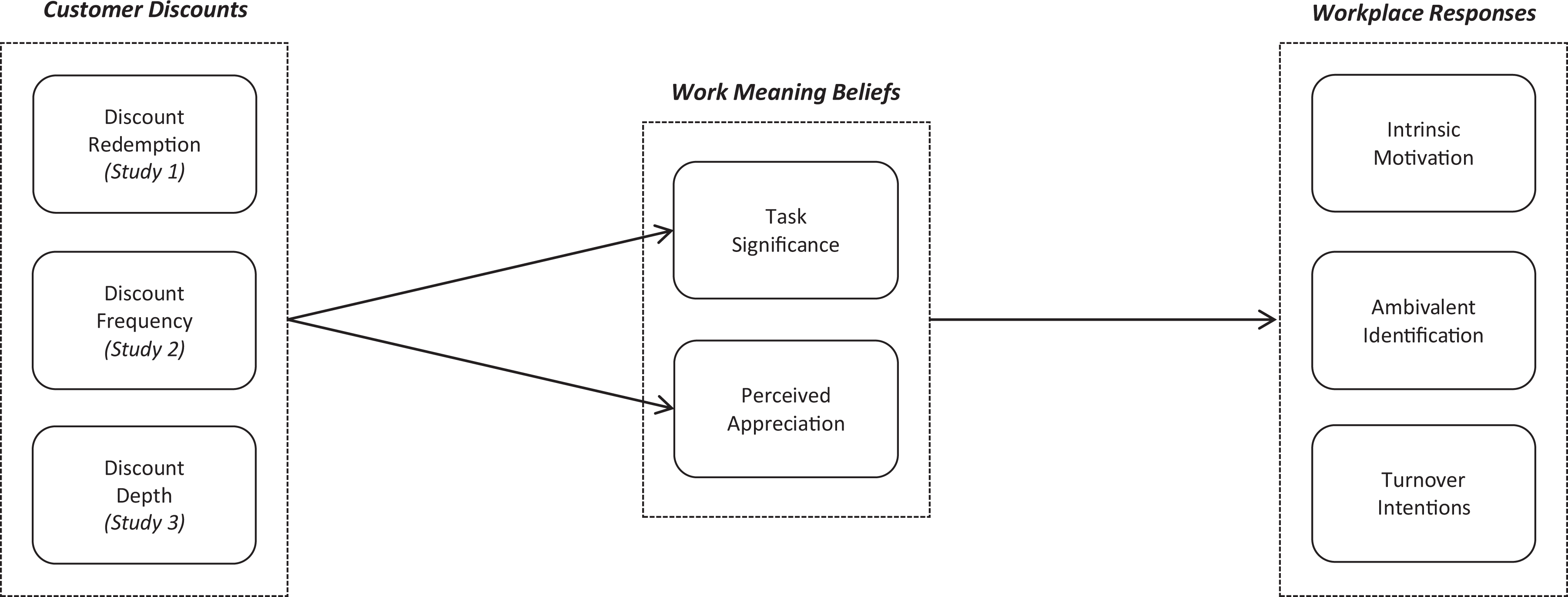
Conceptual Framework.
How Discount Redemptions Affect Frontline Employees
Scholars and practitioners alike have long tried to identify effective drivers of employee productivity. While a rich stream of research illustrates the role of extrinsic and intrinsic rewards for motivation and performance (Cerasoli, Nicklin, and Ford 2014), emerging research acknowledges individuals’ meaning of work as an important determinant of productivity (e.g., Chadi, Jeworrek, and Mertins 2017). Ariely, Kamenica, and Prelec (2008) distinguish two facets of meaning of work, namely, purpose as reflected in the significance of a task (i.e., value or impact, see also Grant 2008) and external recognition such as feeling appreciated by the organization (e.g., Frey, Bayón, and Totzek 2013). The authors identify a Sisyphus Effect, whereby individuals’ work motivation and efforts decline when the meaning of their work is challenged. We thus view meaning of work in terms of task significance and appreciation, experienced as psychological states designated henceforth as work meaning beliefs (Barrick, Mount, and Li 2013).
Task significance is a self-related cognition about the impact of one’s work and may be detached from individual endorsement of professional objectives or personally experienced economic consequences (Grant 2008). Such self-related judgments are shaped by inferences drawn from social cues and extrinsic expectations (Kruger and Dunning 1999; Weiss and Johar 2016), whereby individuals tend to align their assessments with perceived extrinsic valuations through the process of introjection (Irmak, Vallen, and Sen 2010). The selling price of a good or service represents a potent extrinsic valuation not only for customers but also for employees (Norton, Mochon, and Ariely 2012). Hence, when a diminished value of frontline employees’ contribution is signaled by customer discounts, it can be expected that lower levels of task significance will be experienced.
We further anticipate that discounts will shape frontline employees’ beliefs about their work being appreciated by their employer. Discount initiatives and designations are typically determined on the management level, eliciting attributional processes regarding their underlying reasons by others (Aronson, Wilson, and Sommers 2019). Frontline employees may attribute such decisions either to (external) market pressures or to (internal) assessments that the service is overpriced and thus needs negative adjustment. Rich empirical evidence on the correspondence bias (i.e., fundamental attribution error) shows that individuals overestimate the influence of internal as opposed to external influences when interpreting others’ behavior (e.g., Gilbert and Malone 1995). Frontline employees will thus be prone to attribute discount decisions to management’s internal assessment that the service they contribute toward exhibits an inferior value, which we expect to reduce their experienced appreciation.
Because a discount represents a deviation from the expected (regular) price to pay, customers’ redemption of it will receive heightened attention by frontline employees, which increases the salience of the discount (Higgins and Bargh 1987). Individuals commonly overweigh salient attributes in evaluative processes due to their increased mental accessibility (Lalwani and Monroe 2005), affecting the formation of social cognitions including the work meaning beliefs distinguished by our framework. Customer discount redemptions should thus result in reduced levels of task significance and appreciation experienced by frontline employees. We hypothesize accordingly:
Assuming a metatheoretical perspective, self-determination theory identifies further important properties of meaning of work. Accordingly, experienced meaning is derived from the satisfaction of basic psychological needs including the need for competence (i.e., the need for a sense of effectance and mastery). While the fulfillment of this need energizes intrinsic motivation and behavior, competence is a fragile state that is readily thwarted by various social and environmental factors. Irrespective of whether a cue explicitly derogates individuals’ competence level (e.g., negative feedback on performance) or potentially conveys an implicit signal, competence is diminished once an impression is subjectively interpreted and experienced as discouraging (Ryan and Deci 2017).
Concerning the work meaning beliefs distinguished by our framework, self-determination research maintains that experienced competence is derived, among other factors, from task significance (Gagné, Deci, and Ryan 2018) and employees’ beliefs about how their contributions and abilities are valued by their employer (Morhart, Herzog, and Tomczak 2009; Ryan and Deci 2017). Task significance and perceived appreciation by the firm are acknowledged here accordingly as representations of competence need satisfaction. The Self-Determination Theory Model for the Workplace outlines the consequences of competence. Specifically, experienced competence positively affects employees’ intrinsic motivation and other workplace responses including satisfaction-related states and demonstrated behaviors. The central premise of this approach, however, is that the impact of work-related social and environmental factors on downstream workplace responses is mediated by elementary human needs (including the need for competence), which employees seek to satisfy by means of their job activities (Deci, Olafsen, and Ryan 2017). Related research by Barrick, Mount, and Li (2013) mirrors these assertions, eloquently discussing meaning of work as a central self-regulatory process mediating the effects of work characteristics on employees’ motivational and behavioral inclinations.
Because intrinsic motivation, (ambivalent) organizational identification, and turnover intentions are important workplace responses, they are modeled as downstream variables in our framework. Intrinsic motivation reflects the drive to actively engage with the environment in the pursuit of novelty or challenge and to do so regardless of external pressure or rewards (Ryan and Deci 2017). Ambivalent identification occurs when individuals simultaneously identify and disidentify with various aspects of an organization. Such assessments constitute harmful outcomes for firms since employees will deploy resources toward solving these inner conflicts and will be reluctant to demonstrate performance beyond minimum job requirements. Ambivalent identification is also likely to cause hypocrisy perceptions (Kreiner and Ashforth 2004). To the extent that corporate hypocrisy is experienced, significant additional destructive effects on attitudes toward the firm can be expected (Wagner, Lutz, and Weitz 2009). Employees’ turnover intentions represent a relevant outcome since the propensity to leave an organization often reflects unpleasant or exhausting working conditions or unsatisfied psychological needs (Deci, Olafsen, and Ryan 2017). As theorized above, we expect the work meaning beliefs of task significance and perceived appreciation to serve as mechanisms in employees’ cognitive processing of customer discounts in line with self-determination theory as well as contemporary work meaning research. More specifically, discount redemptions will exercise damaging indirect effects upon employees’ workplace responses including intrinsic motivation, ambivalent identification, and turnover intentions. These effects will be mediated in parallel by task significance and appreciation. We thus formally propose as follows:
Study 1: Testing the Impact of Discount Redemptions on Frontline Employees
Research Design
Procedure
To test our initial propositions, we conducted a one-factor (customer discount redemption vs. regular payment) between-subjects experiment. Study participants were 163 members of the Amazon Mechanical Turk panel with work experience in customer service, who were incentivized with US$1 for partaking in the study. Participants were first provided with a hypothetical scenario describing a service encounter in a fitness studio. We used a fictitious studio named BodyFit, a local state-of-the-art studio offering a broad selection of weight training equipment, an indoor running track, various cardio technologies, and a selection of regular group classes such as spinning and yoga. Participants were asked to imagine that they have been working as a personal trainer at the gym for a few years and that the gym offers individual sessions to clients such as personal training or nutrition counseling for predetermined rates, whereby discounts are offered sometimes. Akin to Ariely, Kamenica, and Prelec (2008), the personal salary and working conditions were held constant. Participants in both conditions were informed that the studio’s standard rate for a personal session with a trainer is US$59.50 per hour. Next, participants in the regular payment condition learned that an incoming client for a personal training session with them was charged with the studio’s standard rate of US$59.50. In contrast, participants exposed to the discount redemption scenario learned that the client was charged a significantly discounted rate of US$29.50, paying about 50% less (Just and Wansink 2011). After reading the hypothetical scenario, participants were asked to provide responses to the questionnaire and subsequent manipulation check items.
Measures
To capture our focal constructs, we used 7-point Likert-type scales, ranging from (1) strongly disagree to (7) strongly agree. All items were adopted from the literature and adjusted to fit the context of this study. Each variable was measured by 3 items. A list of the deployed items and respective reliability indices is shown in Web Appendix H.
Manipulation Check
We used 2 items to assess the effectiveness of our experimental manipulation (“In the scenario, the customer received a price discount,” “In the scenario, the customer paid less than the regular price”; 1 = disagree completely, 7 = agree completely; r = .98). The composite score based on these items varied significantly across the experimental conditions, M no_discount = 2.51, M discount = 6.83; t(161) = 18.04, p < .001, and hence the manipulation was effective.
Results
Main Effects
A one-way between-subjects analysis of variance revealed that customer discount redemptions effectively reduce frontline employees’ experienced task significance, M no_discount = 6.58, M discount = 6.31; F(1,161) = 4.16, p < .05, providing evidence for Hypothesis 1a. Likewise, supporting Hypothesis 1b, frontline employees felt less appreciated by the firm when a discount was granted to the customer, M no_discount = 5.94, M discount = 5.43; F(1,161) = 6.83, p < .05; see also Web Appendix A.
Indirect Effects on Workplace Responses
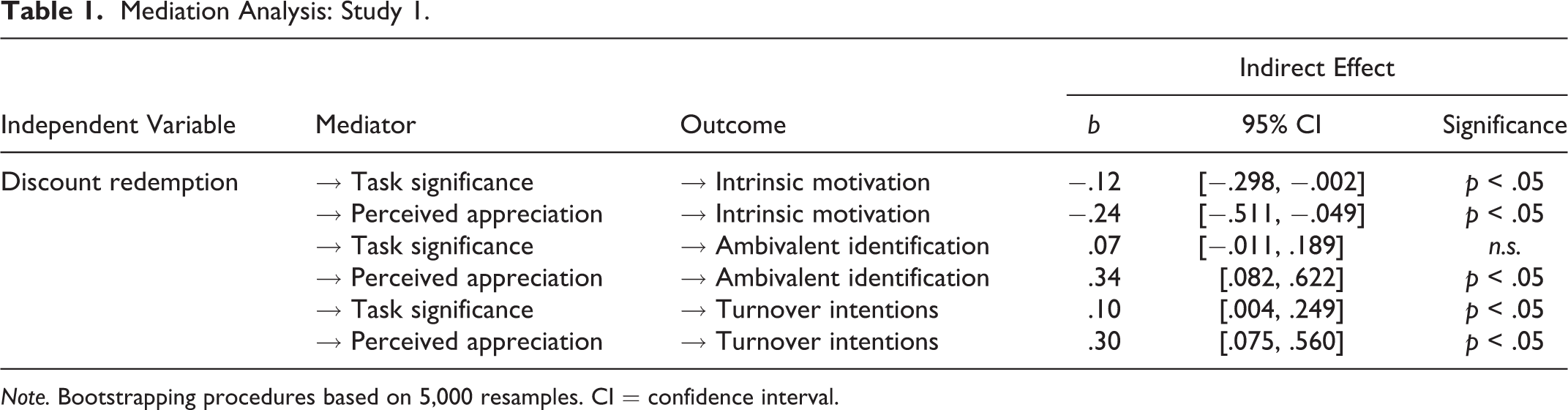
Next, we tested whether the negative effects of discounts on task significance and appreciation have relevant downstream consequences in terms of employees’ workplace responses (i.e., intrinsic motivation, ambivalent identification, and turnover intentions). Specifically, we conducted a mediation analysis with customer discount redemption as the independent variable, task significance and appreciation as parallel mediating variables, and frontline employees’ workplace responses as dependent variables (Pieters 2017). We used Hayes’ (2018) PROCESS macro (Model 4) based on 5,000 bootstrap samples, reporting 95% bias-corrected confidence intervals (CIs) and unstandardized coefficients (Orth and Wirtz 2014). The results of these analyses are shown in Table 1.
Mediation Analysis: Study 1.
Note. Bootstrapping procedures based on 5,000 resamples. CI = confidence interval.
First, we find that the indirect effects of customer discount redemption on intrinsic motivation are significant for both work meaning beliefs, task significance (b = −.12, 95% CI [−0.298, −0.002]) and appreciation (b = −.24, 95% CI [−0.511, −0.049]). Furthermore, we find that customer discount redemption boosts frontline employees’ ambivalent identification with the firm via perceived appreciation (b = .34, 95% CI [0.082, 0.622]) while the indirect path through task significance on ambivalent identification is not significant. Finally, we find that customer discount redemption increases frontline employees’ turnover intentions via perceived appreciation (b = .30, 95% CI [0.075, 0.560]) as well as task significance (b = .10, 95% CI [0.004, 0.249]). Overall, these results are supportive of Hypothesis 2b and provide partial evidence for Hypothesis 2a.
Discussion
The point of departure for this study was to examine the impact of customer discount redemption on frontline employees’ work meaning beliefs. We find support for our central proposition that customer discounts negatively affect frontline employees’ task significance and perceived appreciation (Hypotheses 1a and b). Furthermore, we find evidence that these negative effects have important downstream consequences for organizations. Specifically, our analyses suggest that the reduced levels in perceived appreciation and task significance translate into frontline employees’ negative workplace responses (i.e., reduced intrinsic motivation as well as increased ambivalent identification and turnover intentions), providing full support for Hypothesis 2b and partial but not unsubstantial support of Hypothesis 2a.
Why Discount Frequency Affects Frontline Employees
A strong and stimulating body of research assuming a “behavioral pricing” perspective illustrates that price presentations shape customers’ value perceptions and purchase behaviors in a great manner, to an extent even that the presentation of a price can exert a superior impact upon judgments and choices over its actual monetary amount (Liu and Soman 2008). Consequently, firms endeavor to design their promotional initiatives in a way that elicits desired customer responses and maximizes reaching relevant marketing objectives (Blattberg and Briesch 2012). A widely deployed industry practice is to increase and communicate the frequency of discounts (Kumar and Pereira 1997). As elaborated by the literature on information processing, such initiatives are effective because the frequency with which discounts are perceived or utilized increases individuals’ respective knowledge accessibility (Wyer 2008). The resulting elevated salience levels of frequent customer discounts affect customers’ evaluations and behaviors disproportionally (Lalwani and Monroe 2005).
While such promotional initiatives have the potential to drive desired market responses, discount frequency effects can be expected to extend beyond the targeted customer base to impact frontline employees as well. Indeed, it seems likely that promotional frequency will make discounts even more salient to frontline employees due to amplified exposure during daily interactions with numerous customers (Groth et al. 2019). In consequence, employees will exhibit responses to frequent discounts in terms of their work meaning beliefs as underlined in the preceding sections. Likewise, because task significance and appreciation are meaning-related mediating regulatory processes (Barrick, Mount, and Li 2013), they are expected to serve as effective mechanisms such that discount frequency indirectly affects workplace responses through them. Taken together, we propose as follows:
Study 2: Testing the Impact of Discount Frequency on Frontline Employees
Research Design
Procedure
To test the proposed effects, we conducted a field study in cooperation with a European newsletter provider for frontline employees in the tourism industry. Subscribers of this electronic newsletter include employees from travel agencies, business travel, and “mice” (meeting, incentives, conventions, and exhibitions) service providers as well as from the hotel industry. In close cooperation with the newsletter provider, we developed an ad that was placed in the newsletter inviting subscribers to partake in the study. The ad also directed participants to the online platform facilitating the data collection. As an incentive, participants had the chance to win one out of ten 25€ Amazon gift vouchers. We included the ad in newsletters sent to employees in (1) the general tourism industry, (2) the hotel industry, and (3) to employees working in travel agencies. We chose these employee groups as most of them directly deal with customers and discounts are a common business practice in the respective industries. In total, we were able to recruit 302 employees to participate in the study.
Measures
In order to support participants’ motivation to fully complete the survey and to secure the newsletter provider’s operational support of the study, a compact questionnaire was designed. Consequently, 7-point, single-item measures were used to capture the constructs. Specifically, we included an item for customer discount frequency, probing the extent to which the company offers discounts frequently, anchoring the responses from not at all to very frequently. We also captured the work meaning beliefs and workplace responses depicted in our framework and further included three items serving as instrumental variables to be able to account for potential endogeneity (Sande and Ghosh 2018). Moreover, a set of control variables was captured (e.g., employees’ equality orientation and years of experience). Summary statistics and correlations of the focal constructs are exhibited in Web Appendix B, and all survey items are listed in Web Appendix H.
Results
Main Effects
Linear regression was used to test whether customer discount frequency affects frontline employees’ work meaning beliefs. Consistent with Hypotheses 3a and 3b, we find that customer discount frequency significantly reduces employees’ perceived task significance (β = −.12, p < .05) and appreciation by the firm (β = −.16, p < .01; see also Web Appendix C). Adding the control variables to the models did not change our results.
Indirect Effects on Workplace Responses
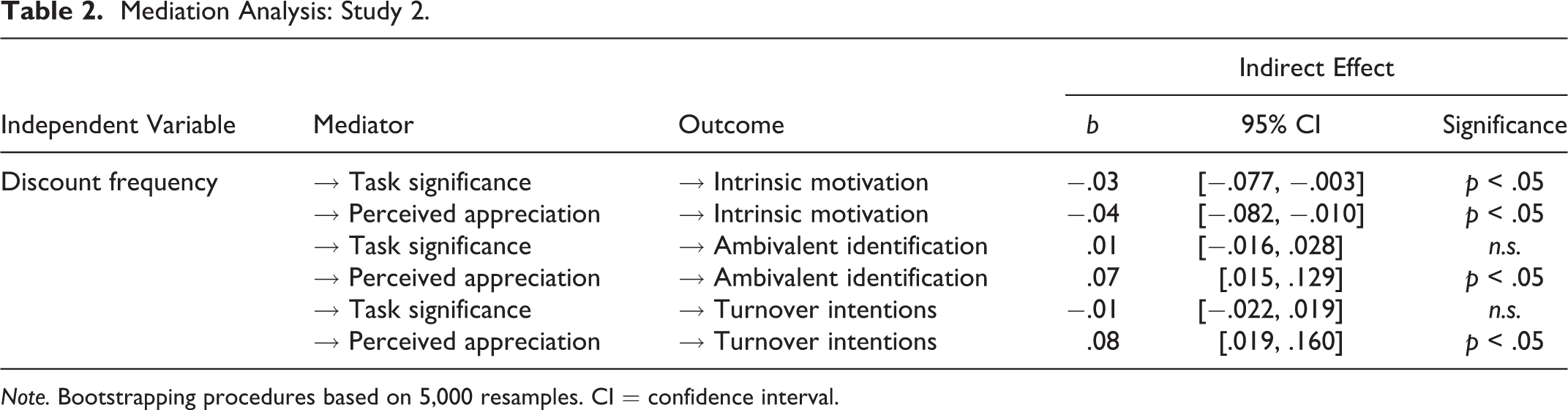
To test Hypotheses 4a and 4b, we ran mediation analyses based on 5,000 bootstrap samples and estimated 95% bias-corrected CIs. Specifically, we tested whether customer discount frequency affects frontline employees’ workplace responses via the two mediators, task significance and perceived appreciation (see Table 2).
Mediation Analysis: Study 2.
Note. Bootstrapping procedures based on 5,000 resamples. CI = confidence interval.
The analyses show that customer discount frequency negatively affects frontline employees’ intrinsic motivation via both task significance (b = −.03, 95% CI [−0.077, −0.003]) and perceived appreciation (b = −.04, 95% CI [−0.082, −0.010]). While discount frequency moreover affects ambivalent identification through perceived appreciation as anticipated (b = .07, 95% CI [0.015, 0.129]), task significance does not emerge as a significant mechanism. Finally, discount frequency indirectly increases turnover intentions via perceived appreciation (b = .08, 95% CI [0.019, 0.160) but again not through experienced task significance. Together, these findings support Hypothesis 4b and provide partial evidence for Hypothesis 4a. Adding the control variables to the models did not change our results.
Robustness Against Endogeneity
Because no experimental method was used in this study, omitted control variables, reverse causality, and common method variance may give cause to an endogeneity bias, potentially distorting our findings (Wooldridge 2010). Endogeneity can also be due to measurement error and thereby attenuate parameter estimates (Antonakis et al. 2010; Bollen 1989). Consequently, potential endogeneity concerns were examined with an instrumental variables regression approach based on two-stage least squares (2SLS) estimations (Leenheer et al. 2007; Papies and van Heerde 2017). Three instrumental variables were used in the procedures including measures of the effectiveness, popularity, and customer expectations of discounts in the given industry (see Web Appendix H for items).
The instrumental variables significantly predict our independent variable (i.e., discount frequency), thereby satisfying the instrument relevance requirement for 2SLS analysis. Specifically, we find that the corresponding F value from the first-stage regression is 78.75, exceeding the recommended threshold of 10 (Staiger and Stock 1997). Importantly, we also find that the three instruments do not exert direct effects on perceived task significance and appreciation, thereby satisfying the exclusion restriction (i.e., instrument exogeneity requirement). Specifically, the corresponding Sargan (1958) overidentification tests were not significant. Hence, there is no evidence for direct effects of the three instruments on perceived task significance and appreciation (Angrist, Imbens, and Rubin 1996; Papies and van Heerde 2017; Wooldridge 2010). After satisfying both requirements for 2SLS analyses, Hausman (1978) tests were conducted to detect a potential endogeneity bias. No evidence for endogeneity bias in the estimated effects of discount frequency on perceived task significance and appreciation emerged (ps > .10). In consequence, endogeneity does not constitute a significant threat to our findings and hence our conclusions regarding the hypothesized effects are sufficiently robust against potential measurement error, common-method variance, omitted variables, and reverse causality (Papies and van Heerde 2017; Sande and Ghosh 2018).
Discussion
Overall, the results of Study 2 underline the central assertions of our conceptual framework with evidence obtained from a field setting. Corresponding to the findings of the experimental Study 1, customer discounts made salient by their frequency have a pronounced impact on frontline employees’ work meaning beliefs, resulting in reduced task significance and decreased perceived appreciation and thereby also negatively affecting the workplace responses of intrinsic motivation, ambivalent identification, and turnover intentions. This study further suggests that perceived appreciation emerges as the more potent psychological mechanism in this framework, particularly regarding its effects on ambivalent identification and turnover intentions. Moreover, Study 2 shows that the frequency of customer price discounts matters. The more often frontline employees are exposed to customer discounts, the more destructive their impact on the employees’ work meaning beliefs and workplace responses. Our results and conclusions appear to be robust against potential endogeneity bias that may be caused by omitted control variables, reverse causality, common method variance, and measurement error. Moreover, Study 2 is based on firms’ actual pricing practices as well as frontline employees’ real-life work meaning beliefs and workplace responses, thereby increasing the external validity of our overall approach.
Why Discount Depth Affects Frontline Employees
Because price promotions increase customers’ utility by reducing economic sacrifices, the depth of a discount, that is, its negative deviation from the regular price, represents a dominant and rapid driver of sales across industries (Guha et al. 2018). Discount depth may be framed as savings in terms of percentages or absolute monetary price reductions, whereby both forms impact customers’ perceived deal savings and related purchase decisions (DelVecchio, Krishnan, and Smith 2007; Krishna et al. 2002). The salience of discounts increases with their depth (i.e., magnitude), as larger discounts facilitate greater contrasts to regular prices and thus highlight the discriminability or intensity of discount stimuli. Deep discounts are thus more salient, mentally accessible, and disproportionately weighted during judgments and decision making (Krishna and Johar 1996; Lalwani and Monroe 2005). Conversely, low-depth promotions will constitute a boundary condition for such effects when discount levels are perceived as distinctively low (Guha et al. 2018). Adaption-level theory (Helson 1964) provides a further rationale for these discrepancies, asserting that discounted prices with a close proximity to the reference price are likely to evoke neutral responses, while aggressively discounted prices will encourage stronger reactions due to their pronounced deviation from the reference price (Biswas et al. 2013). We thus expect the magnitude of a discount to decrease frontline employees’ experienced task significance and appreciation as asserted by our conceptual framework and to likewise shape subsequent workplace responses indirectly through the two regulatory processes modeled by our approach (Barrick, Mount, and Li 2013). Accordingly, we anticipate stronger adverse reactions by employees for deeper discount levels and extend our final hypotheses.
Study 3: Testing the Impact of Discount Depth on Frontline Employees
Prestudy
In a first step, an experimental prestudy was conducted to examine how different levels of promotional depth are reflected in the task significance and appreciation experienced by employees and to provide initial evidence of the mediating properties of these work meaning beliefs when the salience of a discount is elicited by its magnitude. The experimental procedure, manipulations, and construct measures were identical to the ones used in Study 1 except for treatment variations in terms of four levels of discount depth (i.e., no discount, 10% discount, 30% discount, and 50% discount; see Web Appendix F).
The empirical findings demonstrate that varying discount magnitudes result in significantly different levels of perceived task significance, F(3, 201) = 3.48, p < .05, and appreciation, F(3, 201) = 4.88, p < .01. As illustrated by the construct means outlined in Figure 2 and underlined by planned contrasts (Web Appendix G), ascending degrees of discount depth manifest in descending levels of task significance and appreciation. These results correspond to the extant literature, whereby discount depth drives effect size (e.g., Lalwani and Monroe 2005) and marginal promotional levels, correspondingly, constitute a low discount depth boundary condition (Guha et al. 2018). The prestudy also provides support for the mediating role of perceived appreciation but yields no evidence for indirect effects via task significance.
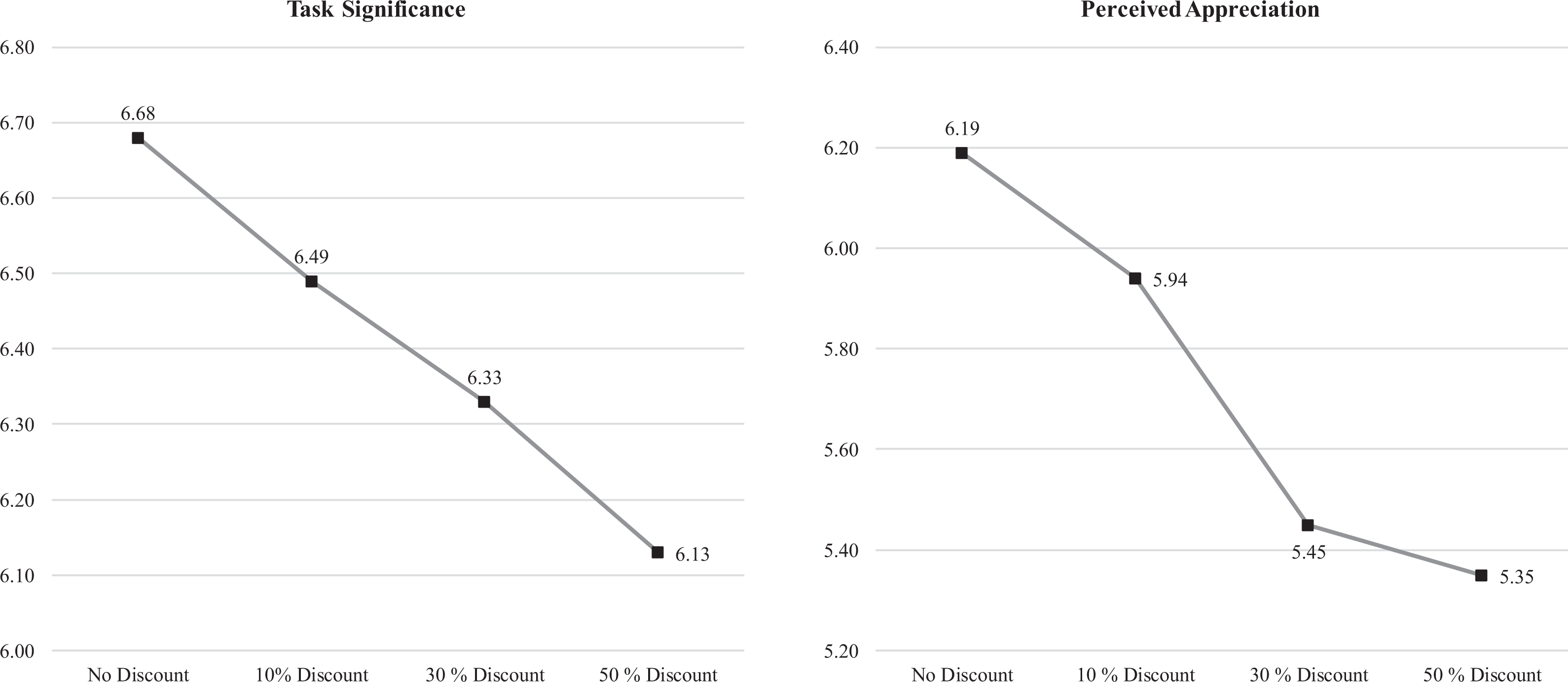
Discount Depth and Work Meaning Beliefs.
Research Design
Procedure
A field investigation of 399 verified frontline service employees from the United States comprised the main empirical effort herein presented as Study 3. Relative to the experimental prestudy, the main study is based on higher levels of external validity and a greater differentiation in terms of the independent variable, discount depth. Participants were recruited via the platform Prolific and were incentivized with a reward of US$1.80. The study probed employees on the typical discount depth deployed by their firm as well as on their work meaning beliefs and workplace responses. A series of control and instrumental variables was captured as well.
Measures
The multi-item measures of work meaning beliefs and workplace responses were the same as in Study 1, and the instrumental variables were identical to Study 2. Customer discount depth was measured with a percentage slider ranging between 0% and 100% (Granovskiy et al. 2015). The control variables captured selected job properties (e.g., autonomy to grant discounts) and firms’ characteristics (e.g., competitive positioning, internal communication of discount objectives). Descriptive statistics and correlations of the focal constructs are shown in Web Appendix D, measurement items are listed in Web Appendix H.
Results
Main Effects
Linear regression was used to test whether customer discount depth affects frontline employees’ work meaning beliefs. Supporting Hypotheses 5a and 5b, we find that discount depth significantly reduces employees’ perceived task significance (β = −.16, p < .01) and appreciation by the firm (β = −.11, p < .05; see also Web Appendix E). Including the control variables in our model did not change the results.
Indirect Effects on Workplace Responses
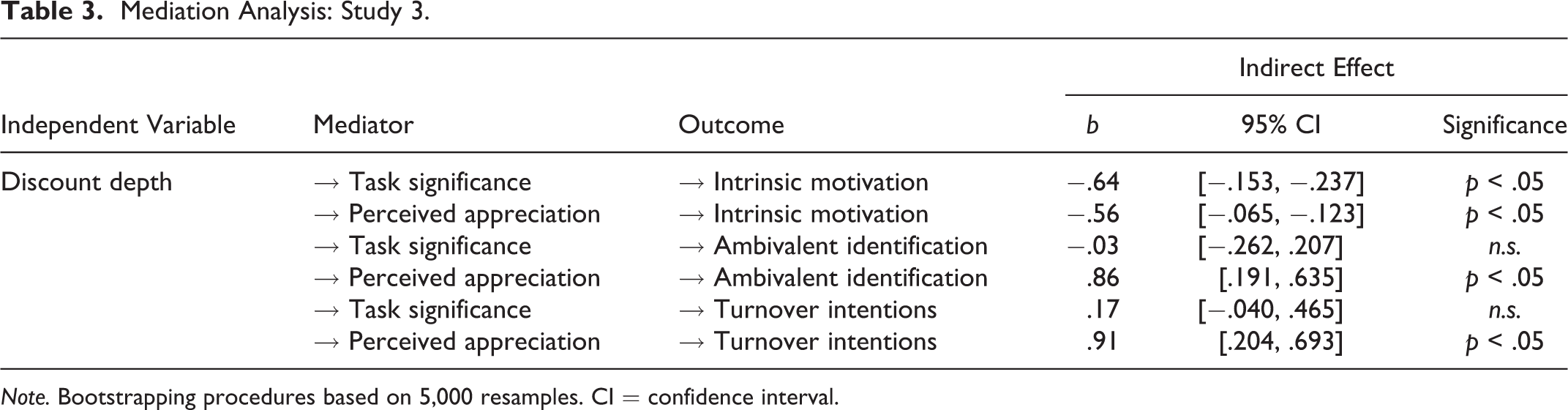
We subsequently tested whether the effects of discount depth on perceived task significance and appreciation have important downstream consequences. Specifically, we tested a mediation model with discount depth as the independent variable, perceived task significance and appreciation as parallel mediating variables, and workplace responses (i.e., intrinsic motivation, ambivalent identification, and turnover intentions) as downstream variables. Hayes’ (2018) PROCESS macro (Model 4) was used to estimate 95% bias-corrected CIs based on 5,000 bootstrap subsamples. The results of these analyses are reported in Table 3.
Mediation Analysis: Study 3.
Note. Bootstrapping procedures based on 5,000 resamples. CI = confidence interval.
The analyses show that discount depth significantly reduces employees’ intrinsic motivation via both perceived appreciation (b = −.56, 95% CI [−1.065, −0.123]) and task significance (b = −.64, 95% CI [−1.153, −0.237]). Moreover, discount depth significantly increases employees’ ambivalent identification via perceived appreciation (b = .86, 95% CI [0.191, 1.635]) but not through task significance. Likewise, customer discount depth significantly elevates employees’ turnover intentions as mediated by perceived appreciation (b = .91, 95% CI [0.204, 1.693]), whereby task significance does not serve as a significant mechanism. Including the control variables in the mediation models did not change the results. Overall, Study 3 provides partial support for the mediating role of task significance (Hypothesis 6a) and full support for perceived appreciation as a potent psychological mechanism (Hypothesis 6b).
Robustness Against Endogeneity
Akin to Study 2, an instrumental variables 2SLS regression approach was used to test for endogeneity (Papies and van Heerde 2017). The three instrumental variables listed in Web Appendix H significantly predict discount depth as our independent variable, thereby fulfilling the instrument relevance requirement (with an F value of the first-stage regression of 72.72). Moreover, the Sargan (1958) overidentification tests were not significant, showing that the instruments exert no direct impact on task significance and appreciation, thereby satisfying the exclusion restriction (Angrist, Imbens, and Rubin 1996). Because these two key requirements for 2SLS analyses are met (Wooldridge 2010), subsequent tests for endogeneity were carried out. The analyses do not find evidence of an endogeneity bias concerning the effect of discount depth on task significance (Hausman test, p > .10) but yield some evidence for endogeneity in the estimated effect of discount depth on appreciation (Hausman test: p < .05). However, the effect of discount depth on appreciation indeed becomes stronger (in the predicted direction) when correcting for endogeneity and remains significant (i.e., effect without endogeneity correction: b = −1.33, p < .05; effect with endogeneity correction: b = −2.98, p < .01). Consequently, the previous analyses are conservative in nature since they underestimate the adverse impact of price discount depth on perceived appreciation (Sande and Ghosh 2018).
Discussion
The results from Study 3 underscore the proposed effects of customer discounts made salient by their magnitude, that is, demonstrating the impact of discount depth on frontline employees’ work meaning beliefs and showing its indirect effects upon downstream workplace responses. We find that perceived appreciation significantly mediates the effects of discount depth on all workplace responses (consistent with Hypothesis 6b), whereas task significance was not a significant mediator for ambivalent identification (consistent with Studies 1 and 2) and turnover intentions (consistent with Study 2). Our instrumental variables analyses underline the robustness of these effects against potential endogeneity biases.
General Discussion
This work concretizes the proposition by Norton, Mochon, and Ariely (2012) that selling prices of goods and services will effectively signal work valuations to employees. Our specific interest lies in the negative effects of customer discounts on frontline employees’ meaning of work and subsequent workplace responses. Because most frontline employees are usually exposed to customer discounts on a regular basis, the organizational frontline setting is a fitting context for our purposes. Moreover, an enhanced understanding of the psychological dynamics underlying service delivery seems critical since superior service levels facilitated by employees can be a significant source of competitive advantage (Lusch, Vargo, and O’Brien 2007).
Because customer discounts are made increasingly salient to employees by their redemption, deployed frequency, and demonstrated depth (Higgins and Bargh 1987; Lalwani and Monroe 2005), our framework differentiates the independent variable, customer discounts, in terms of these facets. Task significance and perceived appreciation are the two work meaning beliefs included in our model as parallel mediators. The workplace responses of intrinsic motivation, ambivalent identification, and turnover intentions represent the downstream variables of our perspective. Demonstrating a research approach of a social psychological nature, we manipulate or measure perceptions of our independent variable and depict mechanisms and downstream outcomes as relevant cognitions illustrating processing of the information of interest (Fiske and Taylor 2017). Empirical evidence is provided by a multimethod approach including behavioral experimentation and field surveys using a multi instrumental variable approach.
The results of our empirical efforts provide first evidence of the work valuation signaling effect of selling prices (Norton, Mochon, and Ariely 2012). As such, we identify an additional key marketing variable with significant potential to cause effects reaching beyond the targeted customer base to also affect corporate employees as a “second audience” in a likely unanticipated and undesired way (Gilly and Wolfinbarger 1998). Our findings further support Ariely, Kamenica, and Prelec’s (2008) Sisyphus Effect, showing that visibly diminishing work meaning erodes individuals’ motivation. Moreover, the present insights underline the central tenets of prominent theories of work meaning and self-determination (Barrick, Mount, and Li 2013; Deci, Olafsen, and Ryan 2017), empirically demonstrating the mediating role of experienced meaning of work as a central self-regulatory process. As an aside, our findings regarding the impact of discount depth also exhibit the low discount depth boundary condition acknowledged by Guha et al. (2018).
In terms of our framework’s specific nomenclature, our empirical evidence shows overall that customer discounts made salient by their redemption, frequency, and depth effectively reduce frontline employees’ work meaning beliefs of task significance and perceived appreciation by the firm. Moreover, discounts exert destructive indirect effects upon workplace responses including intrinsic motivation, ambivalent identification, and turnover intentions. For the most part, these indirect effects are driven by perceived appreciation, serving as a key mechanism in employees’ cognitive processing of customer discounts. More specifically, the experiment reported as Study 1 finds that the redemption of customer discounts effectively reduces task significance and perceived appreciation. Indirect effects on all three workplace responses were also detected. Appreciation emerged as an effective mediator for each of these outcomes. On the contrary, partial evidence for the mediating role of task significance was found, whereby the construct serves as a significant mechanism pertaining only to the downstream variables of intrinsic motivation and turnover intentions. Reflecting firms’ actual pricing practices and frontline employees’ real-life work meaning beliefs and workplace responses, Study 2 provides elevated levels of external validity. The findings show that discount frequency reduces both work meaning beliefs significantly. While appreciation again serves as a significant mediator regarding each workplace response, evidence for task significance as a mechanism is even more limited than the partial evidence provided by the first study. Specifically, task significance appears to only mediate the indirect effect upon employees’ intrinsic motivation. An additional field investigation is reported as Study 3, illustrating negative main effects of discount depth on task significance and appreciation, underlining the general mediating properties of appreciation, and providing evidence of task significance as a relevant mechanism pertaining to the outcome of intrinsic motivation only.
Research Implications
The present contributions have relevant implications for several domains. First of all, this work has been inspired by the acknowledgment of findings and propositions provided by behavioral economic research (Ariely, Kamenica, and Prelec 2008; Norton, Mochon, and Ariely 2012). While we do not wish to imply that our research contributes to this discipline in any way, our results may constitute a noteworthy or at least interesting insight for such work to see its findings and propositions being illustrated by an alternative approach using social psychological principles and methods. Conversely, our empirical results exhibit direct implications for contemporary research on the interrelated topics of work meaning, work motivation and self-determination, as well as organizational identification (e.g., Cerasoli, Nicklin, and Ford 2014; Kreiner and Ashforth 2004). Specifically, we identify marketing-driven price cues as a likely unexpected determinant of employees’ work meaning, intrinsic motivation, ambivalent identification, and behavioral inclinations. Furthermore, we provide empirical support underlining the mediating properties of work meaning asserted by prominent theoretical models depicted in this literature (Barrick, Mount, and Li 2013; Deci, Olafsen, and Ryan 2017).
Our work likewise has significant implications for research on managing service employees and organizational frontlines (e.g., Pugh, Brady, and Hopkins 2018; Singh et al. 2017). Our findings highlight the central role of employees’ work meaning as an important principle in managing the frontline workforce. We identify task significance and perceived appreciation as key work meaning beliefs in this setting and demonstrate their significant impact upon critical workplace responses. These downstream outcomes, we feel compelled to remind, do not constitute isolated phenomena, but commonly translate into further consequences. For example, ambivalent identification tends to cause subsequent perceptions of corporate hypocrisy (Kreiner and Ashforth 2004). Experienced corporate hypocrisy, in turn, potentially triggers an array of negative cognitive, affective, and behavioral responses of a distinctively aggressive nature (Wagner, Korschun, and Troebs 2020). It is also possible, if not likely, that the negative workplace responses identified by our research will affect service firms’ organizational culture in a destructive way (Andersson and Pearson 1999). Moreover, our perspective reveals a significant interplay between firms’ promotional initiatives and service delivery efforts. Our findings show that managerial decisions regarding discount practices can indirectly shape central motivational processes underlying the execution of service delivery.
Reflecting on both the key insights provided by our empirical efforts and the extant body of knowledge let us to suggest that the construct of experienced appreciation may be underrepresented in the literature. Specifically, the critical importance of employees’ sense of feeling appreciated for their efforts and abilities corresponds to the assertions of elementary theories of work meaning and self-determination (Barrick, Mount, and Li 2013; Ryan and Deci 2017). At the same time, however, the notion of appreciation is rarely acknowledged explicitly or distinguished as a relevant work-related cognition. In consequence, while task significance has been examined by several studies including prominent work (e.g., Grant 2008), there seems to be limited empirical evidence revealing effects surrounding appreciation. Research by Frey, Bayón, and Totzek (2013) represents an encouraging but rare exemption. Given the central mediating role of employees’ experienced appreciation identified by our work, we speculate and like to suggest that appreciation may potentially serve as a dominant psychological mechanism in employees’ cognitive processing of other important workplace characteristics as well.
Lastly, this research has further implications, in a broader sense, for the domain of marketing research devoted to the scholarship of discount priming effects (Aydinli, Bertini, and Lambrecht 2014; Mishra and Mishra 2011). Such research commonly designates consumers to represent the relevant unit of analysis. Our work offers an alternative context as an effective setting to examine the impact of discount cues by demonstrating effects upon firms’ internal stakeholders.
Managerial Implications
Customer discounts generally represent one of the most powerful marketing tools, bringing forth desired outcomes more effectively and more rapidly than almost any other type of marketing initiative. However, discount-driven strategies can harm firms’ revenues and profit margins substantially in the long run by conditioning opportunistic customer behaviors and by stimulating increased price competition in the marketplace (Blattberg and Briesch 2012). This research adds to these significant downsides the negative impact of customer discounts upon firms’ service workforce at the frontline. Our findings show that frontline employees interpret reduced selling prices conveyed by discounts as a decreased valuation of their own work. In consequence, deflated levels of meaning of work and intrinsic motivation are experienced, while degrees of ambivalent identification and turnover intentions are increased. Related research has empirically underlined that employees’ experienced meaning of work not only affects evaluative processes and emotional experiences but also determines performance on the job significantly (Chadi, Jeworrek, and Mertins 2017). It thus seems likely that diminished work performance and demonstrated lack of motivation will ultimately shape the service level experienced by customers (Lusch, Vargo, and O’Brien 2007).
Of course, abolishing or limiting customer discounts per se is not an implication emanating from this work due to their desired positive effectiveness and because of potential competitive practices. The results of our research show that employees’ perceived appreciation serves a very central psychological role and thereby determines critical workplace responses. As elaborated in great detail by self-determination theory (Ryan and Deci 2017), the feedback approach demonstrated to employees by their superiors is of critical importance in scenarios like this in order to effectively restore a sense of competence and appreciation. We would thus expect the delivery of such deliberate feedback to be able to mitigate discounts’ negative influences to a significant if not full extent.
Importantly, the negative impact of discounts reported by us is due to employees’ subjective interpretation of such cues as signaling low work valuations. While these effects occur at least in part on a nonconscious level, employees’ perceptions and interpretations can be shaped by additional proactive communication efforts. It seems likely that negative discount effects can be effectively reduced by providing a richer information background on these initiatives to employees. We suggest that the management communication style advocated by Lusch, Vargo, and O’Brien (2007) may serve this purpose. Accordingly, informational asymmetries are reduced by means of open communication and encouraged dialog. Establishing better internal communication with frontline employees this way, informing them about present and planned promotional initiatives and their underlying objectives may also help to reduce discounts’ negative consequences for the workplace.
Moreover, it should be possible to mitigate negative discount effects by using contemporary technology that limits its visibility at the frontline (Larivière et al. 2017). For example, frontline technologies currently deployed in the airline industry by different firms vary in their extent to disclose details of pricing conditions of travelers to service employees. Overall, it should be noted that our managerial suggestions require that the executives responsible for pricing and customer discounts coordinate their efforts with the managers directly interacting with frontline employees. Hence, our research underlines the need for a better integration of firms’ services and marketing activities.
Limitations and Future Research
While this work takes an important first step toward a better understanding of the impact of customer discounts on frontline employees, the present approach is subject to certain limitations, which suggest avenues for future research efforts. First and foremost, it is to be understood that this work demonstrates a social psychological research approach where subjective perceptions are examined from an aggregated perspective. Future work may pursue a behaviorist approach by, for example, relating industry records of discount practices to observed customer behaviors as reflected in objective sources of data. The research designs of follow-up work may also account for the duration of service task completion or capture employees’ demonstration of extra-role behaviors. It could likewise be constructive to detach from an aggregated perspective, employing an ethnographic/qualitative research approach to investigate employees’ individual experiences in light of customer discounts. Such studies may reveal differentiated cultural workplace characteristics of an environment shaped by discount practices, which are difficult to detect for research efforts on an aggregated level. There also remains a promising potential for future research using longitudinal research designs. It seems both interesting and relevant, for instance, to examine the sustainability of employees’ discount responses or to investigate differentiated sequences of the frequencies of discounts and redemptions over time. Moreover, future research efforts may use a dyadic approach and capture relevant responses of both customers and employee to contrast their reactions to lowered expectations signaled by discounts. Our conceptual framework is furthermore limited in its capacity to depict relevant variables that may also play a role toward a more nuanced understanding of the phenomenon. While the instrumental variable approach deployed in our field studies and the randomization underlying our behavioral experimentations underline the validity and robustness of the effects observed by our work, addressing further antecedents, moderators, psychological mechanisms, and workplace response will further increase our understanding of this topic. For example, promising future research areas may pertain to the impact of nonmonetary discounts such as free trials, differentiated firm policies, and employee treatments, as well as addressing further outcome variables and their interrelations. Likewise, it would be a promising research avenue to identify effective managerial initiatives that have the potential to mitigate negative effects upon frontline employees emanating from firms’ discount practices.
Supplemental Material
Supplemental Material, Executive_Summary - Do Customer Discounts Affect Frontline Employees?
Supplemental Material, Executive_Summary for Do Customer Discounts Affect Frontline Employees? by Cord-Christian Troebs, Tillmann Wagner and Walter Herzog in Journal of Service Research
Supplemental Material
Supplemental Material, Web_Appendices - Do Customer Discounts Affect Frontline Employees?
Supplemental Material, Web_Appendices for Do Customer Discounts Affect Frontline Employees? by Cord-Christian Troebs, Tillmann Wagner and Walter Herzog in Journal of Service Research
Footnotes
Acknowledgments
The authors wish to thank Jon B. Sande for his helpful advice and the participants of the second Organizational Frontline Research (OFR) Symposium at Florida State University for their constructive feedback and encouragement. Likewise, the professional guidance provided by the review team is greatly appreciated.
Declaration of Conflicting Interests
The author(s) declared no potential conflicts of interest with respect to the research, authorship, and/or publication of this article.
Funding
The author(s) received no financial support for the research, authorship, and/or publication of this article.

Supplemental Material
Supplemental material for this article is available online.
References
Supplementary Material
Please find the following supplemental material available below.
For Open Access articles published under a Creative Commons License, all supplemental material carries the same license as the article it is associated with.
For non-Open Access articles published, all supplemental material carries a non-exclusive license, and permission requests for re-use of supplemental material or any part of supplemental material shall be sent directly to the copyright owner as specified in the copyright notice associated with the article.
