




Abstract
Despite increasing interest in warmth and competence as fundamental dimensions in consumers’ evaluation of service providers, prior research remains ambiguous about which dimension is more important. The current study develops a nomological framework that clarifies this ambiguity and explains whether, when, and why warmth or competence takes precedence for different outcomes in customer-service provider relationships. Combined evidence from field and laboratory studies support the notion of an asymmetric dominance, which suggests that warmth is dominant in driving outcomes that capture relational aspects (e.g., customer-company identification), whereas competence is dominant in driving outcomes that capture transactional aspects of the customer-service provider relationship (e.g., share of wallet). The findings provide first insights into the underlying mechanisms that drive this asymmetric dominance by demonstrating that relational and capability concerns mediate this process. Moreover, the current investigation identifies novel moderators that offer managers help in identifying service contexts (people vs. object care) and customer segments (differing in process and outcome service goals) for which investing in warmth or competence is more promising. Overall, displaying competence is particular effective in driving customer attraction and current operating performance, whereas displaying warmth is better suited to establish strong emotional bonds and drive customer retention.
Research on how customers evaluate services and their providers has a long-standing history in the service literature (Brady and Cronin 2001). A recently emerging perspective that connects to this research draws from scholarly work on human impression formation and demonstrates that the two fundamental dimensions of social cognition—warmth and competence—generalize to service contexts and can ultimately drive service outcomes (Scott, Mende, and Bolton 2013). While the warmth dimension refers to judgments of a service provider’s social and moral attributes, the competence dimension refers to a provider’s capabilities (Kervyn, Fiske, and Malone 2012). These dimensions have sparked remarkable attention among service academics and managers because they advance understanding of customer judgments and reactions to frontline service employees (e.g., Marinova, Singh, and Singh 2018), service providers (e.g., Bolton and Matilla 2015; Kirmani et al. 2017), and technology-infused services such as chat bots or service robots (van Doorn et al. 2017).
However, a key but unresolved question is which dimension is more important for customer-service provider relationships. Although most studies assign a dominant role to the competence dimension (e.g., Aaker, Garbinsky, and Vohs 2012; Grandey et al. 2005; Kirmani et al. 2017; Marinova, Singh, and Singh 2018), some studies find mixed evidence (Andrei et al. 2017) or a dominant role of warmth (Infanger and Sczesny 2015; Kolbl, Arslanagic-Kalajdzic, and Diamantopoulos 2019). These inconclusive results hinder the development of a general theoretical understanding of the roles of warmth and competence in customer-service provider relationships and point to the omission of important contingency factors. Given these persistent theoretical issues, managers have little orientation regarding initiatives based on the warmth-competence framework and are prone to make dysfunctional decisions such as erroneously focusing on the wrong dimension to attract new customers or build strong customer relationships.
The goal of this investigation is to develop a nomological framework that clarifies ambiguous findings and generally explains whether, when, and why warmth or competence takes precedence for different outcomes in customer-service provider relationships. We validate our framework in a large field study and two experimental studies (N total > 3,700). Specifically, we (1) investigate whether warmth or competence is systematically more important for conceptually different types of marketing outcomes, (2) examine a theoretical mechanism that explains why warmth and competence exert different effects on diverse outcomes, and (3) identify new moderators that advance understanding of the two dimensions’ roles in customer-service provider relationships.
This research makes three distinct theoretical contributions. First, we build on the cue diagnosticity framework (Skowronski and Carlston 1987) and relationship marketing literature (Fournier and Alvarez 2012) to develop a theoretical framework that enables prediction of which dimension takes precedence in driving archetypal marketing outcomes along a relational-transactional continuum. Across three studies, we find consistent evidence for our key notion of an asymmetric dominance, which suggests that warmth is dominant in driving outcomes that capture relational aspects (customer-company identification, attachment), whereas competence is dominant in driving outcomes that capture transactional aspects of the customer-service provider relationship (share of wallet, willingness to purchase). This theorizing provides a missing conceptual link that enables us to synthesize and reconcile inconclusive findings regarding the dominance of warmth versus competence in prior research (Aaker, Garbinsky, and Vohs 2012; Kolbl et al. 2019). Our studies’ results have strategic implications for service management, as they clarify that while a focus on competence is effective in driving customer attraction and current operating performance, a focus on warmth is far more effective in establishing strong emotional bonds and enduring customer relationships.
Second, this research derives first insights into the underlying mechanism that explains this asymmetric dominance. We draw on theories of interpersonal (Wojciszke 2005; Ybarra, Chan, and Park 2001) and agency relationships (Das and Teng 2001; Mills 1990) to propose that the asymmetric dominance of warmth and competence is mediated by latent concerns regarding service providers. Specifically, we show that customer decisions concerning the transactional bond with a service provider render capability concerns more salient, for which competence is more diagnostic, whereas decisions regarding the relational bond with a service provider activate relational concerns, for which warmth is more diagnostic. With this finding, we address calls for research on mediators that offer insights into the effects of warmth and competence for different outcomes (Ivens et al. 2015).
Third, the study advances the limited knowledge on moderators of the effects of warmth and competence on outcomes indicative of a relational bond. While prior research has tested moderating factors of the link between the two dimensions and transactional outcomes (e.g., Li, Chan, and Kim 2019), this study offers a first systematic comparison of moderating effects across different outcome types. A striking finding is that the dominance of warmth for relational outcomes is more robust than the dominance of competence for transactional outcomes. Furthermore, we offer first evidence on the relevance of both dimensions beyond people care service industries (e.g., Marinova, Singh, and Singh 2018) and on individual differences related to customers’ service goals. In sum, this research develops a guiding theoretical framework that offers service managers help in identifying types of service contexts (people vs. object care) and customer groups with different service consumption goals (process and outcome orientation) for which investing in warmth or competence is particularly promising.
Evaluation of Service Providers: The Role of Warmth and Competence Judgments
Universal Judgmental Dimensions: Warmth and Competence
Research in social psychology considers warmth and competence the two most fundamental dimensions in human impression formation (Abele and Wojciszke 2014; Fiske, Cuddy, and Glick 2007; Judd et al. 2005). Warmth refers to the perceived intentions of others and captures attributes that help maintain relationships and social functioning such as friendliness, helpfulness, and sincerity, whereas competence refers to others’ perceived ability to carryout their intentions and captures attributes related to goal achievement and task functioning, such as capability, intelligence, and efficiency (Cuddy, Fiske, and Glick 2008). In research on social relationships, warmth consistently emerges as the primary dimension because warmth is judged before competence and carries more weight in affective and behavioral reactions (Fiske, Cuddy, and Glick 2007; Wojciszke, Bazinska, and Jaworski 1998). 1
Recent research in marketing supports the notion that warmth and competence are also important in guiding consumer judgments and behaviors toward brands and service providers. A study indicates that over 88% of Yelp reviews rely on warmth or competence to evaluate service providers (Kirmani et al. 2017). Consumers also rely on warmth and competence to make sense of a provider’s conspicuous consumption (Scott, Mende, and Bolton 2013), corporate social responsibility (CSR) initiatives, and service failures (Bolton and Matilla 2015). Additionally, consumers rely on the two dimensions in service interactions such as when judging frontline employees’ use of emoticons in service chats (Li et al. 2019), gestures and facial expressions (Grandey et al. 2005; Wang et al. 2017), problem-solving and relating work (Marinova, Singh, and Singh 2018), or customer queries (Singh et al. 2018). Research in other marketing contexts shows that consumers use the two dimensions to make sense of for-profit and non-profit organizations (Aaker, Vohs, and Mogilner 2010), brands (Kervyn, Fiske, and Malone 2012), country-of-origins (Chen, Mathur, and Maheswaran 2014), and gender-stereotypical cues in ads (Zawisza and Pittard 2015; see Table 1 for an overview).
Literature Review on Empirical Studies on the Consequences of Warmth and Competence.
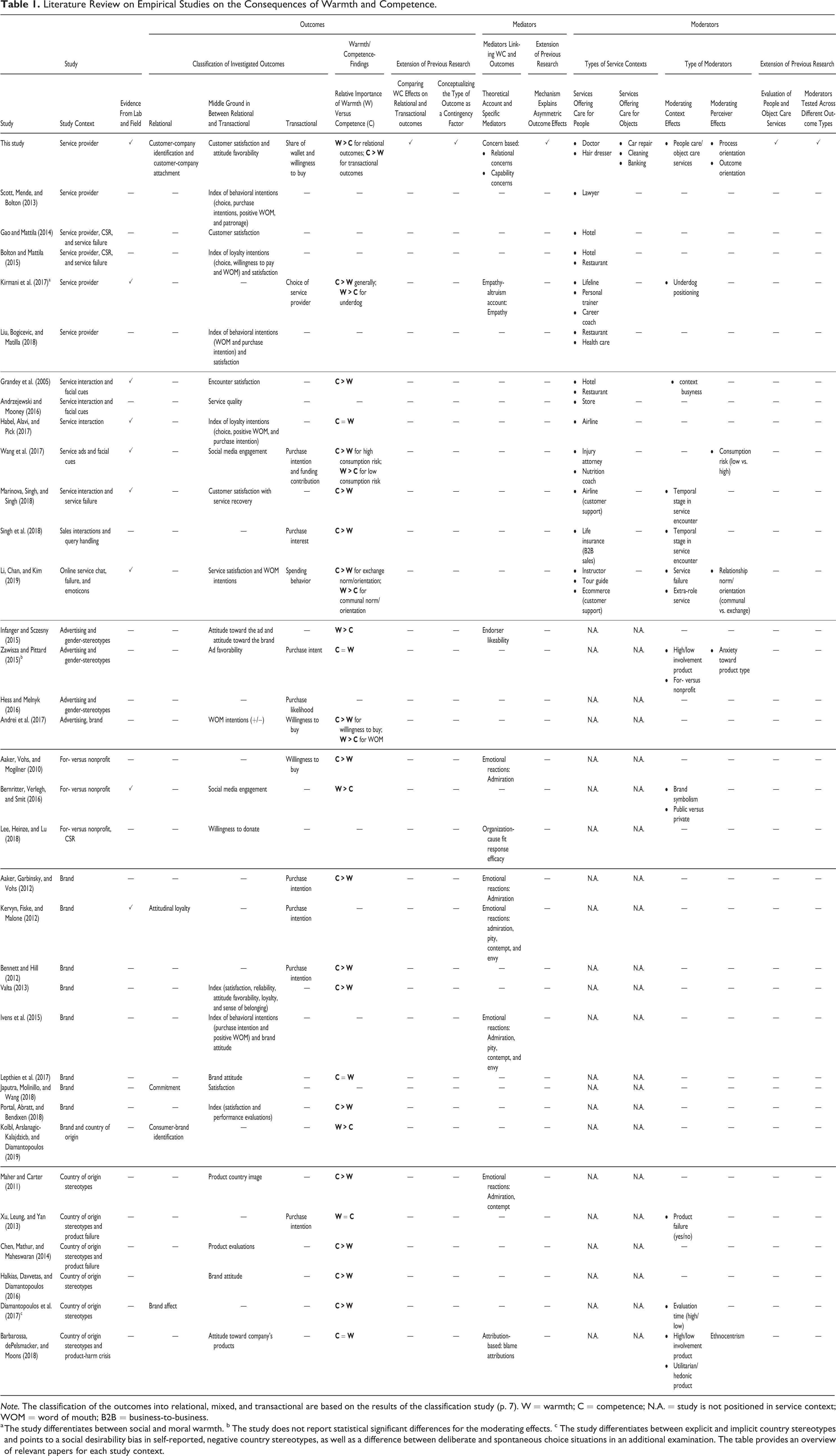
Note. The classification of the outcomes into relational, mixed, and transactional are based on the results of the classification study (p. 7). W = warmth; C = competence; N.A. = study is not positioned in service context; WOM = word of mouth; B2B = business-to-business.
a The study differentiates between social and moral warmth. b The study does not report statistical significant differences for the moderating effects. c The study differentiates between explicit and implicit country stereotypes and points to a social desirability bias in self-reported, negative country stereotypes, as well as a difference between deliberate and spontaneous choice situations in an additional examination. The table provides an overview of relevant papers for each study context.
Relative Importance of Warmth Versus Competence
While considerable evidence shows that the two fundamental dimensions guide consumers’ impression formation and behavior, there is an ongoing but yet unresolved discourse in the literature that aims to clarify which dimension is more important in driving marketing outcomes. Most studies in marketing argue that consumers generally value competence more than warmth (e.g., Aaker, Garbinsky, and Vohs 2012; Grandey et al. 2005; Halkias, Davvetas, and Diamantopoulos 2016; Kirmani et al. 2017). This view is particularly prevalent with respect to consumer judgments of service providers and service encounters. These studies argue that competence generally takes precedence over warmth in service settings because consumers pursue task-related goals in their relationships with service providers (Kirmani et al. 2017). As the literature assumes competence to be more diagnostic for assessing task performance (Marinova, Singh, and Singh 2018) and the quality of offerings (Aaker, Garbinsky, and Vohs 2012), achieving task-related goals seems to particularly depend on a firm’s level of competence.
A few studies report results that question the assumption that competence is more important than warmth. For example, a study shows that ads are more effective when they feature endorsers portrayed as warm rather than competent (Infanger and Sczesny 2015). However, while this study suggests this finding to be due to the interpersonal context, other studies on interpersonal judgments in marketing show that competence is more important (Grandey et al. 2005). Similarly, one study on brand stereotypes finds that warmth is more important (Kolbl et al. 2019), whereas other studies on brand (Aaker, Vohs, and Mogilner 2010) and country stereotypes find that competence is more important (Chen, Mathur, and Maheswaran 2014; Halkias, Davvetas, and Diamantopoulos 2016). Yet another study finds a stronger effect of warmth on word-of-mouth but also a stronger effect of competence on purchase intentions (Andrei et al. 2017). This exploratory result is interesting as it raises questions about the reasons for such ambiguous effects of warmth and competence. However, in the absence of a theoretical explanation and a larger empirical evaluation, these questions remain unanswered.
In sum, although some studies find warmth to be more important than competence, the reason behind these findings remains ambiguous. This is either because the finding are exploratory in nature and remain undiscussed or because they are contrasted by diverging findings of other studies in comparable contexts. Thus, it remains unclear why most marketing studies find a dominance of competence over warmth, but some find a dominance of warmth over competence. This ambiguity points to neglected contingencies that may help to explain the divergent findings of prior research.
Disentangling the Roles of Warmth and Competence by Classifying Marketing Outcomes
We suggest that a pivotal reason for the ambiguity surrounding the role of warmth and competence in marketing research is that prior studies have devoted little attention to the type of outcome under examination. Most earlier studies focus on a single type of outcome (e.g., Kirmani et al. 2017) or rely on a behavioral intention index that combines several conceptually distinct outcomes into a single measure (e.g., Scott, Mende, and Bolton 2013). Moreover, prior work has largely neglected the examination of outcomes that capture relational aspects of the customer-company relationship, such as attachment and identification (Ivens et al. 2015). Although scholars have called for a look “beyond purchase intentions” (MacInnis 2012, p. 196) and emphasized the need to sort out the specific roles that warmth and competence play in driving conceptually different types of marketing outcomes (Fournier and Alvarez 2012; Ivens et al. 2015), these calls have remained unaddressed.
Differentiating between types of outcomes matters because consumers’ evaluation of outcomes may involve distinct decision-making processes (Jacoby and Kyner 1973) for which different underlying judgments (i.e., warmth and competence) become diagnostic. Initial evidence from research in social psychology shows that the relative importance of warmth and competence may depend on the social outcome considered, such that “liking” depends more strongly on warmth, while “respect” depends more strongly on competence (Wojciszke, Abele, and Baryla 2009). Hence, such differences in the underlying mechanisms that drive the evaluation of social outcomes might also apply to outcomes in marketing research. If so, a lack of differentiation between types of outcomes may create errors in the understanding of warmth and competence.
Against this backdrop, this study investigates whether considering conceptual distinctions between types of marketing outcomes can help to distinguish the roles of warmth and competence in shaping customer-service provider relationships. In a first step, we introduce a systematic differentiation between marketing outcomes, which we then use to classify outcomes examined in prior studies.
Classification of outcomes along a relational-transactional continuum
To classify different types of marketing outcomes, we draw from conceptual work on warmth and competence (Fournier and Alvarez 2012) and the relationship marketing literature (Berry 1995; Oliver 1999). This literature builds on the central tenet that customer relationships are complex, multidimensional phenomena that are not limited to repeated purchases and other transaction-focused behaviors (Jacoby and Kyner 1973) but may also involve emotional bonding and a desire to maintain a valued relationship with a service provider (Mattila 2001; Oliver 1999). Assessment of a customer relationship’s true value thus requires complementing transaction-focused outcomes with measures that have a stronger relational focus (Reinartz and Kumar 2000).
This conceptualization lends itself to a classification of marketing outcomes along a continuum ranging from outcomes reflecting either more relational or more transactional aspects of the customer-company relationship (Anderson and Narus 1991; Garbarino and Johnson 1999). Marketing outcomes falling on the transactional end of the continuum are more indicative of a transactional bond between a customer and a company. This bond is typically assessed through outcomes such as purchase intention or volume, frequency, or share of customer wallet, which feed into sales quotas and quarterly benchmarks and determine more or less profitable customers (Du, Kamakura, and Mela 2007; Shoemaker 2001). 2 In contrast, marketing outcomes falling on the relational end of the continuum are indicative of a relational bond that ties the customer to the company emotionally and reflects the customer’s desire to maintain a relationship with the company (Matilla 2001; Thomson, MacInnis, and Park 2005). The relational bond can typically be captured by constructs such as customer-company identification, attachment, or commitment, which reflect the quality and strength of a customer’s volitional relational ties with a provider (Bhattacharya and Sen 2003; Thomson, MacInnis, and Park 2005). While these definitions reflect archetypal outcomes that refer to the respective end points of the relational-transactional continuum, not all marketing outcomes clearly belong to one end or the other.
Classification of outcomes examined in prior warmth and competence research
To identify typical outcomes that fall to one end of the continuum or the other, we conducted an online study in which we asked undergraduate business administration students (n = 99, 62% female, M Age = 22.8) to rate the extent to which specific outcomes reflect the conceptualized transactional and relational definitions (see Web Appendix A). We selected most of these outcomes from prior studies on warmth and competence and added outcomes that the literature would suggest to be typical for reflecting either a strong relational (e.g., customer-company identification) or transactional bond (e.g., share of wallet). A cluster analysis of the resulting mean values suggests a three-cluster solution, with outcomes such as customer-company attachment (CCA), customer-company identification (CCI), affective commitment, and resistance to switching falling on the relational end of the continuum and customer share of wallet (SOW), willingness to buy (WTB), company choice, and cross-buying intentions falling on the transactional end. Outcomes such as customer satisfaction (CS) and customer attitude favorability (CAF) were classified to reflect both ends and can thus be located at the middle ground between both the ends of the continuum.
We use these results to classify the outcomes examined in earlier work on warmth and competence in marketing along the proposed relational-transactional continuum (Table 1). The findings show that 80% of the studies in Table 1 are limited to a single type of outcome measure and approximately 90% of these studies do not consider an outcome that reflects the relational end of the continuum. Furthermore, no research has yet compared the effects of warmth and competence on outcomes with a relational versus a transactional focus. Overall, these insights suggest that the type of outcome as a potentially relevant factor has been largely overlooked.
Furthermore, Table 1 helps to reveal that studies arguing for the dominance of competence over warmth usually rely on an outcome with a transactional focus (e.g., Aaker, Garbinsky, and Vohs 2012; Kirmani et al. 2017) or an outcome that falls into the middle ground of the relational-transactional continuum (e.g., Grandey et al. 2005; Marinova, Singh, and Singh 2018). By contrast, the few studies that argue for a dominance of warmth over competence mostly rely on an outcome with a relational focus (Kolbl et al. 2019) or an outcome that resides in the middle ground (Infanger and Szcesny 2015). This outcome perspective puts prior findings in a new light. For example, Table 1 suggests that the findings of Kolbl et al. (2019) and Aaker, Garbinsky, and Vohs (2012) might diverge because these studies rely on outcomes that reflect opposing ends of the relational-transactional continuum. This perspective also offers a rationale for unexplained findings of earlier studies (Andrei et al. 2017). The introduced outcome classification hence offers a novel perspective on prior findings and indicates a systematic relationship between the importance of warmth versus competence and the outcome type.
Underlying Mechanism Linking Warmth and Competence With Marketing Outcomes
To understand the underlying mechanism that explains differences in the importance of the two dimensions for distinct outcome types, we first turn to the literature. Table 1 shows that of the few marketing studies examining potential mediators of warmth and competence, most examine the role of emotional reactions like contempt, admiration, envy, and pity (Kervyn, Fiske, and Malone 2012). However, these studies only find partial support for the mediating role of emotional reactions in marketing contexts (Ivens et al. 2015; Kervyn, Fiske, and Malone 2012), which might be due to the emotions’ theoretical roots in the stereotyping literature, which focuses on reactions toward comparative out-groups (Fiske, Cuddy, and Glick 2007). Scholars have thus called for further research to identify mediators that might help to explain how warmth and competence affect different outcomes in customer-company relationships (Ivens et al. 2015).
A concern-based mechanism to explain the asymmetric dominance
We address these calls by examining an alternative mechanism that draws from research on interpersonal impression formation (Wojciszke 2005; Ybarra, Chan, and Park 2001) and agency theory (Das and Teng 2001; Mills 1990). This theoretical underpinning focuses on how impressions of others can help to reduce latent concerns about a partner’s capability and integrity in interdependent relationships (Abele and Brack 2013; Mills 1990). Agency theory suggests that the relationship between a customer and a service provider is characterized by information asymmetries, which create latent customer concerns (1) about a provider’s relational integrity and (2) about a provider’s ability to deliver high quality (Mills 1990). Following this theoretical notion, relational concerns reflect a consumer’s uncertainty about the service provider’s intention to cooperate and act in the best interest of the relationship partner, whereas capability concerns reflect uncertainty about the service provider’s ability to perform the service with high quality (Mishra, Heide, and Cort 1998). In line with previous research (Das and Teng 2001), we propose a concern-based mechanism that builds on three distinct subsequent concepts: judgments → latent concerns → attitudes and behavioral intentions. Specifically, we suggest that warmth and competence judgments affect consumers’ attitudes and behavioral intentions by reducing relational and capability concerns toward a service provider.
Moderators of the Link Between Warmth-Competence and Marketing Outcomes
We also aim to advance the understanding of when warmth or competence dominates in the context of customers-service provider relationships. Table 1 indicates that prior research has made first steps in this direction, mostly by studying how service or product failures (e.g., Li et al. 2019; Marinova, Singh, and Singh 2018), product and service characteristics (e.g., Wang et al. 2017; Zawisza and Pittard 2015), or an underdog positioning (Kirmani et al. 2017) might change the effects of warmth and competence. We identify and subsequently discuss three limitations that restrict the generalizability and managerial value of the current literature for service research and management.
Testing moderators across different types of outcomes
First, in line with the stronger focus on transaction-oriented outcomes in the literature, Table 1 reveals that little is known about moderators of the effects of warmth and competence on outcomes indicative of a relational bond. Although prior research shows that some moderating factors can change the dominance of competence for transactional outcomes (e.g., Kirmani et al. 2017; Li et al. 2019), it remains unclear whether the dominance of warmth for relational outcomes would change accordingly or would remain more robust. This lack of knowledge restricts the managerial value of the current literature, as service managers do not know whether decisions based on research focusing on transactional outcomes might lead to favorable or dysfunctional results for the relational bond with the customer. It is thus important to gain a better understanding of the impact of moderators across both relational and transactional marketing outcomes (Table 1). In pursuit of this objective, we focus on moderating factors that are particularly relevant from a service-theoretical lens and facilitate generalizable insights across different service contexts and customer segments.
The moderating role of the type of service context
A second limitation of past research is a narrow choice of service contexts, which hampers the generalizability of the current findings to different types of service contexts. Table 1 shows that prior studies have focused almost exclusively on services offering care for people (e.g., hotels, doctors), with no study having focused on services that provides care for objects (e.g., car repair, cleaning services). However, people and object care services differ in two key aspects that might affect the diagnosticity of warmth and competence. Specifically, they vary in the extent to which (1) customers (vs. their possessions) are the object of service provision (Lovelock 1983) and (2) customers are able to monitor the provider’s actions during service delivery (Mishra, Heide, and Cort 1998). Indeed, summary statistics of Yelp reviews reveal that these differences are worth exploring (Kirmani et al. 2017), as warmth-related attributes are more frequently mentioned in reviews of object care (i.e., mechanics and house cleaners) compared to people care services (i.e., hair stylists and masseuses). However, as no study has discussed or empirically tested this notion, we offer first insights into the moderating role of these service types.
The moderating role of consumers’ consumption goals in services
Third, this study extends the sparse knowledge on moderators at the perceiver level (see Table 1) by investigating individual differences related to service customers’ specific needs and goals. Services essentially consist of two elements that consumers consider in evaluating service providers: the process of service production and the outcome of the service (Grönroos 1984). While both are integral to service evaluation, consumption goals may vary between consumers (Iacobucci and Ostrom 1993). Consumers with high process goals usually focus strongly on aspects related to social functioning, whereas consumers with high outcome-oriented goals tend to focus more on task functioning and the core deliverable aspects of the service (Iacobucci and Ostrom 1993; Kirmani and Campbell 2004). Process- and outcome-oriented goals are thus likely to shift consumers’ attention to different judgment dimensions that underlie their service provider evaluation.
Asymmetric Dominance of Warmth Versus Competence for Different Types of Marketing Outcomes
A Cue Diagnosticity Perspective on Warmth and Competence
The theoretical rationale of our hypotheses builds on the cue diagnosticity framework, which holds that people give greater weight to informational cues that are more diagnostic for a given decision, choice, or evaluation (Feldman and Lynch 1988; Skowronski and Carlston 1987). Informational cues that strongly suggest one decision over alternative decisions are considered diagnostic, whereas cues that do not strongly suggest a decision are considered nondiagnostic (Lynch, Marmorstein, and Weigold 1988). In the presence of multiple cues, cues that are more diagnostic for a decision are more influential than nondiagnostic cues (Dick, Chakravarti, and Biehal 1990).
Warmth and competence are orthogonal conceptualized at a descriptive level, such that the dimensions are theorized to differ in their relative diagnosticity for different decision categories (Fiske, Cuddy, and Glick 2007). Competence is more diagnostic for making decisions in which capability concerns are salient (Abele and Brack 2013; Wojciszke 2005), whereas warmth is more diagnostic for making decisions in which relational concerns are salient (Wojciszke 2005; Ybarra, Chan, and Park 2001).
Hypotheses Development: Asymmetric Dominance of Warmth and Competence
Building on this theoretical framework, we suggest that warmth is more important than competence in driving the relational bond between customers and service providers. Warmth-related traits such as sincerity, friendliness, and helpfulness signal a provider’s cooperative intent and sensitivity to customers’ needs as well as the quality of social interaction with the service provider (Berry 1995; MacInnis 2012), which are more diagnostic to reduce relational concerns than competence-related traits (Das and Teng 2001). Although relational partners must have a minimal level of competence, we expect warmth to dominate competence in predicting the strength of the relational bond between customers and service providers since relational concerns are more salient to this decision.
Accordingly, we suggest that warmth dominates competence in driving marketing outcomes that are indicative of a strong relational bond between customers and service organizations, such as the level of identification with and attachment to the service provider and that this effect is mediated by differences in relational concerns toward the service provider. Thus, we hypothesize:
On the basis of the cue diagnosticity framework, we suggest that competence is more important than warmth in driving marketing outcomes that capture the transactional bond. Competence is theorized to be particularly relevant in decisions in which capability concerns are salient (Das and Teng 2001; Ybarra, Chan, and Park 2001). For example, people rely more heavily on information about another’s competence when deciding on a negotiator in a complicated work dispute (Wojciszke, Bazinska, and Jaworski 1998). In a service context, capability concerns relate to the substance of the exchange that is determined by the degree to which the service provision is effective and of high quality. As competence captures traits related to effective service provision, such as ability and efficiency, competence judgments should also be particularly relevant in transactional decisions in which capability concerns are salient. On the basis of this reasoning, we suggest that competence dominates warmth in driving outcomes that capture the strength of the transactional bond, such as customers’ share of wallet or willingness to purchase from a service provider and that differences in capability concerns about the service provider mediate these effects. Therefore, we hypothesize:
Moderating Role of Service Types: People Versus Object Care Services
Whether services are directed at people or at objects determines whether the customer is physically and/or mentally present during the service delivery (Lovelock 1983). In services directed at people, customers are the subject of the service and thus more actively integrated in the service process (Lovelock and Young 1979). Holding an active, integrated position heightens capability concerns because the customer is immediately vulnerable to a service provider’s potential inability to deliver high-quality service. Capability concerns in turn shift the focus to a provider’s competence, as competence judgments are more accurate in inferring the provider’s ability to deliver high performance (Das and Teng 2001). Furthermore, being actively integrated in people care services also allows customers to monitor the process of service delivery and thus heightens the possibility to detect shirking or cheating by the service provider (Mishra, Heide, and Cort 1998), which in turn, reduces relational concerns and decreases the diagnosticity of warmth judgments. The diagnosticity of competence-related information should thus be higher in services that offer care for people.
Conversely, in services directed at objects, customers tend to be absent from the service delivery process and cannot monitor whether the service provider fully acts in their best interest (Nayyar 1990) and thus have difficulty detecting shirking. Here, warmth-related cues gain relevance as they help consumers to infer whether the service provider uses its task-related competence to deliver the service in line with customer needs (Das and Teng 2001). Then again, being absent from the service delivery process implies a structurally less severe form of vulnerability for customers because they can be affected by service flaws only indirectly through their possessions. Hence, the diagnosticity of competence is lower in object care services owing to lower capability concerns. Based on the two preceding rationales, we suggest that the diagnosticity of warmth and competence judgments differs between object and people care services, irrespective from the type of marketing outcome considered. Thus, we hypothesize:
Moderating Role of Consumers’ Consumption Goals: Process Versus Outcome Orientation
Consumers with strong process-oriented goals are more likely to have stronger relational concerns as for them the intangible aspects of the service delivery, such as social functioning and the atmosphere of the interaction, are particularly important (deRuyter and Wetzels 1998; Kirmani and Campbell 2004). Customers with a high process orientation are thus likely to shift their attention to service provider attributes that indicate whether a provider offers a pleasant and satisfactory process (deRuyter and Wetzels 1998) and weight warmth more heavily in service provider evaluations. Although both warmth- and competence-related attributes are certainly relevant to service delivery (Brady and Cronin 2001), warmth should therefore be more important than competence for consumers with a stronger process orientation.
We again do not expect this moderating effect of consumers’ process goal orientation to differ between types of marketing outcomes because a goal orientation is associated with a perceiver’s general evaluative standard within a given context (Wojciszke 2005). Consumers with a stronger process orientation should thus generally be more attentive to warmth-related cues for both relational and transactional decisions about the service provider. We therefore propose:
Consumers with outcome-oriented goals are more likely to have stronger capability concerns, as for them the task functioning and the core deliverable aspects of the service are particularly important (Iacobucci and Ostrom 1993; Kirmani and Campbell 2004). Outcome orientation is thus likely to shift consumers’ attention to service provider attributes that signify a provider’s ability to deliver a satisfactory outcome (deRuyter and Wetzels 1998). As competence-related informational cues are more accurate for assessing whether service providers can deliver a desirable outcome, these cues should receive more weight in service provider evaluations by consumers with a stronger outcome orientation, and the relative importance of competence for evaluation of service providers should thus be higher for these consumers. As with process orientation, we suggest that this orientation is associated with a general evaluation standard and thus do not expect this moderating effect to differ between types of marketing outcomes. Therefore,
Overview of Studies
We combine evidence from the field and the lab to investigate the asymmetric dominance of warmth and competence in three consecutive studies. Figure 1 provides an overview. Study 1, a large-scale field study, examines whether warmth takes primacy for outcomes reflecting a relational bond (Hypothesis 1a) and competence takes primacy for outcomes reflecting a transactional bond (Hypothesis 2a). Study 2 uses an experimental paradigm to replicate the findings of the field study for additional outcomes of each archetypal category and shows evidence for the mechanism that underlies Hypotheses 1b and 2b. In Study 3, we experimentally test our assumptions across different service contexts and examine moderating effects of service types (Hypothesis 3) and individual consumption goal orientations (Hypotheses 4 and 5).
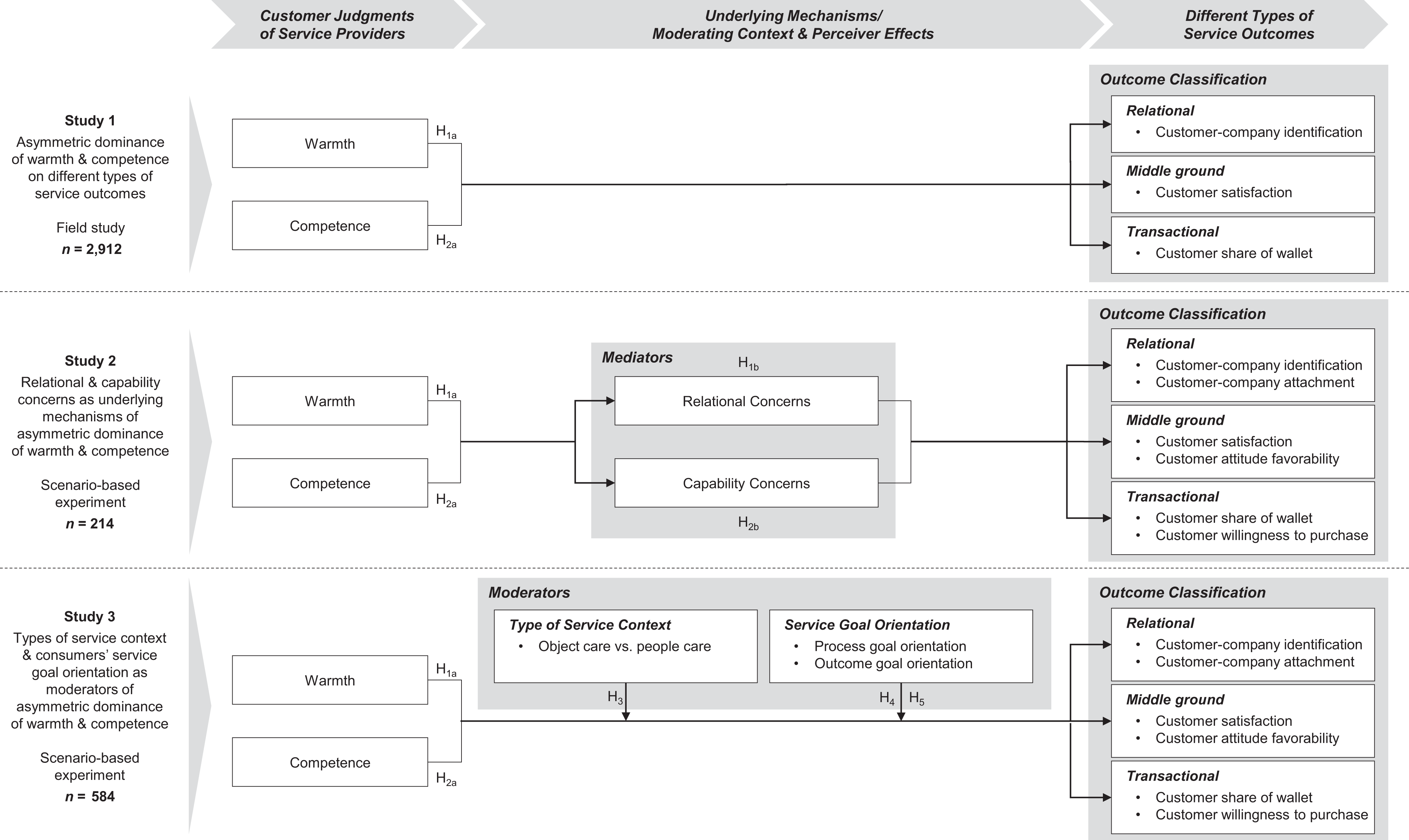
Overview of conceptual framework.
Study 1: Relative Importance of Warmth and Competence for Relational and Transactional Outcomes
Data Collection, Sample, and Measures
Data Collection and Sample
We conducted a large-scale survey among retail bank customers, a typical and frequently studied service context (e.g., Mikolon et al. 2015). We relied on trained research assistants to collect data using the mall intercept method (e.g., Gao, Zhang, and Mittal 2017) in a urban shopping street in a larger European city. While this approach offers several benefits such as a high response rate and a low item omission rate (Bush and Hair 1985), it may limit geographical dispersion. We therefore collected further data using an online survey. Students disseminated the online survey to consumers living in different cities and more rural areas in exchange for course credits. The overall sample consists of 2,912 participants that could be included in the model estimation process. 3 Web Appendix B offers further insights into the balance and diversity of the different customer profiles. Additional tests reveal no significant differences between early and late respondents on all key constructs and demographic variables, indicating that systematic non-response is not a major issue in our data (Armstrong and Overton 1977).
Measures
We relied on well-established measures to assess our variables. In the survey, we first asked participants to specify their main retail bank and answer all following questions from their perspective as customers of their bank. Customers then judged their main bank’s warmth and competence and indicated their level of identification, satisfaction, and SOW with their main bank. We selected these outcomes owing to their archetypal positioning on the relational-transactional continuum in the classification study (p. 7). To assess the robustness of our proposed relationships, we control for the effects of variables that are relevant for the evaluation of service providers, such as perceived image, customer orientation, and operating hours (as a proxy for service convenience). We further control for the length of the customer relationship, the number of service transactions within the previous 24 months, and demographics. Appendix A shows the exact measures of the core variables.
Web Appendix C provides an overview of the descriptive statistics, correlations, and psychometric properties of all variables used in the study. All recommended thresholds for coefficient α (Nunnally and Bernstein 1994), composite reliabilities, and average variance extracted are exceeded (Bagozzi and Yi 1988), and all constructs met the criterion for discriminant validity proposed by Fornell and Larcker (1981). Additional tests suggest that common method variance is not a threat to the results and conclusions of our study (Web Appendix D).
Analytical Approach and Model Estimation
We employed polynomial structural equation modeling and response surface analysis (Edwards 2002). This approach allows a holistic and differentiated analysis of the effects of the interplay between warmth and competence on each of the outcome variables (Edwards 2002). We calculate the absolute difference between the effects of warmth and competence for each outcome type (|Competence − Warmth| = |γ3j − γ1j |) to test Hypotheses 1a and 2a. To control for the nested data structure (i.e., customers nested in banks), we employ a maximum-likelihood estimator that is robust against non-independence and non-normality of observations (Muthén and Muthén 1998–2017). Finally, we center all variables at their group means (Enders and Tofighi 2007) and allow all exogenous variables to covary to account for potential interdependencies.
Results
Table 2 presents the results of the polynomial structural equation model and Figure B1 in Appendix B shows the respective response surfaces. In line with Hypothesis 1a, results show that warmth has a positive impact on CCI (γ11 = 0.285, p < .01), whereas the effect of competence is not significant (γ31 = 0.038, n.s.). A comparison of these effects shows that warmth has a significantly stronger influence than competence on CCI (Δ|γ31 − γ11| = 0.247, p < .05). These results offer support for Hypothesis 1a (see Figure B1A). 4
Asymmetric Dominance of Warmth and Competence for Different Types of Marketing Outcomes: Results of Polynomial Structural Equation Modeling and Response Surface Analysis (Study 1).
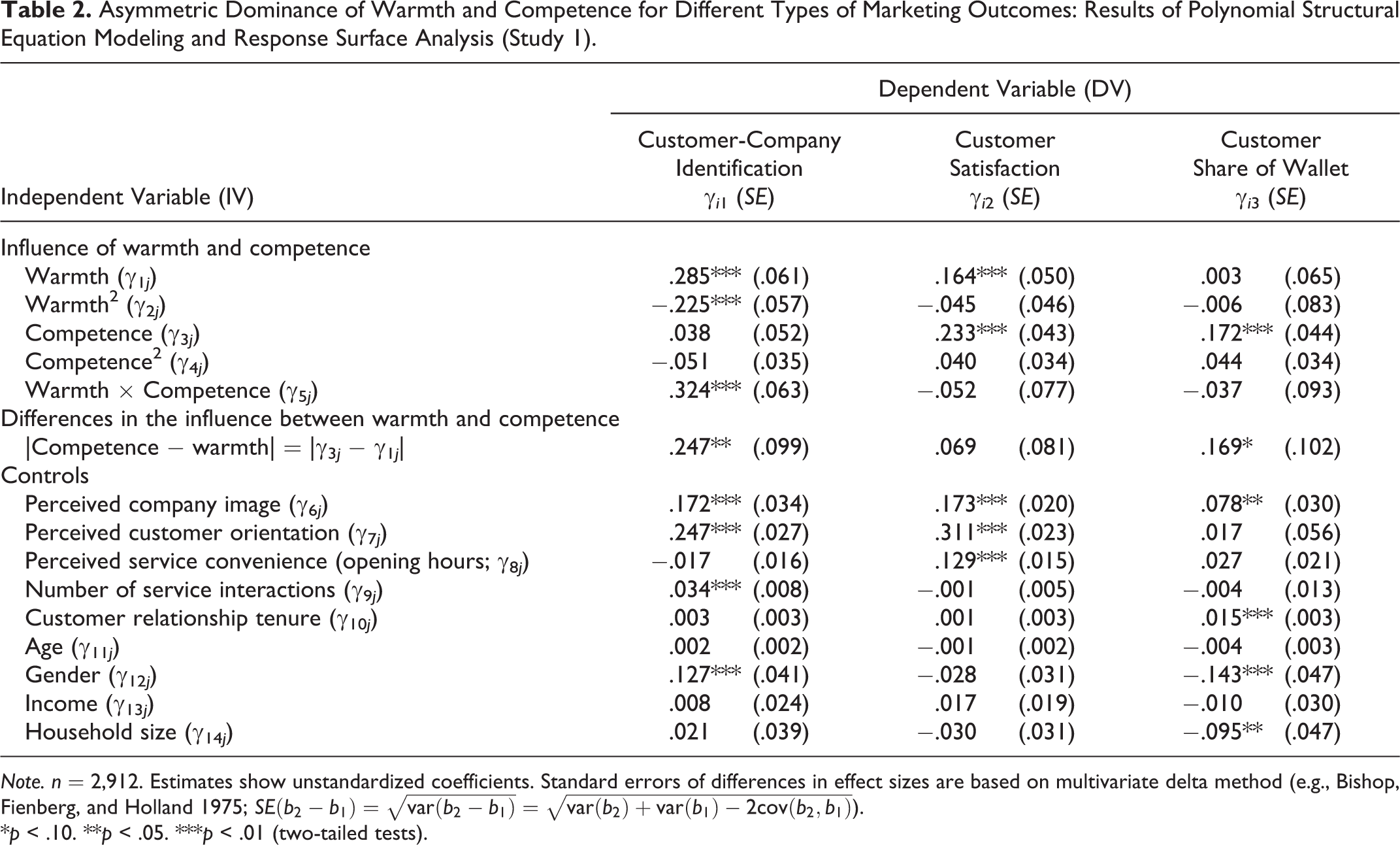
Note. n = 2,912. Estimates show unstandardized coefficients. Standard errors of differences in effect sizes are based on multivariate delta method (e.g., Bishop, Fienberg, and Holland 1975;
*p < .10. **p < .05. ***p < .01 (two-tailed tests).
Results further show that competence has a strong positive effect on customers’ SOW (γ33 = 0.172, p < .01), whereas the effect of warmth is insignificant (γ13 = 0.003, n.s.). An additional test of the difference between both effects further substantiates Hypothesis 2a by showing that competence is significantly more influential than warmth for SOW (Δ|γ33 − γ13| = 0.169, p < .10, two-tailed test). These findings largely confirm Hypothesis 2a (see Figure B1C). 5
We additionally explore whether the importance of both dimensions differs for CS with the service provider. Results show that warmth (γ12 = 0.164, p < .01) and competence (γ32 = 0.233, p < .01) have positive effects that do not significantly differ in their strength (Δ|γ32 − γ12| = 0.069, n.s.). This finding suggests that for outcomes that fall in the middle ground of the relational-transactional continuum, such as CS, no clear hierarchy exists (see Figure B1B).
Additional Analysis: Relationship Between Outcome Variables
Conceivably, strengthening the relational bond between a customer and a service provider may also strengthen the transactional bond (Kumar, Pozza, and Ganesh 2013). Although the employed structural equation modeling approach implicitly accounts for potential dependencies between the outcome variables, we conducted an additional analysis in which we explicitly specify these relationships. Specifically, we estimated a model that included the relationships between marketing outcomes that capture the relational bond (i.e., CCI) and outcomes that capture relational and transactional aspects of the customer-service provider relationship (i.e., CS) on outcomes that capture the transactional bond (i.e., SOW). To test whether the inclusion of these relationships affects our findings, we evaluated the differences in total effects of warmth and competence on all outcome variables. Results appear in Web Appendix E and show that inclusion of potential dependencies between the outcome variables does not substantially affect our findings or change the results of our hypotheses tests.
Discussion
Study 1 lends first empirical field support for Hypotheses 1a and 2a. Results show that warmth is more important than competence in predicting CCI, but competence is more important than warmth in predicting SOW. The results of this study thus provide first support for an asymmetric dominance of warmth and competence for outcomes reflecting relational and transactional aspects of customer-service provider relationships.
Study 2: Relational and Capability Concerns as Underlying Mechanisms
The purpose of Study 2 is threefold. First, we aim to test whether relational and capability concerns make up the mediating mechanisms for the asymmetric dominance of warmth and competence. Second, we aim to replicate the findings from the field study using experimental manipulations of warmth and competence. Third, we intend to extend the generalizability of our findings to additional marketing outcomes for each archetypal outcome category.
Method
We conducted an online-administered randomized scenario experiment with participants recruited via the platform Academic Prolific. Respondents received £1.00 for their participation. We excluded eight respondents who failed to answer the attention check correctly. In total, the analysis included responses from 214 participants (M Age = 32, 49% female).
We used a 2 (warmth: high/low) × 2 (competence: high/low) between-subjects design. In line with prior research (Kervyn, Fiske, and Malone 2012; Kirmani et al. 2017), we used a scenario-based experiment in which participants read a brief review of a fictional retail bank service (Web Appendix F lists all materials). We chose this context to offer a better comparison to the results of the field study. We manipulated warmth and competence by mentioning an equally balanced number of warmth and competence attributes in the description of the retail bank. After reading about the retail bank, participants completed a survey that included the manipulation checks and study variables.
Appendix A shows all measurement items. We used the same items as in Study 1 to measure warmth and competence (as manipulation checks) and CCI, CS, and SOW. The selection of the additional outcomes builds on their archetypal positioning in the classification study and their frequent use in prior literature. We test CCA as an archetypal outcome reflecting the relational bond with a service provider, CWP as an outcome reflecting the transactional bond, and CAF as an outcome that reflects both the transactional and relational bond between a customer and a service provider. Relational concerns and capability concerns were each measured using three items based on prior research on interfirm alliances (Das and Teng 2001; Smith and Barclay 1997). After completing the survey, participants provided demographics and were debriefed.
Results
Manipulation Checks
Analyses of variance show that our manipulations of warmth (M Wlow = 3.66, M Whigh = 5.92, F[1, 212] = 220.38, p < .01) and competence (M Clow = 3.62, M Chigh = 6.24, F[1, 212] = 356.25, p < .01) have the expected effects and perform as intended.
Asymmetric Dominance of Warmth and Competence
To replicate and extend the findings from Study 1, we estimated a model in which we included the direct effects of the dummy variables for warmth and competence on important marketing outcomes. The results of this model (Model 1 in Table C1, Appendix C) show that the effects of warmth are significantly stronger than the effects of competence for marketing outcomes reflecting a relational bond (CCI: Δ|γ2 − γ1| = 0.359, p < .10; CCA: Δ|γ4 − γ3| = 0.920, p < .01). These results lend support to Hypothesis 1a. With respect to Hypothesis 2a, the results show that competence has a significantly stronger effect than warmth on marketing outcomes reflecting a transactional bond (SOW: Δ|γ10 − γ9| = 19.092, p < .01; CWP: Δ|γ12 − γ11| = 0.886, p < .01). Thus, Hypothesis 2a is supported. We also find that warmth and competence have significant comparable effects on CS and CAF (CS: γ5 = 1.537, p < .01, γ6 = 2.165, p < .01; CAF: γ7 = 1.247, p < .01, γ8 = 1.850, p < .01).
Additional Mediation Analysis: Relational and Capability Concerns
We conducted additional analyses to test whether relational and capability concerns mediate the effects of warmth and competence on the considered marketing outcomes. We first test the direct effects on the mediators. Model 2 in Table C1 (Appendix C) shows that warmth reduces relational concerns more strongly than capability concerns (Δ|γ14 − γ13| = 0.751, p < .01) while competence reduces capability concerns more strongly than relational concerns (Δ|γ16 − γ15| = 1.754, p < .01). Results also show that relational and capability concerns exert negative effects on all marketing outcomes (except the effect of capability concerns on attachment). To test for mediation, we estimated a model including the direct and indirect effects of warmth and competence on all marketing outcomes. Results in Web Appendix G show that all expected indirect effects are significant and that the total effects of warmth and competence follow the expected pattern of asymmetric dominance between warmth and competence. These findings offer further support for Hypotheses 1b and 2b.
Additional Analysis: Relationship Between Outcome Variables
As in Study 1, we conducted additional analyses to account for potential dependencies between the outcomes. We replicated the main effects model (Model 1) and included potential effects of the relational and “middle-ground” outcomes on transactional outcomes. Results in Web Appendix E show that differences in total effects remain stable irrespective of the inclusion of dependencies between the outcomes. In a second step, we reevaluated the mechanism model (Model 2) by including potential dependencies between outcomes. Again, all differences between total effects remain stable (see Web Appendix E).
Discussion
Study 2 offers additional support for Hypotheses 1a and 2a by showing that the findings from Study 1 replicate in a controlled experimental setting and generalize to other outcomes focusing on relational or transactional aspects of the customer-company relationship. The study also provides first evidence for Hypotheses 1b and 2b by showing that relational and capability concerns act as underlying mechanisms for the asymmetric dominance of warmth and competence.
Study 3: The Moderating Role of Service Types and Individual Consumption Goal Orientations
The objective of Study 3 is to show the generalizability of our core assumptions across different service industries and individual consumer characteristics. To test Hypothesis 3, we draw from Kirmani et al. (2017) to differentiate between services offering care for people and those offering care for objects. To test Hypotheses 4 and 5, we examine how consumption goal orientations (process vs. outcome orientation) shape the roles that warmth and competence play for different marketing outcomes.
Method
We conducted a randomized scenario experiment employing a 2 (warmth: high/low) × 2 (competence: high/low) × 5 (service context: retail banking, car repair, cleaning services, doctors, hair stylists) between-subjects design. Consumer goal orientations were measured. Participants were undergraduate students at a European university (n = 584, M Age = 21, 52% female) who completed the study in exchange for course credits. We used the same procedure and measures as in Study 2. Web Appendix F shows all experimental materials. Appendix A lists all measurement items.
Results
Manipulation Check
Analyses of variance show that our manipulations of warmth (M Wlow = 1.91, M Whigh = 6.26, F[1, 582] = 3,695.39, p < .01), and competence (M Clow = 1.93, M Chigh = 6.34, F[1, 582] = 4,373.70, p < .01) have the expected effects. As suggested by service theory, we also find that participants classified doctor and hair dressing services as offering more care for people than car repair, cleaning, and banking services (M People = 5.22, M Object = 2.41, F[1, 582] = 483.01, p < .01). Thus, our manipulations perform as intended.
Asymmetric Dominance of Warmth and Competence
We employed a structural equation modeling approach (Bagozzi and Yi 1989) to test our hypotheses. Table 3 presents the results of the main effects of warmth and competence on the different types of marketing outcomes in each service context. Results within the retail banking context show that warmth has a significantly stronger effect than competence on marketing outcomes reflecting a relational bond (CCI: Δ|γ21 − γ11| = 0.483, p < .10; CCA: Δ|γ22 − γ12| = 0.742, p < .05). In contrast, competence has a significantly stronger effect than warmth on marketing outcomes that reflect a transactional bond (SOW: Δ|γ25 − γ15| = 2.232, p < .01; CWP: Δ|γ26 − γ16| = 1.073, p < .01). These findings offer further support for Hypotheses 1a and 2a and thus the asymmetric dominance of warmth and competence. Table 3 shows that the asymmetric dominance is also evident in each of the additional service contexts—cleaning, car repair, hair salon, and doctor service 6 —thus providing evidence for the generalizability of the findings to other service industries.
Asymmetric Dominance of Warmth and Competence in Different Service Contexts (Study 3).
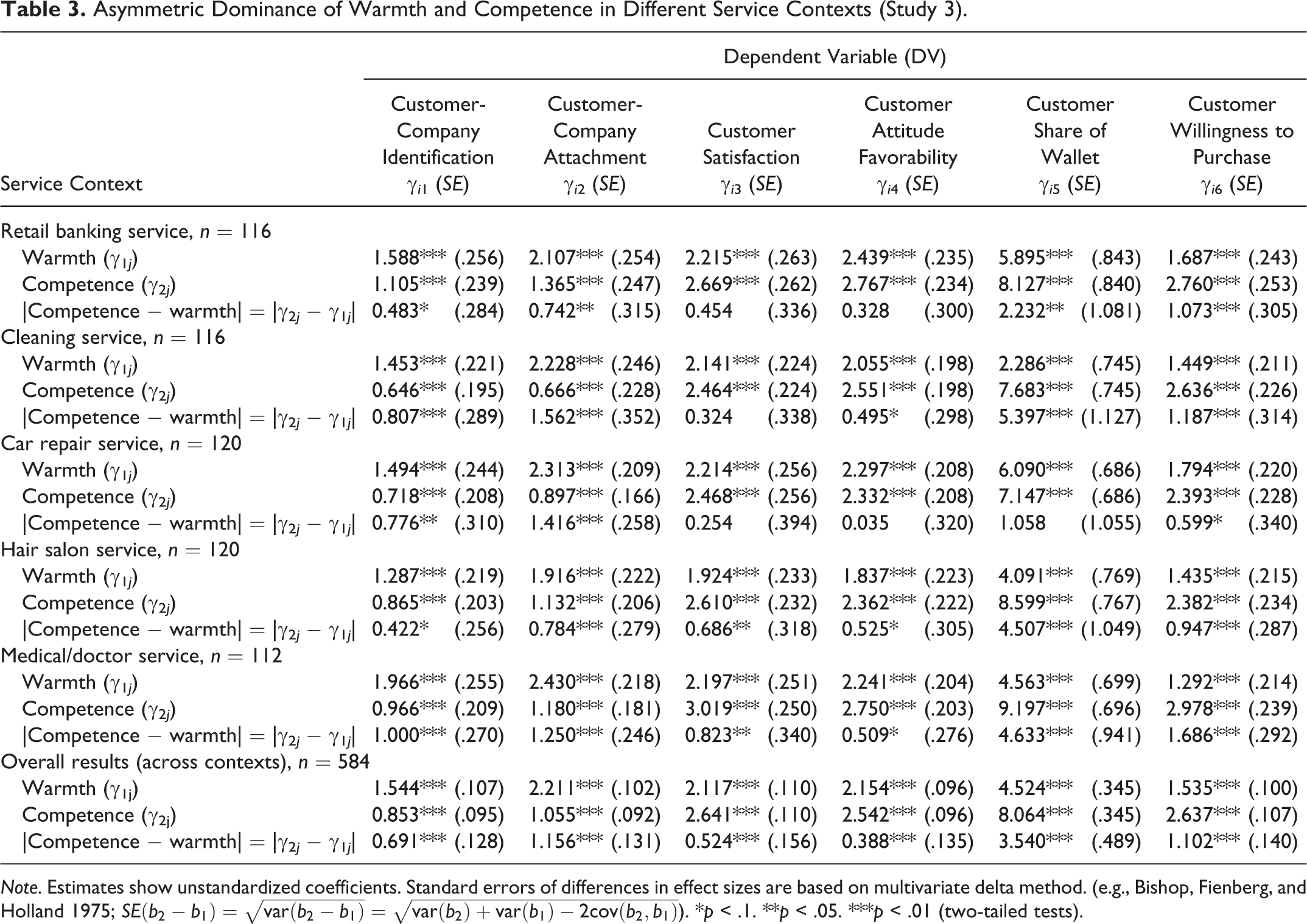
Note. Estimates show unstandardized coefficients. Standard errors of differences in effect sizes are based on multivariate delta method. (e.g., Bishop, Fienberg, and Holland 1975;
With respect to marketing outcomes that reside in the middle of the relational-transactional continuum, we find a more mixed pattern across people and object care services (see Table 3). This finding supports the suggestion that the diagnosticity of warmth and competence might be more context dependent and points to a potential conditional effect of the service type. 7
The Moderating Role of the Service Type
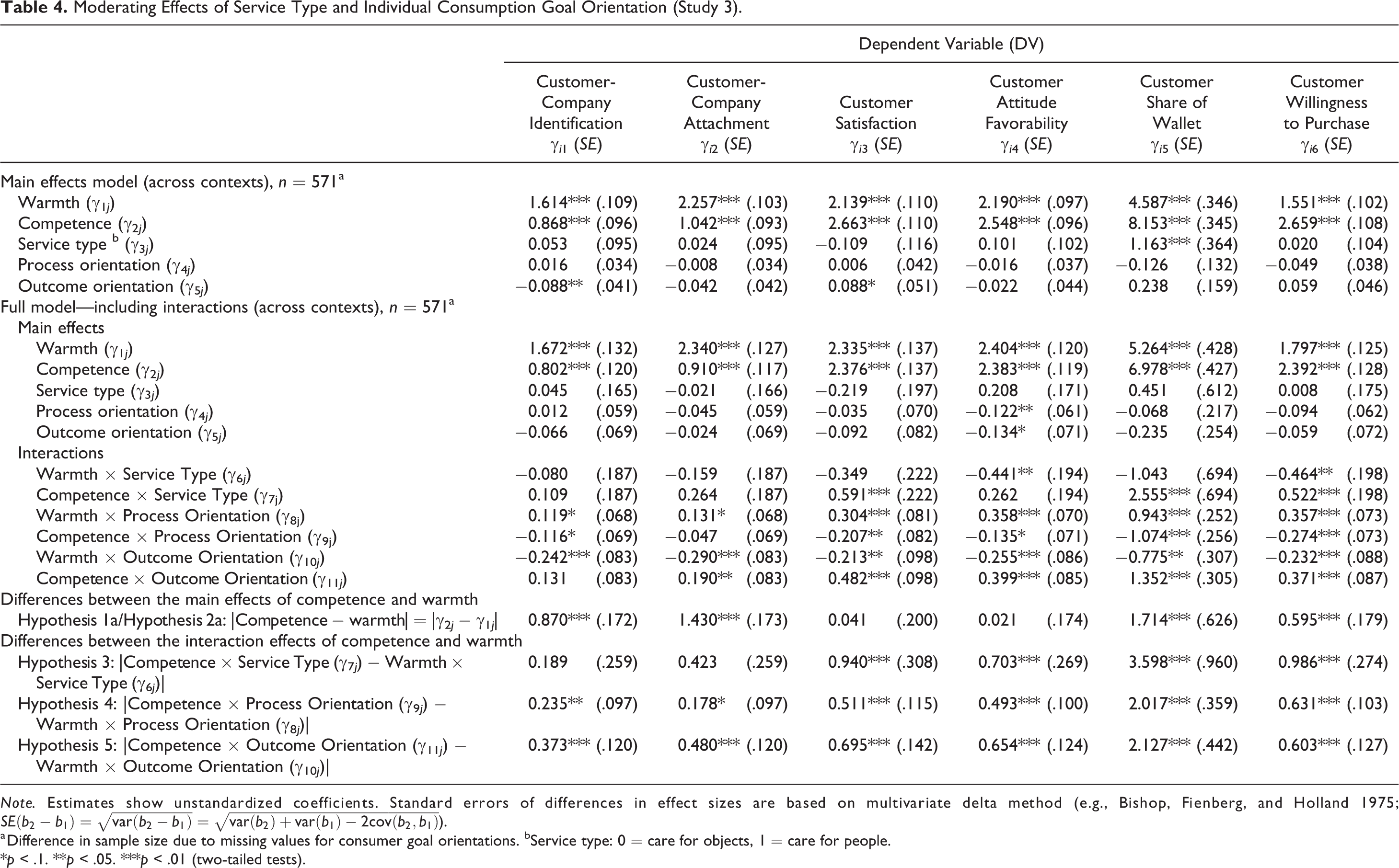
To test the moderating effects of the service type and consumers’ goal orientations, we first inspect the individual interaction effects between warmth and competence and the respective moderator. Then, we formally test Hypotheses 3–5 by comparing the differences between these interaction effects to assess the influence of each moderator on the relative importance between warmth and competence for each specific marketing outcome (see Table 4).
Moderating Effects of Service Type and Individual Consumption Goal Orientation (Study 3).
Note. Estimates show unstandardized coefficients. Standard errors of differences in effect sizes are based on multivariate delta method (e.g., Bishop, Fienberg, and Holland 1975;
a Difference in sample size due to missing values for consumer goal orientations. bService type: 0 = care for objects, 1 = care for people.
*p < .1. **p < .05. ***p < .01 (two-tailed tests).
For outcomes that capture the relational bond, we do not find significant effects for the interaction between competence and service type (CCI: γ71 = 0.109, n.s.; CCA: γ72 = 0.264, n.s.) and warmth and service type (CCI: γ61 = −0.080, n.s.; CCA: γ62 = −0.159, n.s.). Building on these effects, we test Hypothesis 3 by comparing the differences between the interaction effects of service type with both warmth and competence. Results for these tests in Table 4 do not show significant differences (CCI: Δ|γ71 − γ61| = 0.189, n.s.; CCA: Δ|γ72 − γ62| = 0.423, n.s.). This finding does no support Hypothesis 3 but suggests that the dominance of warmth over competence for relational outcomes is rather stable across service types (see Figure 2A and B and the respective simple slope analysis).
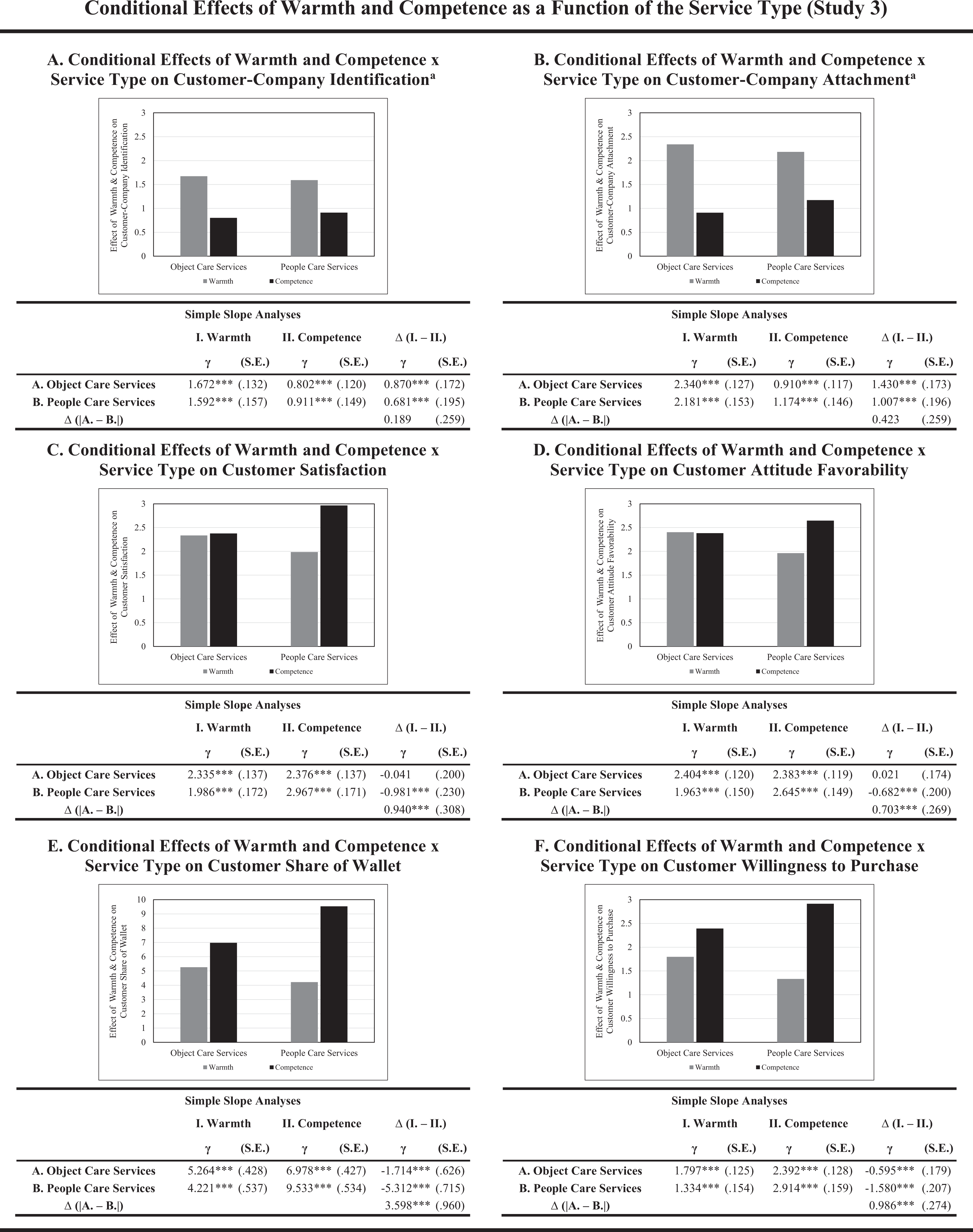
Estimates show unstandardized coefficients. Standard errors (SEs) of differences in effect sizes are based on multivariate delta method (e.g., Bishop, Fienberg, and Holland 1975;
For outcomes that capture the transactional bond, results in Table 4 show positive significant interaction effects between competence and service type (SOW: γ75 = 2.555, p < .01; CWP: γ76 = 0.522, p < .01) and negative interaction effects between warmth and service type (SOW: γ65 = −1.043, n.s.; CWP: γ66 = −0.464, p < .05), of which the effect on SOW, however, is not significant. We test Hypothesis 3 by comparing the differences between the interaction effects of service type with both warmth and competence. Results show significant differences (SOW: Δ|γ75 − γ65| = 3.598, p < .01; CWP: Δ|γ76 − γ66| = 0.986, p < .01), which offer strong support for Hypothesis 3 and indicate that the dominance of competence over warmth for transactional outcomes is stronger for people care compared to object care services (see Figure 2E and F and the respective simple slope analyses).
For outcomes that capture relational and transactional aspects of the customer-service provider relationship (CS and CAF), we also find significant differences between the interaction effects of service type with both warmth and competence (see Table 4). As the interaction plots and simple slope analyses in Figure 2C and D show, competence is more important than warmth in people care services, whereas no significant difference exists between the importance of competence and warmth in object care services. 8
The Moderating Role of Process Goal Orientation
Results in Table 4 show a significant positive moderation of process orientation on the effect of warmth on each marketing outcome and on the effect of competence on each outcome, except for attachment. Building on these effects, we test Hypothesis 4 by comparing the differences between the interaction effects of process orientation with both warmth and competence. We find significant differences for all outcomes (CCI: Δ|γ91 − γ81| = 0.235, p < .05; CCA: Δ|γ92 − γ82| = 0.178, p < .10; CS: Δ|γ93 − γ83| = 0.511, p < .01; CAF: Δ|γ94 − γ84| = 0.493, p < .01; SOW: Δ|γ95 − γ85| = 2.017, p < .01; CWP: Δ|γ96 − γ86| = 0.631, p < .01). These results support Hypothesis 4 by showing that the relative importance shifts toward warmth for consumers with a stronger process orientation.
Figure 3 and the simple slope analyses offer further insights into how these results shift the importance of warmth versus competence for different outcome types. Figure 3A and B show that for outcomes reflecting relational bonds, warmth is more important than competence for customers with both low and high process orientation and that the dominance of warmth over competence is particularly pronounced among consumers with higher process orientation. For outcomes reflecting transactional bonds, Figure 3E and F show that for consumers low in process orientation competence is significantly more important than warmth, whereas for consumers high in process orientation competence and warmth do not significantly differin their importance. These findings support Hypothesis 4 and show that consumers' process goal orientation acts as a theoretical boundary condition for the dominance of competence for outcomes reflecting transactional bonds. 9
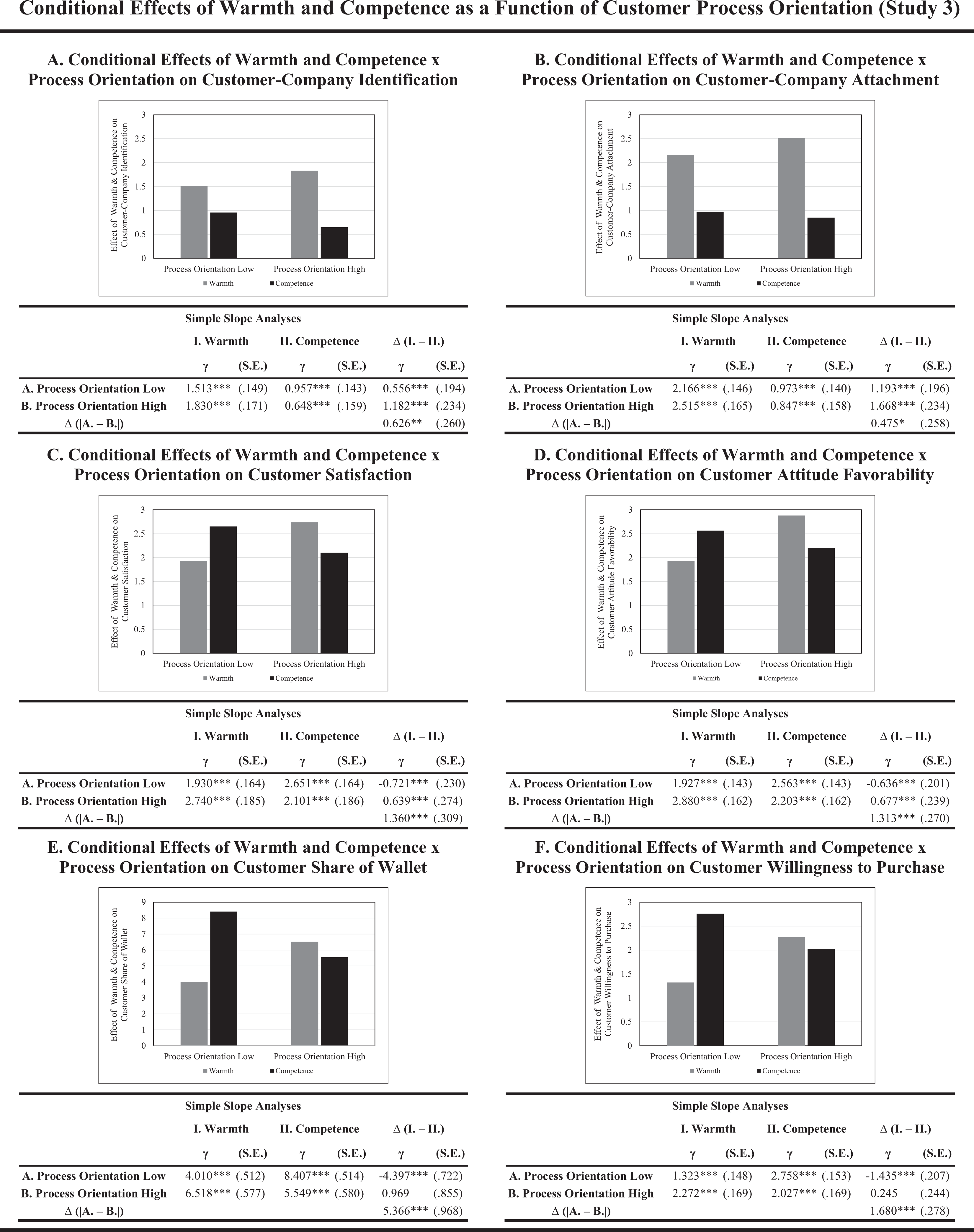
Estimates show unstandardized coefficients. Standard errors (SEs) of differences in effect sizes are based on multivariate delta method (e.g., Bishop, Fienberg, and Holland 1975;
The Moderating Role of Outcome Goal Orientation
Results in Table 4 support a significant positive moderation effect of outcome goal orientation on the effects of warmth on each outcome and on the effect of competence for each marketing outcome, except CCI. We use these effects to test Hypothesis 5 by comparing the differences between the interaction effects of outcome orientation with both warmth and competence. These differences are significant for all outcomes (CCI: Δ|γ111 − γ101| = 0.373, p < .01; CCA: Δ|γ112 − γ102| = 0.480, p < .01; CS: Δ|γ113 − γ103| = 0.695, p < .01; CAF: Δ|γ114 − γ104| = 0.654, p < .01; SOW: Δ|γ115 − γ105| = 2.127, p < .01; CWP: Δ|γ116 − γ106| = 0.603, p < .01). In sum, these findings support Hypothesis 5 by showing that the relative importance shifts toward competence for consumers with stronger outcome orientation.
Figure 4 provides more insights into how the relative importance of warmth and competence shifts as a function of consumers’ outcome orientation. Figure 4A and B show that for the relational bond, warmth is more important than competence irrespective of whether outcome orientation is low or high. Thus, the dominance of warmth is very robust for outcomes with a relational focus although slightly less pronounced for consumers with high outcome orientation. Figure 4E and F shows that for transactional bonds, the dominance of competence over warmth prevails only for consumers with high outcome orientation and not for consumers with low outcome orientation. For marketing outcomes reflecting transactional bonds, the dominance of competence over warmth is thus contingent on consumers’ outcome orientation. 10
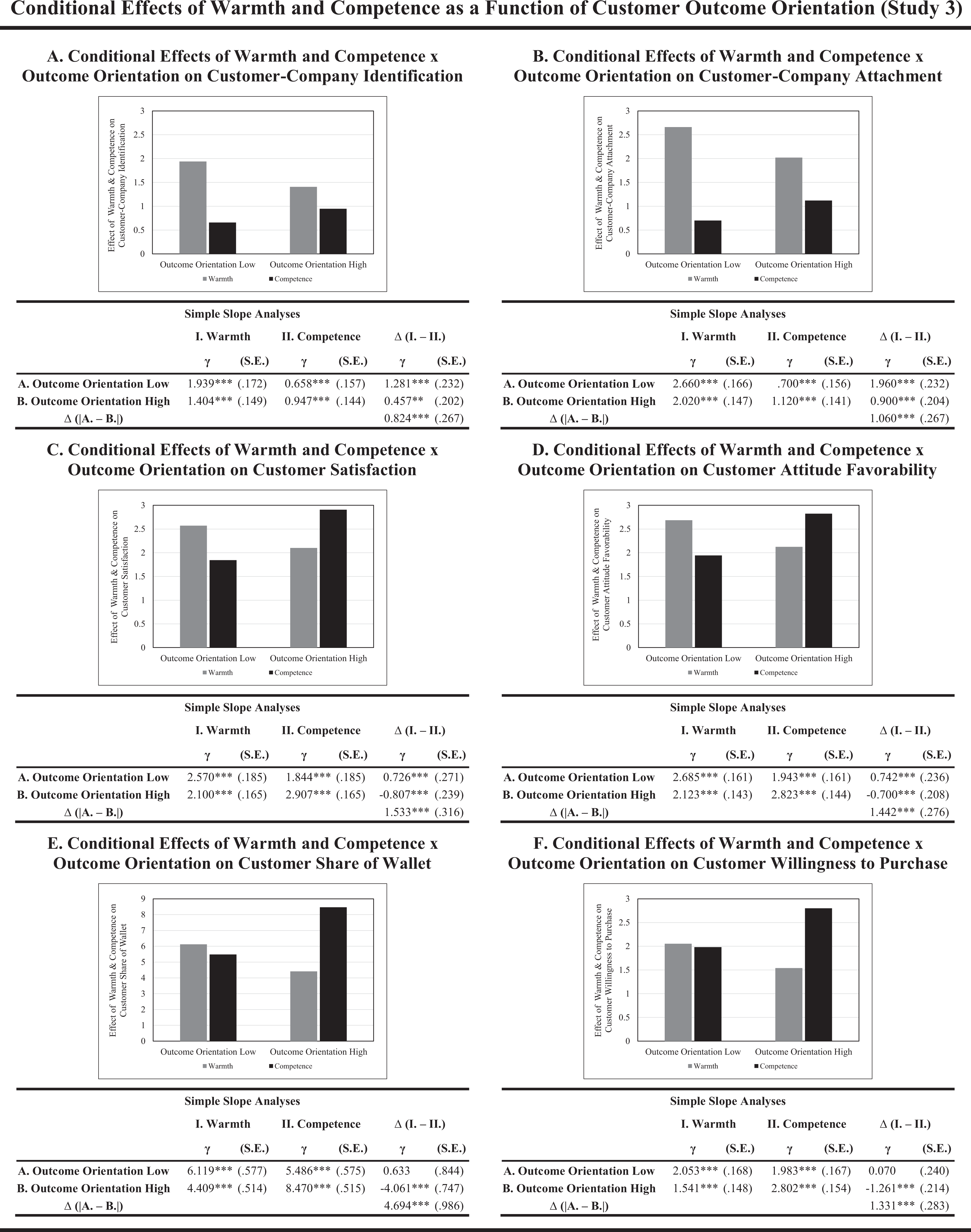
Estimates show unstandardized coefficients. Standard errors of differences in effect sizes are based on multivariate delta method (e.g., Bishop, Fienberg, and Holland 1975;
Additional Analysis: Relationship Between Outcome Variables
As in Studies 1 and 2, we tested potential dependencies between the outcome variables. Again, results of this analysis reveal that the differences between the effects of warmth and competence remain stable for the total effects on all outcomes (Web Appendix E). These results further strengthen the robustness of our findings.
Discussion
The results of Study 3 again support Hypotheses 1a and 2a and thereby provide further evidence for the asymmetric dominance of warmth and competence. The study also shows that the dominance of competence for outcomes reflecting transactional bonds is more pronounced in people versus object care services, whereas the dominance of warmth for outcomes reflecting relational bonds is more stable across service types. This finding supports Hypothesis 3 for outcomes reflecting the transactional bond but also suggests that the dominance of warmth for outcomes reflecting the relational bond is more robust across service industries. Finally, Study 3 shows that consumers with higher process goal orientation emphasize warmth, whereas consumers with higher outcome goal orientation emphasize competence, supporting Hypotheses 4 and 5.
General Discussion
Warmth and competence are important evaluative dimensions that consumers rely on when forming relationships with service providers (e.g., Scott, Mende, and Bolton 2013), but prior research is inconclusive regarding the key questions of whether, when, and why warmth and competence take precedence in customer-service provider relationships. The current investigation develops a nomological framework that addresses these limitations and answers prior calls (Fournier and Alvarez 2012; MacInnis 2012) by investigating the notion that the type of outcome is a key contingency factor that determines whether warmth or competence is more important.
Across three studies, we find converging evidence for an asymmetric dominance—that is, warmth judgments are dominant in predicting marketing outcomes reflecting a relational bond between customers and service providers, whereas competence judgments are dominant in driving outcomes that indicate a transactional bond. Our research offers initial insights into the theoretical mechanisms underlying this asymmetric dominance by showing that relational and capability concerns explain why warmth and competence differ in their diagnosticity for distinct outcome types. We further advance the academic and managerial insight on the warmth and competence framework from a service-theoretical perspective by identifying moderators of the asymmetric dominance such as the service type or differences in consumer’ service consumption goals.
Theoretical Contributions
Asymmetric dominance of warmth and competence
The study provides a new perspective on the roles that warmth and competence judgments play in customer-service provider relationships by introducing a conceptualization of outcomes along a relational-transactional continuum. In line with theoretical notions from the cue diagnosticity framework (Skowronski and Carlston 1987), we find consistent evidence for an asymmetrical dominance of warmth and competence, which implies that warmth is dominant for marketing outcomes reflecting relational bonds, whereas competence is dominant for outcomes reflecting transactional bonds. The finding is theoretically relevant, as it moves beyond the prevailing notion that consumers value competence more than warmth (Aaker, Garbinsky, and Vohs 2012; Kirmani et al. 2017) and highlights the role of warmth as the leading dimension in driving outcomes associated with strong emotional bonds and enduring customer relationships. Our theorizing offers a novel conceptual link that helps to integrate and reconcile inconclusive findings across prior studies (Table 1).
Uncovering the underlying mechanisms
This study provides a systematic understanding of the underlying mechanisms that drive the asymmetric dominance. Drawing from theories of interpersonal (Wojciszke 2005; Ybarra, Chan, and Park 2001) and agency relationships (Das and Teng 2001; Mills 1990), we find that customers’ decisions regarding relational or transactional aspects of their relationship with a service provider are explained by different concerns toward the provider. Customer decisions regarding the transactional bond with a service provider render capability concerns more salient, for which competence is more diagnostic; whereas decisions regarding the relational bond with a service provider make relational concerns more salient, for which warmth is more diagnostic. By identifying a mechanism that links the asymmetric effects, the study advances prior research on mediators of warmth and competence (e.g., Ivens et al. 2015).
Services offering care for objects versus care for people
The study offers first evidence for the notion that the relative importance of warmth and competence varies between services offering care for objects versus care for people. We advance the perspective beyond people care services (e.g., Bolton and Matilla 2015; Grandey et al. 2005), by showing that the dominance of competence for marketing outcomes reflecting transactional bonds is generally more pronounced in people care services than in object care services. Thus, taking into consideration, the service type offers an additional explanation for why prior studies find a strong dominance of competence for outcomes akin to the transactional bond (Kirmani et al. 2017). Moreover, our findings suggest that the dominance of warmth for outcomes reflecting the relational bonds is less affected by differences between service types and is thus potentially more robust across different service contexts.
Process versus outcome goal orientation
By identifying consumers’ consumption goal orientations as important moderators of the effects of warmth and competence, the study also contributes to the sparse research on individual differences that might change the way consumers’ process warmth and competence (e.g., Li et al. 2019). Specifically, we find that for consumers with higher process orientation the diagnosticity of warmth increases, whereas for consumers with higher outcome orientation the diagnosticity of competence increases. Comparison of these moderating effects across different outcome types suggests an important boundary condition to the asymmetric dominance. The dominance of competence for outcomes reflecting transactional bonds dissolves for consumers with high process orientation or low outcome orientation, while the dominance of warmth for outcomes reflecting relational bonds remains more robust to individual differences in consumption goals. These findings are particularly interesting, as they imply that the dominance of competence for outcomes reflecting transactional bonds is more volatile and susceptible to interindividual differences than the dominance of warmth for outcomes reflecting relational bonds.
Consideration of distinct outcome types
Our investigation reveals that considering a set of conceptually distinct types of outcomes might be helpful for academics and managers to derive a better understanding of the unique contributions of the individual dimensions of service provider evaluations. As this research exemplifies, the overgeneralization of insights derived from single outcome measures might be misleading and could potentially lead to dysfunctional managerial decisions. The relational-transactional outcome continuum in this research was derived from the relationship marketing literature and could, among other conceptualizations (e.g., Katsikeas et al. 2016), serve as a fruitful framework to model marketing performance in a more multifaceted way.
Managerial Implications
Our study advances the managerial value of the warmth-competence framework in a number of ways and gives managers a more nuanced understanding of how each dimension contributes to strategic objectives. Specifically, the study demonstrates that competence is a stronger driver of outcomes associated with monetary exchange and operating performance, while warmth is more strongly associated with outcomes linked to customer relationship building and retention. This finding implies that while displaying competence helps service providers to push short-term transactional customer behavior (e.g., purchase, choice), it is less effective in creating strong relational bonds with customers and may thus lead to spurious loyalty (Dick and Basu 1994). The study emphasizes the important but previously underestimated role of warmth and implies that after the initiation of the relationship, service providers should rather emphasize warmth to protect against disruptions such as competitive threats (Lam et al. 2010) or negative publicity (Einwiller et al. 2006).
While being seen as high in both warmth and competence clearly has the most favorable implications, this perception is difficult to achieve, even for incumbents and strong brands (Aaker, Garbinsky, and Vohs. 2012; Kervyn, Fiske, and Malone 2012). A challenge is that comparative contexts often create contrast effects, such that being judged higher on one dimension leads to a lower judgment on the other dimension (Judd et al. 2005). For example, employees who display higher warmth in the service encounter are often rated as less competent and vice versa (Li et al. 2019). In addition, external constraints often limit the possibilities to follow a high-warmth/high-competence strategy and thus force a decision in favor of one dimension. For instance, when recruiting frontline personnel, service providers often must decide between a more competent and a warmer candidate (Cuddy, Glick, and Beninger 2011). Thus, although building perceptions of being both competent and warm is theoretically desirable, in practice, service providers often must decide between an investment in improving one dimension or the other. Our study offers managers a guiding framework for these decisions.
The insights of this study revive the managerial utility of the warmth-competence framework by moving beyond the notions that service providers should simply strive to be seen as competent (Kirmani et al. 2017) or cultivate both competence and warmth (Aaker, Garbinsky, and Vohs 2012). By linking warmth and competence with specific strategic objectives, this framework can serve as a management tool entailing a 2 × 2 grid. Such a management tool could be useful for the positioningof a provider, external benchmarking with competitors, but also for generating strategic predictions about the implications of moving across the cells of the 2 × 2 grid. Due to the universal nature of warmth and competence, this framework can be useful to inform managerial decisions on the development of specific actionable measures, such as marketing communications (Wang et al. 2017), servicescape design (Liu, Bogicevic, and Matilla 2018), or hiring and training of service personnel (Grandey et al. 2005).
In addition, the current study offers service managers guidance regarding specific service types in which investing in warmth or competence is particularly fruitful (Figure 2). Service providers offering care for people should emphasize competence more than service providers offering care for objects, especially to push transactional marketing goals. Prior research suggests several ways to signal competence, such as conspicuous displays of wealth and status (Scott, Mende, and Bolton 2013), the use of angular shapes in the servicescape (Liu, Bogicevic, and Matilla 2018), or more serious facial displays (Wang et al. 2017). Irrespective of the service type, however, signaling warmth is more relevant to establishing strong relational bonds. Warmth can also be displayed in several ways, such as friendly service displays (Mende, Scott, and Bolton 2018), socially responsible behavior (Bolton and Matilla 2015), or the use of feminine cues (e.g., shapes and colors) in marketing communications (Hess and Melnyk 2016).
The study also informs service managers of notable differences between consumers with different consumption goal orientations (cf. Figures 3 and 4). For consumers with low process or high outcome orientation, the asymmetric dominance remains intact. Managers should thus invest in competence to strengthen transactional bonds and invest in warmth to strengthen relational bonds. Conversely, for consumers with high process or low outcome orientation, it seems more effective to invest in warmth rather than competence to strengthen both the relational and the transactional bond.
It thus appears helpful for managers to gain information on consumers’ consumption goals and use this information to segment consumers in order to tailor the service experience to their individual service goals. For example, an additional analysis in the context of Study 3 shows that female and older consumers have a higher process goal orientation, whereas male and younger consumers show a higher outcome orientation. 11 Service providers may use this information to train frontline employees, design their servicescape, or develop appropriate communication messages including personalized communication in digital environments (Tucker 2014; Walrave et al. 2018).
Limitations and Future Research
Our studies are not without limitations that point toward avenues for future research. First, while we have used a cross-sectional approach, future research could try to explore how impressions of a service provider’s warmth and competence develop and manifest over time. Second, although the use of self-reports to measure transactional outcomes such as SOW has been found to be quite accurate (Du, Kamakura, and Mela 2007), future research should try to collect objective sales data to additionally validate information on the strength of the transactional bond. Third, we build on scenario-based experiments to ensure high internal validity and overcome potential confounds of preexisting beliefs about real service providers. However, as this gain in control can come at the cost of reduced realism, future research could try to investigate the consequences of warmth and competence in a field experiment. Fourth, future research could collect data that allow a multilevel design to explore how differences between service providers (within a specific service context), such as service provider size or market strategy, affect the effects of warmth and competence on service outcomes.
Finally, we deliberately focus on advancing current knowledge on the warmth-competence framework. However, in light of the ongoing discourse on how customers evaluate services and their providers (Brady and Cronin 2001), service scholars and managers would also benefit from a better understanding of how the two fundamental dimensions conceptually and empirically relate to other evaluative frameworks, such as the SERVQUAL dimensions (Parasuraman, Zeithaml, and Berry 1988). A comparative analysis of these different frameworks thus offers a fruitful avenue for future research.
Supplemental Material
Supplemental Material, Biographical_Information_Disentangling_the_Differential_Roles_of_Warmth_and_Competence_Judgments - Disentangling the Differential Roles of Warmth and Competence Judgments in Customer-Service Provider Relationships
Supplemental Material, Biographical_Information_Disentangling_the_Differential_Roles_of_Warmth_and_Competence_Judgments for Disentangling the Differential Roles of Warmth and Competence Judgments in Customer-Service Provider Relationships by Pascal Güntürkün, Till Haumann and Sven Mikolon in Journal of Service Research
Supplemental Material
Supplemental Material, Executive_Summary_Disentangling_the_Differential_Roles_of_Warmth_and_Competence - Disentangling the Differential Roles of Warmth and Competence Judgments in Customer-Service Provider Relationships
Supplemental Material, Executive_Summary_Disentangling_the_Differential_Roles_of_Warmth_and_Competence for Disentangling the Differential Roles of Warmth and Competence Judgments in Customer-Service Provider Relationships by Pascal Güntürkün, Till Haumann and Sven Mikolon in Journal of Service Research
Supplemental Material
Supplemental Material, WA_Disentangling_the_Differential_Roles_of_Customers'_Warmth_and_Competence_Judgments - Disentangling the Differential Roles of Warmth and Competence Judgments in Customer-Service Provider Relationships
Supplemental Material, WA_Disentangling_the_Differential_Roles_of_Customers'_Warmth_and_Competence_Judgments for Disentangling the Differential Roles of Warmth and Competence Judgments in Customer-Service Provider Relationships by Pascal Güntürkün, Till Haumann and Sven Mikolon in Journal of Service Research
Footnotes
Appendix A
Measurement of Core Variables (Studies 1–3).
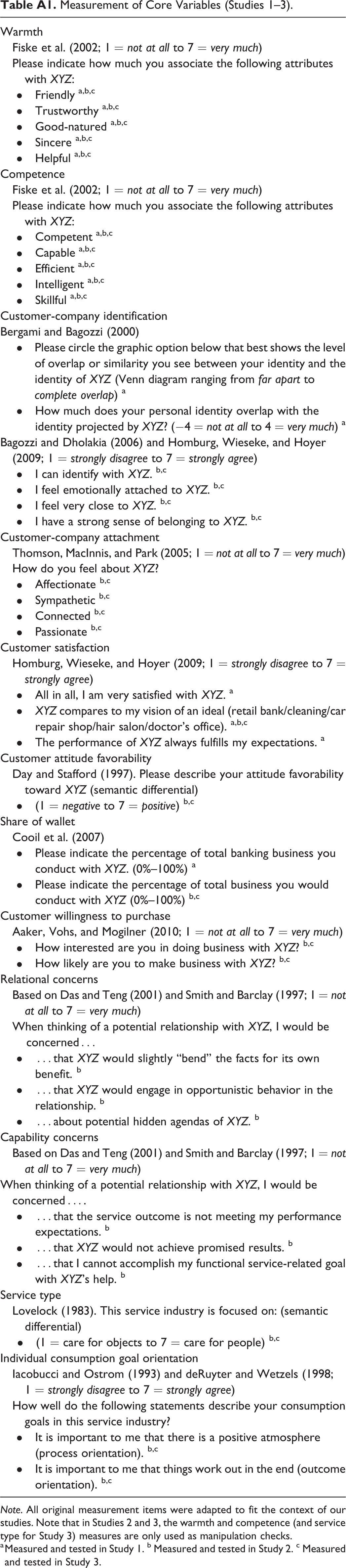
| Warmth |
| Fiske et al. (2002; 1 = not at all to 7 = very much) |
| Please indicate how much you associate the following attributes with XYZ: Friendly a,b,c Trustworthy a,b,c Good-natured a,b,c Sincere a,b,c Helpful a,b,c |
| Competence |
| Fiske et al. (2002; 1 = not at all to 7 = very much) |
| Please indicate how much you associate the following attributes with XYZ: Competent a,b,c Capable a,b,c Efficient a,b,c Intelligent a,b,c Skillful a,b,c |
| Customer-company identification |
|
Bergami and Bagozzi (2000) • Please circle the graphic option below that best shows the level of overlap or similarity you see between your identity and the identity of XYZ (Venn diagram ranging from far apart to complete overlap) a
How much does your personal identity overlap with the identity projected by XYZ? (−4 = not at all to 4 = very much) a |
|
Bagozzi and Dholakia (2006) and Homburg, Wieseke, and Hoyer (2009; 1 = strongly disagree to 7 = strongly agree) I can identify with XYZ. b,c I feel emotionally attached to XYZ. b,c I feel very close to XYZ. b,c I have a strong sense of belonging to XYZ. b,c |
| Customer-company attachment |
| Thomson, MacInnis, and Park (2005; 1 = not at all to 7 = very much) |
| How do you feel about XYZ? Affectionate b,c Sympathetic b,c Connected b,c Passionate b,c |
| Customer satisfaction |
| Homburg, Wieseke, and Hoyer (2009; 1 = strongly disagree to 7 = strongly agree) All in all, I am very satisfied with XYZ. a XYZ compares to my vision of an ideal (retail bank/cleaning/car repair shop/hair salon/doctor’s office). a,b,c The performance of XYZ always fulfills my expectations. a |
| Customer attitude favorability |
| Day and Stafford (1997). Please describe your attitude favorability toward XYZ (semantic differential) (1 = negative to 7 = positive) b,c |
| Share of wallet |
| Cooil et al. (2007)
Please indicate the percentage of total banking business you conduct with XYZ. (0%–100%) a Please indicate the percentage of total business you would conduct with XYZ (0%–100%) b,c |
| Customer willingness to purchase |
| Aaker, Vohs, and Mogilner (2010; 1 = not at all to 7 = very much) |
|
How interested are you in doing business with XYZ? b,c How likely are you to make business with XYZ? b,c |
| Relational concerns |
| Based on Das and Teng (2001) and Smith and Barclay (1997; 1 = not at all to 7 = very much) When thinking of a potential relationship with XYZ, I would be concerned… |
|
…that XYZ would slightly “bend” the facts for its own benefit. b …that XYZ would engage in opportunistic behavior in the relationship. b …about potential hidden agendas of XYZ. b |
| Capability concerns |
| Based on Das and Teng (2001) and Smith and Barclay (1997; 1 = not at all to 7 = very much) |
| When thinking of a potential relationship with XYZ, I would be concerned…. |
|
…that the service outcome is not meeting my performance expectations. b …that XYZ would not achieve promised results. b …that I cannot accomplish my functional service-related goal with XYZ’s help. b |
| Service type |
| Lovelock (1983). This service industry is focused on: (semantic differential) |
| • (1 = care for objects to 7 = care for people) b,c |
| Individual consumption goal orientation |
| Iacobucci and Ostrom (1993) and deRuyter and Wetzels (1998; 1 = strongly disagree to 7 = strongly agree) |
| How well do the following statements describe your consumption goals in this service industry? |
|
It is important to me that there is a positive atmosphere (process orientation). b,c It is important to me that things work out in the end (outcome orientation). b,c |
Note. All original measurement items were adapted to fit the context of our studies. Note that in Studies 2 and 3, the warmth and competence (and service type for Study 3) measures are only used as manipulation checks.
a Measured and tested in Study 1. b Measured and tested in Study 2. c Measured and tested in Study 3.
Appendix B
Appendix C
Results of the Outcome and Mechanism Model (Study 2).

| Relationship | Model 1 Outcome Model | Model 2 Mechanism Model | ||
|---|---|---|---|---|
| γ i (SE) | γ i /β i (SE) | |||
| Influence of warmth and competence on marketing outcomes | ||||
| Warmth → customer-company identification (γ1) | 0.776*** | (0.158) | ||
| Competence → customer-company identification (γ2) | 0.417** | (0.161) | ||
| |Δ (competence/warmth → customer-company identification)| = |γ2 − γ1| | 0.359* | (0.212) | ||
| Warmth → customer-company attachment (γ3) | 1.171*** | (0.202) | ||
| Competence → customer-company attachment (γ4) | 0.251 | (0.204) | ||
| |Δ (competence/warmth → customer-company attachment)| = |γ4 − γ3| | 0.920*** | (0.299) | ||
| Warmth → customer satisfaction (γ5) | 1.537*** | (0.201) | ||
| Competence → Customer satisfaction (γ6) | 2.165*** | (0.202) | ||
| |Δ (competence/warmth → customer satisfaction)| = |γ6 − γ5| | 0.628** | (0.317) | ||
| Warmth → customer attitude favorability (γ7) | 1.247*** | (0.194) | ||
| Competence → customer attitude favorability (γ8) | 1.850*** | (0.195) | ||
| |Δ (competence/warmth → customer attitude favorability)| = |γ8 − γ7| | 0.603** | (0.287) | ||
| Warmth → customer share of wallet (γ9) | 14.961*** | (3.468) | ||
| Competence → customer share of wallet (γ10) | 34.053*** | (3.488) | ||
| |Δ (competence/warmth → customer share of wallet)| = |γ10 − γ9| | 19.092*** | (5.371) | ||
| Warmth → customer willingness to purchase (γ11) | 0.972*** | (0.198) | ||
| Competence → customer willingness to purchase (γ12) | 1.858*** | (0.198) | ||
| |Δ (competence/warmth → customer willingness to purchase)| = |γ12 − γ11| | 0.886*** | (0.293) | ||
| Influence of warmth and competence on relational and capability concerns | ||||
| Warmth → relational concerns (γ13) | −1.132*** | (0.203) | ||
| Warmth → capability concerns (γ14) | −0.381** | (0.176) | ||
| |Δ (warmth → concerns)| = |γ14 − γ13| | 0.751*** | (0.209) | ||
| Competence → relational concerns (γ15) | −0.520** | (0.204) | ||
| Competence → capability concerns (γ16) | −2.274*** | (0.185) | ||
| |Δ (competence → concerns)| = |γ16 − γ15| | 1.754*** | (0.223) | ||
| Effects of relational and capability concerns on marketing outcomes | ||||
| Relational concerns → customer-company identification (β1) | −0.293*** | (0.070) | ||
| Capability concerns → customer-company identification (β2) | −0.174*** | (0.059) | ||
| Relational concerns → customer-company attachment (β3) | −0.437*** | (0.093) | ||
| Capability concerns → customer-company attachment (β4) | −0.103 | (0.079) | ||
| Relational concerns → customer satisfaction (β5) | −0.397*** | (0.102) | ||
| Capability concerns → customer satisfaction (β6) | −0.616*** | (0.089) | ||
| Relational concerns → customer attitude favorability (β7) | −0.523*** | (0.084) | ||
| Capability concerns → customer attitude favorability (β8) | −0.558*** | (0.076) | ||
| Relational concerns → customer share of wallet (β9) | −5.502*** | (1.489) | ||
| Capability concerns → customer share of wallet (β10) | −10.732*** | (1.261) | ||
| Relational concerns → customer willingness to purchase (β11) | −0.350*** | (0.082) | ||
| Capability concerns → customer willingness to purchase (β12) | −0.626*** | (0.075) | ||
Note. n = 214. Estimates show unstandardized coefficients. Standard errors of differences in effect sizes are based on multivariate delta method (e.g., Bishop, Fienberg, and Holland 1975).
*p < .1. **p < .05. ***p < .01 (two-tailed tests).
Acknowledgments
The authors thank the editor, the associate editor, and three anonymous reviewers for their helpful comments. They also thank Jan Wieseke, Valentyna Melnyk, and Amna Kirmani; participants at the Winter AMA; and participants of research seminars at the University of Bochum and Vienna University of Economics and Business for their valuable feedback and suggestions. Finally, the authors thank Niklas Nölle for his research assistance.
Declaration of Conflicting Interests
The author(s) declared no potential conflicts of interest with respect to the research, authorship, and/or publication of this article.
Funding
The author(s) received no financial support for the research, authorship, and/or publication of this article.

Supplemental Material
Supplemental material for this article is available online.
Notes
References
Supplementary Material
Please find the following supplemental material available below.
For Open Access articles published under a Creative Commons License, all supplemental material carries the same license as the article it is associated with.
For non-Open Access articles published, all supplemental material carries a non-exclusive license, and permission requests for re-use of supplemental material or any part of supplemental material shall be sent directly to the copyright owner as specified in the copyright notice associated with the article.
