




Abstract
Profitability considerations lead service providers to divest from customer service contracts, either by service contract demotion (cutting back services) or by service contract termination (ending service provision). Such initiatives have been associated with customer revenge. The pressing question for practitioners is which divestment approach has a stronger or weaker effect on customer revenge. Drawing on justice and appraisal theories, the authors suggest that the answer depends on customers’ predivestment satisfaction and on the provision of financial compensation or apology. Three experiments and a critical incident study reveal that for previously satisfied customers, service termination entails a stronger effect on customer revenge, while for previously dissatisfied customers, service demotion entails a stronger effect. The findings further demonstrate that offering financial compensation or an apology can mitigate or exacerbate the effect, highlighting the need to align these divestment handling instruments with the divestment approach chosen and customers’ predivestment satisfaction. The findings also show that the effect can be explained by customer anger. Overall, this article provides guidance on how to divest whom in order to mitigate detrimental effects.
Keywords
Many service providers divest from service contracts with selected customers to enhance firm profitability (Mittal, Sarkees, and Murshed 2008; Shin, Sudhir, and Yoon 2012; Zeithaml, Rust, and Lemon 2001). Service contract divestment involves service demotion (i.e., reducing the value proposition offered) or termination (i.e., ending service provision; Bolton and Tarasi 2006; Haenlein and Kaplan 2012). Both are common practices in contract- or membership-based services such as banking, finance, insurance, online retailing, telecommunication, energy provision, health care, roadside assistance, and many others (Gautier 2001).
Divestment is a severe relationship intervention that is not based on mutual agreement but solely on the provider’s relationship valuation. To the concern of service providers, initial findings in research and numerous examples from practice suggest that divested customers strike back by engaging in revenge (Lepthien et al. 2017). For instance, Table 1 shows that upon the involuntary closure of more than 6.4 million bank accounts in 2005, major American banks faced a flood of negative word-of-mouth, third-party complaining, marketplace aggression, and vindictive complaining (Campbell, Martínez-Jerez, and Tufano 2012). Similar reactions were observed in 2012, when banks cut back services forcing selected customers to use online channels instead of branches (Marcinek 2012). In the United States, such vengeful customer behaviors significantly reduced sales by US$313 billion per year (Customer Care Measurement & Consulting [CCMC] 2017; Luo and Homburg 2008).
Exemplary Observations of Divestment Practices.
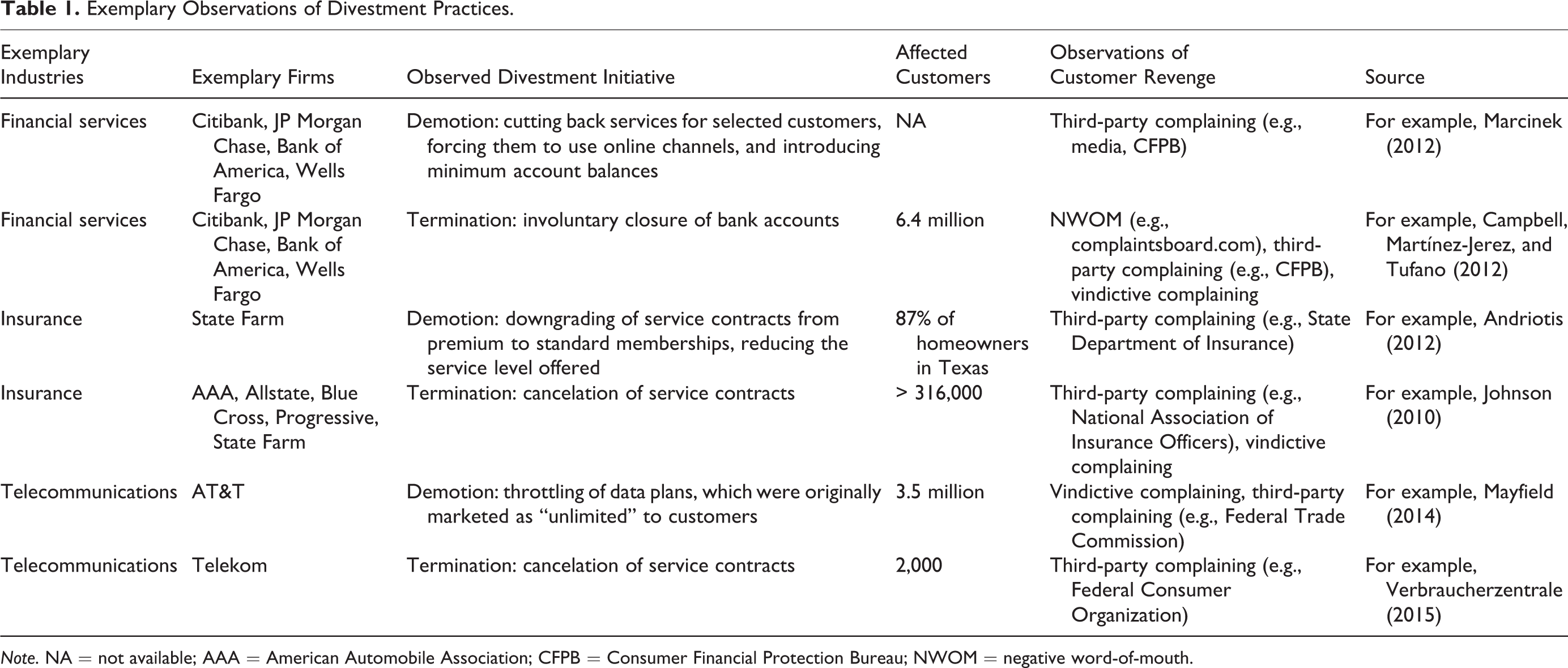
Note. NA = not available; AAA = American Automobile Association; CFPB = Consumer Financial Protection Bureau; NWOM = negative word-of-mouth.
The objective of this article is to offer guidance on how to divest from service contracts in order to avoid customer revenge. Hence, the research questions of this article are (1) whether, (2) when, and (3) why customers respond more vigorously to service demotion versus termination in terms of customer revenge, and (4) what firms can do to mitigate this undesirable outcome.
We draw upon the theoretical tandem of justice theory (Blodgett, Granbois, and Walters 1993) and appraisal theory (Roseman, Spindel, and Jose 1990) to develop a framework that addresses these questions. The framework considers divestment initiatives as critical relational interventions that trigger a customer’s appraisal of being wronged by a service provider and evoke the need to restore justice through customer revenge (Bechwati and Morrin 2003; Bougie, Pieters, and Zeelenberg 2003). The framework also accounts for the possibility that customers’ appraisals of the divestment initiative may depend on their predivestment satisfaction. Further, the framework considers the role that divestment handling instruments, such as financial compensation and apology, play in moderating this effect by offering redress for divestment. Finally, we account for anger as an explanatory mechanism for these effects that trigger customer revenge as a coping response.
We test the framework across three experiments and a critical incident survey. The findings consistently show that in terms of customer revenge, neither the demotion nor the termination of services is more harmful per se. For previously satisfied customers, service termination has a stronger effect on customer revenge than service demotion. For previously dissatisfied customers, however, service demotion entails a stronger revenge effect than service termination. The findings also show that the effect is explained by anger and that caution is required when financial compensation or an apology is offered as an attempt to counter the effect. Both divestment handling instruments fulfill their salutary purpose but only if they are appropriately aligned with the divestment approach and customers’ satisfaction history. Otherwise, they may even exacerbate the effect of the chosen divestment approach on customer revenge.
We contribute to the emerging literature about the potential downsides of customer relationship management practices (Haenlein and Kaplan 2011; Mayser and von Wangenheim 2013; Mittal, Sarkees, and Murshed 2008). Specifically, we make the following contributions.
First and foremost, we offer an initial consideration of how customer contracts should be divested once the divestment decision has been made. Prior research has predominantly focused on the question of whether divestment should be pursued at all (Haenlein, Kaplan, and Schoder 2006; Shin, Sudhir, and Yoon 2012). In spotlighting its potential negative consequences, a few studies have focused on either service demotion or termination (Lepthien et al. 2017; Wagner, Hennig-Thurau, and Rudolph 2009) or have focused on the effects of divestment on the firm’s remaining customers (Haenlein and Kaplan 2011; Lepthien et al. 2017). To the best of our knowledge, this article is the first to provide a synthesized study of the consequences of both service contract demotion and termination among the divested customers. Second, by accounting for predivestment satisfaction, we are able to show that customers’ relationship evaluations play a major role in determining their responses to service divestment initiatives. In particular, we demonstrate that the neglect of predivestment satisfaction results in inferior decisions that may severely undermine firm performance by fueling undesirable emotional (anger), intentional (desire for revenge), and behavioral customer responses (revenge behavior). So far, divestment decisions have been solely based on a service provider’s evaluations of the relationship (e.g., customers’ purchase histories). Third, our findings offer managerial guidance on how to divest whom in order to minimize customer revenge.
We proceed with a literature review before we provide the theoretical background, conceptual framework, and hypotheses. We then present the studies and conclude with implications for researchers and managers as well as avenues for future research.
Prior Research on Service Divestment
Relationship deterioration and dissolution is a matter of ongoing interest in the marketing literature. The focus of prior research is typically on business-to-business (B2B) relationships (e.g., Zhang et al. 2016), on customer-initiated relationship dissolution, and ways to prevent customers from migrating (e.g., Hogan, Lemon, and Libai 2003). Service divestment, however, describes a service provider’s intentional divestment from selected customer relationships. The related literature concludes that divesting from service contracts is often inevitable due to profitability considerations, cost pressure, or capacity constraints (Mittal, Sarkees, and Murshed 2008; Reinartz, Krafft, and Hoyer 2004). Several studies provide guidance on when to divest based on customer value considerations such as customer lifetime value (Haenlein, Kaplan, and Schoder 2006) or customer cost heterogeneity (Shin, Sudhir, and Yoon 2012). The respective literature implies that marketing investments should be concentrated on the most valuable customer relationships and that less valuable ones should be divested from (Zeithaml, Rust, and Lemon 2001). It has been shown that the implementation of such schemes may help to improve profitability, thereby encouraging their broad adoption in practice (Homburg, Droll, and Totzek 2008; Wetzel, Hammerschmidt, and Zablah 2014).
What has rarely been taken into account, however, is how to divest when the decision to divest from a customer relationship has been made. While research has shown that customers disapprove a firm’s divestment from relationships with other customers (Haenlein and Kaplan 2011, 2012), the reactions to divestment initiatives among the customers that are actually targeted by divestment are not yet well understood (Mayser and von Wangenheim 2013). Only a few empirical studies consider the reactions of customers targeted by divestment practices (Lepthien et al. 2017; Wagner, Hennig-Thurau, and Rudolph 2009). Yet these studies focus either on demotion or on termination; they do not compare both divestment initiatives to identify situations when either one is preferable.
Table 2 relates this article to the few studies that explicitly consider divestment initiatives. In a nutshell, this article adds to prior research by demonstrating how different customers should be divested once the divestment decision has been made. We synthesize prior research in that we simultaneously consider two distinct divestment initiatives that have been considered separately in prior research and their undesirable consequences. We extend prior research by allowing for a two-sided perspective on the service relationship in a divestment context. While the provider’s perspective materializes in the chosen divestment approach, the customer’s perspective is reflected in predivestment satisfaction. We suggest that considering the interplay between both is crucial in order to better understand the consequences of divestment. We also examine whether service providers should use financial compensation and apology in order to mitigate the harmful consequences of divestment.
Studies on Customer Divestment.
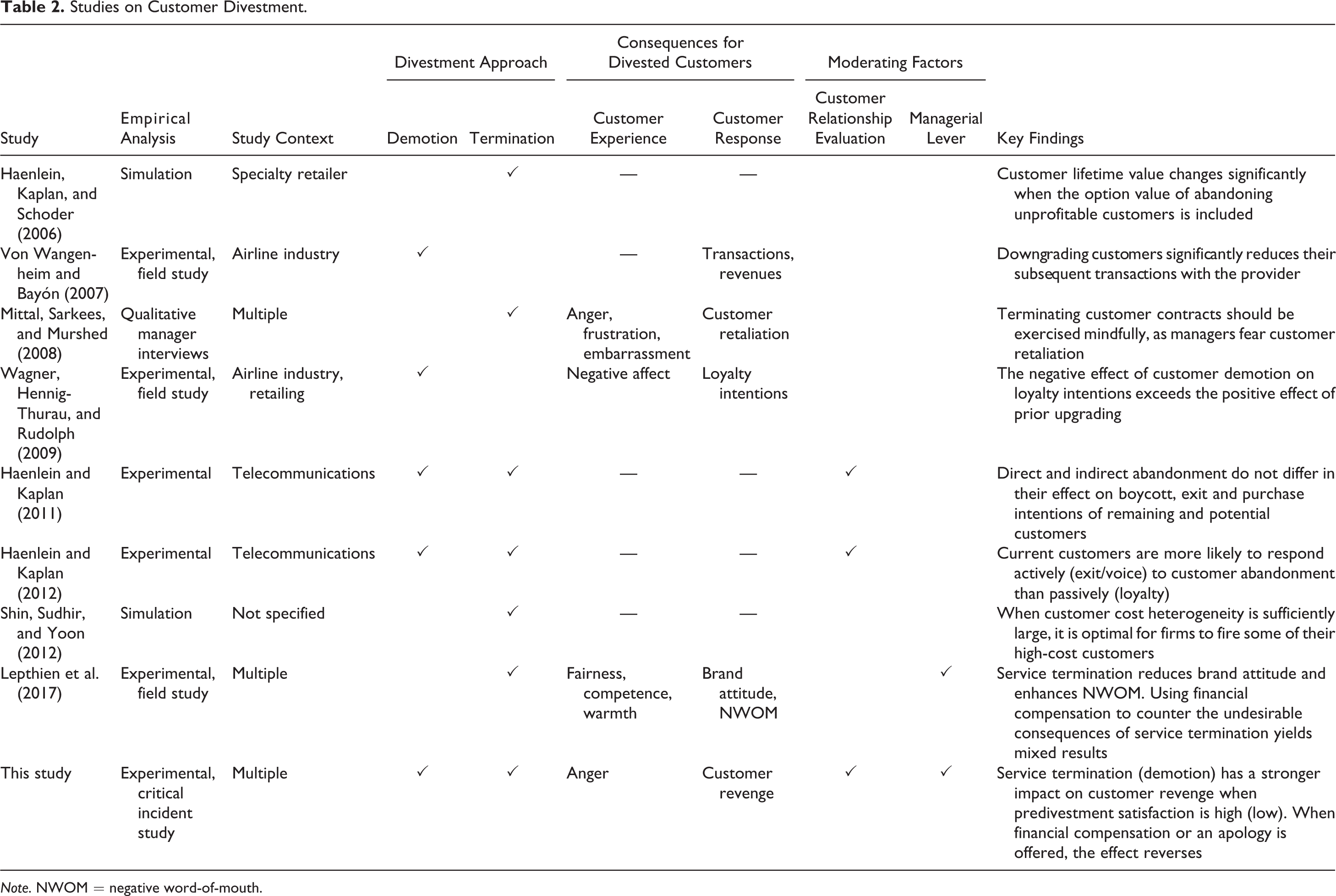
Note. NWOM = negative word-of-mouth.
Theoretical Background
The argument is backed by justice theory and appraisal theory. Both go hand in hand in explaining customer revenge as a response to critical relationship interventions by the firm, including, for instance, service failure recovery or differential customer treatment (e.g., Gelbrich 2010; Mayser and von Wangenheim 2013). The reason for their popularity as a theoretical tandem is that justice theory focuses on justice cognitions and their behavioral consequences such as customer revenge, while appraisal theory opens the black box and explains why these cognitions translate into behavior through the elicitation of distinct emotional responses such as anger (DeWitt, Nguyen, and Marshall 2008; Lazarus 1991).
Justice theory (Blodgett, Granbois, and Walters 1993) suggests that individual fairness or justice perceptions in an exchange determine subsequent intentions and behaviors (DeWitt, Nguyen, and Marshall 2008). It is particularly relevant in a service context. Due to the intangible nature of services, fairness perceptions play a major role in customers’ service evaluations (Blodgett, Granbois, and Walters 1993). An overall fairness perception may arise, for instance, from the means by which decisions are made (Thibaut and Walker 1975), from the allocation of economic resources across actors (Folger and Konovsky 1989), and from the manner in which outcomes are communicated (Bies and Shapiro 1987).
Appraisal theory (Roseman, Spindel, and Jose 1990) further clarifies that cognitive fairness appraisals of an event trigger behavior. The key argument is that cognitive appraisals of an event trigger a distinct emotion that results in a specific action to cope with the emotion. The same event may elicit different fairness appraisals for different persons (Gelbrich 2010). Initially, individuals evaluate the significance of an event for their personal well-being (Folkman et al. 1986). Only if the individual is harmed by the event, is it appraised to be unfair (DeWitt, Nguyen, and Marshall 2008). According to appraisal theory, individuals further appraise the accountability for the event to determine the coping potential and the expectancies for reducing the negative emotional state of specific coping responses (Folkman et al. 1986). The emotion anger, for instance, arises when the service provider is to be held accountable for an event that is appraised as unfair (Lazarus 1991). 1 Retaliatory behavior then serves to restore justice following an unfairness appraisal and to cope with anger (Bougie, Pieters, and Zeelenberg 2003; Gelbrich 2010), particularly when it is unlikely that a customer changes an outcome through problem-solving coping and a complaint would not produce the desired firm response (Bechwati and Morrin 2003; Grégoire, Laufer, and Tripp 2010). As we detail next, justice theory and appraisal theory feed into the framework dictated by our research questions.
Conceptual Framework
The research objective of this article is to offer guidance on how to divest from service contracts in order to avoid customer revenge. Thus, the conceptual framework needs to account for service demotion and service termination as key independent variables and for customer revenge as a key dependent variable. To address various situations in which one or the other divestment approach should be chosen, we account for the moderating roles of predivestment satisfaction, financial compensation, and apology in the framework. Finally, we consider anger as an explanatory variable for the effect of divestment approaches on customer revenge. Figure 1 depicts the framework and the related studies. We next justify and define the variables.
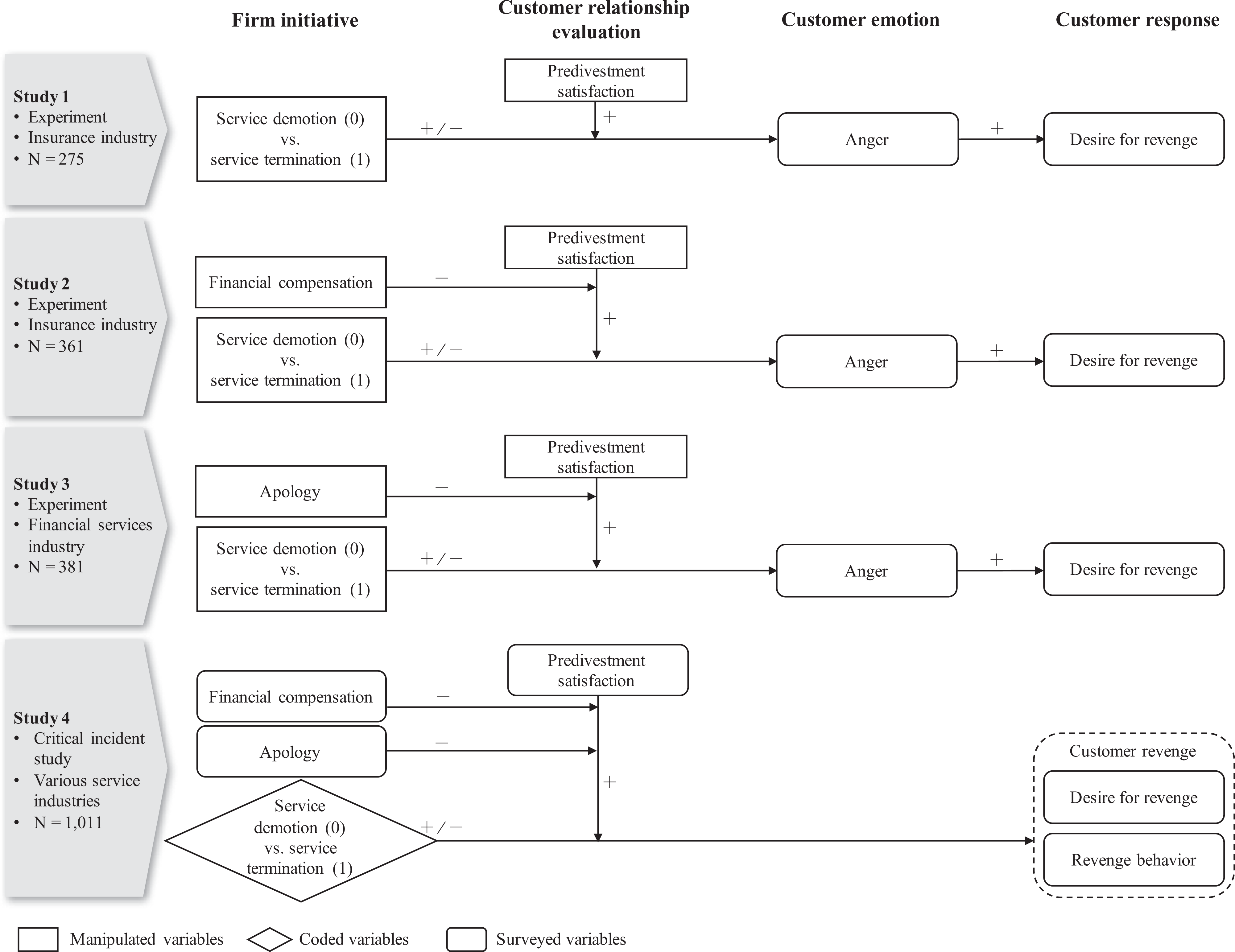
Study overview.
We use service divestment as an umbrella term that covers a service provider’s initiative to demote or terminate selected service contracts or memberships (Bolton and Tarasi 2006). Service contract demotion describes a service provider’s reduction of the contractual services offered to a customer (Wagner, Hennig-Thurau, and Rudolph 2009). Service contract termination occurs when an existing service contract with a customer is abandoned by a service provider, and the customer is no longer provided the service at all (Shin, Sudhir, and Yoon 2012). Please note that the definitions explicitly focus on contractual or membership-based services as in these cases the distinction between the demotion and the termination of a service relationship is most relevant. In contrast to noncontractual services, service divestment decisions are more definite in contractual or membership-based services because all current and future service encounters are affected. For noncontractual services, it is easier to make divestment decisions for individual service encounters than for the whole service relationship. 2
The theoretical argument put forward in the last section implies that consumers appraise divestment initiatives as unfair because they are based on a firm’s relationship evaluation only and not on mutual agreement, because they cause a loss of service value, money, or time invested in the relationship, and because they are severe relationship interventions that are often difficult to communicate in a sensitive manner. In other words, they harm the well-being of the affected customer. Customer revenge serves as a mechanism to cope with unfairness perceptions (Grégoire and Fisher 2008). Customer revenge involves an intentional and a behavioral component. Desire for revenge captures the intentional component. We define it as a perceived urge to punish the provider for the perceived wrongdoing. In line with the common view in literature, we consider revenge behavior a broad construct that incorporates a variety of actions available to customers to harm the firm (Joireman et al. 2013). Actions include customers’ marketplace aggression (e.g., slamming a door or yelling; Grégoire, Laufer, and Tripp 2010), vindictive complaining (e.g., direct complaining to the firm to cause inconvenience; Gelbrich 2010), negative word-of-mouth (e.g., denigrating the firm to other current or potential customers; Gelbrich 2010), and third-party complaining for negative publicity (e.g., indirect complaining via a third party; Grégoire, Laufer, and Tripp 2010).
Appraisal theory offers a detailed explanation for why divestment initiatives may impact customer revenge. Related research in social psychology suggests that unfairness appraisals of social exclusion and rejection for which another party is to be blamed trigger anger, which entails coping via revenge behavior (Leary, Twenge, and Quinlivan 2006). 3 Divestment is the formalized way to exclude or reject a customer in a service context and can be clearly blamed on the service provider. Prior research thus implies that anger is the most appropriate candidate for explaining divestment initiatives’ effect on revenge. We consider anger as an explanatory variable and define it as a negative emotion that involves an impulse to respond and react toward the source of the emotion (Joireman et al. 2013).
We are further interested in identifying situations in which specific divestment initiatives perform better or worse in triggering anger and revenge, which we consider in the framework by accounting for moderators. Our first moderator is predivestment satisfaction because customers’ fairness appraisals of the same firm intervention vary with the individual evaluation of the relationship (Walster, Berscheid, and Walster 1973). We define predivestment satisfaction as a customer’s affective state toward a firm prior to divestment, resulting from an overall evaluation of the previous relationship (Anderson and Narus 1990). Satisfaction is the most conscious, explicit, and sensitive representation of the relationship in a customer’s mind (van Doorn and Verhoef 2008). Research on lost customers (Homburg, Hoyer, and Stock 2007) suggests that satisfaction is therefore more suitable to retrospectively capture customers’ relationship evaluations before a specific event (e.g., divestment) than other relational constructs (e.g., Hennig-Thurau, Gwinner, and Gremler 2002). Focusing on relationship satisfaction is also supported by findings in social psychology that suggest it is critical for shaping responses to rejection (Wheaton 1990).
Service providers often accompany divestment initiatives with divestment handling instruments that aim to influence the affected customers’ appraisal of the divestment initiative. We consider the two most commonly discussed divestment handling instruments as additional moderators (Wagner, Hennig-Thurau, and Rudolph 2009). Service providers can redress the customer’s loss of economic resources due to divestment (e.g., money, service provision) through financial compensation, which we define as a monetary refund and economic redress for divestment (Smith, Bolton, and Wagner 1999). Further, respectful and sensitive communication is necessary to redress the loss of emotional resources (e.g., social status and esteem). Hence, we also consider apology, which is defined as an admission of the wrongdoing and an emotional redress (Smith, Bolton, and Wagner 1999). 4
Hypotheses
Is Service Demotion or Termination Worse in Terms of Customer Revenge?
Service divestment reflects a one-sided decision by the firm that is not based on mutual agreement. Implementing divestment initiatives entails the loss of resources on the affected customers’ side. Divestment initiatives are thus perceived as unfair and evoke the need to restore justice, for instance, through revenge (Bechwati and Morrin 2003; Bougie, Pieters, and Zeelenberg 2003). Similarly, social psychologists have found that when individuals feel unfairly rejected, they may repay by doing harm to the originator of the harmful experience (Leary, Twenge, and Quinlivan 2006). In line with managers’ concerns and initial findings in research (Lepthien et al. 2017; Wagner, Hennig-Thurau, and Rudolph 2009), we thus expect both service demotion and termination to trigger customer revenge.
Yet, the degree of unfairness appraisal depends on the individual assessment (Ringberg, Odekerken-Schröder, and Christensen 2007; Walster, Berscheid, and Walster 1973). For different customers, the same event can result in different unfairness appraisals due to individual differences in the evaluation of the relationship (Aggarwal 2004; Mayser and von Wangenheim 2013). It follows that customers may not perceive either a service demotion or a termination as more harmful per se. The question is when do they appraise either one as more unfair and are thus more likely to take revenge?
The Moderating Role of Predivestment Satisfaction
Service demotion and termination are manifestations of a process in which a provider evaluates the customer relationship. This evaluation is one-sided in nature in that the customer cannot participate in the decision process, which should be appraised as unfair from a customer point of view. However, the customer’s evaluation of the relationship may or may not align with the firm’s evaluation, leading to the customer’s implicit agreement or disagreement with the firm’s decision. The (dis)agreement affects the perceived harmfulness of the event and hence the customer’s fairness appraisal (Lind and Tyler 1988).
From the standpoint of previously satisfied customers, a service termination is more unfair than a demotion because the involuntary termination of the service contract bereaves them of a valued relationship without giving them a chance to influence the decision process, and it entails concerns about not finding an equivalently satisfying alternative (Hennig-Thurau, Gwinner, and Gremler 2002). A service demotion means that the relationship is maintained, and the service is still available, which aligns closer with their relationship evaluation. Hence, we argue that satisfied customers appraise a service termination as more unfair than a demotion, entailing a greater need to restore justice through revenge.
For customers low in predivestment satisfaction, however, a service termination aligns closer with their relationship evaluation than a demotion. A service termination offers an easy escape from an unsatisfying relationship they do not value. For them, a service termination equals an opportunity to search for a service provider that offers a better fit to their needs. A service demotion, in contrast, means that an unsatisfying but binding service contract has to be continued (Ringberg, Odekerken-Schröder, and Christensen 2007). Given the implicit agreement that a termination is the better alternative, we argue that customers low in predivestment satisfaction appraise service termination as less unfair, entailing a lower need to restore justice through revenge. The argument is in line with findings of social psychologists that suggest that individuals’ rejection experiences depend on their relationship evaluations (Wheaton 1990). Previous perceptions of relational problems may mitigate the negative effect of a divorce on an individual’s well-being because the ending of a problematic marriage is a relief, whereas carrying on with a problematic or even worsening marriage draws out the agony. Taken together:
Anger as an Explanatory Mechanism
We further argue that customers’ unfairness appraisals of divestment initiatives drive customer revenge via anger. In particular, divestment decisions are deliberate, intentional, and one-sided decisions made by a provider, causing harm to the customer. The appraisal of willingly being treated unfairly by a firm elicits anger as a negative emotion (Bougie, Pieters, and Zeelenberg 2003). The argument made for Hypothesis 1 suggests that previously satisfied customers appraise a service contract termination as more harmful and therefore more unfair than a demotion. Consequently, we expect that satisfied customers’ appraisal of a service termination results in a higher arousal of anger than their appraisal of a demotion. Conversely, previously dissatisfied customers appraise a service demotion as more unfair and greater wronging by the firm, arousing more anger than their appraisal of a service termination. Angry customers in turn engage in confrontive coping in order to even out the perceived wrongdoing and to vent their anger through revenge (Bougie, Pieters, and Zeelenberg 2003; Grégoire et al. 2018). Thus:
Do Financial Compensation and Apology Alleviate Customer Revenge?
Service recovery literature has shown that firms can counter unfairness appraisals with a conciliatory gesture such as financial compensation or apology to reduce anger and revenge (Bitner, Booms, and Tetreault 1990; Tax, Brown, and Chandrashekaran 1998). We suggest that such gestures may also influence customer responses to divestment initiatives.
However, their usage has to be reasonable (Bitner 1990). When customers’ evaluations of the relationship align with the firm’s evaluations, they are likely to agree implicitly with the divestment decision. Implicit agreement means that customers are less likely to question fairness, and hence, there is no reason for a redress (Gelbrich and Roschk 2011). When customers do not expect to be compensated with a redress because they do not appraise an event as unfair, they may infer negative firm motives from the firm’s offering of redress (Bitner 1990). Customers then feel wronged by the firm where they would not have done so had no redress been granted (Grewal, Roggeveen, and Tsiros 2008). This increases (rather than decreases) anger and revenge. Taken together, we suggest that the provision of financial compensation or apology mitigates the effect on customer anger and hence customer revenge to a greater degree when customers were targeted by the divestment approach they appraise as more unfair. In Hypothesis 1, we posit that for (dis)satisfied customers, this is service termination (demotion). Thus:
Empirical Examination
Study Overview
We run four studies to test the hypotheses (see Figure 1). In Study 1, we examine the interaction effect between divestment initiatives and predivestment satisfaction on customer revenge. We also examine the underlying mechanism in terms of anger. We then test whether offering financial compensation (Study 2) or apology (Study 3) helps to mitigate this effect. Study 4 shows that the experimental findings largely hold for a variety of customers and divestment incidents across various service providers and industries. Together, the four studies provide internally and externally valid evidence for the hypotheses.
Study 1
Study 1 uses an experiment to test whether service divestment has an effect on customer revenge and whether there are differences in the effect of service demotion versus termination on customer revenge depending on predivestment satisfaction (Hypothesis 1). Further, we examine whether the interaction effect between divestment and predivestment satisfaction on customer revenge can be explained by customer anger (Hypothesis 2).
Design, Sample, and Procedure
We use a 3 (service termination vs. service demotion vs. no divestment) × 2 (high vs. low satisfaction) between-subjects design. We collect data using Amazon’s Mechanical Turk (MTurk) among U.S. American consumers with a master qualification (i.e., high degree of task accuracy), offering an incentive of US$1.50. We receive 307 responses. We remove systematic error variance and random noise using common data cleaning procedures to provide more accurate and powerful tests (Meyvis and van Osselaer 2018). We exclude 32 respondents accordingly. The majority of exclusions are due to respondents’ failure to follow instructions (i.e., instructional manipulation checks), followed by unrealistic task completion time (i.e., ≥ 1.2 standard deviations below the mean; Smith, Bolton, and Wagner 1999) and unreliability in responses (i.e., identical ratings across all scales including reverse coded scales). 5 Online Appendix A summarizes all sampling details. We use an effective total of 275 participants (47% women; M age = 35) and assign them randomly to the treatment groups.
We use a scenario approach as it enhances internal validity when studying reactions to negative experiences (Smith, Bolton, and Wagner 1999). We choose a roadside assistance membership as a setting because in this setting divestment activities violate daily life less than in many other settings, offering conservative theory testing. Participants are instructed to imagine one of the six scenarios. First, all participants are told they have a service contract with the fictive roadside assistance Mobility and are eligible to call upon two services. We first manipulate the predivestment satisfaction conditions via customers’ perceptions of the provider’s past performance. We then manipulate the divestment conditions with a letter that is based on actual divestment letters in practice. The letter states that the service level provided is reduced in the demotion condition, it is canceled in the service termination condition, and remains unchanged in the no divestment condition. Online Appendix B contains all scenarios.
Scenario Checks
After presenting the scenario, we ask participants to answer manipulation checks, a test for scenario realism, and a question about the purpose of the study. The manipulation checks indicate that the scenarios work well. Predivestment satisfaction (“With the roadside assistance Mobility I am very…,” anchored by 1 = dissatisfied and 7 = satisfied) is significantly different across groups (M dissatisfied = 2.99 vs. M satisfied = 5.76; F(1, 273) = 346.23, SD = 1.86, p < .01). For the divestment manipulation checks, subjects are given an aided-recall question where they have to choose among three options (“For the next membership year…[1] both services are equally provided as before; [2] both services are reduced [the services are modified, but you can still use them]; and [3] both services are denied [you can no longer use the services]”). We compare the percentage of correct responses for the manipulation check (97%) with the proportion that one would observe if the subjects were guessing (i.e., 33.3%; Grewal, Gotlieb, and Marmorstein 1994). The results suggest that the manipulations work well (t(274) = 67.74, p < .01). Participants perceive the scenarios as realistic (M = 6.10), and the majority (83%) does not realize the purpose of the study. Further, we find no differences between demotion and termination for scenario realism (F(1, 174) = 2.81, p > .05; “I believe that the described situation could happen in real life”; Homburg, Klarmann, and Staritz 2012) and for the suspected study purpose (F(1, 174) = .07, p > .10; “What do you think is the exact purpose of this study?”; Bechwati and Morrin 2003).
Measures
All items appear in Online Appendix C. We rely on established Likert-type scales (anchored by 1 = strongly disagree and 7 = strongly agree) if not stated otherwise. All scales are reliable (Cronbach’s α ≥ .95), and factor loadings are significant (p < .01). In order to control for within-group variance, we include context-driven controls such as car importance, roadside assistance service involvement, and ownership of a driver’s license. These factors could influence the importance of roadside assistance for the individual and thus elicit differences in response behavior. We also control for respondents’ previous critical experiences with actual roadside assistance as these could influence the interpretation and evaluation of scenarios. Finally, we control for respondents’ self-esteem because it could affect unfairness perceptions and coping behavior in turn (Bushman and Baumeister 1998).
Results
Conducting a univariate analysis of covariance (ANCOVA) that only considers the effect of divestment (service termination vs. service demotion vs. no divestment) on desire for revenge, we find a significant main effect (F(1, 272) = 35.16, p < .01). Planned comparison tests using the Bonferroni procedure further reveal a significant difference between service demotion and no divestment (M demotion = 3.47 vs. M no divestment = 1.70; p < .01) and between service termination and no divestment (M termination = 3.45 vs. M no divestment = 1.70; p < .01) but not between service termination and demotion (p > .10).
We conduct another ANCOVA where we add the effect of predivestment satisfaction and its interaction with divestment (service termination vs. service demotion vs. no divestment). We find significant effects of divestment (F(1, 168) = 36.89, p < .01) and predivestment satisfaction on desire for revenge (F(1, 168) = 16.84, p < .01) as well as a significant interaction effect of divestment × predivestment satisfaction on revenge (F(1, 168) = 7.35, p < .01), revealing a significant difference between satisfied (M termination = 3.62, M demotion = 2.71, M no divestment = 1.10) and dissatisfied customers (M termination = 3.28, M demotion = 4.18, M no divestment = 2.31).
Together, these results call for further examination of the responses of satisfied versus unsatisfied customers to different divestment approaches, which we provide in a third ANCOVA. Using a subsample that does not include the control group, we find no significant effect of service termination versus demotion (F(1, 168) = .00, p > .10) and a significant effect of predivestment satisfaction (F(1, 168) = 5.02, p < .05). We find a significant interaction effect of divestment approach (service termination vs. demotion) × predivestment satisfaction on desire for revenge (F(1, 168) = 10.12, p < .01), in support of Hypothesis 1. As we show in Figure 2, the results suggest that customers satisfied with their relationships with the firm have a stronger desire for revenge when their contracts are terminated (M termination = 3.62 vs. M demotion = 2.71; p < .05). Customers dissatisfied with their prior relationships with the firm have a stronger desire for revenge when their contracts are demoted (M termination = 3.28 vs. M demotion = 4.18; p < .05).
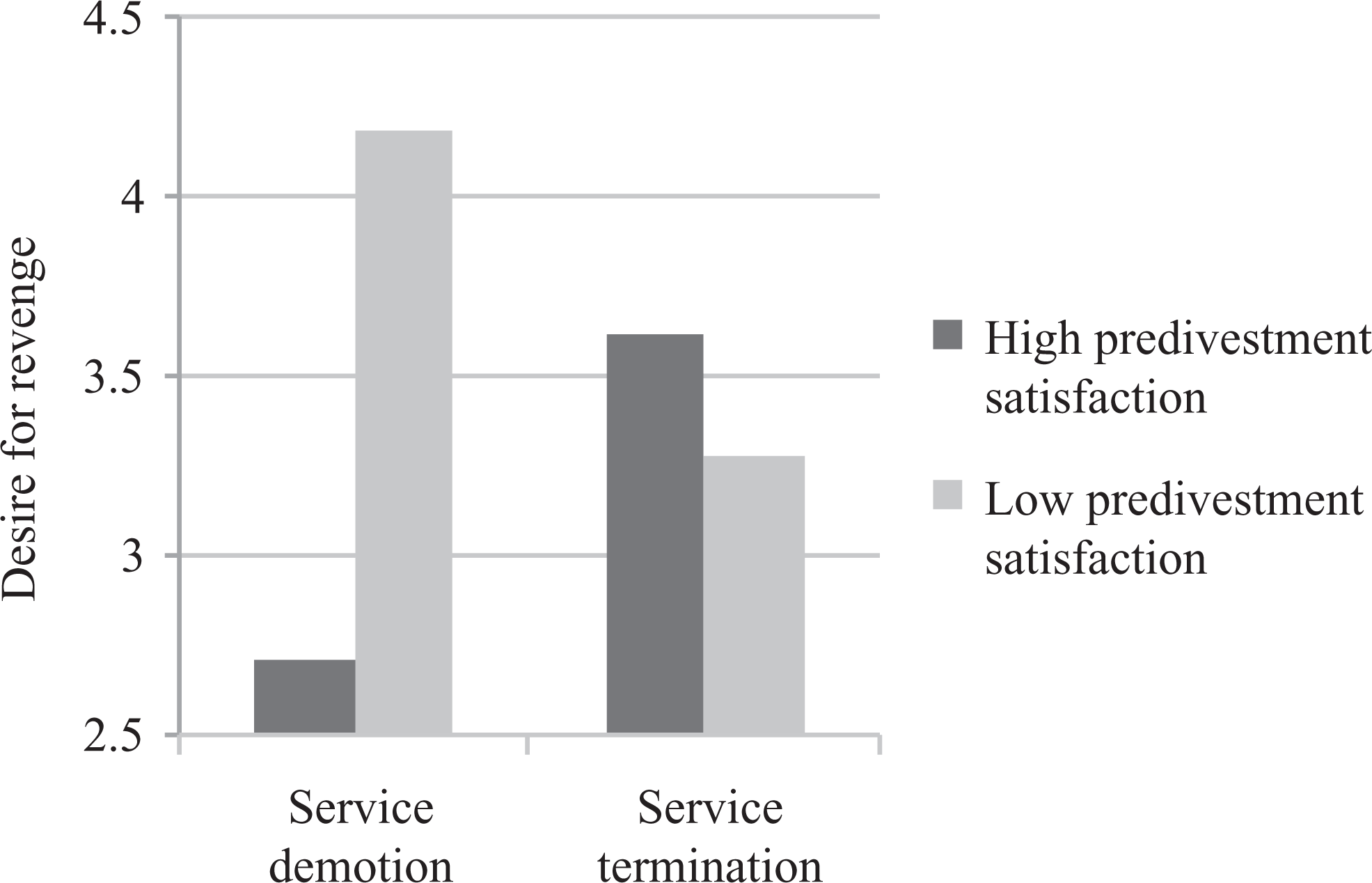
Moderating effects of predivestment satisfaction (Study 1).
We further examine whether the interaction effect on customer revenge is mediated by anger. Using the Preacher and Hayes (2008) PROCESS model with 10,000 bootstraps, we generate a 95% confidence interval (CI) around the indirect effect where significant mediation occurs. The results reveal a significant indirect effect of divestment approach × predivestment satisfaction on desire for revenge through anger (1.42 × .63 = .89; 95% CI [.28, 1.56]), supporting Hypothesis 2. We do not find an additional direct effect of the interaction (β = .84; 95% CI [−.06, 1.73]), indicating full mediation. We also test for potential alternative mediators such as perceived betrayal as a different negative emotion (Grégoire and Fisher 2008) and stress (vs. relief) experience as a negative cognition (Wheaton 1990). The indirect effects though perceived betrayal (.40 × .06 = .02; 95% CI [−.04, .27]) and stress experience (1.04 × −.14 = −.14; 95% CI [−.40, .02]) are not significant, while the indirect effect through anger remains significant (p < .05).
Discussion of Study 1
The findings of Study 1 indicate that practitioners’ concerns about the consequences of service contract termination and demotion are legitimate. Both entail customer revenge. The results, however, suggest that neither service demotion nor termination yields more severe outcomes per se, but that predivestment satisfaction is decisive in understanding which is more or less likely to trigger anger and revenge. These undesirable consequences can be minimized by matching divestment approaches with customers’ satisfaction history. Although, providers may wish to adopt a specific divestment approach regardless of its mismatch with customers’ predivestment satisfaction. We address this in the following studies.
Study 2
The main objective of Study 2 is to experimentally examine whether offering financial compensation helps to reduce the detrimental effect of mismatching the divestment approach with predivestment satisfaction (Hypothesis 3a).
Design, Sample, and Procedure
We use a 2 (termination vs. demotion) × 2 (high vs. low satisfaction) × 2 (financial compensation vs. no compensation) between-subjects experimental design. We collect data among U.S. American consumers using MTurk. To proof replicability to different sample structures, participants receive a lower payment than in Study 1 (US$.80) and are not required to have a master qualification. We apply the same data cleaning procedures as in Study 1 to ensure consistency (Meyvis and van Osselaer 2018), and we exclude 54 questionnaires of the 415 responses. Again, most exclusions were caused by respondents’ failure to follow instructions, followed by an unrealistic task completion time and unreliable responses. 6 Please see Online Appendix A for further details. We use an effective total of 361 participants (54% women; M age = 35) who are randomly assigned to the scenarios. We use the same scenarios and procedures as in Study 1, but add a notification to the letter manipulating financial compensation conditions by offering a monetary refund (Online Appendix B).
Scenario Checks
The manipulation check for predivestment satisfaction is significant (M dissatisfied = 3.12 vs. M satisfied = 5.43; p < .01) as is the check for the divestment treatment (correct response rate = 88%; p < .01) and for compensation (“The company offered me financial compensation”; anchored by 1 = strongly disagree and 7 = strongly agree; M compensation = 5.83 vs. M no compensation = 2.32; p < .01). Participants perceive the scenarios as realistic (M = 5.63), and the majority (88%) do not realize the study purpose. We also find no differences between demotion and termination for the realism check (F(1, 359) = 1.62, p > .10) or for the suspected study purpose (F(1, 359) = .31, p > .10).
Measures
Study 2 uses the same scales as Study 1. The scales are reliable (Cronbach’s α ≥ .90), and factor loadings are significant (p < .01). We also add the same covariates. Items appear in Online Appendix C.
Results
Using only the control group (no compensation), we first run an ANCOVA that reveals a significant interaction effect of divestment approach (service termination vs. demotion) × predivestment satisfaction on desire for revenge in the expected direction (F(1, 173) = 17.31, p < .01; satisfied customers: M termination = 3.66 vs. M demotion = 2.18, p < .01; dissatisfied customers: M termination = 3.03 vs. M demotion = 3.82, p < .05). Neither the main effect of predivestment satisfaction (F(1, 173) = 2.87, p > .05; M satisfied = 2.95 vs. M dissatisfied = 3.41) nor the main effect of service termination versus demotion is significant (F(1, 173) = 1.94, p > .10; M termination = 3.36 vs. M demotion = 2.98), reconfirming the previous study’s results.
The main question in Study 2 is whether the interaction effect between divestment approach and predivestment satisfaction on customer revenge is moderated by financial compensation. Conducting an ANCOVA, we find a significant three-way interaction of divestment approach × predivestment satisfaction × compensation (F(1, 349) = 22.13, p < .01), supporting Hypothesis 3a. We visualize the finding in Figure 3. Notably, compensation not only mitigates the effect of a mismatch between divestment approach and predivestment satisfaction on customer revenge, it completely reverses it. For customers high in predivestment satisfaction, combining financial compensation with service termination (i.e., a “mismatched approach”) leads to less customer revenge (M compensation = 2.74 vs. M no compensation = 3.69; p < .05), but combining it with service demotion leads to more customer revenge (M compensation = 3.18 vs. M no compensation = 2.18; p < .01). For customers low in predivestment satisfaction, financial compensation leads to less customer revenge when it is combined with service demotion (M compensation = 3.03 vs. M no compensation = 3.90; p < .05). It leads to more revenge when it accompanies service termination (M compensation = 3.76 vs. M no compensation = 3.01; p < .05).
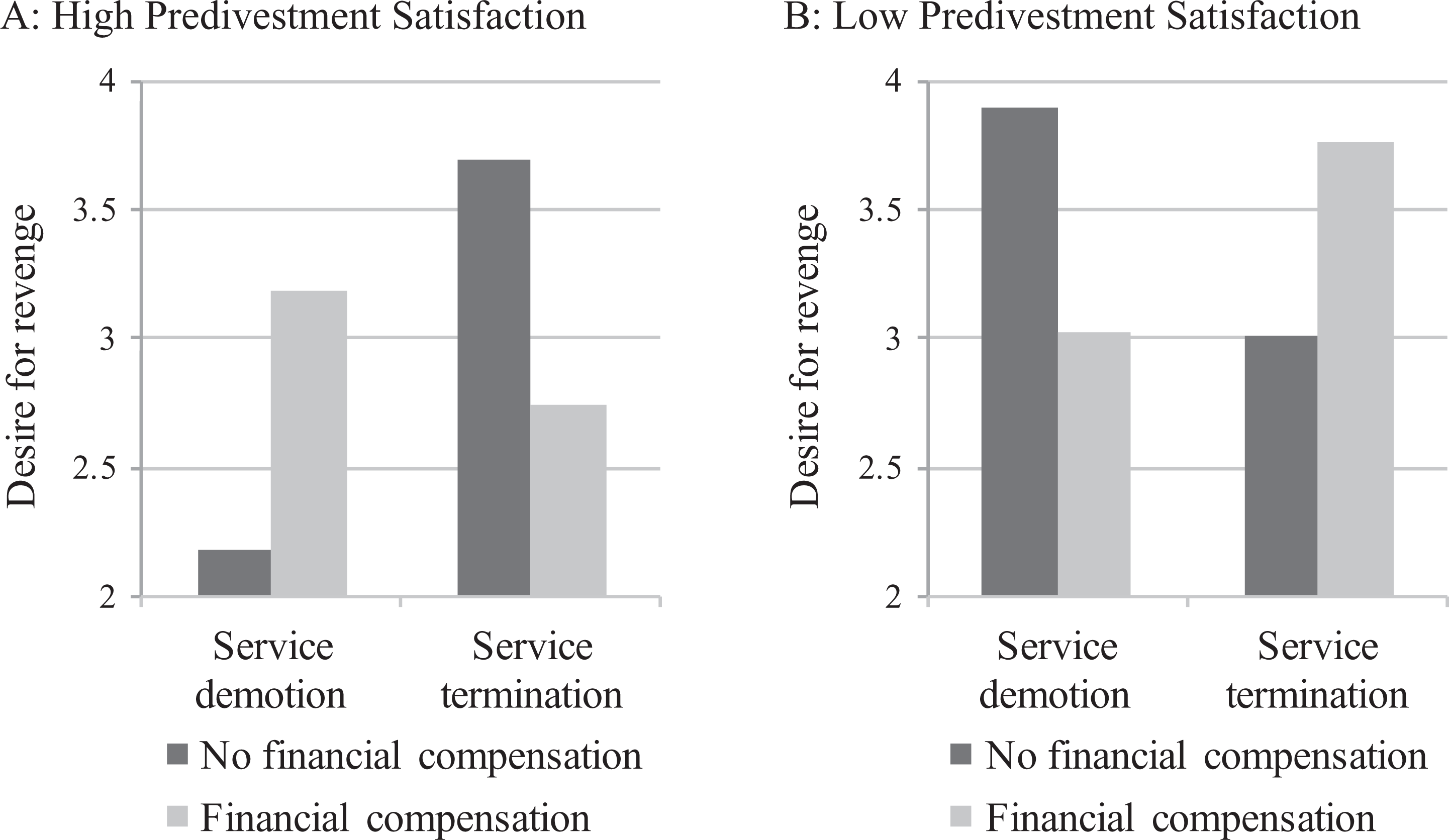
Moderating effects of financial compensation (Study 2).
Based on 10,000 bootstraps, an indirect effects analysis shows that the indirect effect of divestment approach × predivestment satisfaction × compensation on customer revenge through anger is negative and significant (95% CI [−2.30, −.43]), but not the direct effect (95% CI [−.33, .29]), supporting Hypothesis 4a. As in Study 1, we also test for alternative explanatory variables. Neither perceived betrayal (95% CI [−.33, .05]) nor stress experience (95% CI [−.11, .32]) significantly mediates the effect, while the anger mediation remains significant (p < .05).
Discussion of Study 2
Study 2 reconfirms the findings from Study 1 by showing that predivestment satisfaction is decisive for whether service contract demotion or termination has a stronger effect on customer revenge. Moreover, it shows that the interaction effect between divestment and predivestment satisfaction on customer revenge is reversed by offering financial compensation. The findings indicate that financial compensation can be used to avoid the negative consequences of mismatching divestment approaches with predivestment satisfaction. They also show that offering financial compensation may backfire and increase customer revenge when the divestment approach already aligns well with predivestment satisfaction.
Study 3
Study 3 pursues two objectives. First, it serves to establish generalizability of the key Hypothesis 1 by reconfirming the results in a different service context. The second objective is to experimentally examine whether offering an apology moderates the effect of mismatching the divestment approach with predivestment satisfaction (Hypothesis 3b).
Design, Sample, and Procedure
We use a 2 (termination vs. demotion) × 2 (high vs. low satisfaction) × 2 (apology vs. no apology) between-subjects design. We collect data using MTurk but now use a wider sample, recruiting U.S. American, Latin American, European, and Asian participants. Participants receive a payment (US$.70) and are not required to have a master qualification. We exclude 148 of the initial 532 responses from further analysis (Meyvis and van Osselaer 2018). In line with prior research (e.g., Paolacci and Chandler 2014), the relatively high exclusion rate (compared to Studies 1 and 2) is caused by the fact that we use a broader sample with lower demands for the qualification of participants. Please note that we applied exactly the same exclusion criteria as in Studies 1 and 2. Accordingly, the resulting pattern of exclusions is very similar. Again, most exclusions were caused by respondents’ failure to follow instructions, followed by an unrealistic task completion time and unreliable responses. 7 We use an effective total of 381 participants (43% women; M age = 33) who are randomly assigned to the scenarios. Please see Online Appendix A for further details.
Participants are instructed to imagine a scenario in the financial services context in which divestment is highly prevalent and significantly affects consumers’ daily lives. First, all participants are told they have a contract with the fictitious “Direct National Bank” and are eligible to call upon three services for free. The two predivestment satisfaction conditions are manipulated via customers’ perceptions of the bank’s past performance. The divestment conditions are manipulated with a letter that informs participants that the service levels provided are either reduced or that the service contract is canceled. We add a note to the divestment letter to manipulate the apology condition. We report the scenarios in Online Appendix B.
Scenario Checks
The manipulation check for predivestment satisfaction is significant (M satisfied = 6.19 vs. M dissatisfied = 2.61; p < .01), as is the check for divestment (correct responses = 90%; p < .01) and apology (“The company apologized to me for the inconvenience”; anchored by 1 = strongly disagree and 7 = strongly agree; M apology = 4.58 vs. M no apology = 2.48; p < .01). Participants perceive the scenarios as realistic (M = 5.34), and the majority does not realize the study purpose (93%). We find no differences between demotion and termination for the realism check (F(1, 379) = 3.43, p > .05) or for the suspected study purpose (F(1, 379) = 1.04, p > .10).
Measures
Study 3 incorporates the same measures of desire for revenge and anger as used in Studies 1 and 2. The scales are reliable (Cronbach’s α ≥ .91), and factor loadings are significant (p < .01). We control for several covariates that may affect the effectiveness of the scenario and setting. We consider context-related variables associated with financial services such as being a customer of a bank, owning a credit card, and bank account usage to account for real-life experiences. We also control for switching costs because the involuntary closure of an account at one bank suggests opening an account at another one (Campbell, Martínez-Jerez, and Tufano 2012). Awareness of these switching costs may trigger customer revenge. Next, the access to local branches’ financial services differs between rural and urban areas and may thus result in different expectations regarding service standards, which we account for in a dummy (Reinartz and Kumar 2003). Finally, we control for gender as the perceived relevance of financial services may differ between men and women (Campbell, Martínez-Jerez, and Tufano 2012). All items appear in Online Appendix C.
Results
Using only the control group (no apology), we first run an ANCOVA that reveals a significant interaction effect of divestment approach (service termination vs. demotion) × predivestment satisfaction on desire for revenge (F(1, 185) = 18.92, p < .01; satisfied customers: M termination = 3.75 vs. M demotion = 2.77, p < .01; dissatisfied customers: M termination = 3.37 vs. M demotion = 4.58, p < .01). The main effect of service termination versus demotion is not significant (F(1, 185) = .22, p > .10; M termination = 3.68 vs. M demotion = 3.56). Conducting another ANCOVA that uses all groups, we find a significant three-way interaction of divestment approach × predivestment satisfaction × apology (F(1, 367) = 23.55, p < .01), supporting Hypothesis 3b. Again, as Figure 4 shows, the effect is reversed such that for customers high in predivestment satisfaction, combining an apology with a service termination leads to less customer revenge (M apology = 2.50 vs. M no apology = 3.84; p < .01), while combining it with a service demotion leads to more customer revenge (M apology = 3.46 vs. M no apology = 2.71; p < .05). When predivestment satisfaction is low, an apology accompanying a service demotion leads to less customer revenge (M apology = 3.73 vs. M no apology = 4.55; p < .05). Combined with a service termination, it leads to more revenge (M apology = 4.22 vs. M no apology = 3.32; p < .05).
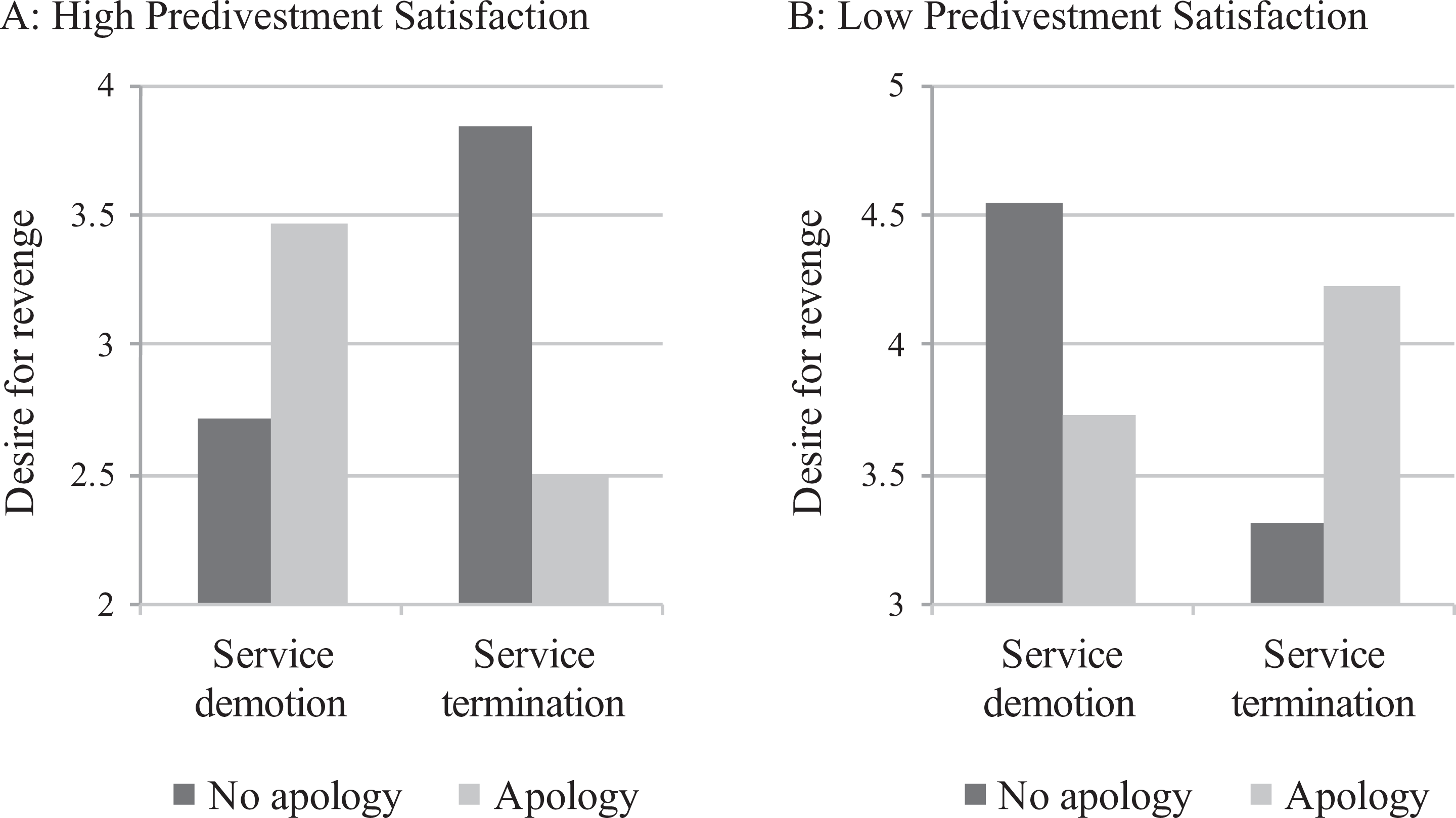
Moderating effects of apology (Study 3).
A 10,000 bootstrapped mediated moderation analysis reveals that the indirect effect of divestment approach × predivestment satisfaction × apology on customer revenge through anger is negative and significant (95% CI [−1.73, −.01]), supporting Hypothesis 4b. We do not find a significant direct effect of the interaction in addition to the mediated effect (95% CI [−.52, .11]).
Discussion of Study 3
Study 3 supports Hypothesis 3b by showing that the interaction effect between divestment approach and predivestment satisfaction on customer revenge is also reversed by offering an apology. The findings indicate that an apology can be effective in avoiding the negative consequences of mismatching divestment approaches with predivestment satisfaction. However, the same pitfall as for financial compensation holds: When the divestment approach already aligns well with predivestment satisfaction, offering an apology increases customer revenge.
Study 4
Study 4 serves to establish external validity and generalizability of the effects of the divestment approach and its interaction with predivestment satisfaction, financial compensation, and apology on customer revenge, which we now capture through both desire for revenge and revenge behavior. Using the critical incident technique, we survey customers about their firsthand experiences with real-life divestment incidents and their reactions across various service settings. Please note that retrospective surveys are well suited to capture behavioral intentions and behaviors triggered by specific incidents (Bitner, Booms, and Tetreault 1990) as well as relationship evaluations (i.e., satisfaction; Grégoire and Fisher 2008). They are less apt to examine event-specific emotions (i.e., anger). These are experienced in a specific situation, dilute quickly in retrospect, are difficult to recall, and are affected by memory bias (Smith, Bolton, and Wagner 1999). Hence, we focus on the effects that are critical to achieve the research goal and refrain from a repeated examination of the anger mediation.
Data Collection and Sample
We collect data in Germany by employing a snowball sampling approach using a web-based questionnaire (Homburg, Klarmann, and Staritz 2012). First, we instruct respondents to read a set of recent examples of actual divestment incidents. We then tell participants to write down a brief description of the last such incident they can remember. If they do not remember such an incident, we ask them to briefly describe the last encounter within a contractual service relationship they can remember. We tell respondents to refer all remaining answers to the respective provider.
We received an effective total of 1,011 responses (51% female; M age = 31). As determined by the coding procedure described in the next section, 318 describe a divestment incident. The data cover a broad range of industries including financial services (14%), insurance (29%), telecommunications (39%), online retailing (9%), and others (9%) such as energy services and fitness clubs. The analysis is based on the divestment sample (N = 318), but we use the full sample to control for selection bias as described below.
Measurement
We use a standard coding procedure (Gremler 2004) to classify the described incidents into one of three categories: service termination, service demotion, and no divestment. We rely on four marketing experts as coders; they are blind to the purpose of this study. Based on written coding instructions, including general instructions, definitions of each category, and decision rules for assigning incidents to categories (Perreault and Leigh 1989), the experts code the critical incident descriptions. Based on coder majority, we then classify the incidents into one of the three categories. Intercoder reliability is high for all categories (αno divestment = .91; αdemotion = .85; αtermination = .85; Perreault and Leigh 1989). If coder judgments result in a stalemate, the discrepancy is resolved by discussion. The coding procedure results in two dummy variables. The dummy variable service divestment (0 = no divestment, 1 = demotion or termination) is used to control for selection bias as described below. The second dummy variable divestment approach (0 = demotion, 1 = termination) is the key independent variable.
As shown in Online Appendix C, we capture desire for revenge, revenge behavior, 8 predivestment satisfaction, 9 financial compensation, and apology via established Likert-type scales. We assess the constructs’ adequacy by performing a confirmatory factor analysis. The measurement model provides a satisfactory fit to the data (χ2/df = 2.31; comparative fit index = .96; standardized root mean square residual = .06; root mean square error of approximation = .06). All scales are reliable (Cronbach’s α ≥ .73), and factor loadings are significant (p < .01).
The examination of divestment consequences across many different customers, industries, and incidents means that we need to consider several control variables. For the same reasons as in the previous studies, we control for self-esteem and gender. We consider customer locus of control as it may affect behavioral responses to divestment initiatives (Wagner, Hennig-Thurau, and Rudolph 2009). We also control for social desirability as it informs whether subjects tend to report compliant behaviors (Crowne and Marlowe 1960). Interdependent individuals may respond differently to harmful service encounters as they are concerned about relationship norms, obligations, and duties (Aggarwal 2004), which is why we include interdependence. The next control is preferred customer status; customers with high perceptions of status and power have been found to be more inclined to seek revenge (Grégoire, Laufer, and Tripp 2010). We control for narcissism because it may explain differences in aggressive behavior (Bushman and Baumeister 1998). We also control for the ability to take another perspective, which may attenuate the negative effects of an aversive situation (Rafaeli et al. 2012). We include relationship length as it may be positively related to customers’ expectations of relationship continuity (Hess, Ganesan, and Klein 2003). Time passed since the incident accounts for participants’ ability to remember all details, which becomes more difficult over time (Harmeling et al. 2015). We include industry dummies as they capture general differences in divestment approaches and the different importance of the offered services for daily life. Descriptive statistics and correlations are displayed in Table 3.
Descriptive Statistics and Correlations for Study 4.
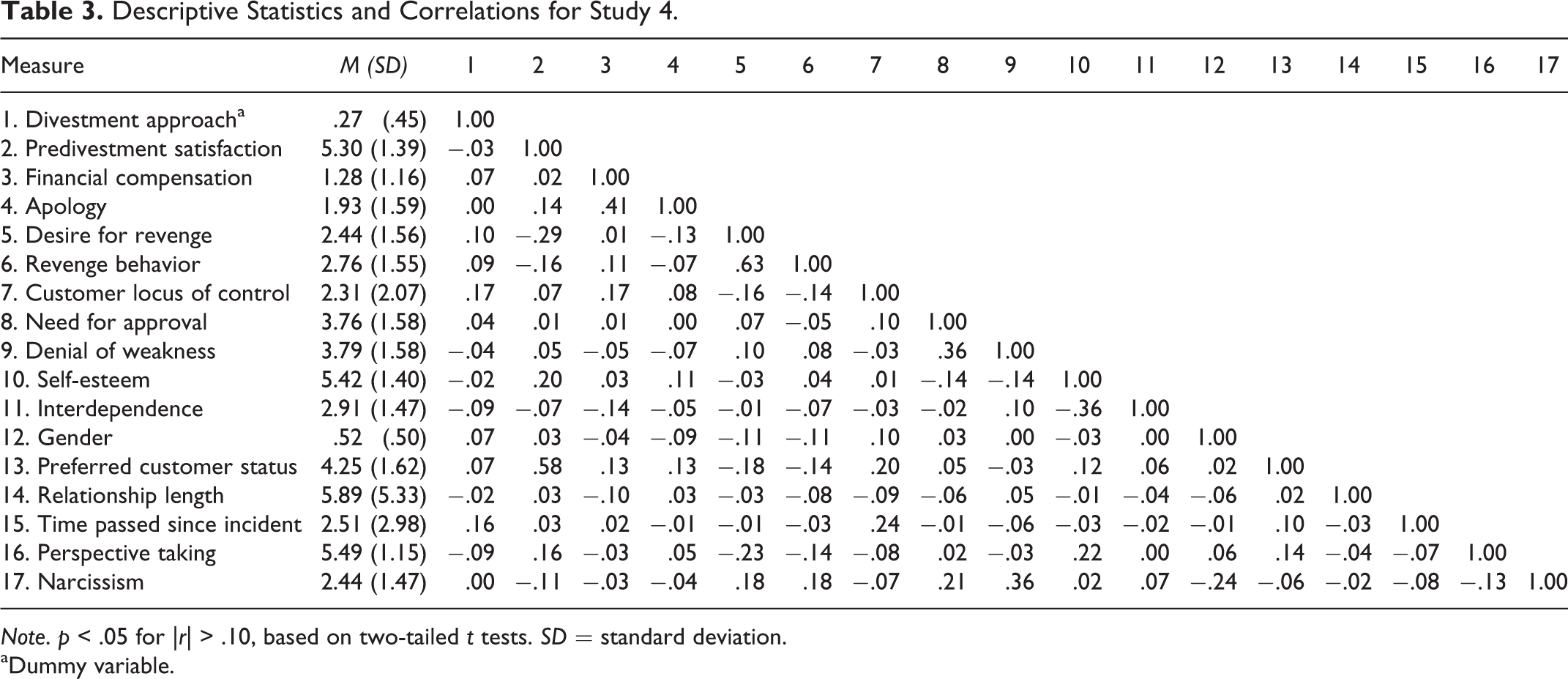
Note. p < .05 for |r| > .10, based on two-tailed t tests. SD = standard deviation.
aDummy variable.
Analysis Approach
We regress customer revenge on the key variables such as divestment approach (0 = demotion, 1 = termination), predivestment satisfaction, compensation, the two- and three-way interactions between these variables, and the controls. The regression addresses two challenges arising from the research topic. First, the divestment sample might differ from the overall population due to the decision rules by which firms decide whether to divest from a service contract. Thus, the results might be biased by sample selection. For instance, divested customers might differ from nondivested customers, in terms of, for example, household income or satisfaction with a service provider’s offering. To correct for sample selection, we calculate the Heckman (1976) correction factor or inverse Mills ratio λ i based on the full sample (N = 1,011) 10 and include it as a control in the model that we apply to the divestment sample (N = 318). Second, service providers might choose the divestment approach based on the anticipated response of a specific customer, resulting in endogeneity (Wetzel, Hammerschmidt, and Zablah 2014). We thus apply Garen’s (1984) procedure for binary endogenous variables. We run a probit model and regress the endogenous variable (divestment approach) on age, relationship length, preferred customer status, and occupation dummies as predictors. We then include the residual ξ i of this regression as another control.
Results
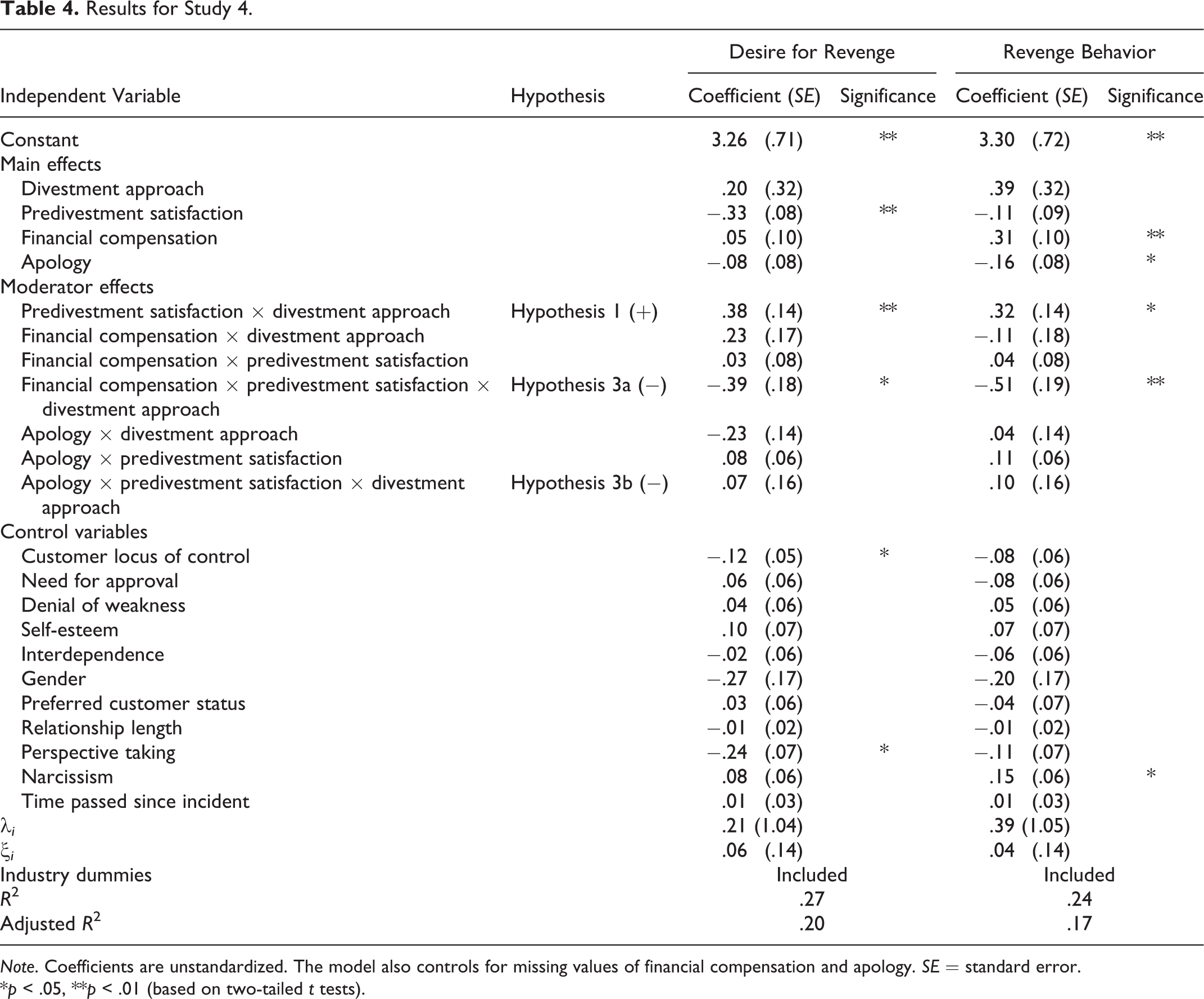
Prior to calculating the interactions and running the analyses, we mean-center all continuous variables to improve interpretability. Variance inflation factors (VIFs) are within an acceptable range (≤ 3.39), indicating that multicollinearity is no problem. As is shown in Table 4, we use two alternative dependents to check whether the results for revenge intentions are also reflected in (self-reported) revenge behavior.
Results for Study 4.
Note. Coefficients are unstandardized. The model also controls for missing values of financial compensation and apology. SE = standard error.
*p < .05, **p < .01 (based on two-tailed t tests).
The results show that the interaction between the divestment approach and predivestment satisfaction yields a positive significant effect both on desire for revenge (β = .38; p < .01) and revenge behavior (β = .32; p < .05), in support of Hypothesis 1. We also find a negative and significant effect of the three-way interaction between divestment approach, predivestment satisfaction, and financial compensation on desire for revenge (β = −.39; p < .05) and on revenge behavior (β = −.51; p < .01), in support of Hypothesis 3a. However, we do not find a significant effect of the three-way interaction that involves apology instead of compensation, neither on desire for revenge (β = .07; p > .05) nor on revenge behavior (β = .10; p > .05), which is why we reject Hypothesis 3b. 11
In sum, the findings indicate that customer revenge is higher when customers high (low) in predivestment satisfaction experience service termination (demotion). As we visualize in Figure 5, in these mismatched situations, offering financial compensation is a meaningful instrument to decrease customer revenge. The figure shows as well, however, that when the divestment approach aligns well with the customer’s predivestment satisfaction (when customers low [high] in predivestment satisfaction experience service termination [demotion]), offering financial compensation backfires and enhances customer revenge.
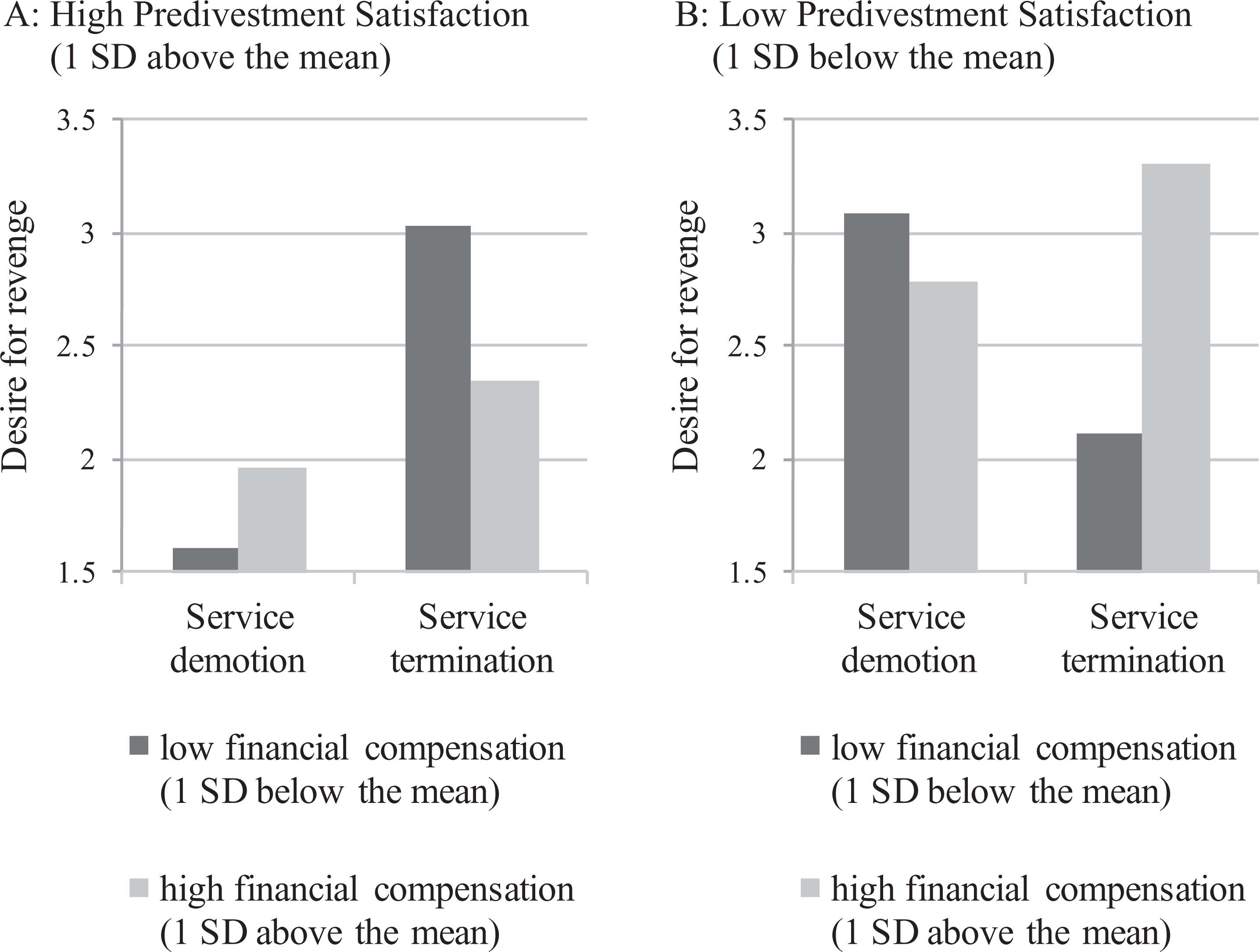
Moderating effects of financial compensation (Study 4).
Additional Tests
We run three alternative models to check whether other relational constructs yield the same results as predivestment satisfaction. In each of them, we replace predivestment satisfaction by predivestment trust (customers’ confidence that a firm is dependable and can be relied on; Morgan and Hunt 1994), predivestment commitment (customers’ desire to continue and maintain a relationship with a firm; Grégoire and Fisher 2008), or predivestment relationship quality (a second-order construct consisting of predivestment satisfaction, trust, and commitment; Grégoire and Fisher 2008). Neither the trust nor the commitment models yield significant interaction effects on desire for revenge or revenge behavior (p > .10). Only the models including predivestment relationship quality yield a significant two-way interaction effect of relationship quality and divestment approach on revenge (desire for revenge: β = .38; p < .01; revenge behavior: β = .26; p > .10) as well as significant three-way interaction effects of relationship quality, divestment approach, and financial compensation on revenge (desire for revenge: β = −.30; p < .05; revenge behavior: β = −.29; p < .05). Recall that predivestment relationship quality comprises trust (which yields no significant interaction effects), commitment (which yields no significant interaction effects), and satisfaction (which yields significant interaction effects). Taken together, the results thus suggest that the moderating effects of relationship quality are mainly caused by the predivestment satisfaction items considered, which emphasizes the focus on satisfaction.
Further, while we focus on the two most common divestment handling instruments, other instruments are theoretically available and their parallel consideration could undermine the effects found in this study. Thus, we also run an alternative model that accounts for another divestment handling instrument, namely, the offering of an explanation. Neither its main effect nor its interactions with divestment approach and satisfaction had a significant effect on desire for revenge (p > .05) or revenge behavior (p > .10). Its consideration does not substantially alter any of the hypothesized results presented in the Results section.
Discussion of Study 4
Study 4 adds to the experimental studies in several ways. First, Study 4 enhances the external validity by accounting for real divestment experiences in various service industries. The key finding—that it depends upon customers’ relationship evaluations whether service demotion or termination yields worse outcomes in terms of revenge—is fully replicated. Second, Study 4 enables us to relate divestment approaches to revenge intentions and revenge behaviors, which underlines the severity of divestment consequences. Finally, the findings reaffirm that offering financial compensation alleviates or aggravates the revenge effect of the divestment approach depending on predivestment satisfaction.
General Discussion
Service providers often choose to divest from service contracts with selected customers but are concerned about customer revenge. To address this concern, we examine customers’ responses to distinct divestment initiatives in terms of customer revenge and what can be done to mitigate this undesirable outcome in a series of three experiments and a critical incident study. The findings indeed indicate that customers seek revenge when they are targeted by divestment initiatives. However, neither service termination nor demotion per se turns out to be worse in fueling revenge. Rather, customers’ relationship evaluations are decisive for the degree to which a specific divestment approach leads to revenge. Previously satisfied (dissatisfied) customers are more likely to engage in revenge upon service termination (demotion), an effect that is explained by customer anger. Interestingly, we find evidence that offering financial compensation or an apology serves to reverse the interaction effect of divestment and predivestment satisfaction on revenge. When offered financial compensation or apology, satisfied (dissatisfied) customers are less likely to engage in revenge upon termination (demotion). These findings have important implications for researchers and practitioners.
Research Implications
Undesirable consequences of relationship management practices should be given more attention
By identifying revenge as a response to divestment, we contribute to an emerging stream of research that reveals the downsides of relationship management practices (e.g., Wetzel, Hammerschmidt, and Zablah 2014). Given the financial implications of customer revenge behaviors (Luo and Homburg 2008), we encourage further research on the negative consequences of divestment initiatives. Taking this further, we call for a more balanced consideration of the benefits versus costs of relationship management practices. As we delineate next, adopting the customer perspective is key to approaching this challenge.
Adopting the customer perspective is key to understanding the repercussions of divestment initiatives
Most prior studies concerned with divestment took a firm-based perspective to decide why and whom to divest. Echoing related calls (Mayser and von Wangenheim 2013), we recommend that researchers consider the customer’s perspective as a critical piece of the puzzle.
Our findings reconfirm prior research that found no significant differences in service demotion’s and termination’s undesirable effects for the divesting firm, all else equal (Haenlein and Kaplan 2011). The findings indicate, however, that customers’ relationship evaluations are decisive for revealing these differences. It is remarkable that it depends on predivestment satisfaction whether service demotion or termination is worse in terms of revenge because intuition postulates the termination of contracts as a last resort, implying a general preference for service demotion (Mittal, Sarkees, and Murshed 2008). The findings are important because it provides an initial explanation for why some firms can manage divestment without noticeable detrimental effects while others face disastrous consequences. A likely reason is that the former are able to align divestment approaches better with their customers’ relationship evaluations.
Not all divestment initiatives are equal
The scarce literature on different divestment initiatives typically focuses on either one (e.g., Wagner, Hennig-Thurau, and Rudolph 2009). The findings of this article highlight, however, that each divestment approach has distinct effects on customer revenge. The implication is that findings related to a service demotion do not necessarily hold for situations that involve a service termination and vice versa.
Aligning divestment handling instruments with divestment approach is crucial to avoid undesirable repercussions
The findings indicate that financial compensation and apologies are powerful instruments for attenuating customer revenge upon divestment. If not aligned with the divestment approach and customers’ satisfaction history, however, both may also exacerbate revenge. The results offer an explanation for prior inconclusive findings. Related research tried to trace back different effects to financial compensation and apology, ending up with divergent findings about the direction of their effects on customer responses (Tax, Brown, and Chandrashekaran 1998). Our results imply that the different effects across different studies might be, to a lesser extent, the consequence of different types of redress (compensation vs. apology) than the consequence of their alignment with the targeted customers’ relationship evaluation. At least in the divestment context, the more appropriate question might be whether redress is required at all rather than which sort of redress is required.
Managerial Implications
Matching divestment initiatives with customers’ relationship evaluations mitigates customer revenge
The bad news is that the results confirm managers’ concerns that divesting from service contracts entails customer revenge, which can yield serious financial consequences (e.g., Luo and Homburg 2008). CCMC (2017) has estimated that these behaviors put US$313 billion in company revenue at risk in the United States alone.
The good news is that matching divestment initiatives to customers’ predivestment satisfaction can minimize these undesirable side effects. We recommend that managers concentrate on service demotion to divest from previously satisfied customers to curtail revenge. Please note that we recommend demoting these customers even if the ultimate goal is to end the relationship. Demoting them may encourage them to leave on their own volition or to revitalize the relationship by becoming more active customers (Mittal, Sarkees, and Murshed 2008; von Wangenheim and Bayón 2007; Wagner, Hennig-Thurau, and Rudolph 2009). Either way, revenge will be much less likely. When divesting from relationships with previously dissatisfied customers, however, this approach would lead to more revenge than terminating the relationship right away. Here, service termination is the more appropriate approach. More generally, the findings emphasize the need to establish customer-centric decision processes not only when the goal is to develop relationships but also when the goal is to loosen or end them.
Collect, analyze, and leverage customer relationship data
Recognizing the need to collect and analyze appropriate data and to make the necessary investments is critical in implementing our recommendations (McAfee and Brynjolfsson 2012). Such efforts will help to identify opportunities to turn customer relationships around to avoid divestment at all (Mittal, Sarkees, and Murshed 2008) and to make more informed decisions about why and whom to divest (e.g., Shin, Sudhir, and Yoon 2012). Our findings imply that such information is also relevant to decide how to divest. Best practice examples like Amazon or Netflix regularly ask their customers to rate their satisfaction, and so do others, both in the online and offline domain (Powell 2016). Service firms could further use social media monitoring in order to track customer satisfaction, another field where Amazon and Netflix are pioneering (Tirunillai and Tellis 2014). These firms rarely suffer from customer revenge behaviors, although they divest from thousands of customer relationships every year, because they are able to better match their divestment approach with customers’ relationship perspectives (Safdar and Stevens 2018).
Financial compensation and apology are double-edged swords
Some service providers are forced to employ a certain divestment approach irrespective of customer satisfaction and may therefore be doomed to face excessive customer revenge. For instance, for smaller banks, contract terminations are often not a viable option as they need coverage for their fixed cost base (Huber, Steclik, and Olsen 2017). For such firms, offering compensation or apology is a viable instrument for attenuating revenge but only if aligned properly with the divestment approach and the customer targeted. As we highlight in Figure 6, previously satisfied (dissatisfied) customers should be offered financial compensation or apology to reduce revenge upon service termination (demotion). Previously satisfied (dissatisfied) customers should not be offered financial compensation or apology upon service demotion (termination), as it would result in stronger customer revenge. These recommendations stand in sharp contrast to current divestment practices: Table 3 suggests that firms are generally reluctant to accompany divestment initiatives with compensation or apology (M compensation = 1.28, M apology = 1.93).
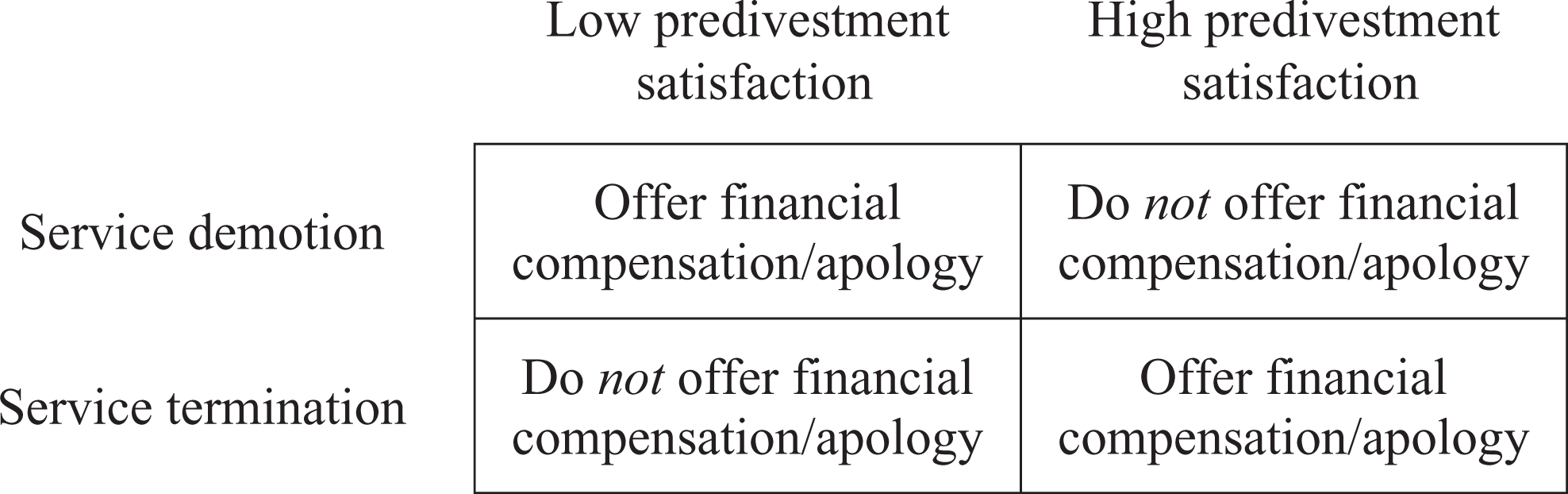
Aligning financial compensation and apology with divestment approach and predivestment satisfaction.
Limitations and Future Research
While prior research has offered meaningful insights on whether and when to divest, this study offers initial guidance on how to divest from service contracts or memberships once the decision to divest has been made. Several avenues for further research exist. First, we focus on two of the most common divestment handling instruments (i.e., financial compensation and apology), but other instruments such as advance notice or support in finding an alternative may play a role in leveraging the effects of service divestment initiatives. An examination of their effectiveness in reducing revenge in response to divestment may prove fruitful.
Second, Study 1 shows that contract demotion and termination enhance customer revenge. We further demonstrate how this effect can be minimized. Going beyond our findings, an interesting question for future research arises: Are there situations in which demotion and/or termination result in less undesirable customer responses than maintaining a relationship?
Third, in line with findings in other contexts (e.g., Grewal, Roggeveen, and Tsiros 2008), the findings suggest a backfiring effect of compensation when the divestment approach is not well aligned with predivestment satisfaction. Future research could zoom in on the mechanism that explains this backfiring effect, for instance, by considering perceptions of negative firm motives.
Fourth, in line with theory and prior research, the findings suggest that anger is a robust candidate for explaining the effect of divestment initiatives on customer revenge. Yet other emotions such as guilt, shame, or sadness may counter the role of anger in explaining the effect, particularly in situations where customers blame themselves for being targeted by a divestment initiative. Thus, it would be useful to consider them in future research. While we offer evidence for the robustness of the moderating role of predivestment satisfaction for the effect of divestment initiatives on customer revenge, the consideration of other relational constructs may serve to further deepen understanding.
Finally, we show that customer revenge depends on the service divestment approach directed at a specific customer. We would welcome future research that considers the financial consequences of customer revenge as a divestment cost to be calculated. Akin to a return on divestment analysis, a combined evaluation of the monetary benefits as well as the monetary costs of service divestment may serve to significantly improve divestment decision-making: While we know about the benefits of divestment initiatives in terms of enhanced customer profitability (e.g., Haenlein, Kaplan, and Schoder 2006), they may also damage a service provider’s brand image and aggravate the acquisition of new customers in the future. Furthermore, demoted customers may switch to an alternative provider; this loss of future profits could also be considered in such an analysis (Hogan, Lemon, and Libai 2003). Divestment initiatives’ net effect on financial performance may then turn negative. All in all, there is rich potential for further research on the undesirable consequences of divestment to yield important results on a topic of hot debate.
Supplemental Material
Supplemental Material, JSR_Executive_Summary_23Jan2019_ch_MH_(2) - The Perils of Service Contract Divestment: When and Why Customers Seek Revenge and How It Can Be Attenuated
Supplemental Material, JSR_Executive_Summary_23Jan2019_ch_MH_(2) for The Perils of Service Contract Divestment: When and Why Customers Seek Revenge and How It Can Be Attenuated by Christina M. Haenel, Hauke A. Wetzel and Maik Hammerschmidt in Journal of Service Research
Supplemental Material
supplemental_material - The Perils of Service Contract Divestment: When and Why Customers Seek Revenge and How It Can Be Attenuated
supplemental_material for The Perils of Service Contract Divestment: When and Why Customers Seek Revenge and How It Can Be Attenuated by Christina M. Haenel, Hauke A. Wetzel and Maik Hammerschmidt in Journal of Service Research
Footnotes
Acknowledgments
The authors thank Todd Arnold, Simona Botti, Michael Brady, Ossama Elshiewy, Steffen Jahn, Sebastian Klein, Robert Palmatier, Luk Warlop, Welf Weiger, and several participants of the 2016 AMA Summer Conference for their helpful comments on prior versions of the article.
Declaration of Conflicting Interests
The author(s) declared no potential conflicts of interest with respect to the research, authorship, and/or publication of this article.
Funding
The author(s) received no financial support for the research, authorship, and/or publication of this article.

Supplemental Material
Supplemental material for this article is available online.
Notes
References
Supplementary Material
Please find the following supplemental material available below.
For Open Access articles published under a Creative Commons License, all supplemental material carries the same license as the article it is associated with.
For non-Open Access articles published, all supplemental material carries a non-exclusive license, and permission requests for re-use of supplemental material or any part of supplemental material shall be sent directly to the copyright owner as specified in the copyright notice associated with the article.
