




Abstract
Codesign allows a design team to combine two sets of knowledge that are key to service design: Customer insights into latent user needs and in-house professionals’ conversion of promising new ideas into viable concepts. While some studies highlight the potential of codesign, others are more skeptical pointing to a lack of clarity over how the involvement of customers affects the design process and outcomes. This article addresses this knowledge gap by reporting on a real-world comparison of design concepts generated by codesign teams with those generated by an in-house professional team and a team solely made up of users in the course of a library service ideation contest. The comparison indicates that codesign teams generate concepts that score significantly higher in user benefit and novelty but lower in feasibility. However, these outcomes are only possible in cohesive teams that develop design concepts collaboratively. In contrast, in teams where individuals dominate, conflict, less collaboration, and diminished innovation outcomes are more likely. The findings add to a better understanding of the value of codesign and shed light on the complex relationship between design team composition, intrateam factors, and innovation outcomes. Service designers obtain recommendations for selecting customers, assembling teams, and managing intrateam dynamics to enhance codesign success.
Customers are central to the service design process. Capturing their unique knowledge about usage and latent needs is key to innovation and new service success (Mahr, Lievens, and Blazevic 2014). Many firms experiment with customer cocreation, a practice that engages customers in the innovation process (Hoyer et al. 2010). However, seldom do firms actually engage customers in service design teams despite studies, suggesting that this may help to foster creativity and develop a firm’s capabilities to innovate (Karpen, Gemser, and Calabretta 2017; Steen, Manschot, and De Koning 2011). Customer input is still most often sought from a distance albeit through increasingly innovative pathways and programs made possible via the Internet (Boudreau and Lakhani 2013). This article explores a specific form of customer cocreation practice, that is, the active involvement of customers through codesign (Holmlid et al. 2015). In stark contrast to design being the exclusive responsibility of individual design experts, codesign allows selected customers or users 1 to become part of the design team as “experts of their experiences” (Visser et al. 2005). Specifically, codesign is the “collective creativity as it is applied across the whole span of a design process” (Sanders and Stappers 2008, p. 6). We ask whether codesign, applied during the ideation stage of the service design process, can benefit an organization’s innovation outcomes.
Service research can be approached in two ways (Edvardsson, Gustafsson, and Roos 2005, p. 118), as a “category of market offerings” or a “perspective on value creation.” The present research draws on the latter approach and considers value, based on the fourth axiom of service-dominant logic, as “always uniquely and phenomenologically determined by the beneficiary” (Vargo and Lusch 2016, p. 8). The phenomenological perspective implies that value cannot be predefined or delivered but is experientially determined by the customer on the basis of the specificity of her or his context (Vargo 2008). Thereby, value is not completely individually or dyadically created but is cocreated through the integration of resources from many sources (Vargo and Lusch 2016), including the possibility that customers cocreate their experiences in autonomous ways (McColl-Kennedy et al. 2012; Teixeira et al. 2017). The potential success of a service offering thus depends on the firm’s ability to understand how customers create value in their context in order to provide the supporting configuration of resources for them to integrate and operate on (Patrício et al. 2011).
Previous research is clear regarding the difficulties of understanding the circumstances surrounding the customers’ value creation processes (Gustafsson, Kristensson, and Witell 2012). The tradition of participatory design suggests that successful design requires the “exchange between people who experience products, interfaces, systems and spaces and people who design for experiencing” (Sanders and Dandavate 1999, p. 90). Similarly, customer cocreation research suggests that by actively involving customers in the innovation process, the firm can overcome the problem of user needs being sticky, difficult to transfer, and articulate (von Hippel 2001; Witell et al. 2011). The involvement of customers with lead user characteristics, those who face needs ahead of the market and have high benefit expectations (von Hippel 1986), appears particularly beneficial for service innovation (Mahr, Lievens, and Blazevic 2014). However, most of the research indicating this is grounded on business-to-business contexts where the distance between customer and firm is often smaller (Gemser and Perks 2015).
The few studies examining customer cocreation practices from a business-to-consumer perspective do not investigate a codesign approach per se but focus on direct comparisons between innovation outcomes achieved by users and in-house professionals (Magnusson, Matthing, and Kristensson 2003; Poetz and Schreier 2012). Further, service firms often limit customer cocreation to the exploration stage of the design process during which they invite customers to reflect on their past experiences by means of conventional market research techniques such as interviews or focus groups (Edvardsson et al. 2013). In contrast, a codesign approach allows selected customers to become members of the service design team, and together with professionals not only reflect on their past experiences but also explore latent user needs and generate design concepts for the future (Sanders and Stappers 2008). Yet, research that investigates the effects of involving customers though codesign is lacking (Ostrom et al. 2015). Consequently, firms do not have a clear understanding of the value of codesign and how the collaboration between in-house professionals and customers in design teams should be managed to leverage full benefits for service design.
Against this backdrop, the present research conducts a first empirical comparison of codesign with two other design approaches that might be used during the ideation stage of a service design process (Patrício and Fisk 2013): First, where design remains the exclusive domain of in-house professionals, and second, where selected customers (i.e., lead users) are tasked with design. The comparison is based on the generation of key innovation outcomes which are, in alignment with previous studies, measured from the firm’s perspective in terms of user benefits, feasibility, and novelty (e.g., Magnusson, Matthing, and Kristensson 2003; Kristensson, Gustafsson, and Archer 2004; Magnusson, Wästlund, and Netz 2016):
Despite the literature constantly exploring new ways of placing innovation in the hands of customers (Boudreau and Lakhani 2013; von Hippel 2005), no studies consider how outcomes emerge from close collaboration with customers in teams. This is problematic because the majority of innovation projects use team approaches involving members from different backgrounds (Mahr, Lievens, and Blazevic 2014). There is a significant knowledge gap concerning our ability to explain the quality and quantity of design team outputs, which is thought to depend on team composition and the occurrence of intrateam factors during the design process (cf. Mathieu et al. 2014). As investigating codesign uses a team perspective, this research additionally asks:
The teams that participated in the research created design concepts for a relevant problem faced by three academic libraries operating in Australian universities. Focus was on the ideation stage, which, after exploring the customer experience, is the second phase of the service design process (Stickdorn and Schneider 2010). Customer involvement during this stage is important because it concerns the creative transition from understanding the customer experience to setting the foundations on which the new service offering is built (Patrício and Fisk 2013). The data generated from the intrateam analysis and the design concept ratings were compared across the teams in order to explore the “black box” of interactions and identify factors that can affect the team process and outcomes.
This article offers three original contributions. First, it investigates the effect of codesign with lead users in direct comparison to alternative approaches with regard to the ideation of new design concepts. Little is known about the effect of involving customers through codesign (Ostrom et al. 2015). We put codesign to the test and investigate whether the close collaboration between in-house professionals and lead users can leverage key innovation outcomes. Second, the research explores the actual codesign process including team dynamics and the possible influence of intrateam factors on innovation outcomes. This provides insight into how outcomes came about and how team-related factors can affect both process and outcomes. The findings have practical significance because they give guidance as to how codesign should be managed to reach full potential. Third, the research utilizes findings from a real-world context where in-house professionals and self-selected lead users ideate design concepts from which they will potentially benefit. We next present the theoretical background and research method before we discuss the findings from the experimental studies.
Theoretical Background
The examination of the literature begins with and then goes beyond service design research by integrating relevant knowledge from customer cocreation and teams. The integration of customer cocreation research provides a deeper understanding of user involvement in design and innovation activities. Team research gives insights into team-related factors affecting performance and outcomes. A literature table summarizing the current research on the described concepts is provided in Appendix Table A1.
Service Design
Service design is “a creative, human-centered and iterative approach to service innovation” (Wetter-Edman et al. 2014, p. 109). It brings innovative ideas to life through an iterative process starting with exploring the customer experience and generating possible new service solutions that are then converted into prototypes, tested, and finally implemented (Patrício and Fisk 2013). The process is human-centered and based on the assumption that a design object has no significant meaning unless it becomes part of the lived experience of people (Krippendorff 2006). This position aligns with service-dominant logic and the shift of focus from service as units of output to “value in use” (Vargo and Lusch 2004) and later “value in context” (Vargo 2008). Value is always contextually specific and determined by the customer or beneficiary. It is not created until the customer integrates and applies the resources of the service provider with other resources in their own context (Vargo and Lusch 2016). Therefore, it is impossible to fully imagine, plan, or design predefined outputs (Kimbell 2011). Instead, the outcomes of the service design process are value propositions or offerings in the form of a supporting configuration of resources that customers can transform into value through use (Patrício et al. 2011). Wetter-Edman (2010) found that service designers take it for granted that “value is in the use,” seeing the core of design practice being to understand future use situations through insights into customers’ dreams, drivers, and needs. To generate such an understanding, the active involvement of customers through codesign has become central (Steen, Manschot, and De Koning 2011).
Service offerings are enabled by complex service systems (Patrício et al. 2011), which are configurations of people, technologies, and other resources that interact with other service systems to cocreate value (Maglio and Spohrer 2008). Thereby, value cocreation is not restricted to dyadic interactions with the service provider but can include any configuration of system entities that link their resources for mutual benefit (Vargo and Lusch 2016). Thus, the design of a service requires a holistic understanding of the circumstances surrounding the customers’ value creation processes (Pinho et al. 2014). This understanding informs the three levels of service design (Teixeira et al. 2017): (1) the service concept (defining the proposed benefits to customers), (2) the service system (orchestrating the different components of the service system to support specific customer activities), and (3) the service encounter (detailing each “touchpoint” to ensure a seamless customer experience across different service interfaces.
This article focuses on the ideation stage, which reflects the creative transition from exploring the customer experience to generating possible service solutions (Stickdorn and Schneider 2010). Design can either be approached as a problem-solving activity or as an exploratory inquiry (Dorst and Dijkhuis 1995). The problem-solving activity implies a desired state of affairs is known in advance (Simon 1990). For example, engineers typically follow a specific problem-solving strategy or working principle in order to address a clearly defined problem (Dorst and Dijkhuis 1995). In contrast, exploratory inquiry is an iterative process where the desired end state is not known and problems and solutions coevolve (Dorst 2011; Dorst and Cross 2001). During this process, close collaboration with customers or other stakeholders affected by design is important because they are “experts of their experiences,” and can contribute valuable knowledge of, and solutions to, latent user needs (Sanders and Stappers 2008; Steen 2013). Exploratory enquiry is the design approach examined in the present research.
Codesign
Codesign is a form of customer cocreation practice characterized by a number of distinct features. Foremost, codesign is characterized by creative and “designerly” approaches (Mattelmäki and Visser 2011). It is an exploratory process of “joint inquiry and imagination” where “problem and solution co-evolve” (Steen 2013, p. 18). Codesign is tightly connected with the tradition of participatory design (Holmlid 2009) of which a key tenet is that “it is possible to gain access to the experiencer’s world only through his or her participation in expressing that experience” (Sanders and Dandavate 1999, p. 90). Similar to recent developments in service design, participatory design seeks to envision use before actual use (Redström 2008). This includes the move from designing “things” (i.e., design objects) to designing “Things” (i.e., sociomaterial assemblies) by means of supporting stakeholders to “design after design” in a specific project (Bjögvinsson, Ehn, and Hillgren 2012; Ehn 2008).
In addition, codesign is built on a mind-set based on collaboration and is a team approach (Sanders and Stappers 2008). Customer cocreation research typically focuses on individuals or user communities taking over innovation activities traditionally executed by the firm (Füller, Matzler, and Hoppe 2008; Schreier, Fuchs, and Dahl 2012). However, codesign can be approached differently in terms of its form of facilitation, the time span of the engagement, the phases of its process, and the level of the contributions from users and other stakeholders (Mattelmäki and Visser 2011). The main purpose is to empower participants to become legitimate and acknowledged members of the design team (Visser et al. 2005).
Finally, codesign includes the application of design tools that encourage collaborative exploration and dialog (Sanders, Brandt, and Binder 2010). Design tools—also described as “tools for conversation”—can be diverse, ranging from make tools (Sanders 2000), design probes (Mattelmäki 2008), design games (Brandt, Messeter, and Binder 2008), and cards (Clatworthy 2011). Additional tools include so-called external representations of services such as blueprints, customer journey maps, and storyboards (Blomkvist and Segelström 2015). These allow designers to transform user information into actionable and testable insights, to share and communicate ideas among participants, and to document insights gained during the design project (Teixeira et al. 2017).
Two aspects appear central to the systematic examination of codesign. Firstly, the identification of “appropriate” users from what may be a large and diversified user base (Hoyer et al. 2010), and secondly, an understanding of team-related aspects to facilitate close collaboration with designers (Sanders and Stappers 2008). Both issues are examined in the following sections with reference to customer cocreation and the team research literature.
Customer Cocreation
When considering what types of customers should be identified and involved in customer cocreation practices, studies have primarily compared key innovation outcomes between ordinary/mainstream users and advanced/lead users. Key innovation outcomes are commonly measured in terms of user benefit (estimates the potential benefit for future use), feasibility (indicates the effort required for implementation), and novelty (refers to the innovative dimension; Magnusson, Wästlund, and Netz 2016).
Studies suggest that firms should primarily focus on identifying and involving lead users, “whose present strong needs will become general in a market-place months or years in the future” (von Hippel 1986, p. 791). These types of users identify problems or face needs before others and have the ability to contribute to the development of commercially attractive innovations (Schreier and Prügl 2008). They are motivated through specific innovation-related benefits, which relate to unsolved problems they face and the expectation of solving these problems through participation in collaborative innovation and design activities (Lüthje 2004; Matthing et al. 2006). This motivating factor can enable a firm to effectively self-select lead users by laying out the potential benefits related to the design task or innovation activity (Füller, Matzler, and Hoppe 2008; Poetz and Schreier 2012).
There is some evidence, however, suggesting that ordinary users are more likely to contribute to the generation of novel ideas as they are able to think outside the box. Unlike lead users, ordinary users are not constrained by “too much knowledge” about technology restrictions and potential feasibility (Magnusson 2009). Carbonell, Rodriguez-Escudero, and Pujari (2012) argue that lead users often have very different needs than the majority of customers, which might hamper the market performance of generated outcomes. However, this has been questioned by studies showing that the involvement of lead users can increase product variety (Al-Zu’bi and Tsinopoulos 2012) and has a positive effect on customer acceptance (Mahr, Lievens, and Blazevic 2014). Studies additionally suggest that the involvement of ordinary users can result in too many ideas, most of which are simply not feasible for the firm to implement (Piller and Walcher 2006).
Studies have also compared the contributions of users with those of in-house professionals and found that user-generated ideas can be higher in novelty and user benefit but generally are lower in feasibility (Magnusson, Matthing, and Kristensson 2003; Poetz and Schreier 2012). The low feasibility score raises the question of whether users are actually capable of meaningfully helping firms to innovative. For example, knowledge intensive business service firms often keep their users at arms’ length because users do not know what they need (Miozzo et al. 2012) or might interfere with good solutions (Lehrer et al. 2012). Others suggest that involving users only ever leads to incremental innovation (Ordanini and Parasuraman 2011; Norman and Verganti 2014), which is in stark contrast to studies finding that users are able to generate radical new ideas (Kristensson, Gustafsson, and Archer 2004; Magnusson 2009). The contrasting arguments underline the necessity to investigate customer cocreation approaches in more depth. This research takes a first step by comparing key innovation outcomes generated by codesign teams (in-house professionals collaborating with lead users) with those generated by an in-house professional team and a team consisting solely of lead users.
Team Research
Codesign is a collaborative team approach (Sanders and Stappers 2008) and as such team-related aspects may affect the design process and outcomes. The conceptual basis for investigating the performance and outcomes of a team is the input-process-outcome framework (Cohen and Bailey 1997). Inputs describe factors such as individual team member characteristics, team-level factors, and organizational and contextual factors that enable and/or constrain members’ interactions during the team processes and assist with task accomplishment (Gilson and Shalley 2004). Processes explain how team inputs are transformed into outcomes (Hülsheger, Anderson, and Salgado 2009). These outcomes are then the results of team activity and as such can be measured in regard to one or more constituencies (Mathieu et al. 2008).
The team’s composition as input has a strong influence on processes and outcomes because it affects the amount of members’ knowledge and skills applied to the task in question (Kozlowski and Bell 2003). For example, Somech and Drach-Zahavy (2013) found that the creative personality of individuals and the collaboration between team members from different disciplines and functions can promote team creativity and innovation. Assembling a team with people with a broad array of skills, knowledge, and expertise can lead to a greater variety of unusual ideas and can assist in solving complex tasks (Amabile 1996). In turn, however, meta-analytic studies also show that team input factors like diversity, team size, and team longevity display only relatively small and variable relationships with team performance (Joshi and Roh 2009).
These contradictory findings highlight the importance of understanding intrateam factors on outcomes (Hülsheger, Anderson, and Salgado 2009). Team outcomes are influenced by (1) interaction processes in terms of exchange of information, learning, motivating, and negotiating between team members (Bunderson and Sutcliffe 2002); (2) team identity and cohesiveness in terms of members’ identification with the team and its objectives, collegiality, comfort with one another, and united teamwork (Sethi, Smith, and Park 2001); (3) the occurrence and resolving of intrateam conflicts including relationship and task conflicts (DeChurch, Mesmer-Magnus, and Doty 2013; Somech, Desivilya, and Lidogoster 2009); and (4) collective efficacy referring to the team’s belief that it can handle certain tasks (Stajkovic, Lee, and Nyberg 2009). A detailed overview of the key findings on the listed concepts affecting team performance and outcomes is provided in the “Team Research” section of the literature review table in Appendix Table A1.
The occurrence and influence of intrateam factors is additionally informed by the task interdependence concept, referring to the degree to which the successful completion of tasks requires information and support from other team members (Gladstein 1984). When task interdependence is low, individual team members are not necessarily dependent on other team members because they can readily complete the task alone. Consequently, intrateam factors have a weak effect on team performance (Stajkovic, Lee, and Nyberg 2009). In turn, with high task interdependence, team members need to coordinate diverse ideas and perspectives and intrateam factors such as team cohesion, collective efficacy, and team identity can have strong effects on team performance and on successful task completion (Gully, Devine, and Whitney 2012; Stajkovic, Lee, and Nyberg 2009).
Managing intrateam factors is important, since the generation of creative ideas at the fuzzy front end of the innovation process is typically characterized by a high degree of task interdependence (Sanders and Stappers 2008). Yet, despite the rich team research literature, the actual team process is still described as a black box highlighting the complexity of the relationship between team composition, the process, and outcomes (Mathieu et al. 2014; Trischler, Pervan, and Scott 2017). The present research goes some way to filling this knowledge gap.
Research Method
To address the research questions, an experimental design was used, supported by qualitative data. This approach enabled a systematic comparison of key innovation outcomes and intrateam factors across the design teams (Miles and Huberman 1994). The experiments were conducted in a real-world setting using a library context. The investigation involved two studies and four library service ideation contests which are briefly described below.
Overview
The setting for the investigation was selected on the basis of (1) the need for service design, (2) access to in-house professionals and users, and (3) a willingness to facilitate an ideation contest. Three academic libraries based on Australian university campuses—hereafter, labeled as Libraries 1, 2, and 3—were identified as organizations that fulfilled these criteria.
Depending on the environment in which they operate, academic libraries could be seen to have characteristics traditionally found within the nonprofit and public sector, being not required to return any generated profits to their owners or directors, and able to control their own activities (Salamon and Anheier 1997). The absence of a profit motivation in these sectors may lead to the adoption of structural features and decision-making processes that inhibit innovation (Damanpour 1991). However, in the Australian Higher Education Sector, academic libraries do not demonstrate these characteristics. This is for two reasons: The first is that government funding is tied to performance measures, which assess quality, in particular student satisfaction and more broadly the student experience (Shah and Richardson 2016), and research into student experience in universities has shown that libraries are considered a key component of service quality (Hennig-Thurau, Langer, and Hansen 2001). The second is that Australia has had a demand-driven university system since 2009, and from 2012 the federal government lifted the cap on undergraduate domestic student numbers per university which effectively freed the market. As a result, the selected libraries possessed commercial features including a strong service orientation, efficiency and effectiveness focus, and the adoption of management and work practices once rare in nonprofit and public service organizations. Reflective of this is the Council of Australian University Librarians (2014) identification of service innovation as a key priority to develop services that are effective, efficient, and resilient to failure.
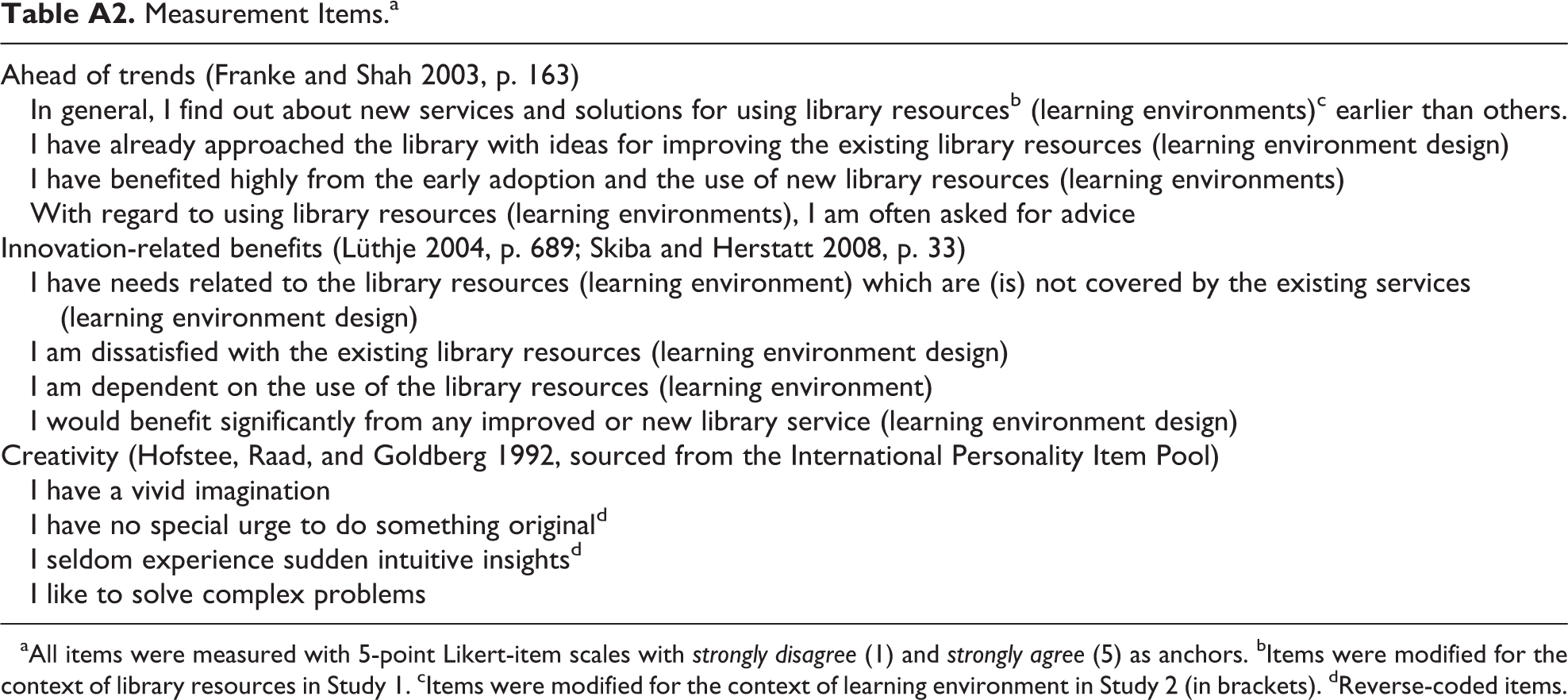
A meeting with the library directors during the planning phase of the studies identified two service design tasks considered as appropriate and relevant: (1) new ways to use and access library resources (focus of Study 1) and (2) a new learning environment (focus of Study 2). Specifically, the libraries sought to actively involve suitable library users to allow them to contribute ideas toward the development of design concepts, which would then be considered as a basis for new library services. The ideation contests were advertised via multiple channels to call library users’ attention to the contributions they could make. As part of an online registration procedure, all interested participants were asked to complete a short questionnaire to screen for relevance and to provide insights into the sample characteristics (e.g., lead user characteristics). The measurement items that were used as part of the questionnaire are provided in Appendix Table A2.
The design activities took place in the respective library facilities. In each activity, a process for the development of library design concepts addressing one of the two service design tasks as defined above was simulated. Two researchers were present during each contest. The principal researcher with background in service design acted as facilitator tasked with guiding the participants through the various stages of the process and enabling the use of design tools (cf. Mattelmäki and Visser 2011). The facilitator took care not to interfere with the teams in any way that might have influenced team dynamics, forms of participation, or collaboration. The second researcher was used as an observer. Each team was set up with the same design tools made up predominantly of “make tools” (Sanders 2000; Sanders, Brandt, and Binder 2010). These included A4-format idea templates (Study 1) and A0-format floor plan templates (Study 2) for the purpose of exploring and generating new design concepts for future possible use situations (Sanders, Brandt, and Binder 2010). In addition, equipment including colored art paper and stationary for 3-D mock-ups as well as sticky notes, butcher paper, and whiteboard markers in diverse colors for 2-D mappings was used. The aim was to support participants to creatively explore and share new design ideas in a visual way.
A between-subject design with teams that were controlled either as a lead user or as a professional-only team was employed. Lead users and in-house professionals were randomly selected from the respective samples and assigned to the teams. This procedure minimized random variability between the groups (Maxwell and Delaney 2004). To address Research Question 1 (a and b), the following two-design team scenarios were used in Studies 1 and 2: collaborative design, where in-house professionals worked together with lead users (referred to as codesign), and no user involvement, where in-house professionals worked without customer input (referred to as professional-only). To address Research Question 1c, the following team scenario was additionally used in Study 2: No professional involvement, where lead users worked without input from in-house professionals (referred to as user only).
Participants
Library users who showed lead user characteristics were defined as the “user” sample. As the participation in this research activity was voluntary and the design task was clearly defined, it was expected that predominantly lead users who associate unsolved needs with the respective tasks would self-select for the ideation contests. Previous studies have shown that this procedure can be effective for finding lead users as they will associate their specific needs with the related design task and will anticipate larger benefits from their investment in an innovation activity (Füller, Matzler, and Hoppe 2008; Poetz and Schreier 2012).
Fifty-one users registered for the design activities at Libraries 1 and 2, respectively, and 46 users registered for the activities at Library 3. The library user samples consisted of mainly Australians. Slightly more library users were female, with most being between 18 and 27 years old. The user sample mainly represented undergraduate and postgraduate students who frequently used the library resources and facilities. It did not attract doctoral students and postdoctoral researchers, seemingly because they had different needs for library resources and facilities, including those designed to facilitate teaching, which were not the focus of the current design tasks. This indicates that the self-selection procedure attracted users whose motivations for participation were closely related to the underlying design task. The distributions of the users’ lead user characteristics indicated that both sets of samples represented lead users (Libraries 1 and 2: mean = 3.55, SD = 0.92 [α = .81] for ahead of trend position and mean = 3.35, SD = 0.75 [α = .78] for innovation-related benefits; Library 3: mean = 3.52, SD = 1.07 [α = .87] for ahead of trend and mean = 3.40, SD = 0.99 [α = .71] for innovation-related benefits). Thus, it is evident that the self-selection process worked effectively; e.g., in a similar procedure, Poetz and Schreier (2012) identified 70 users who predominantly exhibited lead user characteristics.
For the design activities at Libraries 1 and 2, the “professional” sample consisted of 25 in-house professionals, while the sample of Library 3 consisted of 20 professionals. Most professionals were female aged 53–57 years, typical of the sector, and were highly experienced with the majority having over 10 years of work experience. We used the label professional because our sample was limited to in-house staff who were responsible for managing the entire life cycle of library services including ideation, design, testing, marketing, and the delivery of new services (cf. Partridge et al. 2011). These professionals typically have formal training and work backgrounds in the areas of web design, user interaction design, and user-centered design (Ashcroft 2004; Choi and Rasmussen 2009). However, while the selected in-house professionals were experts, exposed to a large number of examples of the problems and solutions that occur in their domain (Cross 2004), they did not have specific service design skills for creating representations of services and/or for engaging users in the design process.
Key Innovation Measures
The efficacy of the service design concepts was tested in terms of key innovation outcomes (user benefit, feasibility, and novelty) using the consensual assessment technique (CAT), which employed a 10-point scale ranging from 1 (lowest) to 10 (highest; Amabile 1982). The use of CAT was recommended by previous studies as a reliable and valid procedure because it would realistically reproduce the idea-screening process applied by a firm (Magnusson 2009; Poetz and Schreier 2012). In accordance with the CAT, five to eight independent judges, who were responsible for the development and implementation of library services and had lengthy work experience within the library sector (>10 years), were recruited. In their study, Magnusson, Wästlund, and Netz (2016) found that firm-internal experts are capable of determining whether or not a design idea has the potential to bring future benefits to its users. All recruited judges were given detailed instructions with regard to the definition and application of the evaluation criteria. The judges rated the design concepts blind from their source and in a random order. Interrater reliability for the composite judge ratings Rc , employing the Tinsley and Weiss (2000) procedure, was used with values of .70 and greater considered as satisfactory.
Intrateam Factors
The influence of potential intrateam factors on the teams’ process and outcomes was investigated by using field notes and responses to open questions. Drawing upon the input-process-outcome framework (Cohen and Bailey 1997) and the task interdependence concept (Stajkovic, Lee, and Nyberg 2009), the focus was on the following areas: (1) the teams’ coordination time prior to the generation of the initial design ideas; (2) the source(s) of inspiration for design ideas; (3) the individuals’ forms of participation within the teams; (4) the atmosphere within the teams, team cohesiveness, and intrateam interactions; and (5) conflict phenomena in regard to team members’ identification with the team and its objectives.
In designated timeslots during and immediately after the research activity, an open-ended questionnaire was administered in order to gain comments on the occurrence and development of intrateam factors. Observational techniques were employed by the second researcher to document specific actions, dynamics, or interactions taking place within the design teams. The questionnaires and field notes were analyzed using the five-phase cycle procedure recommended by Yin (2011, p. 178). The analysis was carried out and cross-checked by two independent researchers.
Study 1
The purpose of Study 1 was to explore how design concepts generated by teams made up of lead users and in-house professionals compare to concepts generated by teams made up of solely in-house professionals, that is, Research Question 1(a and b). Research Question 2 was also addressed; how do potential intrateam factors influence the team process and outcomes? The results of Research Question 2 are reported later in this article.
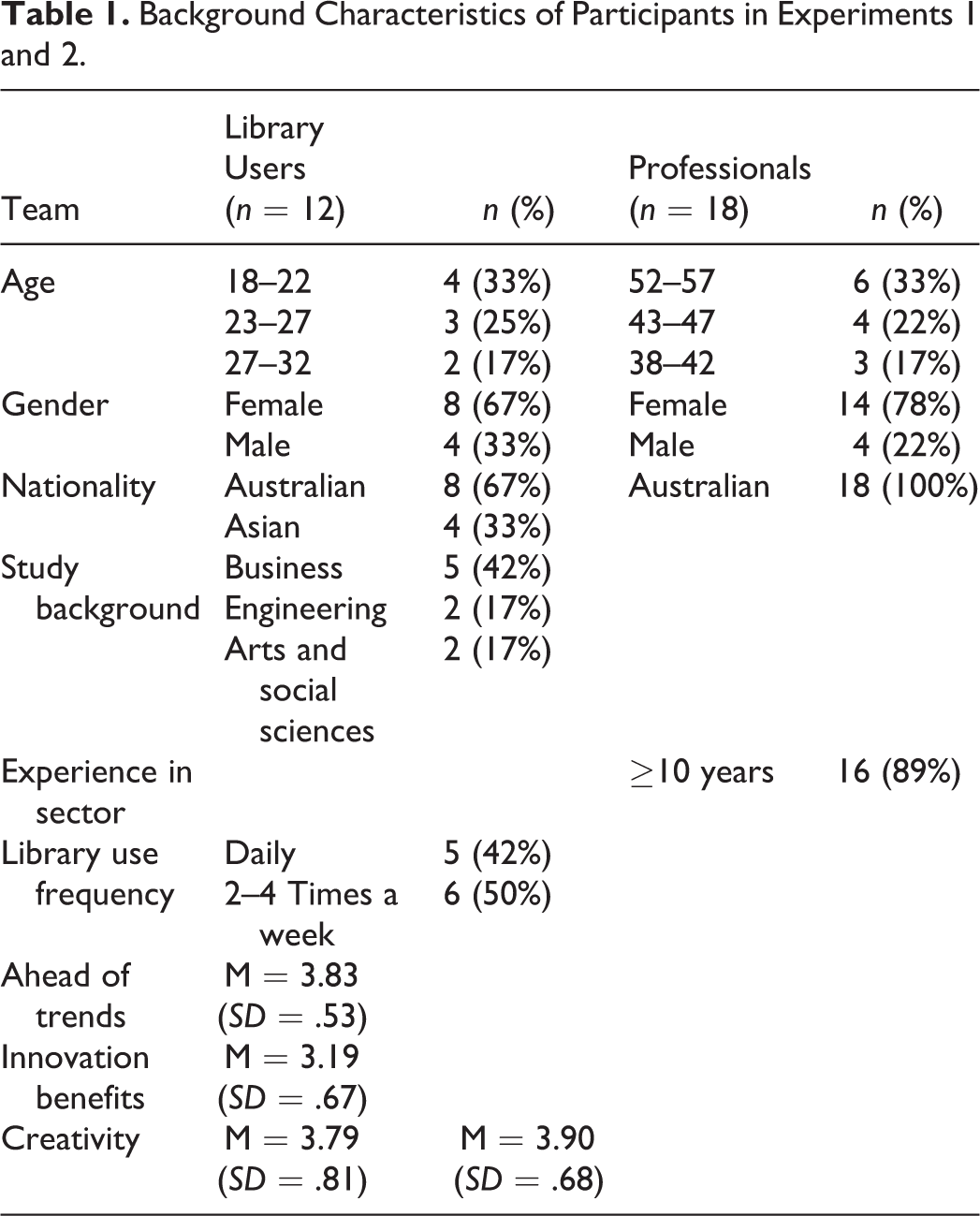
Study 1 was replicated across two study settings (Libraries 1 and 2). In the first library (Experiment 1), three codesign teams were used (two lead users and two in-house professionals each) and one professional-only team (four in-house professionals). In the second library (Experiment 2), two codesign teams (three lead users and two in-house professionals each) and one professional-only team (four in-house professionals) were used. Experiment 2 used three teams due to space restrictions in the respective library facility. The subjects were randomly selected from the respective samples and assigned to the teams. The descriptive statistics of the users and in-house professionals that made up the Experiments 1 and 2 teams are provided in Table 1.
Background Characteristics of Participants in Experiments 1 and 2.
For each experiment, a process for the development of design concepts that set out new ways to use and access library resources was simulated. Predrafted idea templates were used for the concept development and the design task was broadly defined in its task specification: There were no specific requirements in regard to the types, focus, and numbers of design concepts that needed to be developed. Participants were taken through three stages: Stage 1 (60 minutes) involved introductions and brainstorming of ideas; Stage 2 (90 minutes) focused on the conception of ideas including proposed value, required resources, and stakeholders and any potential risks that might be associated with their implementation; and Stage 3 (60 minutes) concerned the development of design concepts using a predefined template. The template enabled an objective comparison to be made.
Results
For the analysis, the highest rated concept for each team, as rated by the judges (see Table 2), was utilized. This avoided the possibility that the use of an amalgam of several concepts could cause a dilution of major effects as a result of the mixing of different designs. The design concepts that were rated highest in all three rating criteria were identified as those constituting the most promising opportunities for the respective firm. In fact, most teams developed one “top idea” that was clearly distinguishable from the other concepts. Acceptable interrater reliability was indicated for all three measures in Experiment 1 (Rc = .97 for user benefit, Rc = .94 for feasibility, and Rc = .97 for novelty) and Experiment 2 (Rc = .94 for user benefit, Rc = .86 for feasibility, and Rc = .84 for novelty).
Experiments 1 and 2—Highest Rated Design Concepts.
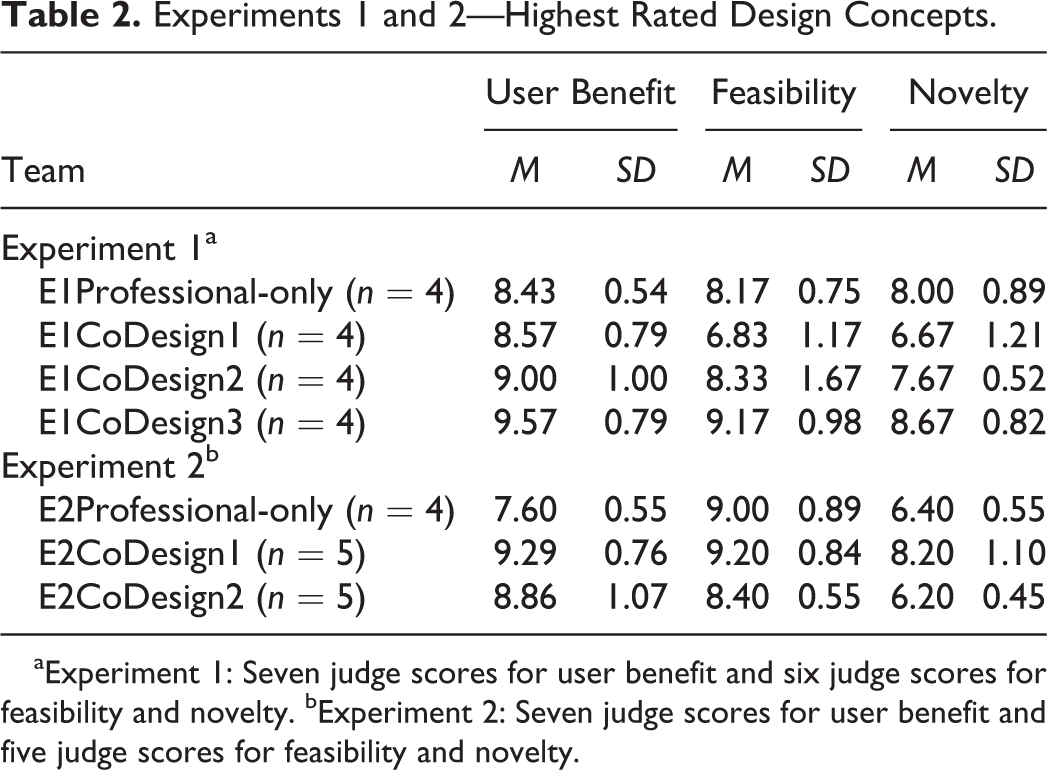
aExperiment 1: Seven judge scores for user benefit and six judge scores for feasibility and novelty. bExperiment 2: Seven judge scores for user benefit and five judge scores for feasibility and novelty.
We used pairwise comparisons between the professional-only and codesign teams by means of t tests. Three of the five codesign teams across both experiments produced concepts that were significantly higher in user benefit (E1CoDesign3, MA-B = 1.14, t = 3.18; E2CoDesign1, MA-B = 1.69, t = 4.90; and E2CoDesign2, MA-B = 1.26, t = 2.85). In addition, one of the five teams, in Experiment 1, scored significantly lower on feasibility (E1CoDesign1, MA-B = −1.34, t = −2.35). Finally, one team, again in Experiment 1, scored significantly lower on novelty (E1CoDesign1, MA-B = −1.33, t = −2.17), while another team from Experiment 2 scored significantly higher on novelty (E2CoDesign1, MA-B = 1.80, t = 2.32). All other differences, presented in Table 3, were nonsignificant.
Experiment 1 and 2—Pairwise Comparison With the Control Group (Professional Only) by Using the Highest Rated Design Concepts of Each Team.a
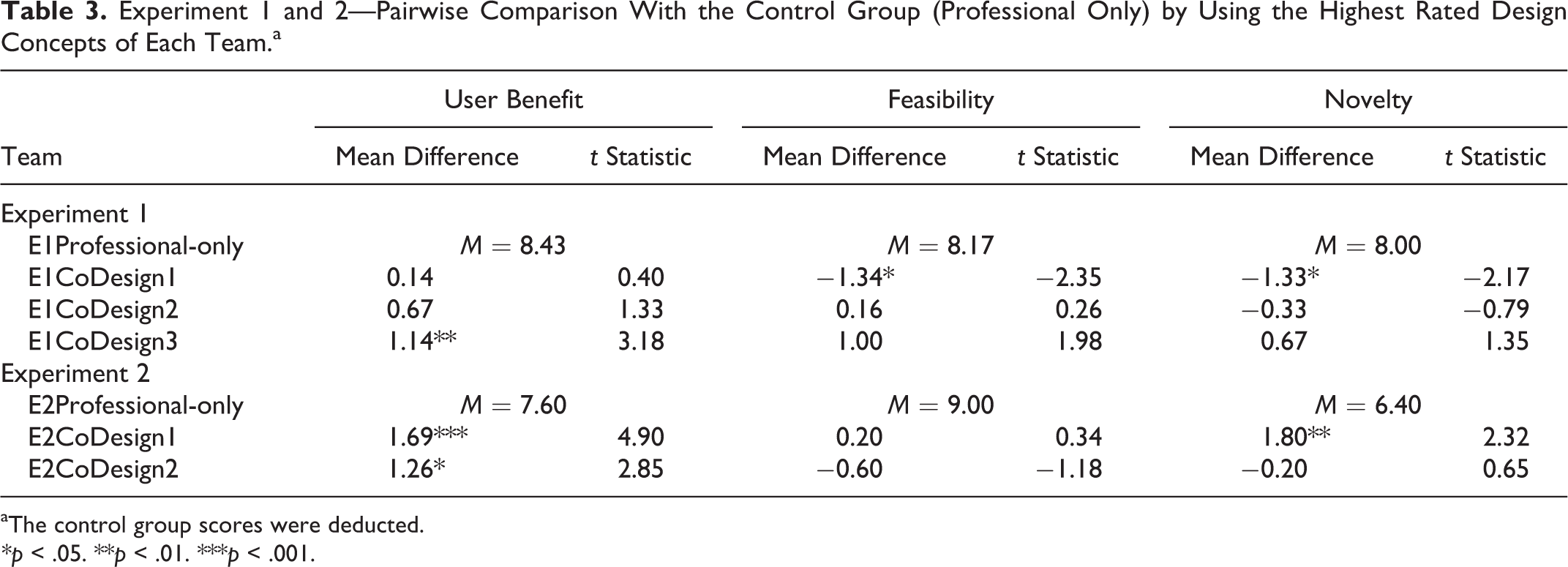
aThe control group scores were deducted.
*p < .05. **p < .01. ***p < .001.
Discussion of Study 1 Results
The results of Study 1 show that lead user involvement through codesign can result in the development of design concepts that are significantly greater in user benefit than those generated by a team consisting solely of in-house professionals. This finding supports the theory that the active involvement of users is important for exploring latent user needs (Witell et al. 2011). However, contrary to previous studies, no clear conclusions can be drawn on the other two innovation outcomes, feasibility, and novelty (Kristensson, Gustafsson, and Archer 2004; Magnusson, Matthing, and Kristensson 2003; Poetz and Schreier 2012). Only the concept of team E2CoDesign1 scored significantly higher in novelty than the one generated by the professional-only team. In turn, the concept developed by team E1CoDesign1 scored significantly poorer both in novelty and in feasibility. The other comparisons were nonsignificant.
The results across the outcomes point toward varying performances across the five codesign teams. This finding suggests that the effect of user involvement may be dependent on how involvement is managed (Magnusson, Matthing, and Kristensson 2003). As the case of team E2CoDesign1 suggests, codesign can result in concepts that are novel and high in user benefit. In contrast, the concept generated by team E1CoDesign1 scored low in both novelty and feasibility and therefore questions the effectiveness of codesign. Here it is important to point out that in contrast to previous customer cocreation studies, the current findings are based on users being involved in teams. This implies that the variations in team performance could have been a result of team-related factors influencing the outcomes (Hülsheger, Anderson, and Salgado 2009). These factors were able to be investigated through the observational and qualitative responses obtained from Study 1 and are reported later in this article. In addition, Study 2 was designed to provide a more nuanced understanding by breaking the design process into three design tasks related to the development of new learning environment concepts. This allowed for further exploration through the use of a more detailed experiment.
Study 2
Two experiments were conducted in Study 2 within the same study setting (the facility of Library 3). The first experiment (Experiment 3) sought to replicate the results of Study 1 and the investigation of Research Question 1(a and b) but used narrowly defined design tasks to allow for a more systematic comparison between the teams. In so doing, we expected to gain additional insights into the underlying reasons for the outcome variations that were evident in Study 1. In the second experiment (Experiment 4), the findings of Study 1 were extended by considering a user-only team to additionally investigate Research Question 1(a and c), namely, how do design concepts produced by a codesign team compare to concepts developed by a team consisting only of lead users. As for Study 1, the potential influence of intrateam factors as asked in Research Question 2 was also explored.
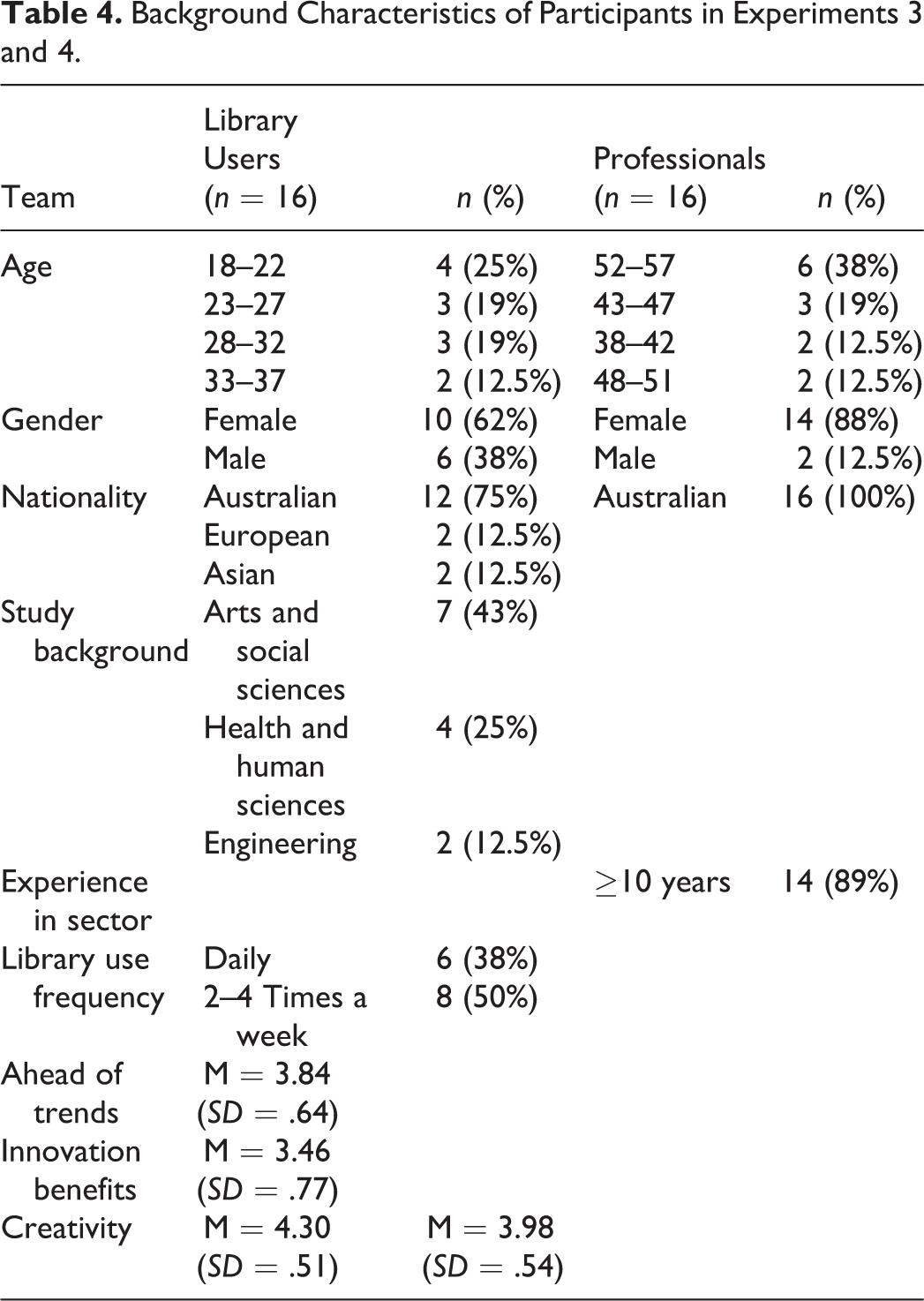
The procedure applied in Experiments 3 and 4 was identical to Study 1, but the design process was slightly longer in duration and contained three distinct tasks. After the introduction and inspiration phase (60 minutes), a new learning environment concept was developed into one floor plan template per team including the following tasks: (1) concept of a new entrance (60 minutes), (2) development of the floor plan layout (60 minutes), and (3) development of interior design ideas (60 minutes). In both experiments, three codesign teams (each consisting of two lead users and two in-house professionals) were used but with a professional-only team in Experiment 3 (comprised of four in-house professionals) and a user-only team in Experiment 4 (comprised of four lead users). The subjects were randomly selected from the respective Library 3 samples and assigned to the teams. The descriptive statistics of the users and in-house professionals that made up the teams for Experiments 3 and 4 are provided in Table 4.
Background Characteristics of Participants in Experiments 3 and 4.
The floor plan generated by each team was rated independently by judges in terms of its entrance, layout, and interior design. Acceptable interrater reliability was indicated for all three measures (Rc = .89 for user benefit, Rc = .92 for feasibility, and Rc = .95 for novelty). Table 5 provides an overview of the design concept ratings.
Experiments 3 and 4—Ratings of Generated Design Concepts.
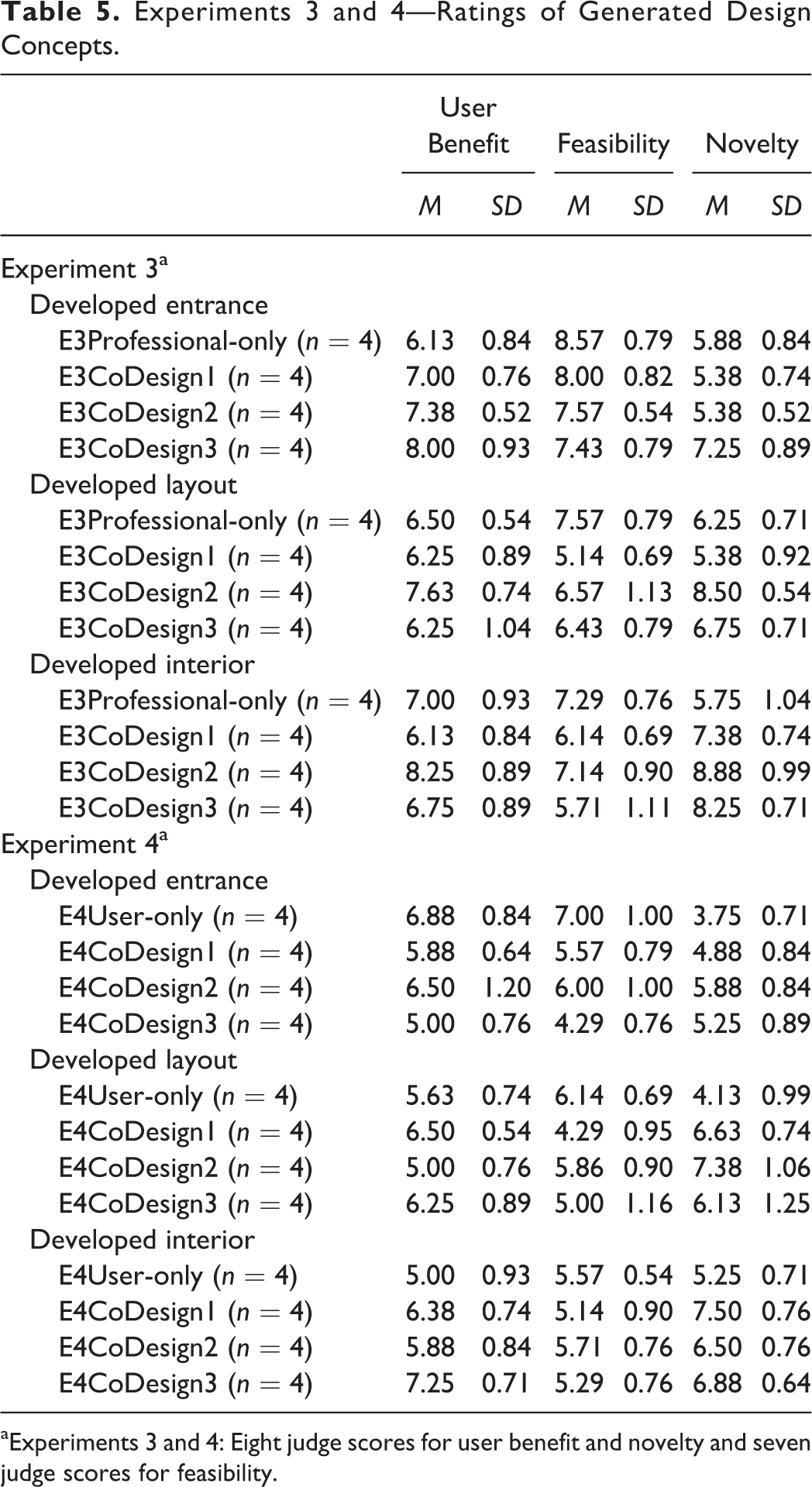
aExperiments 3 and 4: Eight judge scores for user benefit and novelty and seven judge scores for feasibility.
Results
For Experiment 3, as for Study 1, we used t tests to pairwise compare between concept ratings of the professional-only and codesign teams. The results revealed that five of the nine tasks undertaken by codesign teams produced design concepts that were significantly higher in user benefit (Entrance: E3CoDesign1, MA-B = 0.88, t = 1.98; E3CoDesign2, MA-B = 1.25, t = 3.60; E3CoDesign3, MA-B = 1.88, t = 4.25; Layout: E3CoDesign2, MA-B = 1.13, t = 3.47; and Interior: MA-B = 1.25, t = 2.76). In addition, as reported in Table 6, seven of the nine tasks undertaken by codesign teams produced design concepts lower in feasibility, while five of the nine produced concepts significantly higher in novelty.
Experiments 3 and 4—Pairwise Comparison With the Control Group by Using the Entrance, Layout, and Interior Design Concepts of Each Design Team.a
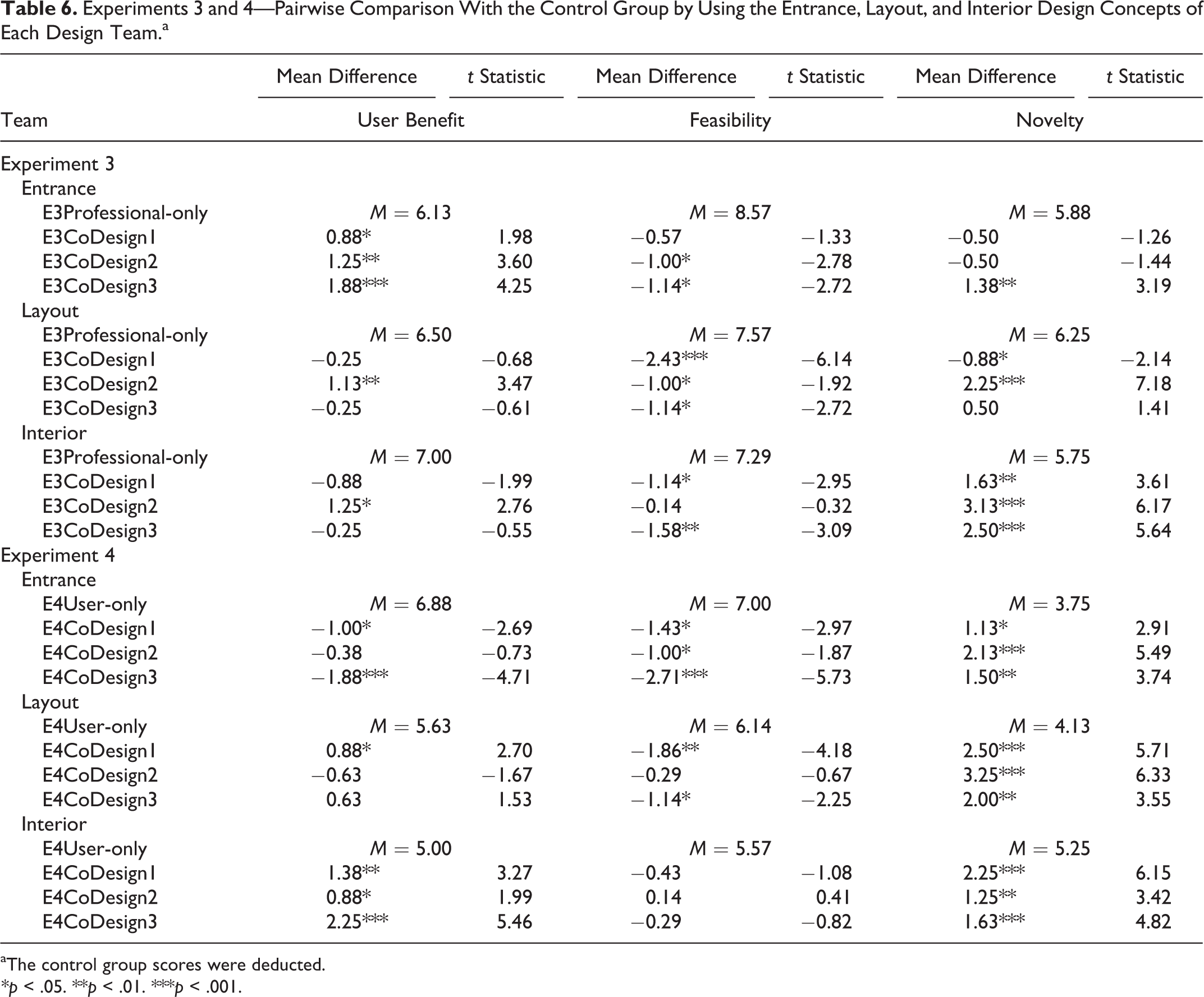
aThe control group scores were deducted.
*p < .05. **p < .01. ***p < .001.
For Experiment 4, we used the same analysis but made the pairwise comparisons between the user-only and codesign teams. The results revealed that four of the nine tasks undertaken by codesign teams produced design concepts that were significantly higher in user benefit while a further two were significantly lower in user benefit (Entrance: E4CoDesign1, MA-B = −1.00, t = −2.69; E4CoDesign3, MA-B = −1.88, t = −4.71; Layout: E4CoDesign1, MA-B = 0.88, t = 2.70; and Interior: E4CoDesign1, MA-B = 1.38, t = 3.27; E4CoDesign2, MA-B = 0.88, t = 1.99; E4CoDesign3, MA-B = 2.25, t = 5.46). The remaining results are reported in Table 6 and show that eight of the nine tasks performed by codesign teams were significantly lower in feasibility than the user-only teams, while all of the tasks performed by the codesign teams were significantly higher in novelty.
Discussion of Study 2 Results
The results of Study 2 draw a more consistent picture of the possible effects of lead user involvement through codesign. In accord with the Study 1 results, codesign led to design concepts high in user benefit. In addition, the codesign teams consistently outperformed both the professional-only and user-only teams in the generation of novel concepts. Codesign thus might be the “optimal” approach when original design concepts with potential high user benefit is the aim (Poetz and Schreier 2012). This finding is in contrast to studies suggesting that user consultation by in-house professionals can hamper innovative outcomes (Magnusson, Matthing, and Kristensson 2003). It appears that the exposure to an array of skills, knowledge, and expertise through the close collaboration between in-house professionals and lead users fostered novel ideas.
Conversely, the codesign teams did not perform well against either team when developing feasible outcomes. This finding suggests that the codesign approach may not utilize the advantage of converting the best ideas into useful concepts with in-house professional expertise as for example suggested by Steen, Manschot, and De Koning (2011). Surprisingly, the design concepts generated by the codesign teams were consistently less feasible than the ones developed by the user-only team. One possible explanation is that ideas developed by the user-only team were by definition less of a departure from what was already being used in the library context.
The variation evident in outcomes between some of the codesign teams suggests that codesign can but does not always lead to key innovation outcomes. In fact, in some instances, codesign may even diminish innovation outcomes. For service design researchers and practitioners, it is therefore important to understand the necessary conditions for codesign to leverage key innovation outcomes. We now turn to the intrateam analysis to investigate this further.
Analysis of the Field Notes and Open-Ended Questionnaire Responses
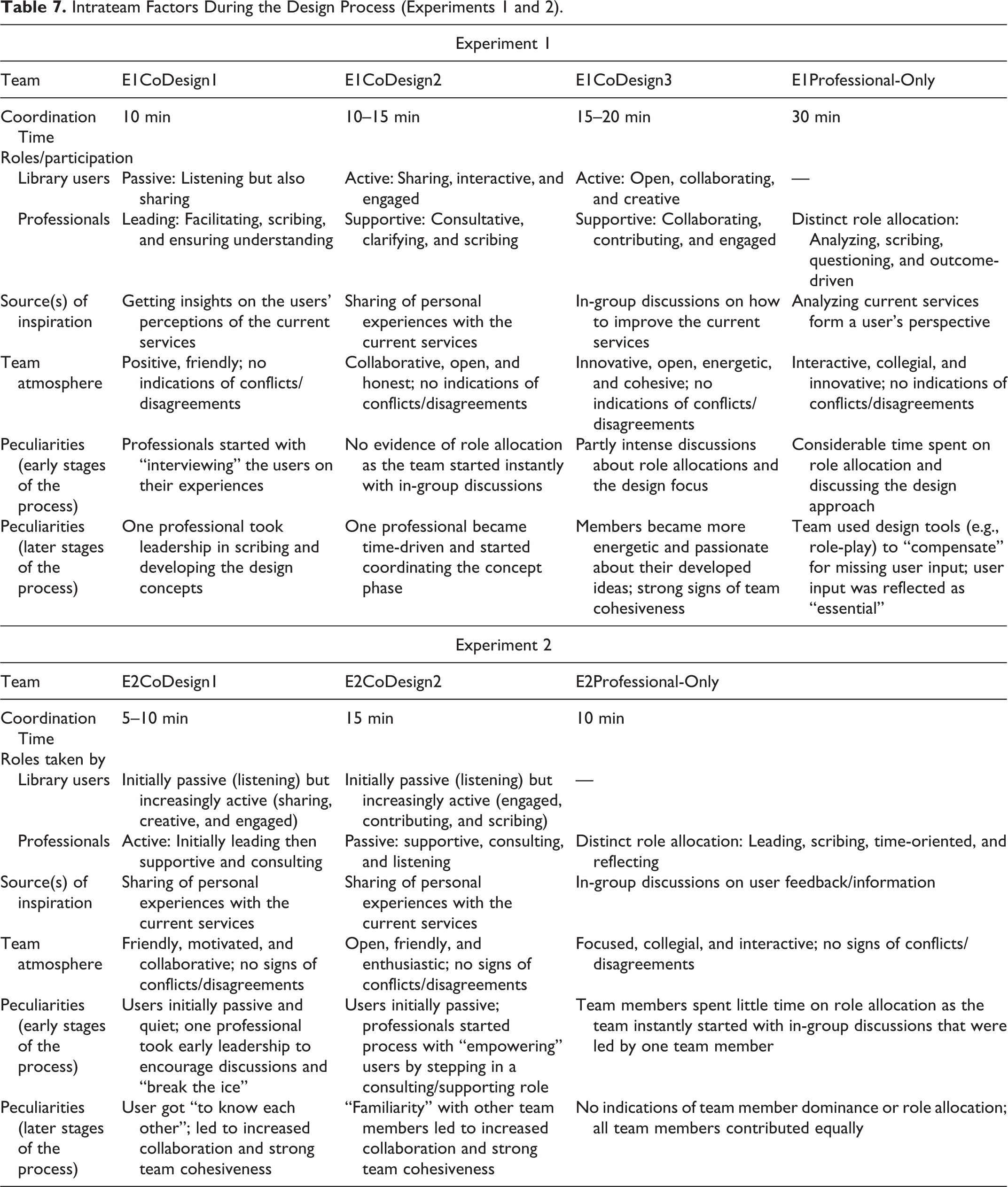
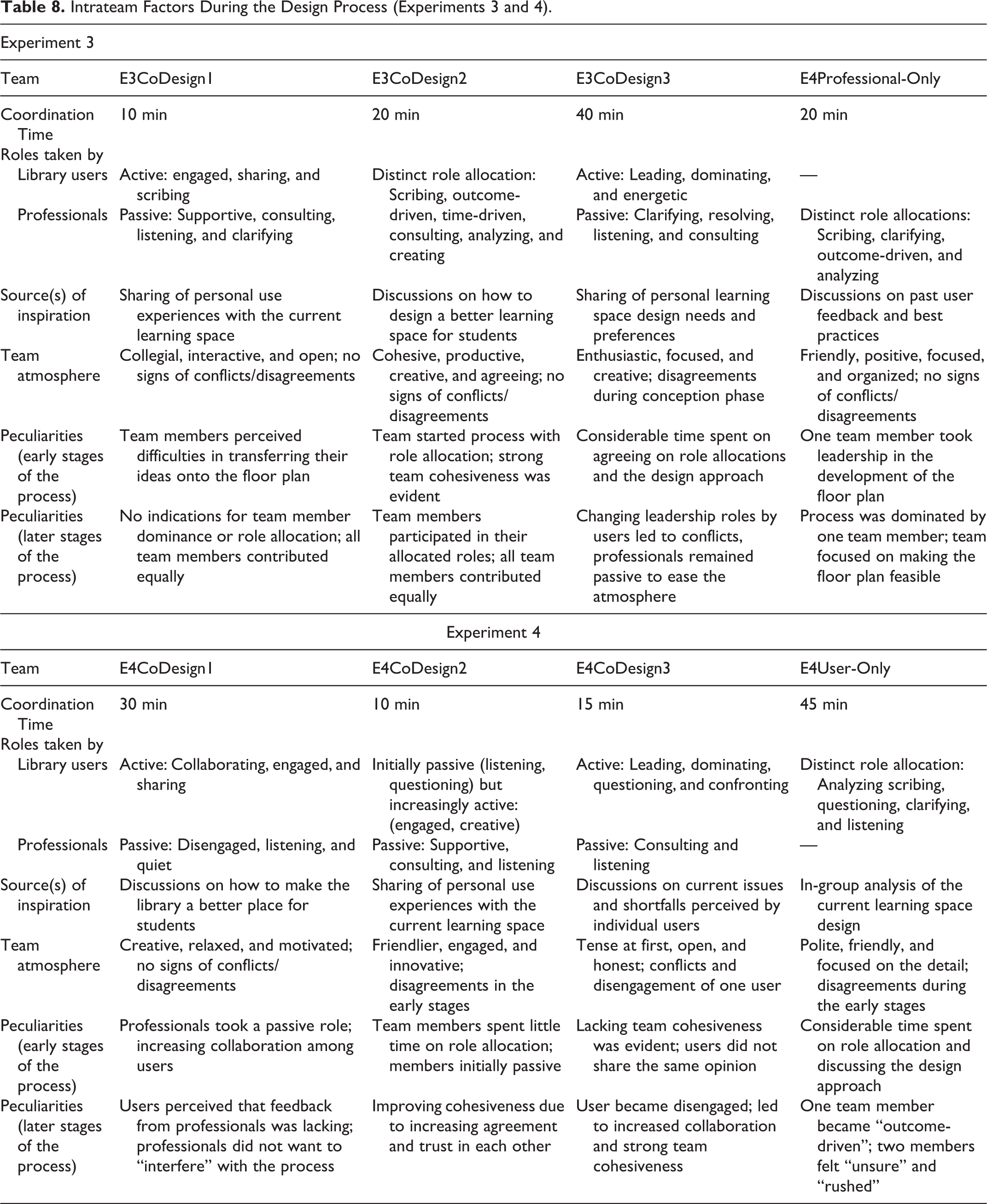
Through the analysis of field notes taken during the observations and open-ended questionnaire responses, intrateam factors were explored. The questionnaires and field notes were transcribed into MS Excel spreadsheets (Hahn 2008) and analyzed by reconstructing the occurrence and development of intrateam factors across the design process of each team. Particular attention was given to task orientation, team coordination and cohesiveness, conflict phenomena, and the form of participation by individuals. Patterns emerged from the data were further analyzed to explore how variations across the teams influenced the codesign process and outcomes. For this purpose, comparison matrices were used (Miles and Huberman 1994) allowing for the analysis of underlying structures and mechanisms (Sobh and Perry 2006). The insights derived from the exploration are provided in Tables 7 and 8.
Intrateam Factors During the Design Process (Experiments 1 and 2).
Intrateam Factors During the Design Process (Experiments 3 and 4).
Task Interdependence and Related Intrateam Factors
We first examined the influence of intrateam factors applied to the design activities. The findings suggested high levels of task interdependence with members in most teams collaborating closely on the generation of design concepts.
Team coordination and collaboration
Teams followed various approaches to increase team cohesiveness and identity. For example, some started the process with specific role allocations and discussions on the team’s objectives. These teams spent a considerable amount of time (up to 45 minutes) on coordination, which appeared to be necessary owing to the newness of the teams: “We spent quite a bit of time on understanding each other’s skills better and agreeing on different roles. It allowed everyone to use their own skills” (User, E3CoDesign2).
Other teams reported short coordination times (5–10 minutes) and immediately started with the idea generation process. Within all of these teams, users initially remained passive, while active leadership roles were taken by the in-house professionals. Users reported that time was required to “get to know each other” (User, E2CoDesign1) and to build “familiarity with others in the group” (User, E2CoDesign2). However, a move toward increased intrateam collaboration was also evident. This was made possible through a change of approach and roles taken by the in-house professionals. For example, professionals within the teams E2CoDesign1 and E2CoDesign2 reported that they started to “encourage more group discussions” and “break the ice” as well as stepping into “more of a consulting” and “supportive” role: I noted that I became biased towards what I thought are good ideas. So we started group discussions leading up to a “sticky note” session. I think this allowed both sides to bring knowledge and their experiences to the exercise. (Professional, E2CoDesign2)
Team cohesiveness and conflict phenomena
Not all teams were immediately able to bond and agree on the team’s objectives. Particularly in Study 2, the members of the codesign teams pointed out task-related conflicts during the early stages: It was difficult to include all ideas because we had quite different opinions on how the plan should be developed. We could not agree on where to locate the strategic points in our floor plan. (User, E4CoDesign3)
The occurrence and resolution of task-related conflicts reflected changes in key innovation outcomes across the design stages. For example, teams E4CoDesign1 and E4CoDesign3 developed low scoring design concepts during the first stage but improved significantly in later stages after conflicts had been resolved (see Table 6). In contrast, team E3CoDesign2 noted strong team cohesiveness from the beginning leading to the highest scoring layout and interior design concepts for user benefit and novelty (see Table 6). Task-related conflicts appeared to hamper team cohesiveness and collaboration, which subsequently negatively affected innovation outcomes.
Innovation-related benefit expectations
Considering the potential negative impact, we were interested in what might have triggered conflicts between team members. For instance, were they related to the different task specifications used in the studies? Notably, no conflicts were evident in the teams that participated in Study 1. However, in contrast to Study 2, the tasks were not restricted in regard to the type, focus, and numbers of design concepts and participants could simply resolve potential task-related conflicts by organizing objectives into the development of various design concepts. The design task of Study 2 did not allow this because teams needed to agree on the development of a single floor plan.
While some teams in Study 2 quickly agreed on the team’s objectives, others engaged in intense discussions and negotiations on how the floor plan should be developed. Hereby, users attempted to take leadership roles and convince other members as to which design ideas they should move forward: Some members tried to take leading roles which was a bit of a hindrance” […] “One drew a lot and tried to lead. Another was a good administrator and also led well. These two clashed in stage 2 but the other 2 [team members] were passive and eased the mood. (Professional, E3CoDesign3)
Sources of New Ideas and Design Focus
A second aspect of investigation was the sources of inspiration as well as the design focus taken by the teams. Of particular interest were the intrateam processes that led to the exploration of new design ideas and the subsequent key innovation outcomes.
Design focus and approach
All codesign teams focused on exploring possible future states and sketching out design concepts that would be of benefit to the library user. The source of new ideas was mostly based on sharing “current student experiences” (User, E4CoDesign3) and exploring “possible solutions for current shortfalls” (Professional, E2CoDesign2). In-house professionals actively engaged users in the ideation process in order to “feed off each other’s ideas and then thinking of ways to improve the student experience and delivery of services” (Professional, E1CoDesign2). A professional of team E2CoDesign2 reflected: I think both viewpoints are needed. Staff have a working and practical knowledge of the facilities and how the library services function. Students have a client view and fresh ideas. This mix gave us different perspectives and some unexpected insights.
The professional-only teams seemed to focus on the development of design concepts that enhanced user benefit. They engaged in user-centered design exercises to explore possible use situations. For example, a member of team E1Professional-only reported that the team used “role-plays” in order to “put ourselves into the ‘shoes’ of the student[s]”: We started using role plays—walking through the front door and getting a feel of the anxiety a student would experience when coming to the library the very first time. I think this is an important communicative tool to be able to reach a holistic understanding of the students’ experience. (Member, E1Professional-only)
In-house professionals of the codesign teams further noted that “Students were unencumbered with blocks, such as university systems, budgets and other controls” (Professional, E4CoDesign1). It was repeatedly observed that teams became more open and unstructured in their interactions. One user of team E4CoDesign2 commented that “we started to become more innovative and bounced ideas off each other.” In addition, role allocations made early in the process, as illustrated by a user in team E3CoDesign2, seemed to foster creative thinking as team members could use their specific skills and participate in different roles: I had some good ideas but was happy that we had a designated person who scribed and was able to translate our ideas to the plan. I was surprised myself with my creativity—I always thought I wasn’t really that creative. (User, E3CoDesign2)
The user-only team followed a different design approach and objective. Describing the team as “outcome-driven” and “focused on the detail,” one user noted that focus was not on user benefit per se but rather on making the floor plan feasible. Task-related conflicts were evident early in the process, which led to the perception that finding a consensus between four members with different innovation-related benefit expectations would not be realizable: “We had a lot of ideas on how the library space could be used. But at the end we were after a design that might actually be implemented. I think our floor plan is very feasible” (User, E4User-only).
While the outcomes of the user-only team scored significantly higher in feasibility than those of the codesign teams, it achieved less novel outcomes with scores as low as 3.75 of 10. The user-only team might have overemphasized feasibility, which could have inhibited the creativeness of the team.
Discussion of Findings from the Intrateam Analysis
The intrateam analysis revealed different approaches to facilitating collaboration. Some teams spent considerable coordination time related to the newness of the team and the high levels of task interdependence. Evidence of high task interdependence was reflected in the teams’ development toward increased cohesiveness, despite conflicts, in order to foster collaboration. Team members appeared to realize that close collaboration was required to successfully handle the complexity of the respective design tasks at hand. It was also observed that in-house professionals partly adjusted their approach to improve collaboration and user engagement during the process. This finding, consistent with Steen, Manschot, and De Koning (2011), suggests that the focus of codesign is on gaining insight into user experiences and latent needs, which can lead to outcomes that are high in user benefit. The consistently higher novelty scores of the codesign teams supports studies showing that the collaboration between members with a broad array of skills and knowledge can foster team creativity (Somech and Drach-Zahavy 2013). Yet, this creative approach to seeking improved user benefits appears to have reduced focus on feasibility.
The findings from the cross-comparison analysis further suggest that task-related conflicts negatively affect key innovation outcomes. These conflicts seem to be related to the incompatibility of users’ innovation-related benefit expectations, which is a task-related motivational driver that is typical for lead users and their engagement in innovation activities (Lüthje 2004; Matthing et al. 2006). Within the codesign teams, lead users engaged in a competitive conflict management style (i.e., competing, controlling, and contending for what should be designed). This has previously been suggested as a hindrance to team cohesion and intrateam collaboration that negatively affects team outcomes (DeChurch, Mesmer-Magnus, and Doty 2013). This may be why the user-only team did not focus on user benefit but on feasibility to avoid competing behavior and to foster team identity and cohesiveness.
General Discussion
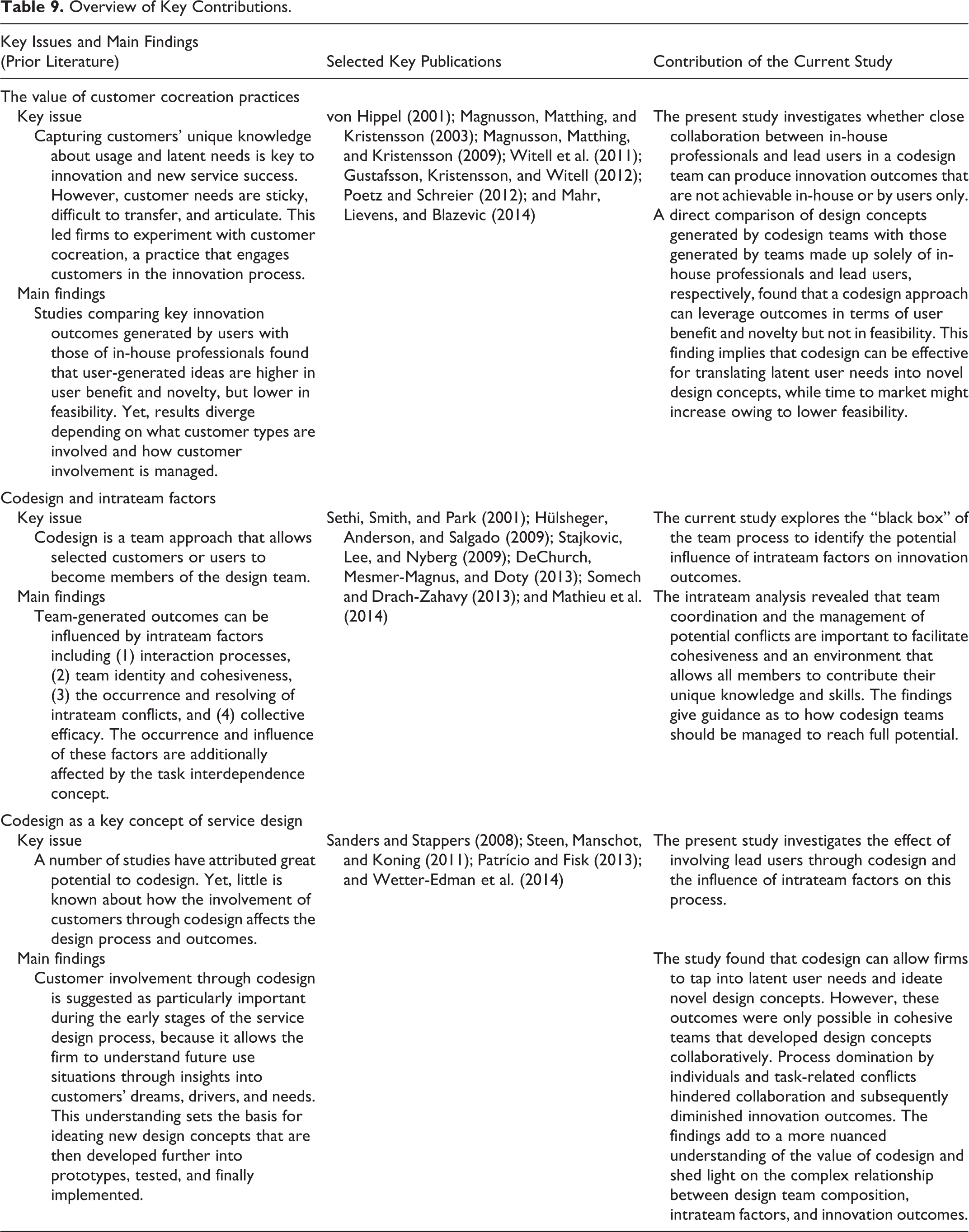
This article has reported on an investigation of customer involvement through codesign in comparison to other commonly used design approaches employed during the ideation stage of a service design process. In the course of a library service ideation contest, it examined and compared design concepts generated by a codesign team (i.e., in-house professionals collaborating with lead users), in-house professionals only, and teams made up solely of lead users. Intrateam factors affecting design process and outcomes were also examined. Table 9 highlights the contributions this research makes. The implications for theory and practice are discussed next.
Overview of Key Contributions.
Theoretical Contribution
This research provides a real-world comparison of codesign with alternative design approaches. Through the exploration of Research Question 1, a key contribution of the research is that the involvement of lead users through codesign can leverage innovation outcomes in terms of user benefit and novelty. The high user benefit scores confirmed the importance of actively engaging customers in service design and innovation processes because it provides an effective way of understanding of how customers create value in their context (Gustafsson, Kristensson, and Witell 2012; Pinho et al. 2014). Findings additionally suggest that codesign fosters creative thinking and novel outcomes. The close collaboration between in-house professionals and lead users appears to facilitate the exploration of latent user needs allowing the development of novel design concepts for possible future use situations (Steen, Manschot, and De Koning 2011).
However, the codesign approach does not seem to overcome low feasibility scores as suggested by previous studies (Poetz and Schreier 2012). This finding is consistent with customer cocreation research showing that user-generated ideas, albeit novel, are rarely implemented by the underlying firm (Edvardsson et al. 2013; Magnusson, Matthing, and Kristensson 2003). The insights into design focus indicated that professionals within the codesign teams did not prioritize feasibility but instead saw the activities as an opportunity to tap into library users’ experiences and latent needs. By comparison, professional-only teams focused on user benefits and applied user-centered methods in order to “compensate” for a lack of user participation. Yet, the comparison of outcomes, particularly user benefit, showed that such design methods might not substitute for active customer involvement and reinforces the argument that user information is “sticky” and therefore cannot be readily transferred (von Hippel 2001; Witell et al. 2011).
A second contribution from this research is the finding that the user-only team produced more feasible but less novel design concepts than the codesign teams, indeed these users prioritized feasibility. It is possible, in line with existing studies, that the advanced knowledge possessed by lead users restricted the generation of novel ideas (Magnusson 2009; Mahr, Lievens, and Blazevic 2014). However, the insights from the intrateam analysis suggest an additional effect related to the team approach used in this research: As lead users typically have high and very specific innovation-related benefit expectations closely related to the underlying task (Lüthje 2004), they appear to have been unable to agree on a multiple design concept that they would value being able to use. This suggests an alternative explanation in team member conformity, where team members’ desire to be accepted leads to conservative and highly similar ideas (Schirr 2012). Another possible explanation is that the user-only team lacked the support and empowerment provided by professionals and took a “play-it-safe” approach which came at the cost of novelty. Both arguments, however, are speculative and call for further investigation.
Through Research Question 2, the research explored the black box of the team process to identify important intrateam factors. In line with the team research literature (Hülsheger, Anderson, and Salgado 2009; Mathieu et al. 2014), intrateam factors appear to have substantial effects on design process outcomes. The analysis showed that in part, teams used very distinct design approaches in order to improve cohesiveness and foster collaboration. This finding supports the relevance of high task interdependence in service design, especially at the fuzzy front end of the design process (Patrício and Fisk 2013; Sanders and Stappers 2008). As a consequence, relevant intrateam factors for codesign processes include team coordination to increase team identity, cohesiveness and collaboration (Sethi, Smith, and Park 2001), task-related conflict phenomena (DeChurch, Mesmer-Magnus, and Doty 2013), and the team objective and related design approach (Stajkovic, Lee, and Nyberg 2009). Task-related conflicts appear to particularly apply to codesign teams involving lead users with high innovation-related benefit expectations. When these expectations are not compatible, users engage in a competing conflict management style, which can impede team performance (DeChurch, Mesmer-Magnus, and Doty 2013). The implication is that specific motivators of user participation need to be considered in codesign activities because they can affect the collective creativity within the design team and, as this study shows, even diminish key innovation outcomes.
Managerial Implications
This research shows that codesign can leverage key innovation outcomes. Service designers that utilize in-house professionals with lead users can achieve greater collective creativity by tapping into latent user needs and enabling the elaboration of novel ideas. However, codesign teams appear to produce the least feasible concepts, which means that extra time and costs will be required for the subsequent development phases. While user benefit and novelty may outweigh this limitation, it might substantially increase the time to market making codesign less attractive in a dynamic marketplace.
It appears that specific conditions need to be met for the successful use of codesign. A codesign team may be professional-led, user-dominated, or a truly collaborative process. The current study indicates that a collaborative approach, which allows all team members to actively contribute their specific skills and knowledge, is the most effective. It is therefore imperative that service designers facilitate the codesign process in a way that fosters team cohesion and collaboration between all members. This can be realized through coordinating team roles and agreeing on the team’s objectives early in the process in order to foster team identity and avoid competing or conflict behavior. As intrateam factors might not be readily manageable by an external team facilitator, an approach where a service designer participates as a member of the team might be more effective.
It is also recommended to prioritize front-end planning including the user selection process and the design task specification. Setting out clear expectations and potential benefits of the design activity might allow for the self-selection of lead users who may be drawn to activities, where they have a common personal interest or perceive potential benefits through contributing. The assembling of the codesign teams should be approached with consideration of user characteristics such as benefit expectations, motivation for innovation, and background diversity. Assembling codesign teams in a systematic way can allow service designers to not only predetermine the conditions for intrateam collaboration but also to produce focused outcomes that address a specifically defined design task and market. A final recommendation is to be aware of the need to facilitate newly assembled codesign teams. Members, who might not have previously collaborated, are from diverse backgrounds and/or have different interests, need be enabled to build familiarity with one another and to bond as a team.
Study Restrictions and Future Research
This research is not without restrictions. The first is that the study was not designed to detect small effects and that in consequence, the t tests had low statistical power. Thus, no conclusion could be drawn from the nonsignificant results reported in this research; that is, it was not possible to affirm whether a nonsignificant result equaled 0 (Sedlmeier and Gigerenzer 1989).
The second restriction was the use of specific types of design tasks, the design approach, and the samples used in this research. These were necessarily narrowly defined to avoid internal validity problems (Maxwell and Delaney 2004). In addition, the selected in-house professionals, while highly experienced in developing and implementing library services, were not service designers skilled in empowering and engaging users in the design process. Further, the involved service users represented lead users of the respective service rather than randomly selected customers. The specific setup means that the team processes and outcomes might vary in accordance with the design task used, the specific participants involved, and the way the codesign activity was facilitated (Mattelmäki and Visser 2011). Future research should systematically investigate collaborative design teams by extracting relevant participant characteristics or simulating different facilitation scenarios. Thereby, research might consider manipulating the form of process facilitation to systematically investigate requirements for managing service design teams in which members are highly diverse in their background characteristics, design expertise, and/or motivations. The study was also conducted within a specific setting, namely, Australian academic libraries. Future studies might consider high-risk environments or where time to market is critical and certainly should test codesign for service applications beyond the academic library and education sector.
Finally, this research focused on the ideation stage with the aim of exploring latent user needs and generating concepts as possible foundations for new service offerings. Experiments were also based on short sessions (i.e., 3.5–4 hours), in which teams were asked to address complex tasks. Previous experimental studies in customer cocreation research suggest that this time frame is reasonable for generating valid results (Franke, Schreier, and Kaiser 2010; Schreier, Fuchs, and Dahl 2012). In addition, participants indicated that the duration of the activity was adequate for achieving the set objectives. Yet, the short duration of the sessions and the nature of the tasks might have implied that the in-house professionals within the codesign teams saw the feasibility dimension as the focus of the succeeding design stages. In fact, codesign is recommended as an activity that is embedded in the broader service design process (Stickdorn and Schneider 2010). Future research might examine the effect of individual codesign activities on the iterative development and implementation of new service offerings by means of a longitudinal study.
This research has taken an early step in exploring the effect of involving lead users through codesign. The team perspective provides insights into the potential effect of intrateam factors on key innovation outcomes. The influences of these team-related factors have not previously been tested empirically. Further research is required to systematically identify and test these factors, not only in direct relationship to innovation outcomes but also in their relationship to each other, using different study contexts to determine their generalizability and validity. This will help build a more complete theory to address the consequences of customer involvement in service design teams.
Footnotes
Appendix
Measurement Items.a
| Ahead of trends (Franke and Shah 2003, p. 163) |
| In general, I find out about new services and solutions for using library resourcesb (learning environments)c earlier than others. |
| I have already approached the library with ideas for improving the existing library resources (learning environment design) |
| I have benefited highly from the early adoption and the use of new library resources (learning environments) |
| With regard to using library resources (learning environments), I am often asked for advice |
| Innovation-related benefits (Lüthje 2004, p. 689; Skiba and Herstatt 2008, p. 33) |
| I have needs related to the library resources (learning environment) which are (is) not covered by the existing services (learning environment design) |
| I am dissatisfied with the existing library resources (learning environment design) |
| I am dependent on the use of the library resources (learning environment) |
| I would benefit significantly from any improved or new library service (learning environment design) |
| Creativity (Hofstee, Raad, and Goldberg 1992, sourced from the International Personality Item Pool) |
| I have a vivid imagination |
| I have no special urge to do something originald |
| I seldom experience sudden intuitive insightsd |
| I like to solve complex problems |
aAll items were measured with 5-point Likert-item scales with strongly disagree (1) and strongly agree (5) as anchors. bItems were modified for the context of library resources in Study 1. cItems were modified for the context of learning environment in Study 2 (in brackets). dReverse-coded items.
Acknowledgments
We would like to thank Per Kristensson, Anita Zehrer, Harald Van Heerde, and the three anonymous reviewers for their valuable comments and feedback on earlier versions of this article. We also thank Kate Kelly, Sandra Jeffries, and Elisabeth Sinnewe for their cooperation and help in realizing this study.
Declaration of Conflicting Interests
The author(s) declared no potential conflicts of interest with respect to the research, authorship, and/or publication of this article.
Funding
The author(s) received no financial support for the research, authorship, and/or publication of this article.
Notes
References
Supplementary Material
Please find the following supplemental material available below.
For Open Access articles published under a Creative Commons License, all supplemental material carries the same license as the article it is associated with.
For non-Open Access articles published, all supplemental material carries a non-exclusive license, and permission requests for re-use of supplemental material or any part of supplemental material shall be sent directly to the copyright owner as specified in the copyright notice associated with the article.
