




Abstract
Research on value creation traditionally has focused on value created by the company, though customers increasingly serve as active partners, able to create value with firms in a collaborative manner. Despite interest by both scholars and managers, existing research has not yet clarified the interdependencies of service offerings and customer role patterns. This article explores value creation rooted in three generic offerings (configuration, solution, and network) and identifies differences in their prerequisites, customer activities, challenges, abilities, ability enhancers, and perceived benefits that arise in collaborative value creation (CVC). Data from 105 collaborations, collected through in-depth interviews, support the qualitative and quantitative analyses that reveal distinct patterns in customers’ value creation for each service offering. A categorical principal components analysis, combined with cluster analysis, identifies five customer roles: bargain-hunting independent, comprehensive help seeker, engaged problem solver, technology-savvy networker, and self-reliant customizer. Our theoretical contribution includes the identification of customer roles across generic offerings and empirical evidence that customers perform multiple roles when engaging in CVC processes. Our findings provide managers engaged in CVC with recommendations on criteria for segmenting customer groups, on the role of the service provider in various value creation processes, and on tailored communication strategies to attract customers.
Introduction
In service settings, customers “often find that performing tasks themselves is faster, more efficient, affords a larger sense of control, and in some cases presents greater customization of the results … customers are able to unlock more value from purchased goods and services when they can successfully complete tasks themselves” (Honebein and Cammarano 2006, p. 26). In turn, they increasingly create value themselves through self-service activities (e.g., booking a holiday trip online) or interactions with other customers (e.g., experience seeking on social networks). Both these facets complement the customer-firm interaction and imply a more active role of customers (Vargo and Lusch 2008) that might affect the benefits they seek, the activities they demand, and their abilities (Payne, Storbacka, and Frow 2008). Thus, traditional views of marketing and value creation, in which companies created value and customers consumed it, demand revision, because value is cocreated through their collaboration (Grönroos and Voima 2012; Helkkula, Kelleher, and Pihlström 2013; Ramirez 1999; Vargo and Lusch 2004b). Modern customers perform diverse roles that vastly exceed their traditional buyer or beneficiary tasks (Bitner et al. 1997). Despite widespread recognition that firms need to integrate alternative routes to value creation and substantially alter their activities and resources (Moeller 2008), they continue to struggle with this effort though. A senior vice president of Oracle thus explained, There is still more we need to understand to advance to this new level of co-created customer experience. Customers have told us what they want, such as more personalized and proactive support, better access to intellectual property and best practices, a trusted network for peer-to-peer interactions, deeper relationships with companies, and higher value solutions. However, getting there requires an unprecedented level of customer collaboration. (quoted in Ostrom et al. 2010, p. 22)
In this process, firms might benefit from an integrative perspective that considers collaborative value creation (CVC) and the roles that customers perform to achieve value in various service offerings.
In line with research signaling, the shift in value creation perspectives away from firms creating value for customers to creating value with customers (Prahalad and Ramaswamy 2004; Vargo and Lusch 2004b), we combine research on customer participation (e.g., Bendapudi and Leone 2003), customer integration (e.g., Moeller 2008), and cocreation (e.g., Payne, Storbacka, and Frow 2008) to outline the process, resources, and value of CVC. We define CVC as a process through which customers perform roles to derive benefits by either jointly with the service provider or independently leveraging their own and the service provider’s resources. This value can thus be created in interaction with the service providers (e.g., consulting) or by making use of service providers’ resources (e.g., ATM). These shifting roles of customers represent one of the great challenges to businesses today (Ostrom et al. 2010; van Doorn et al. 2011), in that customers influence not just the service and their own satisfaction and value (Bettencourt et al. 2002; Franke, Schreier, and Kaiser 2010) but also the benefit of the provider (Lengnick-Hall 1996). This study thus aims to explain the roles customers perform, the activities they undertake, and the related challenges and implications for both customers and service providers.
We rely on several streams of research relevant to customers’ roles in CVC. First, we address customer collaboration in service delivery, including cocreation and customer participation, involvement, and integration (e.g., Bitner et al. 1997). Second, we draw on generic value creation frameworks (e.g., Stabell and Fjeldstad 1998) to delineate the processes and outcomes of customer collaboration. Third, role theory (Biddle 1986) offers a more fine-grained view of individuals during value creation. Despite the contributions of these streams, we concur with Payne, Storbacka, and Frow (2008, p. 83): “little is known about how customers engage in co-creation.” In particular, recent research offers important contributions for specific contexts (e.g., patients suffering from cancer; McColl-Kennedy et al. 2012) but minimal empirical evidence about CVC across contexts and roles that can increase the generalizability of extant findings. We thus need research to shed light on different customer roles and their management across complex, diverse offerings, which constitutes a research priority for service science (Ostrom et al. 2010).
Accordingly, we investigate a broad set of service offerings that require CVC and involve distinct roles for customers to perform. We thereby contribute to marketing literature and the growing service-dominant logic field in several ways. First, we define CVC and empirically validate its emergence in service offerings over a wide range of market offerings. Drawing on an established value creation framework, we specify and include configuration, solution, and network offerings. In addition, to advance the strategic perspective on value creation (e.g., Normann and Ramirez 1993; Prahalad and Ramaswamy 2004), we empirically explore the commonalities and differences in CVC across offering types with in-depth interview data. Second, we examine the roles customers perform during various CVC processes, according to role theory. Using the resultant qualitative insights, we delineate five customer roles and their activities, challenges, ability enhancements, and perceived benefits. Our findings highlight role learning and role acting as two prevailing dimensions on which customers’ roles differ. Third, we develop a CVC framework that matches these roles with three service offerings. Recent studies often tie roles to contexts (e.g., McColl-Kennedy et al. 2012) or service channels (e.g., self-service technologies; Collier and Kimes 2012), but customers may vary across both contexts and personal characteristics and perform multiple roles (e.g., Lamb and Kling 2003). Therefore, we extend current role conceptualizations using quantitative evidence of five distinct customer roles manifesting in multiple service offerings. This approach provides a finer grained assessment of why and how customers participate in different value creation activities; the comprehensive view also provides recommendations for managers about customers’ expectations and the potential for frictions during CVC.
In the next section, we review the three relevant literature streams, before we describe our research methodology through which we derive five CVC customer roles. These roles are then linked to their occurrence in three service offerings. Finally, we open a discussion and derive managerial implications.
Literature Review
Customer Collaboration in Service Delivery
Customer collaboration literature provides our theoretical foundation. Value creation cannot be accomplished without customers’ collaboration, so scholars in varied fields examine it with emphases on different elements. For example, organizational research demonstrates the impact of customers’ contributions to firm processes and identifies contingency effects (e.g., customers’ commitment to the firm; Nambisan and Baron 2010), generally focusing on the firm as the beneficiary rather than taking a customer perspective. Innovation research encompasses both perspectives by noting how customers perform innovation activities traditionally executed by firms to increase the fit of the innovation with their own preferences and feelings of accomplishment (Franke, Schreier, and Kaiser 2010), while firms enjoy a higher innovation success rate at lower costs (von Hippel 2005), because customers, as current and future users of the offerings, possess unique knowledge and abilities (Mahr and Lievens 2012). However, other customer functions (e.g., as buyer) remain underresearched in innovation studies. Operations scholars instead disentangle different roles for customers; Lengnick-Hall (1996) identifies five customer roles whose inputs may lead to enhanced productivity and competitive quality for the firm. Taking a different perspective, information systems research focuses on customers as information users and their interactions with the environment, such as systems or other actors holding information (Hartwick and Barki 1994; Lamb and Kling 2003). Information users perform various roles, because their interactions vary in purpose, social embeddedness, and performed activities. Yet, customer activities that are not technology mediated or that relate to physical input have received limited attention in information systems research. Overall, all research fields acknowledge the increasingly active role of customers but take different approaches.
The interdisciplinary approach of service research facilitates the integration of complementary perspectives, such that this literature refers to the customers’ active role as customer participation (or coproduction; e.g., Auh et al. 2007; Bendapudi and Leone 2003; Bitner et al. 1997; Etgar 2008; Normann and Ramirez 1993), customer integration (e.g., Edvardsson et al. 2012; Fließ and Kleinaltenkamp 2004; Gouthier and Schmid 2003; Moeller 2008), and cocreation (Grönroos and Voima 2012; Helkkula, Kelleher, and Pihlström 2013; McColl-Kennedy et al. 2012; Payne, Storbacka, and Frow 2008; Prahalad and Ramaswamy 2004; Vargo and Lusch 2004b, 2008). Though these definitions have points of difference, they consistently indicate that either a provider and customer jointly create value or the provider facilitates customers’ independent value creation. Both are forms of collaboration—a higher order term describing all these perspectives.
Research on customer participation mainly refers to activities customers take within the service process and contrasts the different types and shares of activities taken by customers and service providers as well as their implications for both parties (Bendapudi and Leone 2003; Etgar 2008). Such customer participation often implies better productivity for service providers, which can outsource or externalize their activities to customers (Bettencourt et al. 2002; Lengnick-Hall 1996). Several abilities are required to fulfill such activities, especially if the task is perceived as challenging; for example, Etgar (2008) notes that access to skills linked to specific tasks can facilitate customer participation, and Risch Rodie and Schulz Kleine (2000) identify poor customer ability as a barrier to collaboration (Collier and Kimes 2012; Meuter et al. 2005). However, little empirical evidence describes the exact activities and roles that customers perform or the abilities needed. To shed light on these aspects, we incorporate activities, challenges, ability requirements, and the means to overcome weak or lacking abilities into our research.
Research on customer integration takes a resource perspective and includes customers’ input into the value creation process (Gouthier and Schmid 2003; Moeller 2008). In this context, CVC resources are either provider-level or customer-level factors that can contribute economic benefits (Galbreath 2005). Beyond human resources (e.g., customers performing activities; Gouthier and Schmid 2003), these resources can be tangible (e.g., a car to be repaired) or intangible (e.g., customers’ knowledge; Fließ and Kleinaltenkamp 2004). To create value, customer resources must be combined with provider resources (Fließ and Kleinaltenkamp 2004; Moeller 2008). In a car repair setting, for example, customers provide the necessary resource (i.e., the car to be repaired) and the mechanic uses his or her resources (e.g., equipment and know-how) to repair it. Following, we also consider which resources are required for which kind of service and which roles are linked to integrating those resources. We account for customer resources as input into CVC in our data analysis.
Research on cocreation mainly takes a value creation perspective (Prahalad and Ramaswamy 2004) and reflects the service-dominant logic (Vargo and Lusch 2004a) and the Nordic School of Service Marketing (Grönroos 2011). In contrast with a goods-dominant logic, these recent views emphasize the interaction between the company and the customer as the locus of value creation. Firms cannot separate the market from the value creation (Prahalad and Ramaswamy 2004), and value might not even exist until the firm’s offering is used or consumed (Grönroos 2011; Vargo and Lusch 2004a). In these approaches, customers’ experiences and perceptions determine the value created. Value is therefore defined as a judgment “always uniquely and phenomenologically determined by the beneficiary” (Vargo and Lusch 2008, p. 3), hence by the experience the customer develops with the service provider.
To understand customer value creation, it is also necessary to view the customer as the value creator and the service provider and other customers as facilitators of that value creation in line with the contributions from the Nordic school (Grönroos 2011). Considering the origin of value and the interaction of customer and provider, three spheres of value creation can be distinguished: a provider sphere, a joint sphere, and a customer sphere (Grönroos 2011; Grönroos and Voima 2012; Moeller 2008). In the provider sphere, there is no interaction between customer and provider, and it only potentially creates value for the customer, by preparing for joint value creation. The joint sphere involves direct interaction between provider and customer, so value is usually created by customers (Grönroos 2011; Grönroos and Voima 2012). In contrast, interaction in the customer sphere happens between customers or with the facilities of the provider, but without the active and personal involvement of the service provider. Our research focuses on the two latter spheres, because they involve interaction with customers. Value is a perception of customers and originates in an interaction, so it can only emerge from the joint activities of providers and customers (joint sphere) or from sole customer activities (customer sphere; Grönroos and Voima 2012). Adapting Grönroos and Voima’s (2012) terminology, we term value creation in the customer sphere as independent value creation and value creation in the joint sphere as joint value creation. Although conceptually independent, these spheres overlap and complement each other. For example, the actual value of a car repair or travel booking only comes to light in the customer sphere, when the customer drives the repaired car or travels, because the customer realizes benefits from a transformation fulfilled in the joint sphere (Moeller 2008). Our conceptualization incorporates the activities, resources, and value perspectives by defining CVC as a process in which customers perform roles to derive benefits by leveraging their own and the service provider’s resources.
Types of Service Offerings
We draw on the generic value creation framework of Stabell and Fjeldstad (1998) and its three types of service offerings. First, this framework explicitly accounts for the heterogeneous nature of services and provides comprehensive coverage of marketed offerings. Second, the chosen typology matches our focus on value creation by defining value as a means to differentiate services and integrate customers as beneficiaries of value creation. Existing service research uses various criteria to differentiate services, though most typologies include the resources on which a transformation is performed and the level of personalization (or customization; Cunningham et al. 2004). From a value creation perspective, Stabell and Fjeldstad’s framework accounts for both these important dimensions. Since the authors chose names analogous to the value chain (i.e., value shop and value network), we needed to rename the types of offerings to adapt the typologies to our CVC setting. Given our value definition that value cannot be created solely by the firm, we chose the term offering and derived further names from the main value driver: configuration, solution, or network.
Collaboration with customers, which requires them to provide data about their preferences and either independently or jointly configure the customized output, is a configuration offering. Service providers offer products bundled with respective services that support substantial customization to match customers’ demands (e.g., Franke, Schreier, and Kaiser 2010), and the utility of these products is higher (Dellaert and Stremersch 2005). Such offerings usually involve the modularized product parts (e.g., computer components), services to help customers make choices (e.g., travel agent consultation), and information from customers about their preferences (e.g., color and extra options on a new car). Value offered by companies in such offerings resembles value creation in value chains, in which inputs get transformed into outputs (Stabell and Fjeldstad 1998).
The second type of service, the solution offering, is based on the customer’s problem when there is a perceived difference between an existing and a desired state. A problem-solving process then pursues change to achieve the aspirational state (Stabell and Fjeldstad 1998). Service providers can accomplish such changes with regard to physical objects (e.g., car repair) or the consumer himself or herself (e.g., surgery; Lovelock 1983). Such services usually involve an information or competence asymmetry between the provider and customer, which provides the origin of the demand (Stabell and Fjeldstad 1998). Customers have more knowledge about the problem; providers have more information about the solution; their collaboration should focus on the joint development of a solution. The source of the value constellation for service providers is thus finding a solution to a customer problem.
Finally, services based on interlinking (Lamb and Kling 2003) are network offerings. Service providers facilitate the value creation of independent customers through a social network (e.g., Facebook, LinkedIn), a shared service capacity (e.g., fitness club membership), or the opportunity to use the network (e.g., insurance; Stabell and Fjeldstad 1998). Thus, the key activities of service providers include establishing the network; providing a service that links customers, membership selection, and monitoring; and maintaining the network infrastructure. Because such offerings link customers, their value depends on the positive externalities of the network (Katz and Shapiro 1985).
Customers’ Value Creation Roles
A third literature stream that constitutes the theoretical foundation of our work is role theory, which focuses on characteristic patterns in human behavior (Biddle 1986). A role is the “total of cultural patterns associated with a particular status,” which include or are influenced by shared cultural values, norms, and beliefs (Linton 1945, p. 77). People assume that others will conform to norms and avoid sanctions for nonconformity (Biddle 1986). Their roles build a link between society (and its institutions) and individual human beings (Parsons 1951). The different roles people perform (e.g., employee, partner, parent) are associated with socially constructed, normative expectations (e.g., to work hard for an employer). Knowing the kind of behavior another person is likely to exhibit and the type of behavior he or she is expected to exhibit simplifies interactions between strangers (Stiles 1985). That is, the existence of roles and role expectations should enable interactions during CVC through four elements: consensus, conformity, role conflict, and ability (Biddle 1986).
Consensus relates to the extent of agreement about cultural patterns or expectations of a role. In a CVC context, customers are expected to perform certain activities, such as providing their preferred specifications to enable customization. Conformity describes reasons for and the extent to which a person’s behavior is consistent with the expectations of his or her role. Rather than focusing on firm benefits (e.g., Nambisan and Baron 2010), we note the benefits that customers anticipate from conforming to role expectations, such as cost reduction or greater convenience (Collier and Kimes 2012). However, role conflict emerges when a person is simultaneously confronted with incompatible expectations and multiple tasks (Lamb and Kling 2003). These challenges likely hinder customers from seizing value creation opportunities through collaboration. The role-taking ability of customers is highly related to their capability to judge expectations accurately and perform the expected behavior (Meuter et al. 2005). In case their abilities do not suffice, customers may enhance them through activities, such as seeking advice from friends.
In summary, this study integrates complementary literature streams on customer collaboration, service offerings, and role theory. Although extant research provides a useful foundation, no studies have synthesized different literature perspectives during CVC or examined the different roles customers perform in distinct types of service offerings.
Methodology
Our research design enables us to explore CVC across different types of service offerings and the various roles customers perform and then matches the types of service offerings with customer roles. With our qualitative research approach, we conducted in-depth interviews to probe customers’ views, engagements, and challenges during CVC. For the data analysis, we applied a triangulation approach that combines qualitative and quantitative techniques (Jick 1979; Odekerken-Schröder, Hennig-Thurau, and Knaevelsrudd 2010).
Interview Structure
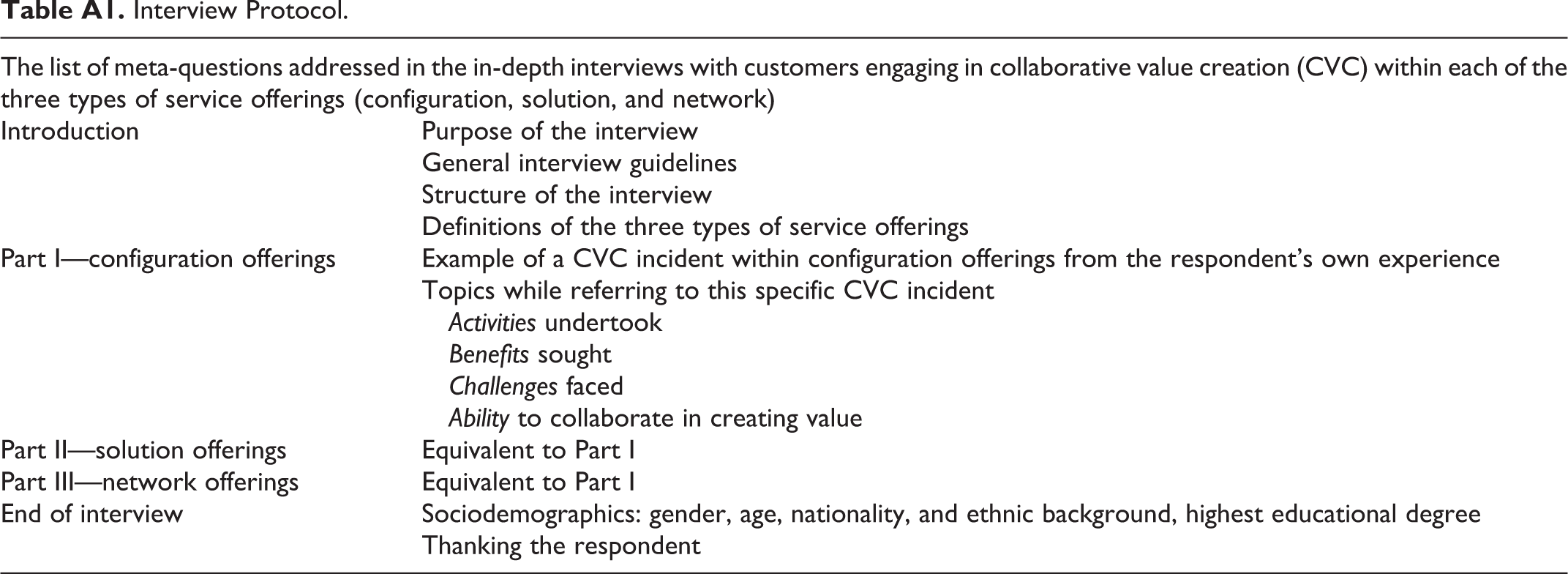
We collected data during semi-structured interviews using a protocol (see Appendix A). The data collection was structured according to the particular service offering (i.e., configuration, solution, or network). The same respondent elaborated on an incident for each type of offering, thus addressing the same set of interview topics, including activities undertaken, benefits sought, challenges faced, and ability to collaborate.
Interviewer Preparation
The three interviewers were postgraduate students in international business, each having undergone a training to gain familiarity with the different types of service offerings and techniques for conducting the interviews. Each interviewer received the same interview protocol and set of instructions, was trained to provide clear definitions for the three types of service offerings, and was instructed to utilize laddering techniques (Reynolds and Gutman 1988), such as asking for more details and clarifications to explain each topic and gain further insights.
Empirical Context and Sample
During the in-depth interviews, each of the 35 respondents reported three different CVC incidents, so our sample included 105 incidents. To capture a wide range of insights, we employed a maximum variation judgment sampling strategy (Marshall 1996) and selected respondents to ensure diversity in gender (37% female), age (M = 28.94 years; SD = 10.36), educational background (doctorate 3%, MBA 14%, master’s 29%, bachelor’s 34%, high school 20%), and geography (31% United States, 34% Asia, 34% Europe). Each interview was recorded and transcribed, which produced a 253-page (1.5-spaced, Times New Roman, 12-point font) document.
Data Analysis
We distinguish two separate three-stage phases in our analysis and interpretation of the 105 CVC incidents (see Table 1). In the first phase, using qualitative analysis techniques, we developed and refined our coding scheme (Stage 1), coded each incident accordingly (Stage 2), and analyzed and interpreted the coding results (Stage 3). The second phase involved quantitative analysis techniques, such that we obtained a bidimensional spatial representation of our coded incidents through categorical principal components analysis (CATPCA; Stage 4), explored potential clustering possibilities in this space through hierarchical cluster analysis (Stage 5), and analyzed and interpreted cluster memberships for the most appropriate clustering solution through k-means cluster analysis (Stage 6).
Overview of Data Analysis Phases and Stages.
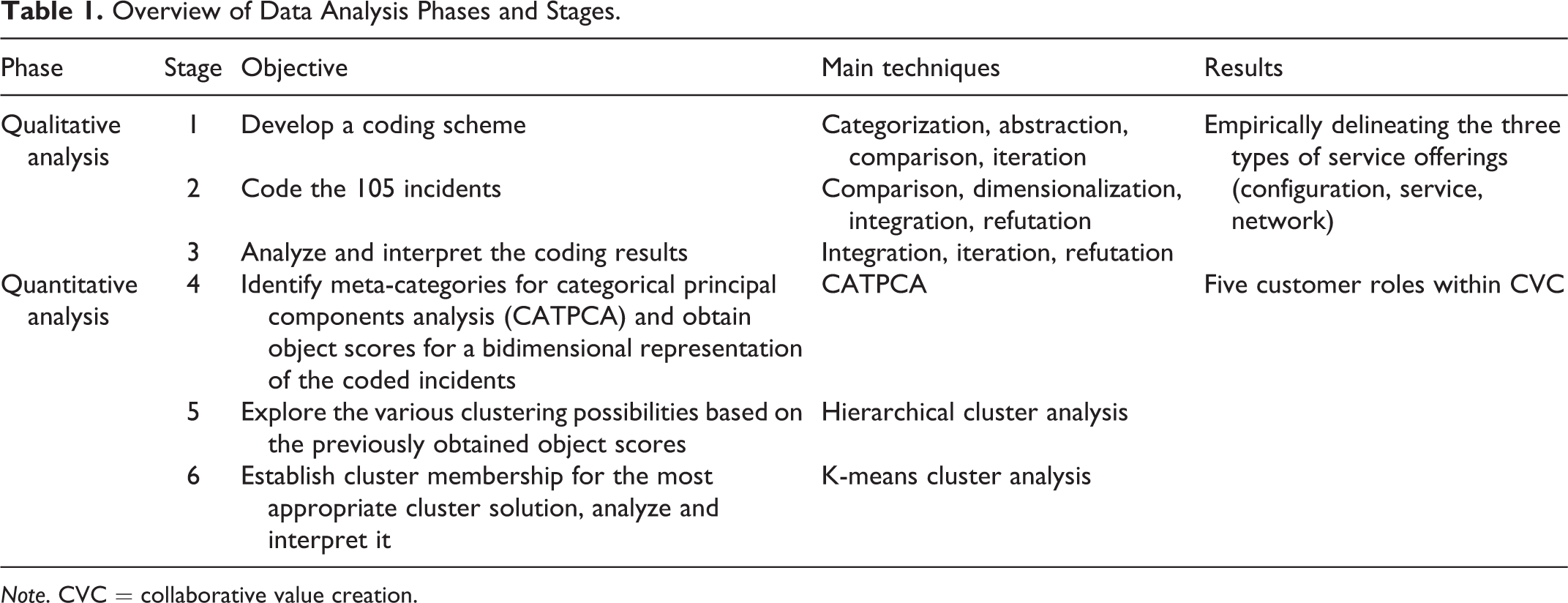
Note. CVC = collaborative value creation.
Qualitative Analysis Phase
We advanced through and across categorization, abstraction, comparison, dimensionalization, and integration, which represent the fundamental, basic, nondiscrete, nonsequential, qualitative data manipulation operations recommended by Spiggle (1994). We also employed iteration and refutation operational tactics, to undertake induction, deduction, and verification processes (Spiggle 1994). In Stage 1, we categorized the CVC themes from the interviews and proceeded both inductively (identifying categories emerging from the data) and deductively (drawing on categories identified in our literature review) to develop a coding scheme. We grouped categories into abstract, conceptual classes (Spiggle 1994), which produced meta-categories, each with a set of subcategories. We compared the 105 incidents and explored their differences and similarities thus developing and refurbishing the coding scheme. Six meta categories related to prerequisites, customer activities, customer challenges, customer ability, customer ability enhancers, and perceived customer benefits emerged from the data.
In Stage 2 of the qualitative analysis, we conducted a methodical, systematic comparison (Spiggle 1994) by coding each paragraph of the 105 incidents using MAXQDA 10. Three authors participated independently in the coding process, then compared coding results and unanimously resolved discrepancies through discussion in a series of feedback sessions. The results provided the foundation for dimensionalization, in which we identified properties of the categories and constructs (Spiggle 1994), and refutation and negative case analysis, where we intentionally sought out incidents that would disconfirm our emerging analysis.
Our use of independent coders for each incident and constructive discussions to bridge any coding divergences created an interpretative tension that improved the integration process in Stage 3, which involved mapping the relationships among conceptual elements (Spiggle 1994). We employed iteration to ensure the comprehensiveness of the constructs and their dimensions and to facilitate interpretation. To obtain inferences, we moved back and forth between each interview and the entire set, reviewing passages within each interview and considering each interview as a whole in relation to the others. This procedure also involved refutation, which increased confidence in our analysis.
Finally, we uncovered various clusters of coded segments in our data by inspecting the code matrices and code relations, then retrieving and inspecting segments of text. With this step, we could delineate the three types of offerings. Our immersion in the data and simultaneous literature review facilitated our identification of causal patterns and the interpretation of their meanings. In addition, regular reflections by the authors not involved in the coding or data analysis validated the results and further refined our interpretation.
Quantitative Analysis Phase
To complement the three stages of our qualitative approach and uncover the roles customers perform within CVC, we followed a quantitative analysis process. In Stage 4, we conducted a CATPCA, a method which fits complicated multivariate data that contain nominal, ordinal, and numerical variables in a straightforward spatial representation (in our case, a biplot). In turn, different groups of objects can be distinguished in the solution, without having to aggregate the categorical data in advance (Meulman, van det Kooij, and Heiser 2004). Thus, we transformed the constructs from our qualitative analysis into categorical variables by assigning numerical values (Odekerken-Schröder, Hennig-Thurau, and Knaevelsrudd 2010), conducted the CATPCA and obtained two dimensions, along with the object scores for each CVC incident on each dimension.
In Stage 5, we used the object scores as cluster variables to conduct a hierarchical cluster analysis, with the standard squared Euclidian distance in combination with Ward’s criterion. Thus, a five-cluster solution emerged as the strongest conceptually, with cluster membership as a distinct variable.
Finally, in Stage 6, we conducted a k-means cluster analysis on the CATPCA object scores with the appropriate number of clusters. The object scores for each incident were aggregated using the five-cluster membership obtained in the hierarchical cluster analysis as a break variable. We determined the optimal cluster membership and uncovered five roles customers perform, according to the two CATPCA dimensions.
Results
The qualitative and quantitative analyses of the incidents of customer-firm collaboration resulted in (1) support for the three types of service offerings, based on the qualitative analysis, and an identification of differences in our six meta categories (prerequisites, customer activities, challenges, abilities, ability enhancers, and perceived benefits); (2) the identification of five customer roles, based on the quantitative analysis; and (3) matches of roles and types of offerings, through the integration of both data analysis phases.
Three Types of Service Offerings
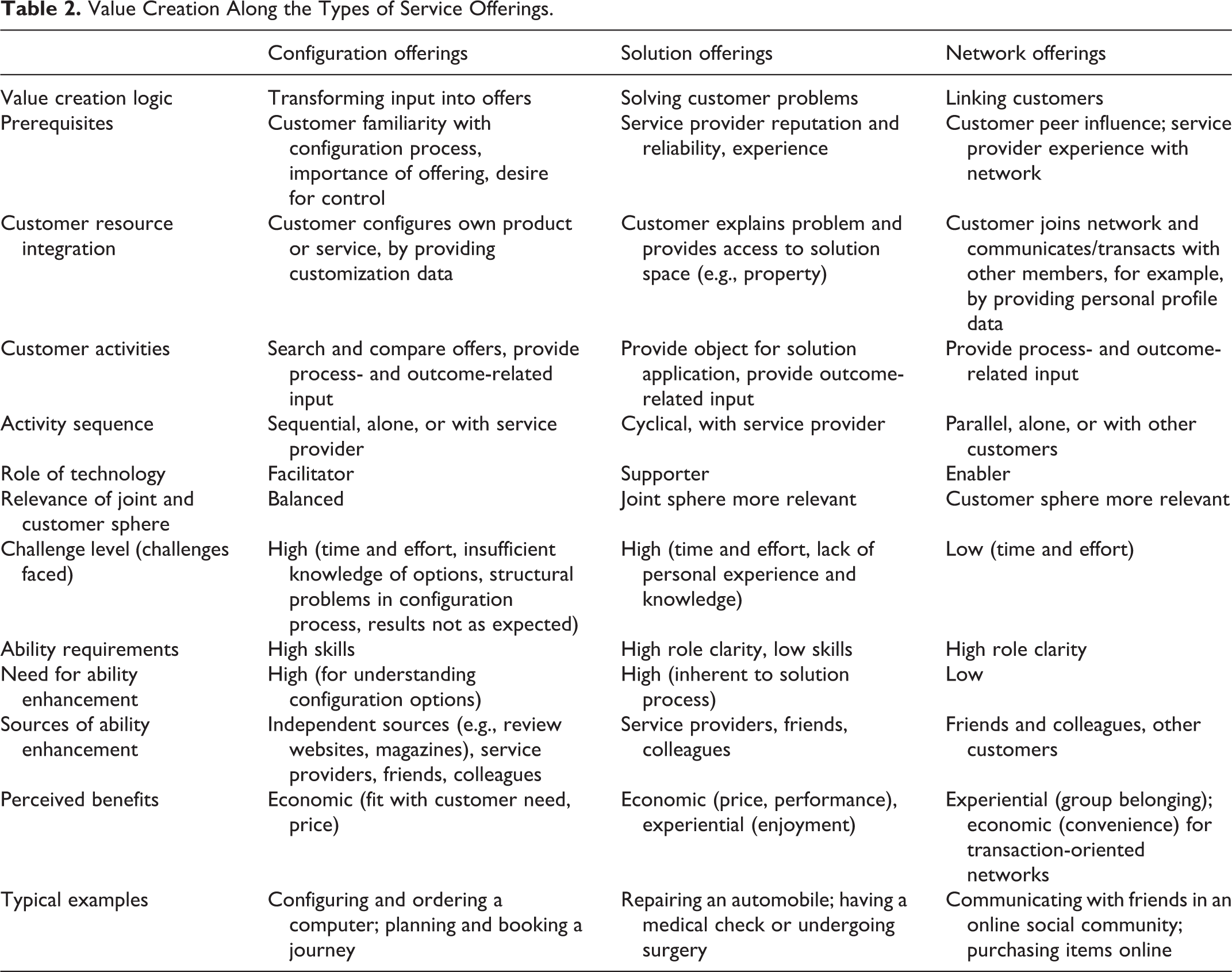
The interview data detail three distinctive service offerings (configuration, solution, and network) and thus extend our initial literature review. The qualitative phase indicated distinctive patterns of benefits, activities, and challenges for customers, as summarized in Table 2.
Value Creation Along the Types of Service Offerings.
Configuration Offerings
Value creation in configuration offerings occurs mainly through the transformation of input into customized offers that get delivered to customers. Respondents chose setting up and customizing computers, holiday trips, or automobiles as typical examples. To contribute, respondents believed they needed familiarity with and a desire to be in charge of the configuration process, which may stem from their beliefs in self-efficacy and positive feelings toward the configuration process, in turn influencing their goal attainment (van Beuningen et al. 2009). Customers engaged in configuration offerings mainly by searching for background information about options and comparing alternatives. Then they supplied information that determined the process (e.g., delivery, payment) and outcomes (e.g., desired color) of the configuration. These self-service activities took place in the customer sphere, demanded limited interaction with the service provider, and were performed sequentially by the customer.
A customer’s strong involvement demands a considerable investment of time and cognitive effort, which may establish a value creation barrier (Lynch and Ariely 2000). Our analysis indicated time investments as requirements for all value types, but configuration offerings suffered especially from this problem. In one incident, the interviewee could not purchase two consecutive flights within the same booking interface, due to restrictions in the airline’s policy. Despite the various customization options available, many respondents reported that they did not receive their expected outcomes. These findings mirror industry reports that indicate greater customer problems with self- than with full-service offerings (van Beuningen et al. 2009). Higher involvement might increase customer expectations and thus the chance for dissatisfaction (Hartwick and Barki 1994). Moreover, the customer’s active role demands more skills, so that the customer can understand configuration opportunities and limitations. If those skills are insufficient, customers mainly draw on neutral sources, such as third-party websites or specialized magazines, or on friends and colleagues (McColl-Kennedy et al. 2012). Such sources are independent of the service provider and perceived as unbiased and trustworthy (Murray 1991). Yet, when they confront specific structural problems, customers typically consult the service provider either indirectly (e.g., reading website information) or directly (e.g., contacting service personnel) to jointly create value.
Benefits originate from a close fit with customers’ needs and lower prices after the elimination of unnecessary options. These benefits resemble Porter’s (1985) generic strategies, such that value stems from offering a distinctive product or a low price relative to competitors. Both represent economic (as opposed to experiential) benefits (Holbrook and Hirschman 1982) that are based on the product’s functional utility. Configuration offerings thus provide a high level of customization but demand that customers possess high prepurchase knowledge to understand the customization options and conduct the process.
Solution Offerings
The service provider helps improve customers’ current state so that they can reach new, desired states, as in the cases of car repairs, medical treatments, hairdressing, or educational services. Located mainly in the joint sphere of value creation, customers contribute to joint value creation through the problem-solving process in two ways. First, they provide access to the problem-solving space, which might be a physical object (e.g., car for repair), a psychological state (e.g., mind for educational services), or a physiological state (e.g., body for surgery). Second, the customers supply the service provider with information on their problems or desired outcomes (e.g., fixing the car, enhancing intellectual abilities, ameliorating pain). With specialized training, a doctor gains expertise that the patient considers necessary to address medical problems (Stabell and Fjeldstad 1998). Our data suggest that the choice of alternative solution offerings often depends on a generally known reputation and reliability as well as personal prior experience with a service provider.
Information acquisition (e.g., inspection checklists for cars, admission tests for universities, physical examinations) may initiate the problem-solving process, before the service provider begins moving back and forth in the joint sphere across diagnosis, treatment alternatives, treatment execution, and evaluation to reach the desired state (Zeithaml, Bitner, and Gremler 2009). Compared with other types of service offerings, technologies are less critical in this category; they support the solution process. For example, using a telephone to call a customer might speed up the decision about alternatives. However, technology also increasingly constitutes the treatment execution, such as for online education or remote health care diagnoses (Bolton and Saxina-Iyer 2009).
Our respondents regarded the efforts they expended for problem explanation and the time for treatment considerable. Clarity in the required customer activities eases value creation (Lamb and Kling 2003), but a lack of personal experience and knowledge would make it difficult for the customer to judge outcomes (Alba and Hutchinson 2000). To improve this knowledge, customers engage in joint value creation and ask the service provider for more details or consult other service providers. The relatively high interaction with the service provider in the joint sphere may stem from its integral role in this type of service offering and its strong availability for direct, personal contact. Another major source of support is friends, colleagues, or neighbors who are familiar with the customer’s individual situation.
The provider’s superior expertise may help the customer achieve better performance or prices relative to the choice to rely on their own expertise. Moreover, experiential benefits during problem solution and interactions with the service provider might be part of the consumption experience. Beyond the economic benefits, experiential benefits should be integrated when service providers develop new solution offerings (Holbrook and Hirschman 1982). The strong involvement of the service provider during value creation reflects the knowledge asymmetry between the service provider and the customer.
Network Offerings
The logic for network offerings involves linking distributed customers who want to exchange information and ideas or perform transactions together, such as on Facebook or eBay or through telephone services. Customers’ main activities take part in the customer sphere and involve providing essential information to join (e.g., personal profile, contact information, preferences) and interacting continuously with other customers (e.g., communication, peer recommendation, purchasing and selling, sharing personal information, generating new ideas, and innovating). For transaction-oriented communities such as eBay, convenient access to information and objects are key motives, in that networks provide efficient structures to match demand and supply (Achrol and Kotler 1999). Respondents named the presence of many peers as a main condition for joining. Such network externalities represent a strategic challenge for new networks that must build a critical mass of members (Stabell and Fjeldstad 1998). Considering the importance of the provider’s or the network’s reputation, the use of elements that signal reliability should help build the network.
The other two types of service offerings involve considerable customer efforts related to searching for information and comparing alternatives; customers of network offerings instead start the service process almost immediately (i.e., by joining) and engage with other members. Reciprocal activities increase their commitment and sense of responsibility to the community as well as provide helping and other interactive behaviors (Mahr and Lievens 2012; Mathwick, Wiertz, and de Ruyter 2008). The underlying infrastructure used by the customer in the customer sphere is pivotal for enabling linkages among customers who are spread out in terms of geography and time zones. The technology’s focus during value creation lies on relationships (e.g., identification of common interests) and interaction (e.g., facilitation, communication, transportation) rather than on single actors (Lamb and Kling 2003).
Our data highlight customers’ interactions with the provider when customers confront challenges. Such independent value creation in the customer sphere regards the service provider only as an enabler of the service that provides the platform (Grönroos 2011), which in turn creates the need for self-explanatory, easy-to-use technology interfaces. Although respondents noted that they expended considerable time and effort, they perceived those contributions as less effortful than those exerted for the other two types of service offerings contrasting early research (Mathwick, Wiertz, and de Ruyter 2008). Experiential value creation in hedonic networks such as brand communities might put customers into a flow state, such that their perception of time gets distorted and activities seem effortless (Novak, Hoffman, and Yung 2000). When they need help, customers turn to friends and other customers, who are not subject to commercial interests and provide appealing emotional, personal explanations rather than plain product descriptions (van Beuningen et al. 2009).
Customer Value-Creating Roles
CATPCA Dimensions
In Stage 4, we considered four meta-categories to perform the CATPCA: customer activities, customer ability enhancers, customer challenges, and perceived customer benefits. Of the six meta-categories emerging from the qualitative phase, these four offer the most distinction in terms of the roles customers perform. Furthermore, they best reflect prior literature on customer collaboration and the key concepts of role theory. First, most existing research on customer participation or collaboration takes an activity-based perspective (e.g., Bendapudi and Leone 2003); we therefore included activities as a meta-category for the dimensions. Second, customer ability enhancers reflect role theory and findings in prior literature that stress the importance of customers’ ability (e.g., Biddle 1986; Meuter et al. 2005) and the possibility to enhance it through collaboration (e.g., Mahr and Lievens 2012; Von Hippel 2005). Third, by including customer challenges, we acknowledge the important influence of role conflict and structural barriers on role behaviors (Bettencourt et al. 2002). Fourth, perceived customer benefits capture the motivation of people to act according to role expectations. Thus, our four meta-categories cover key concepts from role theory while also distinguishing among different customer roles within CVC.
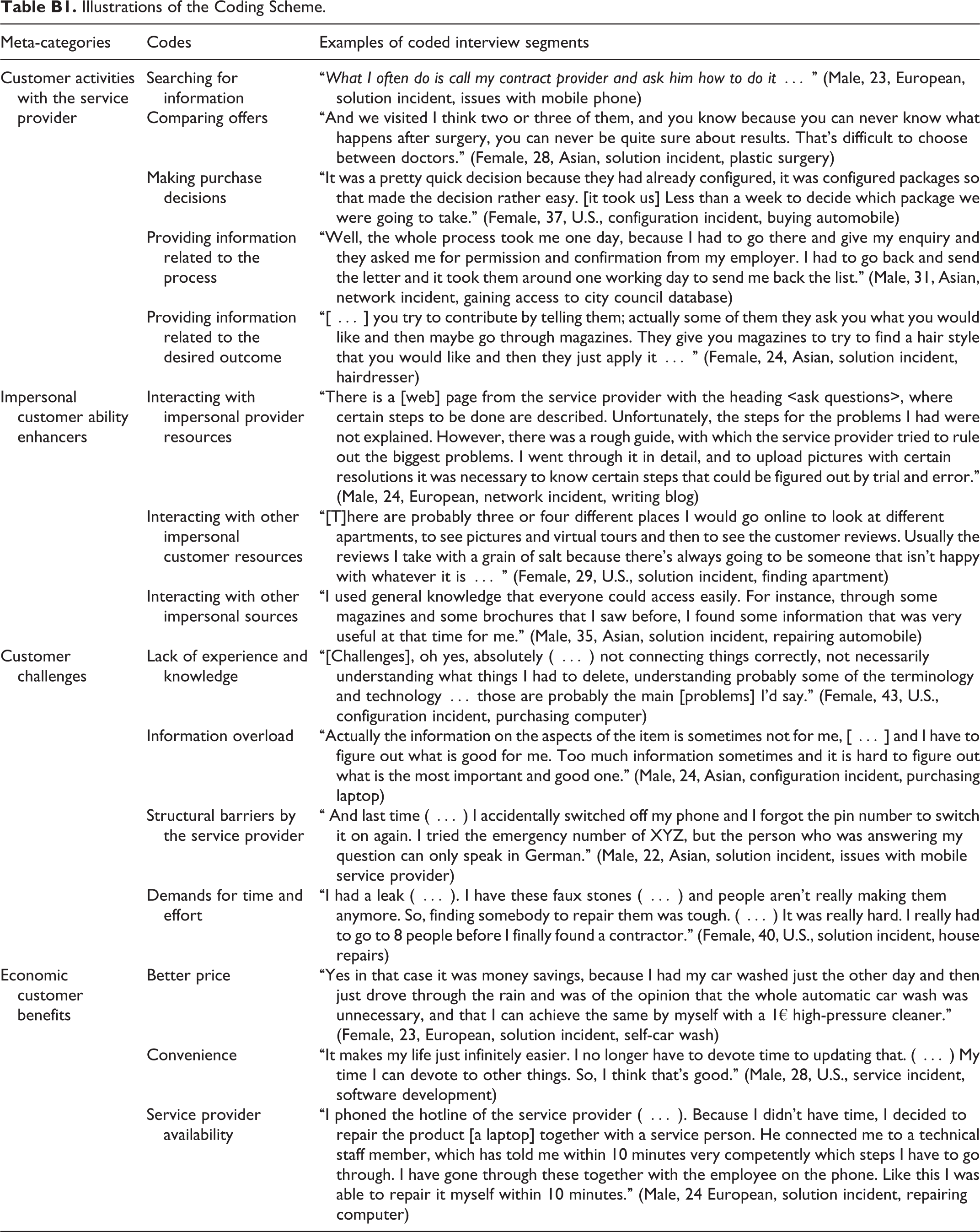
Using the frequencies of the codes for each of the 105 incidents, we computed ordinal variables related to the four chosen meta-categories, labeled them on the basis of the qualitative input (coding and moving back and forth across and within incidents), and refined them to represent the underlying coding as accurately as possible. Specifically, we set the following ordinal variables: customer activities with the service provider, impersonal customer ability enhancers, customer challenges, and economic customer benefits. To facilitate the subsequent CATPCA procedure, we discretized each of these variables while ensuring that the discretization maintained conceptual strength (see Table 3 for an overview of the rules applied to discretize the variables). As a result, each CVC incident took a value (1–4) assigned for each meta-category, where one of the extremes indicated no presence and the other indicated the high presence of the specific meta-category. Appendix B provides an overview and some illustrative quotes of codes whose frequencies we summed to determine the categorical variables pertaining to each meta-category employed in the CATPCA.
Discretized Variables in Categorical Principal Components Analysis (CATPCA).
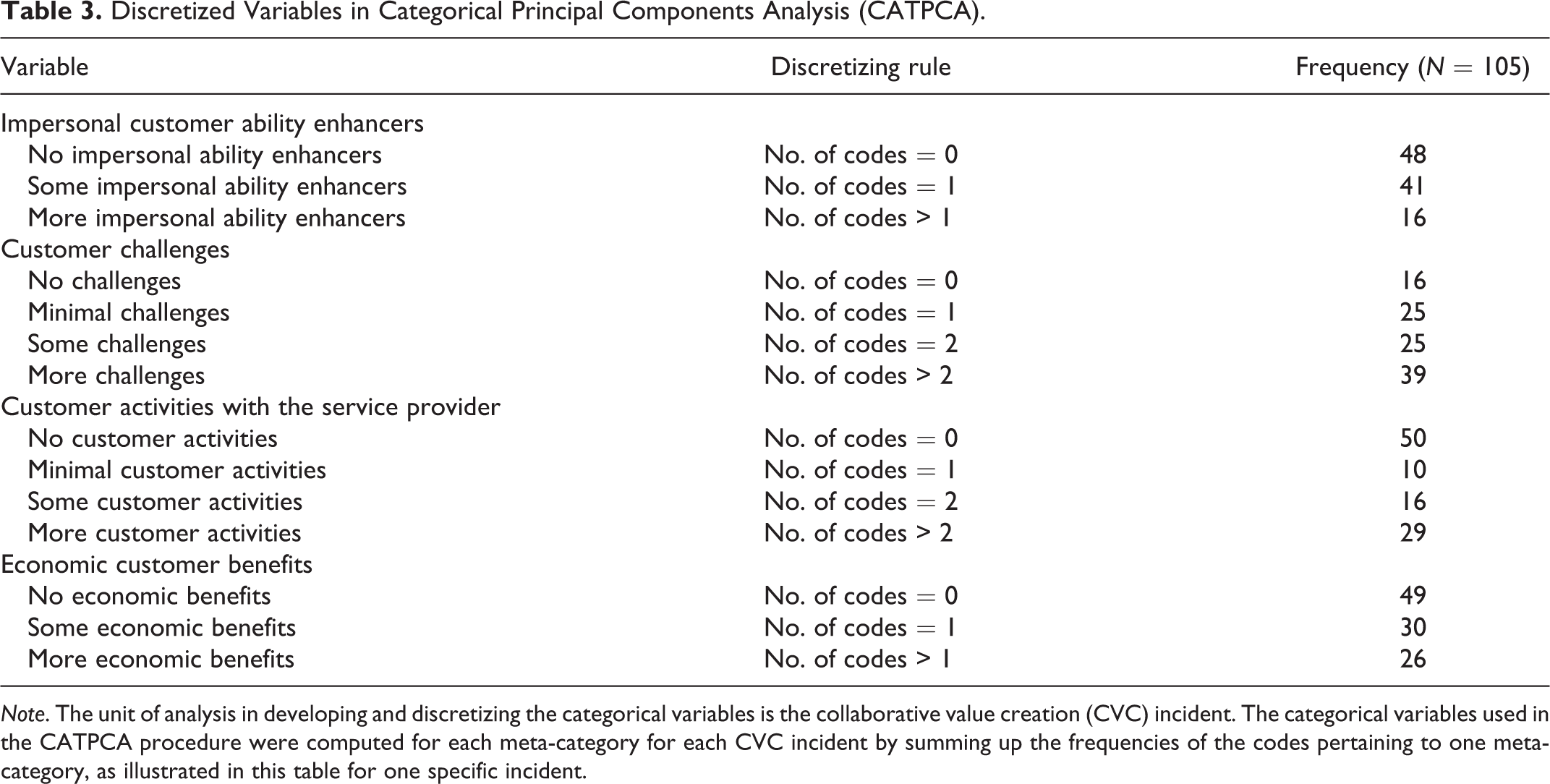
Note. The unit of analysis in developing and discretizing the categorical variables is the collaborative value creation (CVC) incident. The categorical variables used in the CATPCA procedure were computed for each meta-category for each CVC incident by summing up the frequencies of the codes pertaining to one meta-category, as illustrated in this table for one specific incident.
Two CATPCA dimensions resulted from the four ordinal variables, so we calculated an object score for each CVC incident on each dimension. The first dimension, role learning, is composed of impersonal customer ability enhancers and customer challenges. The second dimension, composed of customer activities with the service provider and economic customer benefits, is termed role acting. Both extracted dimensions achieve eigenvalues greater than 1 and sufficient reliability for exploratory research (Cronbach’s α = .841), while also accounting for roughly 68% of the total variance (see Table 4).
Categorical Principal Components Analysis (CATPCA) Results.
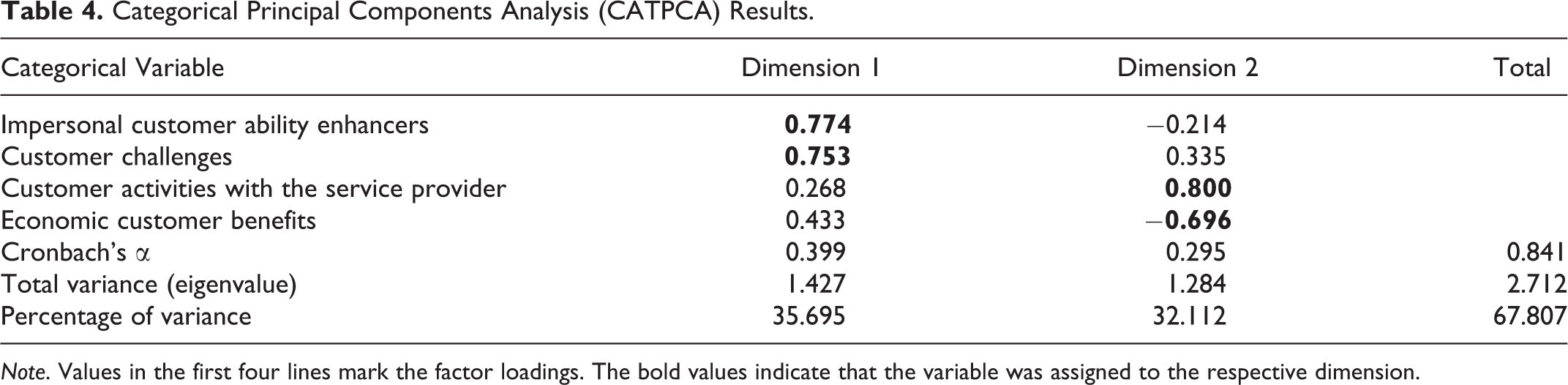
Note. Values in the first four lines mark the factor loadings. The bold values indicate that the variable was assigned to the respective dimension.
These two dimensions thus represent the fundamental factors (role acting and role learning) we employ to define distinctive customer roles, because their constituents address fundamental elements from customer participation literature and role theory (e.g., Biddle 1986; Etgar 2008).
One dimension integrates two variables with high loadings: challenge level and ability enhancement through impersonal sources. The former relates to the challenges that hinder customers’ value creation, such as lack of information, structural barriers, excessive time and effort requirements, a lack of personal experience, or limited availability of the service provider. Because the customer’s lack of ability constitutes a key challenge that can be directly influenced by the customer, learning and enhancing abilities is a primary method to deal with these challenges (Meuter et al. 2005; Risch Rodie and Schultz Kleine 2000). The second variable within the dimension relates to ability enhancement by drawing on inanimate sources, such as websites, magazines, or instruction manuals. Although personal sources might be helpful, customers appreciate impersonal sources for their objectivity or instant availability (McColl-Kennedy et al. 2012; van Beuningen et al. 2009). This CATPCA dimension therefore describes the challenges that customers encounter during CVC and the means they use to overcome them—that is, role learning.
The other dimension also combines two variables with high loadings, namely, activities with the service provider and economic benefits. The activities customers conduct in collaboration with the service provider might include providing specifications for the intended outcome, seeking experts’ advice, or executing payments. In contrast with self-service activities, customers often engage in activities with service providers to benefit from their expertise and attain more complex services (Meuter et al. 2005; Zeithaml, Bitner, and Gremler 2009). In addition, customers seek economic benefits to varying degrees. Although lower costs or customized solutions might be important motives for CVC, in some cases they are less salient, especially if other motives such as fun, convenience, self-esteem, or group belonging become relatively more important (Holbrook and Hirschman 1982). The combined variables constitute the benefits of the value creation process and the main activities that customers initiate to realize the benefits—that is, their role acting.
CVC Role Descriptions
The fifth stage of our empirical analysis aimed to explore the number of clusters. A five-cluster 1 solution helped ensure the spread of the roles over the two CATPCA dimensions and was conceptually strong. Finally, in the sixth stage of our analysis, we established optimal cluster membership. In Figure 1, we present the five clusters that emerged based on the average object score on each of the four meta-categories. The clusters are described in Table 5.
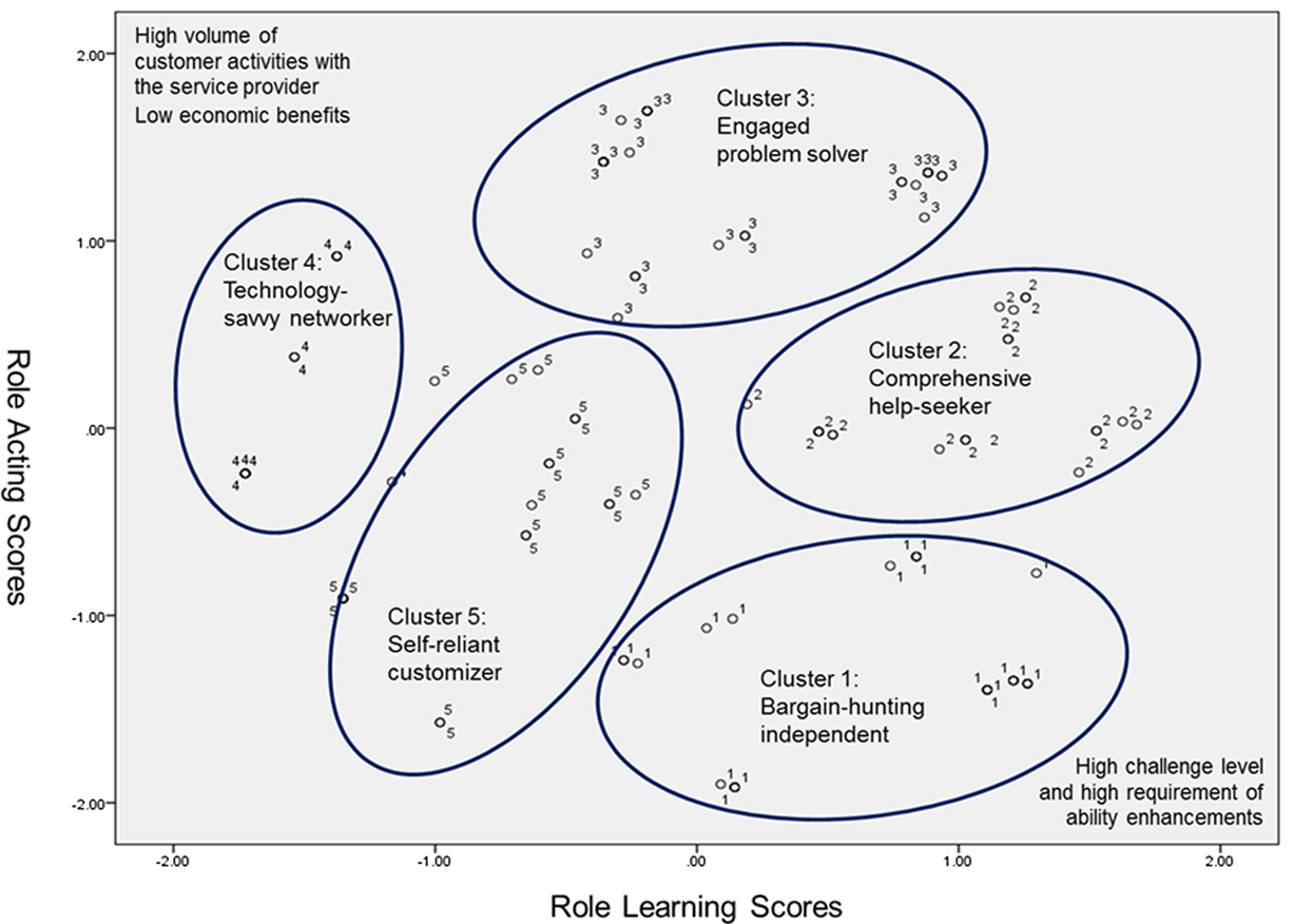
Customer role clusters in the categorical principal components analysis (CATPCA) dimensions biplot.
Role Descriptions and Matches of Roles With Service Offerings.
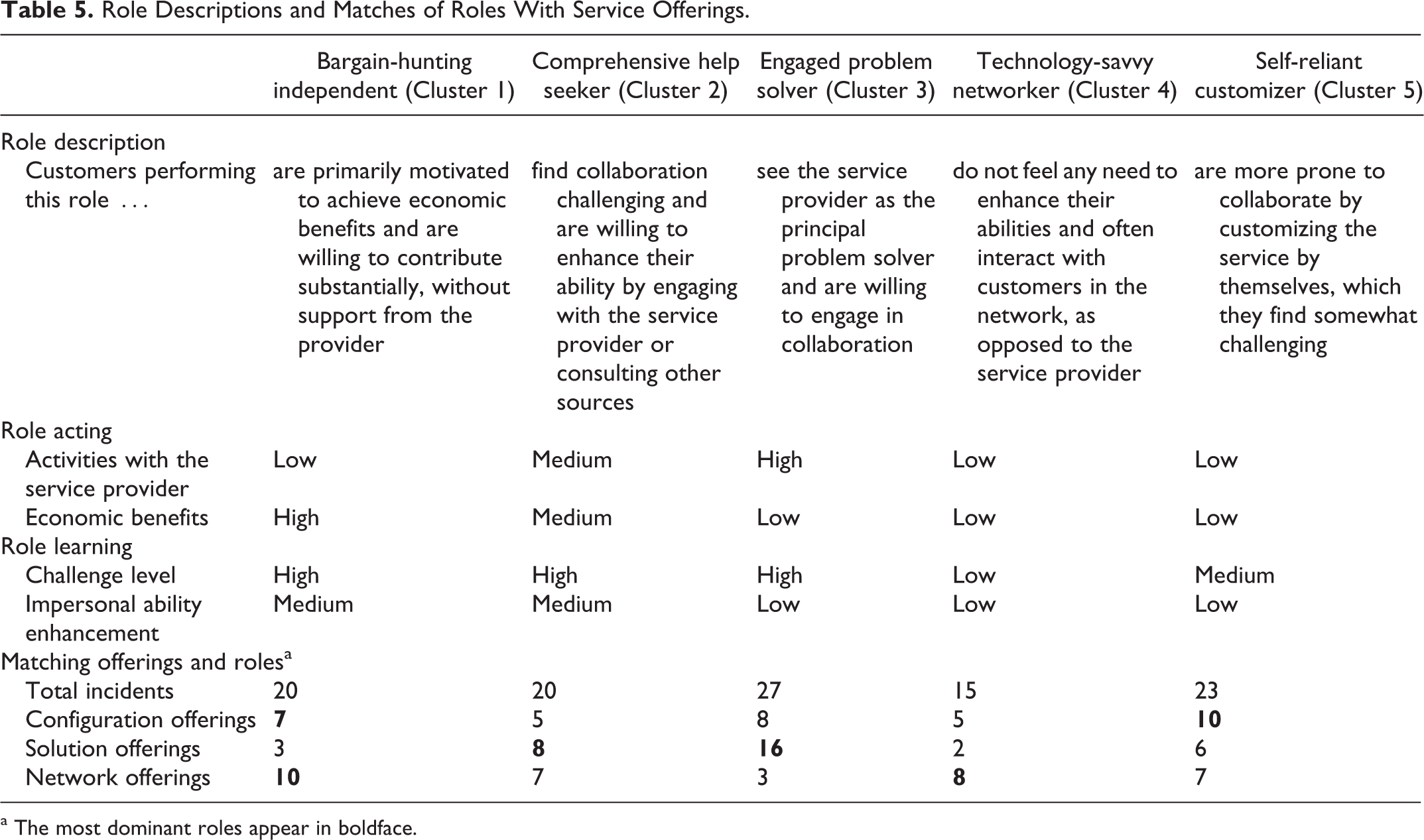
a The most dominant roles appear in boldface.
Cluster 1 is characterized by a high challenge level and a medium level of customer ability enhancement. Although roles are challenging and require learning, these activities do not take place with the collaboration of the service provider, because the customer’s activity level with the service provider is low. Value is thus mainly created in the customer sphere. The challenging and active learning role gets compensated for through a high economic benefit. Therefore, a customer who performs such a role is a bargain-hunting independent.
The most representative characteristic of Cluster 2 is the high level of challenge, along with a medium requirement for ability enhancement. Economic benefits and activities with the service provider are generally at a medium level, showing a balance in the origin of value between the joint and customer spheres. A typical example would be a customer configuring his or her own computer with the assistance of technical staff employed by the service provider. In contrast with Cluster 1, the reasons for this role are not economic but rather because customers feel confident about completing the challenging task and performing the role with help from the service provider. We term this role comprehensive help seeker.
The role patterns of Cluster 3 show high interactivity with the service provider and high-value creation in the joint sphere, yet almost no mention of economic benefits. Aspects other than price seem important, which might be because the challenge level of these activities is generally perceived as high. However, the information or competence asymmetry between providers and customers provides limited possibilities to overcome the challenge just by enhancing their abilities. The typical examples described problems that disrupted a smooth process, such that the customer had to contribute significantly to finding a solution with the service provider. We refer to this role as the engaged problem solver.
Cluster 4 regards the role as easy (low challenges), with no mention of ability enhancements by the customer. This role is unlikely to be performed in interaction with a service provider; instead, customer activities taking place in the customer sphere involve either interacting with other customers or performing alone. Economic benefits do not play an important role, as might be the case on social media platforms that do not demand ability enhancements, because most of the processes are self-explanatory. These examples explain the low importance of economic benefits and the low involvement with the service provider. We term this role technology-savvy networker.
The fifth and last cluster is characterized by a medium level of challenge and a low level of ability enhancement. Most activities are performed without much interaction with the service provider, that is, in the customer sphere. In contrast with the bargain-hunting independent, this role is not dominated by the economic benefits, and for both, service provider involvement is limited. We refer to a customer performing this role as a self-reliant customizer.
Matching Roles With Types of Service Offerings
After separately establishing an understanding of service offerings and customers’ roles, we can explore their interdependencies. In matching offerings and roles, we account for their heterogeneity, an approach that can help firms achieve a more accurate fulfillment of customers’ expectations (Biddle 1986). The review of the incidents suggests different dominant customer roles for the three offerings (see Table 5).
The self-reliant customizer (Cluster 1) and bargain-hunting independent (Cluster 5) are the dominant roles customers perform in configuration offerings, which typically involve self-performed customization efforts and strong customer skills. Both roles involve limited service provider involvement. Customers instead believe in their own abilities and efficacy, which ultimately affects the goals they attain (Collier and Kimes 2012; van Beuningen et al. 2009). However, the inclusion of both roles also reflects the different degrees and types of economic benefits (e.g., fit with customer needs, better price).
The engaged problem solver (Cluster 3) and the comprehensive help seeker (Cluster 2) are the dominant roles customers perform in solution offerings, which draw strongly on the expertise and support of the service provider to overcome obstacles. That is, competence asymmetry prevents customers from enhancing their ability sufficiently on their own, so they must demand the specialized expertise of a service provider (Stabell and Fjeldstad 1998). This expertise then becomes the origin of the value created.
The bargain-hunting independent (Cluster 1) and technology-savvy networker (Cluster 4) are the key roles customers perform in network offerings. The former realizes better prices and a close fit with his or her needs due to the availability of many items in a network, while the latter seeks value from communication with many peers. Network offerings similarly allow for limited involvement of the service provider. The value creation requires interactions with many other customers, which involves positive externalities (Katz and Shapiro 1985).
Discussion and Implications
Theoretical Implications
We empirically validate and extend a service typology by considering CVC patterns across configuration, solution, and network offerings, such that we move beyond a strategic perspective (e.g., Normann and Ramirez 1993; Prahalad and Ramaswamy 2004). In addition, we empirically account for heterogeneity in customer roles by identifying five illustrative clusters that reflect the roles customers perform. Our investigation provides empirical evidence that customers perform different roles when engaging in various CVC processes.
From a theoretical perspective, our CVC framework (Table 5) integrates multiple research disciplines and extends research on customer integration, participation, and cocreation. The observed patterns of CVC across the three types of service offerings reflect the notion of creating value with rather than for customers and thereby enrich the contemporary service-dominant logic. Moreover, the patterns enhance understanding of how customers engage in value creation, which has been largely lacking (Payne, Storbacka, and Frow 2008). The findings also probe interactions between customers and providers and thus the different spheres in which value is created (Grönroos 2011).
The different customer roles in CVC reflect two dimensions: role learning and role acting. Role learning encompasses the challenge level (e.g., lack of information, lack of experience) and ability enhancement through impersonal resources (e.g., websites, manuals)—that is, the challenges customers encounter during CVC and the potential means to overcome them. Role acting instead entails activities with the service provider (e.g., seeking advice, providing specifications) and economic benefits (e.g., lower costs), which reflect the envisioned benefits of the CVC process and the main activities that customers initiate to realize these benefits. By uncovering five customer roles, we advance Vargo and Lusch’s (2004a) sixth foundational premise, “the customer is always a coproducer.” The specified roles reveal what customers are likely to do to create value in relation to different service offerings. Our investigation also responds empirically to a recent call to consider value as perception and experience (Helkkula, Kelleher, and Pihlstrom 2013). Some roles we have uncovered (e.g., engaged problem solver) are characterized by their emphasis on experiential rather than economic benefits.
Finally, our study accounts for customer role heterogeneity by identifying distinct occurrences for different offerings. These insights link role theory (Biddle 1986) to value creation (Stabell and Fjeldstad 1998) and cocreation (Payne, Storbacka, and Frow 2008) and thereby clarify the interactions that take place during CVC (Stiles 1985). By responding to the call for research on customer roles (Ostrom et al. 2010), we probe not only individual customer roles but also their context and potential management in two ways. First, we show that some roles are prominent for a specific offering, such as the engaged problem solver in solution offerings, but others, such as the comprehensive help seeker, appear in several service offering categories. Second, our results prove that role performance reflects the characteristics of the customer as well as the context. On one hand, slightly more than half of the respondents (19 of 35) only performed one or two (but not three) different roles describing their three CVC incidents; this suggests that role performance is independent of the context of a service offering but rather tied to certain customer characteristics. On the other hand, almost half (16 of 35) also performed a distinct role for each service offering, indicating that role performance is also context specific. We thus contribute to research on customer roles tied to one context (McColl-Kennedy et al. 2012) and empirically demonstrate that customers vary across both context and personal characteristics and hence may perform multiple roles (Lamb and Kling 2003).
Understanding customer role performance can simplify the interaction for the service provider, who then can detect and avoid conflicts with the customer. This customer-centric view enables firms to ensure that customers perform their roles correctly, given their capabilities and skills (Ostrom et al. 2010). Acknowledging the interdependencies between offerings and roles may contribute to the development of multichannel services that involve complex interactions between customers and service providers (Bolton and Saxena-Iyer 2009).
Managerial Implications
CVC challenges the traditional roles of customers and service providers. In Table 2, we provided an overview of CVC meta-categories across three types of service offerings from the customer perspective. Given that managers can categorize their service/services into our three types of offerings, our research provides helpful suggestions for prioritizing their resource allocations. Table 2 does not provide an all-encompassing description of the study’s implications, yet we exemplify them with salient results related to prerequisites, ability enhancers, and benefits. In particular, the distinct results for the different prerequisites may help service providers tailor their communication strategies to attract customers. For a solution offering, a service provider should stress its reputation through quality certificates and its success record through success stories; if it provides a network offering, it might emphasize the presence of peers (Join us now! Your friends are already using this) and the long history of the network.
Moreover, the findings pertaining to the ability enhancers reveal the predominant sources on which customers tend to rely to overcome difficulties. Accordingly, a service provider should facilitate their access to third-party sources for configuration offerings (e.g., industry reports, independent review websites), its own knowledge for solution offerings (e.g., repair instructions), and friends and other customers for network offerings (e.g., user communities). The benefits related to the offerings support managers in tailoring their offering to meet customer needs too. Customers mainly realize economic benefits from configuration offerings, so providers should emphasize the results of the service and ensure their offerings contain an optimal number of modules, so that customers can configure the product to fit their price preferences and abilities. In contrast, providers of network offerings should place more emphasis on the service delivery process, because these customers report experiential benefits from interacting with other customers. Such providers likely need to come up with process innovations and new features regularly. Finally, providers of solution offerings must find a balance, because these customers’ benefits relate to both experiential and economic benefits. The overall service result is important, in terms of economic benefits (e.g., good price, effective solution), but so is the way the solution was accomplished (e.g., friendly interaction).
The role dimensions, role learning, and role acting, further provide service managers and personnel with guidelines on how to segment customers and thus how to match their preferences (Ringberg, Odekerken-Schröder, and Christensen 2007). The customer’s proneness to perform service activities with or without the service provider (i.e., joint or independent value creation) is a key segmenting variable. The active role of a service provider is often associated with low economic benefit (i.e., high price), so customers should be willing to pay a premium when interacting with the provider but also expect a significantly lower price when the provider remains a passive facilitator. For example, on a freely accessible online travel website, customers could pay for augmenting personal service, such as a booking hotline.
Finally, the boundary-spanning nature of roles has implications for firms with large service portfolios. For example, the bargain-hunting independent customer emerges mainly in networks but also appears interested in configuration offerings. A member visiting an online user community thus might use the feature to self-configure a service to realize a lower price.
Limitations and Further Research
Our study uses in-depth interviews. Although we employ quantitative methods to establish the customer roles, a more expansive quantitative analysis (e.g., broader scale of customer data) could help validate our results. Our data consist of specific, cross-sectional CVC incidents, so it also would be interesting to adopt a longitudinal perspective.
We clearly take customers’ perspectives, but the roles customers perform when creating value also have implications for their service providers. It would be interesting to investigate CVC roles from the supplier’s perspective. Eventually research might match customer and supplier roles across the distinct service offerings.
Finally, our focus was on identifying the different roles that customers perform, not necessarily how to manage these roles. Further research could investigate implementing the roles.
Footnotes
Appendix A
Interview Protocol.
| The list of meta-questions addressed in the in-depth interviews with customers engaging in collaborative value creation (CVC) within each of the three types of service offerings (configuration, solution, and network) | |
|---|---|
| Introduction | Purpose of the interview |
| General interview guidelines | |
| Structure of the interview | |
| Definitions of the three types of service offerings | |
| Part I—configuration offerings | Example of a CVC incident within configuration offerings from the respondent’s own experience |
| Topics while referring to this specific CVC incident | |
| Activities undertook | |
| Benefits sought | |
| Challenges faced | |
| Ability to collaborate in creating value | |
| Part II—solution offerings | Equivalent to Part I |
| Part III—network offerings | Equivalent to Part I |
| End of interview | Sociodemographics: gender, age, nationality, and ethnic background, highest educational degree |
| Thanking the respondent | |
Appendix B
Illustrations of the Coding Scheme.
| Meta-categories | Codes | Examples of coded interview segments |
|---|---|---|
| Customer activities with the service provider | Searching for information | “What I often do is call my contract provider and ask him how to do it … ” (Male, 23, European, solution incident, issues with mobile phone) |
| Comparing offers | “And we visited I think two or three of them, and you know because you can never know what happens after surgery, you can never be quite sure about results. That’s difficult to choose between doctors.” (Female, 28, Asian, solution incident, plastic surgery) | |
| Making purchase decisions | “It was a pretty quick decision because they had already configured, it was configured packages so that made the decision rather easy. [it took us] Less than a week to decide which package we were going to take.” (Female, 37, U.S., configuration incident, buying automobile) | |
| Providing information related to the process | “Well, the whole process took me one day, because I had to go there and give my enquiry and they asked me for permission and confirmation from my employer. I had to go back and send the letter and it took them around one working day to send me back the list.” (Male, 31, Asian, network incident, gaining access to city council database) | |
| Providing information related to the desired outcome | “[ … ] you try to contribute by telling them; actually some of them they ask you what you would like and then maybe go through magazines. They give you magazines to try to find a hair style that you would like and then they just apply it … ” (Female, 24, Asian, solution incident, hairdresser) | |
| Impersonal customer ability enhancers | Interacting with impersonal provider resources | “There is a [web] page from the service provider with the heading <ask questions>, where certain steps to be done are described. Unfortunately, the steps for the problems I had were not explained. However, there was a rough guide, with which the service provider tried to rule out the biggest problems. I went through it in detail, and to upload pictures with certain resolutions it was necessary to know certain steps that could be figured out by trial and error.” (Male, 24, European, network incident, writing blog) |
| Interacting with other impersonal customer resources | “[T]here are probably three or four different places I would go online to look at different apartments, to see pictures and virtual tours and then to see the customer reviews. Usually the reviews I take with a grain of salt because there’s always going to be someone that isn’t happy with whatever it is … ” (Female, 29, U.S., solution incident, finding apartment) | |
| Interacting with other impersonal sources | “I used general knowledge that everyone could access easily. For instance, through some magazines and some brochures that I saw before, I found some information that was very useful at that time for me.” (Male, 35, Asian, solution incident, repairing automobile) | |
| Customer challenges | Lack of experience and knowledge | “[Challenges], oh yes, absolutely ( … ) not connecting things correctly, not necessarily understanding what things I had to delete, understanding probably some of the terminology and technology … those are probably the main [problems] I’d say.” (Female, 43, U.S., configuration incident, purchasing computer) |
| Information overload | “Actually the information on the aspects of the item is sometimes not for me, [ … ] and I have to figure out what is good for me. Too much information sometimes and it is hard to figure out what is the most important and good one.” (Male, 24, Asian, configuration incident, purchasing laptop) | |
| Structural barriers by the service provider | “ And last time ( … ) I accidentally switched off my phone and I forgot the pin number to switch it on again. I tried the emergency number of XYZ, but the person who was answering my question can only speak in German.” (Male, 22, Asian, solution incident, issues with mobile service provider) | |
| Demands for time and effort | “I had a leak ( … ). I have these faux stones ( … ) and people aren’t really making them anymore. So, finding somebody to repair them was tough. ( … ) It was really hard. I really had to go to 8 people before I finally found a contractor.” (Female, 40, U.S., solution incident, house repairs) | |
| Economic customer benefits | Better price | “Yes in that case it was money savings, because I had my car washed just the other day and then just drove through the rain and was of the opinion that the whole automatic car wash was unnecessary, and that I can achieve the same by myself with a 1€ high-pressure cleaner.” (Female, 23, European, solution incident, self-car wash) |
| Convenience | “It makes my life just infinitely easier. I no longer have to devote time to updating that. ( … ) My time I can devote to other things. So, I think that’s good.” (Male, 28, U.S., service incident, software development) | |
| Service provider availability | “I phoned the hotline of the service provider ( … ). Because I didn’t have time, I decided to repair the product [a laptop] together with a service person. He connected me to a technical staff member, which has told me within 10 minutes very competently which steps I have to go through. I have gone through these together with the employee on the phone. Like this I was able to repair it myself within 10 minutes.” (Male, 24 European, solution incident, repairing computer) |
Acknowledgments
The authors would like to thank Dwayne D. Gremler for his helpful comments on a previous version of our article as well as the participants of the 21st Annual Frontiers in Service Conference for their valuable feedback.
Declaration of Conflicting Interests
The author(s) declared no potential conflicts of interest with respect to the research, authorship, and/or publication of this article.
Funding
The author(s) received no financial support for the research, authorship, and/or publication of this article.
Note
References
Supplementary Material
Please find the following supplemental material available below.
For Open Access articles published under a Creative Commons License, all supplemental material carries the same license as the article it is associated with.
For non-Open Access articles published, all supplemental material carries a non-exclusive license, and permission requests for re-use of supplemental material or any part of supplemental material shall be sent directly to the copyright owner as specified in the copyright notice associated with the article.
