



Abstract
Over the last two decades, much of management research has converged on the belief that one of its major aims is to identify the causal mechanisms that produce the phenomena that researchers seek to explain. In this paper, we review and synthesize the literature that has amassed around causal mechanisms. We do so by detailing the different methodological perspectives that are featured in management research, which we label as the contextual, constitutive, and interventionist perspectives. For each of these perspectives, we examine what it theoretically presupposes a mechanism to be, how this connects to methodological choices, and how this shapes the kind of mechanism-based explanations that each perspective offers. We also explore the main inferential challenges for each of these perspectives and offer specific methodological guidance in response. In this way, we aim to offer a common plank for theorizing and research on causal mechanisms in ways that recognize and harness the productive differences across different epistemologies and methodological traditions.
Identifying the causal mechanisms that explain managerial and organizational phenomena has become a central aim within management and organizational research (hereafter: management research), covering quantitative (Antonakis et al., 2010; Shaver, 2020), qualitative (Durand & Vaara, 2009; Gioia et al., 2013), as well as theoretically driven research (Makadok et al., 2018; Thatcher & Fisher, 2022). Before a focus on mechanisms became central to the field (Cowen et al., 2022), commentators had already made the case for the approach. Some had argued that it is best suited to a field that is defined by problems and middle-range theorizing rather than grand paradigms (Davis & Marquis, 2005). Others had promoted the approach based on its multi-level prowess for capturing the “micro-foundations” of managerial and organizational phenomena (Barney & Felin, 2013). And yet others had advocated a mechanisms approach as the best way toward causal identification (Shaver, 2020), with a specified mechanism acting as the “lever” for why a set of relationships or effects occur (Makadok et al., 2018, p. 1536).
Because of its appeal, the mechanisms approach struck a chord in a field eager to move beyond the much-criticized positivist mantra of aiming to identify universal covering laws for phenomena (Davis & Marquis, 2005; Durand & Vaara, 2009). Paradoxically, however, the more the approach has become commonplace, the less discussion there seems to be on the substantive assumptions from which it proceeds. Perhaps because of such little discussion, different conceptions about what causal mechanisms are and how they are identified currently feature alongside each other, creating conceptual ambiguity and linguistic confusion with researchers oftentimes seemingly talking past each other. Whereas some researchers refer to mechanisms as explanatory models for empirically observed correlations (Cowen et al., 2022; Davis & Marquis, 2005), others conceptualize mechanisms as intervening variables that link a presumed cause and effect (Antonakis et al., 2010; Durand & Vaara, 2009) and yet others consider mechanisms as context-dependent probabilistic processes (Langley, 1999; Van de Ven & Poole, 1995). Universally referred to as causal mechanisms, these conceptions differ in perspective based on how they conceive of the core operations of a mechanism and whether such processes are empirically observable or largely unobservable and analytical in nature.
The common label may thus inadvertently hide and gloss over important differences between different methodological approaches. In this paper, our main objective is to surface such differences by highlighting across traditions of research what different researchers theoretically presuppose a mechanism to be and how this methodologically shapes their research. We ask, how are mechanisms conceptualized across the field of management research and how are such conceptualizations connected to different method choices and mechanism-based explanations? To address this question, we offer an in-depth review and synthesis of the main methodological traditions that make use of the mechanism concept.
Through the review and synthesis that we provide, the present paper makes, we believe, two contributions. The first contribution is that we review existing theoretical views on causal mechanisms in management research and their associated methods. Based on the close links between theory and methods (Van Maanen et al., 2007), we outline three common methodological perspectives on mechanisms: setting out their key differences in what they consider mechanisms to be, in the kind of mechanism-based explanations that they aim for, and in their choice of research methods. This overview not only accommodates past methodological writings but also contextualizes and deepens our understanding of implicit and explicit differences between these different perspectives on the identification and mapping of causal mechanisms. In short, our first contribution is that our synthesis creates added clarity around the concept of causal mechanisms (Suddaby, 2010) by offering a more refined overview (compared to a single label) of what causal mechanisms are purported to be across different methodological traditions in the field.
The second contribution is that, by building on this review, we promote epistemological pluralism (Longino, 2001) as a common plank for the study and conceptualization of mechanisms. Such pluralism not only puts the differences between methodologies in perspective but also allows the field of management research to harness the productive differences across these different epistemologies and methodological traditions. Epistemological pluralism allows for a richer and more encompassing understanding of causal mechanisms and equips individual researchers with a reflexive understanding that, as we show in the paper, strengthens their own research from a particular methodological perspective. In sum, the second contribution of our review and synthesis is to champion an epistemologically pluralistic approach toward accumulating knowledge on the mechanisms underlying managerial and organizational phenomena from a diversity of methodological orientations.
The structure of the paper follows the structure of our review and synthesis. First, we set the scope for our review and define how causal mechanisms are generally understood. Second, we review the different ways in which the mechanism concept has been referenced and methodologically used in the field of management research. We characterize the main methodological perspectives on the concept, noting the key differences between them in relation to methods and the kinds of mechanism-based explanations that they aim for. Third, incorporating the findings of this review, we discuss the value of epistemological and methodological pluralism, drawing out how it benefits the field of management research as well as individual researchers. Finally, we end the paper with a short concluding section summarizing our contributions.
What Are Causal Mechanisms?
Across the social sciences, the core premise of the mechanisms approach is to move beyond any observed empirical regularities or descriptive correlational models for phenomena (Hedström & Ylikoski, 2010) to inquire into the causal process, or mechanism, that may explain any observed patterns or relationships. The focus is on identifying the underlying causal processes that determine such patterns or relationships, with the assumption being that, once identified, these processes will explain why certain effects or outcomes can be expected to arise in the context of certain phenomena (Makadok et al., 2018; Sutton & Staw, 1995). It is this explanatory power and focus that has driven the widespread uptake of the mechanisms approach in management research (Cowen et al., 2022; Davis & Marquis, 2005).
Although the very idea of mechanisms has a long, established history within philosophy and across the physical and social sciences (going back to Archimedes and Democritus; see, e.g., Bunge, 1979), it is only relatively recently that philosophers and scientists have started to advocate mechanisms as a specific concept that is key to the scientific method and central to forming causal explanations, as well as, therefore, to the metaphysics of causality (see, e.g., Bechtel & Richardson, 1993; Craver, 2007; Glennan, 1996; Machamer et al., 2000). The hallmark of this emergent, “new” philosophy of science on mechanisms (Bechtel & Richardson, 1993; Craver, 2007; Glennan, 1996; Glennan et al., 2022; Machamer et al., 2000), which also made its inroads into management research (Davis & Marquis, 2005), is the claim that much explanation across the sciences, including the social sciences, is of a mechanistic kind; i.e., the kind of explanation that reveals the causal mechanism or mechanisms that produces, or brings forth, the phenomenon that researchers aim to explain (Craver, 2007).
Across the physical and social sciences, virtually all work on mechanisms assumes that they are gears in some physical, biological, or social machinery (Gross, 2009, p. 363) such that, once activated, mechanisms produce a phenomenon (Bhaskar, 1979; Hedström & Ylikoski, 2010). This idea of causal production (Hedström & Ylikoski, 2010; Machamer et al., 2000) may involve simple mechanical push-pull systems (Machamer et al., 2000, p. 2) or more complex interactive machinery as “an assembly of elements producing an effect not inherent in any one of them” (Hernes, 1998, p. 74). Regardless of their relative complexity, which anyhow varies between phenomena, mechanisms are “about ‘cogs and wheels’ — the wheelwork or agency by which an effect is produced” (Hernes, 1998, p. 74).
Figure 1 displays this skeletal description of causal mechanisms, whereby mechanisms are entities and activities organized and causally connected such that they produce the targeted phenomenon (Glennan et al., 2022). Figure 1 furthermore highlights how a mechanism, once it is spelled out as an explanation (i.e., the explanans), directly explains the targeted phenomenon (i.e., the explanandum). A key characteristic of mechanisms is that they are directly linked to phenomena, and to the task of explaining them in the best possible way, rather than that they are linked to specific theories or argumentation structures that are reflective of such theories (Simon, 1969). The philosopher Craver (2007, p. 25) articulates this focus as follows: “When researchers explain a phenomenon, their goal is not merely to build a ‘theory’; they set out to discover a mechanism, to identify its components, and to find the crucial feature of its spatial, temporal, and active organization.”
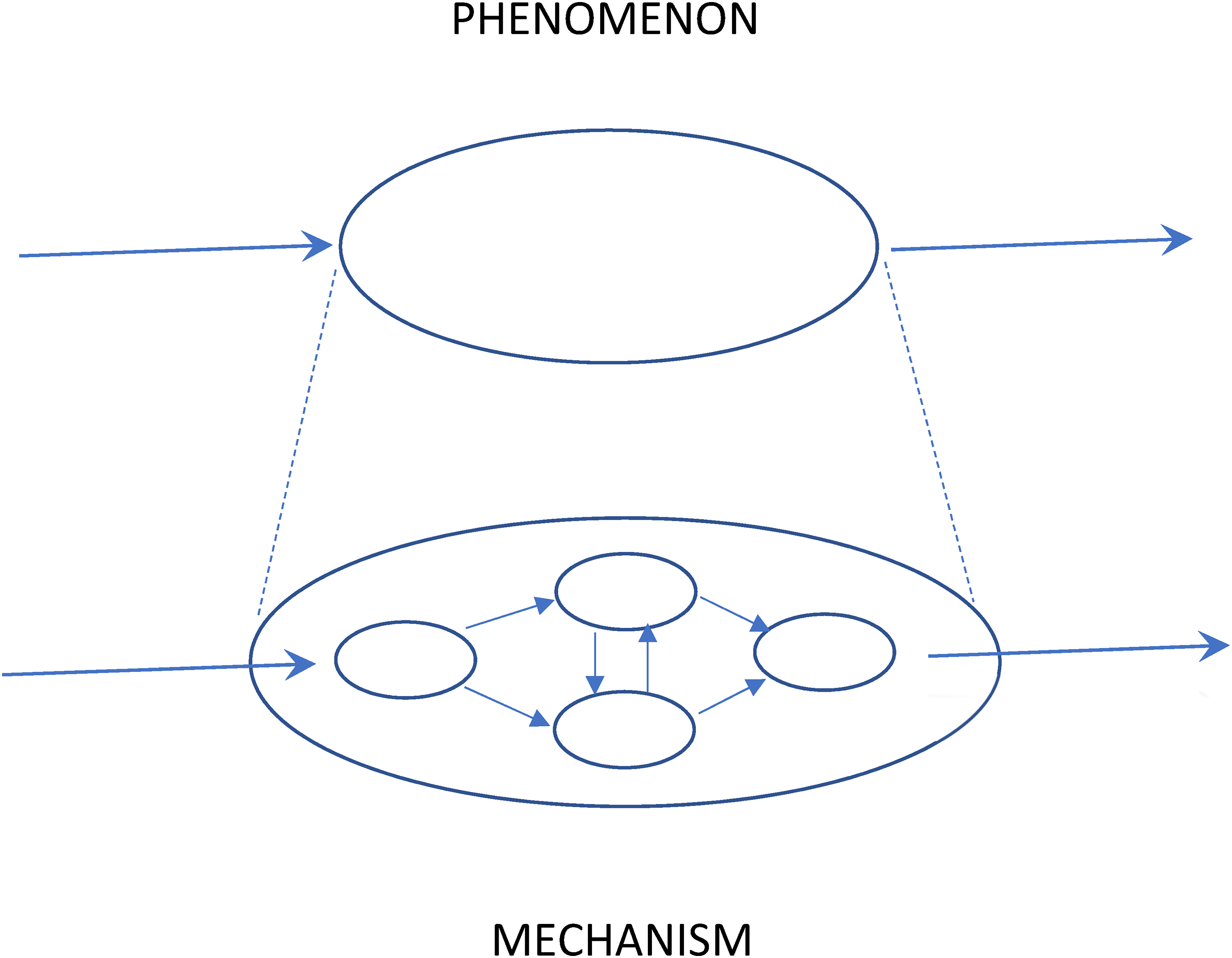
A phenomenon and its mechanism.
Besides being phenomenon driven, the mechanisms approach has historically been an epistemologically pluralistic approach that is bent on causally explaining phenomena in the best possible way, while recognizing that how we construe causal mechanisms and phenomena differs depending on a researcher's epistemological position and their choice of methods (Cartwright, 2020, 2021). Within the management field, this is a set of premises that, with a few exceptions (Cowen et al., 2022), is broadly recognized as well (see Davis & Marquis, 2005; Simon, 1969) and reflected in the uptake of the mechanism concept across epistemologically very different methodological traditions, ranging from, for example, experimental and quasi-experimental studies on the one end to case-based qualitative research on the other (see, e.g., Welch et al., 2011, 2022). In this paper, we similarly recognize this epistemological plurality and associated differences in methodological traditions. We were initially inspired by writings in philosophy (Cartwright, 2021; Longino, 2001) that recognize the way in which different methodologies, ranging from contextually specific to more formal-analytical ones, each provide epistemologically a different way of seeing and studying causal mechanisms. Informed by this lead, our own theoretical approach here is one of offering a meta-theoretical synthesis (Cornelissen et al., 2021) of existing methodological approaches to causal mechanisms in management research and what they allow researchers to theoretically see and, because of their analysis, offer as a mechanism-based explanation. According to Cornelissen et al. (2021, p. 11), “metatheorizing offers at once a synthesis of past research as well as a deeper reading of the theoretical resources that have been routinely used” with the aim of guiding and directing subsequent research. We similarly here aim to offer a review of past work on causal mechanisms and, in ways that, through the synthesis offered, provide methodological guidance to further research.
Before going into detail on the specific steps that we took as part of our meta-theorizing approach, we should clarify the ontological premises that affect what we consider as within the scope of our current exercise. We proceed from the ontological premise that causation manifests itself not just in the minds of human researchers but is a “real” phenomenon in the social worlds we study (Bhaskar, 1979; Durand & Vaara, 2009), although researchers might frame such causal processes and any mechanisms that they see from different epistemological stances. In line with this ontology, we furthermore assume that causal mechanisms are situated in time and space and produce phenomena in probabilistic, contingent, or even determined ways. This position, which can be broadly described as a “realist” stance (Bunge, 1979), differs from post-modern and strong constructivist 1 ontological perspectives that are not principally concerned with causation or causal mechanisms (Durand & Vaara, 2009), as well as from strict empiricist views that confine causation to our human experience and knowledge of the world (Brady, 2011). Within these broad scope constraints, the mechanisms approach is epistemologically “open” but, according to its key proponents in the philosophy of science (Cartwright, 2020; Craver, 2007; Menzies, 2012; Salmon, 1984, 1998), bound by an overarching epistemic commitment to scientific realism. 2 That is, the shared aim for the enterprise as a whole is to try and ensure, through whatever scientific methods and means possible (Cartwright, 2021), that the mechanism-based explanations that are produced capture the causally relevant sets of conditions and interactions that describe regular behaviors, as phenomena, within and across contexts, and succeed in apprehending the causal process(es), or mechanism(s), that might be at work across such contexts (see Figure 1 and Table 2).
Mechanisms in Management Research
Given the breadth of the mechanisms approach as a phenomenon-driven epistemology, there is not surprisingly a lot of diversity in the kinds of studies in management research that similarly are carried out under its banner (as is the case for other disciplinary fields such as sociology or psychology (see, e.g., Norton, 2014)). In what follows, we first review the different perspectives on mechanisms in management research that have been advanced in recent years and that can be readily observed in the research practices of management and organizational researchers (see Table 1). We label these as the interventionist, contextual, and constitutive methodological perspectives, respectively.
Perspectives on Causal Mechanisms Across the Corpus (2020–2023).
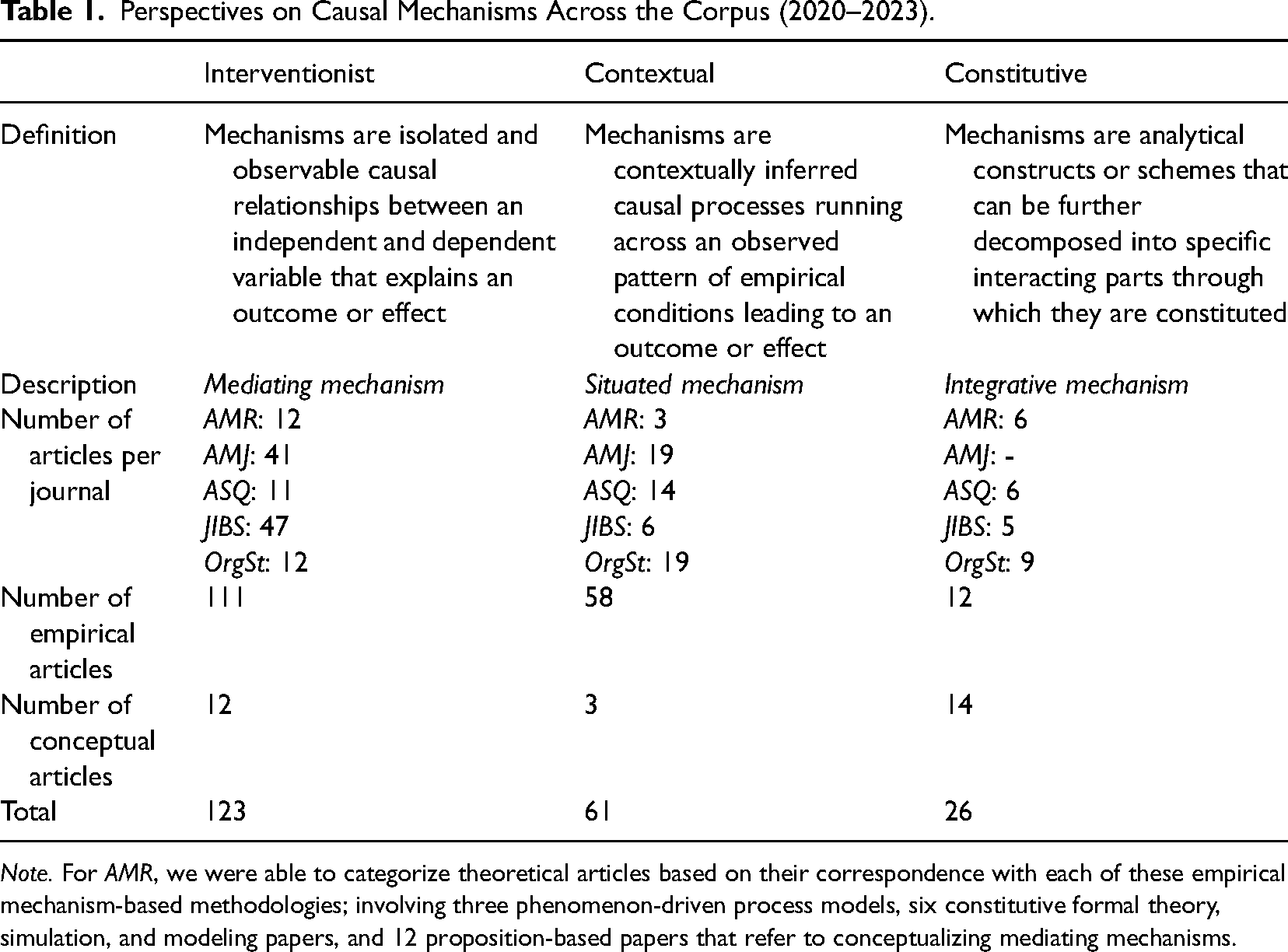
Note. For AMR, we were able to categorize theoretical articles based on their correspondence with each of these empirical mechanism-based methodologies; involving three phenomenon-driven process models, six constitutive formal theory, simulation, and modeling papers, and 12 proposition-based papers that refer to conceptualizing mediating mechanisms.
We identified these three different perspectives in a set of closely related, iterative steps. We first searched for references to causal mechanisms in commentaries and methodological writings in the management field (such as Antonakis et al., 2010; Davis & Marquis, 2005; Durand & Vaara, 2009; Makadok et al., 2018; Pentland, 1999; Thatcher & Fisher, 2022). We catalogued these papers, listing the different definitions of mechanisms that they proposed and the key sources (e.g., Bhaskar, 1979; Hedström & Swedberg, 1998; Pearl, 2018) that these papers cited from across the social sciences, philosophy, and statistics. Using a snowballing method, we then followed up on citations to either these management sources or the original sources in published studies within the management field and, aided by writings in philosophy (Cartwright, 2004, 2007; Longino, 2001), abductively started to build a picture of three distinct approaches.
Once we identified the rough contours of the three methodological approaches, we looked separately for references to “mechanisms” in articles published in Academy of Management Review, Administrative Science Quarterly, Organization Studies, Journal of International Business Studies, and Academy of Management Journal for the last 4 years (2020–2023). We selected these journals as they are highly cited, influential journals, and on that basis can be assumed to represent common ways in which management researchers generally conceive of, and study, causal mechanisms. As a set, these journals furthermore bridge geographies (North America, Europe, the globe), span purely conceptual, quantitative, and qualitative research, cover a range of sub-disciplines (strategy, international business, organizational behavior, organization theory), and incorporate different levels of analysis (including both “micro” and “macro” research).
For each journal, we conducted a search for references to causal mechanisms in published articles (in the title, keywords, or abstracts), using a Boolean search string (“mechanism/mechanical/mechanis*/drive*/motor*”) that accounts for a variety of synonym terms and inflections (e.g., generative mechanism, integrative mechanism, situated mechanism, interpretive mechanism, discursive mechanism) but also allowed us to filter out articles where references to causal terminology were made but without an explicit reference to an associated mechanism or specific mechanisms-related terminology. With this filter in place, we collected a sizable dataset of 210 articles that actively referred to causal mechanisms.
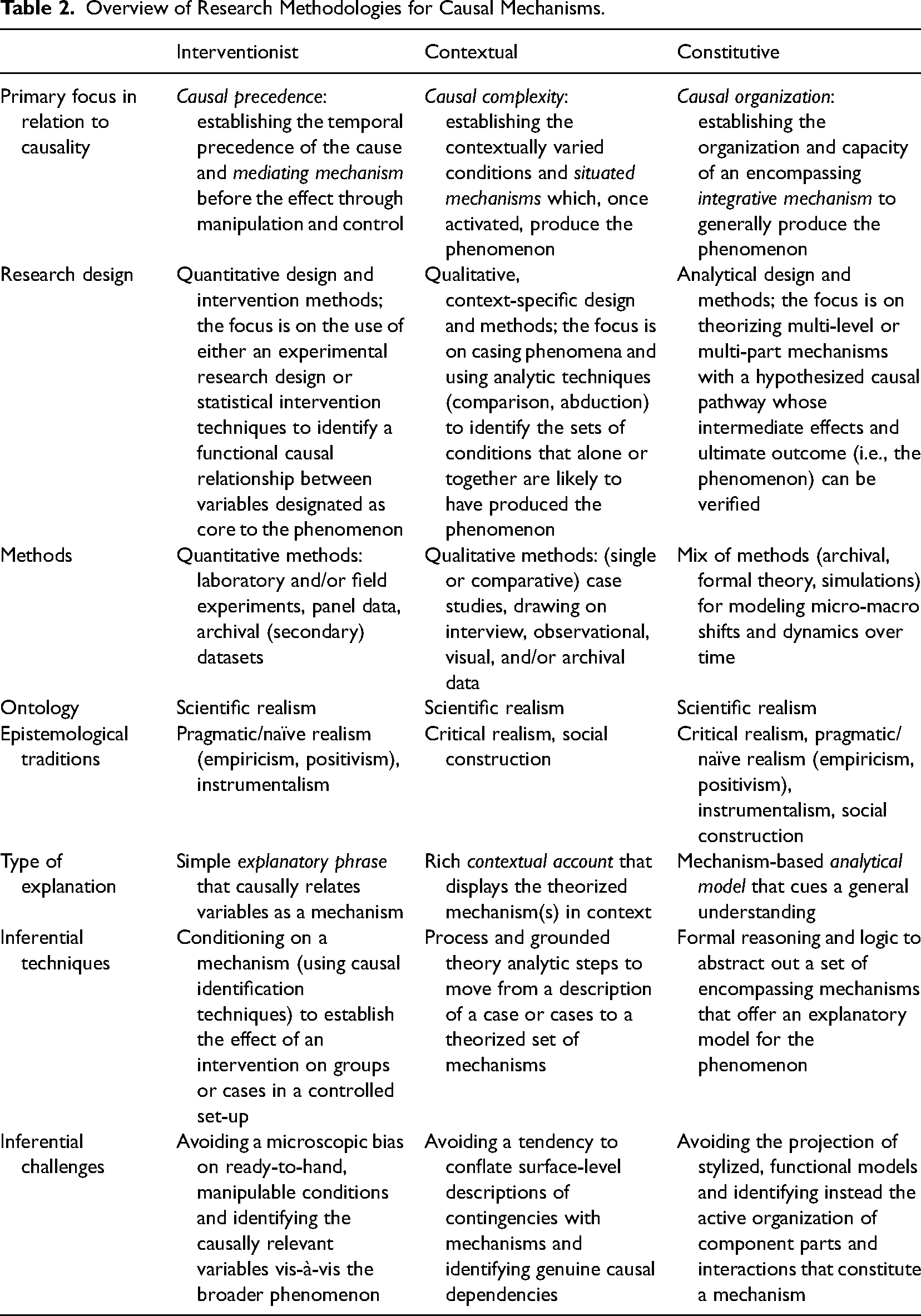
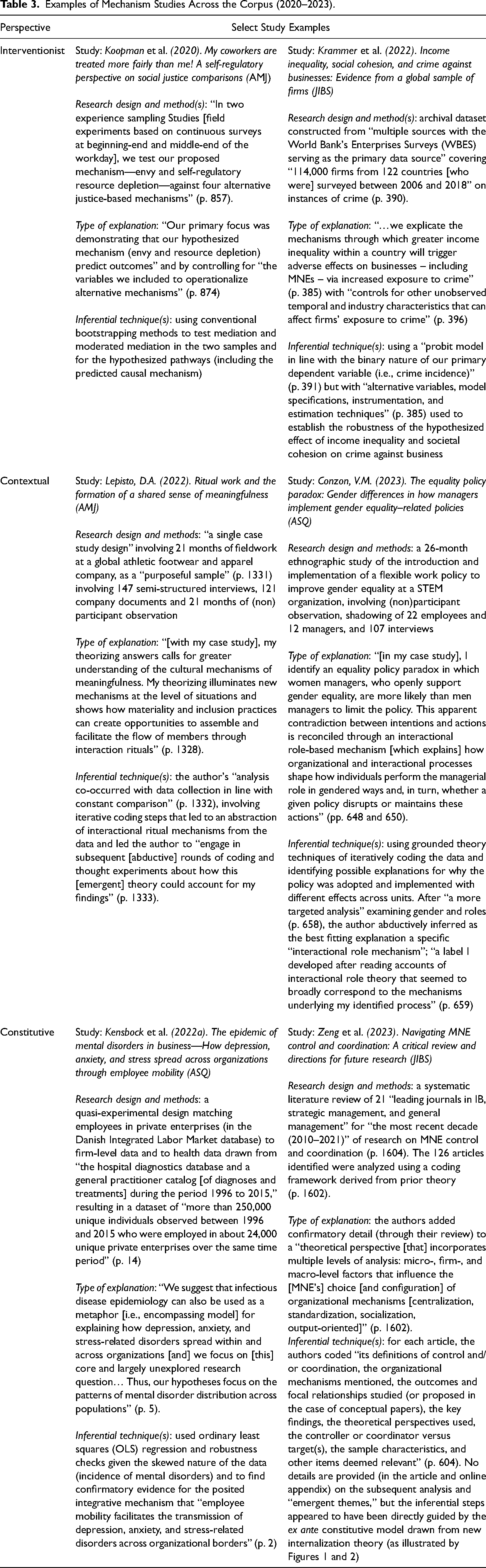
The specialized corpus that we collected in this way (see Table 1) helped refine as well as further validate our core typology and provided illustrations for each of the three methodological perspectives. Table 1 outlines the contours of each methodological perspective and records the prominence of each of these perspectives across the journals surveyed. Table 2 summarizes the methodologies associated with each perspective, including differences in research designs, the methods used to identify or infer mechanisms from data, and the kind of account that is offered as a mechanism-based explanation. Table 3, finally, offers supplementary evidence besides the specific examples that we cross-reference and discuss in detail in the text.
Overview of Research Methodologies for Causal Mechanisms.
Examples of Mechanism Studies Across the Corpus (2020–2023).
As highlighted in Tables 1 and 2, our focus here is on detailing different approaches to causal mechanisms as methodologies, as coherent sets of theoretical ideas and epistemological assumptions about mechanisms that motivate the use of a corresponding set of research designs and methods (e.g., experiments, qualitative case studies) and inferential techniques (e.g., regression discontinuities, abduction) as research practices (Hammersley, 2011). Offering our synthesis at the level of methodology (rather than method or technique per se) allows us to draw out the distinct methodological paradigms (labeled as “perspectives”) that exist in the field, based on the kinds of theoretical assumptions that are made about causal mechanisms and that motivate specific forms of research practice and particular kinds of mechanism-based explanations. Pitching our review at this level additionally allows us to elaborate the specific inferential challenges around mechanisms within and across each of these methodological perspectives as well as, later on in the paper, articulate the value of epistemological and methodological pluralism.
In the following sections, we first conceptually discuss each of the identified perspectives as distinct methodological paradigms. Our style of writing and reporting is, consistent with meta-theorizing (Cornelissen et al., 2021), conceptual and synthetic in nature, although, as mentioned, we cross-reference published examples in the text and enumerate more examples as supplementary details in Table 3.
The Interventionist Perspective
The first and most prominent methodological perspective on mechanisms is the interventionist perspective (Craver, 2007). The guiding idea of this perspective is that mechanisms linking cause and effect are “difference-makers” for phenomena; they produce the phenomenon, as an effect, whereas without them (that is, without the activation of the mechanism), the effect would not be obtained (Woodward, 2003). As such, the task for management researchers is to find ways in their studies to manipulate or otherwise intervene on the presumed “underlying” causal mechanism to observe this change in the effect directly (Durand & Vaara, 2009) and identify or isolate the causal mechanism(s) involved (Dau et al., 2022). This perspective is, as such, “inward” looking (Salmon, 1984) into the functional, operational structure of the causal process that is inherent to a mechanism (Table 2).
This interventionist perspective has been broadly taken up in management research (Aguinis & Edwards, 2014; Antonakis et al., 2010; Lee & Bettis, 2022; Shaver, 2020). In fact, it is by far the most prominent one of the methodological perspectives on causal mechanisms. Within JIBS and AMJ, this approach accounts for most papers published on causal mechanisms (with a key difference that papers in JIBS tend be based on secondary data, while papers published in AMJ include more often primary, experimental data), and across all the journals surveyed it is the most prominent methodological perspective overall (see Table 1).
Research Design and Methods. The interventionist perspective comes with the pragmatic assumption that interventions take place in the context of a modeled scenario where all the causally relevant variables are essentially present, so that the causal efficacy of variables can be established and so that researchers can directly observe the “capacity” of certain sets of variables, as mechanisms, to produce the effect. This pragmatic presumption is epistemologically rooted in a combination of pragmatism (at the operational level of variables) and parsimony (Pearl, 2018) so that the causal picture is assumed to be “complete” (Talmy, 1988) and can in a direct and instrumental sense be intervened on (Imbens & Rubin, 2015) to identify the mediating mechanism determining the effect (see Table 2, guiding epistemological traditions: pragmatic/naïve realism [empiricism, positivism], instrumentalism).
The interventionist perspective is given shape through experimental and quasi-experimental quantitative methods (Woodward, 2003) that specify an “autonomous scenario” of only a few variables as causal “forces” acting on each other (Talmy, 1988, p. 92) and within which what are assumed to be “root” causes are manipulated as part of controlled interventions to ascertain their force in producing a certain effect (Table 2). The general assumption here is that if, in both experimental and quasi-experimental conditions, an association between A and B persists when A is given the right sort of “independent causal history” or is “manipulated” in the right way, we can observe whether A has a consequent effect on B. In this way, the interventionist perspective aims to establish the causal precedence of a cause and associated causal mechanism for an effect to materialize.
Interestingly, of the 111 interventionist empirical articles in our corpus, only 16 studies are purely experimental studies (12 of which are published in AMJ) (see Table 1). The remainder involves quasi-experimentation on archival data or mixed methods. Within experimental studies, researchers manipulate one (or more) conditions as putative causes and mechanisms and, through controls in the design of their experiments or alternatively through statistical randomization (randomized controlled trials), aim to account for the closest “possible worlds” that in turn helps them eliminate confounding explanations. The guiding idea here is that by systematically altering part of a presupposed causal scenario (e.g., a purported antecedent cause or mechanism for an effect), while keeping everything else constant, researchers can zoom in on the mechanisms that really matter, filtering out causal from non-causal relationships through their controlled experimentation (Cornelissen & Kaandorp, 2023). To illustrate, in an experimental study in AMJ, Doyle et al. (2022) examined how past outcomes (i.e., winning vs. losing streak) and future expectations influence an individual's willingness to transgress in a current competition. In a series of experimental studies, they effectively identify stable functional relationships between a set of self-reported, behavioral, and primed proxies with transgression-related effects, inferring a set of cognitive uncertainty and affect-related mediating mechanisms and while discounting “alternative mechanisms” (i.e., other potential mediating variables) across these studies.
Besides the “gold standard” of randomized controlled trials and classic experimental designs (Antonakis et al., 2010), the bulk of interventionist studies as mentioned involve “quasi-experimentation” on archival data. This emphasis may reflect a preference within management research for studies that are based on data and observations drawn from the field (rather than laboratory settings), an interpretation that is reinforced by the fact that the 12 experimental papers in our corpus all include field experiments as part of the studies that they report. For quasi-experimental research designs, the focus is on manipulating “an abrupt intervention at a known time” (Cook & Campbell, 1986, p. 149) in a treatment group, which in turn makes it possible to compare the impacts of the intervention over time or across groups in an archival dataset. To carry out such interventions, management researchers appear to be increasingly using several techniques (including propensity matching techniques, the use of instrumental variables, identifying regression discontinuities, and difference in difference designs) from applied statistics and econometrics (e.g., Imbens & Rubin, 2015; Morgan & Winship, 2015; Pearl, 2018) to perform such controlled interventions on archival, non-experimental data and “identify” the causal mechanism involved (see, e.g., Krammer et al., 2022; Maoret et al., 2023; Zhang, 2022). To give one example from our corpus, in a study in AMJ, Gupta et al. (2020) use a range of such techniques, including exogenous shocks, propensity score matching, and modeling treatment effects, to ascertain for their archival data that the gender of a firm's chief financial officer (CFO) determines the likelihood of the firm's financial misreporting (with female CFOs being generally less prone to do so than their male counterparts) and as furthermore moderated by weak/strong governance mechanisms.
Type of Explanation. The interventionist perspective effectively conceptualizes a causal mechanism as an invariant relationship between variables that holds under different interventions and that reflects a singularly organized causal path as a mechanism (Antonakis et al., 2010; Durand & Vaara, 2009). Whereas the constitutive and contextual perspectives, as we will come to below, alternatively frame mechanisms as an analytical scheme or as a contextual account, the interventionist perspective has a much more operational interest in establishing causally dependent relationships between variables as its way of isolating causal mechanisms (Table 2). Pearl and Verma (1992, p. 91) speak of “stable causal mechanisms, which on a microscopic level, are deterministic functional relationships between variables” that can be observed in differential equations and regressions (Woodward, 2003).
Proponents of this perspective argue that it provides “a concrete meaning to the notion of causal mechanism, by connecting series of observational data with evidence of the influence of unobservable variables, and by identifying relevant causal paths” (Durand & Vaara, 2009, p. 1260). To give one more example, a recent experimental study in AMJ (Clarke et al., 2019) found a positive correlation between the frequency and type of gesturing of a pitching entrepreneur and the expressed intention of investors wanting to invest in the entrepreneur's venture. By conditioning on different possible causal relationships (limited to the set of variables measured in their study), the authors in turn found strong support for the role of “mental imagery” being simulated by such gestures, which, they claim, allowed investors to better imagine the product or service as well as the venture's market potential. The researchers propose that the variable of mental imagery thus forms the causal mediating mechanism ultimately leading to investment intentions.
Hence, as part of the interventionist perspective, mechanisms such as this one (“mental imagery”) involve “assigning” a mediating function to an operational variable (or set of variables) (Imbens, 2022; Imbens & Rubin, 2015; Pearl, 2000) with, as already mentioned, a much more circumscribed scope compared to the descriptions and explanations provided by the constitutive and contextual perspectives (see Table 2). In essence, a mechanism here is in comparison oftentimes little more than a simple and direct inference over a mediating variable and its functional relationship to an effect or outcome (i.e., the study's measurement model). In fact, in many instances the mediating mechanism, or functional relationship (Pearl & Varma, 1992), that is formulated may, as in the example mentioned (i.e., “when gesturing invokes mental imagery it positively affects investment intentions”), be little more than connecting “tissue” (Michell, 2013) or a “simple phrase” akin to a “maxim” (Elster, 2015, pp. 27–32) linking variables and equations.
Inferential Steps: Challenges and Suggestions. While the interventionist perspective offers a concrete way of establishing causally dependent relationships in quantitative studies, it also comes with two inferential challenges. The first challenge is that the variables-as-mechanisms view oftentimes presumes causal variables to be sufficient for an effect, leading to a presumption of linear mediation models (Pearl, 2000; Sobel, 1995). Such a premise may cover the causal dynamics of simple, controlled scenarios such as policy implementation or choice contexts (see Imbens & Rubin, 2015; Pearl, 2018), or other such “low-variance” contexts, but it struggles to account for phenomena that are characterized by more complex, cyclical causal dynamics (Abbott, 1988; Cornelissen & Kaandorp, 2023). To this point, Fitzsimmons et al. (2023) critique the entire body of work on equality, diversity, and inclusion that has accumulated in international business, which has been primarily preoccupied with modeling such low-variance models as supposedly “foundational” mechanisms, but by doing so, they argue, has underrepresented the more complex systemic and dynamic nature of diversity within and across contexts (including intersectionality).
The second challenge stems from its general assumption of having access to all causally relevant variables as part of the modeled and intervened on scenario. In many instances, such modeling may not only fail to be sufficiently credible (Heckman & Pinto, 2022), but it may also lead researchers toward profiling the phenomenon in particular, more limiting ways (Leamer, 1983). For example, taking a broader vantage point (Stinchcombe, 1991) on the mentioned entrepreneurial pitching study (Clarke et al., 2019) suggests how this specific mediating variable may not by itself provide a complete causal explanation but rather reference more fundamental and encompassing communication mechanisms through which synchronization across (verbal and non-verbal) channels takes place and aligns any interacting parties (see, e.g., Ambady & Rosenthal, 1992; McNeill, 2005). There is an important difference here between establishing that active gesturing produces mental simulation on the part of investors and knowing that such active gesturing is situated within more complex or encompassing causal mechanisms constituting effective communication in this context. In the former case, we know gesturing's isolated role; in the latter, we describe its role more broadly and from the perspective of what else we know—or, alternatively, could be found out—about the phenomenon.
While the microscopic bias at the root of both challenges may be hard to fully avoid given the overall epistemological premise of this perspective (including the risk of false positives that it might in turn lead to [see Cornelissen, 2024]), researchers can generally be more reflexive about the limits of their manipulations and data in the context of the broader phenomenon (Luoma & Hietanen, 2024). Such reflexivity presumes that they generally look beyond single manipulations and tests, and the (in)significant results they may lead to, and reflect more deeply on the strengths and limits of their data and results vis-à-vis the phenomenon studied to “know what inferential monsters [might] lurk beyond our immediate field of vision” (Leamer, 1983, p. 39). Such reflexivity may furthermore prime management researchers to actively consider what else there is to know about the phenomenon, which in turn might mean that they coordinate their interventions across studies (such as through replications, conceptual extensions, bigger samples with statistical power, and disconfirming alternative explanations) in ways that allow them to effectively scan the broader causal “field” and causal dynamics around a phenomenon (Cornelissen, 2024; Dau et al., 2022).
The Contextual Perspective
A second widespread methodological perspective on mechanisms is contextual in nature, where confronted with an observed outcome in context, as an empirical phenomenon, management researchers try to infer a causal mechanism of how it came about (Langley, 1999). To do so, researchers aim to identify all the relevant causes that might have brought a phenomenon about; weeding out causal from non-causal conditions in context and figuring out their respective strengths and singular or joint ability to bring forth an outcome (Table 2). As such, their focus is on making an inference to the best possible explanation of the “contingent” set of conditions that, branched together as a “situated” causal mechanism in context, might be seen to have produced the phenomenon in case (Welch et al., 2011, p. 741).
Because of its descriptive strengths, the contextual perspective is well placed to deal with causal complexity (Furnari et al., 2021). Following this perspective, management researchers may establish that no single set of conditions, or a pinpointed mechanism for that matter, is sufficient or necessary to account for a phenomenon, allowing for the possibility that there may be multiple such causal mechanisms whose impact depends on variably activated conditions in context (i.e., equifinality; see Fiss, 2011; Welch et al., 2011, 2022). For example, in a study in ASQ of an ecosystem of social movement activism toward same-sex domestic partner benefits, the authors document various sets of conditions (learning from failure, borrowing approaches, helping each other, fostering solidarity, and expanding the social movement domain) that together make up situated “relational mechanisms” that variably affected the ability of any movement to sustain their efforts and contribute toward collective change. As such, the authors argue that “attention to [such] relational mechanisms may make visible more contingent and cumulative processes that propel the spread of contested practices” (DeJordy et al., 2020, pp. 936–937).
Additionally, researchers operating from this contextual perspective may find that causal mechanisms may not be very discrete and linear, but may, as part of a more extended pathway or set of (cumulative) contingent processes, be characterized by recursive or reinforcing dynamics (Cloutier & Langley, 2020). As one example, Stache and Sydow (2023), in a study in Organization Studies of radical change in the field of pediatric cancer care in Russian hospitals, document a set of self-reinforcing activities, as mechanisms, as well as sets of path-deviating ones that explain the ultimate successful outcome in this case.
Research Design and Methods. The focus on causal complexity and contingency at the surface level of observed phenomena highlights the privileging of contextual accuracy of this contextual perspective (Welch et al., 2022) over parsimony or any simplistic notion of causal sufficiency in the identification of mechanisms. As part of this perspective, researchers use qualitative methods and typically infer mechanisms by “anchoring” themselves on an outcome of interest and then, based on their data, effectively “search” for significant contextual conditions and possible causal mechanisms that might have produced the outcome (Pentland, 1999). They are typically guided when doing so by critical realism or social construction as an underpinning epistemology (see Table 2, guiding epistemological traditions: critical realism, social construction). To illustrate, Ritvala et al. (2021), in a study published in JIBS, examined the failure of the Guggenheim foundation to setup an affiliated museum in another country (Finland) and traced this outcome back to socially constructed discursive stigmatization processes in the local context. They in turn conceptualize a process model of organizational stigmatization in foreign market entry that is built around the “generative mechanism” of liabilities in foreign market entry.
In most empirical contextual studies in our corpus (51 out of 58), we found that researchers infer such a mechanism by focusing on a single case or a comparative set of cases and by using a logically sequenced set of methodological steps to analyze their data (see, e.g., Carney & Dieleman, 2023; Ritvala et al., 2021) (see Table 1). Studies tend to start with a narrative or contextual description of their case or cases (Step 1), use that as a backdrop to further analyze and conceptually code the observed patterns and transitions leading to a designated outcome or outcomes (Step 2), and, finally, move to a theoretical level that connects the coded concepts as part of a theoretical model with a set of situated mechanisms that explains the empirical case or set of cases (Step 3). The consistent use of this stepwise inferential approach across our corpus affirms Berends and Deken's (2021) argument that in (comparative) case-based analyses of this kind, these steps “must be closely and systematically tied together,” with such “close-knit coupling show[ing] how the data support the theory and, at the same time, demonstrate the explanatory value of the theory” and the mechanisms offered (Berends & Deken, 2021, p. 135, italics added). 3
A related observation here is that many such case studies draw on critical realism as a guiding research philosophy. At times, such guidance is openly declared; for example, when Carney and Dieleman (2023) state that “Our theoretical generalization strategy [i.e., the third step] aligns with the critical realism model for theorizing by placing causal mechanisms into a specific context and reflecting on the underlying conditions (Welch et al., 2011)” (Carney & Dieleman, 2023, p. 383). In other instances, it is left implicit but is baked into the mentioned analytical steps for contextual analyses (see, e.g., Berends & Deken, 2021; Langley, 1999; Pentland, 1999; Van de Ven, 2007). That is, researchers implicitly presume that causes, and the mechanisms associated with them, only produce outcomes when they are “actualized” by human agents (Lawson, 2005, p. 381) and can be observed as such in context. Yet, owing to the contingent and heterogeneous nature of social reality, researchers cannot know but, using the three steps mentioned, can only infer such “generative” causal mechanisms (Archer, 1995; Bhaskar [1975] 2008, pp. 123–125; Collier, 1994, pp. 62–64). Thus, by taking these steps, researchers can leap to the “deeper” transitive causal mechanism that, as a “motor” (Van de Ven & Poole, 1995), produces the outcome that is being studied (Pentland, 1999), and which thus “assumes that explanation occurs by specifying generative mechanisms” (Van de Ven, 2007, p. 154).
Type of Explanation. As already mentioned, contextual explanations tend to be, as the philosopher Salmon (1984, 1998) noted, backward looking and “fill in the causally relevant processes and interactions that occupy the past light cone” of the studied phenomenon (Salmon, 1984, p. 275). The guiding idea here is that, as mentioned, mechanisms are triggered by particular sets of conditions, and the job of the researcher is to analyze the circumstances surrounding the outcome, as the key phenomenon of interest (Stinchcombe, 1991) and identify those “active” conditions that appeared to have had the “propensity” (Cartwright, 2004) to trigger one or more causal mechanisms that led to the outcome (Langley, 1999; Misangyi et al., 2017; Pentland, 1999; Van de Ven & Poole, 1995; Welch et al., 2011, 2022). The terminology that is used across studies to refer to such causal mechanisms may vary a little (with alternative labels such as relational, situated, and action-based mechanisms) but the overall explanatory intent is the same (Table 2). Researchers generally aim to offer a worked-through descriptive (Runde & de Rond, 2011) or contextual account (Welch et al., 2011, 2022) that, as the best-fitting explanation, lays out the mechanism or mechanisms that produced the outcome in a specific context or in a comparable set of contexts (Berends & Deken, 2021).
To give one more detailed example from our corpus, an in-depth qualitative study in AMJ (Reinecke & Ansari, 2021) tried to explain why and how protesters of the Occupy London movement shifted their framing efforts during their year-long occupation of St Paul's Cathedral from targeting the financial establishment (“capitalism is crisis”) toward instead targeting the Church of England (“What would Jesus do?”). With the aim of explaining this “unexpected” outcome, Reinecke and Ansari (2021) offer a process model that is built around three “situated mechanisms” (Stinchcombe, 1991): the emerging emotional attachment to the new framing, frame sacralization (i.e., charging the new frame with moral meaning), and frame amplification (i.e., a collective reinforcement and reinvigoration of the frame) that, they argue, best explained what happened in this case.
Their study furthermore illustrates how, as part of this contextual approach, authors typically phrase mechanisms as nominalized word constructions (Billig, 2013); as nouns or noun phrases (gerunds) generated from verbs and other parts of speech, as a shorthand or reference for “summaries of a congeries of causal forces which [are suggested to] form regular enough patterns” (Stinchcombe, 1991, p. 381). The risk here, of course, is that in some instances such nominalized constructions may be “making only rhetorical use of the language of mechanisms” (Stinchcombe, 1991, p. 371). Our corpus reveals many such instances, such as references to gerunds that are too coarse and say little about the associated mechanism (such as, e.g., Iatridis et al. (2022) referring to the mechanisms of “meaning-making through professional self-identification” and “meaning-making through professional socialization”) or ones that simply offer discursive markers or references (such as, e.g., Fortwengel (2021) referring to “sensemaking, storytelling, and standardizing as process mechanisms”).
Inferential Steps: Challenges and Suggestions. In fact, these examples illustrate how the main inferential challenge for this contextual perspective is how studies might move beyond surface-level descriptions and conceptualize the general “propensities” of sets of conditions and processes, isolating the “generative” mechanisms that bring about a certain outcome or effect (Berends & Deken, 2021; Langley et al., 2013, pp. 8–9; Pentland, 1999). Making this inferential leap is difficult and highlights two main challenges for this approach. First, patterns of observed associations between conditions, processes, and outcomes are themselves not causal patterns per se and do not exclude accidental regularities (Beebee, 2014). As such, and unless researchers can make the leap to a deeper, componential level (Craver, 2007; Machamer et al., 2000), such patterns of association may amount to little more than simple contingency statements, such as in the mentioned study of the Occupy movement (Reinecke & Ansari, 2021). Indeed, most published qualitative studies in mainstream management journals we found frame mechanisms in these terms, effectively offering a set of “if-then” propositions in lieu of actual underlying “generative” mechanisms (but with exceptions, such as the Ritvala et al.’s 2021 study mentioned). The methodological suggestion that we offer in response here is for researchers to use available analytic techniques from process research to inquire more deeply into the underlying mechanism for any observed contingencies; including narrative strategy, alternate templates strategy, and process generalization (Langley, 1999; Langley et al., 2013). These techniques, when used, prime researchers to bracket the sequencing of events, identify transition points, and theorize about a generative mechanism unfolding over time (Pentland, 1999).
A second related limitation is that the same set of events, as contextual conditions, may have “mixed capacities” for activating a causal mechanism and thus for bringing about an outcome or effect (Dupré & Cartwright, 1988, p. 521; see also Bhaskar [1975] 2008; Collier, 1994). As Cloutier and Langley (2020, p. 5) note, “contingent interactions, process pathways and outcomes may be multiple” whereby “concretely observed outcomes are often only one of a multitude of “potentialities” that coexist in a particular situation” at a particular point in time. In other words, the contextual focus on observed event sequences oftentimes renders it generally difficult to establish whether any identified causal processes, as mechanisms, reflect genuine causal dependencies between conditions and outcomes. The specific methodological step that may be taken to address this challenge is to incorporate a structured abductive process as part of a study's analysis so that researchers can, through controlled (counterfactual) thought experimentation, winnow in on the most probable causal mechanism that best explains the outcome in case (see Golden-Biddle, 2020; Kistruck & Slade Shantz, 2022; Ritvala et al., 2021).
The Constitutive Perspective
The final methodological perspective on mechanisms in management research involves a constitutive approach (Craver, 2007; Machamer et al., 2000; Salmon, 1984, 1998). According to this view, mechanism-based explanations of phenomena involve explaining the operation of a postulated mechanism as a whole in terms of the organized activities and interactions of its component parts (Table 2). That is, whereas the contextual approach looks backward at the surface level of a phenomenon, the constitutive approach is additionally “downward” looking (Salmon, 1984, p. 275); by specifying within the spatial and temporal boundaries of a phenomenon the nested network of causal processes (causal organization) within which higher-level activities are instantiated by the organized activities of lower-level component parts (and which themselves may be instantiated by the activities of still lower-level components, and so on).
This constitutive approach to mechanisms (see also Archer, 1995; Bechtel & Richardson, 1993; Craver, 2007; Machamer et al., 2000) was part of the impetus behind the original turn to a mechanisms approach in management research (Davis & Marquis, 2005) and was readily embraced for its ability to bridge between micro and macro traditions (Barney & Felin, 2013; Cowen et al., 2022). The roots of the perspective lie primarily in analytical traditions in sociology and economics (Archer, 1995; Hedström & Swedberg, 1998) that offer approaches to decipher the mechanisms linking behaviors and agency at the micro level to macro phenomena. Perhaps because of this background, the constitutive perspective is less common across our corpus than the other two methodological perspectives (see Table 1). It is notably absent in AMJ, which may be partly due to that journal's predilection for deductive hypothesis testing approaches (see Colquitt & Zapata-Phelan, 2007) and of having less of a tradition in analytically building models “through a disciplined integration of relevant [micro and macro level] perspectives” (Agarwal & Hoetker, 2007, p. 1320). However, we do find the constitutive perspective reflected in several papers in ASQ and Organization Studies, perhaps because of their strong sociological tradition, and in JIBS with its eclectic, integrative ambitions across levels of analysis, geographical contexts, and time (see, e.g., Aguinis & Gabriel, 2022).
Research Design and Methods. From this constitutive perspective, mechanisms are “analytical constructs” (Hedström & Swedberg, 1998, p. 13) that in a general, encompassing way depict and explain the phenomenon that is examined and do so by bridging between, or integrating, levels of analysis (such as in the common use of Coleman's (1964) “bathtub” models). Because of their analytical, and at times rather stylized character, such integrative mechanisms (Cowen et al., 2022) are in the first instance judged on their explanatory utility and parsimony in causally explaining phenomena (Hedström & Swedberg, 1998), rather than on their descriptive detail and contextual accuracy (which is the preoccupation of the contextual approach 4 mentioned above). Perhaps because of the focus being on general, analytical mechanisms, the approach seems to cut across, as well as reflect, different guiding epistemologies (see Table 2: critical realism, pragmatic/naïve realism (empiricism, positivism), instrumentalism, social construction), although in studies in our corpus these are not always transparently acknowledged or referenced.
Within this perspective, researchers use research methods that allow them to analytically model or track interrelationships between the micro and macro levels of analysis. The guiding premise here is that explanation requires a generic set of covering integrative mechanisms for a phenomenon, one that not only compresses rich and complex details across levels of analysis into a single schema but also offers a generic causal model for reality. This predominantly analytical style of forming explanations is common across the 12 empirical studies that we identified in our corpus (see Table 1). These studies typically have a longitudinal design, with qualitative and/or quantitative data gathered across an entire field or industry to model the micro-level basis for changes to macro-level phenomena (see, e.g., Hsu & Grodal, 2021; Krabbe & Grodal, 2023). Data in turn become translated into a general set of covering “transformational” mechanisms for the phenomenon (Hedström & Swedberg, 1996, pp. 296–298) that coherently interrelate a sequence of events into organized transitive patterns (causal organization) explaining why events generally evolve in a particular way or, in the setting examined, have led to a particular macro-level outcome (Table 2). For example, Krabbe and Grodal (2023) studied shifts in the dominant esthetic of hearing aid producers. Tracking product innovations and the motivations given by producers for them over time, they show how changes in the shared dominant esthetic at the (macro) category level rest on six integrative mechanisms (labeled as category–cultural fit, generating categorical aspirations toward new cultural trends, maintaining categorical aspirations, esthetic conviction overrules, esthetic–form link, and rallying behind the new esthetic) that license certain product innovations when the new product form esthetically extends the cultural conventions that were associated with the category in novel but congruent ways.
Besides empirical studies, we identified 14 conceptual articles that theoretically elaborate integrative mechanisms for phenomena. Noticeable here is the use of formal theory and simulation methods to conceptualize such integrative mechanisms (see, e.g., Ben-Shahar et al., 2023; Haack et al., 2021) and which, as Hedström and Ylikoski (2010, p. 31) argue, are “not intended to directly explain any particular empirical facts, but to provide general understanding of how things could work.” When researchers develop such formal models (Miller, 2015), they specify assumptions about micro-level conditions and actions and then either logically elaborate themselves or computationally simulate how the phenomenon to be explained is generated and how changes in actions or relational structures are likely to change the macro-level outcome (Hedström & Ylikoski, 2010). Such modeling thus offers highly stylized (mathematical or formal) mechanism-based explanations for a phenomenon that, in a sense, act as an ideal-type analogue to the real world and which, as a simulation, does not require any real-life data or measurement but produces its own “virtual” data (Harrison et al., 2007). To illustrate, Ben-Shahar et al. (2023) use a formal theory approach in a paper in AMR to model in an abstract, highly generalized manner the multi-level and multi-temporal interplay between power and relational mechanisms across generations of family firms to explain the emergence of different coalitions under identical equity holdings of family shareholders.
Type of Explanation. From the constitutive perspective, mechanisms are, as already mentioned, broader analytical devices (Hedström & Swedberg, 1998) that integrate levels of analysis (Table 2). The basic premise is that explanation involves offering a general, integrated mechanism-based model for social reality (Hedström & Swedberg, 1996, 1998). The biologist Darden (2006, p. 281) accordingly describes the core of such an integrative mechanism as “a mechanism scheme,” as essentially “a truncated abstract description of a [familiar and general] mechanism that can be filled with more specific descriptions of component entities and activities” when it is repurposed for different phenomena.
Indeed, within management research (as indeed elsewhere in the social sciences), it can be witnessed that many such integrative mechanisms are colored in by using a stock of readily available covering mechanisms that bridge between levels of analysis as portable “plug and play” modules (Darden, 2006; Glennan, 1996, p. 52), such as, for example, social learning or social contagion mechanisms. A good example of this practice from our corpus is a paper in JIBS that promotes the use of standard behavioral learning mechanisms (from the behavioral theory of the firm) to model innovation and adaptation processes across firms and countries (Lewin et al., 2020).
At the same time, and apart from the provenance of an integrative mechanism, the broad, schematizing models that are offered in this way can oftentimes integrate and accommodate past findings and insights across spatial and temporal scales into a more encompassing model that carves out a domain of inquiry, offers a basic explanatory scheme or structure of what is conceptually considered to be central to the phenomenon, and licenses a novel set of theoretical inferences that researchers make, or can make, from such a broader, multi-level perspective. The inferential power of such mechanism-based models is clearly demonstrated in the categorically new mechanism-based explanations that it offers; such as, for example, in the case of encompassing models of business model development and change (Shepherd et al., 2023), rhetorical-temporal models of stakeholder enrollment (Suddaby et al., 2023), models of the complex formative role of language across spatial and temporal scales in international business (Hornikx et al., 2023), and encompassing models of the mechanisms through which multinational corporations affect the energy transition (Bass & Grogaard, 2021). Yet, at the same time, and reflecting the perspective's analytical roots, such models may at times end up as rather stylized, functional explanations that are tilted toward one end of the micro-macro spectrum (Archer, 1995) and may fail to fully capture the detailed processes through which a phenomenon is constituted.
To give one more detailed example from our corpus, a much talked about study in ASQ (Kensbock et al., 2022a) focuses on the spread of mental disorders (anxiety, depression, and stress) across organizations through employee mobility. The authors coined an innovative integrative mechanism of contagion as an entirely new explanatory model to capture this process, informed by social contagion mechanisms from infectious disease epidemiology. The subsequent debate following this article has focused on the explanatory utility of this overarching mechanism (Keyes & Shaman, 2022; Pierce & Rider, 2022). Not surprisingly, commentators have questioned whether the general mechanism adequately captures the chains of interactions constituting the phenomenon (and compared to other normalization and matching mechanisms), with the “bottoming out” centering on a set of dynamics dictated by the viral metaphor and with data limitations barring the authors from looking at the component “interpersonal psychological mechanisms” constituting the proposed viral “patterns of transmission in groups and populations” (Kensbock et al., 2022b, p. 71).
Inferential Steps: Challenges and Suggestions. As demonstrated by the above example, the main inferential challenge for the constitutive perspective is to adequately trace through the organization of component parts and their interactions as constituting the integrative mechanism or mechanisms for a phenomenon (Archer, 1995). The issue here, as in the study mentioned, is that when researchers coin a singular stylized mechanism as part of an encompassing model and are encouraged to find only confirmatory evidence or “traces” for the interactions involved (cf. Hedström & Swedberg, 1998; Hedström & Ylikoski, 2010), they may gloss over potentially significant interacting parts constituting a phenomenon and may drastically underrepresent it in the explanation that they offer. The methodological suggestion that follows is to not only propose and confirm a mechanism-based model through a singular hypothesis-based test or simulation (Hedström & Ylikoski, 2010) but also to “stay with” the phenomenon and use multiple methods to find accumulating and converging evidence for the different parts of the model, bolstering its credibility (Archer, 1995).
The additional point here is that for many phenomena, integrative mechanisms involve the active organization of their component parts (Wimsatt, 1986, 1997) and are therefore fundamentally different from aggregation-based functions (such as those proposed by Coleman, 1964 5 ) in which the proposed mechanism is simply the sum of its component parts and exhibits little more than a basic mediating function associated with the (dis)aggregation—an example being the study of Gupta et al. (2023) in our corpus on aggregation mechanisms leading to ecosystem capabilities. Instead of such (dis)aggregation, for many phenomena, the component parts of a mechanism may continuously interact and, in dynamic ways, affect the mechanism as a whole (Zednik, 2011). This is also why for many phenomena the active parts of a mechanism cannot be easily reorganized or taken out as separate modules (Wimsatt, 1997) without disturbing the mechanism's overall ability to constitute a particular phenomenon.
The risk here of course is that by not recognizing such active organization and by anchoring a mechanism instead on the same properties that are aggregated or disaggregated (such as simply aggregating individual production functions into macro routines and firm performance (Abell et al., 2008)) the resulting explanation may be subject to downward or upward conflation (Archer, 1995). While this challenge is not easily addressed, in that it challenges routine forms of inferential reasoning (Gould, 1981), researchers might be aided here by working off basic analytical frameworks (such as Archer's 1995 morphogenetic/morphostatic framework) to detail the relevant parts, relationships, and mechanisms pertinent to their multi-level phenomenon of interest and in ways that factor in potentially heterogenous spatial and temporal dynamics that (re)organize the mechanistic unfolding of the phenomenon, rather than assuming a static state or basic mediating function that bridges between the levels (see Reinecke & Lawrence, 2023; Suddaby et al., 2023).
Epistemological and Methodological Pluralism
The three different methodological perspectives should not be taken as “divisions in the furniture of the world” (Craver, 2001, p. 67) but as essentially different epistemological and methodological vantage points on the “cogs and wheels” constituting a phenomenon (Hackman, 2003). Each of these perspectives offers a way of “seeing” what a mechanism is in relation to the broader phenomenon studied and offers a set of associated methods and inferential techniques from that perspective. Recognizing the value and integrity of each of these perspectives, we follow the philosopher Longino (2001) in arguing for epistemological and methodological pluralism in the study of causal mechanisms in management research. A position of pluralism assumes that “…the very same phenomenon can be approached in different ways that yield different representations and explanations, different tracings of causal pathways” (Longino, 2001, p. 199).
As part of this overarching epistemological position, no single methodological perspective is privileged over others. In fact, pluralism “holds that a plurality of adequate and epistemically acceptable explanations or theories can be generated” by a variety of methods in any situation of inquiry (Longino, 2001, p. 184). And as each perspective, as we have seen, comes with different kinds of data and evidence and pursues a different kind of explanation, the difference between them cannot itself be resolved evidentially. There is at the same time also no “higher-level epistemological principle that could settle the conflict” (Longino, 2001, p. 180) between them. Indeed, if one attempts to do so—for instance, by elevating one of the epistemic virtues or principles mentioned (such as contextual accuracy, parsimony, simplicity, or explanatory utility) or by using a particular philosophical model as a baseline (see, e.g., Reed, 2005)—this immediately reduces one's viewpoint on the phenomenon. But, as Longino (2001, p. 200) aptly notes, “this cannot be an epistemological project without arbitrarily closing off avenues of investigation.”
Thus, considering the diversity of perspectives on causal mechanisms (Tables 1 and 2), what may be a more viable option is to accept a general position of epistemological pluralism and allow different methodological perspectives to each in their own way produce knowledge about the possible mechanisms for a phenomenon. The advantages of adopting such pluralism at the community level, and in ways that is inclusive of the different methodological perspectives, is that it produces a richer and more diverse set of mechanism-based explanations compared to what any one perspective would provide. When a community such as management research furthermore commits itself to epistemological pluralism as an important ideal governing its research (Cornelissen et al., 2021), it is furthermore likely to engage in vigorous and reflexive debate, subjecting specific explanations “to the broadest range of criticism” (Longino, 2001, p. 132) and “which is likely to lead both to better research and to broadened usefulness” (Ghoshal, 2005, p. 88) of what it collectively produces.
When we accept such epistemological pluralism as an ideal for the study of causal mechanisms, what does it in turn presume about the relations among the different kinds of mechanism-based explanation that each perspective produces? Must it be possible to reconcile differences between them and work toward more integrated explanations? If this is not fully possible (because of epistemological differences), should different explanations at a minimum be comparable or mutually consistent with one another? What is in effect the “endgame” of epistemological pluralism? On the one hand, one can argue in relation to these questions that there is or might be consistency among a plurality of mechanism-based explanations (Cornelissen, 2024; Cornelissen & Kaandorp, 2023). To this end, the philosopher Giere (2006, p. 80) states that “different perspectives on a single universe should, in principle be compatible” and we can therefore “proceed as if the world has a single structure” (Giere, 1999, pp. 82–83). Likewise, Kitcher (2002, p. 570) claims that “representations that conform to nature (the true statements, the accurate maps, the models that fit parts of the world in various respects to various degrees) are jointly consistent.” This epistemological line would suggest that, even though different methodological perspectives produce different kinds of explanations, these can be made compatible and combined into a more “settled” perspective on the probable causal mechanisms for a phenomenon (Cornelissen, 2024; Cornelissen & Kaandorp, 2023; Cronin et al., 2021).
On the other hand, philosophers such as Cartwright (1999) and Longino (2001) argue that there cannot or might not likely be ultimate consistency among different theoretical representations and causal explanations. “Pluralists hold that the complexity of the […] world is such that a single unified picture is not possible” (Longino, 2001, p. 142). This strong pluralist view in fact challenges the common epistemological presumption (Cronin et al., 2021) that, for most phenomena, we can reconcile different viewpoints into a singular, more integrative or universal representation and explanation. This presumption, as Longino argues, oftentimes ends up favoring once again the one over the other methodological perspective and in ways that thus, practically, still end up as a “zero-sum epistemology” (Longino, 2001, p. 212).
With the synthesis that we have provided in this paper (see Tables 1 and 2), we follow the pluralist position of Longino (2001) and effectively offer our synthesis as a base, or “platform” (Winther, 2020), for methodological reflection and guidance. Rather than reconciling or bridging between perspectives, the synthesis instead highlights the distinct assumptions, contents, and purposes of these different methodological perspectives on causal mechanisms. It offers a way to contextualize the characteristics of each perspective, comparing and contrasting their strengths and weaknesses, mode of application, and overarching purpose compared to one another. In this way, the synthesis may enable reflexivity and perspective taking in ways that “can be understood as a critical interaction that advances all of them rather than as a duel requiring a single victor” (Longino, 2001, p. 189). As such, it also underscores the importance of “epistemic humility” on the part of management researchers in recognizing the existence and value of alternate methodologies to causal mechanisms and such that, as reviewers and academic peers, they read and evaluate studies on mechanisms according to the methodology used—and mobilize relevant criteria to judge the paper, rather than potentially fall back on their own (often implicit) assumptions about mechanisms consistent with their own preferred approach.
To be clear, our purpose with this synthesis is thus not to offer a roadmap toward a singular mechanism-based explanation for a phenomenon, however much that is aspired to by many in the field (e.g., Cowen et al., 2022; Davis & Marquis, 2005). Rather, as highlighted in our review, different methodological traditions are guided by distinct theoretical assumptions and different epistemic norms about what they consider as core to a causal mechanism. As such, the synthesis that we offer is better understood as a reflexive device (Abbott, 2004) that in a broad sense “positions” the different approaches and their respective frame of reference. As such, it lays out lines of inquiry from each perspective and additionally suggests the potential and possibility of perspective taking toward the same phenomenon from multiple, but incompatible methodological points of view.
Methodological Perspective Taking
The guiding metaphor that we provide in relation to the synthesis that we have offered is the one of perspective taking. Perspective taking refers to the ability to recognize an alternative worldview and way of being in the world, which, when enacted, not only includes empathy for views that are different to one's own but also the ability to use and model such insights in ways that enrich and further one's own understanding of the world. Accordingly, the metaphor recognizes a researcher's own default epistemological perspective as well as any continued efforts at understanding from that point of view (Longino, 2001). But it at the same time also highlights the potential value of constructively probing and recasting one's own understanding by entertaining an alternative point of view (Hackman, 2003). Here, we assume that perspective taking might enable management researchers to see more things or to see things somewhat differently, but crucially from their own epistemological perspective (Winther, 2020).
We can illustrate such perspective taking by focusing on one of the methodological perspectives. Consider, for example, management researchers in the interventionist tradition who, from such a point of view, typically conceptualize an intervention (I) into a causal sequence to manipulate or control variable X and to detect (D) its consequent effect (if any) on some downstream variable Y (see, e.g., Antonakis et al., 2010). Interventions of this kind are, as we have highlighted, modular (Woodward, 2008), in that they intervene on a set of singled out cause-effect relationships, as purportedly “autonomous scenarios” of only a few events as intermediary causal “forces” acting on each other (Cornelissen & Kaandorp, 2023). With the help of the synthesis that we have offered, researchers operating in this tradition might be able to reflect more deeply on what they do, with perspective taking enabling them to reflect on their own vantage point and in ways that might benefit their ongoing experimentation.
First of all, when interventionist researchers take perspective from a constitutive angle (and inform themselves by studies in that vein), this may trigger them to look beyond presuming simple causal scenarios and probe for themselves what other conditions and causes may play a potential role for the phenomenon studied. From this angle, they furthermore become tuned to the possibility that the causal relationships, and thus the mechanism(s), that they presuppose across sets of conditions and causes may not be linear and unidirectional, but may, as suggested by the constitutive perspective, be programmed or organized in specific ways, including potentially complex relationships of continuous reciprocal causation in which different active parts of a mechanism are determining, as well as being determined by, other active parts of the “integrative” mechanism (Clark, 1997; Zednik, 2011).
Secondly, taking perspective from a contextual angle might equally benefit interventionist researchers. For one, it may prompt them to reflect more deeply on what the contours are of the studied phenomenon across different contexts and whether there is a “frequently occurring” (Elster, 1998, p. 45) and regular pattern to them (Welch et al., 2011, 2022) that may be indicative of one or more mechanisms. A deeper contextual angle may in this sense help them counter the potential risk of otherwise presuming too quickly the primacy of a root cause and associated mechanism, based on ready-to-hand or otherwise easily manipulable conditions (based on available data or data manipulation techniques) as opposed to in a more natural or ecological sense taking note of the range of conditions and potential causes that, informed by contextual studies of mechanisms, appear to matter. Perspective taking from this angle may thus make their interventions more natural (against the background of observed regularities) and not contrived.
Besides perspective taking from the position of an interventionist researcher, a similar use of the synthesis can be made from the positions of the other methodological perspectives as well. Constitutive researchers, for example, may, through perspective taking from their stance, more deeply investigate the analytical details of the kinds of integrative mechanisms that they presuppose, whether these can be broken down into specific and causally connected operational parts that, upon closer inspection, might be driving the regular occurrence of a phenomenon across contexts. Likewise, researchers at the contextual end of the spectrum may employ perspective taking to make their descriptions of their situated mechanisms more detailed and precise, both in terms of adding specific operating detail to what might be generating the phenomenon in each case as well as in terms of describing the organization and capacity of the posited mechanism (or mechanisms) as a whole. In other words, when used as a reflexive device, the synthesis may help researchers reflect on their mechanism-based inquiries and in ways that might augment their ongoing research from their own methodological standpoint.
While this is somewhat speculative at this point (as the synthesis has not been used yet), the broader benefit of the kind of perspective taking across epistemologies that we propose here is that it may ultimately allow management researchers to look more deeply into the mechanisms that they pose and study, as well as become more reflexive as part of this process. As we have highlighted, each methodological perspective is characterized by its own inferential challenges, some of which may potentially be somewhat offset through the kind of perspective taking that we propose. The contextual perspective risks limiting itself to ever more contingent descriptions of phenomena in lieu of spelling out an underlying generative mechanism (or mechanisms); the constitutive perspective may be quick to project stylized mechanisms and structural diagrams (e.g., bathtub models) that risk abstracting away from how particular organized operations might be instantiated in mechanisms and how exactly they might causally produce the phenomenon in case; and the interventionist perspective is liable to focus on causal relationships in isolation from the larger machinery of which for many phenomena they are likely to be only a part. Perspective taking with the help of the synthesis may potentially offset these kinds of inferential biases and help management researchers progress in their ongoing research and in ways that may collectively allow them to come up with a set of mechanism-based explanations for phenomena that are at once contextually grounded, constitutively comprehensive, and causally robust (Longino, 2001).
Furthermore, such enhanced reflexivity may have the added benefit that it may make researchers more discerning as to what they consider a mechanism to be in their own case and whether in each instance the mechanism label best describes the causal process that they highlight. As our review shows, the common use of the term may occasionally mean that researchers use the label largely rhetorically (in their texts and visual diagrams) or as a simple shorthand for any statistically robust relationships between variables (cf. Stinchcombe, 1991, 1998). The important point here, however, is that when in such instances researchers fail to describe a full-blown mechanism from their methodological perspective, they may not only inappropriately use the concept, but they may also fail to duly recognize that the phenomenon studied may not be produced by a mechanism (Welch et al., 2011, 2022) and may rather lend itself to be theorized and better understood in other ways (Cornelissen et al., 2021).
Conclusion
Early advocates of a mechanism-based approach in management research called for a general shift from paradigm-driven theoretical work to phenomenon-driven research (Davis & Marquis, 2005). In the years since, the mechanisms approach has become firmly established in management research. The approach is touted as one of the most effective ways for developing explanations across levels (Abell et al., 2008), offering a way of realizing one of the discipline's most cherished ideals of integrating the insights from micro- and macro-level research (Agarwal & Hoetker, 2007; Cowen et al., 2022). The mechanisms approach has also been widely embraced because of its aptitude for identifying causal processes in relation to phenomena (Durand & Vaara, 2009; Makadok et al., 2018). More than a decade ago, Hedström and Ylikoski (2010) argued that “while it would be too strong to say that the specification of mechanisms is always necessary for causal inference, a fully satisfactory social scientific explanation requires that the causal mechanisms are specified” (p. 54). This line of thinking has since become a cornerstone of management research, to the extent that the explanatory power or strength of a proffered explanation is seen to hinge on the specification of a causal mechanism for a phenomenon (see, e.g., Cowen et al., 2022; Makadok et al., 2018; Thatcher & Fisher, 2022).
Alongside this broad embrace, or perhaps because of it, are, however, significant differences in how management researchers conceptualize causal mechanisms and offer methodological instructions for their description and identification. Given these differences, and the ambiguity that it has led to, our overall aim in this paper has been to review the different methodologies that are commonly used across the field. To this end, we have described and illustrated the prevailing methodological perspectives, noting their strengths and inferential challenges, and offering in turn for each of these perspectives a set of methodological suggestions. Building on this review, we additionally highlighted the value of epistemological and methodological pluralism, discussing the benefits that such pluralism provides for the entire community of management research as well as for individual researchers who through the perspective taking that it fosters may be better equipped to study causal mechanisms. By making these two contributions, we hope to have offered a firmer theoretical footing for mechanism-based inquiries in ways that support management researchers in realizing their ambition of cataloguing the mechanisms underpinning management and organizations.
Footnotes
Acknowledgments
We are grateful for the expert guidance of our Editor, Catherine Welch, and for the constructive feedback and comments from our reviewers. We also benefitted from comments that we received from seminar participants at BI Norway, ESCP Paris, and the Universities of Geneva, Bath, and Amsterdam.
Declaration of Conflicting Interests
The authors declared no potential conflicts of interest with respect to the research, authorship, and/or publication of this article.
Funding
The authors received no financial support for the research, authorship, and/or publication of this article.
