




Abstract
Cognitive Task Analysis (CTA) is a powerful methodological approach that can enhance the rigorous elicitation and documentation of complex cognitive processes within interview-based qualitative research. We provide insights into this set of semi-structured interviewing techniques that we contend have much to offer management researchers who wish to understand the complexities of expert cognition within specific work-related tasks. Distinct from traditional semi-structured interview methods, CTA is designed to identify the knowledge requirements underpinning expertise in complex work domains. First, we present CTA as a robust approach to eliciting complex cognition and note why, when, and where management scholars might best use its techniques. Second, we provide two examples of how CTA methods have been used to research management; specifically, using the Critical Decision Method to explore management in high-stakes environments, and Applied Cognitive Task Analysis to explore global leadership. In ending, we propose greater use of this pragmatic approach in management research and highlight potential avenues for future research that will advance understanding of complex cognition at work.
Introduction
While once considered to be the preserve of cognitive psychology, the study of judgment, expertise, and decision-making is now an established and burgeoning field within management and organization studies (Akinci & Sadler-Smith, 2012; Baldacchino et al., 2023; Dane, 2010; Dane et al., 2012; Ormerod & Ball, 2007). Managerial and organizational cognition (MOC) researchers have contributed greatly to a diverse range of scholarly inquiry, such as explicating how heuristics and biases influence decision-making and demonstrating the interplay between cognition, intuition, and emotion, at both the individual and group levels within organizations (Ashkansey et al., 2017; Healey et al., 2017; Hodgkinson et al., 2018; Hodgkinson & Healey, 2014; Kaplan, 2011; Sinclair, 2011).
Alongside theoretical developments, MOC scholars have also driven innovations in methods and practices that seek to generate a more nuanced and precise understanding of the “intuitive mind” (Gore & Sadler-Smith, 2011; Hodgkinson et al., 2008; Hodgkinson et al., 2018; Sadler-Smith, 2010). While the development and use of qualitative methods has been central to MOC research (Akinci & Sadler-Smith, 2020; Kaplan, 2011), positivist, quantitative approaches have arguably become increasingly dominant (see Rabetino et al., 2021)—for instance, with the use of laboratory studies (Hodgkinson & Healey, 2008; Hsu et al., 2017; Laureiro-Martínez & Brusoni, 2018) and self-report surveys to identify cognitive styles and thinking strategies (Hodgkinson & Sadler-Smith, 2011; Li & Sullivan, 2022; Scherbaum & Meade, 2013). This can be attributed, in part, to recent advances in technology and increasingly sophisticated measures of cognitive processes and decision-making (e.g., fMRI; Massaro, 2017).
Here, we contend that organizational-based levels of cognitive inquiry continue to encounter difficulties, not least because existing knowledge-elicitation techniques and methods may fail to recognize the essential impact of context on organizational behavior (Eden & Spender, 1998; Jenkins, 1998; Johns, 2006; Massaro, 2017; Wright, 2008). Indeed, despite the many theoretical and methodological advancements made in the study of managerial cognition, a direct focus on the role of context and its influence on cognition has been limited (Johns, 2006; Phillips et al., 2004). Context can include the overarching norms and cultures within which cognition is taking place, along with the specific task demands (e.g., time pressure) that influence how an individual or team might approach a given task. Given the unpredictability witnessed in the twenty-first century to date (e.g., COVID-19, climate change, technological advancement), understanding how contextual factors influence managerial cognition is of paramount importance (Acciarini et al., 2021).
Beyond the precise measurement afforded by quantitative studies, it is not possible to understand human behavior without contextualizing the environment in which it occurs and the availability of data therein (Mills, 2018). We therefore contend that a renewed emphasis on qualitative methods is required to capture the underexplored yet inherently complex relationship between contextual factors and cognition. Qualitative approaches to studying cognition are, of course, not new (Bogner et al., 2018; Hodgkinson & Sadler-Smith, 2011; Sosniak, 2006) and MOC scholars have advanced developments in cognitive mapping, the critical incident technique (CIT) and protocol analysis (e.g., Akinci & Sadler-Smith, 2012; Chell, 2004; Gore & Sadler-Smith, 2011; Hodgkinson et al., 2008; Sadler-Smith, 2023; Sinclair, 2011). However, none of these approaches have been designed specifically with context in mind, and they do not provide researchers with the tools to probe and elicit the features of the environment that might influence cognition in practice.
In this paper, we provide robust evidence to show that Cognitive Task Analysis (CTA) is a promising methodological approach for researchers studying managerial cognition that provides an alternative to positivist approaches while lending itself to the exploration of cognition in context. CTA is a collection of interview-based, qualitative methods that are used to identify the cognitive processes and skills required to perform complex tasks carried out in demanding and contextually dependent work domains (Militello & Hutton, 1998; e.g., emergency management, medicine). Developed over three decades of research, CTA methods are widely used within human factors, ergonomics, and cognitive psychology communities, yet are underutilized by management scholars, despite having the potential to offer much insight (see Appendix; Gore & Riley, 2004; McAndrew & Gore, 2010; Osland et al., 2012).
CTA methods were originally developed in response to concerns that existing techniques did not adequately uncover the cognitive processes involved in decision-making by experts operating in challenging environments, where an advanced understanding of the surrounding context and its influences is of paramount importance to understanding cognition (Gordon & Gill, 1997). Imagine a human resources director tasked with the allocation of new resources in response to a rapid shift to flexible home-working. While we can observe the moment in which a decision is made and the steps taken thereafter to execute that decision, what is less easy to observe is precisely how and why that decision was made and what contextual factors (i.e., time pressure, employee concerns) influenced the decision. For instance—what cues were utilized in the decision-making process, what contextual factors drove their behavior, and which aspects of their expertise and prior experience did the individual draw on in making that decision? It is these questions that CTA methods were designed to answer—to go beyond a description of what steps were taken to perform a task and seek to identify the underlying cognitive processes that give contextualized meaning to observable behavior (Klein & Militello, 2001; Schraagen et al., 2000).
Drawing on insights by psychologists who have advocated a greater focus on context in the behavioral sciences, we too promote context as a central feature for the future of managerial cognition (Hayes et al., 2016). We echo the analogy of Hayes et al. (2016) that management cognition is like an incomplete crossword puzzle, where scholars from different methodological and disciplinary backgrounds provide one another with clues that can be combined to help solve the puzzle. We do not present CTA as a critique of existing MOC methods, nor as something that should be regarded as superior, because we acknowledge that there is “no such thing as a perfect method” in studying cognition (Hodgkinson et al., 2018, p. 14). Instead, we present CTA as a complementary methodological approach that can provide us with further clues to our crossword, supporting our collective ambition to solve the complex puzzle of managerial cognition, with a specific focus on the role of context.
We first discuss the boundaries of CTA, detailing its defining features and outlining five key questions that determine when it might be used. Next, we provide a step-by-step guide to conducting CTA, with two detailed examples of its application in practice. In ending, we reflect on some specific areas of future development for this set of methods, as well as noting their limitations. It is our intention that this paper will inspire future management researchers to utilize CTA methods when exploring complex cognitive processes in the workplace, to generate unique insights into contextually rich work as it is, rather than work as it is imagined.
The Boundaries of CTA: What Is It and When Should It Be Used?
CTA are a series of qualitative methods designed to explore complex cognition in experts at work by accounting for the role of context (Klein & Militello, 2001), while also ensuring that findings have applied value to practitioners (Klein et al., 1989). CTA methods are typically interview-based, recognizing that the voices of individual decision-makers are necessary to elicit complex cognition at work; 1 however, they can also include observations and document analyses (Clark et al., 2008; Militello & Hutton, 1998; Waring et al., 2020).
As a methodological approach, CTA is oriented around three phases of research: (i) knowledge elicitation; (ii) data analysis; (iii) knowledge representation (Crandall et al., 2006). In practice, these three components can be understood as: (i) interviewing or observing an expert to break down the steps required to perform a specific complex task; (ii) identifying and eliciting the cognitive processes adopted by the expert during task completion; (iii) analyzing and mapping the knowledge requirements, cues, strategies, and skills used by the expert during task completion and presenting this in a digestible format that can enhance knowledge transfer within the workplace (Rosen et al., 2013). While the data analysis phase draws on qualitative methods already familiar to management scholars (e.g., thematic analysis, content analysis), it is the knowledge elicitation and knowledge representation phases (discussed in detail below) that represent a new approach for such scholars. Thus, CTA offers a series of methods to identify and describe the cognitive and contextualized demands of a given management task and to elicit the skills, cues, knowledge, and expertise utilized. Such demands, in terms of judgment, situational awareness, sensemaking, problem-solving, and macro-cognitive processing, are rarely documented explicitly when using conventional methods (Militello & Anders, 2020).
With many methods already available to management scholars, a key challenge is to determine whether CTA methods will be appropriate for the research questions posed (Schraagen et al., 2000). Indeed, the field of MOC has contributed greatly to the development of diverse methods (Kaplan, 2011) and alongside advancing traditional techniques and practices, recent advances in neuroscience have even seen MOC scholars utilizing fMRI and EEG to study cognition (Hodgkinson & Healey, 2011; Kaur, 2024; Massaro, 2017). It is not our intention to provide an exhaustive overview of the many methods that might be used to study cognition because this can be found elsewhere (see Hindle, 2004; Hodgkinson et al., 2018; Kaplan, 2011; Yates & Feldon, 2011); rather, it is to provide a guide to management scholars that will enable them to determine whether CTA methods fit the focus and aims of their research and, crucially, to highlight the benefits of applying these methods. We start, below, by identifying five key questions that researchers can use to determine whether CTA is appropriate (see Table 1).
Considerations to Determine Whether CTA Methods are Appropriate for the Research.
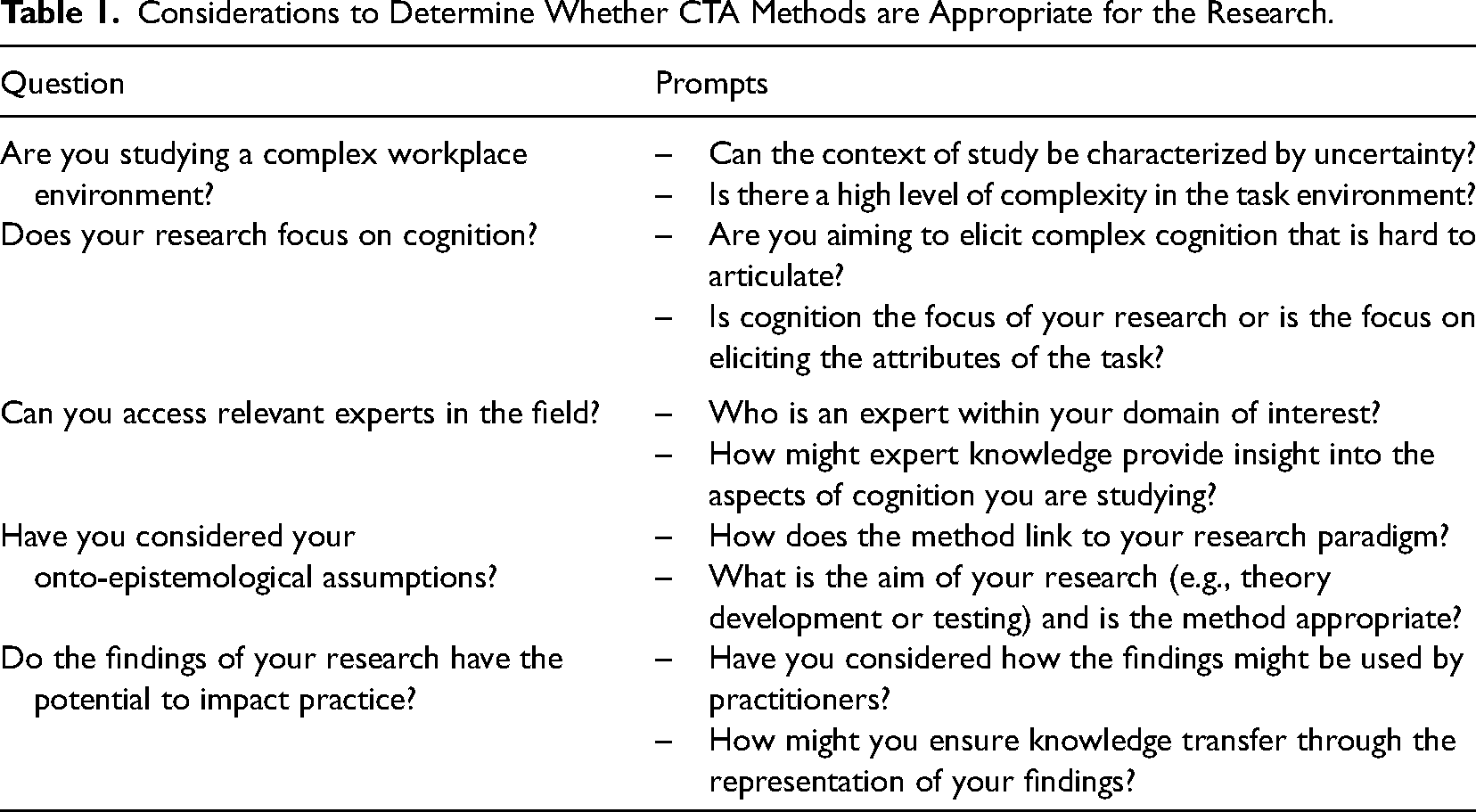
Are You Studying a Complex Workplace Environment?
CTA methods were designed specifically to understand decision-making in difficult, uncertain, and challenging contexts (Militello & Hutton, 1998). Embedded into the assumption of using CTA is that the insights gained into the cognitive skills and processes adopted by experts within a given task domain will be tied to the domain itself (Schraagen et al., 2000). Thus, CTA seeks specifically to understand how people make decisions when, for example, contextual demands derail typical processes or when unforeseen chaos is brought into the workplace. Today, we are witnessing an unprecedented shift toward organizational forms and practices that are more complex than would have seemed possible even a decade ago. Organizations must grapple with the challenges of a constantly changing and unpredictable world in the face of the impacts of, for example, the COVID-19 pandemic, the rise of artificial intelligence, and global warming. Understanding how organizations cope with and respond to dynamic contexts is therefore vital to the future of management cognition.
CTA has much to offer because it was designed to elicit cognitive processes in complex and highly uncertain task environments in which contextual demands make decision-making particularly difficult. We define a complex context as one that is characterized by a high degree of uncertainty, in which goals are ill-structured and/or ill-defined and where real-time decision-making and multitasking is required (Gordon & Gill, 1997; Orasanu & Connolly, 1993), and where significant knowledge, experience, and skill is needed to manage and contain competing or interdependent demands and goals (Gordon & Gill, 1997). This complexity might relate to a specific contained task (e.g., allocating patients to beds in intensive care units; see Power et al. (2018), discussed in detail below) or might characterize the wider environment in which several decisions must be made (e.g., implementing a global change initiative; see Osland et al. (2013), discussed in detail below).
One obvious application of CTA is in the realm of extreme environments—that is, task environments that present atypical demands and in which errors can have life or death consequences (Bell et al., 2018). Examples of teams working in such conditions include those in long-duration space flights (Salas et al., 2015), in nuclear plant control rooms (Stachowski et al., 2009), in medical emergencies (Klein et al., 2006), and in submarine command and control (Bierly & Spender, 1995; Roberts & Stanton, 2018). Extreme contexts provide management scholars with the opportunity to uncover critical new insights into human behaviors not adequately represented by studies in more conventional contexts (Hällgren et al., 2018). CTA methods are well suited to advancing the study of extreme environments and eliciting the cognitive processes that support the decision-making of experts in these contexts (see Boulton & Cole, 2016; Power & Alison, 2017).
Aside from extreme environments, CTA is also becoming increasingly relevant for understanding cognition in more conventional management settings as we witness an unprecedented shift toward more volatile and uncertain working conditions (Bell et al., 2018; Driskell et al., 2018; Golden et al., 2018; Schmutz et al., 2023). Innovative organizations succeed principally because of their ability to adapt to uncertainty and respond to continual changes in their domains (Russell & Russell, 1992). To gain competitive advantage in a marketplace, research has shown that organizations must act creatively, engage in effective knowledge management, and develop an organizational culture that is conducive to change (Adams et al., 2006; Chaston & Sadler-Smith, 2012; Cooper & Kleinschmidt, 1995). However, there remains a lack of clear evidence as to what precisely creates such capacity for change in an organization and what factors contribute toward the ability to adapt in periods of intense uncertainty (Goffin et al., 2019; Neely & Hii, 1998). It is here, in contexts of deep uncertainty and ambiguity, that CTA can provide an integrated perspective of the practices of innovation and knowledge management (Orasanu & Connolly, 1993). The strength of CTA in knowledge elicitation and cognitive mapping (e.g., via a “Knowledge Audit” or “Cognitive Demands Table”, see below) may prove very useful to management scholars seeking to identify how senior managers implement change and innovation within organizations. For example, a Cognitive Demands Table could capture what aspects of an organizational change a manager found difficult, how they overcame such difficulties, what common errors the manager encountered, and—crucially—what cues and strategies were adopted to overcome these difficulties (thereby identifying what provided the capacity for change, see Gore and McAndrew (2009)).
Does Your Research Focus on Cognition?
CTA methods are only relevant to research that is focused on complex cognition, especially aspects of cognition that are difficult to articulate and observe (Militello & Hoffman, 2008). As noted by Roth et al. (2014), it is not sufficient to tell a compelling story of workplace activities using CTA; the findings must also yield insights into cognitive challenges and focus on the role of expertise in enabling practitioners to navigate these challenges. This focus distinguishes CTA from existing approaches within the management literature, which do not probe for specific details of cognition and deeper insights into unconscious thinking, judging, perceiving, or decision-making (Stanton et al., 2017). If the research question is focused primarily on identifying the characteristics or attributes of a task, then it is likely that an alternative method such as CIT would be more appropriate. Indeed, while CTA methods were originally developed as an extension to CIT, and both methods focus on challenging incidents, the aims and applications of the two methods are distinct (Hoffman et al., 1998; Klein et al., 1989). For example, the CIT is used to describe the objectives of an activity and what a person does to accomplish these by having them reconstruct and outline the details of a specific incident (Flanagan, 1954). Thus, the CIT method is focused upon developing a descriptive narrative of how specific behaviors relate to a specific incident. In contrast, the aim of CTA is to unpack the underlying cognitive processes adopted by an expert operating in a complex task environment (Militello et al., 1997). As such, rather than being the core focus of study, the task (or incident) is used as a context with which to explore these cognitive processes (via deepening probes).
Given the welcome advancement of managerial cognition, we believe there are many opportunities for management scholars to utilize CTA in their research. For instance, while there has been a long-standing focus on cognition in the strategy literature (see Acciarini et al., 2020; Kaplan, 2011), much of this research has sought to identify individual dispositions and personality traits that might influence cognitive styles and decision-making (Elenkov et al., 2005; Helfat & Peteraf, 2015). In recent years, researchers have called for further innovation in the study of strategic leaders; for instance, by stepping beyond generalized performance indicators that might determine success and toward a more nuanced understanding of how senior individuals influence their firms and enact decisions within complex settings (Samimi et al., 2022). This approach is compatible with CTA in that it recognizes the inherent complexity of the environments in which strategic leaders operate and opens the door to a deeper exploration of cognitive processes.
Management scholars might, similarly, consider applying CTA in the study of entrepreneurial cognition. Cognitive processes such as perception and intuition are understood to play a vital role in the creation of new ventures, leading to an emerging trend across the entrepreneurial literature for studies grounded in cognitive psychology (Forbes, 1999; Shepherd, 2015). And yet, the field of entrepreneurship remains underdeveloped in comparison to other fields of management; there remains an emphasis on the individual attributes and cognitive styles of successful entrepreneurs, and a focus on research that utilizes experimental manipulation to determine the causal mechanisms that lead to the emergence of such entrepreneurs (Chen et al., 2015; Hsu et al., 2017; Shepherd et al., 2015; Short et al., 2010). In contrast, the focus within CTA on intuitive cognition (or “gut feeling”), and on probing participants’ appreciation for the “big picture”, their ability to “notice,” to recognize conditions as “opportunities,” and to “improvise” offers an alternative mode of inquiry by which to capture how entrepreneurial decisions are made in real-world contexts and the cognitive skills and strategies that guide behavioral actions (see Sadler-Smith & Shefy, 2004).
Can you Access Relevant Experts in the Field?
A third essential consideration when using CTA is ensuring that the prospective sample of participants are experts, because eliciting and utilizing expert knowledge is at the center of CTA methods (Roth et al., 2014). In simple terms, an expert can be defined as an individual who is “outstanding in terms of speed, accuracy, and automaticity of performance” (Hatano & Inagaki, 1984, p. 31). However, CTA methods also allow us to study expertise in a more nuanced way. Instead of the traditional approach of comparing experts to novices, or identifying an expert using a proscriptive formula, CTA embraces the many levels of expertise that exist when someone develops from journeyman to master, and thus does not view expertise as an endpoint in organizational learning but, rather, as a process (Hoffman, 1998). CTA methods also align with the theoretical positioning of cognitive psychologists and human factors researchers, suggesting that we have much to learn from experts and how they perform in complex, challenging environments (see for example, de Groot, 1946/1946/1965; Ericsson et al. 2006, 2018; Hoffman & Lintern, 2006; Shanteau, 1992; Ward et al., 2020). Promisingly for the application of CTA to the study of managerial cognition, this same perspective is common within the management and organization literature (Simon, 1987; Heimstädt et al., 2024). Indeed, expertise has long been regarded as having “explanatory potential” for a broad range of phenomena in management studies (Heimstädt et al., 2024, p. 1).
Consistent with the recent review by Heimstädt et al., of expertise in management research, we contend that the concepts of cognition and intuition are inherently tied to the understanding of what it means to be an expert at work. Thus, we suggest that the focus within CTA methods on eliciting and documenting expert knowledge has the potential to assist management and organization scholars with an alternative and more nuanced lens through which to understand MOC. As Ward et al. (2018, 2020) highlight, with the world of work becoming ever more cognitively challenging and technological, the urgency of the need for proficient and expert workers has increased, as has the value attributed to eliciting and sharing skills and tacit knowledge across the workplace such that it is not lost (see Marr & Spender, 2004; Spender & Grant, 1996). Because experts often find it difficult to reflect upon their own cognitive processes, CTA techniques are designed to provide structured and effective methods to elicit, capture, and, most importantly, share detailed insights relating to MOC (Feldon & Clark, 2006).
Management scholars may therefore consider utilizing CTA methods to further the study of expertise in the workplace. For instance, there is a growing interest in how we might improve our understanding of expertise and, indeed, how workers might sustain the value of their expertise by being more flexible (Frie et al., 2024). This “flexpertise” has been heralded as necessary in the context of increasingly volatile and uncertain working environments, in which adaptivity is becoming increasingly important (Baran & Woznyj, 2020; Dane, 2010; Frie et al., 2024). Here, we contend that CTA's usefulness in eliciting contextual cognition may form a bridge to exploring the link between expertise, adaptivity, and flexibility (Ward et al., 2018) by providing a rich understanding of how experts respond to and embrace dynamic contexts.
Have you Considered Your Onto-Epistemological Assumptions?
A risk with all qualitative research is a failure by researchers to consider their positionality with regards to their onto-epistemological assumptions (Bansal et al., 2018). Historically, CTA methods have been applied by scholars with a predominantly realist, post-positivist positioning. Central to this is the assumption that there are certain known components that characterize expert cognition (e.g., enhanced mental models, advanced sensemaking capabilities) but these can only be partially accessed and understood through the subjective views of an expert sample (Gore et al., 2018; Ward et al., 2018). For example, Klein's (1989) seminal recognition-primed decision model argues that experts utilize common cognitive processing patterns involving mental simulation to rapidly make choices in messy task environments, but that not all experts will make the same decision when faced with the same information (although all expert insights are valid). According to this perspective, one might argue that although there exists truthful knowledge about the process of expert cognition, this process can produce diverging but equally valid expert views dependent on subjective experience. And yet, CTA researchers could also adopt a constructivist perspective in their research, given the emphasis on the linkage of knowledge and expertise to context and to the experience, knowledge, and skill of an individual (Militello & Anders, 2020; Morris et al., 2021).
Therefore, we suggest that CTA can be utilized by scholars with varying onto-epistemological perspectives, as long as this is carefully considered and communicated. This view is concurrent with the assessment of CIT by Chell (1998), in which they argue that the method can be applied in a variety of paradigms as long as the researcher “considers very carefully the nature of the research problem to be investigated, and thinks through how the technique may most appropriately be applied in the particular researchable case” (Chell, 1998, p. 51). However, we would add that a core assumption of CTA-based studies is that it is not the researcher's role to judge the validity of an expert's choice (thus differentiating CTA from CIT), but to instead develop understanding of how that choice was reached by focusing on the cognitive processes, skills, and strategies adopted by the expert (Klein & Militello, 2001). It therefore resembles a process of discovery (Militello et al., 2011), lending itself to the initial phases of theory development, as opposed to the latter phases of theory testing and confirmation (see Carlile & Christensen, 2005). Relatedly, CTA methods might be used to “problematize” existing theory (Alvesson & Karreman, 2007); for example, in challenging existing understandings of cognition by exploring what cues, strategies, and processes are utilized in exceptional and challenging contexts (see, also, Shepherd & Suddaby, 2017). Therefore, while CTA can be applied within diverse research paradigms, it is unlikely to be suited to studies in which the intention is to elicit generalizable knowledge about a phenomenon or to quantitatively compare responses from two distinct groups.
Do the Findings of Your Research Have the Potential to Impact Practice?
Generating meaningful impact is an important element in the application of CTA, such that the findings of the research inform future practice at work (Klein & Militello, 2001). Management scholars face the growing and pertinent challenge of ensuring that academic research has relevance and can be translated into practice (Nicolai & Seidl, 2010; Parry et al., 2020; Shapiro et al., 2007; Starkey & Madan, 2001). Some authors have gone as far as to refer to a “crisis in the field of organizational science”, with research methods and insights reaching such high levels of statistical sophistication and complexity that they fail to offer any meaningful utility to practitioners (Rynes et al., 2001). CTA methods have been designed to address these concerns—to make cognitive mapping more concrete and accessible to practitioners and researchers across a range of fields (e.g., technical specialists, HR practitioners), while simultaneously maintaining the scientific integrity of conventional methods of task analysis (Stanton et al., 2017).
As such, when applying CTA methods, scholars should consider how their findings might provide evidence-based insights into how experts carry out workplace activities and how to translate such findings into recommendations for improving decision-making and performance (Crandall et al., 2006; Gore et al., 2018). Having individuals reflect on their decision-making during critical tasks can help them to understand their thinking processes and in turn improve future performance and facilitate knowledge transfer within the workplace (Moon, 2020). Knowledge transfer is a coveted resource in management practice, as organizations seek to gain a competitive edge while simultaneously protecting their unique capabilities from external competition (Argote & Ingram, 2000). Relatedly, findings can be used to translate expert knowledge into training and protocols, by offering detailed documentation of the complex cognitive processes (e.g., expertise, sensemaking, knowledge acquisition) utilized by skilled practitioners in situ (Clark et al., 2008; Gore et al., 2018; Tofel-Grehl & Feldon, 2013). To date, this has proved especially fruitful in medical training, aviation, and the military (Campbell et al., 2011; Clark & Estes, 1996; O’Hare et al., 1998; Velmahos et al., 2004). The large effect size (Hedges’ g = 0.871) reported in a meta-analysis of 20 studies reviewing the use of CTA in training design indicates that we can expect to see similar benefits in a management context (Tofel-Grehl & Feldon, 2013). Thus, we suggest that when management scholars are seeking to work directly with end-users, the application of CTA methods provides an opportunity not only to extend research interests but also to build collaborative relationships and achieve meaningful impact on organizational practice.
Doing CTA: The Methodology
In the following subsections, we present two examples of CTA in practice, which utilize two different methods of knowledge elicitation (and their associated methods of analysis and knowledge representation) that have the most potential for management research: the Critical Decision Method (CDM) and Applied Cognitive Task Analysis (ACTA). In doing so, we seek to address one of the primary difficulties in applying CTA methods: the choice of where, how, and when to adopt specific forms of the method (Hodgkinson & Healey, 2008; Yates & Feldon, 2011). Our reason for focusing on CDM and ACTA is that these are the two most widely used CTA methods and have therefore been applied across a diversity of work domains and academic disciplines (Boulton & Cole, 2016; Graham et al., 2023; Plant & Stanton, 2015; Swaby et al., 2022). As such, we argue that there is strong and sustained evidence of their successful transferability into management and organization studies.
CDM is a narrative-based, retrospective interview technique that requires experts to reflect on a challenging incident in a complex work domain. In doing so, it seeks to “identify the knowledge requirements, expertise and goal structures involved in performing a decision-maker's work” (Wong, 2003, p. 327). In some instances, CDM can be paired with other methodologies such as observations and document analysis (see Clark et al., 2008; Graham et al., 2023; Waring et al., 2020); however, this is not always possible if the decision-making environment is particularly sensitive (e.g., emergency response; Power & Alison, 2017). CDM is likely to be useful to management scholars interested in studying topics such as entrepreneurship and innovation, contexts in which individuals are faced with risk and complexity.
ACTA is an interview technique designed to identify the key cognitive elements required to perform expert tasks (Militello & Hutton, 1998). It normally involves three phases: (i) developing a task diagram; (ii) a knowledge audit interview; (iii) data analysis and knowledge representation (Gore et al., 2018). Sometimes, to probe into alternative representations of cognition within the knowledge audit interview phase, researchers also utilize CDM and/or a simulation interview or simulated exercise (see Brown et al., 2020). However, ACTA is typically used in a streamlined manner, taking less time to complete than a CDM, and suited to instances in which time is limited (Militello & Hutton, 1998). ACTA is especially useful when the researcher is interested in accessing detailed knowledge about the work activities of a high-performing expert completing a domain-specific task (Klein & Militello, 2004; Militello & Hutton, 1998). We know from many years of experimental work on expertise in cognitive psychology that experts often find it very difficult to tell researchers what they know (Ward et al., 2020), so the ACTA techniques focus upon knowledge elicitation in such a way that expert cues and strategies in a professional domain are documented clearly.
While we propose that both CDM and ACTA are suited to a diverse range of management contexts, we also note that their differences dictate that there may be differences in their application (Hoffman et al., 1998; Yates & Feldon, 2011). As such, we suggest that CDM is best applied in studies that speak to its naming, that is, research contexts in which the aim is to elicit and document the cognitive processes adopted in support of critical decision-making. For instance, CDM might be used to examine complex policy-related decision-making associated with changes in human resources and workplace technology, or in unpacking the decisions made and steps taken in entrepreneurial business development. ACTA, on the other hand, is best used in circumstances in which the primary aim is to uncover the broader cognitive skills and knowledge requirements that are needed to complete a complex workplace task or activity (Hoffman et al., 1998). For example, managers having to develop complex strategies across and within senior leadership teams, or examining how the completion of a complex task might be influenced by the legal and political context of an organization. Overall, CDM may be better suited to research questions in which the decision-making itself is the focus, whereas ACTA might be better suited to research questions that seek to identify the broader range of cognitive skills and knowledge requirements needed to complete a specific workplace task.
Using CDM to Explore Management Decision-Making
This section will describe the use of CDM with two examples that explore senior management decision-making, one in the emergency services (Power & Alison, 2017) and one in hospital intensive care units (ICUs) (Power et al., 2018). CDM was identified as a useful technique for knowledge elicitation in these studies because the researcher sought to explore the core challenges to decision-making in complex, uncertain environments by adopting an inductive and exploratory approach. An important requirement for researchers conducting CDM interviews is that they are familiar with the specifics of the research domain (e.g., terminology, work processes) (Crandall et al., 2006); the interviewer should strive to achieve “quasi-expert” status by increasing their understanding of the expert's domain (Pfadenhauer, 2009). Such familiarity enhances the knowledge elicitation and knowledge representation phases because interviewees feel more able to discuss their cognition in informed yet non-competitive environments (Trinczek, 2009).
Once a suitable incident has been identified and agreed upon by both the interviewer and the expert, then the expert is asked to provide a narrative walkthrough of the incident from start to finish, without interruption from the interviewer (the first sweep), although the interviewer should help to re-focus the interviewee with gentle probes if they begin to drift off-topic. By guiding the participant back to the task (or incident) at hand when conducting CDM, the aim is to ensure that the participant continually reflects on and identifies the cognitive processes and mechanisms used to approach that task. This is not intended to limit the participant's response or to stifle conversation, but rather to keep the interview bounded within the context of one specific incident and invite opportunities to discover complex cognitive processes that may not be identified if the participants were to reflect more broadly on their work activities (Rosen et al., 2013). At the end of this sweep, it is recommended that a check is conducted for “pre-starts” (i.e., anything that happened before the incident) and “second endings” (i.e., what happened after the event), to ensure a full and informed narrative (Crandall et al., 2006).
Example of Cognitive Probes Used in a CDM Interview Examining Decision-Making Processes.
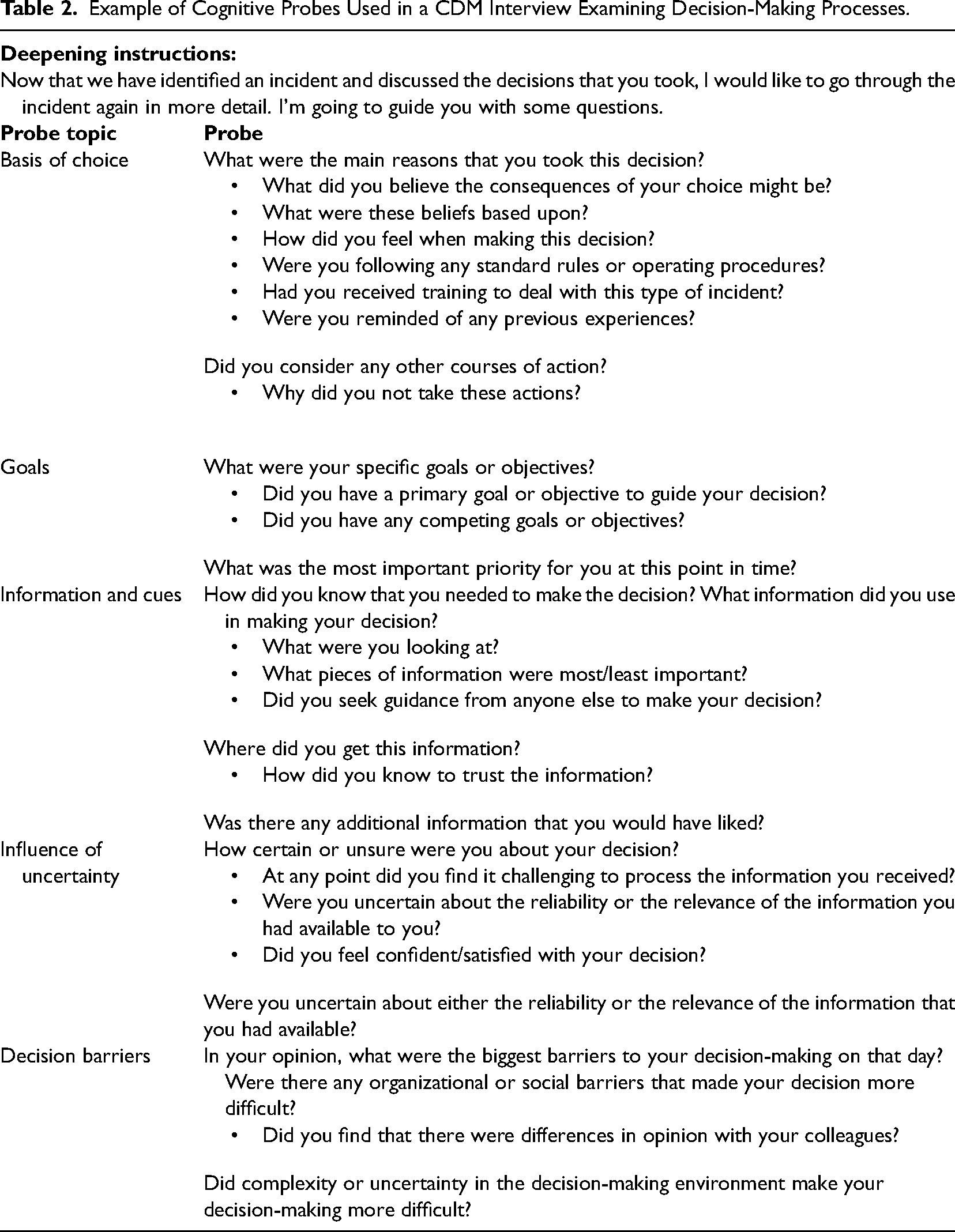
Not all probes will be used in every interview, nor is the researcher limited to the probes on their list because they can create additional ones guided by their curiosity at the time of the interview, as is standard in all semi-structured interview approaches. In general, probes tend to include questions about: the presence or absence of cues; the meaning of cues; the expectations about the situation; the goals/actions considered; the options being evaluated; the uncertainties experienced by the decision-maker (Crandall et al., 2006; O’Hare et al., 1998). The interviewer must be well-versed in the design and type of questions used to probe the responses of interviewees, without deviating too much or losing control of the area of research interest (Hoffman et al., 2006).
Using ACTA to Explore Leadership
This section will outline ACTA with reference to studies of global leadership behavior (Osland, 2010; Osland et al., 2013; Osland et al., 2012; Osland et al., 2017). The aim of Osland et al.'s research was to explore the cognitive processes employed in global change efforts. ACTA was chosen because of its focus on expertise and eliciting cognition, both of which had yet to be explored in detail in the global leadership literature. Prior to data collection, Osland et al. consulted human resources personnel and carried out a vetting process to ensure that participants had the relevant expertise and at least 10 years’ experience in senior management. This criterion was especially stringent, given Klein's (1997) conclusion that experts make up only 2–3% of a workforce. Ten participants were identified who met the criteria, concurrent with CTA guidelines that suggest a minimum of three to five experts are needed to identify expert cognitive processes (Crandall et al., 2006; Gore & McAndrew, 2009). A further ten experts were selected at a later stage for confirmatory analyses.
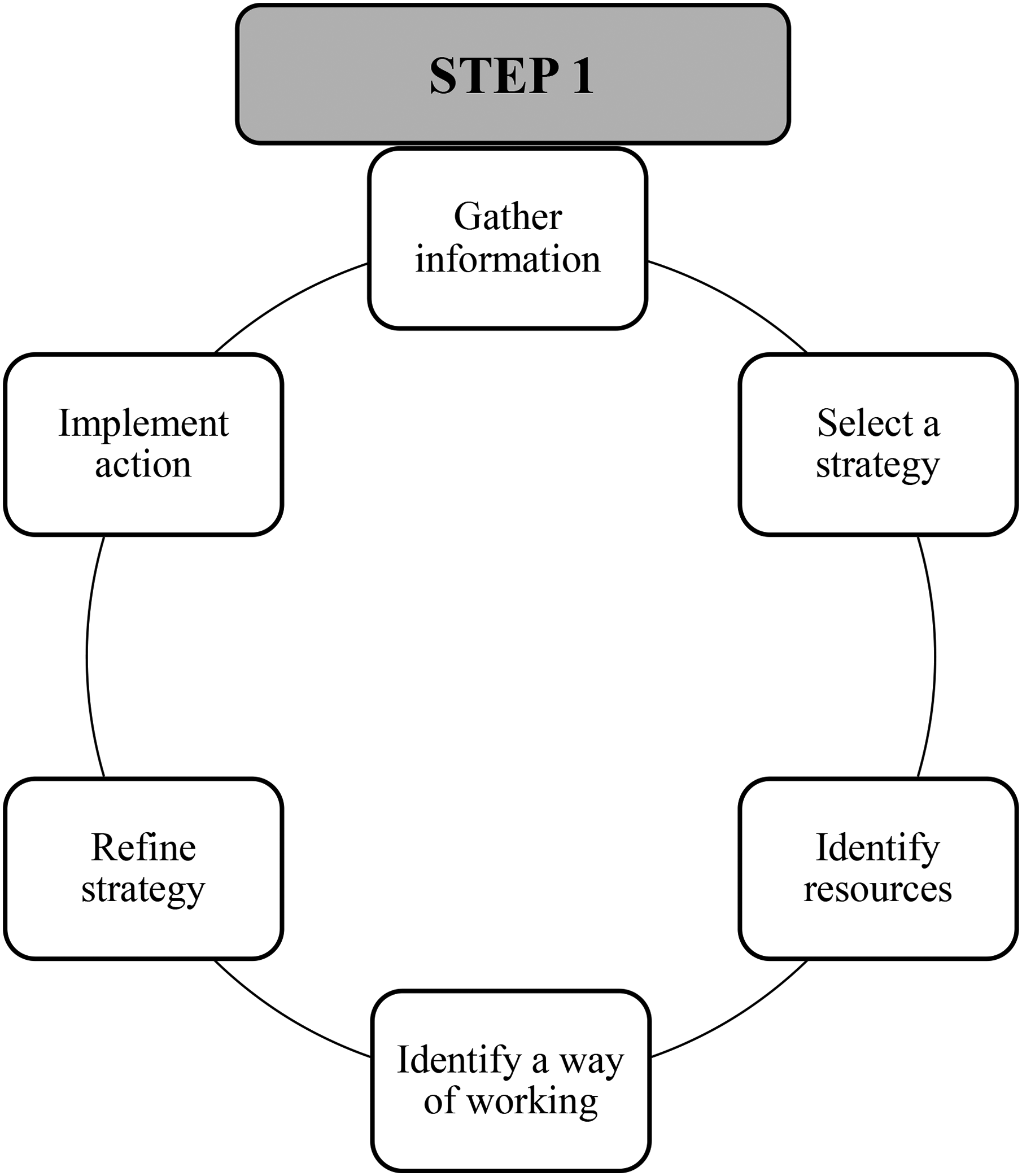
Illustrative example of a task diagram, adapted from Osland et al. (2017).
Depending on the complexity of the task, Task Diagrams can be elicited in 10–30 min and are designed to generate a “big-picture” overview. Participants often find this phase challenging and offer too much detail, and so the interviewer must be prepared and ensure that they keep the conversation on track (for further suggestions in this regard, see Gore et al., 2018). Asking participants to divide the task into three to seven steps aligns well with their short-term memory (i.e., most people can easily remember 7 ± 2 pieces of information; Miller, 1956). The researcher must remain mindful of using this Task Diagram phase to clarify which elements of a complex task experts find the most challenging, and to begin identifying the cognitive skills needed to cope with this complexity (Gore et al., 2018). The salient information obtained in this phase will be used to guide questioning in the next phase, the Knowledge Audit (Militello & Hutton, 1998), which seeks to access complex cognition, typically associated with long-term memory.
Applied Cognitive Task Analysis (ACTA) Probes Used in a Knowledge Audit.
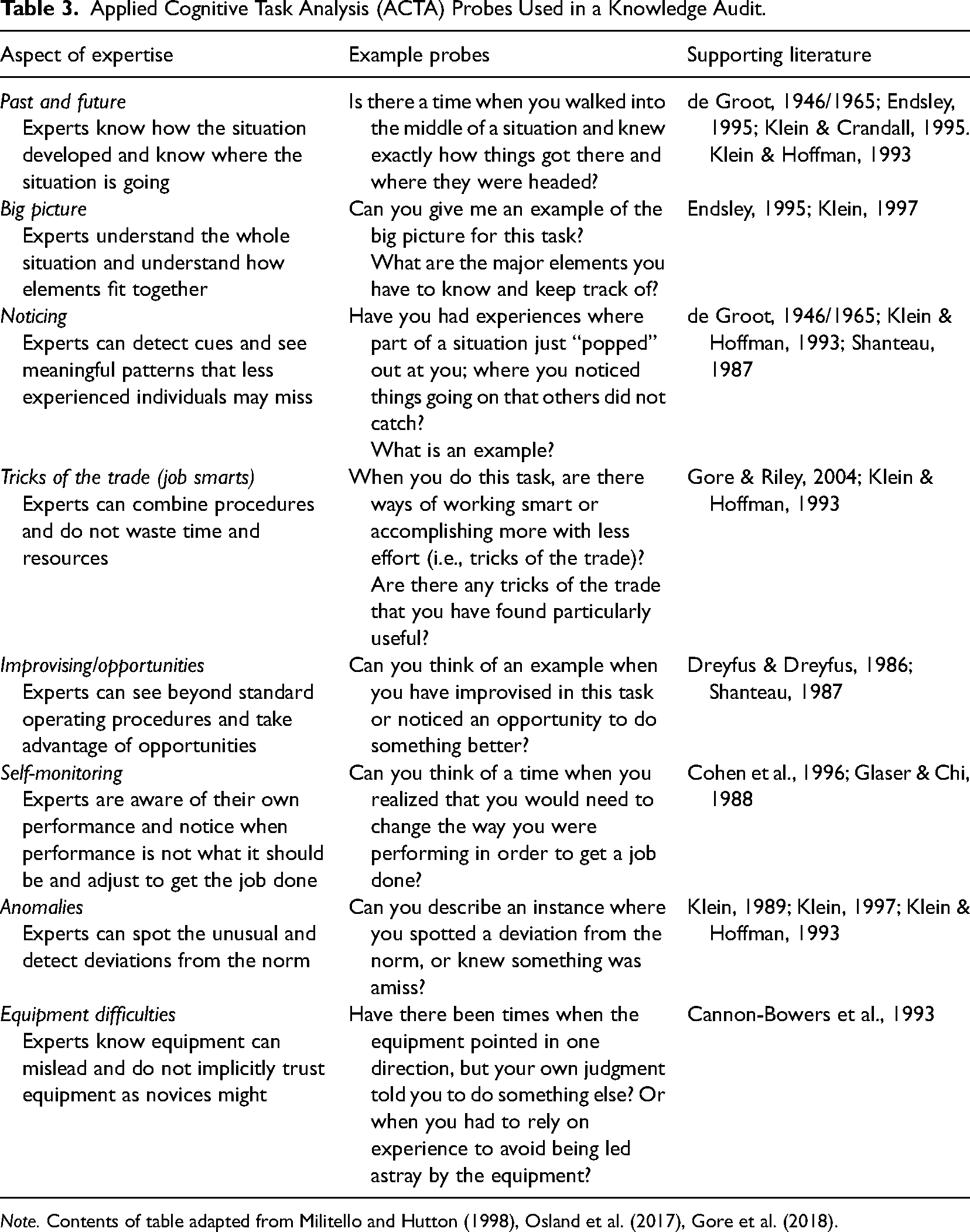
Note. Contents of table adapted from Militello and Hutton (1998), Osland et al. (2017), Gore et al. (2018).
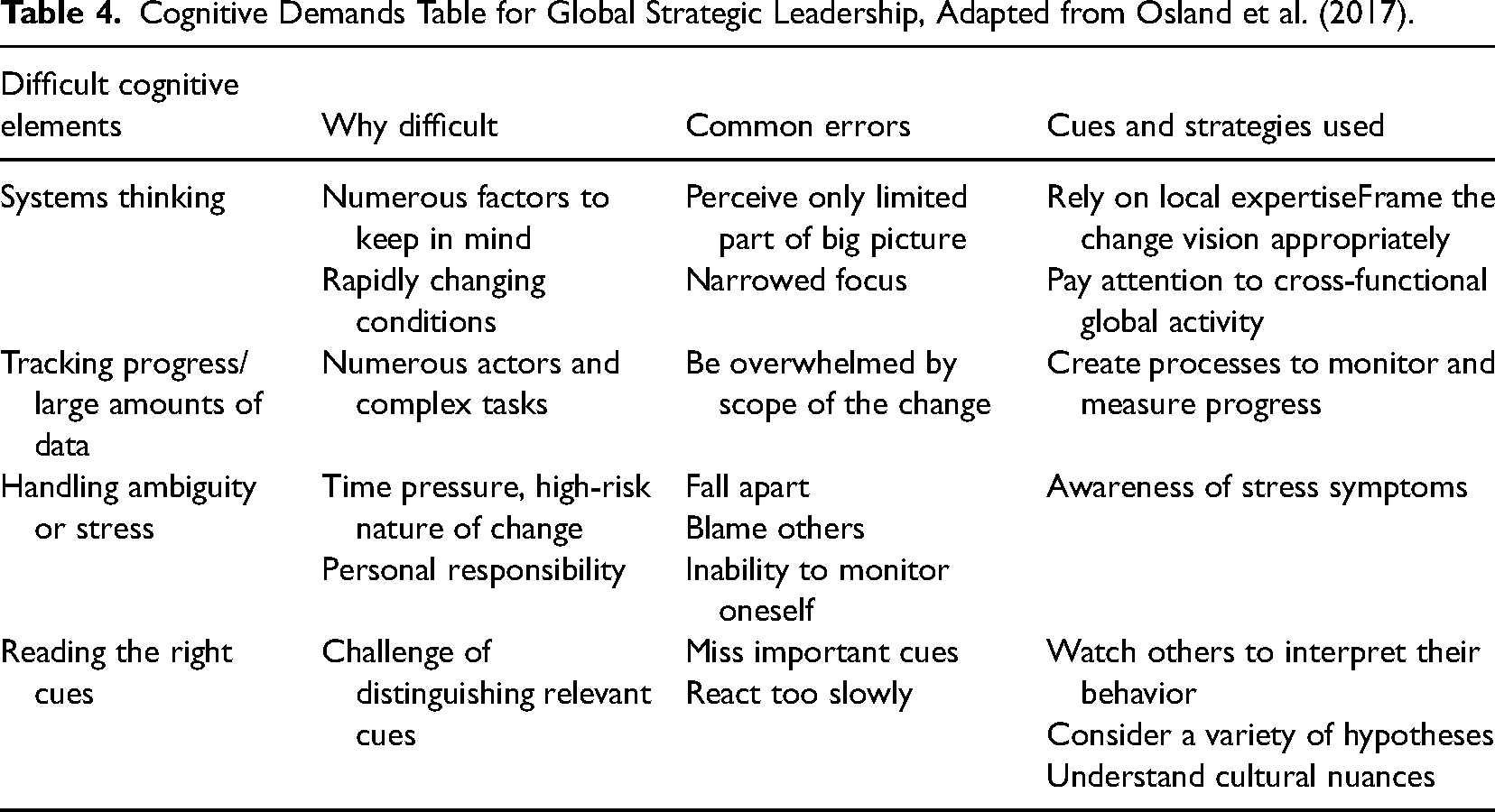
Findings from ACTA are typically represented in a Cognitive Demands Table (see Gore et al., 2018; Gore & McAndrew, 2009; McAndrew & Gore, 2013; Militello & Hutton, 1998; Table 4), which is an outcome of ACTA intended for practitioner use and focuses on the most challenging cognitive elements of a task. By highlighting common challenges and errors, in addition to the solutions adopted to address those challenges, the Cognitive Demands Table offers a concise representation of how experienced practitioners navigate complex incidents. This representation of decision-making and problem-solving solutions can then be used to inform future training and job design. While not included in Osland et al.'s (2013) study of global leadership, the lead author later reflected that this would have been a useful method to complement their findings and represent the most difficult cognitive demands within this particular work domain (see Osland et al., 2017). Building on their team's work in 2013, Osland et al. (2017) conducted a further study of global leadership and used a Cognitive Demands Table to merge and synthesize their data, which were then used to inform global training in leadership development (see Table 4).
Cognitive Demands Table for Global Strategic Leadership, Adapted from Osland et al. (2017).
Future Directions
In this paper, we have provided management scholars with a detailed explanation of the benefits of CTA methods and when best to utilize them, providing two concrete examples of how they have been used to study managerial decision-making (Power et al., 2018; Power & Alison, 2017) and leadership (Osland et al., 2013; Osland et al., 2012; Osland et al., 2017). Our aim of sharing CTA methods with a new audience follows recent calls within the management literature for qualitative researchers to demonstrate how alternative methods might be applied and adapted to garner fresh insights (Köhler et al., 2022). Building on our earlier analogy (inspired by Hayes et al., 2016), we contend that CTA provides an additional, augmentative approach to understanding management cognition by providing contextualized clues to help solve the puzzle of such cognition.
In broad terms, we expect that CTA will offer management scholars an alternative mode of inquiry to continue the critical questioning of conventional representations of management theory, especially with regard to examining cognition in context. As Bridgman and Cummings (2020) argue, continued critical questioning will assist new theories of management to enter the mainstream and advance cognition in the workplace. For instance, CTA may be used to examine the future of work, asking questions that reflect upon management and leadership doing, thinking and acting (see Bridgman & Cummings, 2020), changes in requirements for building socio-technological and cognitive competence (see Gore et al., 2018; Hoffman & Woods, 2000), or the transition toward “flexpertise” in increasingly volatile and uncertain work contexts (see Frie et al., 2024). This exploration will be of paramount value to research communities, as well as speaking to the needs of practitioners who today face unprecedented changes in the way that they work (e.g., hybrid working policies, AI developments; see Benbya et al., 2020).
Extant examples of CTA studies of human–computer interactions suggest that there is great potential for management scholars to utilize these methods when seeking to understand the growing trend toward technology-assisted decision-making within organizations (Colbert et al., 2016; Klein & Militello, 2004; Mahoney et al., 2010). CTA research has long since recognized the importance of viewing human decision-makers as central actors when exploring complex sociotechnical systems in which technology can accelerate and enhance expertise (Klein, 2000)—specifically, the role of AI in assisting, rather than replacing, the decision-maker in complex, cognitively demanding situations. As discussions around the role of AI in the future of work accelerate (Anand & Rofcanin, 2022; Brown et al., 2024; Jarrahi, 2018; Munoko et al., 2020; Parry et al., 2016), CTA presents an opportunity to elicit the intuitive and hard-to-articulate aspects of human cognition not suited to automation (see Jarrahi, 2018; Sadler-Smith & Shefy, 2004) and, thereby, highlight the areas where AI developments might be best focused to support human decision-makers (e.g., information sifting, data analytics).
Throughout this article, we have highlighted the potential for CTA methods to complement and extend existing streams of research in MOC. In addition, we note that there remains scope for further development of CTA methods themselves, specifically in the application of CTA to the study of teams and in adapting CTA to study emotions. While there exists some early documentation of the use of CTA to understand cognition at the team level through observing teams in situ (Klein, 2008, existing empirical studies have tended to employ methods to interview team members individually to ascertain the skills (e.g., communication) and cognitive processes (e.g., situational awareness, team mental models) utilized by teams during complex tasks (see Flin et al., 1996; Pugh et al., 2011).
Concurrently, despite much research in the study of team cognition, scholars have noted how a lack of precisely defined processes in the emergence of team knowledge has limited the collective understanding of how expert team cognition arises and is sustained (Grand et al., 2016; Kozlowski & Chao, 2012). Future explorations of CTA might examine how to develop the methods to better study team cognition in context, perhaps through focus-group-style interviews or by exploring how findings obtained at the individual level might be aggregated and/or compared at the team level. For instance, Akinci and Sadler-Smith (2019) successfully adapted CIT to examine intuition in senior police commanders, and their findings illustrated how teams engaged in organizational learning and collective intuition during team-based decision processes. A similar adaptation to CTA methods could provide a new and innovative way to examine how cognition emerges and develops within teams, and generate new theory as to how cognitive processes might impact on team behaviors.
Finally, it is worth noting that while CTA methods were originally developed to study what has since been termed “cold” cognition (i.e., to elicit knowledge, skills, cues, etc.; see Hodgkinson & Healey, 2014), future adaptations might use and/or combine CTA methods with other methodologies to examine “hot” cognition—that is, to explicate how emotions influence cognition and decision-making. There has been much conjecture within the field of MOC on the need to better acknowledge the role of emotions in decision-making processes (see Ashkansey et al., 2017; Brundin et al., 2022; Hodgkinson & Healey, 2014), and an adapted version of CTA that focuses on eliciting emotions is ripe for further exploration (Crowson et al., 2020), as are the possibilities of combining CTA with other methodologies to examine the affective and implicit aspects of cognition (see Hodgkinson et al., 2018; Hoffman, 2023). Future explorations of CTA in multi-method studies should ensure the sustained relevance of these methods to MOC scholars, as we witness an increase in methodological pluralism and the triangulation of data sources in the study of cognition at work (Christofi et al., 2024; Hodgkinson et al., 2018).
Limitations
CTA methods rely on verbal responses from participants and thus it is important to consider how this might influence the interpretability and validity of the findings. While debate as to the validity of verbally reported data is too lengthy and complex to adequately cover here, it is important to acknowledge that CTA is not immune from the typical criticisms of memory failure that have been directed at interview-based methodologies (Hoffman et al., 1988). It is, of course, possible that during a CTA interview, a participant might select a task or incident that occurred a significant time ago. However, we would counter that CTA methods were designed precisely with such concerns in mind. For instance, in CDM, participants are instructed to recount a specific incident first, before the researcher repeats it back, with an invitation to the participant to intervene should any inconsistencies or corrections arise. This is by design, rather than coincidence, and is intended to facilitate accurate recall (see also Fisher & Geiselman, 1992).
Likewise, it is also plausible that participants will introduce biases when recounting their experiences or even cite fabricated knowledge to provide a stronger post hoc rationale for their decision-making (Hoffman et al., 1998). While this is important, regarding it as a limitation rests on the notion that the very purpose of CTA is to ascertain a precise representation of exactly what happened in any given incident and to determine what the “correct” decision would have been. However, this is not the intended purpose of CTA, which does not attempt to extract knowledge in a manner akin to “the mining of gold” (Hoffman et al., 1998). Indeed, this is a key aspect that distinguishes CTA from CIT, wherein it is assumed that the interviewee can make a judgment surrounding the success or failure of a participant and discern a clear understanding of the consequences of their actions (Bailey, 1956; Flanagan, 1954). Whereas the primary aim of CIT is to explore “what helps or hinders in a particular experience or activity” (Butterfield et al., 2009, p. 268), CTA is not limited to responses that can be anchored or verified (Klein et al., 1989) and does not seek to determine the optimal outcome of a decision or action. Often, the nature of complex work environments means that it is difficult to objectively judge the success of an expert's actions because the context is so unique.
Instead, CTA is designed to uncover and elicit how an individual navigated a particular incident and to elicit the cognitive skills and strategies that they used. The extent to which the individuals’ responses are regarded as “true” ought then to be determined by the onto-epistemological position of the researcher. For example, a constructivist approach might assume that because individuals construct meaning according to their own cognitive functions and processes, the “true” reality of an incident is of little importance because it is the participants’ reflections of their own cognition that matter (see Kartoshkina & Hunter, 2014). However, a realist might assume that there are commonalities in cognitive processes between individuals and thus look to compare a sample of participants in an effort to identify common truths that might (a) fuel the development of theoretical frameworks (e.g., to identify perceptual cues utilized by managers operating in a certain context) or (b) be used to translate expert knowledge into training materials (see Gore et al., 2018; Tofel-Grehl & Feldon, 2013). We therefore suggest that while CTA cannot escape the inherent limitations of a verbal method, these limitations are addressed in both the design of the data collection phase (i.e., through incident recall and the use of cognitive probes) and through the researcher's clear explication of their onto-epistemological position.
Finally, and comparably to many other qualitative methods, CTA techniques are limited by being time-consuming and thereby expensive; significant time is also required for researchers to develop advanced interviewing skills (Brooks & King, 2017; Klein & Armstrong, 2005; Köhler et al., 2022; Militello & Anders, 2020; Schraagen, 2009; Yardley et al., 2020). Without sufficient training, it is possible for researchers to become distracted by participant-led narratives that stray from the boundaries of their research and the focus on cognition throughout (Roth et al., 2014). As such, while we have highlighted the potential and benefits of CTA, and where and when it might be suited to management studies, we urge management scholars to consider carefully how they might adopt a CTA approach and to invest time in crafting their skills in this innovative and diverse set of methods. Scholars are encouraged to take time to engage with the existing literature, developed over decades of research, that offers detailed procedural guidelines to ensure insights are garnered in a systematic, careful manner (see Appendix; Crandall et al., 2006; Militello & Hutton, 1998). This framework encourages scholars to develop a clear research strategy and ensures the focus remains on complex cognitive processes such as decision-making, judgment, and problem-solving (Crandall et al., 2006; Militello & Anders, 2020).
Conclusion
As management scholars continue to explore new ways of studying complex cognition, we contend that the time is ripe to consider additional methodologies currently underutilized in the field (Hodgkinson et al., 2018). As highlighted by Plakoyiannaki and Budhwar (2021, p. 6), and by Pratt et al. (2020, p. 7), qualitative scholars must continue to consider creative and diverse ways to promote craft and methodological pluralism within their research (Cunliffe, 2011). We have presented CTA as a promising methodological approach for management scholars, which can rigorously articulate the complex cognition of experts at work by paying close attention to the role of context. It is our intention that this paper encourages greater use of CTA in management research, contributing critical insights into how we might meet future challenges in our understanding of managerial cognition.
Footnotes
Appendix
Acknowledgments
The authors thank the Associate Editor, Professor Catherine Welch, for her thoughtful engagement and constructive suggestions in guiding the manuscript through the review process. We also thank the anonymous reviewers for their insightful and helpful comments, which have greatly improved our work. Finally, we are grateful to Gary Klein, Robert Hoffman, Laura Militello, Robert Hutton, and Brian Moon who have long advocated for the value of CTA methods and whose work has provided us with much inspiration.
Declaration of Conflicting Interests
The authors declared no potential conflicts of interest with respect to the research, authorship, and/or publication of this article.
Funding
The authors received no financial support for the research, authorship, and/or publication of this article.
