




Abstract
Qualitative research methods are deemed best suited to exploring novel phenomena and generating new concepts. Their potential to reevaluate existing theorizing, however, is underestimated. Qualitative restudies that return to the data and settings on which the original theories were built are a well-established tradition in other disciplines (e.g., history, sociology, and anthropology), but have received little recognition in management and organization studies. We introduce qualitative restudies as a powerful means to improve theorizing by revising or challenging theories that have become outdated or obsolete and establishing transferability and longevity of findings and interpretations. We provide a typology of qualitative restudy designs drawing on an integrative review of literature in management, strategy, and the social sciences and humanities. We highlight the main design and ethical considerations for researchers in undertaking a restudy. We argue for the strengths of restudies as lying in their possibilities for retheorizing, above and beyond verifying or updating prior studies. Restudies draw on the strengths of in-depth qualitative work to uncover how interpretations and theorizing are shaped by methodological traditions, historical contexts, existing societal structures, and researcher backgrounds.
Qualitative research methods embedded in different epistemological and ontological traditions are routinely employed to develop new theory and refine or extend existing theories. In management disciplines, the majority of such work is focused on making novel contributions by building on existing theoretical interpretations. Yet as others have observed, this preference has led to some deleterious consequences, such as an overgrown theory jungle due to the proliferation of concepts (e.g., Cronin, Stouten & van Knippenberg, 2021; Leavitt, Mitchell & Peterson, 2010). Another consequence of the pursuit of novelty is the neglect of qualitative restudies: that is, follow-up studies to reexamine and reinterpret the empirical data and findings on which existing theories were built. In this article, we take the stance that restudy designs represent an under-utilized opportunity for exploiting the explanatory power of retheorizing in management and organization studies.
We define a restudy as an empirical study which is designed to enable systematic comparison with the original data, analytical results, or field setting of a prior study, as the basis for retheorizing. Retheorizing through restudies may consist of revising or challenging theories that have become outdated or obsolete, as well as establishing the transferability and longevity of findings and interpretations. In returning to original studies and their empirical sites, qualitative restudies allow us to explore how our interpretations and theorizing are shaped by theoretical and methodological traditions, historical contexts, existing societal structures, and researcher backgrounds. By acknowledging the situatedness of inquiry, they pave the way for more critical and sustained engagement with phenomena of interest, the populations and contexts in which we explore them, and the theoretical legacy on which we build our work.
Isolated examples of restudies can be found in management, largely in the form of follow-up studies of seminal classics in the literature. For example, Arthur Chandler's work on the M-form has inspired numerous restudies (e.g., Novicevic et al., 2009). The Hawthorne studies have been reexamined by qualitative, not just quantitative researchers, since the original results were published in the early 20th century (Mayo, 2003). These qualitative restudies have problematized the causal links claimed by the Hawthorne studies based on new evidence, including new interviews with surviving participants of the original experiments (Greenwood, Bolton & Greenwood, 1983) and reinterpretations made possible by placing the original studies in their broader social and temporal contexts (Hassard, 2012).
Yet despite the insights that can be gained from returning to prior research (Burawoy, 2003; Heaton, 2004), there is little recognition of the possibilities for restudy designs and the benefits of retheorizing in management and organization studies. Consequently, there is little methodological impetus to encourage crucial and timely reevaluation of our theoretical landscape. This is in contrast to other areas of the humanities and social sciences, where the methodological considerations for undertaking restudies have gained increasing attention. Nor has there been an attempt to integrate these reflections from multiple disciplines, meaning that a systematic approach to qualitative restudies, including a common terminology and clearly articulated methodologies, is currently missing. It is our aim in this article to offer such an approach. We do so by defining different forms of qualitative restudies and specifying their role in the knowledge generation process.
Our article proceeds as follows. We introduce restudies and distinguish them from other, related designs and approaches in qualitative research. We then report conclusions from an integrative review (Cronin & George, 2023) of the existing methodological literature on approaches to restudies, drawing extensively on methodological advances in other disciplines in which such designs have gained greater prominence. Specifically, in our typology of restudy designs we delineate four distinct types of restudies—reanalysis, revisit, revision, and repurposing—and discuss their differences in approaches to study design. We then outline the techniques and steps common to all these types of restudy, focusing on the distinctive feature that sets the restudy apart from other forms of qualitative inquiry: namely, establishing a generative tension between the original and the follow-up study at each stage of a research project. We elaborate on the ethical and practical challenges inherent to this process. Throughout the article, we showcase examples from multiple disciplines, placing emphasis on examples from management research. In our conclusion, we highlight the potential for restudies to offer a distinct contribution to the broader debate on retheorizing, consistent with the strengths and commitments of qualitative research.
Qualitative Retheorizing and Restudies
Restudies are actively discussed and undertaken in other disciplinary fields (Bryman, 1989; Hughes-Warrington, 2007; McLeod & Thomson, 2009). One possible reason that restudies have not received more attention in management is that a host of terms has been used, often interchangeably, to denote such studies, for example, reanalysis (Åkerström, Jacobsson & Wästerfors, 2004), revisits (Burawoy, 2003), reuse (Silva, 2007), revision (Hughes-Warrington, 2013), returns (Howell & Talle, 2012), and even “qualitative replication” (Tuval-Mashiach, 2021). The lack of consistent terminology for qualitative retheorizing makes such designs less visible and a comparison between them more difficult. Another reason for the lack of restudies is that qualitative management researchers may have come to view restudy designs as the prerogative of positivist replication research aligned with quantitative methodologies. While replication concerns in quantitative research focus predominantly on the potential for stable findings across studies, qualitative researchers, no matter their philosophical positioning, would mostly find this assumption of stable findings to be problematic and consequently may question whether retheorizing defined in those terms has any merit (Pratt, Kaplan & Whittington, 2020).
To provide a common definition that builds on qualitative research paradigms, we offer the term restudy to refer to an original empirical study that follows up an earlier piece of research with the purpose of extending existing theory or building new theory, thus developing the stream of research further. The follow-up study may reexamine the original data or collect new data to reevaluate or reinterpret the previous conclusions or to examine change that has occurred. In other words, the original study is retheorized. Goals of restudies include extension of existing theorizing, theoretical reconstruction in meaningful ways, refutation and revision, or the addition of new lenses and theoretical perspectives.
In evaluating the linkages between an original and a follow-up study, restudies go beyond commonly used qualitative techniques focused on establishing trustworthiness and credibility in data analysis and the theoretical robustness of conclusions drawn from findings in a single study. The latter include reinterviews, field revisits and the addition of cases, using a “replication logic” (Yin, 1984), with the purpose of checking whether the emerging theory holds in a new setting. These approaches tend to emphasize the need for stable interpretations of the phenomenon under investigation (Lincoln & Guba, 1985). The goal of deploying such techniques in a single study is integrative theorizing, rather than the purpose of a restudy: namely, reexamination of the theoretical conclusions of an existing study.
Similarly, there is an important conceptual distinction between restudies and longitudinal studies. The former is “dual synchronic” (Howell & Talle, 2012, p. 12): it enables comparison between two points in time, without there having been contact with the field site in between. The express purpose of the two separate studies and their comparison is to reexamine and reevaluate existing theorizing, that is, to retheorize. Longitudinal studies, on the other hand, are “multitemporal” (Howell & Talle, 2012, p. 12), in that they involve multiple returns to the same field site, allowing the research team to remain engaged with the field site over time. The purpose of this repeat engagement is to produce integrative theorizing that takes multiple events over time into account.
Restudies are compatible with a variety of philosophical approaches, ranging from postpositivist realist to critical and constructionist positions (Neale, 2020). Postpositivist realists, no less than constructionists, recognize the fallibilistic nature of our knowledge claims and do not undertake a restudy with the purpose or expectation of finding stable truths. Rather, there is recognition that the passage of time is likely to lead to differences in the theoretical conclusions drawn from an existing dataset. These differences do not necessarily invalidate the conclusions from the original study; rather, they allow for better appreciation of how research is a product of its time, both in terms of its social and analytical contexts (Davies & Charles, 2002). The value of retheorizing in this tradition lies in its ability to highlight the context-boundedness of any single set of theoretical conclusions (Hammersley, 2016). Restudies can also support critical scholarship, allowing researchers to read existing studies “against the grain” (Savage, 2005, p. 43), understanding what was erased in the original study as well as what was foregrounded.
Constructionist researchers undertaking a restudy do so fully aware of the contextualized and interpreted nature of their task. In fact, it is the constructed nature of data that provides a strong rationale for undertaking reinterpretation, recontextualization, and retheorization (Moore, 2006). Constructionist researchers reject any notion of epistemological privilege, either on the part of the original or subsequent researchers (Mason, 2007). All research is necessarily partial due to the positionality of the researchers, their theoretical commitments and assumptions. While the original researcher(s) can claim the advantages of “being there” and of experiencing firsthand the context in which the original data were produced, those conducting a restudy can benefit from greater distance to identify what was taken for granted and unproblematized in the original study. In this approach, retheorizing is a reminder of how “tenuous” (Kleinberg, 2007, p. 143) and “provisional” (Andrews, 2008, p. 1) our knowledge claims are. The value of retheorizing an existing study lies in providing an alternative interpretation in recognition of the epistemological uncertainties and temporal boundedness of any set of research conclusions.
Just as qualitative retheorizing in the form of restudies can accommodate multiple philosophical approaches, we shall now turn to the variety of research designs that can be utilized. Given the limited number of such studies in the management field and the somewhat varied nature of retheorizing in other disciplines, the research methods literature is currently lacking an overview of different types of restudy designs and their associated strengths and weaknesses. In fact, as we know from personal experience of undertaking and publishing a restudy (Rumyantseva & Welch, 2023), if management researchers want to conduct a restudy, they face a series of methodological questions without obvious answers in the management field. These cover the entire research process: which existing restudy designs can be used and for what retheorizing goal, how these designs compare and relate to other more established research designs, how to conduct such a study, retheorize from it, and communicate its results, and many more. The need to address these questions informed our methodological review. Accordingly, the purpose of the current work is to define different forms of qualitative restudies and provide a typology mapping out their respective distinguishing characteristics.
Integrative Review of Restudy Approaches
We conducted an integrative review of existing restudy approaches in related fields to develop a typology of restudy designs that is relevant for management studies. To achieve this, our review required us to examine both (1) existing methodological literature on qualitative restudies which is spread across multiple domains in the social sciences and humanities (i.e., conduct a cross-domain analysis) and (2) empirical examples of qualitative restudies within the management domain (i.e., conduct a within-domain analysis).
According to Cronin and George (2023), an integrative review is an appropriate approach when the literature being analyzed is dispersed across many traditions and research communities, so that new knowledge can be gained by bringing this fragmented literature together. Integrative reviews allow researchers to evaluate knowledge generated in separate research communities, using different vocabulary, paradigms, and research traditions, to create insights that make new sense of existing research and provide novel frames of reference for future research. This purpose of integrative reviews fits the needs of our study very well: integrating the dispersed writings on restudy methods to provide the field of management and organization studies with an overarching vocabulary and options for restudy designs.
The distinctive purpose of an integrative review leads to a different review methodology to that of the more familiar systematic review. Rather than evaluating a body of research with already well-specified boundaries, the integrative review needs to identify and bring together disparate sources from research communities that often do not reference each other, may not share a common terminology, and have different intellectual and paradigmatic roots. The key phases of the integrative review we conducted are shown in Figure 1. The underlying process was iterative and involved multiple rounds of discovery and adjustments. The lack of shared terminology for restudies complicated both the process of conducting keyword searches and of comparing the results. The quality of our review depended on taking an approach that could address this diversity. We now walk the reader through this process.
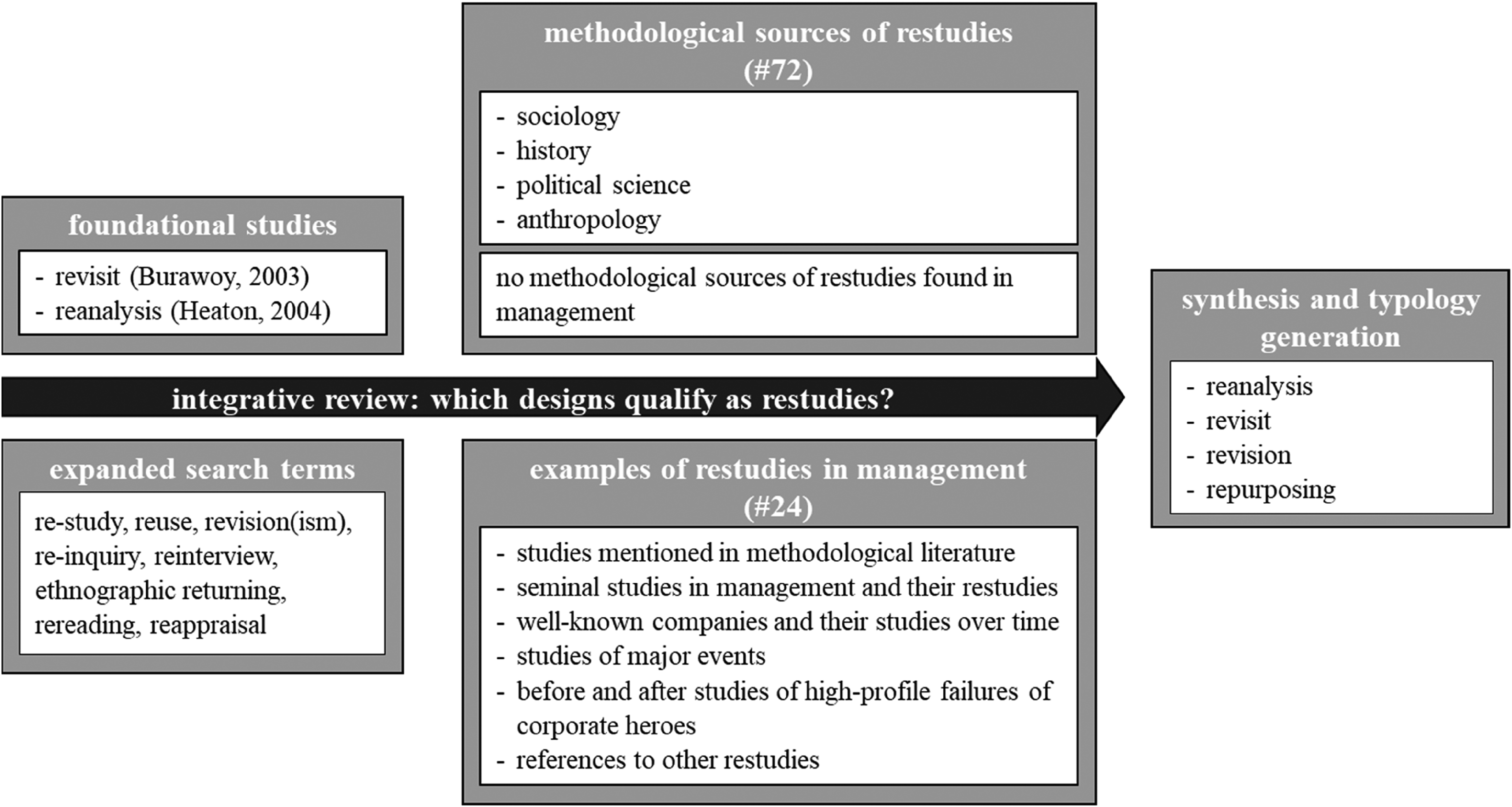
Integrative review process.
Starting Point: Foundational Studies
Cronin and George (2023) recommend several ways to start literature searches across multiple research domains. Two suitable ones for the purposes of this article were analysis of citations of foundational work in multiple disciplines and searching for identifiable conceptual language used in different research communities. Given the lack of methodological discussion of restudies in management and organization studies, we started our exploration with the keywords from two influential restudies from other disciplines: (1) “revisit,” which is the term used by Burawoy (2003), a sociologist who draws heavily on anthropology and is also cited outside his discipline (including by organization theorists) and (2) “reanalysis,” as defined by Heaton (2004) in her groundbreaking book on types of qualitative secondary analysis, drawing mostly (but not exclusively) on sociology. Through an analysis of the citations of and in these two foundational publications, we identified additional methodological literature and terminology. This enabled us to expand our list of keywords, providing the basis for the more extensive searches of the next phase of the review.
Cross-Domain Search for Methodological Sources
In order to expand beyond our initial “start set” (Wohlin, 2014) for the review (i.e., two highly cited sources and their keywords), we used two distinct but complementary types of search strategies. We supplemented traditional database-driven keyword searches with the thoroughness of manual reference-based searches (Webster & Watson, 2002; Wohlin, 2014). In keeping with the ambition of an integrative review to be as comprehensive as possible, we did not confine either of these search strategies to a particular subset of publication type (i.e., journal articles only), journals, or time period. Our only condition was that sources be concerned with restudies in the humanities and social sciences. Importantly, as we now explain, these search strategies were conducted in parallel, allowing the results of one to inform and expand the reach of the other.
The lack of common terminology across disciplines did not just pose a challenge for identifying appropriate keywords, but also complicated the analysis of search results. The terms used to denote restudies typically also have more general uses. For example, “reinterview” is often used to denote follow-up interviews, within a single study. The terms “revision” and “reanalysis” are often used in a broader sense to link to previous studies, without an accompanying empirical study. The term “return” proved to be too broad to be a useful search term, but “ethnographic return”’ was specific enough to yield meaningful results. Compounding the complexity of our analysis even further, the same term (e.g., “reanalysis”) was not used consistently across different disciplines. This means that each article had to be read carefully and in full before it was included.
In the process, we were able to clarify the boundaries as to what constitutes restudies—and what should be excluded. Given the conceptual distinction between restudies and longitudinal studies we provided earlier, we (1) excluded studies with longitudinal designs from our review. Other categories of studies that we excluded were (2) qualitative meta-analyses or meta-syntheses whose main purpose was to compare and integrate the results from multiple studies and empirical contexts (e.g., Hoon, 2013), rather than reanalyze findings from a single setting; (3) qualitative studies that used multiple analytical methods to investigate the same empirical setting as part of the one study, even if this analytical process also included the involvement of multiple researchers (e.g., van den Berg et al., 2003; Wertz et al., 2011); (4) studies using qualitative secondary data that did not reuse data from an existing study (for the latter, see e.g., Hughes & Tarrant, 2020).
Once the data were cleaned of false hits, the search process uncovered 72 methodological sources on the topic of restudies, whose authors represented a wide range of disciplines, including sociology (especially community and development studies), history, political science, education, psychology, and anthropology. Methodological interest in restudies was most prevalent among sociologists, which can be attributed to the decision of a major funding agency (the UK's ESRC) to support the establishment of a qualitative data archive (Qualidata) in the mid-1990s (Corti & Thompson, 1998). In total, our list included six books and nine book chapters, as well as 57 journal articles (see full reference list in Supplemental Appendix A).
Within-Domain Search for Management-Related Empirical Examples
We searched the same databases (Proquest, Scopus, and Google Scholar) to identify and review empirical examples of restudies on management and organization topics (including relevant literature from closely related areas such as organizational sociology). We commenced by making notes of any management studies that were mentioned in the methodological literature. We then searched in the most likely places for examples: (1) restudies of management classics (e.g., Hawthorne studies, Chandler's histories, Tennessee Valley Authority); (2) well-known companies (e.g., Disney and Unilever); (3) events that had significant implications for organizations over time (e.g., Challenger and Columbia accidents and NASA, the Bhopal disaster, and Dow Chemical); and (4) high-profile failures of previously feted corporate heroes (e.g., Nissan, Nokia, and Enron). Finally, we were able to expand our sample by checking references to other relevant studies in the examples we had already found and conducting individual searches of leading journals in business and management (Academy of Management Journal, Organizational Science, Administrative Science Quarterly). Once these checks were completed, we commenced the next phase of our analysis.
Similar to our cross-domain search, we observed that a broad range of terms was used to denote restudies in the management literature: for example, alternate template and cumulative case study (Cunha et al., 2015), historical deconstruction (Hassard, 2012), recontextualization (Brannen, 2004), historical analysis (Kano & Verbeke, 2015), and “replication and extension” (König, Graf-Vlachy & Schöberl 2021). As in the case of the cross-domain search, we had to be wary of false hits, because terms were used for purposes other than as a design for restudies. For example, Weick and Sutcliffe (2003) mention reanalysis in the title, but the article is not focused on reanalysis as we understand it; instead, the authors use it to denote a refinement of an existing theory by examining a new empirical setting. Finally, we also excluded empirical studies in which researchers have published multiple papers on the same research site but without explicitly building on their previous work in the organization (e.g., studies by Hatch & Schultz, 2013, 2015, 2017, of the Danish multinational brewer Carlsberg). Ultimately, we identified 24 sources that employed restudy as their methodological approach out of 81 original search hits (see Supplemental Appendix B for the full list).
Synthesis and Typology Generation
Cronin and George (2023) suggest that an integrative review relies on a “thematic synthesis” (p. 176) of the collated literature. In our case, we used a thematic analysis across all studies to identify the different types of restudy designs. We commenced by recording the different characteristics and decision points of a restudy mentioned in the literature. We then specified the differences in approaches discussed in the literature, with these differences forming the basis for the categorization of distinct design types. Articulating the characteristics of each type was a highly iterative process that involved two researchers (authors two and three) undertaking categorizations independently. We then compared and discussed our results, as is aligned with a qualitative approach. The process of typology specification continued until all authors agreed on the main types of restudies and were satisfied with the conceptual clarity of the obtained definitions of, and distinctions between, the types. The final step of the synthesis was to settle on conceptual labels for each type that were aligned with usage in existing literature—although, as we have emphasized, there was no standardized terminology to adopt. In the following, we present the resulting typology of restudy designs.
A Typology of Restudy Designs
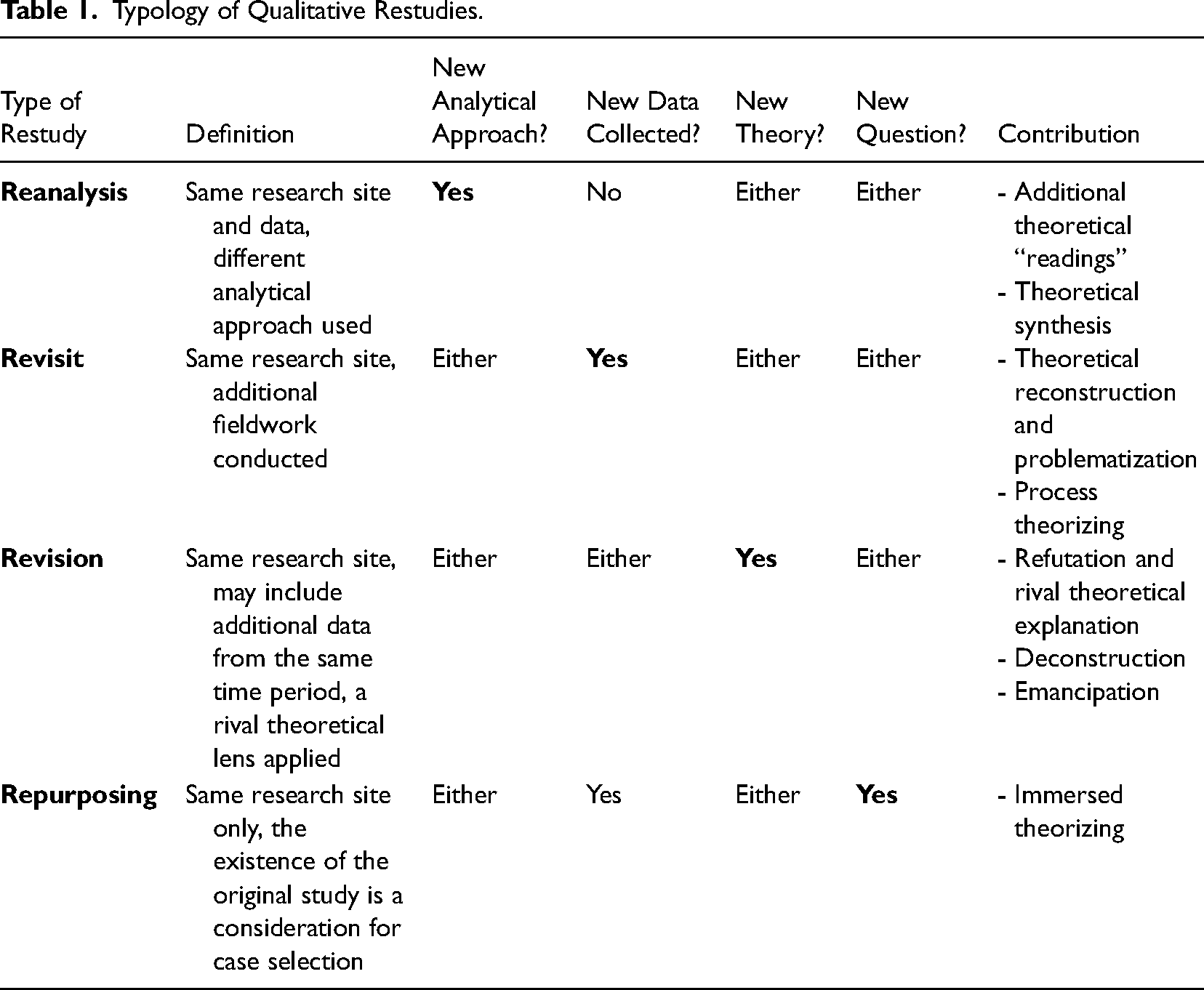
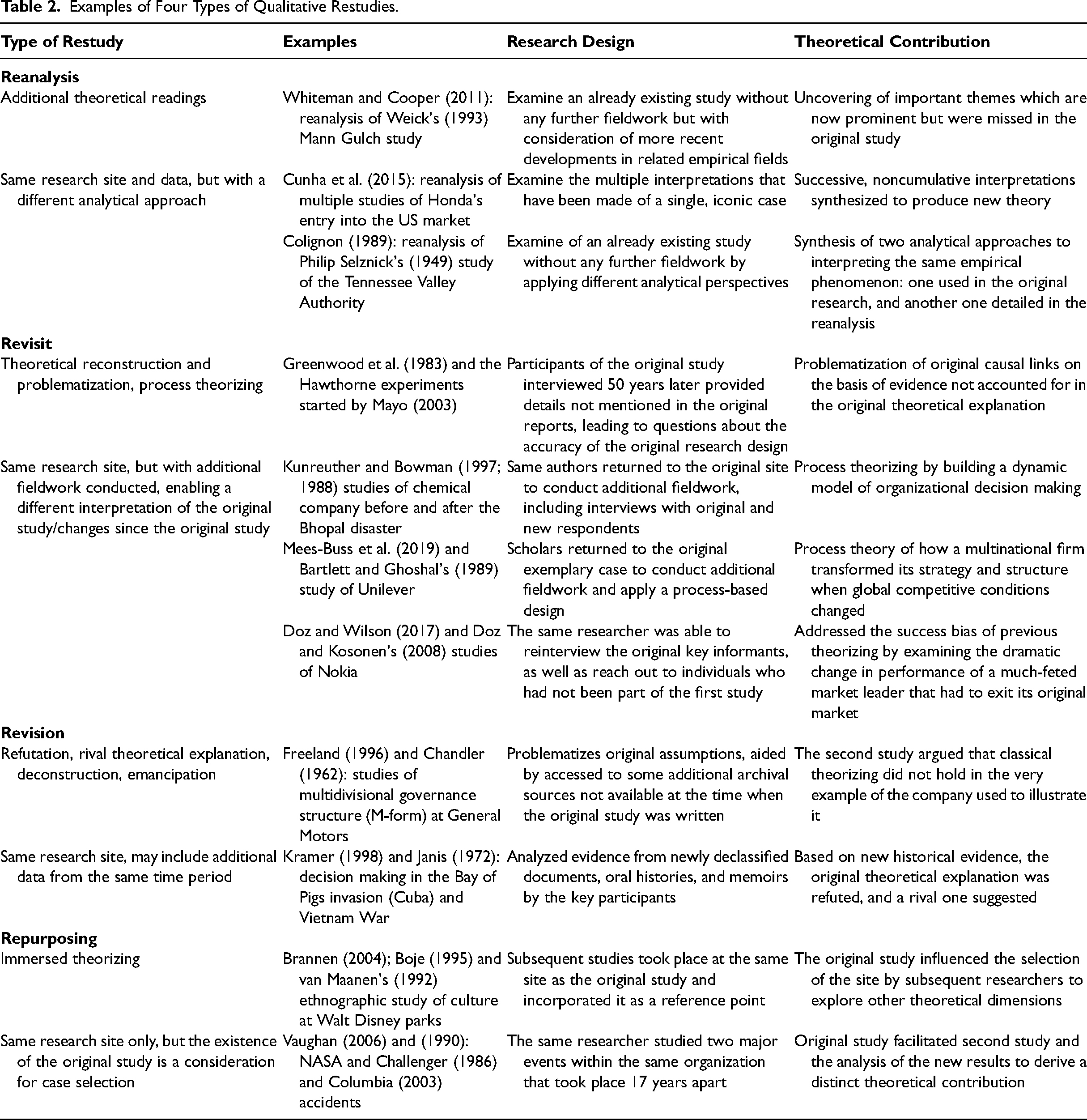
Restudies have in common that they involve the return to the same research site or sample as was used in a previous study. In doing so, they employ different analytical methods, data, theoretical perspectives or paradigms, and/or disciplines to that of the original studies. In this section, we distinguish four types of restudies – reanalysis, revision, revisit, and repurposing (see Table 1) – based on the form that their retheorizing takes. We now consider each type of restudy in turn. We accompany our discussion of each type with illustrative examples of how it has been used, sourced from our within-domain search (the latter examples are showcased in Table 2). We highlight how each type can be applied in empirical studies to make a theoretical contribution. We provide the reader with a discussion of potential ethical considerations emerging during the conduct of restudies in the Discussion section.
Typology of Qualitative Restudies.
Examples of Four Types of Qualitative Restudies.
Reanalysis
A reanalysis involves the reuse of the same dataset from a previous study (or as much of it as has been preserved or is accessible), without returning to the original research site to generate new data (see Table 1). The original data are analyzed with a different analytical strategy and potentially also different theoretical frameworks and analysts (Heaton, 2004). The data being reanalyzed might be in the form of archived fieldnotes and interview transcripts (e.g., Bornat, 2003), the same secondary sources as were used in the original study (e.g., Whiteman & Cooper, 2011, and Weick, 1993, on Mann Gulch), or a rereading of the published form of the original study (e.g., Lewis & Simpson's, 2012, reanalysis of Kanter, 1977). A reanalysis might also be conducted by combining existing datasets from prior studies of the same empirical instance. Essentially, a reanalysis can be conducted based on access to the original study's data, but also through an in-depth rereading of a published account.
The main theoretical purpose of a reanalysis is not to verify the results of the original study – although that may be one outcome. Rather, it is to propose an additional interpretation to that of the original. That is, retheorizing takes the form of a theoretical reading that reframes and extends our understanding of the phenomenon under study. As Fielding and Fielding (2000, p. 680) explain in their reanalysis of a seminal study that uncovered a theme not touched on in the original, “A body of data can often support more than one analytic theme,” so a reanalysis of an existing dataset “is less a matter of proving an analysis ‘right’ or ‘wrong’ than of identifying what themes it has not explored.” A reanalysis is testament to the multiple interpretations – the rereadings – that are possible of the same texts. For this reason, it has an affinity with constructionist approaches to qualitative research.
The rationale for producing additional readings rests first of all on the limitations of any single analytical or theoretical approach. The additional theoretical insights that can be gained through the use of multiple and contrasting analytical strategies or theoretical lenses on the same dataset are well known in a within-study context, although not commonly exploited in management research (for exceptions, see Cassell & Bishop, 2019, on multiple analytical strategies and Langley, 1999, on alternate templates). Methodological innovations in qualitative research mean that the researcher returning to a dataset at a later date has a wider array of analytical options available than when the original study was conducted. For example, researchers have used qualitative comparative analysis to reexamine existing datasets, leading to contrasting results (Giugni & Yamasaki, 2009; Ragin, 2006). Kilduff and Oh (2006) used ethnostatistics to compare prior reanalyses of a seminal, quantitative study on diffusion. They found that by neglecting key aspects of the historical context in which the original events took place, authors of prior reanalyses imposed different interpretations onto the findings and neglected the role that their own methodological assumptions played in their interpretations.
In addition to the theoretical insights that may be gained from the use of alternative analytical strategies, a reanalysis adds the benefit of a switch in temporal standpoint. Returning to the data at a later date allows for fresh themes and perspectives to be discerned that were obscured at the time of the original study. For example, in reanalyzing a set of interview transcripts, Bornat (2003) realized that the themes of race and ethnicity, while raised by interviewees, had been missed by the original researcher – a reflection of UK society in the early 1990s, where the study had been conducted. Whiteman and Cooper's (2011) reanalysis of Weick's (1993) Mann Gulch study argued that his account missed the ecological dimension of sensemaking: that is, the ability to read cues from the local ecology during a crisis (Table 2). Ecological issues have gained greater prominence in recent years, making them more visible to the later generation of researchers and leading to a new theoretical interpretation of the original events.
Similarly, when Lewis and Simpson (2012) returned to Kanter's classic work on gender (1977), they were able to draw on developments that have taken place in feminist theory since the 1970s to demonstrate how gendering of organizations and gendered power were part of the dynamics in the original study without being explicitly analyzed. As Riessman (2004) reflects on analyzing an interview transcript from a prior study for a third time, historical contingencies are more salient from a temporal distance, whereas at the time, they are likely to be naturalized in the interpretations of the researcher and the researched alike. New themes and interpretations may also emerge due to world events that have occurred since the original study; for example, the fall of the Berlin Wall (Andrews, 2008).
The difference in temporal standpoint means that even the same researcher, returning to reanalyze the same dataset from a study that was conducted earlier in his or her career, is likely to obtain additional conclusions to those originally drawn. Roulston (2001) and Åkerström, Jacobsson and Wästerfors (2004) report that when reanalyzing data they had collected as junior scholars, they found that they were now less inclined toward naive empiricism; in other words, taking the content of interviewee statements at face value. Instead of using thematic analysis to concentrate on the content of interviewee accounts (i.e., what was said), their reanalysis shifted to drawing out how the interviewees constructed their accounts by means of narrative analysis (i.e., how it was said). For these scholars, reanalysis became an exercise in reflexivity.
An additional theoretical contribution of a reanalysis can come in the form of a synthesis of multiple interpretations. An example of this form of retheorizing is Colignon's (1989) reanalysis of Philip Selznick's (1949) classical study of the Tennessee Valley Authority (see Table 2). He contrasted two analytical approaches to interpreting social behavior: “holistic,” used in the original study, and “individualist,” detailed in his own research. His resulting analysis shows the complementary strengths of both approaches for capturing the complexity of the social organization of human behavior. He argues that the two analytical perspectives can be integrated, resting as they do on similar epistemological and ontological assumptions. The result is a richer theoretical explanation of the empirical phenomenon achieved without any further fieldwork.
Cunha, Rego, Clegg and Lindsay (2015) show the value of synthesizing successive, noncumulative interpretations of the same empirical case to produce new theory (see Table 2). Their choice for reanalysis is an iconic case in strategy – Honda's entry into the US market – that has been studied by a succession of researchers. They found two common, yet opposing, explanations for Honda's successful entry: the role of forethought and strategic planning versus the role of openness to serendipity. In their reanalysis, Cunha et al. argued that these two forces act in an interplay whereby serendipity happens as a result of preparation and openness. They formulated a more integrated theoretical explanation of serendipity. At the same time, they accounted for and reconciled the diverging conclusions in existing literature – an important contribution given this is a common feature of management research more generally.
Revisit
A revisit returns to the same research site or sample as the original study to generate additional data related to events during and/or after the period covered by the original study (see Table 1). The researcher may use the same questions and theoretical perspectives that were employed in the original study or may be prompted by the revisit to provide an alternative theoretical framing of the events. The findings from the subsequent fieldwork are explicitly compared and contrasted with those of the original study, leading to a materially different interpretation from that of the original.
Revisits have been common in anthropology and community studies in sociology, which traditionally have defined revisits as a return to a physical, geographically bounded site (Phillipson, 2012). However, Burawoy (2003) encourages researchers not to take as given what is being revisited. The original geographical and organizational boundaries of the study may need to be rethought and delimited in new ways by the revisitor (Phillipson, 2012), and the relationships that the original research team developed are, for better or worse, unlikely to be recreated (Silva, 2007). The revisitor will also potentially need to contend with the impact that the original study had on those who participated in it. If the original study proved controversial, this may create a difficult, even hostile environment, for a subsequent revisit (Crow, 2013).
The revisit has been used by constructionist, critical, and realist scholars (Burawoy, 2003). It may employ the same data collection and analytical methods as the original study or may use complementary or even contrasting ones (including a qualitative reinvestigation of a quantitative study). For example, in their revisit of workers in an English town, O’Connor and Goodwin (2012) did not just reinterview some of the original participants and conduct an analysis of the original dataset and fieldnotes; they were also able to make use of visual methods (e.g., photographs) documenting changes to the urban environment. Other researchers have been able to make use of methodological advances, such as social network analysis (Phillipson, 2012), not available to the original project. In this way, the data sources and analytical approaches used in a revisit may be more diverse than in the original study – and even entail the use of qualitative data to reevaluate the results of a quantitative study.
Based on Burawoy (2003), we can distinguish two kinds of theoretical contributions that can be derived from revisits. The first is what he terms a theoretical reconstruction. That is, a different interpretation – based on the collection of additional data not included in the original studies – is offered to that in the original. Reinterpretations may result from incorporating explanatory factors that were overlooked in the prior study. For example, Hassard (2012) returned to the Hawthorne studies in order to understand how historical events (a ferry disaster in which hundreds of employees and their family members lost their lives) formed a crucial influence on the factory under study yet were not part of the analysis in the original studies. Revisits may also allow researchers to uncover the theoretical blind spots of prior research. In reflecting on a revisit to the village that was the site for three previous ethnographies (one of which was his own), Moberg (2022) was struck by the extent to which conclusions were constrained by the researcher's own theoretical commitments.
Reconstructions of an original study may also be warranted to provide voice to groups marginalized or excluded from the original study (e.g., Crow, 2012). For example, feminist scholars have been active in returning to the sites of classic ethnographies, providing an alternative understanding of power relations in a community (Burawoy, 2003). Similarly, Lassiter (2012) returned to the US town that has been the site of a series of influential sociological studies in the 20th century, in order to capture the experiences of the African-American communities who were largely invisible in the earlier studies. In management, Greenwood, Bolton and Greenwood (1983) tracked down and interviewed participants in the Hawthorne experiments 50 years later (Table 2). The interviewees provided details not mentioned in the original reports which had material implications for the theoretical conclusions drawn from the study. They revealed that they received a bonus simply by joining the study. This made establishing the link between production output and subsequent wage incentives more problematic. However, this was not made clear in the original study or subsequent interpretations, which assumed that money was not a motivation for participation in the experiments.
A second type of theoretical contribution is that of process theorizing: that is, using the elapse of time between the original study and the revisit in order to explain change to the research site over time. This kind of theoretical contribution can be illustrated by two studies on organizational decision making conducted by Bowman and Kunreuther (1988; Kunreuther & Bowman, 1997; see Table 2). In their first study, Bowman and Kunreuther (1988) conducted interviews at a large chemical company after the Bhopal disaster, developing a conceptual framework and a set of hypotheses about organizational perceptions and responses to major, but low-probability, industry events. When the authors revisited the same company 6 years later to speak with former and new respondents, the purpose of the study was to build a dynamic model of organizational decision making (Kunreuther & Bowman, 1997). By conducting a new round of field research, the authors benefited from being able to set up a temporal comparison between conditions at the site at different points in time, and to incorporate subsequent events. The revisit allowed them to generate new process-based theory that explains the changes that occurred to the research site since the original study.
Burawoy (2003) advocates a particular form of process theorizing that he terms structuralist, because it traces the impact of changes to the original research site brought about by macro forces such as decolonization or globalization. In this type of revisit, the researcher needs to go beyond the boundaries of the original locality studied in order to consider the site's position in the global economy. For example, in international business, scholars have returned to what in the 1980s and 1990s was regarded as an exemplary case of a “transnational” corporation (Mees-Buss, Welch & Westney, 2019) – the Anglo-Dutch multinational Unilever – to show how it had renounced this strategy and structure when global competitive conditions changed (see Table 2).
We would suggest that structuralist revisits, along with other forms of process theorizing, have considerable potential in management research, given the widespread restructuring and the rise and fall of market leaders that take place in competitive global industries. One of the rare revisits prompted by failure is Doz and Wilson's (2017) study of Nokia (see Table 2). Doz had studied the firm in 2004 to 2006, when it was facing the “curse of success” (Doz & Kosonen, 2008), and returned in 2015 following the firm's exit from the mobile phone business. Doz was able to reinterview key informants, as well as reach out to individuals who had not been part of the previous study. Similarly, Ikegami and Maznevski (2019) returned to a success case they had previously studied (Ikegami, Maznevski & Ota, 2017) – in their case, Nissan. Their revisit was triggered by a dramatic turn of events – the former CEO Carlos Ghosn's arrest – which warranted explanation as well as a reassessment of the original findings. In both studies, the revisit provided an opportunity to redress the success bias that pervades management research.
At its most extreme, changes in the global economy may mean that the original research site has been erased, so a physical revisit is not possible. The workplace that Burawoy (1979) studied was (serendipitously) a revisit to the same factory as that studied by another prominent sociologist (Roy, 1952). However, had a researcher been planning to return to this site now, he or she would have found the factory gone, with the assembly line having been offshored to Asia (Burawoy, 2003). In cases like this, the researcher would then need to decide which location to revisit: Chicago or the site to which the factory has been relocated? In the process of deciding what is most relevant to revisit, the phenomenon of interest may shift away from place, that is, the physical location, to biographies, that is, the lives of those who worked at the site, or to the institution, in this case, the firm itself (Burawoy, 2003). Along these lines, Beunza (2019) was unable to revisit the physical site of his ethnography of a New York trading room of a global investment bank, as the division itself had been shut down, but he was able to conduct interviews with former employees.
Revisions
Revisions make use of an alternative theoretical lens to produce a rival explanation of the same events covered in a prior study (see Table 1). This rejection of the original theoretical framing may also lead to a different set of questions being posed. Revisions to the theoretical framing and conclusions of the original study may be prompted by the uncovering of new historical evidence about the events under study (Tucker, 2008) not available to the original research team (e.g., the release of previously embargoed information). But the distinguishing feature of a revision is that it is “paradigm-driven” (Tucker, 2008), originating in shifts in the underlying assumptions, values, and epistemic commitments of a scholarly community (Hughes-Warrington, 2007). From the prism of a different paradigm, the conclusions of previous studies are judged to be inadequate, misleading, and even erroneous. This problematization and repudiation of the original study may be motivated by a critical or even an emancipatory aim. A revision is not another reading of the data, as in a reanalysis, but rather a refutation of the original explanation and the generation of an alternative.
The process of revision is well-established in history, although it needs to be carefully distinguished from revisionism and denialism (e.g., Gorman, 2007). In fact, it can be argued that revision is an integral, and unavoidable, part of history (Wadhwani & Decker, 2017): interpretations of the past will never be fixed, because of the changing temporal standpoint that is the present. As Spiegel (2007, p. 1) puts it, given that the temporal distance between past and present is not fixed, “revision is the formal prerequisite for writing history.” She uses the rise of post-structuralism as an example of a paradigm-driven process of historical revision. She traces its development to the geopolitical, social, and economic shifts that influenced a generation of historians, such as the counterculture movement of the 1960s and post-Holocaust disillusionment with the Enlightenment. However, while the need to contend with the distance between present and past may be more transparent to a historian than a social scientist, given the greater timeframes involved, this does not mean that social scientists can escape the influence of their own temporal situatedness.
Revisions of classic studies are common in management and organization studies: for example, revisions of Alfred Chandler's work (Novicevic, Humphreys & Zhao, 2009) or of the Hawthorne studies (Muldoon, 2017; Muldoon & Zoller, 2020). Using General Motors (GM) as a case study, Robert Freeland (1996) argues that classical theorizing about the multidivisional governance structure (M-form) does not hold in the very example of the company used by Alfred Chandler (1962) to formulate this theory (see Table 2). The key contribution of Freeland's work is in problematizing Chandler's assumptions about efficient organizations to create managerial consent. According to Freeland, “the GM case suggests that the textbook M-form may actually undermine order within the firm, thus leading to organizational decline” (Freeland, 1996, p. 483). The same company and comparable archival data sources can, therefore, lead to opposing conclusions if the underlying theoretical assumptions are challenged.
Another example of revision is a study by Kramer (1998) that queries Janis’ (1972) theory explaining the Bay of Pigs and Vietnam War decisions (see Table 2). Kramer used newly declassified documents, oral histories, and memoirs by the key participants of the original events to demonstrate that new evidence does not support Janis' interpretation of the underlying decision-making process. Kramer refutes the original social psychology (groupthink) explanation and proposes to use political psychology instead, arguing that it better reflects the broader set of decision makers involved in these fateful choices.
Repurposing
The final type is what we term a repurposing. For a study to qualify as a repurposing, it needs to include the same research site or sample on which the original study was based (see Table 1). In this type of restudy, the findings of the original study provide the starting point for the subsequent study, but the purpose of the latter is not, as in a revisit, primarily to provide a commentary on the former. Rather, the original study is an aid to the second one: it may act as a stimulus for the new study, inform the fieldwork, and enrich the analysis (Heaton, 2004). In-depth understanding of the research site obtained from an earlier study therefore provides the opportunity for subsequent theoretical insights. We term this theoretical contribution immersed theorizing, as the theory that is generated is based on this exceptional prior knowledge of the field setting.
For example, in management studies, repurposing can take the form of case studies whose research site is a well-known company which has been the subject of prior studies. Walt Disney parks have been one such site (Table 2) where exemplary ethnographic studies of culture (e.g., Van Maanen, 1992) have informed an array of later studies in other fields, including discourse theory (Boje, 1995) and international business (Brannen, 2004). These are examples of what Stake (1995) terms an intrinsic case study: it is worth studying in and of itself, not because it may provide us insights into a more general issue. To qualify as repurposing, the study, however, needs to do more than take place at the same site as the original: it also needs to incorporate as a reference point the previous studies that have been conducted.
In contrast to the Disney studies, which were conducted by independent researchers, Diane Vaughan (2006) returned to the same organization, NASA, to study a space shuttle accident (Columbia) that took place 17 years after the one she had previously studied (Challenger in 1986) (see Table 2). She returned by invitation, an opportunity that was made possible on the strength of her previous study. While both studies were on the same organization, with many parallels that could be drawn between the two disasters, a comparison between them was not the purpose of the later study. Rather, the aim was to diagnose the organizational failures surrounding the Columbia accident. Vaughan found that, despite the fact that “the cast of characters had changed,” her original theoretical account held. The causes of the two disasters were “analogical… [in that] the causal theory explaining the first accident generalized to the second” (Vaughan, 2006, p. 357). This finding, enabled by her deep knowledge of the organization, was the basis for a very different theoretical contribution, which led her to cross the boundaries from professional to public sociology and the formation of public policy.
Generative Tensions: Key Considerations in Conducting a Restudy
So far, we have concentrated on the variety of possible designs that can be used to conduct a restudy (Tables 1 and 2). But no matter the design chosen, they share the distinctive feature of a restudy: they use the contrasts between the original and the new study to make a substantive theoretical contribution. We now elaborate on how to set up a productive theoretical dialogue between the original and the new study. As we shall show, to do so requires consideration of each aspect of a qualitative research design (see Figure 2 for a summary). Our aim is to provide researchers with a series of questions that assist them in deciding which form of restudy to select, how to go about designing and conducting such a study, and the ethical considerations that are involved. But in doing so, we also equip reviewers and editors with a set of criteria that can be used to evaluate restudies. However, we emphasize that there is no single, preferred solution to the design issues we identify: how a creative tension between the two studies is best established will depend on the context of the inquiry, its ontological and epistemological underpinnings, the form of retheorizing that is the goal, and the practical constraints that are encountered.
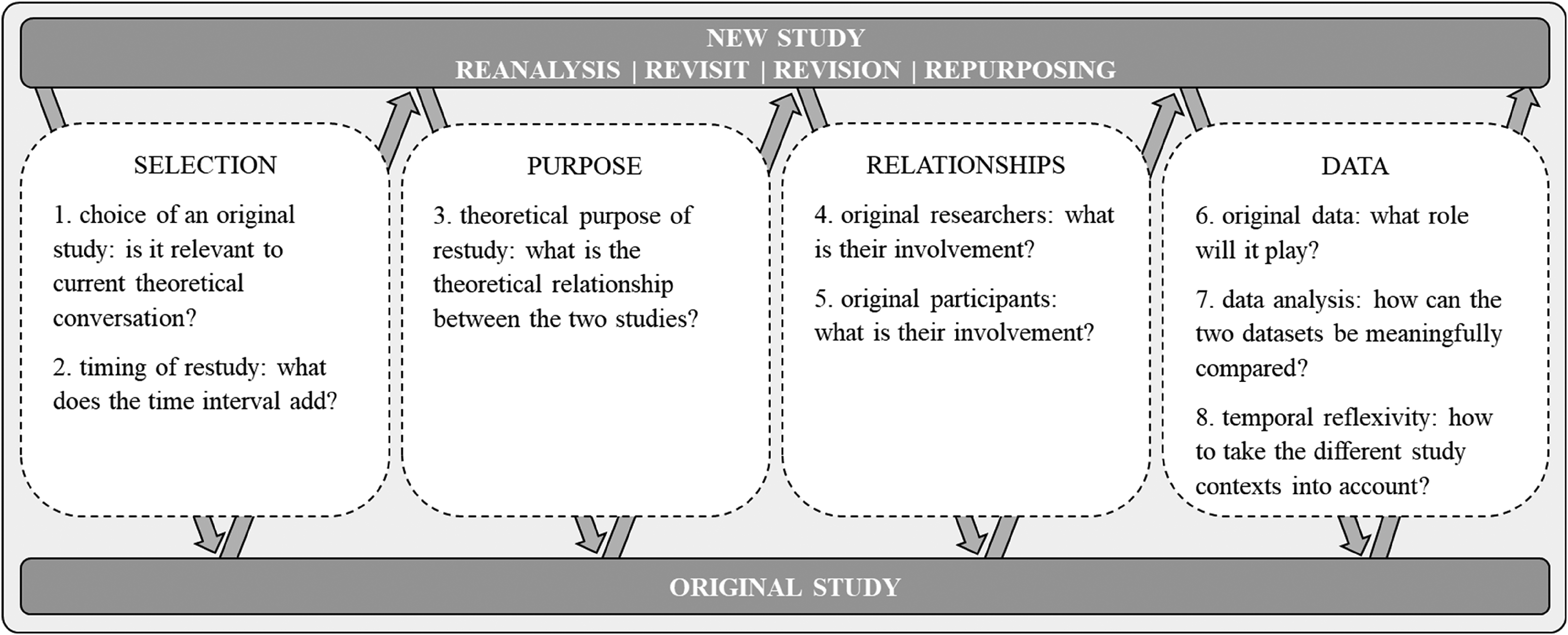
Designing a restudy.
Selection
Setting up a generative dialogue starts with the motivation for a restudy and with the choice of a study to reexamine (#1): A researcher needs to be able to articulate how the original study still has resonance given the evolution of the field. The case needs to be made that a restudy is warranted and that the prior study has ongoing relevance: that is, it needs to be recontextualized in current theoretical debates in the field. As a starting point, a researcher might come across a study in one's reading of a field's literature that was highly influential for subsequent theorizing. However, today, the data would be analyzed differently, which may result in different insights. Or, today, the observations and findings would be interpreted differently, applying different theoretical or epistemological lenses, which may result in different conclusions. Alternatively, a researcher may know of a particular research site that has been employed in previous influential theorizing. The researcher might also know of new data that has come to light about the original research site, or they know that the research site has substantially changed and a current study of said site is likely to lead to entirely different insights.
These multiple opportunities for restudy also highlight that the appropriateness of this design is a matter of timing (#2). Theoretical developments in the field, as well as changes to the research site itself and the availability of evidence, all impact on whether a restudy is justified or even possible. The timing of a restudy has substantive ethical implications relating to how the intervening period of time has affected the conditions under which the site and data might be accessed. For example, the original research team may have been required to restrict the possibilities for data reuse or even destroy their raw data; alternatively, the requirement may have been to deposit the data in an institutional repository in a deidentified form (for a broader discussion of ethics of qualitative data reuse see Bishop, 2009).
Given societal changes, a different set of ethical considerations may prevail than at the time of the original study. At one extreme, a research site might over time have become more controversial or hostile, meaning that a restudy would potentially put research participants and/or the researcher at risk (e.g., Venkatesh, 2008). The passage of time may also have positive benefits. The shift in societal values might enable researchers to right past wrongs, such as the marginalization or silencing of particular voices (such as women, ethnic communities and lower-paid workers) (e.g., Lewis & Simpson, 2012). A restudy provides researchers with the opportunity to redraw the site boundaries in a restudy, incorporating those who were excluded from the original study.
Purpose
The aim of any restudy is to be able to specify how it relates to the original study in theoretical terms (#3), although – as in the case of any qualitative study – this evolves during the course of the inquiry, rather than being fixed upfront. We have seen that there is a spectrum of options for retheorizing the original study, depending on the type of restudy that is conducted: extending or supplementing the original theory, offering an additional conceptualization or theoretical perspective based on a different research question, or providing a rival (even paradigm-challenging) explanation. The nature of restudies means that they offer particular strengths: theorizing about change and processes; problematizing the “in-house” assumptions underlying a field at a point in time (Alvesson & Sandberg, 2011); reconstructing existing concepts; and replacing epistemological perspectives in the field that have been taken for granted.
Restudies can therefore address well-known problems and biases in management research: the dominance of one-shot studies, the proliferation of contradictory and noncumulative findings, success bias, over-reliance on a limited set of methods for data collection and analysis, the reification of concepts that may actually be outdated and the lack of paradigm-challenging research. In addition, we have seen that restudies are a response to the situatedness of any form of inquiry in the social sciences. The ideologies of the time in which a study is conducted inevitably affect the theories that are produced (Hibbert et al., 2014). Yet these ideological commitments may only be readily apparent in hindsight, once their dominance is waning (Smith, 1984). This provides an important rationale for the value of retheorizing to longstanding theoretical traditions in a research field.
Whatever the theoretical relationship that is established with the original study, we have seen that restudies go beyond verifying the original study or reproducing its results. Rather, the results that are obtained are used to offer different theoretical explanations to those proposed by the original study. Reexaminations of existing work that do not meet this criterion would therefore not qualify as restudies. As Burawoy (2003) has pointed out, one of the most famous—or infamous—returns to a field site is Derek Freeman's (1983) repudiation of Margaret Mead's study of Samoan adolescence (Mead, Sieben & Straub, 1973). However, this denunciation of the original study was not accompanied by an alternative theoretical explanation, so it falls short of retheorizing.
Relationships
Setting up a generative theoretical dialogue with the original study is not just a conceptual exercise: it also involves establishing a relationship with stakeholders in the form of the original researcher or research team (#4) and participants (#5). As is the case with any field relationship, this involves a web of practical and ethical considerations, as well as opportunities for insight. Restudies can be conducted by the original researcher/s (i.e., dependent restudies) or by researchers not involved in the previous study (i.e., independent restudies)—or a team containing both (i.e., semi-independent) (#4). Assuming that the original researcher or research team can be contacted, consideration will need to be given to the involvement that may be appropriate. If the original researcher or team is not available, the original project may have been archived, providing public access to transcripts or fieldnotes. At the very least, understanding of the intellectual environment in which the original researchers were operating can be obtained from secondary sources. Such data allow researchers to contextualize the work conducted by their predecessors, giving due acknowledgement to the constraints and standards under which the original team operated.
Participants of the original study (#5) are necessarily involved, if data are reused from the original study. Reusing raw data (as opposed to relying on the published findings only) raises ethical questions about informed consent and confidentiality: concerns that have preoccupied the debate about qualitative data reuse and the rise of qualitative data archives (Bishop, 2005; Corti, Witzel & Bishop, 2005; Hughes & Tarrant, 2020; Parry & Mauthner, 2004). Assuming that researchers are able to access the raw data of the original study, based on the conditions placed on them, consideration needs to be given as to whether the consent that the participants initially provided still endures. If the participants of the original study are identifiable and accessible, they can be contacted for their consent to be involved in the restudy. Researchers have reported that not only is direct involvement by the original participants valuable from an ethical standpoint, but it can yield important contextual insight and additional data (see, e.g., Greenwood et al., 1983). If the original participants cannot be contacted, then a new ethics review that assesses the potential harm to participants from the restudy might be an approach to weigh the potential risks and benefits.
Data
Designing a restudy involves deciding on the role that the original data will play (#6). This partly depends on the quality of the legacy data that are available: how complete they are and how comprehensible to a researcher not involved in the original study (e.g., field notes versus interview transcripts). If a decision is made that the theoretical purpose of the study requires the inclusion of additional secondary or primary data, the question then arises as to how the two datasets can be meaningfully compared and differences accounted for (#7). Even if additional data are not included, such as in a reanalysis or potentially a revision, the researcher needs to take into account the different contexts of production of each dataset. Doing so encourages temporal reflexivity on the part of the researcher when interpreting the data (#8). While qualitative researchers are commonly urged to take a reflexive approach, our inquiries are necessarily temporally bounded. However, having another, prior study as a point of comparison provides insight into how one's own interpretation is affected by the social conditions, norms, ethical standards, theoretical trends, and own life experiences prevailing at the time.
We have seen that restudies do not need to be independent from the original researcher or research team in order to take a critical stance toward the original study. Even dependent restudies, that is, conducted by the original research team, will yield additional and even divergent results, if for no other reason that the researchers themselves will approach the data differently due to the life experiences they have accumulated since the primary study was conducted. Research practices will also have evolved, in terms of the theories, methodologies, and ethical guidelines at the disposal of the new research team. These changes form the basis for greater researcher reflexivity than may have been possible at the time of the first study, forming the basis for a new perspective.
Discussion
In this article, we have introduced a common vocabulary and set of approaches for qualitative restudy. We have argued that qualitative restudy is a powerful tool for theorizing and retheorizing that is currently underused in management research. Restudies exist in management research, but to date they have been conducted with little methodological guidance or institutional encouragement. While examples of restudies have been published in top tier management journals (Supplemental Appendix B), they are standalone research projects that do not form a sustained agenda underpinned by a shared methodological understanding. Providing these methodological underpinnings has been the motivation for the current article.
The range of research designs we have presented in this article provide qualitative research with an enhanced role within the broader knowledge generation agenda in the management field. Based on our review in this article, we highlight four theoretical strengths of qualitative restudies. First, developing alternative theoretical explanations on the basis of an existing research site and data holds considerable promise, as it enables researchers to use the empirical variations found as the basis for generating a theoretical alternative. A second strength of qualitative restudies is their ability to incorporate change and process and to trace the evolution of macro forces in a way that is not possible within the course of a single study. This means they provide additional options to those researchers who seek to undertake a longitudinal study.
Third, a restudy allows the researcher greater theoretical reflexivity. Reflecting on the limitations of theoretical understanding due to the particular intellectual context in which he or she operates reminds us of the fallibility and historicity of our interpretations. While the latter point may seem discouraging, in fact it is the basis for any discipline to thrive. There is always an opportunity for additional insight, even—or perhaps especially—in the case of sites and themes which the field regards as settled. The pursuit of the novel does not depend on discovering new phenomena but can also commence with questioning what we think is already known: that is, to retheorize. Finally, qualitative restudies have the potential to improve the quality of a field's theorizing, by encouraging the use of multiple and contrasting analytical approaches. As Andrews (2008, p. 1) writes, “the more vantage points from which we view phenomena, the richer and more complex our understanding of that which we observe.”
Qualitative restudies can counteract the tendencies for research programs to confirm rather than problematize and retheorize existing findings. Take as an example the assertion that the same finding should be obtained when a different person executes the same general research design on a comparable population (e.g., Aguinis & Solarino, 2019; Antonakis, 2017). That may or may not happen when using qualitative research techniques, yet this is not inherently a sign of faulty design. It is an indication that researcher background, context, sample characteristics, researcher–informant interactions, data collection time, and many other factors matter. As such, not coming to the same conclusions as another researcher is not necessarily an indication of a lack of rigor in qualitative, or even quantitative, research. 1 As there is no assumption of “one true reality,” it is important to be aware of one's lenses and potentially to triangulate across different lenses to explore the phenomenon from different angles and the perspective of different researchers. Multiplicity of perspectives and pluralism are the basis for rigor in a scholarly community, not consistency of results across studies.
In fact, we would propose that this underlying purpose of qualitative restudies, that is, retheorizing, constitutes its core strength and point of distinction. Overall, we argue that the use of qualitative restudy utilizes, and reinforces, the strengths of qualitative research in terms of theory development, understanding of context, criticality, and accounting for multiple and contrasting interpretations. Furthermore, restudy logic is compatible with a range of qualitative research paradigms, ontologies, and epistemologies and shows the way toward making a strong theoretical contribution to the evolution of research programs in management and strategy.
Conclusion
Our contribution in this article is to identify and propose qualitative restudies as a strong, but underused, methodological tool that enables qualitative researchers to reassess and reevaluate existing theorizing obtained from original studies. Such retheorizing can lead to important insights into contextual, historical, methodological, and investigator factors that impacted on earlier theorizing. Moreover, restudies assist the field in advancing its knowledge generation process by reviewing, revising, and challenging theories that are no longer suitable. Restudies can further contribute to novel theorizing in research contexts in which important factors were overlooked, not theorized, or not critically examined. Consequently, restudies promise to be highly useful in advancing the management field's theorizing efforts. In offering a consistent vocabulary and options for research designs, our article assists in realizing this promise. Moreover, we argue that the implications of restudies go beyond the qualitative research community and can contribute to solving the broader replication crises: the utility of a restudy logic can in future be extended to quantitative research designs to inspire more fruitful, critical theorizing.
Supplemental Material
sj-docx-1-orm-10.1177_10944281231216323 - Supplemental material for Qualitative Restudies: Research Designs for Retheorizing
Supplemental material, sj-docx-1-orm-10.1177_10944281231216323 for Qualitative Restudies: Research Designs for Retheorizing by Tine Köhler, Maria Rumyantseva and Catherine Welch in Organizational Research Methods
Footnotes
Acknowledgments
The authors would like to acknowledge financial support from the University of Sydney Business School and from the University of Melbourne Faculty of Business and Economics to facilitate collaboration between the co-authors. The authors would further like to acknowledge the valuable input provided by three friendly reviewers of previous versions of this manuscript: Mike Pratt, Jose Cortina, and Alexandra Michel.
Author Note
Authorship order was determined in alphabetical order. All co-authors contributed equally to the work.
Declaration of Conflicting Interests
The authors declared no potential conflicts of interest with respect to the research, authorship, and/or publication of this article.
Funding
The authors disclosed receipt of the following financial support for the research, authorship, and/or publication of this article: This work was supported by the University of Sydney Business School, Faculty of Business and Economics, University of Melbourne (Revise and resubmit grant).

Supplemental Material
Supplemental material for this article is available online.
Notes
Author Biographies
References
Supplementary Material
Please find the following supplemental material available below.
For Open Access articles published under a Creative Commons License, all supplemental material carries the same license as the article it is associated with.
For non-Open Access articles published, all supplemental material carries a non-exclusive license, and permission requests for re-use of supplemental material or any part of supplemental material shall be sent directly to the copyright owner as specified in the copyright notice associated with the article.
