



Abstract
We review the development of path model fit measures for latent variable models and highlight how they are different from global fit measures. Next, we consider findings from two published simulation articles that reach different conclusions about the effectiveness of one path model fit measure (RMSEA-P). We then report the results of a new simulation study aimed at resolving the questions of whether and how the RMSEA-P should be used by organizational researchers. These results show that the RMSEA-P and its confidence interval is very effective with multiple indicator models at identifying misspecifications across large and small sample sizes and is effective at identifying true models at moderate to large sample sizes. We conclude with recommendations for how the RMSEA-P can be incorporated along with other information into model evaluation.
Keywords
One of the most popular types of structural equation models includes latent variables assessed with multiple indicators, and these models are used to test theories proposing causal relations among the latent variables. Among the various goodness-of-fit measures used with these models, we distinguish between those which attempt to focus on the viability of proposed causal relations among latent variables, as compared to those originally developed that also incorporate information about other parts of the model (links between latent variables and their indicators, covariances among exogenous variables). We will refer to this newer class of fit measures as path-related, to reflect their focus on “relationships of dependency- usually accepted to be in some sense causal- between the latent variables” (McDonald & Ho, 2002, p. 65). Alternatively, those indices that reflect the entire model are commonly referred to as global fit indices, with two current recommended examples being the CFI (Bentler, 1990) and the RMSEA (Steiger & Lind, 1980).
McDonald and Ho (2002) linked their interest in path model fit to the popular global fit measure RMSEA developed by Steiger and Lind (1980) and Steiger (1989). The RMSEA has been described by Browne and Cudeck (1993) as a “measure of discrepancy per degree of freedom of a model” (p. 144). McDonald and Ho (2002) were the first to empirically investigate path model fit vs. global fit, as they conducted re-analyses to obtain RMSEA path model fit values using published results from 14 studies from top psychology journals. The distinction between global and path model fit raised by McDonald and Ho was subsequently pursued within the organizational research community. Williams and O’Boyle (2011) and O’Boyle and Williams (2011) added the “-P” to the RMSEA label to avoid confusion while referring to the RMSEA of the path model as proposed by McDonald and Ho (2002) as compared to the global composite model. 1 More recently, Williams, O’Boyle, and Yu (2020) examined articles from six top management journals for the 2001–2014 time period. Their findings replicated those of McDonald and Ho (2002) and show that evidence of good global fit can be obtained even if the path part of a latent variable model is misspecified, raising questions about conclusions reached by organizational researchers using global fit values. While the results above comparing global vs. path model fit with sample data are provocative, the accuracy of their conclusions requires that the RMSEA-P is effective at distinguishing between correctly specified and misspecified models. Available evidence is conflicting about such effectiveness, and the present study attempts to resolve these conflicting conclusions about the RMSEA-P. We will attempt to determine if the RMSEA-P can be effectively used to distinguish between correct and incorrectly specified path models, identify conditions when it is most effective, and discuss its use in the broader context of model evaluation.
Although first recommended by McDonald and Ho in 2002, the RMSEA-P was not evaluated via simulation until Williams and O’Boyle (2011) conducted a study based on models taken from representative SEM research (see Figure 1). Williams and O’Boyle used previously published simulation-based mean chi-square and degrees of freedom values (Williams & Holahan, 1994) to calculate mean RMSEA-P point estimates and related confidence intervals for true models and misspecified models in which true paths were omitted. In evaluating their results, Williams and O’Boyle (2011) used existing RMSEA guidelines that values less than 0.05 indicate a model with close approximate fit, values between .05 and .08 indicate reasonable fit, with values between .08 and .10 indicate mediocre fit, and higher values indicate unacceptable fit of the model. As for the RMSEA-P confidence intervals, they also followed traditional guidelines for the RMSEA and recommended a path model would be rejected if the lower bound of the confidence interval was greater than .05 or if the upper bound was greater than .10. For the present paper, we will refer to the combined use of RMSEA-P point-estimates and confidence intervals as just described as the PECI approach, to distinguish it from use of only the point-estimate (PE approach) in model evaluation.
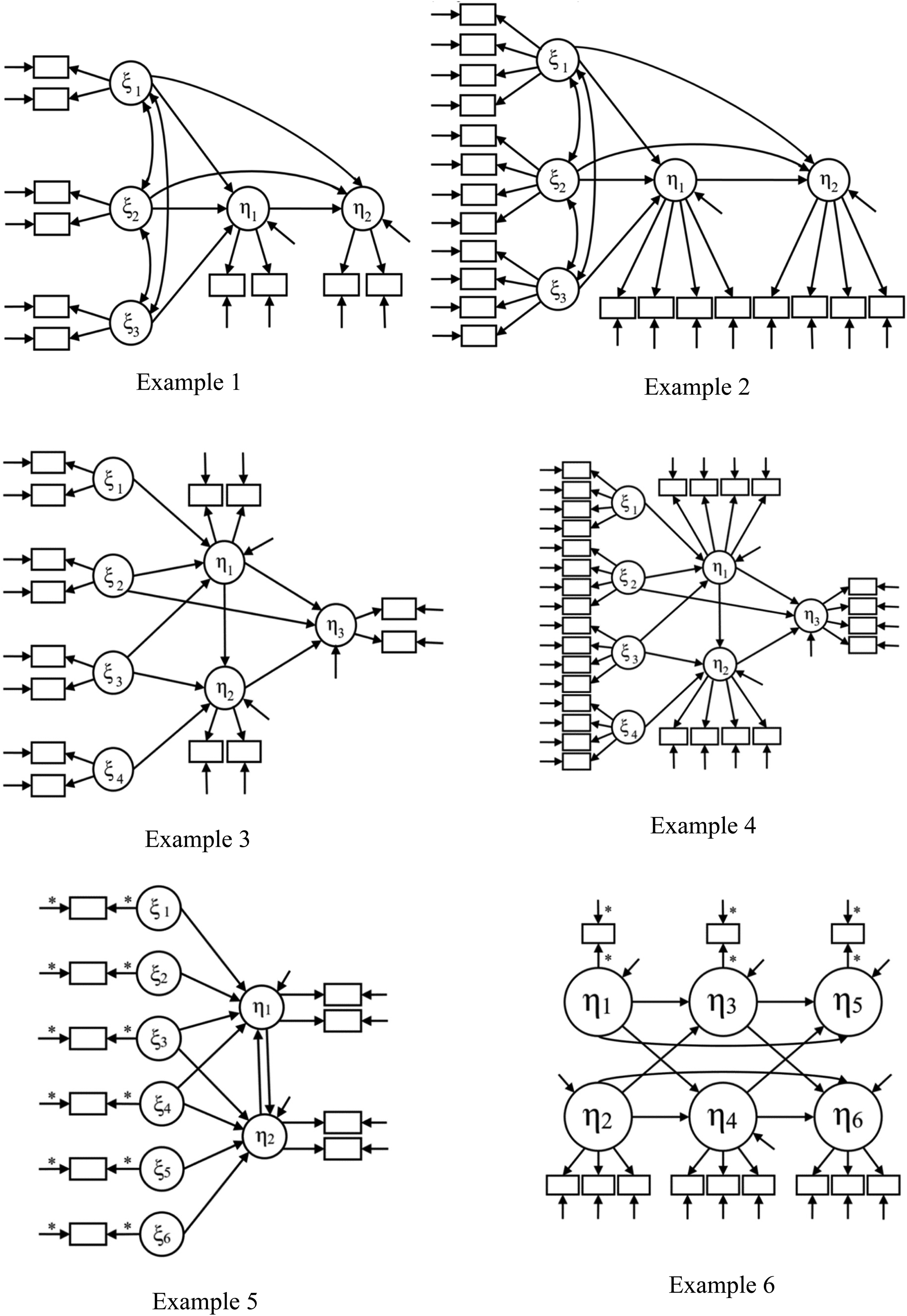
Mt for six examples.
Williams and O’Boyle (2011) found with their simulation that the RMSEA-P with the PECI approach performed as desired in five of the six examples studied with a single sample size of 500. For these five examples, all misspecified models had mean RMSEA-P values greater than .08, with mean lower bound confidence intervals greater than .05 and higher bounds greater than .10. Across the five examples, all true models (MT) had mean values less than the .08 cut-off value often used, and all also met confidence interval requirements of lower bound less than .05 and upper bound less than .10. Results were less supportive with a sixth example. For this example, while the RMSEA-P performed as desired by correctly identifying MT, Williams and O’Boyle found that models with one or two true paths left out (MT−1, MT−2) had mean RMSEA-P values less than .08 and the high end of the interval less than .10.
More recently, Lance, Beck, Fan, and Carter (2016) reached a less favorable conclusion about the RMSEA-P based on their own simulation study. They used the same six population SEM models used by Williams and O’Boyle (2011) but with the added step that they generated individual sample data sets. In presenting their findings, in their Table 11, Lance et al. only reported summaries of the frequency across individual samples that true and misspecified models yielded satisfactory RMSEA-P values (point estimates <.08) that would lead to these models being retained rather than rejected. Specifically, Lance et al. used the PE approach and summarized their RMSEA-P findings by combining across the six examples, while separating results based on four sample sizes (100, 200, 500, 1000). Especially noteworthy is that Lance et al. reported that use of RMSEA-P point estimates led to retention and support of models with key misspecifications: models with one or three significant paths omitted would have been inappropriately retained in over 50% of their simulated samples. For example, their results showed that even for a severely misspecified model with three true paths omitted (MT−3), RMSEA-P values less than .08 were obtained in 42%–54% of cases, as the sample sizes increased from 100 to 1000. Additionally, their findings indicated that the correct model MT frequently had RMSEA-P values greater than the desired .08, which would lead to their rejection. Specifically, Lance et al. reported this occurred in from 35% to 46% of cases as sample sizes increased from 100 to 1000. The negative assessment of the RMSEA-P by Lance et al., who based on their results recommend it never be used, is quite different from Williams and O’Boyle (2011), who suggested that it be used except when latent variables have very few indicators.
We now describe four important characteristics of both studies that make comparing their findings and judging RMSEA-P effectiveness difficult. First, Lance et al. (2016) did not provide any specific descriptive information about their RMSEA-P results, such as mean RMSEA-P values and confidence intervals. Instead, they only summarized the frequency of obtained RMSEA-P values less than .08 for the various design conditions. Not a single RMSEA-P value was reported that could be compared to any of those from Williams and O’Boyle (2011). Second, Lance et al. combined results across all six examples in reporting these frequencies, and as a result, it cannot be determined whether the RMSEA-P performed differently in all six examples. This limitation is important because in the original simulation study by Williams and O’Boyle (2011), the RMSEA-P performed well in five of the six examples. Since the design of Lance et al. was the same as the one that generated the findings of Williams and O’Boyle (2011), it seems possible, if not likely, that many of the non-supportive findings of Lance et al. may be concentrated in only a small subset of the six examples. Third, Lance et al. did not supplement their use of point-estimates of the RMSEA-P with confidence intervals (unlike Williams and O’Boyle who used the PECI approach with mean values). In other words, they used the PE approach rather than the recommended PECI approach. As a result, some of the misspecified models retained by Lance et al. based on RMSEA-P point-estimates less than the .08 cut-off value may have been rejected had confidence interval results been examined. This would occur for cases with upper bound confidence interval values greater than .10.
Fourth, Williams and O’Boyle (2011) were limited to using previously published mean-level data based on the single sample size of 500 in computing their RMSEA-P and confidence interval values (in contrast to Lance et al.'s examination of individual sample results based on use of four sample sizes). These features of their design limit the generalizability of their results. To illustrate why individual sample results are important, consider that a model with a mean RMSEA-P value of .11 (which would be seen unfavorably using the criteria of .08) would have some individual samples in which the sample estimate was less than .08 leading to the model being retained using the PE approach. And, a model with a mean value less than .08 might have some samples for which the upper confidence interval limit is greater than .10, leading to its rejection using the PECI approach. Furthermore, the sample size used by Williams and O’Boyle (2011) is larger than that of typical micro-organizational research. Thus, the findings of Williams and O’Boyle (2011) may not fully indicate the degree to which researchers can reliably identify true and misspecified models in their individual samples with typical sample sizes.
The persistent and growing popularity of structural equation models, coupled with the awareness that global fit indices can mask significant misfit within the model component linking latent variables, results in a need for path model fit indices that accurately identify correct and incorrectly specified models. However, as described above, organizational researchers using latent variable models are presented with conflicting evidence about the effectiveness of one path model index, the RMSEA-P. Given the importance of evidence of correct model specification for subsequent interpretation of parameter estimates linking latent variables, there is a clear need to reconcile the disparate conclusions in order to determine the true viability of the RMSEA-P. The present study attempts to respond to this need.
Method
Inn the present study, we use the same six example models used by both Williams and O’Boyle (2011) and Lance et al. (2016) to evaluate RMSEA-P effectiveness. Our desire was to incorporate features from both designs used in these studies and obtain results that would allow for a understanding and resolution of the differences in conclusions between the two studies. Towards that end, it was noted that Lance et al. did not report any RMSEA-P values in their results. However, they did provide the mean chi-square values for each theoretical model (correct and misspecified) and their corresponding saturated structural model (confirmatory factor analysis model). They reported this information separately for each of the six substantive examples provided and each of the four sample sizes simulated (100, 200, 500, 1000). We used their mean chi-square values and associated degrees of freedom to compute a population path model chi-square difference value
For each combination, we used the χ2P and dfP as population values, and we generated 1000 random sample χ2P values assuming a non-central chi-square distribution.
2
Based on the noncentrality parameter
Results
To check the accuracy of our simulated data, we examined the means and standard deviations of our sample χ2P values and confirmed they matched the population values based on Lance et al. (2016) we used to generate our data. We also used results reported by Lance et al. (2016, Tables 2–7) to compute mean RMSEA-P point estimate and confidence intervals based on their data using their published mean chi-square, degrees of freedom, and sample sizes. 3 We compared these computed values to corresponding RMSEA-P results from our data (mean values of each cell for its 1000 cases). The two sets of RMSEA-P values were nearly identical across the 72 combinations of models, indicating our data was generated appropriately and that further comparisons of our results with those of Lance et al. were warranted. In other words, the similarity of RMSEA-P values indicates our results are the same as if we had generated the raw data for models and used their chi-square values to compute RMSEA-P values.
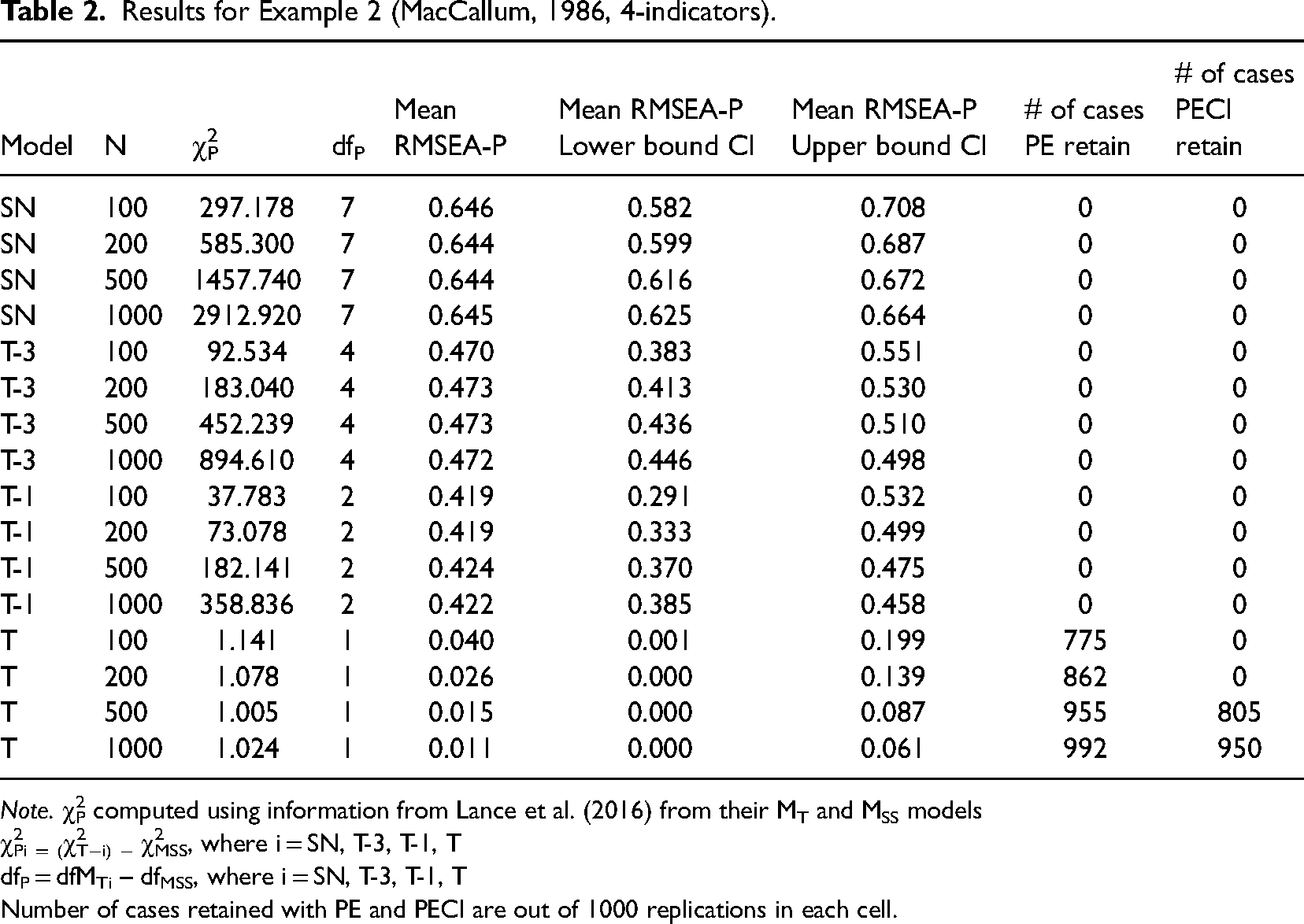
Results for Example 2 (MacCallum, 1986, 4-indicators).
Note. χ2P computed using information from Lance et al. (2016) from their MT and MSS models
χ2Pi = (χ2T−i) − χ2MSS, where i = SN, T-3, T-1, T
dfP = dfMTi – dfMSS, where i = SN, T-3, T-1, T
Number of cases retained with PE and PECI are out of 1000 replications in each cell.
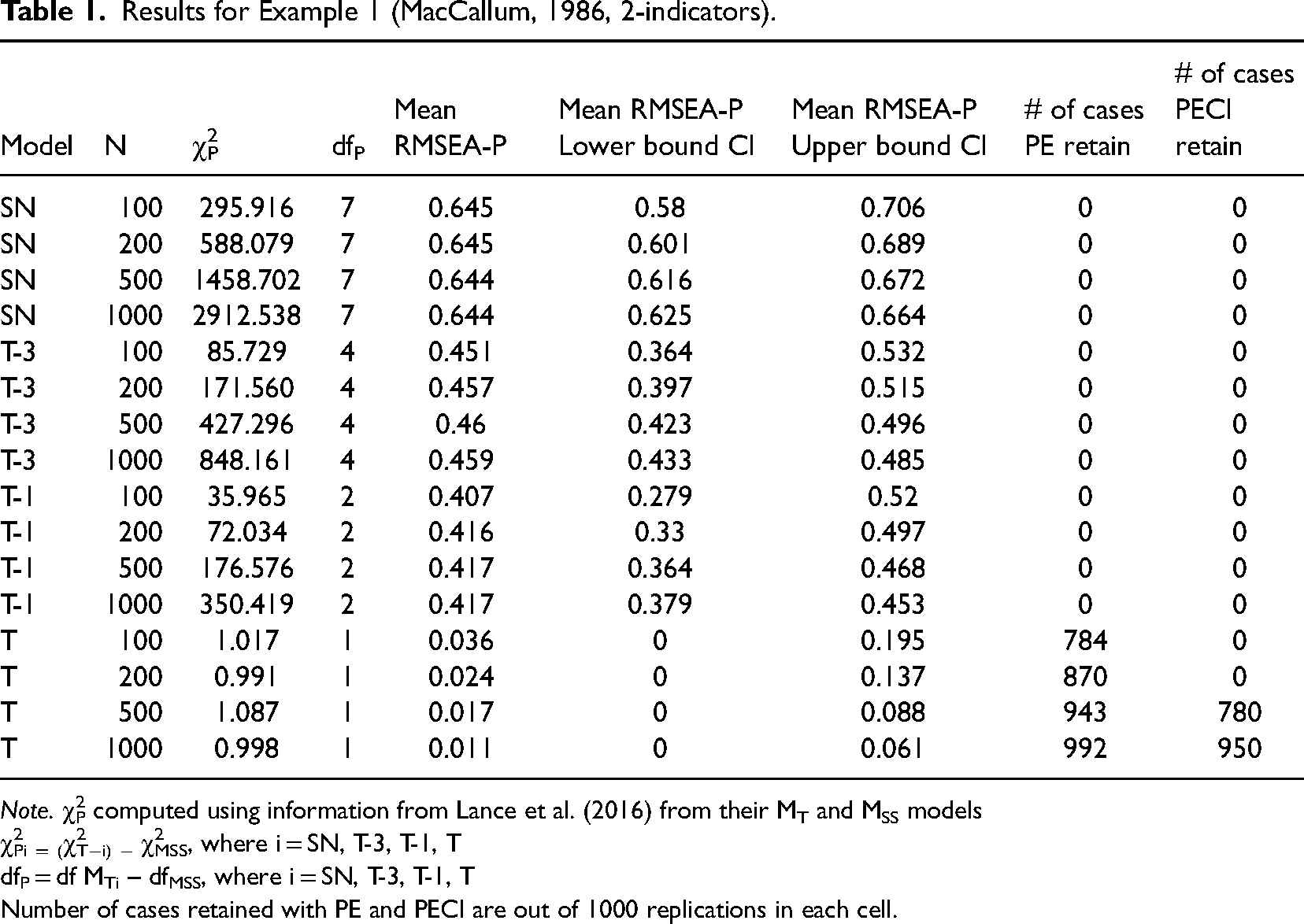
Example 1. Path diagrams for the true model MT for all six examples are provided in Figure 1. The first example involves the use of a mediation model originally used by MacCallum (1986) that has three correlated exogenous latent variables impacting a mediator variable, which then influences an outcome variable. There are two of three possible direct paths from the exogenous latent variables to the outcome variables included in the model, and it was first examined using two indicators per latent variable. The results in Table 1 with our simulated data show that for this example, the RMSEA-P performs as desired for identifying misspecified models. Specifically, all misspecified models had RMSEA-P mean values greater than .08, all lower bounds of CI were >.05 and all higher bounds were >.10. Even for MT−1, with only a single true path omitted, results clearly identified it as misspecified, in that across the four sample sizes, RMSEA-P means ranged from .407 to .417, low ends of CI ranged from .279 to .379, and high ends ranged from .453 to .520. More importantly, at the case level as shown in Table 1, the application of the PE and PECI approaches and criteria resulted in all misspecified models being appropriately rejected in all of the individual samples. Specifically, in all of these instances, there were zero cases where a misspecified model had a point estimate less than .08, a lower bound of the confidence interval less than .05, and a high bound less than .10.
Results for Example 1 (MacCallum, 1986, 2-indicators).
Note. χ2P computed using information from Lance et al. (2016) from their MT and MSS models
χ2Pi = (χ2T−i) − χ2MSS, where i = SN, T-3, T-1, T
dfP = df MTi – dfMSS, where i = SN, T-3, T-1, T
Number of cases retained with PE and PECI are out of 1000 replications in each cell.
For the true model MT, the RMSEA-P mean values were acceptable (<.08) across all sample sizes, ranging from .011 to .036. However, for the two smaller sample sizes (n = 100, 200), the mean values of the high end of the CIs were > .10 (.195, .137), indicating for these cases the model would be rejected. For the two larger sample sizes (n = 500, 1000) the upper bound mean was <.10 (.088, .061). At the case level, the use of the PE criteria resulted in MT being correctly identified as the true model with increasing frequency as the sample size increased (from 784 to 992). In contrast, the PECI approach resulted in MT being retained in no cases for the two smaller sample sizes, but it was correctly identified in 780 of the 1000 cases when n = 500 and in 950 cases when n = 1000.
Example 2. This example is also based on MacCallum (1986), only while the latent variable structure was the same, each latent variable was measured using four indicators (rather than two). The results in Table 2 show a similar pattern as Example 1, in that across all four sample sizes for all misspecified models, the RMSEA-P had mean values indicating rejection (>.08), and the lower and upper bound CI values were greater than .05 and .10, respectively. For instance, with Example 2, we found that for MT−1, the mean RMSEA-P values ranged from .419 to .424, the mean lower bounds of the confidence intervals ranged from .291 to .385, and the mean upper bounds ranged from .458 to .532. These and other RMSEA-P values for Example 2 were very similar to those based on Example 1, which was based on use of two indicators for the latent variables. And as with Example 1, at the case level, use of the PE and PECI approaches with individual samples resulted in no misspecified models being retained.
For MT, the results also parallel those from the two-indicator version in Example 1, in that the RMSEA-P mean values were acceptable for all four sample sizes. The upper-end CI mean values were >.10 with the two smaller sample sizes. And, as with Example 1, for the two larger sample sizes, the mean upper-end CI values were less than .10 (.061, .087), supporting retaining the true model. Results from individual samples and the use of the PECI approach also followed those of Example 1, in that as sample size increased, it was more likely the true model would be correctly retained (from 775 to 992 cases as n increased from 100 to 1000). And like Example 1, with the two smaller sample sizes, there were no cases where use of the PECI approach resulted in retention of MT, while in 805 and 950 instances, MT was correctly identified with the two larger sample sizes.
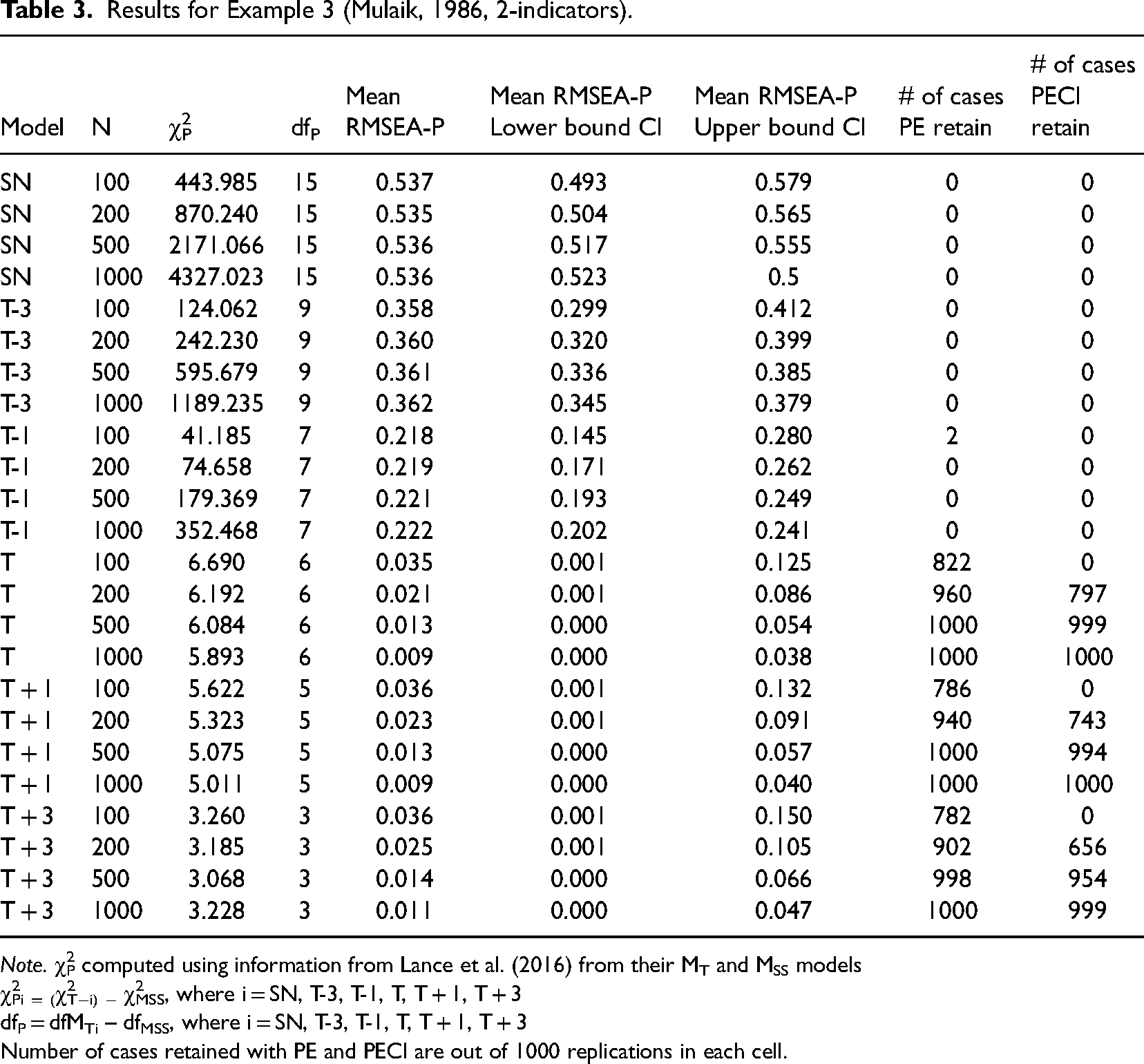
Examples 3 and 4. These two examples were based on Mulaik et al. (1989) and include four correlated exogenous variables impacting two mediator variables, both of which impact an outcome variable. It is a partially mediated model, and the four exogenous variables have different patterns of relationships with the mediators and the outcome. The results based on two indicators per latent variable, Example 3, are presented in Table 3, and conclusions are the same as for the first two examples: all misspecified models had mean RMSEA-P values >.08, lower bounds of CI were >.05, and upper bounds were >.10. Thus, all would be correctly rejected. As an example, for MT−1 the RMSEA-P had mean values across the four sample sizes ranging from .218 to .222, lower bound means ranged from .145 to .202, and upper bound means ranged from .241 to .280. Regarding individual cases, with the PE approach, there were two instances of a misspecified model being incorrectly retained when one path was omitted with the smallest sample size; in all other cases, these models were rejected based on having point-estimates less than .08. More importantly, also matching results from Examples 1 and 2 use of the PECI resulted in no misspecified models being retained.
Results for Example 3 (Mulaik, 1986, 2-indicators).
Note. χ2P computed using information from Lance et al. (2016) from their MT and MSS models
χ2Pi = (χ2T−i) − χ2MSS, where i = SN, T-3, T-1, T, T + 1, T + 3
dfP = dfMTi – dfMSS, where i = SN, T-3, T-1, T, T + 1, T + 3
Number of cases retained with PE and PECI are out of 1000 replications in each cell.
For MT, the findings indicate mean RMSEA-P values below .08 for all four sample sizes (ranging from .009 to .035). For MT confidence intervals, similar sample size effects were obtained as in the other three examples. The lower bound CI values showed that as before, for n = 100 the mean upper bound was >.10 (.125), while the results were favorable for the three larger sample sizes (high end values <.10). At the case level, use of the PE resulted in the number of true models being appropriately retained increasing as sample size increases, from 822 to 1000. Use of the PECI resulted in no cases of retention with n = 100, but correct retention of MT for from 797 to 1000 as sample size increased from 200 to 1000.
When four indicators were used instead of two (Example 4, Table 4), the mean RMSEA-P values and the CI values matched the results with two indicators. With Example 4, for MT−1 and all other misspecified models, results show these incorrect models were correctly rejected based on the PE and PECI approaches, while MT would have been correctly retained with the three larger sample sizes (for n = 100, mean upper end values was .122). Application of the PE with individual cases resulted in correct identification of MT from 836 to 1000 cases across all four sample sizes. The PECI resulted in no retention of MT with the smallest sample size, while the PECI approach resulted in the correct model being retained an increasing number of times, from 801 to 1000 across the three largest sample sizes. In combination, across the first four examples, the RMSEA-P used with the PECI approach at the case level was 100% successful at identifying misspecified models. For MT, with the two larger sample sizes, it was also successful at the case level, in that with the PECI approach correct identification occurred in greater than 95% of the cases for six of eight conditions, and in 78% and 80.5% with the other two conditions.
Results for Example 4 (Mulaik et al., 1989, 4-indicators).
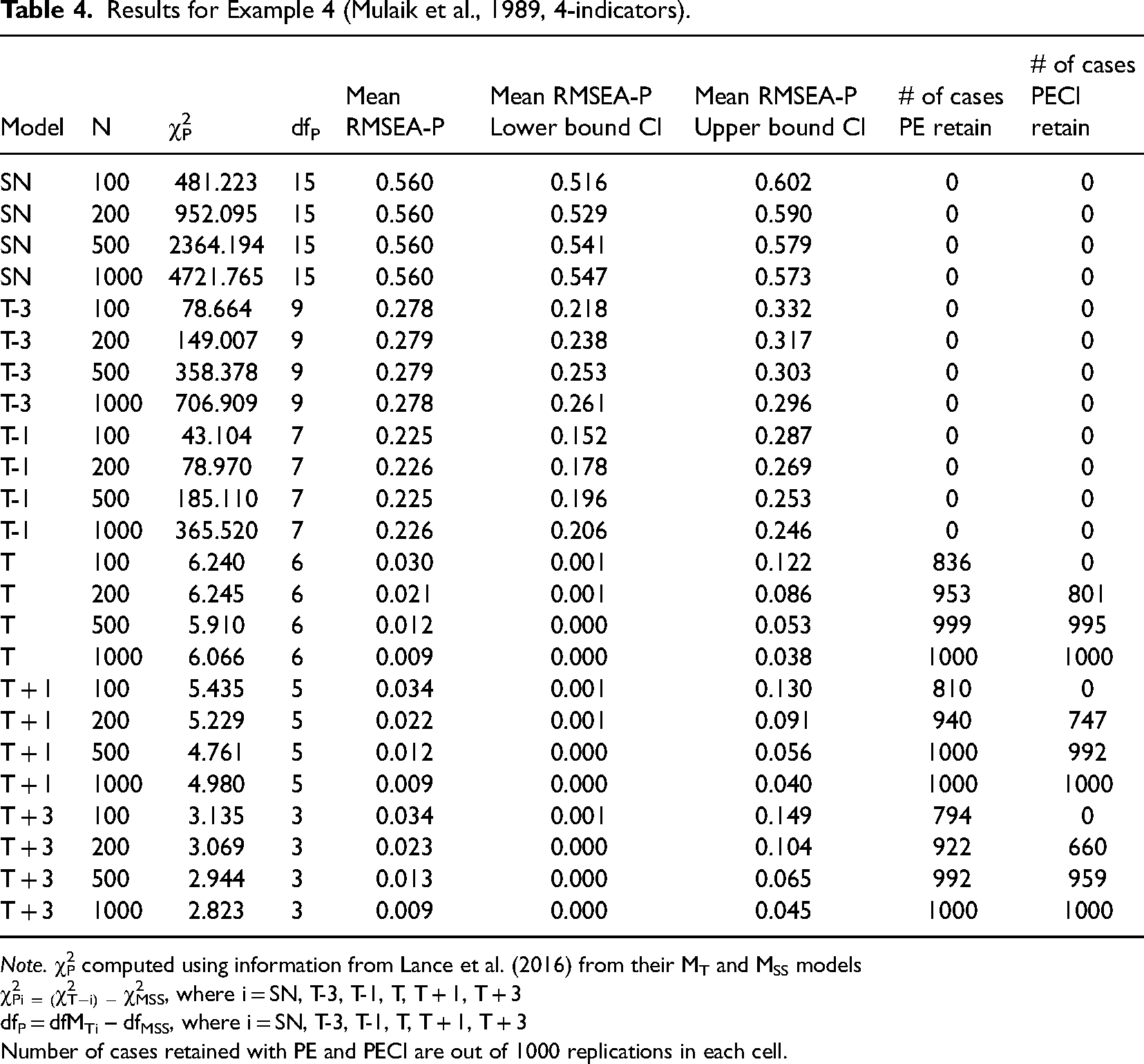
Note. χ2P computed using information from Lance et al. (2016) from their MT and MSS models
χ2Pi = (χ2T−i) − χ2MSS, where i = SN, T-3, T-1, T, T + 1, T + 3
dfP = dfMTi – dfMSS, where i = SN, T-3, T-1, T, T + 1, T + 3
Number of cases retained with PE and PECI are out of 1000 replications in each cell.
Examples 5 and 6. The next two examples are different from the first four in that they each contain a large number of latent variables represented by single indicators. Example 5 was based on a model originally published by Duncan et al. (1971) and is different in that most of its variables were only measured using a single indicator with no provision for measurement error. Specifically, this model includes six correlated exogenous variables, each measured using only a single indicator, and two endogenous latent variables involved in a non-recursive relationship, both measured using two indicators. Thus, three-fourths of the latent variables in this model were assessed with only a single indicator. As shown in Table 5, across the two smaller sample sizes for MT−3 it would have been evaluated as supported (.070, .076) based on mean RMSEA-P values with the PE approach. However, using the PECI, MT−3 would be rejected at all sample sizes as the upper bound to the CI was greater than .10 (.105 to .145). For MT−1, the mean RMSEA-P values were also all less than .05 (ranging from .024 to .03), while the upper bound CI values were <.10 leading to model retention with the three larger sample sizes. Moving to the case level, use of the PE approach resulted in retention of many misspecified models based on RMSEA-P less than .08, ranging from 338 to 553 cases for MT−3 and from 846 to 1000 cases with MT−1. With the PECI approach, when taking into account confidence intervals, MT−3 was retained less frequently in the three larger sample sizes (from 155 to 273 of the cases), while for MT−1 the frequency of retention increased to 749–1000.
Results for Example 5 (Duncan et al., 1971, 2-indicators).
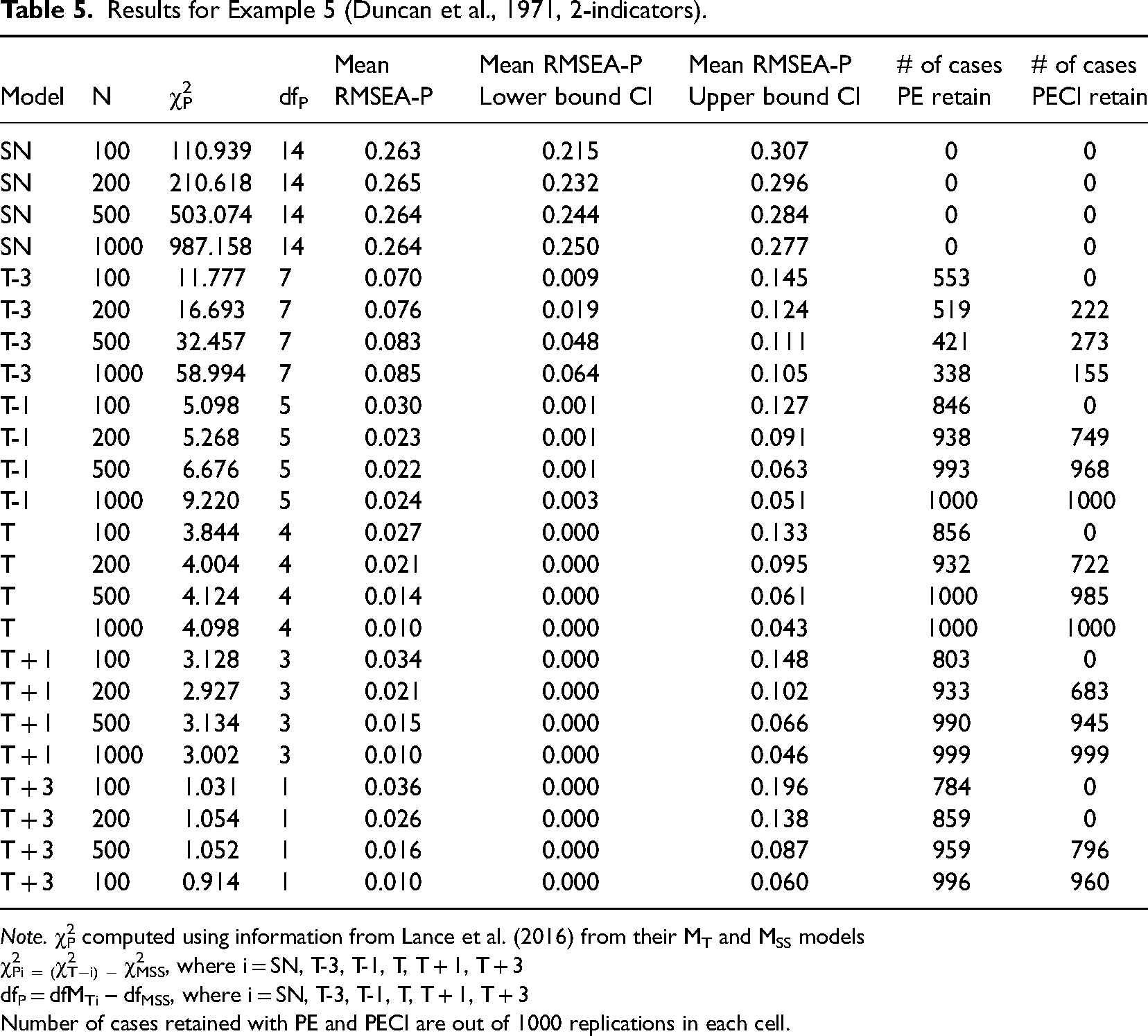
Note. χ2P computed using information from Lance et al. (2016) from their MT and MSS models
χ2Pi = (χ2T−i) − χ2MSS, where i = SN, T-3, T-1, T, T + 1, T + 3
dfP = dfMTi – dfMSS, where i = SN, T-3, T-1, T, T + 1, T + 3
Number of cases retained with PE and PECI are out of 1000 replications in each cell.
For MT, all mean RMSEA-P point estimates and confidence intervals met criteria for their retention in the three larger sample sizes. The PE approach led to support for MT from 856 to 1000 cases as sample size increased from 100 to 1000. Using the PECI, with the smallest sample size, correct identification of MT never occurred, while for the three larger sample sizes, support was obtained from 722 to 1000 cases. In combination, these results for Example 5 show that for MT−3 at the case level use of the RMSEA-P with the PECI approach resulted in mis-specified models being retained less (0%, 22.2%, 27.3%, 15.5% of cases) compared to MT−1 (0%, 72.2%, 98.5%, 100% of cass). Incorrect retention occurred more often in the three larger sample sizes. For MT, RMSEA-P PECI results correctly supported MT in 0%, 72.2%, 98.5%, and 100% of the cases across the four sample sizes, with the greatest success occurring with the three larger sample sizes.
Finally, Example 6 incorporates a latent variable longitudinal panel design from Ecob (1987), in which two latent variables are assessed at three points in time, and the two are linked via lagged (but not within time period) relations. One of the latent variables is represented by a single indicator at each time point, while the other is measured using three indicators. Thus, half of the latent variables in this model were assessed with only a single indicator. Results in Table 6 revealed that like the first four examples, with use of mean RMSEA-P and CI values, all misspecified models were correctly identified as such. For MT−3, mean RMSEA-P values were greater than .08 for all four sample sizes and all upper end values were greater than .10, indicating correct rejection. For MT−1, while all mean RMSEA-P point estimates were less than .08 across the four sample sizes, all upper-bound mean CI estimates were greater than .10, also indicating correct rejection. When looking at individual samples with the PE approach, misspecified models were retained for MT−3 in from 3 to 376 cases, and for MT−1 from 521 to 608 cases as sample size decreased. With the PECI approach, such support occurred much less frequently for MT−3, ranging from 0 to 43 of the 1000 cases, and from 0 to 325 for MT−1.
Results for Example 6 (Ecob, 1987).
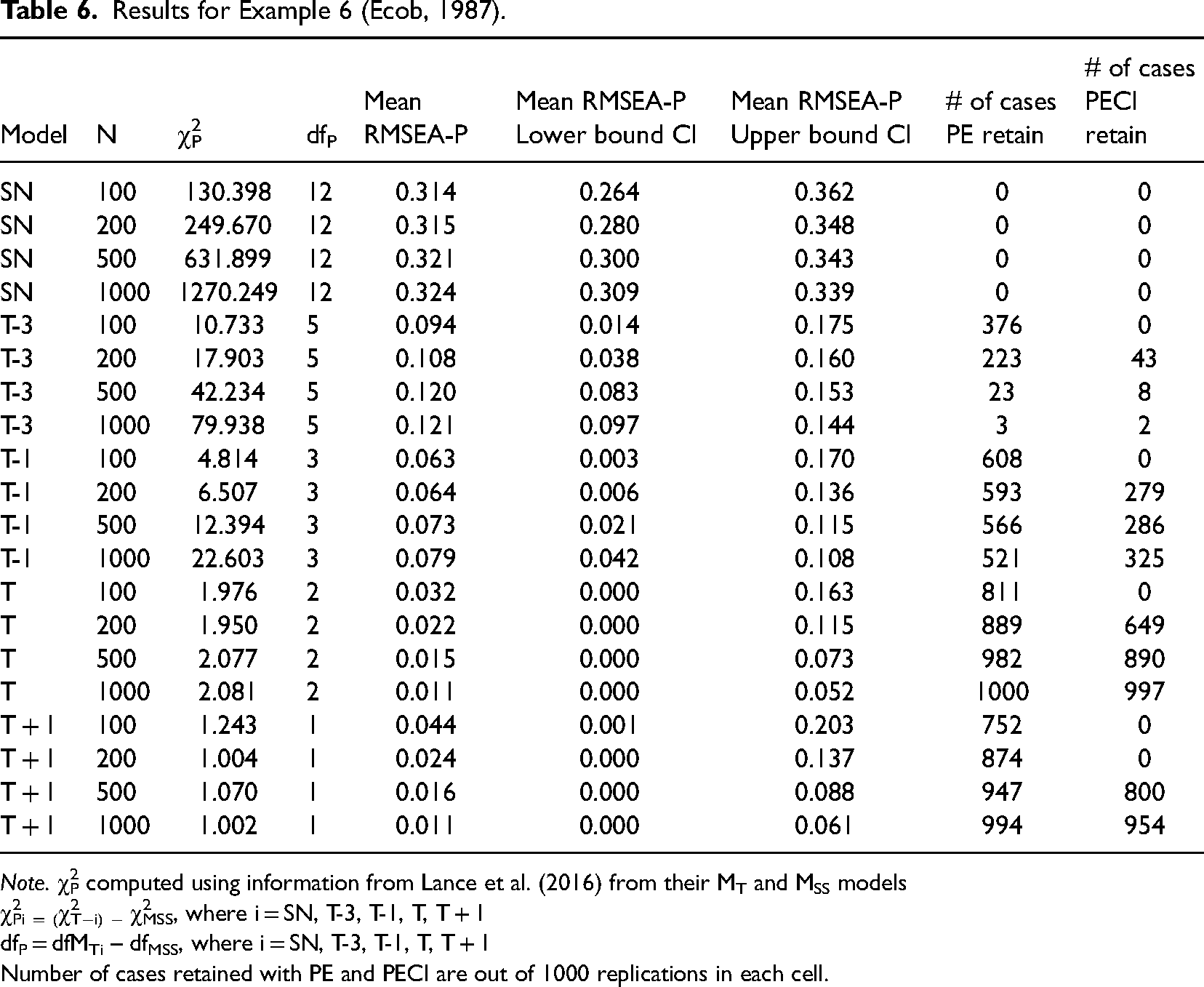
Note. χ2P computed using information from Lance et al. (2016) from their MT and MSS models
χ2Pi = (χ2T−i) − χ2MSS, where i = SN, T-3, T-1, T, T + 1
dfP = dfMTi – dfMSS, where i = SN, T-3, T-1, T, T + 1
Number of cases retained with PE and PECI are out of 1000 replications in each cell.
The results for MT indicated mean RMSEA-P values less than .08 across all four sample sizes and low end values CI less than .05; however high end CV values less than .10 were obtained only with the two larger sample sizes (.052,.073). Use of the PE approach resulted in support for MT ranging from 811 to 1000 cases across the four sample sizes, while the PECI approach did not support MT in any cases when n = 100. For the three larger sample sizes, support was obtained from 649 to 997 cases. In combination, these results for Example 6 show that at the case level use of the RMSEA-P with the PECI approach resulted in misspecified models being retained in around 13% of the cases with MT−3 and about 22% of the time with MT−1, with incorrect retention occurring more often in larger sample sizes. Our RMSEA-P PECI results for this example correctly supported MT in 64% of the cases across the four sample sizes, with the greatest success occurring with the three larger sample sizes.
We next report key findings based on the PE and PECI approaches in a way that allows comparison of our findings with those of Lance et al. (2016) and for consideration of differences among our six examples results. Table 7 presents descriptive RMSEA-P results and the percentage of cases for which each of three key models were retained, for combinations of the six examples used (Examples 1–4, Examples 5 and 6) and the four sample sizes examined. We have added row numbers to facilitate our presentation.
Comparison of RMSEA-P and % of Cases Combining Examples with Lance et al. (2016).
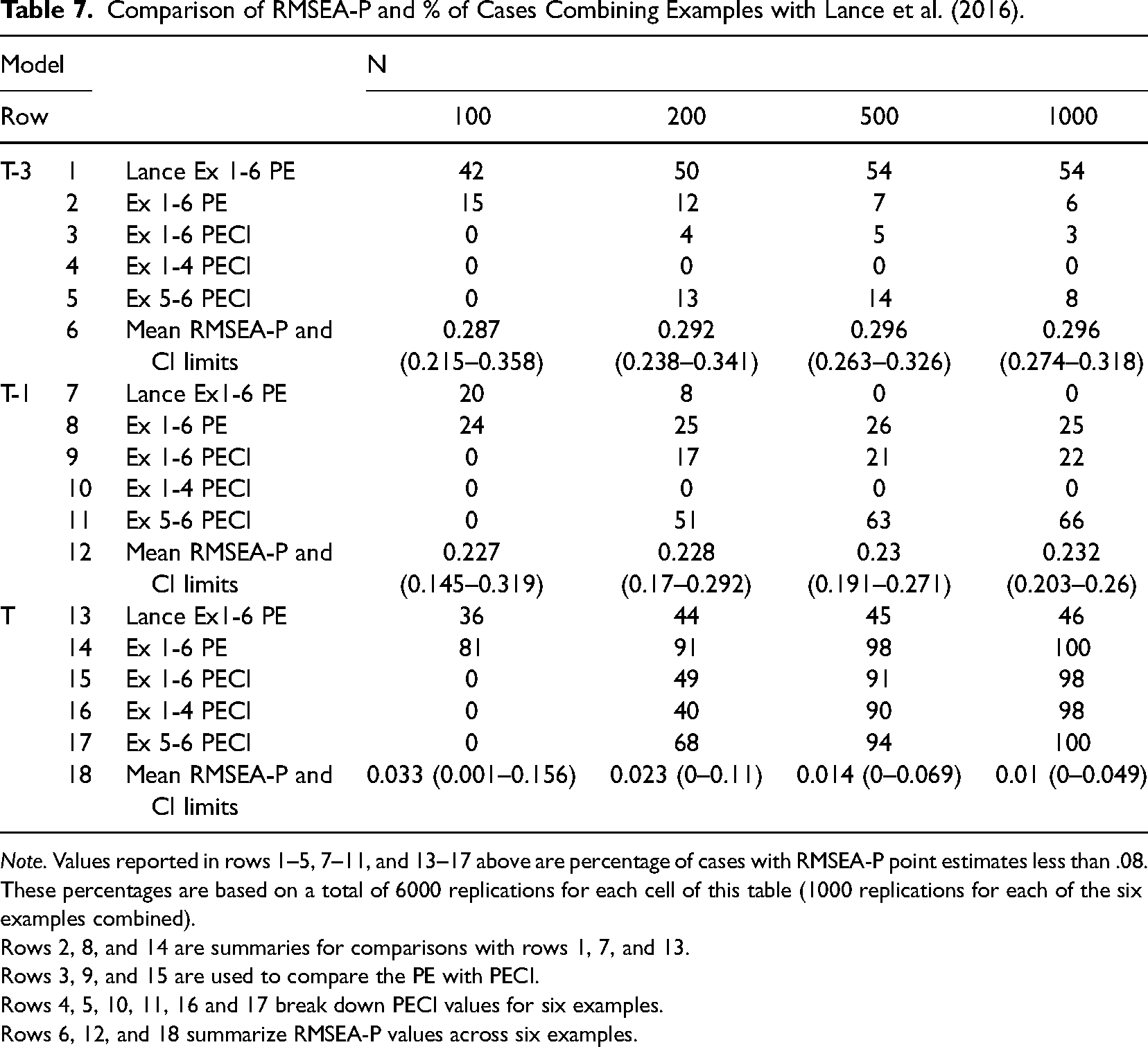
Note. Values reported in rows 1–5, 7–11, and 13–17 above are percentage of cases with RMSEA-P point estimates less than .08. These percentages are based on a total of 6000 replications for each cell of this table (1000 replications for each of the six examples combined).
Rows 2, 8, and 14 are summaries for comparisons with rows 1, 7, and 13.
Rows 3, 9, and 15 are used to compare the PE with PECI.
Rows 4, 5, 10, 11, 16 and 17 break down PECI values for six examples.
Rows 6, 12, and 18 summarize RMSEA-P values across six examples.
For each of the three models, the first row of information (rows 1, 7, 13) presents the percentage of cases retained based on use of the PE approach as reported by Lance et al. (2016), while the second row (rows 2, 8, 14) presents our PE results across all six examples (matching their presentation). A comparison of rows 1 and 2 shows that for MT−3, this model was retained much more frequently by Lance et al. (e.g., 42% vs. 15% for n = 100), a pattern maintained across the other three sample sizes. Alternatively, MT−1 was concluded to meet PE criteria less frequently by Lance et al. compared to our results across the four sample sizes (e.g., rows 7–8, 20% vs. 24% for n = 100). For MT, PE results showed that Lance et al. reported support much less frequently compared to our findings (row 13, 36%–46%; row 14, 81%–100% of cases).
Regarding the PECI, the third row of information for each of the three models (rows 3, 9, 15) presents model retention rate across all six examples based on use of the PECI. A comparison of row 3 with row 2 shows that across all sample sizes use of the PECI with MT−3 results in fewer incorrect models being retained in our results (0%–5% vs. 6%–15%). A similar pattern is found for MT−1 with the comparison of rows 8 vs. 9. This occurs because models with RMSEA-P estimates less than .08 but upper bound confidence intervals greater than .10 are retained with the PE approach but not the PECI approach, especially with small samples.
The next two rows of information for each of the three models present PECI findings for two groups, Examples 1-4 in which all latent variables are represented with multiple indicators, and Examples 5 and 6 in which single indicators are used for over half of the latent variables. A comparison of these two rows (rows 4 and 10) for Models MT−3 and MT−1 shows that in Examples 1–4, there were no cases in which a misspecified model was incorrectly supported; all cases of these two models being incorrectly retained occurred only with Examples 5 and 6 (rows 5 and 11).
The results in Table 7 also show mean RMSEA-P and CI values from our simulated data (rows 6, 12, 18) for three key models (MT−3, MT−1, MT), combined across all six examples but reported separately for the four sample sizes. We report these mean values to allow further exploration of the differences between our results and the findings of Lance et al. (2016) reported in their Table 11. We focus on two cases (MT−3, MT, both with N = 1000). As shown in row 6 of Table 7, for the case in which the misspecified model MT−3 is considered with a sample size of 1000, our mean value for the RMSEA-P is .296 (with mean confidence interval bounds of .274 and .318). These RMSEA-P mean values are consistent with our individual sample results-as already presented in Tables 5 and 6; we found for MT−3 with N = 1000 that in only 5.6% of the 6000 cases of the six examples (338 + 3 = 341) was the RMSEA-P less than .08. By comparison, Lance reported for MT−3 that 54% of their cases had values less than .08 with N = 1000 (row 1). Next, as shown in row 18 for the true model MT we obtained a mean RMSEA-P value of .010 with N = 1000 (with confidence interval bounds of .0 and .049). We add that our individual case values also match what would be expected given these RMSEA-P values—we found all cases to have RMSEA-P values less than .08 (the correct model was identified in all cases—row 14). In contrast, Lance et al. reported obtaining RMSEA-P values less than .08 in only 46% of their samples (row 13). In sum, these results show that findings from Lance et al. are very inconsistent with both our mean RMSEA-P values and our individual case results.
Supplemental Analysis of Data
Having demonstrated the match of our data (chi-square, df, RMSEA-P) with that of Lance et al., we further explored the extreme differences between our findings and those of Lance et al. (2016). We conducted additional analyses using some of their data reported in their Tables 2–8 (p. 394−399). As described in our Appendix, these analyses focused on one case from each of our six examples, the case of MT−3 with a sample size of 1000. We chose these six examples because they are cases where our results were most different from Lance et al.'s findings. The chi-squares and degrees of freedom for these six cases from Lance et al.'s data are presented in our Appendix Table, Part A, columns 1–3. We computed values of RMSEA-P and related confidence intervals with their data and these are shown in our Appendix Table, Part B, columns 4–6. We first note that these values are nearly identical to corresponding values from our simulated data as presented in Tables 1–6, indicating the match between our data generation approach and Lance et al.'s simulation approach. Thus, we can eliminate as an explanation of the differences between our results and those of Lance et al., any concern about the underlying data being different.
Next, we demonstrate that these computed RMSEA-P mean and confidence intervals using Lance et al.'s data are inconsistent with their reported results for RMSEA-P point estimates shown in their Table 11. Specifically, for MT−3 they reported a high percentage of cases (54%) with RMSEA-P values less than .08 across the six examples with a total of 6000 replications. Such a high number of cases with RMSEA-P less than .08 seems very unlikely given the mean RMSEA-P and confidence values from their data for these six examples presented above in Appendix B, Part B, rows 4–6. To illustrate, we combined the RMSEA-P values and confidence intervals from the six examples (Appendix columns 4–6) and obtained an overall value of .296 and confidence interval end points of .274 and .318. Given an interpretation of the confidence intervals that 90% of the RMSEA-P values would be expected to fall between .274 and .318, it seems very unlikely Lance et al. would find 54% of the values from this same data to have values less than .08.
The results above based on our analyses of data taken directly from Lance et al.'s data raise questions about the accuracy of the 54% value for the number of cases with an RMSEA-P <.08. Thus, as described in our Appendix, we further explored results from Lance et al. through a Theoretical Analysis based on their data. Our analysis followed the approach used to investigate RMSEA performance with true models by Kenny, Kaniskan, and McCoach (2015). Our objective was to determine theoretically the expected number of cases with RMSEA-P values <.08 for the 6000 cases across the six examples. As presented in our Appendix, these theoretical results show that for MT−3 and a sample size of 1000 across the six examples, only 5.5% of cases would be expected to have RMSEA-P values less than .08. This value matches very closely results already presented in this paper from our simulations in which we found 5.6% of our 6000 sample replication values had RMSEA-P values less than .08. In sum, both our simulation results and the results of our theoretical analysis, 5.5% and 5.6% with RMSEA-P values less than .08 are very different from the 54% value reported in Table 11 of Lance et al. (2016).
Discussion
The present research investigates the RMSEA-P combining the strengths of two previous simulation studies, including examination of results at the case level for each of six examples separately based on four sample sizes while using point estimates and confidence intervals. Although Williams and O’Boyle (2011) did not examine results at the case level, the present findings are consistent with what they reported. They found the RMSEA-P to effectively distinguish between true and mis-specified models for five of the examples, while with the sixth example (Duncan, et al., 1971, our Example 5) MT was correctly identified but misspecified models with one or two true paths omitted also were retained. It should be noted that Williams and O’Boyle (2011) were using previously published data and only reported results for N = 500, and the number of replications in each cell of their design was only 20. Thus, our current findings are more reliable since we used 1000 replications, and more generalizable since we examined results based on four sample sizes. In contrast, our results are very different from those shown in Table 11 of Lance et al. (2016). And, these differences occurred even though our data generation began with their information (we used their chi-square values as population values) and we used a standard approach to generating our sample chi-square values using R. Moreover, as shown in our Appendix, our reanalysis using Lance et al.'s published results for six specific cases yielded conclusions inconsistent with their reported finding of a high percentage of individual cases of RMSEA-P values less than .08 with a severely misspecified model (MT−3). Finally, we also demonstrated that the results of these six cases are very inconsistent with those predicted by statistical theory. Having demonstrated the validity of our data and conclusions, while also showing serious problems with findings of Lance et al., we now focus on the implications of our results.
The results presented in Tables 1–7 allow several important conclusions. First, regarding differences across examples, the RMSEA-P was very effective with Examples 1–4 at identifying misspecified and correct models. For incorrectly specified models MT−3 and MT−1, combining across four examples (Tables 1–4) with 4000 sample results, there were only two sample RMSEA-P point estimate values that did not exceed the recommended cut-off of. 08 (see Table 3 results for MT−1 from Example 3). When confidence intervals are incorporated, as with PECI, results from Table 7 show that for these four examples combined there were no cases where the PECI approach resulted in retention of an incorrectly specified model (row 4 for MT−3 and row 10 for MT−1). This finding is in strong contrast to results from Lance et al., who found the RMSEAP retained severely misspecified models—for example, see row 1 of Table 7. The fact that the RMSEA-P correctly identified misspecfied models is important because if, instead, these models were retained the interpretation of the paths from the model would be compromised. This would occur because the influence of the omitted paths will be captured in the estimates of paths that are in the model, leading them to be biased.
For true models MT, with these first four examples, our results from Tables 1–4 show the RMSEA-P performed well, especially with sample sizes greater than 200. As shown in these tables, across the four sample sizes examined, PE estimates for MT were very frequently less than .08, indicating acceptable fit (ranging from 77% to 100%). For the two larger sample sizes (n = 500, 1000), this occurred in over 97% of the 4000 cases in Examples 1–4. For the two smaller sample sizes (n = 100, 200), this occurred in between 77% and 95% of the cases with an average success rate of 86%. This pattern is in direct contrast to Lance et al., who across all sample sizes found MT to be correctly retained in less than 50% of the cases using the .08 RMSEA-P cut-off (see row 13, Table 7). Inclusion of the confidence interval information with use of PECI also showed success with sample sizes over 200, in that MT was successfully identified in 90% and 98% of cases (Table 7, row 16). However, when the sample size was 200, this success rate dropped to 40% and with a sample size of 100, no cases had supportive RMSEA-P conclusions using confidence intervals. We will further discuss the implications of sample size effects on confidence intervals with the RMSEA-P in our recommendations section. This overall pattern of findings above is consistent with previous results of Williams and O’Boyle (2011) but is very different from results presented by Lance et al. (2016), who did not distinguish between six example models and reported combined results while not using confidence intervals.
Regarding differences across examples, our findings in Table 7 for Examples 5 and 6 show the RMSEA-P was less effective and illustrate key differences in results for the six example models. In contrast to Examples 1–4, with Examples 5 and 6 MT−3 was supported with the PECI approach in 8%–14% of the cases with the three larger sample sizes (row 5), while for MT−1 support increased to 51%–66% of the cases (row 11). Thus, in these two examples, use of the RMSEA-P and the PECI approach would more often than desired lead to incorrect model retention. The key conclusion is that across sample sizes with Examples 1–4 when multiple indicators are used for all latent variables, if the RMSEA-P is used with the PECI approach, researchers can count on the RMSEA-P to properly reject an incorrect latent variable model. And with moderate sample sizes (>200), researchers can be confident that they can correctly identify a true model if the PECI approach is applied. For our Example 5 and 6 models with fewer indicators, use of the PECI may lead to retention of some mis-specified models and rejection of some correctly specified models. We now note that while our discussion of Examples 5 and 6 has focused on their fewer indicators, there is a different design feature that may explain why their results are different from those of the other four examples.
This explanation focuses on the magnitudes of the paths dropped to create the misspecified models. As described by Lance et al. (2016), in their study, misspecified models were developed by first removing paths with the lowest population values. For these two examples, the paths that were dropped in creating the misspecified models MT−3 and MT−1 had relatively smaller parameter values compared to those of Examples 1–4 (see path values shown in Figures 1–6 from Lance et al., 2016). With Example 5 based on Duncan et al. (1971), the paths dropped had values of .08, .09, and .19, while for Example 6 based on Ecob (1987), the three paths dropped had values of −.14, −.14, and −.16. These values are much lower than the values of the first three paths dropped in the other examples (each .4). These lower path values, rather than the number of indicators, may have led to models being retained that excluded these paths with use of the RMSEA-P. To pursue this explanation, Williams and Castille (2021) increased the magnitude of these three paths in an analytical simulation and found that as these paths were increased in magnitude, RMSEA-P became more effective at identifying MT−3 as a misspecified model. Additional support for this alternative explanation is based on the similarity of RMSEA-P effectiveness in Examples 1 vs. 2 and Examples 3 vs. 4, which differed only in the number of indicators used to measure the latent variables. Finally, we add that with many sample sizes, paths of such small magnitude in a model would not likely be statistically significant. As a result, RMSEA-P support for models with these paths left out (e.g., MT−3) can be seen more favorably since these models would not have misspecifications (because the paths left out are not significant). And, we note the estimates for the paths in the model would not be expected to biased by the omission of the non-significant paths and related conclusions about these paths would remain valid.
A second general finding from our results is that use of confidence intervals with the PECI approach makes a difference in conclusions about rejecting vs. failing to reject a model, as compared to the PE approach. For misspecified models, the use of confidence intervals showed that across all six examples, many models retained based on only point-estimates would be rejected when use of confidence intervals is incorporated as we did in the model evaluation process. For example, as shown in Table 7 use of the PE approach when sample size was 100 with MT−3 resulted in model retention for 15% of cases (row 2), and this success dropped to 0% with PECI (row 3); for MT−1 when sample size was 200 model retention dropped from 25% to 17% with PE vs. PECI. As suggested earlier, this shows that in many cases, incorrect models with PE estimates less than .08 but higher bounds of confidence intervals greater than .10 will be correctly rejected if confidence intervals are examined. Thus, in these cases, the RMSEA-P using confidence intervals works well at lowering the frequency of incorrect retention of misspecified models. Our results in Table 7 show this was true of the findings of Lance et al. (2016), who retained many more incorrect models across all sample sizes using only point-estimates than we did using the PECI. These findings reflect favorably on the RMSEA-P—they indicate that a model with misspecifications will be much more likely to be correctly rejected if confidence intervals are used with the PECI approach.
Compared to misspecified models, for true models, our results showed that use of confidence intervals with the PECI resulted in some MT models being rejected in smaller sample sizes that would have been retained if only the point estimates were examined. Across all six examples, favorable RMSEA-P point estimates less than .08 occurred in 81% and 91% of cases with the two smaller sample sizes (row 14), but with use of confidence intervals in the PECI approach model results supporting MT occurred much less frequently (in 0% and 49% of cases, respectively, row 15). Thus, inclusion of the confidence interval with the RMSEA-P can help researchers realize the limits of their conclusions when they obtain supportive point-estimates with small sample sizes. Use of confidence intervals may also help them correctly identify misspecified models that they might otherwise accept if only point-estimates were examined. In spite of these advantages, use of confidence intervals with fit measures seems to be rare in organizational and management research. For example, Williams, O’Boyle, and Yu (2020) reported that less than 10% of 316 studies in their review used RMSEA confidence intervals. Hopefully our comparison of the success of the PECI relative to the PE approach may increase their use by organizational researchers. However, researchers wanting to include confidence intervals for the RMSEA-P with the evaluation of their models should carefully consider how they are used, and two perspectives seem possible.
The results and conclusions we report are based on one approach, a traditional use in which a model is completely rejected if the upper end of the confidence interval is greater than .10. This approach has been described by Kline (2015) as a test of the poor-fit hypothesis, a “reject-support test of whether the researchers model is just as bad as or even worse than a poor fitting population model” (p. 275). Followers of this approach may have concerns about our findings that the use of RMSEA-P and confidence intervals can lead to rejection of true models with smaller sample sizes. Alternatively, a second approach with the RMSEA suggests that a model not be automatically rejected because the upper end of a confidence interval is greater than .10. This view is reflected in the perspective by Brown and Cudeck (1993) that these intervals remind researchers of the limits of their sample point estimates. As noted by Browne and Cudeck (1993), confidence intervals “supplement point-estimates by interval estimates to bring the lack of precision of the estimates to the users attention” (p. 138). Subsequently, MacCallum, Browne, and Sugawara (1996) stated that confidence intervals “provides information about precision of the estimate and can greatly assist the researcher in drawing appropriate conclusions about model quality” (p. 134). More recently, as noted by Kline (2015, p. 139) the use of the confidence interval with the RMSEA “reflects the degree of uncertainty associated with the RMSEA as a point-estimate”, and “acknowledges that the RMSEA (and all other model fit indices) are sample statistics subject to sampling error” (Kline, 2015, p. 139). These views seem to suggest a broader use of confidence intervals, in contrast to their use in a binary null-hypothesis test regarding poor fit. If one prefers this less restrictive view and favors use of confidence intervals as a reminder of the limitations of one's data, our results with the RMSEA-P can be seen more favorably.
Our findings show that when one's true model has paths of reasonable magnitude and multiple indicators are used, RMSEA-P point estimates are less than .08 in a very high percentage of cases. The finding that with small sample sizes, the upper end of the confidence interval of these estimates may frequently exceed .10 may suggest that rather than leading to the rejection of the model in a binary way, it should lead the researcher to encourage further investigation of the model with larger sample sizes. Indeed, MacCallum et al. (1996) also stated that in such cases of a low RMSEA value but a wide confidence interval “the investigator could recognize that there may be substantial imprecision in their RMSEA estimate, in which case one cannot determine accurately the degree of fit in the population” (our italics, p. 134). In other words, in these circumstances, it may be premature to reach any final decision about the ultimate quality of the model until further evidence is examined. More recently, in a similar circumstance, Klein (2015) noted that when facing estimate imprecision and accompanying ambiguity when hypothesis testing, researchers should obtain a larger sample rather than rejecting the model (p. 275).
Our third conclusion based on our results concerns how path model fit indices should be used in the broader process of model evaluation. We begin by reviewing that for model confirmation a key condition needs to be met, referred to by James, Mulaik, and Brett (1982) as Condition 10, that focuses on evidence that paths left out of any theoretical model (MT) are correctly omitted. Three types of information can be used, and we present the three approaches and provide some comments on their use as background for a subsequent recommendation for their combined use. First, the results of a formal model comparison can be examined based on a chi-square difference test of MT with a model that adds paths linking all latent variables with each other (referred to as a saturated structural model, MSS, that is equivalent in fit to a correlated factors model). This approach was given priority by James et al. and Anderson and Gerbing (1988). The researcher hopes this chi-square difference test is not statistically significant, leading to the conclusion that the added paths should not be included. A concern with this Condition 10 approach is that the high statistical power of the test can lead to rejection even when differences in the amount of explained covariances among the indicators due to the added paths is minimal. In other words, this test can be seen to suffer the limitations of the overall chi-square test as a measure of perfect fit, where the fit is focused on paths added and the test is whether their associated residual covariances as a set are zero.
A second type of Condition 10 test involves the statistical significance of the paths originally predicted to be zero that are added to MT to create MSS. The researcher hopes the added paths are not individually statistically significant, supporting their omission in MT. A concern with this approach can be the absence of theory to support the direction of the added paths. If there is no theory for the added paths, which is likely or the paths would have been in the original model MT, the choice of direction of any path is arbitrary. Moreover, for such a saturated structural model there could be many specifications different from the one chosen by the researcher that would yield “equivalent” model fit. Williams et al. (1996) and Williams (2012) have shown that path estimates and their statistical significance can vary dramatically across equivalent fitting models. Thus, any conclusions about the importance of these statistically significant added paths is of limited value—had the researcher chosen a different specification with paths in a different direction, different patterns of significance would likely be obtained.
The third type of Condition 10 evidence involves goodness of fit measures, of which the RMSEA-P is a special case that focuses on the path component. James et al. (1982) and Anderson and Gerbing (1988) noted that goodness of fit measures should play a supplemental role to these two first two Condition 10 tests. In the seminal article on such measures, Bentler and Bonett (1980) stated that fit indices can “provide information about practical significance, in which a statistically significant effect can be evaluated for its practical usefulness in explaining the data” (p. 599). Or as stated by Kelley and Preacher (2012), the RMSEA (and by extension RMSEA-P) can be seen as “an operationalization of the estimated effect size dimension of model fit” in the context of structural equation models (p. 141). Given this tradition, perhaps the restrictive use of the RMSEA-P confidence interval as a reject/support binary tool for model evaluation is not the best approach. The RMSEA-P, as with the original RMSEA, can be seen as providing a summary of path model misfit per degree of freedom that also includes a confidence interval allowing judgment about performance of the model beyond the sample whose results are being considered. And, the RMSEA-P overcomes the important limitation that the traditional global fit index RMSEA has been demonstrated to support models with extreme misspecifications in the six examples of this study (Williams & O’Boyle, 2011) and in published management research (Williams, O’Boyle, & Yu, 2020).
Recommendations
Given these considerations, we believe that all three approaches to Condition 10 evaluation described above can play an important role, as their individual effectiveness may vary across situations (for example, sample size, path magnitude). Overall, our findings suggest a key recommendation for a researcher, especially when working with a relatively low sample size—make sure to consider the results of all three Condition 10 tests. If the RMSEA-P index is used to evaluate MT with a low sample size and the obtained point estimate is less than .08 but the upper bound of its confidence interval is greater than .10, additional information should be considered before rejecting MT. If the chi-square difference test of MT with MSS is not significant and/or the paths added to form MSS are not themselves statistically significant, this may suggest the non-supportive upper limit of the confidence interval may reflect lower power of the RMSEA-P and MT should be tentatively retained for future evaluation. The use of these statistical tests as supplements to the RMSEA-P help researchers avoid what could be incorrect rejection of MT and allow them to be more confident that their model does not contain important misspecifications. The likely different statistical power of these three statistical tests for Condition 10 suggests using all three would be a good strategy. We note that the focus on individual paths is consistent with recommendations from Kenny, Kaniskan, and McCoach (2015) who encouraged looking at path parameter estimate significance. However, unlike Kenny et al., we feel the RMSEA-P still should continue to be examined, with balance given to interpretation of point estimates and confidence intervals (e.g., Browne & Cudeck, 1993; Klein, 2015; MacCallum et al., 1996). It should be remembered that in the case of inconsistent results across the three Condition 10 tests, a more cautious approach is warranted about the generalizability of the findings to the population, and more research is needed understanding different power of these tests and their sensitivity to model specification (e.g., McNeish, 2020).
Conclusions
We emphasize our belief that the best approach to model testing begins with evaluation and improvement of the measurement model linking latent variables to their indicators, as emphasized by Anderson and Gerbing (1988). However, even with an optimal measurement model, a researcher should not rely only on global fit indices as a Condition 10 test, as done by most organizational researchers (Williams, O’Boyle, Yu, 2020). Instead, confirming Condition 10 for any associated latent variable path models should involve the use of the PECI approach with the RMSEA-P, in combination with the significance of the MT-MSS chi-square difference test and the significance of the paths predicted to be zero. James, Mulaik, and Brett (1982) also describe a Condition 9 for model confirmation, and we believe the chi-square difference between MT and the structural null, as well as the significance of paths included in MT, should be used along with the NSCI-P recommended by Williams and O’Boyle (2011) and Lance et al. (2016). While traditional SEM software does not provide estimates of path model fit, a new package for path model assessment using lavaan with R is now available (pathmodelfit, https://cran.r-project.org/web/packages/pathmodelfit/index.html) which provides RMSEA-P and NSCI values, and an excel file for computing RMSEA-P and confidence intervals using chi-square and degrees of freedom values from theoretical and saturated structural (measurement) models is also available. Finally, we believe that both Condition 9 and Condition 10 tests should be examined before researchers conclude their model is viable, and they should also remember that even if these conditions are fulfilled, the possibility always remains that there may be one or more unexamined alternative models that may fit the data equally or better.
Footnotes
Declaration of Conflicting Interests
The author(s) declared no potential conflicts of interest with respect to the research, authorship, and/or publication of this article.
Funding
The author(s) received no financial support for the research, authorship, and/or publication of this article

Notes
Author Biographies
Appendix. RMSEA-P Theoretical Analysis
We further examined the differences between our findings and those of Lance et al. (2016) by conducting additional analysis using their results from six examples reported in their Tables 2–7. Our analysis followed the approach used to investigate RMSEA performance with true models by Kenny, Kaniskan, and McCoach (2015). We selected a single case from each of the six examples involving one misspecified model with three paths linking latent variables incorrectly omitted, MT−3, and we focused on a single sample size of 1000 (one of four sample sizes included in their study). The use of these cases allows for a direct comparison of our analysis to results for these six examples from Table 11 of Lance et al. (2016). Using their published χ2 and degrees of freedom, we computed RMSEA-P mean values and determined the probability for each of the six cases of obtaining a χ2P value that would result in a RMSEA-P value less than .08 for MT−3. We next combined these probabilities to obtain a value that can be directly compared to our results and information reported in Table 11 by Lance et al. (2016).
Part A of our Appendix Table shown below reports mean chi-square values and degrees of freedom for MT−3 and MSS provided by Lance et al. for each of the six examples, for cases when the sample size is 1000 (columns 1 and 2). For each example, we use this information to compute χ2P as their obtained path model chi-square difference between the chi-square values for MT−3 and MSS, as well as the difference in degrees of freedom (dfP) (column 3). Next, we used the information above to compute the RMSEA-P and associated confidence interval values for MT−3 from each of the six examples (Part B, columns 4–6). We note these values are nearly identical to RMSEA-P results we report in Tables 1–6.
Next, we compute and report in Part C of our Appendix Table the threshold value for each path model chi-square (χ2PTHRESH) that would result in an RMSEA-P value of .08. To obtain the χ2PTHRESH for each of the six examples, we use the RMSEA-P formula from Williams and O’Boyle (2011, ORM, p. 14, equation 7): RMSEA-P = {[χ2P – dfP] / [dfP × (N − 1)]}1/2. For each of our selected six cases, we set the RMSEA-P = .08 and N = 1000, and then we used the cases' computed values for χ2P and dfP to solve for χ2PTHRESH. Specifically:
Having obtained this percentage of cases with RMSEA-P less than .08 for each of the six examples, we then combined across the six examples to obtain the total expected number of cases with an RMSEA-P less than .08. Our findings from this theoretical analysis show that for five of these examples the probability of obtaining a χ2PTHRESH that would yield an RMSEA-P less than .08 was less than .002, while for Example 5, it was much higher (p = .328). Combining across all six examples for a total of 6000 samples, approximately 330 cases (5.5%) would have χ2P values resulting in an RMSEA-P <.08. As shown in Table 7, results from our simulations found 341 cases (5.6%) with an RMSEA-P <.08. Most importantly, the 5.5% and 5.6% results from our theoretical analysis and simulation analysis are dramatically different from the 54% value reported by Lance et al. in their Table 11. In combination, our theoretical analyses and RMSEA values we computed from Lance et al. heighten the contrast of our findings compared to their single reported result for the RMSEA-P (54% of 6000 cases for MT−3 from six example models with values less than .08).