




Abstract
Digital technologies pervade modern life. As a result, organizational ethnographers must contend with informants interacting in face-to-face and digitally mediated encounters (e.g., through email, Facebook Messenger, and Skype). This overlap of informants’ digital and physical interactions challenges ethnographers’ ability to demonstrate authenticity and multivocality in their accounts of contemporary organizing. Drawing on recent theorizing about the nature of digital artifacts and two cases of ethnographic fieldwork, we argue that digital artifacts afford ethnographers different modes of being co-present with research participants: digital as archive and digital as process. We offer guidelines to researchers on how to deploy these modes of co-presence in order to improve authenticity and multivocality in ethnographic studies of modern organizations. We also explore the implications for methodological concerns such as ethics, analytical choice, and reflexivity.
Keywords
Introduction
Multi-sited ethnography is one of the most important reconceptions of ethnography in the past three decades (Marcus, 1995; Smets, Burke, Jarzabkowski, & Spee, 2014; Van Maanen, 2010). Since Marcus’s (1995) seminal exposition of multi-sited ethnography, organizational researchers have employed multi-sited research designs to study teams within a single organization (Bechky, 2003; Bruni, 2005; Smets, Morris, & Greenwood, 2012), firms located in small geographical clusters (Knorr Cetina & Bruegger, 2002; Smets et al., 2014), and organizational units spread across large geographical areas (Barley & Kunda, 2004; Maznevski & Chudoba, 2000; Prasad, Prasad, & Mir, 2011). By emphasizing the physicality of the field, these researchers retain ethnography’s conventional commitment to ocular observation of research participants’ face-to-face interactions and thick description of the field (Bate, 1997; Cornelissen, 2017; Golden-Biddle & Locke, 1993; Hammersley & Atkinson, 2007; Van Maanen, 2011b).
Despite this methodological advance, ethnographers’ continued reliance on observations of face-to-face interaction and rich description of the field is inadequate to capture the vitality of modern organizational life for two reasons. First, as digital technologies permeate social life (Kallinikos, Hasselbladh, & Marton, 2013; Yoo, Boland, Lyytinen, & Majchrzak, 2012), participants increasingly perform work through digitally mediated encounters that are not amenable to ocular observation (Barley & Kunda, 2001; Garcia, Standlee, Bechkoff, & Cui, 2009; Hallett & Barber, 2014; Maznevski & Chudoba, 2000). Second, digital technologies afford an organization’s members different modes of conducting work or experiencing organizational life than face-to-face interactions do (Campbell, 2006; Garcia et al., 2009; Hine, 2000; Murthy, 2008; Ruhleder, 2000). The growing significance of digitally mediated interactions within organizations and the opacity of these interactions challenge an ethnographers’ ability to demonstrate authenticity and capture marginalized voices in their accounts of contemporary organizational life (Bate, 1997; Golden-Biddle & Locke, 1993). This challenge is consequential because ethnographic studies that fail to demonstrate authenticity and multivocality may be perceived as implausible by scholarly audiences. Consequently, such research is unlikely to provoke scholars to reexamine taken-for-granted assumptions about modern work (Barley & Kunda, 2001; Bate, 1997; Golden-Biddle & Locke, 1993).
The purpose of our paper is to address the question: Given the affordances of digital artifacts, how might organizational ethnographers enhance authenticity and multivocality in their studies of modern organizations? By answering this question, we make three contributions to the practice of organizational ethnography. First, we draw on emerging theory in the field of information systems (IS) to highlight the unique nature of digital artifacts (Faulkner & Runde, 2009; Kallinikos, Aaltonen, & Marton, 2013). Second, we distinguish two modes which digital artifacts and their underlying infrastructure enable ethnographers to be co-present with research participants: digital as archive and digital as process. Finally, we advance a set of guidelines to support ethnographers in demonstrating authenticity and representing marginal voices when studying modern organizations.
Our paper is organized as follows. We begin by showing how the overlap of participants’ face-to-face and digitally mediated interactions challenges ethnographic practice. Next, we review the emerging IS theory on the nature of digital artifacts. We then present two illustrative cases detailing our experience doing ethnographic fieldwork in digitally mediated settings. Thereafter, we discuss field research guidelines and conclude with directions for future research.
Doing Ethnography in Modern Organizational Settings
Overlap of Informants’ Physical and Digital Interaction: Why Should We Care?
In contemporary organizations, members’ physical and digital interactions overlap. Front-line staff, middle managers, and executives—the informants 1 organizational ethnographers study—conduct the mundane affairs of organizational life through face-to-face interaction and digitally mediated 2 encounters using platforms such as email, Facebook Messenger, Skype, and WhatsApp (Garcia et al., 2009; Hallett & Barber, 2014; Hammersley & Atkinson, 2007; Howard, 2002). The prevalence of digitally mediated interactions complicates ethnographic research in at least two ways. First, it threatens ethnographers’ ability to demonstrate authenticity in their accounts of organizational life. Ethnographers demonstrate authenticity in part by immersing themselves within a research field. By relying on interviews and ocular observation of their informants’ face-to-face interactions, ethnographers achieve intense familiarity with the informants’ social worlds (Bate, 1997; Boellstorff, Nardi, Pearce, & Taylor, 2012; Hammersley & Atkinson, 2007; Van Maanen, 2010, 2011b; Watson, 2011). Organizational ethnographers who rely principally on interviewing and ocular observation are unlikely to obtain firsthand access to their informants’ language, actions, and perceptions of organizational life because these are digitally mediated and not amenable to observation (Barley & Kunda, 2001; Beaulieu, 2010; Czarniawska, 2008; Knorr Cetina & Bruegger, 2002). In turn, the researchers’ ability to convey the vitality of organizational life is diminished, threatening their claim to ethnographic authenticity (Golden-Biddle & Locke, 1993). For instance, Orgad (2005), reflecting on her study of how breast cancer patients experienced the disease, concludes that having face-to-face interviews as well as observing her informants’ online chats helped contextualize and improve the validity of her findings. Similarly, in a study of a California-based organization that served undocumented immigrants, Hallett and Barber (2014) report that though they had begun the study using interviews and participant observation, they were drawn to their informants’ digital interactions. They conclude, “Had we overlooked the role of online spaces in the lives of our participants, our ethnographies would have failed to capture the ‘multiple levels’ of human interaction” (p. 323).
Second, participants’ digitally mediated interactions challenge ethnographers’ ability to represent the diversity of voices within an organization. When ethnographers research pluralistic organizations, they characteristically strive to represent the voices of various participants (Bate, 1997; Hammersley & Atkinson, 2007; Murthy, 2008; Van Maanen, 2011a; Watson, 2011). This is a feature of ethnography that Martin (1995) calls “multivocality.” Digital technology enables organizational members to participate in organizational life within the office location or remotely by video conferencing, instant chats, and email (Barley & Kunda, 2004; Knorr Cetina & Bruegger, 2002; Smets et al., 2014). Ethnographers who rely on interviews and direct observation within an organization’s offices may miss out on important interactions, particularly in the case of remote work (Kunda, 2006). If remote work is performed by hard-to-reach subpopulations (Johnson, 1994) or marginalized subgroups, such as temporary workers (“temps”), women, and ethnic minorities (Barsness, Diekmann, & Seidel, 2005; Kunda, 2006; Murthy, 2008), then researchers may inadvertently silence these marginal voices in their ethnographic accounts or miss out on deviations from dominant discourses within the organizations they study (Czarniawska, 2008).
Digital and Physical Interaction: A Problem of Multi-sitedness
A valuable starting point for conceptualizing the overlap of informants’ digital and physical interactions is as a problem of multi-sitedness. Traditionally, ethnographers have focused on the intimate study of social worlds characterized by face-to-face interaction within a single, discrete geographical site (Bate, 1997; Boellstorff et al., 2012; Hammersley & Atkinson, 2007; Marcus, 1995; Slutskaya, Game, & Simpson, 2016; Van Maanen, 2011b). As recent advances in digital technology and market globalization shape social life (Barley & Kunda, 2004; Maznevski & Chudoba, 2000; Smets et al., 2014; Yoo et al., 2012), ethnographers have developed research designs that extend the ethnographic remit beyond the single physical site; Marcus (1995) calls these designs “multi-sited ethnography.” Recognizing that collectives such as organizations are not isolated from wider societal influences, Marcus characterizes multi-sited ethnography as involving “chains, paths, threads, conjunctions, or juxtapositions of locations in which the ethnographer establishes some form of literal, physical presence, with an explicit posited logic of association or connection among sites that in fact defines the argument of the ethnography” (p. 105).
Barley and Kunda’s (2004) study of contingent work among itinerant technical professionals in Silicon Valley is an exemplar of how ethnographers establish literal, physical presence in multiple sites. Their study involved nine months of participant observation at three staffing agencies, interviews with 71 technical professionals, and interviews with managers at 10 client firms. Similarly, Prasad et al.’s (2011) study of how fashion discourse influenced the implementation of workplace diversity programs involved participant observation and interviews with 47 staff across four petroleum and two insurance companies in Canada. Generally speaking, multi-sited ethnography emphasizes the physicality of research sites, whether they are communities or departments within a single organization’s office location (Bechky, 2003; Bruni, 2005; Smets et al., 2012), firms in small geographical clusters (Knorr Cetina & Bruegger, 2002; Smets et al., 2014), or organizational units spread across large geographical areas (Barley & Kunda, 2004; Maznevski & Chudoba, 2000; Prasad et al., 2011).
At first glance, modern organizations appear similar to the research sites typically studied in multi-sited ethnographies. After all, organizations are regularly conceived as discrete, physically bounded entities (Abdelnour, Hasselbladh, & Kallinikos, 2017; Scott, 2003). Yet, as Bate (1997) argues, even organizations dominated by face-to-face interactions may be highly fragmented. This situation is exacerbated in modern organizations because members may present different aspects of themselves depending on whether they interact in-person or through digitally mediated means (Boellstorff et al., 2012; Campbell, 2006; Hine, 2000; Joinson, 2005; Murthy, 2008). For example, an organization’s members may use a different language such as “OMG (oh my god), LMAO (laugh my ass off), or BTW (by the way)” (Hallett & Barber, 2014, p. 310) or observe different behavioral norms during digital interaction than they would with in-person interaction (Garcia et al., 2009; Hine, 2000; Orgad, 2005; Ruhleder, 2000). Furthermore, by enabling remote interaction, digital technologies enable members to act or experience organizational life in many places simultaneously (Czarniawska, 2008; Orgad, 2005). In other words, in organizations the digital and physical are likely to form distinct sites of member interaction that give rise to different social situations as they enable members to experience or to contribute to organizational life in different ways (Spradley, 1980).
The observation that participants in a given field site interact in multiple ways is not new among researchers. Drawing on the field of linguistics and communication studies, Dicks, Mason, Coffey, and Atkinson (2005) argue that any ethnographic field is inherently “multimodal” because participants in the field deploy various abstract, nonmaterial resources, such as speech, narrative, and body gestures, to create meaning. This body of work views research participants’ digital and physical interactions as essentially similar. However, digital media (e.g., email, WhatsApp, Facebook) are treated as new material forms through which the participants capture or record preexisting ways of meaning making.
Similarly, organizational ethnographers have yet to problematize the overlap of their participants’ physical and digitally mediated interactions. For instance, organizational researchers typically use digital data to augment participant observation and interviews (e.g., Levina & Vaast, 2008; Maznevski & Chudoba, 2000; Metiu, 2006; Nicholson & Carroll, 2013; Vlaar, van Fenema, & Tiwari, 2008). This approach is perhaps unsurprising since ethnographic fieldwork is committed to the ideal of firsthand witnessing (Van Maanen, 2011b). As an embodied actor, the ethnographer is a data collection “instrument” for whom observing others’ talk, body language, and manipulation of material artifacts comes naturally (Garcia et al., 2009; Hallett & Barber, 2014; Hammersley & Atkinson, 2007; Lincoln & Guba, 1985; Orgad, 2005).
Sociologists and anthropologists of the Internet observe that their informants’ lived realities include “online” and “offline” physical interactions (Boellstorff et al., 2012; Burrell, 2009; Garcia et al., 2009; Hallett & Barber, 2014; Hine, 2000; Mackay, 2005; Murthy, 2008; Tunçalp & Lê, 2014). But for a few notable exceptions (see Miller & Slater, 2001; Orgad, 2005), this stream of scholarship typically focuses on participants’ online interactions. In this body of work, digital media is assumed to be ontologically uncomplicated. Participants’ digital interactions are assumed to be wholly persistent and analyzable after the fact (Boellstorff et al., 2012; Garcia et al., 2009; Hine, 2000; Mackay, 2005). For instance, in a systematic review of online ethnography, Tunçalp and Lê (2014), argue that online ethnography “is entirely mediated by multimedia artifacts such as texts, pictures, videos, etc.” (p. 64). From this perspective, digital data are omnipresent and “temporally suspended.” Digital data are thus considered quasi-permanent and distinct from social action. According to Tunçalp and Lê, the implication for researchers is that synchronous observation of the processes of creating digital data is equivalent to ex post analysis of digital archives.
We present a different view. By drawing on two illustrative cases of ethnographic research and emerging IS theory on the nature of digital artifacts, we argue that the analyses of informants’ digital and physical interactions are not necessarily equivalent. Rather, we suggest that there are at least two ways—digital as archive and digital as process—in which ethnographers can be co-present with their informants to enhance authenticity and multivocality in their studies of organizational life. Before presenting our illustrative cases and defining these modes of co-presence, we briefly review IS scholarship on the distinctive nature of digital artifacts.
The Ontology of Digital Artifacts
In modern organizations, digital interactions occur through observable technological interfaces (e.g., computers, email programs, software platforms, documents, blogs) enabled by an underlying governing infrastructure (e.g., algorithms, motherboards, source codes). According to IS scholars, these are the digital artifacts that shape modern work practices; therefore, understanding the nature and function of these artifacts is vital to understanding contemporary organizational life (Alaimo & Kallinikos, 2016; Faulkner & Runde, 2009, 2013; Garud, Jain, & Tuertscher, 2008; Kallinikos, Aaltonen, et al., 2013; Kallinikos, Hasselbladh, et al., 2013). According to Faulkner and Runde (2013), digital artifacts, like material artifacts, have a technical identity, social position, and structure. The technical identity of an object is “the kind of thing that the object is within some community.” It involves a function, “the use that members of some community impose on that object,” and form, “the characteristics and capabilities required to perform that function” (p. 807). An artifact’s social position is the “role” that the object plays within a community, while structure refers to the logical ordering of and interactions among its discrete components. Digital artifacts differ from physical artifacts in the sense that the former are “aspatial,” namely, they lack “properties of location, mass, shape and volume.”
Kallinikos, Aaltonen, et al. (2013) take this distinction further. They argue that digital artifacts possess an ambivalent ontology or essence. In their view, digital artifacts are “perpetually in the making,” (p. 357) and “lack stability and plenitude of traditional [material] objects” (p. 366). These characteristics stem from digital artifacts’ granularity, defined as “the minute size and resilience of the elementary units or items of which the digital object is composed,” and modularity, “the organization of the items and operations [of digital artifacts] that make up a system in distinct and relatively self-sufficient blocks” (p. 360). The notion of digital artifacts as modular and granular is supported in the organizational literature. For instance, in a study of Linux and Wikipedia, Garud et al. (2008) suggest that the design of digital artifacts is a continually incomplete and generative process.
From this starting point, Kallinikos, Aaltonen, et al. (2013) present four characteristics that distinguish digital artifacts from physical artifacts. First, digital artifacts are editable, meaning they can be modified by adding to, deleting, or reconfiguring the elements of which they are composed. Second, unlike physical artifacts such as books, tables, and mantelpieces, digital artifacts are interactive and highly malleable. Users can activate their embedded functions or access the content of their structures. Third, digital artifacts are open and reprogrammable using other digital artifacts such as other software or source code. Finally, digital artifacts are distributed. Unlike physical artifacts such as archives or libraries, digital artifacts and their supporting infrastructure are rarely contained within the boundaries of a single institution. They are thus “borderless” (Kallinikos, Aaltonen, et al., 2013, p. 360) and “nonexcludable”—once created, the owners of a digital artifact have difficulty preventing others from using it (Faulkner & Runde, 2013).
From the aforementioned IS research, we distill two broad implications for organizational ethnography. First, in organizational settings, the open and interactive nature of digital artifacts renders participants’ digitally mediated interactions easily monitored—whether by virtue of the artifact itself or by using other software. Second, though digital artifacts and their underlying infrastructure have no agency, they intersect with and structure human practices due to their editability, interactivity, openness, and distributedness (Kallinikos, Aaltonen, et al., 2013). In the process, their technical identity, social position, and structure are maintained, replaced, transferred, and co-evolve with the human actors (Faulkner & Runde, 2013).
These implications suggest at least two ways for organizational ethnographers to be co-present with informants in digitally mediated settings: (a) An organization’s digital artifacts and infrastructure may permit an ex post record of informants’ digital interactions; we call this closed mode digital as archive; and (b) an organization’s digital artifacts and underlying infrastructure may allow the researcher, at least in principle, to observe how participants interact with and create a digital artifact such that the researcher observes social processes in real time; we call this mode digital as process. We summarize these approaches in Table 1. 3
Physical Interaction and Modes of Digital Co-Presence in Organizational Research Settings.
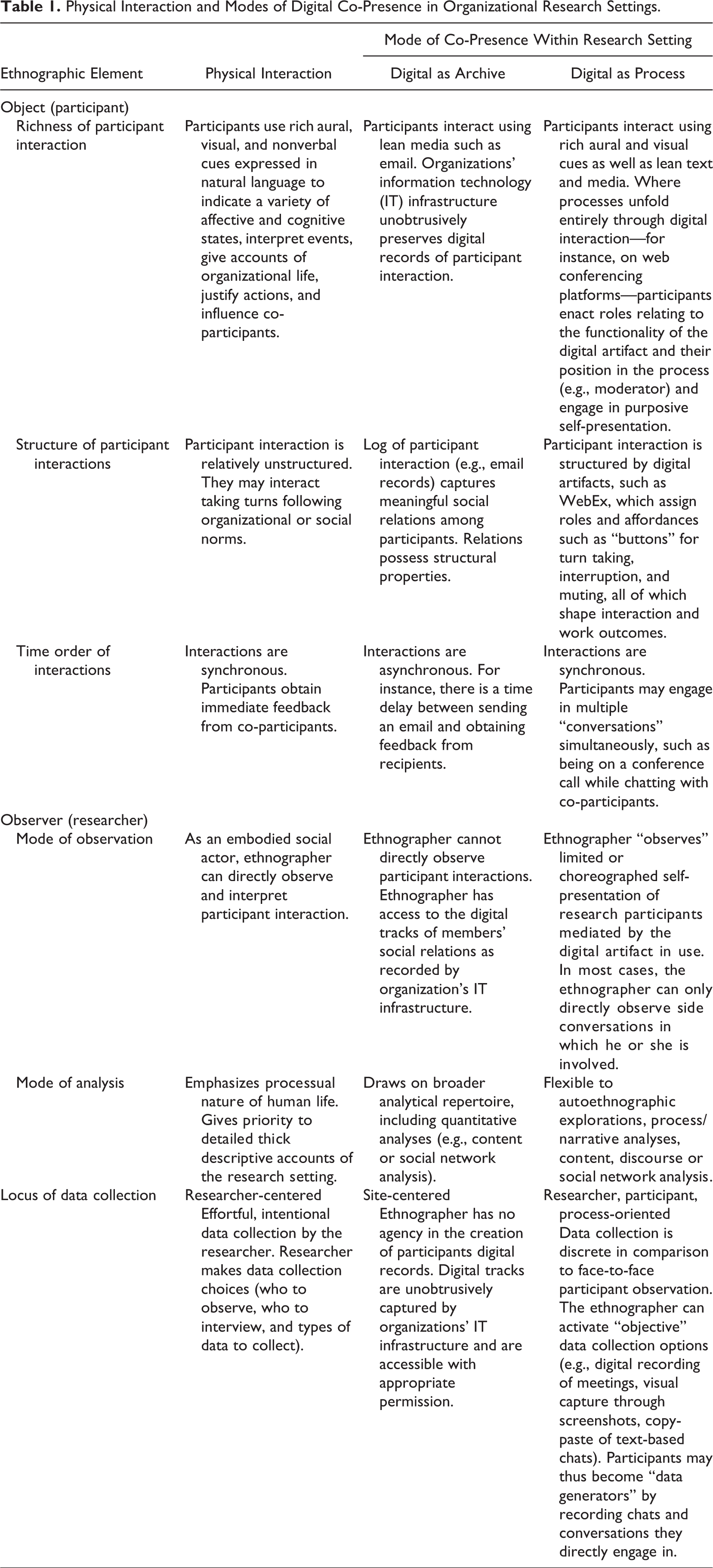
So far, we have shown that the overlap of informants’ digitally mediated and face-to-face interactions in contemporary organizations present methodological challenges that may threaten an ethnographer’s ability to demonstrate authenticity and multivocality in studies of organizational life. We have also shown that these organizations may be fruitfully conceived as multi-sited. Doing so requires interrogating digital artifacts as having distinct properties from the physical sites that traditionally command the ethnographic gaze. We now return to the research question posed at the outset: Given the affordances of digital artifacts, how might organizational ethnographers enhance authenticity and multivocality in their studies of modern organizations?
In the next section, we illustrate the methodological considerations outlined previously using two cases of organizational ethnography. In both cases, we move between physical and digital sites in pursuit of the people and objects under observation (Marcus, 1995). The narration of the cases is in the first person singular; in Case 1, this refers to the first author and in Case 2, the second author.
Case 1: Formal Organization Structure at Zetatech
From October 2013 to January 2015, I did ethnographic fieldwork at ZetaTech, 4 an Amsterdam-based social/technology startup enterprise. Founded in January 2013 by two novice entrepreneurs, ZetaTech was experiencing rapid, unexpected revenue growth when I began my fieldwork. I wanted to research how ZetaTech’s inexperienced staff managed an increasingly complex enterprise. After gaining access to the company, I was officially designated ZetaTech’s “researcher-in-residence.” My involvement in the company’s affairs ranged from passive participation in the early stages of fieldwork, when I was in effect a bystander, to active participation in later stages, when I shared my insights into ZetaTech with the company’s leadership team (Spradley, 1980).
In its eventful first year of operation, ZetaTech had virtually no functional differentiation among employees. In January 2014, Jacqui, a founding employee, recalled the informal egalitarian ethos of the company’s first year, “Last year [2013], all of us [employees] attended every meeting. We were doing everything with everybody.” After consulting with his staff, ZetaTech Founder/CEO Nikki announced a formal organizational structure implementation process in early February 2014. In subsequent months, all employees would be assigned to one of five functional teams with clear reporting relationships: Team Alpha, Team Beta, Team Gamma, Team Delta, and Team Epsilon. I took the formal structure implementation process as an opportunity to investigate a number of foreshadowed problems (Hammersley & Atkinson, 2007): How would ZetaTech’s employees adopt new roles? How would a formal organizational structure influence relationships among employees?
Challenges to Authenticity
As I studied the formal structure implementation process using interviews and participant observation, three changes in the organization challenged my ability to achieve ethnographic authenticity and, by implication, the credibility of my research. First, the number of ZetaTech employees increased sharply during the study. In my first two months of fieldwork, I could easily observe the company’s eight founding employees as they interacted visibly and loudly at two workspaces in ZetaTech’s open plan office. By February 2014, employee numbers had increased to 21; by September 2014, it reached 34. As the number of employees increased, so did the number of face-to-face interactions among them. Being a lone ethnographer in a rapidly changing organization, I soon realized the cognitive limits to participant observation: I could observe only a small fraction of face-to-face interactions among the company’s members during any field visit.
Second, in March 2014, five months into my fieldwork, a new office manager, Jaye, abruptly reconfigured ZetaTech’s office layout to “reduce the noise” from Team Gamma, the newly assembled customer service team. She placed a wooden shelf barrier to physically separate customer service agents from other employees. In effect, the change in office layout created a spatial limit to participant observation. As a data collection instrument (Jorgensen, 1989; Kunda, 2006; Lincoln & Guba, 1985), I could not simultaneously observe the customer service team and the rest of the company. I had to choose whom to observe during a field visit.
Third, as functional groups (e.g., finance, marketing, and production) developed, ZetaTech employees began using specialized software to do their work. The customer service agents (Team Gamma) most clearly exemplified this trend. They conducted a substantial part of their work—interacting with their customers—using a specialized software platform, instant chats, and emails. While I noted face-to-face interaction among the customer service agents, I could not directly observe how they interacted with each other and customers using digital media.
Thus, due to changes in the organization, I could not richly describe the work of ZetaTech’s employees based on interviews and ocular observation. How then could I claim to credibly analyze my informants’ actions and their perspectives on their new roles and their organization if I could directly observe only a small fraction of face-to-face interactions? How could I claim to produce an authentic ethnographic account if I only vaguely understood the content and nature of digital interaction within and among ZetaTech’s emerging functional groups?
Challenges to Multivocality
While ZetaTech’s formal structure took effect in 2014, Founder/CEO Nikki repeatedly asserted that the company’s culture would remain as egalitarian and spontaneous as it had been in 2013. However, as my study progressed, I inferred that there was growing fragmentation within the company. For instance, founding employees were wary of socializing with members of Team Gamma, a team composed of hastily recruited interns, temporary workers, remote workers, and newly graduated university students. As Chad, a founding employee, remarked to me in May 2014, Maybe it is hard for me to trust [new employees]…I am skeptical of bringing new people into the fold…I looked around when everyone [founding employees] was away on a business trip…I am like, “Who are all these new people?”
Within Team Gamma, conflicts also emerged between a close-knit group of female agents and Ai, the leader of team. Shanta, a part-time customer service agent, who often worked remotely from home, gossiped repeatedly within earshot that she “could not stand” Ai. However, Ai thought that I worked surreptitiously for Founder/CEO Nikki to evaluate his performance as leader of Team Gamma. He often tried to impress me with his knowledge of customer service operations. So, I could not assess his candor when he said in a May 2014 interview, Things are quite disconnected for such a small company. I think not everybody really sees what we [Team Gamma] do actually—like the broad scope of it. On the other hand, I do think, we are a [cohesive] team. Indeed we have a clear goal.
Response and Results
At ZetaTech, email was the artifact central to employees’ digitally mediated interactions. ZetaTech’s digital infrastructure “self-documented” (Hammersley & Atkinson, 2007) by logging email exchange and creating an archive of employees’ digital interactions. Since the employees’ digital traces were unobtrusively recorded (without my agency), they were objective, allowing me to balance perspectives of politically motivated gatekeepers like Ai. Accessing the company’s email logs would enable me to be co-present (Bate, 1997; Beaulieu, 2010) to observe the digital interactions by which my informants conducted a significant amount of work. In the process, I could improve authenticity and multivocality of my research.
I employed social network analysis in my ethnographic study to map the patterns of interaction between and within functional teams at ZetaTech (cf. Berthod, Grothe-Hammer, & Sydow, 2017; Johnson, 1994; Roethlisberger & Dickson, 1939/2003; Zwijze-Koning & De Jong, 2005). Being a digital artifact, ZetaTech’s email system is distributed, namely, the supporting infrastructure is not contained within the physical boundaries of the organization (Kallinikos, Aaltonen, et al., 2013). ZetaTech’s employees interacted via email during regular office hours (part-time temps often logged in remotely during office hours) and outside office hours. In Figure 1 and Figure 2, I show sociograms of digital interactions during and outside office hours between June and November 2014.
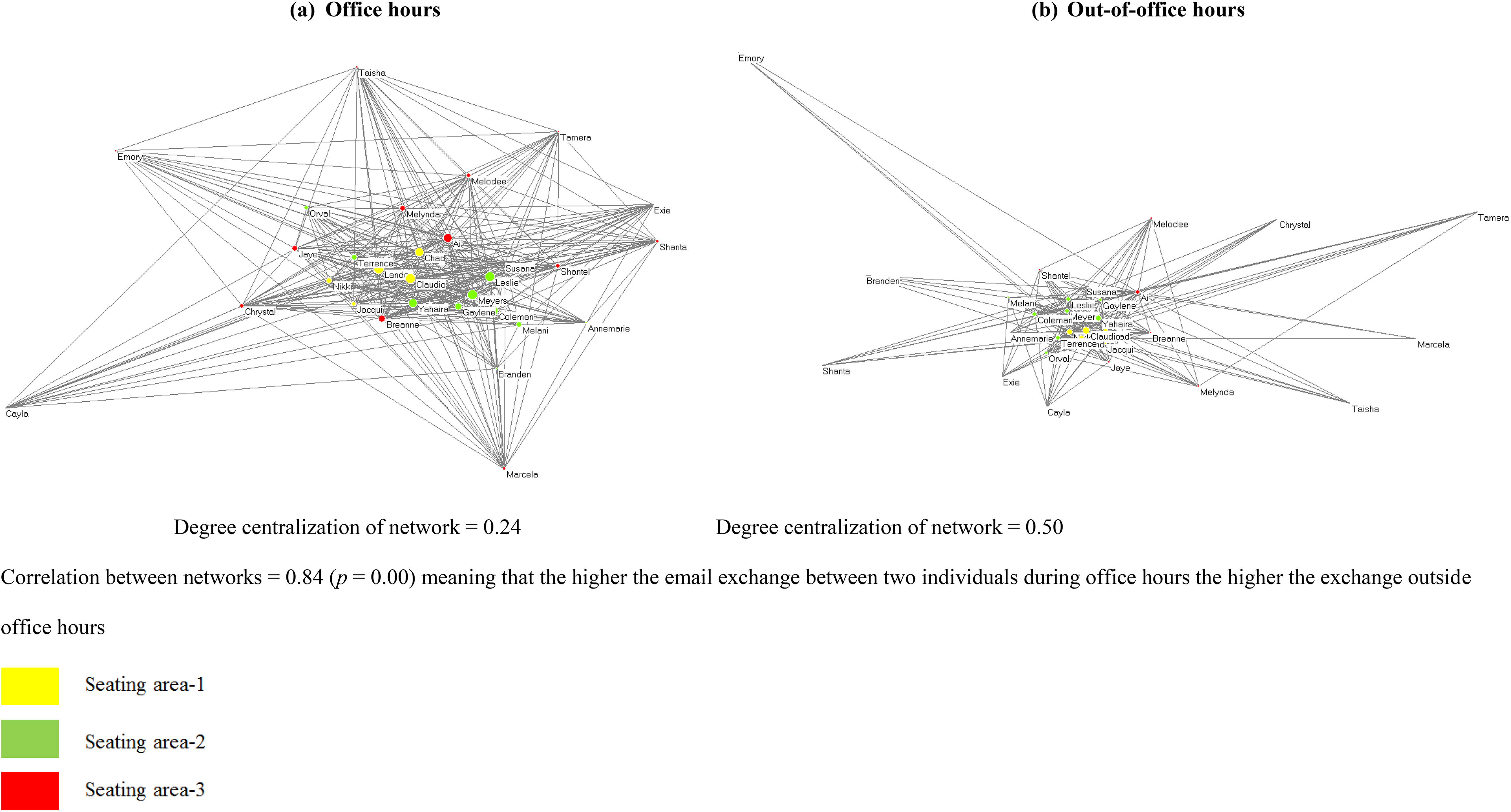
ZetaTech social network (July-August 2014).
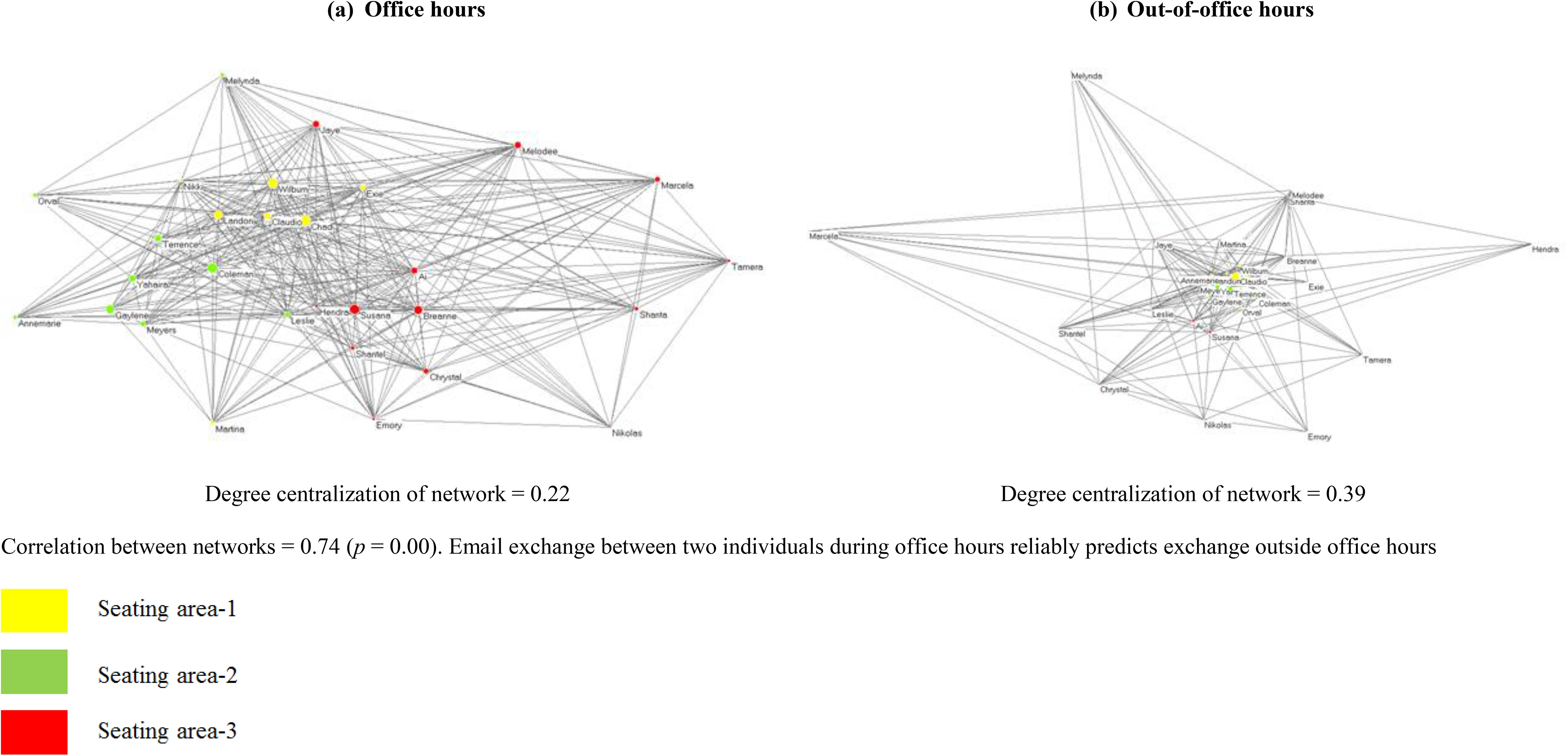
ZetaTech social network (October-November 2014).
Each node in the sociograms represents an individual. The colors of a node indicate the seating area of an individual: Yellow indicates seating area-1; green, area-2; and red, seating area-3. The further an individual is from the center of the sociograms, the weaker his or her interactions with other employees. For both sociograms, the frequency of email interaction between any pair during office hours reliably predicted interaction outside office hours.
The sociograms (Figure 1 and Figure 2) were consistent with interview reports and my observations at ZetaTech. All founding employees occupied the core of both networks. During office hours, they had frequent, often intense conversations and attended various company-wide meetings. As Figure 1(b) and Figure 2(b) show, founding employees like Chad, Claudio, Nikki, and Terrence dominated digital interaction outside office hours. On the other hand, Team Gamma members, who had the shortest tenure in the company, were at the periphery of the networks; they were marginal to information flow—and influence—within the company.
The digital networks contradicted Ai’s reports of cohesion within Team Gamma. Though the customer service team conducted a substantial part of its work using digital media, there was no evidence of clustering in the team’s digital interactions. Though most Team Gamma members share the same seating area, they were comparatively isolated islands in ZetaTech’s digital interaction network.
Following my analysis of structure within the company, I deliberately sought to build rapport with marginal members of the customer service team by following them outside the regular office space and standard working hours of the organization. For instance, after observing a closely knit group of female customer service agents go for periodic cigarette breaks, I followed them outside the office building to listen to their informal chatter. At other times, I stayed late in the office—sometimes until 10 p.m.—with the customer service team whenever they worked overtime to respond to customer requests in order to informally solicit their perspectives on the company.
To sum, due to my prolonged engagement in ZetaTech, observing and interviewing members, and using the organization’s records of its members’ digital traces, I showed overlap between my informants’ face-to-face and digitally mediated interactions. This gave me added confidence in the credibility of my findings (Lincoln & Guba, 1985). In turn, it boosted my claim to achieve authenticity and multivocality in my ethnographic account of ZetaTech’s organizational life in 2014.
Case 2: How Web Conferencing Mediates Work Processes
This case focuses on a multi-stakeholder process to develop an international standard for a household appliance. Participants include dozens of experts the world over who represent their respective national standards bodies or affiliated agencies. I actively participate as a national subject-matter expert. This involves regular web conferencing, preparatory work undertaken individually and in small groups, commenting and voting on documents, and reporting to my national standards body. Participants collaborate primarily using WebEx Meeting Center (WebEx), a web conferencing platform.
I joined the standards work process without intending to undertake an ethnographic study. However, after some time, I began to consider the potential for ethnographic inquiry. I decided to formally study the process after consulting trusted participants in the process as well as senior scholars on the ethics of covert ethnography (Hammersley & Atkinson, 2007). Subsequently, I obtained institutional review board (IRB) approval from my home institution to conduct the study. Next, I outline challenges of and considerations for doing ethnography in digitally mediated work settings.
Functionality: Digital Artifacts Mediate Participant Interactions
Standards processes have elaborate procedures to govern and structure the work required to develop a usable standard. In addition to formal procedures, the functionality of digital artifacts also influences participant interactions and work outcomes. The emerging literature on the ontology of digital artifacts helped me to better understand the role and influence of digital artifacts in the standards work process (Faulkner & Runde, 2013; Kallinikos, Aaltonen, et al., 2013). For instance, most of the work for the standards process unfolds through WebEx, a digital artifact comprised of modular elements associated with specific functions (e.g., shared screen, chat, voice communication), which together form the structure of a web conferencing platform. In the standards process, WebEx holds a central social position as the principal site where participants “meet” and collaborate. WebEx’s form is relatively straightforward. Participants log into a WebEx call via a web browser or downloadable application using a unique identification and meeting number. When a host or moderator initiates the meeting, participants are able to access a number of discrete components viewable as three “windows.” Working from files on their computer, hosts share documents with co-participants. The host also controls the main window, which is where the majority of the work takes place. This work includes viewing documents for discussion and recording meeting notes.
WebEx users can see who is on the call via a Participants window, which lists attendees and indicates when someone is speaking. Each participant has three buttons to choose from: “hand,” “video,” and “mute.” Participants indicate to the host their desire to speak by clicking on the hand button. Usually, participants “self-mute” once they log into the call and only unmute to speak. The chat function allows participants to exchange private messages with the host and some or all co-participants. Participants regularly use the chat function to engage in “side” conversations and exchange ideas on an issue when others are speaking. Chat also serves as a backup communication option for participants unable to use the voice function because of poor connectivity. Additionally, hosts can post a poll for participants to indicate their preferences on a specific issue.
Multivocality: Multiple Channels, Connectivity, and Voice
If WebEx is the digital frontstage (Goffman, 1956) that structures participant interaction within the standards work process, the backstage includes the multiple, simultaneous, spontaneous, and unstructured interactions of participants using different digital platforms. As I have witnessed, such communication regularly occurs during WebEx meetings. WebEx may be partly understood as a stage where members interact in an orderly manner in compliance with the governing rules of the standards development process. At the same time, WebEx offers an opportunity to observe power dynamics among participants within the standards process and how these in turn influence work outcomes. For instance, though participants regularly manage WebEx’s mute function themselves (it is common for participants to self-mute when joining a call and unmute in turn to speak), hosts—by technical virtue of their role—can also mute participants. It is common for a host to mute a participant if they fail to self-mute and unknowingly contribute to background noise. However, on one occasion, I witnessed the muting of a participant deemed to be speaking “out of order.” This demonstrated the host’s use of an otherwise mundane technical function to actively limit voice. Relevant for ethnographers, such events may be windows into power dynamics. They indicate which informants the ethnographer should pursue to better understand marginal perspectives. Such events illustrate how the digital artifact’s functionality enables and constrains voice in ways that influence work outcomes.
In addition to the WebEx’s functionality, connectivity also influences the standards work process. Poor connectivity may result from unreliable Internet service or the mode by which participants connect to the Internet. For instance, a colleague noted that he and other African participants commonly use USB dongles to connect to the Internet. These dongles, which require regular data top-ups via scratch cards, leave participants susceptible to running out of data during a WebEx meeting. (Topping up the USB dongles is expensive for these participants, whose communication costs are not reimbursed.) Since the standards work process is dependent on web conferencing, disruptions in connectivity may reduce experts’ participation and voice. When technology fails, participants are likely to seek alternative channels to express their voice. When attempts to communicate occur outside WebEx, they may be considered or excluded at the discretion of the host. I recall an instance when participants disconnected from a call frantically sent emails to other participants to have their position officially recorded. Their views were eventually recorded only after much discussion and lobbying by some experts connected to the meeting. In another instance, a host copied content from an email and pasted it directly into the meeting minutes, thereby legitimating that content.
A final consideration for understanding multivocality in the standards work process is the scheduled time of WebEx meetings. Most meetings occur at times suitable for North American, European, and African participants, to the dismay of Australian and Chinese experts, who as a result are less likely to join meetings. For some participants, the issue of meeting time is a point of serious contention. Beyond a simple coordination issue, this raises concerns about how the distributed nature of digital artifacts may aggravate power imbalances to the benefit of participants with fewer geo-temporal and technical barriers.
Authenticity: The Challenge of Document Malleability
Unlike physical documents, digital documents are far from static. Rather, digital documents are highly editable, interactive, open, and distributed (Kalliniko, Aaltonen, et al., 2013). In the standards process, documents are in flux until the moment they are fixed as a reference or final product. Fixing documents is akin to “black-boxing,” whereby the contests, work, and politics inherent to their production become hidden. As I have observed, contests over the content of the standards document escalate in advance of key milestones at which documents are to be fixed or finalized as a reference. Hence, if participants suspect misreporting in meeting minutes or detect undisclosed edits within a document, they may interpret these as political acts and react accordingly. This is particularly true for processes where stakeholders with diverse goals are pressured to reach consensus.
Ethnographers who study such processes have the ability to articulate political contests associated with the negotiation and resolution of documents in ways that even the most thorough archival analyses cannot (e.g., Helms, Oliver, & Webb, 2012). The malleability of digital artifacts affords ethnographers opportunities to study digitally mediated organizational processes in real time. For instance, I was able to map stages in the evolution of work from the perspective of content changes (mundane to significant), link content changes to political coalition formation, and investigate how participant interactions (including voting patterns) influence collaboration and consensus outcomes. Taken together, these enabled me to richly unpack the overall processes of standards production (contests, discussions, and milestones).
Multimodal, Multi-Sited Work Processes
Creating and ratifying an international standard requires the combined efforts of subject-matter experts working together within a consensus-oriented process. As illustrated previously, the bulk of this work is undertaken through WebEx. However, this does not rule out in-person interaction among the participants. As part of the standards development process, experts meet and work together in person at official meetings and industry-related events. Interacting with colleagues at face-to-face meetings offers a striking contrast to digitally mediated meetings. As I learned, cues from participant interaction at physical sites augmented my understanding of people and processes generated through the use of WebEx. For instance, during face-to-face meetings, I observed experts who belong to multiple working groups moving back and forth between meeting rooms. I inferred that this behavior indicated what issues the experts perceived to be important or where they thought the “action” was. Face-to-face meetings are also valuable contexts for observing power disparities within groups. For instance, after I observed an intense technical discussion among members of one country’s delegation, one of those involved stated to me that junior experts in the group were monitored by senior experts to ensure they did not contradict the dominant position of the group.
In the case, digitally mediated meetings via WebEx and face-to-face meetings are different sites of participant interaction. The technical attributes of WebEx structure participants’ interactions in ways that constitute an aspatial worksite distinct from in-person meetings. This difference is not lost on the participants. During a side conversation, a co-participant commented to me how people (subject-matter experts) act “quite differently” in person than on WebEx.
Guidelines for Ethnographies of Modern Organizations
Drawing on theory about the nature of digital artifacts and illustrative cases of our ethnographic fieldwork, we infer at least two ways in which the overlap of research participants’ physical and digitally mediated interactions in organizations allows ethnographers to be co-present with their informants. In Case 1, which illustrates the digital as archive, the first author acted like a detective, following his informants’ digital traces to augment his observations of their in-person interactions (Hammersley & Atkinson, 2007). The first author did not observe the creation of the digital artifact (emails). Rather, he used them to confirm an informal system of interaction and triangulate his ocular observation. In Case 2 (illustrating digital as process), the role of digital artifacts is more pervasive. The second author closely tracked in vivo informant interaction via WebEx; he observed contests over document content as well as negotiation and consensus building processes before these became invisible and hidden from view.
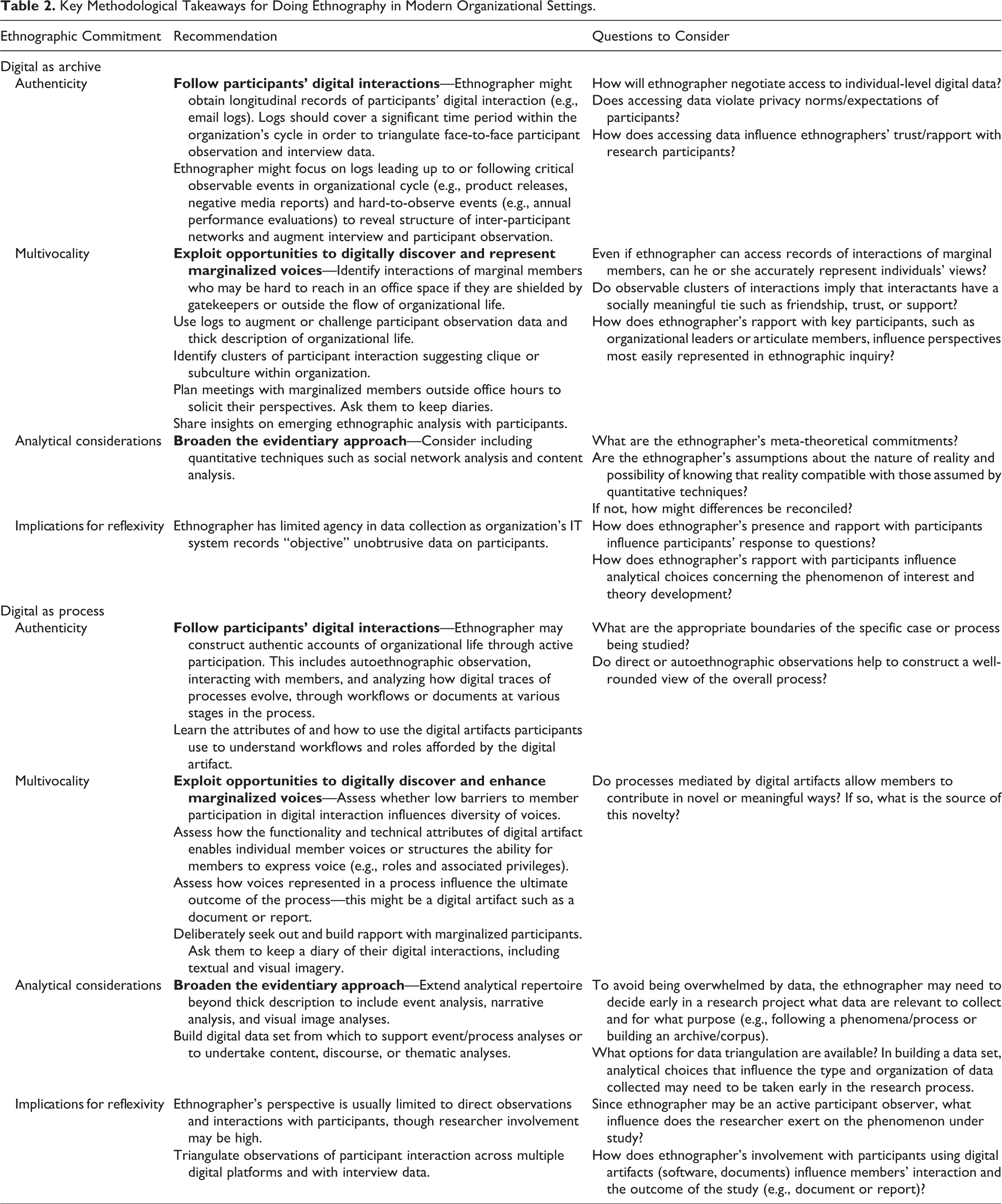
We believe our findings offer possibilities for improving authenticity and multivocality in ethnographic studies of contemporary organizations. We present detailed guidelines for doing so and discuss the implications for ethics, analytical choice and reflexivity. Also, we present a set of questions for researchers to consider when planning fieldwork in organizational settings. Refer to Table 2 for a summary.
Key Methodological Takeaways for Doing Ethnography in Modern Organizational Settings.
Guideline 1: Follow Participants’ Digital Interactions
Adapting Marcus’s (1995) call for multi-sited ethnography designs that follow research participants across physical sites, we recommend that ethnographers consider the multimodal nature of informant interaction within their research settings and follow participants’ interactions across physical and digital sites. Where—as in our illustrative Case 1—digital interactions are archived by an organization’s “self-documenting” digital infrastructure (Hammersley & Atkinson, 2007), ethnographers could improve the authenticity of their research accounts by obtaining longitudinal records of informants’ digital interactions. We recommend ethnographers obtain records of participant digital interaction to cover a sufficiently long period of organizational life coinciding with participant observation and interview data generated by the researcher. For instance, in Case 1, the first author obtained email records spanning six months. An advantage of using longitudinal records is that the researcher is more likely to capture stable patterns of participant interaction covering an organization’s entire temporal cycle, which typically includes annual budgeting, planning, daily operations, product development and vacation periods. This in turn will enable the researcher to triangulate participant observation with contemporaneous digital interaction data.
Where the researcher can directly observe digital interactions and the creation of digital artifacts (as in Case 2), we recommend that researchers learn not only the technical functions of a digital platform, such as which buttons to click to participate, but also the deeper (hidden) features and how the platform’s architecture structures interactions between participants. In Case 2, the second author began using WebEx to participate as a subject-matter expert. As he studied the standards development process, he learned about the deeper functionality of WebEx by consulting user manuals, reading user comments about the software, and speaking with co-participants about the software’s affordances—in particular, what sorts of interactions (unobservable to him) the platform allowed co-participants to undertake.
So far, we have presented the two modes of being there (digital as archive and digital as process) as distinct because we used them in different ways in our studies. However, we realize that both modes may be activated within a single study. For instance, in Case 1, the first author could have, at least in principle, asked to be copied in every email exchange within ZetaTech. That way, he would have had access to the content of participants’ emails and thereby observed the contents of socially meaningful ties. We suggest that researchers consider incorporating these modes ab initio in their research design. Ethnographic research typically begins with an open-ended, exploratory approach (Boellstorff et al., 2012; Hammersley & Atkinson, 2007). In this exploratory vein, researchers should ask, “How important are informants’ digital interactions to the research problem or phenomenon of interest?” It may be that the role of digital interactions is not crucial for some research topics (e.g., leadership decision-making processes during in-person meetings). Second, if participants’ digital interactions inform the research problem, then what aspect of digitally mediated interactions is best suited for the study? Approaching the digital as process is best suited to research designs in which the researcher wants to know the content of interactions (Johnson, 1994), namely, if the researcher wants some access to the perspectives of participants and possibly the cognitive bases on which participants’ behavior is based (Hammersley & Atkinson, 2007). If, on the other hand, the researcher is interested in questions relating to the structural and relational aspects of the field, then accessing digital archives may be preferred to observing the creation of digital artifacts real time.
Once ensconced in the field, the researcher may want to access informants’ digital interactions to confirm an emerging theoretical insight based on interview and participant observation. In addition to the two questions raised previously, researchers should also consider what financial, time and analytical resources are available before choosing the mode of co-presence for the study. Studying the digital as process involves investing considerable amounts of time in learning the functionality of software. It also involves collecting and analyzing voluminous amount of data in the form of video, pictures, text, and audio recordings. This problem is not insurmountable; researchers have addressed it by working in teams composed of members with complementary skills in qualitative and quantitative analysis (see Knorr Cetina & Bruegger, 2002; Smets et al., 2014). However, for a lone (novice) organizational ethnographer, coping with and making sense of such digital data—in addition to participant observation and interview data—requires a prodigious amount of work. Thus, researchers need to weigh potential benefits of one mode of approach with its costs.
Whether researchers establish co-presence using their informants’ archived digital traces or observe the creation of digital artifacts in real time, accessing individual-level digital data raises ethical issues concerning data access, researcher identity, informed consent, and informant privacy (Hammersley & Atkinson, 2007; Tunçalp & Lê, 2014). Due to the open and interactive nature of digital artifacts (Kallinikos, Aaltonen, et al., 2013), an organization’s digital infrastructure records members’ digital interaction in the form of email logs, cookies, IP addresses, Internet search logs, and document history logs. These records are usually accessible to a few employees within the organization, such as information technology (IT) administrators. Understandably, accessing this individual-level data is a sensitive issue for participants, their organizations, and researchers. To minimize the potential for harm to research participants, organizational ethnographers should obtain informed consent before using informants’ digital traces.
They can do this by first establishing in-person rapport with informants. For instance, the first author negotiated access to ZetaTech’s email logs with the consent of most of the company staff, IT administrator, and management team in 2014. By the time he obtained access to the email logs, he had worked for nearly six months to build rapport with ZetaTech employees. He obtained access to ZetaTech’s email logs on the condition that the logs were anonymized. Throughout his fieldwork, he reinforced his position by continually clarifying to ZetaTech staff that his research was strictly for academic purposes and that he would not share confidential information with the company’s leaders. Realizing how sensitive individual-level email logs are, he deliberately rejected access to the contents of employees’ emails. Thereafter, he took care to anonymize his informants’ data. To minimize the risk of deductive disclosure (Scheper-Hughes, 2000), he asked two of ZetaTech’s founding employees to independently read an earlier draft of this article to see whether they could identify their colleagues.
ZetaTech is a small organization with an informal management system; as such, the first author had access to the key decision makers within the company. Our recommendation for informant care by first building rapport may be impractical if the number of research participants is large, participants are geographically inaccessible, or the organization has a highly developed formal management system.
For research designs in which organizational ethnographers are active participants, such as in Case 2, researchers will face additional complexities concerning whether to reveal their identity. We are reluctant to suggest blanket normative positions to ethnographers who have to deal with context-specific ethical dilemmas. In our fieldwork, we have taken positions most consistent with ethical situationalism. Our decision to reveal identity was a matter of judgment in context based on assessment of the costs and benefits and avoidance of harm to our informants (Hammersley & Atkinson, 2007). As we write this paper, the second author’s role as a researcher has been concealed. He obtained IRB approval to conduct a covert ethnography on the condition that he protects his informants’ confidentiality and anonymity. He chose to conceal his identity for a number of reasons. First, as an active participant, revealing his identity while the process is ongoing might jeopardize the legitimacy of the work he and his co-participants have undertaken. Second, revealing his identity may complicate his relationship with the national standards agency to which he is associated. Finally, given the sensitive, private, and ongoing nature of the process, revealing his identity may compromise his ability to continue monitoring the process.
Guideline 2: Exploit Opportunities to Digitally Discover and Represent Marginalized Voices
Ethnographers rely on gossip and other forms of informal talk to understand power dynamics and identify marginalized members of the research setting (Hammersley & Atkinson, 2007; Van Maanen, 2011b). We recommend that researchers also identify marginalized members of organizational settings using archives of digital interaction. This is because members who are not central to information flow—and by implication, influence—within an organization tend to be on the periphery of social networks (Freeman, 1979). Moreover, digital interaction logs are less susceptible to researcher bias, informant self-reports, and purposeful manipulation than interview reports (Zwijze-Koning & De Jong, 2005). By constructing social networks using email, instant chat, or Messenger traffic, researchers can identify cliques or subcultures within an organization. After identifying clusters of interactants, the researcher could then directly seek out marginal members to solicit their perspectives on organizational life using interviews. Care should be taken not to jeopardize the position of marginal members. In Case 1, the first author solicited cooperation from marginal members—after identifying them through analysis of their email traffic—by interviewing them outside the regular temporal and spatial boundaries of the organization (e.g., during lunch or cigarette breaks). If marginal members are shielded by gatekeepers or reluctant to openly participate in the researcher’s data collection efforts, the researcher might solicit written accounts of their perspectives in the form of diaries or personal reflections on events within the organization.
Where the researcher can observe the process of digital interaction (as in Case 2), we recommend that researchers interrogate how the inbuilt functionality of digital artifacts enables participants to exercise power over others and pay attention to voices silenced within the digital platform. Researchers could then deliberately seek out those marginalized participants and ask them to record their version of digital conversations that the researcher can use in subsequent analyses to highlight the variety of voices in the organization.
Guideline 3: Broaden the Evidentiary Approach
Exemplary ethnographic researchers demonstrate authenticity by showing that they have embarked on a disciplined pursuit and analysis of data. They do so typically by privileging thick description in their analyses of organizational life (Cornelissen, 2017; Gephart, 2004; Golden-Biddle & Locke, 1993; Hammersley & Atkinson, 2007). To demonstrate disciplined pursuit and analysis of data in modern organizational research settings, we recommend that organizational ethnographers embrace a broader repertoire of evidentiary approaches suitable to digital and physical interaction. Relational and structural data capturing participants’ digital interactions lend themselves readily to quantitative techniques such as event analysis and social network analysis. We recommend then that in cases where ethnographers have access to archives of participants’ digital interactions, they broaden their analytical repertoires to include techniques such as social network analysis, a technique with a rich history in organizational ethnography (Barley, 1990; Roethlisberger & Dickson, 1939/2003) and an active community in contemporary organizational scholarship (Kilduff & Brass, 2010; Perry-Smith & Mannucci, 2017).
Nevertheless, there are two caveats to this guideline for using participants’ digital traces, such as email logs, to analyze the structure of relationships in the field. First, we assume that participants’ digital communication captures socially significant relations within the organization. We believe this to be the case in ZetaTech, but this may not be so in other organizations. In Case 1, the first author did not distinguish emails that were sent directly to recipients from those in which the recipient was only copied in the transmission. Standard email protocol, especially in large organizations, suggests that there is a difference between being copied in an email and being the direct recipient of one; the former typically suggests passive interaction between parties to the email, while the latter involves active interaction (hence, socially significant relations). Second, the first author assumed that the frequency of email interaction between any two members is indicative of the strength of the social relations between them. But does a high frequency of email exchange between two organizational members mean that they have a socially significant relationship? For instance, in large organizations, professional staff frequently exchange emails with administrative assistants, but that exchange has little social significance.
We suggest that researchers exercise judgment based on observation of participants, informal talk, and if need be, diary studies to ascertain the social significance of the digital communication among research participants. Where researchers can observe digital interaction and the creation of digital artifacts unfold in real time, then the generated data are appropriate for event analysis, content analysis, and visual image analysis.
Adopting methodological pluralism raises questions of methodological slurring (Suddaby, 2006). Is participant observation and interviewing, which are qualitative and typically associated with interpretivist perspectives, compatible with techniques like social network analysis, which are primarily quantitative and associated with positivism (Freeman, 1979; Gephart, 2004)? What if in the spirit of methodological pluralism, different methods lead to competing conclusions about informants’ social worlds (Hammersley & Atkinson, 2007)? For instance, research participants may reveal different aspects of themselves during face-to-face interaction and in digital interaction (Garcia et al., 2009; Hallett & Barber, 2014), leading the researcher to make potentially irreconcilable inferences about organizational life.
We conjecture that the nature of digital artifacts and organizational norms governing digital interaction are important considerations in addressing that question in the field. As described in our illustrative Case 2, research participants develop norms of interaction, such as turn taking, voicing objection, and reaching consensus, that build on WebEx’s functionality. Similarly, many organizations have norms about whom to copy in an email exchange due to the technology’s affordance of low-richness exchange. By learning the norms of an organization’s digital interaction, researchers improve the possibility of reconciling competing conclusions about their informant’s social world.
Understanding the politics of the organization can also help reconcile potentially conflicting results. In our Case 1, the first author’s ocular observations and interviews led him to tentatively conclude that Team Gamma was cohesive. However, network analysis of email communication led him to conclude otherwise (see Figure 1 and Figure 2). He reconciled these results only after learning about a team leader’s role as a gatekeeper who wanted to project a politically desirable image of team cohesion to the first author.
More fundamentally, methodological slurring occurs when there is a mismatch between a researcher’s assumptions about the nature of reality, how they might know that reality, and the assumptions of a given method (Suddaby, 2006). In his research journey, the first author adopted realism, a perspective that holds that though social reality is objective, researchers’ understanding of that reality is partial, incomplete, limited, and potentially divergent; therefore, robust knowledge of social reality demands multiple methods and perspectives (Sayer, 2000; Van de Ven, 2007). In the realist view, quantitative and qualitative approaches to organizational ethnography enrich understanding of contemporary organizational life (Barley, 1990; Barley & Kunda, 2001; Johnson, 1994; Pelto & Pelto, 1978; Roethlisberger & Dickson, 1939/2003; Van Maanen, 1979). 5 Consequently, in Case 1, the first author applied a quantitative technique to confirm his emerging insight originally obtained using participant observation and interview data.
Though we believe that researchers improve the appeal of their ethnographic studies by broadening their evidentiary approaches beyond thick description, it is beyond the scope of this article to resolve these fascinating questions about meta-theory (Gephart, 2004; Hammersley & Atkinson, 2007; Lincoln & Guba, 1985). We leave it to individual researchers to decide which meta-theoretical perspective to adopt.
The aforementioned guidelines have implications for methodological reflexivity, namely, how a researcher’s background and relations with research participants influence the outcome of the ethnographic project (Hammersley & Atkinson, 2007). Where informants’ digital tracks are unobtrusively recorded, it may not be obvious how the researcher’s field relations influence participant’s digital interactions. However, where the researcher observes participants’ digital interactions (as an active participant) or the creation of a digital artifact (as in Case 2), it is good practice for researchers to acknowledge how his or her digital interaction with participants influenced the final outcome of the process.
Conclusion
In modern organizations, research participants—the objects of ethnographic inquiry—interact via face-to-face and digitally mediated encounters within and outside the traditional spatial and temporal boundaries of organizational life. An ethnographer’s inability to directly observe participants’ digitally mediated interactions may challenge his or her ability to richly describe and produce authentic accounts of organizational life or capture marginalized voices that contradict dominant discourses within an organization (Czarniawska, 2008; Golden-Biddle & Locke, 1993).
Drawing on emerging theory about the nature of digital artifacts, the multi-sited ethnography literature, and our experience conducting two ethnographic studies, we make three contributions to the practice of organizational ethnography. First, we highlight the unique nature of digital artifacts that pervade organizational life (Faulkner & Runde, 2009; Kallinikos, Aaltonen, et al., 2013). Second, we distinguish two modes in which digital artifacts enable ethnographers to be co-present with research participants: digital as archive and digital as process. Finally, we advance a set of guidelines to support ethnographers as they study the digitally mediated interactions of their informants to demonstrate authenticity and improve representation of marginalized voices in accounts of organizational life. We argue that by considering the attributes of editability, interactivity, openness, and distributedness and how these structure human practices within contemporary organizations, researchers can produce richer, more authentic portraits of organizational life.
We have presented the digital as archive and digital as process as distinct strategies for achieving co-presence. However, we realize that they are not mutually exclusive modes of co-presence; both may be combined within a single empirical study. In Case 2, for instance, the second author might have combined an excavation of extant references standards produced by digital collaboration archives with ongoing work on the creation of a digital standards document. We welcome research on the methodological implications and challenges of combining both approaches in a single empirical study. Future research might also unpack additional ways of establishing co-presence in organizations where the face-to-face and digitally mediated interactions of geographically dispersed employees interweave.
Close empirical observation of work practices within industrial and government bureaucracies led to significant advances in organizational theory in the 20th century (Barley & Kunda, 2001). As digital technologies transform work practices within contemporary organizations, we firmly believe that ethnography has a vital role to play in understanding and theorizing about these organizations. However, to reach that mark, organizational ethnographers need to understand how the nature and overlap of their informants’ digital and physical interactions influence the constitutive tasks of ethnography: fieldwork, headwork, and textwork (Van Maanen, 2011a). We hope our contribution stimulates researchers’ interest in understanding digital artifacts, undertaking fieldwork, and representing the vitality of modern organizational life.
Footnotes
Acknowledgments
The first author is grateful for the support and trust of the leaders and staff of ZetaTech. We thank Gail Whiteman for her thoughtful support while researching both cases. We also thank Hans Berends and seminar participants at Vrij Universiteit Amsterdam and Fuqua School of Business, Duke University for stimulating discussions about ethnography, and the role of digital artifacts, physical space, and digital communication in modern organizational life. Finally, we thank ORM Associate Editors, Anne Smith and Robert Gephart, and three anonymous reviewers for providing outstanding, constructive support throughout the review process.
Declaration of Conflicting Interests
The authors declared no potential conflicts of interest with respect to the research, authorship, and/or publication of this article.
Funding
The authors disclosed receipt of the following financial support for the research, authorship, and/or publication of this article: Financial support for Case 1 was provided by the Erasmus Research Institute of Management (ERIM). The study that informs Case 2 is supported by a European Commission grant.