



Abstract
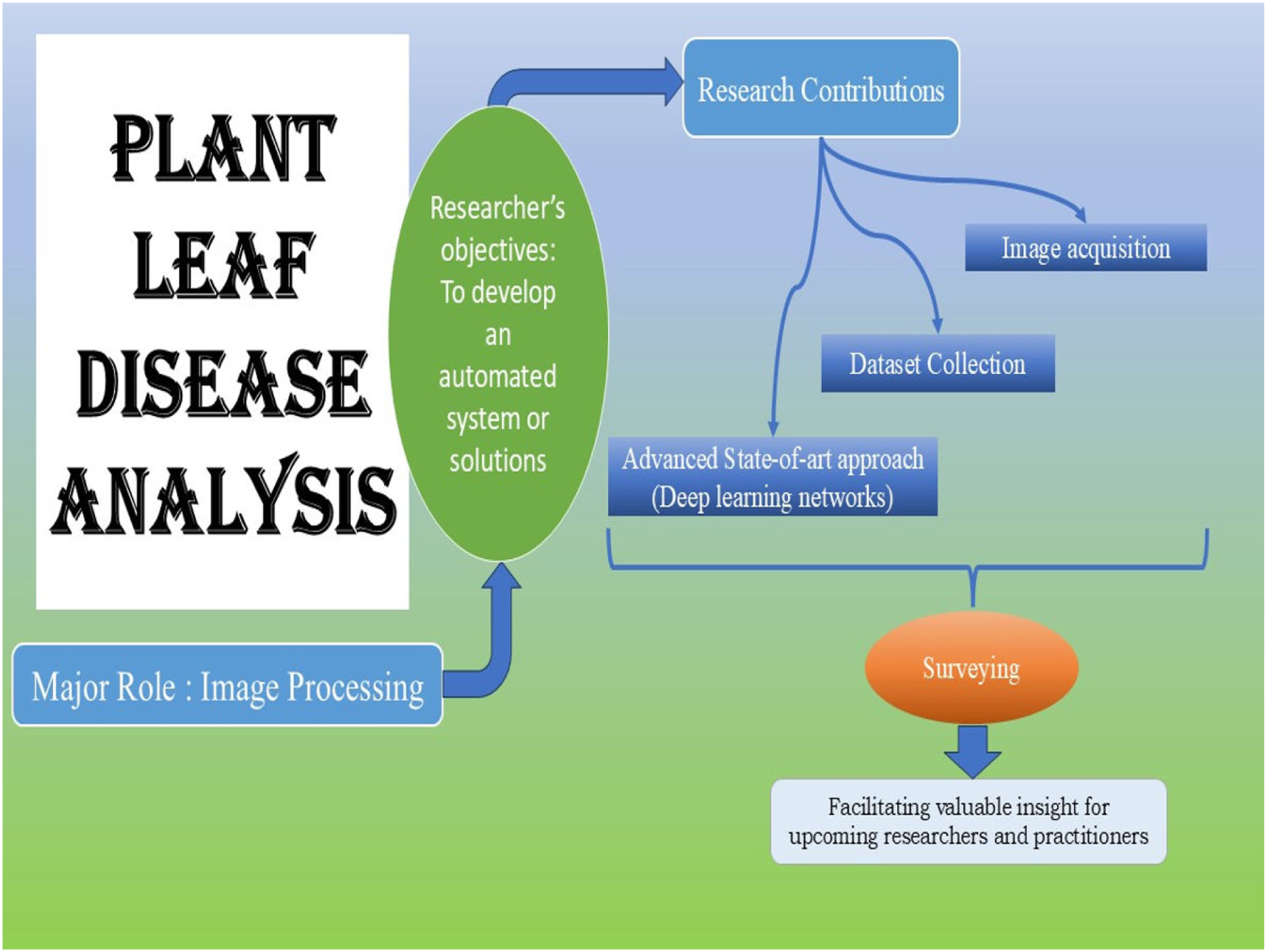
Plants play a vital role in living organisms. However, daily changes in the environment can significantly impact plant growth with respect to their surroundings. Exposure to pathogens, environmental disturbances, or unfavorable conditions make plants vulnerable to diseases. The rapid spread of diseases affects the healthy growth of plants, resulting in the reduction of products quality and quantity. To mitigate these issues, it is necessary to monitor the plant growth and to identify the plant diseases at an earlier stage. However, the manual detection of plant diseases is an unreliable method as it is a time-consuming and error-prone process. Analyzing the subjected plant leaves through the advancements in image processing has paved the way to engage the researchers in the development of automated solutions for disease identification. In addition, image acquisition, data collection, and the development of advanced state-of-the-art approaches are the major research tools contributed by various researchers. Therefore, this paper delves into the latest methodologies by concentrating on these research contributions. In this regards, the available research papers published from 2018 to 2024 are considered. This study also incorporates some of the challenges and research topics for future plant leaf disease analysis by emphasizing the critical role of high-performance computing. Moreover, it offers valuable insights for researchers and practitioners, providing a wide-ranging understanding of the current state-of-the art approaches in the field of plant leaf disease analysis by highlighting their pros and cons.
Get full access to this article
View all access options for this article.
References
Supplementary Material
Please find the following supplemental material available below.
For Open Access articles published under a Creative Commons License, all supplemental material carries the same license as the article it is associated with.
For non-Open Access articles published, all supplemental material carries a non-exclusive license, and permission requests for re-use of supplemental material or any part of supplemental material shall be sent directly to the copyright owner as specified in the copyright notice associated with the article.
