



Abstract
Design research has produced a rich set of theories explaining disparate aspects of design activity, including problem solving, contradiction resolution, conceptual expansion, and reflective practice. However, these theories often emphasize localized mechanisms and provide limited integration of why intervention becomes necessary, how it becomes possible, and why it remains constrained across domains. This paper introduces Designics, a scientific paradigm that defines design as intentional change (i.e., purposive environment transformation via intervention) in human–environment systems. Drawing on a 35-year synthesis of formal logic and empirical cognition, Designics is organized around a minimal unit of analysis—the Designer–Environment–Intervention (DEI) triad—and three governing laws that function as the first principles of the field. The Conflict Law states that conflict drives intervention: conflict (the mismatch between demands and resources) makes intervention necessary. The Perception Law states that perception enables intervention: perception forms the actionable perceived environment that makes intervention possible. The Capability Law states that capability constrains perception, and thereby constrains intervention: finite cognitive-affective capability constrains perception, rendering intervention effortful and recursive. Together, these laws explain design as a recursive process in which conflict makes intervention necessary, perception makes it possible, and finite capability makes it constrained, effortful, and open-ended. The paradigm integrates representation, reasoning, and empirical investigation through formal modeling principles and triangulated research instruments, including behavioral, physiological, and neurocognitive measures. By providing a stable unit of analysis, governing laws, and empirical pathways, Designics offers a scientific foundation for integrating existing design theories while enabling systematic investigation of intentional change across engineering, organizational, and socio-technical systems.
Keywords
Introduction
What this Paper is—and is Not
Design needs analysis, and analysis needs science. Design practice and design education also require the design of designing itself, and a science of design can support this by making design activity open to scientific analysis. This paper introduces Designics as a foundational scientific paradigm for understanding design as intentional change, which is brought about deliberately through intervention in an environment. It addresses three fundamental questions: what makes design intervention necessary, what makes it possible, and what constrains it across design contexts.
Its purpose is explanatory, not prescriptive. It does not propose a new design method, heuristic, or process recipe, nor does it seek to replace the many theories and methods that already support design practice and research. Instead, it provides a scientific structure within which those contributions become comparable, cumulative, and scientifically intelligible. In this sense, the paper aligns with earlier efforts to treat design as a discipline in its own right and with later calls to articulate design theory as a stronger foundation for design science and engineering (Cross, 2006, 2025; Friedman, 2003; Hatchuel et al., 2018).
Why It Is Needed
Two propositions motivate the need for such a science of design.
There is a real disconnection between design research and design practice and education.
Design research has produced a rich body of theories, methods, and empirical findings addressing different aspects of designing, including problem solving, contradiction resolution, conceptual expansion, reflective practice, design cognition, and engineering methodology (Bayazit, 2004; Jiao, 2026; Wynn & Clarkson, 2018). Yet these results only rarely provide a shared explanatory basis for industrial design practice or for design education. In industry, teams may have methods for generating concepts or managing projects, but they often lack formal means for diagnosing why a design effort stalled, why fixation occurred, why iteration became unproductive, or what made a successful intervention succeed (Borgianni et al., 2023; Reich & Subrahmanian, 2020). In education, project-based, studio-based, and experience-based learning remain dominant not simply because they are valuable, but because the field still lacks a sufficiently strong scientific language for explaining why design behaves as it does across contexts (Cross, 2025). As a result, opportunities for learning are lost, resources are wasted, and performance is compromised. Improvement often comes reactively, through costly failure and retrospective interpretation, rather than proactively, through principled diagnosis and redesign.
Design research remains fragmented and does not usually address design as a whole.
The field has grown through multiple valuable traditions, but these traditions often focus on different parts of the phenomenon and adopt different units of analysis, conceptual vocabularies, and explanatory priorities. Simon framed design as the transformation of existing situations into preferred ones under bounded rationality (Simon, 2019). Schön emphasized the situated and reflective character of design practice (Schön, 2017). Formal design theories (Reich, 1995; Zeng & Gu, 1999), systematic methodologies (Hubka & Eder, 1988; Pahl et al., 2007), and empirical studies of design cognition have each advanced important insights (Balters et al., 2023; Hay et al., 2017). Yet many contributions remain largely confined within their own domains, while their relations to one another remain unclear (Blessing & Chakrabarti, 2009; Papalambros et al., 2025; Love, 2002). Consequently, design research has accumulated important concepts, methods, and localized theories, but more slowly accumulated a shared explanation of design as a whole (Papalambros et al., 2025; Reich & Subrahmanian, 2022). The problem is not lack of productivity, but lack of a coherent scientific structure capable of relating otherwise valuable contributions and explaining why intervention is necessary, how it becomes possible, and why it remains constrained across domains.
Taken together, these two propositions identify the central difficulty. Design research, practice, and education are not yet sufficiently connected, and design research itself does not yet commonly explain design as an integrated phenomenon. This is not merely an academic inconvenience. A science matters when it allows practice and education to improve systematically rather than mainly through tacit experience, trial, and costly failure. Physics made modern mechanical and civil engineering possible because it provided a stable basis for explanation, diagnosis, and improvement. Without a comparable science of design, design research risks remaining only loosely connected to the proactive development of advanced design curricula, effective innovation management, and more transparent and auditable design practice.
How Such a Science Must be Built
If design research is to progress toward scientific maturity, it needs more than a collection of useful methods, isolated findings, or local explanations (Friedman, 2003). A mature science requires a coherent object of study, a stable unit of analysis, governing laws, formal means of representation and reasoning, and empirical instruments through which theoretical claims can be examined. Scientific maturity does not require methodological uniformity, but it does require sufficient structural coherence for knowledge to accumulate, be compared, be tested, and be refined over time (Bunge, 2017a, 2017b; Godfrey-Smith, 2009; Van Fraassen, 2012).
Within design research, this implies at least four requirements. First, the field needs a shared object of study capable of integrating otherwise separate traditions. Second, it needs a minimal unit of analysis that captures the essential coupling among human agents, the environments in which they act, and the interventions they produce. Third, it needs governing laws that explain why design activity arises, what enables it, and what constrains it. Fourth, it needs empirical instruments capable of examining theoretical claims without reducing design to an artificially simplified process.
A science of design, however, cannot simply copy the form of sciences whose objects are comparatively stable or externally given. It must also respond to the distinctive nature of design itself. Design spans individual life, professional practice, and every organized discipline. No one can avoid design entirely, and no discipline proceeds without some form of design activity. At the same time, design is highly unstructured. Its goals are often incomplete, its constraints evolve during action, and its outcomes remain sensitive to interpretation, capability, and environmental response. Creativity is therefore not peripheral to design, but fundamental to it. Design cannot be reduced to the technical-functional manipulation of matter alone, because artifacts and interventions must also make sense within the cognitive and social contexts in which they are understood and used (Krippendorff, 1989, 2005).
This requirement is demanding. A mature design science must explain not only orderly design activities, but also distinctive and recurrent phenomena such as iterative framing, co-evolution, fixation, priming effects, path dependance, variability between novice and expert designers, and the open-ended character of creative exploration. In other words, it must be scientific enough to support explanation and cumulative knowledge, yet flexible enough to interpret the very features that make design resistant to rigid procedural reduction.
The challenge, then, is not simply to add structure to an unstructured field. It is to develop a scientific structure capable of explaining why design remains open-ended, recursive, creative, and variable while still being analyzable as intentional change.
What this Paper Provides—and Why it Matters
This paper proposes Designics as a science of intentional change in order to address two main gaps: the gap between design research and design practice and education, and the gap between the requirements of a mature science and the apparently “unscientific” character of many design phenomena.
Designics develops a science of design through four explicit scientific components: an object of study, a minimal unit of analysis, governing laws, and empirical instruments. More specifically, the paper introduces intentional change as the object of study, the Designer–Environment–Intervention (DEI) triad as the minimal unit of analysis, three governing laws, a recursive representational logic for DEI dynamics, and an empirical program including protocol analysis, sketch studies, simulation, questionnaires, physiological measures, and EEG-based investigation.
Designics does not emerge suddenly or in isolation. It is the result of a long hybrid research trajectory developed through both top-down and bottom-up strategies (Zeng, 2002). From the top down, it grows out of recursive design logic, science-based design theory, axiomatic theory of design modeling, recursive object modeling, design creativity theory, and Environment-Based Design (EBD) (Nguyen & Zeng, 2012; Zeng, 2008; Zeng & Cheng, 1991; Zeng & Gu, 1999). From the bottom up, it has been shaped by computational work on perception and structure formation, empirical studies of design cognition and stress, and a broad range of industrial and interdisciplinary design problems (Pan et al., 2023; Yang et al., 2024; Zhang et al., 2011; Zhao et al., 2024). These lines of work gradually converged on the need for a more explicit science of intentional change.
At its core, the framework is organized around three laws:
Conflict drives intervention. Perception enables intervention. Capability constrains perception.
Together, these laws explain why intervention becomes necessary, how it becomes possible, and why it remains constrained. In this way, Designics provides a scientific structure capable of integrating existing design theories without reducing them to a single method or replacing their local strengths.
The significance of this contribution is both theoretical and practical. For research, it offers a stable structure for cumulative knowledge development. For practice, it provides a way to interpret design as intentional change under real human and environmental constraints. For education, it offers a coherent explanation of why design is both structured and open-ended. More broadly, it repositions design research around intentional change as a shared scientific phenomenon.
The remainder of the paper develops this framework. It first introduces the object of study, the DEI triad, the three laws, and the empirical program of Designics. It then situates Designics in relation to major design theories and broader perspectives on change. The paper concludes by summarizing the contribution and identifying future research directions.
Designics
Object of Study and Minimal Unit of Analysis
Designics studies intentional change, which refers to purposive transformation of an environment through an intervention formed and evaluated by an intentional agent (individual, collective, or human–AI system) (Cross, 2006; Hevner et al., 2008; Schön, 2017; Simon, 2019). It is therefore distinct from (i) natural change, which unfolds without such purposive intervention, and (ii) emergent social change, which may be goal-directed at the collective level yet lacks a unified intervention operator at the level of a design episode.
To explain intentional change scientifically, Designics requires a minimal unit of analysis that captures the essential structure of such transformation. That unit is the DEI triad (adapted from Zeng, 2004a), shown in Figure 1.

Designer–Environment–Intervention (DEI) as the minimal unit of intentional change. Intentional change cannot be explained by the designer, the environment, or the intervention in isolation. It arises from their coupled interaction: designers perceive and act, interventions alter environments, and changed environments reshape subsequent perception and action.
Intentional change cannot be explained by the designer alone, because intention operates within environmental conditions not of the designer's making. It cannot be explained by the environment alone, because conflict does not resolve itself simply by existing. Nor can it be explained by the intervention alone, because an intervention acquires meaning only in relation to both the designer who forms it and the environment into which it is introduced. Intentional change therefore arises from the coupling of all three.
In this triad, the designer denotes the agent or agents engaged in recognizing, interpreting, and responding to environmental conflict. The environment denotes the structured context in which conflicts, constraints, and resources exist. The intervention denotes the artifact, action, or combination of both through which the designer attempts to alter the environment. These three components are analytically distinct, but inseparable in the explanation of intentional change.
A relational and environment-centered view of design has antecedents in systematic engineering design, situated design theory, and design science in information systems (Gero & Kannengiesser, 2004; Hevner et al., 2008; Hubka & Eder, 1988; Pahl et al., 2007; Reich & Subrahmanian, 2022; Schön, 2017; Simon, 2019). Designics builds on these lines of work but seeks to integrate them within a more explicit science of intentional change.
The conceptual roots of this relational view can be traced to earlier work in which knowledge and inference were treated as emerging not from subject or object in isolation, but from their interaction (Zeng, 1989). This line of thinking was later extended into recursive design logic, science-based design theory, axiomatic theory of design modeling, and EBD (Zeng, 2002, 2004a, 2015; Zeng & Cheng, 1991; Zeng & Gu, 1999). In the present paper, DEI is used as a conceptually minimal unit of analysis, while its deeper formal structure is left to later work.
The importance of DEI lies in its explanatory completeness at the minimal level. A designer without an environment has nothing to change. An environment without intervention remains only a condition to be described. An intervention without a designer or an environment is merely an abstraction. The DEI triad is therefore the smallest explanatory unit within which intentional change can be meaningfully analyzed.
Design does not unfold as a simple linear progression from problem to solution (Dorst & Cross, 2001; Zeng & Cheng, 1991). Each intervention modifies the environment, and the changed environment alters the conditions under which subsequent conflicts are perceived, resources are identified, and further interventions are formed. Furthermore, designers would update their perception and understanding of the design problem and thus employ updated knowledge to synthesize and evaluate the interventions. Intentional change is therefore recursive: the outcome of one cycle becomes part of the situation confronting the next. In compact form,

Three Governing Laws of Intentional Change
This recursive view in Eq. (1) prepares the ground for the three governing laws of Designics. If intentional change unfolds through repeated transformation of DEI, then a scientific account must explain three things: why intervention begins, how intervention becomes possible, and what constrains it. Designics addresses these questions through three laws:
Conflict drives intervention. Perception enables intervention. Capability constrains perception.
Together, these laws define the necessity, possibility, and constraint of intentional change. Since perception enables intervention, conflict drives intervention only through perception. Since capability constrains perception, capability also constrains intervention.
Conflict Law
The Conflict Law states that intentional change becomes necessary because the environment contains a conflict—an unsatisfactory condition or an unrealized potential—that necessitates intervention. In this context, “conflict” is not limited to reactive problems or technical malfunctions; it is defined as any mismatch between environmental demands and available resources. If no such conflict exists, no intervention is needed. In this sense, no conflict, no intervention.
In Designics, conflict comes from the environment, which is perceived and understood as a structured set of components interacting under natural and social laws (Zeng, 2002, 2004b). These interactions generate observable behaviors, where actions produce responses under particular environmental conditions (Zeng, 2002; Zeng & Gu, 1999). Every interaction consumes resources (Yan & Zeng, 2011). Resources are therefore defined functionally: they are whatever can either drive an action or accommodate an action (Zeng, 2015). This resource-oriented view is compatible with TRIZ, which also encourages the use of available environmental resources in problem solving (Altshuller, 1984). Under different environmental conditions, lawful behaviors may themselves serve as resources.
Let the environment

Eq. (2) constitutes the environment analysis process, through which environment components and their interactions are identified for a given situation (Zeng, 2004b, 2015).
However, interactions also consume environmental resources such as material, energy, information, space, time, or attention. Conflict arises when the interactions required for the environment to function cannot be simultaneously sustained under available resources (Yan & Zeng, 2011; Zeng, 2015).
Conflicts represent mismatches between environmental demands and available resources (Yan & Zeng, 2011). Let

Eq. (3) expresses the minimal condition of environmental conflict. This formulation applies both situations - an unsatisfactory condition or an unrealized potential.
Such situations create conflicts that disrupt or limit the functioning of the environment. Conflicts are therefore interpreted as consequences of constrained interactions within environments. Eq. (3) constitutes the conflict identification process, which detects the critical and other conflicts implied in the environment relevant to the design situation (Zeng, 2015).
This formulation is consistent with earlier work in recursive design logic, science-based design theory, and EBD, where design problems arise from evolving environmental conditions, constraints, and resource relations (Zeng & Cheng, 1991; Zeng & Gu, 1999; Zeng, 2004a, 2004b; Yan & Zeng, 2011).
Once conflict is perceived and identified, the solution generation process begins as an attempt to alter the environment through interventions (
A minimal governing equation consistent with the recursive DEI dynamics is (Zeng, 2004b):

Here
The significance of this law is that intervention is not arbitrary. Intervention becomes necessary because the current environment cannot continue satisfactorily under its existing interaction structure. Environmental conflict therefore provides the basis of intervention. However, environmental conflict does not produce intervention directly in a human system. It produces the need for intervention, which becomes actionable only through perception. This transition is the subject of Law 2.
Perception Law
The Perception Law states intervention becomes possible only because the designer perceives the environment and thereby forms a perceived environment as a workable basis for action. If perception were perfect, intervention could become possible as soon as conflict arises.
Perception in Designics is not limited to sensory registration. It includes the processes by which the designer perceives and identifies relevant environmental components, relationships, laws, resources, conflicts, and possible intervention directions. Through perception, the designer forms a perceived environment within which design reasoning occurs.
The design process therefore does not unfold directly in the objective environment. It unfolds in the perceived environment. Candidate interventions are generated, compared, and evaluated there before a selected intervention is realized and embedded into the objective environment.
Let

The point of this law is not merely that perception “detects” the environment, but that it requires an account of what a perception mechanism must accomplish in order to make intervention possible . The perception must (i) structure the environment into identifiable components and relations, (ii) reveal conflicts as demand–resource mismatches, and (iii) expose intervention directions consistent with laws/constraints and available resources. In Designics, EBD provides a formal, operational reference model for these perception requirements: it specifies how an environment can be structured and analyzed so that conflicts become actionable and interventions become generable (Tan et al., 2016; Zeng, 2015).
Importantly, EBD is used here as an idealized perception benchmark, not as a psychological claim that human cognition literally executes EBD. It plays the same role that an ideal observer or optimal controller plays in other sciences: it clarifies what “perfect perception for intervention” would require. Human perception deviates from this benchmark because capability is finite; those deviations are precisely what Law 3 formalizes.
Through perception, components become recognized components, relations become usable relations, laws become usable knowledge, resources become usable resources, and conflicts become actionable conflicts. This idea resonates with ecological approaches to perception, which treat perception as information pickup in relation to actionable possibilities in the environment rather than as passive reception of stimuli (Gibson, 2014).
This interpretation of perception as structure reconstruction from partial observation is also consistent with the author's bottom-up research trajectory: work on perception-driven structure formation, reconstruction, and clustering shows how global structure can be recovered from incomplete local information under constraints (Nguyen & Zeng, 2008; Pan et al., 2023; Yao et al., 2025; Zeng et al., 2008)—an abstract analog of how designers form a perceived environment sufficient for action under limited access and uncertainty. These results do not replace human perception; they provide additional formal support for treating perception as an active structuring process rather than passive sensing.
If perception were perfect, the relevant environment, laws, conflicts, resources, and intervention implications would all be available at once. In that ideal case, there would be no need for search, little or no need for reasoning under uncertainty, no fixation, and no recursion in the ordinary human sense. This corresponds closely to the limit case of ideal design specified by (Yoshikawa, 1981). Human design differs from this ideal precisely because perception is not perfect.
Earlier work on perception in engineering design supports this broader view directly. Perception was shown to be continuously involved in problem definition, information and background search, requirement gathering, and solution generation, and better perception of the design problem was associated with clearer problem definition, a better-structured process, and better conceptual solutions (Tan et al., 2016).
The second law may therefore be summarized as follows: perception enables intervention by forming the perceived environment. The remaining question is what constrains perception in actual design activity.
Capability Law
The Capability Law states that human intervention requires search, reasoning, comparison, evaluation, and effort because perception is not perfect. These processes are limited by capability. Capability therefore constrains what can be perceived, and since perception enables intervention, capability also constrains intervention.
The effort to compensate the imperfect perception is constrained by human biological limits (Nguyen & Zeng, 2012). Yerkes-Dodson law indicates that the relationship between stress and performance follows an inverted-U relation (Yerkes & Dodson, 1908). Considering that easy task will result in high performance with low stress, the inverted-U pattern was revised from stress-performance to stress-effort relations (Nguyen & Zeng, 2014, 2017b; Yang et al., 2021). At low levels of stress, designers may not engage sufficient cognitive resources to sustain meaningful exploration. As stress increases to moderate levels, cognitive engagement increases and designers can devote greater effort to the design task. However, when stress exceeds a critical threshold, cognitive overload occurs and performance begins to decline. Excessive stress reduces the designer's ability to process information, evaluate alternatives, and sustain coherent reasoning.
The stress–effort (

If a simple parametric form is desired, one may write

Together, these factors bound the level of cognitive effort that designers can sustain when attempting to resolve environmental conflicts. Because these constraints originate from human biology, they cannot be fully eliminated. Instead, design processes must operate within these limits.
Borrowing the concept of stress from Strengths of Materials (Cauchy, 1823; Timoshenko, 1983), human mental stress

In Designics, capability (

This formulation is consistent with earlier design-creativity theory in which mental stress was modeled as increasing with perceived workload and decreasing with the joint contribution of affect, skills, and knowledge, while creativity and performance were related to mental stress through an inverse-U relation (Nguyen & Zeng, 2012). More recent work further suggests that sustainable intentional effort is better understood not as a single optimal point, but as a capacity zone within which workload is appropriately matched to the individual's current mental capacity (Zhao et al., 2023). Within this zone, human beings can complete workload assignments successfully while maintaining relatively high efficiency; outside it, either underload or overload reduces performance and may lead to fatigue or failure. In this sense, capability does not merely determine whether perceived conflict can be resolved at an instant; it defines the region within which intentional change can proceed effectively over time.
The broader significance of Capability Law is that it explains why human design is effortful, uncertain, vulnerable to fixation, and recursive. If perception were perfect, there would be no need for extensive reasoning, search, or iterative evaluation. Because perception is imperfect, capability becomes necessary. Because capability is finite, intervention remains constrained.
As a result, constrained perception becomes the central concept of Designics, which is the coupled effect of (i) the perception process that forms an actionable perceived environment and (ii) the finite capability (affect–skills–knowledge under stress) that limits what can be perceived, retained, and used. In other words, designers do not act on the objective environment
For example, in the same design situation, a novice may perceive mostly surface constraints (e.g., dimensions, cost), while an expert additionally perceives latent constraints and resources (e.g., load paths, failure modes, regulatory implications). The resulting interventions can diverge not because the objective environment differs, but because the perceived environment—and thus the actionable conflict structure—differs.
The third law may therefore be summarized as follows: capability constrains perception, and thereby constrains intervention, because perception enables intervention under Law 2.
Summary of Designics
The three laws together define the minimal explanatory structure of Designics.
Law 1: Conflict drives intervention, whether reactively or proactively. Law 2: Perception enables intervention. Law 3: Capability constrains perception.
Laws 2 and 3 are conceptually distinct but mechanistically inseparable: Law 2 defines the enabling role of perception (forming an actionable perceived environment), while Law 3 specifies why that perception is imperfect, variable, and effortful—thereby producing constrained perception as the operative mechanism of intentional change. Together they imply a simple mechanism: conflict makes intervention necessary, perception makes intervention possible by forming a perceived environment, and capability constrains intervention by constraining perception.
From these, two further consequences follow directly:
Since perception enables intervention, conflict drives intervention only through perception. Since capability constrains perception, capability also constrains intervention.
Laws 2 and 3 also explain why the governing equation (Eq. (4)) implied in Law 1 is recursive rather than static. Because perception enables intervention by forming a perceived environment, and because capability constrains that perception, intervention cannot be generated directly from the objective environment in a single step. Instead, intervention arises through successive cycles of perception, reasoning, evaluation, and embedding. As intervention changes the environment, the next cycle begins under altered conditions. The governing equation therefore expresses not an additional law, but the dynamic consequence of intervention enabled by perception and constrained by capability.
If perception were perfect and unconstrained, intervention would not require recursive search, iterative evaluation, fixation recovery, or progressive reframing in the ordinary human sense. Human design is recursive because perception is imperfect and capability is finite. Recursion is therefore not a primitive law, but a consequence of imperfect perception, limited capability, and environmental update through intervention.
In this sense, Designics provides a concise scientific account of intentional change. Conflict gives rise to the need for intervention. Perception gives rise to the possibility of intervention. Capability gives rise to the constrained, effortful, and recursive character of intervention. Figure 2 summarizes this mechanism graphically by showing how objective environment, perceived environment, capability, and intervention are coupled in intentional change.
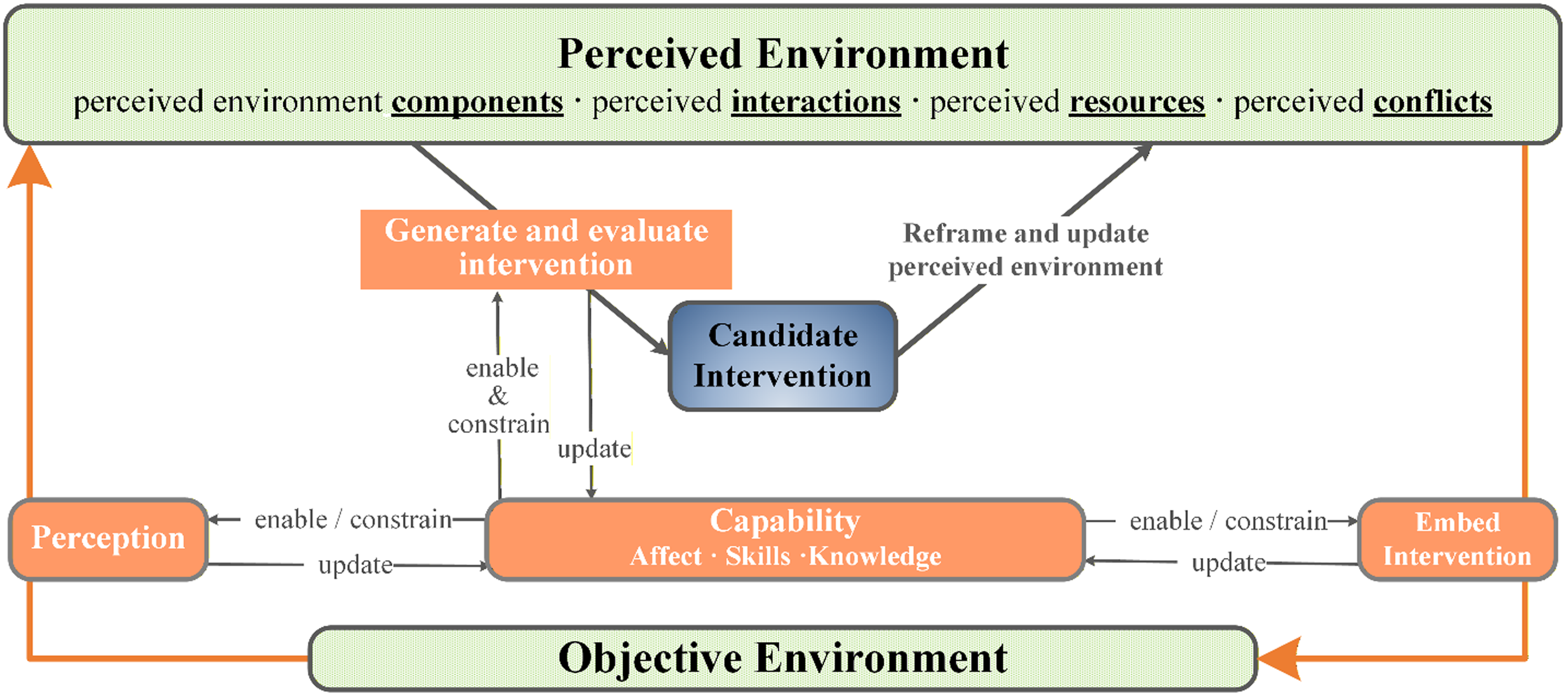
Mechanism of intentional change in Designics. Through perception, the designer forms a perceived environment from the objective environment. The perceived environment includes environment components, interactions, resources, and conflicts. Through perception, the designer also updates affect, skills, and knowledge. Candidate intervention is generated and evaluated within the perceived environment before selected intervention is embedded into the objective environment. Capability—through affect, skills, and knowledge—constrains perception and thereby constrains intervention. Conflict drives intervention, perception enables intervention, and capability constrains perception.
Empirical Program of Designics: Structuring the Unstructured
Design practice is inherently recursive, open ended, and dynamically evolving. Designers reinterpret problems, reframe constraints, and revise interventions in ways that cannot be fully predicted or externally controlled. Because of this, traditional tightly controlled experiments—designed around fixed stimuli and repeatable responses—are not sufficient for studying design in a scientifically meaningful way. To understand design without stripping away its essential complexity, Designics introduces an empirical program aimed at “structuring the unstructured.”(Zhao et al., 2020).
Why an Empirical Program Is Needed
Design differs from classical experimental phenomena in several ways:
It evolves continuously and recursively rather than in predefined linear sequences. Each intervention changes the environment, which changes subsequent perception and action. It cannot be reduced to fixed inputs and outputs. Designers actively construct their perceived environment, and their perception shifts as capability, stress, and understanding evolve. It contains latent cognitive-affective dynamics
For these reasons, the empirical program must preserve the natural richness of design activity while still enabling scientific analysis, comparison, and cumulative evidence.
How the Empirical Program Works
The empirical program of Designics consists of four-part methodological chain that transforms real-world, loosely controlled/structured design activity into analyzable scientific data:
observe design in ecologically meaningful, loosely controlled settings; segment the evolving process into analyzable local states or subprocesses; characterize each segment using theory-relevant variables; and interpret the resulting trajectories using the three governing laws.
This program can draw on multiple instruments for segmentation. Protocol analysis remains useful for observable reasoning and verbalized cognition (Cross et al., 1996; Gero & Mc Neill, 1998; Hay et al., 2017). However, triangulation across protocol, physiological, and neurocognitive measures is assumed to provide a stronger basis for studying design thinking than any single method alone (Gero & Milovanovic, 2020). Earlier work in our research program extended this direction by combining protocol-based analysis with EEG-assisted segmentation and clustering to recover structure from weakly structured design activity (Nguyen & Zeng, 2010, 2014). Physiological and neurocognitive measures, including EEG, GSR, and related signals, provide partial access to latent cognitive-affective dynamics (Nguyen et al., 2013; Nguyen & Zeng, 2010; Tang & Zeng, 2009; Zhao et al., 2020). Simulation provides an additional instrument for exploring the dynamic implications of recursive theoretical structures and for checking whether proposed mechanisms reproduce observed patterns of design behavior (Zeng & Yao, 2009). Earlier work on computer simulation of design activities explicitly treated simulation, mathematical modeling, and statistical analysis as a way to understand design activity and validate design theories (Zeng & Yao, 2009; Zhao et al., 2023).
Within this empirical program, TASKS can be used as an analytic instrument for experimental data analysis (Yang et al., 2021), where T, A, S, K, and S denotes perceived
Finally, the empirical program interprets segment trajectories using the three laws of Designics. The Conflict Law looks into what environmental conflict made intervention necessary in this segment; the Perception Law identifies how the designer's perception shaped the framing, location of resources, or evaluation of alternatives; the Capability Law will be employed to find out how cognitive-affective capability constrains perception and intervention at the concerned segment. By applying the laws to each segment—and to transitions between segments—researchers can reconstruct the mechanisms that drive design behavior, rather than merely describing surface-level actions.
The empirical program enables researchers to analyze real design without forcing artificial linearity, uncover the hidden structure behind open-ended activity, examine design simultaneously at cognitive, behavioral, physiological, and neurocognitive levels, model how conflict, perception, and capability co-evolve during design. In short, it provides a scientifically rigorous way to study intentional change as it actually occurs, turning naturally unstructured design behavior into structured, interpretable, cumulative evidence.
Illustrative Use of Designics: Explaining Design Fixation
A useful test of a foundational science is whether it can explain a familiar phenomenon by identifying its minimal explanatory structure and deriving it from the governing laws. In this section, design fixation is used as an illustrative case.
General Procedure for Applying Designics to a Design Phenomenon
A design phenomenon can be analyzed in Designics through the following procedure.
In this way, Designics explains a design phenomenon scientifically by deriving it from the recursive interaction of designer, environment, and intervention under the Conflict, Perception, and Capability Laws.
Explaining Design Fixation Using Designics
Step 1. Describe the Phenomenon
Design fixation is a well-known phenomenon in which designers fail to solve a design problem because of strong mental attachment to an internal or external inspiring source (Linsey et al., 2010; Nguyen & Zeng, 2017a). The result is that designers tend to generate solutions similar to an existing idea even when that idea is not suitable for the current design problem.
Nguyen and Zeng (Nguyen & Zeng, 2017a) define fixation more formally as the condition in which a designer selects a known solution with higher preference even though another solution has higher expected fitness. In other words, fixation occurs when preference and actual suitability diverge.
Step 2. Identify DEI and Formulate the Proposition
Under Designics, the fixation phenomenon involves:
a designer, whose affect, skills, knowledge, stress, and effort shape perception and action; an environment, which contains the design situation, requirements, constraints, resources, and conflicts; an intervention, which is the candidate solution being generated, evaluated, selected, or retained.
Step 3. Formulate the Proposition
The phenomenon may therefore be restated as the following proposition:
Design fixation arises when conflict makes intervention necessary, perception enables intervention by forming a biased perceived environment, and constrained capability leads the designer to prefer an inappropriate candidate intervention.
Step 4. Apply the Three Laws
By Law 1, fixation presupposes environmental conflict. The design situation contains an unsatisfactory condition that makes intervention necessary.
By Law 2, intervention is only possible because perception forms a perceived environment. The designer does not act directly on the objective problem, but on a perceived problem. Nguyen and Zeng's distinction between the real problem and the perceived problem, and between expected fitness and perceived fitness, is directly compatible with this structure (Nguyen & Zeng, 2017a).
By Law 3, capability constrains perception. The perceived problem, the perceived resources, and the perceived fitness of candidate solutions are therefore shaped by finite knowledge, skills, affect, and stress. Fixation occurs when this constrained perception leads the designer to prefer an inappropriate candidate intervention.
Step 5. Conclude the Explanation
Thus, fixation is not a primitive anomaly. It is a law-governed consequence of the three Designics laws. Environmental conflict makes intervention necessary; perception makes intervention possible; limited capability biases perception; and intervention is therefore directed toward an unsuitable candidate solution.
This example illustrates how Designics can be used scientifically. A familiar design phenomenon is first stated, then represented through DEI, and finally explained by applying the three laws. The details can be found in (Nguyen & Zeng, 2017a).
The value of this illustration is not only that it explains fixation, but that it demonstrates a general procedure for using Designics to analyze design phenomena as consequences of recursive DEI dynamics governed by the three laws.
The same explanatory procedure can be applied to other design phenomena. Additional examples can be found in related work on the role of sketching in creative design (Nguyen & Zeng, 2012), the role of knowledge in creative design (Yang et al., 2022), and the relation between humor and creativity (Yi et al., 2013), where different aspects of perception, capability, and intervention become salient under different conditions.
Synthesis: Designics and the Landscape of Design Theory
Criteria for “Good” Design Theory
Across design research communities, “good theory” is rarely judged by novelty alone. It is typically assessed by what it clarifies, what it explains, and what it enables others to do across research, practice, and education. Several recurring criteria appear—explicitly or implicitly—in the literature.
(C1) Phenomenon alignment and scope clarity. A theory should clearly state the phenomenon it claims to explain, the boundaries of that claim, and what it does not attempt to explain. In design research, this often appears as the distinction between descriptive and prescriptive contributions—for example, theories explaining how designing occurs versus methods recommending how designing should be conducted (Blessing & Chakrabarti, 2009; Finger & Dixon, 1989).
(C2) Representational adequacy. A design theory should provide constructs or representations that are expressive enough to capture key aspects of design while remaining disciplined enough to support consistent use and comparison across studies and domains. Engineering-design traditions often emphasize the separation between ontology (what design is about) and methods (what designers do with tools and methods) (Eder, 2010; Hubka & Eder, 1988).
(C3) Explanatory mechanism. Beyond taxonomy, a strong design theory proposes mechanisms explaining how and why design unfolds as it does—for example through iteration, reframing, co-evolution, divergence, or convergence. Mechanisms allow theory to travel across contexts rather than remaining tied to specific domains or tools (Zeng, 2002).
(C4) Empirical and methodological accountability. A theory should connect to research methodology: what counts as evidence, how claims can be tested, and how studies can accumulate comparable findings. This aligns with the DRM position that theory and method must co-evolve so that evidence becomes cumulative rather than anecdotal (Blessing & Chakrabarti, 2009).
(C5) Multi-level integration. Increasingly, the community expects design theory to be compatible with evidence across multiple levels—cognitive and behavioral processes, artifacts and systems, and social or environmental contexts (Papalambros et al., 2025). In recent years this expectation has expanded to include physiological and neurocognitive measurements, reflecting a growing interest in mind–body–environment integration (Gero & Milovanovic, 2020; Zhao et al., 2020).
These criteria are not a checklist for a single “correct” theory. Rather, they reveal why the field sometimes appears fragmented: influential theories often excel on one or two criteria, while fewer attempt a coherent alignment across phenomenon, representation, mechanism, and evidence. This concern with coherence is consistent with earlier meta-theoretical work arguing that design theory has long suffered from confusion, conflation, and unnecessary multiplicity of concepts, and that progress requires clearer comparison among theories and their underlying assumptions (Love, 2002). Recent reflections in Design Science suggest that this need for clearer articulation of what design science studies, how it reasons, and how it justifies its knowledge claims remains active in the field (Papalambros et al., 2025).
Designics is proposed as such an attempt.
Perspectives on Change
Though Designics explains intentional change—change brought about deliberately through intervention in a human–environment system, the present subsection reviews influential perspectives on change in general as a comparative backdrop (See the subsection on the object of study for the technical definition used in this paper). Across science and philosophy, several influential frameworks have addressed the question of how new forms, knowledge, or systems emerge. Recent work outside mainstream design theory has also treated intentional change itself as a multilevel and recursive phenomenon. For example, Boyatzis's intentional change theory frames sustained desired change as a complex, fractal system spanning individuals to collectives, but its explanatory center lies in vision, emotional attractors, and multilevel resonance rather than in conflict, perception, capability, and intervention (Boyatzis, 2025).
These perspectives can be compared through three fundamental scientific questions:
Why does change occur? How does change happen? What constrains change?
These questions correspond directly to the three fundamental laws proposed in Designics:
Conflict Law – Conflict drives intervention Perception Law – Perception enables intervention Capability Law – Capability constrains perception
Table 1 compares several influential theories of change using this analytical framework. The comparison shows that different theories of change have emphasized natural selection, creative evolution, abduction, or bounded rational search (Bergson, 1911; Darwin, 1859; Peirce, 1934; Simon, 1947, 1957). Designics differs by explaining intentional change through three linked laws: conflict drives intervention, perception enables intervention, and capability constrains perception.
Comparison of Major Theories of Change.

Calls for a deeper theoretical transformation of design research have appeared repeatedly in the field. Dorst, for example, argued that design research was approaching a “revolution-waiting-to-happen,” one that would require reconsidering the object of study, the character of methods, and the way the field generates knowledge (Dorst, 2008).
Where Major Design Theories are Strong—and Where Gaps Remain
Within design research itself, several influential theories explain different aspects of design activity. These theories can be broadly grouped according to the mechanisms they emphasize.
Formal Reasoning Traditions
Several design theories provide formal reasoning structures for innovation and artifact development.
FBS (Function–Behavior–Structure) offers a powerful representational framework for describing artifact transformations (Gero, 1990). In its situated extension, the framework also recognizes designing as unfolding across recursively interacting environments or worlds rather than within a single fixed context (Gero & Kannengiesser, 2004). Designics does not compete with FBS as a representational framework; rather, it situates such mappings within a broader ontology defined by the DEI triad and distinguishes more explicitly between objective environment, perceived environment, and capability-constrained intervention. This distinction between objective and perceived design situations is not introduced here for the first time, but continues a line of work in the author's own research from early studies of evolving experience structures to recursive design logic and later world–mind formulations (Zeng, 1989, 2002; Zeng & Cheng, 1991).
Axiomatic Design provides strong normative principles for functional decomposition and mapping between functional requirements and design parameters (Suh, 1990). It excels as a prescriptive engineering method but typically assumes relatively stable problem framing.
C–K theory provides one of the most compelling formal models of innovation, describing design as the co-expansion of concept and knowledge spaces (Hatchuel & Weil, 2009).
Designics complements these powerful reasoning frameworks with a unified account that connects reasoning dynamics to environmental necessities and designer's capability constraints.
Phenomenological and Process Accounts
Co-evolution describes the mutual shaping of problem and solution spaces and has become one of the most widely accepted descriptive accounts of design processes (Crilly, 2021; Dorst & Cross, 2001). However, it typically stops short of specifying the governing mechanism underlying this coupling.
Designics interprets co-evolution as a surface manifestation of a deeper recursive structure driven by environmental conflicts and constrained perception (Zeng & Cheng, 1991).
Methodological and Heuristic Systems
A third group of approaches focuses on reproducible design procedures or heuristic knowledge. Systematic design emphasizes reproducible process models and strong links to engineering science (Hubka & Eder, 1988; Pahl et al., 2007). These approaches are often method-forward, focusing on “how to design.” TRIZ provides a powerful knowledge base of inventive principles and technology evolution patterns, particularly effective in engineering innovation (Altshuller, 1984).
Designics complements these systems by distinguishing methods from underlying scientific mechanisms. Methods such as TRIZ or systematic design can be interpreted as tools operating within a broader science of intentional change.
Comparison of Design Theories
The diversity of design theories can be compared using the same three questions applied earlier to change theories, as shown in Table 2. This comparison suggests that many design theories emphasize a single explanatory dimension—search, contradiction resolution, generative reasoning, reflection, representation, or decomposition.
Comparison of Major Design Theories.
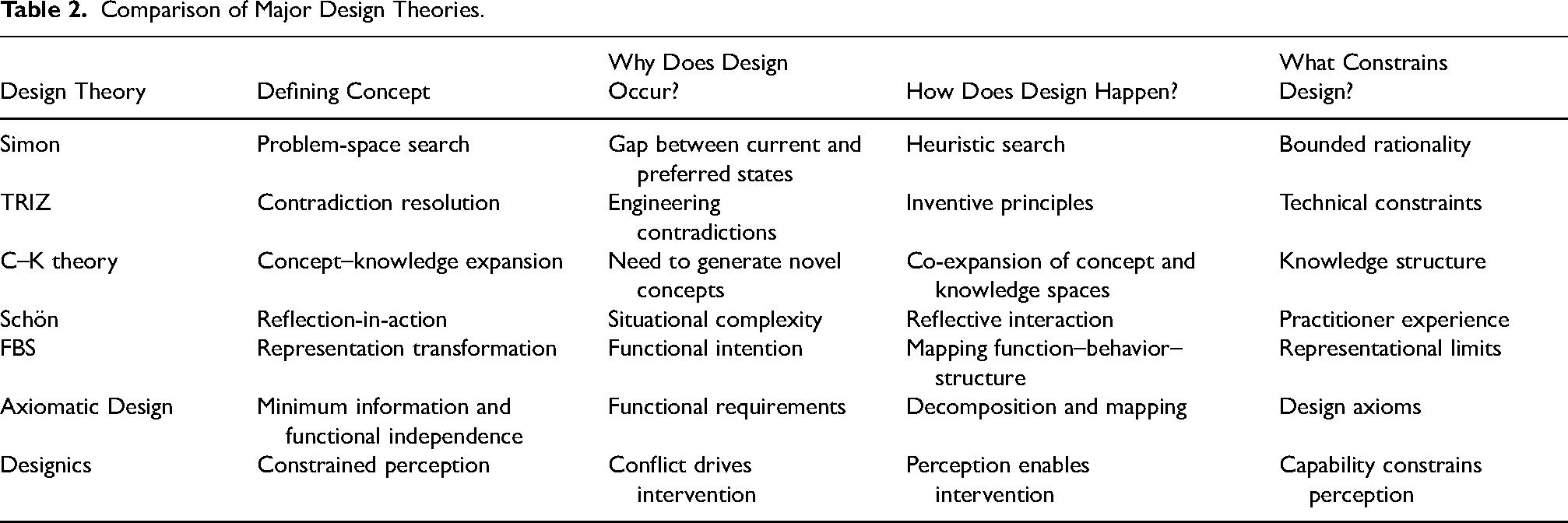
Designics differs by integrating environmental drivers, perceptual mechanisms, and human constraints into a single explanatory framework. In this sense, it complements broader reviews of design process models by shifting the explanatory emphasis from process description to mechanism-centered science (Wynn & Clarkson, 2018).
Designics as an Integrative Completion
Against this background, Designics can be positioned as a foundational science of intentional change. Rather than replacing existing theories, it provides a unifying scientific structure that connects them. This positioning is also consistent with recent reflections on design science that define the field in terms of artifacts and their embedding across physical, virtual, psychological, economic, and social environments, while calling for clearer articulation of what design science studies and how it justifies its claims (Papalambros et al., 2025).
Designics is organized around four scientific components:
Unit of analysis. The Designer–Environment–Intervention (DEI) triad defines the minimal object of intentional change across engineered, digital, organizational, and social contexts. Governing laws. Three laws describe the causal structure of intentional change:
Conflict Law – conflict drives intervention Perception Law – perception enables intervention Capability Law – capability constrains perception Formal reasoning. Design unfolds recursively as designers iteratively perceive conflicts, generate interventions, and transform environments. Empirical instruments. The framework supports triangulated evidence through behavioral observation, protocol analysis, physiological measurement, and neurocognitive investigation.
From this perspective, many existing design theories can be interpreted as partial views within a broader scientific structure. Representation frameworks describe artifact transformations; generative theories describe conceptual exploration; heuristic systems provide practical guidance for problem solving. Designics integrates these contributions by explaining the deeper mechanism that makes intentional change necessary, constrained, and possible.
Designics therefore does not replace established theories and methods. Instead, it provides a common scientific basis—unit of analysis, governing laws, reasoning structure, and empirical instruments—through which these contributions can be related, compared, and cumulatively extended.
Conclusion and Future Research
Conclusion
This paper introduced Designics as a scientific framework for understanding design as intentional change. Rather than approaching design primarily as a collection of methods, heuristics, or representations, Designics begins with a different question: what makes intervention necessary, what makes it possible, and what constrains it across design contexts.
The framework is organized around a minimal unit of analysis—the DEI triad—and three governing laws:
Conflict drives intervention. Perception enables intervention. Capability constrains perception.
Together these laws explain design as a recursive process in which conflict makes intervention necessary, perception forms the perceived environment in which intervention becomes possible, and finite capability constrains what can be perceived and therefore what can be done. From this perspective, many recurring observations in design research—such as ill-structuredness, co-evolution, fixation, path dependance, and outcome multiplicity—can be understood as consequences of imperfect perception, limited capability, and recursive environmental update through intervention.
The contribution of Designics therefore lies not in replacing existing theories or methods, but in providing a scientific structure that integrates them. Representation frameworks, reasoning models, methodological systems, and phenomenological accounts can all be interpreted as partial perspectives operating within a broader mechanism of intentional change. In this sense, Designics contributes not merely another design theory, but a proposed scientific foundation for relating diverse design theories within a common explanatory space.
At the same time, Designics changes how design activity can be understood in both research and practice. For research, it shifts attention from describing design mainly as a sequence of methods, stages, or heuristic moves toward explaining design through conflict, perception, capability, and intervention. This encourages mechanism-centered inquiry, supports a more consistent unit of analysis, and provides a basis for relating behavioral, physiological, neurocognitive, and computational evidence within a shared explanatory structure. For practice, Designics offers a stronger language for diagnosis. It suggests that design should begin from clearer identification of conflicts in the environment, that framing and reframing are practical means of improving perception, and that many familiar difficulties—such as fixation, stalled iteration, premature convergence, weak evaluation, and breakdowns in implementation—can be understood not merely as failures of discipline or talent, but as consequences of finite capability operating under changing conditions. In this way, Designics helps make design activity more interpretable, more diagnosable, and potentially more auditable.
Future Research
If Designics is to function as a cumulative scientific framework, several directions follow naturally.
First, the framework opens a program of phenomenon-specific explanation. The present paper establishes the structure; future work can use it to explain particular design phenomena more precisely. Fixation, co-evolution, sketching, creativity, premature convergence, reflective reframing, and human-AI collaboration can each be revisited as consequences of the relations among conflict, perception, capability, and intervention. The framework becomes scientifically valuable only if it can generate sharper explanations of recognizable phenomena than existing descriptions alone.
Second, Designics invites further formal development. The three laws are intentionally simple, so they can function as major premises for later reasoning. Future work can derive more specific propositions concerning different forms of conflict, different perceptual limitations, different capability conditions, and different recursive trajectories. In this sense, Designics is not completed by this paper; this paper establishes its first explicit scientific structure.
Third, the framework supports empirical testing. Future work can investigate how conflict is detected, how perceived environments are formed, how capability constraints alter perception and intervention, and how recursive trajectories vary across individuals, teams, and settings. Because the framework already links theory to empirical instruments, it supports a cumulative strategy in which behavioral, physiological, and neurocognitive evidence can be examined in relation to common explanatory variables rather than in isolation.
Fourth, Designics enables cross-level extension. The DEI triad is formulated minimally enough to support investigation across multiple levels of activity, from individual design cognition to team collaboration, organizational decision processes, and socio-technical systems. Future work can examine how interventions at one level reshape environments and conflicts at another, and how intentional change propagates across these levels.
Fifth, a natural next step is to extend Designics from explanatory integration toward outcome-based evidence accumulation. The DEI triad and the three laws provide a structured basis for designing and interpreting intervention studies: (i) specify the environmental conflict (demand–resource mismatch) that motivates change, (ii) operationalize how the perceived environment is formed (framing, information acquisition, representation), (iii) measure capability constraints (affect–skills–knowledge, stress–effort limits), and (iv) evaluate outcomes as changes in environment structure, behavior, and resource feasibility after intervention embedding. This aligns Designics with implementation-oriented research by making interventions auditable in terms of what conflict they targeted, what perception they required, what capability they assumed, and what outcome changes followed.
Sixth, the framework opens a direction toward human-AI design science. Designics suggests that effective AI support for design cannot be reduced to search in fixed solution spaces. If design depends on changing conflicts, evolving perceived environments, and capability-constrained intervention, then AI systems must support premise revision, conflict detection, perception of changing environments, and adaptive interaction with human designers. This makes Designics relevant to the next generation of intelligent design-support systems.
More broadly, the framework invites the development of a research program in which theoretical, formal, and empirical work can accumulate around a shared object of study. Design research has long been characterized by rich theoretical diversity. That diversity should be preserved, but it needs not remain disconnected. By articulating a stable object of study, a minimal unit of analysis, governing laws, representational logic, and empirical pathways, Designics aims to provide a shared scientific basis for studying intentional change.
From this perspective, design is neither purely creative improvisation nor purely systematic optimization. It is a structured yet open-ended process in which human agents attempt to transform evolving environments under conditions of incomplete perception and finite capability. Understanding this process is essential not only for advancing design research, but also for addressing increasingly complex challenges in engineering, technology, organizations, and society.
Just as the laws of motion do not dictate where a traveler must go but explain the forces that govern every journey, the laws of Designics do not prescribe what must be designed. Instead, they reveal the universal causal structure—the necessity of conflict, the possibility from perception, and the constraint by capability—that governs every act of intentional change in our world.
Designics therefore invites future work not only to refine its propositions, but to test, extend, and apply them across domains in which intentional change under constraint remains the defining challenge.
Footnotes

Acknowledgments
The author acknowledges the many colleagues, collaborators, students, and research staff whose discussions, related projects, and experimental work contributed over time to the development of the ideas synthesized in this paper.
Funding
The paper is a result of funding spanning 30+ years: The development of this research program over the years was supported in part by funding from the National Natural Science Foundation of China (1993-1996), the Natural Sciences and Engineering Research Council of Canada through Discovery Grants (2004–), the Canada Research Chairs Program (2004–2014), the NSERC Design Chairs Program (2015–2020), NSERC CRD and Alliance grants, the Canadian Institutes of Health Research, the Fonds de recherche du Québec - Société et culture, the Canada Foundation for Innovation, and Mitacs.
Declaration of Conflicting Interests
The authors declared no potential conflicts of interest with respect to the research, authorship, and/or publication of this article.
Author Biography