The Expert Panel for Cosmetic Ingredient Safety (Panel) first published the Final Report of the safety of Isobutane, Isopentane, Butane, and Propane in 1982. The Panel previously concluded that these ingredients are considered safe as cosmetic ingredients under the present conditions of concentration and use, as described in that safety assessment. Upon re-review in 2002, the Panel reaffirmed the original conclusion, as published in 2005. The Panel reviewed update frequency and concentration of use data again in 2023, in addition to newly available, relevant safety data. Considering this information, as well as the information provided in the original safety assessment and the prior re-review document, the Panel reaffirmed the 1982 conclusion for Isobutane, Isopentane, Butane, and Propane.
The Expert Panel for Cosmetic Ingredient Safety (Panel) first published the Final Report of the safety of Isobutane, Isopentane, n-Butane (now known as Butane), and Propane in 1982.1 The Panel concluded that these ingredients are considered safe as cosmetic ingredients under the present conditions of concentration and use, as described in that safety assessment. Upon re-review in 2002, the Panel reaffirmed the original conclusion, as published in 2005.2
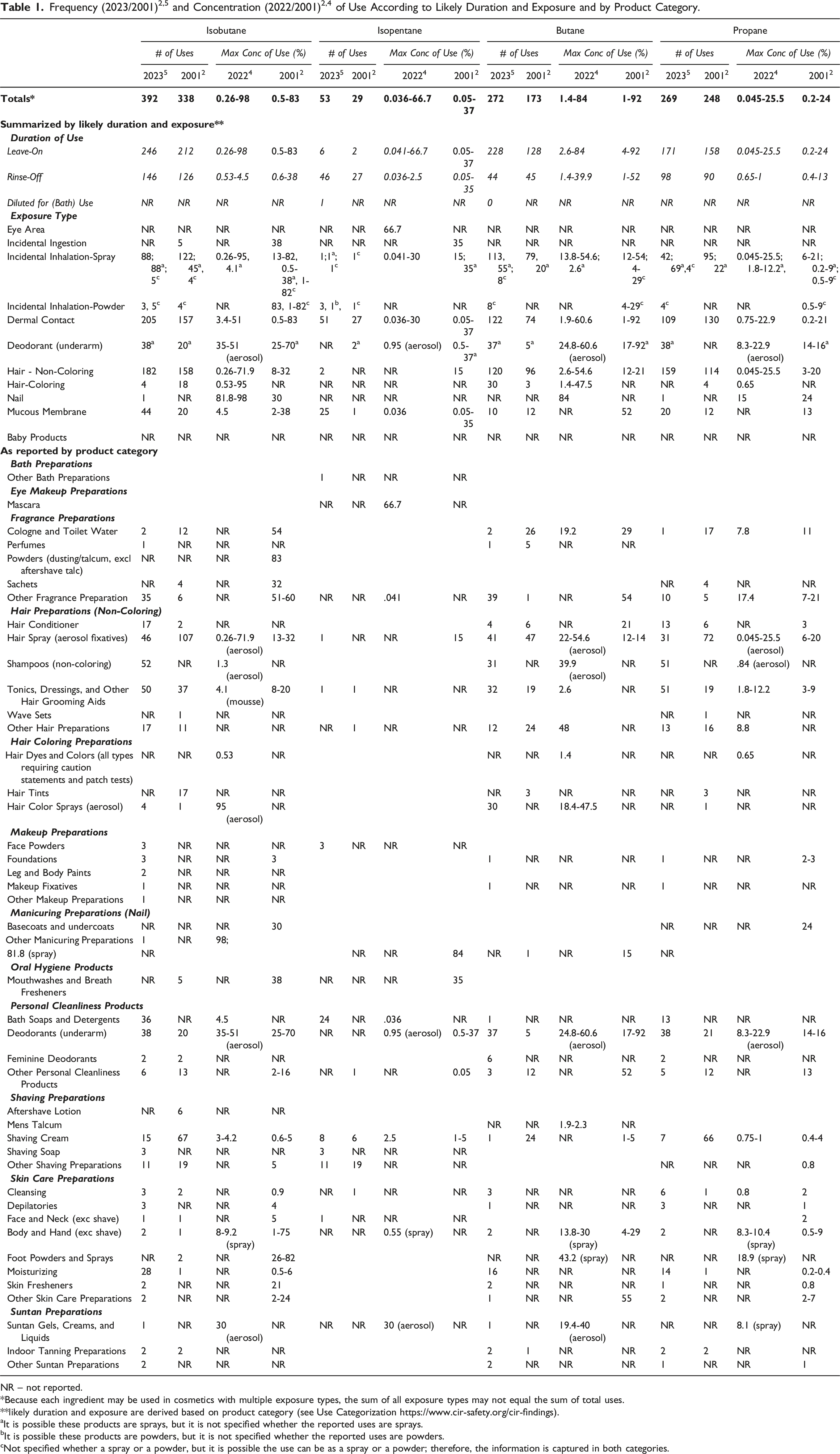
Because it had been at least 15 years since the prior re-review was published, in accordance with Cosmetic Ingredient Review (CIR) Procedures, the Panel again determined whether the safety assessment should be reopened. At its September 2023 meeting, the Panel reviewed updated information regarding product types and ingredient use frequencies as reported in the US Food and Drug Administration (FDA) Voluntary Cosmetic Registration Program (VCRP) database in 20233 and maximum use concentrations provided in response to the survey conducted by the Personal Care Products Council in 2022.4 The frequency and concentrations of use have increased for all ingredients since the re-review was published. According to 2023 frequency of use and 2022 concentration of use data, Isobutane has the greatest frequency and concentration of use, and is used in 392 formulations at up to 98% in other manicuring preparations; in 2001, it was reported to be used in 338 formulations at up to 83% in powder fragrance preparations. The cumulative frequency and concentration of use data for all 4 ingredients are presented in Table 1.
Frequency (2023/2001)2,5 and Concentration (2022/2001)2,4 of Use According to Likely Duration and Exposure and by Product Category.
aIt is possible these products are sprays, but it is not specified whether the reported uses are sprays.
bIt is possible these products are powders, but it is not specified whether the reported uses are powders.
cNot specified whether a spray or a powder, but it is possible the use can be as a spray or a powder; therefore, the information is captured in both categories.
In July 2023, an extensive search of the world’s literature was performed for studies dated 2000 forward, and new data were found.6-18 Notably, Butane and Isobutane are listed in Annex II of the European Union (prohibited), but only if they contain ≥.1% butadiene. No evidence of developmental or reproductive toxicity was observed for Isobutane, Butane, or Propane, and genotoxicity studies were all negative. Irritation and sensitization studies on Isopentane were also negative.
In summary, the Panel reviewed 2023 frequency and 2022 concentration of use data, in addition to newly available, relevant safety data. Considering this information, as well as the information provided in the original safety assessment and the prior re-review document, the Panel reaffirmed the 1982 conclusion for Isobutane, Isopentane, Butane, and Propane. The Panel discussed that these ingredients are propellants and used in cosmetic products which may be incidentally inhaled; however, the Panel noted that despite the very high concentrations reported for leave-on products, these ingredients are completely volatile and therefore are expected to dissipate and not remain on the skin. A detailed discussion and summary of the Panel’s approach to evaluating incidental inhalation exposures to ingredients in cosmetic products is available at https://www.cir-safety.org/cir-findings.
Footnotes
Author’s Note
Unpublished sources cited in this report are available from the Director, Cosmetic Ingredient Review, 555 13th Street, NW, Suite 300W, Washington, DC 20004, USA.
Author Contributions
The articles in this supplement were sponsored by the Cosmetic Ingredient Review.
Declaration of Conflicting Interests
The author(s) declared no potential conflicts of interest with respect to the research, authorship, and/or publication of this article.
Funding
The author(s) disclosed receipt of the following financial support for the research, authorship, and/or publication of this article: The articles in this supplement were sponsored by the Cosmetic Ingredient Review. The Cosmetic Ingredient Review is financially supported by the Personal Care Products Council.
References
1.
ElderRL, ed. Final report of the safety assessment of isobutane, isopentane, n-butane, and propane. J Am Coll Toxicol. 1982;1(4):127-142.
2.
AndersenFA, ed. Annual review of cosmetic ingredient safety assessments 2002/2003- isobutane, isopentane, n-butane, and propane 2002/2003.. Int J Toxicol. 2005;24(S3):52-55.
3.
US Food and Drug Administration (FDA) Center for Food Safety and Applied Nutrition (CFSAN). Voluntary cosmetic registration program- frequency of use of cosmetic ingredients. Obtained Under the Freedom of Information Act from CFSAN; Requested as “Frequency of Use Data”; 2023. Received February 2, 2023. January 4, 2023.
4.
Personal Care Products Council. Concentration of Use by FDA Product Category: Isobutane, Isopentane, n-Butane & Propane; 2022. (Unpublished data submitted by Personal Care Products Council on October 31, 2022).
5.
U.S. Food and Drug Administration (FDA) Center for Food Safety and Applied Nutrition (CFSAN). Voluntary Cosmetic Registration Program- Frequency of Use of Cosmetic Ingredients College Park, MD2023.
EFSA Panel on Food Contact Materials Enzymes Flavourings and Processing Aids CEFSilanoVBolognesiC, et al.Safety assessment of the substance isobutane, for use in food contact materials. EFSA J. 2018;16(1):e05116.
8.
DahlARDamonEGMauderlyJLRothenbergSJSeilerFAMcClellanRO. Uptake of 19 hydrocarbon vapors inhaled by F344 rats. Fund Appl Toxicol. 1988;10(2):262-269.
9.
TsukamotoSChibaSMutoTIshikawaTShimamuraM. Study on the metabolism of volatile hydrocarbons in mice--propane, n-butane, and iso-butane. J Toxicol Sci. 1985;10(4):323-332.
AydinYOzçakarL. Occupational hepatitis due to chronic inhalation of propane and butane gases. Int J Clin Pract. 2003;57(6):546.
15.
UchidaKUnumaKUemuraK. A fatality in a child with severe fatty liver due to n-butane and isopentane poisoning resulting from long-term inhalation of an antiperspirant aerosol. Forensic Sci Med Pathol. 2015;11(4):631-632.
16.
National Institute of Occupational Safety and Health (NIOSH). NIOSH Pocket Guide to Chemical Hazards: Butane. https://www.cdc.gov/niosh/npg/npgd0068.html. Last Updated 2023. Accessed July 2023.
17.
National Institute of Occupational Safety and Health (NIOSH). NIOSH Pocket Guide to Chemical Hazards: Ioobutane. https://www.cdc.gov/niosh/npg/npgd0350.html. Last Updated 2023. Accessed July 2023.
18.
National Institute of Occupational Safety and Health (NIOSH). NIOSH Pocket Guide to Chemical Hazards:Propane. https://www.cdc.gov/niosh/npg/npgd0524.html. Last Updated 2023. Accessed July 2023.