



Abstract
Certification in toxicology remains a subject of interest to those in the field, as evidenced by the number of presentations at major meetings and publications in the past decade. In 2009, Brock and colleagues summarized the certifications available in the field of toxicology and provided an international perspective of the pros and cons of gaining certification. Though that article has been viewed thousands of times, the certification processes have evolved over the past decade. Therefore, the purpose of the article is to build upon the prior work and present current information for toxicologists seeking certification with the American Board of Toxicology (DABT), Academy of Toxicological Sciences (ATS), as a European Registered Toxicologist (ERT), as a Diplomate, Japanese Society of Toxicology (DJSOT), and as a Diplomate of the Chinese Society of Toxicology (DCST). In addition, other certifications are presented, but available details are limited.
Why Consider Certification in Toxicology?
Toxicologists often ask why they should consider certification in toxicology. 1 In some cases there may be a requirement to become certified based on employer or regulatory prerequisites for a particular role. When there is not a tangible driving force however, the personal need is less clear. In these instances, it becomes important to look at the value proposition for certification. Dr. Ruth Roberts laid the groundwork for this nicely in her 2022 ACT presentation in the session on ERT certification, 2 where she highlighted that scientific credibility is under scrutiny. We have known for years that many published papers in the scientific literature cannot be reproduced.3,4 The United States saw this loud and clear during the COVID-19 pandemic when scientists were denounced by many politicians and the lay public for shifting safety recommendations as new information emerged in real-time, fueling further integrity/reliability concerns. Narrow that focus to reliability in toxicology and more specifically, to matters directly related to the generation and/or interpretation of data that may directly or indirectly influence public or environmental health. Dr. Roberts also noted that in an article addressing the concern that toxicology as an academic discipline in European universities may be at risk due to staffing reductions (including the elimination of departments) in the discipline, Wallace and colleagues 5 stated that “In the public debate, toxicological expertise is also needed to evaluate evidence and to argue whether or not there is a scientifically founded reason for public health concerns.” They further comment that toxicological expertise “is an ongoing need which requires appropriately qualified individuals to maintain a safe environment for all” and that “in the absence of appropriately experienced toxicologists, governments will be forced to seek toxicological input from non-experts who may inadvertently offer the wrong advice.” Therein lies the key to unlock the understanding of the need (and overarching value) for certification - appropriately qualified/experienced toxicologists. The certification/registration/accreditation process ensures that the public, employers, governments, etc., have access to individuals who possess the required knowledge, experience, and competence to provide toxicology expertise in matters related to public or environmental health.
The need for certification in toxicology has been evident for many years. Claude and Guittin 6 wrote that toxicology is a profession, and practical experience and continuing education are essential. Therefore, they concluded, an evaluation of toxicologists in the course of their professional activities is necessary, noting that at the time, this was a task undertaken by the American Board of Toxicology (ABT) in the United States and by the EUROTOX accreditation system through the National Registries in Europe. The need was further echoed by Fowler and Galli, 7 stating that toxicology has evolved from the traditional science of poisons into an extensive discipline that is continuously adapting to the advances in this and other scientific fields of study. As a discipline, toxicology seeks to identify, estimate and control the benefits and risks of chemicals in order to preserve public and environmental health and the environment from undesired effects and to interpret the potential impacts of exposures expertly. They further state that the need for a mechanism to certify the professional credibility of toxicologists in a defined and standardized way has been recognized across the USA, Europe, and Asia.
Turning back to the value of certification, the American Board of Medical Specialties notes that for physicians who become board-certified, the value of that certification is that it represents an independent evaluation and recognition that the individual is skilled and clinically competent, is involved in continuous improvement of their expertise throughout their career, and meets the standards of excellence in their practice established by their peers (https://www.abms.org/board-certification/value-of-board-certification/). For the certified toxicologist, it really is not any different. Becoming certified, particularly by the entities described herein, demonstrates that the individual has been independently assessed and acknowledged for their knowledge, experience, and competence to provide toxicology expertise in matters related to public or environmental health. These individuals are also clearly committed to excellence and continually work to improve and often diversify their skills thus bringing a broader and deeper experience to their work.
Certifications
Brief Summary of Toxicology Certifications.
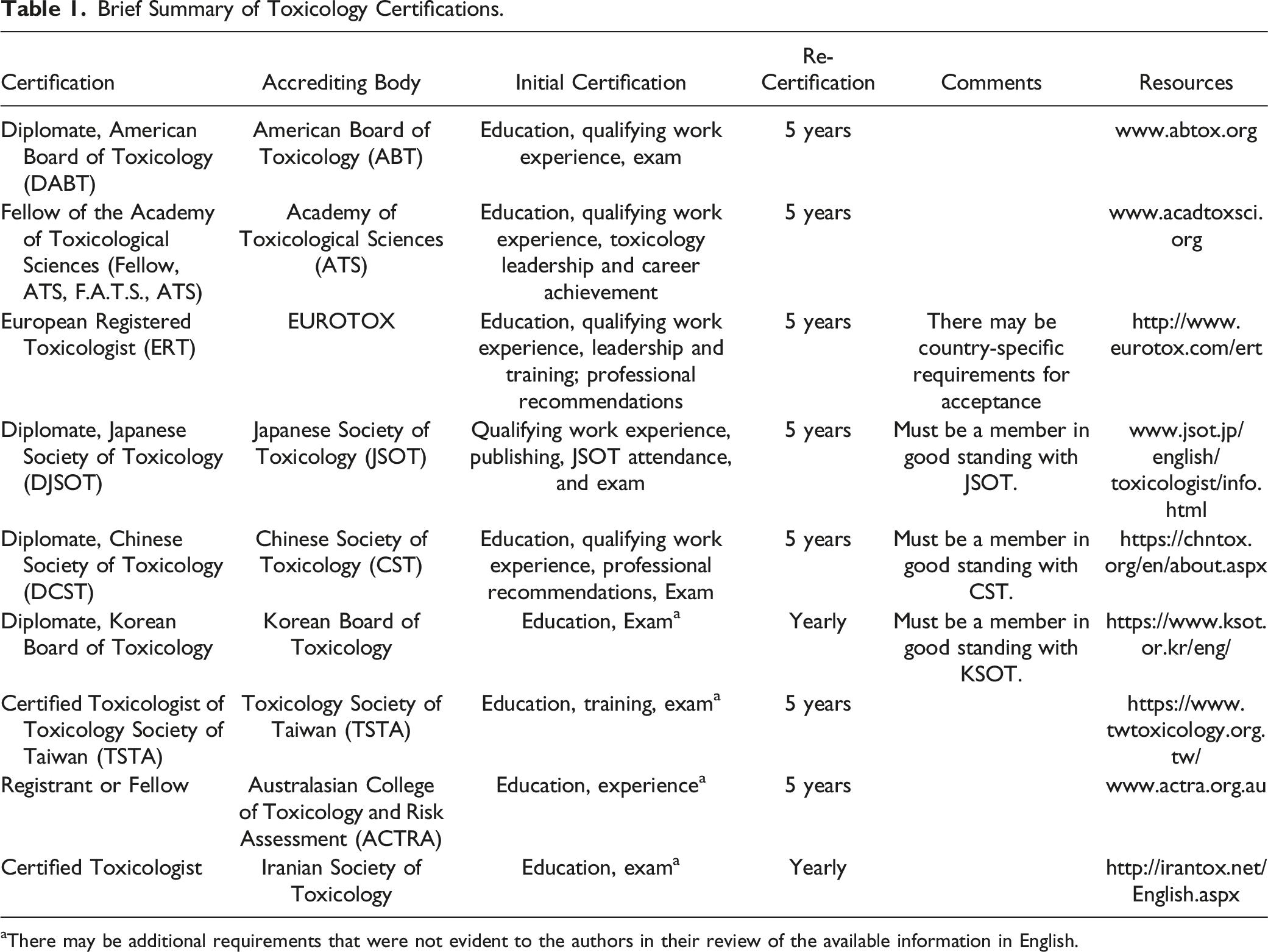
aThere may be additional requirements that were not evident to the authors in their review of the available information in English.
Diplomate, American Board of Toxicology (DABT)®
The American Board of Toxicology (ABT; www.abtox.org) was founded in 1979 to encourage the study of the science of toxicology, to stimulate its advancement by establishing standards for professional practice, to prepare and administer procedures including tests for the implementation of such standards, and to confer recognition by certificates or otherwise upon those members of the profession who, measured against such standards, demonstrate competence. To date, over 4000 candidates have passed the exam since the inception of ABT (personal communication, S. Masten, ABT Executive Director), and the exam has been given in 10 different countries over the years. Currently, there are 2600+ active Diplomates worldwide with representation in over 30 countries. 8 Though the majority of these individuals currently reside in the United States (>2000), as of the drafting of this article, there is significant representation in India (>100), China (90), Canada (81), Switzerland (51), Germany (37), the United Kingdom (33), Japan (30), France (25) and the Republic of Korea (17) (numbers courtesy of the American Board of Toxicology, March 2023).
The first step is to confirm eligibility requirements where the candidate must demonstrate experience in the practice of toxicology for at least 3 years for those who have earned a PhD, 7 years for those who have earned a master’s degree, and 10 years for those who have earned a bachelor’s degree; the degree should be in an appropriate field related to toxicology, and transcripts must be sent from the academic institute to ABT. The applicant must have been in full-time toxicology practice during the year prior to eligibility evaluation, and specific work experience requirements can be found in the candidate handbook located on the ABT website (https://www.abtox.org/candidates/overview/). Once approved to sit for the exam, the applicant must pass the exam within a three (3) year period.
The ABT has developed a candidate handbook that provides excellent recommendations on how to prepare for the examination, including reviewing the content provided by ABT, seeking advice from previous candidates, forming study groups (LinkedIn is a great place to find other candidates who are planning to take the exam), ensuring that you have time to prepare and review the study list prepared by the ABT board. The ABT has continually conducted an independent review of its certification program; however, in the early 2010s, the Board elected to do a more in-depth review of the examination to ensure that the examination and requirements for the attainment of Diplomate status are relevant to modern toxicology practice and based upon an empirical foundation of knowledge. The result was the development of a “standard of knowledge for professional toxicologists” 9 and a Practice Analysis. 10 The outcome of this effort had led to a change in the exam being a multiple day three-part exam (100 questions per part) using pencils and “bubble sheets” and graded in individual parts, to a one day single day computerized exam (200 questions graded in toto). The updated exam format was based on domains and tasks from the Practice Analysis. A second Practice Anaysis was conducted in 2021 resulting in further shortening of the exam (140 scored and 20 unscored pre-test items) for 2022 with data supporting comparability to prior exams. In keeping with certification industry best practices, practice analyses will be conducted regularly in the future.
Once the initial certification has been achieved, there is a requirement for recertification every 5 years to demonstrate that the Diplomate is in active toxicology practice and is keeping up with developments in toxicology through the process of continuing education (CE). The ABT requires a total of 100 CE credits to be earned over a 5-year window. The Board recommends a target of 20 points each year but requires a minimum of 10 points per year to be recorded in its online database accessible to the Diplomate. Additionally, credits must come from two of the three noted categories (CE, meeting attendance, professional development). Some credits are capped with the total number that can be earned for a given activity. The recertification application process changed in 2017 and is the same for all diplomates. During the 4th year of diplomate certification, a review of CE by the ABT Board (where 100 CE hours should be achieved and documented) and a literature review assessment are required. The authors highly recommend that you enter your CE hours on the ABT website at least quarterly, and documentation related to CE should be maintained if requested.
Fellow of the Academy of Toxicological Sciences (Fellow, ATS; F.A.T.S.; ATS)
With increased experience in toxicology, an increased involvement in professional societies and publishing, and international recognition of their contributions to toxicology, a normal progression is to obtain fellowship in the Academy of Toxicological Sciences. The Academy of Toxicological Sciences (www.acadtoxsci.org) was established in 1981, and its vision is to be recognized as the leading international organization that certifies toxicologists by peer review of education, professional experience, leadership, demonstrated achievement and scientific expertise with a current membership of 265 (195 Full and 70 Emeritus Fellows).
The ATS Board of Directors has established a three-part application process that includes documentation of education and experience (minimum of 20 points must be achieved), professional practice in toxicology (minimum of 30 points must be achieved), and professional recognition (minimum of 30 points must be achieved). The professional practice of toxicology is evidenced by scholarly publications and non-published technical reports and integrated analyses, editorial services to scientific journals, participation on external and internal toxicology-related committees, professional society membership(s), scientific presentations, attendance at scientific meetings, teaching responsibilities, etc. Professional recognition is reflected by career advancement, elected and/or appointed service with national and international professional/technical committees and review bodies, invited presentations, and professional honors and awards.
Upon completion by the applicant, the application is submitted for pre-review to an ATS board member, who will review it for completeness and provide the candidate recommendations on any deficiencies. If no deficiencies are noted, the ATS Board will use a peer-review point system for evaluating the candidate against the three criteria. The candidate must achieve a minimum score in each category, as mentioned above, with a combined score of 80 points to achieve the title of ‘‘Fellow, Academy of Toxicological Sciences”. The toxicologist seeking ATS should actively be publishing, serve as officers in toxicology professional organizations, e.g., SOT and ACT, serve on grant reviewing boards, or national and international toxicology committees. For those in government or industry professions, demonstration of professional recognition may be more difficult, but it is certainly achievable as individuals from government and industry are members of ATS and have served on the Board of Directors and in the Presidential chain.
Like ABT, once initial certification has been achieved, there is a requirement for recertification every 5 years to demonstrate that the candidate is still in the practice of toxicology and is keeping up with developments in toxicology. The Fellow must demonstrate continued study in the field of toxicology through publishing, active participation in continuing professional development (CPD), and recognition in the toxicology field.
European Registered Toxicologist
Registration of toxicologists in Europe is overseen by EUROTOX (http://www.eurotox.com/ert), which is the service of the Federation of European Toxicologists and European Societies of Toxicology. Wilks and colleagues 11 described the beginnings of the certification of toxicologists in Europe certification. During the 1980s, the toxicology societies in Germany, the Netherlands, and the UK began to develop national registers to recognize qualified toxicologists. In the early 1990s, experts from several European countries, under the umbrella of EUROTOX, together defined criteria for the registration of qualified toxicologists. These standard requirements were adopted in a number of European toxicology societies, thereby allowing for mutual recognition. Joint European registration according to the “EUROTOX model” was started in 1994 by the three founding registries, and the publication of the “Expectations of a European Registered Toxicologist” rapidly followed, outlining requirements. The designation ERT is in general equivalent to Diplomate status of the ABT with the exception that ERT does not require examination. To start the process of European Registry, the candidate must register with 1 of 24 national registries. It is essential to review the specific registry requirements since each registry can define who can apply, where the applicant is allowed to live and any special requirements. For instance, to apply to the Danish national registry, one must be a Danish citizen or working in Denmark. Admission to the UK Register has no residency requirements and is often the registry selected by individuals from the USA
The process is twofold, with the national registers evaluating applicants according to the agreed requirements. Once a candidate is admitted to the national registry, the registry recommends the individual to EUROTOX ERT Register. EUROTOX then issues the certificate indicating the individual is a European Registered Toxicologist (ERT). The registry thereby constitutes a list of toxicologists who excel by high standards of education, skill, experience and professional standing. At the present time, there are close to 2000 ERTs worldwide.
The requirements for registration are summed in the above referenced link and described in additional detail in the publication by Wilks and colleagues. 11 In brief, the common requirements for registration are based upon your academic degree, your theoretical knowledge of major areas of toxicology, a minimum of 5 years or practical experience, current practice in the field of toxicology and renewal at 5-year intervals. Admission to the national registry, requires two senior toxicologists from different organizations to serve as referees providing justification as to why the candidate should be considered for admission to the national society. The societies place heavy responsibility on the referees in recommending the candidate.
Though there is no specific toxicology examination, demonstration of professional qualifications in toxicology must be provided to be admitted to the national registry. Of interest, individuals who do not meet the specific academic training criteria defined in Section A of the guidelines for registration, acquisition of fundamental theoretical knowledge can be documented by credits/certificates from appropriate courses or possession of other equivalent qualifications (i.e., DABT). For ERT, each national registry has guidance documents to guide individuals in the documentation of their CE/CPD and all are compliant with the guidance set forth under the EUROTOX umbrella. For example, in the UK Register of Toxicologists, 50 points are required yearly with a cap on each category to assure broad continued development (maximum of 20 points yearly for work-based learning and professional activities; maximum of 30 points for formal/educational; maximum of 10 points for self-directed learning; maximum of 10 points in the Other category). A guidance document is available to help determine activities that qualify in each category. To be sure, however, documentation is essential and to be successful with ERT certification (and recertification) documentation will be critical to your success.
Diplomate, Japanese Society of Toxicology
Since 1997, the Japanese Society of Toxicology Education Committee administers a certification exam similar to the ABT, and certification allows one to utilize the abbreviation DJSOT (Diplomate of the Japanese Society of Toxicology). As of March 2023, there were 635 current Diplomates in JSOT(and 49 Emeritus Diplomates, EDJSOT). Certification and recertification in Japan is similar to the original ABT process (pre-2017). Certification is only open to members of the Japanese Society of Toxicology.
Requirements for certification were updated most recently on Feb 23, 2015 (www.jsot.jp/english/toxicologist/info.html). To be eligible for taking the certification examination, applicants must be a member of JSOT, must demonstrate experience in the practice of toxicology for at least 5 years for any university graduate (6-year school course), 7 years for any university graduate (4-year school course), 10 years for junior college graduate and at least 12 years for high school graduates. The applicant must reach a total of 80 or more points in toxicology activities that consists of publishing in toxicology journals (10 points for first author, 5 points for all others), attending JSOT national (10 points/year) and/or international toxicology meetings (5 points/meeting), and participating in JSOT-sponsored educational courses (40 points per course). Lastly, the president of JSOT may grant eligibility for admission to the examination even if an applicant does not reach the minimum number of points for eligibility.
Recertification is required every 5 years and diplomates are required to maintain their JSOT membership during the 5-year period. Additional requirements include reaching a total of 80 points in certification examination preparation (20 points, maximum of 80 in the 5 year window), academic activities like annual meeting attendance or presentation (5 points per instance, maximum of 25), serving as an education lecture (5 points per instance, maximum of 25) and publishing in peer-review journals (5 points per article, maximum of 25). Lastly, each applicant has a recertification exam where a score of 80% is required.
Diplomate, Chinese Society of Toxicology
The Chinese Society of Toxicology (CST) has been administering a qualification/certification exam yearly since 2008. As of July 2022, approximately 584 individuals in China have been certified as a Diplomate of the Chinese Society of Toxicology (DCST), 260 of whom have been recertified once (so far) and 86 of whom have been recertified twice (Lijie Fu, personal communication).
Certification requires successful completion of a written examination which is given once yearly. The 200 question exam consists of three parts: general principles (60 questions), bio-effects (60 questions), and chemicals and applications (60 questions) plus 20 questions presented in English. Once certified, the credential is valid for 5 years after which the individual must submit for recertification. Like all other certifying bodies, there is a requirement to attain a minimum number of points for continuing education (CE)/continued professional development (CPD) over the 5 year period of certification. Certification as DCST is only open to members of the Chinese Society of Toxicology.
Other Certifications
The certifications described above may be the more globally recognized (in terms of awareness only) of the certifications in toxicology. However, they are not the only ones. Satoh 12 describes the rapid development of toxicology as a discipline in Asia and the education and training involved for the societies that form the membership of ASIATOX (of which the Japanese Society of Toxicology and Chinese Society of Toxicology are members). In it, certifications in toxicology are noted to exist for the Korean Society of Toxicology (KSOT), the Toxicology Society of Taiwan (TSTA), and the Iranian Society of Toxicology (IranTox). Recently, the Australasian College of Toxicology and Risk Assessment (ACTRA) was noted to also provide for professional registration of toxicologists and risk assessors (Society of Toxicology Global Gallery poster, 2023). The authors recognize there may be others as well of which we are not yet aware.
The Korean Society of Toxicology (KSOT) administers a certification examination yearly under the auspices of its Korean Board of Toxicology (Korean Society of Toxicology, 2022; poster presented at the Society of Toxicology Global Gallery). The Board was founded in 1999 to establish a process of education/training of toxicologists and certification examination, which are needed to attain diplomate status. The exam consists of three major sections: basic toxicology and biotransformation; target organ toxicity; and toxicants, research techniques and regulation.
The Toxicology Society of Taiwan (TSTA) (https://www.twtoxicology.org.tw/) manages a yearly qualification exam for individuals interested in becoming a Certified Toxicologist of the TSTA. Individuals must be a full member of the TSTA and accept the relevant management regulations of the Society, hold a doctorate or master’s degree in toxicology or a related field and have at least 3 years (7 yr with a master’s degree) full time (or part-time equivalent) or postdoctoral work experience (or just working experience with a master’s degree) in toxicology after the conferral of the doctoral or master’s degree; and must participate and both domestic and foreign toxicology academic activities and CE/training. The purpose of the exam is mainly to test the applicant’s understanding and application of basic knowledge of toxicology, comprehensive analysis ability, understanding of the development status of related fields at home and abroad, and knowledge of laws, regulations and systems related to toxicology. The exam content is broken into three parts: general principles and applied toxicology, toxicity of agents, and organ systems and effects. Passage of all three sections is required for certification. Those who pass two sections may retake the failed section at the next exam. Those who only pass a single section must retake the entire exam. Eligibility to sit for the exam is valid for a total of 3 years. Certification is valid for 5 years, after which recertification is required.
The Australasian College of Toxicology and Risk Assessment (ACTRA) was established in 2006 to advance the study and applications of toxicology and health risk assessment as professional scientific disciplines, and to cultivate and maintain the highest standards of professional practices and ethics in persons engaged in the sciences of toxicology and health risk assessment (www.actra.org.au). ACTRA has established a professional Register of Toxicology and Human Risk Assessors. The intent of the registration is to allow Australian and New Zealand toxicologists and risk assessors a formal, peer-reviewed recognition of their professional standing and credentials. It also provides a high-quality evaluation of each individual’s ability in toxicology and risk assessment, and process of external validation of individuals working in these areas. Entry into the Register is limited to ACTRA members whose applications for membership in the Register are reviewed by four toxicologists or risk assessors of high professional standing (2 within Australasia and 2 distinguished international individuals external to Australasia). Those approved for membership will either be conferred the title of “Registrant” (competent professional in the field) or “Fellow” (highest professional grade in the field) depending on their qualifications. Registration is valid for a period of 5 years after which re-registration (based on fulfillment of CPD) is required.
Banagozar-Mohammadi and colleagues 13 describe the origin of both the Iranian Society of Toxicology (IranTox; 1991) and the National Board of Toxicology (1993) as a result of the recognition of the importance of clinical toxicology following the chemical war gas attack by the Iraqi army against Iranian troops in the 1980s. Their founding was a collaboration between clinical toxicologists at the time and toxicologists in pharmacy schools in the country.
Both Satoh 12 and the IranTox website (http://irantox.net/English.aspx) note that a program for a PhD in toxicology was founded in 1989 and a fellowship in clinical toxicology in 2008. It also notes that from the time of the establishment of courses in basic and clinical toxicology, there have been over 100 diplomates certified since the yearly exam was implemented in 2008 and that there are approximately 150 toxicologists certified across both industry and academia.
A Role for IUTOX in the Recognition of Qualified Toxicologists
The International Union of Toxicology (IUTOX) has acknowledged the need for a means by which to provide recognition for toxicologists working all over the globe. As a result, the Toxicology Recognition Task Force (TRTF) was established (https://www.iutox.org/trtf.asp). Member societies were invited to participate and it was determined that while there was significant interest in global recognition, approximately 50% of the member societies indicated they were already involved in some form of certification activity. The TRTF Matrix (https://www.iutox.org/docs/TRTF_Matrix2012_Oct.xlsx) was developed which gives significant details on the efforts for global recognition/certification as of 2012, including requirements for training, experience, the process for nomination, approval criteria and recertification/approval processes. Societies with requirements listed, in addition to ABT, ATS, ERT, and JSOT, include the Korean Society of Toxicology, the UK Register of Toxicologists, the German Society of Toxicology, and the Chinese Society of Toxicology. While the information contained therein is extensive, the data are over a decade old and may have changed. Most notably for this discussion was that the definition of “certification” varied widely from one organization to another which has been an ongoing barrier to mutual recognition of global certification/registration.
Considerations Before Applying for Certification
Brock and colleagues 1 considered the “risks” of certification. While there is no actual “risk” in being certified, there are commitments that come with all of the certifications, and it is prudent to be aware of these before committing to the process of certification. For ABT and JSOT (and others as noted herein), formal examinations are required to become certified. This has typically required a significant amount of personal study time on the part of the candidate. In prior years, some ABT candidates would often begin their studies by attending week-long courses intended to be a jumping off point for study, which often consumed several months of “after hours” detailed reviews of toxicology textbooks. Some employers have allowed study time during the workday.
All of the certifications require re-registration at designated intervals after the initial certification, typically every 5 years. As of the writing of this update, JSOT requires the passing of a recertification exam, much like ABT did prior to 2017. ABT no longer requires the recertification exam but instead requires the recertifying candidate to read two published articles and answer specific questions on the data and interpretation therein. No dedicated examinations are required for recertification with ATS or ERT.
For all the certifications discussed here, there is also the requirement to demonstrate that the certified individual continually maintains currency in the field. This is accomplished by documentation of continuing education (CE) or continued professional development (CPD) (terms often used interchangeably). CE/CPD comprises activities that serve to maintain current knowledge in the field of toxicology, but more importantly, expand and advance the Diplomate’s knowledge and skills. The intention of the formal documentation of CE/CPD is to substantiate and demonstrate continuing professional development and learning as well as maintenance of competence in toxicology. In all cases, the Diplomate is responsible for maintaining and keeping appropriate records for their CE/CPD activities. For ABT, ERT, and JSOT this is typically accomplished by electronically documenting activities identified by each organization as critical to maintaining expertise. Points are earned and must be documented for yearly review by the appropriate national register for ERT, while both ABT and DJSOT require a total number of points over the 5-year certification window.
As with their certification procedures, documentation of continuing practice of toxicology is required by ATS, but no points are applied, and the current Board of Directors makes the decision on recertification as a collaborative peer review process. Failure to meet the recertification criteria of each certifying body within the designated deadlines results in the inability to use the associated designators (e.g., DABT) and can result in the requirement to begin the process again (e.g., retaking the ABT exam) if continuing certification is desired. In other words, the decision to initiate the certification process must consider the time for recertification and the implications of not meeting those deadlines.
Many organizations have databases for recording of CE/CPD, such as the ABT and the UK Register of Toxicologists (www.toxreg.org.uk). One recommendation to ensure that CE/CPD is correctly updated is to create a monthly calendar invitation to remind you to update your CE/CPD. The candidate is reminded that 50 CPD hours per year are needed to be considered for recertification, but the criterion for acceptable training is somewhat broader than the DABT. The authors are both ERT through the UK Register of Toxicologists and advise others documenting their CE/CPD to pay close attention to the requirement for reflective notes with each activity saying how the individual benefited as a toxicologist from the activity. Omission or inadequate documentation of the reflective notes for each entry can (and has) resulted in refusal to accept the CE/CPD entry(ies). Guidance on the CE/CPD requirements can be found on the UKRT webpage (www.rsb.org.uk/careers-and-cpd/registers/uk-register-of-toxicologists).
Finally, there is the financial commitment. Each organization has a fee structure for application, recertification, and in the case of ERT, for annual retention. In an online review of the fee structures in March 2023, the application fee for ABT was $300 (with an additional $400 exam fee if approved to sit for the exam) and for ATS was $250. An ERT application through the UK Register costs £125 while an application to become DJSOT was ¥30,000 plus ¥20,000 to get the certification after passing. Re-registration also requires fees. For ABT, the recertification fee is currently $325 (with an additional $150 late fee after March 31 of the 4th year of certification). The ATS recertification fee is currently $175 with yearly dues of $140. ERT recertification is currently £100 and if you received your certification through the UK Register of Toxicologists, there is an additional yearly retention fee of £50.
One aspect that may not have been considered by many as they start the process to determine whether they want to actively seek certification, is an understanding of their employer’s support for obligations the certification candidate (or existing certified individual) commits to as part of this process. These primary obligations are the payment of your fees (to certify/re-certify, take prep courses, and any yearly dues/retention fees) and the need to garner CE/CPD credits yearly. This is not as simple as attending a couple of webinars. For example, ERTs are capped on the number of points earned in a given category to assure the individual’s broad continuing professional development. ABT requires earning credits each year in at least two of three specified categories of CE/CPD. Depending on circumstances it can become challenging to attain all yearly credits which can lead to loss of certification. Attending annual meetings is an excellent way to broaden your experience and gain CE/CPD credits for recertification. However, over the past decade, employers have increasingly limited the numbers of individuals who can attend these meetings. Conversely, an employer may allow you to attend a meeting or course but may require you to absorb the cost and possibly the time (e.g., personal time off). In fact, many employers actively support their certified toxicologists because they recognize the value of the certification.
Resources for Preparation and CE/CPD
The examination required to become a DABT or DJSOT is difficult and takes commitment to properly prepare. Candidates must have years of experience for each certification and in the case of ATS, extensive experience is needed. Though organizations with examination requirements (e.g., ABT, JSOT) require a preparation commitment from the candidate, professional societies like SOT and ACT have initiated mentoring and/or educational programs to help younger and earlier-career toxicologists. Historically, the week-long Mid-America Toxicology Course (founded in 1980 by C. Klaassen) was often the start of many individuals’ preparation for sitting for the ABT exam and many still attend this course (https://midamericatoxicology.com/). In 2014, Drs. Mary Beth Genter and William Brock created the Advanced Comprehensive Toxicology course presented by ACT (https://www.actox.org/education/training/Adv-Comp-Tox/2023/about.asp) that can also serve as a primer educational experience before studying for exams like the one given by ABT, or as a final study checklist just before taking the exam. In addition, ACT, SOT and SOT Component Groups (specialty sections, regional chapters, special interest groups), European societies like the British Toxicology Society, and other toxicology organizations around the globe offer a vast array of continuing education including free webinars to weeklong courses that are suitable for CE/CPD credits. Furthermore, each society mentioned typically has annual meetings allowing for the accumulation of additional CE/CPD hours.
Benefits of Certification
The broader value proposition of certification has been addressed earlier in this article. There can be personal and tangible benefits as well. One question that continues to come up is whether or not there are employment and/or compensation benefits to being certified. Brock et al 1 commented that a case is often made that, for those offering testimony in litigation, that certification has become a key hallmark of one’s ability to offer expert opinions. In the United States, not all employers in search of toxicologists make note of certification as a requirement. Very few have it as a requirement, and the ones who are aware and value it typically note that certification is “desirable” or “preferred”, or that they would like the new hire to be “board-eligible”.
This is in contrast to the EU, where many companies require the achievement of ERT for further career advancement, and there are specific regulatory environments where an assessment of safety requires board certification. For example, the CPSC/ASTM-D-4236 specifically note that a board-certified toxicologist must review art material formulations, the definition of which is provided as “an individual who through education, training, and experience has expertise in the field of toxicology, as it relates to human exposure, and is either a toxicologist or physician certified by a nationally recognized certification board”. 14
Recently, having and maintaining certifications is vital for the EU Medical Device Regulation. 15 Article 15 of the EU MDR states, “Manufacturers shall have available within their organization at least one person responsible for regulatory compliance [PRRC] who possesses the requisite expertise in the field of medical devices.” After defining the requisite qualifications of the individual, Article 15 further allows the PRRC to have representatives to support the medical device registration and the authors are aware of a specific example (personal communication) where a Notified Body questioned an assessment from a senior level, ABT-certified toxicologist stating that they needed further credential substantiation since they did not possess the ERT credential. Re-submission of the same assessment co-signed by another toxicologist holding ERT was accepted.
Regarding compensation, Brock et al 1 noted that at the time there was insufficient evidence to support the supposition that certification resulted in higher compensation. However, the 10th Triennial Salary Survey was published in 2020, breaking down the data according to respondents' gender, age, degree, years of experience, certifications, and specialization areas. 16 When evaluating board certification and doctoral salaries together, comparing certified vs non-certified and breaking the data out by sex and years of experience since obtaining the doctorate degree, it was clear that “…certification continues to play a significant positive role in compensation.” What is not considered in this assessment, however, is certification strictly related to toxicology (e.g., DABT, ERT, etc.) as certifications in that survey of 1021 respondents were extensive with only 37.8% DABT, 5.6% ERT, 3.5% ATS and none DJSOT, and, importantly, no indication of how many of these individuals hold multiples of these certifications. So it is still unclear whether obtaining any of the certifications discussed herein does or would result in enhanced compensation.
As noted by Brock et al, 1 one of the most significant benefits of certification is the recognition of continued study and maintenance of expertise. For each of the primary certifications discussed herein, there continues to be a requirement for continuing education and study to retain the certification over time. The efforts made in CE/CPD serve to not only maintain currency in toxicology, but also allow for exploration of new areas of the discipline (e.g., NAMs, systemic reviews, mechanisms, or other specialized areas either related or distinct from one’s current area). This allows the individual to broaden their experience, potentially opening up new career avenues or serving to broaden and deepen existing ones. A broader and/or deeper knowledge and experience only serves to allow the individual to bring additional knowledge and experience to bear on their role as a toxicologist.
Summary
Attaining certification demonstrates that the individual has been independently assessed and acknowledged for their knowledge, experience, and competence to provide toxicology expertise in public or environmental health matters. These individuals also continually work to improve and often diversify their skills, thus bringing a broader and deeper experience to their work. On a personal level, certification not only brings personal satisfaction to the individual, but in relation to the four primary certifications discussed, there has become a worldwide recognition allowing a toxicologist mutual recognition across multiple global regions.
Footnotes
Acknowledgments
The authors wish to thank Dr. Lijie Fu for his input on the certification of toxicologists in China.
Author Contributions
Donahue, Douglas A. Contributed to conception and design, contributed to acquisition, analysis, and interpretation, drafted manuscript, and critically revised manuscript; Burns Naas, Leigh Ann contributed to conception and design, contributed to acquisition, analysis, and interpretation, drafted manuscript, and critically revised manuscript. Both authors gave final approval and agree to be accountable for all aspects of work ensuring integrity and accuracy.
Declaration of conflicting interests
The author(s) declared no potential conflicts of interest with respect to the research, authorship, and/or publication of this article.
Funding
The author(s) received no financial support for the research, authorship, and/or publication of this article.
Disclaimer
The information contained herein is current as of the writing of this article but is subject to change by each certifying body at any time. The reader is advised to investigate the individual details (e.g., requirements, financials, deadlines) for both certification and recertification.
