




Abstract
Various marketed drugs, as well as many in-development, have utilized liposomes, vesicles composed of one or more phospholipid bilayers, as a drug delivery system, often with the statement that they are “non-toxic” materials. This paper examined safety testing considerations and reviewed nonclinical packages used to support the safe clinical use and marketing of drugs using a liposomal drug delivery system, including liposome-only study findings. It was found that most experience has come from use of an established drug (especially in the oncology field) in a liposome formulation with known excipients. From this knowledge, it is proposed that the minimal package of studies (using an oncology indication as an example) needed to support clinical entry should include in vivo pharmacology in selected mouse xenograft models, pharmacokinetic characterization showing enhanced kinetics or disposition and including tumor exposure evaluation along with repeat-dose toxicity testing in one species. It was also found that the liposomes used in drug delivery systems are not truly “non-toxic” materials. However, the majority of findings in toxicity testing relate to macrophage processing of large amounts of lipid material, with no human known safety consequence. Of note, however, are cases of hypersensitivity for some PEGylated liposome forms which translate to the clinic.
Introduction
In the pharmaceutical world, various marketed drugs as well as many in-development, have utilized liposomes as a drug delivery system. Development needs for the liposomal formulation involve at least some of the following: an increase in drug solubility and stability in the body’s circulation, a decrease in drug clearance and volume of distribution plus increased circulation half-life, an increase in drug distribution into target tissues (eg, tumors) and reduced side effects in non-target tissues. Such attributes were key in the development of CaelyxTM/Doxil®, the first approved liposomal drug in the United States (in 1995).
1
Various definitions of what a liposome is occur and include: (1) “artificially prepared vesicles composed of one or more concentric lipidic bi-layers enclosing one or more aqueous compartments” allowing “encapsulation of the active substance(s) in the aqueous phase”, “or incorporation or binding to the lipid components”
2
(2) “vesicles composed of a bilayer (uni-lamellar) and/or a concentric series of multiple bilayers (multi-lamellar) separated by aqueous compartments formed by amphipathic molecules such as phospholipids that enclose a central aqueous compartment” in which “the drug substance” is generally contained
3
(3) “a microvesicle composed of a bilayer of lipid amphipathic molecules, and usually encloses an aqueous compartment. Liposome drug products are formed when a liposome is used to encapsulate an active substance within the lipid bilayer or in the interior space of the liposome”
4
(4) “spherical vesicles with particle sizes ranging from 30 nm to several micrometers”, “created from cholesterol and natural non-toxic phospholipids”
5
Classification ranges from use as conventional liposomes (as in the fungicidal antibiotic AmBisome®), long-circulating liposomes (as in the oncology drug DaunoXome®) to polyethylene glycol (PEGylated) liposomes (as in the oncology drug CaelyxTM in Europe or Doxil® in other regions of the world). 6 The latter form arose from the fact that conventional liposomes can be rapidly removed from the circulation by phagocytic cells in the mononuclear phagocyte system (reticulo-endothelial system) of the liver, spleen and lungs. Thus, drug developers have used PEGylation to camouflage the liposome from the body’s host defense system, resulting in “stealth” liposomes (STEALTH® liposome carrier) which increase plasma longevity.6,7
As in the development of all new candidate drugs, those using liposomes as a delivery system need to undergo nonclinical testing to ensure safety to support clinical use. This is despite the frequently stated comment that liposomes are “non-toxic” 5 or having “low toxicity”, 6 as they are largely composed of naturally occurring lipids. As will be discussed later, such a situation is not strictly true and different scenarios occur with regard to the extent of testing ranging from development of a new drug candidate with a novel liposomal formulation to a liposomal form of an established drug with a known liposome formulation. Actual regulatory agency guidance on the development of drugs using liposomal delivery is limited, although the Japanese Ministry of Health, Labor and Welfare (JMHLW) “Guideline for the Development of Liposome Drug Products” is useful. 4 This guideline covers chemistry, manufacturing and controls (quality) aspects and considerations for first-in-human studies as well as nonclinical study needs, with the latter discussed later. More specifically, the European Medicines Agency (EMA) “Reflection paper on the data requirements for intravenous liposomal products developed with reference to an innovator liposomal product” deals with development requirements, including nonclinical testing needs (discussed later) for generic forms of marketed drugs using liposomal delivery. 2
The purpose of this paper is to examine nonclinical testing evaluation of liposomes as drug delivery systems, with a goal of indicating what a robust package of studies should look like to allow clinical development and marketing. In addition, the purported inherent safety of liposomes as “non-toxic” materials will be examined.
Materials and Methods
Examples of Safety Testing Packages for Marketed or In-Development Liposomal Drug Products.
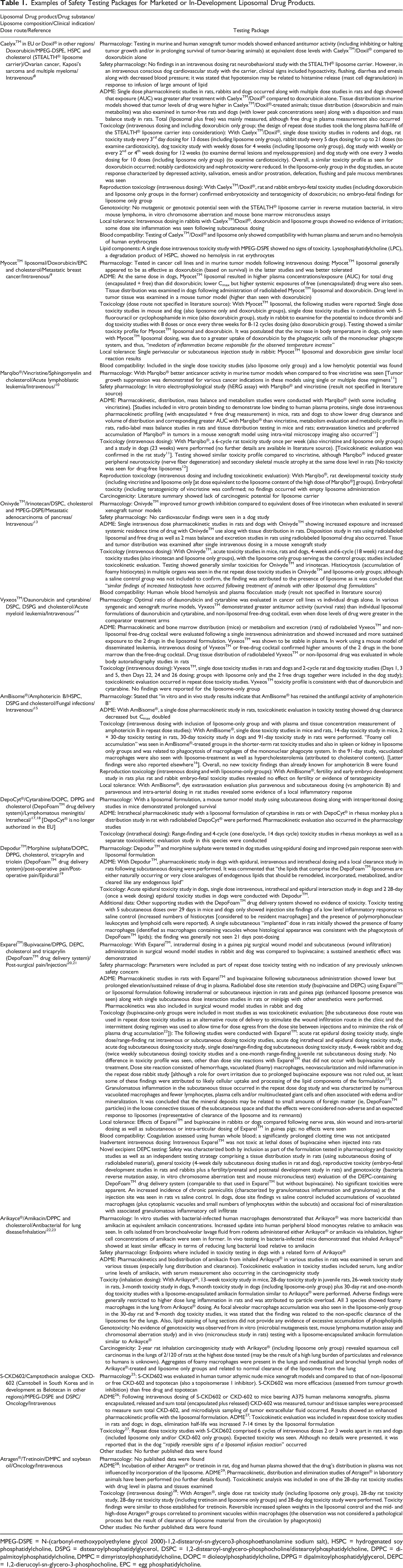
MPEG-DSPE = N-(carbonyl-methoxypolyethylene glycol 2000)-1,2-distearoyl-sn-glycero3-phosphoethanolamine sodium salt), HSPC = hydrogenated soy phosphatidylcholine, DSPG = distearoylphosphatidylglycerol, DSPC = 1,2-distearoyl-snglycero-phosphocholine/distearoylphosphatidylcholine, DPPC = dipalmitoylphosphatidylcholine, DMPC = dimyristoylphosphatidylcholine, DOPC = dioleoylphosphatidylcholine, DPPG = dipalmitoylphosphatidylglycerol, DEPC = 1,2-dierucoyl-sn-glycero-3-phosphocholine, EPC = egg phosphatidylcholine.
Results and Discussion
Table 1 gives examples of safety testing packages for marketed or in-development liposomal drug products. The testing considerations around these drug products were related to knowledge of the drug itself and the novelty of the liposome formulation.
Safety Testing Considerations–New Drug Candidates and Liposome Formulations
Nonclinical development needs for a new drug candidate are described elsewhere and include pharmacology, absorption, distribution, metabolism and excretion (ADME) and, toxicity testing.30,31 For a new drug candidate liposomal product, it would be expected that the bulk of the work would be performed with the clinical form, ie, the drug in the liposomal formulation, as the drug substrate is not being developed for use in its own right. In addition, as mentioned earlier, the JMHLW “Guideline for the Development of Liposome Drug Products” gives good insight into nonclinical development needs for liposomal forms with pharmacology testing needing to demonstrate a “pharmacodynamic response in appropriately justified in vitro (where possible) and in vivo models”, and “In vivo evaluation should involve an appropriate route of administration, justified dose levels, and a justified dosing regimen, depending on the proposed clinical application”. 4 Safety pharmacology studies (to investigate potential undesirable pharmacological effects on the central nervous, respiratory and cardiovascular systems) “should be conducted”. As part of the ADME package, it is “important to compare the in vivo pharmacokinetics of the active substance administered by itself and the liposome drug product”, with exposure measurement for “the total active substances and unencapsulated active substance in the blood, plasma, or serum”, “Measurement of active substance metabolites” and evaluation of the “Distribution of the liposome drug products in organs and/or tissues”. The guideline also points out that “Analytical techniques should be developed that are capable of measuring the concentrations of active substances (in total and unencapsulated forms and where necessary encapsulated form) in blood, plasma or serum, and the total concentration of active substance in organs and/or tissues. Depending on the properties of the liposome drug product (e.g., release properties of active substances in vivo), it may be important to measure the concentrations of active substances encapsulated in the liposome”. In describing values, “The concentrations of active substances that are not separated into the encapsulated and unencapsulated forms in the blood, plasma, or serum sample at each time point after administration should be measured as the “total concentration,” along with the unencapsulated active substance concentration”. Further nonclinical testing considerations given in this guideline for liposome drug product development include evaluation for acute infusion reactions (see later), hematotoxicity, antigenicity and/or immunotoxicity.
From a regulatory agency perspective, use of a liposome and/or its lipid components that do not appear in a marketed product constitute a novel excipient. The latter can be defined as “any inactive ingredients that are intentionally added to therapeutic and diagnostic products, but that: (1) we believe are not intended to exert therapeutic effects at the intended dosage, although they may act to improve product delivery (e.g., enhance absorption or control release of the drug substance); and (2) are not fully qualified by existing safety data with respect to the currently proposed level of exposure, duration of exposure, or route of administration”. 32 Nonclinical testing requirements for a novel excipient have been published 33 and are also included in the US Food and Drug Administration guidance “Nonclinical Studies for Development of Pharmaceutical Excipients”. 32 Requirements cover similar aspects of new drug candidate needs, including general (repeat dose) toxicity and genotoxicity testing. In the JMHLW guideline mentioned earlier, it is stated that “Safety evaluation of the liposome components as excipients can be performed with the complete drug formulation (the whole liposome drug product) if the intention is to have the components approved exclusively for that drug product. However, a toxicity evaluation of the components alone may be required when a suitable toxicity evaluation derived from the liposome components cannot be performed by using only the whole liposome drug product (e.g., because of novel toxicity concerns derived from the lipid structure or the potential for accumulation of the liposome components)”. 4
None of the examples given in Table 1 represent a new candidate drug or a liposome and/or lipid constituents (with one exception) that are considered novel. As a novel excipient, DEPC (1,2-dierucoyl-sn-glycero-3-phosphocholine) in ExparelTM (liposomal bupivacaine using a DepoFoamTM drug delivery system) underwent an extensive nonclinical evaluation that included use in the formulation used for toxicity testing of ExparelTM, as well as stand-alone studies of rat tissue distribution, rat and dog toxicity, rat and rabbit reproductive toxicity and genotoxicity with the DEPC-containing DepoFoamTM drug delivery system.20,21
Safety Testing Considerations–Established Drugs and Liposome Formulations
Marketed and in-development liposomal drugs have tended to use already established non-liposomal drug substances, with one of the earlier uses being the oncology drug doxorubicin to develop CaelyxTM/Doxil®. For marketed drugs, the encapsulation of the drug into a liposomal form would be seen as development of a new drug formulation (continued use of drug substance for intravenous administration of CaelyxTM/Doxil®, AmBisome®, Mariqibo® and OnivydeTM), dose route (change from oral to intravenous administration of drug substance in Atragen®) or a new formulation and dose route (a change from intravenous to inhalation administration of drug substance in Arikayce®) with relevant nonclinical safety testing needed to support safe human use. In the United States, a “505(b)(2)” marketing approach pathway in which “an application that contains full reports of investigations of safety and effectiveness but where at least some of the information required for approval comes from studies not conducted by or for the applicant and for which the applicant has not obtained a right of reference” can be utilized. 34 Changes to previously approved drugs using this pathway include dosage form/formulation, route of administration and strength. A similar approach occurs in the European Union with a “hybrid application” marketing approach pathway for “A medicine that is similar to an authorised medicine containing the same active substance, but where there are certain differences between the two medicines such as in their strength, indication or pharmaceutical form”. 35
As shown in Table 1, most marketed or in-development liposomal drugs have been in the oncology field, with repurposing occurring as a result of them having a very narrow therapeutic window, with the liposomal form increasing the local therapeutic concentration but maintaining a systemic level below the toxic one. As full nonclinical testing will have already occurred for the marketed drug substance, a reduced “bridging” package of studies can occur, usually involving some pharmacology, ADME and toxicity testing as seen in Table 1 and as follows: (1) Pharmacology testing (for oncology drugs) utilized murine xenograft tumor models to demonstrate enhanced antitumor activity vs free drug. (2) A common feature was measurement of tumor uptake of drug. ADME testing (total and non-encapsulated drug) occurred to show an improved pharmacokinetic profile vs free drug. (3) Toxicity testing in many cases used both rodent and non-rodent species, with inclusion of free drug and liposome-only groups and toxicokinetic measurement.
Despite the latter finding, for new liposomal drugs, the way forward is reduced (“bridging”) toxicity testing (eg, one species use) as endorsed in the JMHLW “Guideline for the Development of Liposome Drug Products” “If a toxicity evaluation of the active substance administered by itself has already been completed, the toxicity of the liposome drug product using the same clinical route of administration as the active substance administered by itself should be evaluated by means of a short-term repeated-dose toxicity study using the intended clinical route of administration in one animal species. The obtained toxicity profile and toxicokinetic data should be compared with those of the active substance administered by itself”. 4 Regarding some of the products in Table 1, additional safety testing in the form of reproductive toxicity studies occurred. It may be that such testing was performed with earlier liposomal products such as CaelyxTM/Doxil® and AmBisome® given the novelty of the drug delivery system.
Table 1 also gives information around excipient testing for some liposomal formulations. One of the first of these seen by regulatory agencies, the STEALTH® liposome carrier of CaelyxTM/Doxil®, is composed of N-(carbonyl-methoxypolyethylene glycol 2000)-1,2-distearoyl-sn-glycero3-phosphoethanolamine sodium salt (MPEG-DSPE), fully hydrogenated soy phosphatidylcholine (HSPC) and cholesterol.8,36 These components were not considered novel excipients. Indeed, it was stated that 2 of the 3 liposomal components (HSPC and cholesterol) are ubiquitous dietary lipids and constituents of normal mammalian cell plasma membranes. DSPE is also a dietary lipid, while the PEG derivative was previously approved for parenteral administration in the clinic. 8 Thus, the nonclinical testing package for the liposomal alone part of CaelyxTM/Doxil® was limited (see Table 1). For, Marqibo® (lioposomal vincristine with components of sphingomyelin and cholesterol), a literature summary of carcinogenic potential of liposome carrier sufficed to show that sphingomyelin and cholesterol do not pose any carcinogenic risk at therapeutic dose levels. 10
An important aspect in the development of a liposomal formulation of an established drug is to seek regulatory agency approval on the design of any toxicity testing, including inclusion of liposome only and free drug dose groups as well as how toxicokinetic evaluation will occur. An example of a question for regulatory agency interaction (with relevant supporting data provided in the form of a meeting Briefing Document for the agency to review) is as follows: (1) Question to the agency “Does the agency agree that the proposed toxicity study in rats supports initiation of clinical development in patients with advanced solid tumors, including evaluation of the toxicokinetics of total and unencapsulated X?” (2) Agency response: “Your proposed toxicity study and approach to evaluate the toxicokinetics of total and unencapsulated X in the study in rats appears appropriate.”
Finally, a key consideration is how to use generated nonclinical data to support clinical dosing. In a recent in-house example, to support the first-in-human study for a liposomal formulation of an established drug for the treatment of advanced solid tumors, the starting dose was based on 1/10th of the severely toxic dose level in the rodent GLP toxicity study with the liposomal form. For S-CKD602, which utilizes a MPEG-DSPE and 1,2-distearoyl-snglycero-phosphocholine/distearoylphosphatidylcholine (DSPC) liposome, the starting dose for initial clinical studies was based on 1/5th of the non-severely toxic dose level found in the dog. 27 If needed, regulatory agency endorsement can be sought around proposed dose levels.
Safety Testing Considerations–Variations on Liposome Formulations
As can be seen from Table 1, a high level of similarity in the composition of the liposome and/or its lipid components occurs in marketed or in-development products. Slight variations of liposome components (small difference in composition or level of constituents) do not result in them being considered novel excipients. Nevertheless, safety evaluation may occur as discussed above, usually in the form of a liposomal only group in general toxicity work and, largely to cover any impurity issues during manufacture of the liposome, genotoxicity testing. An in-depth literature review of safety data for the lipid components is also recommended. However, it is important to discuss use of new liposomal formulations with regulatory agencies during development to get their agreement on acceptability and the level of any testing needed. An example of regulatory agency interaction is as follows: (1) Question to the agency “X is used as an excipient in the X liposome formulation but is not considered a novel excipient as the unsaturated analog of X has been used in the approved liposomal product X. In the proposed rat toxicity study, the safety profile of X contained in the in proposed liposomal clinical formulation will be evaluated by inclusion of a placebo liposome dose group (empty liposome). Does the agency agree with this approach? (2) Agency response: “Your approach appears appropriate to characterize the safety of X.”
Safety Testing Considerations–Generic Liposomal Drug Products
As mentioned earlier, the EMA “Reflection paper on the data requirements for intravenous liposomal products developed with reference to an innovator liposomal product” gives nonclinical needs for the development of a generic form. 2 Pharmacology evaluation involves “where possible the development of in-vitro tests capable of characterising any interaction between liposomes and target cells or other cells” and “demonstration of the similarity in pharmacodynamic response using appropriate in-vivo models and at various dose levels chosen taking into account the sensitivity of the model”. ADME testing needs to involve pharmacokinetic assessment and “Single and multiple dose studies at different dose levels may be needed to support the claim of similar pharmacokinetics” and “In addition to the systemic exposure, similarities in the distribution and elimination should be demonstrated”. From an analytical perspective “The kinetics (including tissue distribution and excretion) of both the unencapsulated drug and the encapsulated drug should be investigated if feasible”. Finally, the guideline states that “In general, toxicity studies may not be needed”.
The fact that a number of studies may occur can be shown from the development of a generic form of CaelyxTM in the EU, known as Doxorubicin SUN. 37 The nonclinical testing package included a comparison of the generic product (Doxorubicin SUN) vs reference product (CaelyxTM) in 2 pharmacology studies (using xenograft mice), one pharmacokinetic/bioequivalence study (with exposure measurement in tumor-bearing mice), 6 tissue distribution studies (using tumor-bearing mice), one toxicity study (using a single intravenous dose design in mice) and an in vitro hemolytic potential test using human blood. The studies confirmed similar findings between the 2 drug products.
General Safety of Liposomes
Hypersensitivity Reactions
A feature of some liposomal formulations, both nonclinically and clinically, is hypersensitivity reactions, also known as infusion reactions. In the clinic, early work showed that in patients with resistant malignant tumors, intravenous infusion of the cytostatic agent NSC 251635 entrapped in liposomes made of egg yolk lecithin, cholesterol and stearylamine, side effects included mild sedation, fever, chills, lumbar pain, urticarial rash and bronchospasm. 38 More recently, effects associated with liposomal formulations have been shown on the cardiovascular, bronchopulmonary, mucocutaneous and neuropsychosomatic systems, causing flushing, shortness of breath, facial swelling, chest/back pain and hypotension or hypertension. These effects were considered to be related to reactions to the physicochemical properties of liposomes such as their particle size, surface charges, PEG and cholesterol ratio.39,40 Investigation has shown that the complement system is activated by phospholipid bilayers after liposomal injections, which leads to complement production, mediated by anaphylatoxins, and subsequent release of histamine from mast cells; this phenomenon has been named C activation-related pseudoallergy (CARPA). 41 In addition, for PEGylated liposomes, work with CaelyxTM/Doxil® using plasma from mice and human volunteers has demonstrated that anti-PEG antibodies may contribute to complement activation. 42 From a modeling perspective, it has been shown that pigs are useful for examination of liposome-induced CARPA, as seen by complement activation and consequent hemodynamic and cardiopulmonary changes that mimic some human symptoms, from testing of CaelyxTM/Doxil® and AmBisome® in anesthetized animals.40,41 Other work comparing (anesthetized) pigs and rats by inducing CARPA with intravenous injections of AmBisome® has occurred. 43 Both species showed significant consumption of C3, indicating C activation, along with paralleling pulmonary hypertension and systemic hypotension in pigs, while rats showed systemic hypotension, leukopenia followed by leukocytosis and thrombocytopenia. The data suggested that rats are 2-3 orders of magnitude less sensitive to liposomal CARPA than pigs.
In addition to testing of liposomal formulations in pig and/or rodent models, it has been pointed out that complement activation can be easily tested in vitro as an inexpensive and rapid evaluation of potential safety risk. 44 Endorsement of in vitro or in vivo testing for hypersensitivity reactions is provided in regulatory guidelines. The JMHLW “Guideline for the Development of Liposome Drug Products” states that “Acute infusion reactions are relatively common with liposome drug products. The use of in vitro and in vivo studies such as complement activation assays (and/or macrophage/basophil activation assays) and studies in appropriate animal models should be considered in order to evaluate the potential adverse events”. 4 The EMA “Reflection paper on the data requirements for intravenous liposomal products developed with reference to an innovator liposomal product” states that “Use of in vitro and in vivo immune reactogenicity assays such as complement (and/or macrophage/basophil activation assays) and testing for complement activation-related pseudoallergy (CARPA) in sensitive animal models should be considered to evaluate the extent of potential adverse event”. 2
As can be seen from Table 1, evidence of hypersensitivity reactions has been seen in animal studies with the PEGylated liposome carrier of CaelyxTM/Doxil® which showed clinical signs including flushing as well as decreased blood pressure in a stand-alone cardiovascular study in dogs, with flushing also seen in toxicity testing in this species. 8 It was stated that hypotension may be related to histamine release (mast cell degranulation) in response to infusion of large amount of lipid. More recent work has indicated a sensitivity for dogs from intravenous dosing of the doxorubicin-free liposomal formulation of Doxil® (empty liposome). 39 Macroscopical observations of reddish foci in liver and gall bladder correlated to histopathological changes of perivascular hemorrhage and dilated lymphatic vessels in liver and hemorrhage in gall bladder. Decreased cytoplasmic granules in mast cells beneath endothelium of hepatic vein were noted. The findings also occurred when dogs were dosed with histamine releaser compound 48/80 but were not seen when rats and monkeys were dosed with Doxil®. It was considered that these acute hemorrhagic changes (seen within 24 hours’ post-injection) are likely to result from release of histamine from mast cells that are uniquely located beneath endothelium of hepatic veins in dogs (other species, including human, lack mast cells at this site). Changes were attributed to physicochemical properties of the liposomal formulation and not drug substance. The finding of hypersensitivity in dogs is also reflected in humans as stated in the drug product label for Doxil® as “Acute infusion-related reactions including, but not limited to, flushing, shortness of breath, facial swelling, headache, chills, back pain, tightness in the chest or throat, and/or hypotension have occurred in up to 10% of patients treated with DOXIL. In most patients, these reactions resolve over the course of several hours to a day once the infusion is terminated” and “Similar reactions have not been reported with conventional doxorubicin and they presumably represent a reaction to the DOXIL liposomes or one of its surface components”. 36
Examination of other PEGylated liposome carrier drugs in Table 1 gives a mixed picture with regard to hypersensitivity reactions. A “liposome infusion reaction” was seen in dogs with S-CK602, while no findings were reported for OnivydeTM; both formulations contained DSPC and MPEG-DSPE. Among non-PEGylated conventional or long-circulating liposomes, no evidence of hypersensitivity reactions was seen in nonclinical testing, including for the amphotericin B-containing AmBisome®. Clinically, however, such reactions have been seen with both amphotericin B itself (eg, fever, chills, rigors, nausea, vomiting and headaches) and with its liposomal form (eg, chest pain, dyspnea, hypoxia, flank pain, abdominal pain, leg pain, flushing and urticarial), 45 perhaps indicating a lack of predictivity from nonclinical testing for this drug.
Lipid nanoparticle (LNP) drug delivery systems, which show many similarities to liposomes in having a lipid structure, have also shown evidence of hypersensitivity findings in toxicity testing. An example is with modified mRNA encoding protein for human erythropoietin in a LNP composed of lipids (6Z,9Z,28Z,31Z)-heptatriaconta-6,9,28,31-tetraen-19-yl 4-(dimethylamino)butanoate (MC3), 1,2-distearoyl-sn-glycero-3-phosphocholine (DSPC), cholesterol and 1,2-dimyristoyl-rac-glycerol, methoxypolyethylene glycol (PEG2000-DMG). 46 Testing in monkeys showed a limited to mild trend in complement activation (C3a and C5b-9) following intravenous dosing of empty LNPs, although there was no change in complement (C3) level in rats treated similarly.
Accelerated Blood Clearance Phenomena
The ABC phenomena is one in which, after repeated intravenous infusion of PEGylated liposomes, the circulatory half-life of a second dose (eg, using a one-week interval) is greatly decreased with enhanced uptake of liposome in liver and/or spleen.47-50 The finding has been seen in rat, dog and rhesus monkey.47,50 It has been proposed that the ABC phenomena may be the result of increased splenic production of anti-PEG immunoglobulin (Ig)M after a first liposome dose with this serum factor binding to surface PEG after a second dose, then activation of complement system and phagocytosis in liver and spleen.48,49 More recently, an examination of possible cytochrome P450 involvement in the ABC phenomenon occurred following its demonstration following injection of PEG-coated liposomal docetaxel in rats when time interval between 2 doses was from 1 to 7 days. 51 It was shown that P450s may be induced by repeated injection of PEGylated liposomes, favouring metabolic clearance of a second dose. From a clinical perspective, it has been pointed out that the implications of the ABC phenomena include reduced efficacy and increased liver toxicity, through increased uptake of the liposomal drug product. 47 However, the true clinical consequences of the phenomena have yet to be established, especially as it has not been reported to occur in patients treated with Doxil®. 52
It can be seen that nonclinical testing of liposomal drug given in Table 1 did not specifically identify any aspects relating to the ABC phenomena. Overall, if there is a potential concern for the ABC phenomena in the clinic with a PEGylated liposome, a possible plan is to measure for anti-PEG-IgM in the clinical work if initial subject cohorts show an unexpected increase in drug clearance.
Pathology changes
Early work with various liposome forms including sphingomyelin (SM): phosphatidylcholine (PC), distearoylphosphatidylcholine (DSPC): cholesterol, dipalmitoylphosphatidylcholine (DPPC): cholesterol or PC: cholesterol combinations involved intravenous dosing (2 mg) of mice, 3 times weekly for up to 10 injections. 53 Findings included evidence of granuloma formation in the liver parenchyma accompanied by splenomegaly and/or hepatomegaly, which were reversed upon cessation of dosing. It was concluded that the findings may be related to the nature of phospholipid metabolism and a result of reduced mononuclear phagocyte system function. In contrast, intravenous dosing of 0.2 mL of a DPPC: cholesterol liposome at 6-weekly interval for 2 years showed no liver pathology. 54
As mentioned above, LNPs show similarity to liposomes and have shown liver changes in toxicity testing. In the example with modified mRNA encoding protein for human erythropoietin in a LNP described earlier, testing in rats showed increased mononuclear cell infiltration and a minimal to moderate extent of single-cell necrosis in the liver accompanied with mild elevations in alanine aminotransferase and aspartate aminotransferase following intravenous dosing of empty LNPs. 46 No such change was seen in monkeys treated similarly.
As can be seen from Table 1, pathology changes related to use of liposomal formulations were likely related to macrophage processing of large amounts of lipid material. Findings in repeat dose toxicity testing with rats and/or dogs with AmBisome®, OnivydeTM, Arikayce® and Atragen® included foamy (vacuolated) macrophage accumulation in various organs, associated with clearance of liposome material from the circulation by macrophages. Toxicity testing in monkeys with the liposomal product SPI-077 (oncology drug cisplatin encapsulated in mPEG-DSPE, HSPC and cholesterol liposomes) has also shown similar findings. 55 Dose groups included SPI-077, cisplatin only and liposome only with intravenous dosing once every 3 weeks for a total of 5 treatments. Compared with the saline control, liposome treatment resulted in elevated serum cholesterol level (attributed to its presence in the liposome) and foam cell (macrophages with cytoplasm filled with clear foamy vacuoles) infiltration in liver, spleen, kidney, aorta and bone marrow of many animals, consistent with the phagocytosis of lipid. Findings, including the increased numbers of foam cells seen in the organs of the mononuclear phagocyte system were considered a normal physiological response to the relatively large amount of lipid administered (approximately 1775 mg/kg/dose). An additional finding seen following subcutaneous dosing in dogs of the DepofoamTM drug delivery system used in ExparelTM was granulomatous inflammation (including the presence of vacuolated macrophages) in the subcutaneous tissue, with the finding considered non-adverse and related to the clearance of the liposomes. Indeed, the latter finding may be a feature of this administration route as no dose site pathology changes were reported from intravenous dosing of CaelyxTM/Doxil®, MyocetTM, Marqibo®, VyxeosTM and S-CKD602, while subcutaneous route local tolerance testing of CaelyxTM/Doxil® and MyocetTM in rabbits resulted in some dose site inflammation or local reaction results, respectively.
Conclusions
A number of nonclinical considerations are associated with the development of liposomes as drug delivery systems. Most experience has come from the development of an established drug (especially in the oncology field) in a liposome formulation with known excipients. This experience would suggest that the minimal package of studies (using an oncology indication as an example) likely needed to support clinical entry should include: (1) In vivo pharmacology in selected mouse xenograft models to, for example, demonstrate antitumor activity such as enhanced survival and/or tumor growth inhibition at lower doses vs free drug administration (2) Pharmacokinetic characterization in at least one species with plasma measurement of total and free (non-encapsulated) drug to show, for example, extended half-life, dose-proportionately increased AUC, lower clearance and smaller volume of distribution. Also, pharmacokinetic evaluation in the mouse xenograft work with plasma and tumor level measurement. It is important to show that the majority of drug remains encapsulated in the liposomes and enhanced liposome concentration in the tumor tissue relative to that in plasma. The latter work can negate the need for a separate tissue distribution study in non-tumor bearing animals. (3) Protein binding study using human plasma to allow understanding of free drug exposure. (4) Repeat-dose toxicity study in one species (usually in the rat, given that the target organ toxicity profile of the drug has already been established in previous studies), with examination of total and free (non-encapsulated) drug and/or major metabolite (if this occurs) included. The study would need to be performed to Good Laboratory Practice (GLP).
As our knowledge grows in the development of liposomal drugs, it is becoming rarer for any of the excipients to be considered novel but even use of an analogous lipid to that already approved in a marketed product may necessitate some limited testing, for example, genotoxicity studies. As clinical development progresses for the liposomal drug, a likely further need is a mass balance study, for example in the rat, to examine drug elimination. Depending on the drug (if it is already known to be teratogenic), it may be possible to avoid reproduction toxicity testing and to reference relevant information in the approved drug’s product label. Blood compatibility and/or local tolerance testing (although the effects of parenteral dosing can be assessed in toxicity studies) is also a consideration.
Recently, in considering the design of liposomes, the importance of elucidation of possible toxicities and immune responses that these drug formulations may elicit has been raised. 56 Among concerns, it was stated that “intravenously injected liposomes can interact with plasma proteins, leading to opsonization, thereby altering the healthy cells they come into contact with during circulation and removal. Additionally, due to the pharmacokinetics of liposomes in circulation, drugs can end up sequestered in organs of the mononuclear phagocyte system, affecting liver and spleen function. Importantly, liposomal agents can also stimulate or suppress the immune system depending on their physiochemical properties, such as size, lipid composition, pegylation, and surface charge”.
With the latter comments in mind, review of published nonclinical data on the use of liposomes as drug delivery systems in this paper has confirmed that they are not truly “non-toxic” materials. Of note, cases of hypersensitivity reactions have been seen for some PEGylated liposome forms which translate to the clinic. However, the majority of findings in toxicity testing relate to macrophage processing of large amounts of lipid material, with no apparent human safety consequences. Indeed, other than attribution of acute infusion-related reactions to Doxil® liposomes, 36 examination of drug product labels for the reviewed marketed products mentioned no possible adverse reactions associated with the liposomal content from clinical use. 57
Footnotes
Author Contributions
Paul Baldrick contributed to the conception and design of the manuscript, analysis and interpretation of data, drafted the manuscript, and critically revised the manuscript. He gave final approval and agreed to be accountable for all aspects of work ensuring integrity and accuracy.
Declaration of Conflicting Interests
The author declared no potential conflicts of interest with respect to the research, authorship, and/or publication of this article.
Funding
The author(s) received no financial support for the research, authorship, and/or publication of this article.
