



Abstract
The spread of tobacco smoking has increased over time at the global and national levels. One of the widely spread tobacco products is waterpipe. Recent studies showed that waterpipe tobacco smoke contains toxic substances, including carbon monoxide and nicotine. Some of them are genotoxic carcinogen, such as formaldehyde. This study aims to provide comprehensive insight into the types and depth of the scientific literature on waterpipe tobacco smoke chemical content, its genotoxic effects, and waterpipe device microbial contamination. We conducted a systematic comprehensive review of articles published between 1986 and December 2018. Primary research articles focusing on the content of waterpipe smoke, including chemical, genotoxic, and microbial contaminants, were eligible for inclusion. Of the 1,286 studies generated, 22 studies were included. Twenty-three chemical families were extracted from waterpipe smoke. Aldehydes were the most identified chemical family in 6 studies, and next is polycyclic hydrocarbons, found in 5 studies. About 206 chemical compounds were identified. Flavobacterium, Pseudomonas, coagulase-negative Staphylococci, and Streptococcus were the most abundant pathogen contaminants. Waterpipe smoke had elevated levels of many DNA damage markers (8-hydroxy-2′-deoxyguanosine and cytochrome P450 1A1) and inhibited levels of many DNA repair genes (OGG1 and XRCC1) in waterpipe smokers. Waterpipe smoke is associated with the genotoxic effect, which elevates the levels of many DNA damage markers and inhibits the levels of many DNA repair genes. In addition, waterpipe smoking can expose smokers to a range of pathogenic bacteria.
Introduction
The spread of tobacco consumption is growing with time in both global and local communities. Many tobacco products are available in the market, with one of them being waterpipe tobacco, which is a heavily flavored and sweetened tobacco mixture. 1 According to the National Survey of Tobacco Consumption (2019), the prevalence of waterpipe smoking among adults in Saudi Arabia is 8.12% (95% confidence interval, 6.8054-9.4352). 2 A meta-analysis of waterpipe tobacco smoking health outcomes found that waterpipe tobacco smoke was associated with lung cancer, respiratory illness, low birth weight, and periodontal disease. 3 Waterpipe smoking was also linked to the spread of many infectious diseases, such as tuberculosis and hepatitis C. 4 -7 In addition, recent studies showed that waterpipe tobacco smoke contains a wide range of toxic substances, such as carbon monoxide (CO; 60-370 mg per session) and nicotine (1-8 mg per session). 8 -12 Some of waterpipe smoke components are genotoxic substances that may cause cancer, such as formaldehyde (40-630 ng per session). 13 -15
The impact of waterpipe smoke is not limited to smokers only but it also extends to the surrounding environment in the form of secondhand smoke. Many researchers have investigated the air or water quality of waterpipe cafés, as well as the occupational health of their workers. A study on indoor air quality in waterpipe cafés in Virginia found a 3.2 times higher fine particulate matter concentration in waterpipe cafés compared with restaurants. 16 In a review conducted to study the impact of occupational exposures among waterpipe bar workers, occupational exposure to waterpipe smoke was found to be associated with health complications and can lead to CO poisoning. 17
This systematic review addresses this gap in the existing literature by providing comprehensive insight into the types and depth of the scientific literature on waterpipe tobacco smoke chemical content, its genotoxic effects, and waterpipe device microbial contamination.
Materials and Methods
Search Methods for Identification of Studies
To generate a systematic comprehensive review, 2 researchers independently and simultaneously searched the Medline database for general waterpipe keywords (Waterpipe OR Shisha OR Hookah) between 1986 and December 2018.
Eligibility Criteria
Primary research articles focusing on the content of waterpipe tobacco smoke, including chemical and biological activity, were eligible for inclusion. Articles focusing on the prevalence and behavioral aspects (eg, pattern of use or quitting) of waterpipe smokers were excluded. The literature or systematic reviews of related topics and articles related to other tobacco products, such as e-cigarettes, were also excluded.
Article Selection
Two researchers independently and simultaneously screened the titles and abstracts against the inclusion/exclusion criteria. A list of potentially relevant citations was noted, and sources’ full texts were obtained. Researchers kept a record of all excluded studies and the relevant exclusion criteria for each. The same authors independently assessed the full-text articles against the inclusion criteria listed, and disagreements (if any) were resolved in consultation with a third researcher, who acted as an arbiter where required. The third researcher reverified the final list of included studies against the inclusion and exclusion criteria.
Data Extraction and Outcome Measures
Data were extracted from the full-text versions of all included studies by 3 researchers (R.A., J.A., and N.B.). The data items included study characteristics (first author, year of publication, product name, and country), chemical families and components coming from waterpipe smoke, methodologies used to separate these components, component levels compared with cigarettes, and the International Agency for Research on Cancer (IARC) classification. Data collected on microbial contamination include sample extraction location, type of bacteria, and laboratory and analytical method used for isolate identification. We also categorized genotoxic markers, sample and analytical methods, and levels among waterpipe smokers compared with nonsmokers, cigarette smokers, and Jurak smokers.
Results
The search generated 1,286 scientific articles; title and abstract screening resulted in the selection of 27; and in the screening of the full texts, 22 studies met the inclusion criteria. 9 -11,13,18 -35 A flowchart of the search and selection process is displayed in Figure 1. Of the 22 included studies, 14 studies explored the chemical families and components coming from the waterpipe smoke, 9 -11,18 -28 3 studies assessed the microbial contaminants of waterpipe smoke, 29 -31 and 5 studies evaluated the genotoxic effects of waterpipe smoke. 13,32 -35
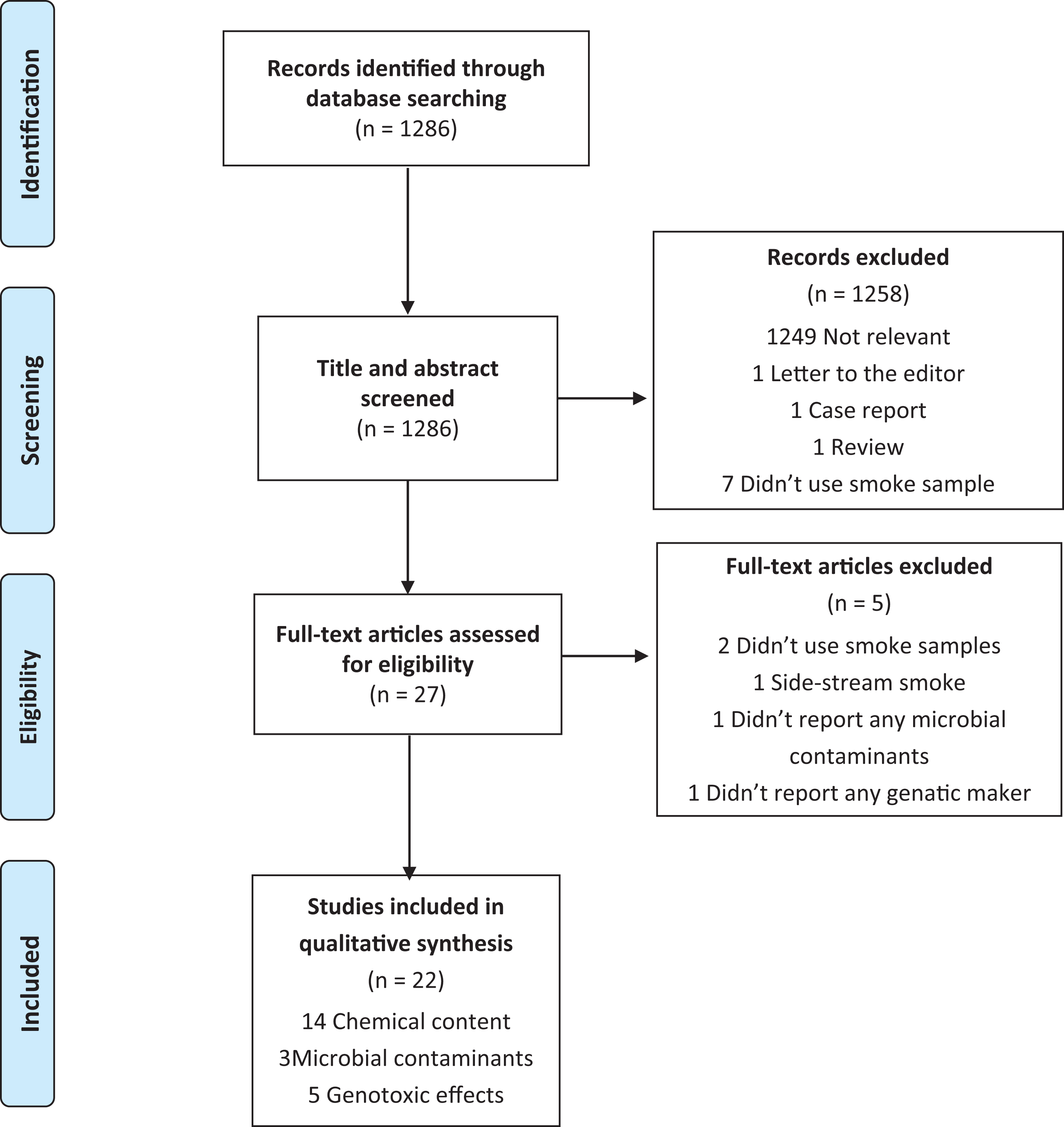
Flowchart of identified and included studies.
Chemical Families and Components
Twenty-three chemical families were extracted from waterpipe smoke, with aldehydes being the most identified chemical family in 6 studies. 10,11,19,21,25 The second most identified chemical family was polycyclic aromatic hydrocarbons (PAHs), found in 5 studies. 9,18,19,24,27 Four studies reported the level of CO. 19,24,27,28 Meanwhile, 3 studies assessed the levels of alcohols, 11,18,22 nitrogenous compounds, 18,19,24 and phenols. 18,20,22 Two studies reported the waterpipe smoke levels of acetals, esters, monoterpene hydrocarbons, 11,18 furanic compounds, 18,23 and humectants. 10,24 A total of 206 chemical compounds were identified, with the most studied compounds being benzo[a]pyrene 9,19,24,27 and CO. 19,21,24,27,28 For benzo[a]pyrene, a PAH, the highest reported level was 307 ± 20 ng per session, 9 whereas the highest reported level of CO was 367 ± 9 mg per session. 24 Other extracted compounds include acenaphthylene, anthracene, phenanthrene, benzo[ghi]perylene, pyrene, indeno[1,2,3-cd]pyrene, di-benzo[a, h]anthracene, fluoranthene, fluorene, 9,24,27 phenol, 17,20,22 and benzyl alcohol. 11,18,22 Additionally, nicotine level was reported in 3 studies, 18,17,24 with the highest level being 7.75 ± 5.1 mg per session. 23 In addition, benzaldehyde 10,11,18 and formaldehyde 10,19,26 reported levels were 293 ± 15 μg/g per session 11 and 630 ± 133 μg per session, 26 respectively. Of the 206 identified compounds, 16 were confirmed to be carcinogenic to humans, including formaldehyde, benzo[a]pyrene, nicotine, and nitrosamines 9,10,18 -20,24 -27 ; 2 were probably carcinogenic 9,18,24,27 ; and 25 were possibly carcinogenic, 9,10,18,20,22 -27 according to the IARC monograph classification. 36 Studies that identified and quantified the chemical families and components coming from the waterpipe smoking session compared with cigarettes are listed in Supplementary Material (Table S1).
Microbial Contamination
Of the 3 studies investigating waterpipe bacterial contamination, 2 studies assessed waterpipe hose bacterial contamination. 29,31 In addition, 2 studies examined mouthpiece contamination. 30,31 Flavobacterium, Pseudomonas, coagulase-negative Staphylococci, and Streptococcus were the most abundant pathogens. 29,31 Ampicillin resistance was found in 3 isolates, whereas 1 isolate was resistant to bacitracin. 30 The studies identifying microbial contamination in waterpipe devices are presented in Table 1.
Studies Examined the Microbial Contamination in Waterpipe Device.

Genotoxic Effects
Six markers were used to examine the genotoxic effect of waterpipe smoke 32 -36 ; 4 were found at increased levels among smokers compared with nonsmokers, and they include the micronucleus test, 13,32 8-hydroxy-2′-deoxyguanosine (8-OHdG), 33,34 a carcinogen-activating gene (cytochrome P450 1A1), 33 and M2 metaphase cells. 35 Significant increases in the level of 8-OHdG were exhibited among smokers: 70% among cigarettes and 50% among waterpipe smokers. 34 DNA repair genes (8-oxoguanine DNA-glycosylase 1 and X-ray repair cross-complementing protein 1] and oxidative stress genes [NAD(P)H: quinone oxidoreductase 1 (NQO1) and glutathione S-transferase α 1) were lower among waterpipe smokers compared with cigarette smokers and nonsmokers, except for NQO1, which was the lowest among cigarette smokers. 34 Studies examining the genotoxic effect of waterpipe smoke are listed in Table 2.
Studies Examined the Genotoxic Effect of Waterpipe Smoke.
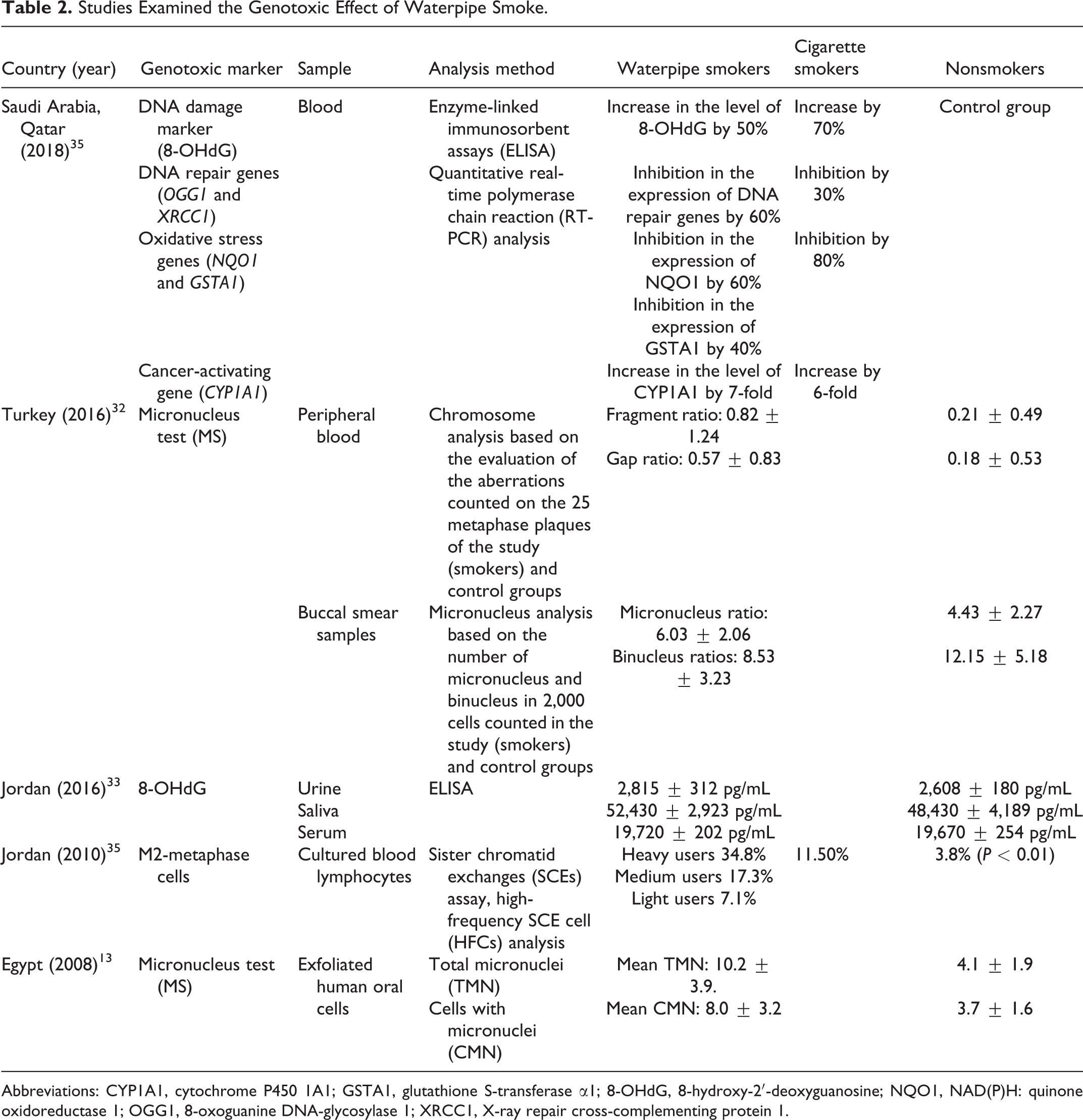
Abbreviations: CYP1A1, cytochrome P450 1A1; GSTA1, glutathione S-transferase α1; 8-OHdG, 8-hydroxy-2′-deoxyguanosine; NQO1, NAD(P)H: quinone oxidoreductase 1; OGG1, 8-oxoguanine DNA-glycosylase 1; XRCC1, X-ray repair cross-complementing protein 1.
Discussion
In this systematic review, we summarized and reported the chemical content of waterpipe smoke, microbial contamination, and the genotoxic effect. Our primary findings covered a wide range of chemical families and compounds, such as aldehydes, PAHs, alcohols, and nitrogenous compounds. A few studies examined the microbial contamination of waterpipe. Diverse pathogenic bacteria were isolated, including Flavobacterium and Pseudomonas. In addition, genotoxic effects were examined using various markers. The results indicated a higher risk of genotoxicity among waterpipe smokers.
Many studies found similarities in the chemical family and compound content between cigarettes smoke and waterpipe smoke, but with differences in the levels of these constituents. 37 -39 The highest reported benzo[a]pyrene level in the cigarette smoke was found in the American Spirit Blue King HP; however, the benzo[a]pyrene level was still 8 times higher in the waterpipe smoke. 37 Additionally, the produced levels of formaldehyde in waterpipe smoke is 6 to 7 times higher compared with a 1R6F intense regime, whereas CO and nicotine levels were significantly higher in waterpipe smoke. 26,38,39 Many factors could contribute to the wide gap of chemical levels between waterpipe and cigarette smoke, including session length, number of puffs, tobacco quantity, heating system, and temperature. Given that a typical waterpipe session lasts approximately 60 minutes and involves an average of 100 puffs compared with an average of 11 puffs from smoking 1 cigarette, waterpipe use is likely to lead to greater exposure to these chemicals. These variations can influence the quantity of toxic chemicals inhaled by smokers.
Waterpipe microbial contamination may increase due to many factors, including the fact that the use of water in waterpipe devices creates a moist environment, which promotes the growth of many types of bacteria, as well as the improper cleaning of waterpipe devices due to their complex structure. 40 Two of the most abundant pathogens reported in waterpipe contamination were Flavobacterium and Pseudomonas; their high growth could be explained by the use of water because these 2 are natural water microbiota. 41
The genotoxicity of waterpipe components is shown in the elevated levels of many DNA damage markers and in the inhibited levels of many DNA repair genes in waterpipe smokers. A comet assay conducted on waterpipe smokers reported greater tail movement and a greater tail length in the buccal cells of smokers compared with the control. 15 Another study found that tobacco smoke increased rates of sister chromatid exchange among smokers compared with their nonsmoking counterparts. 42 These findings illustrate the toxicity of tobacco smoke on human genes.
This systematic review has several limitations; we searched only one database, and some of the included studies lack information about waterpipe tobacco smoke quantity. In addition, variable methods were used to extract waterpipe tobacco smoke chemical components and to assess the bacterial contamination of waterpipe devices. Furthermore, diverse genetic markers were used to examine DNA damage among waterpipe smokers, which is why a meta-analytic approach could not be used to combine the findings of the included studies.
Conclusions
This review found that waterpipe tobacco smoke yields a wide range of chemicals and carcinogens, mainly aldehydes, PAHs, and nitrogenous compounds. Flavobacterium and Pseudomonas were the most abundant pathogens in this study. The waterpipe smoke genotoxic effect is shown in the elevated levels of many DNA damage markers and in the inhibited levels of many DNA repair genes. Further studies are needed to assess the safety of waterpipe smoke to control and prevent health risks associated with waterpipe smoking.
Supplemental Material
Supplemental Material, Supplementary_Table1_(1) - Waterpipe Tobacco Chemical Content, Microbial Contamination, and Genotoxic Effects: A Systematic Review
Supplemental Material, Supplementary_Table1_(1) for Waterpipe Tobacco Chemical Content, Microbial Contamination, and Genotoxic Effects: A Systematic Review by Rawabi H. Aljadani, Aljoharah M. Algabbani, Jumanah A. Alamir, Amani S. Alqahtani and Nasser F. BinDhim in International Journal of Toxicology
Footnotes
Author Contributions
All authors have substantial contributions to the conception or design of the work, acquisition or interpretation of data, drafting the work or revising it critically for important intellectual content, final approval of the version to be published, and agreement to be accountable for all aspects of the work in ensuring that questions related to the accuracy or integrity of any part of the work are appropriately investigated and resolved.
Declaration of Conflicting Interests
The author(s) declared no potential conflicts of interest with respect to the research, authorship, and/or publication of this article.
Funding
The author(s) received no financial support for the research, authorship, and/or publication of this article.

Supplemental Material
Supplemental material for this article is available online.
References
Supplementary Material
Please find the following supplemental material available below.
For Open Access articles published under a Creative Commons License, all supplemental material carries the same license as the article it is associated with.
For non-Open Access articles published, all supplemental material carries a non-exclusive license, and permission requests for re-use of supplemental material or any part of supplemental material shall be sent directly to the copyright owner as specified in the copyright notice associated with the article.
