




Abstract

Photo: Courtesy of Wikifier July, 2002. Wikipedia Foundation, Inc.
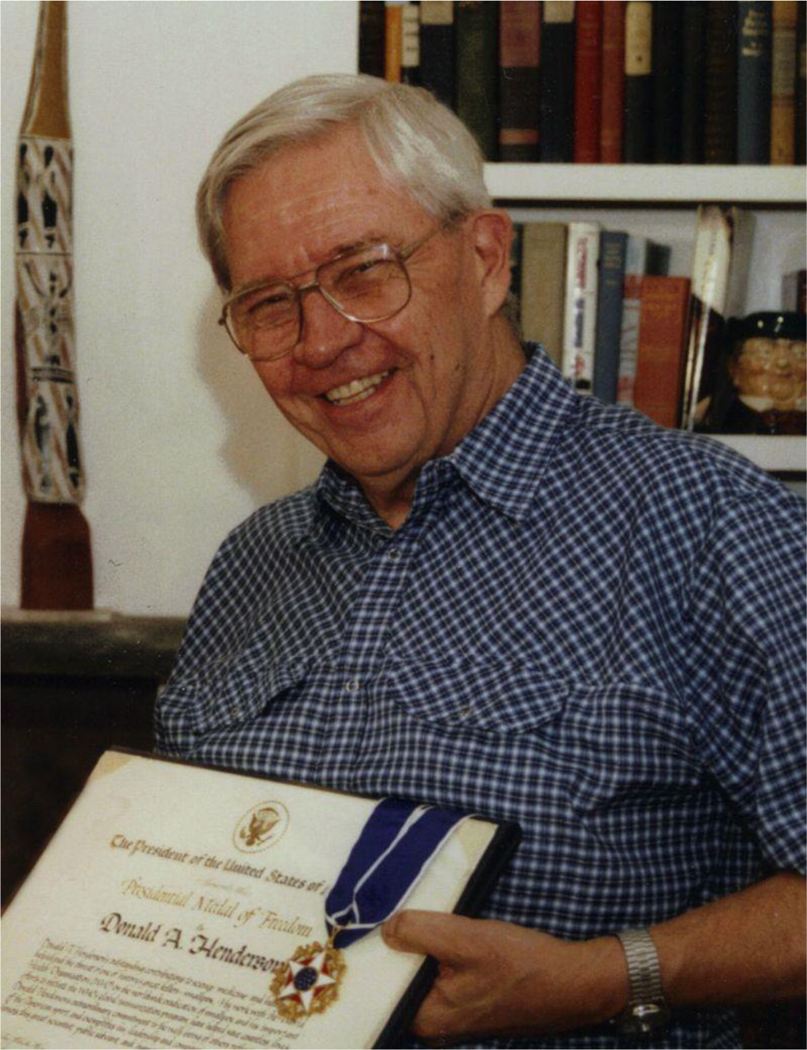
Medicine, science, and humanity lost a giant on August 19, 2016, with the passing of Donald Ainslie Henderson, MD, MPH, at age 87. Toxicology also lost a colleague. Dr Henderson, with his scientific and intellectual ability, along with his managerial leadership and skills, led and achieved the greatest disease eradiation of the 20th century.
Dr Henderson was born in Lakewood, Ohio, and graduated from Oberlin College in 1950. He received his MD from the University of Rochester in 1954 and earned an MPH degree from Johns Hopkins School of Hygiene and Public Health in 1960. He served as chief of the Centers for Disease Control and Prevention virus surveillance programs from 1960 to 1965. During his tenure there, he developed a program to eliminate smallpox and measles from 18 countries in Africa. The program was funded and implemented in 1967 by the United States Aid for International Development (USAID). Dr Henderson’s USAID project became a major catalyst for the World Health Organization’s (WHO) program to eradicate smallpox of which Dr Henderson became director and primary advocate from 1967 to 1977. At the time of the program’s initiation, there were reportedly 10 million cases occurring every year, with over 2 million deaths annually. From 1977 to 1990, he became dean of the Johns Hopkins School of Public Health. He then served in the federal government for several years, first as associate director of the President’s Office of Science and Technology and later as deputy assistant secretary and senior science advisor in Health and Human Services (HHS). In 2001, Dr Henderson was appointed to coordinate the national response to public health emergencies in the wake of 9/11/2001 and was named as director of the newly created Office of Public Health Preparedness at HHS. At the time of his death, he was professor and dean emeritus of the Johns Hopkins Bloomberg School of Public Health, professor of Medicine and Public Health at the University of Pittsburgh, and a distinguished scholar at the University of Pittsburgh Medical Center for Health Security.
Dr Henderson’s contribution to health sciences was overseeing, conquering, and virtually eliminating smallpox from the face of the earth. Smallpox is caused by the variola virus, which occurs in 2 classic varieties—variola major and variola minor. There are other variants of the virus; however, variola virus infection is limited to humans in nature. The primary reason for its virulent infection in humans is due to its ability to evade the host immune responses and avoid complement activation. These viruses are unique in that they replicate in the cytoplasm of the cell as opposed to the nucleus. Variola is a large brick-shaped virus with a single linear double-stranded DNA genome. Variola generates a variety of specialized proteins not produced by other DNA viruses, the most important of which is a viral-associated DNA-dependent RNA polymerase. The transmission of smallpox occurs through inhalation of airborne variola virus, usually droplets expressed from the oral, nasal, or pharyngeal mucosa of an infected person. It is transmitted from one person to another primarily through face-to-face contact with an infected person but can also be spread through direct contact with infected bodily fluids or contaminated objects. The virus can survive outside the body for 2 to 3 weeks; however, aerosolized smallpox does not survive for more than 24 hours. Neither insects nor animals transmit the smallpox virus.
Variola major is a particularly virulent strain which kills almost a third of its victims primarily through pneumonia or brain inflammation. Survivors were frequently blinded from corneal ulcerations or severely disfigured by pockmarks. Variola major, also known as smallpox, has been one of the most devastating diseases known to mankind. The magnitude of the devastation of this disease cannot be overemphasized.
Historians believe its origins were from a mutated rodent virus 68,000 to 16,000 years ago. Archaeologists have found indications that Pharaoh Ramses V of Egypt was infected. It has been suggested that smallpox was responsible for plagues in Athens and the Roman Empire 500 to 100 BCE as well as numerous plagues in both Europe and Asia. It is believed to have been carried back to Africa from Mecca during the elephant war in 567 CE and resulted in hundreds of outbreaks in Africa up to the 1960s. This “Old World” disease was introduced into the “New World”—also known as the Americas—by Cortés in 1519. Ultimately, both Aztec and Incas empires were devastated by the disease, killing 25% of the Aztec population and as much as 90% of the Inca population by the mid-1500s and 25% of the population of Chile by 1562. With the landing of pilgrims in 1617, the devastation continued killing up to 90% of some Native American tribes. This scourge continued for another 200 years as the disease swept over all the Americas. The Philippine Islands, Micronesia, and Polynesia were all victims of the disease as early as 400 AD, possibly due to trade with India and Southeast Asia. Monarchs from China to Europe were known to have contracted the disease, as well as US Presidents Washington, Jackson, and Lincoln, who were fortunate to survive it.
The Chinese were the first to inoculate healthy individuals with material from infected individuals in 1000 CE. The procedure was commonly used in England in the mid-1700s with some success. Around 1765, English physicians became aware that dairy farmers were immune to smallpox and speculated it was a result of being exposed to the less severe yet closely related cowpox. Putting these clinical observations together, in May 1796, Edward Jenner inoculated an 8-year-old boy with the cowpox virus and subsequently exposed him to smallpox. The boy became immune to smallpox, and Jenner was credited for creating the first smallpox vaccine. Jenner’s work is widely regarded as the foundation of immunology—even though he was neither the first to suggest that infection with cowpox conferred specific immunity to smallpox nor the first to attempt cowpox inoculation for this purpose.
Dr Henderson’s smallpox strategy included finding and treating anyone who had been in close contact with infected people, thereby preventing transmission to others. Further, he instituted intense surveillance programs that reported cases which collected morbidity and mortality data to better understand the disease and the effectiveness and duration of immunity from vaccines. Since smallpox is primarily transferred from person to person, the last infected person was the last link in the chain of transmission and represented the end of the disease in a country. Pursuing these immunizations and surveillance processes and the uncanny managerial skills of Dr Henderson, the last known case of smallpox was reported in a hospital cook in Somalia in 1977, and smallpox was officially declared eradicated in 1980 by WHO. The last case of smallpox in the United States was reported in 1949, and routine vaccinations ceased in the United States in 1972.
Dr Henderson told the story of how smallpox—a disease that took an estimated 6 billion lives over the centuries with an estimated 300 to 500 million deaths in the 20th century alone—was conquered in Smallpox—The Death of a Disease, which was published in 2009. In 2002, Dr Henderson received the Presidential Medal of Freedom from President George W. Bush. In 2015, he was awarded Thailand’s Prince Mahidol Award for Public Health; in 2013, he was presented with the Order of the Brilliant Star with Grand Cordon, the highest civilian honor awarded by the Republic of China (Taiwan). Dr Henderson was also the recipient of the National Medal of Science, the National Academy of Sciences’ Public Welfare Medal, and the Japan Prize. He received honorary degrees from 17 universities and special awards from 19 countries. Dr Henderson was a member of the Institute of Medicine, a fellow of the American Academy of Arts and Sciences, an honorary fellow of the National Academy of Medicine of Mexico, an honorary fellow of the Royal College of Physicians of London, an honorary member of the Royal Society of Medicine, and a fellow of numerous professional medical and public health societies worldwide. He authored over 200 journal articles and scientific papers as well as 31 book chapters.
In his role of curing a dreadful disease and reducing its morbidity and mortality in humanity, Dr Henderson was a colleague to all toxicologists. Rather than cure a disease as Dr Henderson did, toxicologists prevent morbidity and mortality in the human population by identifying chemical and physical agents that, if left unchecked, could cause disease.
The importance of the eradication of smallpox is monumental in the archives of human existence. Although there were others who pioneered the disease, treatments, and the vectors over the centuries, Dr D.A. Henderson successfully coordinated and oversaw the final battle which resulted in the complete and total elimination of a disease that killed billions of people and brought down empires for thousands of years.