




Abstract
It is unclear whether exposure to environmentally relevant levels of pesticides in groundwater is associated with an increased risk of Parkinson disease (PD). The purpose of this study was to examine the relationship between PD and pesticide levels in groundwater. This cross-sectional study included 332 971 Medicare beneficiaries, including 4207 prevalent cases of PD from the 2007 Colorado Medicare Beneficiary Database. Residential pesticide levels were estimated from a spatial model based on 286 well water samples with atrazine, simazine, alachlor, and metolachlor measurements. A logistic regression model with known PD risk factors was used to assess the association between residential groundwater pesticide levels and prevalent PD. We found that for every 1.0 µg/L of pesticide in groundwater, the risk of PD increases by 3% (odds ratio = 1.03; 95% confidence interval: 1.02-1.04) while adjusting for age, race/ethnicity, and gender suggesting that higher age-standardized PD prevalence ratios are associated with increasing levels of pesticides in groundwater.
Introduction
It has been suggested that exposure to environmentally relevant levels of pesticides is associated with an increased risk of neurological disorders such as Parkinson disease (PD). 1 –5 Research has suggested that exposure to pesticides such as paraquat and maneb is associated with an increased risk of PD, with odds ratios (ORs) of 4.17 (95% confidence interval [CI]: 1.15-15.6); 2 however, these pesticides are not as readily found in groundwater aquifers due to the affinity for soil. Other research has focused on pesticides more commonly associated with groundwater contamination and potential exposure through drinking water including water-soluble herbicides such as atrazine, which has been associated with an increased risk of PD, 2.5 (95%CI: 1.3-4.5) 6 and 1.8 (95%CI: 1.0-3.3). 7
There exists public health concern about groundwater contamination of pesticides due to the widespread use, especially in rural agriculture areas of Colorado. Both maneb and paraquat have been identified as neurotoxic compounds; however, both pesticides readily bind to soil particles and are not mobile in soil and are not a significant threat to groundwater. Given this, recent focus on water-soluble herbicides, such as atrazine, has become important when evaluating environmental exposure to pesticides in the general population.
Past research has investigated potential biologic mechanisms associated with cell depletion and toxicity to neurons. Several proposed mechanisms are inhibition of aldehyde dehydrogenase involved in the metabolism of xenobiotics, 8 alternation of the dopamine catabolic pathways and glutathione levels, 9 and dopaminergic neurotoxicity initiated by decreased striatal dopamine after exposure to atrazine, which can affect vesicular and synaptosomal uptake. 10 In addition, polymorphisms in several genes including ATP-binding cassette sub-family B member 1 (ABCB1), 11 glutathione S-transferase pi 1 (GSTP1-Alw26I), and serum paraoxonase/arylesterase 1 (PON1) 12 may increase susceptibility to PD following pesticide exposure.
In Colorado, there are 7 main aquifers of which 4 are under agricultural land and therefore susceptible to pesticide contamination (3 in Eastern Colorado: Ogallala, South Platte, Arkansas River and 1 in Southern Colorado: San Luis Valley). The Ogallala aquifer underlies approximately 174 000 square miles that extends through parts of 8 states, including Colorado. Water from the Ogallala aquifer is the primary source of drinking water along with all other water needs in eastern Colorado. The aquifer underlies nearly the entire state of Nebraska, where pesticides in groundwater have been extensively studied. 13,14 Fourteen pesticides were detected in nearly 8000 samples collected between 1991 and 1996 as part of a study completed in the unconfined Ogallala aquifer. 13 Atrazine was detected in 100% of the samples and simazine and alachlor in smaller amounts. 13
Groundwater from both the South Platte and the Arkansas Alluvial aquifers in Colorado is used for drinking water and irrigation. 15 Both of these aquifers are shallow and consist of mostly sand, making them susceptible to agrochemical contamination. 15 The United States Geological Society (USGS) conducted a water quality study in the South Platte Alluvial aquifer and detected pesticides in 29 of the 30 wells, with atrazine and prometon being the most frequently detected pesticides in the shallow groundwater. 14 The San Luis Valley aquifer in south central Colorado is a high desert plain that is about one-third agricultural lands and detectable levels of atrazine. 15 In a recent nationwide study, Toccalino et al found that in wells in agricultural areas, the most prevalent herbicides were atrazine, simazine, and metolachlor all with high levels. Atrazine and simazine have not shown much change in concentrations since 1992, however metolachlor began to decline in 2001. 16
Past studies that have investigated the association between pesticides and PD have raised the question of whether exposure at environmentally relevant levels can increase the risk of PD; however, these studies have been limited due to case definition (self-report of PD) and exposure assessment (self-report of exposure to pesticide). Our investigation uses a large cohort representing the Colorado population aged 65 years and older and groundwater levels of pesticides to investigate this association. The environmentally relevant levels of water-soluble herbicide exposure in groundwater across Colorado may lead to insights into the large-scale risk of PD, and therefore we present our research which explores the association between the prevalence of PD in Colorado with groundwater levels of pesticides including atrazine in 2007.
Methods
Study Population
The study population consisted of Colorado Medicare beneficiaries older than 64 years of age. The population was obtained from the Medicare Denominator (Carrier) File managed by the Center for Medicare and Medicaid Services (CMS). 17 Medicare beneficiaries comprise approximately 93% of the population aged 65 years and older. 18 Records consisted of a unique identification number, International Classification of Diseases, Ninth Revision (ICD-9) code, residential 9-digit zip code, date of birth, race/ethnicity, and gender. Age in decimal years was determined by subtracting the date of birth from the mid-year date of 2007 (July 1, 2007). Age in 2007 for each person was categorized into the following strata: 65 to 74, 75 to 84, and 85 to 100 years. Race/ethnicity was categorized as white non-Hispanic, black, Hispanic, Asian, and other. Cases were defined as any beneficiary with an ICD-9 code of 332.0.
Prevalence Ratios Comparison
The geographic identifier for CMS data is the 9-digit residential zip code at the time of patient report. For the prevalence rate calculation, we aggregated beneficiaries back to the 5-digit zip code due to the potential for small numbers at the 9-digit zip code level. The total number of cases with PD for each 5-digit zip code was calculated and stratified by age-group. Population data included all records from the Medicare denominator files aggregated by residential 5-digit zip code. Age-standardized prevalence ratios for PD per 1000 persons were calculated for each 5-digit zip code using direct standardization to the total Colorado population from age-groups 65 to 74, 75 to 84, and 85 to 100 years.
Since prevalence ratios were calculated for 5-digit zip code, which could have small population numbers, it is expected that many ratios were inflated with the addition of 1 or more cases. Empirical Bayesian Methods were employed to adjust (“smooth”) PD ratios across zip codes. In short, empirical Bayesian analysis was used to calculate a prior distribution for the prevalence rate for each zip code based on the ratios of geographic (adjacent) neighbors. Adjacency was defined as geographic neighbors or zip codes that share a border with the specific zip code. The set of “neighbors” for each zip code was defined as the posterior distribution for the Markov Chain Monte Carlo (MCMC) simulation. The prevalence rate and list of neighbors for each zip code were inputted into WinBUGS software (MRC Biostatistics Unit, Cambridge, UK). 19 WinBUGS software runs the MCMC simulation over a set number of iterations producing “smoothed” ratios based on the ratios of the geographic neighbors. The smoothed ratios were joined with zip code spatial data and displayed in a Geographic Information System (GIS) characterizing the spatial distribution of prevalence ratios of PD.
Environmental Data
Four pesticides (atrazine, simazine, alachlor, and metolachlor) were selected to represent potential pesticide exposure. These pesticides were selected because they have documented presence in Colorado aquifers, are water soluble, and at times applied in admixture. Water quality data were ascertained from the USGS National Water Quality Assessment Data Warehouse (NAWQA) 20 –22 and the Colorado Department of Public Health and Environment (CDPHE) Water Quality Division. The NAWQA is a program established in 1991 to collect and analyze longitudinal information on streams, rivers, groundwater, and aquatic systems in the United States to aid in decision making on the needs and management of water quality and policy. Data can be queried by water basin, year, and contaminant. 20,21 Data included contaminant level (µg/L), geocoordinates for well (latitude and longitude), and sample collection date. A preliminary query found water quality samples with pesticide measurements from all the major aquifers for Colorado including the South Platte Alluvial, Arkansas River Alluvial, Ogallala, Denver, and San Luis Valley. The final query included all groundwater samples located in Colorado from 2000 to 2007 with measurements for at least 1 of the 4 pesticides (atrazine, simazine, alachlor, and metolachlor).
Spatial Analyses
We utilized a GIS, specifically ESRI ArcGIS (Environmental Systems Resource Institute, Redlands, CA), to model the pesticide levels from the aggregated data set and create a spatial characterization of predicted pesticide levels. 23 Pesticide data were imported into the GIS as individual points using latitude and longitude coordinates associated with each sample. Also incorporated into the GIS were data on state and zip code boundaries, land use, water bodies, cities, and major roads ascertained from USGS and ESRI data depots.
We employed Ordinary Kriging methods in ArcGIS Geostatistical Analyst to create a prediction map of pesticide occurrence across the state of Colorado. In brief, we used Ordinary Kriging methods to create a spatial prediction model characterizing the distribution of pesticides in groundwater and validated it by withholding 10% of the samples (n = 23) to compare the predicted and observed value pesticide level. Potential exposure to pesticides at specific locations within Colorado was extrapolated from the spatial model to characterize exposure for each participant in the cohort.
Association Analysis
A logistic regression analysis was completed to test the hypothesis that predicted potential pesticide exposure in groundwater was significantly associated with an increased risk of PD independent of age, race/ethnicity, and gender. The main risk factor, predicted pesticide levels in groundwater, was determined based on the level at the residential 9-digit zip code as determined from the spatial prediction model. Nine-digit zip codes are a very small spatial unit with an average size of several hundred yards. In Colorado, there are over 40 000 nine-digit zip codes each with a centroid at a unique location and therefore a unique level of pesticides in groundwater. Potential exposure to pesticides for each individual was the predicted pesticide level at the residential zip code. A logistic regression analysis was utilized with presence of PD as the outcome, 9-digit zip code pesticide levels as the main risk factor, and age, race, and gender as covariates. Age was a continuous variable ranging between 65 and 100 years, race was categorical as described previously, and gender was categorized as man or woman. In a secondary analysis, pesticide levels were categorized into 3 categories (˜0.0-0.05, 0.05-1.0, and 1.0-10.0 µg/L) and age was categorized into 3 levels (65-74, 75-85, and 85-100 years) and a logistic regression analysis was completed.
Standard protocol approvals, registrations, and patient consents
This research was approved by the Colorado Multiple Institutional Review Board of the University of Colorado, Denver, and Colorado Medicare Services.
Results
The study included 332 971 Medicare-aged (65 years and older) beneficiaries from the year 2007 with a residential zip code within Colorado. The cohort was 54% women, predominantly white (92.5%), and had a median age of 73.9 years (range 65-100 years). Of the 332 971 beneficiaries, there were 4207 cases of PD (˜1.2%) or a crude prevalence rate of 1263 per 100 000.
The statewide age-standardized prevalence rate of PD was 13.1 per 1000 persons with a range of 0 to 22.5 per 1000 persons. These ratios can be greatly skewed by small population numbers that exist in more rural and mountain zip codes; therefore, Bayesian methods were employed to smooth the ratios for presentation in a GIS map. Figure 1 presents the prevalence ratios for PD ratios after Bayesian Smoothing Methods, which ranged between 0 and 22.5 per 1000 persons. The spatial distribution of smoothed prevalence ratios indicate that the northeast and eastern areas of Colorado, where agricultural land use is predominant, have higher ratios of PD relative to the western mountain region of Colorado. The only other area in Colorado with higher prevalence ratios was in the Denver metropolitan area.
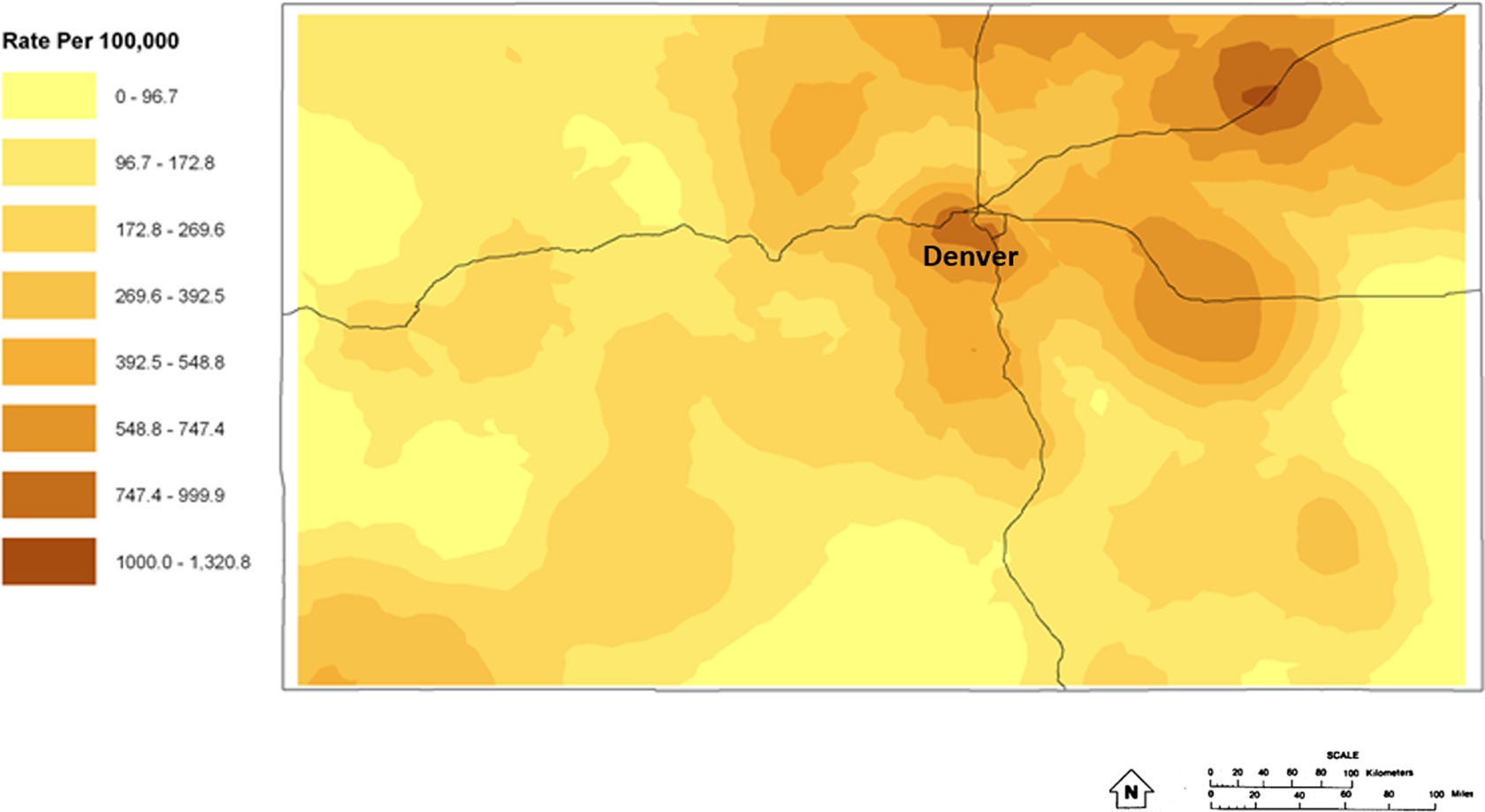
Age- and sex-standardized prevalence rates for Parkinson disease by 9-digit zip code in Colorado (2007) with Bayesian smoothing methods (coordinate plane–decimal degree).
Characterization of Pesticide Occurrence in Colorado
Pesticide water level data included 286 samples (95 from CDPHE and 191 from NWQA). The mean atrazine level was 0.14 µg/L with a range of 0.0005 to 10.0 µg/L. The atrazine concentrations present in Colorado wells on agriculture land are 6 times higher than wells in urban or mixed land use areas. The average concentration for all 4 pesticides in total was 0.17 µg/L and a range the same as atrazine. There was no difference in location or mean pesticide level by reporting agency. All 286 samples were analyzed in an Ordinary Kriging Model to create a statewide prediction model for pesticide levels in groundwater. Figure 1 presents the spatial prediction model as determined by Ordinary Kriging methods for the state of Colorado with Figure 2 presenting the standard error map for the prediction model. As seen in Figure 2, the predicted pesticide levels are highest over the northeast quadrant of Colorado, which is predominantly an agricultural area. The standard error ranged between 0.08 and 0.11 and shows that the prediction model in the central and eastern side of Colorado has less error. This is reflective of more points within those areas.
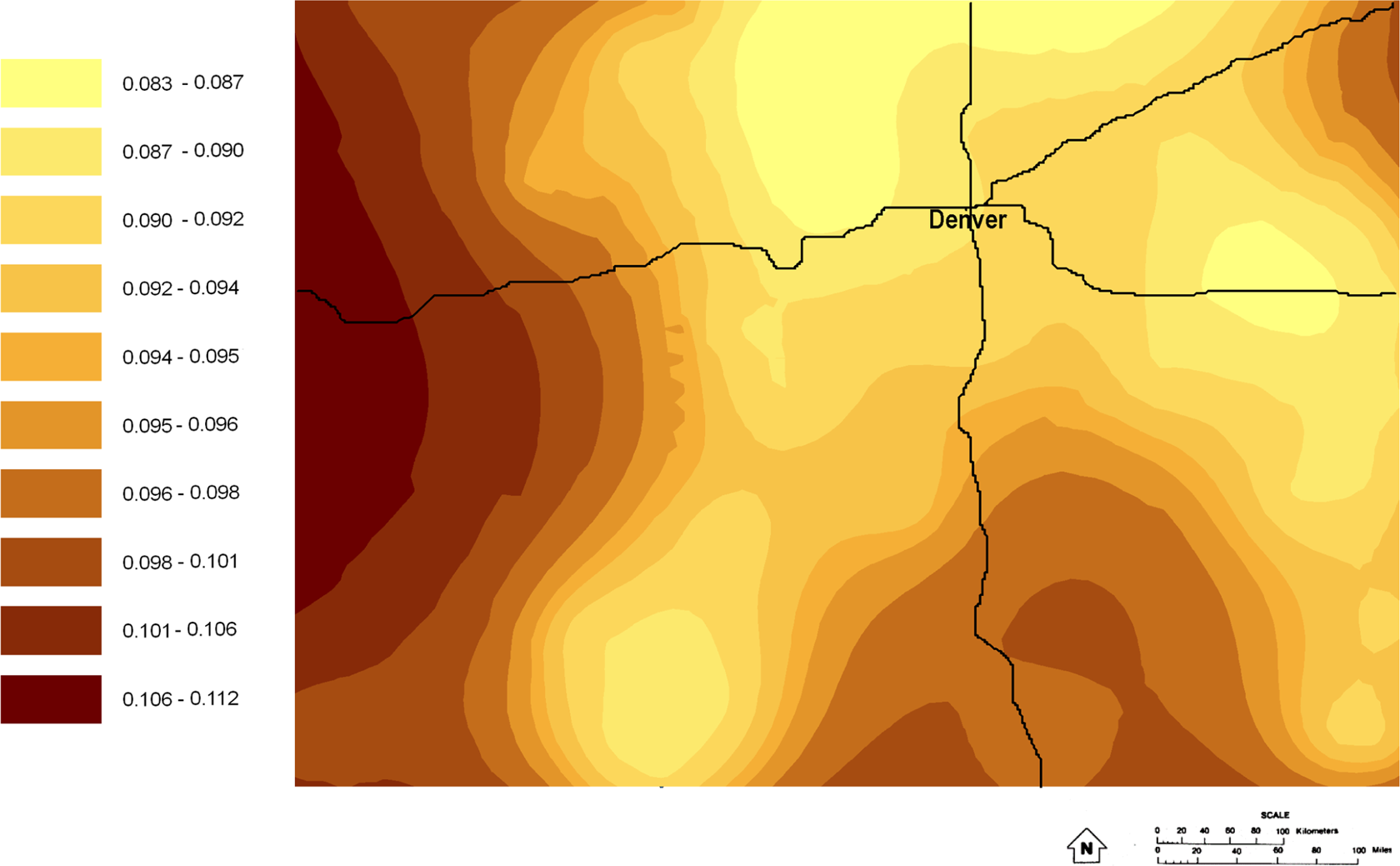
Predicted pesticide groundwater levels (mg/L) based on geospatial modeling in Colorado, 2007 (coordinate plane–decimal degree).
Association Analysis
We completed a logistic regression analysis in a cross-sectional study examining the association between PD and pesticide concentrations in groundwater as defined at the 9-digit zip code level (mean population per zip code = 40 persons). Results show that there is a significant association between groundwater pesticide level and PD occurrence (OR = 1.03; 95%CI: 1.02-1.04) and separately, atrazine concentrations in groundwater and PD (OR = 1.04; 95%CI: 1.03-1.05) while adjusting for age in years (OR = 1.07; 95%CI: 1.06-1.08) and gender (OR = 1.76; 95%CI: 1.66-1.88). Race/ethnicity was not statistically significant (Table 1). These results suggest that for every 0.01 mg/L increase in groundwater pesticide levels, there is a 3% increase in the risk of PD, and for every 0.01 mg/L increase in atrazine levels, there is a 4% increase in PD risk. Concurrently, for every year increase in age, the risk of PD increases by 7% (Table 1).
Multiple Regression Analysis Examining the Association Between Estimated Pesticide Levels at the Individual Level While Adjusting for Age and Sex in 2007 Medicare Beneficiaries.a
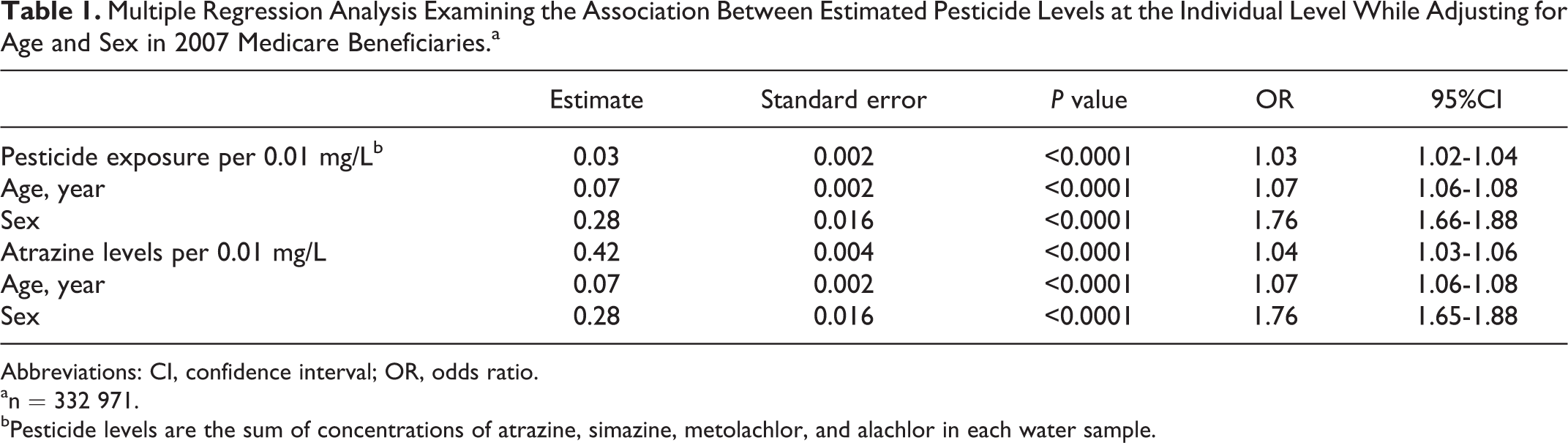
Abbreviations: CI, confidence interval; OR, odds ratio.
an = 332 971.
bPesticide levels are the sum of concentrations of atrazine, simazine, metolachlor, and alachlor in each water sample.
Table 2 presents the secondary analysis with pesticide and atrazine levels categorized to assess a dose–response relationship with PD. The results indicate an increase in risk of PD with increasing pesticide and atrazine levels while controlling for age and gender, suggesting a dose response.
Multiple Regression Analysis Examining the Association Between Categorical Estimated Pesticide Levels at the Individual Level While Adjusting for Categorical Age and Sex in 2007 Medicare Beneficiaries.a
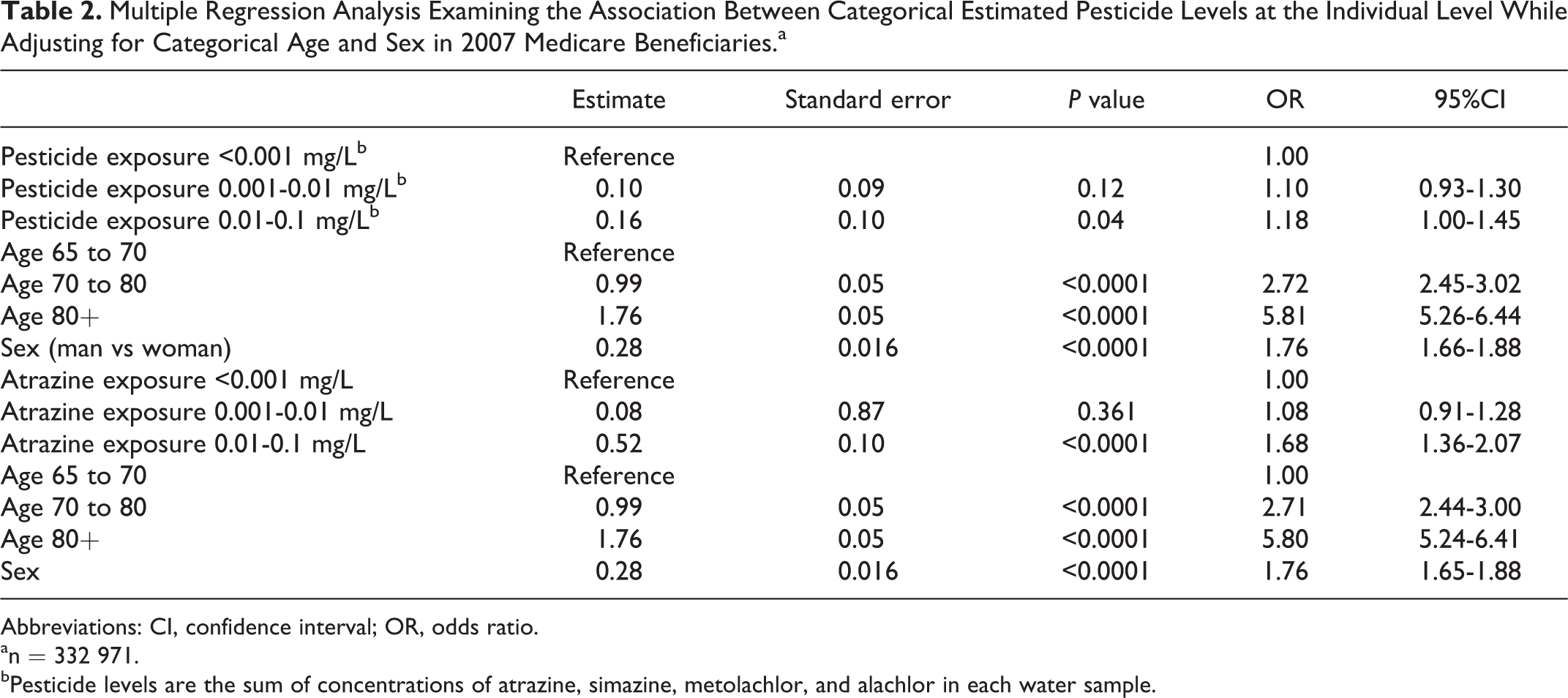
Abbreviations: CI, confidence interval; OR, odds ratio.
an = 332 971.
bPesticide levels are the sum of concentrations of atrazine, simazine, metolachlor, and alachlor in each water sample.
Discussion
This study has identified a positive association between PD and an ecologically defined pesticide occurrence in groundwater in a large population while controlling for age, race/ethnicity, and gender. The spatial distribution of measured pesticide levels in groundwater in Colorado is distinct with the predominantly agricultural land use areas having the highest levels of pesticides. Given that for every 0.01 mg/L increase in pesticides in groundwater there is a 3% increase in risk, then populations residing in the highest pesticide areas have a 200% increase in risk of PD. The atrazine concentrations in groundwater in Colorado are predominantly below the Environmental Protection Agency maximum contaminant level of 3.0 µg/L with 2% of samples exceeding this level, a percentage similar to what was found in other groundwater studies. 16
This study reports a significant association in a large cohort between a predicted exposure defined by subject residence and PD with an indicated dose–response relationship. Past research has involved smaller cohorts (100 cases). 1 –4 Recent research linked historical pesticide application rates within a GIS to land use and residential location to estimate exposure over a 20-year period, one of the first to quantitatively estimate exposure. 21 Results found that wells with greater odds for contamination with pesticides were associated with higher risk of PD and that a higher number of pesticides also increased the risk that concurs with our study. In addition to the present study, there are additional studies that support the positive association between PD and pesticide occurrence in groundwater. Vlajinac et al found a significant association between PD and well and spring water consumption in a population in Belgrade. 24 Additionally, results in another study found that consuming well water contaminated with pesticides may play a role in the etiology of PD. 24
These findings in a large cohort with estimates for pesticides in groundwater at the individual level are limited by case selection criteria using ICD-9 codes in the Medicare beneficiary database. Selecting cases from administrative data such as Medicare beneficiary data has the potential for misclassification. Other studies using Medicare data have validated cases by requiring ICD-9 codes present in multiple years; however, for this study we only had 1 year of beneficiary data. There is potential misdiagnos with atypical parkinsonism in our study; however, this represents only a small percentage of total cases with PD, 25 and 75% of the cases with PD identified in this study had more than 1 claim in 2007 with an ICD-9 code related to PD. To address this limitation, we reran the association model for the 4 pesticides removing all cases with PD with only 1 claim record (n = 604), where 2 or more claims in a year with a PD diagnosis code are more suggestive of a case than 1 and found no change in the risk estimate (1.03 per 0.01 mg/L; 95%CI: 0.92-1.16) although now not significant. This suggests that any misclassification due to case definition would bias the findings toward the null.
The mean age–sex-standardized prevalence ratio of PD in this study (1301 per 100 000 persons) is lower than the national average of 1588.43 per 100 000 persons identified in a study by Willis et al, which used the Medicare beneficiary cohort. 26 One reason for the lower PD prevalence ratio in this study could be due to the fact that we only had 1 year of administrative data for this study and it is likely that cases of PD may not have been to the doctor in that time for a PD-related reason. Also, as noted by Ton et al who investigated enhanced case ascertainment from Medicare beneficiary data, there are certain services not captured in Medicare, especially in those enrolled in managed care programs, which could limit the potential claims made by patients with PD. 27 Also to this point, in Willis et al the areas with the highest prevalence of PD were seen in the Midwest and Northeast with lower rates being in areas of the West including Colorado. 26
One of the main findings of this study is that the spatial distribution of measured pesticides levels in groundwater is in predominantly agrarian land, and this coincided with areas with higher age-standardized PD prevalence rations. This finding is similar to other study populations, both in residence and in occupation. Two studies examined populations residing in largely agricultural regions and found that patients with PD were more likely to have been agricultural workers, but spending their childhood on a farm did not affect the risk of PD. 2,24 These studies support the theory that rural living and agricultural work are risk factors for PD. Contrarily, other studies found that prevalence and incidence of PD in urban counties were greater than in rural areas, which the authors attribute to the variability in the definition of “rural” due to economic and population characteristics. 26,28 Our research avoids this issue by characterizing exposure based on quantitative values (concentration of atrazine) versus a rural category.
In this study, exposure is defined by an admixture of water-soluble pesticides and a singular pesticide (atrazine). Including the admixture as an exposure variable represents potential pesticide application since many are more effective when applied in combination. This is echoed in a report, which suggests that pesticides, and their environmentally relevant combinations, should be evaluated for their ability to promote or accelerate PD because these chemicals may not be singular causative agents. 29 For this study, we selected 4 pesticides that are readily applied together in Colorado and also pose a significant risk to groundwater due to its mobility in soil and water solubility. Other pesticides are readily used in Colorado, however are much less mobile in soil and not a significant risk of groundwater contamination.
The major limitation of this study is the cross-sectional nature of the exposure assessment that does not directly account for exposure variability over time due to mobility of the population or variation in pesticide levels or when disease diagnosis occurred relative to exposure. Although this limitation could lower the validity of the findings, we believe they are still relevant because research has shown that in agriculture land use areas, groundwater concentrations of atrazine, simazine, and metolachlor have declined in the past 20 years (1991-2009), suggesting that the measures used for this study (years 2000-2007) underestimate the long-term groundwater concentrations in agriculture areas. 16 Second, based on data from the Colorado Demography Office, the older population (>64 years) in Colorado has shown little migration in rural counties between 1995 and 2010, suggesting that people aged 64 years and older who live in rural areas are less likely to have migrated there after age 64 years (http://www.colorado.gov/cs/Satellite/DOLA-Main/CBON/1251593300470; accessed July 17, 2014). Given that the rural groundwater pesticide concentrations for this study are potentially an underestimate of long-term concentrations and the negligible migration of people to rural areas after the age of 64 years suggests that while the cross-sectional design has limitations, the risk estimates presented here could be biased toward the null and underestimated.
Another potential limitation of this study is that the individual-level exposure does not estimate internal dose and is ecologic in nature. Ecologic exposure assessments can lead to misclassification of exposure and bias the statistical findings. We expect that this bias would be nondifferential which would bias the findings toward the null hypothesis. A bias toward the null would suggest that the findings could be interpreted as acceptable, however for the findings to be consider valid, further research that estimates individual-level exposure or individual internal dose through the use of biomarkers is needed.
For this study, we selected 4 water-soluble herbicides commonly found in Colorado aquifers. Animal studies have suggested that atrazine decreases tissue dopamine levels by interfering with the vesicular storage and/or cellular uptake of dopamine. 10 However, pathologic mechanisms for alachlor, simazine, and metolachlor have not been explored. In our study, we included all 4 pesticides as an indicator of pesticide exposure in groundwater; however, an analysis specific to atrazine was completed, given the suggested mechanism for neurotoxicity.
This study shows that the prevalence of PD is associated with the occurrence of pesticides in groundwater in Colorado. This association is independent of age, race, and gender. A finding illustrating higher ratios of PD in agricultural areas of Colorado can be a step toward an intensive study at the individual level with historical exposure reconstruction and neurological examination. These findings do not suggest causation, given the limitations in the exposure estimation, but show an area that may be promising for further research. In order to establish causation, a complex study involving case ascertainment through detailed chart review and diagnosis confirmation, individual-level exposure reconstruction, inclusion of other exposure routes (occupational and other environmental), and genetic screening may better clarify the relationship between groundwater exposure and PD.
Footnotes
Acknowledgments
We would like to thank Dr Lee Newman, Director for the MAP-ERC at the University of Colorado, Dr John Reif, Chair of the Pilot Projects Program within the MAP-ERC for their support of this research, and Roy Wright, MD, for the clinical observations which lead to this project.
Author Contributions
Katherine A. James contributed to conception and design; acquisition, analysis, and interpretation; drafted the article; gave final approval; and agrees to be accountable for all aspects of work ensuring integrity and accuracy. Deborah A. Hall contributed to conception and design, acquisition and interpretation, critically revised the article, gave final approval, and agrees to be accountable for all aspects of work ensuring integrity and accuracy.
Declaration of Conflicting Interests
The author(s) declared no potential conflicts of interest with respect to the research, authorship, and/or publication of this article.
Funding
The author(s) disclosed receipt of the following financial support for the research, authorship, and/or publication of this article: This project was funded in part by the Mountain and Plains Environment Research Center pilot project program funded by the Center for Disease Control, NIOSH Training Grant No. T42 OH 009229-01.